Thor/Iron Man: God Complex


By Dan Abnett, Andy Lanning, Scot Eaton, Jaime Mendoza, Jeff Huet, Lorenzo Ruggiero & Veronica Gandini (Marvel)
ISBN: 978-0-936211-4911-8

Two of Marvel’s oldest stars and perennial fan favourites, the Norse God of Thunder and Armoured Avenger, have in their long and chequered careers been the staunchest of allies, fiercely squabbling brothers-in-arms and latterly sworn foes.

In this short, sweet and fabulously straight-shooting traditional team-up however, past grudges are largely forgotten as old foes return with a formidable new master on a fantastic crusade to forever change the world.

Re-presenting the bombastic 4-issue miniseries from 2010, God Complex opens with a horrific assault by a brooding brute on Baron Mordo, resulting in the theft of the evilest of magicians’ mightiest talisman. Simultaneously, the latest ultra-high tech orbital weapons platform of avaricious armaments magnate Moses Magnum is destroyed and its key systems stolen by a mysterious armoured figure…

In Oklahoma the rubble that was Asgard (see Siege and Siege: Dark Avengers) is being slowly checked and cleared by Earthling Emergency teams and latter-day Norse Gods when the workers free a very excitable and ticked-off dragon. Happily, recently reunited Avengers Thor and Iron Man are there to control the irked fire-drake until the beast’s owner Volstagg can calm the poor pet down…

With the infernal rampage suppressed, the work is then interrupted by Steve Rogers – former Captain America and current Chief of National Security – who dispatches the Armoured Avenger toRussia to investigate a runaway Particle Accelerator…

It’s a trap and Iron Man is ambushed by the latest upgrade of the Crimson Dynamo just as back in Oklahoma, Thor is ambushed by ultimate troll Ulik, tasked with retrieving the formidable, unstoppable Asgardian war-armour dubbed the Destroyer.

Although more than a match for their old enemies, the heroes are surprised and subsequently defeated by hidden adversary Diablo and former ally the High Evolutionary…

The latter – an obsessive human geneticist who evolved animals into New Men before turning himself into a cosmic deity – has long dreamed of creating his own gods and now, allied with the malign immortal alchemist, has embarked on his latest experiment: to marry science to sorcery to produce a new supreme being – the one true God of the 21st Century…

For raw material his willing subordinates have been gathering magical artefacts and the most cutting-edge technological components. The last thing needed was a suitable human Petri-dish and vessel. Brilliant, bold Tony Stark ideally fits that bill…

However even as the Evolutionary begins Iron Man’s enforced apotheosis, the hero counterattacks, whilst the bruised but unbowed Thor – and an unlikely ally – hunt for the villains who stole the Destroyer, tracking the sinister god-makers to their unlikely lair…

The consequent catastrophic clash looks set to end in victory for the heroes when the demonic Diablo turns the Avengers against each other with his mystic potions…

Even as the triumphant High Evolutionary begins his the longed-for final transformation, Diablo finally shows his true colours and hijacks the metamorphosis, just as he’d always intended, transcending his merely human villainy to become an omnipotent modern God of  Evil…

However even with the ambitions of centuries at last fulfilled, Diablo has not reckoned on the unfailing courage and determination of heroes or the anger of a master of science frustrated and betrayed…

Splendidly spectacular and visually stunning, this blistering action-epic concludes with one of the best and certainly most literal Deus ex Machina in comics to leave lovers of the genre breathless in wonder and appreciation.

This tumultuous tome also finds space to include text features from the movie tie-in Thor Spotlight, including ‘Abnett/Lanning on Iron Man/Thor: a DnA Q&A’ by Jess Harold, the comedic ‘Iron Man/Thor: Behind the Scenes’, a look at ‘Classic Thor/Iron Man Team-Ups’ from Dana Perkins and a fabulous sneak-peak at Scot Eaton’s many Design Sketches for Crimson Dynamo, Mordo’s Amulet, Ulik and his upgrades and the all-important Cloaking Circuit…

Impossibly recapturing and even improving upon those hallowed and traditional clear-cut, uncomplicated cataclysmic cosmic conflicts of yore, scripters Abnett and Lanning, penciller Eaton, inkers Jaime Mendoza, Jeff Huet & Lorenzo Ruggiero and colourist Veronica Gandini all splendidly combine here to make God Complex a pure joy that will delight fans and readers old and new.
© 2010, 2011 Marvel Characters, Inc. All rights reserved.

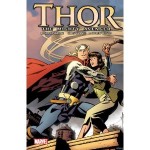
Thor the Mighty Avenger volume 1: the God Who Fell to Earth


By Roger Langridge, Chris Samnee & Matthew Wilson with Stan Lee, Jack Kirby, Larry Leiber, Joe Sinnott & Dick Ayers (Marvel)
ISBN: 978-0-7851-4121-1

For many older fans – and of course I mean me too – Thor was the comic that truly demonstrated the fevered and unfettered imagination of Jack Kirby – at least until he relocated to DC at the beginning of the 1970s and really let rip. Living galaxies, the conquest of Evolution: gods, heroes and aliens, machines with emotions and humans without, the strengths and liabilities of family ties and the inevitability of creation itself, all played out on the pages of the Thunder God’s action-packed comic-books.

Once the King left, the series struggled for decades, with only the Kirby-inspired pastiche by Walt Simonson in the mid-1980s offering any kind of quality continuation of action and imagination, although more recent years have certainly seen a few bold attempts to plough their own creative furrow.

In 2010, no doubt on the back of the major motion picture release, Marvel commissioned a superb new interpretation of the iconic but periodically unsustainable star and his convoluted mythos from the irrepressibly wonderful New Zealand writer/artist Roger Langridge (Judge Dredd Megazine, Batman, Star Wars, Fin Fang Four, The Muppet Show, Popeye and Snarked! as well as his own hilarious Fred the Clown and my personal favourite Knuckles the Malevolent Nun amongst so many others) and artist Chris Samnee (Mighty Avengers, Rocketeer, Daredevil etc.) which stripped away most of the baffling accumulated overblown ephemera and created a fresh vibrant new start – which only coincidentally, I’m sure – initially resembled that filmic feel…

The saga unfolds in stormy Bergen, Oklahomawhen junior curator Jane Foster sees a twisted rainbow one night and a week later is suddenly promoted to head a department of the Bergen War Memorial Museum. Almost immediately she’s called on by Security to deal with a giant hobo trying to whack one of the exhibits with a gnarled old walking stick…

That night whilst strolling with her boyfriend Jim she encounters the young – and exceedingly well-mannered – bum again, hurtling through a bar window very much against his will…

The cause is a monstrous, hulking brute who had been harassing women in the hostelry, but even after Jane joins the fray the ugly thug easily overpowers them and beats the chivalrous vagabond near to death before inexplicably running away…

Battered and grateful, Jane and Jim ignore their better judgement and help the dying blonde wanderer – who calls himself Thor – back to the Museum, where he finally and unexpectedly smashes the Viking urn he’d attacked earlier. Grasping a short-handled hammer the shabby lad is miraculously transformed in a flash of lightning and blast of thunder…

Jane has witnessed the impossible and has to accept that the amnesiac Thor may well be the legendarily mythic Scandinavian hero. He certainly isn’t sure: although possessed of incredible might, his memories are clouded and he only vaguely recalls a fight with his father Odin before waking up in a field, banished to this mortal realm of Midgard…

With nowhere else to go he accepts Jane’s offer to crash at her apartment even as elsewhere a frantic cloaked figure confronts local scientific sage Dr. Lewis Stephens.

Calvin Zabo is desperate for more of the savant’s transformative crystals and is prepared to kill for them, and once the sociopath has them he swiftly regains his hulking, brutish form and goes hunting for the fools who spoiled his fun in the bar last night…

This series is simply stuffed with hilarious lines and comedy set-pieces and, following a delicious moment when the Thunder God encounters his first telephone answering machine, the exiled godling hurtles to the museum to spectacularly save Jane from the malevolent monster who calls himself ‘Hyde’…

A cleverly reformulated Marvel Universe begins to impinge on the series with ‘Here be Giants’ when scientist Henry Pym (and his girlfriend Janet Van Dyne) comes to investigate the murder of his old mentor Dr. Stephens. Thor meanwhile has been plagued with nightmares and wakes to find his brother Loki implanting visions within his tousled head, whilst at the museum Jane’s antics have got her suspended…

As she takes the Thunder God shopping to cheer herself up, Pym, in his dual identities of Ant-Man and Giant-Man, follows a chemical trail from the crime scene and intercepts the bemused boutiquers …and that’s the moment when Loki’s hoodoo in the Thunderer’s head kicks in, causing the stranded Scion of Asgard to see the size-shifting scientist as a dreaded Frost Giant…

Fortunately Pym’s heroism and science proves more than a match for sinister ancient sorcery, else the magnificent concluding adventure of the re-imagined Storm Lord couldn’t happen – and it’s one of the most charming and gently amusing stories in all of Marvel’s seven-plus decades of publishing funnybooks…

Lost and lonely on a weird world of mortals, Thor’s spirits are inestimably raised when three old comrades from Asgard come calling, luring the dispirited Prince on a ‘Boys’ Night Out’…

Fandral, Hogun and Volstagg are valiant and boisterous companions (who know more about Thor’s banishment than they let on) and so whilst Jane wisely decides to go out with her own gal pals, the Asgardians decide to check out the old country – courtesy of a magical flying goat chariot. Unfortunately old maps, fog and intoxication make for missed destinations and stopping in London for directions to Norway, the celestial carousers soon settle in for a night of bevies at a hostelry frequented by uptight and touchy superhero Captain Britain.

Cue ale-fuelled misunderstanding, inevitable punch-up and maudlin vows of eternal friendship…

Collecting issues #1-4 (September-December 2010) of the rebooted series and also offering a host of stunning cover reproductions and variants by Samnee and Kirby, this sparkling tome ends with the first two appearances of the original iteration from Journey into Mystery.

Issue #83 (cover-dated August 1962) featured the tale of crippled American doctor Donald Blake who took a vacation inNorway only to encounter the vanguard of an alien invasion. Fleeing, he was trapped in a cave where he found an old, gnarled walking stick. When in his frustration he smashed the cane into a huge boulder obstructing his escape, his puny frame was transformed into Norse God of Thunder, the Mighty Thor!

Plotted by Stan Lee, scripted by Larry Lieber and illustrated by Kirby & Joe Sinnott (at this juncture a full illustrator, Sinnott became Kirby’s primary inker for his Marvel work) ‘The Stone Men of Saturn’ is pure early Marvel: bombastic, fast-paced, gloriously illogical and captivatingly action-packed. The hugely under-appreciated Art Simek was the letterer and logo designer.

They were making it up as they went along – not in itself a bad thing – and the infectious enthusiasm showed in the next adventure ‘The Mighty Thor Vs. the Executioner’ from JiM #84 and inked by Dick Ayers: a classic “commie-busting” tale, very much of its time with a thinly disguised Fidel Castro wasting his formidable armies in battle against the earthbound immortal in a tale designed to display the vast power and varied abilities of the godly superman.

Most importantly Jane Foster was introduced here as Blake’s faithful nurse, a bland cipher adored from afar by the timid alter-ego of mighty hero.

Early death is a comic book tradition that strikes many brilliant series later deemed brilliant, groundbreaking or ahead of their time: past casualties have included the Denny O’Neil/Neal Adams Green Lantern/Green Arrow, the first volume of the Silver Surfer, Steve Ditko’s Beware the Creeper and the Ditko/Gil Kane Hawk and the Dove as well as almost all of Kirby’s Fourth World Trilogy. Tragically cancelled after only 8 issues, Thor the Mighty Avenger still stands out as  sublime example of a contemporary revamp done right and will certainly only grow in renown as years go by. Moreover, if you’ve never tried Marvel’s fare or find superhero comics not to your taste this might well be a book to change your mind…
© 1962, 1963, 2010 Marvel Characters, Inc. All rights reserved.

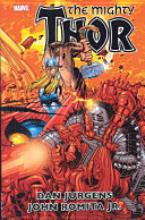
Thor volume 2


By Dan Jurgens & John Romita Jr. with John Buscema, Klaus Janson & Jerry Ordway  (Marvel)
ISBN: 978-0-7851-4632-2

In the middle of 1962, Stan Lee and Jack Kirby launched their latest offbeat superhero creation in anthology monsters-and-mysteries title Journey into Mystery #83. The tale   introduced crippled American doctor Donald Blake who took a vacation in Norway only to encounter the vanguard of an alien invasion. Fleeing in terror he was trapped in a cave wherein lay an old, gnarled walking stick. When, in helplessness and frustration, the puny human smashed the cane into a huge boulder obstructing his escape, his insignificant frame was transformed into the hulking and brawny Norse God of Thunder, Thor!

The series grew from formulaic beginnings battling aliens, commies and cheap thugs into a vast, breathtaking cosmic playground for Kirby’s burgeoning imagination with Journey into Mystery inevitably becoming the Mighty Thor where, after years of bombastic adventuring, the peculiarities and inconsistencies of the Don Blake/Thor relationship were re-examined and finally clarified to explain how the immortal godling could also be locked within frail Don Blake.

The epic saga took the immortal hero back to his long-distant youth and finally revealed that the mortal surgeon was no more than an Odinian construct designed to teach the Thunder God humility and compassion…

Time passed, Kirby left and the Thunderer’s fortunes waxed and waned. During the troubled mid-1990’s the title vanished, culled with the Avengers, Iron Man, Captain America and Fantastic Four and subcontracted out to Image creators Jim Lee and Rob Liefield during 1996-1997 in a desperate attempt to improve sales after Marvel’s apocalyptic Onslaught publishing event.

In 1998 Heroes Return and Heroes Reborn saw those properties rejoin the greater Marvel Universe, relaunched with brand new first issues with the Thunder God reappearing a few weeks later.

In July Mighty Thor volume 2 opened with ‘In Search of the Gods’ by Dan Jurgens, John Romita Jr. & Klaus Janson, which with its ‘Deal with the Devil!’ depicted the return of the lost god and the Avengers after more than a year way from the home cosmos only to find that hallowed Asgard had been devastated and deserted.

Moreover, back on Earth the Thunderer was reinstated into the “real” world just in time to die in battle against the annihilating Asgardian artefact known as the Destroyer. Whilst the Avengers struggled on against the unstoppable creature, the godling’s spirit was snatched from the realm of death-goddess Hela by mysterious mystic powerhouse Marnot before being melded with the dying body of EMT Jake Olsen: an innocent killed during the struggle thanks to Thor’s negligence.

The resurrected Storm Lord again walked the Earth but only as the dormant-until-summoned alter-ego of another frail mortal host: duly defeating the Destroyer, battling sea-monsters of sea-goddess Sedna, sparring with Hercules and being framed for attacking and devastating Olympus…

The true architects of most of this mayhem were a pantheon of previously unknown Dark Gods – Perrikus, Adva, D’Chel, Slottoth, Tokkots and Majeston Zelia – so powerful that they managed to take possession of the fallen Fabled Realm and bar Thor’s return to Asgard…

This second compilation collects the contents of issues #9-13 and the 1999 Thor Annual and sees the end of that first extended story-arc beginning with ‘Answers’ by regular writer Dan Jurgens and guest illustrators John Buscema & Jerry Ordway as a very old robotic menace returns when a couple of young punks luck into the operating system for android bandit Replicus. Whilst the earthbound Thunder God is taking care of business in Asgard, the Dark usurpers are crowing over the ravaged, tortured bodies of his best friend Balder, betrothed Lady Sif and mighty sire Odin, all the while scheming how to destroy the last remaining free Asgardian…

Thor is just as keen on meeting his elusive tormentors and finally gains insight from the enigmatic Marnot who reveals a long ago day when the early Asgardians encountered the pantheon of cruel gods enslaving the realm of Narcisson and were propelled into a brutal all-out war.

Against all logic the Narcisson’s won and were on the verge of eradicating the Asgardians until a juvenile Thor turned the tide and enabled Odin and his surviving warriors to carry the day. With the dark gods defeated and imprisoned the All-Father then wiped the memories of the triumphant warriors to spare them the trauma and loss of so many comrades and loved ones. But now somehow the Narcisson gods were free and had at last conquered the Eternal Realm.

Armed at last with knowledge, Thor began to prepare for the invasion and liberation of Asgard…

The campaign began in the three part saga ‘The Dark Wars’ by Jurgens, John Romita Jr. and Klaus Janson as the human Jake Olsen frantically began to set his complex human affairs in order. The conjoined hero was blithely unaware that Dr. Jane Foster – Don Blake’s first love – had deduced his godly secret and that an unknown hand was setting him up to take the fall for selling stolen hospital drugs…

Before the exiled prince was ready, however, Perrikus attacked New York demanding a duel with the Odin-son and threatening to kill the Lady Sif if the Thunderer didn’t show. With the gateway to Asgard clear, Thor charges in to find the city as bad as ever and his loved ones broken toys of the Dark Gods. Enraged he attacks but after a blockbusting battle his magic mallet is cloven in half and he feels himself impossibly transforming back into mortal Jake Olsen…

Forced to flee into a sewer drain, Olsen discovers a horrific underworld beneath the fallen city and is captured by trolls in the very bowels of Asgard. The frail human is being worked to death as far above the black pantheon are unable to detect any trace of the vanished Thor, but feels a burst of untrammelled hope and joy when he discovers that many of his missing comrades are also enslaved in the noisome pits…

However before Olsen can attempt to rescue them the vile Tokkots appears and whisks him back to the throne-room and the waiting Narcissons, but Perrikus is furious that he cannot battle his true enemy but only a mortal shell, until the broken battered human falls on the remnant of mystic Mjolnir and is transformed into a fighting mad Storm Lord…

Unexpectedly Thor flees into inter-dimensional space, realising that pride and fury are not enough and that what he really needs are potent allies…

The fearsome finale begins as Thor convinces the deadly Destroyer and Hercules to raid the once-Golden Realm in a blistering last charge against the Dark Ones and their massed minions whilst he raids the depths to free the Asgardian survivors and activates a cleverly concealed ally. Soon Odin, Sif and Balder are free too and the fall of the Narcissons is seemingly assured – but the malignant invaders still have one last nasty card to play…

It proves not enough and eventually the brutalised Asgardians are triumphant, after which the epilogue ‘The Work of Odin’ answers many questions – such as the true identity of manipulative schemer Marnot, the ultimate fate of the human trapped within the deadly Destroyer’s shell and the fate of both light and dark gods…

This excessively action-packed, if plot light, chronicle is completed by the inclusion of the 1999 Thor Annual which at last revealed why Thor arrived back in our universe so much later than his Avenging Allies.

Written and pencilled by Jurgens with inks from Janson ‘The Tears of a God’ found Thor visiting the Fantastic Four and describing the dimensional rip which left him partially amnesiac and filled with ineffable sadness, before – for our eyes only – the story was fully disclosed…

After battling Doctor Doom in the space between worlds, Thor and the Iron Dictator were cast onto an alien planet where the wounded Thunderer was nursed to health by a mysterious outcast named Ceranda. Somehow unable to leave the desolate world, the lost scion of Asgard grew slowly closer to the beautiful hermit, whilst elsewhere Doom was taking control of the a subterranean society and co-opting their technology and resources to his selfish needs…

The last thing the Lord of Latveria needed for escape was Thor’s dimension-spanning hammer and he knew the true reason why it wasn’t working…

This tale of dark desire and selfish love ended badly all round so perhaps its best that after the battle and return to Earth Thor had no memory of the weeks spent with the bewitching Ceranda…

Whilst not to everyone’s taste, this blistering Fight’s ‘n’ Tights epic is a cosmic clash fan’s delight and the artwork is undeniably some of the best of the modern Marvel Age, so if you want your pulse to pound and your graphic senses to swim this is the ideal item for you.
© 1998, 1999, 2010 Marvel Characters, Inc. All rights reserved.

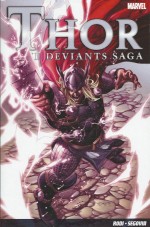
Thor: the Deviants Saga


By Robert Rodi, Stephen Segovia, M. Jason Paz & Jeffrey Huet (Marvel/Panini UK)
ISBN: 978-1-84653-511-6

Once again a major motion picture adaptation has generated a host of supplemental comics product and as Thor returns to the big screen in The Avengers movie there’s still plenty for established fans and freshly-interested parties to grapple with, such as this stirring and tempestuous epic featuring the final fate and rebirth of Jack Kirby’s other Marvel “gods and monsters” series…

The Eternals debuted in 1976 in a series slightly at odds with and removed from the regular company continuity and revealed that giant Celestial aliens had visited Earth in Epochs past, gene-gineering proto-hominids into three distinct species: Human Beings; god-like super-beings who called themselves Eternals and monstrous, genetically unstable but highly intelligent creatures dubbed Deviants. Moreover the Space Gods had periodically returned to check up on their experiment…

Never a comfortable contemporary fit with the rest of the Marvel Universe, the comic explored Kirby’s fascinations with Deities, Space and Supernature through the lens of very human observers. Once the series ended and Kirby left, other creators subsequently co-opted the concept into the regular continuity.

Skilfully remastered here by Robert Rodi and artists Stephen Segovia, M. Jason, Paz & Jeffrey Huet, the story picks up on elements of the 2007 collection Neil Gaiman’s Eternals and opens in the ruins of Asgard as Thor discovers ancient deposed, Deviant ruler Ereshkigal has crept in and is searching through the rubble.

The Deviants have fallen on hard times and face extinction from a deadly plague, inspiring the demonic ex-empress to seek Asgardian tools and weapons to facilitate her return to power. After an inconclusive battle, Ereshkigal escapes with the Unbinding Stone of Oshemar, an apparently innocuous globe which can literally unmake reality.

Utterly unaware of the power of her purloined prize, the Deviant tries and fails to usurp control from the current rulers of the Lemurian under-city which is their home whilst Thor, galvanised by the imminent destruction of the universe, seeks allies and the location of her hidden homeland amongst his old comrades in Olympia, cloaked Earthly citadel of his old Eternal comrades.

The city is all but deserted, with only resurrected hero Virako, master technician Phastos and “reformed” Deviants Karkas and Ransak the Reject occupying the vast mountaintop metropolis…

Before the valiant band can formulate a plan, however, the city is invaded by a Deviant army led by immortal Warlord Kro and a coterie of elite monster warriors. After a spectacular battle the heroes are temporarily overwhelmed and Phastos captured: his incredible devices taken in the misguided belief that they can reverse the effects of the disease devastating the Deviant population.

With the Unbinding Stone still in Ereshkigal’s meddling hands and their friend in peril, Thor and his comrades must storm the very heart of Lemuria before personal tragedy becomes universal Armageddon, but at least they have a hidden ally in the heart of the enemy – the outcast Eternal known alternatively as Gilgamesh and the Forgotten One…

Also re-entering the mix are the space-scattered, missing Eternals, but even if they return in time what can anybody do against a doom-obsessed potentate possessing a device which destroys atomic bonds and has no off-switch…?

A grandiose old-fashioned blockbuster epic, this rousing yarn is craftily constructed so that even first-time readers can get right into the swing of things, whilst veteran followers will find plenty of old favourite characters and themes revisited and clarified, with the adventure rattling along to a perfect climax with the portentous promise of more to come.

Fast, furious, frantic fantasy fun for older kids that no Fights ‘n’ Tights fanatic could possibly resist.
™ & © 2012 Marvel and subs. Licensed by Marvel Characters B.V. through Panini S.p.A, Italy. All Rights Reserved. A British edition published by Panini UK, Ltd.

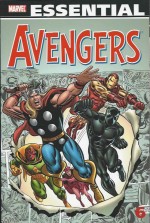
Essential Avengers volume 6


By Steve Englehart, Roy Thomas, Jim Starlin, Gerry Conway, Bob Brown,
Don Heck, Dave Cockrum, Joe Staton, Rich Buckler, John Buscema, George Tuska & various (Marvel)
ISBN: 978-0-7851-3058-1

The Avengers have always proved that putting all one’s star eggs in a single basket pays off big-time: even when all Marvel’s classic all-stars such as Thor, Captain America and Iron Man are absent, it merely allows the team’s lesser lights to shine more brightly.

Of course all the founding stars were regularly featured due to the rotating, open door policy which means that most issues includes somebody’s fave-rave – and the boldly grand-scale impressive stories and artwork are no hindrance either.

This monolithic and monumental sixth tome, collecting the ever-amazing Avengers‘ world-saving exploits (presenting in crisp, stylish monochrome the astounding contents of issues #120-140 of their monthly comic book between March 1974 and October 1975, plus Giant-Size Avengers #1-4 and crossover appearances in Captain Marvel #33 and Fantastic Four #150), saw scripter Steve Englehart examine the outer limits of Marvel history and cosmic geography as he took readers to the ends of their universe and the beginning of time…

Opening this epochal tome is ‘Death-Stars of the Zodiac!’ from Avengers #120, by Steve Englehart, Bob Brown & Don Heck, wherein terrorist astrological adversaries and super-criminal cartel Zodiac attacked again with a manic plan to eradicate everyone in Manhattan born under the sign of Gemini, with heroes Thor, Iron Man, Vision, Scarlet Witch, Swordsman and Mantis seemingly helpless to stop them.

In the blistering battle of #121’s ‘Houses Divided Cannot Stand!’, illustrated by John Buscema & Heck, even the added assistance of Captain America and the Black Panther is of little advantage and with Mantis injured the team begin to question her mysterious past, only to be lured to their seeming doom and ‘Trapped in Outer Space!’ (Brown & Mike Esposito) before at last turning the tables on their fearsome foes after the criminal Libra revealed a shocking secret…

Avengers #123, depicted by Brown & Heck, began a vast and ambitious saga with ‘Vengeance in Viet Nam – or – An Origin For Mantis!’ as Libra’s claim to be Mantis’ father (a story vigorously and violently denied by the Martial Arts Mistress) brought the team to Indo-China.

The criminal ex-mercenary declared that he left the baby Mantis with pacifistic Priests of Pama after running afoul of a local crime-lord, but the bewildered warrior-woman has no memory of such events, nor of being schooled in combat techniques by the Priests. Meanwhile the gravely wounded Swordsman has rushed to Saigon to confront his sadistic ex-boss Monsieur Khruul and save the Priests from being murdered by the gangster’s thugs… but was again too late. It is the tragic story of his wasted life…

Issue #124 found the team stumbling upon a scene of slaughter as clerics and criminals lay dead and a monstrous planet-rending alien horror awoke in ‘Beware the Star-Stalker!’ by J. Buscema & Dave Cockrum…

Mantis was forced to accept that her own memories were not real after Avengers #125, which unleashed ‘The Power of Babel!’ when a vast alien armada attacked and, in combating it, the Earth’s Mightiest Heroes were trapped out of phase with their home-world.

This blockbuster battle bonanza was a crossover, and the penultimate episode of the spectacular Thanos War Saga that had featured in Captain Marvel, Marvel Feature and Iron Man, and included in this compendium is ‘The God Himself!’ scripted by Englehart from Captain Marvel #33 (plotted and illustrated by Jim Starlin & Klaus Janson) wherein the mad Titan Thanos finally fell in combat to the valiant Kree warrior: a stunning piece of comics storytelling which stands up remarkably well here despite being seen without benefit of the preceding ten chapters…

It was back to business in #126 as in ‘All the Sights and Sounds of Death!’ (Brown & Cockrum) villains Klaw and Solarr attacked Avengers Mansion in a devious attempt to achieve vengeance for past indignities, after which Roy Thomas, Rich Buckler & Dan Adkins returned to the fold to delve into superhero history with ‘Nuklo… the Invader that Time Forgot!’ for the first quarterly edition of Giant-Size Avengers.

The stirring saga reintroduced 1940 Marvel sensation Bob Frank AKA The Whizzer in a tragic tale of desperation as the aged speedster begged the heroes’ help in rescuing his son: a radioactive mutant locked in stasis since the early 1950s. Unfortunately within the recently unearthed chrono-capsule the lad has grown into a terrifying atomic horror…

Moreover while in the throes of a stress-induced heart-attack the Whizzer let slip that he was the also the father of mutant Avengers Scarlet Witch and Quicksilver…

In Avengers #127 Sal Buscema & Joe Staton signed on as regular art team with ‘Bride and Doom!’ when the team travelled to the hidden homeland of the Inhumans for the marriage of the aforementioned Quicksilver to elemental enchantress Crystal only to stumble into a uprising of the genetic slave-race known as Alpha Primitives.

Once again the robotic giant Omega had incited the revolt but this time it was controlled by an old Avengers enemy who revealed himself in the concluding chapter of the crossover…

Fantastic Four #150 featured ‘Ultron-7: He’ll Rule the World!’ by Gerry Conway, Buckler & Joe Sinnott, in which an impossible battle of FF, Inhumans and Avengers was ended by a veritable Deus ex Machina after which, at long last ‘The Wedding of Crystal and Quicksilver’ ended events on a happy note.

But not for long: in Avengers #128’s ‘Bewitched, Bothered, and Dead!’ (Englehart, Sal Buscema & Staton) the FF‘s nanny Agatha Harkness began tutoring Wanda Frank in actual sorcery to augment her mutant power, unwittingly allowing dark mage Necrodamus access to the Mansion and their souls, whilst the increasingly troubled Mantis began making a play for the Scarlet Witch’s synthazoid boyfriend The Vision; heedless of the hurt and harm she would bring to her current lover The Swordsman…

In #129 ‘Bid Tomorrow Goodbye!’ kicked the simmering saga into high gear when Kang the Conqueror appeared, determined to possess the legendary female figure he called the Celestial Madonna.

Apparently this anonymous creature would birth the saviour of the universe, and since no records survived disclosing which of the three women in Avengers Mansion at that crucial moment she actually was, the time-reaver was determined to abduct all three and forcibly make Kang the inevitable father of the child…

This time not even the assembled Avengers could stop him and, after crushing and enslaving them, Kang made off with Wanda, Harkness and Mantis, with only the swiftly declining Swordsman free to contest him…

The tale continued into Giant-Size Avengers #2 with ‘A Blast from the Past!’ (illustrated by Cockrum) as reluctant returnee Hawkeye rushed to the team’s rescue, reuniting with old adversary Swordsman and an enigmatic entity named Rama-Tut who claimed to be Kang’s reformed future self…

Against all odds the merely mortal heroes managed to free the enslaved Avengers and rout the unrepentant Kang – but only at the cost of the Swordsman’s life…

Avengers #130’s ‘The Reality Problem!’ (Sal Buscema & Staton) found the heartbroken and much chastened Mantis joining the team in Vietnam to investigate her mysteriously clouded past, only to be drawn into pointless combat with Communist exiles Titanium Man, Radioactive Man and Crimson Dynamo, thanks to the petty manipulations of sneak thief  The Slasher…

The brief battle concluded and the trail then led to ‘A Quiet Half-hour in Saigon!’ during which the American Adventurers were again attacked by Kang who trapped them in Limbo and unleashed a Legion of the Unliving against them…

With another time-villain Immortus added to the mix, ‘Kang War II’ saw temporarily resurrected heroes and villains Wonder Man, 1940’s android Human Torch, the Monster of Frankenstein, martial arts assassin Midnight, the ghostly Flying Dutchman and Baron Zemo decimate the Avengers and the trauma and tragedy were further exacerbated as Mantis kept seeing the spectre of her deceased lover…

This absorbing thriller by Englehart, Thomas Sal Buscema & Staton segued inexorably into Giant-Size Avengers #3’s ‘…What Time Hath put Asunder!’ illustrated by Cockrum & Joe Giella, which saw Earth’s Mightiest Heroes pull victory from the ashes of defeat and receive a unique gift from one of the assembled Masters of Time…

Avengers #133 began ‘Yesterday and Beyond…’ (Englehart, S. Buscema & Staton) as the team followed Mantis to the beginnings of recorded Galactic history and the unravelling of her true past, whilst Vision was dispatched to glimpse his own obscure and complex origins; a double quest which encompassed the Kree and Skrull empires, the defeated Star-Stalker and deceased Priests of Pama and Thanos, and the telepathic Titan dubbed Moondragon, as well as a goodly portion of classic superhero history in ‘The Times That Bind!’ before #135 revealed that ‘The Torch is Passed!’ (illustrated by George Tuska & Frank Chiaramonte) and brought all the disparate elements together in Giant-Size Avengers #4.

‘…Let All Men Bring Together’ (art by Heck & Tartaglione) climaxed the long-standing romance between the Scarlet Witch and Vision and another far more cosmic union with a brace of weddings and the ultimate ascension of the Celestial Madonna – even though demonic extra-dimensional despot Dormammu did try to spoil the show…

A new era was supposed to begin in Avengers #136 but a deadline was missed and instead ‘Iron Man: DOA’ by Englehart, Tom Sutton & Mike Ploog was reprinted from Amazing Adventures #12, wherein the newly mutated and furry Hank McCoy AKA the Beast had attacked the Armoured Avenger whilst mind-controlled.

Although an excellent story in its own right, it rather gave the game away for the next issue after the painfully depleted team declared ‘We Do Seek Out New Avengers!!’ (art by Tuska & Vince Colletta) and amongst the applicants – which included Moondragon, Yellowjacket and the Wasp – was an athletic, enigmatic guy bundled up in a raincoat…

No sooner had the introductions begun than a cosmic interloper attacked, hunting for the honeymooning Witch and Vision, but the ‘Stranger in a Strange Man!’ was far from his expected level of puissance and the heroes soon smelled a rat – unfortunately not before the Wasp was gravely injured…

After all the intergalactic hyper-cosmic extravaganzas and extended epic-ing, Avengers #139 ‘Prescription: Violence!’ and #140’s ‘A Journey to the Center of the Ant’ end this volume on a comfortingly down-to-Earth scale as the malevolent Whirlwind tried to murder the bed-ridden Wasp and her devoted defender Yellowjacket succumbed to a growing affliction which doomed him to exponentially expand to his death until the refreshed, returned Vision and the bludgeoning Beast saved the day…

Roy Thomas and Steve Englehart were at the forefront of Marvel’s second generation of story-makers, brilliantly building on and consolidating the compelling creation of Stan Lee, Jack Kirby and Steve Ditko: spearheading and constructing a logical, fully functioning wonder-machine of places and events that so many others were inspired by and could add to. In this volume, between them they also showed how much more graphic narratives could become and these terrific tales are perfect examples of superhero sagas done just right.

Although not to every reader’s taste these fantastic Fights ‘n’ Tights masterpieces can still boggle the mind and take the breath away, so no lovers of Costumed Dramas can afford to ignore this superbly bombastic book.
© 1972, 1973, 1974, 2006 Marvel Characters, Inc. All Rights Reserved.
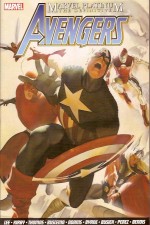
Marvel Platinum: the Definitive Avengers


By Stan Lee, Jack Kirby, Roy Thomas, John Buscema, Neal Adams, John Byrne, Kurt Busiek, George Pérez, Brian Michael Bendis & various (Marvel/Panini UK)
ISBN: 978-1-84653-507-9

The Avengers have always proved that putting all one’s star eggs in one single basket pays off big-time: even when all Marvel’s all-stars such as Thor, Captain America and Iron Man were absent, it merely allowed the team’s lesser lights to shine more brightly.

Of course all the founding stars regularly featured due to the rotating, open-door policy which meant most issues included somebody’s fave-rave – and the boldly grand-scale impressive stories and artwork were no hindrance either.

As the new Avengers film screens across the world, Marvel has again released a bunch of tie-in books and trade paperback collections to maximise exposure and cater to those movie fans wanting to follow up the cinematic exposure with a comics experience.

Under the Marvel Platinum/Definitive Editions umbrella, this treasury of tales reprints some obvious landmarks from the pantheon’s serried history, specifically Avengers volume 1 #1, 4, 57, 93, Avengers West Coast #51-52, Avengers volume 3, #10-11, Avengers volume 1 #503, Avengers Finale and New Avengers #3 which, whilst not all absolutely “definitive” epics, certainly offer a sublime snapshot of just how very great the ever-shifting team of titans can be.

During the Marvel Renaissance of the early 1960’s Stan Lee and Jack Kirby aped the tactic which had worked so tellingly for DC Comics, but with mixed results. Julie Schwartz had incredible success with revised and modernised versions of the company’s Golden Age greats, so it seemed natural to try and revive the characters that had dominated Timely/Atlas in those halcyon days. The JLA inspired Fantastic Four featured a new Human Torch and before long Sub-Mariner was back too…

As the costumed hero revival brought continuing success, the next stage was obvious and is covered here at then end of the volume by historian Mike Conroy’s informative essay ‘The True Origin of the Avengers’…

The concept of combining individual stars into a group had already made the Justice League of America a commercial winner and inspired the moribund Atlas outfit of Stan Lee, Jack Kirby and Steve Ditko to invent many “super-characters” after the Fantastic Four. Nearly 18 months later the fledgling House of Ideas had a viable stable of leading men (but only sidekick women) so Lee & Kirby assembled a handful of them and moulded them into a force for justice and even higher sales…

After a period of meteoric expansion, in 1963 the burgeoning Marvel Universe was finally ready to emulate the successful DC concept that had truly kick-started the Silver Age of comics and this stunning historical retrospective begins as it should with two stories from the groundbreaking Lee/Kirby run which graced the first eight issues of the World’s Mightiest Heroes.

Seldom has it ever been done with such style and sheer exuberance. Cover-dated September, The Avengers #1 launched as part of an expansion package which also included Sgt Fury and his Howling Commandos and The X-Men…

The Coming of the Avengers’ is one of the cannier origin tales in comics. Instead of starting at a zero point and acting as if the reader knew nothing, Stan & Jack (plus inker Dick Ayers) assumed readers had at least a passing familiarity with their other efforts and wasted very little time or energy on introductions.

In Asgard Loki, god of evil, was imprisoned on a dank isle, hungry for vengeance on his half-brother Thor. Observing Earth he espied the monstrous, misunderstood Hulk and engineered a situation wherein the man-brute seemingly went berserk to trick the Thunder God into battling the monster. When the Hulk’s sidekick Rick Jones radioed the Fantastic Four for assistance, Loki diverted the transmission and smugly waited for the mayhem to manifest.

Unfortunately for him, Iron Man, Ant-Man and the Wasp also picked up the SOS….

As the heroes converged in the American Southwest to search for the Jade Giant they realized that something was oddly amiss…

This terse, epic, compelling and wide-ranging yarn (New York, New Mexico, Detroit and Asgard in 22 pages) is Lee & Kirby at their bombastic best and one of the greatest adventure stories of the Silver Age and is followed by the long-awaited return of the last of the “Big Three”…

Avengers #4 (March 1964) was a true landmark of the genre as Marvel’s greatest Golden Age sensation was revived. ‘Captain America Joins the Avengers!’ has everything that made the company’s early tales so fresh and vital. The majesty of a legendary warrior (that most of the readers had never heard of!) returned in our time of greatest need, stark tragedy in the loss of his boon companion Bucky, aliens, gangsters, Sub-Mariner and even wry social commentary. This story by Lee, Kirby & George Roussos just cannot be bettered.

In #57 (October 1968) Roy Thomas, John Buscema & George Klein produced a Golden Age revival of their own as ‘Behold… the Vision!’ introduced a terrifying android apparition designed by arch-foe Ultron to destroy the heroes. Sadly not appearing here is the conclusion wherein the eerie, amnesiac, artificial man with complete control of his mass and density discovered a fraction of his origins and joined the human heroes….

Avengers #89-97 comprised perhaps the most ambitious and certainly boldest saga in Marvel’s early history: an astounding epic of tremendous scope which dumped Earth into a cosmic war the likes of which comics fans had never before seen and creating the template for all multi-part crossovers and publishing events ever since.

The Kree-Skull War captivated a generation of comics readers and from that epic comes the extra-long ‘This Beachhead Earth’ (Avengers #93 November 1972, by Thomas, Neal Adams & Tom Palmer) as the Vision was almost destroyed by alien invaders and Ant-Man was forced to undertake ‘A Journey to the Center of the Android!’ to save the android’s unconventional life. Thereafter the Avengers became aware of not one but two alien presences on Earth: bellicose Kree and sneaky shape-shifting Skrulls, beginning a ‘War of the Weirds!’ on our fragile globe.

Acting too late, the assembled team were unable to prevent the Scarlet Witch, Quicksilver and Captain Marvel from being abducted by the Skrulls…

That cliff-hanging drama is followed by a revelatory two-part tale from Avengers West Coast #51-52 (November and December 1989) by John Byrne & Mike Machlan which opens with ‘I Sing of Arms and Heroes…’ wherein the Scarlet Witch hunted for her missing children only to discover some horrifying truths about them and her own powers. The tragedy was only resolved when demonic foe Master Pandemonium and supernal arch-tempter Mephisto deprived her of everything she had ever believed, wanted or loved in ‘Fragments of a Greater Darkness’…

Avengers volume 3, #10-11 (November and December 1998) by Kurt Busiek, George Pérez, Al Vey & Bob Wiacek) recaps the history and celebrates the team’s anniversary with a parade in ‘Pomp and Pageantry’ until the ghostly Grim Reaper hijacked the affair and attacked them through the medium of their own dead yet resurrected members Wonder Man, Mockingbird, Swordsman, Hellcat, Dr. Druid, Thunderstrike and Captain Marvel. At the same time the increasingly unstable Scarlet Witch learned the true nature of her reality-altering powers in the catastrophic concluding clash ‘…Always an Avenger!’

A few years later the “World’s Mightiest Heroes” were shut down and rebooted in a highly publicised event known as Avengers Disassembled. Of course it was only to replace them with both The New and The Young Avengers. Affiliated comic-books Thor, Iron Man, Captain America, Fantastic Four and Spectacular Spider-Man ran parallel but not necessarily interconnected story-arcs to accompany the Big Show.

Said Show consisted of the worst day in the team’s history as a trusted comrade betrayed the World’s Mightiest Superteam resulting in the destruction of everything they held dear and the death of several members, all of which originally appeared in issues #500-503 plus the one-shot Avengers Finale.

From that epic event comes the closing chapter ‘Chaos part four’ (#503, December 2004, by Brian Michael Bendis, David Finch, Olivier Coipel & Danny Miki) wherein the uncomprehending, surviving heroes discovered and reluctantly despatched the true author of all their woes and losses, after which the moody and elegiac Avengers Finale signalled the end of an era in a powerful tribute by a host of creators including Bendis and artists Finch, Miki, Frank D’Armata, Alex Maleev, Steve Epting, Lee Weeks, Brian Reber, Michael Gaydos, Eric Powell, Darick Robertson, Mike Mayhew, Andy Troy, David Mack, Gary Frank, Mike Avon Oeming, Pete Patanzis, Jim Cheung, Mark Morales, Justin Ponsor, Steve McNiven, George Pérez, Mike Perkins, Neal Adams & Laura Martin.

It is undeniably one of the best superhero “Last Battles” ever created, and loses little impact whether it was your five hundredth or first experience with these tragic heroes.

Shocking and beautiful, there was a genuine feeling of an “End of Days” to this epic Armageddon.

The final comics tale in this sturdy volume comes from New Avengers #3 (March 2005) as, in the aftermath of a massive breakout of super-villains, Captain America and Iron Man tried to put the band back together with a whole new generation including Luke Cage, Spider-Woman and the Amazing Spider-Man.

‘Breakout Part 3’ is just a fraction of a longer epic by Bendis, Finch, Allen Martinez, Miki & Victor Olazaba, but ends this action-adventure compendium on a solid note indicating that the best is still yet to come…

Also contained herein is an extensive prose feature covering the history of the team, the aforementioned ‘true origin’ piece and a raft of classic covers to tantalise and tempt…

This book is one of the very best of these perennial supplements to cinema spectacle, but more importantly it is a supremely well-tailored device to turn curious movie-goers into fans of the comic incarnation too. If there’s a movie sequel, I’m sure Marvel has plans for reprinting much of the masterful material necessarily omitted here, but at least until then we have a superb selection to entice newcomers and charm the veteran American Dreamers.
™ and © 1963, 1964, 1968, 1972, 1989, 1998, 2004, 2005, 2012 Marvel & subs. Licensed by Marvel Characters B.V. through Panini S.p.A, Italy. All Rights Reserved. A British edition published by Panini UK, Ltd.

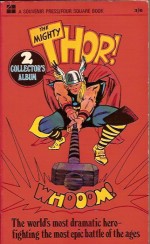
The Mighty Thor! Collector’s Album – US and UK editions


By Stan Lee, Jack Kirby & various (Lancer/Four Square)
“ISBNs” 72-125 (Lancer) & 1918 (Four Square)

Here’s another brace of Swinging Sixties “Pop-Art” compendiums celebrating the meteoric rise of the Little House that Stan, Jack and Steve Built which will probably be of interest only to incurable nostalgics, consumed collectors and historical nit-pickers, but as I’m all of them and it’s my dime…

Far more than a writer or Editor; Stan Lee was also a master of entrepreneurial publicity generation and his tireless schmoozing and exhaustive attention-seeking was as crucial as the actual characters and stories in promoting his burgeoning line of superstars.

In the 1960s most adults, especially many of the professionals who worked in the field, considered comic-books a ghetto. Some disguised their identities whilst others were “just there until they caught a break”. Stan and creative lynchpins Jack Kirby and Steve Ditko had another idea – change the perception.

Whilst Kirby and Ditko pursued their respective creative credos and craft, waiting for the quality of the work to be noticed, Stan pursued every opportunity to break down the ghetto walls: college lecture tours, animated shows (of frankly dubious quality at the start, but always improving), foreign franchising and of course getting their product onto mainstream bookshelves in real book shops.

There had been a revolution in popular fiction during the 1950s with a huge expansion of affordable paperback books and companies developed extensive genre niche-markets, such as war, western, romance, science-fiction and fantasy.

Always hungry for more product for their cheap ubiquitous lines, many old novels and short stories collections were republished, introducing new generations to fantastic pulp authors like Robert E. Howard, Otis Adelbert Kline, H.P. Lovecraft, August Derleth and many others.

In 1955, spurred on by the huge parallel success of cartoon and gag book collections, Bill Gaines began releasing paperback compendiums culling the best strips and features from his landmark humour magazine Mad and comics’ Silver Age was mirrored in popular publishing by an insatiable hunger for escapist fantasy fiction.

In 1964 Bantam Books began reprinting the earliest pulp adventures of Doc Savage, triggering a revival of pulp prose superheroes, and seemed the ideal partner when Marvel began a short-lived attempt to “novelise” their comicbook stable with The Avengers Battle the Earth-Wrecker and Captain America in the Great Gold Steal.

Although growing commercially by leaps and bounds, Marvel in the early 1960s was still hampered by a crippling distribution deal limiting the company to 16 titles (which would curtail their output until 1968), so each new comicbook had to fill the revenue-generating slot (however small) of an existing title. Even though the costumed characters were selling well, each new title would limit the company’s breadth of genres (horror, western, war, etc) and comics were still a very broad field at that time. It was putting a lot of eggs in one basket and superheroes had failed twice before for Marvel.

As Lee cautiously replaced a spectrum of genre titles and specialised in superheroes, a most fortunate event occurred with the advent of the Batman TV show in January 1966. Almost overnight the world went costumed-hero crazy and many publishers repackaged their old comics stories in cheap and cheerful, digest-sized monochrome paperbacks, and it’s easy to assume that Marvel’s resized book collections were just another company cash-cow, part of their perennial “flood the marketplace” sales strategy, but it’s just not true.

Lee’s deal with Lancer to publish selected adventures in handy paperback editions had begun a year earlier and the other funnybook publishers – including National/DC, Tower Comics and Archie – also desperate to add some credibility and even literary legitimacy to their efforts as well as increased profits these forays onto the world’s bookshelves – were caught playing catch-up in the fresh new marketplace.

Moreover, when Lancer began releasing Marvel’s Mightiest in potent and portable little collections it was simple to negotiate British iterations of those editions – although they were not as cheap and had far shorter page-counts – since thanks to Lee’s international expansion drive the characters, creators and stories were already very familiar to British readers, appearing both in Odhams‘ weekly comics Wham!, Pow!, Smash!, Fantastic and Terrific, but also (since 1959) in black and white monthly anthologies comicbooks published by Alan Class which had been bundling up reprinted material from a variety of American companies including Charlton, Tower, I.W., Gold Key, Archie, ACG and others.

As I’ve already mentioned US and UK editions vary significantly. Although both re-present – in truncated, resized monochrome – early Marvel tales, the British Four Square editions are a measly 128 pages, as opposed to the 176 page Lancer editions: necessitating missing stories and odd filler pages. Moreover the UK books are fronted by deliberately garish and poorly drawn “cartoony covers” instead of the American art by Ditko and Kirby, as if the publishers were embarrassed by the content…

Still, considering how many different prose publishing houses have chance their arm on such projects over the years, their editors must also have believed there was money to be made from comics too…

Also it’s impossible to deny that the book editions were fun, thrilling and just, plain cool…

In 1966 The Mighty Thor! Collectors Album was the fourth release from Lancer, with the British edition debuting a year later and although the US and UK editions are quite similar the latter frustrating omits an entire story – the concluding chapter of a two-part story!

Also glaringly omitted from both editions was the origin so in case you’re not au fait with the modern legend here’s a quick recap just for you…

Lonely, crippled American doctor Donald Blake took a vacation in Norway only to encounter the vanguard of an alien invasion. Trapped in a cave, Blake found a gnarled old walking stick, which when struck against the ground turned him into the Norse God of Thunder!

Within moments Thor was defending the weak and smiting the wicked and as the months swiftly passed rapacious extraterrestrials, Commie dictators, costumed crazies and cheap thugs gradually gave way to a terrifying parade of fantastic worlds and incredible, mythic menaces…

A word about artwork here: modern comics are almost universally full-coloured in Britain and America, but for over a century black and white was the only real choice for most mass market publishers – additional (colour) plates being just too expensive for shoe-string operations to indulge in. Even the colour of 1960s comics was cheap and primitive and solid black line, expertly applied by master artists, was the very life-force of sequential narrative.

These days computer enhanced art can hide a multitude of weaknesses – if not actual pictorial sins – but back then companies lived or died on the illustrating skills of their artists: so even in basic black and white (and the printing of paperbacks was as basic as the accountants and bean-counters could get it) the Kirbys and Ditkos of the industry exploded out of those little pages and electrified the readership.

I can’t see that happening with many modern artists deprived of their slick paper and multi-million hued colour palettes…

The mystic mayhem opens with ‘The Mighty Thor Battles… The Lava Man!’ (from the landmark Journey into Mystery #97, October 1963, by Lee, Kirby and Don Heck) wherein an invader from the core of the planet invades the surface world just as a rift between Thor and his father Odin was established when the Lord of Asgard refused to allow his son to love Blake’s mortal nurse Jane Foster.

This acrimonious triangle was a perennial sub-plot that fuelled many attempts to humanise Thor, because already he was a hero too powerful for most villains to cope with…

That titanic tussle was followed by ‘Giants Walk the Earth!’ (Lee, Kirby & Chic Stone, from Journey into Mystery #104, May 1964) the revolutionary saga where, for the first time, Kirby’s imagination was given full play as trickster god and wicked step-brother Loki tricked Odin into visiting Earth, only to release ancient elemental foes Surtur and Skagg, the Storm Giant from Asgardian bondage and bid them kill the All-Father….

This staggering cosmic clash saw noble gods bestriding the Earth, battling demonic evil in a new Heroic Age and this greater role for the Asgardian supporting cast set the scene for a far grander, more epic feel.

Also from JiM #97 comes the premiere instalment of a spectacular back-up series. ‘Tales of Asgard – Home of the mighty Norse Gods’ gave Kirby a place to indulge his fascination with legends. Initially adapting classic tales but eventually with all-new material particular to the Marvel pantheon, he built his own cosmos and mythology, which underpinned the company’s entire continuity. This first saga, scripted by Lee and inked by George Bell (AKA George Roussos) outlined the birth of the gods, the origin of the world and the creation of the World Tree Yggdrasil.

The British edition then concludes with ‘The Stronger I Am, the Sooner I Die!’ from JiM #114, March 1965, which began a two-part tale introducing a new villain of the sort Kirby excelled at, a vicious thug who suddenly lucked into overwhelming power, courtesy of the ever-scheming God of Evil.

Crafted by Lee, Kirby & Stone it saw Loki imbue hardened felon Crusher Creel with the magical ability to duplicate the strength and attributes of anything he touched and subsequently go on a brutal and frenzied rampage…

However, if you’d stuck with the American edition you’d also enjoy the senses-shattering finale as Thor demonstrated not just his power but also his wits in a blockbusting demonstration of ‘The Vengeance of the Thunder God’ (inked by Frank Giacoia as the pseudonymous Frankie Ray, which originally appeared in issue #115 from April 1965)…

As someone who bought these stories in most of the available formats over the years – including the constantly recycled reprints in British weeklies from the mid-sixties to the 1980s – I have to admit that the glossy classic paperback editions have a charm and attraction all their own even if they are heavily edited and abridged and rather disturbingly printed in both portrait and landscape format…

If you’ve not read these tales before then there are certainly better places to do so (such as the pertinent Essential or Marvel Masterwork volumes) but even with all the archaic and just plain dumb bits these books are still fabulous super-hero sagas with beautiful art that will never stale or wither, and for us backward looking Baby-boomers these nostalgic pocket tomes have an incomprehensible allure that logic just can’t tarnish or taint…
© 1966 and 1967 Marvel Comics Group. All rights reserved.

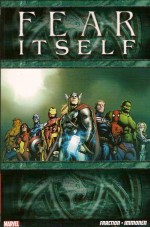
Fear Itself


By Ed Brubaker, Matt Fraction, Scott Eaton, Stuart Immonen & various (Marvel/Panini UK)
ISBN: 978-1-84653-494-2

Recently at Marvel, colossal braided mega-crossover events have been somewhat downplayed in favour of smaller mini-epics (the last biggie was Secret Invasion in 2008, I think), but following the release of the Captain America and Thor movies – not to mention the upcoming Avengers celluloid blockbuster – the time obviously seemed right to once more plunge their entire Universe into cataclysmic chaos and rebirth.

Collecting the one-shot Fear Itself Prologue: the Book of the Skull (March 2011) and the subsequent seven-issue core miniseries (which branched out into 30-odd other regular titles, miniseries and specials) this certainly spectacular puff-piece effectively presents a world-changing blockbuster via the comic equivalent of edited highlights whilst tempting readers to find the detail in the numerous spin-off books.

Quite simply: you can happily have old-fashioned funny-book fun and thrills just reading the basic story here and, should you want more, that’s available too

‘Book of the Skull’ by Ed Brubaker, Scott Eaton & Mark Morales follows Sin, daughter of the Fascist monster as she and Baron Zemo uncover a mystic weapon summoned to Earth during World War II, but rendered temporarily harmless in 1942 by The Invaders Captain America, Bucky and Sub-Mariner.

Only it wasn’t so much harmless as waiting for someone with the right blend of madness, need, hunger and sheer evil to wield it…

‘Fear Itself’ by Matt Fraction, Stuart Immonen & Wade von Grawbadger then opens with ‘The Serpent’ as global civil unrest and disobedience escalates into rioting as Sin picks up the mystic hammer which has been waiting for her, and transforms her into Skadi, herald of a dark and deadly menace from out of antediluvian Asgardian history…

The Home of the Gods has fallen to Earth in Oklahoma and, as Iron Man and the Avengers rally there to rebuild the Shining City, Odin appears and forcibly abducts the entire populace, even Thor, whom he has to batter into unconsciousness first.

Meanwhile Skadi has freed ancient fear-feeding god the Serpent from his prison on the sea-floor…

Soon seven other hammers turn the world’s most powerful denizens into harbingers of terror and mass destruction in ‘The Worthy’…

The Juggernaut, Hulk, Absorbing Man, Titania, Attuma, Grey Gargoyle and Thing are devastating the planet, generating global fear to feed the freed Asgardian outcast and in ‘The Hammer that Fell on Yancy Street’ the Avengers suffer their first tragic fatality, whilst in the nether-space which once housed the Citadel of the Gods the imprisoned Thor joins a secret rebellion against the clearly deranged Odin.

The All-Father plans to starve the fear-feeding Serpent of his food-source by scouring Earth of all life…

With ‘Worlds on Fire’ and the carnage and bloodletting ever-increasing, Thor escapes to Earth determined to aid his human allies and thwart his father’s insane scheme, just as retired hero Steve Rogers once again takes up the mantle of America’s Greatest Hero, and Iron Man forms an unlikely alliance to craft magical weaponry to combat the chaos before ‘Brawl’ finds the hammer-wielding Worthy uniting to crush human resistance, with the death-toll and slaughter escalating to extinction-event levels in ‘Blood-Tied & Doomed’ before Iron Man returns to turn the tide and save what remains of the day and humanity in the cataclysmic finale ‘Thor’s Day’ as the true history of the Gods is revealed and all Earths heroes, human, mortal or other, unite for one tragic last hurrah…

And make no mistake, this time even some of the A-list stars don’t make it…

Not that that means anything in comics, but it does make for an impressive – and breathtaking, beautifully illustrated – read, whilst the four portentous Epilogues (by a host of guest-creators) hint at more horror and heartbreak to come…

Owing far more to the aforementioned recent rash of movies and the general timbre of the times than the rugged mythologies created by Stan Lee and Jack Kirby, this is nevertheless a pretty effective cosmic punch-up which resets the playing field for the next few years and should make very friendly future reading for new and returning fans tantalised by the company’s Hollywood iterations.

With a splendid gallery of variant covers from Joe Quesada, Steve McNiven, Pablo Manuel Rivera, Guiseppe Camuncoli, Terry Dodson, Billy Tan, Humberto Ramos, Ed McGuinness, Mike McKone, this plot-light and action-overloaded epic should delight newer or less continuity-locked readers of Costumed Dramas and adventurous art lovers everywhere…

™ & © 2012 Marvel & Subs. Licensed by Marvel Characters B.V. through Panini S.p.A. Italy. A British Edition by Panini UK Ltd.

The Mighty Thor: I, Whom the Gods Would Destroy

– a Marvel Graphic Novel

By Jim Shooter, James Owsley, Paul Ryan & Vince Colletta (Marvel)
ISBN: 978-0-87135-268-0

When it was released in 1987, I, Whom the Gods Would Destroy offered a decidedly different take on the bombastic fantasy-hero – which perhaps explains why it has unfairly languished in obscurity ever since…

The plot itself is delightfully simple and fiendishly clever: Thor is an immortal of Asgard with all the responsibilities of a warrior prince and champion of justice. Moreover, he can transform at will into mere mortal iteration Don Blake – a crippled surgeon who revels in the minutiae of humanity, regularly and literally holding people’s lives in his hands…

After Blake loses a patient on the operating table he suffers a debilitating crisis of conscience and begins to question his own Divine right to and manner of existence.

Rebuffing the dutiful pleadings of his betrothed, beloved Lady Sif, he goes thoroughly off the rails, decrying the callous, patronising disregard the gods show to mortals.

After a tawdry fling with a girl in a bar Blake decides to abandon his immortal identity intending to live and die as a man, but the ever-present dangers of city-life soon compel him to become the crime-busting saviour-hero once more. Now, however this heroic role is dull and unappetising to him. He attempts to end his undying life…

Traumatised beyond endurance Blake tries to prove the myriad attractions of raw humanity to celestial Sif, but she cannot understand his fascination and rejects the world of mortals. Not even for him can she embrace or understand mankind…

An emotional Rubicon is confronted and crossed when Blake is once more called to operate on a dying patient. This time it’s a child and if he can’t save her, nobody can…

This compelling drama takes the most macho, two-fisted action-hero of the Marvel Universe and puts him through emotional hell in a tale with no villains where strength is irrelevant and compassion is the only weapon…

I can’t recall when Marvel last published an all-original graphic novel as opposed to a collection of previously printed material, but once they were the market leader with an entire range of “big new stories” told on larger than normal pages (285 x 220mm rather than the comic-sized standard 258 x 168mm of today’s books), featuring not only proprietary characters in out-of-the-ordinary adventures but also licensed assets like Conan, creator-owned properties like Alien Legion and new character debuts.

Nonetheless, their ambitious dalliance with the form in the 1980s and 1990s produced some classy results that the company has seldom come close to repeating since. Whether original concepts, licensed projects or their own properties, that run generated a lot of superb or at least different stories that still stand out today – or would if they were actually in print.

Released in 1987, I, Whom the Gods Would Destroy was conceived by Jim Shooter, written by James Owsley and illustrated by Paul Ryan & Vince Colletta; fitting comfortably into the tightly policed continuity of the mainstream Marvel Universe, just before Walt Simonson reinvigorated the title with issue #337 (for which see Mighty Thor: the Ballad of Beta Ray Bill).

A million miles from the usual Fights ‘n’ Tights, Mallets and Monsters monkey-shines, this thought-provoking, long-neglected tale takes Thor in a totally different direction that will similarly delight and surprise new readers and old fans. A cut above the average and well worth an open-eyed reappraisal, this is a Marvel Masterpiece well worth tracking down…
© 1987 Marvel Entertainment Group/Marvel Characters, Inc. All Rights Reserved.
Marvel Platinum: The Definitive Thor


By Stan Lee, Jack Kirby, John Buscema, Walter Simonson, John Romita Jr., J. Michael Straczynski & various (Marvel)
ISBN: 978-1- 84653-481-2

As the new Thor film screened across the world, Marvel quite understandably released a batch of tie-in books and trade paperback collections to maximise exposure and cater to movie fans wanting to follow up with a comics experience. Under the Marvel Platinum/Definitive Editions umbrella this treasury of tales reprints some obvious landmarks from Journey into Mystery #83, Thor #159, 200, 337-339, Thor Volume 2, # 1-2, 84-85 and Volume 3, #3 which, whilst not all being the absolute “definitive” sagas, do provide a snapshot of just how very well the hoary mere-mortal-into-godlike gladiator concept can work.

And just in case you think I’m kidding about the metamorphic riff, remember Billy Batson first became Captain Marvel in 1940, Tommy Preston regularly powered up into Golden Lad from 1945, Tommy Troy began changing into The Fly in 1959 and Nathaniel Adam initially transformed into Captain Atom in 1960 and that’s just the first few I could think of…

In addition to a Stan Lee introduction, this compendium contains an extensive 23 page text features section detailing career overviews, secret origins and technical trivia, maps, and character profile pages culled from assorted issues of the encyclopaedic Marvel Universe Handbook.

The adventure begins with a modest little fantasy tale from one of the company’s ubiquitous mystery anthologies, where, in the summer of 1962 that tried-and-true comicbook concept (feeble mortal into God-like hero) was employed to add a Superman analogue to their growing roster of costumed adventurers.

Journey into Mystery #83 (cover-dated August 1962) featured the debut of crippled American doctor Donald Blake who took a vacation in Norway only to encounter the vanguard of an alien invasion. Fleeing in terror he was trapped in a cave where lay an old, gnarled walking stick. When in his frustration, he smashed the cane into a huge boulder obstructing his escape; his puny frame was transformed into the Norse God of Thunder, the Mighty Thor!

Plotted by Stan Lee, scripted by Larry Leiber and illustrated by Jack Kirby and Joe Sinnott ‘The Stone Men of Saturn’ is pure early Marvel; bombastic, fast-paced, gloriously illogical and captivatingly action-packed. The hugely under-appreciated Art Simek was the letterer and logo designer.

The character grew from that formulaic beginning into a vast, breathtaking cosmic playground for Kirby’s burgeoning imagination with Journey into Mystery inevitably becoming the Mighty Thor (with #126) but in this collection we skip to issue #159 (December 1968) where the peculiarities and inconsistencies of the Don Blake/Thor relationship were re-examined and finally clarified.

In the comic series it began with a framing sequence by Lee, Kirby & Colletta that book-ended a reprint of ‘The Stone Men of Saturn’ in #158, but here ‘The Answer at Last!’ alone suffices to explain how the immortal godling was locked within the frail body of Don Blake: an epic saga which took the immortal hero back to his long-distant youth and finally revealed that the mortal surgeon was no more than an Odinian construct designed to teach the Thunder God humility and compassion…

Next follows ‘Beware! If This be… Ragnarok!’ (#200, June 1972) by Lee, John Buscema & John  Verpoorten, which interrupted an ongoing battle between Thor and Grecian death-god Pluto to adapt the classical Norse myth of the inevitable fall of the Aesir gods; a stunning graphic prophecy which would inform and shape the next few hundred issues of the series.

Thor settled into an uninspired creative lethargy after the departure of Kirby’s imaginative power and subsequently suffered a qualitative drop after Buscema moved on, leaving the series in the doldrums until a new visionary was found to expand the mythology once again…

Or, more accurately, returned as Walter Simonson had for a brief while been one of those artists slavishly soldiering to rekindle Kirby’s easy synthesis of mythology, science fiction and meta-humanist philosophy, but with as little success as any other.

When Simonson assumed the writing and drawing of the title in November1983 with issue #337 – deeply invested in Kirby’s exploratory, radical visionary process – free to let loose and brave enough to bring his own unique sensibilities to the character, the result was an enchanting and groundbreaking body of work (#337-382 plus the Balder the Brave miniseries) that actually moved beyond Kirby’s Canon and dragged the title out of a creative rut which allowed Simonson’s own successors to sunsequently introduce genuine change to a property that had stagnated for 13 years.

This first iconic story-arc ‘Doom!’, ‘A Fool and his Hammer…’ and ‘Something Old, Something New…’from The Mighty Thor #337-339 shook everything up and made the Thunder God a collectible sensation for the first time in a decade. Moreover the entire tale is but the prologue to a stupendous larger epic which actively addressed the over-used dramatic device of the Doom of the Gods that had haunted this series since the mid-1960s…

The story evolves out of a spell inscribed on Thor’s hammer and seen in the character’s very first appearance. When crippled Don Blake was first transformed into the Thunder God he saw on the magic mallet Mjolnir the legend “Whosoever holds this hammer, if he be worthy, shall possess the power of Thor…”

The saga begins when Blake is asked by super-spy outfit S.H.I.E.L.D. to intercept an Earth-bound fleet of starships which refuel themselves by absorbing suns! Hurtling off into deep space the Storm God boarded one vessel only to be defeated in combat by its alien protector, an artificially augmented warrior named Beta Ray Bill. Moreover, as they crashed to Earth the alien somehow co-opted the mystic mallet’s magic and transformed himself into a warped duplicate of Thor, after which Odin mistook Bill for his son and heir, whisking him to Asgard to defend the Realm Eternal from another monstrous threat! And then…

Enough tomfoolery: suffice to say that the action and surprises pile one upon another as the alien revealed that he was the appointed protector of his Korbinite race, the survivors of which are fleeing a horde of demons who destroyed their civilisation and are determined to hunt them to extinction.

And now they’re all heading towards Earth…

After the mandatory big fight Thor and Bill – each with his own hammer – teamed-up to investigate the demons, with confused love-interest Lady Sif along for the rollercoaster ride, discovering in the process a threat to the entire universe. That tale is not included here, resulting in a rather disappointing letdown as the narrative leaps ahead fifteen years to July 1998 and the relaunch of the thunder god in Mighty Thor Volume 2.

‘In Search of the Gods’ and its sequel ‘Deal with the Devil!’ (by Dan Jurgens, John Romita Jr. & Klaus Janson, Volume 2, #1-2) featured the return of Thor and the Avengers after more than a year way from the Marvel Universe, subcontracted out to Image creators Jim Lee and Rob Liefield in a desperate attempt to improve sales after the apocalyptic Onslaught publishing event.

In a spectacular and visually compelling two-parter, the Thunderer was reinstated into the “real” world just in time to fall in battle against the devastating Asgardian artefact known as the Destroyer. As the Avengers struggled on against the unstoppable creature, the godling’s spirit was melded with an innocent killed during the struggle, only to emerge once more with a human alter-ego and a new lease on life…

The second volume concluded with issues #84-85 (November-December 2004, written by Daniel Berman & Michael Avon Oeming, illustrated by Andrea Divito and colourist Laura Villari) which once and for all depicted the Really, Truly, We Mean It End of the Gods and Day of Ragnarok as Thor himself instigated the final fall to end an ceaseless cycle of suffering and destruction, ultimately defeating the ruthless beings who have manipulated the inhabitants of Asgard since time began…

For the full story you’ll need to seek out Avengers Disassembled: Thor whereas this volume’s cosmic comic sagas conclude with the third issue of Thor Volume 3 and ‘Everything Old is New Again’ by J. Michael Straczynski, Olivier Coipel & Mark Morales (November 2007) with the Storm Lord back from the dead, conjoined once more with Don Blake and looking for the displaced citizens of a restored but empty Asgard, which now floats a few dozen feet above the barren flats of Brockton, Oklahoma.

This all-action tale details the clash between Thor and once best-friend Iron Man in a world that has radically changed since the new lord of Asgard’s demise and resurrection…

As a primer or introductory collection for readers unfamiliar with the stentorian Thunderer this book has a lot to recommend it. I’m also keenly aware of the need for newcomers to have his centuries-long saga presented in some form of chronological order, but in all honesty the final result is a little choppy and very much a one-trick pony. With the staggering breadth of characters and variety of adventures that have been generated during Thor’s long career there’s an inescapable aura of missed opportunity to the tome in question.

However, I cannot deny that what does appear is of great quality and thematically an obvious and thoroughly entertaining accompaniment to the cinema spectacle. Most importantly this is a well-tailored device to turn curious movie-goers into fans of the comic incarnation too. If there’s a film sequel, let’s hope that Marvel has plans to include some of the great material by a vast range of creators omitted from this book in a second, more imaginative volume….

™ and © 1962, 1968, 1972, 1983, 1984, 1998, 2004, 2007, 2011 Marvel Entertainment LCC and its subsidiaries. All rights reserved. A British edition released by Panini UK Ltd.