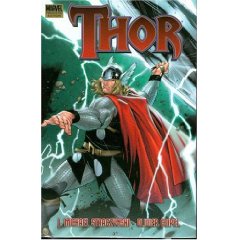
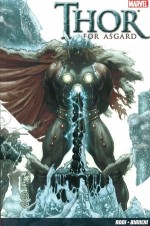
Thor: For Asgard


By Robert Rodi & Simone Bianchi (Marvel/Panini UK)
ISBN: 978-1-84653-482-9

Once again a major motion picture adaptation has generated a host of supplemental comics product and as Thor thunders onto silver screens everywhere there’s plenty for established fans and freshly-interested parties to grapple with…

In this effective and beautiful re-imagining by Robert Rodi, illustrated with astounding imagination and beauty (if not always the greatest narrative or sequential clarity) by Simone Bianchi, the long dreaded Twilight of the Gods has begun and cracks are beginning to show in the heroic façade of the noble and mighty Asgardians…

Reprinting the six-issue miniseries published in 2010 under the Marvel Knights imprint the saga opens in the second icy year of the dread Fimbulwinter, with the shining god Balder long dead, all-father Odin long missing and Thor as Regent.

A better warrior than ruler Thor leads an embattled, increasingly contentious and disgruntled populace in punitive forays against old enemies such as the Frost Giants. All around them former vassal states are stretching long unused muscles and airing old grievances and his two closest advisors are at constant odds with each other…

With the snowy streets of Asgard awash with resentment, if not outright sedition, Idunn informs the out-of-his-depth Thunderer that the Golden Apples – source of immortality – are almost gone and with Spring and Summer banished, no more will grow.

Asgard’s enemies are gathering, led by a secret mastermind, Odin’s mysterious mission has gone awry and, in the gleaming city, mutterings have become desperate, traitorous acts. With even Valhalla, the glorious Hall of the Dead, threatened, and now murder in the streets, Thor needs all his powers to help him, but even his faithful magic mallet has betrayed him: it has been long indeed since the Prince of Asgard was worthy enough to wield the Hammer of the Gods…

With chaos and destruction all around can the hard-pressed Thor hold things together or would the truly heroic thing be to let Ragnarok come and start fresh amid the ruins…?

Bleak, subtly allegorical and utterly enchanting, this moody epic of endings and new beginnings is a powerful tale of a deftly different pantheon that will delight newcomers to the character but possibly irritate long-term Marvelites.

Moreover, by ending on a foreboding note – completists should take heed – the tale is not completely done and there may be more to follow…

™ and © 2010 & 2011 Marvel Entertainment LCC and its subsidiaries. All rights reserved. A British edition released by Panini UK Ltd.

Essential Thor volume 3


By Stan Lee, Jack Kirby, & various (Marvel)
ISBN: 978-0-7851-2149-7

Whereas the rapidly proliferating Marvel Universe grew ever more interconnected as it matured with the assorted superheroes literally tripping over each other as they contiguously and continually saved the world from their New York City bases, the Asgardian heritage of Thor and the soaring imagination of Jack Kirby increasingly pulled the Thunder God away from mortal realms into stunning new landscapes.

Admittedly the son of Odin would pop back for an adventure or two, but it is clear that for Kirby, Earth was just a nice place to visit whilst the stars and beyond were the right and proper domain of the Asgardians and their foes.

Crippled doctor Donald Blake took a vacation in Norway only to stumble into an alien invasion. Trapped in a cave, he found an old walking stick, which when struck against the ground turned him into the Norse God of Thunder! Within moments he was defending the weak and smiting the wicked. Months swiftly passed with the Lord of Storms tackling rapacious extraterrestrials, Commie dictators, costumed crazies and cheap thugs, but these soon gave way to a vast kaleidoscope of fantastic worlds and incredible, mythic menaces.

Soon each issue also carried a spectacular back-up series. Tales of Asgard – Home of the Mighty Norse Gods gave Kirby space to indulge his fascination with legends and allowed both complete vignettes and longer epics (in every sense of the word).

This third mind-boggling monochrome collection, encapsulating the absolute zenith of the fantastic feature, reprints Mighty Thor #137-166, spanning February 1967 to July 1969, as a new era dawned for the no-longer Earthbound Thunder God. At the end of the previous volume Thor had just lost his human paramour Jane Foster, but rediscovered his childhood sweetheart, the goddess Sif, now all grown up and a fierce warrior maid to boot.

A good thing too, since ‘The Thunder God and the Troll!’ (by Stan Lee, Jack Kirby & Vince Colletta) which introduced the bestial menace of Ulik saw open warfare begin between the Asgardians and their implacable troglodytic foes. During spectacular carnage and combat Sif was captured and the Thunderer rushed to Earth to rescue her, whilst legions of monstrous subterraneans attacked the very heart of the kingdom…

The Tales of Asgard feature was being gradually wrapped up, but still offered Kirby a place to stretch his creative muscles. ‘The Tragedy of Hogun!’ (Lee, Kirby & Colletta) began revealing the gripping history of the dour warrior in an Arabian Nights pastiche which introduced Mogul of the Mystic Mountain.

In ‘The Flames of Battle!’ Thor was reunited with Sif but deprived of his magical mallet, courtesy of exotic technology the trolls had mysteriously developed. Did the malign invaders have a new ally or a terrifyingly powerful slave? Trapped on Earth, the hammerless Thor had no means of returning to the realm beyond the Rainbow Bridge whilst in Asgard, the war went badly and the heroic gods were close to defeat…

‘The Quest for the Mystic Mountain!’ found Hogun and his comrades edging closer to revelation and vengeance, which culminated in a truly stunning Kirby spectacle in #139 as the wandering warriors discovered ‘The Secret of the Mystic Mountain!’ in the Tales of Asgard segment whilst the lead story ‘To Die Like a God!’ wrapped up the Troll War in eye-popping style as Thor and Sif invaded the bowels of the Earth to save the day…

Thor #140 began a short run of compete, single episode tales heavy on action, starting with ‘The Growing Man!’ as Thor headed back to Earth and discovered New York under attack by a synthetic warrior who grew larger and stronger with every blow struck against him. Time travelling marauder Kang the Conqueror was behind the Brobdignagian brute, whilst in the back-up ‘The Battle Begins!’ Hogun and friends were menaced by a terrifying genie.

In #141 Thor faced ‘The Wrath of Replicus’, a bombastic, bludgeoning epic involving gangsters, alien and super-robots, counter-pointed by stunning fantasy as the wandering Asgardian warriors met ‘Alibar and the Forty Demons!’

‘The Scourge of the Super Skrull!’ pitted Thunder god against an alien with all the powers of the Fantastic Four, whilst in Asgard a new menace was investigated by Sif and the indomitable Balder. The back-up saw Kirby’s seamless melange of myth and legend go into overdrive as ‘We, Who are About to Die…!’ found young Thor and the Warriors Three facing all the mystic menaces of Mogul.

Thor #143 opened another extended epic with ‘…And, Soon Shall Come: the Enchanters!’ (inked by the magnificent Bill Everett) as Sif and Balder found a deadly trio of wizards plotting to overthrow All-Father Odin, only to fall prey to their power. Escaping to Earth they link up with the thunderer, but they have been followed… Everett also inked the Tales of Asgard instalment ‘To the Death!’ as comic relief Volstagg took centre stage…

Colletta return as inker with ‘This Battleground Earth!’, where two Enchanters attacked whilst the third duelled directly with Odin in the home of the gods. At the back the Mogul declared ‘The Beginning of the End!’

At the height of the battle in the previous issue Odin had withdrawn all the powers of his Asgardian followers, leaving Sif, Balder and Thor ‘Abandoned on Earth!’ Victorious, the All-Father then wanted his subjects home, but his son again chose to stay with mortals, driving Odin into a fury. Stripped of his magical abilities, alone hungry and in need of a job the once-god became embroiled with the Circus of Crime: hypnotised into committing an audacious theft…

The Tales of Asgard feature wrapped up in spectacular fashion with ‘The End!’, to be replaced in the next comicbook issue with the Inhumans – but as that’s a subject for a separate volume, the remainder of this chronicle is all-Norse action, beginning in #146 with ‘…If the Thunder Be Gone!’

Deprived of all but his natural super-strength Thor was helpless against the nefarious Ringmaster’s mesmerism and stole a life-sized, solid gold bull, but when the police interrupted the raid the hero awoke to find himself a moving target. Things got worse when he was arrested in ‘The Wrath of Odin!’ and left a sitting duck for the vengeance of his malign brother Loki. However, the god of Evil’s scheme was thwarted when Sif and Balder rushed to Thor’s rescue, provoking Odin to de-power and banish them all in ‘Let There be… Chaos!’

Even as all this high powered frenzy was occurring a brutal burglar was terrorising New York. The Wrecker was Public Enemy #1 and when he broke into the house where Loki was hiding the cheap thug achieved his greatest coup – intercepting a magic spell from the formidable Norn Queen intended to restore the mischief maker’s evil energies. Now charged with Asgardian forces the Wrecker went on a rampage with only the weakened Thor to resist him…

Issue #149 entered new territory with ‘When Falls a Hero!’ as, after a catastrophic combat the Wrecker killed Thor. ‘Even in Death…’ found the departed Thunder God facing Hela, Goddess of Death, whilst Balder and Sif hunted the Norn Queen and Loki. Hoping to save her beloved Sif entered into a devil’s bargain and surrendered her soul to animate the Destroyer, an unstoppable war-machine, unaware that the Thunderer had already convinced Death to release him…

‘…To Rise Again!’ saw the Destroyer, fresh from crushing the Wrecker, turn on the resurrected Thor as Sif was unable to communicate with or overrule the death machine’s pre-programmed need to kill. The situation was further muddled when Odin arbitrarily restored Thor’s godly might, prompting the Destroyer to go into lethal overdrive…

Meanwhile in the wilds of Asgard, Ulik the Troll attacked Karnilla, Queen of the Norns and Balder offered to be her champion if Sif was freed from the Destroyer…

‘The Dilemma of Dr. Blake!’ reached an epic turning point as Thor joined his lost companions to battle Ulik, only to lose his newly re-energised hammer to Loki, who fled to Earth with it. In hot pursuit the heroes followed and Sif was gravely wounded in ‘…But Dr. Blake Can Die!’ wherein Thor reverted to his mortal guise and operated on the dying goddess – an opportunity for further attack Loki could not resist, but which courage and ingenuity managed to frustrate…

A kind of order was restored but soon threatened again in Thor #154 when the vanquished Ulik accidentally released an ancient unstoppable beast in ‘…To Wake the Mangog!’

A creature imprisoned by Odin in his ancient prime, the monster now rampaged towards the heart of Asgard to trigger Ragnarok in ‘Now Ends the Universe!’ laying waste to everything in its path. All the Golden Realm’s resources were unable to slow its deadly progress in ‘The Hammer and the Holocaust!’ but the valiant delaying tactics, depicted in unimaginably powerful battles scenes from Kirby – a genius on fire – resulted in a last-minute save in #157’s ‘Behind Him… Ragnarok!’

The peculiarities of the Don Blake/Thor relationship were examined and finally clarified next; beginning with ‘The Way it Was!’ – a framing sequence by Lee, Kirby & Colletta that book-ended  the very first Thor story ‘The Stone Men of Saturn’ (inked by Joe Sinnott). This neatly segued into ‘The Answer at Last!’ which took the immortal hero back to his long-distant youth and finally revealed Blake was no more than a Odinian construct designed to teach the Thunder God humility and compassion…

With his true identity re-established Thor then answered a call from the Colonisers of Rigel, plunging into the depths of space to face a cosmic menace. ‘And Now… Galactus!’ reintroduced old companion the Recorder and pitted the Eater of Worlds against the living Planet Ego, a clash concluded with the Thunderer’s aid in ‘Shall a God Prevail?’ The Cosmic wonderment then escalated in ‘Galactus is Born!’ as Asgardian magic finally revealed a tantalising fragment of the space god’s origins…

For #163 and 164 Thor was returned to Earth to battle an invasion from the future. ‘Where Demons Dwell!’ found the recuperating Sif investigating a bizarre energy vortex until captured by mutate monsters controlled by the rogue Greek god Hades. Reunited with Thor the pair decimated the horrors from tomorrow ‘Lest Mankind Fall!’ and as Balder joined them in cataclysmic combat a mysterious cocoon hatched a man-made God…

‘Him!’ (Thor #165) and its conclusion ‘A God Berserk!’ close this hugely enjoyable collection in fine style as the creature created by evil scientists to conquer mankind and who would eventually evolve into the tragic cosmic savior Adam Warlock (as seen in Essential Fantastic Four volume 4) woke amidst the turmoil of the battle and seeing Sif, decided it was time he took a mate…

Trailing the naive superhuman Balder witnessed Thor’s descent into brutal “warrior-madness”, and as this volume ends with a shaken, penitent Thunder God eager to pay penance for his unaccustomed savagery, the best and last of Kirby’s Asgardian adventures still remain as part of the next collection.

More than any other Marvel strip Thor was the feature where Jack Kirby’s creative brilliance matched his questing exploration of an Infinite Imaginative Cosmos: dreaming, extrapolating and honing a dazzling new kind of storytelling graphics with soul-searching, mind-boggling concepts of Man’s place in the universe.

The Kirby Thor is a high-point in graphic fantasy and all the more impressive for their sheer timeless readability. These tales are an absolute must for all fans of the medium.
© 1967, 1968, 1969, 2006 Marvel Characters, Inc. All Rights Reserved.

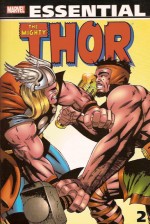
Essential Thor volume 2


By Stan Lee, Jack Kirby, & various (Marvel)
ISBN: 978-0-7851-3381-0

Even more than the Fantastic Four The Mighty Thor was the arena in which Jack Kirby’s creative brilliance blended with his questing exploration of an Infinite Imaginative Cosmos: dreaming, extrapolating and honing a dazzling new kind of storytelling graphics with soul-searching, mind-boggling concepts of Man’s place in the universe.

His unforgettable string of pantheons began in a modest little fantasy title called Journey into Mystery where, in the summer of 1962 a tried-and-true comicbook concept (feeble mortal transformed into God-like hero) was employed by the fledgling Marvel Comics to add a Superman analogue to their growing roster of costumed adventurers. This gloriously economical monochrome tome re-presents the end of that catch-all title as the Asgardian’s increasingly popular exploits saw the title become The Mighty Thor.

Gathered here are Journey into Mystery issues #113-125 plus the Annual for 1965, and without breaking stride, Thor #126-136 and the 1966 Annual, all in clean, crisp black and white for your delectation.

Lonely, crippled American doctor Donald Blake took a vacation in Norway only to encounter the vanguard of an alien invasion. Trapped in a cave, Blake found a gnarled old walking stick, which when struck against the ground turned him into the Norse God of Thunder!

Within moments he was defending the weak and smiting the wicked. As the months swiftly passed the rapacious extraterrestrials, Commie dictators, costumed crazies and cheap thugs gradually gave way to a vast panoply of fantastic worlds and incredible, mythic menaces. By issue #113, the magnificent warrior’s world of Asgard was a regular milieu for the hero’s adventures, and in ‘A World Gone Mad!’ by Stan Lee, Kirby and Chic Stone, the Thunderer, after saving the Shining Realm from invasion, once more defied his father Odin to romantically pursue the mortal nurse Jane Foster – a task made rather hazardous by the return of the petrifying villain Grey Gargoyle.

A long-running plot strand – almost interminably so – was the soap-opera tangle caused by Don Blake’s love for his nurse – a passion his alter ego shared. Sadly the Overlord of Asgard refused to allow his son to love a mortal, which acrimonious triangle provided many attempts to humanise and de-power Thor, already a hero few villains could cope with.

These issues also carried a spectacular back-up series. Tales of Asgard – Home of the mighty Norse Gods gave Kirby space to indulge his fascination with legends and allowed both complete vignettes and longer epics (in every sense of the word). Initially adapted myths, these little yarns grew into sagas unique to the Marvel universe where Kirby built his own cosmos and mythology, underpinning the company’s entire continuity. Here he revealed ‘The Boyhood of Loki!’, scripted as ever by Lee and inked by Vince Colletta, a pensive, brooding taste of the villain to be.

JiM # 114, began a two-part tale that introduced a new villain of the sort Kirby excelled at, a vicious thug who suddenly lucked into overwhelming power. ‘The Stronger I Am, The Sooner I Die!’(Lee, Kirby & Stone) saw Loki imbue hardened felon Crusher Creel with the power to duplicate the strength and attributes of anything he touched, but before he was treated to ‘The Vengeance of the Thunder God’ (inked by Frank Giacoia as the pseudonymous Frankie Ray) we’re indulged with another Tale of Asgard‘The Golden Apples.’ Issue #115’s mini-myth was ‘A Viper in our Midst!’ with young Loki clandestinely cementing relations with the sinister Storm Giants – sworn enemies of the Gods.

A longer saga began in #116, as Colletta settled in as the regular inker for both lead and second feature. ‘The Trial of the Gods’ revealed more of fabled Asgard as Thor and Loki underwent a Trial by Combat, with the god of mischief cheating at every step, whilst ‘Into the Blaze of Battle!’ found Balder the Brave protecting Jane Foster whilst her godly paramour travelled to war-torn Vietnam seeking proof of his step-brother’s infamy. These tales were supplemented by the stellar novellas ‘The Challenge!’ and ‘The Sword in the Scabbard!‘ which saw Asgardian cabin-fever develop into a quest to destroy a threat to the mystic Odinsword, which unsheathing would destroy the universe…

Journey into Mystery #118’s ‘To Kill a Thunder God!’ ramped up the otherworldly drama as Loki, attempting to cover his tracks, unleashed an ancient Asgardian WMD – the Destroyer. When it damaged the mystic hammer of Thor and nearly killed the hero in ‘The Day of the Destroyer!’, the God of Mischief was forced to save his step-brother or bear the brunt of Odin’s anger. Meanwhile in Tales of Asgard the Quest further unfolded in ‘The Crimson Hand!’ and ‘Gather, Warriors!’ as a band of hand-picked Argonauts joined Thor’s flying longship in a bold attempt to forestall Ragnarok.

With the Destroyer defeated and Loki temporarily thwarted Thor returned to America ‘With My Hammer in Hand…!’ only to clash once more with the awesome Absorbing Man. However before that bombastic battle there’s not only the next instalment of the Asgardian Argonauts who boldly ‘Set Sail!’ but also the admittedly superb digression of Journey into Mystery Annual #1, wherein the God of Thunder fell into the realm of the Greek Gods for the landmark heroic hullabaloo ‘When Titan’s Clash! Thor vs. Hercules!’ This incredible action-epic is augmented here by a beautiful double-page pin-up of downtown Asgard – a truly staggering piece of Kirby magic.

The attack of the Absorbing Man resumed with ‘The Power! The Passion! The Pride!’ and seemed set to see the end of Thor: a cliffhanger somewhat assuaged by ‘Maelstrom!’ wherein the Argonauts of Asgard epically encountered an uncanny storm… In JiM #122 ‘Where Mortals Fear to Tread!’ the triumphant Crusher Creel was shanghaied by Loki to attack Asgard and Odin himself, an incredible clash that led to a cataclysmic conclusion ‘While a Universe Trembles!’ Meanwhile ‘The Grim Specter of Mutiny!’ invoked by seditious Loki was quashed in time for valiant Balder to save the Argonauts from ‘The Jaws of the Dragon!’ in the increasingly spectacular Ragnarok Quest.

With the threat to ended Thor returned to Earth to defeat the Demon, a witchdoctor empowered by a magical Asgardian Norn Stone left behind after the Thunder God’s Vietnamese venture. Whilst he was away Hercules was dispatched to Earth on a reconnaissance mission for Zeus. ‘The Grandeur and the Glory!’ began another extended story-arc and all-out action extravaganza, which bounced the Thunderer from bruising battle to brutal defeat to ascendant triumph.

Issue #125 ‘When Meet the Immortals!’ was the last Journey into Mystery: with ‘Whom the Gods Would Destroy!’ the comic was re-titled The Mighty Thor and the drama escalated unabated, culminating with ‘The Hammer and the Holocaust!’ In short order Thor crushed the Demon, seemingly lost his beloved Jane to Hercules, was deprived of his powers and subsequently thrashed by the Grecian Prince of Power but still managed to save Asgard from an unscrupulous traitor who had usurped Odin’s mystic might.

Meanwhile in the Tales of Asgard instalments the Questers homed in on the cause of all their woes. ‘Closer Comes the Swarm’ pitted them against the flying trolls of Thryheim, and ‘The Queen Commands’ saw Loki captured until Thor answered ‘The Summons!’, promptly returning the Argonauts to Asgard to be shown ‘The Meaning of Ragnarok!’

In all honestly these mini-eddas were, although still magnificent in visual excitement, becoming rather rambling in plot, so the narrative reset was neither unexpected nor unwelcome…

Instead of ending, the grandiose saga actually grew in scope with Thor #128 as ‘The Power of Pluto!’ introduced another major foe. The Greek God of the Underworld had tricked Hercules into replacing him in his dread, dead domain, just as the recuperated Thunder God was looking for a rematch, whilst in Tales of Asgard Kirby pulled out all the creative stops to depict the ‘Aftermath!’ of Ragnarok: for many fans the first indication of what was to come in the King’s landmark Fourth World tales half a decade later…

‘The Verdict of Zeus!’ condemned Hercules to the underworld unless he could find a proxy to fight for him, whilst at the back of the comic the assembled Asgardians faced ‘The Hordes of Harokin’ as another multi-chaptered classic began, but for once the cosmic scope of the lead feature eclipsed the little odysseys as ‘Thunder in the Netherworld!’ saw Thor and Hercules carve a swathe of destruction through an unbelievably alien landscape – the beginning of a gradual side-lining of Earthly matters and mere crime-fighting. Thor and Kirby were increasingly expending their efforts in greater realms than ours…

‘The Fateful Change!’ saw the younger Thunder God trade places with the Geghiz Khan-like Harrokin, whilst in issue #136, Thor defeated the invasion plans of Rigellian Colonizer Tana Nile in ‘They Strike from Space!’, but it was merely prologue for a fantastic voyage to the depths of space and a unique universal threat, whilst “Harokin” faced a dire dilemma in ‘The Warlock’s Eye!’.

Thor #132 found the Thunderer laying down the law on ‘Rigel: Where Gods May Fear to Tread!’ whilst ‘The Dark Horse of Death!’ arrived in the Tales of Asgard segment looking for its next doomed rider… The following issue is a Kirby Classic, as ‘Behold… the Living Planet!’ introduced the malevolent Ego, sentient world and master of the living Bio-verse, a stunning visual tour de force that threw one High Concept after another at Thor, his new artificial pal Recorder and the reeling readership, whilst Harokin’s saga ended in one last ride to ‘Valhalla!’

The threat of invasion over, Thor returned to Earth to search for Jane, finding her with ‘The People Breeders!’ – a hidden enclave where the geneticist High Evolutionary was instantly evolving animals into men. His latest experiment had created a lupine future-nightmare ‘The Maddening Menace of the Super-Beast!’ so it’s just as well the Thunder God was on hand. ‘When Speaks the Dragon!’ and ‘The Fiery Breath of Fafnir!’ pitted Thor and his Warriors Three comrades Fandral, Hogun and Volstagg against a staggering reptilian monstrosity: a threat finally quashed in #136’s ‘There Shall Come a Miracle!’

The lead story in that issue is a turning point in the history of Thor. ‘To Become an Immortal!’ saw Odin transform Jane Foster into a Goddess and emigrate to Asgard, but her frail human mind could not cope with the wonders and perils of the Realm Eternal and she was mercifully restored to mortality and all but written out of the series. Lucky for the despondent Thunder God the beauteous Warrior-Maiden Sif was on hand…

With this story Thor’s closest link to Earth was neatly severed: from now on his many adventures on Midgard were as a tourist or beneficent guest, not a resident. Asgard and infinity were now his true home, a situation quickly proved by the bombastic clash that closes this volume. ‘If Asgard Falls…’ is set in the Gleaming City during the annual Tourney of Heroes (and comes from The Mighty Thor Annual #2, 1966): a martial spectacular of outlandish armours and exotic weaponry that turned decidedly serious when the deadly Destroyer was unleashed amidst the wildly warring warriors…

These transitional Thor tales show the development not only of one of Marvel’s fundamental continuity concepts but more importantly the creative evolution of the greatest imagination in comics. Set your commonsense on pause and simply wallow in the glorious imagery and power of these classic adventures for the true secret of what makes graphic narrative a unique experience.

© 1965, 1966, 1967, 2008 Marvel Characters, Inc. All Rights Reserved.
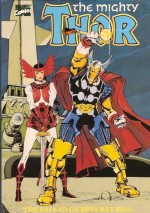
Mighty Thor: The Ballad of Beta Ray Bill

mighty-thor-the-ballad-of-beta-ray-bill
By Walter Simonson with John Workman & George Roussos (Marvel)
ISBN: 0-87135-614-7

For many older fans Thor was the comic that truly demonstrated the fevered and unfettered imagination of Jack Kirby – at least until he relocated to DC at the beginning of the 1970s and really let rip. Living galaxies, the conquest of Evolution: gods, heroes and aliens, machines with emotions and humans without, the strengths and liabilities of family ties and the inevitability of creation itself, all played out on the pages of the Thunder God’s action-packed comic-books.

After The King quit the series Thor floundered as everybody who followed laboured in the master’s largest shadow (and many in his style), but high points were few and inspiration was non-existent.

Until Walter Simonson arrived.

Or more accurately, returned, as he had for a brief while been one of those artists slavishly soldiering to rekindle Kirby’s easily synthesis of mythology, science fiction and meta-humanist philosophy, but with as little success as any other. When Simonson assumed the writing and drawing of the title in November1983 with issue #337, deeply invested in Kirby’s exploratory, radical visionary process, free to let loose and brave enough to bring his own vision to the character, he produced a body of work (#337-382 plus the Balder the Brave miniseries – and which can most easily be found in the Marvel Visionaries series of trade paperbacks) that actually moved beyond Kirby’s Canon and dragged the title out of a creative rut which allowed his own successors to actually introduce genuine change to a property that had stagnated for 13 years.

This particular volume is one of Marvel’s earliest trade paperback collections, with bold vibrant colours on good paper stock, and collects that first iconic story-arc from The Mighty Thor #337-340, which shook everything up and made the Thunder God a collectible sensation for the first time in a decade.

Moreover the entire tale is but the prologue to a stupendous larger epic which actively addresses the over-used dramatic device of the Doom of the Gods that had haunted this series since the mid-1960s…

The story revolves around a spell inscribed on Thor’s hammer and seen in the character’s very first appearance. When crippled Don Blake was first transformed into the Thunder God he saw on the magic mallet Mjolnir the legend “Whosoever holds this hammer, if he be worthy, shall possess the power of Thor…”

The saga begins when Blake is asked by super-spy outfit SHIELD to intercept a fleet of starships headed for Earth which refuel themselves by absorbing suns! Hurtling off into deep space the Storm God boards a vessel only to be defeated in combat by its alien protector, an artificially augmented warrior named Beta Ray Bill. Moreover, as they crash to Earth the alien somehow activates Mjolnir’s magic and transforms itself into a warped duplicate of Thor! And then Odin mistakes Bill for his son and whisks him to Asgard to defend the Realm Eternal from another monstrous threat!  And then…

Enough tomfoolery: suffice to say that the action and surprises pile one upon another as the alien reveals that he is the guardian of his people, the Korbinites, who are fleeing from a horde of demons that destroyed their civilisation and are hunting them to extinction. And now they’re heading towards Earth…

After the mandatory big fight Thor and Bill – each with his own hammer – team-up to investigate the demons, with confused love-interest Lady Sif along for the bombastic ride, and discover a threat to the entire universe. Worse yet, it’s generated by an Asgardian foe destined to defeat the Gods themselves on the Day of Ragnarok!

Brave, bold and occurring at a breakneck pace, with fresh concepts wedded to the most fundamental elements of Marvel mythology, this short appetizer is the perfect cosmic storm, infinitely rewarding and impossibly re-readable. Art, story, concept and design in perfect harmony – this is an unbeatable Marvel Tale…
© 1988 Marvel Entertainment Group Inc. All Rights Reserved.

Secret Invasion: Thor


By Matt Fraction & Doug Braithwaite (Marvel)
ISBN: 978-0-7851-3426-8

The Skrulls are shape-shifting aliens who’ve bedeviled Earth since Fantastic Four #2, and they have long been a cornerstone of the Marvel Universe. After decades of use and misuse the insidious invaders were made the stars of a colossal braided mega-crossover event beginning in April 2008 and running through all the company’s titles until Christmas.

The premise of Secret Invasion is simple: the would-be conquerors have undergone a mass religious conversion and upped their game. They are now utterly resolved and dedicated to make Earth their new homeworld. To this end they have gradually replaced a number of key Earth denizens – including superheroes. When the lid is lifted no defender of the Earth truly knows who is on their side…

Along with that the Skrulls have also unraveled the secrets of magic and superpowers, creating amped-up counterparts to Earth’s mightiest and set them loose to destroy the world’s heroic champions.

Broxton, Oklahoma, is a small simple community with some intriguing neighbours. Local doctor Don Blake is dealing with a problem pregnancy in town when a colossal fireball strikes and he discovers that an old friend has returned. Blake is the mortal host for the God of Thunder and the fiery impact signals the agonized return of his old comrade Beta Ray Bill, an alien hero who possesses power the equal of his own.

The alien is severely wounded: tortured and traumatized near to death, he was thrown to Earth as a warning. The Asgardians must leave the world immediately. If they fight for humanity or oppose the Skrulls they will be destroyed by the same power that shattered Beta Ray Bill…

And so begins another glorious classic of noble combat as the unstoppable invaders are resisted by the epitome of supernatural nobility in a tale of heroism, tragedy, sacrifice and redemption that is any fan’s wildest dream.

But…

This is an oh-so-nearly perfect superhero fun-fest that just misses because of – as is too often the case – editorial sloppiness or lazy thinking.

I was dubious when J. Michael Straczynski and Olivier Coipel revamped Thor but their thoughtful and fun reiteration which established the return of the Norse gods and the rebuilding of the hallowed city of Asgard in – or rather slightly above – the Oklahoma badlands proved an intriguing delight and a solid springboard for fresh wonderment.

Moreover the three-issue miniseries which comprises the Asgardly niche of the company-wide event is compellingly written and superbly illustrated – if only it were longer… I even adore the fact that to pad out the book the editors have included a pertinent 1967 Lee/Kirby Thor classic ‘The Scourge of the Super Skrull!’, from Thor #142, wherein the Son of Odin delivered a sound and spectacular trouncing to a shape-changing marauder with all the powers of the Fantastic Four, but Why on Earth would any editor also include that issue’s back-up strip as well?

Don’t get me wrong: ‘We who are about to Die…!’ is Kirby at his most creative and mythic. He’s revisiting the legends of the Arabian knights with a young Thor and the Warriors Three fighting Djinni, wizards, giants and a host of fantastic horrors.

But this is part 6 of a nine-chapter Tales of Asgard epic that is just plain bewildering seen in isolation. It is five pages of pictorial candy that needs to be in a whole collection of these brilliant fantasy back-ups, not sitting here uncomfortably out of place and generally unappreciated because someone couldn’t search the archives for something more appropriate and new-reader accessible. As there was still room for two text pages on Beta ray Bill why not just add similar pages on Skrulls and Super Skrull? An old Asgard adventure from Marvel Comics Presents? Even a pin-up or two?

Ranting aside: There’s too much competition for the leisure dollar – and £ – to risk alienating new readers even slightly and dedicated fans surely deserve a little regard for their years of service. With the incredible wealth of material sitting unseen and unused in those capacious comics vaults surely a little industry and creativity isn’t too much to ask?

© 2009 Marvel Publishing, Inc., a subsidiary of Marvel Entertainment, Inc.  All Rights Reserved.

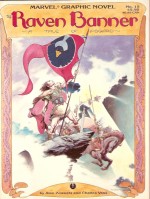
The Raven Banner – A Marvel Graphic Novel (#15)


By Alan Zelenetz & Charles Vess (Marvel)
ISBN: 0- 87135-060-2

It’s been a while since Marvel published an all-original graphic novel as opposed to a collection, but not too long ago they were the market leader in the field with an entire range of “big stories” told on larger than normal pages (285 x 220mm rather than the now customary 258 x 168mm) featuring not only proprietary characters but also licensed assets like Conan and even creator-owned properties like Jim Starlin’s Dreadstar.

From the cod mythology of Marvel’s bowdlerized Aesir Alan Zelenetz and Charles Vess crafted this beautiful fairytale/fable that would not be out of place amongst the true Elder Eddas. Merry Marvelites will be enthralled by the inclusion of Balder the Brave as well as cameos by such Asgardian stalwarts as Thor and Hogun, Fandral and Volstagg – the Warriors Three – but the true story of honour lost and redeemed in the name of eternal glory belongs to the young wastrel Greyval Grimson who forsook his duty and paid the proper price.

Asgard is land of warrior gods constantly confronting monstrous evil, but Storm Giants, witches and dark elves can never triumph as long as heroes battle beneath the flowing Raven Banner. As long as the standard bearer holds it high, victory is assured, although its ancient magic demands the death of the bearer every time. But when the eternal enemies clash upon the Plain of Ida and Grim Magnus fulfills his fated task, for the first time his successor is not there to take up the perilous pennon. Where is the dying warrior’s son?

Greyval Grimson, although wed to Sygnet the Valkyrie Shield-Maiden, is still a flighty lad, full of joy and keen on merriment. As the Banner is torn from his father’s dying grasp the boy is dancing drunk with the treacherous trolls. Seduced from his duty, he is yet unaware that his negligence has not only lost him a father but also imperiled the entire kingdom of the Gods…

The penitent boy’s quest to regain the Raven Banner and his own true self is an unparalleled, magical tale of heroism, as accompanied by Balder and the fuzzy but querulous Oddbrand, the Otter God, he strives to overcome not only the assembled forces of Death and Evil, but also the overbearing ambition of a fellow Asgardian, whose head has been turned by dreams of unearned fame…

This tale of triumph and tragedy is a perfect blend of Marvel’s Norse Gods and the classical legends that inspired them; stirring and beguiling by turns and painted with astounding facility by Vess in full, acknowledged tribute to the works of Arthur Rackham and Hal Foster. It is a magnificent piece of storytelling and I simply cannot understand why such a universally appealing work is not permanently in print. Track a copy down, and see what I mean…
© 1985 Marvel Comics Group. All Rights Reserved.

Thor


By J. Michael Straczynski, Olivier Coipel & Mark Morales (Marvel)
ISBN: 978-0-7851-1722-3

I’m always a little dubious about high-profile, big-name relaunches, coming as I do from that curmudgeonly old school which believes that “there are no bad characters”, “Iconoclasm isn’t Creativity” and especially “Famous doesn’t mean Good”.

So it’s rather refreshing to be able to say that the newest incarnation of Marvel’s God of Thunder is a delightfully good read. Collecting issues #1-6 of the monthly comicbook it finds all the entities of Asgard dead and gone (see Avengers Disassembled: Thor, ISBN: 978-0-7851-1599-1 for the startling details) until a mysterious voice summons Thor back to life – and Earth (us fans call it Midgard) – in a crack of spectacular thunder. Revived for an unspecified purpose the solitary Lord of Asgard sets about retrieving the souls of his fellow godlings, scattered and hidden inside human hosts – or perhaps incubators?

There’s a welcome reappearance and significant role for Thor’s early alter-ego Don Blake when the Thunderer rebuilds Asgard in the wilds of Oklahoma and plenty of action as the immortal hero adapts to a world that has radically changed since his demise. Even with cataclysmic battles against former ally Iron Man and the Dread Demolisher, plus a radical new look for the hero’s oldest and most implacable foe, the real joy here is the savvy script, especially the interactions between the resurrected gods and their new neighbours the ordinary folks of Broxton, Oklahoma,.

Beautiful to look at, engagingly written and with a welcome dose of political intrigue and social commentary, this “cosmic comic” has a lot of earthy resonance to balance the scope of its own mythology and, despite ending on an annoying cliffhanger, is a book to recommend to complete neophytes as well as dedicated fans. If you’ve never seen Thor before, you should now…

© 2007, 2008 Marvel Publishing, Inc., a subsidiary of Marvel Entertainment, Inc.  All Rights Reserved.

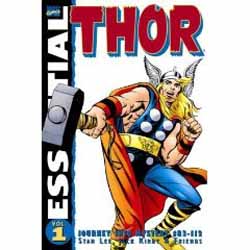
Essential Thor volume 1

Essential Thor
Essential Thor

By Stan Lee, Jack Kirby & various (Marvel)
ISBN 0-7851-1866-7

Even more than the Fantastic Four The Mighty Thor was the arena in which Jack Kirby’s restless fascination with the Cosmic was honed and refined in dazzling graphics and captivating concepts. His string of pantheons began with a modest little fantasy title called Journey into Mystery where in the summer of 1962 a tried-and-true comicbook concept (feeble mortal transformed into God-like hero) was employed by the fledgling Marvel Comics to add a Superman analogue to their growing roster of costumed adventurers. This gloriously economical tome represents those Asgardian exploits from JiM #83-112 in clean crisp black and white for your delectation.

Journey into Mystery #83 (cover-dated August 1962) featured the tale of crippled American doctor Donald Blake who takes a vacation in Norway only to encounter the vanguard of an alien invasion. Fleeing he is trapped in a cave where he finds an old, gnarled walking stick. When in his frustration he smashes the cane into a huge boulder obstructing his escape, his puny frame is transformed into the Norse God of Thunder, the Mighty Thor! Plotted by Stan Lee, scripted by Larry Lieber and illustrated by Kirby and Joe Sinnott (at this juncture a full illustrator, Sinnott would become Kirby’s primary inker for his Marvel career) ‘The Stone Men of Saturn’ is pure early Marvel, bombastic, fast-paced, gloriously illogical and captivatingly action-packed. The hugely under-appreciated Art Simek was the letterer and logo designer.

They were making it up as they went along – not in itself a bad thing – and the infectious enthusiasm shows in the next adventure ‘The Mighty Thor Vs. the Executioner’, a “commie-busting” tale of its time with a thinly disguised Fidel Castro wasting his formidable armies in battle against our hero. Dr. Blake’s nurse Jane Foster was introduced, a bland cipher adored from afar by the timid alter-ego of mighty hero. The creative team settled as Dick Ayers replacing Sinnott, and with #85’s ‘Trapped by Loki, God of Mischief!’ the last element fell into place with the introduction of a suitably awesome arch-foe; in this case a half-brother evil magician. We also saw a new world revealed with the first hints and glimpses of the celestial otherworld and more Nordic gods.

Issue #86 introduced another recurring villain. Zarrko, bristling at the sedentary ease of 23rd century life, travelled to our time to steal an experimental “C-Bomb” forcing the God of Thunder into a stirring chase through time and battle with super-technology ‘On the Trail of the Tomorrow Man!’, whilst on his return Don Blake became a target for Soviet abductors. Those sneaky spies even managed to make Thor a ‘Prisoner of the Reds!’

‘The Vengeance of Loki’ saw the god of Evil’s flamboyant, bombastic return in #88, but ‘The Thunder God and the Thug’ was an adventure with a much more human scale as a gang boss runs riot over the city and roughshod over a good woman’s heart, giving the Asgardian a chance to demonstrate a more sophisticated and sympathetic side. Issue #90 was a total surprise to fans as the grandeur of Kirby and Ayers was replaced by the charming but drama-free art of Al Hartley, who illustrated a stock invasion tale of shape-changing aliens. ‘Trapped by the Carbon-Copy Man’ was followed a month later by ‘Sandu, Master of the Supernatural!’, with Joe Sinnott handling all the art, in a thriller starring a carnival mentalist augmented by Loki’s magic who comes close to killing our hero.

Sinnott also drew #92’s ‘The Day Loki Stole Thor’s Magic Hammer’ scripted by Robert Bernstein over Lee’s plot which moved the action fully to the mythical realm of Asgard for the first time as the hero sought to recover his stolen weapon. Kirby and Ayers returned for the Cold War thriller ‘The Mysterious Radio-Active Man!’, again plotted by Bernstein, as Mao Tse Tung unleashes an atomic assassin in retaliation for Thor thwarting China’s invasion of India. Such “Red-baiting” was common in early Marvel titles, but their inherent jingoistic silliness can’t mar the eerie beauty of the artwork. With this tale the rangy raw-boned Thunder God completed his slow metamorphosis into the husky, burly blonde bruiser that dominated any panel he was drawn in.

Sinnott illustrated the next three adventures ‘Thor and Loki Attack the Human Race!’, ‘The Demon Duplicator’ and ‘The Magic of Mad Merlin!’, but these mediocre tales of amnesia, evil doppelgangers and ancient menaces were the last of a old style of comics. Stan Lee took over the scripting with the Journey into Mystery #97 and action wedded to melodrama produced a fresh style for a developing readership.

‘The Lava Man’ was again drawn by Kirby, with the subtly textured inking of Don Heck adding depth to the tale of an invader from the subterranean realms, as a long running rift with Thor’s father Odin was established when the Lord of Asgard refused to allow his son to love the mortal Jane Foster. This acrimonious triangle was a perennial sub-plot that fuelled many attempts to humanise Thor, because already he was a hero too powerful for most villains to cope with. This issue was also notable for the launch of a spectacular back-up series. ‘Tales of Asgard – Home of the mighty Norse Gods’ gave Jack Kirby a space to indulge his fascination with legends. Initially adapting classic tales but eventually with all-new material particular to the Marvel pantheon, he built his own cosmos and mythology, which underpinned the company’s entire continuity. This first saga, scripted by Lee and inked by George Bell (AKA George Roussos) outlined the origin of the world and the creation of the World Tree Yggdrasil.

‘Challenged by the Human Cobra’ introduced the serpentine villain (bitten by a radioactive Cobra, would you believe?) in a tale by Lee and Heck, whilst Kirby, with them in attendance contributed ‘Odin Battles Ymir, King of the Ice Giants!’ a short but potent fantasy romp which presaged the cosmic wonderment of years to come. The same format held for issues #99 and #100, where the main story (the first two-part adventure in the run) introduced the bestial ‘Mysterious Mister Hyde’, and concluding ‘The Master Plan of Mr. Hyde!’ dealt with a contemporary super-villain Kirby produced ‘Surtur the Fire Demon’ and latterly (with Vince Colletta inks) ‘The Storm Giants – a tale of the Boyhood of Thor’. As always Lee scripted this increasingly influential comicbook.

JIM #101 saw Kirby finally assume complete control of the pencilling on both strips. ‘The Return of Zarrko, the Tomorrow Man’ sees Odin halve Thor’s powers for disobedience just as the futuristic felon abducts the Thunder God to help him conquer the 23rd century. Anther two-parter (the first half inked by Roussos), it was balanced by another exuberant tale of the boy Thor. ‘The Invasion of Asgard’ sees the valiant lad fight a heroic rearguard action that introduced a host of future villainous mainstays. ‘Slave of Zarrko, the Tomorrow Man’ is a tour de force epic conclusion most notable for the introduction of Chic Stone as inker. To many of us oldsters, the clean full brush lines make him The King’s best embellisher ever. This triumphant epic is balanced by the brooding short ‘Death Comes to Thor!’ as the young hero faces his greatest challenge yet. Two females that would play huge roles in his life were introduced in this brief 5-pager, the young Goddess Sif and Hela, Queen of the dead.

On a creative roll, Lee Kirby and Stone next introduced ‘The Enchantress and the Executioner’ ruthless renegade Asgardians in the front of JIM #103 and in ‘Thor’s Mission to Mirmir’ revealed how the gods created humanity, which lead to a revolutionary saga ‘Giants Walk the Earth’ in the next issue. For the first time Kirby’s imagination was given full play as Loki tricked Odin into visiting Earth, only to release ancient foes Surtur and Skagg, the Storm Giant from Asgardian bondage.

This cosmic saga saw noble gods stride the Earth battling demonic evil in a new Heroic Age, and the greater role of the Norse supporting cast was reinforced by a new Tales of Asgard strand focussing on individual Gods and Heroes. Heimdall the Sentry was first, with Don Heck inking. Issue #105-106 saw the teaming of two old foes in ‘The Cobra and Mr, Hyde’ and ‘The Thunder God Strikes Back’, another continued story packed with tension and spectacular action, which showed that Thor was swiftly growing beyond the constraints of traditional single story adventures. The respective back-ups ‘When Heimdall Failed!’ (Lee, Kirby, Roussos) and ‘Balder the Brave’ (Lee, Kirby, Colletta) further fleshed out the back-story of an Asgardian pantheon deviating more and more from the classical Eddas and Sagas kids had to plough through in schools.

JIM #107 introduced another major villain in ‘When the Grey Gargoyle Strikes’, a rare tale that highlighted the fortitude of Don Blake rather than the Thunder God, who was increasingly reducing his own alter-ego to an inconsequentiality, and the Norn Queen debuted in the quirky reinterpretation of the classic tale ‘Balder Must Die!’ illustrated by Kirby and Colletta. After months of manipulation the God of Evil once again took direct action in ‘At the Mercy of Lokj, Prince of Evil!’ With Jane a helpless pawn to Asgardian magic the willing help of new Marvel star Doctor Strange made this a captivating team-up to read, whilst ‘Trapped by the Trolls’ (inked by Colletta) showed the power and promise of tales set solely on the other side of the Rainbow Bridge. Issue #109 was another superb adventure masquerading as a plug for another new series. ‘When Magneto Strikes!’ pitted Thor against the X-Men’s greatest foe in a cataclysmic clash, but you couldn’t actually call it a team-up as the heroic mutants were never seen. The teasing hints and cropped glimpses are fascinating teasers now, but the kid I was annoyed not to have seen these new heroes. Oh… maybe that was the point?

The young Thor feature ‘Banished from Asgard’ is uncharacteristically lacklustre but the concluding part ‘The Defeat of Odin!’ in JiM #110 makes up for the silly plot with breathtaking battles scenes. The lead story in that issue is ‘Every Hand Against Him’ as Loki, the Cobra and Mr. Hyde kidnap Jane as Odin once again over-reacts to Thor’s affections for the mortal girl. The concluding part ‘The Power of the Thunder God’ features a major role for Balder the Braver, further integrating the “historical” and contemporary Asgards in a spellbinding saga of triumph and near-tragedy, whilst the Tale of Asgard co-opts a Greek myth (Antaeus if you’re asking) for ‘The Secret of Sigurd’.

This wonderfully economical black-and white compendium closes with the contents of Journey into Mystery #112. ‘The Mighty Thor Battles the Incredible Hulk!’ is a glorious gift to all those fans who perpetually ask “Who’s stronger…?” Possibly Kirby and Stone’s finest artistic moment, it details a private duel between the two super-humans that occurred during a free-for-all between The Avengers, the Sub-Mariner and the eponymous Green Goliath. The raw power of that tale is followed by ‘The Coming of Loki’, a retelling of how Odin came to adopt the baby son of Laufey, the Giant King.

These early tales of the God of Thunder show the development not only of one of Marvel’s fundamental story concepts but more importantly the creative evolution of one of the greatest imaginations in comics. Set your commonsense on pause and simply wallow in the glorious imagery and power of these classic adventures for the true secret of what makes graphic narrative a unique experience.

© 1962, 1963, 1964, 2005 Marvel Characters, Inc. All Rights Reserved.