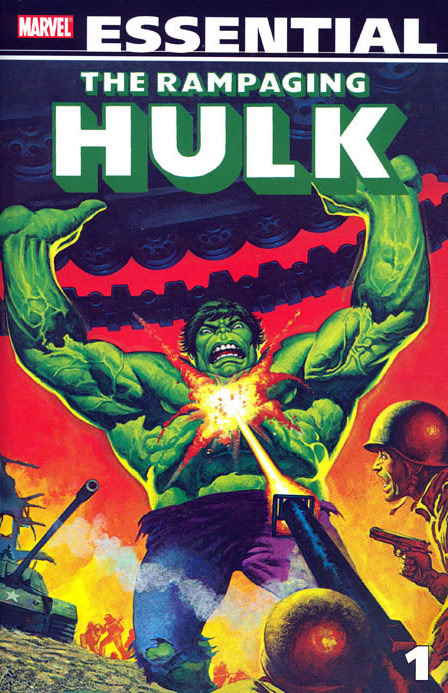
Essential Rampaging Hulk volume 1


By Doug Moench, John Warner, Walter Simonson, Alfred Alcala, Alex Niño, Jim Starlin, Keith Pollard, Tony DeZuñiga, Herb Trimpe, Sal Buscema, Ron Wilson, Bill Sienkiewicz, Rudy Nebres, Bob McLeod & various (Marvel)
ISBN: 978-0-7851-2699-7 (TPB)

The Incredible Hulk was Marvel’s second “superhero” title, although technically Henry Pym debuted earlier in a one-off yarn in Tales to Astonish #27 (January 1962). However, he didn’t become a costumed hero until the autumn, by which time Ol’ Greenskin was not-so-firmly established.

The Hulk crashed right into his own comic book and – after some classic romps by Young Marvel’s finest creators – crashed right out again. After six bi-monthly issues the series was cancelled and Lee retrenched, making the man-monster a perennial guest-star in Marvel’s other titles (Fantastic Four #12, Amazing Spider-Man #14, The Avengers from #1 and so forth) until such time as they restarted his own exploits in the new “Split-Book” format. The Jade Giant landed in Tales To Astonish where Ant/Giant-Man was rapidly proving to be a character who had outlived his time.

It all began in The Incredible Hulk #1 (cover-dated May 1962) which saw puny atomic scientist Bruce Banner sequestered on a secret military base in the desert, and perpetually bullied by bombastic commander General “Thunderbolt” Ross as the clock counted down to the world’s first Gamma Bomb test. Besotted by Ross’s daughter Betty, Banner endured the General’s constant jibes as the clock ticked on and tension increased. During the final countdown, Banner spotted a teenager lollygagging at Ground Zero and frantically rushed to the site to drag the boy away…

Rick Jones was a wayward but good-hearted kid. After initial resistance he let himself be pushed into a safety trench, but just as Banner was about to join him The Bomb detonated…

Miraculously surviving the blast, Banner and the boy were secured by soldiers, but that evening as the sun set the scientist underwent a monstrous transformation. He grew larger and his skin turned a stony grey…

In six simple pages that’s how it all started, and no matter what any number of TV, movie or comic book retcons and psycho-babble re-evaluations would have you believe, it’s still the best and most primal take on the origin. A good man, an unobtainable girl, a foolish kid, an unknown enemy and the horrible power of destructive science unchecked. It was clearly also the idea for a later iteration where continuity was rolled right back to the era of the first run: set in the Sixties and revealing previously “untold tales”…

In December 1976 that’s how the retrospective spin-off series began. Now a literal and figurative Marvel powerhouse, the Jade Juggernaut was awarded a monochrome magazine free of Comics Code supervision to augment his many in-continuity appearances. The Rampaging Hulk took the controversial tack of telling stories of what Banner, Jones and the Big Guy did next during the further formation of the nascent Marvel Universe…

Keeping up the theme, early issues featured tales of monster-hunter Ulysses Bloodstone, but you’ll need to look elsewhere for them…

The Hulk stories were set in 1963, after his own first series foundered, and – following a terse retelling of the classic origin cited above – scripter Doug Moench and illustrators Walt Simonson & Alfredo Alcala channelled primal Jack Kirby via a rather heavy grey-tone wash in a wild yarn of flying saucer sightings over Rome. The portentous sightings heralded invasion and, by also referencing the company’s early Sixties monster mag triumphs, the second-generation creators tacitly acknowledged their target audience: a supposedly older magazine readership who were presumably many of the same kids who had bought the original fantasy masterpieces…

Moench’s scripts and tone were wryly tongue-in-cheek, offering constant visual and verbal comedic touches whilst channelling early Marvel continuity and the tropes of the Sixties, if only as seen from the distant perspective of ten years after…

The magazine phenomenon had only a minor impact and effect on the Hulk’s four-colour adventures at that time, but, as always, the fury-fuelled fugitive was alternately aided or hunted by General Ross and met a variety of guest-star heroes and villains…

Opening gambit ‘The Krylorian Conspiracy’ saw Banner and Jones teaming up with alien rebel Bereet: a pacifist techno-artist hiding on Earth and seeking to prevent her bellicose shape-shifting people conquering humanity. The militaristic, monster-obsessed Krylorians – having failed to recruit the Gamma Goliath – attack Rome whilst enlisting the aid of The Hulk’s first super-foe: renegade Russian mutant The Gargoyle. Of course, they intend to betray him at the first opportunity…

It all ends up in a colossal clash with lots of spectacular smashing, with Bereet, Jones, Banner and The Hulk all resolved to stop the invasion at any cost…

Embellisher Alcala switched to a drybrush technique for the second issue as ‘And Then… The X-Men’ finds the wanderers in Paris, contesting more Krylorian shapeshifters, robots and crazy creatures, and subsequently attracting the attention of a certain band of mutant hunting teenagers. After the customary violent misunderstandings, the clandestine outsiders join forces with the Hulk to stop the razing of the City of Lights…

Another early foe returned as #3 shifted the action to the South of France where ‘The Monster and the Metal Master’ sees the treacherous Krylorians dupe and exploit another alien – a manic metal-moulding malcontent who appeared in the last issue of the original Hulk comic – into piloting their new weapon (“The Ferronaut”), whilst Rick, Bruce and Bereet seek to save little boy Spirou from being abused by his guardian and hotel-running employer. When they also find the invaders, all hell breaks loose and another Krylor base gets rocked to rubble…

The Rampaging Hulk #4 diverts from the overarching plot arc as Jim Starlin & Alex Niño take the tormented Green Giant to another time and place situated on ‘The Other Side of Night!’ Scripted by John Warner from Starlin’s plot, the tale reveals how extraterrestrial wizard Chen K’an abducts Banner and places his intellect into the Hulk’s body to make him the ideal comrade in a quest to defeat evil and save his dying, demon-infested world. The plan succeeds, but as is always the case with mages, Chen K’an has been less than honest about his ultimate intentions…

Back on Earth and his own era, the Hulk next meets his undersea antithesis in an epic 2-part continued tale from Moench, Keith Pollard, Alcala & Tony DeZuñiga. Beginning with ‘Lo, the Sub-Mariner Strikes!’ wherein Krylorians use manufactured sea monsters to assault Atlantis and provoke Prince Namor’s retaliation on Rome. The scheme explosively escalates as Sub-Mariner rescues and is captivated by Bereet, provoking a far from chivalrous response from the Hulk…

During the monumental battle that follows, Bereet is wounded and taken by Namor to Atlantis. The ever-enraged Hulk and Rick follow for cataclysmic climax ‘…And All the Sea With Monsters!’ arriving just in time to duel Namor in his own element until another Krylorian undersea attack puts them on the same side… for a moment…

Throughout the series, Bereet’s semi-sentient techno-creations had played a major role in aiding their efforts but in #7 a typical Hulk tantrum unleashes an inimical spirit inhabiting her bag of tricks and spawning a terrifying ‘Night of the Wraith!’ (Moench, Pollard & Jim Mooney) before the end of the reprised era begins with #8’s ‘A Gathering of Doom!’ – illustrated by Hulk veteran Herb Trimpe & Alcala.

The Hulk’s biggest boost after his debut title was cancelled came as he fought, joined, co-founded and left The Avengers: a saga that took up the first five issues of the new team title. Here that debt is acknowledged in another 2-parter as the Krylorians at last attack America and the valiant trio go after them.

With the shapeshifters impersonating recently emergent hero Iron Man, and the Hulk battling the doppelganger, other new champions are drawn to the conflict. However, when Thor, Ant-Man, The Wasp and the real Iron Man converge, another wrong conclusion is leapt to and the “Pre-Vengers” turn on the big green angry monster…

The shattering finale is by Moench, Sal Buscema & Rudy Mesina as all-out chaos explodes when the assembled titans clash. It’s exactly to wrong moment for the Krylorian fleet to distract everybody with a screaming attack, but that’s what they do, accidentally uniting the suspicious heroic strangers who join forces to ‘To Avenge the Earth’ and repel the invasion…

Originally released as newsprint magazine, The Rampaging Hulk abruptly transformed (and became the testing ground of the company’s “Marvelcolor” process) when a hugely successful TV show starring the Green Goliath took off. It saw the periodical upgraded to slicker paper stock. Sadly, that’s not apparent in this monochrome collection, but I’m sure that one day we’ll see the tales as they were meant to be…

The obliquely continuity-adjacent storylines were instantly shelved and the narrative tone adjusted to address the needs of casual curious readers and television converts. Although guest stars were dropped the scenario shifted back to present day as a solitary emerald outcast wandered the world looking for a cure or at least a little peace…

Supposedly a more sophisticated product, the book also offered a home to Moon Knight, who moved in for a series of darkly modern tales also outside standard superhero parameters.

Only a taste of those is included here, but before those begin, #10 of retitled The Hulk! magazine offers ‘Thunder of Dawn’ with Moench, Ron Wilson & Ricardo Villamonte depositing Hulk/Banner in the Pacific west and working in a local mine.

A born trouble-magnet, Banner takes up with Dawn – a whistle-blower investigating kickbacks and environmental abuses but his assistance only triggers tragedy, murder and a blockbusting battle against colossal digging machines…

The tale is divided by a brief prose vignette by David Anthony Kraft & Dwight Jon Zimmerman with spot illustrations by Ernie Chan. ‘The Runaway and the Rescuer!’ channels a key moment of a classic Universal Pictures Frankenstein film as the lonely misunderstood monster befriends a little girl with tragic and unexpected consequences…

Issue #11 (October 1978) continues the scary star’s picaresque perambulations with restless vagrant Banner joining a travelling circus, only to find his cherished anonymity threatened by ‘The Boy Who Cried Hulk!’ (inked by Fran Matera). When the abused kid’s plight coincides with a string of suspicious fires, Banner’s new friends (such as strongman Bruno) turn against him, and the Hulk is again unleashed…

Moench, Wilson & Chan return to Bruno in #12 as ‘The Color of Hate!’ sees the humiliated performer – now obsessed by the mysterious green brute – sign up for a science experiment and steal an exoskeleton to destroy his personal bête noire (or is that vert?)

The Hulk! #13 finds Banner flying to Zurich after a newspaper headline hints at a possible cure for The Hulk. Inked by Bob McLeod, ‘Season of Terror’ starts with the Green Goliath bringing down the airliner an increasingly stressed Banner was a passenger on – and that was before hijackers took control of the cockpit…

The enraged colossus redeems himself by (mostly) saving it from crashing into an alp with a minimum of fatalities, but that only means the terrorists are able to make hostages of the survivors. As a wary, weary Banner tries to keep everyone safe until rescue parties arrive, he is reminded again what true monsters look and act like…

With Rudy Nebres inking Wilson, the Swiss tragedy resolves into a spark of hope as the fugitive scientist finds ‘A Cure for Chaos!’ in the chateau/schloss of Dr. Hans Feldstadt. Sadly, not all researchers are as altruistic as Banner and the hope is extinguished amidst a wash of unleashed gamma rays and a flurry of huge flying fists…

This initial compilation concludes with Alcala back for #15 (June 1980) to ink Wilson on ‘The Top Secret’. Banner is again in his southwestern desert stomping grounds, and headed for his old subterranean secret lab, resolved to cure himself but the region is now home to bunch of crazed militarists seeking to gain a technological head start on the Soviet Union, telemetrically planting good American patriots in fearsome Cybortron warbots…

When they stumble across and even capture The Hulk, the researchers think they’ve found a way to upgrade the tech even further, but it’s never a good idea to let Banner or The Hulk near your machines or plans…

Just for once, the full contents of this issue are included in the form of a notional crossover between headliner and back-up star. As stated above, Moon Knight was building his reputation in the rear of this title and here is part of a single encounter told from two perspectives. Moench, Sienkiewicz & McLeod explored ‘An Eclipse, Waning’ with millionaire playboy Steven Grant indulging a neglected passion for astronomy by visiting an old pal in the countryside on the night of a total lunar occultation. The event brings brutal burglars out of the woodwork and Moon Knight is required to stop them, but, bizarrely, at the height of the eclipse, during the moment of utter darkness, the Lunar Avenger encounters something huge, monstrous and unbeatable, barely escaping with his life.

Answers come in ‘An Eclipse Waxing’ as on that same night, fugitive Bruce Banner stumbles into burglars breaking into an isolated house. Helplessly transforms into the Hulk just as total night falls, the monster briefly encounters an unseen foe of uncanny capabilities…

With painted covers by Ken Barr, Earl Norem, Starlin, Val Mayerik and Bob Larkin, plus pin-ups and frontispiece from occasional series ‘Great moments in Hulk History’ revisited and reprised by Moench and artists Ed Hannigan, John Romita, Jr. & Nebres, Al Milgrom, Chan, Terry Austin, Rich Buckler, Simonson, Mike Zeck and Gene Colan, this tome concludes with a house ad and a bargain bonus.

In regular monthly comic book The Incredible Hulk #269 (cover-dated March 1982 and by Bill Mantlo &Sal Buscema) it was revealed that the entire tranche of lost 1960s stories and Krylorian Saga was actual an art installation by alien artis Bereet. That 5-page sequence is included here to denote the character finally joining the official Marvel continuity…

The Hulk is one of the most well-known comics characters in the business, thanks in great part to his numerous assaults on the wider world of both large and small screens. The satisfyingly effective formula of radioactively-afflicted Bruce Banner wandering the Earth seeking a cure for his gamma-transformative curse whilst constantly pursued by authoritarian forces struck a particular chord in the late 1970s as the first live action TV show captured the hearts and minds of the viewing public. You can relive or at last sample that simplistic but satisfying situation just by stopping here for little while before inevitably moving on…
© 1976, 1977, 1978, 2010 Marvel Characters, Inc. All rights reserved.

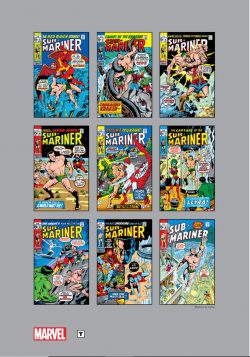
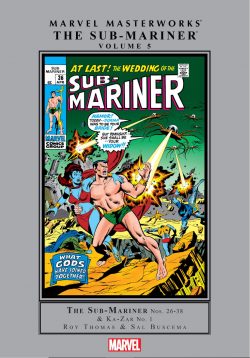
Sub-Mariner Marvel Masterworks volume 5


By Roy Thomas, Allyn Brodsky, Sal Buscema, Ross Andru, Frank Springer & various (Marvel)
ISBN: 978-0-7851-6619-1 (HB/Digital edition)

Prince Namor, the Sub-Mariner is the offspring of a water-breathing Atlantean princess and an American polar explorer; a hybrid being of immense strength, highly resistant to physical harm, able to fly, and thrive above and below the waves. Created by young, talented Bill Everett, Namor technically predates Marvel/Atlas/Timely Comics.

He first caught the public’s avid attention as part of an elementally appealing fire vs. water headlining team-up in the October 1939 Marvel Comics #1 (which renamed itself Marvel Mystery Comics from #2 onwards). The amphibian antihero shared honours and top billing with The Human Torch, but had originally been seen (albeit in a truncated, monochrome version) in Motion Picture Funnies: a promotional booklet handed out to moviegoers earlier in the year. Rapidly emerging as one of the industry’s biggest draws, Namor won his own title at the end of 1940 (cover-dated Spring 1941) and was one of the last super-characters to vanish at the end of the first heroic age.

In 1954, when Atlas (as the company then was) briefly revived its “Big Three” line-up – the Torch and Captain America being the other two – Everett returned for an extended run of superbly dark, mordantly timely fantasy fables. However, even his input wasn’t sufficient to keep the title afloat and eventually Sub-Mariner sank again.

In 1961, as Stan Lee & Jack Kirby were reinventing superheroes with the landmark title Fantastic Four, they revived the awesome, all-but-forgotten aquanaut as a troubled, semi-amnesiac antihero. Decidedly more bombastic, regal and grandiose, this returnee despised humanity: embittered and broken by the loss of his sub-sea kingdom which had been (seemingly) destroyed by American atomic testing. His rightful revenge became infinitely complicated after he became utterly besotted with the FF’s Susan Storm.

Namor knocked around the budding Marvel universe for a few years, squabbling with other star turns such as The Hulk, Avengers, X-Men and Daredevil before securing his own series as one half of Tales to Astonish, and from there graduating in 1968 to his own solo title.

This fifth subsea selection trawls Prince Namor, the Sub-Mariner #26-38 and portions of Ka-Zar #1, spanning June 1970 to June 1971, and opens with another heartfelt appreciation and more creative secret-sharing in an Introduction from life-long devotee – and primary scribe of this book – Roy Thomas. The drama recommences as recently self-appointed relentless guardian of the safety and ecology of all Earth’s oceans, the Prince of Atlantis furtively returns to the surface world.

In ‘“Kill!” Cried the Raven!’ by Thomas, Sal Buscema & Joe Gaudioso (AKA Mike Esposito) the Sub-Mariner has come to investigate reports of comatose superhuman Red Raven. He was the human emissary of a legendary race of sky-dwelling Birdmen recently encountered by The Angel of the X-Men in their last clash with Magneto. With the covert assistance of old friend Diane Arliss, Namor seeks to forge an alliance with the Avian race, but shocks, surprises and the Raven’s trauma-induced madness all conspire to sink the plan…

Back brooding in Atlantis in the wake of another failure, Namor’s mood is further plagued when a human pirate uses his giant monster-vessel to attack shipping with Atlantis bearing the brunt of blame ‘When Wakes the Kraken!’ His hunt for bizarre bandit Commander Kraken again involves Diane and ends only when the Sub-Mariner demonstrates what a real sea monster looks like…

Recuperating with her in New York City, Namor is incensed by the actions of an unrepentant industrial polluter and joins teen protestors fighting developer Sam Westman’s thugs and mega machines in ‘Youthquake!’ before we pause for a little diversion…

Beginning as a Tarzan tribute act relocated to a lost world in a sub-polar realm of swamp-men and dinosaurs, Ka-Zar eventually evolved into one of Marvel’s more complex and mercurial characters. Wealthy heir to one of Britain’s oldest noble families, his best friend is Zabu the sabretooth tiger, his wife is feisty environmental-crusader Shanna the She-Devil and his brother is a homicidal super-scientific bandit. Kevin Reginald, Lord Plunder is perpetually torn between the clean life-or-death simplicity of the jungle and the bewildering constant compromises of modern civilisation.

The primordial paragon even outranks Namor in terms of longevity, having begun as a prose pulp star, boasting three issues of his own magazine between October 1936 and June 1937. They were authored by Bob Byrd – a pseudonym for publisher Martin Goodman or one of a fleet of writers on his staff – and he was latterly shoehorned into a speculative new-fangled comic book venture Marvel Comics #1. There he roamed alongside another pulp mag graduate: The Angel, plus Masked Raider, the Human Torch and Sub-Mariner

When Ka-Zar reappeared all rowdy and renovated in 1965’s X-Men #10, it was clear the Sovereign of the Savage Land was destined for bigger things. However, for years all he got was guest shots as misunderstood foe du jour for Daredevil, Sub-Mariner, Spider-Man, and the Hulk.

In 1969, he took his shot with a solo saga in Marvel Super-Heroes and later that year – after Roy Thomas & Neal Adams used him so effectively in their X-Men run (issues #62-63) – was awarded a giant-sized solo title reprinting many previous appearances. The title also incongruously offered all-new stories of Hercules and the second, mutant X-Man Angel. That same month, Ka-Zar’s first regular series began in Astonishing Tales

That Hercules back up from Ka-Zar #1 (August 1970 by Allyn Brodsky, Frank Springer & Dick Ayers) is reprinted here as it impacts Namor’s exploits…

‘In his Footsteps… The Huntsman of Zeus!’ sees the potent Prince of Power on the run from an Olympian agent despatched by the King of the Gods. Following another bitter dispute with his sire Hercules returns to Earth, leaving Ares to foment trouble and prompt Zeus to set his terror-inducing Huntsman on the godling’s trail…

After seeking sanctuary with the Avengers, Hercules sees his mortal friends brutally beaten and flees once again…

The panicked rush takes him to Sub-Mariner #29 and the distant Mediterranean where the Huntsman ensorcells Namor and pits him against the fugitive. Although Hercules soon breaks the hypnotic spell, ‘Fear is the Hunter!’ reveals why the pursuer is so dreaded as he sends mythical terrors Scylla, Charybdis and Polyphemus against the heroes and the pitiful mortals of the region, until a valiant breakthrough ends the threat and forces a paternal reconciliation…

Another guest star treat materialises in #30 as ‘Calling Captain Marvel!’ sees Namor again reduced to a mesmerised puppet and attacking the Kree warrior and his human host Rick Jones. This time the condition is due to the amphibian’s falling in battle against toxic terrorist Mr. Markham who attempts to blackmail Earth by threatening to poison the seas with his molecular polluter. Once Captain Marvel batters Namor back to his right mind, they make quick work of the maniac in a concerted twin assault…

The fallout from his recent actions have unsettled Namor’s old friend Triton, and the Inhuman goes looking for the prince in #31 just as apparent Atlantean attacks on surface shipping mounts. Meeting equally concerned human Walt Newell (who operates as undersea Avenger Stingray) they finally find – and fight – the Sub-Mariner, only to learn the crisis has been manufactured by his old enemy who is now ‘Attuma Triumphant!’

The barbarian’s plans include destroying human civilisation, but he still has time to pit his captives against each other in a gladiatorial battle to the death; which of course is Attuma’s undoing…

Jim Mooney comes aboard as inker with #32 as a new and deadly enemy debuts in ‘Call Her Llyra… Call Her Legend!’ when fresh human atomic tests prompt Namor to voyage to the Pacific and renew political alliance with the undersea state of Lemuria. However, on arrival he finds noble Karthon replaced by a sinister seductress who lusts for war and harbours a tragic Jekyll & Hyde secret…

By the time he reaches Atlantis again the Sunken City is being ravaged by seaquakes and old political enemy Prince Byrrah is seizing control from Namor’s deputies and devoted paramour Lady Dorma. ‘Come the Cataclysm’ sees him first accuse surface-worlders before locating and defeating the true culprits – an alliance of Byrrah with failed usurper Warlord Krang and human mad genius Dr. Dorcas. In the throes of triumph, Prince Namor announces his imminent marriage to Dorma…

Antihero superteam The Defenders officially begin with Sub-Mariner #34-35 (cover-dated February & March 1971). As previously stated, the Prince of Atlantis had become an early and ardent activist and advocate of the ecology movement, and here he takes radical steps to save the planet by fractiously recruiting The Hulk and Silver Surfer to help him destroy an American Nuclear Weather-Control station.

In ‘Titans Three!’ and concluding chapter ‘Confrontation!’ (by Thomas, Sal Buscema & Jim Mooney) the always-misunderstood outcasts unite to battle a despotic dictator’s legions, the US Army, UN defence forces and the mighty Avengers to prevent the malfunctioning station from vaporising half the planet…

Inked by Berni Wrightson, Sub-Mariner #36 augurs a huge sea change in Namor’s fortunes that begins with time-honoured holy preparations for a happy event as ‘What Gods Have Joined Together!’ Elsewhere, arcane enemy Llyra is resuurected and seeks to steal the throne by abducting and replacing the bride-to-be whilst Namor is distracted by an invasion of Attuma’s hordes.

Ross Andru & Esposito take over illustration duties with #37 as an era ends and tragedy triumphs, leading to a catastrophic battle on ‘The Way to Dusty Death!’

Betrayed by one of his closest friends and ultimately unable to save his beloved, the heartbroken prince thinks long and hard before abdicating in #38 ‘Namor Agonistes!’: reprising his origins and life choices before choosing to henceforth pursue the human half of his hybrid heritage as a surface dweller…

To Be Continued…

More sunken treasures salvaged here include the cover to all-reprint Sub-Mariner Annual #1 (January 1971, and reprising the underwater portions of Tales to Astonish #70-73) plus Bill Everett’s pin-up of young Namor, contemporary House Ads and Marie Severin’s glorious cover sketch for #33, plus a huge Biographies section.

Many early Marvel Comics are more exuberant than qualitative, but this volume, especially from an art-lover’s point of view, is a wonderful exception: a historical treasure with narrative bite that fans will delight in forever. Moreover, with the Prince of Atlantis now a bona fide big screen sensation that no one’s ever heard of, now might be the time to get wise and impress your friends with a little insider knowledge…
© 2018 Marvel Characters, Inc. All rights reserved.

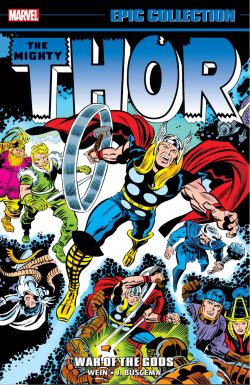
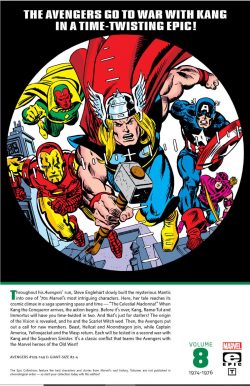
Thor Epic Collection volume 8: War of the Gods 1975-1977


By Len Wein, David Anthony Kraft, Steve Englehart, John Buscema, Pablo Marcos, Tony DeZuñiga & various (MARVEL)
ISBN: 978-1-3029-3364-7 (TPB/Digital edition)

Win’s Christmas Gift Recommendation: Thunderous Fun… 8/10

Once upon a time, disabled doctor Donald Blake took a vacation in Norway only to stumble into an alien invasion. Trapped in a cave, he found an ancient walking stick which, when struck against the ground, turned him into the Norse God of Thunder! Within moments he was defending the weak and smiting the wicked.

Months swiftly passed with the Lord of Storms tackling rapacious extra-terrestrials, Commie dictators, costumed crazies and cheap thugs, but these soon gave way to a vast kaleidoscope of fantastic worlds and incredible, mythic menaces, usually tackled with an ever-changing cast of stalwart immortal warriors at his side…

Whilst the ever-expanding Marvel Universe had grown ever-more interconnected as it matured through its first decade, with characters literally tripping over each other in New York City, the Asgardian heritage of Thor and the soaring imagination of Jack Kirby had most often drawn the Thunder God away from mortal realms into stunning, unique landscapes and scenarios.

However, by the time of this compelling compendium, the King had been long gone and was actually back for a last hurrah. Only echoes of his groundbreaking presence remained in the evolving multiverse he had made. In the interim, John Buscema had visually claimed the Thunder God as his own, as a succession of scripters struggled to match the epic scope of Kirby’s vision and Stan Lee’s off-kilter, comfortingly faux-Shakespearean verbiage…

This power-packed trade paperback/eBook gathers Thor #242-259, Annual #5 and Marvel Spotlight #30, spanning December 1975- May 1977: a period when writer/editor Len Wein arrived to steady a rather shaky ship…

Previously, a round-robin flurry of writers detailed how lordly Odin had gone missing before being rescued from bondage to a pantheon of Egyptian gods, but now stability resumed with #242 as Wein joined illustrators Buscema & Joe Sinnott for epic time travel tale ‘When the Servitor Commands!’

In the 20th century, a colossal all-conquering warrior construct scoops up Thor, his lover Jane Foster (mystically imbued with the life force of goddess Sif) and visiting Asgardians Fandral the Dashing, Voluminous Volstagg and Hogun the Grim at the behest of despotic chrononaut  and old enemy Zarrko the Tomorrow Man

The time tyrant claims to be on the side of the angels for now: seeking heroes to help stop a trio of entropic entities travelling back from the end of eternity, callously destroying all life as they go. Although suspicious, the assembled Asgardians agree to help stop ‘Turmoil in the Time Stream!’ caused by the uncanny Time-Twisters

Clashes with vagrant monsters and warriors plucked from other eras barely slow the heroes, but neither do they hinder the widdershins progress of the Armageddon entities in ‘This is the Way the World Ends!’ However, by the time the voyagers discover ‘The Temple at the End of Time!’ – which originally spawned the Time-Twisters – and end the crisis before it began, Zarrko has already reverted to type and tried to betray them… much to his own regret…

A rematch between Thunder God and an extra-terrestrial Flaming Fury sparks up in #246 as ‘The Fury of Firelord!’ follows the unworldly alien’s meeting with a lovely witch working for Latin American rebel and would-be tin pot dictator El Lobo. Whilst Thor heads south to stop a civil war, in Asgard his boon companion Balder comes to a staggering conclusion: Odin may be back in body, but his spirit is still ailing. In fact, the All-Father might well be completely insane…

When Thor also succumbs to sinister gypsy enchantments, ‘The Flame and the Hammer!’ unite to crush the feeble democracy of Costa Verde, once again vibrant valiant Jane is there to save the day…

An out-of-chronology break follows as try-out title Marvel Spotlight #30 serves up a tale of the Warriors Three. Crafted by Wein, Buscema & Sinnott, ‘A Night on the Town!’ finds Fandral, Volstagg and Hogun drawn into a tale of love on the rocks when their Manhattan carousal is interrupted by a woman’s suicide attempt. Her cry for help impels the heroic trio to save her fiancé from a life of crime and leads to action, adventure and matrimony…

Back in Thor #248, ‘There Shall Come… Revolution!’ (inked by Tony DeZuñiga) starts the build-up to anniversary issue #250 with the earthbound Asgardians recalled to the Realm Eternal by bold Balder whose battered body is living proof that Odin has become a brutal, vicious tyrant. Rebellion builds in ‘The Throne and the Fury!’ (Wein, Buscema & DeZuñiga, and featuring the first of a series of new covers by Jack Kirby) as Thor and Company batter their way into the godly citadel. As the heroes seek to ally with old enemy Karnilla the Norn Queen, amidst the madness, Jane assumes the form of Sif in time to join the potentially universe-shattering battle as Odin is proved an imposter and defeated in ‘Asgard Should Perish!’

In the aftermath – AKA #251 – the search for the true All-Father leads Thor to the underworld to see if Odin is dead. Despite cataclysmic combat against the legions of the dead, ‘To Hela and Back!’ proves a frustrating waste of time, barely ameliorated by a new clue in #252. ‘A Dragon at the Gates!’, by Wein, Buscema & DeZuñiga, sees the Thunderer undertake a quest for knowledge that draws him into another brutal battle with ultimate troll Ulik which concludes in the next issue with seeming defeat for the Prince of Asgard and ‘Chaos in the Kingdom of the Trolls!’

These issues also include a return for venerable back-up feature Tales of Asgard, Home of the Mighty Norse Gods: a glimpse of Thor’s boyhood by David Anthony Kraft & Pablo Marcos wherein the young warrior learns the value of restraint and self-reliance while learning how to wield Mjolnir in ‘The Weapon and the Warrior!’

Mighty Thor #254 reprinted #159 due to another deadline crisis, and is only represented here by its cover after which Wein & DeZuñiga launch a new epic interstellar adventure in Thor #255’s ‘Lo, the Quest Begins!’ After embattled Asgard survived invasion the heroes learned their divine Liege Lord has gone missing again. Having exhausted every avenue of investigation available, Thor must search the galaxies, prompted by vague hints from all-knowing spirit Mimir of a distant destination – the Doomsday Star…

Boarding spacefaring dragonship Starjammer, Thor, Lady Sif, Fandral, Hogun and Volstagg set (solar) sail, leaving a beleaguered Eternal Realm under the stewardship of Balder and his dark inamorata the Norn Queen. However, before they even leave local space, the seekers encounter – and battle – malign aliens marooned ever since they initially fought the Storm Lord in his debut adventure…

A classic case of Marvel Misunderstanding occurs in #256 as the voyagers encounter an ancient and colossal colony ship populated by the last survivors of a civilisation that died from over-exploiting their environment. As the Asgardians are joined by Rigellian Recorder Memorax, the slowly-fading Levianons reveal how their poverty and resource-blighted existence has been further threatened by an invasive beast who takes the elderly like a ‘Lurker in the Dark!’

When the hideous Sporr abducts recently wounded Sif, enraged Thor leads a savage counter-assault that sparks incomprehensible tragedy in concluding chapter ‘Death, Thou Shalt Die!’

Another mineral-based miscreant resurfaces in #258. ‘If the Stars be Made of Stone!’ sees the Starjammer attacked by space pirates inexplicably led by human supervillain – and early Thor foe – the Grey Gargoyle. It’s not a job he wants, but as the unwilling captain conspires with the beaten-&-enslaved Asgardians for a chance to see again the Green Hills of Earth, their plot is exposed by fanatical second-in command Fee-Lon.

As in Asgard, Balder and Karnilla resist an invasion helmed by arch-traitors Enchantress and Executioner, brutal usurper Fee-Lon proves a truly ferocious and capable brigand, but ultimately fights in vain to end the gods’ ‘Escape into Oblivion!’

Thor’s hunt for his father will conclude in the next volume but this one holds still more action and drama in the form of Mighty Thor Annual #5 which depicts ‘War of the Gods!’

Crafted by Steve Englehart, Buscema & DeZuñiga, it opens with the origin of Asgard’s divine inhabitants while explaining the geographical limitations of pantheons and worship, after which an adolescent Thunderer is drawn by his earthly worshippers into battle with alien gods he never knew of.

As the territorial clash between Norsemen and invading Greeks escalates, Asgardians and Hellenics fight to the death but aloof Odin and Zeus know a secret that makes all the bloodshed simultaneously pointless and crucial…

This early peek into Marvel’s ever-expanding cosmology is followed by house ads, Kirby’s wraparound cover for Marvel Treasury Edition #10 (reprinting the Mangog saga from Thor #154-157), cover roughs by Gil Kane and a wealth of original art and covers by Buscema, Kirby, Kane, Frank Giacoia, Sinnott, DeZuñiga, John Romita art pages.

The tales gathered here may lack the sheer punch and verve of the early years but fans of ferocious Fights ‘n’ Tights fantasy will find this tome still stuffed with intrigue and action, magnificently rendered by artists who, whilst not possessing Kirby’s vaulting visionary passion, were every inch his equal in craft and dedication, making this a must-read for all fans of the character and the genre.
© 2022 MARVEL

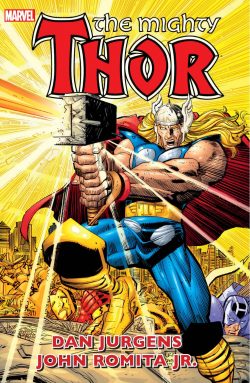
Thor Volume One


By Dan Jurgens & John Romita Jr., Klaus Janson, with Howard Mackie, Scott Hanna, & various (MARVEL)
ISBN: 978-0-7851-4632-2 (TPB/Digital edition)

In the middle of 1962, Stan Lee and Jack Kirby launched their latest offbeat superhero creation in anthology monsters-and-mysteries title Journey into Mystery #83. The tale introduced meek, disabled American doctor Donald Blake who took a vacation in Norway only to encounter the vanguard of an alien invasion. Fleeing in terror, he was trapped in a cave and found an old, gnarled walking stick. When, in helplessness and frustration, he smashed the cane into a huge boulder obstructing his escape, his insignificant frame was transformed into the hulking and brawny Norse God of Thunder, Thor!

The series grew from formulaic beginnings battling aliens, commies and cheap thugs into a vast, breathtaking cosmic playground for Kirby’s burgeoning imagination with Journey into Mystery inevitably becoming the Mighty Thor. After years of celestial adventuring, the peculiarities and inconsistencies of the Don Blake/Thor relationship were re-examined – as well as his doomed romance with his nurse Jane Foster – and all was finally clarified and explained regarding how an immortal godling could also be frail Don Blake.

The epic saga took the immortal hero back to his long-distant youth, ultimately revealing that the mortal surgeon was no more than an Odinian deception: a living shell designed to teach the Thunder God humility and compassion…

Time passed, Kirby left and the Thunderer’s fortunes waxed and waned. During the troubled mid-1990’s the title vanished, culled with The Avengers, Iron Man, Captain America and Fantastic Four and subcontracted out to Image creators Jim Lee and Rob Liefeld during 1996-1997 in a desperate attempt to improve sales after Marvel’s apocalyptic Onslaught publishing event.

In 1998 Heroes Return and Heroes Reborn saw those properties rejoin the greater Marvel Universe, relaunched with brand new first issues with the Thunder God reappearing a few weeks later. In July, Mighty Thor volume 2 launched, and this compendium gathers #1-8, plus Peter Parker, Spider-Man #2 spanning July 1998 to February #1999.

It begins with ‘In Search of the Gods’ by Dan Jurgens, John Romita Jr. & Klaus Janson and finds the Thunderer back on Midgard after more than a year away from the home cosmos, and instantly involved in a desperate hostage situation.

Acting immediately, he ends the crisis only to discover the perpetrator is the now-powerless Guardian God Heimdall. In the recently relaunched Avengers #1, Thor had found Asgard devastated and deserted and now that shocking mystery has been further compounded on Earth…

Elsewhere, Death Goddess Hela and Volla the Prophetess conspire in anticipation of cosmic calamity and desires reaching fruition, even as a military shipment goes badly wrong at New York’s docks where EMT/paramedic Jake Olsen gets the call to assist…

Before leaving Heimdall with (now) Doctor Jane Foster, Thor and the sentinel Asgardian explored shattered Asgard again, inadvertently liberating an unknown horror from ancient captivity, but that is forgotten as the docks situation worsens and Thor joins the hard-pressed Avengers in battling reawakened Odinian ultimate weapon The Destroyer

Despite the best efforts of the World’s Mightiest Heroes, the carnage is shattering and people die. People like Olson… and Thor…

Thor’s story nevertheless continues as his journey to Hela’s realm is interrupted by disturbing new cosmic entity Marnot who claims the Thunderer’s soul and returns it to the living world, bound to equally-miraculously resurrected Olsen in a revival of the spell that created Don Blake and just in time to stop The Destroyer. However, the new-old arrangement will prove to be a true ‘Deal with the Devil!’

Reborn as ‘God and Man’ in #3, the Storm Lord again walks the Earth – but only as the dormant-until-summoned alter-ego of another frail mortal host with a painfully complex personal life. It makes battling the sea-monsters of beguiling sea-goddess Sedna beside former Avenger Namor the Sub-Mariner a far from friendly reunion in ‘From the Ashes’ and leads to Mjolnir rebelling after Thor’s take-charge personality overrules Olsen’s legal authority when the Thunderer compels the paramedic to perform illegal surgery to save a life in ‘Heroes’

The wreckers of Asgard and Marnot have all been manoeuvring in the background throughout and following a flashback to Asgardian childhood ‘What’s a God to Do?’ finds Thor edging closer to the truth after another pointless clash with best pal Hercules. Once the dust has settled, Thor finds his people have been framed for attacking Olympus even as in Asgard the fate of the vanquished All-Father is revealed. However,  the ‘Deception’ has proven effective and Thor and Hercules are attacked by the entire outraged Hellenic pantheon…

The true architects of most of this mayhem are a pantheon of previously unknown Dark Gods – Perrikus, Adva, D’Chel, Slottoth, Tokkots and Majeston Zelia – so powerful that they have managed to take possession of the fallen Fabled Realm, constantly attack Thor since his return to Asgard and now bar him entirely from reaching his sundered home…

This initial collection concludes with a stellar crossover between hammer-hurler and webspinner as Thor #8 sees the Thunder God encounter Spider-Man when Tokkots goes on an Earthly rampage of destruction in ‘…and the Home of the Brave!’ before being spectacularly defeated and despatched to enslaved Asgard in ‘Plaything of the Gods’ (Peter Parker, Spider-Man #2, by Howard Mackie, Romita Jr. & Scott Hanna).

An all action, rocket-paced return to comic book basics, this revival includes a wealth of covers and variants by Romita Jr., Janson & Hanna, and, whilst perhaps not to everyone’s taste (it’s woefully short of anything even approaching a funny moment) is a blistering epic to delight the Fight’s ‘n’ Tights faithful, with the artwork undeniably some of the best of the modern Marvel Age. If you want your pulse to pound and your graphic senses to swim, this is the ideal item for you.
© 1998, 1999, 2010 Marvel Characters, Inc. All rights reserved. Digital version © 2020 MARVEL

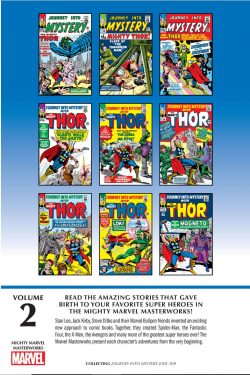
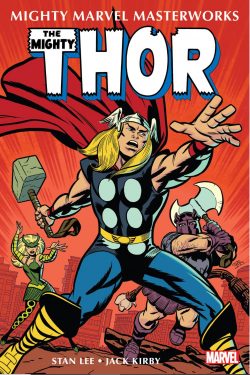
Mighty Marvel Masterworks volume 2: The Invasion of Asgard


By Stan Lee & Jack Kirby, with Chic Stone, George Roussos, Vince Colletta, Paul Reinman, Don Heck & various (MARVEL)
ISBN: 978-1-3029-3442-2 (PB/Digital edition)

These stories are timeless and have been gathered many times before, but today I’m once again focussing on format. The Mighty Marvel Masterworks line launched with economy in mind: classic tales of Marvel’s key creators and characters re-presented in chronological publishing order. It’s been a staple since the 1990s, but always in lavish, hardback collectors editions. These editions are cheaper, on lower quality paper and – crucially – smaller, about the dimensions of a paperback book. Your eyesight might be failing and your hands too big and shaky, but at 152 x 227mm, they’re perfect for kids. If you opt for the digital editions, that’s no issue at all…

Even more than The Fantastic Four, The Mighty Thor was the arena in which Jack Kirby’s boundless fascination with all things Cosmic was honed and refined through his dazzling graphics and captivating concepts. The King’s plethora of power-packed signature pantheons began in a modest little fantasy/monster title called Journey into Mystery where – in the summer of 1962 – a tried-and-true comicbook concept (feeble mortal transformed into god-like hero) was revived by the rapidly resurgent company who were not yet Marvel Comics: adding a Superman analogue to their growing roster of costumed adventurers.

Cover-dated August 1962, Journey into Mystery #83 saw a bold costumed Adonis jostling aside the regular fare of monsters, aliens and sinister scientists in a brash, vivid explosion of verve and vigour. The initial exploit followed disabled American doctor Donald Blake who took a vacation in Norway and encountered the vanguard of an alien invasion. Fleeing, he was trapped in a cave where he found an old, gnarled walking stick. When, in frustration, he smashed the stick into the huge boulder blocking his escape, his puny frame was transformed into the Norse God of Thunder!

Plotted by Stan Lee, scripted by his brother Larry Lieber and illustrated by Kirby and inker Joe Sinnott (at this juncture a full illustrator, Sinnott would become Kirby’s primary inker for most of his Marvel career), that introduction was pure primal Marvel: bombastic, fast-paced, gloriously illogical and captivatingly action-packed. It was the start of a new kind of legend and style of comics’ storytelling…

Spanning February to October 1964, this gloriously economical full-colour paperback tome – also available in eFormats – revisits pioneering Asgardian exploits from JiM #101-109 in a blur of innovation and seat-of-the-pants myth-revising and universe-building…

Lee had taken over scripting with Journey into Mystery #97, the issue that launched a spectacular back-up series. Tales of Asgard – Home of the Mighty Norse Gods gave Kirby a vehicle to indulge his fascination with legends and began by adapting classic traditional tales before eventually switching to all-new material shaped for Marvel’s pantheon. Here, Kirby built his own cosmos and mythology, which would underpin the company’s entire continuity.

Journey into Mystery #101 featured ‘The Return of Zarrko, the Tomorrow Man!’ and sees Odin halve Thor’s powers for wilful disobedience, just as the futuristic felon abducts the Thunder God to help him conquer the 23rd century. A two-parter (with the first chapter inked by George Roussos), it was balanced by another exuberant tale of the boy Thor.

‘The Invasion of Asgard!’ sees the valiant lad fight a heroic rearguard action whilst introducing a host of future villainous mainstays such as the Rime Giants, King Geirrodur and Trolls.

‘Slave of Zarrko, the Tomorrow Man!’ is a tour de force epic conclusion most notable for the introduction of Chic Stone as inker. To many of us oldsters, his clean, full brush lines make him The King’s best embellisher ever. This triumphant futuristic thriller is counterbalanced by brooding short  from ancient history. ‘Death Comes to Thor!’ has the teen hero face his greatest challenge yet, with two women who would play huge roles in his life introduced in this brief 5-pager; young goddess Sif and Hela, Queen of the Dead.

On a creative roll, Lee, Kirby & Stone next introduced ‘The Enchantress and the Executioner’ ruthless renegade Asgardians determined to respectively seduce or destroy the warrior prince at the front of JiM #103 whilst the rear detailed ‘Thor’s Mission to Mirmir!’, disclosing how the gods created humanity. That led one month later to a revolutionary saga in the present day lead feature when ‘Giants Walk the Earth!’

For the first time, Kirby’s imagination was given full rein after Loki tricks Odin into visiting Earth, only to release in his absence, ancient elemental enemies Surtur and Skagg, the Storm Giant from eternal Asgardian bondage.

This cosmic clash depicted noble gods battling demonic evil in a new Heroic Age, and the greater role of the Norse supporting cast – especially noble warrior Balder – was reinforced by a new Tales of Asgard strand focussing on individual Gods and Heroes. Inked by Don Heck, ‘Heimdall: Guardian of the Mystic Rainbow Bridge!’ was first, highlighting the mighty sentinel’s uncanny senses and crucial role in defending the realm from its foes…

JiM #105-106 saw the teaming of two old foes in ‘The Cobra and Mr, Hyde!’ and ‘The Thunder God Strikes Back!’: another continued story packed with tension and spectacular action, and proving Thor was swiftly growing beyond the constraints of traditional single issue adventures. The respective back-ups ‘When Heimdall Failed!’ (Lee, Kirby & Roussos) and ‘Balder the Brave’ (inked by Vince Colletta) further fleshed out the back-story of an Asgardian pantheon deviating more and more from those classical Eddas and Sagas kids had to plough through in schools.

A petrifying villain premiered ‘When the Grey Gargoyle Strikes!’ in Journey into Mystery #107: a rare yarn highlighting the fortitude of Dr. Blake rather than the power of the Thunder God, who was increasingly reducing his own alter-ego to an inconsequentiality. Closing the issue, the Norn Queen debuted in a quirky reinterpretation of the classic myth in ‘Balder Must Die!’ illustrated by Kirby & Colletta.

After months of manipulation, the God of Evil once again attempted direct confrontation with his despised step-sibling in ‘At the Mercy of Loki, Prince of Evil!’ With Jane Foster a helpless victim of Asgardian magic, the willing assistance of new Marvel star Doctor Strange made this a captivating team-up read, whilst ‘Trapped by the Trolls!’ (Colletta inks) showed the power and promise of tales set solely on the other side of the Rainbow Bridge as Thor liberates enslaved Asgardians from subterranean bondage.

Bringing down the curtain on this increasingly cosmic carnival, Journey into Mystery #109 was another superb adventure masquerading as a plug for recent addition to the Marvel roster.

‘When Magneto Strikes!’ pits Thor against the X-Men’s archfoe in a cataclysmic clash of fundamental powers, although you could hardly call it a team-up since the heroic mutants are never actually seen. The tantalising hints and cropped glimpses are fascinating teasers now, but the kid I then was felt annoyed not to have seen these new heroes… oh, wait… maybe that was the point?

The Young Thor feature ‘Banished from Asgard’ is an uncharacteristically lacklustre effort to end on, with Odin and Thor enacting a devious plan to trap a traitor in Asgard’s ranks, but the vignette hinted at much greater thrills to follow…

Rounding off the increasingly spectacular shenanigans are a gallery of original art pages and a rousing landmark house ad for the entire Marvel Comics line.

These foundational tales of the God of Thunder show the development not only of one of Marvel’s core narrative concepts but, more importantly, the creative evolution of perhaps the greatest imagination in comics. Set your common sense on pause and simply wallow in the glorious imagery and power of these matchless adventures to discover the true secret of what makes comic book superheroes such a unique experience.
© 2022 MARVEL.

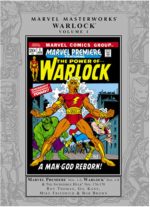
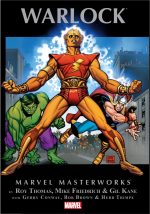
Warlock Marvel Masterworks volume 1


By Roy Thomas, Mike Friedrich, Gerry Conway, Ron Goulart, Tony Isabella, Gil Kane, Bob Brown, Herb Trimpe, John Buscema, Tom Sutton & various (Marvel)
ISBN: 978-0-7851-2411-5 (HB) 978-0-7851-8858-2 (TPB/Digital edition)

During the 1970s in America and Britain (the latter of which deemed newspaper cartoons and strips worthy of adult appreciation for centuries whilst fervently denying similar appreciation and potential for comics), the first inklings of wider public respect for the medium of graphic narratives began to blossom. This followed teen response to such pioneering series as Stan Lee & John Buscema’s biblically allegorical Silver Surfer and Roy Thomas’ ecologically strident antihero Sub-Mariner, a procession of thoughtfully-delivered attacks on drugs in many titles and constant use of positive racial role models everywhere on four-colour pages.

Comics were inexorably developing into a vibrant forum of debate (a situation also seen in Europe and Japan), engaging youngsters in real world issues relevant to them. As 1972 dawned, Thomas took the next logical step, transubstantiating an old Lee & Jack Kirby Fantastic Four throwaway foe into a potent political and religious metaphor.

Debuting in FF #66 (September 1967) dread mystery menace Him was re-imagined by Thomas and Gil Kane as a modern interpretation of the Christ myth: stationed on an alternate Earth far more like our own than that of Marvel’s unique universe.

Re-presenting Marvel Premiere #1-2, Warlock #1-8 and Incredible Hulk #176-178 – collectively spanning the tumultuous time between April 1972 and August 1974, this epic adventure also offers a context-soaked Introduction from originator Thomas.

It all began with April cover-dated Marvel Premiere #1, which boldly proclaimed on its cover The Power of… Warlock. Inside, the stunning fable – by Thomas, Kane & Dan Adkins – declared ‘And Men Shall Call Him… Warlock’: swiftly recapitulating the artificial man’s origins as a lab experiment concocted by rogue geneticists eager to create a superman they could control for conquest.

After facing the Fantastic Four, the manufactured man had subsequently escaped to the stars, later initiating a naive clash with Asgardian Thor over the rights to a mate before returning to an all-encompassing cosmic cocoon to evolve a little more…

Now the all-encompassing shell is plucked from the interplanetary void thanks to the moon-sized ship of self-created god The High Evolutionary. Having artificially ascended to godhood, he is wrapped up in a bold new experiment…

Establishing contact with Him as he basks in his cocoon, the Evolutionary explains that he is constructing from space rubble a duplicate planet Earth on the opposite side of the sun. Here he replays the development of life, intending that humanity on Counter Earth will evolve without the taint of cruelty and greed and deprived of the lust to kill…

It’s a magnificent scheme that might well have worked, but as the Evolutionary wearies, his greatest mistake intervenes. The Man-Beast was hyper-evolved from a wolf and gained mighty powers, but also ferocious savagery and ruthless wickedness. Now he invades the satellite, despoiling humanity’s rise and ensuring the new world’s development exactly mirror’s True-Earth’s. The only exception is the meticulous exclusion of enhanced individuals. This beleaguered planet has all mankind’s woes but no superheroes to save or inspire them.

A helpless witness to the desecration, the golden being furiously crashes free of his cocoon to save the High Evolutionary and rout the Man-Beast and his bestial cronies (all similarly evolved animal-humanoids called “New-Men”).

When the despondent and enraged science god recovers, he makes to erase his failed experiment but is stopped by his rescuer. As a powerless observer, Him saw the potential and value of embattled humanity. Despite all its flaws, he believes he can save them from the imminent doom caused by their own unthinking actions, wars and intolerance. His pleas at last convince the Evolutionary to give this mankind one last chance, and the wanderer is hurled down to Counter-Earth, equipped with a strange gem to focus his powers, a mission to find the best in the fallen and a name of his own… Adam Warlock

Marvel Premiere #2 (July) sees the golden man-god crash to Earth in America and immediately win over a small group of disciples: a quartet of disenchanted teen runaways fleeing The Man, The Establishment and their oppressive families. His nativity and transformation leave him briefly amnesiac, and as Warlock’s followers seek to help, all are unaware that Man-Beast has moved quickly, insinuating himself and his bestial servants into the USA’s political hierarchy and Military/Industrial complex.

This devil knows the High Evolutionary is watching and breaks cover to introduce unnatural forces on a world previously devoid of superbeings and aliens. The result is an all-out attack by rat mutate Rhodan, who pounces on his prey at the very moment Colonel Barney Roberts, uber-capitalist Josiah Grey and Senator Nathan Carter track their missing kids to the desolate Southern Californian farm where they have been nursing the golden angel…

Men of power and influence, they realise their world has changed forever after seeing Warlock destroy the monstrous beast and ‘The Hounds of Helios!’

Doctor Strange was revived to fill the space in MP #3, as the gleaming saviour catapulted into his own August cover-dated title. Inked by Tom Sutton, Warlock #1 decreed ‘The Day of the Prophet!’: recapping key events and seeing the High Evolutionary safeguard his failing project by masking Counter-Earth from the rest of the solar system behind a vibratory screen.

With his mistake securely isolated from further contamination, HE asks Adam if he’s had enough of this pointless mission, and is disappointed to see Warlock’s resolve is unshaken. That assessment is questioned when the disciples take the spaceman to his first human city. Senses reeling, Warlock is drawn to bombastic street preacher and his psychic sister Astrella who are seemingly targeted by the Man-Beast. Of course, all is not as it seems…

Thomas’s plot is scripted by Mike Friedrich and John Buscema joins Sutton in illuminating ‘Count-Down for Counter-Earth!’: taking the biblical allegory even further as Warlock is captured by his vile foes and tempted with power in partnership with evil, even as his erstwhile disciples are attacked and deny him. Counter-Earth has never been closer to damnation and doom, but once more the saviour’s determination overcomes the odds…

The epic continues with Friedrich in the hot seat and Kane & Sutton reunited to steer the redeemer’s path. ‘The Apollo Eclipse’ begins with Adam and his apostles harassed by the increasingly impatient High Evolutionary following a breaching of his vibratory barrier by the Incredible Hulk and the Rhino (in Hulk #158 and reprinted in many volumes …but not this one). That episode is soon forgotten after they are targeted by another Man-Beast crony, hiding his revolting origins and unstable psyche behind a pretty façade.

The brute attacks a rocket base where Adam seeks to reconcile his youthful followers with their parents, but the subsequent clash turns into tragedy in #4’s ‘Come Sing a Searing Song of Vengeance!’ as the exposed monster takes the children hostage. Astrella senses that visiting Presidential candidate Rex Carpenter holds the key to the stalemate, but when he intervenes at her urging, unbridled escalation, death and disaster follow…

Although super-beings were excised from the world’s evolution, extraordinary beings still exist. Warlock #5 (April 1973) sees Ron Goulart write the aftermath as the doubt-riddled redeemer emerges from another sojourn in a recuperative cocoon. In the intervening months Carpenter has become President and ordered an increase in weapons testing to combat the incredible new dangers he personally witness.

Tragically, he also ignores warnings from government scientist Victor Von Doom, and when one military manoeuvre sparks ‘The Day of the Death-Birds!’ Adam is there to help when a dam is wrecked. His might is sufficient to stop the automated launch of swarms of robotic drones programmed to strafe ground-based beings, but cannot stop the grateful citizenry turning on him when President Carter declares him a menace to society…

Friedrich scripts Goulart & Thomas’ plot and Bob Brown joins the team as penciller in #6 as Warlock battles the army and Doom contacts fellow genius Reed Richards for help. However, the Latverian is unaware of a shocking change in his oldest friend who is now ‘The Brute!’: a mutated cosmic horror enthralled by the malign thing running the White House and now ordered to ambush Warlock as Astrella brings him to truce talks…

It’s all a pack of lies and a trap. As the Golden Gladiator defeats Richards, enraged mobs egged on by the President move on Warlock’s growing band of supporters. Now, though, the alien’s very public life-saving heroics have swayed fickle opinion and Carter is compelled to reverse his stance and exonerate Warlock. Even this is a ploy, allowing him to set the energy-absorbing Brute on the redeemer in ‘Doom: at the Earth’s Core!’

Beyond all control, Richards’ rampage threatens to explode Counter-Earth, and only the supreme sacrifice of one of Adams’s constantly dwinling band of supporters saves the planet…

Warlock’s rocky road paused with the next issue. Cancelled with #8, Friedrich, Brown & Sutton dutifully detailed ‘Confrontation’ in Washington DC as the supposed saviour’s supporters clashed with incensed cops. Intent on stopping a riot, Warlock finds his work magnified when Man-Beast’s New-Men minions join the battle. The saga then ends on an eternal cliffhanger as Warlock finally exposes what Carpenter is… before vanishing from sight for 8 months…

The aforementioned Hulk #158 had seen the Jade Giant dispatched to the far side of the Sun to clash on Counter-Earth with the messiahs enemies. Although excluded here, the 3-issue sequel it spawned was concocted after the Golden Godling’s series ended.

When the feature returned the tone, like the times had comprehensively changed. All the hopeful positivity and naivety had, post-Vietnam and Watergate, turned to world-weary cynicism in the manner of Moorcock’s doomed hero Elric. Maybe that was a harbinger of things to come…?

The cosmic codicil closing this initial collection came after the Hulk’s typically short-tempered encounter with the Uncanny Inhumans and devastating duel with silent super-monarch Black Bolt. Following the usual collateral carnage, the bout ended with the Gamma Goliath hurtling in a rocket-ship to the far side of the sun for a date with allegory, if not destiny.

The troubled globe codified Counter-Earth had seen messianic Adam Warlock futilely battle Satan-analogue Man-Beast: a struggle the Jade Juggernaut learned of on his previous visit. Now he crashed there again to complete the cruelly truncated metaphorical epic, beginning in ‘Crisis on Counter-Earth!’ (Incredible Hulk #176, June 1974) by Gerry Conway, Herb Trimpe & Jack Abel.

Since the Hulk’s last visit Man-Beast and his animalistic flunkies had become America’s President and Cabinet. Moving deceptively but decisively, they had finally captured Warlock and led humanity to the brink of extinction, leaving the would-be messiah’s disciples in utter confusion.

With the nation reeling, Hulk’s shattering return gives Warlock’s faithful flock opportunity to save their saviour in ‘Peril of the Plural Planet!’ but the foray badly misfires and Adam is captured. Publicly crucified, humanity’s last hope perishes…

The quasi-religious experience concludes with ‘Triumph on Terra-Two’ (Conway, Tony Isabella, Trimpe & Abel, Incredible Hulk #178). Whilst Hulk furiously battles Man-Beast, the expired redeemer resurrects in time to deliver a karmic coup de grace before ascending from Counter-Earth to the beckoning stars…

Adding temptation at the end is a gallery of Kane pencil page layouts and a half dozen inked pages plus the Marvel Bullpen Bulletins page that first announced Warlock’s debut.

Ambitious and beautiful to behold, the early Warlock adventures are very much a product of their tempestuous, socially divisive times. For many, they proved how mature comics might become, but for others they were simply pretty pictures and epic fights with little lasting relevance. What they unquestionably remain is a series of crucial stepping stones to greater epics and unmissable appetisers to Marvel Magic at its finest.
© 2020 MARVEL

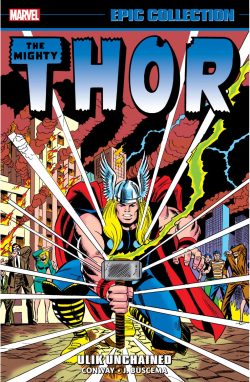
The Mighty Thor Epic Collection volume 7: Ulik Unchained 1973-1975


By Gerry Conway, Bill Mantlo, Roy Thomas, John Buscema, Rich Buckler, Sal Buscema, Arvell Jones & Keith Pollard, George Tuska & various (Marvel)
ISBN: 978-1-3029-2949-7 (TPB/Digital edition)

Disabled doctor Donald Blake took a vacation in Norway only to stumble into an alien invasion. Trapped in a cave, he found an ancient walking stick which, when struck against the ground, turned him into the Norse God of Thunder! Within moments he was defending the weak and smiting the wicked.

Months swiftly passed with the Lord of Storms tackling rapacious extraterrestrials, Commie dictators, costumed crazies and cheap thugs, but these soon gave way to a vast kaleidoscope of fantastic worlds and incredible, mythic menaces, usually tackled with an ever-changing cast of stalwart immortal warriors at his side…

As this bombastic compendium (reprinting Mighty Thor #217-241 and Marvel Premier #26 – spanning November 1973 through November 1975) opens, our cosmic cast returns to long-abandoned Asgard after interstellar escapades and bravely endured exile.

Thor #217 sees the triumphant return of Thor with recently rescued from alien enslavement All-Father Odin. He and his fellow heroes Sif, Fandral, Volstagg, Hogun, Hildegarde (plus Rigellian Tana Nile and planetary exile Silas Grant) discover a mysteriously rebuilt Eternal Realm filled with their fellow Asgardians who brandish ‘All Swords Against Them!’

Scripted by Gerry Conway with art by John & Sal Buscema, the saga sees them confronting impossible doppelgangers of Odin, Thor and the rest, all offering murderous hostility…

Whilst the Thunderer furiously struggles to unravel this latest mystery and defeat the invading fakes, in another sector of the universe the all-conquering Colonizers of Rigel are put to flight; abandoning their worlds to an all-consuming force of sheer destruction…

Issue #218 proves there’s no rest for the weary as the again-victorious true Asgardians once more take ship to the stars to prevent the Rigellians’ doom affecting Earth. ‘Where Pass the Black Stars There Also Passes… Death!’ (illustrated by J. Buscema & Jim Mooney) finds the hard-travelling heroes facing a nomadic race of colossal, decadent starfarers who fuel their unending flight by converting thriving civilisations into food and power.

In distant Asgard, war woman Hildegarde’s young sister Krista is slowly falling under the sway of sinister seductive evil, even as her hereditary protectors are a cosmos away, daringly infiltrating one of the Black Stars’ cosmic scoops and encountering a race of mechanical slaves in ‘A Galaxy Consumed!’ (Mike Esposito inks) before they and their charismatic messiah Avalon are at last freed – and untold galaxies subsequently saved – from callous consumption in ‘Behold! The Land of Doom!’

With scripter Conway firmly in the driving seat and legendary illustrator John Buscema (aided by inker Esposito) delivering the art, the mythic mayhem intensifies with ‘Hercules Enraged!’ as Thor savagely attacks Olympus, in search of the Grecian Prince of Power.

After Asgardian maiden’s Krista abduction, the All-Father had a vision of her chained in Hades with the Thunder God’s trusted ally gloating over her beside vile Grecian netherlord Pluto

By the time lordly Zeus stops the shattering clash that follows, half of the celestial city is in ruins, but in that breathing space he proves Hercules innocent of the atrocious act and the abashed comrades duly turn their attentions to the true culprit…

Inked by Joe Sinnott, Thor #222 finds the earnest comrades in search of Hercules’ insidious impersonator and taking advice from a scary sorceress even as war-god Ares receives an eldritch summons to meet his co-conspirator ‘Before the Gates of Hell!’

Sadly for him, the war god is intercepted by our heroes before he gets there and receives the sound thrashing he deserves prior to the enraged companions storming the netherworld itself. At the moment of their triumph, however, Pluto snatches up his hostage and vanishes. The infernal trail leads straight to Earth where one final confrontation results in ‘Hellfire Across the World!’ (Esposito inks) leaving kidnapped Krista wounded unto death…

After a lengthy hiatus, #224 finds Thor resuming his mortal alter ego as surgeon Don Blake is needed to operate on the dying Asgardian, even as elsewhere in Manhattan, a rash scientist accidentally reactivates Odin’s unstoppable battle construct and discovers ‘No One Can Stop… the Destroyer!’

With Krista saved, Thor joins sorely-pressed Hercules and – although outmatched by the Asgardian killing machine – devises a way to stop its human power source, only to then face ‘The Coming of Firelord!’ (inked by Sinnott). The tempestuous, short-tempered herald of planet-consuming Galactus has been sent to fetch Thor and will brook no refusals…

Issue #226 sees the voracious space god on Earth again, personally beseeching the Thunder God’s aid in ‘The Battle Beyond!’ (Esposito) against living planet Ego, who has seemingly gone mad and now poses a threat to the entire universe…

Deftly channelling Jack Kirby, penciller Rich Buckler (aided by his pals Arvell Jones & Keith Pollard) joined Conway & Sinnott in #227 as the Storm Lord, Hercules and Firelord go ‘In Search of… Ego!’

Penetrating deep within the sentient-but-raving planet and defeating incredible biological horrors acting as planetary antibodies, the trio reach his malfunctioning brain and experience the incredible origin of the “bioverse” in ‘Ego: Beginning and End!’, before contriving an earth-shaking solution to the wild world’s rampages. In a final act of unlikely diplomacy, the Thunderer then finds a replacement herald and secures Firelord’s freedom from Galactus…

Joined by veteran inker Chic Stone, Buckler depicts the godly prince safely back on Earth and facing a new kind of terror in Thor #229 as ‘Where Darkness Dwells, Dwell I!’ finds fellow Avenger Hercules investigating an uncanny string of suicides amongst the mortals of Manhattan. After consulting the Storm Lord and recently returned Sif, the Prince of Power is ambushed by a shadowy figure and himself succumbs to dark despondency…

Plucked from psychological catatonia by Iron Man and recuperating Krista, the severely shaken Hercules recovers enough to lead Thor deep beneath the city where they jointly confront and conquer a horrific lord of fear in #230’s climactic ‘The Sky Above… the Pits Below!’ (inked by Sinnott).

Of greater moment is the revelation in hallowed Asgard that almighty Odin is mysteriously missing again…

John Buscema returned in #231, inked by Dick Giordano to limn ‘A Spectre from the Past!’, wherein Thor learns that former true love Jane Foster is dying: another victim of the recently defeated fear lord. Whilst doting current paramour Sif fruitlessly returns to Asgard seeking a cure, the grieving Thunderer is momentarily distracted when Hercules is attacked by an unbelievably powerful anthropoidal throwback. Disembodied spirit Armak the First Man has somehow possessed the body of an unwary séance attendee and now runs savagely amok in the streets…

Since gaining his liberty, former herald Firelord had been aimlessly travelling the globe. Lured by Asgardian magic he now becomes wicked Loki’s vassal in ‘Lo, the Raging Battle!’…

Heartsick Thor will not leave Jane’s hospital bedside, prompting Sif and Hercules to travel alone to the ends of the universe to retrieve the mystic and fabled Runestaff of Kamo Tharnn. No sooner do they depart than ensorcelled Firelord attacks and whilst incensed, impatient Thor is knocking sense back into him, his evil half-brother leads an Asgardian army in a sneak attack on America…

With ‘Midgard Aflame’ (J. Buscema & Stone) Thor furiously leads the human resistance and learns for the first time that his father is missing. Odin’s faithful vizier reveals the All-Father has deliberately divested himself of his memory and chosen to reside somewhere on Earth as a hapless mortal, the better to learn humility…

With humanity preparing to unleash their atomic arsenal against the occupying Asgardians, the invasion abruptly ends after a savage duel between Thor and Loki in ‘O, Bitter Victory!’ (inked by Sinnott) after which the Thunderer returns to Jane’s side, unaware that he is being stalked by a merciless old enemy. Simultaneously but far, far away Sif and Hercules have clashed with the one ‘Who Lurks Beyond the Labyrinth!’ and secured a remedy for Thor’s mortal beloved…

Thor #236 opens as the Thunder God revels in furious combat with The Absorbing Man. Unknown to the blockbusting battlers, at that very moment Sif is expressing her own love for her wayward prince by using the Runestaff to fix Jane in ‘One Life to Give!’

…And somewhere in California, an imposing old man called Orrin ponders his strangely selective amnesia and wonders how he can possibly possess such incredible strength and vitality…

With combat concluded, Thor hastens back to Jane and finds her completely cured. His joy is short-lived, however, as he realises that Sif is gone, seemingly forever…

Issue #237 finds reunited lovers Don Blake and Jane Foster cautiously getting reacquainted and pondering Sif’s incredible sacrifice when an army of Asgardian Trolls led by ‘Ulik Unchained’ attack New York. Before long, they have made off with Jane under cover of the blockbusting melee that inevitably ensues…

Conway concluded his tenure with Thor #238 as the Thunderer capitulates to his hostage-taking foe and is taken below the worlds of Earth and Asgard on the ‘Night of the Troll!’ Ulik wants to overthrow his king Geirrodur and is confident his hold over his mighty archenemy will accomplish the act for him. He is utterly unprepared for the new martial spirit which now infuses his formerly frail mortal hostage…

…And in California old man Orrin decides to use his power to help the poor, arousing the ire of big business, brutal strike-breakers and the local authorities…

Writer/Editor Roy Thomas and artist Sal Buscema join Sinnott in Thor #239 as the Thunder God brutally ends his association with the trolls even as Orrin’s rabble-rousing civil unrest is cut short when a colossal pyramid containing Egyptian gods erupts from the Californian ground in ‘Time-Quake!’

Thor knows nothing of the latest upheaval. He has returned to Asgard, uncovering a mysterious force draining his people of power and vitality. Warned by duplicitous seer Mimir, the anguished godling rushes back to Earth to clash with puissant Horus ‘When the Gods Make War!’ (Thomas, Bill Mantlo, Sal B & Klaus Janson).

The depleted Egyptian pantheon have desperate need of an All-Father and have conditioned Odin/Orrin to believe that he is their long-lost patron Atum-Re

Go-getting, proactively take-charge Jane is already waiting in California when Thor arrives and is present when the elder deity devastatingly assaults his astounded son. Happily, her cool head prevails and soon the warring deities are talking. An uneasy alliance forms and the truth comes out. Horus, Isis and Osiris are at war with vile Death God Seth and need the power of a supreme over-god to assure victory for the forces of Life. Sadly, that energy is being siphoned from Asgard…

The cosmic conflict concludes in #241 as ‘The Death-Ship Sails the Stars!’ (Mantlo, John B & Sinnott) with ghastly Seth and his demonic servants ultimately repulsed and Jane again playing a major role: even triumphally shaking Odin out of his compliant, mind-wiped state…

To Be Continued…

Adding lustre next is the cover to all-reprint Giant-Size Thor #1, followed by a compelling contemporaneous solo tale of Hercules (November 1975), taken from Marvel Premiere #26. Used to set up his major role in forthcoming team title The Champions, it was crafted by Mantlo, George Tuska & Vince Colletta. Sporting a new Kirby cover, ‘The Game of Raging Gods’ has the legendary hero relocate to California on the college lecture circuit and targeted by old enemies Typhon the Titan and spurned priestess Cylla the Witch of Delphos

With covers by John Romita, Buckler, Sinnott, John Buscema, Gil Kane, Esposito, Frank Giacoia, Marie Severin, Tom Palmer, Giordano, Dan Adkins, Klaus Janson and Jack Kirby & Vince Colletta, this collection also includes assorted House ads; covers created by Romita, a John Buscema double page pin-up of the Asgardian cast and a frontispiece by Marie Severin from the Thor-starring reprint edition Marvel Treasury Edition #3.

Thor is one of modern comics’ greatest attractions and a cornerstone of the Marvel Universe. Always a high-point in graphic fantasy, his longevity is all the more impressive for the sheer imagination and timeless readability of the tales crafted by an army of creators. This chronicle is an absolute must for all fans of the medium and far-flung fantasy thrills.
© 2021 MARVEL

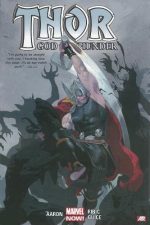
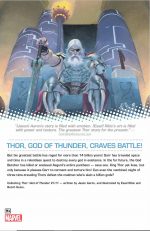
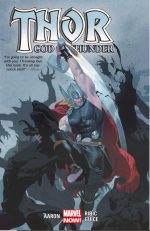
Thor God of Thunder by Jason Aaron volume 1


By Jason Aaron, Esad Ribic, Butch Guice, Tom Palmer & various (MARVEL)
ISBN: 978-0785191131 (HB/Digital edition)

In the wake of the game-changing Avengers versus X-Men publishing event, the company’s entire continuity was reconfigured. From that point on, the proud banner MarvelNOW! indicated a radical repositioning and recasting of all the characters in an undertaking designed to keep the more than 50-year old universe interesting to readers old and new alike.

This involved a varying degree of drastic rethink for beloved icons, concepts and brands, always, I’m sure, with one wary eye on how the material would look on a movie screen…

Well the fourth Thor feature film is upon us and this collection will offer the print origins of its major villain, so buckle up for a rocky rowdy ride…

Collecting Thor, God of Thunder #1-11 (cover-dated January-October 2013), this big, bold blockbuster saga simultaneously unfolds over three separate eras, offering a spectacular clash as the bellicose Lord of Lightning faces his ultimate adversary…

It begins in 893AD where a young god revels amongst his Viking worshippers in Iceland, slaying monsters and bedding mortal maids in the days before he proved worthy enough to wield mystic mallet Mjolnir.

During his revels a dismembered corpse washes up, terrifying the valiant Norsemen. They have never seen the like, but Thor recognises it as a god from another pantheon, slaughtered and dismembered like meat…

In the now, Thor is summoned into deep space and the parched planet Indigarr. The Storm Lord has mystically heard the desperate prayer of a little girl and on his arrival brings rain and salvation to her dying world. Celebrated as a saviour, the Thunderer wonders aloud why the people did not pray to their own gods – across the entire universe, all civilisations and peoples have deities – and learns they are dead.

Investigating further, he locates Indigarr’s god-palace and discovers the entire pantheon was tortured to death eons ago and as a monstrous black beast ambushes him, he remembers a horrific experience more than a millennium past and knows fear…

In the furthest future, an aged Thor sits in a shattered Great Hall of Asgard. He has only one arm and one eye and is the last god – perhaps the last being – in existence …except for the uncountable hordes of savage black beasts that surround him…

The cosmic conundrum continues in ‘A World without Gods’ as, in Iceland, Thor leads a bold band of worshipful reivers on a quest into what will one day be Russia and encounters a being who has killed all the gods of the Slavs.

Appropriating one of the perished pantheon’s flying horses, Thor soars aloft to challenge the mysterious God Butcher and, amidst a welter of ‘Blood in the Clouds’, eventually defeats the maniacal alien Gorr

In the present, an enraged Thunder God, having honourably disposed of the celestial corpses, sets off to discover the truth of the situation…

Arriving at the pan-cosmic metropolis of Omnipotence City, where gods of every world and time have met since the universe began, the Thunderer discovers that, over the ages many divinities have gradually ceased visiting.

After consulting the infinitude of scrolls in ‘The Hall of the Lost’, Thor journeys to many of the worlds and finds the same thing over and again: dismembered, desecrated corpses and planets bereft of godly life. Each of them does however, harbour a brutal black beast…

In ancient Russia, the Thunder godling recovers after seven days in a coma, tended by his faithful Vikings. Seeking to confirm his victory, Thor subsequently searches the icy wastes and finds the last of the Slavic Celestials, left as a swiftly expiring signpost to a rematch with the diabolical divinity-slayer…

In our time Thor and Avenger ally Iron Man visit the same region, scouting the cave where Thor remembers ending the menace of Gorr, the God Butcher in the 9th century. After all he has seen in space, however, the Thunderer is questioning his memory and conclusions. Wiser and warier than his youthful incarnation, the Prince of Asgard dispatches the Golden Avenger to warn Earth’s other pantheons of their imminent peril before entering the cave he’d last visited more than a thousand years ago…

At the very end of days the dotard Thunder God continues to slay black beasts, hungry for the honourable death they will not allow him…

And in the 21st century, the Lord of Storms finds not his foe, but a pathetically broken alien god the Butcher has left with a personal message – “It’s all your fault, Thor…”

At the end of time, ‘The Last God in Asgard’ is left to fight again but never die, whilst in the now, Thor and broken alien deity Shadrak return to Omnipotence City following a slipped reference to something called “Chronux” and stumble upon a raid by the beast creatures determined to erase all reference to it from the infinite library of the eternal Omnopolis.

In 893AD, the awful truth of what occurred in Gorr’s cavern is revealed, as present-day Thor follows a faint hope to the planet of the Time Gods and learns the impossibly grandiose, history-shredding scheme of the Butcher.

Gorr meanwhile has uncovered the true origin-story of universal life and invades the corridors of time to achieve his ‘Dream of a Godless Age’

The Celestial Slaughterman is even more elated when his 21st century nemesis is catapulted to Asgard at the end of eternity. Now the chronal marauder has two Thors to play with – for as long as he wishes…

The saga pauses for a brief digression as ‘What the Gods Have Wrought’ (illustrated by Butch Guice & Tom Palmer) reveals the brutal ancient origins of the primitive Gorr on a hellish world where all his children died long, slow deaths. Discarding the gods who had abandoned him, the enraged apostate stumbled into a duel between two cosmic beings and killed them both after the battle left them spent and helpless.

One of the celestial beings had employed a black energy force, and that eerie weapon transferred its power and allegiance to Gorr. Revelling in revenge achieved, the barbarian reshaped the dark force into armour before flying into space, seeking more gods to kill. By time’s end he had eradicated almost all of them – apart from a captive population he kept to torture and fuel his ultimate weapon…

Ribic returns to illustrate 5-part epic ‘Godbomb’ which opens ‘Where Gods Go to Die’. In the final future, the mature and ancient Thors gird themselves for battle as, in 893AD, young Thor is attacked by Gorr’s minions and becomes the latest captive of the God Butcher’s slaughter camp…

In the now at the Library of Omnipotence City, Shadrak reveals his hidden nature and what Gorr made him build. The Librarian is appalled at what the “God of Bombs and Explosions” has wrought…

Brought forward to be broken at the end of eternity, the juvenile Thunderer meets the last deities in creation – including his own eventual granddaughters Atli, Ellisiv and Frigg – before learning the meaning of sacrifice and humility as a ‘God in Chains’. His unending torment is only leavened by meeting the son of Gorr – a kind and decent boy who worships his own red-handed sire as divine…

The ultimate bomb is fed by the deaths of gods and when ready it will detonate, sending killing energies throughout time to destroy all gods everywhere. The captive deities are intent on sabotaging it, but before they can find a volunteer, Atli realises her boy-grandfather has already gone…

The attempt fails completely, leaving the Godbomb utterly unscathed. There is no sign of young Thor. Unknown to all, the boy has been blasted into space to be fortuitously rescued by a flying dragon boat carrying two older versions of himself. Set on war, ready to die and uniquely sharing ‘Thunder in the Blood’, the Boy, Man and Dotard turn towards what will be a fateful Final Battle…

From here on the story becomes a magnificent spectacle of heroic sacrifice and glorious action as the trinity of Thors defeats the ultimate enemy, setting Reality to rights in a tale of blistering action and exultant adventure that cleverly capitalises on the Thunder God’s key conceptual strengths, producing a saga to shake the heavens and delight fans of both the comics and the movies.

Also included is a cover-and-variants gallery by Ribic, Gabriele Dell’Otto, Julian Totino Tedesco, Skottie Young, Daniel Acuña, Joe Quesada, Olivier Coipel & Rajko Milosevic Guera, and an Esad Ribic Sketchbook section sharing character designs and 20 uncoloured pencil pages.
© 2019 MARVEL

Incredible Hulk: Hulk Vs. The Marvel Universe


By Stan Lee, Jack Kirby, Roger McKenzie, Bill Mantlo, Peter David, Howard Mackie, Marie Severin, Frank Miller, Sal Buscema, Todd McFarlane, John Romita Jr., Jorge Lucas & various (MARVEL)
ISBN: 978-0-7851-3129-8 (TPB/Digital edition)

The Incredible Hulk #1 hit newsstands and magazine spinners on March 1st 1962. The comic book was cover-dated May. He was technically (excluding once-&-future Ant-Man Henry Pym) the second superhero star of the dawning Marvel Age. A few more debuted that year – so Happy Anniversary all – before the true Annus Mirabilis Atomicus (stop sniggering: it hopefully means Year of Atomic Miracles) that was 1963…

This 2008 collection was unleashed on readers due to the World War Hulk event. Reprinted here are Fantastic Four #25-26, Journey into Mystery #112, Tales to Astonish #92-93, Daredevil #163, Incredible Hulk #300 & 340, Peter Parker: Spider-Man #14 and Hulk Vs. Fin Fang Foom cumulatively spanning cover-dates April 1964 to February 2008.

With the Big Green Galoot and his chartreuse cousin both making new screen appearances this year, it seems sensible to take another look at the original Marvel antihero’s irascible interactions with his fellow power-packed pals. First, though…

Bruce Banner was a military scientist caught in a gamma bomb detonation of his own devising. As a result of ongoing mutation, stress and other factors caused him to transform into a giant green monster of unstoppable strength and fury.

After an initially troubled few years the irradiated idol finally found his size-700 feet and a format that worked, becoming one of young Marvel’s most popular features. After his first solo-title folded, Hulk shambled around the slowly-coalescing Marvel Universe as guest star and misunderstood miscreant of the moment, until a new home was found for him in “split-book” Tales to Astonish: sharing space with fellow maligned misanthrope Namor the Sub-Mariner, who proved an ideal thematic companion from his induction in #70.

This book is for every fan (isn’t that all of us?) that asked eternal question “who would win if…?” and we open without preamble on an early landmark as Fantastic Four #25 (April 1964) sees a cataclysmic clash that had young heads spinning then and ever since.

The Hulk’s own title had folded after six issues, and he joined debuting solo star assemblage The Avengers, before explosively quitting in #2: joining Namor’s assault on them in #3. That globe-trotting romp delivered high energy thrills and one of the best battle scenes in comics history but you’ll need to go elsewhere to see it.

Here and now, it’s 3 months later and Stan Lee, Jack Kirby & George Roussos use FF #25 to establish an evergreen tradition – the first of many instances of ‘The Hulk Vs The Thing’.

Accompanied by FF #26’s concluding episode ‘The Avengers Take Over!’, the is an all-out Battle Royale as the disgruntled man-monster searches Manhattan for former sidekick Rick Jones, with only an injury-wracked Fantastic Four to curtail his destructive rampage.

A definitive moment in the character development of The Thing, the action ramps up when a rather stiff-necked and officious Avengers team horns in, claiming jurisdictional rights on “Bob” Banner – this tale is plagued with pesky continuity errors that haunted Lee for decades – and his Jaded alter ego. Notwithstanding bloopers, this is one of Marvel’s key moments and still a visceral, vital read.

The second chapter of the Hulk’s career began in Tales to Astonish #59 (September 1964) as his became co-star to fading property Giant-Man – soon to be replaced by Marvel’s Man from Atlantis – whilst the Green Goliath’s guest star career continued unabated. Next up is a perfect example of that pulling power: the lead story in Journey into Mystery #112 (January 1965) where ‘The Mighty Thor Battles the Incredible Hulk!’

The Hulk and Mighty Thor share their 60th anniversary and whether in print, in animations or in blockbuster movies, that eternal question has been asked but never answered to anyone’s satisfaction whenever applied to the modern iteration of the age-old mythic war between gods and monsters. This tale is the first of many return engagements: a glorious gift to every fight fan and arguably Kirby & Chic Stone’s finest artistic moment, detailing a private duel between the two super-humans that occurred during that free-for-all between Earth’s Mightiest, Sub-Mariner and Ol’ Greenskin back in Avengers #3. The raw power of that tale is a perfect exemplar of what makes the Hulk work as a returning foe and yardstick of heroism and determination of those unlucky enough to battle him.

Technical aside: I’m reviewing the digital release and here that blistering bout is followed by JIM #112’s Tales of Asgard back-up ‘The Coming of Loki!’ by Lee, Kirby & Vince Colletta. I suspect you won’t find it in the physical copies of this book…

In Tales to Astonish #92 (June 1967) Lee, superb Marie Severin & Frank Giacoia promised a ‘Turning Point!’, depicting Banner hunted through a terrified New York City as prelude to his alter ego clashing with an incredible opponent in the next issue. Back then, Hulk didn’t really team-up with visiting stars, he just got mad and smashed them. Such was certainly the case as he became ‘He Who Strikes the Silver Surfer’: ironically driving off a fellow outcast who held the power to cure him of his atomic affliction.

There’s a big leap to March 1979 next as Daredevil #163 sees Matt Murdock offer the fugitive Banner sanctuary before the tormented scientist again loses his eternal struggle to suppress the monster inside. Inevitably, the forgone conclusion is the Man without Fear outclassed and punching up before getting creamed to save New York from the Hulk in ‘Blind Alley’ by Roger McKenzie, Frank Miller & Josef Rubinstein, after which we hurtle to Incredible Hulk #300 (cover-dated October 1984) and the end of an epic run by scripter Bill Mantlo and illustrator Sal Buscema. The Hulk had gone from monster outcast to global hero and Banner’s intellect had overridden the brute’s simplistic nature, but now, thanks to the insidious acts of dream demon Nightmare, banner was gone leaving only a murderous, mindless engine of gamma fuelled destruction to ravage New York City.

Inked by Gerry Talaoc, extended epic ‘Days of Rage!’ saw the unstoppable monster easily defeat every superhero in town before being exiled to another universe…

Of course, he came back and was mostly restored, but radical change remained a constant. October 1984’s Incredible Hulk #340 was highpoint in a game-changing run by Peter David and sensation-in-waiting Todd McFarlane. The Hulk was notionally de-powered and returned to the grey-skinned cunning brute of his first appearances just in time for a savage rematch with Wolverine in ‘Vicious Circle’. That inconclusive bout segues here to another battle with another shared-birthday boy.

The wondrous crawler was wracked with agonising ‘Denial’ (Peter Parker: Spider-Man #14, February 2000, by in Howard Mackie, John Romita Jr. & Scott Hanna) in a mismatched clash that occurred with Peter Parker reeling in shock and grief, believing his wife Mary Jane and baby daughter had died in a plane crash. All he had left was great responsibility and something to hit…

We end on a raucously rowdy light-heartedly cathartic note with a modern take on the classic monster battles motif. One-shot Hulk vs Fin Fang Foom #1 (February 2008) was by Peter David, Jorge Lucas & Robert Campanella, revealing an “untold tale” of the early Kirby-era with the gamma goliath headed to the far north in time to see a dragon decanted from the ice.

Parody pastiche ‘The Fin from Outer Space’ is a furious flurry of fisticuffs and fantastic force unleashed with the sole intent of making pulses pound…

With covers from Kirby – with Roussos and Stone, Marie Severin & Giacoia, Miller & Rubinstein, Bret Blevins, McFarlane & Bob Wiacek, Romita Jr. and Jim Cheung, John Dell & Justin Ponsor, this is a straightforward, no-nonsense, all-battle bill of fare no Fights ‘n’ Tights fan could have the strength to resist. Grab it if you can!
© 2020 MARVEL.

Thor: For Asgard


By Robert Rodi, Simone Bianchi & various (MARVEL)
ISBN: 978-0-7851-4445-8 (HB/Digital edition) 978-1-84653-482-9 (TPB Marvel/Panini UK)

In his anniversary year and with another motion picture interpretation of Marvel’s Thor eagerly anticipated, it appropriate to remember his roots and that there’s plenty for established fans and freshly-interested parties to grapple with in book form. Here’s one that might tickle the fancy of older readers…

In an effective and beautiful re-imagining by Robert Rodi, illustrated with astounding imagination and beauty by Simone Bianchi (assisted by Andrea Silvestri and colourist Simone Peruzzi), the long dreaded Twilight of the Gods has begun and cracks are beginning to show in the heroic façade of the noble and mighty Asgardians…

Reprinting a six-issue miniseries published in 2010 under the Marvel Knights imprint, our saga opens in the second icy year of the dread Fimbulwinter, with shining god Balder long dead, all-father Odin long missing and Thor as long-suffering Regent.

A better warrior than ruler, the Thunderer leads an embattled, increasingly contentious and disgruntled populace in punitive forays against old enemies such as the Frost Giants. All around them, former vassal states are stretching long unused muscles and airing old grievances whilst the unhappy ruler’s two closest advisors are at constant odds with each other…

With the snowy streets of Asgard awash with resentment, if not outright sedition, Idunn informs the out-of-his-depth Storm Lord that the Golden Apples – source of Asgardian immortality – are almost gone and with Spring and Summer banished, no more will grow.

Asgard’s enemies are gathering, led by a secret mastermind, Odin’s mysterious mission has gone awry and, in the gleaming city, mutterings have become desperate, traitorous acts. With even Valhalla – glorious Hall of the Dead – threatened, and now murder in the streets, Thor needs all his powers to help him, but even his faithful magic mallet has betrayed him: it has been long indeed since the Prince of Asgard was worthy enough to wield the Hammer of the Gods…

With chaos and destruction from every faction and direction, can hard-pressed Thor hold things together, or is the truly heroic action letting Ragnarok come and starting afresh amid the ruins…?

Bleak, subtly allegorical and utterly enchanting, this moody epic of endings and new beginnings is a powerful tale of a deftly different pantheon that will delight newcomers to the character but possibly irritate long-term Marvelites. Moreover, by ending on a foreboding note – completists should take heed – the tale is not completely done yet and more may follow…

The moody, sexy, and uncompromisingly violent tale is augmented in this 2019 re-release by a ‘Spotlight’ addendum, featuring stills from the movies and heavily-illustrated background feature ‘For Asgard!’ by historian Mike Conroy, covering author Rodi’s other Thor sagas (The Deviant Saga, Thor & Loki: Blood Brothers and Astonishing Thor). This volume is also still readily available in a British released edition from Marvel/Panini UK.
© 2019 MARVEL.