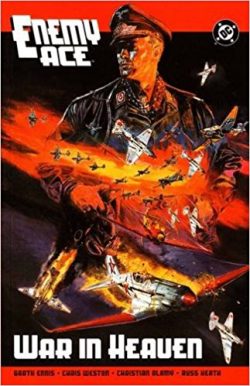
Enemy Ace: War in Heaven


By Garth Ennis, Chris Weston, Christian Alamy & Russ Heath, with Robert Kanigher & Joe Kubert (DC Comics)
ISBN: 978-1-56389-982-9

Enemy Ace first appeared as a back-up in issue #151 of DC’s flagship war comic Our Army at War (cover-dated February 1965): home of the already legendary Sergeant Rock. Produced by the dream team of Robert Kanigher & Joe Kubert during a period when the ongoing Vietnam conflict was beginning to tear American society apart, the series told bitter tales of valour and honour from the point of view of German WWI fighter pilot Hans Von Hammer: a noble warrior fighting for his country in a conflict that was swiftly excising all trace of such outmoded concepts from the increasingly industrialised business of mass-killing.

The sagas – loosely based on the life of “Red Baron” Manfred von Richthofen – were a magnificent tribute to the profession of soldiering whilst condemning the madness of war, produced during those turbulent days of foreign conflicts and intense home front unrest. They are still moving and powerful beyond belief, as is George Pratt’s seminal 1989 sequel, Enemy Ace: War Idyll.

In 2001, Garth Ennis – no stranger to combat fiction – took another look at the flyer on the other side in a 2-issue miniseries that extended his martial longevity by transplanting him to World War II and a far less defensible ethical position…

Bavaria, 1942 and forty-six-year-old Baron Hans von Hammer is visited by an old flying comrade who desperately urges him to come out of retirement and serve his country. No lover of Nazism, the old ace has kept himself isolated until now, but Germany’s attack on Russia has proven a disastrous blunder, and this last plea is as much warning as request…

The neophyte pilots on the Eastern Front need his experience and leadership, whereas Hitler’s goons and zealots don’t need much excuse to remove a dissident thorn…

Based loosely on the lives of such German pilots as Adolf Galland, book I of War in Heaven (illustrated by Chris Weston) finds von Hammer as indomitable as ever in the Eastern killer skies but unable to come to terms with the increasing horror and stupidity of the conflict and its instigators.

The phrase “My Country, Right or Wrong” leaves an increasingly sour taste in his mouth as the last of his nation’s young men die above Soviet fields…

Book II is set in 1945 and witnesses Germany on the brink of defeat with von Hammer flying an experimental early jet fighter (a Messerschmitt 262, if you’re interested); shooting down not nearly enough Allied bombers to make a difference and still annoying the wrong people at Nazi High Command.

He knows the war is over but his sense of duty and personal honour won’t let him quit. He is resigned to die in the bloody skies that have been his second home, but then he is shot down and parachutes into a concentration camp named Dachau…

With art from comics legend Russ Heath, this stirring tale ends with a triumph of integrity over patriotism: a perfect end to the war record of a true soldier.

This slim paperback volume (still findable, despite being incomprehensibly out of print and unavailable digitally) is supplemented by a classic anti-war tale of WWI by Kanigher & Kubert, taken from Star-Spangled War Stories #139.

‘Death Whispers… Death Screams!’ explores the Enemy Ace’s childhood and noble lineage as he endures the daily atrocities of being one of the world’s last warrior knights in a mechanised, conveyor-belt conflict. Just another day above the trenches but never away from them…

Here is another gripping, compelling, deeply incisive exploration of war, its repercussions, both good and bad, and the effects that combat has on singular men. This should be mandatory reading for every child who wants to be a soldier…
© 2001, 2002 DC Comics. All Rights Reserved.
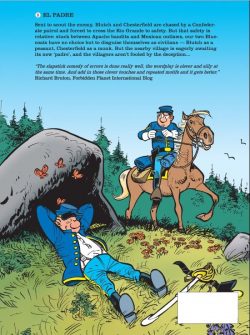
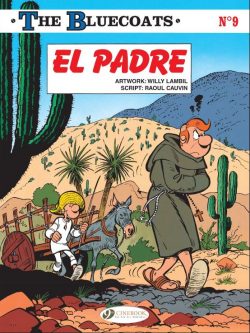
The Bluecoats volume 9: El Padre


By Willy Lambil & Raoul Cauvin translated by Jerome Saincantin (Cinebook)
ISBN: 978-1-84918-286-7

Les Tuniques Bleues began in 1968; an occasional comedy western strip created by Louis “Salvé” Salvérius & Raoul Colvin – who has solo-written every best-selling volume since. The feature was created to replace Western wonder man Lucky Luke when the laconic lone gunslinger defected from weekly anthology Le Journal de Spirou to comic rival Pilote.

His rapidly-rendered replacements swiftly became one of the most popular bande dessinée stars on the Continent…

Salvé was a cartoonist of the Gallic big-foot/big-nose humour style, and when he died suddenly in 1972, his replacement – Willy “Lambil” Lambillotte – gradually moved towards an edgier, more realistic (although still broadly comedic) illustrative manner. Lambil is Belgian-born (in 1936) and, after studying Fine Art in college, joined publishing giant Dupuis as a letterer in 1952.

Born in 1938, scripter Raoul Cauvin is also Belgian and studied Lithography before joining Dupuis’ animation department in 1960. He soon discovered his true calling as a comedy writer and began a glittering and prolific career at Spirou.

In addition to Bluecoats Cauvin has written dozens of other long-running, award winning series including Cédric, Les Femmes en Blanc and Agent 212: amassing more than 240 separate albums in total. The Bluecoats alone have sold more than 15 million copies worldwide.

The sorry protagonists of the show are Sergeant Cornelius Chesterfield and Corporal Blutch, a pair of worthy fools in the manner of Laurel and Hardy: hapless, ill-starred US cavalrymen posted to the wild frontier and various key points of mythic America.

The original format was single-page gags centred about an Indian-plagued cavalry fort, but with second volume ‘Du Nord au Sud’ (North and South) the sad-sack soldiers went back East to fight in the American Civil War.

That origin was discarded and rewritten a decade later, finally and canonically describing how the chumps were drafted into the military during the war as seen in previous volume Auld Lang Blue. All subsequent adventures – despite ranging far beyond the traditional environs of America and taking in a lot of genuine and thoroughly researched history – are set within the timeframe of the Secession conflict.

Les Tuniques Bleues: El Padre was first seen on the continent in 1980, serialised in Spirou #2192-2202. Originally the 17th Euro-compilation, it comprises Cinebook’s 9th compellingly charming Bluecoats translated album of 60 thus far released in French…

Blutch is your average whinging little-man-in-the street: work-shy, mouthy, devious and especially critical of the army and its inept commanders. Ducking, diving, feigning death and even deserting whenever he can, he’s you or me – except sometimes he’s quite smart and heroic if no other, easier, option is available.

Chesterfield is a big burly man; an apparently ideal career soldier who has passionately bought into all the patriotism and esprit-de-corps of the Military. He is brave, never shirks his duty and wants to be a hero. He also loves his cynical little pal. They quarrel like an old married couple, fight like brothers but simply cannot agree on the point and purpose of the horrendous war they are trapped in…

It opens on the Rio Grande as our heroes are pursued by a determined party of Confederate troops. The pair have stumbled upon critical military information and the Greycoats are resolved they will not get back to their own lines…

With no other options, Chesterfield and Blutch cross into Mexico, painfully aware what might happen if they are captured by the nation’s own army, or – worse yet – its rampaging bandits…

With the Rebs posted all along the US riverbank, the lads have no choice but to head inland and eventually – with Blutch whining all the way – are forced to make camp. It’s actually a ploy to distract the vigilant Southern soldiery, but instead draws the attention of a roaming band of Indian renegades, forcing the Bluecoats even further south and into the clothing of a murdered monk and peon they discover near an abandoned mule cart.

Dreading the prospect of Mexican prison, the lads seek another river crossing but are quickly captured by Apache outlaw Jacomino before being saved by an even more deadly murdering cutthroat…

Sadistic but (sort of) devout bandito El Señor Diaz urgently needs a priest. He has subjugated a local village for his own nefarious purposes, but the Peones are refusing his demands for food and tribute until their new overlord replaces their recently murdered holy father…

The obviously-Americano Padre will have to do and with the help of the villagers – who aren’t fooled for a moment by the feisty, two-fisted cleric in a badly-fitting, blood-stained robe – Chesterfield goes about his secular and temporal duties.

Father Chesterfield’s plan is to keep the peons safe until he can get back to the war, despite the constant harassment of Jacomino’s monk-hating band, but events cascade out of control once he learns that Diaz has a hidden treasure that will earn him vast wealth and a constant supply of weapons and ammunition from the Bluecoat Army…

A little dutiful prying by Blutch exposes the horrific secret: the prize is Emily Appleton, daughter of his commanding colonel and the blithely unaware object of the bluff sergeant’s unrequited affection…

With no other option, the enraged soldier resolves that he and Blutch will steal her back and make a break for the border. As usual the plan almost works but before too long both Diaz and Jacomino are in hot in pursuit even as the confederates await at the river’s edge for the fugitives.

If there was ever a moment for a last-minute cavalry rescue this would be it…

Historically authentic, always in good taste despite an uncompromising portrayal of violence, the attitudes expressed by the down-to-earth pair never make battle anything but arrant folly and, like the hilarious yet insanely tragic war memoirs of Spike Milligan, these are comedic tales whose very humour makes the occasional moments of shocking verity doubly powerful and hard-hitting. Nevertheless, the scope for light-hearted, hot-blooded adventure is always high and this wild ride is also is heavy on comedy too: a fun, informative, beautifully realised and eminently readable yarn to appeal to the best, not worst, of the human spirit.
© Dupuis 1981 by Lambil & Cauvin. English translation © 2015 Cinebook Ltd. All rights reserved.

Sgt. Fury and His Howling Commandos Masterworks volume 2


By Stan Lee & Dick Ayers, with George Roussos, Steve Ditko, Frank Giacoia, Vince Colletta, Chic Stone, Carl Hubbell & various (Marvel)
ISBN: 978-0-7851-2928-8 (HB)

Sgt. Fury and his Howling Commandos began as an improbable, decidedly over-the-top and raucous WWII combat comics series similar in tone to later ensemble action movies such as The Magnificent Seven, The Wild Bunch and The Dirty Dozen. The surly squad of sorry reprobates premiered in May 1963, one of three teams concocted by men-on-fire Jack Kirby & Stan Lee to secure fledgling Marvel’s growing position as a publisher to watch.

Two years later Fury’s post-war self was retooled as the big-name star of a second series (beginning with Strange Tales #135, August 1965) when espionage shows like The Man from U.N.C.L.E. and the 007 film franchise became global sensations.

Nick Fury, Agent of S.H.I.E.L.D. combined Cold War tensions with sinister schemes of World Domination by subversive all-encompassing hidden enemy organisations: with captivating super-science gadgetry and iconic imagineering from Jack Kirby and Jim Steranko.

For all that time, however, the original wartime version soldiered on (sorry: puns are my weapon of choice), blending a uniquely flamboyant house-bravado style and often ludicrous, implausible, historically inaccurate, all-action bombast with moments of genuine heartbreak, unbridled passion and seething emotion.

Sgt. Fury started out as a pure Kirby creation. As with all his various combat comics, The King made everything look harsh and real and appalling: the people and places all grimy, tired, battered yet indomitable.

The artist had served in some of the worst battles of the war and never forgot the horrific and heroic things he saw – and more graphically expressed in his efforts during the 1950s genre boom at a number of different companies. However, even at kid-friendly, Comics Code-sanitised Marvel, those experiences perpetually leaked through onto his powerfully gripping pages.

Kirby was – unfortunately – far too valuable a resource to squander on a simple war comic (or indeed the X-Men and Avengers: the other series launched in that tripartite blitz on kids spending money) and quickly moved on leaving redoubtable fellow veteran Dick Ayers to illuminate later stories, which he did for almost the entire run of the series (95 issues and Annuals) until its transition to a reprint title with #121 (July 1974). The title then carried on until its ultimate demise in December 1981 with #167.

Following an enticing and revelatory reminiscence from Ayers in his Introduction, this second hardback and eBook compendium re-presents the contents of Sgt. Fury and his Howling Commandos #14-23 and the first Annual (collectively spanning January to October 1965) opening with a Lee scripted, George Roussos/Bell inked milestone as harassed Adolf Hitler decrees the creation of a Nazi answer to Fury’s elite attack force.

All ‘The Blitzkrieg Squad of Baron Strucker!’ had to do was lure the Howlers to a V2 rocket base and spring their trap… Yeah, that was all…

Regular supplemental feature Weapons of War then provides all the gen on the ‘B-26 Martin Marauder’ to inform and entertain in equal amounts.

Steve Ditko stepped in to ink Ayers in issue #15 as ‘Too Small to Fight, Too Young to Die’ related an ill-fated mission in Holland to destroy the dykes and flood the occupation forces. The job soon goes drastically wrong and the Howlers “flee” back to Britain with nothing but a broken-hearted boy named Hans Rooten – who had no idea that his despised quisling father was in fact the Allies’ top spy in the region…

The boy is adopted as the Howlers’ plucky mascot but can’t accompany them when the squad is despatched to Africa in #16 to eradicate yet more Nazi super-weapons in ‘A Fortress in the Desert Stands!’ (inked by Frank Giacoia using the pseudonym Frankie Ray). From there it’s only a short camel-ride south until the ragtag rovers encounter spear-wielding natives and nasty Nazis engaged in a battle of Hearts & Minds ‘While the Jungle Sleeps!’ (by Lee, Ayers & Vince Colletta).

All this time the chalk-and-cheese romantic relationship between Nick and English aristocrat Lady Pamela Hawley had been developing to the point where the Yankee lout was ready to propose. That all ends in #18 when, whilst the unit is busy sinking a German battleship in a Norwegian port, she is ‘Killed in Action!’ (Chic Stone inks).

Crushed and crazy, Fury goes AWOL in the next issue, remorselessly hunting down the leader of the bomber flight which had targeted the hospital she worked in before extracting ‘An Eye for an Eye!’ in a satisfyingly shocking Stan Lee story sensitively rendered by Ayers & Giacoia. The Howlers go along for the ride, but whether to help their leader or hold him back is debatable…

A far grimmer Fury is still in the mood for cathartic carnage in #20, so when ‘The Blitz Squad Strikes!’ features the German Kommandos invading a Scottish castle filled with imprisoned Nazi airmen, he and the Howlers are more than delighted to lead the sortie to retake it.

In the next issue the long-running rivalry with First Attack Squad; Baker Company again results in frantic fisticuffs before being interrupted by another last-ditch rescue mission in Czechoslovakia ‘To Free a Hostage!’ (inked by Golden Age legend Carl Hubbell, as was the next issue).

However, even after Allied scientist and captive daughter are reunited, the bubbling beef with B Company doesn’t diminish and when both units are subsequently sent to sabotage the oil refinery at Ploesti the defending forces capture everybody. However, after the gloating Nazis try making Fury and his opposite number to kill each they quickly learn ‘Don’t Turn Your Back on Bull McGiveney!’ and even Strucker’s Blitz Squad can’t contain the devastating destruction that follows…

The final WWII exploit contained herein is the Giacoia-inked saga of ‘The Man Who Failed!’, wherein a rescue jaunt to Burma to save nuns and orphans results in shameful revelations from English Howler Percy Pinkerton‘s past: simultaneously supplying close insight into why our True Brit upper lips are so stiff…

This combat compendium then concludes with the 15-page lead story from Sgt. Fury and his Howling Commandos King Size Annual #1 (1965) as the post-war Howlers are called up and mustered to the 38th Parallel to defend democracy from Communist aggression. This particular escapade sees them rescuing former Commanding Officer Colonel Sam Sawyer and results in Fury winning a battlefield ‘Commission in Korea!’ to at last become a Lieutenant in a rousing romp by Lee, Ayers & Giacoia. Also extracted from that that might special are pictorial features ‘A Re-introduction to the Howlers’; ‘A Birds Eye View of HQ, Able Company – Fury’s Base in Britain’; ‘Plane’s-Eye View of Base Tactical Area, Sub-Pen, Dock and Air-Strip!’ and ‘Combat Arm and Hand Signals’ before a 2-page house ad feature for the hero’s super-spy iteration as ‘Nick Fury, Agent of S.H.I.E.L.D.’ wraps everything up in Marvel’s military fashion.

Whereas close rival DC increasingly abandoned the Death or Glory bombast at this time in favour of humanistic, almost anti-war explorations of war and soldiering, Marvel’s take always favoured action-entertainment and fantasy over soul-searching for ultimate truths. On that level at least, these early epics are stunningly effective and galvanically powerful exhibitions of the genre.

Just don’t use them for history homework.
© 1965, 2017 Marvel Characters Inc. All rights reserved.

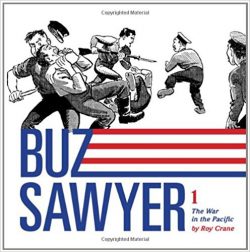
Buz Sawyer: The War in the Pacific


By Roy Crane (Fantagraphics Books)
ISBN: 978-1-60699-362-0 (HB)

Modern comics evolved from newspaper comic strips, and these pictorial features were until relatively recently utterly ubiquitous and hugely popular with the public – and highly valued by publishers who used them as an irresistible sales weapon to guarantee and increase circulation and profits.

It’s virtually impossible for us to today to understand the overwhelming power of the comic strip in America (and the wider world) from the Great Depression to the end of World War II. With no television, broadcast radio far from universal and movie shows at best a weekly treat for most folk, household entertainment was mostly derived from the comic sections of daily and especially Sunday Newspapers. “The Funnies” were the most common recreation for millions who were well served by a fantastic variety and incredible quality.

From the very start humour was paramount; hence the terms “Funnies” and “Comics”, and from these gag and stunt beginnings – a blend of silent movie slapstick, outrageous fantasy and the vaudeville shows – came a thoroughly entertaining mutant hybrid: Roy Crane’s Wash Tubbs.

Debuting on April 21st 1924 Washington Tubbs II was a comedic gag-a-day strip that evolved into a globe-girdling adventure serial. Crane crafted pages of stunning, addictive quality yarn-spinning whilst his introduction of moody swashbuckler Captain Easy in the landmark episode for 6th May, 1929 led to a Sunday colour page that was possibly the most compelling and visually impressive of the entire Golden Age of Newspaper strips (as seen in Roy Crane’s Captain Easy, Soldier of Fortune: The Complete Sunday Newspaper Strips volume 1).

Almost improving minute by minute Crane’s imagination and his fabulous visual masterpieces achieved a timeless immediacy that made each page a unified piece of sequential art. The influence of those pages can be seen in the works of near-contemporaries such as Hergé, giants-in-waiting like Charles Schulz and comics creators like Alex Toth and John Severin ever since.

The work was obviously as much fun to create as to read. In fact, the cited reason for Crane surrendering the Sunday strip to his assistant Les turner in 1937 was the NEA/United Features Syndicate’s abrupt and arbitrary demand that all its strips must henceforward be produced in a rigid panel-structure to facilitate their being cut up and re-pasted as local editors dictated – although the compelling text features in this book dedicated to his second masterpiece reveal a few more commercial and professional reasons for the jump from the small and provincial syndicate to the monolithic King Features outfit.

At the height of his powers Crane just walked away from the astounding Captain Easy page, concentrating on the daily feature, and when his contract expired in 1943 he left United Features to create the World War II aviation strip Buz Sawyer; lured away by the grandee of strip poachers William Randolph Hearst.

The result is 75 years old this year and still one of the freshest and most engaging comics strips of all time…

Where Wash Tubbs was a brave but comedic Lothario and Easy a surly tight-lipped he-man, John Singer “Buz” Sawyer was a happy amalgam of the two: a plain and simple, good-looking popular country-boy who went to war because his country needed him.

After the gripping and informative text feature ‘Crane’s Great Gamble’ by Jeet Heer, the strip explodes into action on Christmas Eve 1942, as new Essex Class Aircraft Carrier USS Tippecanoe steams for the Pacific Theatre of Operation carrying 100 fighter-bombers and an extremely keen pair of cartoon paladins.

Buz Sawyer is a fun-loving, skirt-chasing, musically-inclined pilot and his devoted gunner Rosco Sweeney a bluff, simple ordinary guy – as well as one of the best comedy foils ever created.

The strip is a marvel of authenticity: picturing not just the action and drama of the locale and situation but more importantly capturing the quiet, dull hours of training, routine and desperate larks between the serious business of killing whilst staying alive.

Like contemporaries Bill Mauldin and Milton Caniff, Crane was acutely aware that all his readers had someone involved in the action and therefore felt he had a duty to inform and enlighten as well as entertain. Spectacular as the adventure was, the truly magical moments focus on the off-duty camaraderie and candid personal interactions that pepper the daily drama.

This beautiful archival hardback covers the entire war years of the strip from November 1st 1943 to October 5th 1945, wherein the great artist perfected his masterly skill with Craftint (a mechanical monochrome patterning effect used to add greys and halftones which Crane employed to add miraculous depths and moods to his superb drawing) and opens with the lovable lads shot down whilst tackling a Japanese carrier.

Marooned, their life raft washes up on a desolate desert island where they’re hunted by enemy troops and discover a marooned German farmer and his beautiful daughter. At first hostile, lovely fräulein April soon succumbs to Buz’s boyish charm. Helping Buz and Roscoe escape, the trio only make it as far as the next islet where fellow pilot and friendly rival Chili Harrison has also been stranded since his plane went down.

Eventually rescued, the Navy fliers return to “the Tip” for training on new planes (Curtiss SB2C Helldivers; in case you were wondering) in preparation for the push to Japan. Amidst spectacular action sequences shipboard life goes on, but during a raid on an occupied island Buz and Sweeney are once more shot down. In the middle of a fire-fight they effect repairs and head back to the Tippecanoe, but not without cost. Rosco has been hit…

Sawyer’s exemplary exploits haven’t gone unnoticed and, whilst Sweeney is recovering from wounds, the hero is selected for a secret mission deep into enemy territory; ferrying an intelligence agent to a meeting with enigmatic underground leader the Cobra.

It all goes tragically wrong and the American agent is captured. With the enemy hunting high and low for the pilot, Buz then falls back on his most infuriating ability: falling into the willing laps of beautiful women…

‘Sultry’ is a gorgeous collaborator high in the favour of the occupying Japanese, but she too finds the corn-fed aviator irresistible. Of course, it might simply be that she’s also Cobra…

This extended epic is a brilliant, breathtaking romp blending action, suspense, love and tragedy into a compelling thriller that carries Buz all the way to December 1944.

As a result of his trials, the hero is sent back to America on a 30-day leave – enabling Crane to reveal some enticing background and invoke all the passions, joys and heartbreaks of the Home Front.

Buz doesn’t want to go but orders are orders, so to make things a little more bearable he takes the still-recuperating Sweeney with him. It isn’t that the young flier despises his origins – indeed, his civilian life is a purely idyllic American Dream – it’s simply that he wants to get the job done against the enemy. Nevertheless, with a warrior’s grace under pressure, he resigns himself to peace and enjoyment whilst his comrades soldier on. If he knew the foe he would face in his little hometown, Buz would probably have gone AWOL…

Crane’s inspirational use of the War at Home was a masterstroke: it’s not a world of spies and insidious Bundists, but just an appetising little burg filled with home-comforts and proud people: the kind of place soldiers were fighting to preserve and a powerful tool in the morale-builder’s arsenal. It’s also a place of completely different dangers…

Buz is the son of the town’s doctor; plain, simple and good-hearted. In that egalitarian environment the kid was the sweetheart of the richest girl in town, and when Tot Winter‘s upstart nouveau riche parents hear of the decorated hero’s return they hijacked the homecoming and turn it into a self-serving publicity carnival.

Moreover, ghastly, snobbish Mrs. Winter conspires with her daughter to trap the lad into a quick and newsworthy marriage. Class, prejudice, financial greed and social climbing are enemies Buz and Sweeney are ill-equipped to fight, but luckily that annoying tomboy-brat Christy Jameson has blossomed into a sensible, down-to-earth, practical and clever young woman. She’s scrubs up real pretty too…

After a staggeringly smart and compelling soap opera sequence that would do Eastenders or Coronation Street proud, Buz ends up (accidentally) engaged to Tot after all. Mercifully the leave ends and he and Sweeney must return to the war… but even then they are disappointed to discover that they won’t immediately be fighting again.

Posted to Monterey, California, they are to be retrained for new planes and a new squadron, reuniting with rowdy rival Chili Harrison: but Mrs Winter is determined to have a war hero in the clan and pursues them with Tot in tow, determined to get Buz married before he returns to the Pacific.

Insights into another aspect of the military experience (Crane had almost unfettered access, consultation privileges and the grateful willing cooperation of the US Navy) are revealed to readers as the whiz-kid is suddenly back in school again – and usually in the dog-house because of his hot-dogging.

Dramatic tension divides evenly between Buz’s apparent inability to be a team-player and the increasingly insistent and insidious ploys of Mrs. Winter.

Moreover, the squadron’s training commander has an uncanny ability to predict which pilots will die in training or combat and Buz’s name is high on that list…

At last the training concludes and – miraculously alive and unmarried – Buz and Sweeney ship out back to the Pacific and the relatively easy task of ending the war. Part of a massive fleet mopping up the island fortresses en route to Tokyo, they are soon flying combat missions and before long, shot down once more. This time they are taken prisoner aboard an enemy submarine…

After another incredible escape and rousing triumph, the war ends, but Crane actually ratcheted up the tension by covering the period of American consolidation and occupation as Buz and Sweeney await demobilisation. Whilst posted to a medical facility in Melatonga, the boys and Chili encounter a woman from Buz’s chequered past they had all believed long dead…

When their discharge papers finally arrive (in the episode for September 9th 1945) an era of desperate struggle ends. However, with such a popular and pivotal strip as Buz Sawyer that only means that the era of Globe-Girdling adventure is about to begin…

This superb monochrome hardback also contains a selection of Sunday strips in full colour. The eternal dichotomy and difficulty of producing Sunday Pages (many client papers would only buy either dailies or Sunday strips, not both) meant that many strip creators would produce different story-lines for each feature – Milt Caniff’s Steve Canyon being one of the few notable exceptions.

Crane handled the problem with typical aplomb: using the Sundays to tell completely unrelated stories. For Wash Tubbs he created a prequel series starring Captain Easy in adventures set before the mismatched pair had met; with Buz Sawyer he turned over the Sabbath slot to Rosco Sweeney for lavish gag-a-day exploits, big on laughs and situation comedy.

Set among the common “swabbies” aboard ship it was a far more family-oriented feature and probably far more welcome among the weekend crowd of parents and children than the often chilling or disturbing realistically and sophisticated saga that unfolded Mondays to Saturdays.

Also included here – and spanning November 28th 1943 to 25th February 1945 in delicious full-page fold outs – are fifteen of the best (many with appearances by Buz): a cheerily tantalising bonus which will hopefully one day materialise as an archival collection of their own. Whilst not as innovative or groundbreaking as Captain Easy, they’re still proficient works by one of the grand masters of our art-form.

This initial collection is the perfect means of discovering or rediscovering Crane’s second magnum opus – spectacular, enthralling, exotically immediate adventures that influenced generations of modern cartoonists, illustrators, comics creators and storytellers.

Buz Sawyer: War in the Pacific ranks as one the greatest strip sequences ever created: thrilling, rousing, funny and moving yarn-spinning that is unforgettable, unmissable and utterly irresistible.
Strips © 2010 King Features Syndicate, Inc. This edition © 2011 Fantagraphics Books, all other material © the respective copyright holders. All rights reserved.

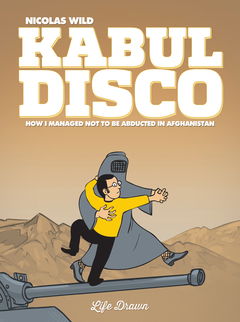
Kabul Disco Book 1: How I Managed Not to be Abducted in Afghanistan


By Nicolas Wild, translated by Mark Bence & Fabrice Sapolsky (Life Drawn/Humanoids Inc.)
ISBN: 978-1-59465-868-6

Fiction and reality frequently blur, but stories – True, mostly True, totally True or Officially Confirmed by a Government Official and therefore Utterly Fallacious – told in comics form somehow always acquire an instant edge of veracity and patina of authenticity that is hard to dispute or refute.

Kabul Disco is a superb case-in-point: an example of sophisticated yet simple Euro-cartooning designed to charm and challenge in equal amounts. It is also the initial release of trans-Continental publisher Humanoids’ new Down-to-Earth, Real-World graphic novel imprint Life Drawn.

This fabulous monochrome travel memoir is the debut episode in a sequence by French writer/artist Nicholas Wild and details his globe-trotting quest for employment: a worthy endeavour which took the wide-eyed political innocent to Afghanistan in 2005.

Remember This: there’s always a war going on somewhere. That’s just the way it is. The enemy are always monsters and our side – there’s no leeway to not take sides anymore – are always justified in what they do. Heaven forfend if you slip up and start thinking of rivals or adversaries or opponents or even those who disagree with you as no more than people – with or without grievances or differing opinions…

In January 2005, Wild was in Paris; gripped by ennui and lack of inspiration and only mildly galvanised by lack of money and imminent homelessness. Responding to an online ad he applied to a Communications Agency looking for a comics artist and was astounded to find himself accepted for a short commission. The job was overseas…

‘Part One: A Winter in Kabul’ follows the culture-shocked scribbler as he arduously transitions to a country in the throes of enforced reconstruction and modernisation, joining the somewhat sketchy and rather dubious NGO Zendagui Media as they work to bring the war-torn region into the arena of modern nations.

Wild’s proposed task is to help define the fancy notion of democracy for the still-largely illiterate populace through comicbook versions of Afghanistan’s new Constitution…

The artist’s early difficulties in adjusting to the primitive conditions and superb gift for wry commentary then afford the reader a brilliant example of the complex made simple as Wild succinctly unpicks Afghanistan’s convoluted history through the 20th century via a cartoon political primer that brilliantly defines how the place got to be such a corrupt mess. I certainly wish I’d had more comics like this when I studied modern history…

Days pass and Nicholas settles in, toiling against impossible deadlines, conversely feeling locked in or anxiously exposed whenever he goes exploring; always aware that in this place foreigners go missing every day…

Although the security situation remains tense, trouble seems to only strike elsewhere and eventually Nick assimilates: befriending ordinary Afghanis, shopping, visiting Shiite mosques, eating in restaurants and even sightseeing in the stunning Bamiyan Valley…

All too soon the job is done and Wild is afraid he’s going to be let go…

‘Part Two: No Spring in Kabul’ finds Wild on April 1st 2005, happy to be retained, albeit on a 3-month contract as a graphic designer for Zendagui’s new project. The brief is to supply materials for a US military-sponsored push to recruit native Afghanis for the new National Army. The thought of crafting military propaganda is not a comforting or comfortable one…

Spiced with further insights about his improbable and unpredictable bosses and new eating experiences, the real kicker is meeting new recruit Laurie White: a political communications expert who worked with the 2000 Bush Election Campaign…

Trips to the University of Herat and enjoyable days amidst the villagers soon cement the visitor’s sense of belonging but that all takes a hard knock as the political situation intensifies and overconfidence leads to Wild getting lost in old Kabul…

When a fresh kidnapping results in a full lockdown for Zendagui staff, Laurie teasingly reveals the true story of Bush’s “victory” in Florida but once the panic subsides it’s back to work. Even though Al Qaeda and the Taliban are ramping up their activities, Nick is sent to the far end of the Jalalabad Road to observe the filming of a recruitment ad even as Laurie is despatched to consult on the new voting form for a nation of more than two dozen different tribes and sects who don’t speak the same language and can’t read…

And so it goes, with fond reveries and razor-sharp observations peppering Wild’s irresistible account of an ordinary job in extraordinary times and a magical place: with idiocy and contradiction piling up but progress somehow being made until it’s time to go home again…

But is it for good?

Although rendered in beguiling black and white, Kabul Disco also provides a stunning, full colour ‘Bonus Section’ comprising candid personal photographs of Wild’s stay, plus extensive examples of Yassin & Kaka Raouf: the 10-volume educational comicbook he illustrated to explain the new Constitution for the newly democratised country.

Captivating, warm, funny, scarily informative and unobtrusively polemical, Kabul Disco is a wittily readable, non-discriminating reverie that informs and charms with surprising effect: the perfect response to the idiocy of war and dangers of corporate imperialism as well as a sublime tribute to the potent indomitability of human nature. I can’t wait for the second volume scheduled for later this year – although I’m just going to have to.

Moreover, the quality of this book augers exceedingly well for Life Drawn’s other imminent releases (Vietnamese Memories: Leaving Saigon by Clément Baloup; Louisa: Now and Then by Carole Maurel &‎ Mariko Tamaki; Madame Cat by Nancy Peña): a barrage of personal stories certain to challenge any comics fan’s definition of fantastic fiction and true-life drama.
© 2018, Humanoids Inc., Los Angeles (USA). All rights reserved. First published in France as Kabul Disco Tome 1: Comment je ne me suis pas fait kidnapper en Afghanistan, © 2007 La Boîte à Bulles & Nicholas Wild. All rights reserved.

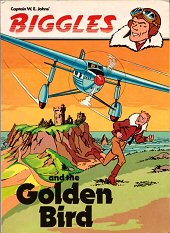
W.E. Johns’ Biggles and the Golden Bird


By Björn Karlström, translated by Peter James (Hodder and Stoughton)
ISBN: 978-0-34023-081-7(HB)                      0-340-23081-9(PB)

In acknowledgement of today’s Centenary of the Royal Air Force, I’m reviewing a captivating combat classic starring one of the Service’s most glittering – albeit fictional – stars.

Although one of the most popular and enduring of all True Brit heroes, air detective Squadron Leader James Bigglesworth – immortally known as “Biggles” – has never been the star of British comics you’d reasonably expect.

Whilst the likes of Sherlock Holmes, Dick Turpin, Sexton Blake, Dick Barton and others have regularly made the jump to sequential pictorials, as far as I can determine the only time Biggles hit the funny pages was as a beautiful strip illustrated firstly by Ron Embleton and later Mike Western for the lush, tabloid-sized photogravure weekly TV Express (issues 306-376, 1960-1962). Even then the strip was based on the 1960 television series rather than the armada of books and short stories generated over Johns’ 56-year career.

Much of this superb stuff has been reprinted in French and other European editions but remains criminally uncollected in the UK. Indeed Biggles is huge all over the Continent, particularly Holland, Belgium and France, which makes it doubly galling that only a short-lived Swedish interpretation of Biggles has ever made the transition back to Blighty…

Created by World War 1 flying veteran and aviation enthusiast William Earl Johns (February 5th 1893-June 21st 1968), the airborne adventures of Biggles, his cousin the Hon. Algernon Montgomery Lacey AKA “Algy”, Ginger Hebblethwaite and their trusty mechanic and dogsbody Flight Sergeant Smyth ran as prose thrillers in the magazines Modern Boy, Popular Flying and Flying – periodicals which Johns designed, edited and even illustrated.

Initially aimed at an older audience, the Biggles stories quickly became a staple of boys’ entertainment in anthology and full novels (nearly 100 between 1932-1968) as well as a true cultural icon. Utilising the unique timeless quality of proper heroes, Biggles and Co. have waged their dauntless war against evil as combatants in World Wars I and II, as Special Air Detectives for Scotland Yard in the interregnum of 1918-1939 and as freelance agents and adventurers in the Cold War years…

“Captain” W.E. Johns was one of the most prolific writers of the 20th century and wrote over 160 books in total as well as innumerable features and articles ranging from gardening to treasure-hunting, aviation, crime fiction, pirates and historical fact and fiction.

He created many heroic novel series which shared the same continuity as Biggles: 6 “Steeley” novels starring Deeley Montfort Delaroy, a WWI fighter ace-turned-crimebuster between 1936-1939, 10 volumes of commando Captain Lorrington King AKA Gimlet (1943-1954) and a 10 volume science fiction saga starring retired RAF Group Captain Timothy ‘Tiger’ Clinton, his son Rex and boffin Professor Lucius Brane who voyaged among the stars in a cosmic ray powered spaceship between 1954 and 1963.

Although much of his work is afflicted with the parochial British jingoism and racial superiority that blights so much of the fiction of the early 20th century, Johns was certainly ahead of his time in areas of class and gender equality. Although Algy is a purely traditional plucky Toff, working class Ginger is an equal partner and participant in all things, whilst Flight Officer Joan Worralson was a WAAF pilot who starred in 11 “Worrals” novels between 1941 and 1950, commissioned by the Air Ministry to encourage women to enlist in the Women’s Auxiliary Air Force.

In 1977, veteran Swedish author and cartoonist Björn Karlström returned to comics when publisher Semics commissioned him to produce four new Biggles adventures; ‘Het Sargasso mysterie’, ‘Operatie goudvis’, ‘De tijger bende’ and ‘Ruimtestation Aries’ (The Sargasso Mystery; Operation Goldfish; The Tiger Gang and Space Station Aries, respectively). These were picked up by Hodder and Stoughton in 1978, deftly translated by Peter James and released as Biggles and the Sargasso Triangle, Biggles and the Golden Bird, Biggles and the Tiger and Biggles and the Menace from Space…

In 1983, two further albums were released, created by Stig Stjernvik.

Although deeply mired in the stylisation and tone of Hergé’s Tintin, to my mind the most authentic-seeming to Johns’ core concept was the second, highlighted here for today’s celebrations…

Swedish designer, author and aviation enthusiast Björn Karlström began working in comics for the vast Scandinavian market in 1938, producing scale-model plans and drawings for the magazine Flygning. In 1941 he created the adventure strip Jan Winther for them before devising international speculative fiction hit Johnny Wiking: followed up with another SF classic which closely foreshadowed the microscopic missionaries of (Otto Klement, Jerome Bixby and Isaac Asimov’s) Fantastic Voyage in ‘En Resa i Människokroppen’ (1943-1946), before taking over Lennart Ek’s successful super-heroine strip Dotty Virvelvind in 1944.

Karlström left comics at the end of the war and returned to illustration and commercial design, working on jet fighters for Saab and trucks for Scania.

Whereas most of his earlier comics were rendered in a passable imitation of Alex Raymond’s Flash Gordon, when he was convinced to produce the Biggles quartet Karlström adopted a raw, lean version of Hergé’s Ligne Claire style which adds a welcome sense of period veracity to the tales but often offends and upsets Tintin purists…

Biggles and the Golden Bird is set in the early 1930s and begins when the aerial adventurers are asked to pilot a new super-plane in an attempt to break the world long-distance flying record. Fact freaks might be intrigued to discover that the “Fairview” of this story is closely based on the record-smashing Fairey Long Range Monoplane, which stars in a splendid plans-&-diagrams section at the back that also includes the De Havilland C-24 Autogiro also featuring prominently in this ripping yarn…

When mysterious intruders brazenly steal the Fairview, intelligence supremo General Raymond dispatches Biggles, Algy and Ginger to track them down and retrieve the prototype air-machine. A crashed light plane and a rustic witness point the trio in the direction of Scotland and, dashing North in a ministry-provided autogiro (that’s a cross between a plane and an early kind of helicopter), they rendezvous with a fishing boat whose captain also witnessed strange sky shenanigans only to be attacked and overcome…

Their enigmatic adversaries had anticipated the pursuit and laid a trap, but with a typical display of pluck and fortune, Ginger turns the tables and drives off the thugs. The real Captain Gilbert then imparts his information and the autogiro brings them to a desolate ruined castle on a rocky headland, where Ginger and Algy are captured by an armed gang even as poor Biggles plunges over a cliff to certain doom…

Naturally the Ace Aviator saves himself at the last moment and subsequently discovers a sub-sea cavern – complete with deep-sea diving operation – just as his pals cunningly escape captivity. Fortuitously meeting up, the trio follow their foes and find a sunken U-Boat full of gold…

The uncanny reason for the theft of the Fairview and the mastermind behind it all is revealed when arch-enemy and all-around Hunnish blackguard Erich von Stalhein arrives to take possession of the recovered bullion before fleeing to a new life in distant lands. Having none of it the plucky lads strike, leading to a blistering battle and spectacular showdown…

Fast and furious, full of fights and hairsbreadth chases – although perhaps a touch formulaic and too steeped in the old-fashioned traditions for modern comics purists – this light and snappy tale would delight newer readers and general action fans and is readily available in both hardback and softcover editions, since the books were re-released in 1983 in advance of the star-studded but controversial British film-flop Biggles: Adventures in Time.

Perhaps it’s time for another revival and even some fresh exploits?
Characters © W.E. Johns (Publications). Text and pictures © 1978 Björn Karlström. English text © 1978 Hodder and Stoughton Ltd.

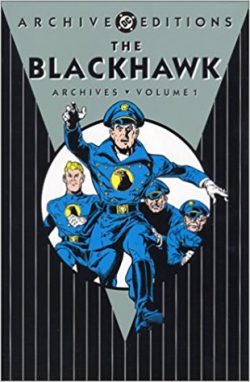
Blackhawk Archives Volume 1


By Will Eisner, Dick French, William Woolfolk, Bob Powell, Chuck Cuidera, Reed Crandall & various (DC Comics)
ISBN: 978-1-56389-700-9

The early days of the American comicbook industry were awash with both opportunity and talent, and these factors beneficially coincided with a vast population hungry for cheap entertainment.

Comics had practically no fans or collectors; only a large marketplace open to all varied aspects of yarn-spinning and tale-telling. Thus, even though America loudly proclaimed its isolationism and remained more than six months away from active inclusion in World War II, creators like Will Eisner and publishers like Everett M. (known to all as “Busy”) Arnold felt that Americans were ready for a themed anthology title such as Military Comics.

Nobody was ready for Blackhawk.

Military Comics #1 launched on May 30th 1941 (with an August off-sale or cover-date) and included in its gritty, two-fisted line-up Death Patrol by Jack Cole, Miss America, Fred Guardineer’s Blue Tracer, X of the Underground, The Yankee Eagle, Q-Boat, Shot and Shell, Archie Atkins and Loops and Banks by “Bud Ernest” (in actuality, aviation-nut and unsung comics genius Bob Powell), but none of the strips, not even Cole’s surreal and suicidal team of hell-bent fliers, had the instant cachet and sheer appeal of Eisner & Powell’s “Foreign Legion of the Air” led by a charismatic Dark Knight known only as Blackhawk.

Chuck Cuidera – already famed for creating The Blue Beetle for Fox Publications – drew ‘The Origin of Blackhawk’ for the premiere issue, wherein a lone, magnificently skilled pilot fighting the Nazi invasion of Poland in 1939 is finally shot down by Nazi Ace Von Tepp.

The sadistic killer then goes on to bomb a farmhouse sheltering the defeated pilot’s family. Rising from his plane’s wreckage, the distraught pilot vows vengeance…

Two years later, with the Nazis in control of most of Europe, Von Tepp’s unassailable position is threatened by a mysterious paramilitary squadron of unbeatable fliers, dedicated to crushing injustice and smashing the Axis war-machine…

Eisner wrote the first four Blackhawk episodes and Cuidera stayed aboard until issue #11 – although the artist would return in later years. Many of the stories were originally untitled but have been conveniently characterized with such stirring designations as issue #2’s ‘The Coward Dies Twice’ wherein the team – “the last free men of the conquered countries” – offer a deserter from a Spitfire Squadron a chance to redeem himself…

The easy mix of patriotism, adventure and slapstick was magnified by the inclusion of Chop-Chop in ‘The Doomed Squadron’: a comedy Chinaman painful to see through modern eyes, but a stock type considered almost as mandatory as a heroic leading man in those dark days, and not just in comics.

At least this Asian man is a brave and formidable fighter both on the ground and in a plane…

‘Desert Death’ takes the team to Suez – for the first of many memorable Arabian adventures – as Nazi agitators attempt to foment revolution among the tribesmen in hopes that they will rise up and destroy the British. This tale is also notable for the introduction of a species of sexy siren beloved of Eisner and Quality Comics. Her or similar seductresses of her ilk would populate the strip until DC bought the property in 1957. Also included here is also a secret map of Blackhawk Island, mysterious base of the ebon-clad freedom fighters.

With issue #5 Dick French assumed the writing role and ‘Scavengers of Doom’ tells a biting tale of battlefield looters allied to a Nazi mastermind, united to set an inescapable trap for the heroic fliers. More importantly, French began providing distinct and discrete characters for the previously anonymous minor players.

In MC #6 the rapidly gelling team joins the frantic hunt for a germ weapon the Gestapo are desperate to possess, resulting in spectacular alpine adventure ‘The Vial of Death’, after which #7 (the first issue released after America entered World War II although the stories had not yet caught up to reality) finds the lads prowling the Mongolian Steppe on horseback to thwart ‘The Return of Genghis Khan’.

‘The Sunken Island of Death’ from #8 is a striking maritime romp wherein the warring powers battle to occupy and possess an island freshly risen from the Atlantic depths. The new-born landmass is strategically equidistant between the USA, Britain and Festung Europa (that’s what the Nazis called the enslaved stronghold they had made of mainland Europe).

Although complete in itself, the yarn is also the first of an experimental, thematic 3-part saga that stretched the way comics stories were told.

There were many marvellously melodramatic touches to make the Blackhawks so memorable in the eyes of a wide-eyed populace of thrill-hungry kids. There was the cool, black leather uniforms and peaked caps. The unique – yet real – Grumman F5F-1 Skyrocket planes they flew from their secret island base and their eerie battle-cry “Hawkaaaaa!” But perhaps the oddest idiosyncrasy to modern readers was that they had their own song which André, Stanislaus, Olaf, Chuck, Hendrickson and Chop-Chop would sing as they plunged into battle. And just to be informative and inclusive, the sheet-music and lyrics were published in this issue and are re-presented here – just remember this is written for seven really tough guys to sing while dodging bullets and weaving between bursts of flak…

Military #9 led with ‘The Man in the Iron Mask’ as the unflappable team discover that a fallen comrade did not actually die in combat, but was hideously disfigured saving them, whilst the next issue’s tale – ‘Trapped in the Devil’s Oven’ – is another desert adventure focusing on the still primitive science of plastic surgery to restore said hero to full fighting trim.

Issue #11 – Cuidera’s last – saw the squadron turn their attention to Japan, as reality at last caught up with publishing schedules. Intriguingly, ‘Fury in the Philippines’ starts quietly with the entire team calmly discussing carrying on against the Nazis or switching their attentions to the Pacific Theatre of Operations, until comedy relief Chop-Chop sways the debaters with an impassioned stand.

Though inarguably an offensive stereotype visually, the Chinese warrior was often given the best lines and most memorable actions. A sneakily subversive attempt on the part of the creators (frequently from immigrant backgrounds and ethnic origins) to shake up those hide-bound societal prejudices, perhaps?

Notwithstanding, the resultant mission against the Japanese fleet is a cataclysmic Battle Royale, full of the kind of vicarious pay-back that demoralized Americans needed to see following Pearl Harbor…

‘The Curse of Xanukhara’ added fantasy elements to the gritty mix of blood and iron as the team’s hunt for a stolen codebook leads them to occupied Borneo and eventually the heart of Tokyo; a classy espionage thriller marking the start of a superlative run of thrillers illustrated by the incredible Reed Crandall.

The artist’s realistic line and the graceful poise of his work – especially on exotic femmes fatale and trustworthy girls-next-door – made his strips an absolute joy to behold.

‘Blackhawk vs. The Butcher’ (Military #13, November 1942) was written by new regular scripter Bill Woolfolk and returned the team to Nazi territory as a fleeing Countess turned the team’s attention to the most sadistic Gauleiter (Nazi regional leader in charge of a conquered territory) in the German Army.

What follows is a spectacular saga of justice and righteous vengeance, whilst ‘Tondeleyo’ reveals a different kind of thriller as an exotic siren uses her almost unholy allure to turn the entire team against each other.

Such quasi-supernatural overtones held firm in the stirring ‘Men Who Never Came Back’ – when the team travel to India to foil a Japanese plot – in a portmanteau tale narrated by the three witches Trouble, Terror and Mystery; eerily presaging the EC horror classics that would cement Crandall’s artistic reputation more than a decade later.

‘Blackhawk vs. the Fox’ pits the flight of heroes against a Nazi strategic wizard (a clear reference to the epic victories of Erwin Rommel) in the burning sands of Libya and remains one of the most authentic battle tales in the canon, before this sublime hardback volume concludes with a racy tale of vengeance and tragedy wherein Japanese traitor Yoshi uses her wiles to punish the military government of Nippon, with Blackhawk as her unwitting tool in ‘The Golden Bell of Soong-Toy!’

These stories were produced at a pivotal moment in both comics and world history, a blend of weary sophistication and glorious, juvenile bravado. Like the best movies of the time – Casablanca, Foreign Correspondent, Freedom Radio, Captain of the Clouds, The Day Will Dawn, The First of the Few, In Which We Serve and all the rest – with their understated, overblown way of accepting duty and loss, these rousing tales of the miracles that good men can do are some of the Golden Age’s finest moments.

In fact, these are some of the best comics stories of their time and I sincerely wish DC had proceeded with further collections.

So will you…
© 1941-1942, 2001 DC Comics. All Rights Reserved.
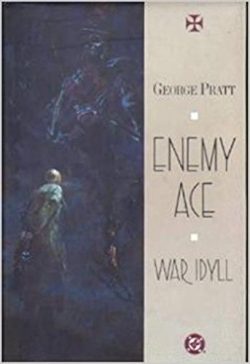
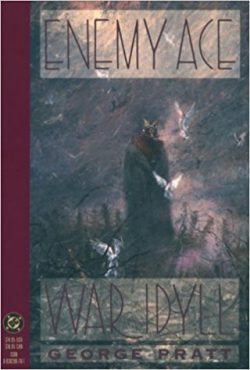
Enemy Ace: War Idyll


By George Pratt (DC Comics)
ISBN: 0-930289-78-1 (HB)                978-0930289782 (TPB)

During the 1960s Marvel gave industry leader National (now DC) Comics an artistic and sales drubbing, overhauling their 20-year position as industry leader – but only in the resurgent genre of super-heroes. In such areas as young kids’ comics, teen-comedies and romance, the House of Ideas still lagged behind, and in the venerable and gritty war-comics market they rated lower even than Charlton.

Admittedly they weren’t really trying, with only the highly inconsistent Sgt. Fury and his Howling Commandos and latterly Captain Savage and his Leatherneck Raiders as publications of any longevity, but that didn’t stop National’s editors and creators from forging ahead: creating a phenomenal number of memorable series and characters to thrill and inform a generation very much concerned with all aspects of military life.

Enemy Ace first appeared as a back-up in issue #151 of flagship war comic Our Army at War (cover-dated February 1965): home of the already legendary Sergeant Rock.

Crafted by the dream-team of Robert Kanigher & Joe Kubert the series told bitter tales of valour and honour from the point of view of German WWI fighter pilot Hans Von Hammer: a pure and noble warrior fighting for his country in a conflict that was swiftly excising all trace of such outmoded concepts from the business of mass-killing.

The tales – loosely based on “Red Baron” Manfred von Richthofen – were a magnificent tribute to the discipline of soldiering whilst wholeheartedly condemning the utter madness of war, produced during the turbulent days of the Vietnam War. They are still moving and powerful beyond belief.

As is this seminal sequel, Enemy Ace: War Idyll. Delineated in moody, misty, strikingly sombre images by painter George Pratt, the story follows the quest of troubled veteran Edward Mannock, a recently returned Vietnam grunt turned photo-journalist. He is a man desperately seeking answers to imponderable questions and great truths to cure the damage his own combat experiences have caused.

1969, and Mannock’s search takes a pivotal turn when, on a routine assignment, he discovers elderly, infirm Von Hammer. The mythic “Hammer of Hell” is dying in a German nursing home but instantly sees that he and the distraught young man share a deep and common bond…

Inexplicably allowed to drop out of print in both hardback and softcover editions and still unavailable in digital formats, this is an astounding, deeply incisive exploration of war, its repercussions, both good and bad, and the effects that combat has on singular men. War Idyll is visceral, poetic, emotive, evocative and terrifyingly instructive: with as much impact as All Quiet on the Western Front or Charley’s War. Every child who wants to be a soldier should be made to read this book.

You don’t want me to talk about it, but you do need to experience it, and once you have you’ll want to share that experience with others…
© 1990, 1998 DC Comics. All Rights Reserved.
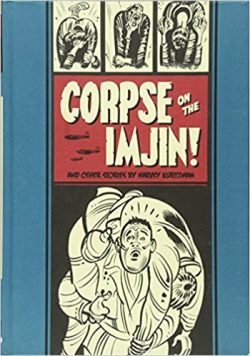
Corpse on the Imjin! and Other Stories by Harvey Kurtzman


By Harvey Kurtzman with Alex Toth, John Severin, Joe Kubert, Russ Heath, Dave Berg, Ric Estrada, Gene Colan, Johnny Craig others (Fantagraphics Books)
ISBN: 978-1-60699-545-7

The legendary EC Comics began in 1944 when comicbook pioneer Max Gaines sold the superhero properties of his All-American Comics company to half-sister National/DC, retaining only Pictures Stories from the Bible.

His plan was to produce a line of Educational Comics with schools and church groups as the major target market and he augmented his core title with Picture Stories from American History, Picture Stories from Science and Picture Stories from World History. Sadly, the worthy project was already struggling badly when he died in a boating accident in 1947.

As detailed in the final comprehensive essay in this superb graphic collection – available as a sturdily spiffy hardcover or in various eBook formats – his son William was dragged into the family business and, with much support and encouragement from unsung hero Sol Cohen (who held the company together until the initially unwilling Bill Gaines abandoned his dreams of a career in chemistry) transformed the ailing enterprise into Entertaining Comics…

After a few tentative false starts and abortive experiments, Gaines and his multi-talented associate Al Feldstein settled into a bold and impressive publishing strategy, utilising the most gifted illustrators in the field to tell a “New Trend” of stories aimed at an older and more discerning readership.

From 1950-1954 EC was the most innovative and influential publisher in America, dominating the genres of crime, horror, war and science fiction and, under the auspices of writer, artist and editor Harvey Kurtzman, the inventor of an entirely new beast: the satirical comicbook…

Kurtzman was hired to supplement the workforce on the horror titles but wasn’t keen on the genre and instead suggested a new action-adventure title. The result was Two-Fisted Tales which began with issue #18 at the end of 1959 as an anthology of rip-snorting, he-man suspense dramas. However, with America embroiled in a military “police action” in Korea, the title soon became primarily a war comic and was rapidly augmented by another.

Frontline Combat was also written and edited by Kurtzman, who assiduously laid-out and meticulously designed every story. It made for great entertainment and a unifying authorial voice but was frequently a cause of friction with many artists…

In keeping with the New Trend spirit, these war stories were not bombastic, jingoistic fantasies for glory-hungry little boys, but rather subtly subversive examinations of the cost of conflict which highlighted the madness, futility and senseless, pointless waste of it all…

Kurtzman was a cartoon genius and probably the most important cartoonist of the last half of the 20th century. His early triumphs in the fledgling field of comicbooks (especially the groundbreaking Mad magazine) would be enough for most creators to lean back on but Kurtzman was a force in newspaper strips (See Flash Gordon Complete Daily Strips 1951-1953) and restless innovator. As a commentator and social explorer, he just kept on looking at folk and their doings: a man with exacting standards who just couldn’t stop creating.

Kurtzman invented a whole new format and gave America Popular Satire by converting his highly successful full-colour baby Mad into a monochrome magazine, safely distancing the outrageously brilliant comedic publication from the fall-out caused by the 1950s socio-political witch-hunt which eventually killed all EC’s other titles.

He pursued his unique brand of thoughtfully outré comedy and social satire further with the magazines Trump, Humbug and Help!, all the while still conceiving challenging and powerfully effective funny strips such as Little Annie Fannie (for Playboy), The Jungle Book, Nutz, Goodman Beaver, Betsy and her Buddies and many more. He died far too young in 1993.

This first volume of the Fantagraphics EC Library gathers a stunning selection of Kurtzman stories in a lavish monochrome hardcover edition, packed with supplementary interviews, features and dissertations, and opens with ‘The Truth’ by cartoonist and historian R.C. Harvey, describing in stark detail the history of Kurtzman’s EC days.

Then follows a raft of stirring sagas solely from the master’s hand, beginning with ‘Conquest’ from Two-Fisted Tales #18, which with acerbic aplomb relates the rise and fall of Spanish conquistador Juan Alvorado whose rapacious hunger for Aztec gold led inexorably to the downfall and doom of his entire expedition.

‘Jivaro Death’ (#19) deals with modern-day greed as two duplicitous Yankees search for diamonds in the heart of the Amazon jungle whilst T-FT #20 detailed the fate of an amnesiac buccaneer who returned from certain death to obsessively reclaim his ‘Pirate Gold’ from the men who betrayed him…

From issue #21 comes ‘Search!’ which ironically combines an Italian-American’s search for family with the devastating US assault on Anzio in 1943, after which the first selection from Frontline Combat provides an uncharacteristically patriotic clash with the North Korean aggressors in ‘Contact!’ (#2, September 1951).

‘Kill’ from T-FT #23 also takes place in Korea, relating a squalid encounter between a blood-thirsty knife-wielding G.I. psycho and his soulless Commie antithesis, whilst ‘Prisoner of War!’ (FC #3) highlights the numbing, inhuman brutality of combat when American POWs attempt an escape…

‘Rubble!’ (T-FT #24) boldly steps into “enemy” shoes by highlighting the war’s casual cost to simple Korean civilians whilst ‘Air Burst!’ in FC #4 goes even further by voicing the Communist soldiers’ side of the conflict.

The eponymous ‘Corpse on the Imjin!’ (T-FT #25) is one of the most memorable, moving and respected tales of the genre: a genuine anti-war story which elegiacally traces a floating body’s motion down the river to expose the ruminations of the doomed observers who see it.

The sentiment is further explored in ‘Big ‘If’!’ (FC #5) as G.I. Paul Maynard sits in a shell hole and ponders what might have been…

Kurtzman’s unique display of cartooning and craftsmanship is followed by the essay ‘Combat Duty’ wherein Jared Gardner discusses the background and usage of the other artists who worked on the author’s Two-Fisted Tales and Frontline Combat scripts, before ‘Marines Retreat!’ – drawn by John Severin and inked by Kurtzman from FC #1 (July/August 1951) – describes in microcosm the shocking American forced withdrawal from the Changjin Reservoir in December 1950. The event stunned and terrified the folks at home and shook forever the cherished belief in the US Marines’ invincibility, and this is all told through the eyes of a soldier who understands too late the values he was supposed to be fighting for…

Kurtzman’s relationship with his artists could be fraught. Alex Toth, a tempestuous individualist who only drew three tales from his editor’s incredibly detailed lay-outs, famously produced some of his very best work at EC under such creative duress. The first and least was ‘Dying City!’ (T-FT #22) which found an aged Korean grandfather berating his dying descendent for the death and destruction he had brought upon his family and nation,

‘O.P.!’ was drawn by hyper-realist Russ Heath (FC #1) and once more ladled on the bleak, black irony during an annihilating trench encounter during WWI, after which Toth’s astounding aerial imagination produced in ‘Thunderjet!’ (FC #8) one of the most thrilling and evocative dogfight dramas in comics history.

This tale alone is worth the price of admission and was an alarm-call to complacent America as a US pilot is forced to concede that his winged weapon is technologically inferior to the ever-present Communist MIGs…

‘Fire Mission!’ (T-FT #29) was drawn by Dave Berg – an artist far better regarded for his comedy work – who lent his facility with expressions to a rather standard tale of courage discovered under fire in Korea, after which Gene Colan delineated the rift between military and civilians in the hours before the attack on Pearl Harbor in ‘Wake!’ from T-FT #30.

From the same issue ‘Bunker!’ was the first strip illustrated by Ric Estrada, describing rivalry and tension between American units during a Korean offensive. Oddly enough for the times, the fact that one faction was comprised of Negro soldiers was not mentioned at all…

The Cuban artist then drew a chillingly macabre tale of Teddy Roosevelt and the Spanish American war of 1898 in ‘Rough Riders!’ (FC #11) before master of comics noir Johnny Craig detailed the fate of a ‘Lost Battalion!’ in WWI (T-FT #32, March/April 1953).

From the same issue, ‘Tide!’ was an EC debut tale for the already-legendary Joe Kubert depicting a D-Day debacle and its insignificance in the grand scheme of things, whilst Toth’s magnificent Kurtzman-scripted swansong ‘F-86 Sabre Jet!’ (FC #12) revisited and even surpassed his Thunderjet job with a potent and beguiling reductionist minimalism that perfectly captured the disorienting hell of war in the air.

Due to illness and the increasing workload caused by Mad, Kurtzman’s involvement with war titles gradually dwindled. Frontline Combat #14, (October 1953) provided his last collaboration with Kubert in ‘Bonhomme Richard!’: a shocking, personalised account of American nautical legend John Paul Jones’ devastating duel with the British warship Serapis – as told by one of the hundreds of ordinary sailors who didn’t survive…

This masterclass in sequential excellence concludes with a salutary tale from the Civil War Special, Two-Fisted Tales #35 (October 1953). Illustrated by Reed Crandall, ‘Memphis!’ blends the destructive horror of the Union’s River Fleet of Ironclads as they inexorably take control of the Mississippi with the irrepressible excitement of Southern kids who simply could not understand what was happening to their parents and families…

Even with the comics extravaganza ended, there’s still more to enjoy as underground cartooning legend Frank Stack discusses the techniques and impact of Kurtzman’s astonishing covers for Two-Fisted Tales and Frontline Combat in ‘Respect for Simplicity – the War Covers of Harvey Kurtzman’; superbly supplemented by a full-colour section representing all of them, even the seldom-seen Two-Fisted Annual 1952.

Also adding to the value is ‘A Conversation with Harvey Kurtzman’ by John Benson, E.B. Boatner & Jay Kinney, which transcribes two interviews from 1979 and 1982, as well as a full appreciation of the great man’s career in ‘Harvey Kurtzman’ by S.C. Ringgenberg.

Rounding everything off is ‘Behind the Panels: Creator Biographies’ a comprehensive run-down of all involved by Bill Mason and others, plus a general heads-up on the entire EC phenomenon in ‘The Ups and Downs of EC Comics: A Short History’ by author, editor, critic and comics fan Ted White.

The short, sweet but severely limited output of EC has been reprinted ad infinitum in the decades since the company died. These astounding stories and art have changed not just comics but also infected the larger world through film and television and via the millions of dedicated devotees still addicted to New Trend tales.

However, as far as I can recall nobody has produced collections faithfully focussing on the contributions of individual creators, and even though fuddy-duddies like me know these timeless classics intimately, this simple innovation has somehow added a new dimension to the readers’ enjoyment.

I strongly suggest that whether you are an aged EC Fan-Addict or nervous newbie, this is a book no comics aficionado can afford to miss…
This edition © 2012 Fantagraphics Books, Inc. All comics stories © 2012 William M. Gaines Agent, Inc., reprinted with permission. All other material © 2012 the respective creators and owners.

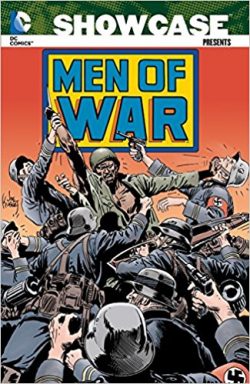
Showcase Presents Men of War


By David Michelinie, Robert Kanigher, Roger McKenzie, Jack C. Harris, Cary Burkett, Paul Kupperberg, Ed Davis, Dick Ayers, Jerry Grandenetti, Howard Chaykin, Arvell Jones, Larry Hama, & various (DC Comics)
ISBN: 978-1-4012-4388-3

In America after the demise of EC Comics in the mid-1950’s and prior to the game-changing Blazing Combat, the only certain place to find controversial, challenging and entertaining American war comics was DC.

In fact, even whilst Archie Goodwin’s stunning but tragically mis-marketed quartet of classics were waking up a generation, the home of Superman, Batman and Wonder Woman was a veritable cornucopia of gritty, intriguing and beautifully illustrated battle tales presenting combat on a variety of fronts and from many differing points of view.

Whilst the Vietnam War escalated, 1960s America increasingly endured a Home Front death-struggle pitting deeply-ingrained Establishment social attitudes against a youth-oriented generation with a radical new sensibility. In response DC’s (or rather National Periodical Publishing, as it then was) military-themed comicbooks became even more bold and innovative…

That stellar and challenging creative period came to an end as all strip trends do, but a few of the more impressive and popular features (Sgt. Rock, Haunted Tank, The Losers) survived well into the second superhero revival. One of the most engaging wartime wonders was a notional espionage thriller starring a faceless, nameless hero perpetually in the right place at the right time, ready, willing and so very able to turn the tide one battle at a time…

Currently English-reading fans of war stories are grievously underserved in both print and digital formats, but this magnificent monochrome reprint compendium is still readily available online. It collects the entire contents of Men of War: an all-new new anthology comicbook which debuted in August 1977 and ran 26 issues until March 1980.

Although offering the usual a variety of alternating back-up strips, Men of War controversially starred and cover-featured Gravedigger, a black American GI in WWII fighting prejudice, segregationist policies and blinkered authority as much as Fascist aggression.

The series was originated by scripter David Michelinie with art on the first episode by Ed Davis & Romeo Tanghal as MoW #1 introduced ‘Codename: Gravedigger’: grumbling US soldier Sergeant Ulysses Hazard in France and under fire in the Summer of 1942.

Of course, he had a lot to complain about. Being a negro, Hazard was not permitted to fight beside white enlisted men and could only be assigned to catering services or the Graves Registration team, marking and recovering the fallen.

A hard pill to swallow for a tough-minded ghetto kid who overcame polio, privation, bigots and bullies, and – through sheer determination – turned his body into a physically perfect human weapon.

When he single-handedly saves a French family from a gang of brutal Germans, white soldiers led by Lieutenant Gage claim the credit. The next day Hazard again displays his military superiority by saving the entire unit from a strafing attack, only to be told once more black men can’t fight.

When Ulysses realises he was saving racists whilst his best pal Andy died in the raid, Hazard fixes upon a desperate plan…

Arvell Jones & Tanghal illustrate the next chapter in #2 as Hazard goes AWOL: sneaking back into America to fight ‘The Five-Walled War!’. Breaking into the newly-constructed Pentagon, the outraged warrior battles his way past an army of troops to confront the astounded Undersecretary of War.

A shrewd and ruthless opportunist, the politico sees a chance to create a different kind of soldier and maybe even buy black votes in the next election cycle. Decreeing Hazard a top secret, one-man strike-force and personal suicide squad, with typical unforced irony the demagogue designates his new, extremely expendable toy ‘Codename: Gravedigger’…

Issue #3 finds newly-promoted Captain Hazard back in France within days; rescuing Gage and the soldiers who took credit for his actions. Even after they try to arrest him for desertion, Hazard pushes on with his first mission: ‘The Suicide Stratagem’ demanding he invade a mountain-top fortress to clear out a nest of Nazis holding up the entire war effort. No sooner has he done so than Gage and crew burst in to wipe out the survivors… especially any black soldiers who might get in the way…

Evergreen WWI anti-war feature Enemy Ace copped the first tranche of back-up slots for issues #1-3. Executed by Robert Kanigher, Ed Davis & Juan Ortiz, opening chapter ‘Death is a Wild Beast!’ has conflicted, honourable fighter pilot Hans Von Hammer downing a devil-themed British pilot who accomplishes a miraculous ‘Return from Hell!’ in the second instalment before experiencing ‘The Three Faces of Death’ in the final instalment.

As ever, the real meat of the macabre missions is the toll on the minds and bodies of the merely mortal fliers who die while Von Hammer lives on in guilty anguish…

The next triptych of back-ups (in #4-6) introduced New York Courier reporter Wayne Clifford, arriving in London in June 1940 to cover the “European War” for the still-neutral folks back home.

Crafted by Cary Burkett & Jerry Grandenetti ‘Dateline: Frontline’ focuses on the stories behind the war as neophyte Clifford is taken under the wing of veteran wordsmith Ed Barnes and learns some hard truths about propaganda, integrity and necessity after he tries to send back his account of a friendly-fire incident…

More gritty revelations add to the innocent’s education during an air raid spent with hard-pressed Londoners in a tube station in ‘Dateline: Frontline: Human Interest Story’ whilst #7 found the plucky news-hawk at ground zero on top of an unexploded bomb in ‘Dateline: Frontline Countdown!’

In Men of War #4 Dick Ayers took over as penciler as Gravedigger’s ‘Trial by Fire’ explosively ends with the pariah destroying the mountaintop Nazi base and saving Gage’s unit, only to be reviled and attacked by the man he humiliatingly saved, after which #5 welcomed Roger McKenzie as new writer.

Here Gravedigger enters the ‘Valley of the Shadow’ in an Alpine village turned impregnable German stronghold. His mission is to start an avalanche and eradicate the Nazi artillery nest but no one warned him of the captive populace held in the church…

MoW #6 then offers ‘A Choice of Deaths’ (McKenzie, Ayers & Tanghal) as the loner’s daring raid on a prison to free hostages is almost thwarted by the internees’ reluctance to leave behind certain works of art…

Men of War #7 featured Gravedigger’s first full-length exploit. ‘Milkrun’ sees the one-man army ordered to England for further intensive training at the hands of British expert Major Birch, but the journey back with mild-mannered clerk-turned-jeep driver Boston proves to be one of the most eventful rides Hazard has ever taken…

‘Death-Stroke’ leads in #8, as the American’s intensive training includes a potent degree of brainwashing. Unknow to anybody, Birch has been replaced by a Nazi agent who primes Ulysses to murder Winston Churchill…

Another Enemy Ace triptych began in the back of #8 and ‘Silent Sky… Screaming Death!!’ (illustrated by Larry Hama & Bob Smith) details a trenchant tale of a family at war. Howard Chaykin took over the illustration as a regulation clash in the sky resulted in attack by vengeful siblings and the return of Von Hammer’s father in ‘Brother Killers!’ (#9), revealing aspects of the German Ace’s own childhood and culminating in a fateful and final ‘Duel at Dawn!’ in #10.

MoW #9’s ‘Gravedigger – R.I.P.’ exposed layer upon layer of deceit and deception. Thanks to a tip-off by investigative reporter Wayne Clifford, Hazard’s assassination attempt is foiled by the Allies’ own master-of-disguise super-agent (no prizes for guessing who) and the brainwashed killer is captured and de-programmed. His death then faked, Hazard clandestinely heads to Berlin to rescue the real Birch…

This issue included extra feature ‘Dateline: Frontline: Bathtub Blues’ by Burkett & Grandenetti. Now stationed in North Africa, Clifford is attached to the British Army and sees for himself the nauseating difference between a braggart and a hero…

Men of War #10 opened with a ‘Crossroads’ reached by Codename: Gravedigger when he is shot down miles short of his Berlin destination and meets a fugitive Jewish family torn apart less by the war than the hatred and horrors that sparked it…

Supplementing the Enemy Ace back-up cited above is another stark and moving Wayne Clifford yarn by Burkett & Grandenetti. ‘Dateline: Frontline: Glory Soldier’ sees the writer caught in the bloody orbit of a gung-ho suicidal British corporal…

In #11 Hazard and his new Jewish comrades invade top secret death camp ‘Berkstaten’ and discovering to his shock and relief that not all Germans are monsters, whilst ‘Dateline: Frontline: Funeral Pyre’ sees Wayne lose his journalistic distance and impartiality after rescuing a baby and being captured by Arab raiders who consider both Germans and British as ruthless invaders…

Jack C. Harris took over writing the lead feature in MoW #12 as ‘Where is Gravedigger?’ sees the black soldier and his youthful Jewish allies finally enter Germany’s capital, even with the entire German army hunting for them. Unfortunately for the hunters, the one place they neglect to check is the torture chamber holding Major Birch…

Kanigher & Chaykin began another doleful, doom-laden Enemy Ace drama in the same issue. ‘Banner of Blood!’ sees the troubled Rittmeister striving to retrieve the Von Hammer family standard from a cunning French air ace who is the latest scion of an ancestral foe.

The tale continued in #13 as Von Hammer’s face-to-face confrontation with ‘The Last Baron!‘ leads to the final clash in a centuries-long vendetta with the Comtes de Burgundy ending forever in one last honourable ‘Duel!’…

‘Project Gravedigger…Plus One’ was the blockbusting main attraction in #13 as Hazard and Birch blaze and blast their way out of Berlin and back to Britain, where a confrontation with original sponsor the US Undersecretary of War leads to the black warrior taking on a new and freer role in his own affairs.

In Germany, however, outraged bigot and madman Joseph Goebbels takes personal charge of punishing the “subhuman inferior” who has shamed the entire Reich…

Despatched to Egypt in #14, Hazard faces ‘The Swirling Sounds of Death’ when the interception of a crucial Nazi courier is briefly derailed after Gravedigger is captured by Arab bandits. By the time he resumes stalking his target, Ulysses rules the Tuaregs but leads them into disastrously battle with British tanks before being himself taken by his elusive enemy Eric Von King – ‘The Man with the Opened Eye’…

Rounding out the issue are a brace of short combat yarns: underwater demolitions thriller ‘Wolf Pack’ by Bill Kelley, Hama & Jack Abel and American Civil War vignette ‘The Sentry’ by artist Bill Payne and an unknown writer.

A minor visual overhaul for Gravedigger comes with #16’s book-length thriller ‘Hide and Seek the Spy’ as Von King uses Hazard as a human shield during a Panzer assault on the British lines. Although the lone wolf escapes, he will forever bear the scars of his close shave. Worst of all, the slippery courier again eludes him with the critical plans known as Defense Packet 6…

Never quitting, Hazard and an elite commando team continue their pursuit in MoW #17 reaching the Nile where a German mini U-boat turns the majestic waterway into ‘The River of Death’. Meanwhile in Germany, Goebbels’ top scientists edge closer to completing the perfect antidote to the Gravedigger’s perpetual interference…

In the back of the issue Paul Kupperberg & Grandenetti introduced a new historical star as ‘Rosa: The Castle Rhinehart Affair Part One’ depicts a 19th century secret agent and international man of mystery tasked in 1870 with ending the Franco-Prussian War by assassinating Bismarck’s top advisor…

The fraught and frantic mission in a strategically vital Schloss concludes in ‘Rosa: The Castle Rhinehart Affair Part Two’ with the master-spy completing his task and consequently uncovering top-level double-dealing amongst his own superiors. A creature of implacable moral fortitude, Rosa has his own cure for treachery…

Gravedigger’s apparent failure is rewarded with another suicidal solo mission in MoW #18 as ‘The Amiens Assault’ covertly returns him to France to extract atomic scientist Monsieur Noir; another doomed mission that gets a miraculous helping hand from French Resistance fighters and ‘An Angel Named Marie’ in #19.

Issues #19-20 (August and September 1979) also featured another Kanigher/Chaykin Enemy Ace back-up tale of nobly idiotic honour and wasted young lives as Von Hammer makes ‘A Promise to the Dying’ and seeks to restore a contentious souvenir to its rightful owner in ‘Death Must Wait!’

For Ulysses Hazard #20 meant a short trip to Sicily to find and destroy a munitions dump reinforcing German forces battling General Patton’s advance in ‘Cry: Jericho’…

Men of War #21 provided a novel change of pace and locale as ‘Home – Is Where the Hell Is’ takes Hazard back to America after his mother is taken ill. Even a one-man army despised and reviled by his superiors is eligible for compassionate leave, but nobody realises the entire scheme has been concocted by Goebbels using surgically created doppelgangers to eliminate the black super soldier…

Taking up the rear, the most harrowing phase of Wayne Clifford’s career begins when Burkett & Grandenetti point his nose for news towards the Eastern Front in ‘Dateline: Frontline: Mother Russia’.

Barely surviving passage on a convoy ship and limping into a battered port, the journalist realises the true import of his next story only after meeting starving Russian children…

Ambushed in Atlantic City, New Jersey, Gravedigger opens issue #22 by killing his assailants, sinking a Nazi U-boat and causing a ‘Blackout on the Boardwalk’, after which ‘Dateline: Frontline: Scorched Earth, Crimson Snow’ further explores the Eastern hell as Clifford experiences first hand and up close the siege of Moscow…

Gravedigger’s ‘Mission: Six Feet Under!’ sees him plying his old trade with the Graves Registration unit during a highly suspicious trade of bodies with the Germans. It doesn’t take him long to determine that the American cadavers he’s retrieving have been gimmicked with the vilest form of biological weapon and respond accordingly…

Burkett & Grandenetti then record that ‘Dateline: Frontline: A Quiet Day in Leningrad’ is anything but…

MoW #24 starts a 2-part tale of ‘The Presidential Peril’ as Hazard is detailed to safeguard Franklin Delano Roosevelt on a trip to England that has all manner of Nazi spy and maniac crawling out of the woodwork…

‘Rosa: The Ambassador’s Son Affair Part One’ (Kupperberg & Grandenetti and concluding in the next issue) finds the master of intrigue sharing his (possible) origins with an imperilled junior dignitary in Mexico circa 1867 before #25 sees Gravedigger ‘Save the President’ through a phenomenal display of ingenuity and martial prowess only to be rewarded with an even more impossible mission…

Men of War was cancelled with #26 but went out in a blaze of glory as ‘Night on Nickname Hill’ (Harris, Ayers & Tanghal) sees Hazard despatched to Tunis in March 1943 to link up with Sgt Rock and lead Easy Company against a fortified artillery position: a critical battle that would determine the outcome of the Allies’ campaign in Africa…

With stunning covers by Joe Kubert, Ed Davis and George Evans, this mighty black-&-white treasure trove of combat classics is a type and style of storytelling we’re all the poorer without. Hopefully publishers will wise up soon and begin restoring their like to the wide variety of genre sagas currently available in graphic collections.
© 1977, 1978, 1979, 1980, 2014 DC Comics. All Rights Reserved.