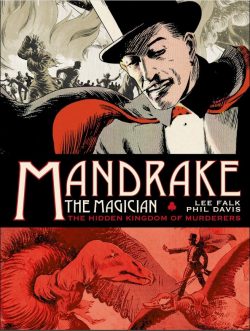
Mandrake the Magician: The Hidden Kingdom of Murderers – Sundays 1935-1937


By Lee Falk & Phil Davis (Titan Books)
ISBN: 978-0-85768-572-8 (HB)

Win’s Christmas Gift Recommendation: Because We Believe in Magic… 10/10

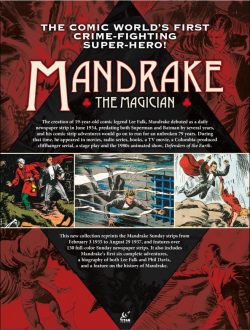
Regarded by many as the first superhero, Mandrake the Magician debuted as a daily newspaper strip on 11th June 1934. An instant hit, it was soon supplemented by a full-colour Sunday companion page which launched on February 3rd 1935.

Creator Lee Falk had actually sold the strip to King Features Syndicate years earlier as a 19-year old college student, but asked the monolithic company to let him finish his studies before dedicating himself to it full time. With his schooling done, the 23-year old master raconteur settled in to begin his life’s work: entertaining millions with his astounding tales.

Falk – who also created the first costumed superhero in moodily magnificent mystery man The Phantom – spawned an actual comicbook subgenre with his first creation. Most publishers of the Golden Age boasted at least one (and usually many more) nattily attired wonder wizards amongst their gaudily-garbed pantheons; all roaming the world making miracles and defeating injustice with varying degrees of stage legerdemain or actual sorcery.

Characters such Mr. Mystic, Ibis the Invincible, Sargon the Sorcerer, and an assortment of “…the Magicians” such as Zanzibar, Zatara, Kardak and so many, many more, all borrowed heavily and shamelessly from the uncanny exploits of the elegant, enigmatic white knight who graced the pages of the world’s newspapers and magazines.

In the Antipodes, Mandrake was a stalwart regular of the Australian Women’s Weekly, and also became a cherished star in the UK, Italy and Scandinavia. Over the years he has been a star of radio, movie chapter-serials, a theatrical play, television and animation as part of the cartoon series Defenders of the Earth. With that has come the usual merchandising bonanza of games, toys (including magic trick kits), books, comics and more…

Falk worked on Mandrake and “The Ghost who Walks” until his death in 1999 (even on his deathbed he was laying out one last story) but he also found time to become a playwright, theatre producer and impresario, as well as an inveterate world-traveller.

A man of many talents, Falk drew the first few weeks himself before uniting with sublimely imaginative cartoonist Phil Davis, whose sleekly understated renditions took the daily strip – and especially these expansive full-page Sunday offerings – to unparalleled heights of sophistication: his steady assured realism the perfect tool to render the Magician’s mounting catalogue of wondrous miracles…

Those in the know are well aware that Mandrake was educated at the fabled College of Magic in Tibet, thereafter becoming a suave globe-trotting troubleshooter, always accompanied by his faithful African partner Lothar and beautiful, feisty companion (and eventually, in 1997, bride) Princess Narda of Cockaigne, solving crimes and fighting evil. Those days, however, are still to come as the comics section opens in this splendidly oversized (315 x 236 mm) full-colour luxury hardback – and digital equivalents – with ‘The Hidden Kingdom of Murderers’ (which ran from February 3rd to June 2nd 1935) as the urbane Prince of Prestidigitation and his herculean companion are approached by members of the international police to help expose a secret society of criminals and killers acting against the civilised world from their own hidden country.

After officer Duval is assassinated, Mandrake and Lothar – accompanied by panther woman Rheeta and surviving cop Pierce – embark upon a multi-continental search which, after many adventures, eventually brings them to a desolate desert region where they are confronted by bloody-handed Bull Ganton, King of Killers.

With the master murderer distracted by Rheeta, Mandrake easily infiltrates the odious organisation and quickly begins dismantling the secret society of two million murderers. By the time Ganton wises up and begins a succession of schemes to end Mandrake, it’s too late…

That deadly drama concluded, Mandrake and Lothar head to India to revisit old haunts and end up playing both peacemaker and cupid in the ‘Land of the Fakirs’ (running from June 9th to October 6th).

When Princess Jana, daughter of Mandrake’s old acquaintance Jehol Khan is abducted by rival ruler Rajah Indus of Lapore, the Magician ends his mischievous baiting of the street fakirs to intervene. In the meantime, Captain Jorga – who loves Jana despite being of a lower caste – sets off from the Khan’s palace to save her or die in the trying…

After many terrific and protracted struggles, Mandrake, Lothar and Jorga finally unite to defeat the devious and duplicitous Rajah before the westerners set about their most difficult and important feat; overturning centuries of tradition so that Jorga and Jana might marry…

Heading north, the peripatetic performers stumble into amazing fantasy after entering the ‘Land of the Little People’ (13thOctober 1935 to March 1st 1936), encountering a lost race of tiny people embroiled in a centuries-long war with brutal cannibalistic adversaries. After saving the proud warriors from obliteration, Mandrake again plays matchmaker, allowing valiant Prince Dano to wed brave and formidable commoner Derina who fought so bravely beside them…

With this sequence illustrator Davis seemed to shake off all prior influences and truly blossomed into an artist with a unique and mesmerising style all his own. That is perfectly showcased in the loosely knit sequence (spanning 8th March to 23rd August 1936) which follows, as Mandrake and Lothar return to civilisation only to narrowly escape death in an horrific train wreck.

Crawling from the wreckage, our heroes help ‘The Circus People’ recapture and calm the animals freed by the crash, subsequently sticking around as the close-knit family of nomadic outcasts rebuild. Mighty Lothar has many clashes with jealous bully Zaro the Strongman, culminating in thwarting attempted murder, whilst Mandrake uses his hypnotic hoodoo to teach sadistic animal trainer Almado lessons in how to behave, but primarily the newcomers act as a catalyst, making three slow-burning romances finally burst into roaring passionate life…

Absolutely the best tale in this tome and an imaginative tour de force which inspired many soon-to-be legendary comicbook stars, ‘The Chamber into the X Dimension’ (30th August 1936 to March 7th 1937) is a breathtaking, mind-bending saga starting when Mandrake and Lothar search for the missing daughter of a scientist whose experiments have sent her literally out of this world.

Professor Theobold has discovered a way to pierce the walls between worlds but his beloved Fran never returned from the first live test. Eager to help – and addicted to adventure – Mandrake and Lothar volunteer to go in search of her and soon find themselves in a bizarre timeless world where the rules of science are warped and races of sentient vegetation, living metal, crystal and even flame war with fleshly humanoids for dominance and survival.

After months of captivity, slavery, exploration and struggle our human heroes finally lead a rebellion of the downtrodden fleshlings and bring the professor the happiest news of his long-missing child…

Concluding this initial conjuror’s compilation is a whimsical tale of judgement and redemption as Mandrake uses his gifts to challenge the mad antics of ‘Prince Paulo the Tyrant’ 14th (March 14th – 29th August 1937).

The unhappy usurper stole the throne of Ruritanian Dementor and promptly turned the idyllic kingdom into a scientifically created madhouse. Sadly, Paulo had no conception of what true chaos and terror were until the magician exercised his mesmeric talents…

This epic celebration also offers a fulsome, picture-packed and informative introduction to the character – thanks to Magnus Magnuson’s compelling essay ‘Mandrake the Magician Wonder of a Generation’ – plus details on the lives of the creators (‘Lee Falk’ and ‘Phil Davis Biography’ features) plus a marvellous Davis pin-up of the cast to complete an immaculate confection of nostalgic strip wonderment for young and old alike.
Mandrake the Magician © 2016 King Features Syndicate. All Rights Reserved. “Mandrake the Magician Wonder of a Generation” © 2016 by Magnus Magnuson.

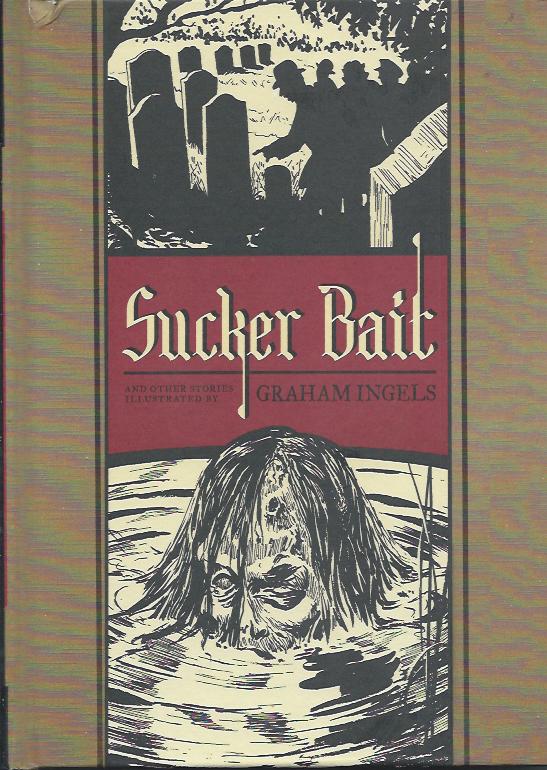
Sucker Bait and Other Stories


By illustrated by Graham Ingels, written by Al Feldstein with Ray Bradbury & Bill Gaines (Fantagraphics Books)
ISBN: 978-1-60699-689-8 (HB)

For most people who have heard of them, EC Comics mean one thing only: shocking, appalling, stomach-turning horror. Moreover, the artist they’re probably picturing – even if they can’t name him – is Graham Ingels, who wryly sighed his work “Ghastly”…

The company began in 1944 when comicbook pioneer Max Gaines – presumably seeing the writing on the wall – sold the superhero properties of his All-American Comics company to half-sister National/DC, retaining only Picture Stories from the Bible. His plan was to produce a line of Educational Comics with schools and church groups as the major target market.

He augmented his flagship title with Picture Stories from American History, Picture Stories from Science and Picture Stories from World History but the worthy projects were all struggling when he died in a boating accident in 1947.

As detailed in the comprehensive closing essay of this superb graphic compilation (‘Crime, Horror, Terror, Gore, Depravity, Disrespect for Established Authority – and Science Fiction Too: the Ups and Downs of EC Comics’ by author, editor, critic and comics fan Ted White), his son William was dragged into the company by unsung hero and Business Manager Sol Cohen who held the company together until the initially unwilling Bill Gaines abandoned his dreams of being a chemistry teacher and transformed the ailing Educational enterprise into Entertaining Comics…

After a few tentative false starts and abortive experiments copying industry fashions, Gaines took advantage of his multi-talented associate Al Feldstein, who promptly graduated from creating teen comedies and westerns into becoming Gaines’ editorial supervisor and co-conspirator.

As they began co-plotting the bulk of EC’s stories together, they changed tack, moving in a boldly impressive fresh direction. Their publishing strategy, wisely utilising the most gifted illustrators in the field, was to tell a “New Trend” of stories aimed at older and more discerning readers, not the mythical semi-literate 8-year-old all comicbooks ostensibly targeted.

From 1950 to 1954 EC was the most innovative and influential publisher in America, dominating the genres of crime, horror, war and science fiction and originating an entirely new beast: the satirical comicbook…

Feldstein had started life as a comedy cartoonist and, after creator/editor Harvey Kurtzman departed in 1956, Al became Mad‘s Editor for the next three decades…

This seventh volume of the Fantagraphics EC Library gathers a mind-boggling selection of Feldstein’s most baroque and grotesquely hilarious horror stories – most co-plotted by companion-in-crime Gaines – and all illuminated by the company’s enigmatic yet unsurpassed master of macabre mood, in a lavish monochrome hardcover or digital edition packed with supplementary interviews, features and dissertations.

It begins with historian and lecturer Bill Mason’s touching and revelatory commentary ‘Mr. Horror Builds his Scream House’ before dipping into this diary of disgust and dread with ‘Hook, Line, and Stinker!’ (Vault of Horror #26, August/September 1952): the tale of a spinster’s vengeance after she finds the gentleman she’s been affianced to for fifteen years spends his weekends in the arms of a young floozy rather than on his precious – and fictitious – fishing trips…

The most memorable assets of EC’s horror titles were the uniquely memorable hosts whose execrable wisecracks bracketed each fantastic yarn. The Vault-Keeper, Crypt-Keeper and Old Witch were the company’s only returning characters during the New Trend era, becoming beloved favourites of the “Fan Addict” readership. Haunt of Fear #14 (July/August 1952) revealed the shocking and hilarious origins of the scurvy sorceress herself in a sublime pastiche of the Christian Nativity dubbed ‘A Little Stranger!’…

A murderous elephant trainer’s infidelities come back to haunt him in circus chiller ‘Squash… Anyone?’ (Tales From the Crypt #32, October/November 1952), whilst in that same month, in Vault of Horror #27, a rat-infested kingdom where starving peasants are tormented by their over-stuffed queen provide grisly meat for ‘A Grim Fairy Tale!’

‘Chatter-Boxed!’ (Haunt of Fear #15, September/October 1952) is a superb blend of maguffins as a man terrified of premature burial takes special steps to ensure he’s never buried alive, but even after factoring in that his wife is always gabbing on the phone, there’s one element he could never have foreseen…

Next follows a wealth of material published in titles cover-dated December 1952/January 1953, beginning with ‘Private Performance’ from Crime SuspenStories #14, wherein a burglar witnesses a murder in an old Vaudevillian’s home before hiding in exactly the wrong place, whilst ‘None but the Lonely Heart!’ (Tales from the Crypt #33) reveals the ultimate downfall of a serial bigamist and black widower.

‘We Ain’t Got No Body’ (Vault of Horror #28), ghoulishly revels in the vengeance of a man murdered by fellow train commuters before ‘Sugar ‘n Spice ‘n…’ (Shock SuspenStories #6) toys wickedly with the fable of Hansel and Gretel, proving some kids get what they deserve…

A pioneering surgeon is blackmailed for decades by his greatest triumph in ‘Nobody There!’ (Haunt of Fear #16, November/December 1952), whilst ‘Hail and Heart-y!’ (from Crime SuspenStories #15 February/March 1953) sees a lazy husband driving his enduring wife to exhaustion and over the edge by feigning disability, before Ingels superbly captures the macabre eccentricity of Ray Bradbury’s story of a crusty dowager too mean to stay decently dead in ‘There Was an Old Woman!’ – from Tales from the Crypt #34 (February/March).

That same month Vault of Horror #29 featured ‘Pickled Pints!’, as unscrupulous rogues buying cut-rate blood from winos push their plastered pumps a little too far, after which Haunt of Fear #17 (January/February) offers the acme of sinister swamp scare stories in ‘Horror We? How’s Bayou?’: a tale of rural madness and supernatural revenge long acclaimed as the greatest EC horror story ever crafted…

An irritated and merciless mummy stalks an Egyptian dig in ‘This Wraps it Up!’ (Tales from the Crypt #35, April/May 1953; the same month Vault of Horror #30 told a truly chilling tale of human retribution when the good citizens of a small town finally find the writer of cruel poison-pen letters in ‘Notes to You!’, after which ‘Pipe Down!’ (Haunt of Fear#18, March/April) goes completely round the bend to describe how a young wife and handsome plumber get rid of her rich old man… and what the victim does about it…

Bradbury’s disturbing yarn ‘The Handler’ was adroitly adapted in Tales from the Crypt #36 (June/July) depicting how an undertaker’s secret liberties – inflicted upon the cadavers in his care – came back to haunt him, whilst over in Vault of Horror #31 that month ‘One Good Turn…’ revealed one little old lady’s gruesome interpretation of the old adage, and Haunt of Fear #19 (May/June 1953) discloses the incredible lengths some men will go to in order to kill vampires in eponymous shocker ‘Sucker Bait!’…

From August/September, ‘The Rover Boys’ in Tales from the Crypt #37 is a purely bonkers tale of brain transplantation gone wild, whilst Vault of Horror #32 offers up more traditional fare with ‘Funereal Disease!’, describing how a murdered miser gets back what he loves most, and ‘Thump Fun!’ (Haunt of Fear #20, July/August) archly revisits Poe’s Tell-Tale Heart whilst adding a little twist…

‘Mournin’ Mess’ (Tales from the Crypt #38, October/November) is a stylish and clever mystery about rich men funding a paupers graveyard – and why – whilst over in Vault of Horror (#32) ‘Strung Along’ depicts the revenge marionettes inflicted on the greedy woman who murdered their elderly puppeteer before the artistic arcana all ends with ‘An Off-Color Heir’ (Haunt of Fear #21, September/October 1953) and the salutary tale of an artist’s wife who discovers just too late her man’s habits and horrific heritage …

Adding final weight to the proceedings is S.C. Ringgenberg’s biography of the tragic genius ‘Graham Ingels’, the aforementioned history of EC and a comprehensively illuminating ‘Behind the Panels: Creator Biographies’ feature by Mason, Spurgeon and Janice Lee.

The short, sweet but severely limited output of EC has been reprinted ad infinitum in the decades since the company died. These astounding stories and art not only changed comics but also infected the larger world through film and television and via the millions of dedicated devotees still addicted to New Trend tales.

However, the most influential stories are somehow the ones least known these days. Although Ingels turned his back on his comics career, ashamed of the furore and frenzy generated by closed-minded bigots in the 1950s, his incredible artistic talent and narrative legacy are finally gaining him the celebrity he should have had in life.

Sucker Bait is a scarily lovely tribute to the sheer ability of an unsung master of comics art and offers a fabulously engaging introduction for every lucky fear fan encountering the material for the very first time. Whether you are an aging fear aficionado or callow contemporary convert, this is a book you should have…
Sucker Bait and Other Stories © 2014 Fantagraphics Books, Inc. All comics stories © 2014 William M. Gaines Agent, Inc., reprinted with permission. All other material © 2014 the respective creators and owners.

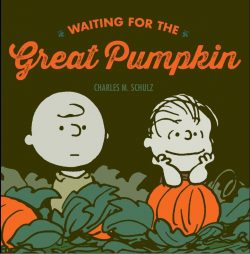
Waiting for the Great Pumpkin


By Charles M. Schulz (Fantagraphics Books)
ISBN: 978-1-60699-772-7 (HB)

Peanuts is 70 years old today and not even death can stop it. Many happy returns Chuck…

Peanuts is unequivocally the most important comics strip in the history of graphic narrative. It is also the most broadly accepted, since – after the characters made the jump to television – the little nippers become an integral part of the American mass cultural experience.

Cartoonist Charles M. Schulz crafted his moodily hilarious, hysterically introspective, shockingly philosophical epic for fifty years. He published 17,897 strips from October 2nd 1950 to February 13th 2000 and died from the complications of cancer the day before his last strip was published…

At its height, the strip ran in 2,600 newspapers in 75 countries, translated into 21 languages. Many of those venues are still running perpetual reprints, as they have ever since his departure. Attendant book collections, a merchandising mountain and TV spin-offs made the publicity-shy artist a billionaire. That profitable sideline – one Schulz devoted barely any time to over the decades – is where this little gem originates from…

Peanuts – a title Schulz loathed, but one the syndicate forced upon him – changed the way comics strips were received and perceived by showing that cartoon comedy could have edges and nuance as well as pratfalls and punchlines.

The usual focus of the feature (we just can’t call him “star” or “hero”) is everyman loser Charlie Brown who, with high-maintenance, fanciful mutt Snoopy, endures a bombastic and mercurial supporting cast who hang out doing kid things in a most introspective, self-absorbed manner.

The daily gags centred on playing (pranks, sports, musical instruments), teasing each other, making ill-informed observations and occasionally acting a bit too much like grown-ups. The consistently expanding cast also includes mean girl Violet, infant prodigy Schroeder, “world’s greatest fussbudget” Lucy Van Pelt, her other-worldly baby brother Linus and dirt-magnet “Pig-Pen”: each with a signature twist to the overall mirth quotient and sufficiently fleshed out and personified to generate jokes and sequences around their own foibles. As a whole, the kids tackled every aspect of human existence in a charming and witty manner, acting as cartoon therapists and graphic philosophical guides to the world that watched them.

Charlie Brown is settled into his existential angst and resigned to his role as eternal loser as if singled out by a gleeful Fate. It’s a set-up that remains timelessly funny and infinitely enduring…

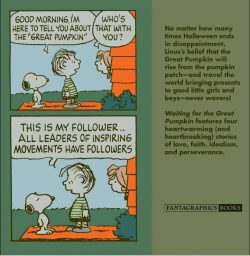
This outing – available in a child-friendly hardback and the usual digital formats – celebrates the whimsy at the feature’s core and spotlights Lucy’s weird little brother Linus and a peculiar belief system all his own…

Waiting for the Great Pumpkin offers a quartet of vintage seasonal sequences dedicated to the kid’s attempts displace Santa Claus as the benevolent bestower of largesse to the good little boys and girls and promote a far earthier patron: one who comes to good children from a gourd plantation somewhere in America…

Like all zealots, Linus never ceases to proselytise, and Charlie Brown and Snoopy are happy to go along and see for themselves in ‘You Believe in Santa Claus and I’ll Believe in the Great Pumpkin’, but there’s a time limit to their willingness to convert…

Another year and the kids are back in fraught contention for ‘Santa Claus vs. the Great Pumpkin’, but how long can even the most devout devote last in the face of perpetual disappointment? According to ‘Oh, Great Pumpkin, You’re Going to Drive Me Crazy!’, not forever, but the year Linus convinces Charlie’s little sister Sally to wait with him is painfully revelatory as seen in ‘True Love Revealed in the Pumpkin Patch’…

The tales are told in a series of monochrome panels (generally four to a page) that never fail to delight, recapturing the hilarious seriousness of childhood in a manner nobody else can match. Since you and yours are almost certainly not going out for “tricks or treats” this year, why not ameliorate your own existentialist family travails with online sweets deliveries and this handy gem?
Waiting for the Great Pumpkin © 2014 Peanuts Worldwide, LLC. All rights reserved.
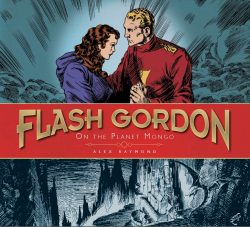
Flash Gordon on the Planet Mongo: volume 1 Sundays 1934-1937 (The Complete Flash Gordon Library)


By Alex Raymond & Don Moore with restorations by Peter Maresca (Titan Books)
ISBN: 978-0-85768-154-6 (HB)

By most lights, Flash Gordon is the most influential comic strip in the world. When the hero debuted on Sunday January 7th 1934 (with the superb but rather dated Jungle Jim running as a supplementary “topper” strip) as response to revolutionary, inspirational, but clunky Buck Rogers (by Philip Nolan & Dick Calkins and which had also began on January 7th but in 1929), a new element was added to the realm of fantasy wonderment: Classical Lyricism.

Where Rogers had traditional adventures and high science concepts, this new feature reinterpreted Fairy Tales, Heroic Epics and Mythology. It did so by spectacularly draping them in the trappings of the contemporary future, with varying ‘Rays’, ‘Engines’ and ‘Motors’ substituting for trusty swords and lances – although there were also plenty of those – and exotic flying craft and contraptions standing in for Galleons, Chariots and Magic Carpets.

Most important of all, the sheer artistic talent of Raymond, his compositional skills, fine line-work, eye for concise, elegant detail and just plain genius for drawing beautiful people and things, swiftly made this the strip all young artists swiped from.

When all-original comic books began a few years later, literally dozens of talented kids used the clean lined Romanticism of Gordon as their model and ticket to future success in the field of adventure strips. Most of the others went with Milton Caniff’s expressionistic masterpiece Terry and the Pirates (which also began in 1934 – and he’ll get his go another day).

Thankfully, there are a few collections knocking about, but I’m plumping here for 2012’s hardcover archive from British publisher and keeper of old traditions Titan Books, who boldly began a Complete Library of the stellar crusader’s exploits that year…

Augmenting the epic entertainment are a brace of photo and illustration-packed introductory essays, beginning with uber-artist and fan Alex Ross’ exploration of ‘The Flash Gordon Legacy’ and continuing with ‘Birth of a Legend’ by comics writer and historical publisher Doug Murray, detailing the world and fantasy milieu into which the dauntless hero was born…

The very first tale begins with a rogue planet about to smash into the Earth. As panic grips the planet, polo player Flash and fellow airline passenger Dale Arden narrowly escape disaster when a meteor fragment downs the plane they’re traveling on. They parachute out and land on the estate of tormented genius Dr. Hans Zarkov, who imprisons them on the rocket-ship he has built. His plan? To fly the ship directly at the astral invader and deflect it from Earth by crashing into it!

And that’s just in the first, 13-panel episode. ‘On the Planet Mongo’ ran every Sunday until April 15th 1934, when, according to this wonderful full-colour book, second adventure ‘Monsters of Mongo’ (22nd April – 18th November 1934) began, to be promptly followed by ‘Tournaments of Mongo’ (25th November 1934 to 24th February 1935).

To the readers back then, of course, there were no such artificial divisions. There was just one continuous, unmissable Sunday appointment with sheer wonderment. The machinations of the utterly evil but magnetic Ming, emperor of the fantastic wandering planet; Flash’s battles and alliances with all the myriad exotic races subject to the Emperor’s will and the gradual victory over oppression captivated America, and the World, in tales that seemed a direct contrast to the increasingly darker reality in the days before World War II.

In short order the Earthlings become firm friends – and in the case of Flash and Dale, much more – as they encounter battle and frequently ally with beautiful, cruel Princess Aura, the Red Monkey Men, Lion Men, Shark Men, Dwarf Men, King Vultan and the winged Hawkmen.

The epic rebellion against seemingly unbeatable Ming opened with the awesome ‘Tournaments…’: a sequence wherein Raymond seemed to simply explode with confidence.

It was here that the true magic blossomed, with every episode more spectacular than the last. Without breaking step, Raymond moved on to next saga, as our hero entered ‘The Caverns of Mongo’ (March 3rd – 14th April 1935).

Veteran editor Don Moore was only 30 when he was convinced to “assist” Raymond with the writing, starting soon after the strip first gained popularity. Moore remained until 1953, long after Raymond departed. The artist joined the Marines in February 1944, and the last page he worked on was published on April 30th of that year. On his demobilisation, Raymond moved to fresh strip fields with Rip Kirby. Mercifully, that still leaves a decade’s worth of spectacular, majestic adventure for us to enjoy…

Without pausing for breath, the collaborators rapidly introduced a host of new races and places for their perfect hero to win over in the war against Ming’s timeless evil. On increasingly epic Sunday comics pages Flash and his entourage confronted the ‘Witch Queen of Mongo’ (April 21st – 13th October 1935), found themselves ‘At War with Ming’ (20thOctober 1935 – April 5th 1936) and discovered ‘The Undersea Kingdom of Mongo’ (12th April – October 11th 1936). The sheer beauty and drama of the globally syndicated serial captivated readers all over the world, resulting in not only some of the medium’s most glorious comic art, but also novels, three movie serials, a radio and later TV show, a monochrome daily strip (by Raymond’s former assistant Austin Briggs), comic books, merchandise and so much more.

The Ruritanian flavour of the series was enhanced continuously, as Raymond’s slick, sleek futurism endlessly accessed and refined the picture-perfect Romanticism of idyllic Kingdoms, populated by idealised heroes, stylised villains and women of staggering beauty.

In these episodes Azura, Witch Queen of Mongo wages a brutal and bloody war with Flash and his friends for control of the underworld, which eventually leads to all-out conflict with Ming the Merciless – a sequence of such memorable power that artists and movie-men would be swiping from it for decades to come. When the war ends our heroes are forced to flee, only to become refugees and captives of the seductive Queen Undina in her undersea Coral City…

The never-ending parade of hairsbreadth escapes, fights and/or chases continues as Flash, Dale and Zarkov crash into the huge jungle of Mongo. As this initial tome ends, the refugees enter ‘The Forest Kingdom of Mongo’ (October 18th 1936 to 31st January 1937), barely surviving its wild creatures before weathering the horrific tunnels of ‘The Tusk-Men of Mongo’ (February 7th to June 5th 1938). Here, struggling through desperate hardship and overcoming both monsters and the esoteric semi-humans they finally reach Arboria, the Tree kingdom of Prince Barin, Ming’s son-in-law. He is not what he seems…

And so the book ends, but not the adventure. Even stripped down to the bare plot-facts, the drama is captivating. Once you factor in the by-play, the jealousies and intrigues, all rendered with spectacular and lush visualisation by the master of classical realism, you can begin to grasp why this strip captured the world’s imagination and holds it still. To garnish all this enchantment, there’s even ‘The Alex Raymond Flash Gordon Checklist’ and biographies of both creators and this astounding tome’s key contributors

Along with Hal Foster (Prince Valiant) and Milton Caniff (Terry and the Pirates and Steve Canyon), Raymond’s work on Flash Gordon is considered pivotal to the development of American – if not world – comic art. These works overwhelmingly influenced everybody who followed until the emergence of manga and the advancement of computer technology. If you’ve only heard how good this strip is, you owe it to yourself to experience the magic up close and personal.

I never fail to be impressed by the quality of Alex Raymond’s Flash Gordon. Yes, the plots are formulaic but what commercial narrative medium is free of that? What is never dull or repetitive is the sheer artistry and bravura staging of the tales. Every episode is the most beautiful thing you’ve ever seen, but the next episode still tops it. You are a fool to yourself if you don’t try this wonderful strip out, and all the more so in such inexpensive yet lavish volumes. It’s not too soon to start dropping hints for Christmas, you know…
Flash Gordon © 2012 King Features Syndicate Inc., & ™ Hearst Holdings, Inc. All rights reserved.

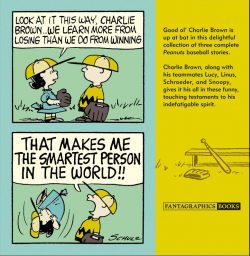
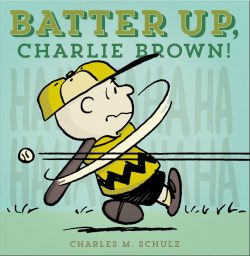
Batter Up, Charlie Brown!


By Charles M. Schulz (Fantagraphics Books)
ISBN: 978-1-60699-725-3 (HB)

Peanuts is unequivocally the most important comics strip in the history of graphic narrative. It is also the most broadly accepted, since – after the characters made the jump to television – the little nippers become an integral part of the American mass cultural experience.

Cartoonist Charles M. Schulz crafted his moodily hilarious, hysterically introspective, shockingly philosophical epic for fifty years. He published 17,897 strips from October 2nd 1950 to February 13th 2000 and died from the complications of cancer the day before his last strip was published…

At its height, the strip ran in 2,600 newspapers in 75 countries, translated into 21 languages. Many of those venues are still running perpetual reprints, as they have ever since his departure. Attendant book collections, a merchandising mountain and TV spin-offs made the publicity-shy artist a billionaire. That profitable sideline – one Schulz devoted barely any time to over the decades – is where this little gem originates from…

Peanuts – a title Schulz loathed, but one the syndicate forced upon him – changed the way comics strips were received and perceived by showing that cartoon comedy could have edges and nuance as well as pratfalls and punchlines.

The usual focus of the feature (we just can’t call him “star” or “hero”) is everyman loser Charlie Brown who, with high-maintenance, fanciful mutt Snoopy, endures a bombastic and mercurial supporting cast who hang out doing kid things in a most introspective, self-absorbed manner.

The daily gags centred on playing (pranks, sports, musical instruments), teasing each other, making ill-informed observations and occasionally acting a bit too much like grown-ups. The consistently expanding cast also includes mean girl Violet, infant prodigy Schroeder, “world’s greatest fussbudget” Lucy Van Pelt, her other-worldly baby brother Linusand dirt-magnet “Pig-Pen”: each with a signature twist to the overall mirth quotient and sufficiently fleshed out and personified to generate jokes and sequences around their own foibles. As a whole, the kids tackled every aspect of human existence in a charming and witty manner, acting as cartoon therapists and graphic philosophical guides to the world that watched them.

Charlie Brown is settled into his existential angst and resigned to his role as eternal loser as if singled out by a gleeful Fate. It’s a set-up that remains timelessly funny and infinitely enduring…

Available in a child-friendly hardback and the usual digital formats, Batter Up, Charlie Brown! offers a trio of extended vintage sequences dedicated to the kids’ attempts to distinguish themselves as sporting superstars in the heady arena of America’s favourite summer pastime. As a metaphor for living life to the full, sports has never been more accurate in its foreshadowings…

The tales are told in a series of monochrome panels (generally four to a page) and begin with ‘Team Manager’ as the perpetually anxious and responsibility-burdened Charlie anticipates the start of a new season. His worries are only further exacerbated by his devoted team who are all eager to act as back seat strategists…

Eponymous delight ‘Batter up!’ sees our gallant but overwhelmed commander stretched beyond his own herculean capacities as the squad call on him to lead from the front as usual but Charlie is weighed down with new familial stress as he’s ordered to push his new sister Sally in her stroller all day long. Can he cope with the stress of twin challenges and still save the game in the final inning?

Wrapping up the field fiascos, ‘Slide!’ sees the plucky player/manager (groundsman, talent scout, coach, organiser, tailor…) called upon to end the team’s permanent losing streak through innovative new tactics and heroic last-minute athleticism…

Timeless and evergreen – although that might just be grass stains – Charlie Brown’s existentialist travail have been delighting readers seemingly forever and clearly will not be stopping or superseded anytime soon. If you haven’t joined this club yet, why not sign up now?
Batter Up, Charlie Brown! © 2014 Peanuts Worldwide, LLC. All rights reserved.

Zorro in Old California


By Nedaud & Carlo Marcello (Eclipse Books)
ISBN: 978-0-91303-513-9 (HB) 978-0-91303-512-2 (Album PB)

Here’s a fabulous old classic that’s still generally available, but which really needs to relative immortality of a digital edition as well as simple revival. Let’s hope current license holders Dynamite Entertainment agree…

One the earliest masked heroes and still phenomenally popular throughout the world is perennial film favourite El Zorro, The Fox. He was originally created by jobbing writer Johnston McCulley in 1919 in a 5-part prose serial entitled ‘The Curse of Capistrano’: debuting and running in All-Story Weekly from August 6th to 6th September. The tale was subsequently published by Grossett & Dunlap in 1924 as The Mark of Zorro and further reissued in 1959 and 1998 by MacDonald & Co., and Tor, respectively.

Famously, Hollywood royalty Douglas Fairbanks and Mary Pickford read the tale in All-Story Weekly whilst on their honeymoon and immediately optioned the adventure to be the first film release from their new production company/studio United Artists.

The Mark of Zorro was a global movie sensation in 1920 and for years after, so New York based McCulley re-tailored his creation to match the extremely different filmic incarnation. The Caped Crusader aptly fitted the burgeoning genre that would soon be peopled by the likes of The Shadow, Doc Savage and the Spider as well as later comics champions such as Mandrake and the Phantom.

Rouben Mamoulian’s filmic remake of The Mark of Zorro further ingrained the Fox into the World’s psyche, and, as the prose exploits continued in a variety of publications, Dell began a comicbook version in 1949.

When Walt Disney began a hugely popular Zorro TV show in 1957, the comics series was redesigned to capitalise on it and the entertainment corporation began a decades-long strip incarnation of “their” version of the character in various regions of the world. This classy tome collects half of the dozen stories produced for a French iteration which originally ran in Le Journal de Mickey by veteran Italian artist Raphaël Carlo Marcello and relative enigma Nedaud, of whom I sadly know very little.

The celebrated and supremely stylish Marcello (1929-2007) moved to Paris in 1948 and began his long and prestigious career drawing Loana et le Masque Chinois in Aventures de Paris-Jeunes and Nick Silver for Collection Victoire. He then switched to newspaper strips for Opera Mundi in 1950, illustrating La Découverte du Monde and L’Histoire de Parisbefore adapting Ben Hur, Jane Eyre and the Bible.

In 1952, he joined Héroic, working on Oliver Twist, Gil Blas and Bug Jargal, then began a 15-year run (1955-1970) on Le Cavalier Inconnu in Pépito. He maintained ties to newspapers throughout and continued general interest literary adaptations for Mondial-Presse.

In 1956, he contributed Bob Franck to Bugs Bunny magazine and numerous strips to Lisette, Monty, Mireille, L’Intrépide/Hurrah and Rintintin. In 1970 he moved to Pif Gadget, collaborating on his signature series Docteur Justicewith prolific scenarist/writer Jean Ollivier as well as Amicalement Vôtre (a TV adaptation scripted Spanish by the legendary Victor Mora), Taranis (scripts by Ollivier & Mora), Tarao (by Roger Lécureux) and La Guerre du Feu.

Barely stopping for breath, Marcello illustrated John Parade, Patrouilleur de l’Espace, in Le Journal des Pieds Nickelés, the Larousse series L’Histoire de France en Bandes Dessinées, La Découverte du Mond and L’Histoire du Far West until 1985 when he joined Le Journal de Mickey to render Le Regard du Tigre, Le Club des Cinq and the subject of this collection.

Solidly based on the 1950s TV series, Zorro ran for a year (1985-1986): 12 rousing swashbuckling romps, the first half of which are collected in this slim, full colour European-format album. After these thundering epics, Marcello carried on improving, drawing sci fi extravaganza Cristal, epigrammatic short stories Voulez-vous de Nos Nouvelles?, Michael Jackson, Wayne Thunder, L’Épopée du Paris Saint-Germain and mature-reader series Nuit Barbare and Amok.

In 1991 he returned to his hometown of Vintimille where he ended his days drawing episodes of iconic Italian series Tex and Zagor for Il Giornalino and Bonelli publishing.

Here and now, however, Don Diego de la Vega is the foppish son of a noble house in old California when it was a Spanish Possession. He used the masked persona of Zorro the Fox to right wrongs, defend the weak and champion the oppressed – particularly the pitifully maltreated natives and Indians – gleefully thwarting the schemes of Capitan Monastario, his bumbling sergeant Garcia and the despicable Governor who were determined to milk the populace for all they had.

In his crusade Diego was aided by Bernardo (the “deaf-mute” manservant retained for the assorted TV and movies) and the good will of the overwhelmed and overtaxed people of Los Angeles.

Whenever Zorro appeared, he left his mark – a bold letter “Z” – carved into walls, doors, curtains, but never, ever, faces…

Written for an all-ages audience, these stories, each around 10 pages long, play out an exotic eternal, riotous game of tag, beginning with ‘Wanted!’ as a huge reward galvanises the town to hunt the Fox… until Zorro turns the tables by capturing the Capitan and ransoming him back, thereby emptying the military coffers.

In ‘The Assassins’, bandits posing as patriotic rebels capture the masked hero as part of their plan to murder the Governor and loot the ever-growing township, whilst ‘Double Agent’ sees Monastario blackmail a girl into betraying the wily avenger, but once again misjudges Zorro’s ability to connect with the downtrodden Californios…

‘The Scarecrow’ sees the hero thwart a plot to discredit the Fox’s reputation as the unscrupulous Capitan employs a murderous masked impostor, after which ‘Tight as a Noose’ sees Monastario arrest Diego’s father Don Alejandro for treason to entrap the mysterious vigilante, before this rip-roaring rollercoaster ride concludes with ‘The Winds of Rebellion’ as the latest illegal tax rouses the town council against the Capitan and Zorro gets involved to prevent bloodshed and potentially appalling state reprisals…

Full-bodied, all-action and beautifully realised, these classy adventures of a global icon are long overdue for a comprehensive and complete re-release, but until then at least this terrific tome is still readily available in both hardback and softcover through many online retailers.
® and © 1986 Zorro Productions, Inc. All Rights Reserved.

Popeye Classics volume 5

.
By Bud Sagendorf, edited and designed by Craig Yoe (Yoe Books/IDW)
ISBN: 978-1-63140-175-6(HB) eISBN: 978-1-62302-720-9

How many cartoon classics can you think of still going after a century? Here’s one…

There are a few fictional personages to enter communal world consciousness – and fewer still from comics – but a grizzled, bluff, uneducated, visually impaired old sailor with a speech impediment is possibly the most well-known of that select bunch.

Elzie Crisler Segar was born in Chester, Illinois on 8th December 1894. His father was a general handyman, and the boy’s early life was filled with the kinds of solid, dependable blue-collar jobs that typified his generation of cartoonists. He worked as a decorator, house-painter and also played drums; accompanying vaudeville acts at the local theatre.

When the town got a movie-house, he played for the silent films, absorbing all the staging, timing and narrative tricks from keen observation of the screen. Those lessons would become his greatest assets as a cartoonist. It was while working as the film projectionist, at age 18, that he decided to become a cartoonist and tell his own stories.

Like so many others in those hard times, he studied art via mail, in this case W.L. Evans’ cartooning correspondence course out of Cleveland, Ohio, before gravitating to Chicago where he was “discovered” by Richard F. Outcault – regarded by most in the know today as the inventor of modern newspaper comic strips with The Yellow Kid and Buster Brown.

The celebrated pioneer introduced Segar around at the prestigious Chicago Herald. Still wet behind the ears, the kid’s first strip, Charley Chaplin’s Comedy Capers, debuted on 12th March 1916.

In 1918, Segar married Myrtle Johnson and moved to William Randolph Hearst’s Chicago Evening American to create Looping the Loop, but Managing Editor William Curley saw a big future for Segar and packed the newlyweds off to New York, HQ of the mighty King Features Syndicate.

Within a year Segar was producing Thimble Theatre, which launched December 19th 1919 in the New York Journal. It was a smart pastiche of cinema and knock-off of movie-inspired features like Hairbreadth Harry and Midget Movies, with a repertory of stock players to act out comedies, melodramas, comedies, crime-stories, chases and especially comedies for vast daily audiences. It didn’t stay that way for long…

The core cartoon cast included parental pillars Nana and Cole Oyl; their lanky, highly-strung daughter Olive, diminutive-but-pushy son Castor and the homely ingenue’s plain and (very) simple occasional boyfriend Horace Hamgravy (latterly, just Ham Gravy).

Segar had been successfully, steadily producing Thimble Theatre for a decade when he introduced a brusque, vulgar “sailor man” into the everyday ongoing saga of hapless halfwits on January 29th 1929. Nobody suspected the giddy heights that stubborn cantankerous walk-on would reach…

In 1924 Segar created a second daily strip The 5:15: a surreal domestic comedy featuring weedy commuter and would-be inventor John Sappo and his formidable wife Myrtle. This one endured – in one form or another – as a topper/footer-feature accompanying the main Sunday page throughout the author’s career. The feature even survived his untimely death, eventually becoming the trainee-playground of Popeye’s second great humour stylist: Bud Sagendorf.

After Segar’s far-too-premature death in 1938, Doc Winner, Tom Sims, Ralph Stein and Bela Zambouly all worked on the strip, even as the Fleischer Studio’s animated features brought Popeye to the entire world, albeit a slightly different vision of the old salt of the funny pages. Sadly, none of them had the eccentric flair and raw inventiveness that had put Thimble Theatre at the forefront of cartoon entertainments. But then, finally, Bud arrived…

Born in 1915, Forrest “Bud” Sagendorf was barely 17 when his sister – who worked in the Santa Monica art store where Segar bought his drawing supplies – introduced the kid to the master cartoonist who became his teacher and employer as well as a father-figure. In 1958, after years on the periphery, Sagendorf finally took over the strip and all the merchandise design, becoming Popeye’s prime originator…

When Sagendorf became the main man, his loose, rangy style and breezy scripts brought the strip itself back to the forefront of popularity and made reading it cool and fun all over again. Bud wrote and drew Popeye in every graphic arena for 24 years and when he died in 1994, he was succeeded by controversial “Underground” cartoonist Bobby London.

Young Bud had been Segar’s assistant and apprentice, and from 1948 onwards was exclusive writer and illustrator of Popeye’s comicbook adventures. These launched in February of that year in a regular monthly title published by America’s unassailable king of periodical licensing, Dell Comics.

When Popeye first appeared, he was a rude, crude brawler: a gambling, cheating, uncivilised ne’er-do-well. He was soon exposed as the ultimate working-class hero: raw and rough-hewn, practical, but with an innate, unshakable sense of what’s fair and what’s not; a joker who wanted kids to be themselves – but not necessarily “good” – and someone who took no guff from anyone…

Naturally, as his popularity grew, Popeye mellowed somewhat. He was still ready to defend the weak and had absolutely no pretensions or aspirations to rise above his fellows, but the shocking sense of dangerous unpredictability and comedic anarchy he initially provided was sorely missed… but not in Sagendorf’s comicbook yarns…

Collected in their entirety in this beguiling full-colour hardback (also available in digital editions) are issues #20-24 of Popeye‘s comic book series, produced by the irrepressible Sagendorf and collectively spanning April-June 1952 to April-June 1953.

The stunning, almost stream-of-consciousness slapstick stories are preceded as ever by an effusively appreciative Foreword‘Society of Sagendorks’– by inspired aficionado, historian and publisher Craig Yoe, offering a mirthful mission statement.

Every volume includes a collation or ephemera and merchandise courtesy of the ‘Bud Sagendorf Scrapbook’. Included here are newspaper clippings, ads and assorted trivia such as packaging for candy, toys, stationery, fridge magnets, plates, Dutch newspaper strips & comics covers plus a selection of images from a colouring book.

We rejoin the ceaseless parade of laughs, surreal imagination and thrills with #20 which opens and closes with a prose yarn adorning both inside front and back covers. ‘Big House Bill in “House for Rent”’ reveals how a churlish sea snail is inveigled to join the other molluscs’ games…

Sagendorf was a smart guy who kept abreast of trends and fashions as well as understanding how kids’ minds worked and these tales are timeless in approach and delivery. In the era of rapid television expansion, cowboys were King, with westerns dominating both large and small screens as well as plenty of comics. Thus, many sagas featured Popeye as a horse-riding sagebrush wanderer who ran a desert railroad when he wasn’t prospecting…

The comics kick off with ‘Here Comes the Bride!!’ detailing how the saddle-sore Sailor-Man upsets a lost tribe of Indians and can only end his sea of trouble by marrying the chief’s beautiful daughter. Of course, that assuming his ferociously possessive – and possibly psychic – sweetie-pie Olive doesn’t find him first…

‘Little Kids Should Have Ice Cream! or Swee’ Pea Gets It!’ then pictures the precocious kid pushing the limits of everyone’s patience to score a cold treat, after which back-up feature Sherman sees another bright spark youngster become an inadvertent counterfeiter – and getaway driver – in ‘Rolling Along!’ The issue concludes with a salutary back cover Popeye gag as Swee’ Pea digs a backyard well with catastrophic results…

Issue #21 of the quarterly delight covered July-September 1952 and again offered a Sagendorf illustrated prose yarn on the interior covers: this one detailing how ‘Harry the People Horse’ attempts to assimilate with humanity by wearing clothes…

The comics commence with ‘Interplanetary Battle’ which taps into the era’s other mass obsession: a growing fascination with UFOs. On Earth prize fighter Popeye cannot find an opponent brave enough to face him, so Wimpy innocently seeks to aid his old pal by broadcasting a message to the universe. Sadly, what answers the clarion call is a bizarre, shapeshifting swab with sneaky magic powers…

An engaging Micawber-like coward, cad and conman, the insatiably ravenous J. Wellington Wimpy debuted in the newspaper strip on May 3rd 1931 as an unnamed and decidedly partisan referee in one of Popeye’s pugilistic bouts. The scurrilous yet scrupulously polite oaf struck a chord and Segar gradually made him a fixture. Always hungry, keen to solicit bribes and a cunning coiner of many immortal catchphrases – such as “I would gladly pay you Tuesday for a hamburger today” and “Let’s you and him fight” – Wimpy is the perfect foil for a simple action hero who increasingly stole the entire show… and anything else unless it was extremely well nailed down…

After an unseemly moment of jealousy, Popeye is compelled to take over the redecoration of Olive’s house in ‘Paper and Paste’, but his lack of experience and Wimpy’s assistance soon combine to create the usual chaos after which the back-up feature – now redubbed Sherm – finds the kid in dire straits after leaving his wiener dog Winky alone in the ‘Dog House!’…

Proceedings again conclude with a back-cover gag involving Swee’ Pea and eggs…

Another prose ‘Horse Tale’ brackets the interiors of #22 (October-December 1952), detailing a desert steed’s gold prospecting woes before the Old Salt suffers a tragic reversal of fortune during a shortage of his favourite vegetable. Sadly, starting a ‘Spinach Farm’ and making a go of it prove distressingly difficult once Wimpy starts helping…

‘Swee’ Pea’s Vacation!’ then sees the valiant nipper take an eventful voyage to Spinachovia, that shatters the island’s economy and devastates their armed forces, before Sherm takes ‘The Long Way Home!’ in a wry episode incorporating a host of puzzles and mazes to keep reader interest honed and the back cover Popeye gag sees Swee’ Pea become a dirt magnet…

Popeye #23 (January-March 1953) opens and closes with prose tale ‘The Rocket Horse’ detailing a non-consensual trip to Mars, whilst lead strip ‘Boom! Boom! or Pirates is Rodents!’ returns the Sailor-Man to his nautical roots to eradicate scurvy corsairs besmirching his beloved seven seas. His only miscalculation is bringing Olive and Wimpy with him…

His sweety takes centre stage in ‘Ship Shape!’ as she tries to make Popeye and his dad Poopdeck Pappy clean up their scruffy sea-going vessel, whist Sherm indulges in winter sports and a spot of detecting when Pa goes missing in ‘Snow-Father!’, and the issue closes with Popeye and Swee’ Pea disastrously disputing ownership of a dingy in the traditional back-cover vignette.

Closing this vivid and varied volume is #24 (April-June), which begins and ends with text triumph ‘Apple House’ – highlighting a housing crisis for cute maggot Vernon Greentop – before cartoon chaos ensues with ‘Popeye an’ Pappy in Golden Street!’ as the seasoned mariners become western prospectors and the incorrigible elderly reprobate finds gold in the most likely place imaginable, leaving Popeye to fix the mess as usual…

Fantasy reigns supreme in ‘Hole in the Mountain!’ as Popeye & Swee’ Pea discover a fantastic unknown kingdom on a desert island ruled by a perilously familiar tyrant before more puzzles and mazes bedevil automobile-mad Sherm and the readership in ‘The Race!’ The last word again goes to a short sharp back-page gag starring innocent demon Swee’ Pea to wrap up another treasure trove of timeless entertainment…

Outrageous and side-splitting, these all-ages yarns are evergreen examples of surreal narrative cartooning at its most inspirational. Over the last nine decades Thimble Theatre and its most successful son have unfailingly delighted readers and viewers around the world. This book – available in sturdy hardback or accessible eBook formats – is simply one of many but definitely top-tier entertainment for all those who love lunacy, laughter, frantic fantasy and rollicking adventure. If that’s you, add this compendium of wonder to your collection.
Popeye Classics volume 5 © 2014 Gussoni-Yoe Studio, Inc. All Rights Reserved. Popeye © 2014 King Features Syndicate. ™ Heart Holdings Inc.

Barnaby volume 1: 1942-1943


By Crockett Johnson (Fantagraphics Books)
ISBN: 978-1-60699-522-8 (HB)

This is one of those books that’s worthy of two reviews, so if you’re in a hurry…
Buy Barnaby now – it’s one of the most wonderful strips of all time and this superb hardcover compilation – and its digitised equivalent – has lots of fascinating extras. If you harbour any yearnings for the lost joys of childish glee and simpler, more clear-cut world-ending crises, you would be crazy to miss this book…

However, if you’re still here and need a little more time to decide…
As long ago as August 2007 I started whining that one of the greatest comic strips of all time was criminally out of print and in desperate need of a major deluxe re-issue. So – as if by the magic of a fine Panatella… Cushlamocree! – Fantagraphics came to my rescue…

Today’s newspapers – those that still cling on by an ink-stained fingernail – have precious few continuity drama or adventure strips. Indeed, if a paper has any strips, as opposed to single panel editorial cartoons at all, chances are they will be of the episodic variety typified by Jim Davis’ Garfield or Scott Adams’ Dilbert – or reruns of old favourites like Calvin and Hobbes or Peanuts.

You can describe most of these as single-idea pieces with a set-up, delivery and punch-line, rendered in sparse, pared-down-to-basics drawing style. In that they’re nothing new. Narrative impetus comes from the unchanging characters themselves, and a building of gag-upon-gag in extended themes. The advantage to the newspaper was obvious. If readers liked a strip it encouraged them to buy the paper. If one missed a day or two, they could return fresh at any time having, in real terms, missed nothing.

Such was not always the case, especially in America. Once upon a time the Daily “funny” – comedic or otherwise – was a crucial circulation builder and preserver, with lush, lavish and magnificently rendered fantasies or romances rubbing shoulders with thrilling, moody masterpieces of crime, war, sci-fi and everyday melodrama. Even the legion of humour strips actively strived to maintain an avid, devoted following.

And eventually there was Barnaby which in so many ways bridged the gap between then and now…

On April 20th 1942, with America at war for the second time in 25 years, liberal New York tabloid PM (a later iteration of which – The New York Star – debuted Walt Kelly’s wonderful Pogo) began running a new, sweet strip for kids which was the most whimsically addicting, socially seditious and ferociously smart satire since the creation of Al Capp’s Li’l Abner – another complete innocent left to the mercy of scurrilous worldly influences…

The outlandish 4-panel Daily, by Crockett Johnson, was the brainchild of a man who didn’t particularly care for comics, but who – according to celebrated strip historian Ron Goulart – just wanted steady employment…

David Johnson Leisk (October 20th 1906-July 11th 1975) was an ardent socialist, passionate anti-fascist, gifted artisan and brilliant designer who had spent much of his working life as a commercial artist, Editor and Art Director.

Born in New York City and raised in the outer borough of Queens (when it was still semi-rural – very near the slag heaps which would eventually house two New York World’s Fairs in Flushing Meadows) Leisk studied art at Cooper Union (for the Advancement of Science and Art) and New York University before leaving early to support his widowed mother. This entailed embarking upon a hand-to-mouth career drawing and constructing department-store advertising.

He supplemented that income with occasional cartoons to magazines such as Collier’s before becoming an Art Editor at magazine publisher McGraw-Hill. He also began producing a moderately successful, “silent” strip called The Little Man with the Eyes.

Johnson had divorced his first wife in 1939 and moved out of the city to Connecticut, sharing an ocean-side home with student (and eventual bride) Ruth Krauss, always looking to create that steady something, when, almost by accident, he devised a masterpiece of comics narrative…

However, if his friend Charles Martin hadn’t seen a prototype Barnaby half-page lying around the house, the series might never have existed. Happily, Martin hijacked the sample and parlayed it into a regular feature in prestigious highbrow leftist tabloid PM simply by showing the scrap to the paper’s Comics Editor, Hannah Baker.

Among her other finds was a strip by a cartoonist dubbed Dr. Seuss which would run contiguously in the same publication. Despite Johnson’s initial reticence, within a year Barnaby had become the new darling of the intelligentsia…

Soon there were hard-back book collections, talk of a Radio show (in 1946 it was adapted as a stage play), rave reviews in Time, Newsweek and Life. The small but rabid fan-base ranged from politicians and the smart set such as President and First Lady Roosevelt, Vice-President Henry Wallace, Rockwell Kent, William Rose Benet and Lois Untermeyer to cool celebrities such as Duke Ellington, Dorothy Parker, W. C. Fields and even legendary New York Mayor Fiorello La Guardia.

Of course, the last two might only have checking the paper because the undisputed, unsavoury star of the show was a scurrilous if fanciful amalgam of them both…

Not since George Herriman’s Krazy Kat had a scrap of popular culture so infiltrated the halls of the mighty, whilst largely passing way over the heads of the masses and without troubling the Funnies sections of big circulation papers. Over its 10-year run – from April 1942 to February 1952 – Barnaby was only syndicated to 64 papers nationally, with a combined circulation of just over five and a half million, but it kept Crockett (a childhood nickname) and Ruth in relative comfort whilst America’s Great and Good constantly agitated on the kid’s behalf.

This splendid collection opens with a hearty appreciation from Chris Ware in the Foreword before cartoonist and historian Jeet Heer provides a critical appraisal in ‘Barnaby and American Clear Line Cartooning’, after which the captivating yarn-spinning takes us from April 20th 1942 to December 31st 1943.

There’s even more elucidatory content after that, though, as education scholar and Professor of English Philip Nel provides a fact-filled, picture-packed ‘Afterword: Crockett Johnson and the Invention of Barnaby’; Dorothy Parker’s original ‘Mash Note to Crockett Johnson’ is reprinted in full, and Nel also supplies strip-by-strip commentary and background in ‘The Elves, Leprechauns, Gnomes, and Little Men’s Chowder & Marching Society: a Handy Pocket Guide’…

The real meat begins with the strip itself and starts when ‘Mr. O’Malley Arrives’. This ran from 20th to 29th April 1942, setting the ball rolling as a little boy wishes one night for a Fairy Godmother and something strange and disreputable falls in through his window…

Barnaby Baxter is a smart, ingenuous and scrupulously honest pre-schooler (4-year-old to you) whose ardent wish is to be an Air Raid Warden like his dad. Instead he is “adopted” by a short, portly, pompous, mildly unsavoury and wholly discreditable windbag with pink wings.

Jackeen J. O’Malley, card carrying-member of the “Elves, Gnomes, Leprechauns and Little Men’s Chowder and Marching Society” – although he hasn’t paid his dues in years – installs himself as the lad’s Fairy Godfather. A lazier, more self-aggrandizing, mooching old glutton and probable soak (he certainly frequents taverns but only ever raids the Baxter’s icebox, pantry and humidor, never their drinks cabinet…) could not be found anywhere.

Due more to intransigence than evidence – there’s always plenty of physical proof whenever O’Malley has been around – Barnaby’s father and mother adamantly refuse to believe in the ungainly, insalubrious sprite, whose continued presence hopelessly complicates the sweet boy’s life. The poor parents’ greatest abiding fear is that Barnaby is cursed with Too Much Imagination…

In fact, this entire glorious confection is about our relationship to imagination. This is not a strip about childhood fantasy. The theme here, beloved by both parents and children alike, is that grown-ups don’t listen to kids enough, and that they certainly don’t know everything.

Despite looking like a fraud – he never uses his magic and always wields one of Dad’s stolen cigars as a substitute wand – O’Malley is the real deal: he’s just incredibly lazy, greedy, arrogant and inept. He does – sort of – grant Barnaby’s wish though, as his midnight travels in the sky trigger a full air raid alert in ‘Mr. O’Malley Takes Flight’ (30th April-14th May)…

‘Mr. O’Malley’s Mishaps’ (15th-28th May) offer further insights into the obese elf’s character – or lack of same – as Barnaby continually fails to convince his folks of his newfound companion’s existence, before the bestiary expands into a topical full-length adventure when the little guys stumble into a genuine Nazi plot with supernatural overtones in the hilariously outrageous ‘O’Malley vs. Ogre’ – which ran from 29th May through 31st August.

‘Mr. O’Malley’s Malady’ (1st – 11th September) deals with the airborne oaf’s brief bout of amnesia, even as Mum and Dad, believing their boy is acting up, take him to a child psychologist. However, ‘The Doctor’s Analysis’ (12th – 24thSeptember) doesn’t help…

The war’s effect on the Home Front is an integral part of the strip and ‘Pop vs. Mr. O’Malley’ (25th September – 6thOctober) and ‘The Test Blackout’ (7th – 16th October) see Mr. Baxter become chief Civil Defense Coordinator despite – not because of – the winged interloper, but not without suffering the usual personal humiliation.

There is plenty to go around and, when ‘The Invisible McSnoyd’ (17th – 31st October) turns up, O’Malley gets it all.

The Brooklyn Leprechaun, although unseen, is O’Malley’s personal gadfly: continually barracking, offering harsh, ribald counterpoints and home truths to the Godfather’s self-laudatory pronouncements, and in ‘The Pot of Gold’ (2nd – 20thNovember) perpetually taunting and tempting JJ to provide a treasure trove of laughs…

When Barnaby wins a scrap-metal finding competition and is feted on radio, O’Malley co-opts ‘The Big Broadcast’ (21st – 28th November) and brings chaos to the airwaves, but once again Mr. Baxter won’t believe his senses. Dad’s situation only worsens after ‘The New Neighbors’ (30th November – 16th December) move in and little Jane Shultz also starts candidly reporting Mr. O’Malley’s deeds and misadventures…

Barnaby’s faith is only near-shaken when the Fairy Fool’s constant prevarications and procrastination mean Dad Baxter’s Christmas present arrives late. The Godfather did accidentally destroy an animal shelter in the process, so ‘Pop is Given a Dog’ (17th – 30th December) which brings a happy resolution of sorts…

A perfect indication of the wry humour that peppered the feature can be seen in ‘The Dog Can Talk’ – which ran from 31stDecember 1942 to 17th January 1943. New pooch Gorgon can indeed converse – but never when the parents are around, and only then with such overwhelming dullness that everybody listening wishes him as mute as all other mutts…

Playing in an old abandoned house (don’t you miss those days when kids could wander off for hours, unsupervised by eagle-eyed, anxious parents – or were even able to walk further than the length of a garden?) serves to introduce Barnaby and Jane to ‘Gus, the Ghost’ (18th January to February 4th) which in turn involves the entire ensemble with ration-busting thieves after they uncover ‘The Hot Coffee Ring’ (5th – 27th February). Barnaby is again hailed a public hero and credit to his neighbourhood, even as poor Dad stands back and stares, nonplussed and incredulous…

As Johnson continually expanded his gently bizarre cast of Gremlins, Ogres, Ghosts, Policemen, Spies, Black Marketeers, Talking Dogs and even Little Girls, all of whom can see O’Malley, the unyieldingly faithful little lad’s parents are always too busy and too certain that the Fairy Godfather and all his ilk are unhealthy, unwanted, juvenile fabrications.

With such a simple yet flexible formula Johnson made pure cartoon magic. ‘The Ghostwriter Moves In’ (1st – 11th March) finds Gus reluctantly relocating to the Baxter abode, where he is even less happy to be cajoled into typing out O’Malley’s odious memoirs and organising ‘The Testimonial Dinner’ (12th March – 2nd April) for the swell-headed sprite at the Elves, Leprechauns, Gnomes, and Little Men’s Chowder & Marching Society clubhouse and pool hall…

With the nation urged to plant food crops, ‘Barnaby’s Garden’ (3rd – 16th April) debuts as a another fine example of the things O’Malley is (not) expert in, whilst ‘O’Malley and the Lion’ (17th April – 17th May) finds the innocent waif offering sanctuary to a hirsute circus star even as his conniving, cheroot-chewing cherub contemplates his own “return” to showbiz, after which ‘Atlas, the Giant’ (18th May – 3rd June) wanders into the serial. At only 2-feet tall, the pint-sized colossus is not that impressive… until he gets out his slide-rule to demonstrate that he is, in fact, a mental giant…

‘Gorgon’s Father’ (4th June – 10th July) turns up to cause contretemps and consternation before disappearing again, after which Barnaby and Jane are packed off to ‘Mrs. Krump’s Kiddie Kamp’ (12th July – 13th September) for vacation rest and the company of normal children.

Sadly, although the wise matron and her assistant never glimpse O’Malley and Gus, all the other tykes and inmates are more than happy to associate with them…

Once the kids arrive back in Queens – Johnson had set the series in the streets where he’d grown up – the Fairy Fool is showing off his “mechanical aptitude” on a parked car with its engine wastefully running and breaks the idling getaway car just in time to foil a robbery…

Implausibly overnight he becomes an unseen and reclusive ‘Man of the Hour’ (14th – 18th September) before preposterously translating that cachet into a political career by accidentally becoming a patsy for a corrupt political machine in ‘O’Malley for Congress!’ (20th September – 8th October).

This strand gave staunchly socialist cynic Johnson ample opportunity to ferociously lampoon the electoral system, the pundits and even the public. Without spending money, campaigning – or even being seen – the pompous pixie wins ‘The Election’ (9th October – 12th November) and actually becomes ‘Congressman O’Malley’ (13th – 23rd November), with Barnaby’s parents perpetually assuring their boy that this guy was not “his” Fairy Godfather’…

The outrageous satire only intensified once ‘The O’Malley Committee’ (24th November – 27th December 1943) began its work – by investigating Santa Claus – despite the newest, shortest Congressman in the House never actually turning up to do a day’s work…

Raucous, riotous sublimely surreal and adorably absurd, the untrammelled, razor-sharp whimsy of the strip is instantly captivating, and the laconic charm of the writing well-nigh irresistible, but the lasting legacy of this ground-breaking feature is the clean, sparse line-work that reduces images to almost technical drawings: unwavering line-weights and solid swathes of black that define space and depth by practically eliminating it, without ever obscuring the fluid warmth and humanity of the characters. Almost every modern strip cartoon follows the principles laid down here by a man who purportedly disliked the medium…

The major difference between then and now should also be noted, however. Johnson despised doing shoddy work, or short-changing his audience. On average each of his daily, always self-contained encounters built on the previous episode without needing to re-reference it, and offered three to four times as much text as its contemporaries. It’s a sign of the author’s ability that the extra wordage is never unnecessary, and often uniquely readable, blending storybook clarity, the snappy pace of “Screwball” comedy films and the contemporary rhythms and idiom of authors such as Damon Runyan.

He managed this miracle by type-setting the dialogue and pasting up the strips himself – primarily in Futura Medium Italic but with effective forays into other fonts for dramatic and comedic effect.

No sticky-beaked educational vigilante could claim Barnaby harmed children’s reading abilities by confusing the tykes with non-standard letter-forms (a charge levelled at comics as late as the turn of this century), and the device also allowed him to maintain an easy, elegant, effective balance of black and white which makes the deliciously diagrammatic art light, airy and implausibly fresh and accessible.

During 1946-1947, Johnson surrendered the strip to friends as he pursued a career illustrating children’s book such as Constance J. Foster’s This Rich World: The Story of Money, but eventually he returned, crafting more magic until he retired Barnaby in 1952 to concentrate on books.

When Ruth graduated she became a successful children’s writer and they collaborated on four tomes – The Carrot Seed(1945), How to Make an Earthquake, Is This You? and The Happy Egg, but these days Crockett Johnson is best known for his seven “Harold” books. These began in 1955 with the captivating Harold and the Purple Crayon.

During a global war with heroes and villains aplenty, where no comic page could top the daily headlines for thrills, drama and heartbreak, Barnaby was an absolute panacea to the horrors without ever ignoring or escaping them.

For far too long, Barnaby was a lost masterpiece. It is influential, ground-breaking and a shining classic of the form. It is also warm, comforting and outrageously hilarious. You are all poorer for not knowing it, and should move mountains to change that situation. I’m not kidding.

Liberally illustrated throughout with sketches, roughs, photos and advertising materials as well as Credits, Thank You and a brief biography of Johnson, this big book of joy will be a welcome addition to 21st century bookshelves – especially yours…
Barnaby and all its images © 2013 the Estate of Ruth Kraus. Supplemental material © 2013 its respective creators and owners.

Asterix Omnibus volume 1: Asterix the Gaul; Asterix and the Golden Sickle; Asterix and the Goths


By René Goscinny & Albert Uderzo, translated by Anthea Bell & Derek Hockridge (Orion)
ISBN: 978-0-75289-154-5(HB) 978-1-44400-423-6(TPB)

I’ve just heard the sad news about Albert Uderzo, who has just passed away after 92 amazing, gloriously productive and fun-filled years. In the current climate of horrific global crisis, it’s ultimately just one more death, no more or less important than any other, but I’m compelled to mark his end with sadness, inexpressible gratitude and this rerun of a review for his greatest work.

In a career absolutely packed with joyous invention, Uderzo brought happiness and inspiration to generations of readers across the world through Asterix and his many other creations, so I can only say “thank you” to him and urge you to revisit his works if you’re already au fait. If you have never seen his genius in action – especially in conjunction with his perfect partner René Goscinny – this collection is the ideal place to start, and you won’t be sorry…

Asterix the Gaul is probably France’s greatest literary export. The feisty, wily little warrior who fought the iniquities and viewed the myriad wonders of Julius Caesar‘s Roman Empire with brains, bravery and – whenever necessary – a magical potion imbuing the imbiber with incredible strength, speed and vitality, is the go-to reference all us non-Gallic gallants when we think of France.

The diminutive, doughty darling was created at the close of the 1950s by two of our artform’s greatest masters…

René Goscinny is arguably the most prolific and remains one of the most-read writers of comic strips the world has ever known. Born in Paris in 1926, he grew up in Argentina where his father taught mathematics. From an early age René showed artistic promise. He studied fine arts and graduated in 1942. Three years later, while working as junior illustrator at an ad agency, his uncle invited him to stay in America, where he worked as a translator.

After National Service in France, he returned to the States and settled in Brooklyn, pursuing an artistic career and becoming, in 1948, an assistant for a small studio which included Harvey Kurtzman, Will Elder, Jack Davis and John Severin, as well as European giants-in-waiting Maurice de Bévère (Morris, with whom from 1955-1977 Goscinny produced Lucky Luke) and Joseph Gillain (Jijé).

Goscinny also met Georges Troisfontaines, head of the World Press Agency, the company that provided comics for the French magazine Le Journal de Spirou.

After contributing scripts to Belles Histoires de l’Oncle Paul and Jerry Spring, Goscinny was promoted to head of World Press’ Paris office where he met his ultimate creative collaborator Albert Uderzo. In his spare time, Rene also created Sylvie and Alain et Christine with Martial Durand (Martial) and Fanfan et Polo, drawn by Dino Attanasio.

In 1955, Goscinny, Uderzo, Charlier and Jean Hébrard formed the independent syndicate Édipress/Édifrance, creating magazines for business and general industry (Clairon for the factory union and Pistolin for a chocolate factory). With Uderzo, René spawned Bill Blanchart, Pistolet and Benjamin et Benjamine, whilst illustrated his own scripts for Le Capitaine Bibobu.

Under nom-de-plume Agostini he wrote Le Petit Nicholas (drawn by Jean-Jacques Sempé), and in 1956 began an association with revolutionary periodical Le Journal de Tintin, writing for various illustrators including Attanasio(Signor Spagetti), Bob De Moor (Monsieur Tric), Maréchal (Prudence Petitpas), Berck (Strapontin), Globule le Martienand Alphonse for Tibet; as well as Modeste et Pompon for André Franquin, and – with Uderzo – the fabulously funny adventures of inimitable Indian brave Oumpah-Pah. He also wrote for the magazines Paris-Flirt and Vaillant.

In 1959, Édipress/Édifrance launched Pilote, and Goscinny went into overdrive. The first issue featured re-launched versions of Le Petit Nicolas, Jehan Pistolet/Jehan Soupolet, new serials Jacquot le Mousse and Tromblon et Bottaclou(drawn by Godard), plus a little something called Astérix le gaulois: inarguably the greatest achievement of his partnership with Uderzo.

When Georges Dargaud bought Pilote in 1960, Goscinny became Editor-in-Chief, but still found time to add new series Les Divagations de Monsieur Sait-Tout (with Martial), La Potachologie Illustrée (Cabu), Les Dingodossiers (Gotlib) and La Forêt de Chênebeau (Mic Delinx).

He also wrote frequently for television, but never stopped creating strips such Les Aventures du Calife Haroun el Poussahfor Record and illustrated by Swedish artist Jean Tabary. A minor success, it was re-tooled as Iznogoud when it transferred to Pilote. Goscinny died far too young, in November 1977.

Alberto Aleandro Uderzo was born on April 25th 1927, in Fismes, on the Marne, a child of Italian immigrants. As a boy reading Mickey Mouse in Le Pétit Parisien, he showed artistic flair from an early age. Alberto became a French citizen when he was seven and dreamed of becoming an aircraft mechanic, but at 13 he became an apprentice of the Paris Publishing Society, learning design, typography, calligraphy and photo retouching.

When WWII broke out, he spent time with farming relatives in Brittany, joining his father’s furniture-making business. Brittany beguiled Uderzo: when a location for Asterix’s idyllic village was being decided upon the region was the only choice…

In the post-war rebuilding of France, Uderzo returned to Paris to become a successful illustrator in the country’s burgeoning comics industry. His first published work – a pastiche of Aesop’s Fables – appeared in Junior and, in 1945, he was introduced to industry giant Edmond-François Calvo (whose masterpiece The Beast is Dead is long overdue for the world’s closer attention…).

Young Uderzo’s subsequent creations included indomitable eccentric Clopinard, Belloy, l’Invulnérable, Prince Rollin and Arys Buck. He illustrated Em-Ré-Vil’s novel Flamberge, worked in animation, as a journalist, as an illustrator for France Dimanche and created vertical comic strip ‘Le Crime ne Paie pas’ for France-Soir.

In 1950, he drew a few episodes of the franchised European version of Fawcett’s Captain Marvel Jr. for Bravo!

Another inveterate traveller, the young artist met Goscinny in 1951. Soon fast friends, they decided to work together at the new Paris office of Belgian Publishing giant World Press. Their first collaboration was in November of that year; a feature piece on savoir vivre (how to live right or gracious living) for women’s weekly Bonnes Soirée, after which an avalanche of splendid strips and serials poured forth.

Jehan Pistolet and Luc Junior were created for La Libre Junior and they produced a comedy Western starring a very Red (but not so American) Indian who evolved into Oumpah-Pah. In 1955, with the formation of Édifrance/Édipresse, Uderzo drew Bill Blanchart for La Libre Junior, replacing Christian Godard on Benjamin et Benjamine before, in 1957 adding Charlier’s Clairette to his bulging portfolio.

The following year, he made his Tintin debut, as Oumpah-Pah finally found a home and rapturous audience. Uderzo also illuminated Poussin et Poussif, La Famille Moutonet and La Famille Cokalane

When Pilote launched in 1959, Uderzo was the major creative force for the new magazine, limning Charlier’s Tanguy et Laverdure and a humorous historical strip about Romans…

Although Asterix was a massive hit from the start, Uderzo continued working with Charlier on Michel Tanguy, (subsequently Les Aventures de Tanguy et Laverdure), but soon after the first serial was collected in a single volume as Astérix le gaulois (in 1961), it became clear that the series would demand most of his time – especially as the incredible Goscinny never seemed to require rest or run out of ideas (after the writer’s death, the publication rate of Asterix tales dropped from two per year to one volume every three-to-five).

By 1967, Asterix occupied all Uderzo’s time and attention. In 1974 the partners formed Idéfix Studios to fully exploit their inimitable creation, and when Goscinny passed away three years later, Uderzo had to be convinced to continue the adventures as writer and artist. Happily, he gave in and produced a further ten volumes before retiring in 2009.

According to UNESCO’s Index Translationum, Uderzo is the 10th most-often translated French-language author in the world and 3rd most-translated French language comics author – right behind his old mate René and the grand master Hergé.

So what’s it all about?

Like all entertainments the premise works on two levels: as an action-packed comedic romp of sneaky and bullying baddies coming a-cropper for younger readers and as a pun-filled, sly and witty satire for older, wiser heads, transformed here by the brilliantly light touch of master translators Anthea Bell & Derek Hockridge (who played no small part in making the indomitable little Gaul so very palatable to the English tongue).

Originally published in Pilote #1-38 (29th October 1959-4th July 1960, with the first page appearing a week earlier in a promotional issue #0, distributed on June 1st 1959), the story is set on the tip of Uderzo’s beloved Brittany coast in the year 50BC.

Here a small village of redoubtable warriors and their families frustrate every effort of the immense but not so irresistible Roman Empire to complete their conquest of Gaul. Unable to defeat these Horatian hold-outs, the Empire resorts to a policy of containment leaving the little seaside hamlet hemmed in by the heavily fortified permanent garrisons of Totorum, Aquarium, Laudanum and Compendium.

The Gauls don’t care: they daily defy the world’s greatest military machine by just going about their everyday affairs, protected by a magic potion provided by the resident druid and the shrewd wits of a rather diminutive dynamo and his simplistic best friend…

In Asterix the Gaul this immaculate comedy-drama scenario is hilariously demonstrated when Centurion Crismus Bonus– fed up with his soldiers being casually beaten up by the fiercely free Frenchmen – sends reluctant spy Caligula Minus to ferret out the secret of their incredible strength.

The affable insurgents take the infiltrator in and, soon dosed up with potion, the perfidious Roman escapes with the answer – if not the formula itself…

Soon after, wise Druid Getafix is captured by the invaders and the village seems doomed, but wily Asterix is on the case. Breaking into Compendium and determined to teach the Romans a lesson, he drives them crazy for ages by resisting all efforts at bribery and coercion, until abruptly wizard and warrior seemingly capitulate and make the Romans a magic potion – but not the one the rapacious oppressors were hoping for…

Although comparatively raw and unpolished, the good-natured, adventurous humour and sheer energy of the yarn barrels along, delivering barrages of puns, oodles of insane situations and loads of low-trauma slapstick action, all marvellously rendered in Uderzo’s seductively stylish bigfoot art-style.

From the second saga on the unique and expanding cast would encroach on events, especially the unique and expanded, show-stealing sidekick Obelix – who had fallen into a vat of potion as a baby – and became a genial, permanently superhuman, eternally hungry foil to our little wise guy…

Asterix and the Golden Sickle was originally serialised in Pilote #42-74 and recounts the disastrous consequences of Getafix losing his ceremonial gold sickle just before the grand Annual Conference of Gaulish Druids. Since time is passing and no ordinary replacement will suffice to cut ingredients for magic potion, Asterix offers to go all the way to Lutetia (you can call it Paris if you want) to find another.

As Obelix has a cousin there – Metallurgix the Smith – he also volunteers for the trip and the punning pair are swiftly off, barely stopping to teach assorted bandits the errors of their pilfering ways but still finding a little time to visit many roadside inns and taverns serving traditional roast boar…

There is concurrently a crisis in Lutetia: a mysterious gang is stealing all the Golden Sickles and forcing prices up. The druid community is deeply distressed and, more worrying still, master sickle-maker Metallurgix has gone missing. Asterix and Obelix investigate the dastardly doings in their own bombastic manner and discover a nefarious plot that seems to go all the way to the office of the local Roman Prefect…

The early creative experiment was quickly crystallizing into a supremely winning format of ongoing weekly episodes slowly building into complete and readily divisible adventures. The next epic cemented the strip’s status as a popular icon of Gallic excellence.

Asterix and the Goths ran from 1962-1963 and followed the dangling plot-thread of the Druid Conference as Getafix, brand new sickle in hand, sets off for the Forest of the Carnutes to compete. However, on the Gaul’s Eastern border savage Goths – barbarians who remained unconquered by the might of the empire – crossed into pacified Roman territory. The barbarians are intent on capturing the mightiest Druid and turning his magic against the rule of Julius Caesar…

Although non-Druids aren’t allowed into the forest, Asterix and Obelix had accompanied Getafix to its edge, and as the competition round of the Conference ends in victory for him and his power-potion, the Goths strike, abducting him in his moment of triumph…

Alerted by fellow Druid Prefix, our heroic duo track the kidnappers, but are mistaken for Visigoths by Roman patrols, allowing the Goths to cross the border into Germania. Although Romans are no threat, they can be a time-wasting hindrance, so Asterix and Obelix disguise themselves as Romans to invade the Barbarian lands…

Well-used to being held prisoner by now, Getafix is making himself a nuisance to his bellicose captors and a genuine threat to the wellbeing of his long-suffering translator. When Asterix and Obelix are captured dressed as Goths, the wily Gauls conceive a cunning plan to end the ever-present threat of Gothic invasion – a scheme that continues successfully for almost two thousand years…

Asterix is one of the most popular comics in the world, translated into 111 languages; with a host of animated and live-action movies, assorted games and even his own theme park (Parc Astérix, near Paris). More than 380 million copies of 38 Asterix books have been sold worldwide, making Goscinny & Uderzo France’s bestselling international authors.

This is sublime comics storytelling and you’d be as Crazy as the Romans not to increase that statistic by finally getting around to acquiring your own copies of this fabulous, frolicsome French Folly.
© 1961-1963 Goscinny/Uderzo. Revised English translation © 2004 Hachette. All rights reserved.

Moomin: The Complete Tove Jansson Comic Strips volume 3


By Tove Jansson (Drawn & Quarterly)
ISBN: 978-1-89729-955-5 (HB)

Tove Jansson was one of the greatest literary innovators and narrative pioneers of the 20th century: equally adept at shaping words and images to create worlds of wonder. She was especially expressive with basic components such as pen and ink, manipulating slim economical lines and patterns to realise sublime realms of fascination, whilst her dexterity made simple forms into incredibly expressive and potent symbols.

Tove Marika Jansson was born into an artistic, intellectual and surprisingly bohemian Swedish family in Helsinki, Finland on August 9th 1914. Her father Viktor was a sculptor, her mother Signe Hammarsten-Jansson a successful illustrator, graphic designer and commercial artist. Tove’s brothers Lars and Per Olov became a cartoonist/writer and photographer respectively. The family and its close intellectual, eccentric circle of friends seems to have been cast rather than born, with a witty play or challenging sitcom as the piece they were all destined to act in.

After intensive study from 1930-1938 (University College of Arts, Crafts and Design, Stockholm, the Graphic School of The Finnish Academy of Fine Arts and L’Ecole d’Adrien Holy and L’Ecole des Beaux-Arts, Paris) she became a successful exhibiting artist through the troubled period of the Second World War. Intensely creative in many fields, she published the first fantastic Moomins adventure in 1945: SmÃ¥trollen och den stora översvämningen (The Little Trolls and the Great Flood or latterly and more euphoniously The Moomins and the Great Flood), a whimsical epic of gentle, inclusive, accepting, understanding, bohemian, misfit trolls and their strange friends…

A youthful over-achiever, from 1930-1953 Tove worked as an illustrator and cartoonist for the Swedish satirical magazine Garm, and achieved some measure of notoriety with an infamous political sketch of Hitler in nappies that lampooned the Appeasement policies of Chamberlain and other European leaders in the build-up to World War II. She was also an in-demand illustrator for many magazines and children’s books, and had started selling comic strips as early as 1929.

Moomintroll was her signature character. Quite Literally.

The lumpy, gently adventurous, wide-eyed romantic goof began life as a spindly sigil next to her name in Jansson’s political works. She called him “Snork” and claimed she had designed him in a childish fit of pique – the ugliest thing a precocious little girl could imagine – as a response to losing an argument about Immanuel Kant with her brother.

The term “Moomin” came from her maternal uncle Einar Hammarsten who attempted to stop her pilfering food when she visited by warning her that a Moomintroll guarded the kitchen, creeping up on trespassers and breathing cold air down their necks. Snork/Moomin filled out, became timidly nicer – if a little clingy and insecure – acting as a placid therapy-tool to counteract the grimness of the post-war world.

The Moomins and the Great Flood didn’t make much of an initial impact but she persisted, probably as much for her own edification as any other reason, and in 1946 the second book Kometjakten (Comet in Moominland) was published. Many commentators have reckoned the terrifying tale a skilfully compelling allegory of Nuclear Armageddon.

When it and her third illustrated novel Trollkarlens hatt (1948, Finn Family Moomintroll or occasionally The Happy Moomins) were translated into English in 1952 to great acclaim, it prompted British publishing giant Associated Press to commission a newspaper strip about her seductively sweet and sensibly surreal creations.

Jansson had no misgivings or prejudices about strip cartoons and had already adapted Comet in Moominland for Swedish/Finnish paper Ny Tid. Mumintrollet och jordens undergängMoomintrolls and the End of the World – was a popular feature so Jansson readily accepted the chance to extend her eclectic family across the world.

After brief negotiations with AP boss Charles Sutton, in 1953 The London Evening News began the first of 21 Moomin strip sagas which rapidly captivated readers of all ages. Jansson’s involvement in the cartoon feature ended in 1959, a casualty of its own success and a punishing publication schedule. So great was the strain that towards the end she had recruited brother Lars to help. He took over, continuing the feature until its end in 1975. The five strips in this volume are all Tove and span July 18th 1956 to 30th April 1957.

Free of the strip, Tove returned to painting, writing and her other creative pursuits, generating plays, murals, public art, stage designs, costumes for dramas and ballets, a Moomin opera and another nine Moomin-related picture-books and novels, as well as thirteen books and short-story collections strictly for grown-ups.

Tove Jansson died on June 27th 2001 and her awards are too numerous to mention, but consider this: how many modern artists – let alone comics creators – get their faces on the national currency?

The Moomin comic strips have long been available in Scandinavian volumes but it took the discerning folk at Drawn & Quarterly to sagely and belatedly translated them all into English for your – and especially my – sheer delight and delectation, so a hearty “thanks” to them!

Moomintrolls are easy-going free spirits, bohemians untroubled by hidebound domestic mores and societal pressures. Moominmama is warm and capable but overly concerned with propriety and appearances whilst Moominpappa spends most of his time trying to rekindle his adventurous youth or dreaming of fantastic journeys. Their unimaginatively named son Moomin is a meek and dreamy boy utterly besotted with their permanent house guest Snorkmaiden… although that particularly impressionable gamin prefers to play things slowly whilst waiting for somebody potentially better…

As already stated, this third oversized (312 x 222mm) monochrome hardback compilation gathers strip sagas from 1956 and 1957, with Tove in fine satirical form and eerily ecologically prescient as ‘Moomin Falls in Love’ sees scarily unseasonal rainfall result in devasting floods that inundate the sedate valley.

With everything under water, a wave of refugees soon wash up: not only displaced and drenched neighbours but also wildly exotic strangers such as the circus horse, multitalented performer Emeraldo and glamourous leading lady La Goona.

Soon, this lascivious latter has naïve Moomin agonisingly under her uncaring thumb and Snorkmaiden is fuming, but romantic advice from quirky, overly romantic and lonely Mymble and spiteful Little My isn’t helping at all…

Just as the crisis is calmed, the weather again goes wild as a super heatwave blisters the land. When a large crate of tropical seeds washes ashore it isn’t long before ‘Moominvalley Turns Jungle’: a situation made even worse when sneaky rogue Stinky frees all the animals from the local zoo. With beasts and bewildered boffins roaming the verdant countryside and young Moomintroll channelling his inner Tarzan, chaos abounds and goes into overdrive when the zookeepers invade in force determined to recapture all their animals. Sadly, these seasoned professionals are utterly unable to tell the difference between Moomins and Hippos…

And then the weather turns again…

Succumbing to the tone of the times, an abundance of flying Saucer sightings leads to ‘Moomin and the Martians’ as a crashed UFO allows dangerously miraculous machinery to fall into untrustworthy paws. Its bad enough that Moomintroll and Moominpappa’s meddling provokes a plague of invisibility and antigravity, but when Moominmamma takes charge decent sensible folk start indulging in odd transformations…

Meanwhile the anxious authorities send their top Inspector to solve the situation, but instead of locating the missing invader from the Red Planet he becomes a menace too. And then more Martians arrive…

Presaging and informing her 1965 novel Moominpappa at Sea, ‘Moomin and the Sea’ finds Jansson’s eclectic family reluctantly relocated to a desolate rock to man a lighthouse whilst allowing the man of the house the time and experiences needed to write the Great Finnish Maritime Novel.

Of course, the foolish pipedream soon goes terribly awry. The island is desolate, forbidding, so utterly lacking in the vegetation that Moominmamma needs to thrive that the new inhabitants become anxious, fractious and even hostile. Somehow, the barren rock still has room for a ghost – albeit a peculiarly ineffective one that only scares young Moomintroll…

The only relief from the abject misery is a strangely dedicated old fisherman and a canny, capable beachcomber called Too-Tikki (the eminently practical sailor woman was based on Jansson’s life partner, graphic artist Tuulikki Pietilä, and first appeared in print in the 1957 novel Moominland Midwinter) but even they can’t help much when a big storm breaks without warning…

Once back in their beloved homeland, the family is then aggrieved by cultural catastrophe and legal tribulation in the final yarn of this collection as ‘Club Life in Moominvalley’ sees Pappa and Mamma beguiled by a mad upswell of lodges, societies and exclusive social networks amongst the adults.

These make a spoiled, arrogant and juvenile chauvinist of him and a nervous, browbeaten and unwilling criminal accomplice of her, as mean old Stinky starts his own Gangsters and Robbers Club and blackmails Moominmamma into using the cellar as their loot cache…

Thankfully Moomintroll and the Snorkmaiden are still young enough not to bow to such intolerable peer pressure and The Inspector is on the case…

This amazing, enchanting collection concludes with short essay ‘Tove Jansson: To Live in Peace, Plant Potatoes, and Dream’: a comprehensive biography and commentary by Alisia Grace Chase (PhD) which celebrates the incredible achievements of this genteel giant of literature.

These are truly enchanting magical tales for the young laced with the devastating observation and razor-sharp mature wit which enhances and elevates only the greatest kid’s stories into classics of literature. These volumes are an international treasure and no fan of the medium – or indeed carbon-based lifeform with even a hint of heart and soul – can afford to be without them.
© 2008, 2015 Solo/Bulls. All other material © its creators. All rights reserved.