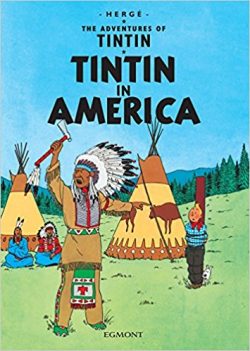
Tintin in America


By Hergé & various; translated by Leslie Lonsdale-Cooper & Michael Turner (Egmont)
ISBN: 978-1-40520-802-4 (HB)                    : 978-1-40520-614-3 (PB)

By the time Georges Remi, known the world over as Hergé, began the boy-hero’s third adventure Tintin in America (which ran from 1931-1932), he was well on the way to mastery of his art but was still growing as a writer. Although the periodical format meant that a certain degree of broad comedy and seemingly directionless, action was necessary to keep the attention of the reader, his ability to integrate these set-piece elements into the building of a complete narrative was still developing.

Georges Prosper Remi created a true masterpiece of graphic literature with his many tales of a plucky boy reporter and his entourage of iconic associates. Singly, and later with assistants including Edgar P. Jacobs, Bob de Moor and the Hergé Studio, Remi completed 23 splendid volumes (originally produced in brief instalments for a variety of periodicals) that have grown beyond their popular culture roots and attained the status of High Art.

Like Charles Dickens with The Mystery of Edwin Drood, Hergé died in the throes of creation, and final outing Tintin and Alph-Art remains a volume without a conclusion, but still a fascinating examination and a pictorial memorial of how the artist worked.

It’s only fair though, to ascribe a substantial proportion of credit to the many translators whose diligent contributions have enabled the series to be understood and beloved in 38 languages. The subtle, canny, witty and slyly funny English versions are the work of Leslie Lonsdale-Cooper & Michael Turner.

On leaving school in 1925, Remi worked for Catholic newspaper Le XXe Siécle where he fell under the influence of its Svengali-like editor Abbot Norbert Wallez. The following year, the young artist – a dedicated boy-scout – produced his first strip series: The Adventures of Totor for the Boy Scouts of Belgium monthly magazine.

By 1928 was in charge of producing the contents of Le XXe Siécles children’s weekly supplement Le Petit Vingtiéme.

He was unhappily illustrating The Adventures of Flup, Nénesse, Poussette and Cochonette when Abbot Wallez urged Remi to create a new adventure series. Perhaps a young reporter who would travel the world, doing good whilst displaying solid Catholic values and virtues?

And also, perhaps, highlight and expose some the Faith’s greatest enemies and threats…?

Having recently discovered the word balloon in imported newspaper strips, Remi decided to incorporate this simple yet effective innovation into his own work. He would produce a strip that was modern and action-packed. Beginning January 10th 1929, Tintin in the Land of the Soviets appeared in weekly instalments, running until May 8th 1930.

The boy-hero – a combination of Ideal Good Scout and Remi’s own brother Paul (a soldier in the Belgian Army) would be accompanied by his dog Milou (Snowy to us Brits) and report back all the inequities from the “Godless Russias”.

The strip’s prime conceit was that Tintin was an actual foreign correspondent for Le Petit Vingtiéme…

The odyssey was a huge success, assuring further – albeit less politically charged and controversial – exploits to follow. At least that was the plan…

Following directly on from Tintin in the Congo the valiant juvenile journalist heads for Chicago to sort out the gangster Al Capone, whose diamond smuggling enterprise he had inadvertently scotched whilst in Africa. However, Capone and his hoods are ready and waiting…

Thwarting the plots and schemes of the legendary gangster make for thrilling, uproarious reading, full of chases, fights and hairsbreadth escapes, but events take a darker turn – and broad detour – once Capone’s biggest rival Bobby Smiles enters the picture.

Head of the Gangsters Syndicate of Chicago, Smiles first tries to buy Tintin off and, when he is furiously rebuffed, tries repeatedly to have the nosy, crime-busting reporter killed.

Setting a trap with the police, Tintin smashes the GSC and chases Smiles out west to Redskin City, only to fall foul of a tribe of Indians the mobster has hoodwinked into attacking the indomitable lad.

Hergé had a life-long fascination with the American West, and it featured in many of his works (such as Tim the Squirrel and Popol Out West). It’s also clear that he watched a lot of movies, as many signature Western set-pieces are adapted to strip format as Tintin and Snowy hunt Smiles – a thrilling pursuit involving railroad chases, dynamite sabotage, a prairie wildfire and even tying our heroes to the tracks before the boy and his dog finally capture the desperate thug.

Returning to Chicago, Tintin is once more the target of the remaining criminal gangs, but they prove no match for his resourceful ingenuity, and the brave Belgian leaves America a better, cleaner place…

With this somewhat long and rambling series of exploits – still not quite a cohesive narrative – Hergé begins to pepper the instalments with sly, dry social commentary, beginning the process of sophisticating the stories. He also adds satire to the breakneck slapstick – an acknowledgement that adults, too, were devout fans and followers of the strip.

The comedy of such moments as the rush of speculators when oil is found on the Indian Reservation, or the inept way in which cowboys try to lynch Tintin and Snowy (is that PC these days? – Can’t decide, but it is still awfully funny), is graphically interesting, but surely aimed at a more worldly and cynical consumer.

Like your kids, or you…

Tintin in America: artwork © 1945, 1973, 2016 Editions Casterman, Paris & Tournai.
Text © 1978, Egmont UK Limited. All Rights Reserved.

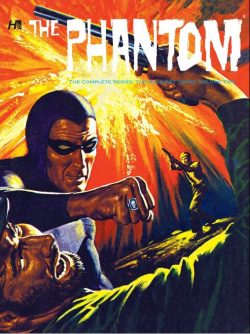
The Phantom – The Complete Series: The Gold Key Years volume 2


By Bill Harris & Bill Lignante with George Wilson (Hermes Press)
ISBN: 978-1-61345-023-9

In the 17th century a British sailor survived an attack by pirates, and, washing ashore in Africa, swore on the skull of his murdered father to dedicate his life and that of all his descendants to destroying all pirates and criminals. The Phantom fights crime and injustice from a base deep in the jungles of Bengali, and throughout Africa is known as the “Ghost Who Walks”.

His unchanging appearance and unswerving quest for justice have led to him being considered an immortal avenger by the credulous and the wicked. Down the decades one hero after another has fought and died in an unbroken line, and the latest wearer of the mask, indistinguishable from the first, continues the never-ending battle…

Lee Falk created the Jungle Avenger at the request of his syndicate employers who were already making history, public headway and loads of money with his first strip sensation Mandrake the Magician…

Although technically not the first ever costumed hero in comics, The Phantom was the prototype paladin to wear a skin-tight body-stocking, and the first to have a mask with opaque eye-slits.

He debuted on February 17th 1936 in an extended sequence that pitted him against a global confederation of pirates called the Singh Brotherhood. Falk wrote and drew the daily strip for the first two weeks before handing artist Ray Moore the illustration side. The Sunday feature began in May 1939.

For such a successful, long-lived and influential series, in terms of compendia or graphic novel collections, The Phantom has been very poorly served by the English language market. Various small companies have tried to collect the strips – one of the longest continually running adventure serials in publishing history – but in no systematic or chronological order and never with any sustained success.

But, even if it were only of historical value (or just printed for Australians, who have long been manic devotees of the implacable champion) surely “Kit Walker” is worthy of a definitive chronological compendium series?

Happily, his comic book adventures have fared slightly better – at least in recent times…

In the 1960’s King Features Syndicate dabbled with a comicbook line of their biggest stars – Flash Gordon, Mandrake and The Phantom – but immediately prior to that, the Ghost Who Walks helmed a solo-starring vehicle under the broad and effective aegis of veteran licensed properties publisher Gold Key Comics. Each issue was fronted by a stunning painted cover by George Wilson.

The Phantom was no stranger to funnybooks, having been featured since the Golden Age in titles such as Feature Book and Harvey Hits, but only as straight strip reprints. These Gold Key exploits were tailored to a big page and a young readership.

This second superb full-cover hardcover – with equivalent eBook editions for the modern minded – gathers The Phantom #9-17 (originally released between November 1964 and July 1966) and opens with fan and scholar Pete Klaus’ Introduction ‘The Gold Key Phantom’: offering original art panels (many by Sy Barry) and a welcoming overview of the immortal strip star.

Scripted by Bill Harris and drawn in comicbook format by Bill Lignante, the illustrated adventures resume with full-length epic ‘The Sixth Man’ from #9 as the Ghost Who Walks takes a rare trip into modern civilisation only to be shanghaied by crooks. The miscreants realise too late that they have made the biggest mistake of their shady lives…

Determined to discover what’s behind the nefarious scheme, Kit Walker allows himself to be taken to a remote island ruled by bored, cruel queen Sansamor who thrives on making powerful men duel to the death.

Once the hero sees the kind of creature she is, her downfall is assured…

The issue is concluded by a single-page historical recap of the legend of ‘The Phantom’ and equally brief monochrome run-down of the mystery man’s intended bride ‘Diana’ (Palmer).

Cover-dated February 1965, The Phantom #10 opens with devious action thriller ‘The Sleeping Giant’ wherein the long-peaceful tribe of Itongo headhunters take up the old ways after their ancestral idol Tuamotu comes to life.

Thankfully, the Phantom is on hand to stem the potential carnage and expose crooked diamond prospector Joe Gagnon and his oversized circus performer inciting the tribesmen to war and conquest. All he has to do is defeat the giant warrior in unarmed combat…

Assisting the masked peacekeeper in policing the tribes and criminals of the region is ‘The Patrol’. These worthy soldiers have no idea who their mysterious “Commander” actually is and when the latest recruit tries to find out he receives a startling shock in this wry vignette.

Issue #11 (April 1965) features ‘Blind Man’s Bluff’ with two brutal convicts breaking out of the Bengal Penal Colony to terrorise native communities by masquerading as demonic spirits. When the Ghost Who Walks apprehends them as they link up with pirates, he is struck sightless by a flare gun. Not even blindness can stop the resourceful champion from dispensing justice, however…

Closing the issue is a one-page tour of ‘The Skull Cave’ by Joe Certa, after which #12 (June) introduces ‘The Beast of Bengali’, with art by Sparky Moore & Lignante. Here a golden giant capable of seeming miracles subjugates the locality until the masked marvel exposes his magical feats for the tricks they really are…

Following a mouth-watering period ad for the Phantom Revell model kit, issue #13 (August) opens ‘The Phantom Chronicles’ as the Jungle Sentinel consults his ancestor’s meticulous records for tips on defeating seemingly immortal bandit Rachamond…

The Phantom #14 (October) begins with ‘The Historian’ as scholar Dr. Heg consults with the Jungle Patrol on a book chronicling their achievements. His ulterior motive is to destroy the only law for hundreds of miles, but he has not reckoned on the true identity of their enigmatic leader…

‘Grandpa’ then switches locales to America where Diana Palmer’s doting ancestor is playing unwelcome matchmaker. Eventually, after violent incidents involving bears and robbers, the old man warms to African mystery man Kit Walker…

Closing 1966, issue #15 (December) details the downfall of ‘The River Pirates’ who ravage along the mighty waterways of the region. Their modern weapons prove little use against the cunning and bravery of the Deep Woods Guardian…

‘The Tournament’ then focuses on an unlucky prison escapee who finds the Phantom’s clothes and is stuck fighting a native gladiator in a centuries-old grudge match. Sadly, if he loses, the prestige lost means chaos will return to the tribes enjoying The Phantom’s Peace…

‘The Chain’ opens #16 (April 1966) as a world-weary Phantom considers quitting after an interminable period negotiating peace between warring tribes. Even Diana cannot change his mind, but when ancient wise man Wuru appears he relates a story of the hero’s father, who endured hardship, mockery and even slavery in a quest to rescue a woman from vile bondage. Her name was Maude, and she was to be the Phantom’s mother…

A brace of single-pagers follow, revealing Kit Walker’s unrecorded boxing bout against ‘The Champ’ and a battle in a bar won by ‘The Milk Drinker’ before ‘The Crescent Cult’ sees the Jungle Ghost crushing an assassination gang determined to murder their country’s new Maharani. The comic concludes with another 1-page yarn as ‘The Diggers’ examine old ruins and discover proof that the Phantom has lived and fought evil for centuries!

This second volume ends on a truly supernatural note as The Phantom #17 (July 1966) discloses how undying witch ‘Samaris’ has preyed on male suitors for centuries, and believes she has last found another cursed to live forever…

Following one-pager ‘The Waterfall’, detailing the secrets of the entrance to the fabled Skull Cave, ‘Samaris Part II’ finds the Ghost Who Walks captive of the Queen but resisting her every wile until justice, fate and an avalanche of deferred years catch up to her at last…

Wrapping up is a monochrome vignette detailing the secrets of The Phantoms’ devout helpers ‘The Bandar’ Poison Pygmy People and a sumptuous cover gallery by George Wilson.

Straightforward, captivating rollicking action-adventure has always been the staple of The Phantom. If that sounds like a good time to you, this is a traditional nostalgia-fest you won’t want to miss…
The Phantom® © 1964-1966 and 2012 King Features Syndicate, Inc. ® Hearst Holdings, Inc. Reprinted with permission. All rights reserved.

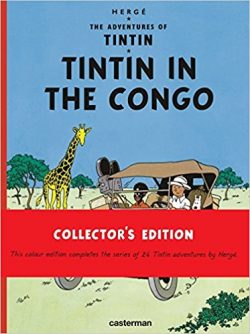
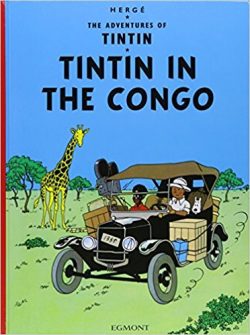
Tintin in the Congo


By Hergé & various; translated by Leslie Lonsdale-Cooper and Michael Turner (Egmont)
ISBN: 978-2-20309-650-9 (2016 HB)           :978-0-78595-830-7 (1987 HB)
:978-1-40526-651-2 (PB)

Georges Prosper Remi, known universally as Hergé, created a true masterpiece of graphic literature with his many tales of a plucky boy reporter and his entourage of iconic associates.

Singly, and later with assistants including Edgar P. Jacobs, Bob de Moor and the Hergé Studio, Remi completed 23 splendid volumes (originally produced in brief instalments for a variety of periodicals) that have grown beyond their popular culture roots and attained the status of High Art.

Like Charles Dickens with the Mystery of Edwin Drood, Hergé died in the throes of creation, and final outing Tintin and Alph-Art remains a volume without a conclusion, but still a fascinating examination – and a pictorial memorial of how the artist worked.

It’s only fair though, to ascribe a substantial proportion of credit to the many translators whose diligent contributions have enabled the series to be understood and beloved in 38 languages. The subtle, canny, witty and slyly funny English versions are the work of Leslie Lonsdale-Cooper & Michael Turner.

On leaving school in 1925, Remi worked for Catholic newspaper Le XXe Siécle where he seems to have fallen under the influence of its Svengali-like editor Abbot Norbert Wallez. The following year, the young artist – himself a dedicated boy-scout – produced his first strip series – The Adventures of Totor – for the monthly Boy Scouts of Belgium magazine and by 1928 was in charge of producing the contents of Le XXe Siécle’s children’s weekly supplement Le Petit Vingtiéme.

He was unhappily illustrating The Adventures of Flup, Nénesse, Poussette and Cochonette (written by the staff sports reporter) when Abbot Wallez urged Remi to create a new adventure series. Perhaps a young reporter who would travel the world, doing good whilst displaying solid Catholic values and virtues?

And also, perhaps, highlight and expose some the Faith’s greatest enemies and threats…?

Having recently discovered the word balloon in imported newspaper strips, Remi decided to incorporate this simple yet effective innovation into his own work. He would produce a strip that was modern and action-packed. Beginning on January 10th 1929, Tintin in the Land of the Soviets appeared in weekly instalments in Le Petit Vingtiéme, eventually running until May 8th 1930. The boy-hero – a combination of Ideal Good Scout and Remi’s own brother Paul (a soldier in the Belgian Army) would be accompanied by his dog Milou (Snowy to us Brits) and report back all the inequities from the “Godless Russias”.

The strip’s prime conceit was that Tintin was an actual foreign correspondent for Le Petit Vingtiéme…

The odyssey was a huge success, assuring further – albeit less politically charged and controversial exploits – to follow. At least that was the plan…

Whereas the originally serialised tale was simply black and white and episodic, Tintin in the Congo as a book is much more stylistically familiar to modern readers. This saga, which originally ran in Le Petit Vingtiéme from June 1930 to June 1931, was radically restructured in 1946 for release as a collected album, and later, a rather shocking page featuring a rhinoceros, a hand-drill and a stick of dynamite was deftly replaced with a much funnier scene…

Moreover, this tale was unavailable to English-readers for years due to its depiction of ethic people and its white Eurocentric bias: a situation confronted and addressed head-on in the 2016 Collectors Edition in a forthright and contextualising Forward…

So, making allowances for the time frame, what’s here?

Still hampered by his weekly, episodic format, Tintin and Snowy take ship for the Belgian Congo where they perforce have many little adventures, but also incredibly uncover a plot by US gangster Al Capone to take control of Africa’s diamond trade…

The book version features a Tintin retrofitted for both artistic and commercial reasons. By 1946 Hergé had completed thirteen full Tintin adventures and the characters were fully developed. It was both logical and preferable that new readers be presented with a consistent vision. Moreover, as Hergé had grown as both author and artist, the album editions gave him an opportunity to rectify some earlier decisions that he had long regretted.

When producing work for a perpetual deadline not only are you trapped by the urgent need to finish and move on, but you are imprisoned in the context of your own times. When ‘The Congo’ ran in 1930-1931, representations of ethnicities and more importantly the attitudes of a Belgium that was still a Colonial and Imperial Power informed the text and indubitably influenced the Catholic newspaper then paying for the strip.

In later years Hergé admitted to deeply regretting much of his early work and took every opportunity to repair it.

A scene in which natives are taught that they are happy Belgians was gladly replaced with a maths lesson and many images and scenes were subtly altered to enhance the standing and image of native Africans. The ongoing controversy regarding ethnic depictions in historical comics (and remember, this tale is almost ninety years old) seems doubly cynical and politically self-serving when one considers that Hergé was rectifying what he saw as racial slurs in the 1940s whilst modern society is still denying that there’s a problem. For every black African waving a spear and shield in this story there’s another in a suit, a uniform or tee shirt.

This yarn might be potentially controversial but it is also the transitional outing that confirmed the boy-hero’s drawing power: a highly readable, joyously thrilling, exuberant and deeply informative adventure romp for any fan of the comic strip medium.

And, although each exploit can be read singly, since Hergé was an early proponent of extended continuity, this early epic is actually necessary reading if you want a better understanding of the Tintin masterpieces to come.

Tintin in the Congo: artwork © 1946, 1974, 2016 Editions Casterman, Paris & Tournai.
Text © 2005 Egmont UK Limited. All Rights Reserved.

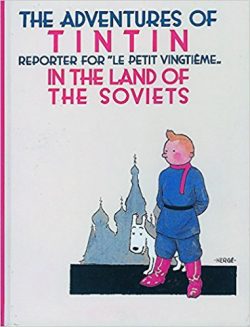
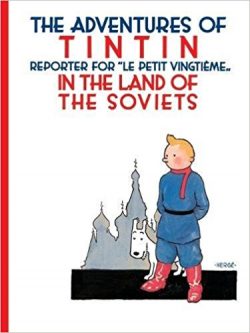
Tintin in the Land of the Soviets


By Hergé (Egmont)
ISBN: 978-1-40521-477-3 (HB)                    978-1-40526-651-2 (PB)

Georges Prosper Remi, known all over the world as Hergé, created a true masterpiece of graphic literature with his many tales of a plucky boy reporter and his entourage of iconic associates. Singly, and later with assistants including Edgar P. Jacobs, Bob de Moor and the Hergé Studio, Hergé completed 23 splendid volumes (originally produced in brief instalments for a variety of periodicals) that have grown beyond their popular culture roots and attained the status of High Art.

Like Charles Dickens with the Mystery of Edwin Drood, Hergé died while working, so final outing Tintin and Alph-Art remains a volume without a conclusion, but still a fascinating examination – and a pictorial memorial of how the artist worked.

It’s only fair though, to ascribe a substantial proportion of credit to the many translators whose diligent contributions have enabled the series to be understood and beloved in 38 languages. The subtle, canny, witty and slyly funny English versions are the work of Leslie Lonsdale-Cooper & Michael Turner.

On leaving school in 1925, Remi worked for Catholic newspaper Le XXe Siécle where he seems to have fallen under the influence of its Svengali-like editor Abbot Norbert Wallez. The following year, the young artist (himself a dedicated boy scout) produced his first strip series – The Adventures of Totor – for the monthly Boy Scouts of Belgium magazine and by 1928 was in charge of producing the contents of Le XXe Siécle’s children’s weekly supplement Le Petit Vingtiéme.

He was unhappily illustrating The Adventures of Flup, Nénesse, Poussette and Cochonette (written by the staff sports reporter) when Abbot Wallez urged Remi to create a new adventure series. Perhaps a young reporter who would travel the world, doing good whilst displaying solid Catholic values and virtues? And also, perhaps highlight and expose some the Faith’s greatest enemies and threats…?

Having recently discovered the word balloon in imported newspaper strips, Remi decided to incorporate this simple yet effective innovation into his own work. He would produce a strip that was modern and action-packed. Beginning on January 10th 1929, Tintin in the Land of the Soviets appeared in weekly instalments in Le Petit Vingtiéme, eventually running until May 8th 1930.

The boy-hero – a combination of Ideal Good Scout and Remi’s own brother Paul (a soldier in the Belgian Army) – would be accompanied by his dog Milou (Snowy to us Brits) and report back all the inequities from the “Godless Russias”.

The strip’s prime conceit was that Tintin was an actual foreign correspondent for Le Petit Vingtiéme…

Arriving in Russia, the dog and his boy are constantly subjected to a series of attacks and tricks in a vain scheme by the Soviets to prevent the truth of their failed economic progress, specious popular feeling and wicked global aspirations being revealed to the Free World.

In a manic, breathless progression of fights, chases, slapstick accidents and futile attempts to bribe and corrupt him – or worse –  a hint of Tintin as a capable, decent and resourceful hero can be seen to gel on every progressive page as he thwarts the plots of the Bolsheviks and Moscow’s ubiquitous Secret Police…

Week by week, page by page, Tintin “gets away clean” in all manner of fast and flashy machines – all lovingly rendered in a stylised, meta-realistic manner not yet used for the human characters. This is a clear forerunner of Hergé’s Ligne Claire drawing style which develops rapidly as the plucky lad makes his way back across Europe to a rapturous welcome in Belgium, and with every kilometre covered, the personalities of the characters move beyond action-ciphers towards the more fully realised universal boy-hero we all know today.

The strip itself is very much a work-in-progress, primitive both in narrative and artistic execution. But amidst the simplified line, hairsbreadth chases and grossly simplistic anti-communistic polemic there is something… an intriguing hint of things to come.

Rendered in sleek monochrome, Tintin in the Land of the Soviets, was one of the last adventures to be published in English and is still available in both hardback and paperback editions.

Although possibly still a little controversial (and not ideal for the stated target market of eight years old and up), this is a highly readable, joyously thrilling, exuberant and deeply informative romp for any fan of the comic strip medium.

Tintin in the Land of the Soviets: artwork © 1999 Editions Casterman, Paris& Tournai.
Text ©1999, 2007Casterman/Moulinsart. All Rights Reserved.

Krazy & Ignatz 1935-1936: “A Wild Warmth of Chromatic Gravy”


By George Herriman, edited by Bill Blackbeard (Fantagraphics Books)
ISBN: 978-1-56097-690-5

The Krazy Kat cartoon strip is, for many of us, the pinnacle of graphic narrative innovation; a singular and hugely influential body of work which shaped the early comics industry to become an undisputed treasure of world literature. It’s 105 years old and should be known and loved by far more folk than it is. Also worth remarking is that it may be the strangest and most authentic love story in comics history…

Krazy and Ignatz, as Fantagraphics designated its sequence of glorious archival tomes, is a creation which must be appreciated on its own terms. The feature evolved a unique language – at once both visual and verbal – to deal with the immeasurable variety of human experience, foibles and peccadilloes with unfaltering warmth and understanding without ever offending anybody.

Sadly, however, it baffled far more than a few…

Never a strip for dull or unimaginative people who simply won’t or can’t appreciate the complex multi-layered verbal and pictorial whimsy, absurdist philosophy or the seamless blending of sardonic slapstick with arcane joshing, it’s still the closest thing to pure poesy narrative art has ever produced.

George Herriman was already a successful cartoonist and journalist in 1913 when the cat and mouse who had been cropping up in his ever-evolving, outrageous domestic comedy strip The Dingbat Family/The Family Upstairs graduated to their own feature.

Krazy Kat debuted in William Randolph Hearst’s New York Evening Journal on Oct 28th 1913 and – largely by dint of the publishing magnate’s overpowering direct influence and hands-on interference – gradually spread throughout his vast stable of papers.

Although Hearst and a host of the period’s artistic and literary intelligentsia (such as e.e. Cummings, Frank Capra, John Alden Carpenter, Gilbert Seldes, Willem de Kooning, H.L. Mencken and others) all adored the strip, most local and regional editors did not; many taking every potentially career-ending opportunity to drop it from the comics section whenever they could.

Eventually the Kat found a home and safe haven in the Arts and Drama section of Hearst’s papers. Protected there by Hearst’s heavy-handed patronage, Krazy flourished, unharmed by editorial interference and fashion. One way or another and by hook or by crook Krazy ran – generally unmolested – until Herriman’s death in April 1944.

The core premise is simple: Krazy Kat is an effeminate, dreamy, sensitive and romantic feline of indeterminate gender hopelessly in love with rude, crude, brutal, mendacious, thoroughly scurrilous Ignatz Mouse.

Ignatz is a truly unreconstructed and probably irredeemable male; drinking, stealing, fighting, conniving, constantly neglecting his wife and children and always abusively responding to Krazy’s genteel advances by clobbering the Kat with a well-aimed brick (obtained singly or in bulk from noted local brick-maker Kolin Kelly). The smitten kitten invariably misidentifies these assaults as tokens of equally recondite affection.

The third crucial element completing an anthropomorphic eternal triangle is local cop Offissa Bull Pupp; a figure of honesty and stolid duty completely besotted with Krazy. Ever vigilant, he is professionally aware of the Mouse’s true nature, yet hamstrung – by his own amorous timidity and sense of honour – from permanently removing his devilish rival for the foolish feline’s affections.

Krazy is, of course, blithely oblivious to Pupp’s dilemma and has cast him eternally into what we now call the “Friend Zone”…

Crowding out the ever-mutable stage are a stunning supporting cast of inspired bit players such as Joe Stork (dreaded deliverer of unplanned, and generally unwanted, babies); hobo Bum Bill Bee; unsavoury conman trickster Don Kiyoti; self-aggrandizing Walter Cephus Austridge; fussbudget busybody Pauline Parrot, inscrutable, barely intelligible Chinese mallard Mokk Dukk; dozy Joe Turtil and a host of other audacious animal krackers, all equally capable of stealing the limelight or even supporting their own strip features.

The exotic, quixotic episodes occur in and around the Painted Desert environs of Coconino (based on the artist’s Coconino County, Arizona vacation retreat) where absurdly surreal playfulness and the fluid ambiguity of both flora and landscape are perhaps the most important member of the cast.

The strips are a masterful mélange of unique experimental art: wildly expressionistic and strongly referencing Navajo and Mexican art forms whilst graphically utilising sheer unbridled imagination and delightfully evocative lettering and language.

Those bizarre balloons and chaotic captions are crammed with florid verbiage: alliterative, phonetically and even onomatopoeically joyous with a compelling musical force (“l’il dahlink”, “You is inwited to a ketnip potty or “so genteel, so riffime, so soba”)…

Yet for all that, these adventures are lyrical, satirical, timely, timeless, bittersweet, self-referential, fourth-wall bending, eerily idiosyncratic, astonishingly hilarious escapades encompassing all aspects of humour from painfully punning shaggy dog stories to riotous, violent slapstick.

Sometimes Herriman even eschewed his mystical mumblings and arcane argots for the simply sublime grace of a supremely entertaining silent gag in the manner of his beloved Keystone Cops and other stars of silent slapstick comedies…

Krazy Kat‘s resurgence started in the late 1970s when the strip was rediscovered by a better-educated, open-minded and far more accepting generation. This top notch tinted tome – offering material from 1935-1936 – luxuriates in the switch to full colour (after decades of monochrome mirth and madness) under the sheltered safe-haven of a nationally-controlled Hearst comics insert package and manifests as a comfortably tactile paperback or eBook edition.

It was the first collection “Coalescing the Complete Full-Page Comics Strips, with the usual extra Rarities” such as candid photographs, contemporary press articles, toys, merchandise and even a 1916 original Krazy Kat page sublimely hand-tinted by Herriman to open this volume…

The precarious history of how these ultra-rare later strips were preserved and returned to print once more are detailed in Bill Blackbeard’s Introduction ‘Autumn Leaves: Herriman’s Klosing Kat Pages Revel in Fine Syndicate Kolur (But with a Briefly Blue Ignatz)’: supplemented by an examination of Herriman’s unclear – if not positively murky – past, potential ethnicity and the strip’s treatment of race issues in Jeet Heer’s article ‘The Kolors of Krazy Kat’.

Augmenting the journalism and sociology are a number of early strips plus a few magnificent painted pieces from the maestro, as well as a selection of merchandising treasures to ogle over and lust after…

The actual strip pages resume with June 1st 1935 – the colour provided by professional separators rather than Herriman – and pretty much pick up where the black and white feature left off.

We do, however, meet some new characters: perambulating elephants; an entrepreneurial cow; a Mocking Bird called Moggin Boid; doleful doggie and tax-dodging calf L’il Thinn Dyme and dismal dodo Dough Dough amongst others.

The most significant debuting presence is a thoroughly brutal bad guy dubbed “the Growler”. This deplorable mutt adds a frisson of dangerous gangsterism to the aura of domestic dispute and romantic disharmony. Although the surly bandit easily outmatches and cows Offisa Pupp, he is clearly no match for the tangled trio working what we’ll kindly designate as “together”…

Despite having to split his time between watching the mouse, confronting the Growler, administrating tax and dole crises and freeing the county of generalised sin and depravity, the lawdog soon settles into a comfortable pattern of wishful monitoring in these strips as Ignatz and Krazy perpetuate their bizarre romantic ritual. The Mouse constantly innovates in his obsessive desire to bean the Kat’s bonce: generally ending up in the cells whether successful or otherwise.

The Kat kontinues to await bad love’s brainbusting kiss, joyous of every kontusion and konkussion and deflated and woeful every time fate, cruel misfortune or the konstabulary aborts that longed for high-velocity assignation…

Pupp still proactively stalks and thwarts Ignatz, but as always, the mouse’s continual search for his ammunition of choice and the perfect ambush spot hogs most pages, leading to many brick-based gags and increasing frustration amongst all involved.

The county lock-up remains a key component as escalating slapstick silliness frequently concludes with Ignatz in the dog’s “house”. Naturally, that just means the malign Mus Musculus maximising his malevolent efforts; regularly taking to the air or adopting uncanny disguises to achieve his aims…

New topics of interest and comedic provenance include the arrival of novel and challenging foodstuffs to the region – tortillas, water-melons and an assortment of fast foods. Also numbering amongst new arrivals and fresh phenomena are a film crew lensing authentic and reasonable romantic encounters, ghost sightings, unoccupied top hats, overly-effective hair restorers, a smoking ban, trick photography, beauty salons for pelt/skin tone reassignment procedures, boomerangs and strange lights in the sky…

Worst of all, with 1936 a Leap Year, the populace all seem to lose their bearings and become marriage mad even as Joe Stork – whose delivery of unexpected babies still brings dread responsibility and smug schadenfreude in equal amounts to all – expands his remit by becoming a self-appointed truant officer to Ignatz’ many progeny …

The region abounds with a copious coterie of confidence tricksters – a scurrilous sub-population which seems to grow weekly – but a new addition is a clique of nouveau riche billionaires and trillionaires seeking to increase their short-term assets before the year ends with a nasty outbreak of election fever and bogus prognostication…

As always there is a solid dependence on the strange landscapes and eccentric flora – especially the viciously ferocious coconuts and various cacti – for humorous inspiration, and bizarre weather plays a greater part in inducing anxiety and bewilderment. Strip humour was never more eclectic or indefinable…

Supplementing the cartoon gold and ending this slim tome is another erudite and instructional ‘Ignatz Mouse Debaffler Page’, providing pertinent facts, snippets of contextual history and necessary notes for the young and potentially perplexed before the collection closes with a fabulous photo feature on possibly the very first Krazy Kat stuffed toy and a selection of pinback buttons (we Brits call them badges) from the 1910s-1930s.

Herriman’s epochal classic is a phenomenal achievement: in all the arenas of Art and Literature nothing has been seen like these comics which shaped our industry and creators: inspiring auteurs in fields as disparate as prose fiction, film, dance, animation and music, all whilst delivering delight and delectation to generations of wonder-starved fans on a daily and weekly basis.

If, however, you’re one of Them and not Us, or if you yet haven’t experienced this gleeful graphic assault on the sensorium, mental equilibrium and emotional lexicon concocted by George Herriman from the dawn of the 20th century until the dog days of World War II, this astounding compendium is a supremely effective and accessible way to do so.
© 2005 Fantagraphics Books. All rights reserved.

Krazy & Ignatz 1933-1934: “Necromancy by the Blue Bean Bush”


By George Herriman, edited by Bill Blackbeard & Derya Ataker (Fantagraphics Books)
ISBN: 978-1-56097-620-2

The Krazy Kat cartoon strip is arguably the pinnacle of graphic narrative innovation; a singular and hugely influential body of work which shaped the early days of the comics industry and became an undisputed treasure of world literature.

Krazy and Ignatz, as it is now dubbed for these glorious commemorative tomes from Fantagraphics, is a creation which must be appreciated on its own terms. The strip developed a unique language – at once both visual and verbal – and dealt with the immeasurable variety of human experience, foibles and peccadilloes with unfaltering warmth and understanding without ever offending anybody.

Sadly, however, it baffled far more than a few…

It was never a strip for dull, slow or unimaginative people who simply won’t or can’t appreciate the complex multi-layered verbal and pictorial whimsy, absurdist philosophy or seamless blending of sardonic slapstick with arcane joshing. It is still the closest thing to pure poesy that narrative art has ever produced.

Herriman was already a successful cartoonist and journalist in 1913 when a cat and mouse who had been cropping up in his ever-evolving, outrageous domestic comedy strip The Dingbat Family/The Family Upstairs graduated to their own feature. Krazy Kat debuted in William Randolph Hearst’s New York Evening Journal on Oct 28th 1913 and – largely by dint of the publishing magnate’s overpowering direct influence and interference – gradually spread throughout his vast stable of papers.

Although Hearst and a host of the period’s artistic and literary intelligentsia (notably – but not exclusively – e.e. Cummings, Frank Capra, John Alden Carpenter, Gilbert Seldes, Willem de Kooning, H.L. Mencken and – latterly – Jack Kerouac) all adored the strip, many local and regional editors did not; taking every potentially career-ending opportunity to drop it from the comics section.

Eventually the feature found a home and safe haven in the Arts and Drama section of Hearst’s papers. Protected there by Hearst’s heavy-handed patronage, the Kat flourished unharmed by editorial interference and fashion, running generally unmolested until Herriman’s death in April 1944.

The basic premise is simple: Krazy is an effeminate, dreamy, sensitive and romantic feline of indeterminate gender hopelessly in love with Ignatz Mouse: rude crude, brutal, mendacious and thoroughly scurrilous.

Ignatz is a true unreconstructed male; drinking, stealing, fighting, conniving, constantly neglecting his wife and children and always responding to Krazy’s genteel advances by clobbering the Kat with a well-aimed brick (obtained singly or in bulk from noted local brick-maker Kolin Kelly) which the smitten kitten invariably misidentifies as tokens of equally recondite affection.

The third crucial element completing an anthropomorphic eternal triangle is lawman Offissa Bull Pupp, a figure of honesty and stolid duty completely besotted with Krazy, professionally aware of the Mouse’s true nature, yet hamstrung – by his own amorous timidity and sense of honour – from permanently removing his devilish rival for the foolish feline’s affections.

Krazy is, of course, blithely oblivious to Pupp’s dilemma…

Also populating the ever-mutable stage are a stunning supporting cast of inspired bit players such as Joe Stork, dreaded deliverer of unplanned, and generally unwanted, babies; hobo Bum Bill Bee, unsavoury conman and trickster Don Kiyoti, self-aggrandizing Walter Cephus Austridge, busybody Pauline Parrot, inscrutable, barely intelligible Chinese mallard Mock Duck, dozy Joe Turtil and a host of other audacious characters, all equally capable of stealing the limelight or even supporting their own strip features.

The exotic, quixotic episodes occur in and around the Painted Desert environs of Coconino (based on the artist’s vacation retreat in Coconino County, Arizona) where absurdly surreal playfulness and the fluid ambiguity of the flora and landscape are perhaps the most important member of the cast.

The strips are a masterful mélange of unique experimental art, wildly expressionistic and strongly referencing Navajo art forms whilst graphically utilising sheer unbridled imagination and delightfully evocative lettering and language: alliterative, phonetically and even onomatopoeically joyous with a compelling musical force (“Mitt me at the Musharoon”, “l’il dahlink” or “Ignatz, ware four is thou at Ignatz??”).

Yet for all that, the adventures are poetic, satirical, timely, timeless, bittersweet, self-referential, fourth-wall bending, eerily idiosyncratic, astonishingly hilarious escapades encompassing every aspect of humour from painfully punning shaggy dog stories to riotous, violent slapstick.

Sometimes Herriman even eschewed his mystical mumblings and arcane argots for the simply sublime grace of a supremely entertaining silent gag in the manner of his beloved Keystone Cops and other stars of silent slapstick comedies…

The wealth of Krazy Kat collections started in the late 1970s when the strip was first rediscovered by a better-educated, open-minded and far more accepting generation. This delirious tome, covering the last of the full-page black-&-white Sunday Page material from 1933-1934 – prior to a switch to full colour and a sheltered safe-haven in a sheltered Hearst comics insert package – comes in a comfortably hefty (231 x 305 mm) softcover or eBook edition: one last monochrome masterpiece expansively “Compounding the Complete Full-Page Comics Strips, with some extra Rarities”…

The machinations that brought about that transformation and an account describing the herculean efforts involved in finding and restoring those final strips can be found in Bill Blackbeard’s Introduction ‘No Kidding… We’ve Run Out of Kats!’, supplemented by examples of another Herriman lost treasure – ‘Mary’s Home From College’ – plus contemporary photo-material from King Features promotional magazine Circulation, and additional strip examples such as Dempsey Under Wraps and beguiling hand drawn postcard by the master himself.

Extra treats manifest in a selection of Herriman’s Krazy Kat Daily strips hilariously discussing the gender-confabulation of the mixed-up moggy and lost strips and gag-panels are uncovered with samples of ‘The Amours of Marie Anne Magee’, ‘Embarrassing Moments’, ‘Darktown Aristocracy Caught in the Swirl’ and ‘Baron Bean’ plus pertinent newspaper clippings featuring the artist from a time when cartoonists were actual celebrities…

On to the strips then: within this compelling compendium of incessant passions thwarted in another land and time, the torrid triangular drama dwindles and expires in the middle of 1934 in preparation for later, greater full-colour glories but never ceases to revel in the wild wonders of blithe whimsy as winningly as ever, but with the old familiar faces popping up to contribute to the insular insanity and well-cloaked social satire…

One thing to note: during this period local editors who actually ran the strip usually had the manically expressive layouts reformatted to standard tiers – and the Fantagraphics staff are to be praised eternally for their efforts to restore the original designs…

We open on January 1st 1933 with the tangled trio greeting another year with the same heartworn and forlorn shenanigans, although Offisa Pupp is now pressing his attentive suit with more desperate forcefulness…

A spate of strips sees the lawdog proactively stalking and thwarting Ignatz, but as always, the mouse’s continual search for his ammunition of choice and the perfect ambush spot predominate, leading to many brick-based gags and increasing frustration.

One happy circumstance is the growing use of the county lock-up as the escalating slapstick silliness frequently concludes with Ignatz incarcerated. Naturally that just means the malign Mus Musculus (look it up if you must) magnifying his malevolent efforts; even regularly taking to the air in a series of aeronautical escapades…

In response, Coconino’s (occasionally “Kokonino”) Finest has taken to hurling missiles of his own in retaliation and – on the rare but exceeding satisfactory occasion – Pretaliation…

Of course, the mouse is a macho jerk who enjoys revenge served hot, cold or late…

The region still abounds with a copious coterie of confidence tricksters – a scurrilous sub-population which seems to grow weekly – but a new addition is a perennial reoccurring abundance of giant fungi, adding confusion, bewilderment and visual zest to proceedings …

Amongst the new arrivals is a colony of extremely bellicose kingfishers and a helpful sawfish and greater use of inspired comedy trigger Joe Stork, whose delivery of unexpected babies still brings dread responsibility and smug schadenfreude in equal amounts to all denizens of the county and the introduction of enhanced aerial bombardment courtesy of an actual flying carpet…

As ever there is a solid dependence on the strange landscapes and eccentric flora – especially the viciously ferocious coconuts – for humorous inspiration, and bizarre weather plays a greater part in inducing anxiety and bewilderment. Strip humour never got more eclectic or off-kilter…

Supplementing the cartoon gold and ending this slim tome is another erudite and instructional ‘Ignatz Mouse Debaffler Page’, providing ‘Komments on Mysteries of the Master’s Drawing Mesa’ through pertinent facts, snippets of contextual history and necessary notes for the young and potentially perplexed.

Herriman’s epochal classic is a phenomenal achievement: in all the arenas of Art and Literature there has never been anything like these comic strips which have shaped our industry and creators, and inspired auteurs in fields as disparate as prose fiction, film, dance, animation and music, whilst delivering delight and delectation to generations of wonder-starved fans.

If, however, you are one of Them and not Us, or if you actually haven’t experienced the gleeful graphic assault on the sensorium, mental equilibrium and emotional lexicon carefully thrown together by George Herriman from the dawn of the 20th century until the dog days of World War II, this astounding compendium is a most accessible way to do so.
© 2004, 2015 Fantagraphics Books. All rights reserved.
Batman: The Golden Age Volume 3


By Bill Finger, Joseph Greene, Edmond Hamilton, Jack Schiff, Bob Kane, Jack Burnley, Fred Ray, Jerry Robinson, George Roussos & various (DC Comics)
ISBN: 978-1-4012-7130-5

Win’s Christmas Gift Recommendation: Thrilling and Totally Traditional… 10/10

The history of the American comicbook industry in most ways stems from the raw, vital and still compelling tales of two iconic creations published by DC/National Comics: Superman and Batman. It’s only fair and fitting that both those characters are still going strong and that their earliest adventures can be relived in chronological order in relatively cheap, and gloriously cheerful, compilations.

Debuting a year after Superman, “The Bat-Man” (and latterly Robin, the Boy Wonder) cemented DC/National Comics as the market frontrunner and conceptual leader of the burgeoning comicbook industry.

Having established the parameters of the metahuman in their Man of Tomorrow, the physical mortal perfection and dashing derring-do of the strictly-human Dynamic Duo rapidly became the swashbuckling benchmark by which all other four-colour crime-busters were judged.

Batman: The Golden Age is a series of paperback feasts (there’s also weightier, pricier, more capacious hardback Omnibus editions available, and digital iterations too) re-presenting the Dark Knight’s earliest exploits.

Set out in original publishing release order, the tomes trace the character’s growth into the major player who would inspire so many and develop the resilience to survive the stifling cultural vicissitudes the coming decades would inflict upon him and his partner, Robin.

Re-presenting astounding cape-&-cowl classics and iconic covers from Detective Comics #57-65, Batman #8-11 and pertinent stories from World’s Finest Comics #4-6, this book covers groundbreaking escapades from November 1941 to July 1942: as the Dynamic Duo continually develop and storm ahead of all competition.

As the heroes’ influence expanded, new talent joined the stable of creators. Jerry Robinson had already worked with writer Bill Finger and penciller Bob Kane, and during this period two further scripters joined the team. Detective Comics #57 featured ‘Twenty-Four Hours to Live’, a tale of poisonings and Crimes of Passion whilst the perfidious Penguin returned in the next issue to make our heroes the victims of ‘One of the Most Perfect Frame-Ups’…

A few weeks later Batman #8 (now Bi-Monthly!) came out, cover-dated December 1941-January 1942. Such a meteoric rise and expansion during a time of extreme paper shortages gives evidence to the burgeoning popularity of the characters. Behind a superbly evocative “Infinity” cover by Fred Ray & Robinson lurked four striking tales of bravura adventure.

‘Stone Walls Do Not a Prison Make’ is a brooding prison drama, followed by a rare foray into science fiction as a scientist abused by money-grubbing financial backers turns himself into a deadly radioactive marauder in ‘The Strange Case of Professor Radium.’ This tale was later radically revised and recycled by Finger & Kane as a sequence of the Batman daily newspaper strip from September 23rd – November 2nd

‘The Superstition Murders’ is an enthralling example of the “ABC Murders” – style plot and the issue wraps up on a high as ‘The Cross Country Crimes’ sees the Joker rampage across America in a classic blend of larceny and lunacy.

The Batman tale from Detective Comics #59 was written by Joseph Greene and details how the Penguin turns his formidable talents to bounty-hunting his fellow criminals in ‘The King of the Jungle’, and is followed here by rip-roaring modern cowboy yarn ‘The Ghost Gang Goes West’ which first appeared in the winter issue of World’s Finest Comics (#4).

Jack Schiff, who had a long and auspicious career as an editor at DC, scripted ‘The Case of the Costume-Clad Killers’ (Detective #60): another excursion into mania starring the Joker, leaving Bill Finger free to concentrate on the four fabulous tales comprising Batman #9 (February-March 1942) – one of the greatest single issues of the Golden Age and still a cracking parcel of joy today.

Behind possibly the most reproduced cover ever crafted by the brilliant Jack Burnley are ‘The Four Fates’: a dark and moving human interest drama featuring a quartet of fore-doomed mobsters; a maritime saga based on Moby Dick entitled ‘The White Whale’; another unforgettable Joker yarn ‘The Case of the Lucky Law-Breakers’, and the birth of a venerable tradition in an untitled story called here for expediency’s sake ‘Christmas’.

Over the decades, many of the Caped Crusaders’ best and finest adventures have had a Seasonal theme (and why there’s never been a Greatest Christmas Batman Stories is a mystery I’ve pondered for years!) and this touching – even heart-warming – story of petty skulduggery and little miracles is where it all really began.

There’s not a comic fan alive who won’t dab away a tear…

Next is another much-reprinted classic (aren’t they all?) from Detective Comics #61. ‘The Three Racketeers’ is the perfect example of a vintage Batman novella as a trio of criminal big-shots swap stories of the Gotham Guardians over a quiet game of cards, and the ripping yarn even conceals a sting-in-the-tail that still hits home 75 years later.

America had entered World War II by this period and the stories – especially the patriotic covers – went all-out to capture the imagination, comfort the down-hearted and bolster the nation’s morale.

One of the very best (and don’t just take my word for it – type “World’s Finest covers” into your preferred search engine and see for yourselves – go on, I’ll wait) designed and executed by the astounding Jerry Robinson precedes ‘Crime takes a Holiday’, (WFC #5, Spring 1942, by Finger, Kane & Robinson), a canny mystery yarn revealing how and why the criminal element of Gotham City suddenly “downs tools”. Naturally it’s all part of a devious master-plan and just as naturally our heroes soon get to the bottom of it…

The same creative team also produced ‘Laugh, Town Laugh!’ (Detective #62, April 1942) wherein the diabolical Joker goes on a murder-spree to prove to the nation’s comedians and entertainers who actually is the “King of Jesters”.

Cover-dated April-May 1942, Batman #10 follows with another four mini-masterpieces. Scripted by Greene ‘The Isle That Time Forgot’ sees the Dynamic Duo trapped in a land of dinosaurs and cavemen, whilst ‘Report Card Blues’ (also Greene) scripting, has the heroes inspire a wayward kid to return to his studies by crushing the mobsters he’s ditched school for.

Robinson soloed as illustrator and Jack Schiff typed the words for the classy jewel caper (oh, for those heady days when Bats wasn’t too grim and important to stop the odd robbery or two!) ‘The Princess of Plunder’ starring everyone’s favourite Feline Femme Fatale Catwoman, before the boys headed way out west to meet ‘The Sheriff of Ghost Town!’

This extremely impressive slice of contemporary Americana came courtesy of Finger, Kane & Robinson, who then went on to produce ‘A Gentleman in Gotham’ for Detective Comics #63.

Here the Caped Crusader has to confront tuxedoed International Man of Mystery Mr Baffle, before the Crime Clown again causes malignant mirthful mayhem in ‘The Joker Walks the Last Mile’ (Detective #64. June 1942).

Obviously, he didn’t since he was cover-featured and lead story in Batman #11 (June-July 1942). Finger is writer for ‘The Joker’s Advertising Campaign’ and ‘Payment in Full’ – a touching melodrama about the District Attorney and the vicious criminal to whom he owes his life, before ‘Bandits in Toyland’ features the scripting debut of pulp Sci Fi author Edmond Hamilton who details why a gang of thugs are stealing dolls and train-sets.

Finger then returns for ‘Four Birds of a Feather!’ which finds Batman in Miami to scotch the Penguin’s dreams of a crooked gambling empire…

There’s another cracking War cover and brilliant Bat-yarn from World’s Finest Comics #6 (Summer 1942) in ‘The Secret of Bruce Wayne!’ as Greene and Robinson provide a clandestine identity exposé tale that would become a standard plot of later years, before the volume closes with one more superb patriotic cover (this one by Jack Kirby & Joe Simon for Detective Comics #65) and a gripping crime-romp as Jack Burnley & George Roussos render Greene’s poignant and powerful North Woods thriller ‘The Cop who Hated Batman!’

These are the stories that cemented the popularity of Batman and Robin and brought temporary relief to millions during a time of tremendous hardship and crisis. Even if these days aren’t nearly as perilous or desperate – and there ain’t many who thinks otherwise! – the power of such work to rouse and charm is still potent and just as necessary. You owe it to yourself and your family and even your hamster to Buy This Book…
© 1941, 1942, 2017 DC Comics. All Rights Reserved.

Popeye Classics volume 2


By Bud Sagendorf, edited and designed by Craig Yoe (Yoe Books/IDW)
ISBN: 978-1-61377-652-0                  eISBN: 978-1-62302-415-4

There are few comic characters that have entered communal world consciousness, but a grizzled, bluff, uneducated, visually impaired old sailor with a speech impediment is possibly the most well-known of that select bunch.

Elzie Segar had been producing Thimble Theatre since December 19th 1919, but when he introduced a coarse, brusque “sailor man” into the everyday ongoing saga of Ham Gravy and Castor Oyl on January 29th 1929, nobody suspected the giddy heights that walk-on would reach…

In 1924 Segar created a second daily strip The 5:15: a surreal domestic comedy featuring weedy commuter and would-be inventor John Sappo and his formidable wife Myrtle which endured – in one form or another – as a topper/footer-feature accompanying the main Sunday page throughout the author’s career. The feature even survived his untimely death, eventually becoming the trainee-playground of Popeye’s second great stylist: Bud Sagendorf.

After Segar’s far-too-premature death in 1938, Doc Winner, Tom Sims, Ralph Stein and Bela Zambouly all worked on the strip, even as the animated features brought Popeye to the entire world. Sadly, none of them had the eccentric flair and raw inventiveness that had put Thimble Theatre at the forefront of cartoon entertainments…

Born in 1915, Forrest “Bud” Sagendorf was barely 17 when his sister – who worked in the Santa Monica art store where Segar bought his supplies – introduced the kid to the master who became his teacher and employer as well as a father-figure. In 1958, Sagendorf took over the strip and all the merchandise design, becoming Popeye’s prime originator…

When Sagendorf became the Go-To Guy, his loose, rangy style and breezy scripts brought the strip itself back to the forefront of popularity and made reading it cool and fun all over again. He wrote and drew Popeye in every graphic arena for 24 years.

He died in 1994 and was succeeded by “Underground” cartoonist Bobby London.

Bud had been Segar’s assistant and apprentice, and – from 1948 onwards – exclusive writer and illustrator of Popeye’s comicbook adventures in a regular monthly title published by America’s king of licensed periodicals, Dell Comics.

When Popeye first appeared, he was a rude, crude brawler: a gambling, cheating, uncivilised ne’er-do-well. He was soon exposed as the ultimate working-class hero: raw and rough-hewn, practical, but with an innate, unshakable sense of what’s fair and what’s not; a joker who wanted kids to be themselves – but not necessarily “good” – and someone who took no guff from anyone…

Naturally, as his popularity grew Popeye mellowed somewhat. He was still ready to defend the weak and had absolutely no pretensions or aspirations to rise above his fellows but the shocking sense of dangerous unpredictability and comedic anarchy he initially provided was sorely missed… but not in Sagendorf’s comicbook yarns…

Collected in their entirety in this beguiling full-colour hardback (also available in a digital edition) are issues #5-9 of the Popeye comicbooks produced by the irrepressible Bud, collectively spanning February/March to October/November 1949.

The stunning, seemingly stream-of-consciousness stories are preceded by an effusively appreciative Foreword‘Society of Sagendorks’ – by inspired aficionado, historian and publisher Craig Yoe and a fabulous collation of candid photos, strip proofs, original art and designs, foreign edition covers and greetings cards in another ‘Bud Sagendorf Scrapbook’.

Popeye‘s fantastic first issue launched in February 1948, with no ads and duo-coloured (black & red) single-page strips on the inside front and back covers – which were always dynamic, surreal, silent sight gags of incredible whimsy and ingenuity.

We rejoin the parade of laughs and thrills one year later with #5 and a single-page duel of wits between Popeye and master moocher Wellington J. Wimpy over the price of water before main event ‘Moon Goon! or Goon on the Moon! or The Man in the Moon is a Goon!’ espies the scrappy sailor-man hired in dishonest circumstances to pilot a ship to our nearest celestial neighbour.

Once there, he and Wimpy meet a number of incredible races, discover the origins of their unsightly associate Alice the Goon and enjoy an astounding and perilous new means of locomotion to get them back down to Earth…

Short prose stories were a staple of these comics and ‘Swee’ Pea‘s Dip in the Dark!’ details a frantic scramble for survival after the mighty muscled, irrepressible “infink” falls overboard during a sudden squall at sea, after which cartoon hilarity ensues as Wimpy tests the patience and resolve of diner chef Rough House in ‘Another Day, Another Breakfast!’ before deciding to grow his own burgers by raising cattle…

The interior end page then sees Olive Oyl fall foul of Swee’ Pea’s boisterous playtime whilst the full-colour back cover gag sees the little lad get down and dirty defending his pocket money…

Sporting a shark-themed cover #6 (April/May 1949) opens with a monochrome Popeye short involving bad dreams before lengthy sea-borne saga ‘Raft! or It’s a Long Drift Home! or Rafts are Boats, But Not So Comfortable!’ depicts Swee’ Pea and playmate Hink jerry-build a dubious wooden vessel and disappear down the river and out into the ocean…

When piratical rogue Captain Zato picks up the soggy waifs he thinks he has the secret of controlling Popeye and gaining vast wealth, but he’s made a terrible mistake…

‘Pappy Doesn’t Tell a Story!’ offers a prose poser as Popeye’s salty sire Poopdeck adamantly refuses to lull Swee’ Pea with a bedtime tale, after which that ravenous finagler J. W. Wimpy stars in ‘A Story of Hunger and Desert Madness entitled Food! Food! or May I Borrow Your Duck, Mister?’ dumped in a desert for his usual parsimonious behaviour (fare-dodging on a locomotive). As starvation looms, the chiseller encounters owlhoot bandit Terrific Tension and a grim battle begins for possession of the cowboy’s most treasured possession – a ham sandwich…

A Popeye and Olive end-page reveals how to keep the picnic dry before #7 (June/July) opens with a similar jape starring Wimpy bamboozling the overconfident Sailor-man. Then, in dazzling full-colour, ‘Help! or Sailor, Save My Baby!’ finds our grizzled hero acting as bodyguard to a millionaire’s little girl. Sadly, Olive is not happy since the precious Miss Pat Goldhold is old enough to pose a matrimonial threat, and is almost glad when thieves and a hulking man-monster turn up to rob her…

After getting the notion that people only like him because he’s tougher than them, Popeye feigns weakness and hosts a ‘Surprize Party!’ to test his theory. The result is quite an eye-opener and segues into text tale ‘Swee’ Pea and the Hungry Lady!‘ with Wimpy resorting to drag to steal provender from a baby…

The master moocher exhibits even greater guile in ‘A Tale of Brains vs. Work entitled Who Won? or The Fleeter of Foot Emerges Victorious!’, again fooling Rough House and his customers with the old raffle dodge, before a Popeye closing gag finds Olive learning the finer points of manners from her brawling beau…

Issue #8 (August/September) sees the opener-strip back in black & red as Popeye decides Swee’ Pea’s new kite might a bit big for him, after which ‘On the House’ finds the sailor and the skiver go into business together as hamburger vendors. Happily, Swee’ Pea is on hand and on guard to ensure Wimpy’s carnivorous instincts are kept under control…

Sagendorf took his japery with alternate appellations to extreme limits with ‘I Am the Mayor!’) but I’m not playing anymore so just buy the book if you want to see the tale’s other titles) but the comedy is even sharper than usual as Swee’ Pea races across America to substitute for Popeye and save the town of Boghill from bullying entrepreneur and arms dealer Bull Branco…

‘Quiet Please’ offers prose diversions as the bombastic baby attempts to fix Poopdeck’s hammock and ensure a good night’s sleep for the veteran mariner after which Sagendorf’s old strip charges ‘Sappo and Wotasnozzle’ unexpectedly resurface. Here henpecked oaf John Sappo once more allows his mad scientist lodger Professor Wotasnozzle to make him a pasty after sampling the bonkers boffin’s food stretching breakfast additive. Of course, it’s not just the meal that elongates exponentially…

Black and white and red all over the Popeye and Olive Oyl end-page reveals the sailor’s breaking point when being asked to constantly rearrange furniture before the last issue in this outrageous compendium (#9, October/November) opens with the first half of the prose tale as opener. ‘Black Jack’ reveals the sheer stupidity of telling a kid like Swee’ Pea pirate stories at bedtime before main cartoon feature ‘Misermites! or I’d Rather Have Termites!’ details how the peaceful coastal town of Seawet is plagued by an invasion plundering dwarves. When the petty pilferers vanish back to their island with Swee’ Pea as part of their spoils, Popeye and Wimpy give chase and end up battling a really, really big secret weapon…

Then ‘Presenting John Sappo and the Experiment of the Sound Pills!’ finds the goony-eye genius and his long-suffering stooge enduring the gibes of Sappo’s little nephew and respond in typical over-the-top fashion after which the concluding part of ‘Black Jack’ wraps up this particular nautical compendium.

There is more than one Popeye. Most of them are pretty good, and some are truly excellent. This book is definitely top tier and if you love lunacy, laughter, frantic fantasy and rollicking adventure you must add this treasure trove of wonder to your collection.
Popeye Classics volume 2 © 2013 Gussoni-Yoe Studio, Inc. All Rights Reserved. Popeye © 2013 King Features Syndicate. ™ Heart Holdings Inc.

Asterix and the Chariot Race


By Jean-Yves Ferri & Didier Conrad, colored by Thierry Mébarki and translated by Adriana Hunter (Orion Books)
ISBN: 978-1-5101-0401-3 (HB)                    eISBN: 978-1-5101-0402-0

Win’s Christmas Gift Recommendation: Celebrate the Season in Classical Style… 9/10

Asterix debuted in 1959 and has since become part of the fabric of French life. His exploits have touched billions of people all around the world for five and a half decades and for almost all of that time his astounding adventures were the sole preserve of originators Rene Goscinny and/or Albert Uderzo.

After nearly 15 years dissemination as weekly serials (subsequently collected into book-length compilations), in 1974 the 21st saga – Asterix and Caesar’s Gift – was the first to be released as a complete, original album prior to serialisation.

Thereafter each new tome became an eagerly anticipated, impatiently awaited treat for legions of devotees. The eager anxiety hasn’t diminished any even now that Uderzo’s handpicked replacements – scripter Jean-Yves Ferri (Fables Autonomes, La Retour à la terre) and illustrator Didier Conrad (Les Innomables, Le Piège Malais, Tatum) have taken up the creative role since his retirement in 2009.

Whether as an action-packed comedic romp with sneaky, bullying baddies getting their just deserts or as a sly and wicked satire for older-if-no-wiser heads, these new yarns are just as engrossing as the established canon.

As you already know, half of the intoxicating epics take place in various exotic locales throughout the Ancient World, whilst the alternating rest are set in and around Uderzo’s adored Brittany where, circa 50 BC, a little hamlet of cantankerous, proudly defiant warriors and their families resist every effort of the mighty Roman Empire to complete the conquest of Gaul.

Although the country is divided by the notional conquerors into provinces Celtica, Aquitania and Armorica, the very tip of the last named stubbornly refuses to be properly pacified. The otherwise dominant overlords, utterly unable to overrun this last bastion of Gallic insouciance, are reduced to a pointless policy of absolute containment – and yet the irksome Gauls come and go as they please.

Thus, a tiny seaside hamlet is permanently hemmed in by heavily fortified garrisons Totorum, Aquarium, Laudanum and Compendium, filled with veteran fighters who would rather be anywhere else on earth than there…

Their “prisoners” couldn’t care less; daily defying and frustrating the world’s greatest military machine by uncaringly going about their everyday affairs, bolstered by magic potion brewed by resident druid Getafix and the shrewd wits and strategic aplomb of diminutive dynamo Asterix and his simplistic, supercharged best friend Obelix…

Astérix et la Transitalique was released on October 17th 2017, and simultaneously or soon after hurtled off the shelves of many nations as Asterix and the Chariot Race – or whatever the local language equivalent of the many nations addicted to these epics might be…

This time the narrative horsepower comes from sport, and as always there is a healthy helping of satirical lampooning of current affairs, administrative, political and regional and nationalistic…

Before this away game eventually takes in all of Italy it opens bombastically in the Roman Senate where shifty political chancer Lactus Bifidus is fiercely challenged about the appalling state of the Empire’s roads. Yes, they all still lead to Rome, but their maintenance is a major issue riddled with potholes that are a public disgrace and hazard to safe navigation…

Roused from a sneaky slumber and thinking too fast, the overly-defensive corrupt bureaucrat instantly declares a grand chariot race to span all of Italy and thereby prove the perfection of the byways under his management.

His big mistake is publicly declaring his magnificent trans-Italian rally open to “all the peoples of the known world”…

As a seething Julius Caesar is quick to point out in private, a competition spanning the entire Italic Peninsula is liable to stir up subject races and even other Italian cities if it’s won by anyone but a purebred Roman Citizen.

The Emperors then advises Lactus that it’s now the Senator’s sole responsibility to guarantee no barbarian crosses the finish line first…

In Gaul, the residents of a certain indomitable village are rowdily enjoying themselves at a huge market festival. Amidst the tooth pullers, weapons-sellers, fortune tellers and other vendors, one canny salesman spies an easy mark and lumbers gullible giant Obelix with a flashy racing chariot.

The superhuman simpleton’s friends soon cease their good-natured teasing at his foolish purchase after the announcement of the great Trans-Italic Race is read out and Chief Vitalstatistix agrees that it would be nice to bother the Romans on their own turf for a change…

Soon Asterix, Obelix and canine companion Dogmatix are off on those bumpy deplorable roads and heading for the border. From Modica they will pit themselves against a horde of teams hungry for victory as they chase down to the “boot of Italy” to the finish line at Neapolis under the grumbling fire mountain Vesuvius…

Most of their competitors seem decent enough folk, but amongst the racers from Breton, Lusitania, Kush, Liguria, Calabria and other desolate points of the Empire, Asterix notes a few teams to watch closely: the devious Cimbri, the rowdy Normans and Sarmatians but most especially the Roman squad and their always-masked, unbeaten charioteer Coronavirus…

There’s something not quite right about him…

And then, with wealthy sponsors Lupus Garum (the Fermented Fish-gut Sauce of Champions!) adjudicating every stage of the contest the valiant Aurigae (you know that means charioteers, right?) are off!

Spoofing sporting corruption, the ephemeral venalities of corporate sponsorship and the sordid power of petty nationalism, this rocket-paced rollercoaster ride is awash with sneaky plots, dirty tricks and rapid switches of allegiance; providing plenty of thrills and spills to garnish the madcap chase to the finish line, and even incorporates spacious room for plenty of twists, turns and deliciously doled-out just deserts.

With Asterix and Obelix at their most disingenuously heroic and charming, this unbeatable Race of the Century is furiously funny and hilariously jam-packed with and timeless jibes and cracking contemporary swipes, plus an enchanting double-surprise ending. Asterix and the Chariot Race is a sure win and another triumphant addition to the mythic canon for laugh-seekers in general and all devotees of comics.
© 2017 Les Éditions Albert René. English translation: © 2017 Les Éditions Albert René. All rights reserved.

Amazing Spider-Man Epic Collection: The Goblin’s Last Stand


By Stan Lee, Gerry Conway, John Romita, Gil Kane, Jim Starlin, Paul Reinman, Frank Giacoia, Tony Mortellaro & various (Marvel)
ISBN: 978-0-3029-0407-4

Win’s Christmas Gift Recommendation: Sheer Blockbuster Entertainment… 9/10

Outcast, geeky high school kid Peter Parker was bitten by a radioactive spider and, after attempting to cash-in on the astonishing abilities he’d developed, suffered an irreconcilable personal tragedy. Due to the teenager’s arrogant neglect, his beloved guardian Uncle Ben was murdered and the traumatised boy determined henceforward to always use his powers to help those in dire need.

For years the brilliant young hero suffered privation and travail in his domestic situation, whilst his heroic alter ego endured public condemnation and mistrust as he valiantly battled all manner of threat and foe…

The isolated High School nerd had grown up and gone to college but despite having more friends now, due to his guilt-fuelled double-life he struggled there too. His one glimmer of hope and joy came from finding true love with policeman’s daughter Gwen Stacy…

Spanning February 1972 to August 1973, this fulsome, tragedy-tinged full-colour Epic Collection kicks off with the middle chapter of an enthralling 3-part saga depicting our rapidly-maturing hero facing a city seemingly gone mad…

Capitalising on an era rife with social unrest and political protest, Stan Lee, Gil Kane & Frank Giacoia set the ball rolling with ‘The Spider Slayer!’ as the New York City police install spy cameras on every rooftop and discredited technologist Spencer Smythe resurfaces with a far more formidable anti-Spider-Man robot for obsessed Daily Bugle publisher J. Jonah Jameson to set against the wallcrawler.

The story also features the release of Harry Osborn from drug rehab and former school bully and gadfly Flash Thompson returning from Vietnam, but the big shock is discovering the once-benign Smythe has gone totally bonkers…

Also responsible for and secretly controlling the police spy-eyes, Smythe observes Spidey without his mask and in ‘Squash! Goes the Spider!’ (triumphantly pencilled by the returning John Romita Sr.) the potty professor betrays old employer Jameson, allies with criminal gangs and attempts to plunder the entire city. When the Amazing Arachnid attempts to block the banditry, he finds himself facing the ultimate Spider-Slayer before valiantly battling his way to victory in ‘Spidey Smashes Thru!’

The secret of Flash Thompson starts to unfold in issue #108’s ‘Vengeance from Vietnam!’ (with Romita inking his own pencils) as our troubled war hero reveals an American war atrocity. The event left a peaceful in-country village devastated and a benign wise man comatose and near-dead, consequently setting a vengeful cult upon the saddened soldier’s guilt-ridden heels, which all Spider-Man’s best efforts could not deflect or deter.

The campaign of terror culminates in #109 as ‘Enter: Dr. Strange!’ sees America’s Master of the Mystic Arts divine the truth and set things aright, but only after an extraordinary amount of unnecessary violence for all involved …

Amazing Spider-Man #110 featured ‘The Birth of… the Gibbon!’ (by Lee & Romita) which finds a despondent and world-weary wallcrawler battling another shunned and lonely outcast. Orphaned drifter Martin Blank possesses an anthropoid frame which makes him an outcast and brings out the cruel worst in humanity. When he reaches out in friendship and admiration to Spidey he is rebuffed again and savagely retaliates…

By the time of these tales Stan Lee was easing out of writing and here replaces himself with 19-year-old science fiction author Gerry Conway. The scripts – aided in no small part by the plotting input and mentoring of resident illustrator John Romita – achieved a greater contemporary tone more closely in tune with the times. Combined with the emphatic use of soap opera subplots to keep older readers glued to the series even when bombastic battle sequences didn’t, the series grew to ever greater heights of popularity.

Moreover, as a true sign of the times a hint of cynical surrealism also began creeping in…

The Gibbon returned a month later when psychopathic stalker Kraven the Hunter brainwashes the hapless outcast ‘To Stalk a Spider!’. Gerry Conway’s tenure then takes hold as #112 follows up with another periodic crisis of faith for Peter Parker quits adventuring or in the parlance of the period, ‘Spidey Cops Out!’

The harassed, exhausted hero is ready to chuck it all in until another nightmarish adversary resurfaces as part of a growing gang war…

‘They Call the Doctor… Octopus!’ (Conway & Romita with art assistance from Tony Mortellaro and Jim Starlin) sees the city plunged into chaos when the multi-limbed madman squares off against mysterious gang-boss Hammerhead with a rededicated but fearfully overmatched Spider-Man caught in the middle…

The next chapter in a brutal and comparatively long-running duel for control of New York’s underworld plays out in ‘Gang War, Schmang War! What I Want to Know is … Who the Heck is Hammerhead?’ by Conway, Romita Sr., Mortellaro & Jim Starlin, with our angst-ridden arachnid trapped between the duelling mobs of 1930s movie gangster pastiche Hammerhead and sworn nemesis Otto Octavius; each seeking to top the other’s callous, staggering ruthlessness.

In the melee Spidey is captured by the bizarre boastful braggart and learns how an ordinary amnesiac gunsel was rebuilt into an unstoppable cyborg by a rogue scientist named Jonas Harrow.

Seconds from death, Spider-Man risks everything on a wild escape bid after overhearing that Ock will be meeting up with an old lady. The agonised wallcrawler fears that his beloved, befuddled, missing-for-months Aunt May is once more sheltering the many-armed menace…

Dashing into the Westchester countryside, Spider-Man breaks in to Octavius’ HQ only to be brained with a vase by the terrified May Parker. Moments behind him are Hammerhead’s goons and, all too soon, ‘The Last Battle!’ is savagely underway…

As the mobsters decimate each other, Spider-Man barely escapes being shot by his closest relative and is more than happy to disappear when the police show up to arrest (almost) everybody…

In the aftermath the Widow Parker astounds everybody by revealing that she will be staying in Octopus’ mansion until he is released…

Amazing Spider-Man #116 began an extended political thriller with charismatic reformer Richard Raleigh opens a savvy campaign to become Mayor, only to be opposed and hunted by a brutish monster and hidden mastermind in ‘Suddenly… the Smasher!’

Older fans will recognise much of the story and art since it was a recycled Lee, Romita & Jim Mooney monochrome saga from 1968’s Spectacular Spider-Man Magazine (retrofitted with additional art by Romita & Mortellaro and bridging scenes scripted by Conway).

The tale is also neatly reconfigured to encompass new subplots regarding May’s absence and Jameson’s involvement and obsession with squeaky clean Law-&-Order demagogue Raleigh…

The drama deepens with ‘The Deadly Designs of the Disruptor!’ as the monster’s masked master intensifies efforts to destroy the would-be Mayor – with only Spider-Man seemingly able to deter the maniac – until the affair finally culminates in a ‘Countdown to Chaos!’ wherein the true architect of the campaign of terror is exposed and destroyed…

Peter’s problems exponentially increased in #119 as a mysterious telegram for Aunt May calls him away to Canada to meet a lawyer named Rimbaud. Before he leaves, however, Peter’s best friend’s father has a disturbing episode.

Norman Osborn had been secretly terrorising New York and plaguing Peter as the maniacal Green Goblin until cured by hallucinogen-induced amnesia. Now as Parker readies himself for a trip to Montreal, Osborn seems to be recovering long obscured memories…

With no other option, our harried hero heads north, arriving in time to be caught in a city-wide panic as another verdant former sparring partner hits town. ‘The Gentleman’s Name is… Hulk!’ (an all-Conway & Romita collaboration) saw the wallcrawler utterly overmatched but still striving to stop the rampaging green juggernaut, spectacularly culminating in ‘The Fight and the Fury!’ (illustrated by Gil Kane with Paul Reinman and inked by Romita & Mortellaro).

With the immediate threat averted, Peter at last rendezvous with Rimbaud only to witness the secretive legal eagle murdered before he can share whatever he knows about May Parker…

Returning home, Parker endures the culmination of a decade of suspense and intrigue on ‘The Night Gwen Stacy Died’ (Conway, Kane, Romita & Mortellaro): the initial instalment of a 2-part tale which gobsmacked fans as the hero’s greatest efforts proved insufficient to save his intended from the insane rage of the resurgent Goblin.

The ultimate nemesis had recovered the lost memory of his evil alter ego after his son Harry fell back into drug abuse. Once restored to his malign potency, the maniac kidnapped Spider-Man’s girlfriend to force a final confrontation…

The tragic episode leads inexorably to ‘The Goblin’s Last Stand!’ one issue later and a grim and gritty new direction…

With Spider-Man accused of murdering Osborn and erroneously implicated in Gwen’s death, Jameson takes advantage of a new kind of metahuman champion in #123; engaging emergent Hero for Hire Luke Cage to bring the webspinner to justice in‘…Just a Man Called Cage!’

However, the clash only proves that the antagonists’ lives are more tragically similar than different and Marvel’s pre-eminent African American adventurer recuses from the case in a most distinctive manner…

To Be Continued…

As if added enticements were even necessary, this splendid collection also features House Ads, the Romita cover to all-reprint Amazing Spider-Man Annual #9 and rare material by Jim Steranko and others only previously seen in the third – all Spider-Man issue – of exclusive company fan-club newsletter F.O.O.M. (Friends of Ol’ Marvel). As well as covers and pin-ups there’s also ‘Bullpen Bios’, puzzles, ‘Everything You Always Wanted to Know About Spider-Man (but were afraid to ask)’, a checklist of appearances and spoof strip ‘The Amusing Spider-Guy’ by Roy Thomas, Len Brown Kane & Wally Wood.

The candid treats don’t end there though. Also on view is original art by Lee & Romita taken from a Spider-Man strip created for Time Magazine with the wallcrawler assessing the chances of assorted Presidential candidates including Richard Nixon and Hubert Humphrey plus production art, original covers, Kane page layouts and pencils.

The biggest treat is some reproduction pages of Kane’s pencils for Amazing Spider-Man #123. The issue was infamously lost by the Post Office in 1973, compelling Romita to ink and embellish the entire story from preliminary photocopies…

Also included are a range of previous collections covers by John Van Fleet, J.G. Jones and Kane images enhanced by painter Richard Isanove.

Fast-paced, fabulously far-fetched and full of innovative thrills, these tales are quintessential comics magic which constitute the very foundation of everything Marvel is. This sturdy compendium (or ephemeral eBook edition) is an unmissable opportunity for readers of all ages to celebrate the magic and myths of the modern heroic ideal in delightfully decadent luxury and would make an ideal gift.
© 1972, 1973, 2017 Marvel Characters, Inc. All rights reserved.