Maus volumes 1 & 2: My Father Bleeds History & And Here My Troubles Began


By Art Spiegelman (Pantheon/Penguin)
ISBN: 978-0-14017-315-4 & 978-0-14013-206-9

Also available as: Complete Maus: A Survivors Tale
ISBN: 978-0141014081

During the 1980s, English-language comics finally began to be accepted by the wider world and that’s in no small part due to the groundbreaking success of an independent funny-animal comic for adults which quite rightly took the world by storm.

Most of you will probably have read this incredible tale already – and if you have feel free to skip the following tirade – but on the rare chance that you haven’t but are still open to persuasion I offer these thoughts…

Art Spiegelman first began his exploration into his family’s history in 1972 when he created a short strip for the Underground anthology Short Order Comix, in which he first examined his own reactions and response to his mother’s suicide in 1968. That tale led to a desire to understand his extremely difficult father Vladek and a determination to turn his recollections and experiences as a Holocaust survivor into a series of strips.

The individual chapters of what would become Maus began appearing at the end of the decade as monochrome mini-comic inserts in Spiegelman’s experimental and increasingly prestigious art-house anthology Raw! with the first collected edition of the scratchy, primally evocative chapters released in 1986 and a concluding volume published in 1991.

This is a graphic masterwork everybody should read and I’m hesitant to give too much away in a review, but in the hope of enticing any new readers or late hold-outs here are the bare bones…

My Father Bleeds History introduces the young Spiegelman and his father Vladek in 1958, in the sparse and primitive anthropomorphic style that did so much to rightly shade this tale as “History” and “Autobiography” rather than “Fiction” on library and bookshop shelves.

‘The Sheik’ re-introduces them both decades later.

Vladek is a crusty old kvetch even his son finds hard to deal with. The old man’s second wife Mala suffers greatly with her husband’s odd, penny-pinching, bigoted and fiercely independent ways and manners. Over an uncomfortable dinner Art convinces his dad to speak about his life during wartime…

It all began with good times in Czestochowa, a Polish city close to the German border and relates how the youthful, stylish, even rakish entrepreneur found true love whilst pursuing and winning the wealthy Anja Zylberberg, whilst ‘The Honeymoon’ detailed the frail woman’s clandestine connection to the pre-war Communists, the birth of their first child Richieu – paralleled with some poignant modern day interjections regarding Art’s own birth – and presented the first inklings of what was to come when the happy couple visited Nazi-occupied Czechoslovakia in 1938, culminating in Vladek’s being drafted into the Polish Army in August 1939…

With his contemporary home-life deteriorating and ill health overtaking him Vladek relates how he became a ‘Prisoner of War’ almost immediately after induction into the military and separated from the Christian Poles in the German POW camp. Suffering extreme hardship and particular abuse, the Jewish prisoners were offered the chance to volunteer for labour assignments in exchange for better conditions.

The job was literally moving mountains…

Whilst working for the invaders Vladek had a vision which carried him through all the horrors of the conflict, and in the short-term led to his repatriation when the German work project finished. Even with the Jewish workers dispatched back to Poland, Vladek knew the Nazis had not finished with the Jews…

By guile and sheer enterprise he made his way back to Anja and Richieu in Sosnowiec and began a brief career on the wrong side of the law as new rules and old prejudices made life increasingly difficult for Jewish citizens…

In 1941 ‘The Noose Tightens’ with his friends and acquaintances enduring increasing hardship but still refusing to see the way the winds were blowing. Vladek carried on ducking and diving to keep his family alive, but the occupiers were becoming ever bolder and entire enclaves of Jews were being transported on the flimsiest pretexts. The Spiegelman’s were compelled to give Richieu away to keep him safe. Now Vladek was a full-time trader of illegal and contraband goods, constantly risking his life. Even with the transportations gathering pace most Jews believed they were merely being deported or exiled, but Vladek began preparing a hiding place for the family: a bunker to live out the war. In August 1942 a mass “passport inspection” in Sosnowiec practically emptied the town of Jews – an event for which Spiegelman’s step-mother Mala offered her own participant survivor’s perspective…

‘Mouse Holes’ opens with Art having to referee Vladek and Mala’s latest confrontation and incorporates the 1972 prologue strip ‘Prisoner on the Hell Planet’ which depicted the events following Anja’s suicide in 1968. When Vladek reads the strip it prompts him to a new level of revelation…

In 1943 the final round-up of Polish Jews began and with daily atrocities mounting, the family fostering Richieu chose death rather than the camps. Vladek and Anja took to their bunker with their remaining friends but after torturous weeks they too were captured leaving the couple alone, desperate and hunted…

The first volume concludes with ‘Mouse Trap’ as in the present day Vladek and Mala’s relationship deteriorates even further with Art caught impossibly in the middle – leading the embittered and belligerent old man to finally disclose how he and Anja were caught masquerading as non-Jews and sold to the Nazis by gangsters…

In March 1944 they were sent to Auschwitz and separated…

The second volume And Here My Troubles Began (From Mauschwitz to the Catskills and Beyond) concentrates equally between Vladek’s memories and his catastrophic present-day (1979) relationship with second wife Mala, beginning with ‘Mauschwitz’ as Art was dragged to the Catskills after Vladek faked a heart attack. In truth the crisis was that Mala has left him and emptied one of his bank accounts…

After much acrimony and acting out Vladek buys his son’s attention and goodwill by revealing how life in Auschwitz worked and how even in the worst of all possible situations, a smart operator could soften the pain and even perhaps profit whilst surviving…

‘Auschwitz (Time Flies)’ creatively jumps to recount Vladek’s death in 1982 and the reaction to the public sensation which followed the release of the first volume, before returning to the death-camp where Vladek discovered that an adjoining camp – Auschwitz II/Birkenau – held women prisoners and that Anja was still alive…

Exerting all his wiles and scams Vladek manages to get himself assigned there as a repairman and is reunited – albeit through barbed wire – with his wife. Meanwhile all around them, the Nazis were frantically exercising their horrific “Final Solution”…

With Vladek quickly driving Art and his wife Françoise crazy ‘…And Here My Troubles Began…’ simultaneously explores the ongoing father-son relationship as the old man gradually describes the last days of the death-camp, with daily privation constantly punctuated by the rapidly approaching sound of Allied artillery getting ever closer.

The terrified guards moved the prisoners in ghastly forced marches into Germany and a new camp where the worst atrocities occurred after the survivors were forced onto packed cattle-trains as the Jew were moved towards their final fate in Dachau…

Enduring, brutality, betrayal and disease the prisoners waited for the inevitable end but inexplicably found themselves again herded onto trains and shuttled towards Switzerland…

‘Saved’ sees the bewildering old man at his anti-social worst whilst describing how they were released near the border, in an exchange for German POWs, only to suffer one final betrayal before being found by American soldiers…

Free and safe, Vladek shares with his son intimate details of the friends and family forever lost before the final chapter ‘The Second Honeymoon’ begins months later with a frantic call from Mala. She and Vladek had reconciled in Florida but now he was sick again and had discharged himself from hospital, determined to be treated in New York. Art reluctantly travels South to accompany his father and learns of the immediate post-war years when the last survivors travelled to Sweden and settled there, once again depending on his guile and ability to make deals to thrive.

Eventually Vladek and Anja obtained visas for America and emigrated…

From his sickbed the tired survivor at last reveals the magical events of the immediate post-war days. Of life in a Displaced Persons camp, relapsing into typhus, contracting diabetes and being assigned to work details rebuilding Germany, ending with his journey back to Sosnowiec where Anja, having consulted a Gypsy fortune teller, was waiting…

Maus is a fabulous, horrible, poignant and captivating examination of not just the most appalling moments of modern history and worst examples of human depravity but also how tribulation shapes and recasts survivors: not merely a brilliant comic story but a magnificent example of narrative as history. It a tale no one should be unfamiliar with.
© 1973, 1980, 1981, 1982, 1983, 1984, 1985, 1986 Art Spiegelman. All rights reserved.

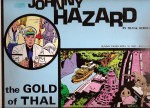
Johnny Hazard: Mammoth Marches On


By Frank Robbins (Pacific Comics Publications)
No ISBN

Johnny Hazard was a newspaper strip created in answer to and in the style and manner of Terry and the Pirates, but in many ways the steely-eyed hero most resembles – and indeed presages – Milton Caniff’s second magnum opus Steve Canyon.

Unbelievably, until last year this stunningly impressive and enthralling adventure strip has never been comprehensively collected in graphic novels – at least in English – although selected highlights had appeared in nostalgia magazines such as Pioneer Comics and Dragon Lady Press Presents.

However, sporadic compendiums of the full-colour Sunday pages have popped up over the years, such as this glorious and huge (340 x 245mm) landscape tabloid produced by re-translating a collected Italian edition back into English, courtesy of the Pacific Comic Club.

Frank Robbins was a brilliant all-around cartoonist whose unique artistic and lettering style lent themselves equally to adventure, comedy and superhero tales and his stunning cunning storytellers mind made him one of the best writers of three generations of comics.

He first came to fame in 1939 when he took over the Scorchy Smith newspaper strip from the legendary Noel Sickles and created a Sunday page for the feature in 1940. He was offered the prominent Secret Agent X-9 but instead created his own lantern jawed, steely-eyed man of action. A tireless and prolific worker, even whilst producing a daily and Sunday Hazard (usually a separate storyline for each) Robbins freelanced as an illustrator for The Saturday Evening Post, Look, Life and a host of other mainstream magazines.

In the 1960s and 1970s he moved into comicbooks, becoming a key contributor to Batman, Batgirl, Detective Comics (where he created Man-Bat with Neal Adams), The Shadow and DC’s mystery anthologies before settling in as an artist at Marvel on a variety of titles including Captain America, Daredevil, Ghost Rider, Morbius, Human Fly, Man from Atlantis, Power Man and The Invaders, which he co-created with Roy Thomas.

When the strip launched on Monday June 5th 1944, Johnny Hazard was an aviator, in the United States Army Air Corps and when hostilities ceased became for a while a freelance charter pilot and secret agent before settling into the bombastic life of a globe-girdling troubleshooter, mystery-solver and modern day Knight Errant babe-magnet.

The strip ended in 1977: another victim of diminishing panel-sizes and the move towards simplified, thrill-free, family-friendly gag-a-day graphic fodder to wrap around small-ads.

With the release at long last of a dedicated collection of the black and white Daily strips, I thought I’d spotlight a few of those fabulous landscape tomes which kept Johnny Hazard alive in fans hearts during years after it ceased publication beginning with the thoroughly captivating Mammoth Marches On and subsequent sequences which first appeared in American Sunday Supplements between January 27th 1952 to April 12th 1953.

In the steaming jungle heat of French Indo-China the pilot is transporting famed Movie Director Grippman of Mammoth Studios, and his star attraction Cerise to the heart of the rain forest on a location-shoot is stricken with malaria. Forced to land at a Military field they make the fortuitous acquaintance of our hero and his friends Brandy and Blitz Martin; all currently without a plane of their own…

Also in tow are an entire film crew, assorted extras and a baby Elephant, all destined for a distant abandoned temple and village of unsuspecting natives. Short of cash and with nothing to do, Johnny lets himself be talked into taking the pilot’s place whilst wandering journalist Brandy agrees to act as the haughty Cerise’s stand-in and body double… to limit the star’s exposure to sun, insects and peasants…

Amidst all the drama and passion such events always generate, Johnny warily keeps aloof. The big scene involves an ancient idol for which Grippman has brought a fist-sized hunk of glass to replace the legendary lost diamond eye it boasted until white explorers first appeared a century ago…

When Cerise makes a play for Hazard and is rebuffed she storms into the temple and falls into a secret chamber, finding the genuine lost sparkler. In a fit of greedy pique she replaces the fake with the real thing…

The trained baby elephant Mammoth has seen it all and Cerise determines to get rid of the four-footed witness in an increasing dangerous series of arranged accidents…

Things come to head when the monsoon hits early and disaster strikes for the greedy starlet…

The strip then effortlessly segues into blistering criminal action with ‘The Hunted’ as Johnny ferries the film crew on to Tokyo where old pal Blitz buys a souvenir samurai sword from a street vendor. Of course nobody realised that the katana was a thousand year old relic most recently owned by Baron Takana: a big shot in the recent war and a fugitive war criminal ever since.

When the sword is stolen and a venerated historical expert murdered, suspicion rests equally on the elusive Takana and Hazard’s sexy femme fatale foe Baroness Flame, but as the hunt continues the drama escalates into full-blown crisis when the fugitive Baron is cornered and threatens to detonate a stolen atomic weapon…

The fabulous frantic fun and thrills conclude with ‘Scavengers’ as Johnny is asked by his old boss Lisbeth Manning to investigate a series of mysterious plane crashes and cargo thefts. With typical savvy Hazard deduces the method and tracks the gang of highly sophisticated bandits to a deadly confrontation in the jungles between Vietnam and Cambodia, before this stunning old-fashioned romp ends with the thieves in custody and the tantalising opening pages of the next mind-boggling yarn ‘Ceiling Zero-Minus’.

To be continued…

These exotic action romances perfectly capture the mood and magic of a distant but so incredibly familiar time; with cool heroes, hot dames and very wicked villains decorating captivating locales and stunning scenarios, all peppered with blistering tension, mature humour and visceral excitement.

Johnny Hazard is a brilliant two-fisted thriller strip and even if you can’t easily locate these fantastic full-colour chronicles, at least the prospect of an eventual new Sunday strip collection is a little closer at last…
© 1952-1953 King Features Syndicate. © 1979 Pacific C.C.

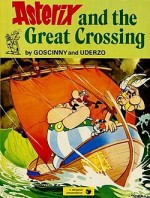
Asterix in Switzerland, The Mansions of the Gods & Asterix and the Laurel Wreath


By Goscinny & Uderzo, translated by Anthea Bell & Derek Hockridge (Orion Books)
ISBNs: 978-075286-628-4, 978-0-75286-630-7 and 978-0-75286-632-1

One of the most-read comics strips in the world, the collected chronicles of Asterix the Gaul have been translated into more than 100 languages since his debut in 1959, with animated and live-action movies, TV series, assorted games, toys and even a theme park outside Paris (Parc Astérix, unsurprisingly…) all stemming from his glorious exploits.

More than 325 million copies of 34 Asterix books have sold worldwide, making his joint creators France’s bestselling international authors.

The diminutive, doughty, potion-powered paragon of Gallic Pride was created by two of the industry’s greatest masters, René Goscinny & Albert Uderzo. Although their inspirational collaborations ended in 1977 with the death of the prolific scripter, the creative wonderment continued until relatively recently from Uderzo and assistants – albeit at a slightly reduced rate.

The wonderment works on multiple levels: ostensibly, younger readers revel in the action-packed, lavishly illustrated comedic romps where sneaky, bullying baddies get their just deserts, whilst we more worldly readers enthuse over the dry, pun-filled, sly satire, especially as enhanced for English speakers by the brilliantly light touch of translators Anthea Bell & Derek Hockridge, who played no small part in making the indomitable Gaul and his gallant companions so palatable to the Anglo-Saxon world. (Moi, I still rejoice in a perfectly produced “Paf!” to the phizzog as much as any painfully potent procession of puns or sardonic satirical sideswipe…)

The stories were set on Uderzo’s beloved Brittany coast, where a small village of warriors and their families resisted every effort of the Roman Empire to complete the conquest of Gaul, or alternately, anywhere in the Ancient World, circa 50BC, as the Gallic Gentlemen wandered the fantastic lands of the Empire and beyond…

When the heroes were playing at home, the Romans, unable to defeat this last bastion of Gallic insouciance, resorted to a policy of containment. Thus the little seaside hamlet is permanently hemmed in by the heavily fortified garrisons of Totorum, Aquarium, Laudanum and Compendium.

The Gauls don’t care: they daily defy the world’s greatest military machine simply by going about their everyday affairs, protected by the magic potion of resident druid Getafix and the shrewd wits of the rather diminutive dynamo and his simplistic, supercharged best friend…

Firmly established as a global brand and premium French export by the mid-1960s, Asterix the Gaul continued to grow in quality as Goscinny & Uderzo toiled ever onward, crafting further fabulous sagas; building a stunning legacy of graphic excellence and storytelling gold. Moreover, following the civil unrest and nigh-revolution in French society following the Paris riots of 1968, the tales began to increasingly show signs of trenchant satire and more directed social commentary…

Asterix in Switzerland was the sixteenth saga, originally running in Pilote #557-578 throughout 1970 and first translated into English in 1973. It opens with the attempted murder of Roman official Quaestor Vexatius Sinusitus; dispatched to Gaul to audit the corrupt, embezzling and utterly decadent Governor Varius Flavus.

The poisoning only fails due to the efforts of the Druid Getafix, but to keep the Roman alive – and further thwart Flavus – the sage needs a rare flower which only grows in the mountains of neighbouring country Helvetia (and that’s Switzerland, mein kinder).

Always keen for a road-trip, Asterix and Obelix quickly volunteer to fetch the fabled “silver star” or Edelweiss …

With Sinusitus sheltered in the village of the indomitable Gauls, Flavus’ only hope is to stop the happy voyagers and to that end he sends his most unscrupulous man to warn the equally repugnant and devious Curius Odus, Governor of Helvetia, to stop the Gauls at all costs…

Although a far darker tale than most previous escapades, all the familiar gentle spoofing of national characteristics, cartoon action and hilarious lampoonery is incorporated into this splendid and beautifully rendered yarn.

Asterix and Obelix cannily avoid Roman sabotage plots, beat up many, many thugs and bullies, whilst marvelling at the quirkiness of their newfound Helvetian friends, with their mania for cleanliness, yodelling, passion for melted cheese, tidy, solicitous brand of medical treatments, cultured beverages, cultivated villages, lakes and banks and their fruit-based archery training programs for the young…

The search for the silver-star is, of course ultimately successful, despite an entire battalion of troops racing up a mountain after them, with a stunning alpine climax and an exceptionally different kind of ending…


Translated that same year was The Mansions of the Gods (from Pilote #591-612, in 1971) wherein Caesar, determined to eradicate the last remnant of Gaulish resistance, tries to win by social planning and cultural imperialism. To that end he plans to cut down the great forest which surrounds the village and build a new town of lavish Roman apartments in the stylish, modern Roman manner.

Whiz kid architect Squaronthehypotenus leads the project, but his immigrant army of slave labourers soon founders when boar-loving Obelix strenuously objects to having his hunting preserve torn down and paved over…

However the massed might of Rome is insurmountable and eventually many mighty oaks are felled. To counter this Getafix simply grows instant new ones whilst Asterix shares his magic potion with the increasingly fed up slaves…

This stalemate is only overcome when the wily Gauls seemingly surrender and allow the “Mansions of the Gods” to be built and stocked with middle-class colonists from Rome. After a rapid bump in trade as the villagers become tourist-trappers, the complacent property developers make their greatest mistake and rent an apartment to the Gaul’s uniquely gifted bard Cacofonix, leading to an exodus of tenants and an inevitable and breathtaking final clash with the garrison of Aquarium, who had moved into the luxurious vacant apartments…

Drenched in trenchant observation of and jibes at the industrial relations conflicts, the then runaway speculation in new developments in France and the inexorable growth of “planning blight” (still painfully relevant today anywhere in the industrialised world), this tremendously effective satire is packed with gags and action and displays artist Uderzo’s sublime gift for caricature and parody – especially in the wonderful spoofs of real estate advertising campaigns…


Asterix and the Laurel Wreath was serialised in issues #621-642, in 1971 and given the fabulous Bell/Hockridge treatment in 1974. It begins in Rome where Asterix and Obelix are arguing…

During a visit to Chief Vitalstatistix‘s wealthy, snobbish, city-dwelling brother-in-law Homeopathix the doughty old warrior gets too drunk and boasts that he can get something which all the merchant’s money cannot buy – a stew seasoned with Caesar’s fabled wreath of office.

Sober now and in dire danger of eternal embarrassment and the unflinching approbation of his sharp-tongued wife Impedimenta, the Chief has no option but to allow his two best men – the larger of whom had drunkenly egged him on at the family gathering and then volunteered to fetch the leafy headpiece – to travel to the heart of Caesar’s power and attempt the impossible…

At least Asterix knows it’s impossible; Obelix is quite happy to storm the Imperial Palace and just grab the wreath…

Luckily reason prevails and the wily little warrior determines their only chance is infiltration, to which end Asterix sells them both as slaves. Unfortunately they are bought by the wrong Roman…

Osseus Humerus is an innocuous Patrician with a troublesome family, but as Asterix tries every trick to get their unsuspecting owner to return them to the Slave Auctioneer, he only endears himself even more to very satisfied customer. So much so in fact, that Humerus entrusts them with a message to be delivered to Julius Caesar himself…

Jealous major-domo Goldendelicius then accuses them of planning assassination and the heroes are locked in the dungeons – leaving them complete access to the entire palace…

Before long the indomitable duo are wreaking havoc in the Imperial Court and playing hob with the usually predictable proceeding in the Arena of the Circus Maximus.

Seemingly untouchable but no nearer the Laurel Wreath, the despondent Gauls finally seize their chance when they encounter again the recently promoted Goldendelicius. Rewarded by Caesar, the major-domo now holds a position of great responsibility: holder of the triumphal floral arrangement at Caesar’s next public engagement…

Sharp and deeply intriguing this comedy of errors is spectacularly illustrated by Uderzo at the very top of his game, whilst Goscinny’s dry, wry script seamlessly rockets from slapstick set-piece to penetrating observational comedy and magnificently engaging adventure, with, as always our unlikely heroes inevitably, happily victorious in every  instance.

Asterix epics are always packed with captivating historical titbits, soupcons of healthy cynicism, singularly surreal situations and amazingly addictive but generally consequence-free action, illustrated in a magically enticing manner. These are perfect comics that everyone should read over and over again.
© 1970-1972-3 Goscinny/Uderzo. Revised English translation © 2004 Hachette. All rights reserved.

Princess Knight Part 1


By Osamu Tezuka, translated by Maya Rosewood (Vertical)
ISBN: 978-1934287-27-9

Win’s Christmas Gift Recommendation: a fairytale for all ages and types of romantic… 8/10

Osamu Tezuka utterly revolutionised the Japanese comics industry during the 1950s and 1960s. Being a devoted fan of the films of Walt Disney he also performed similar sterling service in the country’s fledgling animation industry.

Many of his earliest works were aimed at children but right from the start his expansive fairytale stylisations – so perfectly seen in this splendid romp – harboured more mature themes and held hidden treasures for older readers…

Ribon no Kishi or “Knight of the Ribbon” is a series which Tezuka returned to repeatedly during his life and one that is being continued even in the 21st century by his disciples. The simple tale has been turned into TV anime seen all over the world (generally known as some variation of “Choppy and the Princess” in places as far-flung as Canada, France and Brazil) and in 2006 a stage musical was launched.

The serial was first published in Kodansha’s Shoujo Korabu (Shōjo Club), running from January 1954 to January 1956, with a generational sequel appearing in Nakayoshi magazine between January 1958 and June 1959. The original tale was updated and revised in 1963-1966 and forms the basis of the version featured in this magnificent tome, translated from the Tezuka Osamu Manga Zenshu Edition 1977.

In 1967-1968, to tie-in with a television adaptation, Tezuka reconfigured the tale with science fiction overtones and, illustrated by Kitano Hideaki, it ran for a year in Shōjo Friend.

The series is a perennial favourite and classic of the medium and this volume forms part of a two-volume softcover English-language edition, containing the first 16 episodes.

‘Once Upon a Time’ opens in Heaven where junior angels are busy with soon to be born souls, installing either blue boy hearts or pink girl hearts to the ante-natal cherubs in their care. Unfortunately easily distractible Tink (AKA “Choppy” in many foreign iterations) cocks up and one proto-baby gets both…

Tink is dispatched to Earth to retrieve the superfluous metaphysical organ and lands in the feudal kingdom of Silverland, where a most important child is about to be born. The King and Queen desperately desire that their imminent first-born be a boy, for no female can rule the country. Should the child be a princess then vile Duke Duralumin‘s idiot and nastily maladjusted boy Plastic will become heir-apparent.

Thus, due to a concatenation of circumstances, a baby girl with a dual nature spends her formative years pretending to be a prince…

Fifteen years pass before ‘Flowers and Parades’ resumes the saga. Tink has been lax in his mission and Prince Sapphire has become the darling boy of the kingdom. Duralumin and his crafty henchman Sir Nylon have spent the intervening years certain that the gallant boy is actually a useless girl but have been unable to prove it, whilst Sapphire has grown into a dutiful, beautiful – if androgynous – specimen skilled in riding, sports and all arts martial, but passionately yearns to be allowed to openly wear the dresses and make-up which are her family’s most intimate secret. When Tink finally reveals himself and exposes the heir’s hidden nature, Nylon overhears…

‘The Carnival’ sees gorgeous Prince Franz Charming pay a royal visit from neighbouring Goldland and Sapphire, aided by her mother and nurse, dons a blonde wig and party frock and clandestinely give vent to her true nature, turning all heads and captivating her regal guest. When she returns to her public identity all Franz can talk about is the mysterious girl with flaxen hair, blind to the fact that she is sitting beside him…

In ‘The Tournament’ the evil Duke turns a fencing exhibition to his advantage, killing the King and framing Franz for the deed, after which the ‘Prisoner Prince’ is helped to escape by his Flaxen maid. Heir Sapphire accedes to the throne in ‘Coronation’ only to have it all snatched away as the Duke’s latest scheme succeeds beyond all his wildest dreams and Sapphire is publicly exposed as a girl, and her recently widowed mother is accused of betraying the nation by concealing the fact since her birth…

Reviled and shunned, mother and daughter are imprisoned with ghastly hunchback jailer Gammer in ‘Sapphire in Coffin Tower’ wherein the distraught girl befriends the vermin of the keep just as Gammer gets his orders to dispose of his charges. Meanwhile Tink has been searching high and low for Sapphire…

Narrowly escaping being murdered the princess becomes a masculine masked avenger of wrongs in ‘Phantom Knight’s Debut’, punishing the wicked men who have ruined her nation since Plastic was enthroned by his corrupt father Duralumin.

Meanwhile in the Palace the villains look for ways to control the increasingly off-kilter Plastic in ‘The Idiot King’s Bride’. Little do they know that Briar Rose, the fetching companion they’ve acquired, is Sapphire on an infiltration mission…

When she is inevitably caught Sapphire’s life takes an even more dramatic turn in ‘Devil’s Whisper’ when terrifying witch Madame Hell materialises, offering her untold wealth and power if she will sell her female heart and nature. Luckily Tink’s angelic power drives her off, but is unable to prevent the princess being sentenced to a life of penal servitude in ‘Two By the Quarry’.

Here she again meets Franz, who has long believed Sapphire responsible for his frame-up and imprisonment in Silverland’s dungeons. Nevertheless the Prince helps Sapphire escape, almost dying in the effort. Soon after the girl is transported to ‘The Witch’s Lair’ and meet’s Hell’s daughter Hecate, who is violently opposed to her mother’s scheme to marry her off to Franz.

That young worthy however, has meanwhile recovered from his wounds and is still searching for the Flaxen-haired girl, oblivious to her true identity and nature…

Hecate does not want Sapphire’s girlish heart and frees the Princess Knight by turning her into a ‘Grieving Swan’ who is captured by Franz and added to the Royal Flock. The Prince too is being pressured to marry and beget an heir, so when Madame Hell arrives with a huge bribe and a now compliant Hecate the boy’s uncle is keen to cement the nuptial alliance until the ensorcelled swan Sapphire exposes their true natures with Tink’s angelic assistance…

Just as Franz begins to finally notice the similarity of his flaxen dream girl to the freshly restored Sapphire in ‘Two Hearts’ she and Tink are fleeing – right into the clutches of Nylon who is keen to wipe out any loose ends. At the worst possible moment the angel completes his long mission and reclaims the boy-heart, leaving her helpless, but cannot betray his friend and returns it, consequently losing his place in Heaven…

Together again the pair attempt to rescue Sapphire’s mother from Coffin Tower but are too late. The Queen and Gammer have been taken to Sea Snake Island where vengeful Madame Hell’s dark magic has transformed her into a petrified ‘Stone Queen’.

This premier chronicle concludes with Sapphire and Tink adrift on the ocean where they encounter the brilliant, dashing and gloriously charismatic ‘Captain Blood, Pirate’ who instantly penetrates the princess’ manly disguise and sees a woman he wants to marry at all costs…

Princess Knight is a spectacular, riotous, rollicking adventuresome fairytale about desire, destiny and determination which practically invented the Shoujo (“Little Female” or young girl’s manga) genre in Japan and can still deliver a powerful punch and wide eyed wonder on a variety of intellectual levels. Still one of the best and most challenging kid’s comics tales ever, it’s a work that all fans and – especially parents – should know.

This black and white book is printed in the traditional ‘read-from-back-to-front’ manga format.

© 2011 by Tezuka Productions. Translation © 2011 by Mari Morimoto and Vertical, Inc. All rights reserved.

The Book of Human Insects


By Osamu Tezuka translated by Mari Morimoto (Vertical)
ISBN: 978-1-935654-20-9

Win’s Christmas Gift Recommendation: an ideal chiller for those dark nights… 8/10

There aren’t many Names in comics. Lots of creators; multi-disciplined or single focussed, who have contributed to the body of the art form, but we don’t have many Global Presences whose contributions have affected generations of readers and aspirants all over the World, like a Mozart or Michelangelo or Shakespeare. There’s just Hergé and Jack Kirby and Osamu Tezuka.

Tezuka was born in Osaka Prefecture on 3rd November 1928 and as a child suffered from a severe illness which made his arms swell. The doctor who cured him inspired him to study medicine, and although Osamu began his professional drawing career while at university, he persevered with his studies and qualified as a doctor too. Facing a career crossroads, his mother advised him to do the thing that made him happiest. He never practiced as a healer but the world was gifted with such classic cartoon masterpieces as Tetsuwan Atomu (Astro-boy), Kimba the White Lion, Buddha, Adolf and literally hundreds of other graphic narratives. Along the way Tezuka incidentally pioneered, if not created, the Japanese anime industry.

Able to speak to the hearts and minds of children and adults equally, Tezuka’s works range from the childishly charming to the disturbing – and even terrifying. In 1970-1971 he produced the stark and moody psycho-thriller Ningen Konchuuki for Akita Shonen’s Play Comic, detailing the inexorable rise of a truly different kind of monster for the burgeoning audiences who were growing up and demanding more mature manga fare.

This superb black and white 364 page hardback opens with ‘Spring Cicada’ as failed and broken designer Ryotaro Mizuno ponders the incredible success of golden girl Toshiko Tomura; a bright young thing who has just scooped a major literary prize for her first novel.

Across town a broken-down derelict also toasts her success whilst in a lonely garret a girl hangs from the end of a noose…

Mizuno confronts Toshiko in her moment of triumph, telling her failed author Kageri Usuba has committed suicide. Their tense exchange is observed by muck-raking journalist Aokusa…

Convinced he’s on to something the reporter perseveres and discovers that Toshiko is a modern renaissance woman: emerging from obscurity to become a celebrated actress while still in her teens, she graduated to directing before becoming an award-winning designer. Abruptly she metamorphosed again, writing the stunning novel The Book of Human Insects. Still in her twenties, there seems to be nothing the angelic girl cannot do…

Further enquiry leads the newsman to her desolate rural home where the uncanny genius presents an entirely different, almost wanton aspect. Moreover she keeps there a very creepy waxwork of her dead mother…

Toshiko catches the professional voyeur and agrees to an interview, but before that meeting Aokusa is accosted by shambling drop-out Hyoroku Hachisuka, a once-prominent stage-director who imparts the true story of Toshiko’s resplendent rise to fame and fortune.

Once, the universally approved-of, wholesome girl was a small, timid creature who inveigled her way into his theatre company. Once there she attached herself like a leech to the star, learning her ways and mannerisms. A perfect mimic, Toshiko not only acquired the actress’s skills but also seemed to suck out her talent and inspiration. When the former star quit Toshiko replaced her…

She performed that same slow consumption of the entire company and then turned her attentions to the director…

Moreover, the seemingly helpless waif was utterly amoral, using sex, slander and perhaps even murder to achieve her ends, which were always short-term: she had no goals or life ambitions, but merely flitted from victim to victim like a wasp seeking its next meal…

Ignoring the warning Aosuka persists and discovers that promising writer Usuba once had a room-mate named Toshiko whom she accused of plagiarising her novel…

Intriguingly, the lonely writer’s recent suicide occurred in extremely suspicious circumstances…

During a TV interview Toshiko accidentally meets Mizuno again. Revealed as one of her earliest victims, can he possibly be the only man she ever loved?

In ‘Leafhopper’ Aosuka uncovers another of Toshiko’s secrets when he meets for the first and last time her shady associate Arikawa – a murderous anarchist who cleans ups the lovely mimic’s potential embarrassments – just as she tries to renew her relationship with the bitter and far wiser Mizuno.

Toshiko also meets war criminal and right-wing “businessman” Sesson Kabuto who immediately discerns her true nature and keeps a fascinated but wary professional distance from her…

Toshiko operates almost instinctively and according to immediate desire, but she has a terrifying capacity to clean up any potentially damaging loose-ends. After seducing Arikawa she spectacularly removes him during a political assassination and uses the affair to promote her next book…

Meanwhile Mizuno spirals further into despondency until he meets a prostitute who looks like Toshiko and finally finds redeeming true love – of a sort…

Toshiko almost overreaches her abilities when she is arrested by South Korean security forces in ‘Longhorn Beetle’ but is rescued and forced into marriage by a man every inch her ruthless, remorseless equal, compelling her to even more inspired acts of perversion and survival – which consequentially endangers the wellbeing of everybody in Japan – before ‘Katydid’ brings the unique drama to a shocking, bloody, poignant and utterly unexpected conclusion…

Murder-mystery, Greek Tragedy, trenchant melodrama, serial-killer horror story and much more, this supremely adult tale has hardly dated at all since its release and offers a chilling image of those hidden invisible predators who have supplanted vampires, witches and werewolves in the dark corners of our communal consciousness.

The beautiful maiden as lure and amoral predator possibly began with this truly disturbing tale and the story is one which will stay with readers long after the final page is turned…

“God of Manga” Osamu Tezuka died in 1989 but with ever more of his copious canon at last being released in English there’s plenty of brilliant material for all ages, intellects and inclinations to admire and adore, so why not start right here, right now.

Accept no imitations…

© 2011 by Tezuka Productions. Translation © 2011 by Mari Morimoto and Vertical, Inc. All rights reserved.

Pogo: the Complete Syndicated Comic Strips volume 1


By Walt Kelly (Fantagraphics Books)
ISBN: 978-1-56097-869-5

Win’s Christmas Gift Recommendation: Perfect for anybody with a brain or heart…  10/10

This is one of those once in lifetime books which reduce honest critics to nigh speechlessness so I’m offering two different reviews: the first and most fearsomely honest is freely adapted from President’s Clinton’s election catchphrase “It’s the Economy, Stupid!”

Ready?

Just buy it, Stupid!


If you need more though, and aren’t driven off by my unbridled brusqueness, I’ll elucidate at tedious, pointless length…

Walter Crawford Kelly Jr. was born in 1913 and started his cartooning career whilst still in High School, as both artist and reporter for the Bridgeport Post. In 1935, he moved to California and joined the Disney Studio, working on shorts and such features as Dumbo, Fantasia and Pinocchio until the infamous animator’s strike in 1941.

Refusing to take a side, Kelly moved back East and began drawing comicbooks – primarily for Dell Comics, who had the Disney funnybook license.

Despite his glorious work on such humanistic classics as the Our Gang movie spin-off, Kelly preferred anthropomorphic animal and children’s fantasy (see Walt Kelly’s Santa Claus Adventures) and created Albert the Alligator and Pogo Possum for Animal Comics #1 (December 1942) sagaciously retaining the copyrights in the ongoing tale of two Bayou critters and their young African-American pal Bumbazine. Although the black kid soon disappeared, the animal pals stayed on as stars until 1948 when Kelly became art editor and cartoonist for the hard hitting, left-leaning liberal newspaper The New York Star.

On October 4th 1948, Pogo, Albert and an ever-expanding cast began their careers in the funny pages, appearing six days a week until the periodical folded in January 1949.

Although a gently humorous kids feature, by the end of its run – reprinted in full at the back of this magnificent tome – the first glimmers of the increasingly barbed, boldly satirical masterpiece of velvet-pawed social commentary began to be seen…

This much delayed – but absolutely worth it – first of twelve volumes follows the ascent of this scintillating and vastly influential strip; don’t believe me, just listen to Gary Trudeau, Berke Breathed, Bill Watterson, Jeff McNally, Bill Holbrook, Mark O’Hare, Alan Moore, Jeff Smith and even Goscinny & Uderzo and our own Maurice Dodd & Dennis Collins, whose wonderful strip The Perishers owes more than a little to the sublime antics of the Okefenokee Swamp citizenry…

After the Star closed Pogo was picked up for mass distribution by the Post-Hall Syndicate and launched on May 16th 1949. A colour Sunday page debuted January 29th 1950 and both were produced simultaneously by Kelly until his death in 1973 (and beyond, courtesy of his talented wife and family…).

At its peak the strip appeared in 500 papers in 14 countries and the book collections which began in 1951 numbered nearly 50, collectively selling 30 million copies.

This volume includes all the Star strips, the Dailies from inception to December 30th 1950, and the Sundays – in a full colour section – from January 29th – December 31st 1950, plus a wealth of supplementary features including a Foreword from columnist Jimmy Breslin, an introduction by biographer Steve Thompson, a week-by-week highly detailed contents section, a useful guide ‘About the Sundays’ by Mark Evanier, and an invaluable context and historical notes feature ‘Swanp Talk’ by the amazing R.C. Harvey.

Kelly’s genius was the ability to beautifully, vivaciously draw comedic, tragic, pompous, sympathetic characters of any shape or breed and make them inescapably human and he used that gift to blend hard-hitting observation of our crimes, foibles and peccadilloes with rampaging whimsy, poesy and sheer exuberant joie de vivre.

The hairy, scaly, feathered slimy folk here are inescapably us, elevated by burlesque, slapstick, absurdism and all the glorious joys of wordplay from puns to malapropisms to raucous accent humour into a multi-layered hodge-podge of all-ages accessible delight.

In volumes to come Kelly will set his bestial cast loose on such timid, defenceless victims as Senator Joe McCarthy, J.Edgar Hoover, the John Birch Society, Richard Nixon and the Ku Klux Clan, but he starts off small here, introducing the gently bemused Pogo, boisterous, happily ignorant Albert, dolorous Porkypine, obnoxious turtle Churchy La Femme, lugubrious hound Beauregard Bugleboy, carpet-bagging Seminole Sam Fox, pompous (not) know-it-all Howland Owl and a host of others in gags and extended epics ranging from assorted fishing trips, building an Adam Bomb, losing and finding other people’s children, electioneering, education, kidnapping, the evil influence of comicbooks, Baseball season, why folks shouldn’t eat each other, Western cow punchers, cows punching back, New Years Resolutions, public holidays and so much more…

The Sundays also began with one-off gags but soon evolved into convoluted and mesmeric continued sagas such as the search for the Fountain of Youth, building a school and keeping it filled, Albert being elected Queen of the Woodland by the elf-like forest fauns – and why that was ultimately a very bad thing indeed…

Timeless and magical, Pogo is a giant of world literature, not simply comics, and this magnificent edition should be the pride of every home’s bookshelf.

POGO Through the Wild Blue Wonder and all POGO images, including Walt Kelly’s signature © 2011 Okefenokee Glee & Perloo Inc. All other material © 2011 the respective creator and owner. All rights reserved.

Asterix and the Cauldron, Asterix in Spain & Asterix and the Roman Agent


By Goscinny & Uderzo, translated by Anthea Bell & Derek Hockridge (Orion Books)
ISBNs: 978-075286-628-4, 978-0-75286-630-7 and 978-0-75286-632-1

One of the most-read comics series in the world, the collected chronicles of Asterix the Gaul have been translated into more than 100 languages since his debut in 1959, with animated and live-action movies, TV series, assorted games, toys and even a theme park outside Paris (Parc Astérix, if you’re planning a trip…) spinning off from his hilarious exploits.

More than 325 million copies of 34 Asterix books have sold worldwide, making his joint creators France’s bestselling international authors.

The diminutive, doughty potion-powered champion of Gallic Pride was created by two of the art-form’s greatest proponents, writer René Goscinny & illustrator Albert Uderzo and although their inspirational collaborations ended in 1977 with the death of the prolific scripter, the creative wonderment still continued until relatively recently from Uderzo and assistants – albeit at a slightly reduced rate.

The wonderment works on multiple levels: ostensibly, younger readers revel in the action-packed, lavishly illustrated comedic romps where sneaky, bullying baddies get their just deserts whilst we more worldly readers enthuse over the dry, pun-filled, sly satire, especially as enhanced for English speakers by the brilliantly light touch of translators Anthea Bell & Derek Hockridge, who played no small part in making the indomitable Gaul and his gallant companions so palatable to the Anglo-Saxon world. (Me, I still admire a divinely delivered “Paff!” as much as any painfully potent pun or dry cutting jibe…)

The stories were set on Uderzo’s beloved Brittany coast, where a small village of warriors and their families resisted every effort of the Roman Empire to complete the conquest of Gaul, or alternately, anywhere in the Ancient World, circa 50BC, as the Gallic Gentlemen wandered the fantastic lands of the Empire and beyond…

When the heroes were playing at home, the Romans, unable to defeat this last bastion of Gallic insouciance, resorted to a policy of containment. Thus the little seaside hamlet is permanently hemmed in by the heavily fortified garrisons of Totorum, Aquarium, Laudanum and Compendium.

The Gauls don’t care: they daily defy the world’s greatest military machine simply by going about their everyday affairs, protected by the magic potion of resident druid Getafix and the shrewd wits of the rather diminutive dynamo and his simplistic, supercharged best friend…

Firmly established as a global brand and premium French export by the mid-1960s, Asterix the Gaul continued to grow in quality as Goscinny & Uderzo toiled ever onward, crafting further fabulous sagas; building a stunning legacy of graphic excellence and storytelling gold.

Asterix and the Cauldron was the thirteenth saga, originally running in Pilote #469-491, throughout 1968 and first translated into English in 1976.

The tale is one of treachery, felony and dishonour as fellow Gaulish chieftain Whosemoralsarelastix – a cunning and conniving Roman collaborator – convinces the reluctant but big-hearted Vitalstatistix to guard the occupied cliff-top community’s treasury from Imperial tax collectors.

Despite knowing how untrustworthy the scoundrel is, Gaul must help Gaul and the rogue’s huge onion-soup cauldron, stuffed with his people’s golden Sestertii, is placed under the stewardship of the village’s greatest hero and most trustworthy warrior: Asterix.

However, that night, as a great inter-village feast is consumed, somebody cuts their way into the guard hut and steals the glittering contents of that mighty tureen. Naturally Whosemoralsarelastix wants his money back and the noble Vitalstatistix is honour bound to replace the stolen horde, Disgraced, Asterix is banished until he can refill the empty cauldron with gold…

Trusty Obelix refuses to turn away from his friend and joins the quest, which first takes them to the garrison of Compendium, where the wily warrior intends to refill the empty churn with some of the gold the occupiers have been regularly collecting from Gauls.

Unfortunately, Caesar has been experiencing some cash-flow problems and not only has he been rushing the takings to Rome, he hasn’t even paid his soldiers for months.

With disharmony, mutiny and strike action imminent among the legions Asterix and Obelix realise they must look elsewhere for their loot.

Even their old acquaintances the pirates are cash-strapped – and soon traditionally thrashed – so the doughty duo must seek their fortune at the grand market in Condatum, briefly and disastrously becoming Boar merchants, paid street boxers, actors and charioteers, before turning to crime and planning a bank robbery…

Even here our two just men fare badly. In desperation, they decide to rob Caesar’s tax collector, but Asterix discovers a strange thing. Not only has the destitute Whosemoralsarelastix somehow paid his taxes, but the coins smell of onion soup…

With realisation dawning Asterix visits the cliff-dwelling villagers for a little chat and a mighty reckoning…

Rich with slapstick action and cutting commercial satire (for example the tax collector was a caricature of France’s then Finance Minister Valéry Giscard d’Estaing), this hilarious crime caper is a glorious example of dry yet riotous adventure comedy.


Asterix in Spain promptly followed during 1969 (Pilote #498-519) in France and Astérix en Hispanie was translated into English two years later, recounting how a valiant group of Iberian warriors were similarly holding-out against Caesar’s total conquest of that proud nation.

Chief Huevos Y Bacon was the noble warrior leading the resistance but when his haughty son Pepe was captured all seemed lost. Fearing reprisal or rescue the Romans hastily despatched the hostage lad to the garrison at Totorum, under the command of brutish Spurius Brontosaurus, who has no idea what the “pacified” Gauls of the area are like and has his hands more than full contending with the appallingly behaved and inspirationally vicious young prince.

When his guards encounter Gauls in the great forest they are easily overwhelmed by playful Obelix. Asterix takes Pepe back to the village where, after an ill-advised and painful attempt by Brontosaurus and the legion to reclaim him, the heroes decide to return him to his father. Most pertinent in this decision is the spoiled brat’s obnoxious behaviour…

Brontosaurus has pragmatically decided the kid is perfectly safe with the Gauls and unaware of their planned jaunt to Hispania, smugly returns to his post. Meanwhile, after their mandatory encounter with pirates, Asterix, Obelix and faithful mutt Dogmatix make their leisurely way through the scenic countryside (offering many trenchant asides regarding the modern French passion for Spanish touring holidays) until a chance encounter in an inn reveals to the General how close they are to undoing all his plans.

Venal but no coward the Roman joins their excursion party, captures Asterix and steals the Gaul’s magic potion and plans to destroy Huevos Y Bacon’s resistance forever. However Obelix, Pepe – and Dogmatix – have a plan to spectacularly save the day…

Full of good-natured nationalistic pokes and trans-national teasing, liberally served up with raucous hi-jinks and fast-paced action, this is another magical titbit of all-ages entertainment.


Asterix and the Roman Agent was first seen 1970 in Pilote #531-552, making the jump to English in 1972, and once more featured homeland insecurity as Caesar, under attack by the Roman Senate over the indomitable, unconquerable Gauls, deploys his greatest weapon: a double-edged sword named Tortuous Convolvulus, whose every word and gesture seems to stir ill-feeling and conflict in all who meet him.

Where Force of Arms has failed perhaps this living agent of dissent might forever fracture the Gauls’ unshakable comradeship and solidarity with dose of Roman entente dis-cordiale…

On the crossing, just two minutes with the conniving Convolvulus has the brotherhood of pirates at each other’s throats, and even while discussing the plan with Aquarium’s commander Felix Platypus, the agent’s unique gift sows discord and violence, so when he finally enters the village it’s not long before the high-spirited and fractious Gauls are at war with each other…

The women are cattily sniping at each other, the traders are trading blows and even Asterix and Obelix are on the outs. But that’s not the worst of it: somehow the idea has gotten around that their sharp little champion has sold out to the Romans…

With discord rife the Romans soon have the secret of the magic potion too – or do they? -but the ingenious Convolvulus hasn’t reckoned on two things: the sheer dimness of Imperial troops and the invaluable power of true friendship, leaving Asterix and Obelix a way to overcome their differences, turn the tables and once more save the day.

At last, the agent provocateur is forced to realise that sometimes one can be too smart for one’s own good…

Brittle, barbed and devilishly sharp, this yarn was reputedly based on lingering ill-feeling following an internal power-struggle at Pilote which almost cost editor Goscinny his job. The original title for the tale was La Zizanie – “The Ill-feeling” or “The Dissension”. Seen through the lens of forty years of distance, however, all that can be seen now is stinging, clever, witty observational comedy and magnificently engaging adventure, and surely that’s what matters most?

Asterix sagas are always stuffed with captivating historical titbits, soupcons of healthy cynicism, singularly surreal situations and amazingly addictive action, illustrated in a magically enticing manner. These are perfect comics that everyone should read over and over again.

© 1968-1970 Goscinny/Uderzo. Revised English translation © 2004 Hachette. All rights reserved.
Zorro in Old California


By Nedaud & Carlo Marcello (Eclipse Books)
ISBN: 978-1-89172-920-1 hardcover,   978-0-91303-512-2 paperback

One the earliest masked heroes and still phenomenally popular throughout the world is perennial film favourite “El Zorro, The Fox”, originally created by jobbing writer Johnston McCulley in 1919 in a five part serial entitled ‘The Curse of Capistrano’ and debuting in All-Story Weekly from August 6th to 6th September. The tale was subsequently published by Grossett & Dunlap in 1924 as The Mark of Zorro and further reissued in 1959 and 1998 by MacDonald & Co. and Tor respectively.

Famously Hollywood royalty Douglas Fairbanks and Mary Pickford read the ‘The Curse of Capistrano’ in All-Story Weekly on their honeymoon and immediately optioned the adventure to be the first film release from their new production company/studio United Artists.

The Mark of Zorro was a global movie sensation in 1920 and for years after, and New York based McCulley re-tailored his creation to match the extremely different filmic incarnation. The Caped Crusader aptly fitted the burgeoning genre that would soon be people by the likes of The Shadow, Doc Savage and the Spider.

Rouben Mamoulian’s filmic remake of The Mark of Zorro further ingrained the Fox into the World’s psyche, and as the prose exploits continued in a variety of publications Dell began a comicbook version in 1949. When Walt Disney began a hugely popular Zorro TV show in 1957 the comics series was redesigned to capitalise on it and the entertainment corporation began a decades-long strip incarnation of “their” version of the character in various areas of the world. This classy tome collects half of the dozen stories produced for a French iteration which originally ran in Le Journal de Mickey, by veteran Italian artist Raphaël Carlo Marcello and relative enigma Nedaud, of whom I sadly know very little.

The celebrated and supremely stylish Marcello (1929-2007) moved to Paris in 1948 and began his long and prestigious career drawing Loana et le Masque Chinois in Aventures de Paris-Jeunes and Nick Silver for Collection Victoire before switching to newspaper strips for Opera Mundi in 1950, illustrating La Découverte du Monde and L’Histoire de Paris before adapting Ben Hur, Jane Eyre and the Bible.

In 1952, he joined Héroic, working on Oliver Twist, Gil Blas and Bug Jargal, then began a 15-year run on Le Cavalier Inconnu (1955-1970) in Pépito. His maintained ties to newspapers throughout and continued general interest literary adaptations for Mondial-Presse.

In 1956, he contributed Bob Franck to Bugs Bunny magazine and numerous strips to Lisette, Monty, Mireille, L’Intrépide/Hurrah and Rintintin. He moved to Pif Gadget in 1970, collaborating on his signature series Docteur Justice with prolific scenarist/writer Jean Ollivier as well as Amicalement Vôtre (a TV adaptation scripted Spanish by the legendary Victor Mora), Taranis (scripts by Ollivier & Mora), Tarao (by Roger Lécureux) and La Guerre du Feu.

Never stopping for breath Marcello illustrated John Parade, Patrouilleur de l’Espace, in Le Journal des Pieds Nickelés, the Larousse series L’Histoire de France en Bandes Dessinées, La Découverte du Mond and L’Histoire du Far West until 1985 when he joined Le Journal de Mickey to create Le Regard du Tigre, Le Club des Cinq and the subject of this collection.

Solidly based on the 1950s TV series Zorro ran for a year (1985-1986): 12 stirring fast-paced, swashbuckling romps, the first half of which are collected in this slim, full colour European-format album. After these thundering epics Marcello carried on improving, drawing sci fi extravaganza Cristal, epigrammatic short stories Voulez-vous de Nos Nouvelles?, Michael Jackson, Wayne Thunder, L’Épopée du Paris Saint-Germain and mature-reader series Nuit Barbare and Amok. In 1991 he returned to his hometown of Vintimille where he ended his days drawing episodes of iconic Italian series’ Tex and Zagor for Il Giornalino and Bonelli publishing.

Don Diego de la Vega is the foppish son of a noble house in old California when it was a Spanish Possession, who used the masked persona of Zorro the Fox to right wrongs, defend the weak and oppressed – particularly the pitifully maltreated natives and Indians – and thwart the schemes of Capitan Monastario, his bumbling sergeant Garcia and the despicable Governor determined to milk the populace for all they had. In his crusade Diego was aided by Bernardo (the deaf-mute manservant retained for the assorted TV and movies) and the good-will of the oppressed and overtaxed people of Los Angeles.

Whenever Zorro appeared he left his mark – a bold letter “Z” – carved into walls, doors, curtains, but never, ever faces…

Written for an all-ages audience these stories, each around ten pages long, play out an exotic eternal, riotous game of tag, beginning with ‘Wanted!’ as a huge reward galvanises the town to hunt the Fox, until Zorro turns the tables by capturing the Capitan and ransoming him back, thereby emptying the military coffers…

Next, in ‘The Assassins’ bandits posing as patriotic rebels capture the masked hero as part of their plan to murder the Governor and loot the ever-growing township, whilst ‘Double Agent’ sees Monastario blackmail a girl into betraying the wily avenger, but again misjudges Zorro’s ability to connect with the downtrodden Californians…

‘The Scarecrow’ finds the hero thwart a plot to discredit the reputation of Zorro when the unscrupulous Capitan employs a murderous masked impostor, after which ‘Tight as a Noose’ sees Monastario arrest Diego’s father Don Alejandro for treason to entrap the mysterious vigilante, and this rip-roaring rollercoaster ride concludes with ‘The Winds of Rebellion’ as the latest illegal tax rouses the town council against the Capitan and Zorro gets involved to prevent bloodshed…

Full-bodied, all-action and beautifully realised these classy adventures of a global icon are long overdue for a comprehensive and complete re-release, but until then at least this terrific tome is still readily available in both hardback and softcover through many online retailers.
® and © 1986 Zorro Productions, Inc. All Rights Reserved.

The Three Musketeers – a Golden Picture Classic


By Alexandre Dumas, edited and abridged by Marjorie Mattern and illustrated by Hamilton Greene (Purnell & Sons)
No ISBN

Never one to avoid cashing in, I’m using all the foofaraw about the new movie as an excuse to dig out this beloved old interpretation of the evergreen adventure classic and give it a fresh once-over.

As always, the prime directive here is “Read The Original Prose Novel Too” – if not first – but since Les Trois Mousquetaires first appeared in 1844, serialised from March to July in the French newspaper Le Siècle, I suppose a decent English translation will suffice. For kids I suggest the William Barrow version, one of the three translations available by 1846 but cleaned up for modest British tastes – still in print and available in the Oxford World’s Classics 1999 edition – or if you’re not shy, the rather more racy and fully restored 2006 edition by Richard Pevear.

The story has been adapted so very many times, with varying degrees of fidelity, and since the tome under review here is both a bit old and abridged for American children, I’ll keep the précis brief.

Impoverished Gascon youth d’Artagnan leaves the farm to join the personal guard of the French King, just as his father once had. A bit of a country bumpkin, the lad is nonetheless a devastatingly deft swordsman. Soon after reaching Paris he manages to annoy and impress the veteran musketeers Athos, Porthos and Aramis before becoming embroiled in a Machiavellian intrigue between State and Church, as despicably represented by the nefarious and ambitious Cardinal Richelieu…

And thus begins an unshakable comradeship between four great and noble fighters in a rollercoaster ride of swashbuckling adventure stretching from the backstreets of Paris to the deadly wilds of England and Queen’s bedchambers to the bloody battlefields of Rochelle… If you get the novel and want more, the team returned in two sequels in Twenty Years After and The Vicomte of Bragelonne: Ten Years Later. Collectively they known as known as the d’Artagnan Romances.

This fabulous primer edition was released in the USA as part of a sublime series of hardback, illustrated literary classics edited for children (and not to be confused with the legendary comicbook series Classics Illustrated), with a skilful rewrite by Marjorie Mattern, although the real lure for young and old alike must be the beautiful and copious colour illustrations by celebrated artist and war correspondent Hamilton Greene (who also applied his prodigious talents to companion volume The Count of Monte Cristo).

This particular nostalgic nugget was published in a UK edition by Purnell and Sons although the US Simon and Shuster edition is more readily available should I have sufficiently piqued your interest…

An absolute template for today’s comicbook teams (just check out that aforementioned new movie…) this spectacular romp – or any sufficiently diligent adaptation – is an absolute must for all action aficionados and drama divas…
© 1957 Golden Press, Inc, and Artists and Writers Guild Inc. Published by arrangement with Western Printing and Lithographing Company, Racine, Wisconsin.

Hal Foster’s Prince Valiant volume 4: 1943-1944


By Hal Foster (Fantagraphics Books)
ISBN: 978-1-60699-455-9

Win’s Christmas Gift Recommendation: Ideal for anybody who ever strived or dreamed or wished… 9/10

Almost certainly the most successful comic strip fantasy ever conceived, the Sunday page Prince Valiant in the Days of King Arthur launched on February 13th 1937, a luscious full-colour weekly window onto a perfect realm of perfect adventure and romance. The strip followed the life and exploits of a refugee boy driven by invaders from his ancestral homeland in Scandinavian Thule who grew up to roam the world and rose to a paramount position amongst the mightiest heroes of fabled Camelot.

Written and drawn by sublime master draftsman Harold “Hal” Foster, the little princeling matured to clean-limbed manhood in a heady sea of wonderment, visiting far-flung lands and siring a dynasty of equally puissant heroes whilst captivating and influencing generations of readers and thousands of creative types in all the arts.

There have been films, animated series and all manner of toys, games and collections based on the strip – one of the few to have lasted from the thunderous 1930s to the present day (over 3800 episodes and counting) – and even in these declining days of the newspaper narrative strip as a viable medium it still claims over 300 American papers as its home. It has even made it into the very ether with an online edition.

Foster produced the strip, one spectacular page a week until 1971, when, after auditioning such notables as Wally Wood and Gray Morrow, Big Ben Bolt artist John Cullen Murphy was selected to draw the feature. Foster carried on as writer and designer until 1980, after which he fully retired and Murphy’s son assumed the writer’s role.

In 2004 the senior Cullen Murphy also retired (he died a month later on July 2nd) and the strip has soldiered on under the extremely talented auspices of artist Gary Gianni and writer Mark Schultz.

This fourth luxurious oversized full-colour hardback volume reprints – spectacularly restored from Foster’s original Printer’s Proofs – the strips from January 3rd 1943 to 31st December 1944 and sees the beginning of his celebrated but rarely seen “Footer strip” The Mediaeval Castle.

As comprehensively explained in Brian M. Kaine’s introductory essay ‘Hal Foster’s The Mediaeval Castle in the Days of President Roosevelt’ wartime paper rationing forced newspapers to dictate format-changes to their syndicated strip purchases and properties like Prince Valiant began to appear with an unrelated (and therefore optional) second feature, which individual client papers could choose to omit according to their local space considerations.

Apparently the three-panel-per week saga starring the 11th century family of Lord and Lady Harwood, their young sons Arn and Guy and teenaged daughter Alice – a feudal pot-boiler so popular that it spawned a couple of book collections – wasn’t dropped by a single paper throughout its 18-month run from April 23, 1944 to the dog-days of 1945, but Foster was happy to return to one epic per full page once the newsprint restrictions were lifted. This volume also includes a candid glimpse of a painting by the artist lost since his death and only recently discovered at auction.

This comic chronicle opens with Valiant leading King Arthur’s forces in a cunning war of attrition against united Scottish Picts and invading Vikings – but only until the wily young paladin starts sowing deadly discord amongst their assembled ranks, breaking the invasion force by turning it upon itself.

After the clash of arms subsides, restless Val is haunted by visions of Queen Aleta of The Misty Isles, whom he believes has bewitched him, utterly unaware that she saved his life not once but twice.

Determined to lose his dolorous mood, he revisits the fenland swamps of his youth and spends a tempestuous time with the wizard Merlin, before moving on to Camelot and a joyous reunion with his dashing and outrageous comrade Gawain. Even in such company Val’s mood is poor and he determines to visit his father King Aguar in distant Thule, stopping only to eradicate two bands of bandits and cut-purses lurking in the great forest, ably assisted by his devoted squire Beric.

Taking passage to Scandia, the heroes stumble into a turbulent shipboard romance and extended drama which ends tragically as the great vessel Poseidon, carrying them all to Uppsala, founders in a mighty storm.

Enemies become comrades and even friends as they all struggle for survival, with Val, Beric and a few others, including Jewish merchant Ahab and a rowdy Saxon yclept Eric, finally continuing their voyage in small skiff, encountering Viking raiders and deep sea monsters before safely beaching in Trondheim.

Eric joins Val and Beric for the final leg of the journey to Thule, but as they near King Aguar’s palace they become fortuitously embroiled in a plot to oust the aged monarch, leading to insidious intrigue and a spectacular confrontation. As the heroes of the day bask in deserved glory, the boastful and flirtatious Eric is easily and permanently tamed by the delightfully capable maid Ingrid, but the idyllic days don’t last long as the other elements of the proposed coup become known.

For a change, Val uses diplomacy to end the crisis but danger still cloaks him like a shroud. When a hunting accident almost kills him, he accidentally plays Cupid for a crippled artist and a Viking’s daughter and, barely recovered, repulses an invasion by barbarian Finns.

After a collapsing glacier nearly ends his life he is captured by rebellious nobles determined to be rid of his sire. Tortured and used as bait, Valiant escapes, turns the tables on his captors and presides over a grim and merciless siege which sees them all destroyed like vermin.

Midway through that action The Mediaeval Castle debuted, beginning with details of daily life for the noble Harwoods before launching into an epic feud between rival lords that lasted until the end of this collection whilst depriving the lead feature of fully a third of its usual story-space each Sunday.

Undeterred Foster then launched his longest yarn to date: a twenty-month extravaganza which saw Prince Valiant set out for the Misty Isles to free himself of the “spell” of grey-eyed siren Aleta. Returning to Camelot the tormented Prince enlists the aid of Gawain and they promptly set off across the kingdoms of Europe. In Germany they are attacked by barbaric Goths, before taking ship in Rome and being shipwrecked. Beric and the now amnesiac Val are marooned whilst Gawain, who is held hostage by an ambitious Sicilian noble, takes the spotlight for a few weeks.

The sheer bravura of Foster’s storytelling ability comes to the fore now: in modern times an author of a periodical tale would blanch at the spending of a great and well-established character, but as Valiant finally recovers and lands on the extremely hostile Misty Isles one of the most loved players dies nobly to save the Prince’s life…

Aleta, the spellbinder of Val’s nightmares, has been ill-used by fate and is not the monster the bold voyager believes. She is however, in dire straits with a flock of suitors and her own courtiers pressing her to marry immediately and produce an heir. So it’s with mixed emotions that she sees the boy she once rescued burst in, snatch her up and flee the Isles with her as his uncomplaining prisoner.

As for the exhausted but exultant Val, he now has the cause of all his woes chained and at his mercy…

To Be Continued…

Rendered in a simply stunning panorama of glowing visual passion and precision, Prince Valiant is a non-stop rollercoaster of stirring action, exotic adventure and grand romance; blending human-scaled fantasy with dry wit and broad humour with shatteringly dark violence. Beautiful, captivating and utterly awe-inspiring the strip is a World Classic of fiction and something no fan can afford to miss. If you have never experienced the intoxicating grandeur of Foster’s magnum opus these magnificent, lavishly substantial deluxe editions are the best way possible to do so and will be your gateway to an eye-opening world of wonder and imagination…

Prince Valiant © 2011 King Features Syndicate. All other content and properties © 2011 their respective creators or holders. All rights reserved.