
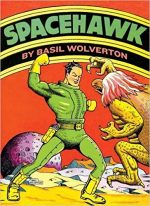

By Basil Wolverton with commentary by Monte Wolverton (Fantagraphics Books)
ISBN: 978-1-60699-550-1 (TPB/Digital edition)
This book includes Discriminatory Content produced in less enlightened times.
Basil Wolverton was one of a kind: an artist, humourist and wordsmith of unique skill and imagination and one whose controversial works inspired and delighted many whilst utterly revolting others. Born in Central Point, Oregon on July 9th 1909, Wolverton worked as a Vaudeville performer, reporter, illustrator and cartoonist. However, unlike most artistic tyros of his time, he preferred to stay far away from the big city. For most of his life, he mailed in his artistic offerings from the rural wilderness of Vancouver, Washington State.
He made his first national cartoon sale at age 16 and began pitching newspaper strips in the late 1920s. A great fan of fantastic tales and the swiftly-developing science fiction genre, Wolverton sold Marco of Mars to the Independent Syndicate of New York in 1929, but the company ultimately declined to publish it, citing its similarity to the popular Buck Rogers feature they sought to compete with!
Equally at home with comedy, horror and adventure/fantasy material, the young creative dynamo adapted easily to the notion of superheroes, and began working extensively in the new medium of comic books, generating such gems as Spacehawks and Disk-Eyes the Detective for Circus Comics, plus a brace of minor hits and unabashed classics. These included Rockman – Underground Secret Agent for Timely/Marvel’s USA Comics and today’s star: the grimly imaginative (but unrelated) cosmic avenger Spacehawk for Target Comics. Apparently tireless and blessed with unlimited imagination, Wolverton also produced a seemingly endless supply of comedic features, ranging from extended series (like Superman/sports parody Powerhouse Pepper) to double-, single- and half-page gag fillers such as Bedtime Bunk, Culture Quickie and Bedtime Banter.
In 1946, he notoriously won a national competition held by Al Capp – of Li’l Abner fame – to visualise Lena the Hyena, that strip’s “ugliest woman in the world”, and, during the space and horror boom the 1950s, crafted some of the most imaginative short stories comics have ever seen. He also worked for Mad Magazine with staggering effect…
Wolverton became a member of the Radio Church of God in 1941. The organisation was devised by Herbert W. Armstrong: a prototype televangelist of a then-burgeoning Christian fundamentalist movement. In 1956, Wolverton illustrated the founder’s pamphlet 1975 in Prophecy and two years later produced a stunning illustrative interpretation of The Book of Revelation Unveiled at Last. Soon after, he began writing and drawing an illustrated 6-volume adaptation of the Old Testament. Entitled The Bible Story: The Story of Man, it was serialised in the sect’s journal The Plain Truth. His association with the Radio Church of God endured for the rest of his life. In 1973 the artist returned to comic books, illustrating more of his memorably comedic grotesques for DC’s Plop!, before suffering a stroke the next year. Basil Wolverton died on December 31st 1978.
His greatest triumph is undoubtedly the WWII-adjacent adventures of a mysterious, solitary steely-jawed he-man known only as Spacehawk. The strip debuted in the June 1940 issue of Target Comics (volume 1, #5) and ran for 30 issues until Wolverton left the company. With his origins only hinted at, Spacehawk initially prowled the star-lanes and outer reaches: a grim, relentless avenger of the persecuted innocent,. The stark, boldly exaggerated but meticulous art served only to highlight the singular appearance of the alien monstrosities and landscapes envisaged by Wolverton and defeated by “the Superhuman Enemy of Crime”. Some kids had nightmares after reading Spacehawk, and many parents wrote complaining letters because of it…
This epic assemblage gathers all those stunning stories in one breathtaking curated outburst, and begins by sharing pertinent background and context regarding the artist and his works in Monte (his son and also a cartoonist) Wolverton’s Introduction “The Lone Wolf of Void”. The heir also provided – from his father’s notes – individual episode names for those yarns that were originally untitled. Thereafter, the entire Spacehawk oeuvre unfolds in blistering force and all its delightfully overwhelming mechanistic totality.
Wolverton senior was clearly an avid follower of the nascent new genre of “scienti-fiction” in the grand Hugo Gernsback manner and his vivid, vibrant pages were bursting with highbrow concepts and images built from Functional Utilitarianism, with every panel crumbling under the weight of assorted tubes or tentacles, rockets, rays and bolts (both kinds) in service to the tale of a solitary, implacable dispenser of pitiless cosmic justice and retribution…
Just remember, this is not “retro”. This is what the term retro is referring to…
In the first episode (from Target Comics volume 1 #5 and cover-dated June 1940) the living enigma prowls the life-packed solar system in an era of constant interplanetary travel and commerce, albeit one plagued by petty regional tyrants and interworld piracy. With nothing but veiled hints of his coming from another system – if not galaxy – Spacehawk was simply a superior being resolved to do good and punish evil: a physical and mental marvel, brilliant beyond measure, and armed with psionic powers and an arsenal of astounding devices he set about righting wrongs wherever he found them. Yes: Doc Savage in space…
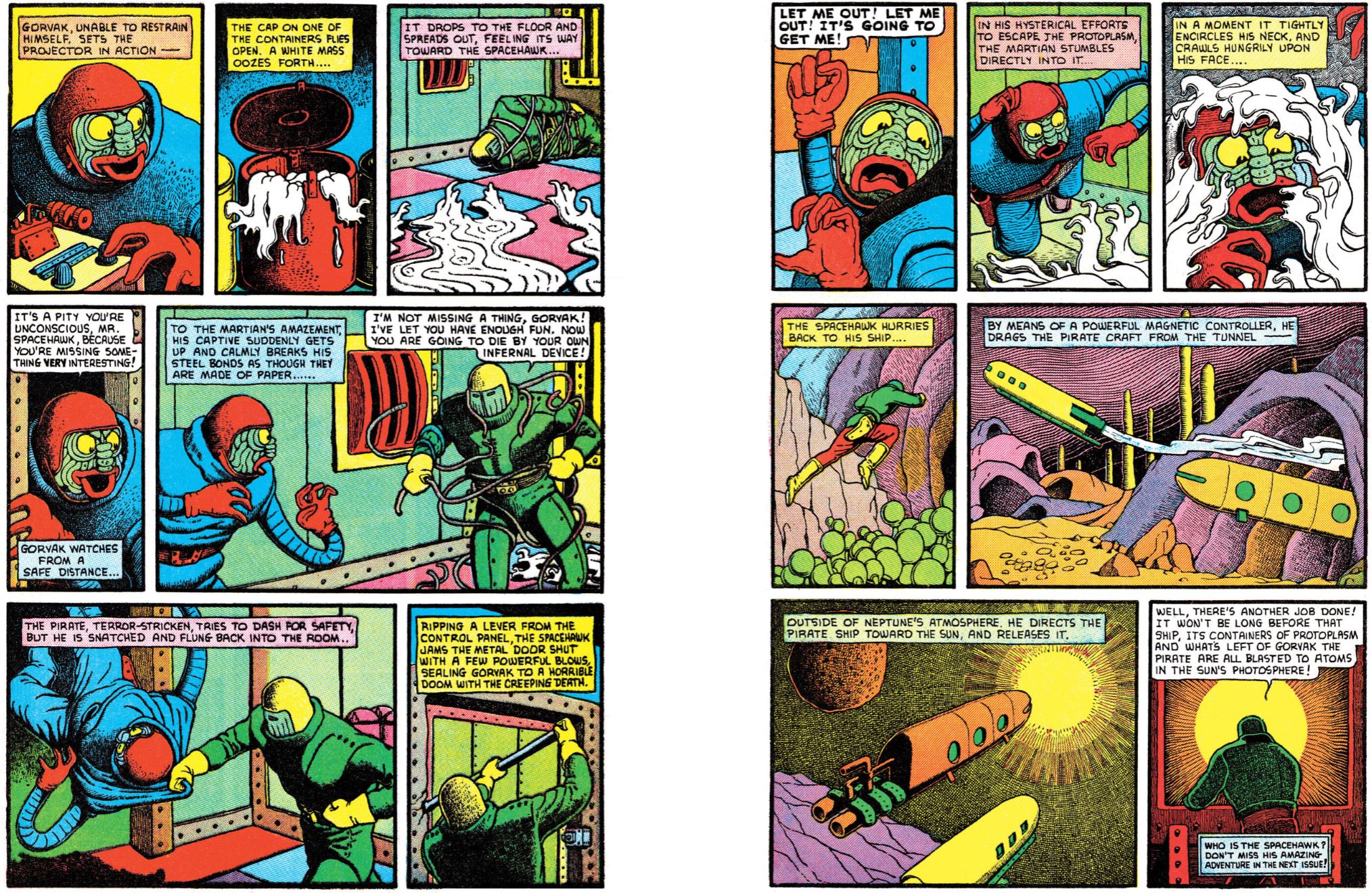
Delivered in an eye-popping and baroque style of fantastic imagination, introductory exploit ‘Spacehawk and the Creeping Death from Neptune’ sees the pitiless, mysteriously masked nemesis of evil drawn to the eighth planet to rescue kidnapped humans used as test subjects for sadistic Martian pirate Gorvak who is employing protoplasmic horrors to kill his victims.
With those monsters safely despatched, the still-faceless hero returned in vol. 1 #6 for ‘Spacehawk and the Lost Tribe of Mercury’ to save – through forced evolution – peaceful sea-dwellers on Venus as predatory Mercurians Rogg & Grebo ravage the water-world as they seek to locate, rob and kill refugees from their own fiery world, before #7 details how a beautiful Earth woman unmasks him. Whilst battling bizarre bandits Jark & Zork in ‘Spacehawk and the Perilous Planetoid Trap’ he strives to crush ruthless pirates using ballistic asteroids and gravity waves to plunder stellar shipping, but almost abandons his mission thanks to the charms of a newly-liberated slave girl…
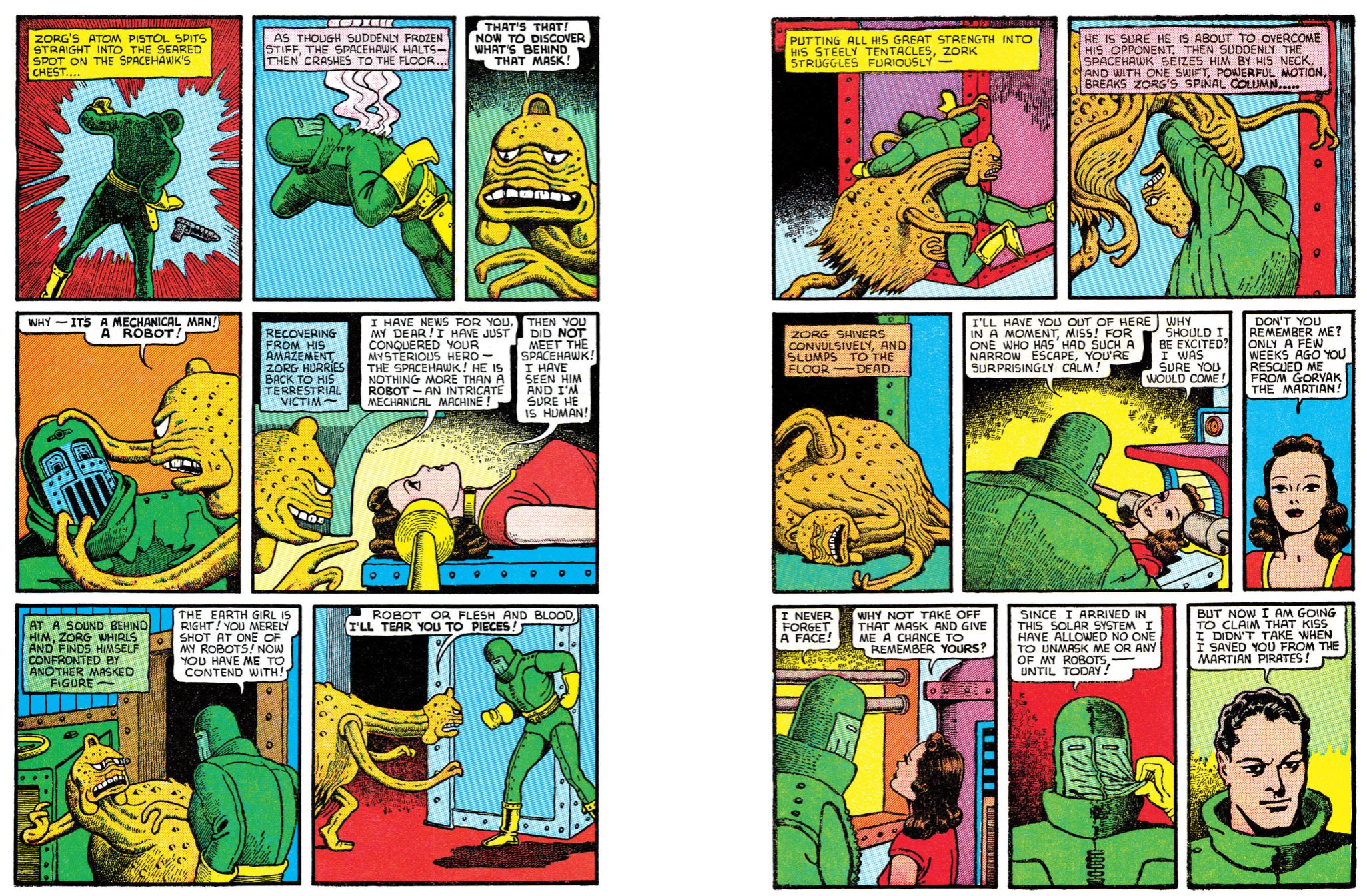
Back to his stolid dedicated self, the Lone Wolf then battles cunning scavengers from his past and another star-system in ‘Spacehawk and the Vulture Men from the Void’ and displays his undercover credentials when he is dragged into the cesspit morass of politics in #9’s ‘Spacehawk and Mayhem at the Martian Election’. In Target Comics #10 ‘Spacehawk and the Pirate City on Venus’ – wherein the vigilante saves interplanetary police from a cosmic corsair citadel by extraordinary trans-species brain surgery – is supplemented by prose vignette ‘The Scratches of Doom – A Spacehawk Adventure’ as the astral avenger uses ancient detective methods to ferret out a cunning but short-sighted murderer. TC #11 finds him back in all his visual magnificence for ‘Spacehawk and the Pirates of Saturn’ as his relentless pursuit of evil briefly reunites him with Galar: another of his own race of supermen but one who has drifted from the path of virtue and valour…
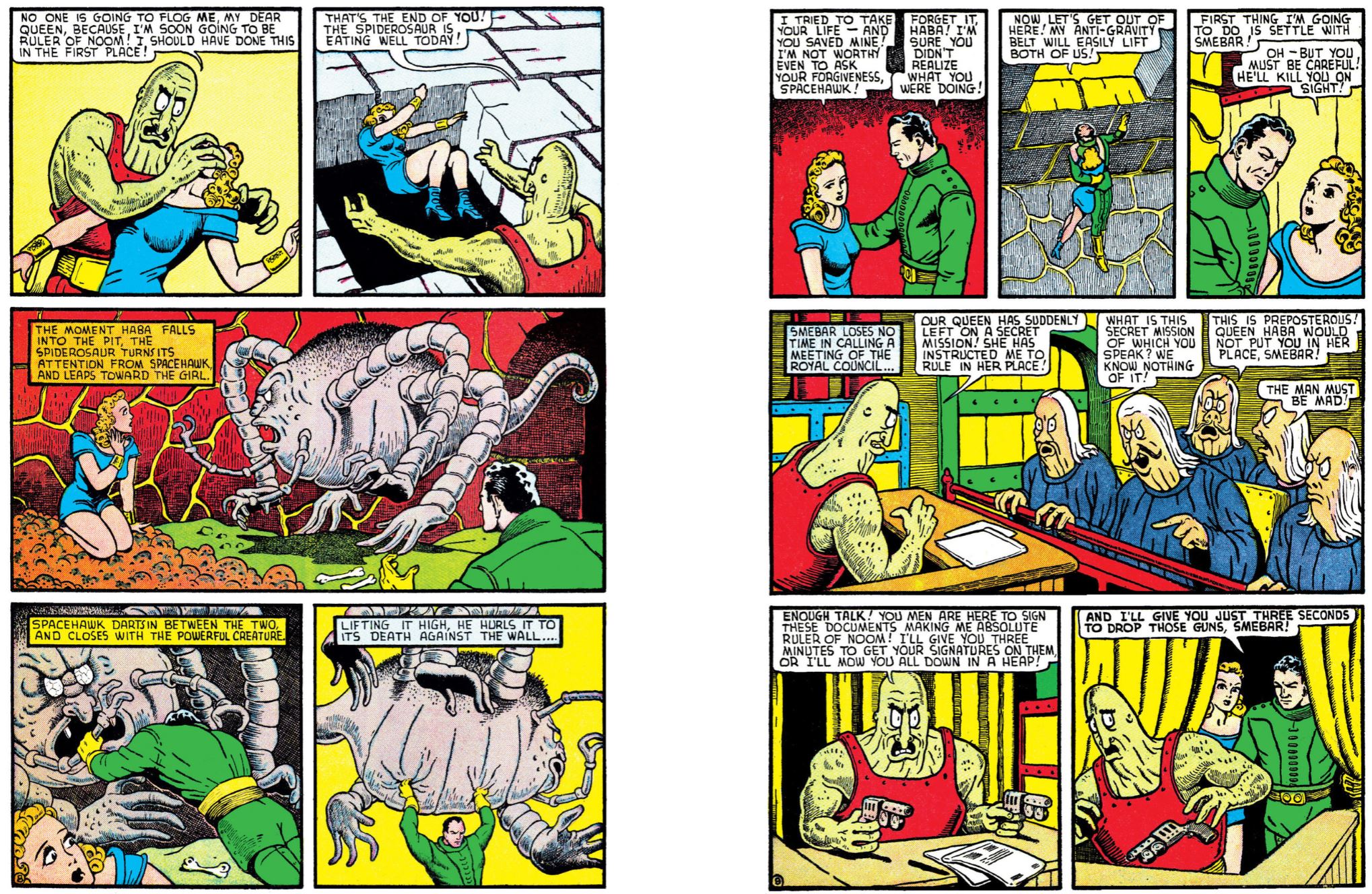
Target #12 (January 1941) ended the first volume by introducing some recurring friends and foes as ‘Spacehawk and the Treachery of Smebar’ sees the hero save Neptune’s Noomite Queen Haba from her lustful, ambitious and usurping chief minister – who sees himself as a potential global overlord – whilst volume 2 #1 sees the Lone Wolf still in the vicinity and the focus of ‘Droon’s Plot Against Spacehawk’. However, the promise of Haba’s vile science advisor to make the enigmatic hero more tractable and amenable to her amorous overtures is foiled in vol. 2 #2’s ‘Spacehawk and the Master Plan of Droon’… just in time for a radical course correction…
Redefined by the designation Defender of America, the remaining Spacehawk tales are all Earth-based, with his mighty mentality and staggering superscience aimed at a contemporary, immediate and local threat. When the US entered the war on December 8th 1941, Wolverton’s editors compelled him to shift his story perspectives. Thus the space ranger took up a close orbit and faced Axis powers Nazi Germany and Imperial Japan (but not Italy) who gave the stellar Sentinel far more trouble than all the devils in the rest of the solar system, thereby further diluting the eerie power of the series but never the astounding illustration. By the end of 1942 (Target Comics volume 3, #10) Wolverton and his interplanetary masterpiece were gone, and headed for less hostile climes and more appreciative bosses.
In the first Terran trial he rapidly ends a Japanese scheme to bomb American cities from an artificial asteroid before vol. 2 #3’s ‘Spacehawk and the Undersea Tank’ sees Democracy’s newest champion spectacularly scuttling a city-sized subsea moving fortress constructed to sink US shipping and destroy the Panama Canal…
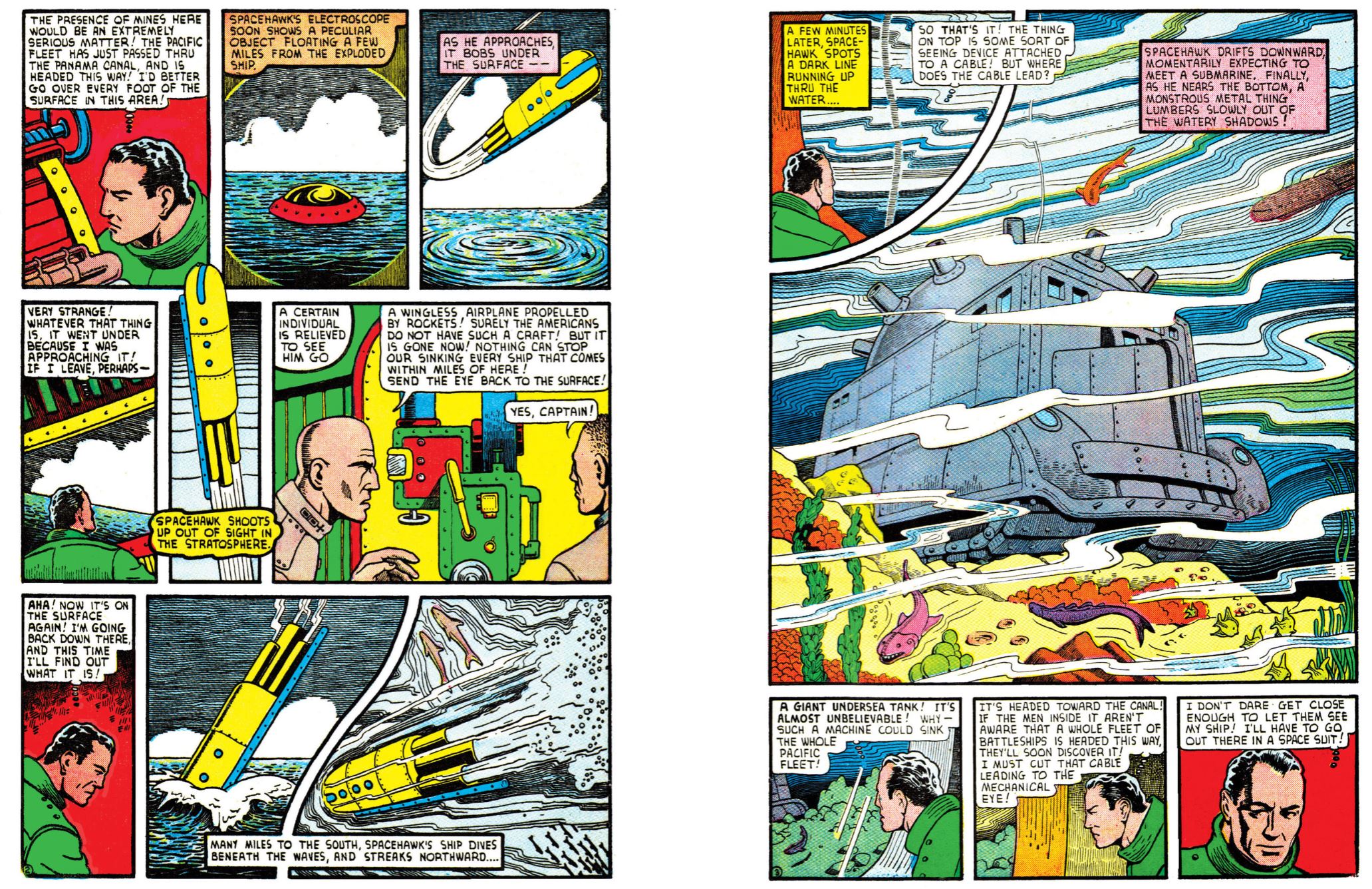
Wolverton’s wicked gift for caricature increasingly came into play from now on, and in Spacehawk and the Submarine Attack’ the alien Übermensch abducts grotesque and clownish German dictator “Moosler” and gives him a terrifying taste of battlefield conditions before deploying his mentally-controlled robotmen to wreck another marine masterplan in vol 2. #5’s ‘Spacehawk and the German Submarine Carrier’, after which ‘Spacehawk and the German Snow Airbase’ details how a hidden arctic airfield is destroyed and all its bombers shot down by the Stratospheric Sentinel…
An earthly archenemy manifests next as a sinister mercenary scientist steals many of the Lone Wolf’s secrets (including the ubiquitous and awesome antigravity principles) after our hero is ambushed and tortured in ‘Dr. Gore’s Hidden Lab’. Although his escape is prompt and vengeance terrible, the miscreant is as hard to kill as a cockroach and promptly retaliates in sequel saga ‘Dr. Gore’s Ant-Gravity Villainy’. Thankfully, the hero has enlisted a willing extraterrestrial sidekick in mighty minion Dork, a gleeful but so-homely comedic collaborator set on smashing bad guys and a being happy to maroon Gore on barren Mars once Spacehawk has done with him…
Target Comics vol, 2 #9 introduces another manic and hilariously libellous faux Fuhrer as ‘Nitwitler’s Secret Stratosphere Ships’ finds Spacehawk saving Canada from high-altitude bombardment before ‘Spacehawk and the Disks of Death’ sees him perform similar service, saving San Franciso from propaganda inundation and deadly skyscraper-scything missiles…
A change of pace in v2 #11 has the hero and Dork heading out west to stop subversive Bund leader Herman Vogel building a Fifth Column army in ‘Spacehawk and the Bullet Ship …That Brought Vengeance from the Void’ before the final issue of volume 2 (cover-dated February 1942) explores ‘Spacehawk and the Return of Dr. Gore’. Now, having escaped Mars, the tyrannical technologist wreaks vengeance on American infrastructure using stolen antigravity tricks… until Spacehawk intervenes…
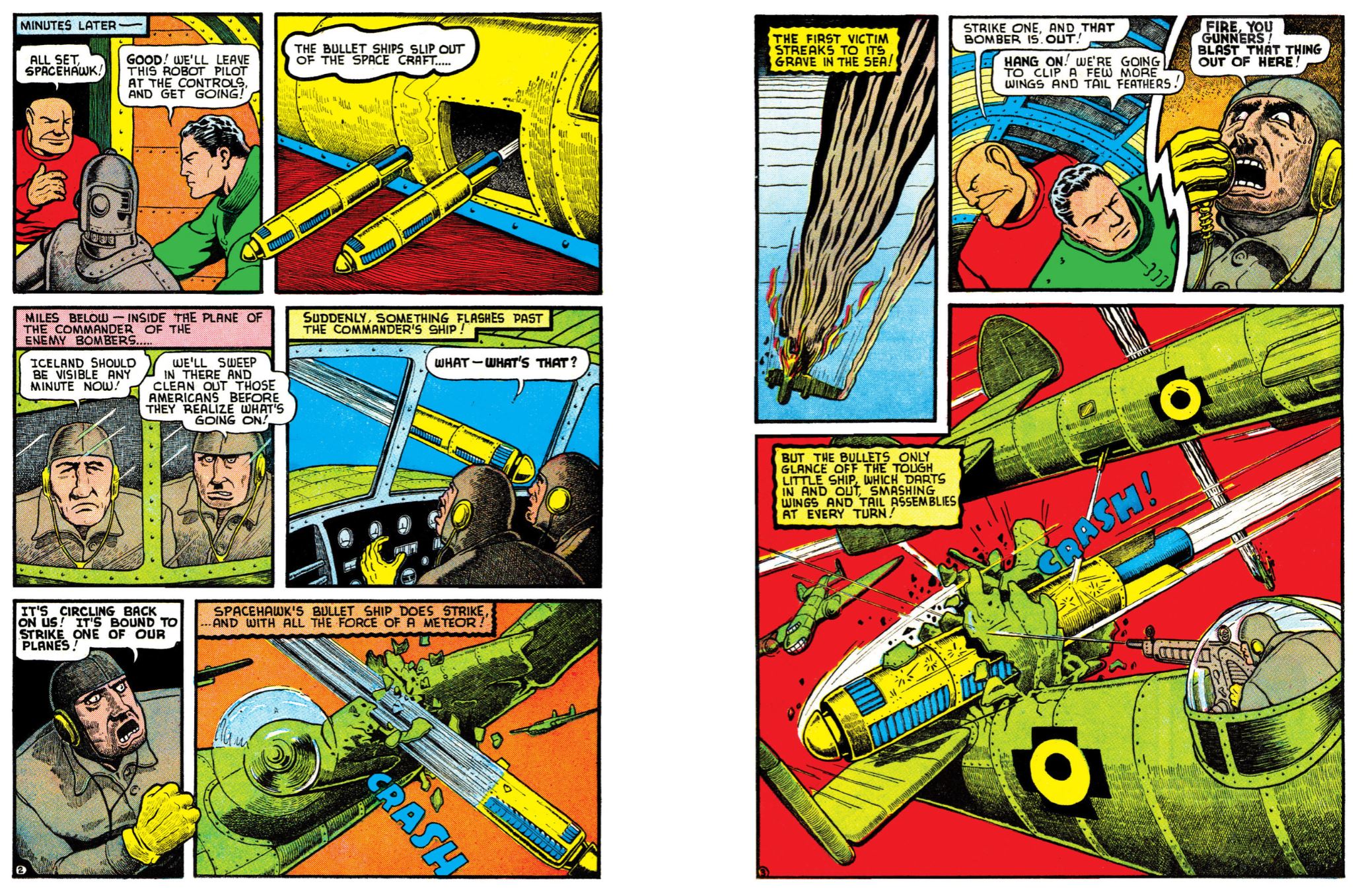
Volume 3 #1 (March 1942) ramps up the patriotic fervour as ‘Spacehawk and the Battling Bullet Ships’ details the Deep Space Duo’s demolition of enemy planes bombing Iceland, before again going undercover to ferret out saboteurs wrecking dam construction in ‘Spacehawk and the Case of the Black Avenger’. Then, madder than ever, Dr. Gore resurfaces in ‘Spacehawk and the Blazing Death’ using an artificial storm cloud to blast US ships after which a turning point is reached…
Vowing to use his science directly for the war effort, the alien ace joins government think tanks in ‘Spacehawk and his Super Divebomber’ (Target vol. 3 #4) building revolutionary aircraft and crushing the wave of saboteurs resolved to destroy them. However, he is soon called away to wipe out a fiendish Japanese super-sub squadron in 5 ‘Spacehawk and the Devil Divers of the Deep’ before going on to Alaska in vol.3 #6 and destroying an invasion force in ‘Spacehawk and the Secret Japanese Base’…
‘Spacehawk and the Mystery of the Green Faces’ finds him recalled to Washington DC to cure a diabolical bio-weapon that turns sufferers into emerald-hued raving fascists. After defeating the archenemy behind the threat he then delves into creating his own weapon of mass destruction in ‘Spacehawk and the Supersonic Siren’…
The foe of fascism was happy to employ their own methodology against them with both bio-weapons and ultimate destruction devices leaping off his drawing board and into action, but he also fought an occasional small battle. In TC v3 #9, Spacehawk and the Case of The Missing Tires’ delivers a wry, light-hearted romp as the Lone Wolf grudgingly helps a feisty motorist made victim of tyre thieves (a grievous and growing felony in those times of war-effort rationing) and finds himself in over his head as left-leaning actress Diana Drean refuses to be patronised, assisted, sidelined or assassinated by the tyre-stealing gangsters…
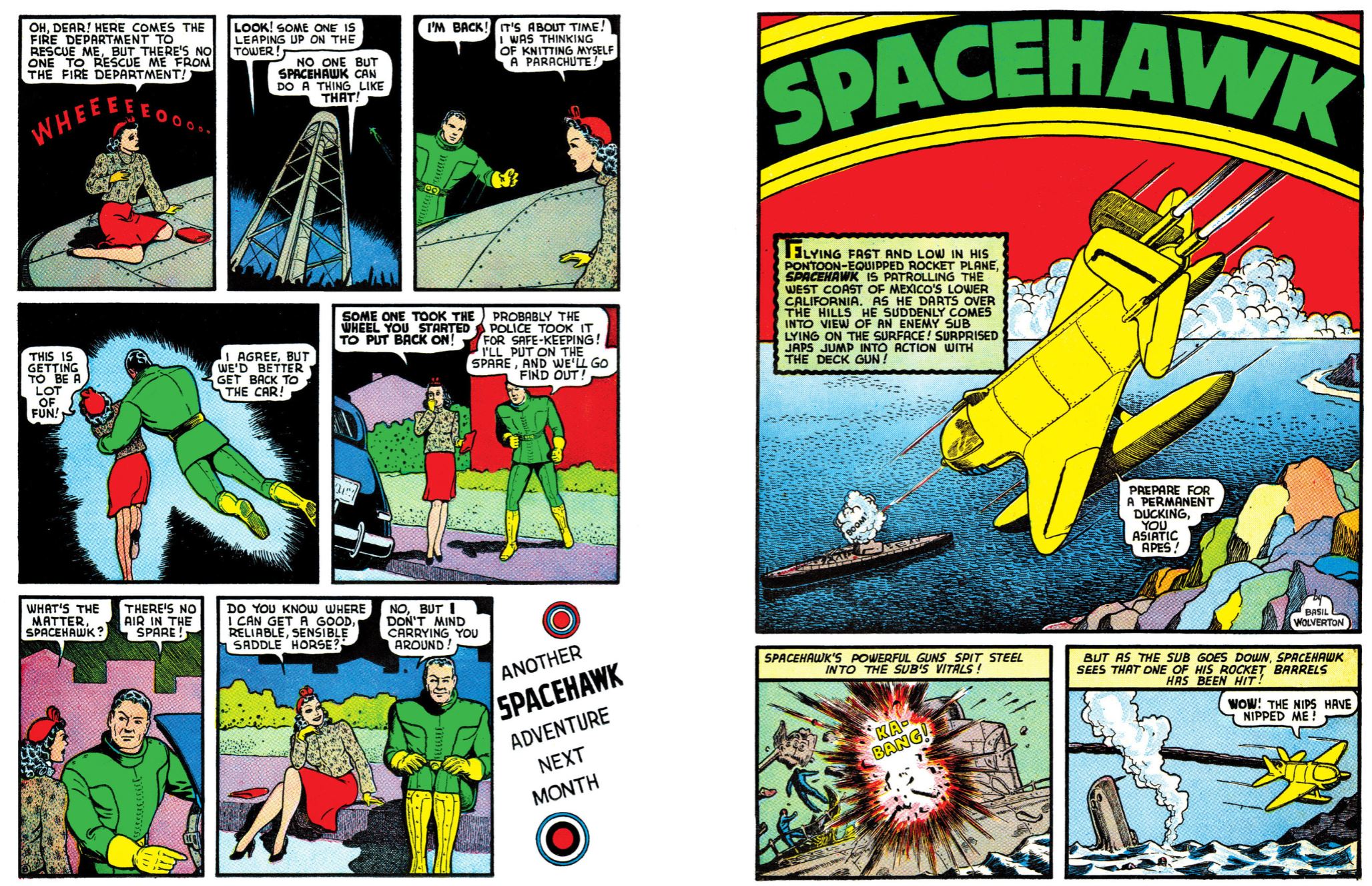
Sadly that delightful switch in tone was never built upon as vol 3 #10 (December 1942) presented one final exploit in ‘Spacehawk and the Secret Submarine Fuel Depot’ with the space ace uncovering an enemy U-Boat installation in neutral Mexico and taking appropriate definitive action….
And that was that.
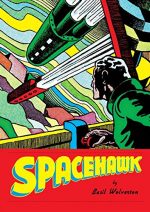
Changing times and tastes meant that Wolverton never returned to dramatic serial storytelling but instead went on to master anthological short graphic fiction – especially in the booming post-war fields of horror and science fiction (so stay tuned for those in days to come). This titanic tome also abruptly ends, delivering one last treat in a sublimely pencilled ‘Spacehawk cover sketch’ plus his only front of house appearance in the ‘Spacehawk cover’ on Traget Comic vol. 1 7…
Finally achieving the measure of popular recognition he always deserved, Basil Wolverton was a truly unique visionary and graphic pathfinder who inspired hundreds and entertained millions. This compendium from 2012 gathers all those so-Retro sidereal sagas and is an unmissable example of a creator given latitude and permission to be himself. If you love outré wonder and breathless, breakneck joy in motion, this is a treat you must not miss…
© 2012 Fantagraphics Books, Inc. All contents © 2012 Fantagraphics Books, Inc. unless otherwise noted. “The Lone Wolf of the Void” © 2012 Monte Wolverton. All rights reserved.
Today in 1897 pioneering and groundbreaking Russo-Serbian cartoonist Ivan Sensin was born, with Barney Google creator Fred Lasswell arriving in 1916; Archie Comics head honcho Richard Goldwater, coming along in 1936 and Underground legend S. Clay Wilson (Zap Comix, The Checkered Demon) in1941. Italian comics creator Anna Brandoli (Cuba 42, La Strega) was born in 1945 and French artist/raconteur Thierry “Ted” Benoit (Bingo Bongo et son Combo Congolais, Ray Banana, Blake and Mortimer) followed in 1947: as did cartoonist Ray Billingsley (Lookin’ Fine, Curtis) in 1957 and artist/letterer Galen Showman in 1972.
Today in 1887 journalist, playwright, social reformer and Punch co-founder Henry Mayhew died. In 1982 Canadian adventure strip god Hal Foster (Tarzan, Prince Valiant) died too.
Today in 2007 The United States Postal Service introduced Marvel superhero postage stamps.