
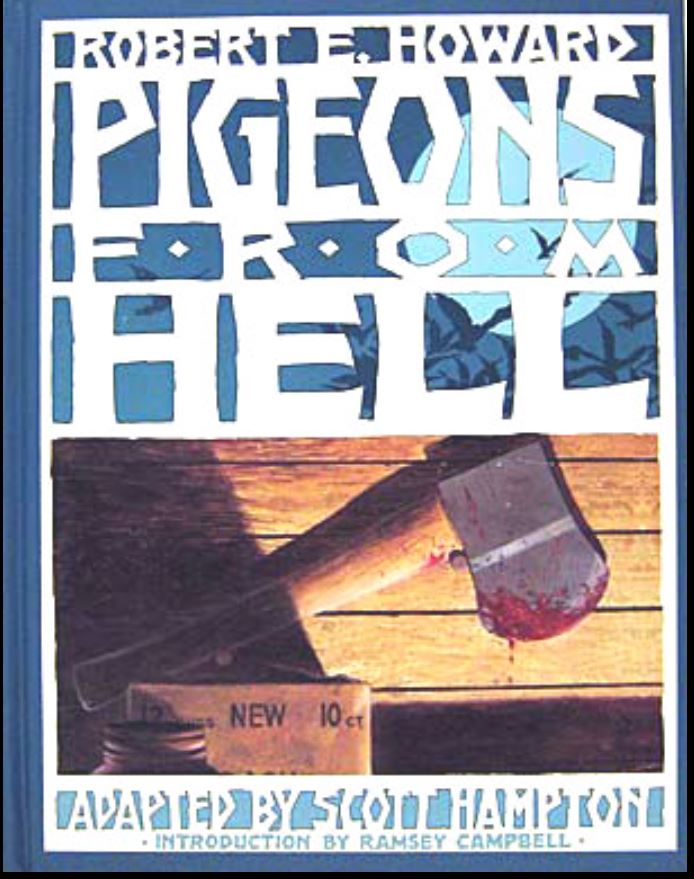
By Robert E. Howard, adapted by Scott Hampton & lettered by Steve Vance (Eclipse Books)
ISBN: 0-913035-69-6 (Limited Edition Album HB), 978-0-91303-568-9 (Album TPB)
This book contains Discriminatory Content commonplace in less enlightened times. This book includes Discriminatory Content used for dramatic effect.
Robert Ervin Howard is justly celebrated for his burly, barbarian sword-&-sorcery creations such as Conan, Kull, Bran Mak Morn and others but as a successful jobbing writer in the heyday of pulp fiction he also turned his blazing typewriter to most of the other extant genres of the era. Moreover, as aficionados of his blistering fantasy fiction are well aware, he was a dab hand at creating tension, suspense and moody macabre horror.
During the too-brief time of his creative peak he crafted a select pack of chilling spooky supernatural stories set in the evocative southern milieu known as ArkLaTex – a doom- shrouded, decadence-driven Deep South meeting-point of the darkest corners of Arkansas, Louisiana, Oklahoma and his beloved Texas. Deeply moved and inspired by old stories heard at his grandmother’s knee, Howard transformed oft-told anecdotes into timeless masterpieces of terror such as The Shadow of the Beast, Moon of Zambebwie, Black Hound of Death, Black Canaan and especially the yarn under scrutiny here: a chilling confection described by Stephen King as “one of the finest horror stories of our century”.
The tirelessly prolific Howard took his own life in 1936 and the prose Pigeons from Hell (unsold since its completion in 1932) was published posthumously in the May 1938 edition of premier pulp Weird Tales. It has become a classic not just of the genre but also a notional inclusion of the prestigious Southern Gothic movement of writers including Thomas Wolfe, William Faulkner, Erskine Caldwell, Tennessee Williams and others.
In 1988 the original text was incorporated into a stunningly lush, lavishly painted deeply faithful adaptation by Scott Hampton and published by West Coast mavericks Eclipse Books, which, despite a later version by Joe R. Lansdale & Nathan Fox in 2008 (published by Dark Horse and reviewed here, remains one of the best horror graphic novels ever produced. This is in no small part due to its being printed on magnificently larger-than-life, glossy square white pages produced in the oversized European Album format of 285 x 220mm rather than the standard US proportions of 258 x 168mm.
Following an impassioned Introduction from Horrorist Supreme Ramsey Campbell the Depression-era exercise in the unnatural opens with ‘The Whistler in the Dark’ as a pair of perambulating New Englanders bumming their way across America on a motoring vacation reach the southlands region of Piney Woods and decide to spend the night in a dark, decrepit, abandoned antebellum plantation house.
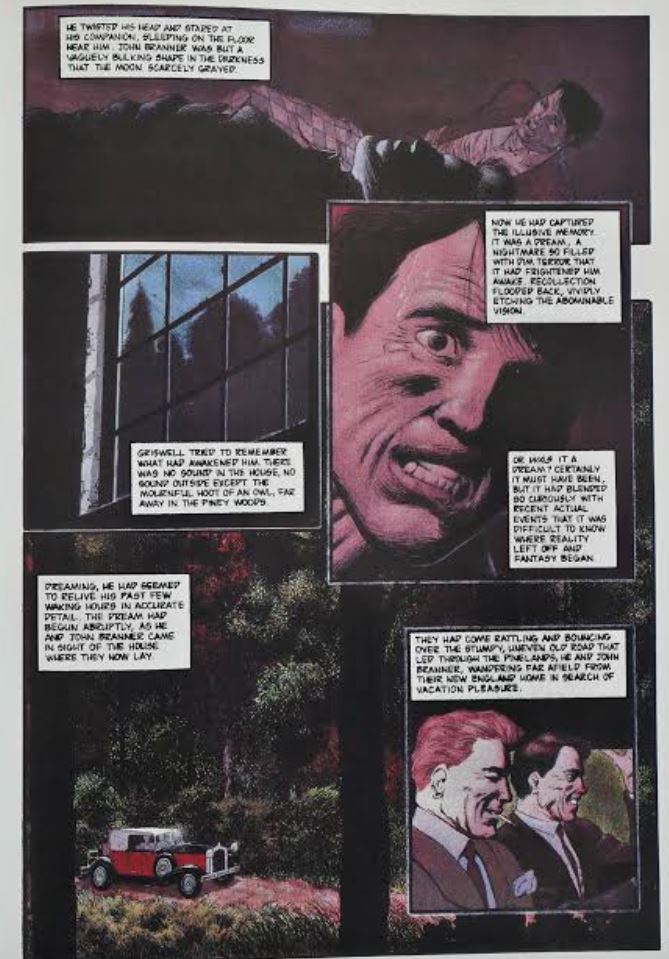
Crashing out on the musty floor of the main downstairs room they sink into exhausted sleep, but in the middle of the night Griswell is awakened by bad dreams. They’d begun with replaying their arrival at sunset, discovery of the ramshackle edifice and all the oddly ethereal white birds their presence had disturbed. From there his visions had moved on to their quick, cold repast and weary lapse into slumber before shifting into nightmare feelings of disquiet. When Griswell roused, anxious and disturbed, it was with images of ghostly doves, hidden rooms concealing ancient hanging bodies and a sense that something was hiding just beyond his sight…
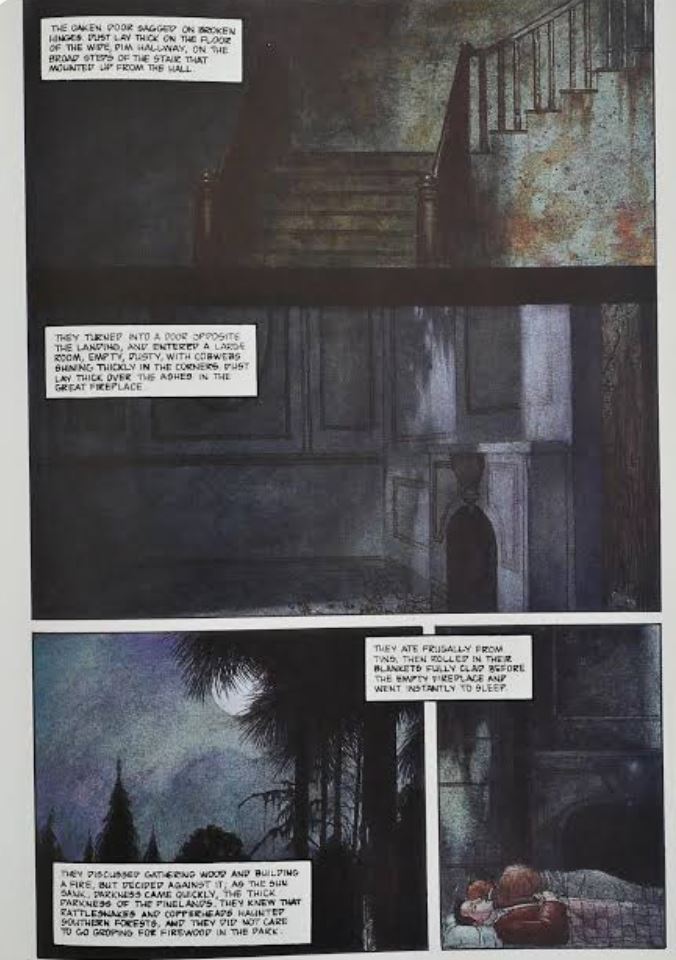
Trying to shake himself to full alertness, Griswell suddenly heard an eerie whistling and, helpless, watched his companion John Branner rise – as if sleepwalking – to ascend the grand staircase to the upper storey and into all-enveloping darkness. Incapable of movement, Griswell followed the sounds of Branner’s progress and suddenly, a hideous scream came…
Before he could move, Griswell heard Branner’s slow return. Then moonlight allowed a glimpse of his companion, and the sight was enough to send Griswold screaming helter-skelter into the night…
Reaching their automobile he found the vehicle infested with snakes and kept on running, convinced some unknown beast was at his heels. Careering ever on, he ran straight into a local lawman who instantly emptied his revolver into a shadow that pursued him…
‘Return’ fully introduces capable County Sheriff Kirby Buckner, who surprisingly accepts much of Griswell’s incredible tale and provides historical insight into the woeful tale and sinister reputation of Blassenville Manor as he and the terrified vacationer revisit – in full, comforting daylight – a scene of dreadful slaughter.
Swiftly ruling out the possibility of argument and murder amongst friends, Buckner begins searching the house for the true killer but comes up empty. Furthermore, knowing how bad things would look in a rational courtroom, he invites traumatised Griswell to help him get to the truth, by joining him and spending another night in the house…
‘The Snake’s Brother’ finds them preparing for that horrific prospect by researching the tragic history of the last of the Blassenvilles. In the years following the Civil War, three unwed daughters and a cousin, struggling to maintain the old pile, were eventually joined and chaperoned by their cold, brutal Aunt Celia, who had returned from the West Indies to watch over them.
Celia was a terrifying presence, as harsh with the girls as she was with remaining plantation staff and her own much-maltreated “mulatto” maid Joan…
The legend of the girls’ mysterious and sudden disappearance was common knowledge, but for more details Buckner and Griswold question an aged Negro who used to work on the plantation. When pressed, the still-mortally terrified dotard Jacob reveals a fantastic tale of brutal oppression, serpent worship, voodoo and appalling, unleashed, brooding vengeance… until he is hideously struck down by the power that lurks in the mansion…
Appalled, deeply shaken but more resolved than ever, Buckner and Griswold head for the Manor, mistakenly believing that they have a handle on what unquiet horror haunts the place and how to handle it in final chapter ‘The Call of Zuvembie’. They have jumped to a ghastly and tragic wrong conclusion…
Not only is the original prose work one of the best pieces of horror fiction ever written, but in this rare instance this adaptation – crafted over two long, meticulous years by Hampton – more than matches the power and all-encompassing mood of its source material. This is a classic of graphic narrative and fear fiction no fan will want to miss – but only with all the lights on…
© 1932, 1988 the Estate of Robert E, Howard, Glenn Lord Executor. Adaptation and painting © 1988 Scott Hampton. Introduction © 1988 Ramsey Campbell. Pigeons from Hell © 2008, 2009 Robert E. Howard Properties Inc. (“REHP”). All rights reserved.
Today in 1907 Antonia Yeoman was born: an Australian-Englishwoman cartoonist who became the only female member of Punch’s elite (male only) Toby Club. She shares the date with veteran colourist Gene D’Angelo (The Phantom, Flash Gordon, Blondie, Mandrake the Magician, Beetle Bailey, Superman Family, Action Comics, World’s Finest, Flash, Superboy, Justice League of America), born in 1924; Batman artist Lew Sayre Schwartz in 1926; artist Ricardo Villamonte (Doctor Strange, Saga of Crystar) in 1932; Australian cartoonist, sculptor, caricaturist and satirist Pat Oliphant in 1935. In 1947 Filipino artist Romeo Tanghal (New Teen Titans, Wonder Woman, Men of War) arrived on Earth, joined in 1958 by writer/editor Bob Greenberger (Crisis on Infinite Earths, Doom Patrol, Who’s Who in the DC Universe, Star Trek, Suicide Squad), and one year later by Guyanese American illustrator Trevor Von Eeden (Black Lightning, Batman, Thriller), with Colleen Doran (A Distant Soil, Amazing Spider-Man, The Sandman, Orbiter) coming along in 1963.
British Superman Garth debuted today in 1943, in a Daily Mirror strip by Steve Dowling & John Allard that ran until 1997.
The day also saw the deaths of some major and much-beloved players, such as illustrator Lou Fine (The Ray, Black Condor, The Flame, Uncle Sam, The Spirit, Taylor Woe, Adam Ames) in 1971; All Ages All Star Warren Kremer (Richie Rich, Caspar the Friendly Ghost, Hot Stuff the Little Devil, Little Audrey, Stumbo the Giant, Joe Palooka, Planet Terry, Count Duckula, Ewoks, Royal Roy, Top Dog) in 2003 and in 2012, Chilean cartoonist Themístocles Nazario Lobos Aguirre – AKA “Themo Lobos” – (Máximo Chambónez, Ferrilo, Nick Obre, Alaraco, with his most famous work being Mampato, Cucalón) and Indonesian comics author “R. A.” (Raden Ahmad) Kosasih (Sri Asih, Ramayana, Siti Gahara, Seri Mahabharata, Setan Cebol).