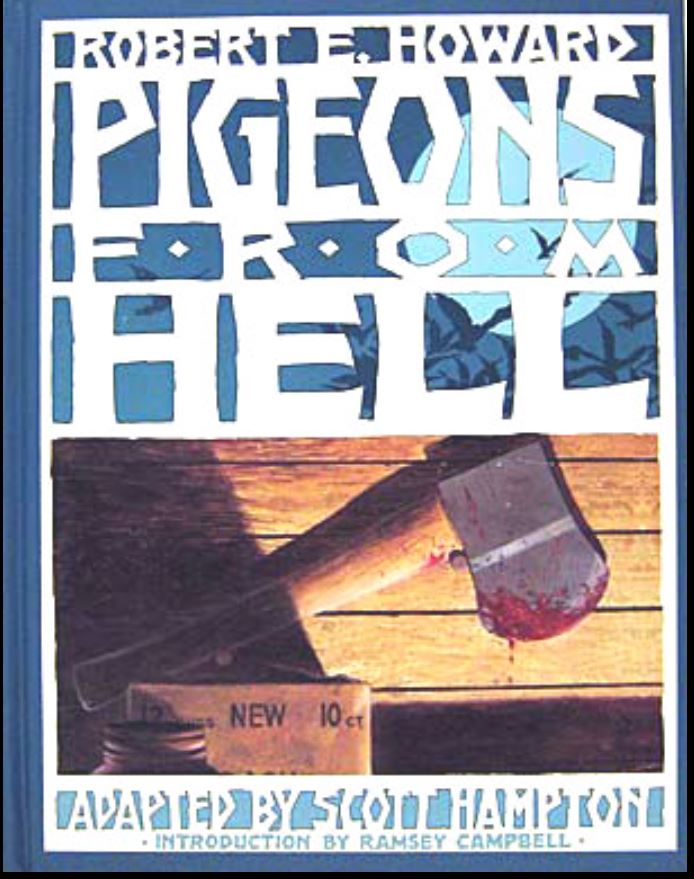
Pigeons from Hell


By Robert E. Howard, adapted by Scott Hampton & lettered by Steve Vance (Eclipse Books)
ISBN: 0-913035-69-6 (Limited Edition Album HB), 978-0-91303-568-9 (Album TPB)

This book contains Discriminatory Content commonplace in less enlightened times. This book includes Discriminatory Content used for dramatic effect.

Robert Ervin Howard is justly celebrated for his burly, barbarian sword-&-sorcery creations such as Conan, Kull, Bran Mak Morn and others but as a successful jobbing writer in the heyday of pulp fiction he also turned his blazing typewriter to most of the other extant genres of the era. Moreover, as aficionados of his blistering fantasy fiction are well aware, he was a dab hand at creating tension, suspense and moody macabre horror.

During the too-brief time of his creative peak he crafted a select pack of chilling spooky supernatural stories set in the evocative southern milieu known as ArkLaTex – a doom- shrouded, decadence-driven Deep South meeting-point of the darkest corners of Arkansas, Louisiana, Oklahoma and his beloved Texas. Deeply moved and inspired by old stories heard at his grandmother’s knee, Howard transformed oft-told anecdotes into timeless masterpieces of terror such as The Shadow of the Beast, Moon of Zambebwie, Black Hound of Death, Black Canaan and especially the yarn under scrutiny here: a chilling confection described by Stephen King as “one of the finest horror stories of our century”.

The tirelessly prolific Howard took his own life in 1936 and the prose Pigeons from Hell (unsold since its completion in 1932) was published posthumously in the May 1938 edition of premier pulp Weird Tales. It has become a classic not just of the genre but also a notional inclusion of the prestigious Southern Gothic movement of writers including Thomas Wolfe, William Faulkner, Erskine Caldwell, Tennessee Williams and others.

In 1988 the original text was incorporated into a stunningly lush, lavishly painted deeply faithful adaptation by Scott Hampton and published by West Coast mavericks Eclipse Books, which, despite a later version by Joe R. Lansdale & Nathan Fox in 2008 (published by Dark Horse and reviewed here, remains one of the best horror graphic novels ever produced. This is in no small part due to its being printed on magnificently larger-than-life, glossy square white pages produced in the oversized European Album format of 285 x 220mm rather than the standard US proportions of 258 x 168mm.

Following an impassioned Introduction from Horrorist Supreme Ramsey Campbell the Depression-era exercise in the unnatural opens with ‘The Whistler in the Dark’ as a pair of perambulating New Englanders bumming their way across America on a motoring vacation reach the southlands region of Piney Woods and decide to spend the night in a dark, decrepit, abandoned antebellum plantation house.

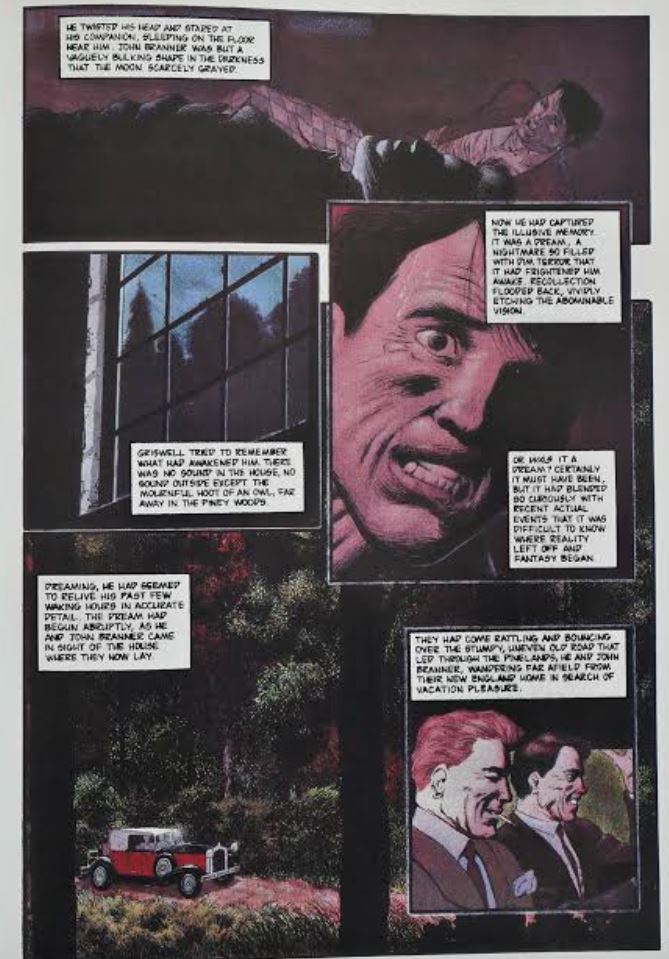
Crashing out on the musty floor of the main downstairs room they sink into exhausted sleep, but in the middle of the night Griswell is awakened by bad dreams. They’d begun with replaying their arrival at sunset, discovery of the ramshackle edifice and all the oddly ethereal white birds their presence had disturbed. From there his visions had moved on to their quick, cold repast and weary lapse into slumber before shifting into nightmare feelings of disquiet. When Griswell roused, anxious and disturbed, it was with images of ghostly doves, hidden rooms concealing ancient hanging bodies and a sense that something was hiding just beyond his sight…
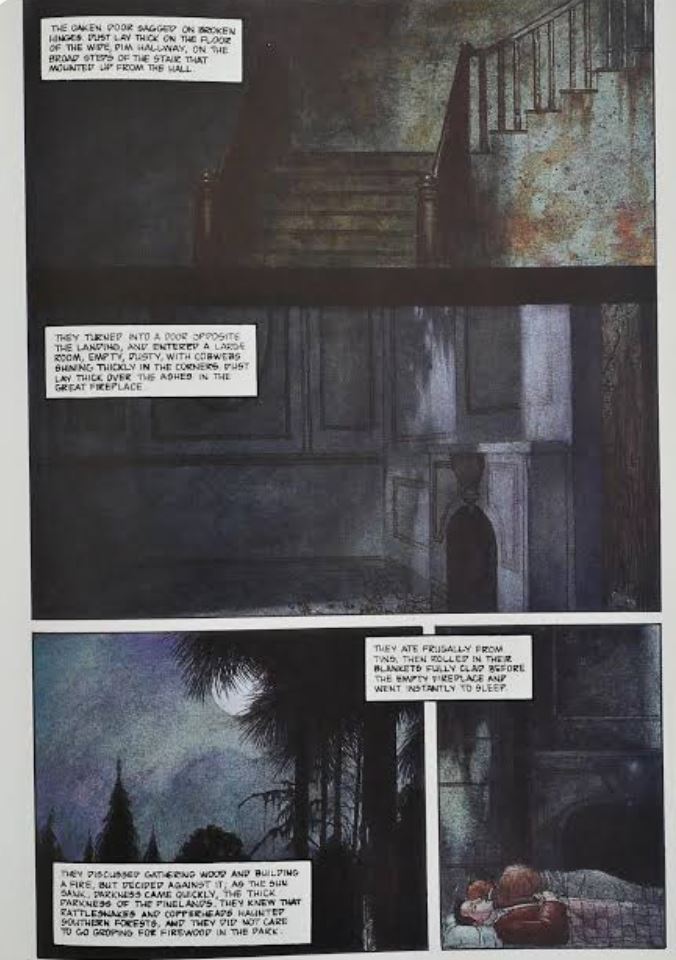
Trying to shake himself to full alertness, Griswell suddenly heard an eerie whistling and, helpless, watched his companion John Branner rise – as if sleepwalking – to ascend the grand staircase to the upper storey and into all-enveloping darkness. Incapable of movement, Griswell followed the sounds of Branner’s progress and suddenly, a hideous scream came…

Before he could move, Griswell heard Branner’s slow return. Then moonlight allowed a glimpse of his companion, and the sight was enough to send Griswold screaming helter-skelter into the night…

Reaching their automobile he found the vehicle infested with snakes and kept on running, convinced some unknown beast was at his heels. Careering ever on, he ran straight into a local lawman who instantly emptied his revolver into a shadow that pursued him…

‘Return’ fully introduces capable County Sheriff Kirby Buckner, who surprisingly accepts much of Griswell’s incredible tale and provides historical insight into the woeful tale and sinister reputation of Blassenville Manor as he and the terrified vacationer revisit – in full, comforting daylight – a scene of dreadful slaughter.

Swiftly ruling out the possibility of argument and murder amongst friends, Buckner begins searching the house for the true killer but comes up empty. Furthermore, knowing how bad things would look in a rational courtroom, he invites traumatised Griswell to help him get to the truth, by joining him and spending another night in the house…

‘The Snake’s Brother’ finds them preparing for that horrific prospect by researching the tragic history of the last of the Blassenvilles. In the years following the Civil War, three unwed daughters and a cousin, struggling to maintain the old pile, were eventually joined and chaperoned by their cold, brutal Aunt Celia, who had returned from the West Indies to watch over them.

Celia was a terrifying presence, as harsh with the girls as she was with remaining plantation staff and her own much-maltreated “mulatto” maid Joan

The legend of the girls’ mysterious and sudden disappearance was common knowledge, but for more details Buckner and Griswold question an aged Negro who used to work on the plantation. When pressed, the still-mortally terrified dotard Jacob reveals a fantastic tale of brutal oppression, serpent worship, voodoo and appalling, unleashed, brooding vengeance… until he is hideously struck down by the power that lurks in the mansion…

Appalled, deeply shaken but more resolved than ever, Buckner and Griswold head for the Manor, mistakenly believing that they have a handle on what unquiet horror haunts the place and how to handle it in final chapter ‘The Call of Zuvembie’. They have jumped to a ghastly and tragic wrong conclusion…

Not only is the original prose work one of the best pieces of horror fiction ever written, but in this rare instance this adaptation – crafted over two long, meticulous years by Hampton – more than matches the power and all-encompassing mood of its source material. This is a classic of graphic narrative and fear fiction no fan will want to miss – but only with all the lights on…
© 1932, 1988 the Estate of Robert E, Howard, Glenn Lord Executor. Adaptation and painting © 1988 Scott Hampton. Introduction © 1988 Ramsey Campbell. Pigeons from Hell © 2008, 2009 Robert E. Howard Properties Inc. (“REHP”). All rights reserved.

Today in 1907 Antonia Yeoman was born: an Australian-Englishwoman cartoonist who became the only female member of Punch’s elite (male only) Toby Club. She shares the date with veteran colourist Gene D’Angelo (The Phantom, Flash Gordon, Blondie, Mandrake the Magician, Beetle Bailey, Superman Family, Action Comics, World’s Finest, Flash, Superboy, Justice League of America), born in 1924; Batman artist Lew Sayre Schwartz in 1926; artist Ricardo Villamonte (Doctor Strange, Saga of Crystar) in 1932; Australian cartoonist, sculptor, caricaturist and satirist Pat Oliphant in 1935. In 1947 Filipino artist Romeo Tanghal (New Teen Titans, Wonder Woman, Men of War) arrived on Earth, joined in 1958 by writer/editor Bob Greenberger (Crisis on Infinite Earths, Doom Patrol, Who’s Who in the DC Universe, Star Trek, Suicide Squad), and one year later by Guyanese American illustrator Trevor Von Eeden (Black Lightning, Batman, Thriller), with Colleen Doran (A Distant Soil, Amazing Spider-Man, The Sandman, Orbiter) coming along in 1963.

British Superman Garth debuted today in 1943, in a Daily Mirror strip by Steve Dowling & John Allard that ran until 1997.

The day also saw the deaths of some major and much-beloved players, such as illustrator Lou Fine (The Ray, Black Condor, The Flame, Uncle Sam, The Spirit, Taylor Woe, Adam Ames) in 1971; All Ages All Star Warren Kremer (Richie Rich, Caspar the Friendly Ghost, Hot Stuff the Little Devil, Little Audrey, Stumbo the Giant, Joe Palooka, Planet Terry, Count Duckula, Ewoks, Royal Roy, Top Dog) in 2003 and in 2012, Chilean cartoonist Themístocles Nazario Lobos Aguirre – AKA “Themo Lobos” – (Máximo Chambónez, Ferrilo, Nick Obre, Alaraco, with his most famous work being Mampato, Cucalón) and Indonesian comics author “R. A.” (Raden Ahmad) Kosasih (Sri Asih, Ramayana, Siti Gahara, Seri Mahabharata, Setan Cebol).

Conan Epic Collection volume 5: Of Once and Future Kings (1976-1977)


By Roy Thomas & John Buscema, with John Jakes, Len Wein, Skip Kirkland, Ralph Macchio, Jim Starlin & Al Milgrom, Val Mayerik, Vicente Alcázar, Howard Bender, Marshall Rogers, Neal Adams, Tim Conrad & various (MARVEL)
ISBN: 1-84576- (TPB/Digital edition)

This book includes Discriminatory Content produced in less enlightened times.

In the 1970’s, America’s comic book industry opened up after more than 15 years of calcified publishing practises promulgated by the censorious, self-inflicted Comics Code Authority: a self-imposed oversight organisation created to police product after the industry suffered its very own McCarthy-style 1950s witch-hunt. The first genre revisited during the literary liberation was Horror/Mystery, and from those changes sprang migrated pulp star Conan.

Sword & Sorcery stories had been undergoing a prose revival in the paperback marketplace since the release of softcover editions of Lord of the Rings in 1954 and, in the 1960s, revivals of the fantasies of Edgar Rice Burroughs, Otis Adelbert Kline, Fritz Lieber and others were making huge inroads into buying patterns across the world. The old masters had also been augmented by many modern writers. Michael Moorcock, Lin Carter and others kick-started their prose careers with contemporary versions of man against mage against monsters. The undisputed overlord of the genre was Robert E. Howard with his 1930s pulp masterpiece Conan of Cimmeria.

Gold Key had notionally opened the field in 1964 with cult hit Mighty Samson, followed by Harvey Comics’ ‘Clawfang the Barbarian’ (1966’s Thrill-O-Rama #2). Both steely warriors dwelt in post-apocalyptic techno-wildernesses, but in 1969 DC dabbled with previously code-proscribed mysticism as Nightmaster came (and went) in Showcase #82-84, following the example of CCA-exempt Warren anthologies Creepy, Eerie and Vampirella. Marvel tested the waters with barbarian villain/Conan prototype Arkon the Magnificent in Avengers #76 (April 1970) – the same month they went all-out with short supernatural thriller ‘The Sword and the Sorcerers’ in their own watered-down horror anthology Chamber of Darkness #4.

Written by Roy Thomas and drawn by fresh-faced Barry Smith (a recent Marvel find just breaking free of the company’s still-prevalent, nigh-compulsory Kirby house style) the tale introduced Starr the Slayer… who also bore no small resemblance to our Barbarian-in-waiting…

Conan the Barbarian debuted with an October 1970 cover-date and despite early teething problems (including being cancelled and reinstated in the same month) these strip adventures of Howard’s primal hero were as big a success as the prose yarns they adapted. Conan became a huge hit: a blockbuster brand that prompted new prose tales, movies, TV series, cartoon shows, a newspaper strip and all the other paraphernalia of global superstardom.

However, times changed, sales declined and in 2003 the property moved to another comics publisher. Then in 2019 the brawny brute returned to the aegis of Marvel.

Their first bite of the cherry was retroactively subtitled “the Original Marvel Years” due to the character’s sojourn with Dark Horse Comics and other intellectual rights holders, and this fifth compendium spans cover-dates March 1976 to February 1977. It reprints Conan the Barbarian #60-71, Conan Annual #2-3 plus material from Power Records #31, F.O.O.M. #14 and elsewhere, highlighting a period when the burly brute was very much the darling of the comics crowd, and when artist John Buscema made the hero his very own.

Adaptor Thomas had resolved to follow the character’s narrative timeline as laid out by Howard and successors like L. Sprague de Camp and Lin Carter, expanded and padded out with other adaptions of REH and his contemporaries and – almost as a last resort – all-new adventures. Thus, content was evermore redolent of pulp-oriented episodic action rather than traditional fantasy fiction. As usual, firstly hurtle back in time approximately 12,000 years to a forgotten age of wonders, and follow the now traditional map of ‘The Hyborean Age of Conan’ plus accompanying mandatory establishing quote.

Maybe we’d best pause a moment and say something necessary. Many of the trappings and themes of Sword & Sorcery stories – especially those from the 1970s & 1980s adapting even earlier tales when racism, sexism and the presumed superiority of white males was a given – are not as comfortable – or unchallenged – for modern readers as they were for my generation or its forebears. Many elements here, for all their artistic and narrative excellence, will be hard to swallow for a lot of younger readers.

At least I hope so…

If barely-clad women casually traded as prizes and trophies and brown people waving spears and wearing feathers are a trigger, please don’t read these tales. I’m not making apologies when I say Thomas and his collaborators were actively working to subvert the established paradigm even then, or that these stories are powerful, thrilling and of evolving cultural significance, but, until so very recently, this kind of epic was a diminishing force with dwindling power to supress or denigrate ethnicities and minorities.

Now, with ugly race supremacism, resurgent sexism, and all forms of “othering” on the rise once more, I get the need to call out or shout down things that could warp young or weak minds. Don’t read these if you can’t. They are only comics, but it doesn’t take much to form and fix a bias, does it?

If you’re still with us, the hopefully harmless action nonsense resumes with a riotous romp from CtB #60 introducing ‘Riders of the River-Dragons!’ The Cimmerian wanderer continues as red-handed consort to pirate queen Bêlit, a Shemite orphan raised by a Kushite witch doctor and considered an avatar of his tribe’s death goddess…

Pulp novelette Queen of the Black Coast was originally published in the May 1934 Weird Tales, and obliquely told of Conan’s time as infamous pirate “Amra”: plundering the coasts of Kush (prehistoric Africa) beside his first great love. The brief but tragic tale of bold buccaneer Bêlit was a prose one-off, but Thomas expanded it over years into an epic comics storyline that ran to #100 of the monthly title.

It had all begun in  Conan The Barbarian #58, where Thomas, Buscema & Steve Gan debuted their Queen of the Black Coast! After the fugitive Cimmerian found safe harbour on an outward bound Argossean trading ship. The Northborn outlaw befriended entrepreneurial Captain Tito and settled into the mariner’s life. After visiting many fabulous ports and exotic wild places, Conan’s life changed when the ship encountered the most feared vessel afloat. Only Conan survived the assault of Kushite warriors, but as he prepared to die fighting, their white queen spared his life, and allowed Conan to earn his place by fighting any objectors before settling in as Bêlit’s prize…

As Thomas fleshed out the text tale, eventually Conan learned from shaman/mentor/guardian N’yaga how the warrior woman had remade herself. How a daughter of Asgalun’s king escaped murder by the Stygians who placed her uncle on the suddenly vacant throne, and how she grew up among barbarous tribesmen of the Silver Isles. Trained to best any man and after mastering supernal horrors, she destroyed a jealous chieftain, proving her in the eyes of the tribes an earthly daughter of Death Goddess Derketa: sworn to inflict bloody vengeance on Stygians and all who stand with them. Before long she had trained them as seafaring plunderers building a war chest to retake her throne: her, deadly, merciless devoutly loyal “black Corsairs”…

Conan also realises that he loves Bêlit beyond all else, even if she may not be wholly human…

Here the saga further expands in Thomas, Buscema & Gan’s opening shot where the pirate goddess is captured by crocodile-riding warriors as she visits a vassal coastal tribe, When the dragon riders come again, Conan, his shipmates and the river dwelling Watambis turn the tables on them, forcing captive raiders to lead them to their distant domain and hidden lord: a bestial godlike entity called “Amra”…

Ploughing through foetid forests, the rescue party is hard ‘On the Track of the She-Pirate!’ (#61), but Bêlit has already escaped, only to fall victim to a monstrous Moth creature. Her death is only prevented by the arrival of the brutal ‘Lord of the Lions!’ in #63, who takes a fancy to a woman who is the same colour he is…

In a barbed pastiche of ultimate white god Tarzan, Thomas, Buscema & Gan reveal how a red-haired noble child lost in jungles is reared by lions. On maturity, his physical might and domination of beasts makes him de facto ruler of terrorised local tribes surrounding the ruined lost city he calls home. Sadly, Amra’s fascination with Bêlit drives a previous captive paramour – chief’s daughter Makeda – to jealously retaliate by awakening demonic creatures asleep in the city’s bowels.

By the time Conan arrives to duel his rival and physical equal, the entire region is imperilled as the dead hunt the living and ‘Death Among the Ruins!’ leads to Amra’s defeat and the Cimmerian being hailed as a new Lord of Lions…

Deadlines were always a scourge at this time and #64 pauses the serial to reprint a colorised, toned down tale from mature readers magazine Savage Tales #5 (July 1974). Crafted by Thomas from a John Jakes plot, ‘The Secret of Skull River’ is illustrated Jim Starlin & Al Milgrom, detailing the Cimmerian’s mercenary’s battle against monster-making alchemists Anaximander and Sophos, prior to CtB #65’s ‘Fiends of the Feathered Serpent!’ (inked by the Tribe) returning to the shipboard romance in a canny adaptation of Howard’s The Thunder Rider. Here the Corsairs are driven by a Stygian fleet into uncharted waters, encountering the accursed remains of legendary black slave liberator Ahmaan the Merciless and the sorcerer who finally killed him. Tezcatlipoca is still there, trying to steal the dead man’s magic axe – which has already chosen Conan/Amra as its next host – when Ahmaan comes back to settle unfinished business, with the entire atoll paying the price of that clash…

Still inked by The Tribe, ‘Daggers and Death-Gods!’ brings the corsairs back to Argossean port city Messantia as Bêlit seeks to barter her plunder for Shemite currency to fund her counter-revolution. When shady fence Publio offers a big payout for a special job robbing a temple , it results in a mesmerising priest pitting the lovers against each other after seemingly awakening guardian death deities Derketa and Dagon, The pitiless duel is interrupted by the sudden arrival of Conan’s old sparring partner Red Sonja

Although based on Robert E. Howard’s Russian war-woman Red Sonya of Rogatine (from 16th century-set thriller The Shadow of the Vulture with a smidgen of Dark Agnes de Chastillon thrown into the mix) the comic book Red Sonja is very much Thomas’ brainchild. She debuted in Conan the Barbarian #23 (in November 1973) and became an unattainable gadfly/lure for the Cimmerian before gaining her own series and creative stable. Thomas returned as scripter to set up a tumultuous extended team-up with Conan and Bêlit that began with CtB #67’s ‘Talons of the Man-Tiger!’ as the Pirate Queen suspiciously eyes her man’s “one that got away” – and who is also after the loot Pulbio wants so badly…

Sonja was commissioned by Karanthes, High Priest of the Ibis God, to secure a page torn from mystic grimoire the Iron-Bound Book of Skelos in demon-haunted Stygia. She’s barely aware of an unending war between ancient deities, or that old colleague and rival Conan of Cimmeria is similarly seeking the arcane artefact. Ignoring his offer to work together, the women set off singly after the artefact, and Conan meets old apprentice Tara of Hanumar, who begs him to rescue her husband Yusef from a castle dungeon guarded by were-panther. By the time he finds Bêlit, Sonja has ridden off with the prize and the lovers give chase…

Prose recap of Marvel Feature #7 ‘The Battle of the Barbarians!’ summarises the other side of the story – and for her exploits see The Adventures of Red Sonja vol. 1. Sonja clashes repeatedly with her rivals and defeats many beasts and terrors, believing she has the upper hand, but there’s more at stake than any doughty warrior might imagine as the players reconvene with Karanthes.

Attacked by a demon bat who steals the page, Sonja, Amra and Bêlit give chase until they discover a strange city in the wastelands. Pencilled & inked by Buscema, CtB #68’s ‘Of Once and Future Kings!’ sees the sorcery of a sinister mastermind bring King Kull and his armies out of the past to conquer Conan’s era in a spectacular crossover conclusion that sets the scene for future forays of the fantastic before the love story takes centre stage once more with ‘The Demon Out of the Deep!’ as Thomas, Val Mayerik & the Tribe adapt REH’s historical horror classic Out of the Deep with the Cimmerian sharing an exploit of his teen years when as a captive of the enemy Vanir tribe he witnessed a sea devil decimate a fishing village before killing the thing with own brawny arms, neatly segueing into a two-part thriller from Conan the Barbarian #70 & 71, freely adapted from Howard’s The Marchers of Valhalla and inked by returning embellisher Ernie Chan.

In ‘The City in the Storm!’ a mighty storm drives the pirates far from recognisable shores and the corsairs’ iron discipline begins the fracture as they reach a welcoming island adorned with a fabulous walled metropolis of gold. With N’Yaga injured the crew head for shore and find glorious women serving a population of near-bestial sub-men. After an inconclusive battle, serving maid Aluna and her priestly master Akkheba negotiate a deal for the corsairs to defend the city – Kelka – from rival Barachan pirates, but there’s double dealing in the contract and soon the Kushites and their queen are captives awaiting sacrifice…

However as Conan discovers in ‘The Secret of Ashtoreth!’, the immortal captive the Kelkans worship and abuse in equal measure is no patron but vengeful victim who only needs a little aid to end their treacherous depredations forever…

The volume pauses Belit’s romance here to conclude with a selection of out-chronology oddments, beginning with 1976’s Conan the Barbarian Annual  #2. Opening with graphic reprise ‘Conan the Cimmerian’ by Thomas, Buscema & Yong Montano, the main event is a much abridged adaptation of ‘The Phoenix on the Sword’ by Thomas, Vicente Alcázar & Yong Montano, as aging King Conan faces sedition, rebellion and usurpation as he rules mighty empire Aquilonia. The thriller is backed up by The Hyborian Page text feature detailing the convoluted path of Howard’s original tale.

One year later, Conan the Barbarian Annual 3 reprinted some of Savage Sword of Conan #3 (December 1974) in a colourised, bowdlerised family friendly form, preceded by framing sequence ‘Conan the Barbarian and King Kull!’. Thomas, Buscema & Pablo Marcos placed General Conan of Khoraja ‘At the Mountain of the Moon-God’ and ‘Where Dark Death Soars’ to foil a scheme to replace the new King Khossus with a puppet of King Strabonus of Koth

With covers by Gil Kane, John Romita, Rich Buckler, Vince Colletta, Mike Esposito, Dan Adkins, Marcos, Chan, Buscema, Adams & Crusty Bunkers, the regular comics fare is augmented by rare treats, beginning with a genuine rarity. Power Records #31: Conan the Barbarian was part of line of vinyl records packaged with comic adventures. Other titles included Batman, Planet of the Apes and many more, but here – scripted by Len Wein & J.M. DeMatteis and illustrated by Buscema, Neal Adams, Dick Giordano and friends – ‘The Crawler in the Mists!’ offers an old fashioned monster & misjudgement parable as Conan faces the uncanny and comes away far wiser…

House fan mag F.O.O.M. #14 (June 1976) was an all barbarian special and from it liberally-illustrated features ‘The Barbarian and the Bullpen!’, ‘Thomas Speaks!’, ‘Robert E. Howard: The Man Who Created Conan!’, ‘Conan Checklist’, ‘A Marvel Artistic Double-Treat’ and ‘Marvel Writer/Artist Scorecard’ reveal all things Hyborian. Then Conan ‘Marvel Value Stamp’, assorted house ads and pages from Mighty Marvel Bicentennial Calendar (April 1976 by Gil Kane & Tony Isabella) reflect the comics popularity, and a Power Comics Conan promo and sleeve art by Adams leads to incisive article ‘The (Almost) Forgotten Tales of Conan’ by Fred Blosser from SSoC #40, a Romita pencil sketch and original art by Buscema & Gan, many pages of layouts, Tim Conrad pin-up and artwork from 1976’s Marvel Comics Index #2, painted by Conrad.

Stirring, evocative, cathartic and thrilling for all their modern faults and failings, these yarns are deeply satisfying on a primal level, and this is one of the best volumes in a superb series starring a paragon and icon of adventure heroes. This is classic pulp/comic action in all its unashamed exuberance: an honestly guilty pleasure for old time fans and newbies of all persuasion. What more does any red-blooded, action-starved fan need to know?
Conan the Barbarian Published Monthly by MARVEL WORLDWIDE Inc, a subsidiary of MARVEL ENTERTAINMENT, LLC. © 2022 Conan Properties International, LLC (“CPI”).