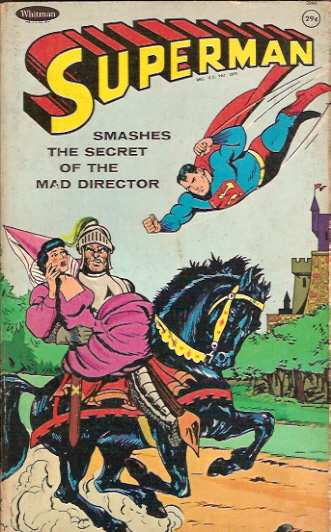
Superman Smashes the Secret of the Mad Director


By George S. Elrick and anonymous (Whitman)
ASIN: B000H7WMWA

It’s Superman’s Birthday! Sadly, more people know the Man of Steel as a screen star than a paragon of print.

I bang on a lot about comics as an art form and (justifiably, I think) decry the fact – despite the current vogue for superhero movies – that printed comics have never been given the mainstream recognition other forms of popular creative expression enjoy. I also encourage all and sundry to read more graphic narrative (I’m blurring my own terms here by including any product where text and image work co-operatively to tell a story, rather than simply a sequence of pictures with words attached), and I’m judicious and even selective (really and truly – there’s stuff I’m never going to share and recommend because, by most critical criteria, it’s better off ignored and forgotten).

However sometimes I’m caught in a bind: I tend to minimise the impact of nostalgia on my beloved world of “funnybooks”, but so often that irresistible siren call from the Golden Years will utterly trump any hi-falutin’ aesthetic ideal and proselytising zeal for acceptance and recognition.

Good luck finding this one; it’s well worth the search.

Superman Smashes the Secret of the Mad Director is such a product from a simpler time when it could be truly said that everybody had seen some sort of comic in their lives (not so easy to claim these days, I fear): a standard paperback most probably released to capitalise on the groundbreaking Saturday morning cartoon series The New Adventures of Superman (first hit for the fledgling Filmation Studios) than on the periodical delights of the “World’s Best Selling Comics Magazine!”

The half-hour cartoon show was a huge success, running three seasons; initially piggybacked with Superboy in its first year (beginning September 10th 1966), expanding into The Superman/Aquaman Hour of Adventure in 1967 and finally The Superman/Batman Hour in 1968. It was cancelled in September 1969 due to pressure from the censorious Action For Children’s Television who agitated against it for its unacceptably violent content!

As was the often the case in those times Big Little Books were produced under license by Whitman Publishing (the print giant that owned Dell and Gold Key Comics) in a mutually advantageous system that got books for younger readers featuring popular characters and cartoon brands (Man From U.N.C.L.E., the Monkees, Shazzan!, Flintstones, Journey to the Centre of the Earth, Batman, even the Fantastic Four amongst literally hundreds of others) into huge general store chains such as Woolworth’s, thus expanding recognition, product longevity – and hopefully sales.

Don Markstein’s superb Toonopedia site defines Big Little Books as: a small, square book, usually measuring about 3″x3″, with text on the left-hand pages and a single full-page illustration on the right. Big Little Books were originally created in the 1930s, to make use of small pieces of paper that had formerly gone to waste when magazines were trimmed after printing. By running a separate publication on paper that would otherwise go in the trash, the printer was able to create a salable product almost for free.

Big Little Books were an ideal way to merchandise comic strip characters, as the drawings could simply be taken directly from the strips themselves. Big Little Books flourished during the days of pulp magazine publishing, which mostly came to an end after World War II. The form was revived in the 1960s, partly as a nostalgia item, and has been used sporadically ever since. These latter-day Big Little Books are generally printed on better paper, and some, at least, have color illustrations.

This novel for children, written by BLB mainstay George S. Elrick, is slightly different, having no colour illustrations on its 166 interior pages and reformatted like a bookstore paperback of the sort that proliferated during the 1960s “Camp Superhero Craze” (check out our archived review for High Camp Super-Heroes for a handy example), and tells a rather good action/mystery yarn about a demented movie maker whose search for ultimate realism draws investigative reporters Clark Kent and Lois Lane into a pretty pickle…

To be frank the illustrations are pretty poor, originals not clipped pictures, but ineptly traced from reference material provided by comics drawn by the great Kurt Schaffenberger. Still, the wholesome naivety, rapid pace and gentle enthusiasm of the package surprised and engrossed me – even after the more than forty years since I last read it.

It’s a crying shame that the world still won’t take comics seriously nor appreciate the medium’s place and role in global society and the pantheon of Arts. Still, as long as graphic narrative has the power to transport such as me to faraway, better places I’m not going to lose too much sleep over it…

© 1966 National Periodical Publications, Inc. All Rights Reserved.

It’s A Bird…


By Steven T. Seagle & Teddy Kristiansen (Vertigo)
ISBN: 978-1-4012-0109-8 (HB)                    :987-1-4012-7288-3 (TPB)

Since his debut in June 1938 Superman has proven to be many things to billions of people, to the point of even changing their lives and shaping their actions.

It’s a Bird… was originally released in 2004 (and recently re-released in a new edition): offering something of a departure from typical Superman graphic novel fare with author Steven T. Seagle working through his understandable angst about writing the ongoing adventures of the Man of Steel without simply rehashing what has gone before.

Seagle (whose other comics work includes Uncanny X-Men, Sandman Mystery Theatre and Big Hero 6, and is part of TV cartoon creation collective Man of Action) actually scripted Superman #190-200 – published between April 2003 and February 2004.

The intriguing, demi-therapeutic exercise revealed in this slim and beguiling pictorial introspection deals with the author’s misgivings about contributing to the canon of an eternally unfolding legend.

However, underpinning what might so easily become a self-gratifying ego-stroke is a subtle undercurrent of savvy verity which strikes a chord with many creative professionals and insightful consumers as the professional writer finally finds the themes he needs to explore to be satisfied with his commission.

Let’s be honest here, every comic fan, indeed every twitcher and hobbyist, looks for a way to present and explain their particular passion to the “real” world and not feel like an imbecile in the process…

“Steve” is a writer working through some emotional baggage. He is still coming to terms with his family’s gradual disintegration – mental, physical and spiritual – from hereditary genetic disease Huntington’s Disease (Chorea, as was).

In everyday life, his father has gone missing, his mom and partner are making the “let’s have kids” noises whilst Steve’s waiting for the hammer to fall regarding his own potential prognosis with a condition that cannot be beaten…

He never wanted to write comics – even though he’s successful at it – and now his editor wants him to write Superman. He’s never had any feeling for the character or the medium and his damned editor just keeps on and on and on about… You get the picture?

It’s a Bird… is slow and lyrical in its deconstructive self-absorption as Steve makes his choices, and Teddy Kristiansen’s range of enticing drawing styles is a marvel and won him the 2005 Eisner Award for Best Painter/Multimedia Artist (Interior).

If you feel the urge to go beyond the panel borders of your private obsession, this one is well worth a look.
© 2004, 2017 DC Comics. All Rights Reserved.

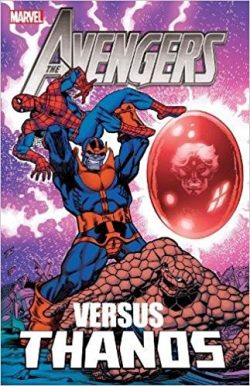
The Avengers versus Thanos


By Jim Starlin, Mike Friedrich, Steve Englehart, Steve Gerber, Scott Edelman, Don Heck, Bob Brown, John Buscema, Mike Zeck & various (Marvel)
ISBN: 978-0-7851-6850-8

With another Marvel Cinematic Universe film scoring big around the world, here’s a timely trade paperback and eBook edition to augment the celluloid exposure and cater to movie fans wanting to follow up with a comics experience that fills in all the gaps.

After Marvel mainstays Steve Ditko and Jack Kirby left the company, the burgeoning publisher brought in a raft of young newcomers to fill the void. One of the most successful of these was Jim Starlin who especially rose to the occasion by masterminding a vast and sprawling cosmic epic using a constantly failing property various stalwarts of the House of Ideas could not make a hit…

Captain Marvel was an alien on Earth, a defector from the militaristic Kree empire who fought for Earth and was atomically bonded to professional sidekick Rick Jones by a pair of wristbands allowing them to share the same space in our universe. When one was here, the other was trapped in the antimatter dimension designated the Negative Zone.

After meandering around the Marvel Universe for a while, continually one step ahead of cancellation (the series had folded many times, but always quickly returned – primarily to secure the all-important trademark name), Mar-Vell was handed to Starlin – and the young craftsman was left alone to get on with it.

With many of his fellow neophytes he began laying seeds (particularly in Iron Man, Sub-Mariner and Daredevil) for a saga that would in many ways become as well-regarded as the Jack Kirby Fourth World Trilogy that inspired it.

However, the Thanos War, despite many superficial similarities, would soon develop into a uniquely modern experience. And what it lacked in grandeur it made up for with sheer energy and enthusiasm…

Spanning February 1973-September 1974, this grandiose compendium (available in Trade Paperback and eBook editions) gathers and chronologically collates Iron Man #55, Captain Marvel #25-33, Marvel Feature #12, Daredevil #105-107, Avengers #125, Warlock #9-11 and 15, Avengers Annual #7, Marvel Two-in-One Annual #2 and concludes with a pertinent back-up from Logan’s Run #6 (June 1977: re-presenting Starlin’s entire early development of and engagement with one of comicbooks’ most popular villains.

The artistic iconoclasm began in Iron Man #55 (February 1973) where Mike Friedrich scripted Starlin’s opening gambit in a cosmic epic that would change the nature of Marvel itself.

Inked by Mike Esposito, ‘Beware… Beware… Beware the … Blood Brothers!’ introduces formidable and obsessive Drax the Destroyer; an immensely powerful humanoid trapped under the Nevada desert and in dire need of rescue by even more potent extraterrestrial invader Thanos…

That comes when the Armoured Avenger blazes in, answering a mysterious SOS, but only after brutally dealing with the secret invader’s bombastic and brutal underlings…

All this is merely a prelude to the main story which starts unfolding a month later in Captain Marvel #25, courtesy of Friedrich, Starlin, & Chic Stone, wherein Thanos unleashes ‘A Taste of Madness!’, changing exiled Mar-Vell’s fortunes forever…

When Mar-Vell is ambushed by a pack of extraterrestrial assassins, he is forced to admit that his powers have been in decline for some time. Unaware that an unseen foe is counting on that, Rick manifests from the Negative Zone to check in with sagacious scientific maverick Dr. Savannah, only to find himself accused by the savant’s daughter (and Rick’s beloved) Lou-Ann of her father’s murder…

Hauled off to jail, Rick brings in Mar-Vell who is suddenly confronted by a veritable legion of old foes before deducing who in fact his true enemies are…

Issue #26 then sees Rick freed from police custody to confront Lou-Ann over her seeming ‘Betrayal!’ (Starlin, Friedrich & Dave Cockrum). Before long, though, he and Mar-Vell realise they are the targets of psychological warfare: the girl is being mind-controlled whilst Super Skrull and his hidden “Masterlord” are manipulating them and others in search of a lost secret…

When a subsequent scheme to have Mar-Vell murder The Thing spectacularly fails, Thanos takes personal charge. The Titan is hungry for conquest and needs Rick because his subconscious conceals the location of an irresistible ultimate weapon.

Rick awakens to find himself ‘Trapped on Titan!’ (Pablo Marcos inks) not realising the villain has already extracted the location of a reality-altering Cosmic Cube from him. Rescued by Thanos’ hyper-powered father Mentor and noble brother Eros, the horrified human lad sees first-hand the extent of the genocide the death-loving monster has inflicted upon his own birthworld. Appalled and angry, Rick summons Captain Marvel to wreak vengeance…

Meanwhile on Earth, still-enslaved Lou-Ann has gone to warn the Mighty Avengers and summarily collapsed. By the time Mar-Vell arrives in #28 she lies near death. ‘When Titans Collide!’ (inks by Dan Green) reveals another plank of Thanos’ plan.

As the heroes are picked off by psychic parasite The Controller, the Kree Captain is assaulted by bizarre visions of an incredibly ancient being. Fatally distracted, he becomes the malevolent mind-leech’s latest conquest…

Al Milgrom inks ‘Metamorphosis!’ as Mar-Vell’s connection to Rick is severed before the Kree exile is transported to an otherworldly locale where a grotesque eight billion-year-old being named Eon reveals the origins of universal life whilst overseeing the abductee’s forced evolution into an ultimate warrior: a universal champion gifted with the subtly irresistible power of Cosmic Awareness…

Subsequently returned to Earth and reconnected to his frantic atomic counterpart, the newly-appointed “Protector of the Universe” confronts The Controller, thrashing the monumentally powerful brain-parasite in a devastating display of skill countering exo-skeletal super-strength in #30’s ‘…To Be Free from Control!’

Iron Man, meanwhile, has recovered from a previous Controller assault and headed for Marvel Feature #12 to join Ben Grimm in ending a desert incursion by Thanos’ forces before enduring ‘The Bite of the Blood Brothers!’ (Friedrich, Starlin, & Joe Sinnott), after which the story develops through the unseeing eyes of San Francisco-based swashbuckler Daredevil.

In DD #105, Matt Murdock has realised his new boss Kerwin Broderick has been sabotaging the attorney’s cases, and even hired warped mercenary Sergei Kravinoff AKA Kraven the Hunter to crush Daredevil’s investigative interference. When Kraven abducts his lover The Black Widow, the hero tries to save her but is thrown to his death over a cliff…

Natasha brutally avenge her man’s murder, but Murdock is far from dead, having being teleported from the jaws of doom by a ‘Menace from the Moons of Saturn!’ (scripted by Steve Gerber with art by Don Heck & Don Perlin).

In a short sequence pencilled by Starlin, the earthborn Priestess of Titan reveals how she had been dispatched to Earth to counter the schemes of death-worshipping proto-god Thanos.

Here the formerly enigmatic and emotionless super scientist Madame MacEvil shares her origins and foreshadows her future role in the cosmic catastrophe to come.

When Thanos killed her family, the infant Heather Douglas was adopted by Mentor, taken to Titan and reared by psionic martial artists of the Shao-Lom Monastery. Years later when Thanos attacked Titan and destroyed the monks she swore revenge and took a new name… Moondragon.

She also inadvertently discloses how she had innocently allied with a respected man of power and authority, providing him with a variety of augmented agents such as Dark Messiah, Ramrod and Angar …in fact all the menaces who have recently dogged the Man Without Fear…

Gerber, Heck & Trapani then brought the expansive sidebar saga closer to culmination as the manipulator is unmasked in ‘Life Be Not Proud!’ but not before the wily plotter redeploys all his past minions, shoots his misguided ally Moondragon, usurps a Titanian ultimate weapon and unleashes a life-leeching horror dubbed Terrex upon the world.

With all Earth endangered, DD, the Widow and guest-star Captain Marvel are forced to pull out all the stops to defeat the threat, and only then after a last-minute defection by the worst of their enemies and a desperate ‘Blind Man’s Life!’ courtesy of Gerber, Bob Brown & Sal Buscema.

Inked by Green & Milgrom, Captain Marvel #31 announces ‘The Beginning of the End!’ as the Avengers – in a gathering of last resort – are joined by psionic priestess Moondragon and Drax: revealed as one more of Thanos’ victims but one recalled from death by supernal forces to hunt and destroy the deranged Titan…

Thanos is then revealed as a lover of the personification of Death: determined to gift her Earth as a betrothal present. To that end he uses the Cosmic Cube to turn himself into ‘Thanos the Insane God!’ (Green inks) who, with a casual thought, imprisons all opposition to his reign.

The story then slips into Avengers #125, as Thanos unleashes ‘The Power of Babel!’ (Steve Englehart, John Buscema & Cockrum) with his vast alien armada bombarding Earth. In combating it, the Earth’s Mightiest Heroes are trapped out of phase with their home-world and, on defeating the star raiders, can only watch helplessly as ghosts in another dimension…

All seems lost but the Titan’s insane arrogance leaves the cosmically aware Mar-Vell with one slim chance to undo every change. Brilliantly outmanoeuvring the omnipotent ogre, the Kree Captain defeats and apparently destroys ‘The God Himself!’ in cosmically climatic Captain Marvel #33 (inked by Klaus Janson).

With the menace removed life returned to hectic normality, but the threat of Thanos had not ended.

While the war unfolded on Earth, Avatar of Life Adam Warlock had been making his way across the cosmos. The man-made man-god origins were as a lab experiment concocted by rogue geneticists eager to create a superman they could control for conquest. After facing the Fantastic Four, “Him” subsequently escaped to the stars before returning to his all-encompassing cocoon to evolve a little more.

That stellar shell was picked up by the moon-sized ship of self-created deity the High Evolutionary who was wrapped up in a bold new experiment. The naive wanderer observed as the Evolutionary created a duplicate Earth on the far side of the sun, running through billions of years of evolution in mere hours.

The intent was to create a civilisation without aggression or rancour, but the Evolutionary collapsed from exhaustion just as proto-hominid became Homo Sapien and his greatest mistake took instant advantage of the fact…

Years previously Man-Beast had been hyper-evolved from a wolf and instantly became his creator’s nemesis. Now he and his equally debased minions invaded the ship and interfered with the experiment: reintroducing evil to the perfect creatures below and, in fact, making them just like us. At incredible speed Earth’s history re-ran with the creature in the cocoon afforded a ring-side seat to humanity’s fall from grace…

When the High Evolutionary awoke and fought Man-Beast’s army, Him broke out of his shell and helped rout the demons, who fled to the despoiled Counter-Earth. With calm restored, the science-god sought to sterilise his ruined experiment: a world now indistinguishable from our own. No superheroes; disease and poverty rampant; injustice in ascendance and moments away from nuclear Armageddon… but Him begged him not to.

Claiming the evil tide could be turned, he begged the Evolutionary to stay his hand. The grieving, despondent creator agreed… but only until the rechristened Adam Warlock should admit that humanity was beyond redemption…

After failing in that endeavour Warlock travelled to the furthest reaches of creation only to discover a cruel and rapacious Universal Church of Truth slaughtering billions and learned with horror that the faith was based on a living god: his own evil future self The Magus.

Resolved to destroy the vile aberration he partnered with a troll named Pip and an assassin named Gamora, unaware that she actually worked for a hidden masterlord with a devilish agenda of his own…

Taken from Warlock #9-11 (October 1975-February 1976) the culmination of that struggle began with ‘The Infinity Effect’ (Starlin & Steve Leialoha) as the triumphant Magus easily countered every desperate ploy of Warlock to avoid an imminent metamorphosis into his malignant future self. All hope seems lost until Gamora’s master finally intercedes…

‘How Strange My Destiny!’ finds the unflappable Magus respond by setting 25,000 super-powered religious fanatics on the Warlock and Thanos as a way of keeping them occupied until the inevitable transformation occurs. ‘Enter the Redemption Principle!’ finds Magus at last rattled and personally intervening…

Issue #12’s sees an ‘Escape into the Inner Prison!’ as Warlock discovers that his ally is the Avatar of Death, just as the Magus has usurped his own position as Avatar of Life. With no other option he chooses to circumvent an intolerable fate with ‘The Strange Death of Adam Warlock!’…

After months more purposeless adventuring for Adam, infinitely patient Thanos at last shares his ultimate plans with devoted disciple Gamora. With Starlin handling all the creative chores, ‘Just a Series of Events!’ in Warlock #15 follows the artificial angel as he meanders towards his ultimate end and reveals that the all-powerful Soul Gem he wears on his brow is more his parasitic master than faithful servant…

That leads directly into a brace of 1977 Annuals which promised to resolve the Thanos/Warlock conflict forever. ‘The Final Threat’ (Starlin & Joe Rubinstein), from Avengers Annual #7, saw Captain Marvel and Moondragon return to Earth with vague anticipations of an impending cosmic catastrophe.

Their premonitions are confirmed when galactic wanderer Adam Warlock arrives with news that death-obsessed Thanos has amassed an alien armada and built a Soul-Gem powered cannon to snuff out the stars like candles…

Broaching interstellar space to stop the scheme, the united heroes forestall the stellar invasion and prevent the Dark Titan from destroying the Sun – but only at the cost of Warlock’s life…

Then ‘Death Watch!’ (Starlin & Rubinstein, Marvel Two-in-One Annual #2) finds Peter Parker plagued by prophetic nightmares, disclosing how Thanos had snatched victory from defeat and now holds the Avengers captive whilst he again prepares to extinguish Sol.

With nowhere else to turn, the anguished, disbelieving Spider-Man heads for the Baxter Building, hoping to borrow a spacecraft, and unaware that The Thing also had a history with the terrifying Titan.

Although utterly overmatched, the mismatched substitute-champions of Life subsequently upset Thanos’ plans enough so that the Avengers and the Universe’s true agent of retribution are able to end the Titan’s threat forever… or at least until next time…

That ought to be the end of this first cycle of cosmic conflagration but there’s still one more treat on offer here.

Logan’s Run was a short-lived licensed property tie-in and #6 incongruously featured a 5-page filler short starring Thanos in battle against his precision-crafted nemesis Drax the Destroyer: a typically inconclusive out-world clash over ‘The Final Flower’ by Scott Edelman & Mike Zeck.

A timeless classic of the company and the genre, made topical by the latest Marvel Cinematic Universe extravaganza, this is a tale no full-blooded print or screen-based Fights ‘n’ Tights fan can be without.
© 1972, 1973, 1974, 1975, 1976, 1977, 2013, 2018 Marvel Characters, Inc. All rights reserved.

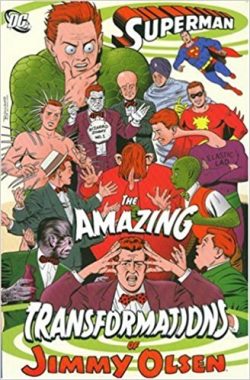
Superman: The Amazing Transformations of Jimmy Olsen


By Otto Binder, Alvin Schwartz, Robert Bernstein, Jerry Siegel, Leo Dorfman, E. Nelson Bridwell, Cary Bates, Curt Swan, John Forte, Pete Costanza, Kurt Schaffenberger, Ray Burnley, Creig Flessel, Stan Kaye, George Klein & various (DC Comics)
ISBN: 978-1-4012-1369-5

Over eight decades, Superman has provided excitement, imagination and fun in more or less equal amounts. This compilation relies heavily on the last two categories and offers the kind of reading experience we just don’t get enough of these days…

Although unnamed, a red-headed, be-freckled plucky kid worked alongside Clark Kent and Lois Lane from Action Comics #6 (November 1938). He was called by his first name from Superman #13 (November-December 1941) onwards. That lad was Jimmy Olsen and he was a major player in The Adventures of Superman radio show from its debut on April 15th 1940; somebody for the hero to explain stuff to for the listener’s benefit and the closest thing to a sidekick the Man of Tomorrow ever needed…

When the similarly titled television show launched in the autumn of 1952 it became a monolithic hit and National Periodicals began cautiously expanding their valuable and precious franchise with new characters and titles. First up were the gloriously charming, light-hearted escapades of a rash, capable but naïve photographer and “cub reporter” from the Daily Planet: titular star of Superman’s Pal Jimmy Olsen, which launched in 1954 with a September-October cover date.

The comic was popular for more than two decades, blending action, adventure, broad, wacky comedy, fantasy and science fiction in the gentle manner scripter Otto Binder had perfected a decade previously at Fawcett Comics on the magnificent Captain Marvel. As the feature progressed, one of the most popular plot-themes (and most fondly remembered and referenced today by most Baby-Boomer fans) was the unlucky lad’s appalling talent for being warped, mutated and physically manipulated by fate, aliens and even his friends…

The Amazing Transformations of Jimmy Olsen delightfully collects some of the very best and most iconic tales from the series; all of which originally appeared in issues #22, 28, 31-33, 41-42, 44, 49, 53, 59, 65, 72, 77, 80, 85 and 105 of the comicbook, plus the lead story from giant-size anthology Superman Family #173, into which SPJO evolved.

The spellbinding wonderment begins with a selection of beautifully reconfigured covers (from issues 22, 44, 59 and 105) which act as contents and credit pages after which the story segments open with ‘The Super-Brain of Jimmy Olsen’ by Binder, Curt Swan & Ray Burnley, wherein resident crackpot genius Professor Phineas Potter evolves the boy into a man from 1,000,000AD. The apparently benevolent being seems to have a hidden agenda, however, and is able to bend Superman to his towering will…

The same creative team produced ‘The Human Skyscraper’ with another Potter production enlarging Jimmy to monumental size, whilst in ‘The E-L-A-S-T-I-C Lad’ Superman is ultimately responsible for the reporter gaining stretching powers after leaving a chest of alien artefacts with the nosy, accident-prone kid.

‘The Jimmy Olsen from Jupiter’ by Alvin Schwartz, Swan & Burnley sees aliens mutate him into one of their scaly selves, complete with mind reading powers, whilst Binder’s ‘The Human Flame-Thrower!’ reveals how Potter’s latest experiment causes the worst case of high-octane halitosis in history, after which Robert Bernstein, Swan & John Forte display the lad’s negligent idiocy when Jimmy eats alien fruit and becomes ‘The Human Octopus!’

Creig Flessel inked the hilariously ingenious ‘Jimmy the Genie!’ in which boy and magical sprite exchange roles after which ‘The Wolf-Man of Metropolis!’, by Binder, Swan, Stan Kaye, blended horror, mystery and heart-warming charm in a mini-classic of the genre.

Professor Potter is blamed for, but entirely innocent of, turning Jimmy into ‘The Fat Boy of Metropolis!’ – a daft but clever crime caper from Swan & Forte – whilst sheer mischance results in the now-legendary saga of ‘The Giant Turtle Man!’ and his oddly casualty-free rampage (courtesy of scripter Jerry Siegel) before Leo Dorfman, Swan & George Klein collaborated to produce the sparkling tale of alien love gone amiss, which resulted in our boy temporarily becoming ‘Jimmy Olsen, Freak!’

When Jimmy spurns the amorous attentions of supernatural Fifth Dimensional hottie Miss Gzptlsnz, she quite understandably turns him into ‘The Human Porcupine’ by Siegel, Swan & Klein, who also crafted the intriguing enigma of ‘The World of Doomed Olsens!’ wherein Jimmy is aggressively confronted by materialisations of his most memorable metamorphoses…

‘The Colossus of Metropolis!’ sees Jimmy deliberately and daringly grow into a giant to tackle rampaging Super-Ape Titano, whilst Siegel, Forte & Klein’s ‘Jimmy Olsen, the Bizarro Boy!’ is a merry comedy of errors with Potter’s cure for the backwards-living artificial beings going painfully awry, resulting in the poor lad being ‘Exiled on the Bizarro World!’

The immensely popular Legion of Super-Heroes guest-star in many of these tales and play a pivotal part in ‘The Adventures of Chameleon-Head Olsen!’, a madcap mirth spree as only Siegel, Forte & Klein could make ’em, whilst the far more menacing tale of ‘The World of 1,000 Olsens!’ (by Binder, E. Nelson Bridwell & Pete Costanza) was a product of changing times and darker tastes; with an actual arch-enemy trapping Jimmy on a murderous planet where everybody looks like but hates the cub reporter…

This fabulously strange brew concludes with a smart thriller set in the Bottled City of Kandor where Jimmy resumes his occasional costumed-hero identity of Flamebird beside Superman (AKA Nightwing) to save the last Kryptonians from the ‘Menace of the Micro-Monster!’ …a sharp terrorism-tinged shocker by Cary Bates & Kurt Schaffenberger which satisfyingly closes this magically engaging tome.

As well as relating some of the most delightful episodes of the pre-angst-drenched, cosmically catastrophic DC, these stories also perfectly depict the changing mores and tastes which reshaped comics from the safe 1950s to the seditious, rebellious 1970s, all the while keeping to the prime directive of the industry – “keep them entertained and keep them wanting more”.

I know I certainly do…
© 1957-1965, 1967, 1975, 2007 DC Comics. All Rights Reserved.

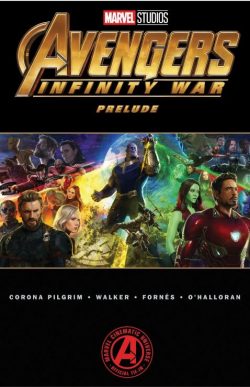
Marvel’s Avengers – Infinity War Prelude


By Will Corona Pilgrim, Tigh Walker, Jorge Fornés, Chris O’Halloran, with Jonathan Hickman, Jim Starlin, Jim Cheung, Ron Lim & various (Marvel)
ISBN: 978-1-3029-0943-7

With another eagerly anticipated Marvel Cinematic Universe film premiering around the world, here’s a timely trade paperback and eBook edition to augment the celluloid exposure and cater to movie fans wanting to follow up with a comics experience.

Comprising selected reprints and new digital material designed to supplement the movie release, these Prelude editions have become a traditional part of the dissemination and build-up and this compilation contains Marvel’s Avengers Infinity War Prelude #1-2 plus material starring the ultimate arch-villain Thanos taken from Infinity #1 and Thanos Annual #1.

This original 2-part miniseries sets the scene for the film blockbuster: written by Will Corona Pilgrim and based on the Captain America: Civil War screenplay by Christopher Markus & Stephen McFeely. It was realised by illustrator Tigh Walker, colourist Chris O’Halloran and letterer Travis Lanham and reveals how the knowledge that Captain America’s old ally Bucky (AKA Winter Soldier) assassinated Tony Stark‘s parents splits the Avengers into two warring teams…

After a ferocious battle, Cap’s allies – Falcon, Scarlet Witch, Ant-Man and Hawkeye – are broken out of prison by the renegade Sentinel of Liberty and take refuge in Wakanda where the advanced technologies of the Black Panther deprogram Bucky even as in America an isolated Stark reconfigures his armour in advance of an overwhelming threat heading to Earth from the depths of space…

The second chapter – with Jorge Fornés as artist – features new movie maven Dr. Strange, coming to terms with his role in a terrifying universe of appalling unknown forces and deadly dangers.

As advisor Wong regales the wizard with tales and histories of the Infinity Stones and how they have shaped events (as seen in many previous MCU films), Thor and Loki return to Earth to consult the mage in the matter of the sudden disappearance of Asgardian All-Father Odin…

In space, the Guardians of the Galaxy are also gauging a growing threat as cosmic overlord Thanos turns his avaricious eyes upon Earth…

Of course, all these plot threads get knotted together in the movie…

The supplemental classic appearances then open with the first chapter of mega publishing event Infinity #1 (August 2013), scripted by Jonathan Hickman.

In the aftermath of the blockbuster Avengers versus X-Men war, the company-wide reboot MarvelNOW! reformed the entire overarching continuity: a drastic reshuffle and rethink of characters, concepts and brands with an eye to winning new readers and feeding the company’s burgeoning movie blockbuster machine…

Moreover, numerous story strands were slowly building and combining to kick off the Next Big Thing with the cosmically revamped Avengers titles forming the spine of an encroaching mega-epic.

The intergalactic Hammer of Doom finally fell as a two-pronged, all-out attack which saw an impossibly ancient threat materialise to wipe out life in the cosmos, whilst Earth itself was targeted by an old enemy with a long memory and monstrous agenda…

What Came Before: In recent Avengers episodes an impossibly ancient trio of galactic “Gardeners” – robotic Aleph, seductive Abyss and passionate Ex Nihilo – attempted to remake Earth into something special. To that end they bombarded the world with “Origin bombs”, seeding locations with bizarre, exotic and uncompromising new life-forms.

When the Avengers went after them, the invaders claimed to have been tasked by The Builders – first species in creation – and their Mother of the Universe to test and, whenever necessary, eradicate, recreate and replace life on all worlds.

Although the World’s Mightiest Heroes defeated the intruders and set about mitigating the effects of the O-bombs on Earth, it seemed increasingly futile as global threats seemingly multiplied without surcease. Evidence also indicated that the very structure and celestial mechanics of the multiverse were catastrophically unravelling.

And then rumours began of an incredible alien armada heading directly for Earth…

It all starts here with the miniseries’ first issue as ‘Infinity’ (illustrated by Jim Cheung, Mark Morales, John Livesay & David Meikis) focuses on Saturnian moon Titan where death-driven despot Thanos dispatches his diabolical Outrider to demand ‘The Tribute’ from another newly enslaved world in his growing interstellar empire. Some of the Dark Lord’s most effective agents are already on Earth, stalking the planet’s greatest champions and ‘Constructing Apocalypse’…

Sixty thousand light-years away, an even bigger threat is mopping up the puissant Space Knights of Galador. Various varieties of Builders – of the same ancient order that spawned Aleph, Abyss and Ex Nihilo – have razed the planet whilst unearthly new Avenger Captain Universe (whom the Gardeners call “Mother”) can only look on with despair as her wayward children destroy another world tainted by contact with Earth…

‘Orbital’ finds Captain America and Hawkeye cleaning out a nest of Skrulls in Palermo, but these invaders are far from the arrogant, treacherous warriors they’re accustomed to. The shapeshifters are scared, cowering refugees, fleeing and hiding from something incomprehensibly bad…

‘What was Hidden, Now Uncovered’ then focuses on the Inhumans‘ floating city Attilan, currently parked above Manhattan, where Outrider prepares to extract secrets from the brain of slumbering monarch Black Bolt.

Even as the supremely powerful Inhuman foils the ghastly intrusion, the Avengers have regrouped following Captain Universe’s return with warnings of an oncoming impossibly vast Builder Armada. It merely confirms what Earth’s deep space monitoring array already shows: The fleet is bearing directly on Earth and any race or empire in the way is summarily destroyed as the invaders move ever closer.

The once unbeatable Kree are only the latest to fall…

When a distress call arrives from the rulers of the Galactic Council representing Kree, Skrulls, Badoon, Spartax, Brood and Shi’ar, the Avengers are soon ‘Outbound’, resolved to stop the fleet long before it reaches Earth.

Severely wounded, Outrider returns to Titan to inform Thanos that the thing he seeks most in the universe has been hidden on Earth by Black Bolt, prompting an invasion by the Titan’s own fleet long before the Builders can arrive. Moreover, almost all the planet’s infernal metahuman champions have left for Kree space…

If that whetted your appetite, you’ll need to see the two volume Infinity collection…

Here, however, we move on to Thanos Annual #1 (July 2014) as a defeated, comatose Mad Titan recalls an early turning point in his life. Written by Jim Starlin, pencilled by Ron Lim and inked by Andy Smith, ‘Damnation and Redemption’ begins after his first defeat by Captain Marvel and the Avengers, when he used a Cosmic Cube to become God before being stripped of everything through his own arrogance.

At this low ebb he is tempted by arch demon Mephisto but saved by his own future self, using the Infinity Gauntlet’s Time Gem to correct an almost irrevocable error…

Shown his potential future, the Titanian plotter thinks he is on the rise but has not counted on the interference of true cosmic gods such as the Living Tribunal…

This selection also includes a cover and variants gallery by Adam Kubert, Dale Keown & Ive Svorcina, Skottie Young, Marko Djurdjević, Lim & Smith and Starlin & Al Milgrom.

From such disparate seeds movie gold can grow, but never forget that the originating material is pretty damned good too and will deliver a tempting tray of treats that should have most curious fans scurrying for back-issue boxes, bookshop shelves or online emporia…
© 2013, 2014, 2018 Marvel Characters, Inc. All rights reserved.
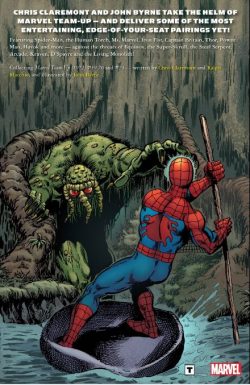
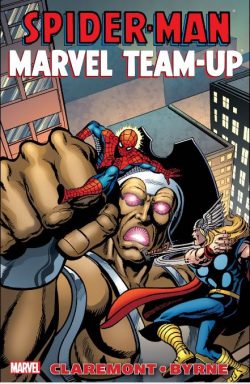
Spider-Man: Marvel Team-Up by Claremont & Byrne


By Chris Claremont, John Byrne, Ralph Macchio, Dave Hunt & various (Marvel)
ISBN: 978-0-7851-5866-0

The concept of team-up books – an established A-lister joining or battling (usually both) less well-selling company co-stars – was not new when Marvel decided to award their most popular hero the lion’s share of a new title, but they wisely left their options open by allocating an occasional substitute lead in the Human Torch.

In those halcyon, simpler days editors were acutely conscious of potential over-exposure and since super-heroes were actually in a decline at that time, they may well have been right.

Nevertheless, when it launched in March 1972, Marvel Team-Up was the second official Spider-Man title (an abortive companion title Spectacular Spider-Man was created for the more respectable – and pricey – magazine market in 1968 but folded after two issues) and it immediately began bucking the downward trend for costumed crusaders.

Encompassing July 1977 to November 1978 and re-presenting Marvel Team-Up #59-70 and 75, this highly selective and utterly engaging volume gathers the (almost) complete oeuvre and cathartic collaborations of late 70’s wonder kids Chris Claremont and John Byrne: at that time setting the comics world on fire with their Iron Fist and new X-Men tales. Why “almost”? Because the book sadly omits a lovely Red Sonja pairing presumably unavailable as the “She-Devil with a Sword” is now licensed to another publisher…

The tense suspense and cataclysmic action commence with #59 which declared ‘Some Say Spidey Will Die by Fire… Some Say by Ice!’ by (Claremont, Byrne & inker Dave Hunt) as veteran Avenger Yellowjacket is apparently murdered by rampaging mystery maniac Equinox, the Thermo-Dynamic Man and the Amazing Arachnid is hard-pressed to stop the traumatised Wasp exacting bloody vengeance in concluding episode ‘A Matter of Love… and Death!’ in MTU #60

Claremont had actually begun scripting the title with issue #57 as a succession of espionage-flavoured heroes and villains battled for possession of a mysterious clay statuette.

The secret of the artefact is now revealed in #61 as the Human Torch Johnny Storm joins his creepy-crawly frenemy in battle against the Super-Skrull and learns ‘Not All Thy Powers Can Save Thee!’, before the furious clash calamitously escalates to include Ms. Marvel with the next issue’s ‘All This and the QE2’…

Despite the very best efforts of Claremont & Byrne, their Kung Fu fantasy Iron Fist never quite achieved the kind of sales traction of their collaboration on the X-Men, and thus the living weapon lost his circulation battle with issue #15 of his own title.

The series ended in spectacular fashion, but the cancellation was clearly unplanned, as two major subplots went unresolved: private detective Misty Knight had disappeared on an undercover assignment to investigate European gang-boss John Bushmaster and K’un Lun kid Danny Rand was still suffering repeated attacks on his chi by the enigmatic and murderous Steel Serpent…

Frustrated fans didn’t have to wait long for a resolution though: Marvel Team-Up was becoming the creative team’s personal clearing house for unresolved plot-lines. Issues #63 and 64 exposed the secret of the sinister K’un Lun pariah on the ‘Night of the Dragon’ before Rand and Spidey – with the assistance of Daughters of the Dragon Misty Knight and Colleen Wing – finally ended the threat in blistering martial arts manner with ‘If Death Be My Destiny!’

After a short and sweet flurry of original adventures in his own UK title, Captain Britain eventually succumbed to the English version of funnybook limbo – his title subsumed by a more successful one with CB reduced to reprints. Soon after, he pyrrhically debuted across the water in Marvel Team-Up #65 ‘Introducing Captain Britain’ by originating scripter Claremont and British-born, Canada-bred Byrne.

The story depicted Brian Braddock on student transfer to Manhattan as the unsuspecting house-guest of Peter Parker. Before long the heroes had met, fought and then teamed-up to defeat the flamboyant hit-man games-obsessed Arcade with the transatlantic tale concluding in #66 wherein the abducted antagonists systematically dismantled the maniac’s ‘Murderworld’.

The mystery of a long-vanished feline were-woman warrior was then resolved in ‘Tigra, Tigra, Burning Bright!’ as the webslinger is targeted by Kraven the Hunter, using the Feral Fury as his enslaved attack beast until Spider-Man breaks her conditioning, after which Claremont, Byrne & Bob Wiacek explore ‘The Measure of a Man!’ in #68 as the Arachnid philanthropically returns the captive Man-Thing to his Florida swamp habitat. No good deed ever goes unpunished and soon he encounters horrific demon D’Spayre torturing benevolent enchanters Dakimh and Jennifer Kale. It takes every ounce of courage both man and monster possess to defeat the sadistic dark lord…

A clash with Egyptian-themed thieves next draws Spidey into the years-long duel between cosmic powered X-Man Havoc and his nemesis the Living Monolith in ‘Night of the Living God!’ (inked by Ricardo Villamonte), but when the battle turns against them it requires the thunderous might of Thor to stop the ravening astral menace in ‘Whom Gods Destroy!’ by Claremont, Byrne & Tony DeZuñiga…

This epic clash signalled an end to the good times as MTU then downshifted to short filler tales but this collection of top-rate comics entertainment still end on a stellar high as Claremont, Ralph Macchio, Byrne & Al Gordon unite in tribute to the New York Fire Department with #75’s ‘The Smoke of That Great Burning!’ wherein Spider-Man and Hero for Hire Luke Cage are caught up in a robbery and hostage crisis which soon turns into a major conflagration…

There’s tons of great Fights ‘n’ Tights action here and younger readers will have a blast, so why not consider this tome for your “Must-Have” library…
© 1977, 1978, 2011, 2018 Marvel Characters, Inc. All rights reserved.
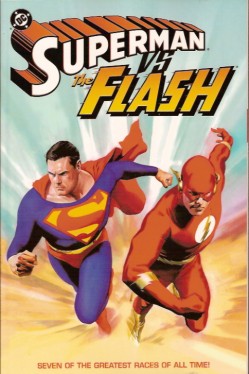
Superman vs The Flash


By Jim Shooter, E. Nelson Bridwell, Dennis O’Neil, Marty Pasko, Dan Jurgens, Geoff Johns, Curt Swan, Ross Andru, Dick Dillin, José Luis García-López, Rick Burchett & various (DC Comics)
ISBN: 978-1-4012-0456-3

The comicbook experience is littered with eternal questions that can never really be satisfactorily answered. The most common and most passionately asked always begin “who would win if…” or “who’s strongest/smartest/fastest…”

Teenaged scripting wunderkind Jim Shooter knew that very well when he pitched and subsequently scripted a Superman story in 1967 that created a sub-genre of comic-plots and led inevitably and delightfully to the graphic compilation under review here.

DC Editors in the 1960s generally avoided such questions as who’s best for fear of upsetting some portion of their tenuous and supposed-transitory fan-base, but as the superhero boom slowed and the upstart Marvel Comics began to make genuine inroads into their market, the notion of a definitive race between the almighty Man of Steel and the Fastest Man Alive became an increasingly enticing and sales-worthy proposition.

This sporty trade paperback chronicle collects Superman #199, Flash #175, World’s Finest Comics #198-199, DC Comics Presents #1-2, Adventures of Superman #463 and DC First: Flash/Superman: spanning August 1967 through July 2002.

Long overdue for re-release and translation to digital formats, it gathers together that initial contest and numerous rematches between the heroic speed-demons, but if you’re seeking a definitive answer you won’t find it here. These are splendid costumed entertainments; adventures designed to catch your breath and quicken your pulse. It not about the winning: it’s all about the taking part…

‘Superman’s Race with the Flash’ (Superman #199, August 1967) gets the ball rolling in a stirring saga by Shooter, Curt Swan & George Klein, wherein the two speedy champions are asked to compete in an exhibition contest by the United Nations, thereby raising money to fight World Hunger.

Naturally they agree, but the clever global handicap, circling the planet three times, is secretly and insidiously subverted by rival criminal combines attempting to stage the greatest gambling coup in history…

Of course, justice and charity triumph in the end, but the stakes are catastrophically raised in the inevitable rematch from Flash #175 (December 1967).

‘Race to the End of the Universe!’ sees the friendly rivals speeding across the cosmos after ruthless alien gamblers threaten to eradicate Central City and Metropolis unless the pair settle who was fastest.

Scripter E. Nelson Bridwell added an ingenious sting in the tale, whilst Ross Andru & Mike Esposito delivered a sterling illustration job in this yarn, but once more the actual winning was deliberately fudged…

When World’s Finest Comics became briefly a team-up vehicle for Superman the first guest-star was the Flash who again found himself in speedy if contrived competition.

‘Race to Save the Universe!’ and its conclusion ‘Race to Save Time’ (WFC #198-199, November and December 1970, by Denny O’Neil, Dick Dillin & Joe Giella) once more upped the stakes as the high-speed heroes are conscripted by the Guardians of the Universe to circumnavigate the entire cosmos at their greatest velocities to undo the rampage of the mysterious Anachronids: faster-than-light creatures whose pell-mell course throughout the galaxies is actually unwinding time itself.

Little did anybody suspect that Superman’s oldest enemies are behind the scheme…

Chase to the End of Time!’ and ‘Race to the End of Time!’ opened the new team-up series DC Comics Presents (#1-2, July-August and September-October 1978) as Marty Pasko and the utterly superb José Luis García-López & Dan Adkins rather reprised that World’s Finest tale with a brace of eternally-warring alien races tricking Superman and Flash into speeding through the time-stream to prevent Earth’s history from being corrupted and destroyed.

As if that wasn’t dangerous enough, nobody could predict the deadly intervention of the Scarlet Speedster’s most dangerous foe, Professor Zoom, the Reverse-Flash…

After the Crisis on Infinite Earths mega-event, DC heroes got a sound refitting, and the frankly colossal power levels of the heroic community were suitably downscaled to more believable levels. Some stalwarts even died, and so, when ‘Speed Kills!’ appeared in Adventures of Superman #463 (February 1990 by writer/artist Dan Jurgens and inker Art Thibert), the issue was touted as the first race between the fastest men on Earth.

There was a new kid in the Flash’s uniform: former sidekick Wally West had graduated to the role after his mentor Barry Allen perished saving the universes in that aforementioned epic…

The story itself is a delightfully whacky romp wherein 5th dimensional gadfly Mr. Mxyzptlk coerces the pair into running a race everybody knew was fixed from the get-go…

This collection concludes with a spectacular saga unerringly aimed at older fans. ‘Speeding Bullets’ (from one-shot DC First: Flash/Superman July 2002) is by Geoff Johns, Rick Burchett & Prentis Rollins, and features futuristic villain Abra Kadabra who challenges the Man of Steel and 1940s Flash Jay Garrick to catch the current Vizier of Velocity – currently running amok at hyper-speed and rapid-aging with every step he takes. If they can’t catch him then the Fastest Man Alive won’t be for long…

With the inclusion to this book of some of the very best covers the company has ever produced – courtesy of Carmine Infantino, Murphy Anderson, Mike Esposito, Curt Swan, Neal Adams, García-López, Jurgens & Brett Breeding and Kevin Nowlan – readers casual or deeply devoted alike are guaranteed a joyous thrill-ride from some of the most entertaining stand-alone stories in DC history.

On your marks… get set… Get!
© 1970, 1972, 1973, 1978, 1990, 2002, 2005 DC Comics. All Rights Reserved.

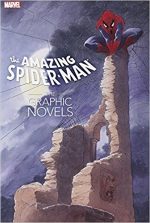
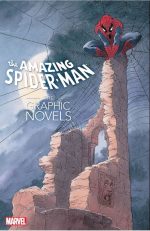
Spider-Man: The Graphic Novels


By Susan K. Putney, Gerry Conway, Stan Lee, Charles Vess, Berni Wrightson, Alex Saviuk, Ross Andru & various (Marvel)
ISBN: 978-0-7851-6065-6

When Marvel began its line of Original Graphic Novels in 1980, the books were based on European Albums: large, square-bound paperback volumes offering 80 to 100 pages of new material on high-quality paper. The project – which began with Jim Starlin’s The Death of Captain Marvel – produced some classy results that the company has seldom come close to repeating since. Both original concepts and established characters were represented in that initial run and many of the stories still stand out today as huge successes: debuting many new series, celebrating licensed properties and devising special stories featuring the company’s proprietary superstars.

Marvel icon the Amazing Spider-Man graced a bunch of extraordinary sagas which were reprinted in 2012 and now form the contents of this splendid oversized (190 x 286 mm) hardback and eBook edition.

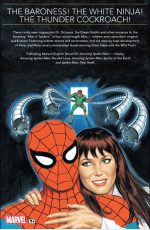
The web-wrapped wonderment begins with Hookey – originally released as Marvel Graphic Novel #22 in August 1986. This charming fantasy fable written by Susan K. Putney and painted by comic-book legend Berni Wrightson with the colouring assistance of Michelle Wrightson took the wallcrawler on a journey unlike any other he had previously experienced…

Marandi Sjörokker is not the carefree little girl she appears to be. For a start she’s been twelve for over two hundred years, and after introducing herself by calling Spider-Man “Petey”, she goes on to reveals how she knew him when he was a toddler and she delivered newspapers to his Uncle Ben…

And so begins a wild and beguiling other-dimensional romp, full of action and spectacle, as the webslinger takes a break from his grim and grimy reality to help the permanently adolescent sorceress battle against the demonic and unstoppable TordenKakerlakk (which I’m reliably informed is Norwegian for Thunder Cockroach).

Moreover, this witty, whimsical coming-of-age tale is beautifully and imaginatively illustrated by a master craftsman. A wonderful change-of-pace tale that perfectly displays the versatility of everybody’s favourite wall-crawler – and one that once read will never be forgotten…

Marvel Graphic Novel #46 was first released in May 1989, soon after Peter Parker married Mary Jane Watson and comes courtesy of Gerry Conway, Alex Saviuk & Andy Mushynsky. By referencing the stories crafted by a host of creators since the Amazing Arachnid’s debut, the tale (with Doctor Octopus as menace du jour) sheds new light on how the newlyweds grew up and grew together against terrible odds to live their now-united but always Parallel Lives…

Charles Vess’ Spirits of the Earth is one of the prettiest graphic novels ever produced, not to say one of the most entertaining Spider-Man adventures ever told and was first released as premium hardcover Marvel Graphic Novel #63 in August 1990.

Here Mary Jane and Peter Parker are astounded and delighted to discover that an unknown relative has left the bride a castle deep in the Scottish Highlands. Setting off for a second honeymoon they soon become embroiled in ancient magic and high-tech abominations courtesy of the Celtic branch of the perfidious Mutants and Millionaires cabal The Hellfire Club…

Ghoulies, ghosties and villainous super-criminals combine with some of the best artwork you’ve ever seen for a truly wonderful adventure that desperately needs to be on your bookshelf. Also included here is a delightful pictorial travelogue by Vess entitled ‘A Scottish Journey’

Wrapping up the vintage adventure is Fear Itself by Gerry Conway, Stan Lee, Ross Andru & Mike Esposito, which was in February 1992 stand-alone OGN Marvel Graphic Novel #72.

This taut thriller is a good, old-fashioned, nostalgic Spidey yarn for readers who yearn for simpler times long past. Unlike many all-new works, it’s also quite tightly bound to Marvel continuity (perhaps it was intended as an annual but got “promoted” to a more expansive and therefore expensive format?), so if you need a lot of footnotes to read Spider-Man you might want to think carefully before plunging in.

The plot concerns the return of old Captain America villain Baron Zemo – radically transformed here by Hitler’s deranged geneticist Arnim Zola. The revived, resurrected and radically revised Zemo steals a new, weaponized drug from the US government developed at the company owned by Peter Parker’s friend Harry Osborn.

This chemical contagion drives victims mad with fear and – in alliance with Nazi-hunting mercenary Silver Sable – our hero travels post haste to Bavaria for a series of life-or death showdowns in a terrific ticking-timebomb-thriller.

Although there are some plot holes you could drive a Kampfpanzer through (that’s a big Nazi tank, you know) the dialogue by two of the wall-crawler’s greatest scribes is still effective and engaging, but the real joy is the last hurrah of the fabulous and criminally undervalued art team of Ross Andru & Mike Esposito, who had been crafting great comics in innumerable genres since the early 1950s, and were Spider-Man’s artists for a huge part of the Seventies.

Thrills. Spills. Chills. Ancient Hills and indomitable wills: this confection of Spidery classics is something no Fights ‘n’ Tights fans should miss. Go on. You know you want to…
© 1986, 1989, 1990, 1992, 2012, 2018 Marvel Characters, Inc. All rights reserved

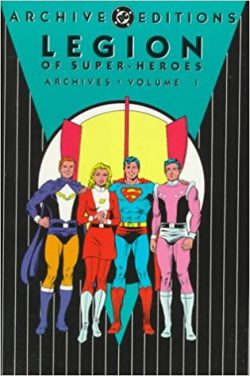
Legion of Super-Heroes: Archive Edition volume 1


By Otto Binder, Jerry Siegel, Edmond Hamilton, Al Plastino, Curt Swan, John Forte, Jim Mooney & various (DC Comics)
ISBN: 978-1-56389-020-8

Once upon a time, in the far future, a band of super-powered kids from dozens of alien civilisations took inspiration from the legend of the greatest champion of all time and formed a club of heroes. One day those Children of Tomorrow came back in time and invited that legend to join them…

And thus began the vast and epic saga of the Legion of Super-Heroes, as first envisioned by writer Otto Binder and artist Al Plastino in early 1958, just as the revived comicbook genre of superheroes was gathering an inexorable head of steam. Since that time the popularity of the Legion has perpetually waxed and waned, with their complex continuity continually tweaked and rebooted, retconned and overwritten again and again to comply with editorial diktat and popular whim.

We Silver Age Legion fans are indubitably the most persistent, passionate, finicky and snitty of all – and editors crossed us at their peril – so when DC announced that it would be gathering all the titanic team’s appearances in a chronological series of deluxe hardcover Archive Editions we were overjoyed (actually most of us thought it was about time and long overdue…) and eager.

Sadly, even in this anniversary year those stories are no longer all in print, but at least old editions like this one from 1997 can still be found if you look hard enough. You’d think in the advanced world of the 21st century a popular series about the future would be available digitally, but you’d be wrong…

Spanning 1958-1963, this glorious full-colour compendium assembles the numerous and far-ranging preliminary appearances of these valiant Tomorrow People and their inevitable progress towards and attainment of their own feature; specifically, all pertinent material from Adventure Comics #247, 267, 282, 290, 293, and 300-305; Action Comics #267, 276, 287 and 289; Superboy #86, 89, 98 and Superman #147.

Also included are an introduction by editor, publisher and devotee Mike Gold, creator biographies and a Curt Swan cover gallery (all inked by either Stan Kaye or George Klein) featuring all the burgeoning band of brothers’ pole positions from those comics.

The multi-hued mob of universe-savers first manifested in Adventure Comics #247 (April 1958) in a Superboy tale wherein three mysterious kids – Lightning Lad, Saturn Girl and Cosmic Boy – invited the bemused Boy of Steel to visit the 30th century and join their team of metahuman champions: all originally inspired by his historic career.

Created by Otto Binder & Al Plastino, the throwaway concept inflamed public imagination and after a slew of further appearances throughout Superman Family titles, the LSH eventually took over Superboy’s lead spot in Adventure for their own far-flung, quirky escapades, with the Caped Kid Kryptonian reduced to simply a face in the in-crowd…

Here, however, the excitement was still gradually building when the kids returned more than 18 months later in Adventure #267 (December 1959) for Jerry Siegel & George Papp to play with.

In ‘Prisoner of the Super-Heroes!‘ the teen wonders reappear to attack and incarcerate the Boy of Steel because of a misunderstood ancient historical record…

The following summer Supergirl met the Legion in Action Comics #267 (August 1960, by Siegel & Jim Mooney) as Lightning Lad, Saturn Girl and Cosmic Boy secretly voyage to modern day America to similarly invite the Maid of Might to join, in a repetition of their offer to Superboy 15 years previously (in nit-picking fact, they claimed to be the children of the original team – a fact glossed over and forgotten these days: don’t time-travel stories make your head hurt…?).

Due to a dubious technicality, young and eager Kara Zor-El fails her initiation at the hands of ‘The Three Super-Heroes’ and was regretfully required to reapply later – but at least we got to meet a few more Legionnaires, including Chameleon Boy, Invisible Kid and Colossal Boy…

With the editors still cautiously testing the waters, it was January 1961 and Superboy #86 before the ‘The Army of Living Kryptonite Men!’ (by Siegel & Papp) turn the LSH into a last-minute Deus ex Machina to save the Smallville Sentinel from juvenile delinquent Lex Luthor‘s most insidious assault.

Two months later in Adventure #282, Binder & Papp introduce Star Boy as a romantic rival for the Last Son of Krypton in ‘Lana Lang and the Legion of Super-Heroes!’

Action #276 (May 1961) then debuted ‘Supergirl’s Three Super Girl-Friends’ (Siegel & Mooney, which finally sees her crack the plasti-glass ceiling and successfully enlist, sponsored by Saturn Girl, Phantom Girl and Triplicate Girl.

We also meet for the first time Bouncing Boy, Shrinking Violet, Sun Boy and potential bad-boy love-interest Brainiac 5 (well at least his distant ancestor Brainiac was a very bad boy…)

Next comes pivotal two-part tale ‘Superboy’s Big Brother’ (by Robert Bernstein & Papp from Superboy #89; June 1961) in which an amnesiac, super-powered space traveller crashes in Smallville, speaking Kryptonese and carrying star-maps written by the Boy of Steel’s long-dead father…

Jubilant, baffled and suspicious in equal amounts Superboy eventually, tragically discovers ‘The Secret of Mon-El’ by accidentally exposing the stranger to a lingering, inexorable death, before desperately providing critical life-support by depositing the dying alien in the Phantom Zone until a cure can be found…

With an August 1961 cover-date, Superman #147 unleashed ‘The Legion of Super-Villains’ (by Siegel, Curt Swan & Sheldon Moldoff): a stand-out thriller featuring Lex Luthor and the adult adversary Legion coming far too close to destroying the Action Ace until the temporal cavalry arrive…

Adventure #290 (November 1961, Bernstein & Papp) seemingly gave Sun Boy a starring role in ‘The Secret of the Seventh Super-Hero!’ – a clever tale of redemption and second chances, followed in #293 (February 1962) by a gripping thriller from Siegel, Swan & George Klein: ‘The Legion of Super-Traitors!’

Here the future heroes are turned evil, prompting Saturn Girl to recruit a Legion of Super-Pets including Krypto, Streaky the Super Cat, Beppo, the monkey from Krypton and Comet the magical Super-horse to save the world – and yes, I typed all that with a (reasonably) straight face…

Siegel & Mooney’s ‘Supergirl’s Greatest Challenge!’ (Action #287, April 1962) has her visit the Legion (quibblers be warned: it is mistakenly described as the 21st century in this story) to save future Earth from invasion. She also meets a telepathic descendent of her cat Streaky. His perhaps ill-considered name was Whizzy…

Action #289 featured ‘Superman’s Super-Courtship!’ wherein the Girl of Steel scours the universe for an ideal mate for her cousin. One highly likely candidate is the adult Saturn Woman, but her husband Lightning Man objects…

Perhaps charming at the time, but modern sensibilities might quail at the conclusion that Superman’s perfect match is a total doppelganger of Supergirl herself, albeit thankfully a few years older…

By the release of Superboy #98 (July 1962), the decision had been made. The buying public wanted more Legion stories and once ‘The Boy with Ultra-Powers’ by Siegel, Swan & Klein introduced a mysterious lad with greater powers than the Boy of Steel, the focus shifted to Adventure Comics #300 (cover dated September 1962) wherein the futuristic super-squad finally begin their own series; even occasionally stealing the odd cover-spot from the still top-featured Superboy.

Tales of the Legion of Super-Heroes opened its stellar run with Siegel, John Forte & Plastino’s ‘The Face Behind the Lead Mask!’; a fast-paced premier pitting Superboy and the 30th century champions against an impossibly unbeatable foe. All looks bleak until Mon-El – long-trapped in the Phantom Zone – briefly escapes a millennium of confinement to save the day…

In those halcyon days humour was as important as action, imagination and drama, so many early escapades were light-hearted and overtly moralistic. Issue #301 offered hope to fat kids everywhere with ‘The Secret Origin of Bouncing Boy!’ – by regular creative team Siegel & Forte – wherein the process of open auditions is instigated (providing devoted fans with loads of truly bizarre and memorable applicants over the years) whilst allowing the rebounding human rotunda to give a salutary pep talk and inspirational recount of heroism persevering over adversity.

Adventure #302 highlighted ‘Sun Boy’s Lost Power!’ as the golden boy is forced to resign until fortune and boldness restore his abilities after which ‘The Fantastic Spy!’ in #303 provides a tense tale of espionage and possible betrayal by new member Matter-Eater Lad.

The happy readership was stunned by the events of #304 when Saturn Girl engineered ‘The Stolen Super-Powers!’ to make herself a one-woman Legion. Of course, it was for the best possible reasons, but still didn’t prevent the shocking murder of Lightning Lad…

With comfortable complacency utterly destroyed, #305 further shook everything up with ‘The Secret of the Mystery Legionnaire!’ – who turned out to be the long-suffering Mon-El, finally cured of terminal lead poisoning and freed from his Phantom Zone prison.

The Legion is undoubtedly one of the most beloved and bewildering creations in American comicbook history and largely responsible for the growth of the groundswell movement that became Comics Fandom. Moreover, these sparkling, simplistic and astoundingly addictive stories, as much as the innovations of Julie Schwartz’s Justice League, fired up the interest and imaginations of a generation of young readers and built the industry we all know today.

Naive, silly, joyous, stirring and utterly compelling yarns are precious and fun beyond any ability to explain, and if you love comics and haven’t read this stuff, you are the poorer for it and need to enrich your future life as soon as possible…
© 1958-1964, 1991, 1997 DC Comics. All Rights Reserved.

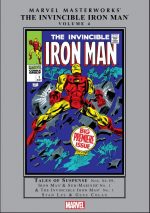
Iron Man Marvel Masterworks volume 4


By Stan Lee, Archie Goodwin, Gene Colan & various (Marvel)
ISBN: 978-0-7851-2678-2 (HB)

Marvel’s rise to dominance of the US comicbook industry really took hold in 1968 when most of their characters finally got their own titles. Prior to that – and due to a highly restrictive distribution deal – the company had been tied to a limit of 16 publications per month. To circumvent this drawback, Marvel developed “split-books” with two features per title, such as Tales of Suspense where Iron Man originally solo-starred before being joined by patriotic cohort Captain America in issue #59 (cover-dated November 1964).

Marvel’s fortunes prospered – thanks in large part to Stan Lee’s gift for promotion, but primarily because of superbly engaging stories such as the ones collected in this enticing hardback and/or eBook edition.

With the new distributor came a demand for more product, and the stars of the split books were all awarded their own titles. When the division came, the Armoured Avenger started afresh with a “Collector’s Item First Issue” (but only after a shared one-shot with the Sub-Mariner that squared divergent schedules) with Cap retaining the numbering of the original title; thereby premiering in number #100.

Herein find contained in chronological order the remaining tales of the transitional period, reprinting Tales of Suspense #84-99, plus the pertinent portion of place-holding one-shot Iron Man and the Sub-Mariner #1 and at long last Iron Man #1, cumulatively covering December 1966 to May 1968.

Tony Stark is the acceptable face of 1960s Capitalism; a glamorous ultra-rich industrialist and inventor – and a benevolent all-conquering hero when clad in the super-scientific armour of his secret alter-ego, Iron Man.

Created in the aftermath of the Cuban Missile Crisis and at a time when “Red-baiting” and “Commie-bashing” were American national obsessions, the emergence of a brilliant new Thomas Edison, using Yankee ingenuity and invention to safeguard and better the World, seemed inevitable. Combine the then-sacrosanct belief that technology and business could solve any problem with the universal imagery of noble knights battling evil and the concept behind the Golden Avenger seems an infallibly successful proposition. Of course, it helps that all that money and gadgetry is great fun and very, very cool…

Following a critique by critic and historian Arlen Schumer in his Introduction, this stunning all-Gene Colan illustrated volume begins with ToS #84 and picks up soap opera fashion with Stark submitting to months of governmental pressure and testifying to a Congressional Committee hungry for the secrets of his greatest creation.

However. at the critical moment, the inventor keels over…

Stark’s controversial reputation is finally restored as the public at last learns that his life is only preserved by a metallic chest-plate which keeps his maimed heart beating in ‘The Other Iron Man!’ (scripted by Lee and inked by Frank Giacoia). Somehow, nobody at all connects that hunk of steel to the identical one his Avenging “bodyguard” wears…

With the hero stuck in a hospital bed, best friend Happy Hogan foolishly dons the suit to preserve that precious secret only to be abducted by the insidious Mandarin in another extended assault that begins with ‘Into the Jaws of Death’.

Propelled by guilt and fuelled by fear the still-ailing Stark breaks into his own Congressionally-closed factory and creates new, more powerful armour before flying to his rescue in ‘Death Duel for the Life of Happy Hogan!’

The epic encounter successfully concluded, the Americans return home just in time for #87 and #88 to host the merciless Mole Man who attacks from below, prompting a ‘Crisis… at the Earth’s Core!’

The villain has no idea who hostage Stark really is, believing the inventor and his assistant Pepper Potts ‘Beyond all Rescue!’ but is soon proved very wrong, after which another old B-List bad-guy takes his shot in ‘The Monstrous Menace of the Mysterious Melter!’

Its tense, terse sequel ‘The Golden Ghost!’ fabulously features a glorious reprise of Iron Man’s original battle suit and a wonderfully twisty conclusion.

‘The Uncanny Challenge of the Crusher!’ offers an all-action tale – possibly marred for modern audiences by a painful Commie-bustin’ sub-plot featuring a thinly disguised Fidel Castro – and the impressions of the on-going “Police Action” in Indo-China are also a little gung-ho (if completely understandable) when Iron Man goes hunting for a Red Menace called Half-Face ‘Within the Vastness of Viet Nam!’

The urgent insertion results in another clash with incorrigible old foe Titanium Man in ‘The Golden Gladiator and… the Giant!’ before our hero at last snatches victory from the mechanical jaws of defeat in ‘The Tragedy and the Triumph!’ (this last inked by Dan Adkins).

Giacoia returns and a new cast member debuts in #95 as eager-beaver adult boy scout S.H.I.E.L.D. agent Jasper Sitwell is assigned as security advisor to America’s most prominent weapons maker, just as veteran Thor villain Grey Gargoyle attacks in ‘If a Man be Stone!’ The mismatched and overpowered maniac is then summarily defeated in ‘The Deadly Victory!’

Tales of Suspense #97 began an extended story-arc that would carry the series to the launch of the solo series and beyond, in which criminal cartel the Maggia schemes to move in on Stark’s company.

Their campaign opens with the hero’s capture, as ‘The Coming of… Whiplash!’ depicts the Golden Avenger cut to steely ribbons, drawn out in ‘The Warrior and the Whip!’ and – as the magnificent Archie Goodwin assumed the scripting reins and EC legend Johnny Craig came aboard as inker – finds Iron Man trapped on a sinking submarine ‘At the Mercy of the Maggia’ just as the venerable Tales of Suspense ends with its 99th issue…

Of course, it was just changing its name to Captain America, whilst Tales to Astonish seamlessly shifted into The Incredible Hulk, but – due to a scheduling snafu – neither of the split-book co-stars had a home that month (April 1968).

This situation led to the one-and-only Iron Man and the Sub-Mariner #1 to carry concluding episode ‘The Torrent Without… The Tumult Within!’, wherein sinister super-scientists of A.I.M. (Advanced Idea Mechanics, acronym-fans) snatch the Armoured Avenger from the Maggia’s swiftly sinking submarine, intent on stealing the hero’s technical secrets.

Invincible Iron Man #1 finally appeared with a May 1968 cover-date, triumphantly ending the extended sub-sea-saga as our hero stands ‘Alone against A.I.M.!’: a thrilling roller-coaster ride supplemented by ‘The Origin of Iron Man’ offering a revitalised re-telling to conclude Colan’s long and impressive tenure on the character.

Supplementing and counterpointing the ongoing graphic dramas herein are a stunning selection of original art pages and covers by Colan from the stories in this volume and even a brace of Don Heck pages from the previous Marvel Masterworks edition…

Despite some rough narrative patches this is a fantastic period in the Golden Gladiator’s career: one immaculately envisioned by Gene Colan and perfectly encapsulating the vast changes Marvel and America went through at the time. These unmissable tales of a true comics icon are some of the best and most memorable efforts of a simply transformative era and no Fights ‘n’ Tights fanatic can afford to be without them.
© 1966, 1967, 1968, 2017 Marvel Characters, Inc. All rights reserved.