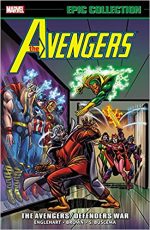
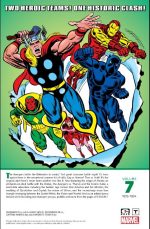
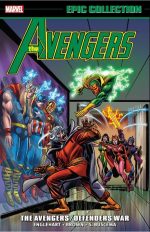
Avengers Epic Collection Volume 7: The Avengers/Defenders War


By Steve Englehart, Roy Thomas, Jim Starlin, Gerry Conway, Bob Brown, Sal Buscema, John Buscema, Rich Buckler & various (Marvel)
ISBN: 978-1-3029-1000-6

One of the most momentous events in comics history came in the middle of 1963 when a disparate gang of heroic individuals banded together to combat an apparently out of control Incredible Hulk.

The Avengers combined most of the company’s fledgling superhero line in one bright, shiny and highly commercial package. Over the intervening decades the roster has unceasingly changed, and now almost every character in the Marvel multiverse has at some time numbered amongst their colourful ranks…

The Avengers always proved that putting all one’s star eggs in on single basket can pay off big-time. Even when all Marvel Royalty such as Thor, Captain America and Iron Man are absent, it merely allows the team’s lesser lights to shine more brightly.

Of course, the founding stars always regularly feature due to a rotating, open door policy ensuring most issues include somebody’s fave-rave.

After instigators Stan Lee & Jack Kirby moved on, the team prospered under the guidance of Roy Thomas who grew into one of the industry’s most impressive writers, guiding the World’s Mightiest Heroes through a range of adventures ranging from sublimely poetic to staggeringly epic. He then handed over the scripting to a young writer who carried the team to even greater heights…

This stunning seventh trade paperback compilation – also available in eBook iterations – assembles Avengers #115-128 and Giant Size Avengers #1, plus crucial crossover episodes from Defenders #8-1, Captain Marvel #33 and Fantastic Four # 150; collectively covering September 1973 to October 1974 and celebrating an era of cosmic catastrophe and cataclysmically captivating creative cross-pollination…

For kids – of any and all ages – there is a simply primal fascination with brute strength and feeling dangerous, which surely goes some way towards explaining the perennial interest in angry tough guys who break stuff as best exemplified by Prince Namor, the Sub-Mariner and the Incredible Hulk.

When you add the mystery and magic of Doctor Strange the recipe for thrills, spills and chills becomes simply irresistible…

Last of the big star-name conglomerate super-groups, the Defenders would eventually number amongst its membership almost every hero – and some few villains – in the Marvel Universe.

No surprise there then since the initial line was composed of the company’s major league bad-boys: misunderstood, outcast and often actually dangerous to know. For Marvel in the 1970s, the outsider super-group must have seemed a conceptual inevitability – once they’d finally published it.

Apart from Spider-Man and Daredevil, all their heroes regularly teamed up in various mob-handed assemblages, and in the wake of the Defenders’ success even more super-teams featuring pre-existing characters would be packaged: The Champions, Invaders, New Warriors, Inhumans, Guardians of the Galaxy and so on… but never again with so many Very Big Guns…

The genesis of the team in fact derived from their status as publicly distrusted “villains”, and they never achieved the “in-continuity” fame or acceptance of other teams, but that simply seemed to leave the creators open to taking a few chances and playing the occasional narrative wild card.

In 1973 wunderkind scripter Steve Englehart was writing both Avengers and Defenders (as well as Doctor Strange, the Hulk and Luke Cage, Hero for Hire) and, yearning for the days of DC’s summer blockbuster annual events, decided to attempt his own massive multi-player epic.

Bravely given the editorial go-ahead at a time when deadline crunches regularly interrupted ongoing storylines, the author and his regular pencillers Sal Buscema and Bob Brown laid their plans…

Threads had been planted as early as Defenders #4 with Englehart carefully putting players in place for a hugely ambitious cross-over experiment: one that would turn the comics industry on its head.

After earthly madwoman Barbara Norris was cursed by amoral Asgardian Amora the Enchantress, the human was transformed into an incarnation of old Avengers enemy Valkyrie. The denouement of the tale also left part-time Avenger and Defender the Black Knight an ensorcelled, immobile stone statue. As Strange and Co. searched for a cure, aided by the Silver Surfer and tempestuous Hawkeye (another ex-Assembler looking to forge a solo career), they all fell into a subtle scheme orchestrated by two of the greatest forces of evil in all creation….

This bombastic tome commences with Avengers #115 as lead story ‘Below Us the Battle!’ (illustrated by Bob Brown & Mike Esposito sees the critically- understaffed Avengers travel to England and the castle of the Black Knight, only to find mystic resistance, a troglodytic race of scavengers and their old comrade long missing…

The issue also contained a little prologue, ‘Alliance Most Foul!’, which revealed other-dimensional Dark Lord Dormammu and Asgardian god of Evil Loki united to secure an ultimate weapon which would give them ultimate victory against all their foes.

This despotic duo would deceive the Defenders into securing the six component parts by “revealing” that the reconstructed Evil Eye could de-petrify and restore the Black Knight – a plan that began with a similar prologue at the end of Defenders #8…

‘Deception’ (Englehart, Sal Buscema & Esposito) was the first chapter in ‘The Avengers/Defenders Clash’ disclosing that a mystic SOS message from the spirit of the Black Knight is intercepted by the twin gods of evil, leading directly to ‘Betrayal!’ in Avengers #116, wherein the heroes, hunting for their missing comrade, “discover” that their oldest enemies Hulk and Sub-Mariner may have turned the Black Knight to stone…

This and third chapter ‘Silver Surfer Vs. the Vision and the Scarlet Witch’ see the rival teams split up: one to gather the scattered sections of the Eye and the other to stop them at all costs…

Defenders #9 (with Sal Buscema & Frank McLaughlin art) begins with tense recap ‘Divide …and Conquer’ before ‘The Invincible Iron Man Vs. Hawkeye the Archer’ and ‘Dr. Strange Vs. the Black Panther and Mantis’ sheds more suspicion and doubt on the vile villains’ subtle master-plan…

In Avengers #117, ‘Holocaust’, ‘Swordsman Vs. the Valkyrie’ and crucial turning point ‘Captain America Vs. Sub-Mariner’ (all by Brown & Esposito) lead to the penultimate duel in Defenders #10 (Sal Buscema & Frank Bolle) in ‘Breakthrough! The Incredible Hulk Vs. Thor’ and the inevitable joining together of the warring camps in ‘United We Stand!’. Tragically, understanding comes too late as Dormammu seizes the reconstructed Evil Eye and uses its power to merge his monstrous realm with Earth.

Avengers #118 delivers the cathartic climactic conclusion in ‘To the Death’ (Brown, Esposito & Frank Giacoia) wherein all the heroes of the Marvel Universe resist the demonic invasion on hideously mutated home soil whilst the Avengers and Defenders plunge deep into the Dark Dimension itself to end forever the threat of the evil gods (well, for the moment, at least…).

With the overwhelming cosmic threat over the victorious Defenders attempt to use the Eye to cure their petrified comrade, only to discover that his spirit has found a new home in the 12th century.

In #11’s ‘A Dark and Stormy Knight’ (Sal B with Bolle inks), the group battle black magic during the Crusades, fail to retrieve the Knight and acrimoniously go their separate ways – as did overworked departing scripter Englehart, who dropped the “non-team” to concentrate on “The World’s Greatest Super-Heroes”…

The drama resumes with a delightfully traditional spooky Halloween tale as the Avengers, warned by clairvoyant vision from martial arts enigma Mantis, head to Rutland, Vermont for the ‘Night of the Collector’ (#119, illustrated by Brown & Don Heck); encountering old friends, a dastardly and determined foe, blistering action and staggering suspense…

In ‘Death-Stars of the Zodiac!’ (Avengers#120, by Englehart, Brown & Heck), terrorist astrological adversaries and super-criminal cartel Zodiac attack again with a manic plan to eradicate everyone in Manhattan born under the sign of Gemini.

Thor, Iron Man, Vision, Scarlet Witch, Swordsman and Mantis are seemingly helpless to stop them but the blockbusting battle in #121’s ‘Houses Divided Cannot Stand!’ (illustrated by John Buscema & Heck,) and even the added assistance of Captain America and the Black Panther is of little advantage…

With Mantis injured the team begin to question her mysterious past, only to be lured to their seeming doom and ‘Trapped in Outer Space!’ (Brown & Mike Esposito) before at last turning the tables on their fearsome foes after the criminal Libra reveals a shocking secret…

Avengers #123, ( Brown & Heck) begins a vast and ambitious saga with ‘Vengeance in Viet Nam – or – An Origin For Mantis!’ as Libra’s claim to be Mantis’ father (a story vigorously and violently denied by the Martial Arts Mistress) sends the team to Indo-China in a big hurry.

The former mercenary declared that he left the baby Mantis with pacifistic Priests of Pama after running afoul of a local crime-lord, but the bewildered warrior-woman has no memory of such events, nor of being schooled in combat techniques by the Priests. Meanwhile, the gravely wounded Swordsman has also rushed to Saigon to confront his sadistic ex-boss Monsieur Khruul and save the Priests from being murdered by the gangster’s thugs… but is again too late. It is the same old story of his pathetic, wasted life…

Issue #124 has the team stumbling upon a scene of slaughter as dead clerics and criminals lead to a monstrous planet-rending alien horror freshly awakened in ‘Beware the Star-Stalker!’ (limned by John Buscema & Dave Cockrum)…

Mantis is forced to accept that her own memories are not real after Avengers #125, which unleashed ‘The Power of Babel!’ after a vast alien armada attacks and, in combating it, the Earth’s Mightiest Heroes are trapped out of phase with their home-world.

This blockbuster battle bonanza was a crossover, and the penultimate episode of the spectacular Thanos War Saga that had featured in Captain Marvel, Marvel Feature and Iron Man.

Included in this compendium is climactic last chapter of that epic, plotted and illustrated by Jim Starlin, scripted by Englehart and inked by Klaus Janson. ‘The God Himself!’ (from Captain Marvel #33) sees mad Titan Thanos finally fall in combat to the valiant Kree warrior: a stunning piece of comics storytelling which stands up remarkably well here despite being seen without benefit of the preceding ten chapters…

It’s back to Avengers business as Roy Thomas, Rich Buckler & Dan Adkins return to the fold to delve and reboot some superhero history with ‘Nuklo… The Invader that Time Forgot!’ for the first quarterly edition of Giant-Size Avengers.

The stirring saga reintroduced 1940 Marvel sensation Bob Frank AKA The Whizzer in a taut and tragic tale of desperation as the aged speedster begs the heroes’ help in rescuing his son: a radioactive mutant locked in stasis by the US Government since the early 1950s. Unfortunately, within the recently unearthed chrono-capsule, the lad has grown into a terrifying atomic horror…

Moreover, while in the throes of a stress-induced heart attack the Whizzer lets slip that he is the also the father of mutant Avengers Scarlet Witch and Quicksilver…

Back in regular continuity, Avengers #126 offers ‘All the Sights and Sounds of Death!’ (Englehart, Brown & Cockrum) as villains Klaw and Solarr invade Avengers Mansion in a devious attempt to achieve vengeance for past indignities, after which in #127 Sal Buscema & Joe Staton sign on as regular art team with ‘Bride and Doom!’ as the team voyage to the hidden Himalayan homeland of The Inhumans to attend the marriage of the aforementioned Quicksilver to elemental enchantress Crystal. Sadly, the happy event craftily coincides with an uprising of the genetic slave-race known as Alpha Primitives. Once again robotic giant Omega has incited the revolt, but this time it is controlled by an old Avengers enemy who reveals himself in the concluding chapter of the crossover…

The story wraps up in Fantastic Four #150 with ‘Ultron-7: He’ll Rule the World!’ by Gerry Conway, Buckler & Joe Sinnott, in which a devastating battle between FF, Inhumans and Avengers is ended by a veritable Deus ex Machina moment, after which, at long last ‘The Wedding of Crystal and Quicksilver’ ends events on a happy note.

But not for long as a final tale from Avengers #128′ sees the FF’s nanny Agatha Harkness get a new job tutoring Wanda Frank in actual sorcery to augment her mutant power. In Bewitched, Bothered, and Dead!’ (Englehart, Sal Buscema & Staton), the new student unwittingly allows dark mage Necrodamus access to the Mansion and the souls of the occupants, even as increasingly troubled Mantis makes a play for the Scarlet Witch’s synthezoid boyfriend The Vision; heedless of the hurt and harm she will bring to her current lover The Swordsman…

Extra enticements include Roy Thomas’ ‘Avengers Re-Assemble’ article from Giant-Size Avengers #1, art and features starring assorted Avengers from company fanzine F.O.O.M. (#3, 5, 6, 7, by John and Sal Buscema, John Byrne & Duffy Vohland, Marie Severin, Dave Cockrum, John Romita); comedy skit ‘Those Wedding Bells are Bustin’ Up that Avengin’ Gang of Mine‘ by Tony Isabella & Paty Cockrum; House ads, covers from previous collections by Carlos Pacheco, Jesus Merino & Ang Tsang and Romita & Richard Isanove and an original art gallery of sketches, pages and covers by Brown, Romita, Starlin, Ron Wilson, John and Sal Buscema, Buckler and Byrne.

Roy Thomas and Steve Englehart were at the forefront of Marvel’s second generation of story-makers, brilliantly building on and consolidating the compelling creation of Stan Lee, Jack Kirby and Steve Ditko: spearheading and constructing a logical, fully functioning wonder-machine of places and events that so many others were inspired by and could add to.

These terrific tales are perfect examples of superhero sagas done just right and also a pivotal step transforming the little company into today’s multinational corporate colossus. Englehart’s forthcoming concoctions would turn the Marvel Universe on its head and pave the way for a new acme of cosmic adventure…
© 1973, 1974, 2018 Marvel Characters, Inc. All rights reserved.
Avengers Epic Collection Volume 7: The Avengers/Defenders War is scheduled for release on April 24th and is available digitally or for pre-order now.
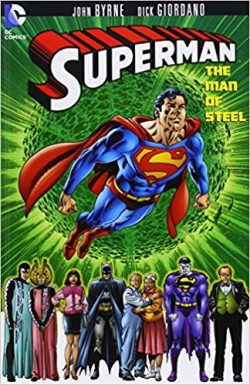
Superman: The Man of Steel


By John Byrne & Dick Giordano (DC Comics)
ISBN: 978-0-93028-928-7

In 1985 when DC Comics decided to rationalise, reconstruct and reinvigorate their continuity with Crisis on Infinite Earths they used the event to simultaneously regenerate their key properties at the same time.

The biggest gun they had was Superman and it’s hard to argue that the change was not before time.

The big guy was in a bit of a slump, but he’d weathered those before. So how could a root and branch retooling be anything but a pathetic marketing ploy that would alienate the real fans for a few fly-by-night Johnny-come-latelies who would jump ship as soon as the next fad surfaced? This new Superman was going to suck…

He didn’t.

The public furore began with all DC’s Superman titles being “cancelled” (actually suspended) for three months, and yes, that did make the real-world media sit-up and take notice of the character everybody thought they knew for the first time in decades. However, there was method in this seeming corporate madness.

The missing mainstays were replaced by a 6-part miniseries running from October to December 1986. Entitled Man of Steel it was written and drawn by Marvel’s mainstream superstar John Byrne and inked by venerated veteran Dick Giordano.

The bold manoeuvre was a huge and instant success. So much so that when it was first collected as a stand-alone compilation album in the 1980s (currently redesigned and available in trade paperback and digital editions as volume 1 of an ongoing series of far too occasional reprint editions), it became one of comics’ premiere ‘break-out’ hits in a new format that would eventually become the industry standard for reaching mass readerships. Nowadays very few people buy the periodical pamphlets but almost everybody has read a graphic novel…

From that overwhelming start the Action Ace seamlessly returned to his suspended comicbook homes with the addition of a third monthly title premiering that same month.

Superman, Adventures of Superman, and Action Comics (which acted as a fan-pleasing team-up book guest-starring other favourites of the DC Universe, in the manner of the cancelled DC Comics Presents) were instant best-sellers.

So successful was the relaunch that by the early 1990’s Superman would be carrying four monthly titles as well as Specials, Annuals, guest shots and his regular appearances in titles such as Justice League.

Quite a turnaround from the earlier heydays of the Man of Steel when editors were frantic about never overexposing their meal-ticket.

In Superman’s 80th year of more-or-less consecutive and continuous publication, this collection offers six self-contained stories from key points in Superman’s career, newly readjusted for contemporary consumption in the wake of that aforementioned worlds-shattering Crisis.

Starting with a startling new and bleakly dystopian view of Krypton, ‘From Out of the Green Dawn’ follows the child’s voyage in a self-propelled birthing matrix to a primitive world.

Discovered by childless couple Jonathan and Martha Kent, the alien foundling spends his years growing secretly in Smallville, indistinguishable from other earthlings until strange abilities begin to gradually manifest.

Eighteen years after his arrival the boy learns of his extraterrestrial origins and leaves home to wander the world. Clark Kent eventually settles in Metropolis and we get a rapid re-education of what is and isn’t canonical as he performs his first public super-exploit, meets with Lois Lane, joins the Daily Planet and gets an identity-obscuring costume…

Lois takes centre-stage for the second issue, scheming and manipulating to secure the first in-depth interview with the new hero before losing out to neophyte colleague Kent whose first big scoop becomes ‘The Story of the Century!’

The third chapter recounts the Metropolis Marvel’s first meeting with Batman as ‘One Night in Gotham City’ reveals a fractious and reluctant team-up to capture murdering thief Magpie. The unsatisfactory encounter sees the heroes part warily, not knowing if they will become friends or foes…

‘Enemy Mine…’ in MoS #4 expands and redefines the new Lex Luthor: a genius, multi-billionaire industrialist who was the most powerful man in Metropolis until the Caped Crime-buster appears. When the tycoon overreaches himself in trying to suborn the hero, he is publicly humiliated and swears vengeance and eternal enmity…

By ‘The Mirror, Crack’d’ in issue #5 Luthor is Superman’s greatest foe – albeit one who scrupulously maintains a veneer of respectability and plausible deniability. Here, Luthor’s clandestine attempt to clone his own Man of Tomorrow results in a monstrous flawed duplicate dubbed Bizarro and introduces Lois’ sister Lucy to play hapless victim in a moving tale of triumph and tragedy.

The reimagination concludes with ‘The Haunting’ as a troubled Clark/Superman returns to Smallville. Reuniting with childhood sweetheart Lana Lang (who shares his secrets and knows as much as he of his alien origins), the strange visitor finally learns of his Kryptonian origins when the birthing matrix projects a recorded message from his long-dead parents and their hopes and plans for him…

The shock and reaction of his foster family only affirms his dedication and connection to humanity…

John Byrne was a controversial choice at the time, but he magnificently recaptured the exuberant excitement and visually compelling, socially aware innovation which informed and galvanised Jerry Seigel and Joe Shuster’s inspired creation. Man of Steel granted a new generation the same kind of intoxicating four-colour fantasy that was the original Superman, and made it possible to be a fan again, no matter your age or prejudice. Superman had always been great, but Byrne had once again made him thrilling. Rivetingly so.

A saga well worth your time and your money and a genuine Must-Have for any serious collector and reader.
© 1987, 2005 DC Comics. All Rights Reserved.

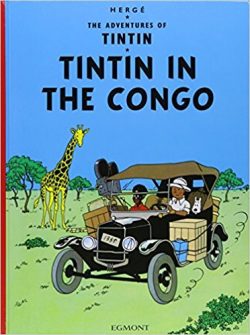
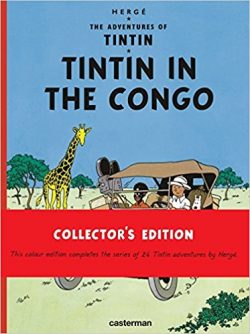
Tintin in the Congo


By Hergé & various; translated by Leslie Lonsdale-Cooper and Michael Turner (Egmont)
ISBN: 978-2-20309-650-9 (2016 HB)           :978-0-78595-830-7 (1987 HB)
:978-1-40526-651-2 (PB)

Georges Prosper Remi, known universally as Hergé, created a true masterpiece of graphic literature with his many tales of a plucky boy reporter and his entourage of iconic associates.

Singly, and later with assistants including Edgar P. Jacobs, Bob de Moor and the Hergé Studio, Remi completed 23 splendid volumes (originally produced in brief instalments for a variety of periodicals) that have grown beyond their popular culture roots and attained the status of High Art.

Like Charles Dickens with the Mystery of Edwin Drood, Hergé died in the throes of creation, and final outing Tintin and Alph-Art remains a volume without a conclusion, but still a fascinating examination – and a pictorial memorial of how the artist worked.

It’s only fair though, to ascribe a substantial proportion of credit to the many translators whose diligent contributions have enabled the series to be understood and beloved in 38 languages. The subtle, canny, witty and slyly funny English versions are the work of Leslie Lonsdale-Cooper & Michael Turner.

On leaving school in 1925, Remi worked for Catholic newspaper Le XXe Siécle where he seems to have fallen under the influence of its Svengali-like editor Abbot Norbert Wallez. The following year, the young artist – himself a dedicated boy-scout – produced his first strip series – The Adventures of Totor – for the monthly Boy Scouts of Belgium magazine and by 1928 was in charge of producing the contents of Le XXe Siécle’s children’s weekly supplement Le Petit Vingtiéme.

He was unhappily illustrating The Adventures of Flup, Nénesse, Poussette and Cochonette (written by the staff sports reporter) when Abbot Wallez urged Remi to create a new adventure series. Perhaps a young reporter who would travel the world, doing good whilst displaying solid Catholic values and virtues?

And also, perhaps, highlight and expose some the Faith’s greatest enemies and threats…?

Having recently discovered the word balloon in imported newspaper strips, Remi decided to incorporate this simple yet effective innovation into his own work. He would produce a strip that was modern and action-packed. Beginning on January 10th 1929, Tintin in the Land of the Soviets appeared in weekly instalments in Le Petit Vingtiéme, eventually running until May 8th 1930. The boy-hero – a combination of Ideal Good Scout and Remi’s own brother Paul (a soldier in the Belgian Army) would be accompanied by his dog Milou (Snowy to us Brits) and report back all the inequities from the “Godless Russias”.

The strip’s prime conceit was that Tintin was an actual foreign correspondent for Le Petit Vingtiéme…

The odyssey was a huge success, assuring further – albeit less politically charged and controversial exploits – to follow. At least that was the plan…

Whereas the originally serialised tale was simply black and white and episodic, Tintin in the Congo as a book is much more stylistically familiar to modern readers. This saga, which originally ran in Le Petit Vingtiéme from June 1930 to June 1931, was radically restructured in 1946 for release as a collected album, and later, a rather shocking page featuring a rhinoceros, a hand-drill and a stick of dynamite was deftly replaced with a much funnier scene…

Moreover, this tale was unavailable to English-readers for years due to its depiction of ethic people and its white Eurocentric bias: a situation confronted and addressed head-on in the 2016 Collectors Edition in a forthright and contextualising Forward…

So, making allowances for the time frame, what’s here?

Still hampered by his weekly, episodic format, Tintin and Snowy take ship for the Belgian Congo where they perforce have many little adventures, but also incredibly uncover a plot by US gangster Al Capone to take control of Africa’s diamond trade…

The book version features a Tintin retrofitted for both artistic and commercial reasons. By 1946 Hergé had completed thirteen full Tintin adventures and the characters were fully developed. It was both logical and preferable that new readers be presented with a consistent vision. Moreover, as Hergé had grown as both author and artist, the album editions gave him an opportunity to rectify some earlier decisions that he had long regretted.

When producing work for a perpetual deadline not only are you trapped by the urgent need to finish and move on, but you are imprisoned in the context of your own times. When ‘The Congo’ ran in 1930-1931, representations of ethnicities and more importantly the attitudes of a Belgium that was still a Colonial and Imperial Power informed the text and indubitably influenced the Catholic newspaper then paying for the strip.

In later years Hergé admitted to deeply regretting much of his early work and took every opportunity to repair it.

A scene in which natives are taught that they are happy Belgians was gladly replaced with a maths lesson and many images and scenes were subtly altered to enhance the standing and image of native Africans. The ongoing controversy regarding ethnic depictions in historical comics (and remember, this tale is almost ninety years old) seems doubly cynical and politically self-serving when one considers that Hergé was rectifying what he saw as racial slurs in the 1940s whilst modern society is still denying that there’s a problem. For every black African waving a spear and shield in this story there’s another in a suit, a uniform or tee shirt.

This yarn might be potentially controversial but it is also the transitional outing that confirmed the boy-hero’s drawing power: a highly readable, joyously thrilling, exuberant and deeply informative adventure romp for any fan of the comic strip medium.

And, although each exploit can be read singly, since Hergé was an early proponent of extended continuity, this early epic is actually necessary reading if you want a better understanding of the Tintin masterpieces to come.

Tintin in the Congo: artwork © 1946, 1974, 2016 Editions Casterman, Paris & Tournai.
Text © 2005 Egmont UK Limited. All Rights Reserved.

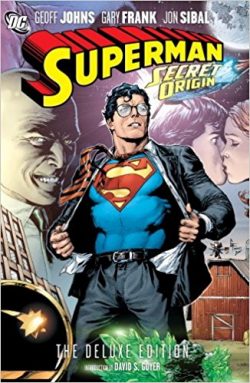
Superman Secret Origin


By Geoff Johns, Gary Frank, Jon Sibal & various (DC Comics)
ISBN: 978-1-4012-2697-8(HC)                     978-1-4012-3299-3(TPB)

One of the perennial dangers of comicbook longevity is the incessant – and, as you get older, apparently hyper-accelerated – revisionism afflicting origin stories. Characters with any measure of success or staying power are continually reinvented to appeal to new readers and generally appal or gradually disaffect veteran aficionados.

Moreover, nowadays it seems to happen sooner and sooner into a rebooted hero’s run.

Batman and Superman in particular seem accursed by this situation, as much because of their broad mass-media appeal as their perfectly simple bedrock concepts. In recent years DC has been sedulously and assiduously editing, in-filling and cross-fertilising its icons until – whether through movies, animated cartoons, TV shows, video games or the comics themselves – followers of the World’s Finest Heroes can be assured that the ephemera and backstory always remain consistent and reliably reconcilable.

The upside of this is that as long as we fanboys can sufficiently stifle our chagrin and curb our umbrage, every so often we can enjoy a fresh but not condescending, vivacious but not fatuous, re-imagining of our best-beloved childhood touchstones…

Through 2009 and 2010 Geoff Johns & Gary Frank remastered the Man of Tomorrow with 6-issue miniseries Superman: Secret Origin which, whilst reinstating many formerly-erased elements of the classic Silver Age mythology and incorporating much of John Byrne’s groundbreaking 1986 reboot (as collected in the Man of Steel), created a new version in tune with Mark Waid, Lenil Francis Yu & Gerry Alanguilan’s 2003 (Smallville TV-show inspired) Superman: Birthright.

Moreover, the resultant story similarly legitimised and fully absorbed the Christopher Reeve Superman movies into the canon, with Frank’s supremely authentic renditions making the actor’s appearance and demeanour – as both Action Ace and klutzy Clark Kent – the definitive comicbook look for the Action Ace.

This particularly well-known folk-tale-retold (available in hardcover, trade paperback and digital editions) opens with an Introduction by screenwriter, producer and occasional comics scribe David S. Goyer before the drama commences with ‘The Boy of Steel’, honing in on Clark Kent’s formative years with the Kansas farmboy beginning to realise just how truly different he is from his friends and classmates…

Traumatised when he accidentally breaks the arm of best pal Pete Ross while playing football, Clark’s only confidante is Lana Lang – who has long known about his incredible strength and durability – but even she can offer no solace. The strange boy’s abilities are growing every day and his father is increasingly advising him to distance himself from ordinary kids.

When Lana kisses Clark, his eyes blast forth heat rays which nearly set the school on fire, prompting Jonathan and Martha Kent to reveal an incredible truth to their troubled son. Buried under the barn is a small spaceship, and when Clark touches it, a recorded hologram message from his birth-parents Jor-El and Lara shockingly discloses the orphan’s incredible origins as Kal-El; Last Son of the dead planet Krypton…

As the stunned and traumatised youth flees into the night, in another part of Smallville an equally unique youngster discovers a glowing green meteor fragment…

In the confused days that follow, Clark, weighed down by a new sense of responsibility and isolation, begins the life-long masquerade that will forever deflect attention from the being he really is. In the meantime, Martha uses materials from the fallen star-ship to make her son an outfit based on the garments she saw in the alien’s message. They bear the proud family crest of the House of El…

On the day of the County Fair, Clark meets Lex Luthor and feels sick for the first time in his life when the arrogantly abrasive boy-genius shows him a green rock he had found in the fields. At that moment a tornado strikes the little town and Lana is swept to her doom in the skies until, incredibly, Clark chases after her and flies her to safety…

Issue #2 features ‘Superboy and the Legion of Super-Heroes’: disclosing how Smallville is seemingly protected by an invisible guardian angel who mysteriously saves people and property. Clark is lonelier than ever and, with only Lana and his folks to talk to, tries to strike up a friendship with Lex, but the aggressively disdainful and disparaging prodigy can only dream of escaping the revoltingly provincial backwater and moving to the big city of Metropolis…

Everything changes when the scion of Krypton encounters a trio of super-powered strangers from the future. Saturn Girl, Lightning Lad and Cosmic Boy have travelled back to meet the youth who inspired a thousand years of heroism and show it by taking the Boy of Steel on a breathtaking vacation into the fabulous future.

…And when he eventually returns home, there’s one more glorious surprise after Superboy intercepts an extraterrestrial projectile and is reunited with his long-lost Kryptonian pet…

Things are looking up for Luthor too. His despised but fully-insured father having just conveniently died, the brilliant boy and his little sister are now on their way to bigger and better things…

‘Mild-Mannered Reporter’ begins as, after years of travelling, bumbling, mild-mannered and meek Clark Kent begins work at the Metropolis Daily Planet; a once-great newspaper on the verge of bankruptcy in a once-great city. The venerable rag is slowly dying; suffering and expiring by degrees for the crucial mistake of trying to expose the billionaire plutocrat who currently owns most of the vast conurbation: swaggering self-styled philanthropist Lex Luthor.

Even so, Editor Perry White, intern and aspiring photo-journalist Jimmy Olsen and especially lead reporter Lois Lane are determined to go down fighting…

Every day Luthor appears on the balcony of his corporate HQ: deigning to grant the tawdry request of one of the fawning, desperate rabble gathered beneath him, but his gloating is spoiled when Lane and her new stooge Kent break through security and disrupt the demonstration of a new high-tech fighting-suit. In the melee, Lois and a helicopter are knocked off the skyscraper roof and somehow saved by a flying blue and red Adonis…

Fully revealed to the world, the mysterious Superman captures humanity’s imagination. Soon exclusive reports and Olsen’s photos in the Planet turn the paper’s fortunes around. Luthor instinctively knows he has a rival for Metropolis’ attention and approbation and savagely dedicates all his vast resources to destroying his foe…

An early opportunity comes when destitute, grasping janitor Rudy Jones accepts Luthor’s daily benison and is accidentally mutated by exposure to Green Rock waste into a life-absorbing energy-leeching monster.

‘Parasites’ sees the Man of Tomorrow’s spectacular victory thrown in his face by Luthor who publicly brands the hero an alien spy and vanguard of invasion…

Tension escalates in ‘Strange Visitor’ when Lois’s estranged father General Sam Lane collaborates with Luthor to capture Superman; using the military man’s pet psycho Sgt. John Corben. The elder Lane personally selected and groomed him to marry Lois and “set her straight” and his frustration at her furious response drives the creepy stalker into calamitously piloting an armoured war-suit powered by the mysterious Green Rock.

When the naïve Kryptonian hero agrees to be interviewed by the army he is ambushed by crack attack units and Corben. Valiantly fighting his way free, the Caped Crimebuster critically injures the war-suit wearer in the process and, sensing a unique opportunity, Luthor then rebuilds the broken soldier, inserting Green Rock into his heart to create a relentless, anti-Superman cyborg weapon: Metallo…

The voyage of rediscovery concludes in ‘Man of Steel’ wherein the desperate hero, hunted by Lane’s troops through the city, faces the berserk Cyborg in the streets and wins over the fickle public with his overarching nobility, instilling in the venal masses who were once Luthor’s cowering creatures a renewed spirit of hope, optimism and individuality…

The Adventure Begins… Again…

Inspiring and grandly mythic, this epic retelling (containing also a baker’s dozen of covers, variants and an unused extra) combines modern insights and innovations with unchanging Lore: paying lip service to TV’s Smallville and venerating the movies whilst still managing to hew closely to many of the fan-favourite idiosyncrasies that keep old duffers like me coming back for more.

This sterling reinvigoration and visually intoxicating reworking is one that shouldn’t offend the faithful whilst providing an efficient jump-on guide for any newcomers and potential converts.
© 2009, 2010, 2011 DC Comics. All Rights Reserved.

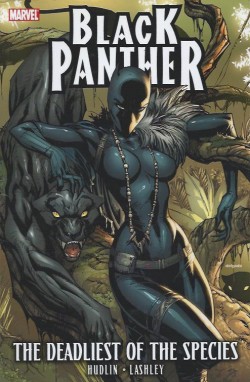
Black Panther: The Deadliest of the Species


By Reginald Hudlin, Ken Lashley, Paul Neary & various (Marvel)
ISBN: 978-0-7851-3342-1

Regarded as the first black hero in American comics and one of the first to carry his own series, the Black Panther’s popularity and fortunes have waxed and waned since July 1966 when he attacked the Fantastic Four as part of an extended plan to gain vengeance on the murderer of his father.

T’Challa, son of T’Chaka, is an African monarch whose secluded kingdom is the only source of a miraculous alien metal upon which the country’s immense wealth is founded. Those mineral riches – derived from a fallen meteor which struck the continent in lost antiquity – enabled him to turn his country into a technological wonderland.

Moreover, the tribal resources and the people have been eternally safeguarded by a cat-like human champion deriving incredible physical advantages from secret ceremonies and a mysterious heart-shaped herb simultaneously ensuring the generational dominance of the nation’s Panther Cult.

In recent years that continuity mythology was retooled to reveal that the “Vibranium” mound had actually made the country a secret Superpower for centuries but now only increasingly turns Wakanda into a target for subversion and incursion.

This slim, unassuming but extremely engaging Costumed Drama outing – available in trade paperback and eBook editions – collects the first six issues of Black Panther volume 5 (April to September 2009) and was originally part of Marvel’s company-wide “Dark Reign” publishing event.

‘The Deadliest of the Species’ begins as T’Challa’s new bride (and queen) Ororo nervously embarks on a goodwill tour. As a mutant – and far worse, an American – who has married the king, she is keenly aware of her tenuous position and potential for disrupting the ancient social order.

All thoughts of winning over the people are soon forgotten when her husband’s jet – which left only hours ago on a diplomatic mission – screams in and catastrophically crashes in the heart of the city despite all the weather goddess’ efforts to slow it down…

Unknown to all, five hours previously the Black Panther had secretly met with regal rival Namor the Sub-Mariner to hear an invitational offer from a Cabal of world-conquerors led by former Green Goblin-turned government operative Norman Osborn. Now the adored sovereign is near death.

His formidable Dora Milaje bodyguards are gone and, after being dragged from the wreckage burned and broken, T’Challa agonisingly reveals it was an ambush before lapsing into a coma…

As Queen Mother Ramonda and sister Shuri rush to the hospital, the ruling council are frantic; terrified that the assassination attempt is prelude to invasion. Wakanda has always been ready for such assaults, but that was with a healthy Black Panther. Right now, they are spiritually all but defenceless…

Even though the king is not quite dead, the Ministers advocate activating the protocols to create a new Panther warrior… but the question is who will succeed?

Hours ago, after Namor departed, a far less friendly potentate accosted T’Challa as he left the conference. Dr. Doom is also a member of the Cabal and took the Panther’s refusal to join the club very, very badly…

Back in the now, desperate meetings and Ororo’s refusal to undertake the mystic rituals result in Princess Shuri being reluctantly assigned – over the strenuous protests of her own mother – the role of Black Panther Apparent. As T’Challa’s older sister it’s a role she was destined for, but one her brother seized decades ago.

At that time, she was away being schooled in the West when an invasion by American adventurer Ulysses Klaw claimed her father’s life. With cruel circumstance demanding nothing less, the boy took the initiative, the role and the responsibility of defending his nation…

Thus, after years as an irrelevant spare, the flighty jet-setter is being asked to take up a destiny she now neither wants nor feels capable of fulfilling. She is especially afraid of the part of the ceremony where she faces the Panther God and is judged…

T’Challa cannot reveal how the battle with Doom ended in brutal defeat and certain death, or how his valiant Dora Milaje gave their lives to get his maimed body back in the jet and home via auto-pilot. He is unable to even stay alive and, as the world’s most up-to-date doctors slowly abandon hope, Ramonda convinces Queen Ororo to try something terrible and very ancient instead…

Despite a pervasive cloak of secrecy bad new travels fast. Across the continent adherents of the Panther Cult’s theological antithesis revel in Wakanda’s misfortune. Smug, gleeful worshippers of rival cults prepare arcane rituals to finally destroy their enemies and – in a place far removed from the world – T’Challa awakes to meet his dead bodyguards once more…

In an isolated hut Queen and Queen Mother are bickering with sinister shaman Zawavari. The wizard claims to be able to bring T’Challa back but gleefully warns that the price will be high…

Thanks to her years of constant training, Shuri is having no problem with the physical rigours of the Panther Protocols and foolishly grows in confidence. Far away, Wakanda’s enemies succeed in summoning terrible Morlun, Devourer of Totems, but are wholly unprepared for the voracious horror to consume them before turning his attention to more distant theological fodder…

And in Limbo, a succession of dead friends and family subtly and seductively attempt to convince T’Challa that his time is past and that he must lay down his regal burdens…

As Morlun ponderously makes his way to Wakanda, stopping only to destroy other petty pantheons such as the master of the Man-Ape sect, Death continues her campaign to convince T’Challa to surrender to the inevitable whilst Shuri faces her final test…

It does not end well. The puissant Panther God looks right through her and declares her pitifully unworthy to wear his mantle or defend the Wakandan worshippers. Despondent Shuri is ignominiously despatched back to the physical world just as her new sister-in-law arrives in Limbo, sent by Zawavari to retrieve her husband from Death’s clutches.

Ororo doesn’t want to tell her husband that this is their last meeting. The price of his safe passage back is her becoming his replacement…

In the world of the living, Morlun has reached Wakanda’s borders, drawn inexorably to T’Challa’s (currently vacant) physical form. The beast is utterly invulnerable to everything in the nation’s super-scientific arsenal and leaves a mountain of corpses behind him.

With Armageddon manifesting all about them, the Royal Family and Ruling Council are out of options until sly Zawavari points out an odd inconsistency: the price for failing to become Wakanda’s living totem has always been instant death, but Shuri, although rejected, still breathes…

Realising both she and her country have one last chance, the newest Black Panther goes out to battle the totem-eater whilst in the Country of the Dead T’Challa and Ororo resolve to ignore the devil’s bargain and fight their way back to life.

And as the two hopeless battles proceed, Ramonda and Zawavari engage in a last-ditch ploy which will win both wars by bring all the combatants together…

Fast-paced, compelling and gloriously readable, this splendid blend of horror story, action epic, political thriller and coming-of-age tale also offers an impressive cover-&-variants gallery by J. Scott Campbell, Edgar Delgado, Michael Djurdjevic, Ken Lashley and Mitch Breitweiser.

If you don’t despise reboots and re-treads on unswerving principle and are instead prepared to give something new(ish) a go, there’s lots to enjoy in this fantastic Fights ‘n’ Tights farrago, so why not set your sights and hunt this down?
© 2009 Marvel Characters, Inc. All rights reserved.

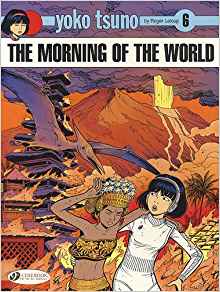
Yoko Tsuno volume 6: The Morning of the World


By Roger Leloup translated by Jerome Saincantin (Cinebook)
ISBN: 978-1-84918-082-5

Indomitable intellectual adventurer Yoko Tsuno debuted in 1970 with the September 24th 1970 edition of Le Journal de Spirou and is still delighting regular readers and making new fans to this day. Her astounding all-action, uncannily accessible exploits are amongst the most intoxicating, absorbing and broad-ranging comics thrillers ever created.

The globe-girdling, space-&-time-spanning serial saga of the slim, slight Japanese technologist-investigator was devised by monumentally multi-talented Belgian maestro Roger Leloup who began his spellbinding solo career after working as a studio assistant on Hergé’s Adventures of Tintin.

Compellingly told, superbly imaginative and – no matter how implausible the premise of any individual yarn – always solidly grounded in hyper-realistic settings underpinned by authentic, unshakably believable technology and scientific principles, Leloup’s illustrated escapades were at the vanguard of a wave of strips revolutionising European comics in the mid-1970s.

That long-overdue attitude adjustment saw the rise of many competent, clever and brave female protagonists, all taking their places as heroic ideals beside the boys to uniformly elevate Continental comics. Best of all, the majority of their exploits are as engaging and empowering now as they ever were, and none more so than the trials and tribulations of Yoko Tsuno.

Her very first outings (the still unavailable and untranslated Hold-up en hi-fi, La belle et la bête and Cap 351) were simple introductory vignettes before the superbly capable engineer and her valiant if less able male comrades Pol Paris and Vic Van Steen properly hit their stride with premier full-length saga Le trio de l’étrange in 1971 in Spirou‘s May 13th issue…

There have been 28 European albums to date – with a 29th being completed as we read this…

Yoko’s exploits include explosive escapades in exotic corners of our world, time-travelling jaunts and sinister deep-space sagas with the secretive, disaster-prone alien colonists from planet Vinea. However, for the majority of English translations thus far, the close encounters have been more-or-less side-lined in favour of intriguing Earthly exploits, but this tale stays strictly Earthbound while plumbing the depths of the fantastic…

Today’s particular tale was originally serialised in Spirou #2613-2630 and collected in 1988 as 17th album Le Matin du monde. Due to the exigencies of publishing it reached English eyes as Yoko’s sixth Cinebook outing; a time-bending mystery of glamour and action shedding a fraction of light on Yoko’s own shrouded origins…

It begins with Yoko and her new ward Morning Dew testing a new jet over Indonesia before reuniting with temporal refugee Monya. This time-travelling expatriate from 3872 AD (see The Time Spiral for further details) has had to settle in the present after her own timeline was overwritten, but she’s had a hard time adjusting and despite her best intentions regularly risks catastrophe by visiting other time-periods…

Monya originally came back in time to prevent a scientific experiment which would have resulted in Earth’s destruction by her own era. The voyager witnessed her father’s death and the planet turned to a cinder, relative moments before arriving in Yoko’s locale, so her predilection for exploration and meddling in earlier time periods is perhaps understandable…

Now, though, she’s gone too far: stealing a gold statue from its rightful era and endangering the life of a native…

Urgently summoned to help fix things, Yoko, Vic and Pol are quickly apprised of the situation. Monya has taken a sacred temple statue of a dancer from 1350 AD, a short time before history records the eruption of the Agung volcano and eradication of the entire community and civilisation dwelling there. Technically, Monya’s actions should cause no disruption to the timeline, but it has resulted in the long-dead priests condemning native dancer Narki to death for the crime…

A heated debate over the morality of keeping the immensely valuable statue versus using their time machine and attempting to save the life of a woman already dead for centuries consumes the adults. It only ends when Monya’s new acquaintance Mike – an obsessive religious fanatic – traps them all in the barn housing the chronal craft and sets it afire.

Compelled to use the time engine to save themselves, the entire party is plunged back to 1350 where Narki is condemned to die…

Befriending the local villagers, the travellers learn that the innocent scapegoat has been taken to the capital. Swiftly following, Yoko and Monya find her in a drugged state and determined to sacrifice herself to “winged demons” plaguing the city. Most confusingly, as they struggle to rouse her, Yoko realises that – somehow – she recognises the doomed Narki…

Desperate for solutions, Monya tries unsuccessfully to return the statue to the Brahmin priests, even as Yoko and her comrades assemble some clever 20th century kit they’d providentially stowed aboard the time-ship. Despite all their efforts, Narki is left to the mercies of the demons, and only Yoko and Vic’s spectacular intervention saves her from what turn out to be savage survivors of antediluvian vintage…

Yet, even after destroying one of the flying monsters and snapping Narki out of her trance, the future heroes are unable to save the damsel in distress. Accusing them of killing the gods’ messenger, Narki swears to throw herself into the now-erupting Agung volcano to expiate her sins and save everybody…

That pointless gesture is applauded by the priests, but again thwarted by Yoko and Vic, who snatch the dancer from the edge of fiery doom. They are, however, helpless to save the rest of the populace from the inescapable judgement of history and one of the greatest volcanic eruptions of all time…

Now the sole survivor of her civilisation, Narki makes no protest as Monya relocates her to another time and place she has extensively studied. And when the survivor is left with villagers in 1520 AD Borneo, Yoko realises with a shock how she knows the tragic temple dancer…

Complex, rocket-paced, explosively exciting and subtly suspenseful, this beguiling brush with paradox and passion blazes with thrills and chills, delivering a powerfully moving denouement which again affirms Yoko Tsuno as a top-flight trouble-shooter.

As always, the most effective asset in these breathtaking tales is the amazingly authentic and staggeringly detailed draughtsmanship and storytelling, which superbly benefits from Leloup’s diligent research and meticulous attention to detail.

The Morning of the World is an epic fantasy spectacle to delight and enthral all lovers of inventive adventure.

Original edition © Dupuis, 1988 by Roger Leloup. All rights reserved. English translation 2011 © Cinebook Ltd.

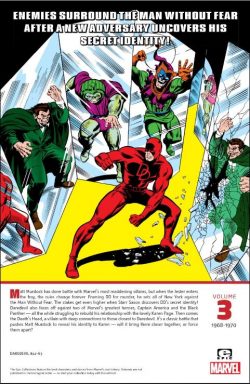
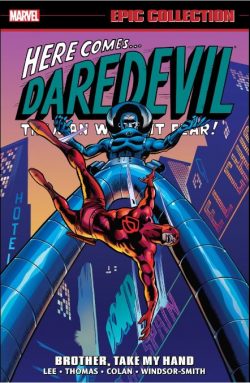
Daredevil Epic Collection: volume 3 – 1968-1970: Brother, Take My Hand


By Stan Lee, Roy Thomas, Gene Colan, Barry Windsor-Smith & various (Marvel)
ISBN: 978-1-3029-0425-8

Matt Murdock is a blind lawyer whose remaining senses hyper-compensate, making him an astonishing acrobat, formidable fighter and living lie-detector. Very much a second-string hero for most of his early years, Daredevil was nonetheless a striking and popular one, due in large part to the roster of brilliant artists who had illustrated the strip. He only really came into his own, however, after artist Gene Colan signed up for the long haul and wunderkind scripter Roy Thomas added an edge of darkness to the swashbuckling derring-do…

The natal DD battled thugs, gangsters, mad scientists, robots and a plethora of super-villains, quipping and wise-cracking his way through life and life-threatening combat.

Covering July 1968 to April 1970 this third tumultuous collection (in both trade paperback and eBook formats) sees a radical shift in treatment and content after in Stan Lee surrendered the scripter’s role to Thomas and an aura of barely contained escalating madness begins permeating the now staid soap opera narrative beats, peerlessly pictured by the masterful Colan, and a promising British fill-in artist named Barry Smith….

Having killed off his fictitious twin brother Mike Murdock, Matt briefly considered hanging up his scarlet long-johns but eventually retained his secret other-life by revealing to his closest friends that Mike was only one of a number of Men without Fear in the first part of a prolonged battle with a new nemesis as ‘Nobody Laughs at The Jester!’ (by Lee, Colan and inker Dan Adkins).

The Malevolent Mountebank only wanted to be more successful as a criminal than he had been as a bit-playing actor, but his motivation changed when crooked mayoral candidate Richard Raleigh hired him to spoil incorruptible Foggy Nelson‘s campaign for the D.A. post.

The role grew, precipitating a protracted saga which kicked off with a temporarily befuddled DD ‘In Combat with Captain America!’ (inked by Vince Colletta) before Hornhead is framed for killing the Jester’s alter ego Jonathan Powers in #44’s ‘I, Murderer!’

Soundly defeated in combat by the Jester, our hero experiences ‘The Dismal Dregs of Defeat!’ and becomes a wanted fugitive. Following a frenetic police manhunt, he is finally arrested before snatching victory in thoroughly enthralling conclusion ‘The Final Jest!’ as inker extraordinary George Klein began a long and impressive association with the series.

With the Vietnam War raging, a story involving the conflict was inevitable but #47’s ‘Brother, Take My Hand!’ was so much more than a quick cash-in or even well-meaning examination of contemporary controversy as Marvel found another strong and admirable African American character (one of far too few in those blinkered times) to add to their growing stable.

Newly-blinded veteran Willie Lincoln turns to Matt Murdock and Daredevil for help on his return home. A disgraced cop framed by gang-boss Biggie Benson before joining the army, Lincoln is now back in America and determined to clear his name at all costs.

This gripping, life-affirming crime thriller not only triumphs in Daredevil’s natural milieu of moody urban menace but also sets up a long-running plot that would ultimately change the Man without Fear forever.

The return of Stilt-Man posed little more than a distraction in ‘Farewell to Foggy’ as Matt’s oldest friend wins the race for District Attorney but acrimoniously turns his back on Murdock, seemingly forever….

Stan Lee’s final script on the sightless crusader, ‘Daredevil Drops Out’ (#49), was illustrated by Colan & Klein, depicting Murdock as the target of a robotic assassin built by Mad-Scientist-for-Hire Starr Saxon. This tense, action-packed thriller grew into something very special with second chapter ‘If in Battle I Fall…!’ as neophyte penciller Barry Smith stepped in, ably augmented by veteran inker Johnny Craig.

Lee then left comics-scripting Boy Wonder Roy Thomas to finish up for him in ‘Run, Murdock, Run!’ (Daredevil #51, April 1969 with art by Smith & Klein): a wickedly engaging, frantically escalating psychedelic thriller which sees Saxon uncover the hero’s greatest secret after the Man Without Fear succumbs to toxins in his bloodstream and goes berserk.

The saga climaxes in stunning style on ‘The Night of the Panther!’ (Smith & Craig) as African Avenger Black Panther joins the hunt for an out-of-control Daredevil before subsequently helping contain, if not defeat, the dastardly Saxon.

The radically unsettling ending blew away all the conventions of traditional Fights ‘n’ Tights melodrama and still shocks me today…

Colan & Klein returned for #53’s ‘As it Was in the Beginning…’ wherein Thomas reprised, revised and expanded Lee & Bill Everett’s origin script from Daredevil #1, allowing the troubled hero to reach a bold decision, executed in #54 as ‘Call him Fear!’ featured the “death” of Matt Murdock and the triumphant return of long-vanished villain Mr. Fear.

‘Cry Coward!’ (beginning a superb inking run by legendary illustrator Syd Shores) reveals DD’s desperate reason for faking his demise (again!) and enacts the end of one of the Scarlet Swashbuckler’s greatest enemies.

‘…And Death Came Riding!’ then opens a tense 2-parter which forever changes Murdock’s relationship with the perennially loved-from-afar Karen Page whilst introducing a stunningly sinister new menace in Death’s-Head. By the end of ‘In the Midst of Life…!’ Matt and Karen are enjoying the most progressive and mature relationship in mainstream comics…

‘Spin-Out on Fifth Avenue!’ starts re-establishing some civilian stability as resurrected (again!) Matt Murdock becomes a special prosecutor for New York District Attorney Foggy Nelson and promptly goes after a mysterious new gang-boss dubbed Crime-Wave. As the fresh plot-threads take hold, new threats emerge, such as amped-up biker and reluctant assassin-for-hire Stunt-Master and #59’s far nastier hired gun who boasts ‘The Torpedo Will Get You if you Don’t Watch Out!’

‘Showdown at Sea!’ closes the career of the insidious and treacherous Crime-Wave, simultaneously signalling a return to single-issue action-based stories, starting with ‘Trapped… by the Trio of Doom!’ and spotlighting featuring a spectacular struggle against Cobra, Mr. Hyde and The Jester.

DD #62 features the nefarious Batman analogue from the Squadron Sinister who attempts to destroy the hero’s reputation in ‘Quoth the Nighthawk “Nevermore”!’ after which Horn-Head stunningly stops deadly psychopath Melvin Potter from busting out of jail in ‘The Girl… or the Gladiator’… but only at the cost of his constantly conflicted love-life…

To Be Continued…

Adding extra value to the proceeding are unused Colan cover pencils for #43, cover art for #44 and a delicious selection of original art pages concluding and complimenting a bonanza of bombastic battles tales that are pure Fights ‘n’ Tights magic in the grand Marvel Manner that no fan of stunning super-heroics can afford to ignore.
© 1968, 1969, 1970, 2017 Marvel Characters, Inc. All rights reserved.

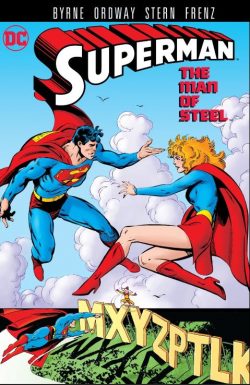
Superman: Man of Steel volume 9


By John Byrne, Jerry Ordway, Roger Stern, Paul Kupperberg, Erik Larsen, John Statema, Ron Frenz & various (DC Comics)
ISBN: 978-1-4012-6637-0

Although largely out of favour these days as the myriad decades of Superman mythology are relentlessly assimilated into one overarching, all-inclusive multi-media DC franchise, the gritty, stripped-down post-Crisis on Infinite Earths Action Ace, as re-imagined by John Byrne and marvellously built upon by a stunning succession of gifted comics craftsmen, produced some genuine comics classics.

Controversial at the start, Byrne’s reboot of the world’s first superhero was quickly acknowledged as a solid hit and the collaborative teams who complemented and followed him maintained the high quality, ensuring continued success.

That vast, interlocking saga has been collected – far too slowly – over recent years in a more-or-less chronologically combined format as the fabulously economical trade paperback (and latterly digital) series Superman: The Man of Steel, with this splendid ninth volume revisiting Superman #19-22, Superman Annual #2, Adventures of Superman #441-444 and crossover continuation Doom Patrol #10. These collectively span June to October 1988 and re-present one of the most talked-about storylines of the entire run.

The fabulous Fights ‘n’ Tights fun begins with Adventures of Superman #441 and an exploration of multidimensional madness in ‘The Tiny Terror of Tinseltown’, courtesy of Byrne, Jerry Ordway & Dennis Janke, wherein 5th Dimensional sprite Mr. Mxyzptlk heads for Hollywood to wreak more prankish madcap mayhem. His animation of cartoon favourites is however, overshadowed by a remarkable event in Antarctica as a young girl staggers into a research station, immune to the cold and claiming amnesia. She is clad in a brief but fetching variation of Superman’s uniform…

Having tricked the mischievous mite into leaving our plane, the Man of Tomorrow faces an insidious assault by alien energy-leech Psi-phon, who gradually and systematically removes the hero’s abilities in ‘The Power that Failed!’ (Superman #19, by Byrne and inker John Beatty). The story continues in Adventures of Superman #442 (Byrne, Ordway & Andy Kubert) as ‘Power Play’ introduces the alien’s brutal partner Dreadnaught, resulting in a cataclysmic clash in Metropolis that eventually involves the Justice League of America…

Elsewhere, that mystery girl has recovered a few memories and headed for Smallville, Kansas, zeroing in on the Kent family farm…

Doom Patrol #10 (July 1988) begins a crossover clash as Robotman Cliff Steele painfully discovers his spare bodies and replacement parts have been stolen by mecha-monster Metallo. The ensuing battle for ‘The Soul of the Machine’ (Paul Kupperberg, Erik Larsen & Gary Martin) devastates Kansas City, drawing the Metropolis Marvel into the conflict ‘In the Heartland!’ (Superman #20, by Byrne & inker Karl Kesel).

As the united champions seemingly end the techno-tainted threat, back in Kansas a very confused Girl of Steel meets Ma and Pa Kent and Lana Lang: people she has known all her life but has never met before. After some trenchant conversations the baffled stranger flies off to Metropolis…

Meanwhile in Adventures of Superman #443, Clark Kent and Jimmy Olsen investigate a hostage-taking in war-torn Qurac. Incredibly – and typically – their hunt for an American ‘Prisoner of Conscience’ (scripted by Ordway and illustrated by John Statema & Doug Hazelwood) leads them to a race of fantastic, paranoid and combative aliens hidden beneath the deserts sands since the time of the pharaohs…

Finally, the ongoing enigmas are addressed as the “Supergirl Saga” commences in Superman #21 with Byrne & Beatty’s ‘You Can’t Go Home Again’. After the Action Ace encounters the flying girl her memories return and she reveals her astounding secret. Of course, it’s not that simple and the revelations only come after a traditional hero-on-hero fight…

When Crisis on Infinite Earths overwrote and restarted DC Universal Continuity, a number of remaining paradoxes required some fairly deft and imaginative back-writing. Most pressing was how could the 30th century Legion of Super-Heroes exist if the Superboy who inspired them never existed? The solution was an epic story arc in Legion of Super-Heroes #37-38 and Action Comics #591 (collected in Superman: Man of Steel volume 4) that posited a “pocket universe duplicate Earth” created for nefarious purposes by the almighty Time Trapper, where all the events of Pre-Crisis Earth actually occurred.

Now that world is revisited with humanity on the edge of extinction…

As seen in ‘Parallel Lines Meet at Infinity…’ (Adventures of Superman #444, Byrne, Ordway, & Janke), when “Superboy” vanished during the Crisis, his world was left to the mercies of three of his Kryptonian arch-enemies.

Before long General Zod, Zaora and Quex-Ul reduced mankind to a desperate handful of survivors with super-genius Lex Luthor acting as technological saviour. Learning of the outer universe, he created a Supergirl to fetch the true Superman and enact his final plans for the artificial world…

The shocking tale culminates in Superman #21 as the conflicted champion eventually defeats his ruthless, sadistic and far more powerful fellow Kryptonians, – but not before Earth is wiped clean of all life. With Byrne writing drawing and inking, ‘The Price’ sets the tone for the next phase of the Man of Tomorrow’s life as he is compelled to take drastic action that alters his moral stance forever-after and affects him for the rest of his life…

The adventure concludes with the contents of Superman Annual #2 as ‘The Cadmus Project’ (Roger Stern, Ron Frenz & Brett Breeding) reprises and adapts major elements of Jack Kirby’s breathtaking material from Jimmy Olsen #133-148, which introduced and supplemented his landmark Fourth World Trilogy.

Here clones of the 1940s Newsboy Legion escape the top-secret genetics project and hide in Metropolis. Magnets for trouble, the kids stumble into gang crime and are rescued by the revenant of their original Guardian – part-time costumed hero Jim Harper.

When the furore attracts Superman’s attention, the inevitable battle leads him into a fantastic hidden world, albeit one now under the malicious psychic sway of vile old enemy Sleez…

Supplementing the main event is all-Byrne Private Lives sidebar story ‘Loves Labor’s…’, starring Captain Maggie Sawyer and Terrible Turpin of Metropolis’s Special Crimes Unit. When a close call under fire leads to the aging veteran’s latest hospitalisation, Maggie’s solicitousness leads the old detective to jump to some extremely erroneous romantic conclusions…

Topped off with Byrne-limned pages from DC’s Who’s Who, giving the lowdown on the then new iterations of Bizarro, Lex Luthor, Magpie and Mr. Mxyzptlk, plus original covers by Byrne, Ordway, Frenz, Larsen and Brett Breeding, this titanic tome celebrates the back-to-basics approach which lured many readers to – and crucially back to – the Superman franchise at a time when interest in the character had slumped to perilous levels.

Publicity might have brought big sales but it was the sheer quality of the stories and art which convinced them to stay…

Such cracking superhero tales are a high point in Superman’s eight decades of multi-media existence and these astoundingly readable collections are certainly the easiest way to enjoy a stand-out reinvention of the ultimate comic-book icon.
© 1988, 2016 DC Comics. All Rights Reserved.

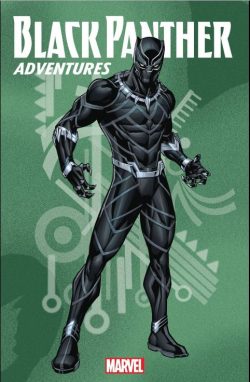
Black Panther Adventures


By Jeff Parker, Marc Sumerak, Christopher Yost, Elliot Kalan, Roy Thomas, Manuel Garcia, Ig Guara, Scott Wegener, Christopher Jones, Chris Giarusso, John Buscema & various (Marvel)
ISBN: 978-1-3029-1034-1

Since its earliest days Marvel has always courted and accommodated young comicbook consumers through various titles and imprints. In 2003 the company instituted the Marvel Age line to update and reframe classic original tales by Stan Lee, Jack Kirby, Steve Ditko and others for a fresh-faced 21st century readership.

The experiment was tweaked in 2005, becoming Marvel Adventures. The tone of all the tales was very much that of the company’s burgeoning TV cartoon franchises, in execution if not name. Titles bearing the Marvel Adventures brand included Spider-Man, Fantastic Four and The Avengers and ran until 2010 when they were uniformly cancelled and replaced by new volumes of Marvel Adventures: Super Heroes and Marvel Adventures: Spider-Man.

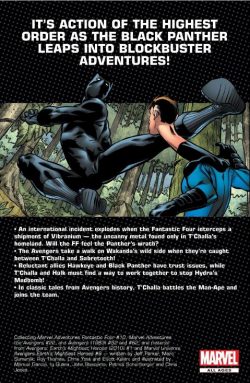
Most of those yarns have since been collected in digest-sized compilations such as this timely paperback (or eBook), which gathers a quartet of all-ages Black Panther tales and includes a brace of early1960s episodes from his first stint in the Avengers.

Acclaimed as the first black superhero in American comics and one of the first to carry his own series, the Black Panther’s popularity and fortunes have waxed and waned since he first debuted as a character in Fantastic Four.

In his 1966 debut, the cat king attacked Marvel’s First Family as part of an extended plan to gain vengeance on the murderer of his father, before eventually teaming up with them to defeat the malign master of sound Klaw.

This eclectic compilation – comprising Marvel Adventures Fantastic Four #10, Marvel Adventures The Avengers #22, Avengers: Earth’s Mightiest Heroes #1, Marvel Universe Avengers Earth’s Mightiest Heroes #8 (November 2012), plus Silver Age epics from Avengers #52 and 62 – begins by broadly reimagining that initial encounter in ‘Law of the Jungle’ by Jeff Parker, Manuel Garcia & Scott Koblish from Marvel Adventures Fantastic Four #10 (May 2006) wherein the FF are suckered into buying smuggled Vibranium.

The miracle mineral is Wakanda’s only export and the illegal sale quickly brings the duped heroes into savage conflict with a mysterious cat-garbed super-warrior. Tracking the Black Panther back to his super-scientific jungle kingdom, the FF eventually convince the king of their innocence and good intentions before teaming up to tackle the true villains…

Two years later Marvel Adventures The Avengers #22 (May 2008) revealed the ‘Wakanda Wild Side’ (by Marc Sumerak, Ig Guara &Jay Leisten) as a sighting of murderous mutant Sabretooth in Africa draws Wolverine, Storm, Captain America, Spider-Man, Giant-Girl and the Hulk into an uncharted kingdom. They shouldn’t have bothered: Wakanda’s Panther chieftain was more than equal to the task of taking down the savage invader…

Following a page of comedic Marvel Mini Classics by Chris Giarusso, a short vignette from Avengers: Earth’s Mightiest Heroes #1 (November 2010) as Christopher Yost & Scott Wegener reveal how rival heroes T’Challa and Hawkeye work out their ‘Trust’ issues whilst battling crazed villain Whiplash.

Never the success the company hoped, the Marvel Adventures project was superseded in 2012 by specific comics tied to those Disney XD television shows designated as “Marvel Universe cartoons”, but these collected stories are still an intriguing, amazingly entertaining and superbly accessible means of introducing characters and concepts to kids born sometimes three generations or more away from the originating events.

Another short yarn – this time from Marvel Universe Avengers Earth’s Mightiest Heroes #8 (November 2012) – unites the Panther with fellow Avenger the Hulk.

Crafted by Elliott Kalan, Christopher Jones & Pond Scum, ‘Mayhem of the Madbomb!’ sees the Green Goliath and Cat King bombastically battle Hydra to prevent the triggering of an insanity-inducing WMD cached in the Empire State Building…

Wrapping up the action is a brace of classic adventures from Roy Thomas & John Buscema.

On Captain America’s recommendation Black Panther joined the Avengers in #52’s ‘Death Calls for the Arch-Heroes’ (May 1968 and inked by Vince Colletta): a fast-paced murder mystery which also saw the advent of obsessive super-psycho the Grim Reaper who attempted to frame the freshly-arrived in America T’Challa for the murder of Goliath, the Wasp and Hawkeye.

Then The Monarch and the Man-Ape!’ (Avengers #62, March 1969, by Thomas, Buscema & George Klein) offered Marvel fans the first real view of hidden Wakanda – and a brutal exploration of T’Challa’s history and rivals – as his trusted regent tried to usurp his kingdom and the state religion after declaring himself to be M’Baku the Man-Ape…

Augmented with a complete cover gallery by Carlo Pagulayan & Chris Sotomayor, Leonard Kirk & Val Staples, Scott Wegener & Jean-François Beaulieu, Khoi Pham & Edgar Delgado and John Buscema, this fast-paced, ferociously enthralling compilation of riotous mini-epics is extremely enjoyable and engaging, although parents should note that some of the themes and certainly the level of violence might not be what everybody considers “All-Ages Super Hero Action”…
© 2017 Marvel Characters, Inc. All rights reserved.

Legends – The 30th Anniversary Edition


By John Ostrander, Len Wein, John Byrne, Karl Kesel & various (DC Comics)
ISBN: 978-1-4012-6316-4

With the success of Crisis on Infinite Earths and Marvel’s Secret Wars in the middle of the 1980s, comicbook publishers had grand dreams of regular and spectacular sales boosts, but a section of the cantankerous buying public muttered about gimmicks to make them spend more and voiced concerns about keeping the quality high.

At DC fan-interest was still fresh and keen as so many of their major properties – and indeed the entire continuity – was open for radical change, innovation and renewal. So, how best to follow the previous year’s cosmic catastrophe? Why not a much smaller and more personal Great Disaster, spotlighting those strangers wearing familiar costumes and a bunch of beginnings rather than the deaths and endings of Crisis?

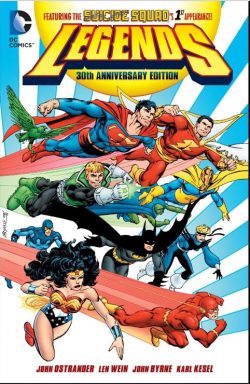
Possibly the best and certainly the most cohesive of the numerous company-wide braided mega-series, Legends was a 6-issue miniseries cover-dated November 1986 through April 1987. Like its predecessor the major narrative thread spread out into other DC series, but unlike Crisis on Infinite Earths each tie-in was consecutively numbered and every pertinent cover was suitably badged. If you got ’em all you couldn’t help but read them in the right order!

The event crossed into 22 other comics and miniseries and premiered three new series, Justice League, Flash and the superb Suicide Squad. It even led to another new treatment for Billy Batson in a follow-up Shazam! miniseries whilst offering a tantalising sneak peek at the newly re-minted Wonder Woman…

The drama opens in ‘Once Upon a Time…!’ as Evil New God Darkseid of Apokolips decides to attack humanity’s spirit by destroying the very concept of heroism and individuality. To this end he sends hyper-charismatic thrall Glorious Godfrey to America to lead a common man’s crusade against extraordinary heroes, whilst initiating individual plans intended to demoralize and destroy key champions of Earth. His first scalp is naïve, youthful Captain Marvel, who is deceived into believing his powers have accidentally killed an enemy after explosively confronting monstrous menace Macro-Man …

As Darkseid’s flaming minion Brimstone ravages the nation – despite the best efforts of Firestorm, time-displaced Legionnaire Cosmic Boy and Justice League Detroit – the US government activates its own covert and illegal solution to the crisis.

Conceived and devised by civil servant Amanda Waller, a new Task Force X is brought into being: comprising volunteers such as Colonel Rick Flag and martial artist Bronze Tiger riding roughshod over convicted super-criminals all offered a pardon in return for secret services rendered…

As Godfrey’s influence spreads across America, inciting riots that hospitalise Boy Wonder Robin and drive Batman, Blue Beetle and Green Lantern Guy Gardner into hiding, ‘Breach of Faith!’ sees President Ronald Reagan respond to the rampant civil unrest by outlawing costumed crime-busters…

With heroes searching their consciences, unsure whether to comply or rebel, world-wide chaos ensues and Darkseid amps up the pressure. Sentient mountain of super-heated plasma Brimstone attempts to reduce national monument Mount Rushmore into molten slag only to be destroyed by America’s latest dirty secret in ‘Send for… the Suicide Squad!’

Meanwhile heartbroken Billy Batson – the juvenile alter ego of Captain Marvel – meets hero-worshipping Lisa. When her family take him in, he gains valuable insight and perspective on the ongoing calamity…

Things go from bad to worse in ‘Cry Havoc…!’ as the embargo emboldens numerous super-villains to go wild. This prompts many costumed heroes to ignore the Presidential Edict and go after them. As the Phantom Stranger faces Darkseid on Apokolips, immortal mystic Doctor Fate begins gathering select champions for the approaching final confrontation he foresees even as on Earth Godfrey makes a power grab using human-fuelled Apokoliptian Warhounds in ‘Let Slip the Dogs of War!’

All the disparate strands weave together in ‘Finale!’ as Fate’s new Justice League – aided by an enigmatic new hero calling herself Wonder Woman – stand fast against the destructive forces of anarchy: coming together to prevent the conquest of Mankind and erasure of its most vital beliefs…

The enthralling tale re-presented here can comfortably be read without the assorted spin-offs, crossovers and tie-ins, and it still feels like a magnificent mission statement for that new DC Universe: gritty, witty, cohesive and contemporary.

John Ostrander was new to DC, lured from Chicago’s First Comics with editor Mike Gold where their work on Starslayer, Munden’s Bar and especially Grimjack had made those independent minnows some of the most readable series of the decade.

Paired with veteran scripter Len Wein, whose familiarity with the DC stable ensured the scripts would have the right company flavour, they concocted a bold and controversial tale for super-star Superman re-creator John Byrne to draw and the immensely talented Karl Kesel to ink.

This 30th Anniversary edition (available in Trade paperback and eBook editions) comes with an informative Afterword from Mike Gold and full cover-gallery – including the original trade paperback collection cover – but regrettably neglects to retain the cover reproductions of each out-rider instalment of the greater story, as seen in the first edition. Should you feel like tracking down those missing components you’ll need to play comics detective on fan sites…

Who knows, maybe for the 40th Anniversary, DC will release a humongous, all-inclusive Absolute Omnibus Edition? Until then, why not simply kick back and enjoy an awesome slice of fabulous Fights ‘n’ Tights fun and fury?
© 1986, 1987, 2016 DC Comics. All Rights Reserved.