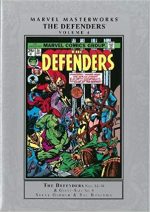
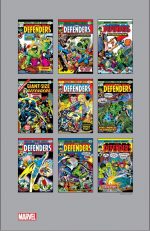
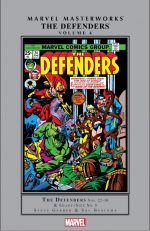
Defenders Marvel Masterworks volume 4


By Steve Gerber, Bill Mantlo, Gerry Conway, Roger Slifer, Len Wein, Chris Claremont, Scott Edelman, Sal Buscema, Mike Esposito, Don Heck, Sam Grainger & various (Marvel)
ISBN: 978-0-7851-6627-6 (HB)

Win’s Christmas Gift Recommendation: Monumental Marvel Magic for Festive Fun Seekers… 8/10

The Defenders were the last of the big star-name conglomerate super-groups, and would eventually number amongst their membership almost every hero – and some few villains – in the Marvel Universe. No real surprise there, since the initial line-up was composed of the company’s major league bad-boys: misunderstood and mad, outcast and bad and so often actually dangerous to know.

The genesis of the team derived from their status as publicly distrusted “villains”, and they never achieved the “in-continuity” fame or acceptance of other teams, but that simply seemed to leave the creators open to taking a few more chances and playing the occasional narrative wild card.

This Fabulous fourth hardcover/eBook Masterworks collection assembles a veritable host of Fights ‘n’ Tights wonders from across the Marvel firmament to star in Defenders #22-30 and Giant-Sized Defenders #5: cumulatively encompassing cover-dates April-December 1975 and irrevocably reshaping their shared and ever-expanding universe.

The action commences after Steve Englehart shares recollections of the brilliant and much missed Steve Gerber before the action opens with Defenders #22’s ‘Fangs of Fire and Blood!’ (by Gerber, Sal Buscema & Mike Esposito) as the sinister secret society known as the Sons of the Serpent begin another hate-fuelled, racist terror-pogrom, forcing the outcast champions into an uncomfortably public response.

The stakes are raised in ‘The Snakes Shall Inherit the Earth!’ with Hank Pym – in his Yellowjacket persona – returning to the Defenders to confront his most reviled old enemies. Even with his assistance, the Defenders are defeated in combat and left ‘…In the Jaws of the Serpent!’ (inked by Bob McLeod), necessitating a nick-of-time rescue by Daredevil, Luke Cage and Son of Satan Daimon Hellstrom before the epic ends in a stunning and still sickening realistic twist as ‘The Serpent Sheds its Skin’ (inked by Jack Abel)…

Giant Sized Defenders #5 was an all-hands-on-deck production, detailing a story that would transform a seminal and rare early Marvel non-event. ‘Eelar Moves in Mysterious Ways’credited to writers Gerber, Gerry Conway, Roger Slifer, Len Wein, Chris Claremont & Scott Edelman – was illustrated by dependable Don Heck & Esposito: a spectacular and satisfyingly cohesive result revealing how the Defenders meet with future heroes the Guardians of the Galaxy in a time-twisting disaster yarn that sets up the next continued arc for the monthly comicbook…

‘Savage Time’ (Defenders #26 by Gerber, Buscema & Vince Colletta) has Hulk, Doctor Strange, Nighthawk and Valkyrie accompany the Guardians back to 3015AD in a bold bid to liberate the last survivors of mankind from the alien, all-conquering Badoon, after hearing the future history of the world as dictated by time-lost space explorer Vance Astro.

The mission properly commences with ‘Three Worlds to Conquer!’ which introduces stellar enigma and future god Starhawk to his soon to be companions Martinex, Yondu and Charlie 27 (as well as us).

Events becomes infinitely more complicated and satirically scathing when ‘My Mother, The Badoon!’ reveals the sex-based divisions that so compellingly motivate the marauding lizard-men and then triumphantly climaxes in the stirring ‘Let My Planet Go!’

The pressures of producing regular comics is staggering and constant, with the slightest communications delay, illness, personal emergency or even work lost in transit causing all manner of costly hiccups. During the 1970s these “Dreaded Deadline Dooms” occurred all too often and in response Marvel instituted a policy of keeping one-size-fits-all, complete stories for every title in “inventory”: i.e. stashed in a drawer ready to use in an emergency. Designed to fill pages on time but produced with the intention of never being used, most of them were not that good, but despite at first glance seeming to be one of those, ‘Gold Diggers of Fear!’ (Defenders #30, by Bill Mantlo, Sam Grainger & Abel) manages to tap into Gerber’s off-the-wall sensibilities with impressive effect.

The done-in-one yarn pits Strange, Hulk, Nighthawk and Valkyrie against Tapping Tommy, a high-tech Maggia assassin who bases his murderous modus operandi and weaponry on Busby Berkeley musical numbers…

This bizarrely appealing volume ends with a rerun of the first appearance of future warriors from Marvel Super Heroes #18 (January 1969).

‘Guardians of the Galaxy: Earth Shall Overcome!’ is a terse, grittily engaging encounter which introduces a disparate band of freedom fighters united to save Earth from occupation and humanity from extinction at the scaly hands of the reptilian Brotherhood of Badoon.

It all starts when Jovian militia-man Charlie-27 returns home from a six-month tour of scout duty to find his entire colony subjugated by invading aliens. Fighting free, he jumps into a randomly programmed teleporter and emerges on Pluto, just in time to scotch the escape of crystalline scientist Martinex.

Both are examples of radical human genetic engineering: subspecies carefully designed to populate and colonise Sol system’s outer planets but now possibly the last of their kinds. After helping the mineral man complete his mission of sabotage – blowing up potentially useful material before the Badoon can get their hands on it – the odd couple set the teleporter for Earth and jump…

Unfortunately, the invaders have already taken the homeworld…

The Supreme Badoon Elite are there, busily mocking the oldest Earthman alive. Major Vance Astro had been humanity’s first intersolar astronaut; solo flying in cold sleep to Alpha Centauri at a plodding fraction of the speed of light.

When he got there 1000 years later, humanity was waiting for him, having cracked trans-luminal speeds a mere two centuries after he took off. Now he and Centauri aborigine Yondu are a comedy exhibit for the cruel conquerors actively eradicating both of their races…

The smug invaders are utterly overwhelmed when Astro breaks free, utilising psionic powers he developed in hibernation, before Yondu butchers them with the sound-controlled energy arrows he carries.

In their pell-mell flight, the pair stumble across incoming Martinex and Charlie-27 and a new legend of valiant resistance was born…

The eccentric team, as originally envisioned by Arnold Drake, Gene Colan & Mike Esposito were presented to an audience undergoing immense social change, with dissent in the air, riot in the streets and with the Vietnam War on their TV screens every night.

Perhaps the jingoistic militaristic overtones were off-putting or maybe the tenor of the times were against the Guardians, since costumed hero titles were entering a temporary downturn, but whatever the reason the feature was a rare “Miss” for Early Marvel and the futuristic freedom fighters were not seen again for years until Gerber incorporated them into his run on Marvel Two-In-One…

And once the action concludes you can still enjoy a brief gallery of original art pages by Buscema & Colletta and Grainger & Abel.

For the longest time The Defenders was the best and weirdest superhero comicbook in the business, and this bitty, unwieldy collection was where it all started. The next volume would see the inspirational unconventionality reach even greater heights of drama and lunacy…

If you love superheroes but crave something just a little different these yarns are for you… and the best is still to come.
© 1968, 1975, 2016 Marvel Characters, Inc. All rights reserved.
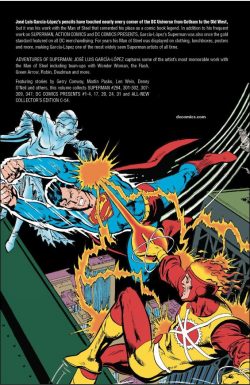
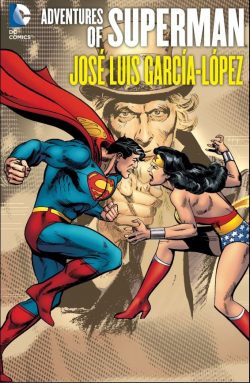
Adventures of Superman: José Luis García-López


By José Luis García-López, Martin Pasko, Gerry Conway, Elliot S. Maggin, David Michelinie, Len Wein, Denny O’Neil & various (DC Comics)
ISBN: 978-1-4012-3856-8 (HB)

Win’s Christmas Gift Recommendation: Super Special Stocking Stuffer… 9/10

It’s a fact (if such mythological concepts still exist): the American comicbook industry would be utterly unrecognisable without the invention of Superman. His unprecedented adoption by a desperate and joy-starved generation quite literally gave birth to a genre if not an actual art form.

Within three years of his June 1938 debut, the intoxicating blend of eye-popping action and social wish-fulfilment which hallmarked the early Man of Steel had grown to encompass cops-and-robbers crime-busting, socially reforming dramas, science fiction, fantasy, whimsical comedy and, once the war in Europe and the East embroiled America, patriotic relevance.

In comicbook terms at least Superman is master of the world, having utterly changed the shape of a fledgling industry and modern entertainment in general. There have been newspaper strips, radio and TV shows, cartoons games, toys, merchandise and blockbusting movies. Everyone on Earth gets a picture in their heads when they hear the name.

Moreover, he is a character endlessly revitalised by the creators who work on his never-ending exploits. One the most gifted and intoxicating is José Luis García-López.

An industry professional since he was 13 years old, he was born in Pontevedra, Spain in 1948. By age three he was living in Argentina where he was reared on a steady diet of comics: especially the works of Alex Raymond, Hal Foster, Alberto Breccia, Milt Caniff and José Luis Salinas.

During the late 1960s, García-López finally broke into the US comics world, with anthological romance work and anodyne horror tales for Charlton Comics and mystery-suspense yarns for Gold Key, and in 1974 moved to New York City where Joe Orlando got him a crucial intro with DC Comics. That turned into an almost-exclusive 40-year association which not only led to some astounding comics sagas, but also saw the artist become the corporation’s official reference artist for style guides and merchandising materials. His art was DC’s interface with the wider world.

After a few tentative inking jobs, García-López debuted as a penciller/inker on a Hawkman back-up in Detective Comics#452 in October 1975, and a month later began illustrating Hercules Unbound. His sumptuous art could also encompass grim & gritty and he was drafted in to end run on the company’s Tarzan title, and afterwards handed western antihero Jonah Hex as the gunslinger – bucking all industry sales trends – graduated to his own solo title in early 1977.

The artist’s star was on the rise. While filling in all across the DCU – his assorted Superman tales are all in this stunning hardback and digital compilation – García-López was increasingly first choice for major publishing projects such as the Marvel-DC Batman/Hulk tabloid crossover, prestige specials such the Wonder Woman clash collected here and such breakthrough miniseries and graphic novels as Cinder & Ashe, Atari Force, Twilight, Star Raiders, Road to Perditionand countless more. He remains, paradoxically, one of the company’s greatest artists and yet largely unknown and under-appreciated…

This splendid tome gathers the contents of Superman #294, 301-302, 307-309, 347, All-New Collectors’ Edition C-54and DC Comics Presents #1-4, 17, 20, 24, 31, collectively spanning December 1975 to March 1981 and, hopefully, eventually to be joined by a companion DC Universe of… edition one day.

What we have here, though, is a boldly exuberant celebration of the Man of Steel, many with guest stars and all splendidly accessible to veteran fans and casual acquaintances alike.

The wonderment opens with a short back-up from Superman #294.

Scripted by Martin Pasko and inked by Vince Colletta, ‘The Tattoo Switcheroo!’ details how Clark Kent escapes secret identity exposure after being nabbed by gangsters, but such pedestrian concerns are forgotten in issue #301 (July 76) where Gerry Conway & Bob Oksner help prove ‘Solomon Grundy Wins on a Monday!’ as the Earth-2’s monstrous zombie horror sideslips to Earth-1 to wreak havoc in Metropolis, forcing the Action Ace to use brains rather than brawn to win the day.

An issue later, Elliot S. Maggin scripted ‘Seven-Foot-Two… and Still Growing!’ as super scientist Lex Luthor finds a way to diminish the hero’s intellect by enlarging him to the point where his brain no longer connects to his dinosaur-dimensioned body. Thankfully, size-shifting hero The Atom is only a phone call away…

Curt Swan was Superman’s premiere artist for decades: a supremely gifted and conscientious illustrator who made the character his own. He was not, however, superhuman and while he was drawing the then-“longest Superman story ever” for DC Special Series #5 (Superman Spectacular 1977) García-López united with Conway and inker Frank Springer for issues #307-309 (January – March 1977), as the Man of Steel was deluded in ‘Krypton – No More!’ into believing his alien origins to be a comfortable fabrication to ease a human mutant’s twisted mind. Waging a war to save the environment from big business and their multipowered minions Radion and Protector, Kal-El even battles his cousin Supergirl to disprove ‘This Planet is Mine!’ before the true story is revealed, just in time to tackle an alien invasion in ‘Blind Hero’s Bluff!’ with the Girl of Steel returning to battle beside the now clear-headed hero and his faithful dog Krypto…

Following that comes one of the most impressive and fun comics sagas of the era as All-New Collectors’ Edition C-54(January 1978), written by Conway and inked by Dan Adkins. ‘Superman vs. Wonder Woman’ takes us back to World War II, as Man of Steel and Amazing Amazon meet for the first time after Nazi Übermensch Baron Blitzkrieg and Japan’s lethal assassin Sumo the Samurai unite to steal a prototype atomic device. Although they should be allies, the heroes are quickly and cataclysmically at odds over the dispensation of the nuke, but once they stop fighting, they still must defeat the Axis Powers’ most fanatical operatives…

From the moment a kid first sees his second superhero the only thing they want is to see how the new gaudy gladiator stacks up against the first. From the earliest days of the comics industry (and according to DC Comics Presents editor Julie Schwartz it was the same with the pulps and dime novels that preceded it), we’ve wanted our idols to meet, associate, battle together – and if you follow the Timely/Marvel model, that means against each other – far more than we want to see them trounce their archenemies in a united front…

The concept of team-up books – an established star pairing or battling (usually both) with less well-selling company characters – was far from new when DC awarded their then-biggest gun a regular arena to have adventures with other stars of their firmament, just as Batman had been doing since the middle of the 1960s in The Brave and the Bold. It was the publicity-drenched weeks before release of Superman: The Movie and Tim Burton’s Batman (which, BTW, García-López also provided designs for) was over a decade away…

In truth, the Metropolis Marvel had already enjoyed the serial sharing experience before, when World’s Finest Comicsbriefly ejected the Caped Crusader and Superman battled beside a coterie of heroes including Flash, Robin, Teen Titans, Vigilante, Dr. Fate and others (issues #198-214: November 1970 to October/November 1972) before a proper status quo was re-established.

The star-studded new monthly DC Comics Presents was a big deal at the time, so only the utterly astounding and series-unattached José Luis García-López (inked by Adkins) could conceivably open the show.

Silver Age Flash Barry Allen had been Superman’s first co-star in that aforementioned World’s Finest Comics run and reprises his role in ‘Chase to the End of Time!’ and ‘Race to the End of Time!’ from DCCP #1 and 2 (July/August and September/October 1978), wherein scripter Marty Pasko detailed how warring alien races trick both heroes into speeding relentlessly through the time-stream to prevent Earth’s history from being corrupted and destroyed.

As if that isn’t dangerous enough, nobody could predict the deadly intervention of the Scarlet Speedster’s most dangerous foe, Professor Zoom, the Reverse-Flash, who tries to turn the race against time to his own advantage…

David Michelinie then wrote a tantalising pastiche of classic Adam Strange Mystery in Space thrillers for García-López to draw and ink in ‘The Riddle of Little Earth Lost’, wherein the Man of Two Worlds and Man of Tomorrow foil the diabolical cosmic catastrophe scheme of a deranged military genius Kaskor to transpose, subjugate or destroy Earth and light-years distant planet Rann.

Len Wein came aboard to script the superb ‘Sun-Stroke!’ as the Man of Steel and the madly-malleable Metal Men join forces to thwart solar-fuelled genius I.Q. and toxic elemental menace Chemo after an ill-considered plan to enhance Earth’s solar radiation exposure provokes a cataclysmic solar-flare.

With the title on solid ground the artist moved on, but returned with Gerry Conway and inker Steve Mitchell to herald the return of Firestorm in DCCP #17’s ‘The Ice Slaves of Killer Frost!’: a bombastic, saves-the-day epic which brings the Nuclear Man back into the active DC pantheon after a long hiatus.

In #20, Green Arrow steals the show as always in gripping, big-business-busting eco-thriller ‘Inferno from the Sky!’ by Denny O’Neil, García-López & Joe Giella, after which the artist filled in with Conway on Superman #347 (May 1980) as the Last Son of Krypton clashes with a mythic cosmic courier in ‘The Sleeper Out of Time!’

In his peregrinations around the DCU, García-López had particularly distinguished himself with numerous episodes and fill-ins starring murdered aerialist Deadman. One of the very best came in DC Comics Presents #24 (August 1980) wherein scripter Wein reveals the tragic and chilling story of ‘The Man Who Was the World!’ as the grim ghost is forced to possess Superman and save the Earth… but fouls up badly…

Wrapping up this superb Fights ‘n’ Tights festival is ‘The Deadliest Show on Earth!’ (DCCP #31); written by Conway and inked by Dick Giordano, teaming Man of Steel and original Robin, the Teen Wonder Dick Grayson to conclusively crush a perfidious psychic vampire predating on the performers at the troubled Sterling Circus…

These tales are gripping fare elevated to epic regions by the magnificent art of one of the world’s finest artists. How could any fan possibly resist?
© 1975, 1976, 1977, 1978, 1979, 1980, 1981, 2013 DC Comics. All Rights Reserved.

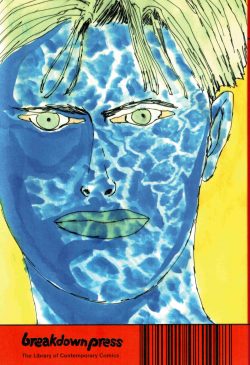
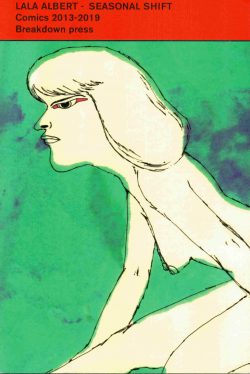
Lala Albert: Seasonal Shift – Comics 2013-2019


By Lala Albert (Breakdown Press/The Library of Contemporary Comics)
ISBN: 978-1-911081-09-8 (TPB)

Win’s Christmas Gift Recommendation: Because Not All Beautiful Things are Pretty… 9/10

All right-thinking people know that graphic narrative is the most expressive and expansive medium to work in, right? The range of themes explored, stories told and varieties of delivery are pretty near infinite if created by an inspired artisan.

The act of stringing pictures and/or words together is something almost everybody has done at some stage of their lives. It’s a key step in the cognitive path of children and, for an increasing number of us, that compulsive, absorbing euphoria never goes away.

Whilst many millions acquiesce to the crushing weight of a world which stifles the liberation of creativity, turning a preponderance of makers into consumers, a privileged, determined few carry on: drawing, exploring, and in some cases, with technology’s help, producing and sharing.

That emotional and creative volatility has never been better realised than in the modern crop of storymakers, many of whom are being rightly-celebrated in collections of minicomics and collections such as this compilation of works by Brooklyn-based Lala Albert as part of the Library of Contemporary Comics, which is collecting shorter works by the best cartoonists currently working in the medium right now.

Opening with a forthright ‘Interview’ conducted by Michael DeForge, this sequence of tales, vignettes and self-publications addresses body issues, human relationships, and most especially interactions with society and the ever more imperilled environment through terse short stories, generally framed in science fictional, fantasy and horror terms of reference.

Gathered from Albert’s last six years, the raw, primitivist, questing revelations begin with ‘Morning Dew’: a self-published moment of luxurious hedonism in natural circumstances from 2019 that lapses into a glimpse at the inevitable, if improbable, consequence of plastic saturation, first seen in Future Shock #7 (2014), before ‘Starlight Local’ – part of Alien Invasion volume 3, 2013 – details the disturbing outcome of a casual hook-up during an interstellar commute…

Consumerism and self-determination get a handy heads-up when a girl orders a ‘nu device’ (Trapper Keeper volume 4, 2016) after which a new kind of surveillance society dystopia is explored and overturned in ‘R.A.T.’ (crafted for Latvia’s KuÅ¡ Comics in 2015).

These tales are delivered in a range of styles and palettes, but for me, pure stark monochrome is always a blessing, so the ferocious attitude of ‘Brainbuzz’ (Weird Magazine volume 5, 2014) only intensifies the disturbing exploration of bodily invasion undertaken here…

Masks and the mutability of personas are thoroughly, forensically questioned in kJanus”:a voyage of intense personal discovery first released by Breakdown Press UK in 2014, before a distressing fascination of what lurks under our skins is displayed in ‘Flower Pot’! courtesy of Marécage, Revue Lagon, France, 2019.

An epic of ecological combat and fairy survival is revealed in multi-chapter saga of survival ‘Wet Earth’ (Sonatina, 2017), pitting ethereal pixies against the lower ends of an uncaring food chain, before a modicum of sanity – but never safety or true security – returns via comforting self-assessment in ‘Pinhole’ (Over the Line, Sidekick Books UK, 2015). After everything, it’s always good to check back in with your own skin…

Dark but never hopeless, and always avoiding slick, glib professional sheen, these tales bore right in to the heart, asking questions we all have. Whether you find any answers truly depends on you…
All work © Lala Albert 2019. This edition © Breakdown Press 2019. All rights reserved.

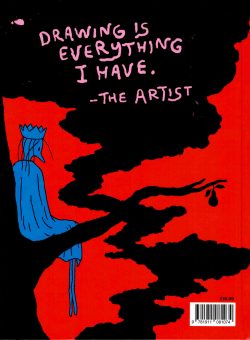
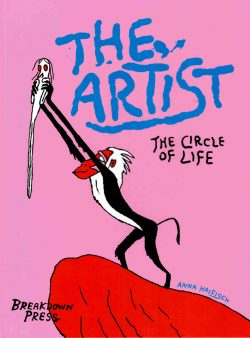
The Artist: The Circle of Life


By Anna Haifisch (Breakdown Press)
ISBN: 978-1-91108-107-4 (HB)

Win’s Christmas Gift Recommendation: Picture Perfect Grown Up Fun… 9/10

Like Norwegian émigré and cartoon superstar Jason, Anna Haifisch is a compulsive visualiser and raconteur with a devastating touch of whimsy that is impossible to resist.

Born in 1986 in Leipzig, the illustrator and screen printer is a truly dedicated purveyor of captivating comics that exude charm and wit whilst tackling big issues in accessible ways. She’s also very sly, and very funny. It’s made her something of an international celebrity…

In 2017 her book The Artist introduced an effete intellectual avian utterly in love with the fashionable concept of being a creator and this long-awaited sequel delivers another clutch of wry, vainglorious, heartfelt, pompous and charming episodes detailing how tough it is to dedicate one’s life to the Muse… especially if you only want to draw birds and snakes…

A vivid hardback collation, sequel volume The Circle of Life collects strips from 2016 that first appeared online at Vice.Com and shares even more insights in powerful line and flat colour combinations, beginning with an eponymous self-deprecating introduction…

Delivered as short 2-3 page cartoon colloquies, the drama dioramas open on a wearying, pharmaceutical-fuelled night out with Owl, leading to an origin of sorts and a challenging confrontation with that bane of all artists, the wealthy but clueless collector/sponsor…

Most episodes are brief and untitled but some earn themselves notoriety and utility through names such as ‘Art Rap’ which follows a deliriously engaging vignette about St. Luke (Patron Saint of artists). After that blending of imagery with devious street patter, an idealised day segues into a faux documentary on lost painter Edzard Fünfhauser, an incident of excoriating self-recrimination, a visit to the psych ward and a restorative trip down memory lane…

A fanciful sojourn amidst Art’s Great Ones and a historically significant moment of letter-writing leads to a temporary abandonment of dreams and principles before a sordid session of tool fetishism restores equilibrium via a period of Japanese impressionism and Haiku drafting.

There follows and Interlude: On Birds enquiring ‘What Happened to All the Aspiring Cartoon Birds‘ (such as Donald, Woodstock and Tweety), after which a dissertation on being online and painful interactions with a non-artistic relative lead to a re-examination of favourite themes and a brief commission in frozen Greenland.

A sad tryst with a cage bird triggers ‘3 Jolly Autumn Strips’; a visit to the Jail built for Artists and the horrors of tawdry commercialism and hawking your work to the public (so clearly autobiographical, as Haifisch is co-founder of Germany’s The Millionaires Club Indie Comics Festival in Leipzig) before concluding on an uplifting high note with an illustrative paean to creativity and a singalong tribute to ‘Sorority’…

Outrageous and charming, these exploration of the fabled life and anxiety-drenched traps of the creative spirit are a delight for everyone who’s ever picked up a pencil or looked at a masterpiece and thought “I can do that”…
© Anna Haifisch Breakdown Press 2019.

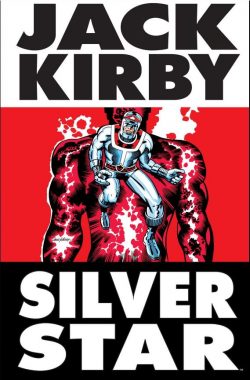
Jack Kirby’s Silver Star


By Jack Kirby, with Mike Royer, D. Bruce Berry, Janice Cohen, Erik Larsen & Eric Stephenson (Image)
ISBN: 978-1-58240-764-7 (HB)

Win’s Christmas Gift Recommendation: Monumental Marvel Magic for Fun Seekers… 8/10

Jack Kirby was – and remains – the most important single influence in the history of American comics. There are millions of words about what the man has done and meant, and you should read those if you are at all interested in our medium.

Of course I’m going to add my own two-bobs’-worth, pointing out what you probably already know: Kirby was a man of vast imagination who translated big concepts into astoundingly potent and accessible symbols for generations of fantasy fans. If you were exposed to Kirby as an impressionable kid you were his for life. To be honest, the same probably applies whatever age you jump aboard the “Kirby Express”…

For those of us who grew up with Jack, his are the images which furnish our interior mindsets. Close your eyes and think “robot” and the first thing that pops up is a Kirby creation. Every fantastic, futuristic city in our heads is crammed with his chunky, towering spires. Because of Jack, we all know what the bodies beneath those stony-head statues on Easter Island look like, we are all viscerally aware that you can never trust great big aliens parading around in their underpants and, most importantly, we know how cavemen dressed and carnosaurs clashed…

Kirby’s creations are magical: they all inspire successive generations of creators to pick up the ball and keep running with it…

In the late 1930s, it took a remarkably short time for Kirby and his creative partner Joe Simon to become the wonder-kid dream-team of the new-born comic book industry. Together they produced a year’s worth of pioneering influential monthly Blue Bolt, rushed out Captain Marvel Adventures (#1) for overstretched Fawcett and, after Martin Goodman appointed Simon editor at Timely Comics, co-created a host of iconic characters such as Red Raven, the original Marvel Boy, Mercury, Hurricane, The Vision, Young Allies and of course million-selling mega-hit Captain America.

When Goodman failed to make good on his financial obligations, Simon & Kirby were snapped up by National/DC, who welcomed them with open arms and a fat chequebook. Bursting with ideas the staid company were never really comfortable with, the pair were initially an uneasy fit, and were given two moribund strips to play with until they found their creative feet: Sandman and Manhunter.

They turned both around virtually overnight and, once established and left to their own devices, switched to the “Kid Gang” genre they had pioneered at Timely. Joe and Jack created wartime sales sensation Boy Commandos and a Homefront iteration dubbed the Newsboy Legion before being called up to serve in the war they had been fighting on comicbook pages since 1940.

Once demobbed, they returned to a very different funnybook business and soon left National to create their own little empire…

Simon & Kirby heralded and ushered in the first American age of mature comics – not just by inventing the Romance genre, but with all manner of challenging modern material about real people in extraordinary situations – before seeing it all disappear again in less than eight years.

Their small stable of magazines – generated for the association of companies known as Prize, Crestwood, Pines, Essenkay and/or Mainline Comics – blossomed and as quickly wilted when the industry abruptly contracted throughout the 1950s.

After years of working for others, Simon & Kirby had finally established their own publishing house, producing comics for a far more sophisticated audience, only to find themselves in a sales downturn and awash in public hysteria generated by an anti-comicbook pogrom.

Hysterical censorship-fever spearheaded by US Senator Estes Kefauver and opportunistic pop psychologist Dr. Frederic Wertham led to witch-hunting Senate hearings. Caving in, publishers adopted a castrating straitjacket of draconian self-regulatory rules. Horror titles produced under the aegis and emblem of the Comics Code Authority were sanitised and anodyne affairs in terms of Shock and Gore, even though the market’s appetite for suspense and the uncanny was still high. Crime comics vanished and mature themes challenging an increasingly stratified and oppressive society were suppressed…

Simon quit the business for advertising, but Jack soldiered on, taking his skills and ideas to a number of safer, if less experimental, companies. As the panic abated, Kirby returned briefly to DC Comics where he worked on mystery tales and Green Arrow (at that time a mere back-up, page-filler in Adventure Comics and World’s Finest Comics) whilst concentrating on his long-dreamed-of newspaper strip Sky Masters of the Space Force.

During that period Kirby also re-packaged an original super-team concept that had been kicking around in his head since he and Joe Simon had closed their innovative, ill-timed ventures. At the end of 1956 Showcase #6 premiered the Challengers of the Unknown…

After three more test issues the “Challs” won their own title with Kirby in command for the first eight issues. Then a legal dispute with Editor Jack Schiff exploded and the King was gone…

He found fresh fields and an equally hungry-for-change new partner in Stan Lee at ailing Atlas Comics (which had once been mighty Timely) and there created a revolution in superhero comics storytelling…

After just over a decade of never-ending innovation and crowd-pleasing wonderment, Kirby felt increasingly stifled. His efforts had transformed the little publisher into industry-pioneer Marvel but now felt trapped in a rut. Thus, he moved back to DC for another burst of sheer imagination and pure invention.

Kirby always understood the fundamentals of pleasing his audience and strived diligently to combat the appalling state of prejudice about the comics medium – especially from industry insiders and professionals who despised the “kiddies’ world” they felt trapped in.

After his controversial, grandiose Fourth World titles were cancelled, Kirby looked for other concepts which would stimulate his own vast creativity yet still appeal to a market growing evermore fickle. His follow-ups included science fiction themed heroes Kamandi and OMAC, supernatural star The Demon, a run of war stories starring The Losers, and even a new Sandman co-created with old Joe Simon, but although the ideas kept coming (Atlas, Kobra, Dingbats of Danger Street), yet again editorial disputes ended up with him leaving for promises of more creative freedom elsewhere…

Jack Kirby’s return to Marvel in 1976 was much hyped at the time but again turned out to be controversial. His new works and creations (2001: A Space Odyssey, The Eternals, Devil Dinosaur, Machine Man) found friends rapidly, but his return to earlier creations Captain America and Black Panther divided the fanbase.

Kirby was never slavishly wedded to tight continuity, and preferred, in many ways, to treat his stints on titles as another “Day One”: a policy increasing at odds with the close-continuity demanded by a strident faction of the readership…

They were apparently blind to the unfettered, joyous freedom of imagination run wild, the majesty of pulse-pounding thrills and galvanising BIG ART channelling BIG IDEAS!

The end of the 1970s saw Kirby drift into animation: designing characters and scenarios for shows such as Turbo-Teen, Thundarr the Barbarian and even The New Fantastic Four. His comics efforts included graphic novel The Hunger Dogs and Super Powers for DC, and an adaptation of movie The Black Hole for syndicated strip Walt Disney’s Treasury of Classic Tales.

However, his most memorable move was to validate the newly-minted Independent Comics/Direct Sale Market sector where he launched bombastic sci fi shocker Captain Victory and the Galactic Rangers for distributor-turned-publisher Pacific Comics.

For Eclipse, he co-created with Steve Gerber the industry-excoriating symbol of creative rebellion Destroyer Duck (part of a grass-roots campaign that ultimately destroyed the iniquitous work-for-hire business model that had made creators little more than indentured servants for decades).

Also for Pacific at that time, Kirby crafted a 6-issue miniseries returning to his cherished themes of human advancement and perfection. The lure of these projects was that after decades of toil and unleashed genius, now Jack owned his stuff and had complete editorial control…

That’s paid off here in this deluxe hardback and digital edition celebrating the sheer power and exuberance of The King’s gifts. Kirby never threw away a notion or design, and from his copious “Maybe Later/Maybe One Day” file in 1983, he crafted this frantic, frenetic superhero/espionage/doomsday thriller based on an unsuccessful screenplay he and then-assistant Steve Sherman had put together in the 1970s.

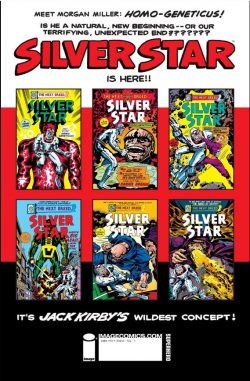
Accompanied by an early concept drawing, the origins and impact of the original Silver Star miniseries – which ran from February 1983 to January 1984 – are discussed by Pacific’s editorial director Dave Scroggy in his Introduction before we meet Morgan Miller: Homo Geneticus! in premiere outing ‘Silver Star is here!!’ as, via a communal psychic network, the next stage in human evolution reveals his secrets…

Morgan’s incredible powers come from prenatal genetic tampering by his father Dr. Bradford Miller, who was seeking to offset the repercussions of prospective atomic war, and the son is apparently not the only one of this “Next Breed”.

He soon might be though, since earlier prototype Darius Drumm is methodically and ruthlessly exterminating them whenever he tracks them down…

Morgan’s powers manifest when he comes under heavy fire as a good soldier fighting in another American overseas war. After such a public debut, he’s quickly co-opted by Secret Service agent Floyd Custer to protect America, but Drumm’s campaign of terror against ‘The Others’ continues, not just with uncanny powers in the all-too-frail physical world, but also in torment-fuelled sorties into the communal astral plane where Morgan seeks to preserve the life and sanity of mysterious gamin Tracy Coleman…

Sadly, the hero’s success rate is pretty abysmal, and Drumm’s twisted religious mania gives him an advantage in the war, as seen in ‘The Super-Normals: Are they God’s or Satan’s Children?’  It seems the tireless demagogue is also charismatic leader of a vast, anti-happiness and wellbeing cult…

The first four issues were inked & lettered by Mike Royer with colours from Janice Cohen, but the remaining two chapters (which coincided in the 1980s with Pacific moving to more experimental print processes and paper stock, with a noticeable loss of reproduction quality) are graced with the pens and brushes of D. Bruce Berry. They have been re-coloured for this edition by Erik Larsen & Eric Stephenson, who usher in a climactic showdown and moment of global revelation as ‘The World According to Drumm!’ finds hard-pressed hero Silver Star and his surviving species-mates zeroing in on the killer, who has expanded his remit to encompass all Earth, forcing the hero to battle a science-spawned ‘Angel of Death!’

Peppered with concept and developmental sketches, unused artwork and covers, plus pin-ups and designs inked by the likes of Jim Lee and Joe Sinnott, Kirby’s self-described and long-awaited Visual Novel also offers a lavishly illustrated look at his and Steve Sherman’s Silver Star Original Screenplay.

Jack Kirby’s commitment to wholesome adventure, breakneck action and breathless wonderment, combined with his absolute mastery of the comic page and unceasing quest for the Next Big Thrill always makes for a captivating read. His comics should be compulsory for all and found in every home…
© 2007 the Jack Kirby Estate. All rights reserved.

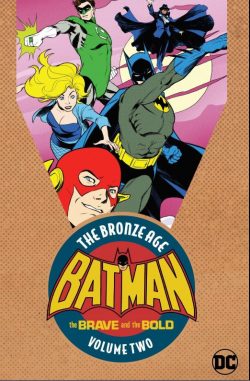
Batman in the Brave and the Bold: The Bronze Age volume two


By Bob Haney, Denny O’Neil, Jim Aparo, Nick Cardy, Neal Adams, Bob Brown, Frank McLaughlin & various (DC Comics)
ISBN: 978-1-4012-8582-1 (TPB)

Win’s Christmas Gift Recommendation: Perfect Pairings for Festive Fun Seekers… 10/10

The Brave and the Bold began in 1955 as an anthology adventure comic featuring short complete tales about a variety of period heroes: a format that mirrored the contemporary movie fascination with historical dramas.

Written by Bob Kanigher, issue #1 led with Golden Gladiator, the Silent Knight and Joe Kubert’s now legendary Viking Prince. From #5 the Gladiator was increasingly alternated with Robin Hood, but such manly, mainly mainstream romps still carried the title until the end of the decade when the burgeoning costumed character revival saw B&B transform into a try-out vehicle like sister publication Showcase.

Issue #25 (August-September 1959) featured the debut of Task Force X: Suicide Squad, followed by Justice League of America (#28), Cave Carson (#31) and Hawkman (#34). Since only the JLA hit the first time out, there were return engagements for the Squad, Carson and Hawkman.

Something truly different appeared in #45-49 with the science fictional Strange Sports Stories before Brave and the Bold #50 triggered a new concept that once again truly caught the reader’s imagination.

That issue paired two superheroes – Green Arrow and Martian Manhunter – in a one-off team-up, as did succeeding issues: Aquaman and Hawkman in #51, WWII combatants Sgt. Rock, Captain Cloud, Mme. Marie and the Haunted Tank in #52 and Atom and Flash in #53. The next team-up – Robin, Aqualad and Kid Flash – swiftly evolved into the Teen Titans. After Metal Men/the Atom and Flash/Martian Manhunter, new hero Metamorpho, the Element Man debuted in #57-58.

Then it was back to superhero pairings with #59, and although no one realised it at the time this particular conjunction (Batman with Green Lantern) would be particularly significant.

After a return engagement for the Teen Titans in #60, the next two issues highlighted Earth-2 champions Starman and Black Canary, whilst Wonder Woman met Supergirl in #63.

Then, in an indication of things to come, and in anticipation of the TV-induced mania mere months away, Batman duelled hero/villain Eclipso in #64. Within two issues, following Flash/Doom Patrol (#65) and Metamorpho/Metal Men (#66), Brave and the Bold #67 saw the Caped Crusader take de facto control of the title and the lion’s share of the team-ups. With the exception of #72-73 (Spectre/Flash and Aquaman/Atom) the comic was henceforth to be a place where Batman invited the rest of company’s heroic pantheon to come and play…

For the sake of brevity and clarity and according to the wise ones who dictate such arbitrary demarcations, it’s also the point at which Comics’ Silver Age transitioned into the Bronze Age…

This second selection of unalloyed Batman pairings with other luminaries of the DC universe reprints B&B #92-109 (spanning October/November 1970 to October/November 1973) featuring the last vestiges of a continuity-reduced DC where individual story needs were seldom submerged into a cohesive overarching scenario, and where lead writer Bob Haney crafted stories that were meant to be read in isolation, drawn by a profusion of artists with only one goal: entertainment. At this time editors favoured regular if not permanent creative teams, feeling that a sense of visual and even narrative continuity would avoid confusion amongst younger readers.

It thus signalled the advent of the superb Nick Cardy as an innovative illustrator: his short run of beautifully drawn and boldly experimental assignments is still startling to see five decades later.

Haney was always at his best with terse, human scale dramas, especially “straight” crime thrillers, as in the eccentric thriller in #92 wherein Batman travels to England, embroiled in a moody, gothic murder mystery with a trio of British stereotypes fancifully christened “The Bat Squad.” Although the scratch team never reappeared, ‘Night Wears a Scarlet Shroud!’ remains a period delight and a must for those who still remember when “Eng-ga-land Swung”…

At the end of the 1960s the Comics Code Authority ended its ban on crime and horror comics to allow publishers to exploit the global interest in the supernatural. This had instantly affected comics and more and more stories had macabre overtones. It led to the revival of horror and suspense anthologies, such as the venerable House of Mystery and unquestionably the oddest team-up in B&B history.

Scripted by Denny O’Neil and illustrated by Neal Adams, #93’s ‘Red Water, Crimson Death’ is a chilling ghost story with the added advantage of having the Dark Knight’s sombre shtick counterbalanced by the musings of the sardonic laconic Cain, ethereal and hip caretaker of that haunted habitat…

Haney, Cardy and the Teen Titans returned for powerful counter-culture bomb-plot ‘Rebels in the Streets’ after which a forgotten mystery hero (I won’t spoil it for you) helps Batman get the goods on ruthless, fat-cat industrialist Ruby Ryder in ‘C.O.D. – Corpse on Delivery’ in #95 before – somewhat more palatable for continuity bugs – Sgt Rock’s second engagement with the Bat was set in contemporary times rather than in WWII. Here the honourable old soldier becomes a bureaucrat’s patsy in compelling espionage thriller ‘The Striped-Pants War!’

Haney clearly had a fondness for grizzled older heroes as former pugilist Wildcat made another comeback in #97’s South-of-the-Border saga ‘The Smile of Choclotan!’: an epic of exploration inked by Cardy over the husky he-man pencils of the hugely underrated Bob Brown.

The Phantom Stranger guested next in a truly sinister tale of suburban devil worship which found Batman thoroughly out of his depth in ‘The Mansion of the Misbegotten!’, illustrated by the man who would soon become the only B&B artist: Jim Aparo.

Brown & Cardy returned to draw the Flash saving the Gotham Gangbuster from ghostly possession in ‘The Man who Murdered the Past’ and Aparo illustrated the anniversary 100th issue as Green Lantern, Green Arrow and Black Canary had to take over for a Batman on the verge of death and trapped as ‘The Warrior in a Wheel-Chair’.

Aparo stuck around for the outrageous murder-mystery ‘Cold-Blood, Hot Gun’ wherein Metamorpho, the Element Man assists the Caped Crusader in foiling the World’s most deadly hitman, but Brave and the Bold #102 featured a true rarity.

The Teen Titans again featured in an angry tale of the generation gap but ‘Commune of Defiance’ began as an Aparo job, but in a bizarre turnabout Neal Adams – an artist legendary for blowing deadlines – was called in to finish the story, contributing the last nine pages of the tension-packed political thriller, after which Brown and Frank McLaughlin illustrated ‘A Traitor Lurks Inside Earth!’: a doomsday saga of military computers gone awry featuring the multipurpose Metal Men.

Aparo was back in #104 for a poignant story of love from beyond the grave in the enigmatically entitled ‘Second Chance for a Deadman?’ after which a depowered Wonder Woman resurfaced after a long absence in Haney & Aparo’s superb revolutionary epic ‘Play Now… Die Later!’ as Diana Prince and the Darknight Detective become pawns in a bloody South American feud exported to the streets of Gotham.

Newly penniless social reformer Green Arrow is then sucked into a murderous get-rich-quick con in #106’s ‘Double Your Money… and Die’, featuring a surprise star villain, before Black Canary co-stars in a clever take on the headline-grabbing – and still unsolved – D.B. Cooper hijacking of an airliner in ‘The 3-Million Dollar Sky’ from B&B #107 (June-July 1973). Inflation sucks: “Cooper” only got $200,000 when he jumped out of that Boeing 727 in November 1971, never to be see again…

A wonderfully chilling tale of obsession and old soldiers never dying follows as Sgt. Rock tries once more to catch the greatest monster in history on ‘The Night Batman Sold his Soul!’ before this bronze bonanza concludes with superb supernatural thriller ‘Gotham Bay, Be My Grave!’ wherein the Caped Crusader and Jack Kirby’s then newest sensation Etrigan the Demon battle an unquiet spirit determined to avenge his own execution after nearly a century…

These are some of the best and most entertainingly varied yarns from a period of magnificent creativity in the American comics industry. Aimed at a general readership, gloriously free of heavy, cloying continuity baggage and brought to stirring, action-packed life by some of the greatest artists in the business, this is a Batman for all seasons and reasons with the added bonus of some of the most fabulous and engaging co-stars a fan could imagine. How could anybody resist? Can you…?

© 1970, 1971, 1972, 1973, 2018 DC Comics. All Rights Reserved.

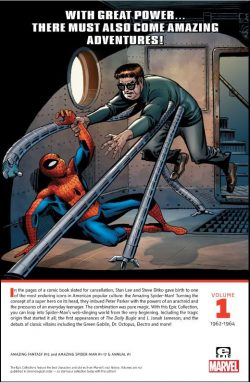
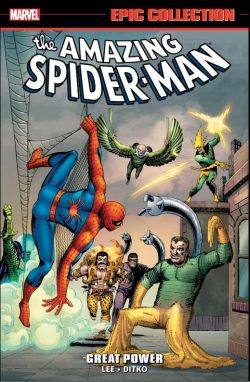
Amazing Spider-Man Epic Collection volume 1: Great Power 1962-1964


By Stan Lee & Steve Ditko, with Jack Kirby & various (Marvel)
ISBN: 978-0-7851-8834-6 (TPB)

Win’s Christmas Gift Recommendation: Timeless and Essential Comics Perfection… 10/10

Marvel is often termed “the House that Jack Built” and King Kirby’s contributions are undeniable and inescapable in the creation of a new kind of comic book storytelling, but there was another unique visionary toiling at Atlas-Comics-as-was: one whose creativity and even philosophy seemed diametrically opposed to the bludgeoning power, vast imaginative scope and clean, broad lines of Kirby’s ever-expanding search for the external and infinite.

Steve Ditko was quiet and unassuming, voluntarily diffident to the point of invisibility, but his work was both subtle and striking: innovative and meticulously polished. Always questing for detail, he ever explored the man within. He found heroism – and humour and ultimate evil – all contained within the frail but noble confines of human scope and consciousness. His drawing could be oddly disquieting… and, when he wanted, decidedly creepy.

Crafting extremely well-received monster and mystery tales for and with Stan Lee, Ditko had been rewarded with his own title. Amazing Adventures/Amazing Adult Fantasy featured a subtler brand of yarn than Rampaging Aliens and Furry Underpants Monsters and the ilk which, though individually entertaining, had been slowly losing traction in the world of comics ever since National/DC had successfully reintroduced costumed heroes.

Lee & Kirby had responded with Fantastic Four and the ahead-of-its-time Incredible Hulk but there was no indication of the renaissance to come when the cover of officially just-cancelled Amazing Fantasy featured a brand new and rather eerie adventure character.

This compelling and economical full-colour trade paperback and digital compilation re-presents the early run of Amazing Spider-Man #1-17, plus Annual #1 and that auspicious tale from Amazing Fantasy #15 (spanning August 1962 through October 1964): allowing newcomers and veteran readers to relive some of the greatest moments in sequential narrative.

The wonderment came and concluded in 11 captivating pages: ‘Spider-Man!’ tells the parable of Peter Parker, a smart but alienated kid bitten by a radioactive spider on a high school science trip. Discovering he has developed arachnid abilities – which he augments with his own natural engineering genius – he does what any lonely, geeky nerd would do when given such a gift… he tries to cash in for girls, fame and money.

Creating a costume to hide his identity in case he makes a fool of himself, Parker becomes a minor celebrity – and a vain, self-important one. To his eternal regret, when a thief flees past, he doesn’t lift a finger to stop him, only to find when he returns home that his Uncle Ben has been murdered.

Crazy for vengeance, Parker stalks the assailant who made his beloved Aunt May a widow and killed the only father he had ever known, only to find that it is the felon he couldn’t be bothered with. Since his social irresponsibility led to the death of the man who raised him, the boy swears to always use his powers to help others…

It wasn’t a new story, but the setting was one familiar to every kid reading it and the artwork was downright spooky. This wasn’t the gleaming high-tech world of moon-rockets, giant monsters and flying cars – this stuff could happen to anybody…

Amazing Fantasy #15 came out the same month as Tales to Astonish #35 (cover-dated September 1962) – the first to feature the Astonishing Ant-Man in costumed capers, but it was the last issue of Ditko’s Amazing playground. In this volume you’ll find the ‘Fan Page – Important Announcement from the Editor!’ that completely misled fans as to what would happen next…

However, the tragic last-ditch tale struck a chord with the reading public and by Christmas a new comicbook superstar was ready to launch in his own title, with Ditko eager to show what he could do with his first returning character since the demise of Charlton action hero Captain Atom…

Holding on to the “Amazing” prefix to jog reader’s memories, the bi-monthly Amazing Spider-Man #1 arrived with a March 1963 cover-date and two complete stories. It also prominently featured the Fantastic Four and took the readership by storm. The opening tale, again simply entitled ‘Spider-Man!’, recapitulated the origin whilst adding a brilliant twist to the conventional mix…

By now the wall-crawling hero was feared and reviled by the general public thanks in no small part to J. Jonah Jameson, a newspaper magnate who pilloried the adventurer from spite and for profit. With time-honoured comicbook irony, Spider-Man then had to save Jameson’s astronaut son John from a faulty space capsule in extremely low orbit…

The second yarn ‘Vs the Chameleon!’ finds the cash-strapped kid trying to force his way onto the roster – and payroll – of the FF whilst elsewhere a spy perfectly impersonates the web-spinner to steal military secrets. This is a stunning example of the high-strung, antagonistic crossovers and cameos that so startled the jaded kids of the early 1960s. Heroes just didn’t act like that and they certainly didn’t speak directly to the fans as in ‘A Personal Message from Spider-Man’ that’s reprinted here…

With his second issue, our new champion began a meteoric rise in quality and innovative storytelling. ‘Duel to the Death with the Vulture!’ catches Parker chasing a flying thief as much for profit as justice. Desperate to help his aunt make ends meet, Spider-Man starts to taking photos of his cases to sell to Jameson’s Daily Bugle, making his personal gadfly his sole means of support.

Matching his deft comedy and moody soap-operatic melodrama, Ditko’s action sequences were imaginative and magnificently visceral, with odd angle shots and quirky, mis-balanced poses adding a vertiginous sense of unease to fight scenes. But crime wasn’t the only threat to the world and Spider-Man was just as (un)comfortable battling “aliens” in ‘The Uncanny Threat of the Terrible Tinkerer!’

Amazing Spider-Man #3 introduced possibly the apprentice hero’s greatest enemy in ‘Versus Doctor Octopus’; a full-length saga wherein a dedicated scientist survives an atomic accident only to discover his self-designed mechanical tentacles have permanently grafted to his body. Power-mad, Otto Octavius initially thrashes Spider-Man, sending the lad into a depression until an impromptu pep-talk from Human Torch Johnny Storm galvanises Spider-Man to one of his greatest victories. Also included here is a stunning ‘Special Surprise Bonus Spider-Man Pin-up Page!’…

‘Nothing Can Stop… the Sandman!’ was another instant classic wherein a common thug who gains the power to transform to sand (another pesky nuclear snafu) invades Parker’s school, and must be stopped at all costs, whilst issue #5 finds the webspinner ‘Marked for Destruction by Dr. Doom!’ – not so much winning as surviving his battle against the deadliest man on Earth.

Presumably he didn’t mind too much, as this marked the transition from bi-monthly to monthly status for the series. In this tale Parker’s social nemesis, jock bully Flash Thompson, first displays depths beyond the usual in contemporary comicbooks, beginning one of the best love/hate buddy relationships in popular literature…

Sometime mentor Dr. Curtis Connors debuts in #6 when Spidey comes ‘Face-to-face with… The Lizard!’ Ttttas the wallcrawler fights far from the concrete canyons and comfort zone of New York – specifically in the murky Florida Everglades. Parker was back in the Big Apple in #7 to breathtakingly tackle ‘The Return of the Vulture’ in a full-length masterpiece.

Fun and youthful hi-jinks were a signature feature of the series, as was Parker’s budding romance with “older woman” Betty Brant, Jameson’s secretary/PA at the Daily Bugle. Youthful exuberance was the underlying drive in #8′s lead tale ‘The Living Brain!’ wherein an ambulatory robot calculator threatens to expose Spider-Man’s secret identity before running amok at beleaguered Midtown High, just as Parker is finally beating the stuffings out of school bully Flash Thompson.

This 17-page triumph was accompanied by ‘Spiderman Tackles the Torch!’: a 6-page vignette drawn by Jack Kirby and inked by Ditko, wherein a boisterous wall-crawler gate-crashes a beach party thrown by the flaming hero’s girlfriend… with suitably explosive consequences.

Amazing Spider-Man #9 is a qualitative step-up in dramatic terms, as Aunt May is revealed to be chronically ill – adding to Parker’s financial woes – with the action supplied by ‘The Man Called Electro!’ – an accidental super-criminal with grand aspirations.

Spider-Man was always a loner, never far from the streets and small-scale-crime, and with this tale – wherein he also quells a prison riot single handed – Ditko’s preference for tales of gangersterism starts to show through; a predilection confirmed in #10′s ‘The Enforcers!’ This is a classy mystery with a masked mastermind known as the Big Man using a position of trust at the Bugle to organise all New York mobs into one unbeatable army against decency.

Longer plot-strands are also introduced as Betty mysteriously vanishes, although most fans remember this one for the spectacularly climactic 7-page fight scene in an underworld chop-shop that has still never been beaten for action-choreography.

The wonderment intensifies with a magical 2-part yarn. ‘Turning Point’ and ‘Unmasked by Dr. Octopus!’ sees the return of the lethally deranged and deformed scientist and the disclosure of a long-hidden secret which had haunted Parker’s girlfriend Betty Brant for years.

The dark, tragedy-filled tale of extortion and excoriating tension stretches from Philadelphia to the Bronx Zoo and cannily tempers the trenchant melodrama with spectacular fight scenes in unusual and exotic locations, before culminating in a truly staggering super-powered duel as only the masterful Ditko could orchestrate it.

A new super-foe premiered in Amazing Spider-Man #13 with ‘The Menace of Mysterio!’ as a seemingly eldritch bounty-hunter hired by publisher J. Jonah Jameson to capture Spider-Man eventually reveals his own dark criminal agenda, whilst #14 is an absolute milestone in the series as a hidden criminal mastermind manipulates a Hollywood studio into making a movie about the wall-crawler.

Even with guest-star opponents the Enforcers and Incredible Hulk, ‘The Grotesque Adventure of the Green Goblin’ is most notable for introducing Spider-Man’s most perfidious and flamboyant enemy.

Jungle superman and thrill-junkie ‘Kraven the Hunter!’ makes Spider-Man his intended prey at the behest of embittered Spidey-foe the Chameleon in #15, and promptly reappears in the first Amazing Spider-Man Annual that follows.

A timeless landmark and still magnificently thrilling battle, tale, the ‘Sinister Six’ begins after a team of villains comprising Electro, Kraven, Mysterio, Sandman, Vulture and Doctor Octopus abduct Aunt May and Betty, and Spider-Man is forced to confront them without his Spider-powers – lost in a guilt-fuelled panic attack. A staggeringly enthralling Fights ‘n’ Tights saga, this influential tale also featured cameos (or, more honestly, product placement segments) by every other extant hero of the budding Marvel universe.

Also included from the colossal comic book are special feature pages on ‘The Secrets of Spider-Man!’ and the comedic short ‘How Stan Lee and Steve Ditko Created Spider-Man’ and a gallery of pin-up pages featuring ‘Spider-Man’s Most Famous Foes!’ – (the Burglar, Chameleon, Vulture, Terrible Tinkerer, Dr. Octopus, Sandman, Doctor Doom, The Lizard, Living Brain, Electro, The Enforcers, Mysterio, Green Goblin and Kraven the Hunter) – plus pin-ups of Betty and Jonah, Parker’s classmates and house and heroic guest stars…

Amazing Spider-Man #16 extended that circle of friends and foes as the webslinger battles the Ringmaster and his Circus of Evil and meets a fellow loner hero in a dazzling and delightful ‘Duel with Daredevil’.

An ambitious 3-part saga began in Amazing Spider-Man #17 wherein the rapidly-maturing hero touches emotional bottom before rising to triumphant victory over all manner of enemies. Sadly, ‘The Return of the Green Goblin!’ only opens that encounter here and you’ll need the next Epic Collection to conclude the saga…

Offering some consolation however is the entire debut tale from AF #15, in original art form, taken from the Library of Congress where it now resides and fully curated and commented upon by historian and scholar Blake Bell. Also on view are unused Ditko covers and early monochrome pin-ups, unretouched cover art for AS #11 and a barrage of pulse-pounding house ads, plus a photo-feature on the Marvel Bullpen circa 1964.

These immortal epics are something no serous fan can be without, and will make the ideal gift for any curious newcomer.
© 1962, 1963, 1964, 2019 MARVEL. All rights reserved.

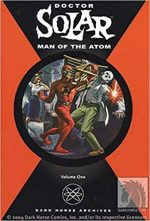
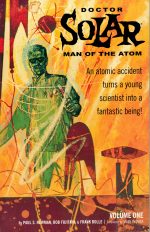
Doctor Solar, Man of the Atom Archives volume 1


By Paul S. Newman, Matt Murphy, Bob Fujitani, Frank Bolle & various (Dark Horse Books)
ISBN: 978-1-59307-285-8 (HB) 978-1-59582-586-5 (TPB)

Win’s Christmas Gift Recommendation: Epic Atom Age Adventure… 9/10

The comics colossus identified by fans as Dell/Gold Key/Whitman had one of the most complicated publishing set-ups in history but that didn’t matter one iota to the kids of all ages who consumed their vastly varied product.

Based in Racine, Wisconsin, Whitman had been a crucial part of the monolithic Western Publishing and Lithography Company since 1915 and could draw on the commercial resources and industry connections that came with editorial offices on both coasts (and even a subsidiary printing plant in Poughkeepsie, New York).

Another connection was with fellow Western subsidiary K.K. Publications (named for licensing legend Kay Kamen who facilitated extremely lucrative “license to print money” merchandising deals for Walt Disney Studios between 1933 and 1949).

From 1938, Western’s comicbook output was released under a partnership deal with a “pulps” periodical publisher under the umbrella imprint Dell Comics – and again those creative staff and commercial contacts fed into the line-up of the Big Little, Little Golden and Golden Press books for children. This partnership ended in 1962 and Western had to swiftly reinvent its comics division as Gold Key.

As previously cited, Western Publishing had been a major player since comics’ earliest days, blending a huge tranche of licensed titles such as newspaper strip, TV and Disney titles, (such as Nancy and Sluggo, Tarzan, or the Lone Ranger) with home-grown hits like Turok, Son of Stone and Space Family Robinson.

In the 1960s, during the camp/superhero boom these original adventure titles expanded to include Brain Boy, M.A.R.S. Patrol, Total War (created by Wally Wood), Magnus, Robot Fighter (by the incredible Russ Manning) and – in deference to the atomic age of heroes – Nukla and another brilliantly cool and understated nuclear white knight…

Despite supremely high quality and passionate fan-bases, they never really captured the media spotlight of DC or Marvel’s costumed cut-ups. Western eventually shut up their comics division in 1984 having lost or ceded their licenses to DC Marvel and Charlton.

All this and much more can be found far more clearly explained by the wonderful Mark Evanier in this hardback or trade paperback collection’s Foreword – ‘The Golden Years’ – as well as a fond critical appraisal of the superb comics yarn-spinning that follows…

As a publisher, Gold Key never really “got” the melodramatic, breast-beating, often-mock-heroic Sturm und Drang of the 1960s superhero boom – although for many of us, the understated functionality of Silver Age classics like Magnus, Robot Fighter or the remarkably radical concepts of atomic crusader Nukla and crime-fighting iterations of classic movie monsters Dracula, Frankenstein and Werewolf were utterly irresistible. The sheer off-the-wall lunacy of features like Neutro or Dr. Spektor I will save for a future occasion…

The company’s most recognisable stab at a superhero was an understated nuclear era star with the rather unwieldy codename Dr. Solar, Man of the Atom who debuted in an eponymous title dated October 1962, sporting a captivating painted cover by Richard M. Powers that made the whole deal feel like a grown up book rather than a mere comic.

Crafted by writers Paul S. Newman & Matt Murphy with art by Bob Fujitani, the 2-part origin ‘Solar’s Secret’ and ‘An Atomic Inferno’ detailed how a campaign of sabotage at research base Atom Valley culminates in the death of Dr. Bentley and the accidental transmutation of his lab partner Doctor Solar into a (no longer) human atomic pile with incredible, impossible and apparently unlimited powers and abilities. Of course, his very presence is lethal to all around him…

The espionage and murder are at the instigation mysterious Bad Actor Nuro, who wants the monopoly on atomic science and when his operative targets Solar’s girlfriend Gail Sanders, the reluctant hero – still learning his potential and limitations – is forced to act fast…

Powers painted a second rousing cover (before handing the job over to Gold Key mainstay George Wilson for the rest of this collections inclusions) and #2 (December) opens with Nuro’s latest plot: using radio implants to turn Gail into ‘The Remote-Control Traitor’ before unwise atomic testing triggers tectonic terror for the entire region on ‘The Night of the Volcano’…

By the time of Dr. Solar, Man of the Atom #3 (March 1963), a solid pattern was in place. Solar continued his researches aided by his two confidantes, Gail and project leader Dr. Clarkson, facing a wide variety of nefarious challenges and unnatural disasters at a rate of two stories per issue.

In ‘The Hidden Hands’ the science hero becomes a clandestine globetrotter to foil a plundering terrorist with the power of invisibility, whilst Atom Valley’s own prototype weather satellite triggers atmospheric conditions which split the hero into polar opposites in ‘Solar’s Deadly Double’.

June 1963 brought #4 atomic contamination to the Atlantic as Solar scuppers a certain mystery mastermind’s gold extraction engine in ‘The Deadly Sea’ before ‘The Treacherous Trap’ finds the Atomic Man – who must regularly absorb lethal amounts of radiation to live – accidentally imperilled by fellow scientist Thor Neilsen‘s radical rad poisoning cure. The good-looking swine has also turned poor Gail’s head with romantic notions…

A big change came with #5 in September as the until-now top-secret activities of Solar are first exposed to a ruthless thief trying to steal the Atomic Ace’s latest elemental discovery in ‘The Crystallized Killers’. This, and his advancing mutation, leads to ‘The New Man of the Atom’ as Solar adopts a public masked persona and finally dons a costume: all whilst stopping an incipient atom war…

With #6 (November 1963) illustrator Frank Bolle joins Newman & Murphy to detail Solar’s stories, beginning with ‘The Impostor’ wherein Nuro despatches a face-shifting automaton to infiltrate Atom Valley and discover the masked hero’s true identity: a saga which concludes in spectacular nuclear combat in ‘Android Against the Atom’…

This volume’s action concludes with #7 (March 1964), beginning with a drastic drop in sea levels. Upon investigation Solar discovers malevolent extraterrestrials are behind the ‘Vanishing Oceans’ but no sooner does he deal with them than ‘The Guided Comet’ covertly controlled by Nuro, simultaneously threatens human existence and acts as an almost-foolproof deathtrap for the Man of the Atom. Almost…

Augmented by fulsome ‘Biographies’ of the creative personnel, this charismatic collection offers potently underplayed and scientifically astute (as far as the facts of the day were generally known) adventures blending the best of contemporary movie tropes with the still fresh but burgeoning mythology of the Silver Age super hero boom. Enticingly restrained, these Atom Age action comics offered a compelling counterpoint to the eccentric hyperbole of DC and Marvel and remain some of the most readable thrillers of the era.

These tales are lost gems from a time when fun was paramount and entertainment a mandatory requirement. This is comics the way they were and really should be again…
DOCTOR SOLAR®, MAN OF THE ATOM ARCHIVES Volume 1 ™ and © 2010 Random House, Inc. Under license to Classic Media, LLC. All rights reserved.

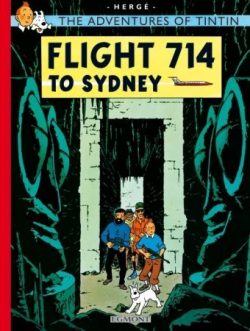
Adventures of Tintin: Flight 714 to Sydney


By Hergé, Bob De Moor, Roger Leloup and others, translated by Leslie Lonsdale-Cooper & Michael Turner (Egmont UK/Methuen/Little Brown Books)
ISBN: 978-1-40520-821-5 (HB) 978-0-31635-837-8 (Album PB)

Win’s Christmas Gift Recommendation: A Great British Tradition of Belgian Origin. Gotta Get ‘Em All… 10/10

Georges Prosper Remi, AKA Hergé, created an eternal masterpiece of graphic literature with his tales of a plucky boy reporter and entourage of iconic associates. Singly, and later with assistants including Edgar P. Jacobs, Bob de Moor, Roger Leloup and other supreme stylists of the Hergé Studio, he created 23 timeless yarns (initially serialised in instalments for a variety of newspaper periodicals) which have since grown beyond their pop culture roots to attain the status of High Art and international cultural icons.

On leaving school in 1925, Remi began working for conservative Catholic newspaper Le Vingtiéme Siécle where he fell under the influence of its Svengali-esque editor Abbot Norbert Wallez. A devoted boy scout, one year later the artist was producing his first strip series – The Adventures of Totor – for monthly Boy Scouts of Belgium magazine. By 1928 Remi was in charge of producing the contents of the newspaper’s weekly children’s supplement Le Petit Vingtiéme.

While he was illustrating The Adventures of Flup, Nénesse, Poussette and Cochonette – written by the staff sports reporter – Wallez required his compliant creative cash-cow to concoct a new and contemporary adventure series. Perhaps a young reporter who roamed the world, doing good whilst displaying solid Catholic values and virtues?

The rest is history…

Some of that history is quite dark: During the Nazi Occupation of Belgium, Le Vingtiéme Siécle was closed down and Hergé was compelled to move his supremely popular strip to daily newspaper Le Soir (Brussels’ most prominent French-language periodical, and thus appropriated and controlled by the Nazis).

He diligently toiled on for the duration, but following Belgium’s liberation was accused of collaboration and even of being a Nazi sympathiser. It took the intervention of Belgian Resistance war-hero Raymond Leblanc to dispel the cloud over Hergé, which he did by simply vouching for the cartoonist through words and deeds.

Leblanc provided cash to create a new magazine – Le Journal de Tintin – which he published and managed. The anthology comic swiftly achieved a huge weekly circulation, allowing Remi and his studio team to remaster past tales: excising material dictated by the Fascist invaders to ideologically shade the wartime adventures. These modernising post-war exercises also generally improved and updated the great tales, just in time for Tintin to become a global phenomenon, both in books and as an early star of animated TV adventure.

With the war over and his reputation restored, Hergé entered the most successful period of his artistic career. He had mastered his storytelling craft, possessed a dedicated audience eager for his every effort and was finally able to say exactly what he wanted in his work, free from fear or censure, if not his personal demons and declining health…

The greatest sign of this was not substantially in the comics tales – although Hergé continued to tinker with the form of his efforts – but rather in how long the gaps were between new exploits. The last romp had finished serialisation in September 1962 and been collected as an album in 1963. Vol 714 pour Sydney began its weekly run in Le Journal de Tintin #936 – 27th September 1966 – and concluded in #997, cover-dated November 28th 1967. The inevitable book collection came in May 1968.

Flight 714 To Sydney appears to be a return to classic adventure, but conceals some ironic modernist twists, opening with our heroes hurriedly en route to Australia. During an intrigue-redolent stopover at Djakarta, Tintin, Captain Haddock and Professor Calculus are inveigled (almost duped) into joining unconventional and somewhat unpleasant aviation tycoon Laszlo Carreidas on his personal supersonic prototype. The petty-minded multi-millionaire obviously has some ulterior design but cannot be dissuaded.

However, due to the type of coincidence that plagues our heroes, that plane has been targeted by the villainous outlaw Rastapopoulos whose gang hijack the aircraft and land it on a desolate Pacific island. The former criminal mastermind has a crazy scheme to siphon off Carreidas’ fortune but has lost a lot of his old sinister efficiency…

After many ploys and countermoves between the opposing forces, and with danger a constant companion, the prisoners escape the villain’s clutches only to discover that the Island is volcanic and conceals a fantastic ancient secret that dwarfs the threat of mere death and penury before escalating to a spectacular climax no reader will ever forget…

Although full of Hergé’s trademark slapstick humour, there is also a sly undercurrent of self-examination that highlights the intrinsic futility of the criminals’ acts. As time has passed, the murderous human monsters have all been exposed as foolish, posturing and largely ineffectual.

Nevertheless, the yarn is primarily an extremely effective, suspenseful action thriller with science fiction roots as the author plays with the multifarious strands of international research then in vogue which led to Erich von Däniken’s Chariots of the Gods and other lesser known tracts of cod science.

Once more the supernormal plays a large part in proceedings – but not as a malign force – and this time science and rationality, not the supernatural, are the basis of the wonderment. Flight 714 To Sydney is slick, compelling and astoundingly engaging: a true epic escapade no fan of fun could fail to adore.
Flight 714 To Sydney: artwork © 1968 Casterman, Paris & Tournai. Text © 1968 Egmont UK Limited. All rights reserved.

The Light


By Jim Alexander, edited by Kirsten Murray (Planet Jimbot)
ISBN: 978-1-9164535-2-4 (PB) eISBN: 978-1-9164535-3-1

Win’s Christmas Gift Recommendation: A Decidedly Different Spooky Saga for the Season… 9/10

Apparently tireless raconteur and comics veteran Jim Alexander is back with another prose novel (available in paperback and a variety of eBook formats).

His pictorial back-catalogue includes Star Trek the Manga, Calhab Justice and other strips for 2000AD, licensed properties such as Ben 10 and Generator Rex as well as a broad variety of comics and strips for The Dandy, DC, Marvel, Dark Horse Comics, Metal Hurlant Chronicles, and loads of other places including his own publishing empire Planet Jimbot. He’s imminently due back in the mainstream too, with a forthcoming Marvel Graphic Novel in the offing…

Everyone dies. That’s biology. How they die isn’t as important as how they lived, right?

That’s an assumption that is devilishly challenged in The Light as a world so very much our own takes a path less travelled after a global catastrophe in 1998.

Here and now, twenty years after the event, humanity has gained an eerie new ability: unfailing certainty in the knowledge of when your time is up.

It’s not a proper super power: decedents only know from the moment they wake up that it’s their Last Day and not everyone is sure – or convinced – until they place a palm on the ubiquitous domestic device (also available on all street corners and in every lamp post) and a purple hue tells them its time…

Socially, things haven’t changed much: Capitalism has devised new ways to monetise the change and the elites and powers-that-be have found fresh ways to restrict the thinking and spending of the masses. Someone has turned Last Day into the world’s most debauched, powerful and unavoidable religion, and on dark fringes of the planet, outsiders try to live beyond the newly-established margins and avoid collaborating with the system that demands that all citizens test their light every day…

The rest of us? We just comply, testing ourselves every 24 hours and going about our lawful business until it’s that day and we have a decision to make: lie down and die or rebel and act out…

Told through a string of narrative viewpoints from the highest and mightiest to the most excluded and lowly, how The Light works – and how it ultimately fails – is beguilingly exposed in a wry and mordant, satire-saturated tale that delves like a forensic exam into the nature of what it means to be human and truly alive…

And when this has sufficiently blown your mind, you really should really read the author’s first novel GoodCopBadCop and track down the superb comics by Alexander and his confederates Luke Cooper, Gary McLaughlin, Will Pickering, Aaron Murphy, Chris Twydell & Jim Campbell.

The Jims – Alexander & Campbell – have been providing challenging, captivating and enthralling graphic narratives for ages now and you owe it to yourself to catch them too.
© 2019 Jim Alexander.

Planet Jimbot has a splendid online shop so why not check it out? Conversely why not go to:

UK
Amazon (print) (ebook)
Kobo

US
Amazon (print) (ebook)
Kobo
Barnes & Noble