Palace of Tears Part 1


By Michael Lomon, with Alice Mazzilli
No ISBN

Win’s Christmas Gift Recommendation: Old School Blockbuster Family Entertainment… 9/10

Those of you who get out to popular events are probably well aware that all this week the Thought Bubble Yorkshire Comic Art Festival is lighting up the North, and morphs into a massive Comic Con on Saturday and Sunday (9th and 10th November).

As well as all the usual wonderments, mega guest stars convivial and bon homie of such enterprises, Thought Bubble is very proud of the number of comics and graphic novels that use the event for a high-profile launch springboard.

If you have the opportunity, you should go. Take your friends and family too. They’ll have a great time and maybe see that you aren’t that weird – relatively speaking – after all…

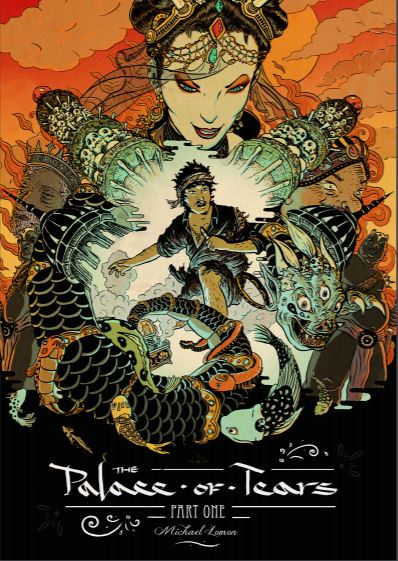
One enterprising chap attending the celebration is artist, illustrator and Motion Graphics Designer Michael Lomon – who wearily balances the complex digital day job with an irresistible drive to create thrilling traditional adventures (in actual pen and ink, yet!) – will be there, launching in person his latest extravaganza The Palace of Tears Part 1.

Somewhere in times forgotten or yet to be experienced, a poor fisherman dredges up a strange casket which contains possible doom and potential untold wealth. After opening the ornate flotsam – and subsequently outwitting the arcane horror within – the fisherman is set upon a precarious path to riches, selling very special fish to the Sultan.

However, human nature being what it is, neither vendor nor consumer can leave well enough alone and the equanimous daily transaction soon comes fatally adrift…

Accused of wizardry and cast into a dungeon, the cunning angler is astounded when a most unusual liberator manifests in a blaze of destructive luminescence and goes on a cataclysmic rampage.
That’s when things start to get really interesting… and quite terrifying…

Derived from an ancient Jewish folk tale and originated previously as a webcomic, this scintillating science fantasy tome offers a stunning, suspenseful yet fast-paced romp visually informed by classical fairy tales such as the Arabian Nights and Sinbad, with lush, lavish artwork referencing the very best of Michael Kaluta, Charles Vess, Moebius and the cinematic exploits of Douglas Fairbanks. It’s frankly quite dazzling to behold…
Absorbing, charming and over far too soon for my impatient attentions, this a sheer delight you must experience for yourself: either by going to the Comic Con and shelling out or via the usual web-based emporia…
© 2019 Michael Lomon. All rights reserved.

Find out more about The Palace of Tears at and other fine products at www.michaellomon.com
Find out more about Thought Bubble Yorkshire Comic Art Festival at https://www.thoughtbubblefestival.com/

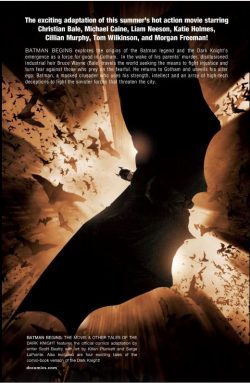
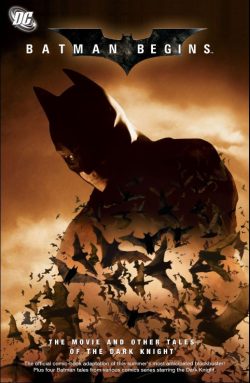
Batman Begins – the Movie and Other Tales of the Dark Knight


By Scott Beatty, Denny O’Neil, Greg Rucka, Ed Brubaker, Bill Willingham, Kilian Plunkett, Dick Giordano, Rick Burchett, Scott McDaniel, Tom Fowler & various (DC Comics)
ISBN: 978-1-4012-0440-2 (TPB)

Win’s Christmas Gift Recommendation: Blockbuster Bat Fun… 8/10

It looks like I’m just destined to be wrong. Do you remember flared jeans, or even bell-bottoms? From which time? As the 1970s gasped to a close I said that we’d never see those again. Horribly, tragically, I was wrong.

I was seven when the Batman TV show first aired, and I loved it. By the time I was nine I had learned the word ‘travesty’ and loathed the show with a passion. When it was all over and the “Camp” fallout had faded from my beloved comics, giving way to the likes of Frank Robbins, Denny O’Neil and the iconoclastic Neal Adams, I was in seventh heaven and praised pantheons of deities that I should never see ‘Batmania’ again. I was, of course, doubly wrong.

The Caped Crusader reconquered the world in 1989 and only the increasing imbecility of its movie sequels stopped that particular multimedia juggernaut. Now there’s a been a whole new sequence of films (some not half-bad – though that’s beside the point) spin-offs and a new iteration beyond that beckons. Each of these cinematic milestones generated its own host of print (and latterly, digital) tie in Bat Products.

Originally released in 2005, this crafty marriage of an inevitable “Official Movie Adaptation” of Batman Begins with a well-considered selection of thematically similar stories is one of the best I can recall and a nice prospect if you’re looking for a great read or ideal gift option…

The lead feature – creditably handled by Scott Beatty on script with Kilian Plunkett & Serge LaPointe illustrating – is an intensely readable reworking of the myth, so much so that I was able, for once, to stifle the small, shrill and incessant comic-fan voice that always screams “why do they keep mucking about with this?”, and “why isn’t the comic version good enough for those movie morons?”

I do, however, still question the modern hang-up with having to start from origin stories at all. Was Star Wars: A New Hope a relative flop because we didn’t know how Darth Vader got Laryngitis? Which Bond movie tells us how he got to be so mean and sardonic? Why can’t film-makers assume that an audience can deduce motivation without a brand-spanking-new road-map every time? Although to be painfully honest, most modern comics seem to be afflicted with this bug too…

Could it be that it’s simply a cheap way of adding weight to the villain du jour, who can then become a Motivating Force in the Birth of the Hero? Said baddies this time out are the Scarecrow and Ra’s Al Ghul, but I’m not going to speak any more about the cinema or plot of a movie that’s already being superseded by this generation’s Gotham Guardian. Batman fans will have already passed judgement…

Accompanying the filmic iteration, and following a pin-up by Ruben Procopio, is ‘The Man Who Falls’ by the aforementioned O’Neil and veteran Bat-artist Dick Giordano and taken from Secret Origins of the World’s Greatest Heroes. This is a skilful, engaging comics retooling of the so-pliable natal legend, created to address the media mania around the 1989 movie.

Hard on its heels and prefaced by a pin-up courtesy of Bill Sienkiewicz comes one of the better stories of recent vintage. ‘Air Time’ is by Greg Rucka, Rick Burchett & Rodney Ramos from Detective Comics #757 in 2001. It’s a taut countdown thriller that in many ways presages the style adopted for the wonderful procedural series Gotham Central.

KReasons’ (Batman #604, 2002), by Ed Brubaker & Scott McDaniel, revisits Batman’s origins in a tale seeking to redefine his relationship to inimical amour Catwoman, before the volume concludes with the brilliant ‘Urban Legend’ from Batman: Legends of the Dark Knight #168.

In a grim and unsettling tale of frailties, Tom Fowler illustrates a wickedly sharp Bill Willingham script stuffed with the dark humour and skewed sensibilities that made his Fables stories such a joy for grown-ups who love comics.

This is a smart package for any casual reader the films might send our way, with a strong thematic underpinning. In an era of streaming and ultra-rapid home release, I’m increasingly unsure of the merit of comic adaptations, but if you are into such things it’s probably best they’re done well, like here…
© 1989, 2001, 2002, 2003, 2005, 2012 DC Comics. All Rights Reserved.

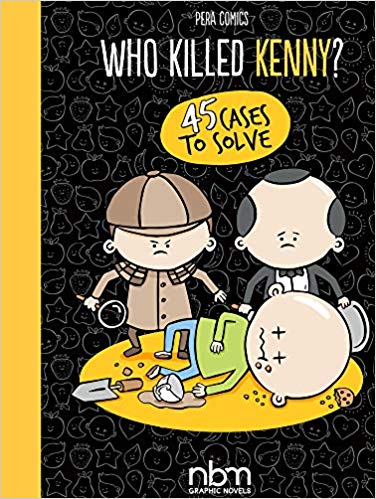
Who Killed Kenny? – 45 Cases to Solve


By Pera Comics (NBM)
ISBN: 978-1-6811-2224-3 (HB)

Win’s Christmas Gift Recommendation: Compelling Crime Cartooning… 8/10

There’s an irreverent, adult-oriented animated TV show about really unpleasant kids that’s quite popular around the world. It’s got a number of catch-phrases that people in the know often quote to each other. This book is nothing to do with that show in any way at all and besides, imitation as the cheapest sincerest form of flattery…

Seriously though, this tiny (130x 160 mm) hardback – or digital – diversion is as much game and quizbook as comics extravaganza, and although tipping its hat to the iconic South Park, is in fact a hugely popular fair play mystery game developed by cartoonist Alessandro Perugini and unleashed periodically on Instagram.

As “Pera Comics”, the artist explains it all in ‘Who is Pera’ and ‘Who is Kenny?’ but unless I’ve already convinced you to dash off and buy, I’ll blather on a bit and describe how the eponymous latter is a perpetual victim cast adrift in time and space and how each easily-accessible cartoon adventure finds him dead. From clues visual and verbal, participants must decide whether his fate is accident, suicide or murder. You get points for correct answers and rise up the rankings from Simple Agent through various Detective grades to, ultimately, a Pera Detective!

The eccentric exploits begin in ancient Rome with lengthy introductory adventure ‘The Ides of Kenny!’, to be followed by a flood of rapid-fire, funny, quirky brain-teasers such as ‘Who Killed Kenny? Devil or God?’, ‘Who Killed Kenny? Beethoven or Mozart’, ‘Who Killed Kenny? A, B, or C?’, ‘Homicide or Suicide?’, and ‘Who Killed Kenny? Zombie or Vampire?’.

The enjoyment and bloodletting never seem to end!
Deliriously daft, morbidly macabre and insanely addictive, this is a splendid treat for the easily bored with idle hands and will make for an ideal stocking-stuffer.
© 2018 Pera Comics/Tunué S.r.l. © 2019 NBM for the English translation.

Who Killed Kenny? will be published on November 14th 2019 and is available for pre-order now.
For more information and other great reads go to NBM Publishing at nbmpub.com

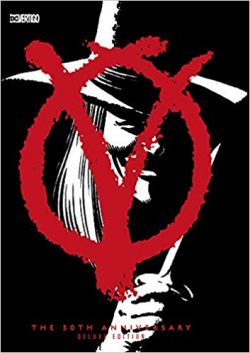
V for Vendetta/V for Vendetta 30th Anniversary Deluxe Edition


By Alan Moore & David Lloyd, with Tony Weare, Steve Whitaker, Siobhan Dodds & various (Vertigo)

ISBN: 978-1-4012-8500-5(30th Deluxe HB) 978-1-4012-0841-7(TPB)

Win’s Christmas Gift Recommendation: Groundbreaking, Life-Changing Comics Masterpiece… 10/10

Very few pieces of literature enter public consciousness and fewer still from the relatively young land of graphic narratives. Here’s one of the best…

The serial V for Vendetta began in 1982 in legendary British comics magazine Warrior. The deviously convoluted mystery play describes a highly individualistic resistance campaign conducted by an enigmatic flamboyant and ruthless “anarchist” against a fascistic British government which stumbles into power after a nuclear exchange destroyed all the bigger countries.

Or does it?

This is just as much a tale of intellectual and political awakening. Most events are seen (and the escalating situation unravels) through the eyes and experiences of Evey Hammond, a pathetic little nobody rescued from secret policemen – almost as an afterthought – by V during his first highly public exploit.

The sinisterly suspenseful series was originally presented in stark and stunning black & white, every chapter title beginning with a “v” word. Fans of classic British strip art revelled in occasional contributions from the wonderful Tony Weare (Matt Marriot, Pride of the Circus, Savage Splendour, The Colditz Story and much, much more) who fully illustrated the chapter dubbed ‘Vincent’ and also assisted master stylist David Lloyd in creating a masterpiece of daunting visual atmosphere throughout.

This was no mean feat as V – whilst dismantling with lethal efficiency the machineries of a totalitarian and ever vigilant State that constantly voiced its views that everything was better in the Good Old Days – declared himself the true guardian of lost or forgotten British culture. This demanded a phenomenal amount of research and vital trust that the readership would pick up on some pretty obscure references, both Verbal and Visual…

The then-controversial jump to colour (I, for one, would kill for a fully monochrome director’s cut edition of this saga) following DC’s appropriation of the saga was deftly handled by Lloyd himself, with the hued back-up of much-missed Steve Whitaker and Siobhan Dodds, whilst the relentless lettering of Alan Moore’s astounding script came courtesy of Jenny O’Connor, Steve Craddock & Elitta Fell.

And yes, pitiless protagonist V generally adopts the seeming of ultimate anti-authoritarian rebel Guido “Guy” Fawkes. His once-common masked vulpine visage was rescued from vintage obscurity for this tale: subsequently becoming a symbol and tool of anonymity for new generations of rebels, resisters and occupiers…

The subtle shadings of the large cast and the device of telling this from the point of view of the villains as much as the protagonists adds vast shades of meaning to this exploration of free will and oppression, and it’s still shocking to realise that the “hero” is too often indistinguishable from his opponents: philosophically or physically…

The collected book was released in the early 1990s, re-released to coincide with a movie adaptation and is now available in a snazzy hardback Deluxe edition.

Although temporarily reclaiming the image for good old Guy Fawkes night, this review is actually a paean of praise for our art form’s ultimate resistance tract and I would strongly suggest that if you are still uninformed and unentertained, you should the experience V as soon as viable. Moore & Lloyd made a magnificent beast and it should be viewed in all its glory, before vile politics ends us all…
© 1988, 1989, 1990, 2009, 2018 DC Comics. All Rights Reserved.

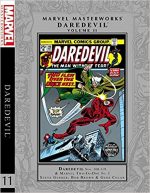
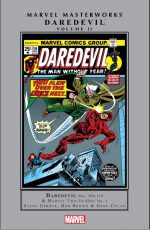
Daredevil Marvel Masterworks volume 11


By Steve Gerber, Chris Claremont, Gerry Conway, Tony Isabella, Bob Brown, Gene Colan, Don Heck, Sal Buscema & various (Marvel)
ISBN: 978-1-3029-0346-6 (HB)

Win’s Christmas Gift Recommendation: Unbeatable Fights ‘n’ Tights Fun… 8/10

Matt Murdock is a blind lawyer whose remaining senses hyper-compensate, making him an astonishing acrobat, formidable fighter and living lie-detector. Very much a second-string hero for much of his early years, Daredevil was nonetheless a striking and popular one, due in very large part to the captivatingly humanistic art of Gene Colan. He fought gangsters, a variety of super-villains and even the occasional monster or alien invasion, quipping and wisecracking his way through life and life-threatening combat, utterly unlike the grim, moody, quasi-religious metaphor he’s been seen as in latter years.

After spending years in a disastrous on-again, off-again relationship with his secretary Karen Page Murdock took up with Russian émigré and occasional client Natasha Romanoff, the infamous and notorious spy dubbed The Black Widow.

She was railroaded and framed for murder and prosecuted by Matt’s best friend and law partner Foggy Nelson before the legal eagle cleared her. Subsequently leaving New York with her for the wild wacky and West Coast, Matt joined prestigious San Francisco law firm Broderick & Sloan but adventure, disaster and intrigue sought out the Sightless Swashbuckler anywhere…

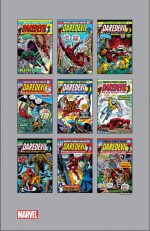
This eleventh hardback and eBook collection re-presents Daredevil #108-119, spanning March 1974 through March 1975, as well as Marvel Two-in-One #3, wherein twin storylines converged, and offers a heartfelt reminiscence eulogising unique authorial voice and much-missed scripter Steve Gerber in an effusive Introduction by sometime collaborator Mary Skrenes.

Following a period of cosmic intensity which saw the heroes battling aliens and monsters as part of the first war against Thanos, a new direction began in #108 after Daredevil rebukes the Widow for using increasingly excessive force on the thugs they stalked.

In ‘Cry… Beetle’ (by Gerber, Bob Brown & Paul Gulacy) their heated arguments are forcibly curtailed when Matt’s oldest friend – and current New York DA Foggy Nelson – is shot and she refuses to rush to his side with Murdock…

Back in the Big Apple for #109, Matt meets Foggy’s radical student sister Candace and learns of a plot by a mysterious criminal organisation. Black Spectre seek to steal government printing plates but rapidly en route to stop the raid, the Scarlet Swashbuckler is intercepted by a larcenous third party whose brutal interference allows the sinister plotters to abscond with the money-making plates…

Even the arrival of the cops can’t slow the bludgeoning battle against the Beetle in ‘Dying for Dollar$!’ (Brown & Heck), but as the exo-skeletoned thugs breaks away in Manhattan, back in San Francisco Natasha is attacked by a terrifying albino mutant called Nekra, Priestess of Darkness, who tries to forcibly recruit her into Black Spectre.

After tracking down and defeating the Beetle, Daredevil meets Africa-based hero Shanna the She-Devil, unaware that the fiery American ex-pat is back seeking bloody vengeance against the same enemies who have attacked Foggy, Natasha and the US economy…

The next chapter came in Marvel Two-in-One #3 (May 1974, by Gerber, Sal Buscema & Joe Sinnott), providing a peek ‘Inside Black Spectre!’ as destabilising attacks on US prosperity and culture foment riot in the streets of the beleaguered nation. Following separate clue trails, the Thing links up with the Man without Fear to invade the cabal’s aerial HQ but are improbably overcome soon after discovering the Black Widow has defected to the rebels…

Daredevil #110 sees the return of Gene Colan – inked by Frank Chiaramonte – as the perfidious plot further develops in ‘Birthright!’, revealing Black Spectre is an exclusively female-staffed organisation, led by a pheromone-fuelled male mutant called Mandrill.

One of the first “Children of the Atom”, the ape-like creature had suffered appalling abuse and rejection until finding the equally ostracised Nekra. Once they met and realised their combined power, they swore to make America pay…

‘Sword of the Samurai!’ (Brown & Jim Mooney) in issue #111 opens with DD and Shanna attacked by a monstrous Japanese warrior even as the She-Devil at last discloses her own tragic reasons for hunting Nekra and Mandrill. When she too is taken by Black Spectre – who want to dissect her to discover how she can resist Mandrill’s influence – DD is again attacked by the outrageously powerful sword-wielding Silver Samurai…

Triumphing over impossible odds, DD then infiltrates the cabal’s flying fortress in #112 before spectacular concluding with ‘Death of a Nation?’ (illustrated by Colan & Frank Giacoia) which finds the mutant duo seemingly achieving their ultimate goal by desecrating the White House and temporarily taking (symbolic) control of America.

…But only until Shanna, a freshly-liberated Natasha and fighting mad Man without Fear marshal their utmost resources…

Even with the epic over, Gerber still kept popping away at contemporary socio-political issues, as with #113’s ‘When Strikes the Gladiator!’ – illustrated by Brown & Vince Colletta – which opens with the Black Widow calling it a day, continues with Candace Nelson arrested for treason, teases with her then being kidnapped by one of DD’s most bloodthirsty foes and climaxes with the creation of a new major villain and an attack by one of Marvel’s most controversial monster heroes…

Ted Sallis was a government scientist hired to recreate the Super-Soldier serum that turned a puny, 4-F volunteer into Captain America. Due to corporate interference and what we today call “mission creep”, the project metamorphosed into a fall-back plan to turn humans into monstrous beings able to thrive in the most polluted of toxic environments…

When Sallis was subsequently captured by spies and consumed his serum to stop them from stealing it, he was transformed into a horrific mindless Man-Thing and vanished into the swamps of Florida…

Candace, an idealistic journalism student, had uncovered illicit links between Big Business, her own university and the Military’s misuse of public funds in regard to the Sallis Project, and when she attempted to blow the whistle, the government decided to shut her up. More worryingly, sinister scientific mastermind Death-Stalker imagined far more profitable uses for a solution that made unkillable monsters…

Trailing Candy’s abductors to Citrusville, Florida, Daredevil is ambushed by Gladiator and his macabre senior partner, but saved after a furious fracas by the mysterious muck-monster in #114’s ironically entitled ‘A Quiet Night in the Swamp!’ (Brown & Colletta). Deathstalker unfortunately escapes, returning to New York where he tries to kill Foggy and restart the clandestine Sallis Project.

Even though DD foils the maniac in #115’s ‘Death Stalks the City!’, the staggering duel ends inconclusively and the potential mass-murderer’s body cannot be found…

Colan & Colletta reunited for ‘Two Flew Over the Owl’s Nest!’ wherein Daredevil jets back to San Francisco in search of reconciliation with Natasha, only to blunder into the latest criminal enterprise of one of his oldest enemies. This time however, The Owl isn’t waiting to be found and launches an all-out attack on the unsuspecting and barely reconciled heroic couple.

Chris Claremont scripted the conclusion over Gerber’s plot, with Brown & Colletta back on the art as Natasha and She-Devil Shanna desperately hunt for the missing Man without Fear, before the avian arch-criminal can add him to a pile of purloined personalities trapped in his diabolical computerised ‘Mind Tap!’…

With Gerber moving on to other projects, a little messy creative shuffling results in ‘Circus Spelled Sideways is Death!’ (#118 by Gerry Conway, Don Heck & Colletta). Here Daredevil leaves Natasha, resettles in New York and promptly battles the infamous but always-inept Circus of Crime and their latest star turn – a bat-controlling masked nut called Blackwing, after which Tony Isabella takes the authorial reins and end this outing with a clever piece of sentimental back-writing in ‘They’re Tearing Down Fogwell’s Gym!’ – rendered by Brown & Heck.

As Murdock negotiates a plea deal for Candace, the man who trained his boxer father Battling Jack Murdock comes by with a little problem. It seems a crazy crooked doctor is offering an impossible muscle and density boosting treatment that turns bantamweight pugilists into unstoppable rock-hard giant monsters…

Addling lustre to the proceedings, this tome also includes contemporary house ads and a wealth of original art page by Brown, Gulacy, Heck, Colan, Chiaramonte, Colletta & Mooney, plus pre-production-amended cover art.

As the social upheaval of the 1960s and early 1970s receded, the impressively earnest but often strident material was gradually replaced by fabulous fantasy tales strongly suggesting the true potential of Daredevil was in reach. These classic adventures are dramatic delights no action fan can afford to miss.
© 1974, 1975, 2017 Marvel Characters, Inc. All rights reserved.

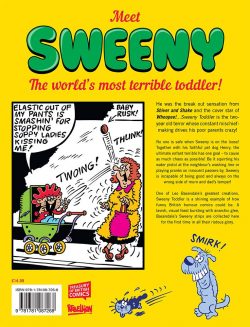
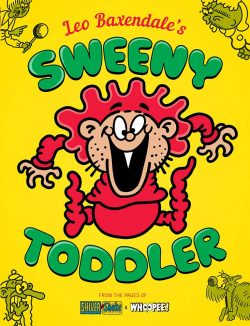
Leo Baxendale’s Sweeny Toddler


By Leo Baxendale & others (Rebellion Studios)
ISBN: 978-1-78108-726-8 (HB)

Win’s Christmas Gift Recommendation: Utterly Bonkers, Inspired Lunacy… 10/10

If you know British Comics, you know Leo Baxendale.
He was the epitome of rebellious, youth-oriented artistic prodigies who, largely unsung, went about seditiously transforming British Comics: entertaining millions and inspiring uncounted numbers of those readers to become cartoonists too.

Joseph Leo Baxendale (27th October 1930 – 23rd April 2017) was educated at Preston Catholic College, served in the RAF and was born on 27th October 1930, in Whittle-le-Woods, Lancashire – but not necessarily in that order.

His first paid artistic efforts were drawing ads and cartoons for The Lancashire Evening Post but his life – and the entire British comics scene – changed in 1952 when he began freelancing for DC Thomson’s top weekly The Beano.

Leo assumed creative control of moribund Lord Snooty and his Pals and originated anarchically surreal strips Little Plum, Minnie the Minx, The Three Bears and When the Bell Rings. This last strip soon metamorphosed into the legendary, lurgy-packed Bash Street Kids, thereby altering the daily realities and lifetime sensibilities of millions of readers and generations of kids.

Baxendale also contributed heavily to the creation of comics tabloid The Beezer in 1956, but, following editorial and financial disputes with his editors, migrated in 1962 to London-based, Harmsworth-owned conglomerate Odhams/Fleetway/IPC.

South of the border, his initial humorous creations included Grimly Feendish, General Nitt and his Barmy Army, Bad Penny and a horrid horde of similarly revoltingly, uncannily engaging oiks, yobs and weirdoes who cumulatively made the company’s “Power Comics” era such a joy to behold.

During the 1970s he devised more remarkable cartoon star turns which, whilst not perhaps as groundbreaking as Plum, Minnie, or The Bash Street Kids nor as subversively enticing as Wham, Smash and Pow creations such as Eagle Eye, Junior Spy, The Swots and the Blots or The Tiddlers (or indeed, as garishly outlandish as George’s Germs or Sam’s Spook), remained part of the nation’s junior landscape for decades ever after.

The main body of his later creations appeared in Buster: features such as The Cave Kids, Big Chief Pow Wow, Clever Dick and Snooper. Baxendale latterly foisted Willy the Kid on the world before creating his own publishing imprint – Reaper Books.

He also sued DCT for rights to his innovative inky inventions: a 7-year struggle that was eventually settled out of court. Other notable graphic landmarks include pantomimic vision THRRP!, his biography A Very Funny Business: 40 Years of Comics and the strip I Love You, Baby Basil which ran in The Guardian during the early 1990s.

Signature stinker Sweeny Toddler debuted in Shiver and Shake in 1973, unsurprisingly surviving repeated mergers – with Whoopee! and Whizzer and Chips – before settling in at the seemingly unsinkable Buster.

This stunning hardback (and eBook) celebration – hopefully the first of many gathering the entire run – is another crucial addition to Rebellion’s ever-expanding Treasury of British Comics. It gathers the episodes from Shiver and Shake (spanning March 10th 1973 to 5th October 1974), plus the first tranche from Whoopee!, beginning with 23rd November 1974 until 7th June 1975).

The potent package is suitably garnished with an appreciative and informative Introduction by his son Martin (who also drew the Bad Boy’s adventures after Baxendale senior moved into publishing) and is a magnificent exercise in manic misrule starring the absolute worst baby in the world…

In a simple terrace house with the legend “Tremble wiv fear, Sweeny livs here” scrawled all over it, lives a spotty (occasionally be-stubbled) mono-fanged tyke who is disturbingly fast and strong with a physiognomy that can sour milk.

He is able to read – after a fashion – and that, coupled with a lethally low tolerance for boredom and obedience, means the nasty nipper always finds new and distressing ways to amuse himself at someone else’s expense…

With or without faithful dog and eager abettor Hairy Henry, Sweeny turns every pram ride into a pulse-pounding rollercoaster adventure for his poor benighted mum and grandad, every visit to park, shop or museum into a heart-stopping chase and every cuddlesome interlude with ill-advised adults into an exhausting episode in psychological and physical torture…

At least six strips re-presented here are not by Baxendale, but record-keeping is sadly incomplete. Chances are they’re drawn by Tom Paterson, who eventually took over the feature (or possibly Roy Nixon?) but they are all deliciously weird and wonderful: a blend of unbeatable whacky wordplay, explosive slapstick and bizarre situations, garnished by Baxendale’s unique and evocative sound effects: once read, never forgotten…

Briefly retitled Help! It’s Sweeny Toddler in experimental pages that feature second stories starring monstrous beasts living the borders and margins of the panel dividers, the latter pages never lost the eccentric impetus of the first, with the baby from hell, as ever, mugging old ladies, postmen, schoolboys and other unwary visitors; creating his own zoo, attempting to sneak into X films (remember those, kids?) and totally tormenting anyone who treats him like a child…

As well as straight strips, this first collection also offers ‘Sweeny Toddler’s Beat the Bully Guide’ and graphic game ‘Sweeny Toddler’s Fifty Frightful Faces!’, proving the vile versatility of the little villain…

Leo Baxendale was one-of-a-kind: a hugely influential, much-imitated master of pictorial comedy and noxious gross-out escapades whose work deeply affected (some would say warped) generations of British and Commonwealth kids.

We’ll not see his like again, but these astoundingly engrossing comedy classics are a perfect example of his resolutely British humorous sensibilities – absurdist, whimsically anarchic, outrageously aggressive, crazily confrontational and gleefully grotesque – starring an unremittingly rebellious force of nature with no impulse control.

Sweeny Toddler says and does whatever he wants as soon as he thinks of it, albeit usually to his own detriment and great regret: a rare gift, usually only employed by madmen and foreign Presidents…

These cartoon capers are amongst the most memorable and re-readable exploits in all comics history: smart, eternally, existentially funny and immaculately rendered. This a treasure-trove of laughs that spans generations and must be in every family bookcase.
© 1973, 1974, 1975 & 2019 Rebellion Publishing Ltd. Sweeny Toddler is ™ Rebellion Publishing Ltd. All Rights Reserved.

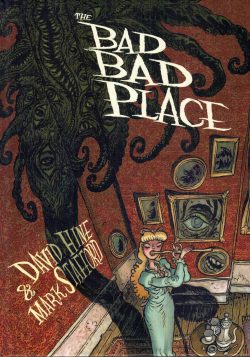
The Bad Bad Place


By David Hine & Mark Stafford (Soaring Penguin Press)
ISBN: 978-1-908030-276 (HB)

Win’s Christmas Gift Recommendation: Dread Delight for Darkest Nights… 9/10

Happy Día de Muertos…

I’d planned to make this new release part of our annual Occultoberfest, but fortunately, my review copy didn’t arrive in time so now it gets an extra chance to impress as it now stands out even further from the pack.

In luxurious and sturdy hardback (and digital) compilation The Bad Bad Place, material originally created as a serial for Soaring Penguin Press’ excellent comics anthology Meanwhile… has been modified, tweaked and at last completed for the delectation of fans of bizarre black comedy, gross Lovecraftian horror and uniquely British macabre tomfoolery…

Before we get started, I must acknowledge that I’ve known all involved in the project for many years – although I trust they’ve either forgotten or at least forgiven me for all that’s occurred (they know what I mean and you’ll never know…), so any thoughts of nepotism, favouritism and dishonourable conduct should be redirected to modern political and commercial life, where they properly belong…

This wry but effective pastiche of Chthonic horrors is the morbid brainchild of Dave Hine (Strange Embrace, Spider-Man: Noir, Batman, X-Men, The Bullet Proof Coffin) and Mark Stafford (Cherubs!) who have wrought previous similar graphic marvels together in The Man Who Laughs and Lip Hook.

The unease begins in ‘Warning Signs’ as a gaunt and ragged town crier accosts a young woman in the strangely deserted new town of Faraway Hills. Jenny is forthright and determined and refuses to obey old Ned Trench‘s admonitions that she should flee for her life…

Over a nice cup of tea, the rank, decrepit dotard – and former town crier – details how the rapidly-built modern conurbation was situated over the ruins of a Victorian village that had died in mysterious circumstances, and how, one night a plot of vacant land was suddenly filled with long-vanished Castavette House and the much-neglected grounds which had once dominated the ancient hamlet of Crouch Heath…

With rumours flying about and the town council dithering, events took a while to kick off, but when they despatched a flurry of official forms to the mansion in ‘Going Postal’ the postman was never seen again.

Those that knew him privately thought it was no less than he deserved. Later investigations proved they weren’t wrong…

In ‘The Lottery Winner, the Minstrel and the Narcissist Who Would Not Stop…’ a trio of friends trapped in a love triangle are declared to have also suffered dreadful fates after passing the gates of the House, seduced by mystic music and the promise of tawdry pleasures within…

Ned and Jenny’s discourse takes a dramatic turn in ‘Close Up and Personal’ when the aged doomsayer describes the fate of a young photojournalist and she reveals her own intimate connection to the missing snapper…

The incredible truth of Trench’s origins comes out in The Truth, the Whole Truth and Anything But…’ as Jenny learns how and why Crouch Heath disappeared from the map so long ago, thanks in large part to the manorial family’s devotion to vile elder gods and the innate casual cruelty of their all-too human neighbours…

A bereaved and vengeful mother literally wedded to ancient monsters takes her revenge in ‘Let Not Man Put Asunder…’ before more ghastly secrets are shared in ‘The Birthing’, so by the time Jenny gets ‘A Short History of the Twentieth Century’ from Trench’s weirdly skewed perspective, the anxious listener fully appreciates the lack of ‘Logic and Proportion’ exercised by the mistress of Castavette House when the entire population of Faraway Hills invaded the grounds of the returned estate, seeking unearned rewards and illicit gratifications…

The arcane malign saga concludes with the unwise expression of Jenny’s own ‘Heart’s Desire’, but just as all hope seems lost in the bowels of the House, there comes an intervention from a most unexpected quarter…

Afterword ‘The Good Good Place’ then offers context and background on the creation of this macabre treat courtesy of author Hine, whilst creator biographies plus a moody graphic gallery turns up the tension tone to round out this exemplary example of pictorial gothic terror.

Mordant and moody, occasionally deliberately daft and always deeply disturbing, The Bad Bad Place is a treat no terror-seeker can afford to miss.
This edition © 2019 Soaring Penguin Press. Created by and © David Hine & Mark Stafford.

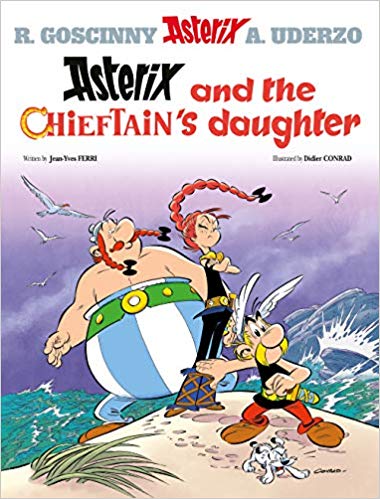
Asterix and the Chieftain’s Daughter


By Jean-Yves Ferri & Didier Conrad, coloured by Thierry Mébarki and translated by Adriana Hunter (Orion Books)
ISBN: 978-1-51010-713-7 (HB) 978-1-51010-714-4 (PB Album) eISBN: 978-1-5101-0720-5

Win’s Christmas Gift Recommendation: Celebrate the Season in Classical Style… 9/10

Asterix le Gaulois debuted in 1959 and has since become part of the fabric of French life. His exploits have touched billions of people all around the world for five and a half decades and for almost all of that time his astounding adventures were the sole preserve of originators Rene Goscinny and/or Albert Uderzo.

After nearly 15 years dissemination as weekly serials (subsequently collected into book-length compilations), in 1974 the 21st saga – Asterix and Caesar’s Gift – was the first to be released as a complete, original album prior to serialisation. Thereafter each new tome became an eagerly anticipated, impatiently awaited treat for legions of devotees.

The eager anxiety hasn’t diminished any even now that Uderzo’s handpicked replacements -scripter Jean-Yves Ferri (Fables Autonomes, La Retour à la terre) and illustrator Didier Conrad (Les Innomables, Le Piège Malais, Tatum) have properly settled into the creative role since his retirement in 2009.

Whether as an action-packed comedic romp with sneaky, bullying baddies getting their just deserts or as a sly and wicked satire for older-if-no-wiser heads, these new yarns are just as engrossing as the established canon.

As you already know, half of the intoxicating epics take place in various exotic locales throughout the Ancient World, whilst the alternating rest are set in and around Uderzo’s adored Brittany where, circa 50 BC, a little hamlet of cantankerous, proudly defiant warriors and their families resist every effort of the mighty Roman Empire to complete the conquest of Gaul.

Although the land is divided by the conquerors into provinces Celtica, Aquitania and Armorica, the very tip of the last-named region stubbornly refuses to be properly pacified. The otherwise supreme overlords, utterly unable to overrun this last little bastion of Gallic insouciance, are reduced to a pointless policy of absolute containment – even though the irksome Gauls come and go as they please…

Thus, a tiny seaside hamlet is permanently hemmed in by heavily fortified garrisons Totorum, Aquarium, Laudanum and Compendium, filled with veteran fighters who would rather be anywhere else on earth than there…

Those contained couldn’t care less; daily defying and frustrating the world’s greatest military machine by going about their everyday affairs, bolstered by magic potion brewed by resident druid Getafix and the shrewd wits and strategic aplomb of diminutive dynamo Asterix and his simplistic, supercharged best friend Obelix…

Ferri & Didier’s fourth album (and 38th canonical chronicle of Asterix) La Fille de Vercingétorix was released on October 17th 2018, with an English edition hitting shelves – and the digital emporia – as Asterix and the Chieftain’s Daughter on the 24th.

It similarly debuted that day in 19 other languages with an initial global print run of more than 5,000,000 copies.

As proof that time marches and on that youth will ultimately have its day, the narrative focus here is on a new generation of characters, but as always, action, suspense and comedy are very much in evidence. There’s a healthy helping of satirical lampooning of the generation gap, fads and trends as well as the traditional regional and nationalistic leitmotifs…

It all begins one evening when elderly Averni warriors Monolithix and Sidekix arrive at the village in search of Chief Vitalstatistix. They are aged survivors of the climactic battle of Alesia which culminated in the Romans taking control of Gaul. That occurred after great Vercingetorix ignominiously capitulated to Julius Caesar: a shame so great that most Gauls can no longer speak his name aloud…

In his grand hut, Vitalstatistix hears out his old comrades and agrees to take in a young girl. Surly teenager Adrenalin is the daughter of the defeated commander in chief and wears the great gold torc that symbolised his rule. Resolved that she will one day lead a liberating revolt, Monolithix and Sidekix have reared the girl in secret, but recently learned that a Gaulish traitor – Binjwatchflix – has informed Caesar of her existence.

Now the emperor wants the torc and the girl – whom he plans to indoctrinate into Roman ways and use as a puppet proxy – so the wrinkly resistance fighters need time to arrange a smuggled flight to Britain for their juvenile charge.

The skulking traitor is not the only problem: truculent Adrenalin is currently rebelling against her destiny and tends to run away at every opportunity. Suitably warned and worried, the Chief assigns his two top men – and their canine companion Dogmatix – to watch over her…

As the girl is assimilated into the village, nefarious Binjwatchflix steals into the garrison of Totorum and drafts the unwilling commander into a nasty scheme to capture the unwary, unruly child…

Back in the village, Adrenalin is causing a bit of a stir amongst the younger crowd. She’s rude, insolent and dresses in men’s clothes: the local lads just can’t stop following her about…

She’s especially interesting to the sons of Unhygienix the fishmonger and his great rival Fulliautomatix the blacksmith. Little Crabstix thinks she’s cool, but his elder sibling Blinix and the armourers’ boy Selfipix both know she’s far more than that…

Soon there’s a new gang in town, rejecting all the old ways and sassing their elders – and their music is just appalling and incomprehensible. Raucous bard Cacofonix is the only adult they can tolerate…

Already overmatched, Asterix and Obelix try to stay close, but although the massive menhir man is extremely childlike, he’s no teenager and is soon well out of his depth. Doughty Asterix just doesn’t understand what’s happening these days…

Adrenalin has already planned her escape: she’s going to ditch all the expectations of her elders, the plans to fight and liberate the land and run away to fabled Thule…

Oblivious to the rapidly-coalescing plot of vile Binjwatchflix, she convinces the village lads to help, just as the far-from-eager soldiers from Totorum infiltrate the forest surrounding the town and the long-suffering, lethally-optimistic and unlucky sea pirates make a disastrous foray upriver and unwittingly provide her with the one thing her plans lacks thus far: a ship…

As Monolithix and Sidekix covertly sail back from Britain with gorgeous mariner Captain Peacenix to retrieve their regal charge, all the enemy forces arraigned against Adrenalin close in.

Realising almost too late that she’s gone, odd-men-out Asterix and Obelix follow in their own boat, but happily, they’re not the only magic-potioned players in action as the Roman navy intercepts: further complicating a rapidly escalating catastrophe in the making…

Cue, glorious, uproarious action and a host of twisty, turny surprises…

Despite Asterix, Obelix and old our favourites very much playing second fiddle in this riotous tale of kids in revolt, the result is refreshingly off-kilter yet still suitably engaging. Teen-oriented, heavy on sardonic caricatures and daft wordplay – especially pop tunes given the old Crackerjack! (“Crackerjack! ..ack! …ack! …ack!!”*) – punny-rewrite treatments – and cannily sentimental, this yarn is awash with sneaky diversions, dirty tricks and vile villainy; providing non-stop thrills and spills to as we battle our way to the most effective of happy endings.

Asterix and the Chieftain’s Daughter is a sure win and another triumphant addition to the mythic canon for laugh-seekers in general and all devotees of comics.
© 2019 Les Éditions Albert René. English translation: © 2019 Les Éditions Albert René. All rights reserved.
*You must be British, at least 40 years old or aware of what’s coming in 2020 to understand this reference…

Showcase Presents the House of Mystery volume 1


By Joe Orlando, Otto Binder, Jack Miller, Bob Haney, Neal Adams, Arnold Drake, John Albano, Marv Wolfman, Howie Post, E. Nelson Bridwell, Gil Kane, Mike Friedrich, Bob Kanigher, Jack Oleck, Joe Gill, Gerry Conway, Len Wein, Virgil North, Alan Riefe, Francis X. Bushmaster, Lee Elias, Doug Wildey, Carmine Infantino, Mort Meskin, Sergio Aragonés, Bernard Baily, George Roussos, Jack Sparling, Sid Greene, Bill Draut, Jim Mooney, Win Mortimer, Jerry Grandenetti, Bernie Wrightson, Wally Wood, Wayne Howard, Alex Toth, Al Williamson, John Celardo, Tony DeZuñiga, Leonard Starr, Tom Sutton, Ric Estrada, Jim Aparo, Gray Morrow, Don Heck, Russ Heath, Jack Kirby, Nestor Redondo, Lore Shoberg, John Costanza & various (DC Comics)
ISBN: 978-1-4012-0786-1 (TPB)

These days DC – particularly its prestigious Vertigo sub-division – are acknowledged leaders in comic book horror and dark fantasy fiction, with titles and characters like Swamp Thing, Sandman and Hellblazer riding high beside anthological and creator-owned properties all designed to make readers think twice and lose sleep…

As National Periodical Publications, the company was slow to join the first horror boom that began in 1948, but after a few tenuous attempts with supernatural-themed heroic leads in established titles (Johnny Peril in Comic Cavalcade, All Star Comics and Sensation Comics and Dr. Terry Thirteen, The Ghostbreaker in Star-Spangled Comics) bowed to the inevitable.

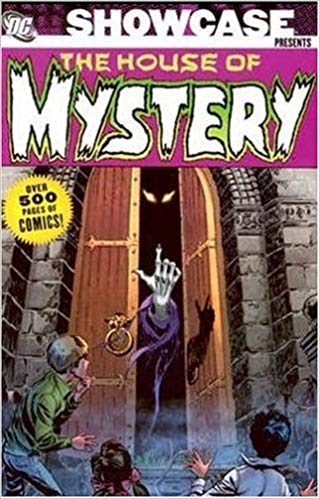
The result was a rather prim and straitlaced anthology that nevertheless became one of their longest-running and most influential titles. The House of Mystery launched with a December 1951/January 1952 cover date and neatly dodged most of the later flak aimed at horror comics by the Senate Subcommittee on Juvenile Delinquency (April- June 1954). When the industry adopted a castrating straitjacket of self-regulatory rules, HoM and its sister title House of Secrets were dialled back into rationalistic, fantasy adventure vehicles, without any appreciable harm. They even became super-hero tinged split-books (with Martian Manhunter and Dial H for Hero in HoM, and Eclipso sharing space with mystic detective Mark Merlin – latterly Prince Ra-Man – in HoS)…

Nothing combats censorship better than falling profits and when the Silver Age superhero boom stalled and crashed at the end of the 1960s, it led to the surviving publishers of the field agreeing to loosen their self-imposed restraints against crime and horror comics. Nobody much cared about gangster titles, but as the liberalisation coincided with another bump in global interest in all aspects of the Worlds Beyond, the resurrection of scary stories was a foregone conclusion and obvious “no-brainer.” Even ultra-wholesome Archie Comics re-entered the field with their tasty line of Red Circle Thrillers…

Thus with absolutely no fanfare at all issue #174, cover dated May-June 1968 fronted a bold banner heading demanding “Do You Dare Enter The House of Mystery?” whilst reprinting a bunch of – admittedly excellent – short fantastic thrillers originally seen in House of Secrets from the heady days when it was okay and quite profitable to scare kids…

Incomprehensively, these classic yarns are still unavailable in digital compilations, although there’s a new (and rather expensive) hardback Bronze Age Omnibus edition out if you aren’t afraid of wrist strain. If cost is an issue and you don’t mind monochrome reproduction, this classic trade paperback – collecting the contents of The House of Mystery #174 -196 (May 1968 to September 1971) – is still easy to find and impossible to not enjoy…

Starting off with The House of Mystery #174, the opening shot is ‘The Wondrous Witch’s Cauldron’, by an unknown writer and compellingly illustrated by the great Lee Elias. It comes from 1963’s HoS #58, as does the tale that follows it. Equally anonymous, ‘The Man Who Hated Good Luck!’ is limned by Doug Wildey and leads to the only new feature of the issue – one which would set the tone for decades to come.

Page 13 was a trenchantly comedic feature page scripted by Editor and EC veteran Joe Orlando, suitable cartooned by manic genius Sergio Aragonés. It states quite clearly that, whilst the intent was to thrill, enthral and even appal, it was all in the spirit of sinister fun, and gallows humour was the true order of the day.

The comic then continued with an Otto Binder/Bernard Baily tale of the unexpected: ‘The Museum of Worthless Inventions’ (from HoS #13) and concluded with Jack Miller, Carmine Infantino & Mort Meskin’s fantasy fable ‘The Court of Creatures’ (a Mark Merlin masterpiece from HoS #43).

The next issue can probably be counted as the true start of this latter-day revenant renaissance, as Orlando revived the EC tradition of slyly sardonic narrators by creating the Machiavellian Cain, “caretaker of the House of Mystery” and wicked raconteur par excellence.

Behind the first of a spectacular series of creepy covers from Neal Adams lurked another reprint, ‘The Gift of Doom’ (from HoM #137, illustrated by George Roussos) followed by ‘All Alone’, an original, uncredited prose chiller.

After another Page 13 side-splitter, Aragonés launched his long-running gag page ‘Cain’s Game Room’ before the issue closed with all-new new comic thriller ‘The House of Gargoyles!’ by veteran scaremongers Bob Haney & Jack Sparling.

With winning format firmly established and commercially successful, the fear-fest was off and running. Stunning Adams covers, painfully punny introductory segments, interspersed with gag pages (originally just Aragonés but eventually supplemented by other cartoonists such as John Albano, Lore Shoberg & John Costanza).

This last feature eventually grew popular enough to be spun off into bizarrely outrageous comicbook called Plop! (but that’s a subject for another day…) and supplied an element of continuity to an increasingly superior range of self-contained supernatural thrillers. Moreover, if ever deadline distress loomed, there was always a wealth of superb old material to fill in with.

HoM #176 led with spectral thriller ‘The House of No Return!’ by writer unknown and the great Sid Greene after which young Marv Wolfman (one of an absolute Who’s Who of budding writers and artists who went on to bigger things) teamed with Sparling on paranoiac mad science shocker ‘The Root of Evil!’

Reprinted masterpiece of form from Mort Meskin, ‘The Son of the Monstross Monster’ – having previously appeared in House of Mystery #130 – leads off #177, and a 1950’s fearsome fact-page is recycled into ‘Odds and Ends from Cain’s Cellar’ before Charles King and Orlando’s illustrated prose piece ‘Last Meal’ segues into dream-team Howie (Anthro) Post & Bill Draut produce a ghoulish period parable in ‘The Curse of the Cat.’

Neal Adams debuts as an interior illustrator – and writer – with a mind-boggling virtuoso performance as a little boy survives ‘The Game’, after which Jim Mooney’s spooky credentials are affirmed with ‘The Man Who Haunted a Ghost’ (first seen in HoM #35) and E. Nelson Bridwell, Win Mortimer & George Roussos delineate an eternal dream with ‘What’s the Youth?’ before ‘Cain’s True Case Files: Ghostly Miners’ closes the issue.

Bridwell contributes the claustrophobic ‘Sour Note’ as lead in #179, rendered by the uniquely visionary Jerry Grandenetti & Roussos.

A next generation of comics genius begins with Bernie Wrightson’s first creepy contribution. ‘Cain’s True Case Files: The Man Who Murdered Himself’ was scripted by Wolfman and is still a stunning example of gothic perfection in Wrightson’s Graham Ingels-inspired lush, fine-line style.

This exceptional artist’s issue also contains moody supernatural romance ‘The Widow’s Walk’ by Post. Adams & Orlando: a subtle shift from schlocky black humour to terrifying suspense and tragedy presumably intended to appeal to the increasingly expanding female readership. The issue ends with another fact feature ‘Cain’s True Case Files: The Dead Tell Tales’.

Going from strength to strength, House of Mystery was increasingly drawing on DC’s major artistic resources. ‘Comes a Warrior’, which opened #180, is a chilling faux Sword & Sorcery classic written and drawn by da Vinci of Dynamism Gil Kane, inked by the incomparable Wally Wood, and the same art team also illustrate Mike Friedrich’s fourth-wall demolishing ‘His Name is Cain Kane!’

Cliff Rhodes & Orlando contribute text-terror ‘Oscar Horns In!’ and Wolfman & Wrightson return with prophetic vignette ‘Scared to Life’ before an uncredited forensic history lesson from ‘Cain’s True Case Files’ closes proceedings for that month.

Scripted by Otto Binder and drawn by the quirkily capable Sparling, ‘Sir Greeley’s Revenge!’ is a heart-warmingly genteel spook story, but Wrightson’s first long tale – fantastical reincarnation saga ‘The Circle of Satan’ (scripted by horror veteran Bob Kanigher) – ends #181 on an eerily unsettling note before #182 opens with one of the most impressive tales of the entire run.

Jack Oleck’s take on the old cursed mirror plot is elevated to high art as his script ‘The Devil’s Doorway’ is illustrated by the incredible Alex Toth. Wolfman & Wayne Howard follow with ‘Cain’s True Case Files: Grave Results!’, after which an Orlando-limned house promotion leads to nightmarish revenge tale ‘The Hound of Night!’ by Kanigher & Grandenetti.

In collaboration with Oleck, Grandenetti opens #183 with ‘The Haunting!’ after which, courtesy of Baily ‘Odds and Ends from Cain’s Cellar’ returns with ‘Curse of the Blankenship’s’ and ‘Superstitions About Spiders’ before Wolfman & Wrightson contribute ‘Cain’s True Case Files: The Dead Can Kill!’ and the canny teaming of Kanigher with Grandenetti and Wally Wood results in the truly bizarre ‘Secret of the Whale’s Vengeance.’…

The next issue features the triumphant return of Oleck & Toth for a captivating Egyptian tomb raider epic ‘Turner’s Treasure’ whilst Bridwell, Kane & Wood unite for barbarian blockbuster ‘The Eyes of the Basilisk!’

House of Mystery #185 sees caretaker Cain take a more active role in the all-Grandenetti yarn ‘Boom!’, Wayne Howard illustrates the sinister ‘Voice from the Dead!’ and prolific Charlton scribe Joe Gill debuts with ‘The Beautiful Beast’: a lost world romance perfectly pictured by EC alumnus Al Williamson.

The next issue tops even that as Wrightson limns Kanigher’s spectacular bestiary tale ‘The Secret of the Egyptian Cat’, whilst Adams produces some his best art ever for Oleck’s ‘Nightmare’: a poignant tale of fervid imagination and childhood lost. Nobody who ever adored Mr. Tumnus could read this little gem without choking up… and as for the rest of you, I just despair and discard you…

Kanigher & Toth deliver another brilliantly disquieting drama in ‘Mask of the Red Fox’ to open #187, and Wayne Howard is at his workmanlike best on ‘Cain’s True Case Files: Appointment Beyond the Grave!’, before John Celardo & Mike Peppe render the anonymous script for period peril ‘An Aura of Death!’ (although to my jaded old eyes the penciller looks more like Win Mortimer…)

Another revolutionary moment occurs with #188’s lead story. Gerry Conway gets an early credit scripting ‘Dark City of Doom’: a chilling reincarnation mystery simultaneously set in contemporary times and Mayan South America, as the trailblazer for a magnificent tidal wave of Filipino artists debuted.

The stunning art of Tony DeZuñiga opened the door for many of his talented countrymen to enter and reshape both Marvel and DC’s graphic landscape and this black and white compendium is the perfect vehicle to see their mastery of line and texture…

Wrightson was responsible for time-lost thriller ‘House of Madness!’ which closes the issue whilst Aragonés opens the proceedings for #189, closely followed by Kanigher, Grandenetti & Wood’s ‘Eyes of the Cat’ and ‘The Deadly Game of G-H-O-S-T‘ (from HoM #11: a 1953 reprint drawn by Leonard Starr) before another Charlton mystery superstar premiers as Tom Sutton illustrates Oleck’s ‘The Thing in the Chair’.

Kanigher & Toth team for another impeccable graphic masterwork in ‘Fright!’, Albano fills Cain’s Game Room and Aragonés debuts another long-running gag page with ‘Cain’s Gargoyles’ before this issue ends with Salem-based shocker ‘A Witch Must Die!’ by Jack Miller, Ric Estrada & Frank Giacoia.

HoM #191 saw the debut of Len Wein, who wrote terrifying puppet-show tragedy ‘No Strings Attached!’ for Bill Draut, as DeZuñiga returns to draw Oleck’s cautionary tale ‘The Hanging Tree!’ before Wein closes the show, paired with Wrightson on ‘Night-Prowler!’: a seasonal instant-classic that has been reprinted many times since.

Albano wrote ‘The Garden of Eden!’, a sinister surgical stunner made utterly believably by Jim Aparo’s polished art, Gray Morrow illustrates Kanigher’s modern psycho-drama ‘Image of Darkness’ and superhero veteran Don Heck returns to his suspenseful roots drawing Virgil North’s monstrously whimsical ‘Nobody Loves a Lizard!’

Wrightson contributes the first of many magnificent covers for #193, depicting the graveyard terrors of Alan Riefe & DeZuñiga’s ‘Voodoo Vengeance!’, whilst Draut skilfully delineates the screaming tension of Francis X. Bushmaster’s ‘Dark Knight, Dark Dreams!’

For #194, which saw House of Mystery expand from 32 to 52 pages (as did all DC’s titles for the next couple of years, opening the doors for a superb period of new material and the best of the company’s prodigious archives to an appreciative, impressionable audience), the magic commences with another bravura Toth contribution in Oleck’s ‘Born Loser’, swiftly followed by Russ Heath-illustrated monster thriller ‘The Human Wave’ (from House of Secrets #31), Jack Kirby monster-work ‘The Negative Man’ (House of Mystery #84) before Oleck and the simply stunning Nestor Redondo close the issue and this volume with metamorphic horror ‘The King is Dead’.

These terror-tales captivated the reading public and comics critics alike when they first appeared, and it’s no exaggeration to posit that they may well have saved the company during the dire downward sales spiral of the 1970. Now their blend of sinister mirth and classical suspense situations can most usually be seen in such series as Goosebumps, Horrible Histories and their many imitators. However, if you crave beautifully realised, tastefully, splatter-free sagas of tension and imagination, not to mention a huge supply of bad-taste, kid-friendly creepy cartooning, The House of Mystery is the place for you…
© 1968-1971, 2006 DC Comics. All Rights Reserved.

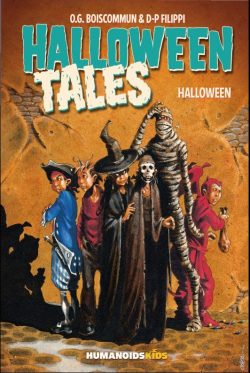
Halloween Tales


By O.G. Boiscommun & D-P Filippi, translated by Montana Kane (HumanoidsKids)
ISBN: 978-1-59465-654-5 (HB)

The trauma-tinged, gluttonously anarchic ceremonies of Halloween are celebrated far and wide these days, and although the basic principles are fairly homogenised now, different regions can throw up a few enticing variations that are well worth noting.

A graphic series that proved a huge European best-seller when released in 2017, the three stories comprising this magnificent hardback compilation are also available digitally in the original 3-album format, albeit translated into English for your delectation and approval.

Snob and eco-supporter that I am, these days, I’m going to say buy or gift the book if you like: I’m reviewing the electronic editions here…

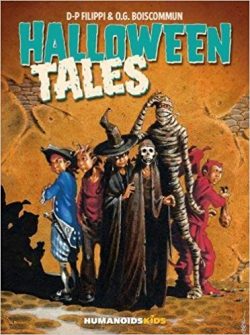
Devised by writer/artist Olivier Boiscommun (Renaissance: Children of the Nile) and full-time screenwriter/scenarist Denis-Pierre Filippi (Gregory and the Gargoyles, Muse, Fondation Z, John Lord), the overlapping adventures focus on a band of kinds in an oddly archaic city of indeterminate vintage. It’s a place of towers and cathedrals, strange moods and winding streets, perfectly captured by Boiscommun’s exaggerated painting style…

The first album – Halloween Tales: Halloween – finds a gaggle of adolescent children gathering to celebrate the night with frolics and mischief: elaborately costumed and frightening each other. However, gauntly-garbed Asphodel remains gloomy and aloof and soon heads off alone. Her thoughts are locked on death, until she is accosted by a strange clownish figure who seems barely real and seeks to alter her mood and mind with a strange philosophy…

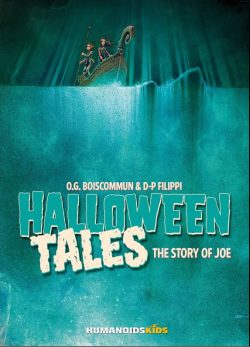
Second volume Halloween Tales: The Story of Joe is delivered in eerie monochrome tones and hues and returns us to the mountainous outskirts of that dreaming city where little Bea can’t understand why her playmate Joe is being so mean. As they idle about on the rooftops, the boy and his new pet cat survive a close encounter with a huge bat that leaves Joe scarred and bleeding.

His doting dad is too busy working these days, so it’s Bea who first notices the bizarre changes – physical as well as emotional – that afflict her friend and culminate in him dealing with the bullies who persecute them with terrifying power…

Only when Joe’s awful transformation is nearly complete do Bea, the cat and his father find a way to challenge the tainted child’s descent into nocturnal isolation and monstrosity…

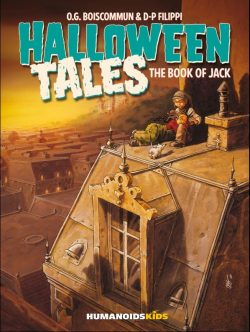
Scripted by D-P Filippi, Halloween Tales: The Book of Jack completes the trilogy with a return to vibrant colour as a pack of children led by overbearing Stan dare little runt Jack to break into a spooky haunted mansion. As the group approaches the dilapidated pile through a statuary-infested overgrown garden – or is it a graveyard? – lanky Sam tries to reason with her little companion. She has plenty of misgivings and a really bad feeling about all this…

Bravado and peer pressure win out though, and Jack enters the derelict building and soon discovers the biggest library in the world in its centre.

Suddenly panicking, he snatches up a tatty tome to prove he succeeded and dashes for the door. Only when they are all safely back outside the gates does Sam realise there’s something odd about the book. Many pages are blank, but gradually filing with spindly writing every moment – each unfolding line magically recording what Jack is doing as he does it.

Mean, jealous Stan sees an opportunity for mischief…

Next morning the book has vanished, and Jack is slowly transforming into a gigantic savagely uncontrollable beast. Sam instantly knows what’s happened and starts searching the city for the miraculous chronicle, determined to get it and literally rewrite her friend’s appalling future…

With All Hallows festive celebrations inexorably installed in so many modern cultures, it’s grand to see an alternative to the almost-suffocating commercialising and movie tropes where heart, sentiment and yes, unease and outright fear can be safely experienced and expunged.

These moody escapades are a true treat, in darkness or in light, and that’s no mean trick …
© 2017 Humanoids, Inc. Los Angeles (USA) All rights reserved.