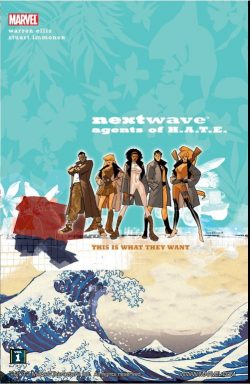
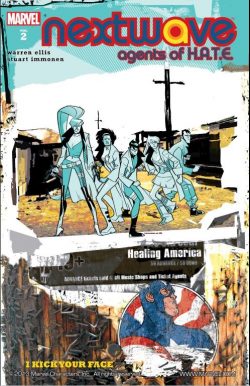
Nextwave Agents of H.A.T.E. volume 1 This is What They Want and volume 2 I Kick Your Face


By Warren Ellis, Stuart Immonen & Wade Von Grawbadger (Marvel)
ISBN: 978-0-7851-2278-4 (Vol. 1 HB); 978-0-7851-1910-4 (Vol. 2 TPB)

Even for the most dedicated fans, superhero comics can become a little samey and pedestrian, so when gifted big- name creators such as Warren Ellis and Stuart Immonen decide to have a little fun with the fringes of such a ponderous continuity as Marvel’s, expectations are always understandably high.

In 2006 Nextwave: Agents of H.A.T.E. (Highest Anti-Terrorism Effort) launched for a breathtaking and controversial 12 issue run and happily proved to be everything a jaded old fan could hope for…

The series has been compiled into one complete volume, these two collections (re-presenting #1-6 and #7-12 respectively) as well as in digital formats. That’s the illusion of choice right there, that is…

Wry, cynically Post-Modern and malevolently mischievous, the saga borrowed shamelessly from kid’s bubblegum pop culture – especially trans-pacific animation. There was even a theme-song you could hear online and a variant-issue that readers could colour in to win prizes – as well as the forgotten contents of the daftest corners of Marvel’s decades of accumulated continuity to captivatingly satirise the genre, the medium and itself.

Best of all, it was hilariously anti-globalisation, counter-capitalist, rude, sexy and excessively ultra-violent…

H.A.T.E. is another of those numerous acronymic quasi-governmental, covert high-tech agencies dedicated to keeping us all safe in our overpriced, indolent beds – at least that was what their eccentric team of operatives initially believed.

When they discovered that their employers were in fact a fully owned subsidiary of the Beyond Corporation© and the latest iteration of diabolical terrorist cabal S.I.L.E.N.T., former Avengers Monica Rambeau (Captain Marvel II/Photon/Spectrum, etc…) and artificial individual Aaron (Machine Man) Stack rightly rebelled.

With ex-X-Man Tabitha Smith (Meltdown/Boom Boom); stroppy immortal monster-hunter Elsa Bloodstone and hyper-powered, unimaginative enigma The Captain in tow, they went AWOL, intending to stop their former paymasters at all costs.

Incidentally, the last-cited was formerly Captain $#!£ until ostracized by all the other military-monickered mystery-men, after which Captain America punched his foul-mouthed head in and washed his mouth out with soap.

Further investigation disclosed that the terrorist conglomerate was actually planning to product-test potentially lucrative BWMDs (Bizarre Weapons of Mass Destruction) on American soil and ordinary folks, so the disgruntled quintet promptly stole a super-ship and all the plans, determined to stop the callous campaign and take down the despicable Beyond©-ers forever…

With their increasingly deranged, suicidal and sexually outré former commander Dirk Anger in hot pursuit, the team begins its fightback in Abcess, North Dakota where the legendary giant dragon-in-underpants Fin Fang Foom has been awakened and… stimulated… into going on a rampage of destructive frustration…

On the streets of Abcess, hordes of Beyond©’s mass-produced vegetable warriors are attacking the citizenry and exacerbating the chaos until Elsa and The Captain intervene with their signature lack of restraint and disregard for human life or private property.

As municipal damage and general unrest spiral upwards, Monica devises an unsavoury plan and orders Aaron – a fantastic, military-created robot who despises human “fleshy ones” and has reprogrammed himself to crave vast amounts of beer – to get himself swallowed and deal with the dragon from the inside…

With no rest for the Wicked-crushers, the renegade revengers then head to Sink City, Illinois where brutally corrupt cop Mac Mangel has been infected with a mechanistically mutating program, transforming him into a colossal flesh-and-steel beast hungry to eat metal and/or children…

With mounting carnage everywhere, the Captain still gets distracted into an origin flashback, leaving Tabitha to deal with the Transformer-ed Mangel in her stylishly simple yet permanent manner…

In Wyoming, the Nextwave discover a Beyond© War Garden and set about destroying the next crop of broccoli berserkers and cabbage crusaders, just as Dirk Anger and his other – still-loyal – agents of H.A.T.E. arrive in their flying citadel to unleash all the insane instruments of doom in their arsenal. However even the Drop Bears of Cuddly Koala Death, a flock of Assault Pterosaurs, Samurai Robots and Homicide Crabs cannot contain the righteous indignation of the forgotten heroes, and when Aaron counterattacks by stealing Dirk’s chic-est most secret possession the deviant Director has no choice but to retreat…

To Be Continued…


Nextwave Agents of H.A.T.E. volume 2: I Kick Your Face

The action barely pauses for a primer recap before Beyond©orp’s follow-up BWMD event sees the terrorist entrepreneurs summon an extremely minor and rather juvenile Elder God, Rorkannu, Lord of the Dank Dimension. The malefactors trade that for access to a deadly invading army of mystic behemoths that Dr. Strange fans will recognise as merciless “Mindless Ones” to decimate the town of Shotcreek, Colorado.

Ready to back-up the embattled townspeople are Monica and her crew, but things take a decidedly surreal turn as the monolithic marauders prove to be not all that mindless after all…

In the blistering last-stand battle, Elsa becomes lost in fond reminiscences of her truly unique and bloody childhood, before, against all odds, the Captain stumbles onto Rorkannu and -contrary to everyone’s expectations – finally does something right…

When Steve Rogers became Captain America in 1941, nobody realised that a second Nazi spy stole his urine sample. Now, through a most torturous and arcane path, that last remnant of the original Super-Soldier serum has allowed the ruling elite of the Beyond© group to create whole battalions of customised metahuman champions…

When Nextwave finally track the terrorists to their inverted floating fortress, they are confronted by an army of esoteric adversaries derived and developed from the misappropriated hero-pee and aligned in specifically themed teams such as The Surgery, The Vestry and The Homosexuality, but even such lethally dedicated foes as Dr. Headless, Father Pain, Dr. Nosexy, Sun King, Red Rosary and Slightly Creepy Policewoman pale into feeble insignificance beside the reality-altering threat of Forbush-Man and his eerily familiar comrades the New Paramounts…

Once again plunged into horrifically violent combat, the Nextwave are slowly making bloody headway until the diminutive demon plunges the team into depressing and dreary alternate lives from the worst recesses of their inner visions. Tragically for Forbush-Man, nobody had ever found any evidence of intellect or imagination in Tabitha, just an overwhelming vacuity, urge to steal and need to blow stuff up…

With the end in sight, the triumphant heroes invade the Beyond Corporation©’s hidden HQ State 51 just as Dirk Anger, transformed and degraded beyond imagination, arrives, culminating in an even more spectacular clash before finally confronting the utterly macabre mastermind behind the monstrous marketing campaign of destruction. The elation is non-existent as the team discover an even more bizarre kingmaker behind it all and finally bring the hammer down once and for all…

As action comics in their purest form, the tales are laced with light-hearted lethality and superbly smutty innuendo, with hints of Garth Ennis and John McCrea’s Hitman, Ben Edlund’s The Tick, Pat Mills & Kevin O’Neill’s Marshall Law and Keith Giffen’s Ambush Bug, with all the verve, panache and invention of the Powerpuff Girls and Dexter’s Laboratory, all wrapped up in pithy corporate sloganeering a la Better Off Ted, Corporate and Joseph Goebbels…

Jam-packed with in-joke extras, this is a glorious comic series – in every sense of the word – and an experience no, fun-loving fan could possibly find fault with.

“Healing America by Beating People Up” and making us laugh by taking the piss…

© 2006, 2007, 2010 Marvel Characters, Inc. All rights reserved.

How to Be Happy


By Eleanor Davis (Fantagraphics Books)
ISBN: 978-1-60699-740-6 (HB)

Do acts of creation make one happy? They certainly do for me. but sometimes so do acts of wanton destruction. I’m sharing, not judging…

Eleanor Davis is one of those rare sparks that just can’t help making great comics. Born in 1983, and growing up in Tucson, Arizona, she was blessed with parents who reared her on classic strips such as Little Nemo, Little Lulu and Krazy Kat. Following unconventional schooling and teen years spent making minicomics, she studied at Georgia’s wonderful Savannah College of Art and Design, where she now teaches. Her innovative works have appeared in diverse places such as Mome, Nobrow and Lucky Peach.

A life of glittering prizes began after her award-winning easy reader book Stinky was released in 2008. Davis has since followed up with gems such as The Secret Science Alliance and the Copycat Crook (with her husband Drew Weing), You & a Bike & a Road and Why Art?

In 2014, Fantagraphics released her themed collection of epigrammatic tales, crafted in a mesmerising variety of styles and riffing on the concept of joy and contentment: causes, failings, and what to do with them when and if they happen. These are enigmatic variations on the most ephemeral of emotions and one you only really notice when it’s gone, but the individual episodes here are truly joyous to share.

How to Be Happy is NOT a self-help book – at least not in any traditional sense, but it did make me feel very good when I first read it and only increases my sense of fulfilment every time I pick it up, whether in its comforting reassuring hardback edition or my ever-present anxiety-reducing digital edition…

These observational short stories were created, it seems, for the sheer innocent joy of making them, and examine many aspects of life through self-contained yarns ranging from cautionary tales to excoriating self-diagnosis to flights of sardonic fancy. Some are titled like proper narratives whilst others just happen like life does. Those I’ve identified by first lines if no title is obvious…

Packed with evocative, stand-alone imagery, the episodes commence with line art pictorial pep talk ‘Write a Story’ before switching to lush colour for ‘In Our Eden’, wherein a primitive life of pastoral toil starts to grate on Adam and Eve. They are, unsurprisingly, not all they seem…

Further monochrome line art interventionism manifests in ‘First We Take Off Our Clothes’ after which a short hop into full-colour and a longer one into a fraught future examines family life on Tomorrow’s sub-continent when ‘Nita Goes Home’…

Separation and rural isolation underpin black-&-white monologue ‘We Come Down on Clear Days’ before the restricted colour palette of ‘Stick and String’ offers a hard look at relationships and agency in the tale of a wandering minstrel and the captivating power of momentary fascination…

Relations are further tested in monochrome as ‘Darling I’ve Realized I Don’t Love You’ provides unwise solutions to ancient problems before a truly disquieting incident of mutual grooming in ‘Snip’ segues into a chilling visit to ‘The Emotion Room’.

Colour is employed to potent effect in ‘He turned a grey-green and thought he might pass out’ whilst ‘Seven Sacks’ addresses grisly problems in a fresh fable Aesop or the Brothers Grimm would be proud to pen.

Two colours and self-delusion tinge ‘Did you want to see the statue?’, whilst B&W lines detail the rewards of heroic vitality in ‘Make Yourself Strong’, after which young love blossoms in living colour in ‘Summer Snakes’…

The pure exultation and imagination of childhood is exposed through stark monochrome in ‘Thomas the Leader’ before a brief Vox-pop moment in ‘I used to be so unhappy but then I got on Prozac’ is built upon in further untitled moments of self-realisation before a strong admonition to ‘Pray’…

Observation, tribulation and revelation all come to the author in ‘In 2006 I took a Greyhound from Georgia to Los Angeles’ before a descent into dark moments and extreme actions in ‘The fox must have been hit pretty recently…’ is balanced by intimate sharing in ‘The woman feels sadness’.

Colour adds depth in an extended moment of group therapy release in ‘No Tears, No Sorrow’, after which the wandering introspection of ‘9/26’ leads to a conclusion of sorts in a cab ride to ’25 Washington Street, Please’…

A superb example of the range and versatility of image and text happily combined, this a true joy for all fans of unbridled expression no one could fail to enjoy.
© Eleanor Davis 2014. All rights reserved.

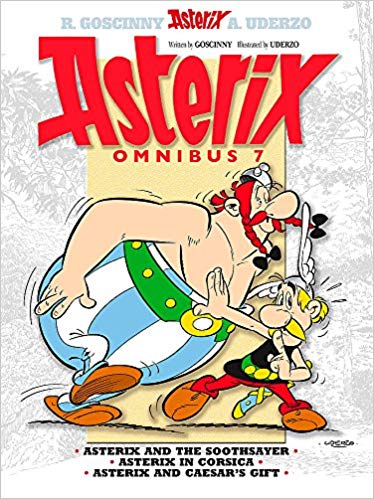
Asterix Omnibus volume 7: Asterix and the Soothsayer; Asterix in Corsica; Asterix and Caesar’s Gift


By Goscinny & Uderzo, translated by Anthea Bell & Derek Hockridge (Orion Books)
ISBN: 978-1-44400-835-7 (HB), 978-1-44400-836-4 (PB)

One of the most-read comics strips in the world, the collected chronicles of Asterix the Gaul have been translated into more than 100 languages since his debut in 1959, with animated and live-action movies, TV series, assorted games, toys and even a theme park outside Paris (Parc Astérix, unsurprisingly…) all stemming from his glorious exploits.

More than 325 million copies of Asterix’s many albums have sold worldwide, making his joint creators France’s bestselling international authors.

The doughty, potion-powered paragon of Gallic Insouciance was created by two grandmasters of comics: René Goscinny & Albert Uderzo. Although their inspirational collaborations ended with the death of the prolific scripter in 1977, the creative wonderment continued until relatively recently from Uderzo, assistants and ultimately his successors – albeit at a slightly reduced rate.

The wonderment works on multiple levels: ostensibly, younger readers revel in action-packed, lavishly illustrated comedic romps wherein sneaky, bullying baddies get their just deserts, whilst we more worldly readers enthuse over the dry, pun-filled, sly satire, especially as enhanced for English speakers by the brilliantly light touch of translators Anthea Bell & Derek Hockridge, who played no small part in making the indomitable Gaul and his gallant companions so palatable to the Anglo-Saxon world.

(Moi, I still rejoice in a perfectly produced “Paf!” to the phizzog as much as any painfully potent procession of puns or sardonic satirical sideswipe…)

The stories were set on Uderzo’s beloved Brittany coast, where a small village of warriors and their families resisted every effort of the Roman Empire to complete the conquest of Gaul, or alternately, anywhere in the Ancient World, circa 50 BCE, as the Gallic Gentlemen wandered the multifarious provinces of the Empire and even beyond its generally-secure borders…

When the heroes were playing at home, the Romans, unable to defeat this last bastion of Gallic insouciance, resorted to a policy of containment. Thus, the little seaside hamlet is permanently hemmed in by the heavily fortified garrisons of Totorum, Aquarium, Laudanum and Compendium.

The truculent Gauls don’t care: they daily defy the world’s greatest military machine simply by going about their everyday affairs, protected by the magic potion of resident druid Getafix and the shrewd wits of the diminutive dynamo and his simplistic, supercharged best friend…

Firmly established as a global brand and premium French export by the mid-1960s, Asterix the Gaul continued to grow in quality as Goscinny & Uderzo toiled ever onward, crafting further fabulous sagas; building a stunning legacy of graphic excellence and storytelling gold.

Le Devin was the 19th serialised epic, originally running in Pilote #652-673 throughout 1972, first translated into English album Asterix and the Soothsayer in 1975, and begins ominously whilst the village’s venerable mystic protector Getafix is away at his annual Druiding conference.

During a torrential storm, a nefarious soothsayer named Prolix turns up seeking shelter. His dark predictions instantly spread disharmony amongst the hospitable, hot-headed, painfully superstitious and credulous Gaulish stalwarts… except for level-headed, canny little Asterix.

As Prolix leaves, Chief’s wife Impedimenta sneaks after him, keen on a personal prediction, and the crafty charlatan soon discovers he’s on to a good thing and profitably cushy number…

Before long the entire village is under the soothsayer’s grimy thumb, but when he vanishes the ladies of the village accuse Asterix of driving him away.

In actuality, the unsavoury sage has been arrested by the Romans who have standing orders to deal harshly with all non-Roman prognosticators and troublemakers. Wily Prolix barters for his life with Centurion Arteriosclerosus, who sees a way to end his Indomitable Gaul problem by using the obviously fraudulent fortune-teller as a wedge to drive out the obstreperous resistors. Prolix returns to the village uttering a doom-laden pronouncement: the place has been cursed by the Gods and a pestilential stench will precede plague. Inevitable death will be their fate if they remain…

Panicked, the gullible Gauls head for the beach and take refuge on an off-shore island – all that is, except for Asterix, Obelix and chivalrous canine companion Dogmatix…

With the Romans at last in possession of the village – and all Gaul finally conquered – the bold last rebels make their plans until Getafix returns. On his arrival the three men and a dog embark on an elaborate scheme to take back their home and teach their foolish fellows a much-needed lesson.

Concocting a stunningly malodorous vapour which drives the occupiers from the village, the druid convinces the Romans that Prolix is a real soothsayer and ambitious Arteriosclerosus sees a chance to become the next Caesar. Increasingly baffled, conman Prolix begins to believe his predictions are real…

After dressing down the refugee Gauls, Getafix leads them back to their beloved homes where the incensed and wiser villagers top up on magic potion before rushing off to teach the invaders – and Prolix – a much needed lesson. On this occasion, Impedimenta and the village women accompany their men, determined to expiate their embarrassing gullibility with a little cathartic violence of their own…

This delightfully arch and acerbic attack on gullibility and superstition is a splendid and long-overdue chance to see the minor characters play to their strengths and weaknesses, with Asterix and Obelix almost relegated to walk-on parts…

First translated two years earlier in England but chronologically following on from The Soothsayer in the original French serialisations, Astérix en Corse (Pilote #687-708, in 1973) was the 20th adventure and the best-selling French-language album of the series.

Another globe-trotting yarn, it begins with the Romans of the four occupying garrisons “deploying for manoeuvres” to avoid having to deal with Gauls’ painfully exuberant celebration of the anniversary of the Battle of Gergovia. Unfortunately for Centurion Hippotamus and his men, they are delayed by the arrival of a party from Praetor Perfidius, Governor of Corsica, escorting a dangerous prisoner into exile. They are all still in Totorum when the high-spirited villagers (and many guest-star friends from previous tales) arrive, keen for a punch-up and a little annoyed that all the other Roman camps are deserted…

When the dust settles and the groans of pain subside, Asterix discovers and liberates the prisoner Boneywasawarriorwayayix and invites him back to the village for a slap-up feed. Over boar and beer, the Gauls hear how Perfidius had the popular Corsican leader exiled to prevent him revealing how the Praetor has been over-taxing the people and embezzling the gold for himself instead of sending it to Caesar in Rome.

Corsica is officially the most troublesome spot in the Empire and the exile is determined to return and expose the hated Governor, so proud, haughty Boneywasawarriorwayayix is delighted when Asterix and Obelix – with faithful canine companion Dogmatix – determine to help him sneak back to his fiercely over-fortified and contained island (most volumes of this album have a map of Corsica instead of the traditional Gaulish village, and the tiny nation contains four towns and forty-six Roman camps)…

Hilariously obtaining passage on the pirate ship of Redbeard, the voyagers soon find themselves on the island – but by no means unnoticed…

Soon the dissolute and lazy soldiery are hunting the heroes as they make their way inland to the exile’s home village to rally the populace, whilst in the city of Aleria Perfidius reckons the jig is up and prepares to flee with his ill-gotten gains…

Attempting to rally the natives, Boneywasawarriorwayayix comes up against the age-old dilemma: most Corsicans are involved in centuries-long vendettas and would much rather fight each other – at least when they’re not taking a siesta – than unite to attack the invaders. However, eventually – and almost too late – a determined band of warriors march on Aleria. Perfidius has been secretly loading his loot onto a ship, but when his soldiers discover the riches, they realise their leader is planning to abandon them to the fiercely furious Corsicans – at least if overtaxed diplomatic Asterix can keep the natives from killing each other first…

Asterix travel epics are always packed with captivating historical titbits, soupcons of healthy cynicism, singularly surreal situations and amazingly addictive but generally consequence-free action, always illustrated in a magically enticing manner.

Stuffed with sly pokes and good-natured trans-national teasing of perceived (and generally treasured) national characteristics; celebrating the terrifying power of Corsican cheeses and liberally served up with raucous hi-jinks and fast-paced action, this is another magical titbit of all-ages entertainment.

In 1974 Le Cadeau de César was the first tale to be published as a complete album prior to being serialised, with British translation Asterix and Caesar’s Gift appearing in 1977. The saga begins in Rome where two 20-year veteran legionaries drunkenly celebrate being honourably discharged. Tremensdelirious and Egganlettus eagerly look forward to being given their service reward: a parcel of land each.

Unfortunately, Tremensdelirious is overheard disparaging Caesar, but the sardonically cruel Emperor does not punish the old soldier or even withhold his pension. In fact, he gives the veteran a lovely portion of the Gaulish coast in Armorica: all he has to do is shift a few recalcitrant Gauls from their village on his new small holding…

A drunk but not a fool, the old soldier knows his fate is sealed and soon trades his dispensation to Lutetian inn-keeper Orthopaedix to settle his outstanding and prodigious bar-bill…

The first that the Indomitable Gauls know of this is when Orthopaedix, wife Angina and daughter Influenza roll up in their cart and try to take possession. After some hilarity the villagers go back about their business and the inn-keeper is left to suffer the fury of his wife at the uprooting of the family to a barbaric hovel where nobody acknowledges their claim.

No stranger to such a tongue-lashing, Chief Vitalstatistix takes pity on Orthopaedix, offering to let them stay and open an inn in the hamlet, but the standoffish villagers are angered by Angina’s superior airs and a riot breaks out on opening night…

The world-weary publican is ready to quit, but now humiliated Angina is in a status duel with Impedimenta and, determined to stay, forces Orthopaedix to challenge Vitalstatistix for the post of village Chief. As the campaign to win the support of the always-argumentative villagers intensifies, all manner of shoddy tactics, dubious lobbying and outright bribery takes place, with each party frantically trying to curry political favour from the fickle but extremely astute potential voters who know the value of their own support…

Meanwhile, simple, gentle, oafish Obelix has fallen under the spell of the lovely Influenza, and she leads him on cruelly to help out her mother’s naked ambition, leading to a clash with his best friend. Only Asterix seems aware that the discord could well be the death of the village and lead to Caesar’s ultimate triumph and before long the waters are further muddied when elderly Lothario Geriatrix declares himself a third party, splitting the potential vote even further.

The political crisis reaches boiling point when Tremensdelirious turns up, demanding his land-grant back: after all it’s illegal to sell them to Gauls, and Orthopaedix has no say in the matter…

When the ex-legionary turns violent, Asterix steps in to save the day and the old sot is driven off at sword-point. He doesn’t go far – only to the garrison of Laudanum where old comrade Egganlettus has re-enlisted – and together they blackmail Centurion Tonsillitus into attacking the Gauls to uphold Roman law and get back that “official” pension land which is every soldier’s right…

That kind of military intervention usually ends disastrously, but this time the village is hopelessly divided by political intrigue and backstabbing and even Asterix cannot unite them against their real and common foe. It seems that the Gauls must lose everything until Orthopaedix makes a supreme sacrifice to save the day…

Brittle, barbed and devilishly sharp, this outrageous political thriller and satire on modern electioneering is as pertinent and punchy as it ever was, proving once again that these Gallic graphic masterpieces are perfect comics which everyone should read over and over again.
© 1972-1974 Goscinny/Uderzo. Revised English translation © 2004 Hachette. All rights reserved.

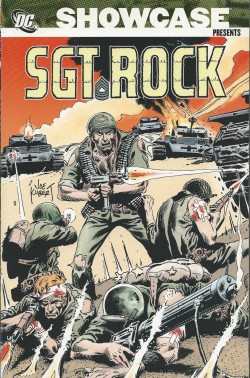
Showcase Presents Sgt. Rock volume 2


By Robert Kanigher, Joe Kubert, Bob Haney, Russ Heath, Jerry Grandenetti & various (DC Comics)
ISBN: 978-1-4012-1984-0 (TPB)

Sgt Rock and the “combat-happy Joes” of Easy Company are one of the great and enduring creations of the American comic-book industry. The gritty meta-realism of Robert Kanigher’s ordinary guys in life-or-death situations captured the imaginations of generations of readers, young and old. So pervasive is this icon of comicbook combat that’s it’s hard to grasp that Rock is not an immortal industry prototype like Superman, Batman and Wonder Woman – with us since the earliest moments of the industry – but is in fact a late addition to and child of the Silver Age of Comics: debuting as just another tale in war anthology G.I. Combat (#68, January 1959, by Kanigher & Joe Kubert).

The archetypal sergeant was an anonymous boxer who wasn’t particularly skilled but simply refused to be beaten, absorbing any and all the punishment dealt out to him.

When ‘The Rock!’ enlisted in the US Army, however, that same Horatian quality attained mythic proportions as he held back an overwhelming Nazi attack by sheer grit and determination, remaining bloody but unbowed on a field littered with dead and broken men.

The tale inspired an instant sequel or two before, in Our Army at War #83 (June 1959), the story really began…

This second titanic tour of duty collects as a paperback and in stark and stunning monochrome the groundbreaking tales which made Sgt Rock a comics legend. These grim and gritty, epically poetic war stories are taken from the then still-anthological Our Army at War #118-148, bracketing May 1962 to November 1964, a period when American comics were undergoing a renaissance in style, theme and quality. Sadly, there’s no news on when these classic yarns will enter the 21st century either in modern colour editions or in digital formats…

Scripted throughout by then-editor Kanigher, the terse episodes herein begin with ‘The Tank vs. the Tin Soldier!’ – illustrated by the magnificent Russ Heath – wherein movie idol Randy Booth is mustered in to Easy Company and spends all his snobbish energy trying to get out again. By the time he learns how to be a real soldier, his moment in the limelight has turned from cinematic melodrama to Greek tragedy…

The artist most closely associated with Rock is Joe Kubert, who illustrated #119’s memorable fable ‘A Bazooka for Babyface!’ as a kid who lied about his age makes it to the Front, but doesn’t fool the indomitable topkick. Of course, by the time the fighting dies down enough to send him back, the Babyface is a seasoned combat veteran…

Kubert superbly limned the majority of stories in this volume, such as #120’s ‘Battle Tags for Easy Co.!’, which deployed brief vignettes to illustrate how squad stalwarts Ice Cream Soldier, Wild Man and Bulldozer earned their nicknames, before showing the latest “Green Apple” recruit why the Sarge was called Rock, after which ‘New Boy in Easy!’ (#121) introduced a chess-obsessed replacement who takes a lot of convincing that war is no hobby and men aren’t just pawns…

This narrative device of incorporating brief past-action episodes into a baptism of fire scenario played over and over again in Sgt. Rock and never got old. OAAW #122 featured ‘Battle of the Pyjama Commandoes!’, comprising more portmanteau tales as a number of Easy Joes recuperate in a field hospital, until the Germans break through and the wounded must pick up their weapons again…

High-energy stylist Jerry Grandenetti illustrated ‘Battle Brass Ring!’ in #123 as a pushy new replacement antagonises the entire unit until he learns to his cost the value of teamwork and price of command, after which Kubert returned for ‘Target – Sgt. Rock!’

When the indomitable warrior is captured and brainwashed by a Nazi tank commander into leading an attack on Easy, Bulldozer has to balance Rock’s life against his beloved sergeant’s unflinching standing orders…

More moral dilemmas punish the valiant warriors in #125 (illustrated by Heath) as the unit is cut off from the main Allied force and ordered to ‘Hold – At All Costs!’, whilst ‘The End of Easy Company!’ (#126 and illustrated by Kubert) pits the unstoppable dogfaces against impassable fortifications and a veritable mountain of Germans who severely underestimate the sheer stubbornness of tired, angry GIs…

With Kubert settling in for the long haul as regular artist on the strip, issue #127 offered an epic 25-page blitz of stories-within-a-story, as a quartet of combat-happy Joes relate personal tales of their unbeatable boss in ‘4 Faces of Sgt. Rock’.

OAAW #128 headlined ‘The Battle of the Sergeants!’ as Rock meets his Nazi counterpart in the deserts of Africa, after which #129 reveals that ‘Heroes Need Cowards!’: exploring Rock’s earliest days in the Army, whilst ‘No Hill for Easy!’ in #130 sees the battered band of brothers go above and beyond to placate a shell-shocked Major and finish the suicide mission of a deranged last man standing…

In #131 ‘One Pair of Dogtags … For Sale’ introduces Easy to a woman warrior every inch their equal, who literally spills her own blood to keep Rock alive, whilst in ‘Young Soldiers Never Cry!’ the sergeant becomes a combat babysitter after rescuing a toddler on the battlefield of Normandy.

In #133 ‘Yesterday’s Hero!’ depicts how a decorated veteran joins Easy to a rapturous welcome, but flounders, unable to escape the shocking circumstances that made him an unwilling example of both heroism and cowardice, after which, in ‘The T.N.T. Book’ another replacement insists on playing the odds in war as he had on the track… until discovering the true stakes of battle…

Our Army at War #135 pits Rock against a German non-com who was in almost every way his ‘Battlefield Double!’, whilst in #136 a desperately frightened new kid arrives, begging the indomitable topkick to ‘Make Me a Hero!’

Issue #137 sees a cavalry holdover from WWI finally achieve his long-delayed charge to glory in ‘Too Many Sergeants!’, before close skirmish separates Rock from his greenest new man in #138, and the weary warrior goes through combat hell to find ‘Easy’s Lost Sparrow!’ The next mission results in capture for four of the unit’s best and a ‘A Firing Squad for Easy!’ at a German Submarine dock. Happily, the team of Frogmen they’d been protecting return the favour…

OAAW #140 offers another full-length thriller – with cameos from fellow comicbook combatants Captain Johnny Cloud and French Resistance fighter Mademoiselle Marie – revealing the wry story of how Rock keeps winning deserved but wholly unwelcome battlefield promotions. His dilemma as a ‘Brass Sergeant!’ is only resolved after reuniting a misunderstood son with his “spit-and-polish” General father under most exceptional circumstances…

An timid old school friend turns up in #141, still needing Rock’s protection until “Shaker” finally pulls the ‘Dead Man’s Trigger!’, whilst in the next issue Kanigher pushed the envelope with the tale of a boy who held the sergeant to ransom and became ‘Easy’s New Topkick!’ in order to finish his dead Maquis comrades’ last mission. This stirring saga inspired the creation of Unit 3 – a French Resistance squad of battle-hardened children who appeared sporadically in later issues.

In #143, the US soldiers are back in the desert where embattled dogfaces honour fallen comrade Farmer Boy by planting ‘Easy’s T.N.T. Crop!’ to harvest a victory built on sand, after which ‘The Sparrow and the Tiger!’ sees Rock at last succumb to battle fatigue and the constant loss of his “kids” until a scared replacement shows him the true value of persistence and grace under fire…

Our Army at War #145 offers the backstory on the squad’s Native American rifleman in ‘A Feather for Little Sure-Shot!’, whilst in #146 imagination runs wild as ‘The Fighting Guns of Easy!’ compare stories about the men who fire them.

This second searing selection of combat actions concludes with a rare 2-part yarn, beginning in #147 as ‘Generals Don’t Die! Book One’ finds the hands-on topkick the envy of all his commanding officers. However, after helping desk-jockey General Bentley die in glorious battle, Rock is obliged to fulfil a promise to a dying man and forced to impersonate Bentley.

Things get even trickier when the impostor must lead the troops in breaking a stalled advance: a classic conundrum spectacularly resolved in the blockbuster conclusion ‘Generals Don’t Die! Book Two: Generals are Sergeants with Stars!’ Here Rock keeps a dead man’s secret and maintains the Bentley family honour until he can pass on those unearned “brass stars” to the next Bentley generation…

Kanigher at his worst was a declarative, heavy-handed and formulaic writer, but when writing his best stuff – as here – his work was imaginative, evocative, iconoclastic and heart-rending. He was a unique reporter and observer of the warrior’s way and the unchanging condition of the dedicated and so very human ordinary foot-slogging G.I.

With superb combat covers from Kubert, Grandenetti, and Heath fronting each episode, this battle-book is a visually perfect compendium and a certain delight for any jaded comics fan looking for something more than flash and dazzle.

A perfect example of true Shock and Awe; these are stories every comics fan and combat collector should see, and are too long overdue for collection in modern archival editions
© 1963, 1964, 2008 DC Comics. All Rights Reserved.

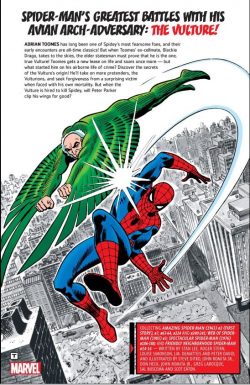
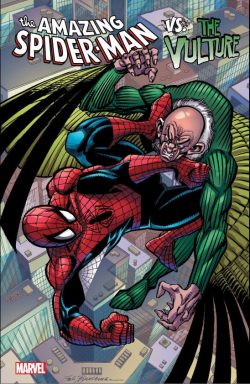
Spider-Man Vs. The Vulture


By Stan Lee & Steve Ditko, Roger Stern, Louise Simonson, J. M. DeMatteis, Peter David, John Romita, Don Heck, John Romita Jr., Greg LaRocque, Sal Buscema, Scot Eaton & various (Marvel)

ISBN: 978-1-3029-0706-8 (TPB)

Heroes are only truly defined by their enemies and superheroes doubly so, with the added proviso that costumed crusaders generally have a rogue’s gallery of fantastic foes rather than just one arch-nemesis. Even so, there’s always one particular enemy who wears that mantle: Moriarty for Sherlock Holmes; Blofeld for James Bond; Luthor for Superman.

Spider-Man has always had two top contenders… but the Vulture isn’t one of them. (*If you can’t guess who, check out the end of the review, puzzle-fans!).

Devised to cash in on the movie Spider-Man: Coming Home, this nifty trade paperback (and eBook) compilation gathers many of the now-cinematic sky bandit’s key clashes with the Wondrous Wallcrawler, tracing his rather rocky development whilst offering an uncomplicated, no-frills thrill-ride of frantic spills and chills, equally appetising to film-inspired new meat and grizzled old veterans of the Fights ‘n’ Tights arena.

Enhanced by an informative Introduction by former Spidey-Editor Ralph Macchio, this titanic tome explores the criminal career of elderly Adrian Toomes: a brilliant scientist twisted by tragedy and persecution into becoming a ruthless predator scavenging on the society which constantly betrayed him and made him unjustly suffer as a shunned outcast.

Amazing Spider-Man #1 (not included in this comprehensive paperback and digital compilation) had a March 1963 cover-date and two complete stories. The opening tale recapitulated the origin whilst adding a brilliant twist to the conventional mix…

The wall-crawling hero was feared and reviled by the general public thanks in no small part to J. Jonah Jameson, a newspaper magnate who pilloried the adventurer from spite and for profit. With time-honoured comicbook irony, Spider-Man then saved Jameson’s astronaut son John from a faulty space capsule…

The second tale found the cash-strapped kid trying to force his way onto the roster – and payroll – of the Fantastic Four whilst elsewhere a spy perfectly impersonated the web-spinner to steal military secrets, in a stunning example of the high-strung, antagonistic crossovers and cameos that so startled the jaded kids of the early 1960s.

With the second issue our new champion began a meteoric rise in quality and innovative storytelling. He also faced his first genuine super-powered, costumed crazy…

Opening the action here is ‘Duel to the Death with the Vulture!’ which revealed how a bizarre flying thief was plundering Manhattan at will, with no police effort effective against him.

Desperate to help his aunt make ends meet, Spider-Man began to take photos of his cases to sell to Jameson’s Daily Bugle, transforming his personal gadfly into his sole means of support.

Along with comedy and soap-operatic melodrama Ditko’s action sequences were imaginative and magnificently visceral, with odd angle shots and quirky, mis-balanced poses adding a vertiginous sense of unease to fight scenes. In the end, however, it was Peter Parker’s brains not the webslinger’s power that brought the Vulture down…

Amazing Spider-Man #7 (December 1963) boasted ‘The Return of the Vulture!’ as the creepy Bird of Ill-Omen became the webslinger’s first bad guy to come back for more. This time the cataclysmic final clash took place inside the Daily Bugle building and remains one Spidey’s best staged fights…

Amazing Spider-Man #48 had introduced Blackie Drago: a ruthless thug who shared a prison cell with the Vulture. After Drago orchestrated a near-fatal-accident for his cellmate, the cunning convict inveigled the ailing super-villain into revealing his technological secrets, enabling Drago to escape and take over the role: a younger, faster, tougher foe who nevertheless failed in every attempt to kill Spider-Man.

In Amazing Spider-Man #63 (August 1968, by Lee, John Romita, Don Heck & Mike Esposito) revealed the old buzzard had not died as Toomes vengefully stalked his successor in ‘Wings in the Night!’ The duel extended into the next issue with both Drago and the wallcrawler reduced to ‘The Vulture’s Prey’ until Spider-Man barely drove the aged maniac away…

A generation later, Amazing Spider-Man #224 (January 1982 by Roger Stern, John Romita Jr. & Pablo Marcos provided a fresh take on the bird bandit in ‘Let Fly These Aged Wings!’ as the now decrepit villain slumped into his imminent death-decline until inadvertently given a new perspective by Aunt May‘s latest beau Nathan Lubensky.

By attempting to boost the confidence of a fellow octogenarian, Nathan instead unleashed Toomes’ dormant inner killer and revived the Vulture’s predatory career… at least until Spidey showed up…

Amazing Spider-Man #240 (May 1983, by Stern, Romita Jr. & Bob Layton) then details how the carrion crook wised up and moved out of NYC, until the business partner who first cheated him out of all his inventions resurfaced. On ‘Wings of Vengeance!’ Toomes soared back into action, even defeating Spider-Man in his righteous fury before the tale concluded with #241’s ‘In the Beginning…’ by Stern, Romita Jr. & Frank Giacoia.

Behind a stunning John Byrne cover, Web of Spider-Man #3 (June 1985 by Louise Simonson, Greg LaRoque & Jim Mooney) ‘Iron Bars Do Not a Prison Make… …Or Vulture is as Vulture Does!’ relates the fate of a gang of thugs who appropriate Toomes’ flying tech to plunder the city as Vulturions. Even the webslinger is unable to stop the old buzzard’s quest for vengeance…

‘Funeral Arrangements’ is a story arc from The Spectacular Spider-Man #186-188 (March-May 1992 by J. M. DeMatteis & Sal Buscema), with the Vulture on a rampage and pitilessly settling old scores. Believing his life to be imminently ending, in ‘Settling Scores’ Toomes murders old allies and contacts before targeting May Parker and J. Jonah Jameson, leading Spider-Man to ‘Desperate Measures’ and a devasting showdown in ‘Final Judgement’…

Set during the first superhero Civil War, 3-parter ‘Taking Wing’ is by Peter David, Scot Eaton & John Dell and comes from Friendly Neighborhood Spider-Man #14-16 (January-March 2007). Peter Parker and his loved ones are on the run, since Spider-Man’s secret identity has been revealed on live TV. To stay safe, Peter has assumed the role of his former clone Ben Reilly…

Unwillingly allied with Wolverine and the Punisher, Spider-Man is learning to be a true outlaw when the government offer the Vulture a shady deal: capture the wallcrawler and earn a pardon…

The scheme instantly goes south when Toomes turns Parker’s old girlfriend Debra Whitman into live bait to draw out his prey and ensnares Betty Brant and Flash Thompson too…

The final battle pushes the wallcrawler to the edge of sanity, almost costing him his life, honour and integrity…

The Vulture has always been one of the most visually arresting of foes and a gallery of covers is supplemented at the close by a wealth of stunning images. Starting with Ditko’s data-file pin-up from Amazing Spider-Man Annual #1, successive covers include Annual #7 (December 1970, by Romita Sr.), Spider-Man Classics #3 (June 1993 by Tom Lyle) and #8 (November 1993 Bret Blevins) plus illustrations by Blevins, Ron Frenz & Josef Rubinstein from Official Handbook of the Marvel Universe Deluxe Edition 1985.

Also on show are original art pages by Ditko, Romita Sr./Heck/Esposito, Romita Jr. & Layton and Sal Buscema, as well as cover reproductions from Essential Spider-Man vol. 11 by Romita Jr. & Layton, a textless version of this book’s cover by Sal Buscema and those from Friendly Neighborhood Spider-Man #14-16 by Eaton.

Epic and engaging, this grab-bag of aerial assaults ant titanic tussles is pure comicbook catharsis: fast, furious fun and thrill-a-minute-melodrama no Fights ‘n’ Tights fan could resist.
© 2010, 2016 Marvel Characters, Inc. All rights reserved.
* Green Goblin Norman Osborn and Doctor Otto Octavius share the dishonours of being Spider-Man’s most dastardly nemeses. If you had trouble with that, you need to read more mainstream comics, Fanboy…

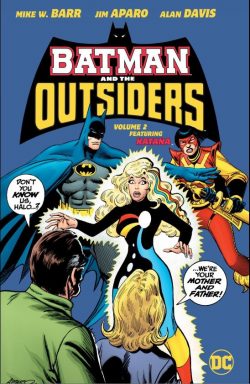
Batman and the Outsiders volume 2


By Mike W. Barr, Jim Aparo, Alan Davis, Jerome K. Moore, Alex Saviuk, Jan Duursema, Rick Hoberg, Bill Willingham, Trevor Von Eeden, Ron Randall & various (DC Comics)
ISBN: 978-1-4012-7753-6 (HC)

During the early 1980s the general trend of comics sales was yet another downturn – although team-books were holding their own – and the major publishers were less concerned with experimentation than with consolidation. Many popular titles were augmented by spin-offs, a recurring tactic in publishing troughs.

At the time the Dark Knight was the star of two and two half titles, sharing World’s Finest Comics with Superman (until its cancellation in 1986) and appearing with rotating guest-stars in The Brave and the Bold, as well as his regular lead spots in both Batman and Detective Comics. He was also a member of the Justice League of America.

In July 1983 B&B was cancelled with issue #200, but inside was a preview of a new Bat-title. One month later Batman and the Outsiders debuted…

The core premise of the new series revealed that Batman was convinced that the JLA was no longer fit for purpose; that too many problems were beyond their reach because they were hamstrung by international red tape and, by inference, too many laws.

To fix the problem he recruited a new team intended to be living weapons in his arsenal: a combination of old allies and new talent.

Markovian scientist Dr. Jace specialised in creating superpowers. When King Victor died, she used her process on Prince Brion and his sister Tara to create Earth-powered Geo-Force (and Terra). Rex (Metamorpho) Mason is a chemical freak able to turn into any element, and Jefferson (Black Lightning) Pierce is an electrically powered urban vigilante.

They were supplemented by female samurai/ninja Katana who wields a magic soul-drinking blade and an amnesiac American girl with inexplicable light-based powers answering to Halo.

The introductory stories cleverly peeled back layers of mystery shrouding all the newcomers, with plenty of plot threads laid for future development in the tried-&-tested super-team formula that had worked so well with the New X-Men and New Teen Titans.

This enticing hardback collection (also available as an eBook) resumes the daring departure of the Gotham Gangbuster, re-presenting BATO #14-23 and Batman and the Outsiders Annual #1, collectively spanning October 1984-July 1985, and also includes relevant pages from the Who’s Who Guide to the DC Universe. The entirety of the book is graced by the adroit writing of Mike W. Barr which – for the majority of the run – meshed perfectly with the understated talents of Jim Aparo; an artist who gave his all to a script. Eventually though he would move on to be replaced by a growing star of the “British Invasion”…

The action opens with the first Annual as ‘…Land Where Our Fathers Died…’ introduces a gang of ultra-patriots seeking to head the country in their own hard right direction called the Force of July in a barbed epic written by Barr and episodically illustrated by Jerome Moore, Alex Saviuk, Jan Duursema and Rick Hoberg with Aparo on inks.

Illustrated by Bill Willingham & Bill Anderson, BATO #14’s ‘Two by Two…’ and #15’s ‘Going for the Gold’ (spectacularly and moodily rendered by Trevor Von Eeden) comprise a two-part thriller set at the 1984 Olympics with raving loon and self-proclaimed god Maxie Zeus unleashing a super-powered minion on the team in an ploy to reclaim the Great Games for his own glory…

Aparo returns in #16 for the start of extended epic ‘The Truth About Halo’: as inconclusive opening ‘…Goodbye…’ sees a couple claiming to be her parents reclaim the memory-wiped child before the next two issues spotlight Metamorpho. This diverting digression takes the depleted team to the desert and back three millennia for ‘We Are Dying, Egypt… Dying’ and ‘Who Wears the Crown of Ra?’, to explore the fateful origins of the ancient antecedents of Element Man.

Seasonal Christmas tale. ‘Who’s Afraid of the Big Red “S”?’ then offers a powerful tale of date-rape and sexual bullying, which results in Geo-Force battling Superman to a standstill, after which a new year resolution details ‘The Truth About Halo: Part Two’ as grotesque gang boss Tobias Whale, debased criminal surgeon Dr. Moon and kinky assassin Syonide reveal the sordid, shocking truth about teenager Violet Harper, if not how she lost her memory and gained her powers. Powerful and haunting, the Barr/Aparo thriller drops as many bodies as secrets…

BATO #23 offers a triptych of solo tales by Barr, with Katana getting ‘The Silent Treatment’ (Jerome K. Moore) while saving priceless and extremely fragile Japanese pottery from thieves in, after which Geo-Force battles a tricked-up and amok robot shark in ‘Jaws 4… Gotham, 0!’ (limned by Von Eeden) and Black Lightning clashes with a sham radical social activist in Ron Randall’s ‘The Roar of the Ghetto-Blaster!’.

Slick stylist Alan Davis became regular artist with issue #22, as ‘The Truth About Halo: Part Three’ promised to disclose ‘What She is and How She Came to Be!’. Invading the recently wrecked and abandoned Justice League Satellite, Batman’s squad and Dr. Jace utilise its advanced technology to scan Violet and finally find what they’ve been looking for…

Sadly, that only leads to Halo being abducted and imprisoned by immortal, antediluvian light beings called Aurakles, prompting the heroes to breach the walls of reality to get her back…

With a full cover gallery, Who’s Who data pages on Black Lightning, Geo-Force, Halo and Katana and a team pin-up by Davis, this is a splendid package to appeal to dedicated Fights ‘n’ Tights fanatics. Batman and the Outsiders was always a highly readable series and is re-presented here in most accessible manner so open-minded new readers in search of quality storytelling could do lots worse than try out this near-forgotten corner of the DCU.
© 1984, 1985, 2018 DC Comics. All Rights Reserved.

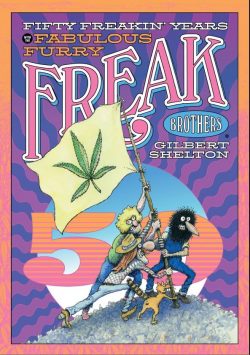
Fifty Freakin’ Years with the Fabulous Furry Freak Brothers


By Gilbert Shelton & various (Knockabout Comics)
ISBN: 978-0-86166-261-6 (TPB)

Because you’re all decent, deity-fearing, upstanding citizens you’re probably utterly unaware of the extensive sub-culture which has grown up around the recreational abuse of narcotic pharmaceuticals – and so, of course, am I – but it must be said: those counter-culture chaps certainly know how to craft a comic tale.

The Fabulous Furry Freak Brothers first appeared in Texas local paper The Rag, shambling out of the gradually burgeoning Underground Commix counter-culture wave in 1968. They jumped to Berkeley Print Mint’s Feds ‘n’ Heads, and New York tabloid The East Village Other before creator Gilbert Shelton and a few friends moved to California and founded their own San Francisco based Rip Off Press in 1969.

This effective collective continued to maximise the madness as the hilarious antics of the “Freaks” (a contemporary term for lazy, dirty, drug-taking hippy folks) captured the imagination of the open-minded portions of America and the world.

In 1971, they published the first compilation: The Collected Adventures of the Fabulous Furry Freak Brothers – which has been in print all around the planet ever since – and soon assorted underground magazines and college papers were joined by the heady likes of Rip Off Comix, High Times and Playboy (as well as numerous foreign periodicals) in featuring the addictive adventures of Freewheelin’ Franklin, Phineas T. Freakears and Fat Freddy Freekowtski (and his cat): siblings in sybaritic self-indulgence.

Always written by Shelton and, from 1974 illustrated by Dave Sheridan (until his death in 1982) and latterly Paul Mavrides and others, the disjointed strips (sorry; drug-humour is just irresistible…) combined canny satirical cynicism, surreal situations, scatological sauciness and an astounding grasp of human nature in brilliantly comedic episodes that cannot fail to amuse anyone with a mature sense of humour.

All the strips have been collected in various formats (in Britain by the equally fine and fabulous folks of Knockabout Comics) and have been happily absorbed by vast generations of fans – most of whom wouldn’t read any other comic.

Despite the hippy-dippy antecedents and stoner presentiments, Shelton is irrefutably a consummate professional and born storymaker. His ideas are always enchantingly fresh yet deviously skewed, the dialogue is permanently spot-on and his pacing perfect. The stories, whether half-page fillers, short vignettes or full-blown sagas, start strong and relentlessly build to spectacular – and often wildly outrageous, hallucinogenic yet narrative-appropriate – climaxes.

And they’re so very, very funny.

Without Shelton and the Freaks, the whole sub-genre of slacker/stoner movies, from Cheech and Chong’s assorted escapades to Dude, Where’s My Car? and all the rest – good, bad or indifferent – wouldn’t exist. Whether or not that’s a good thing is up to you…

Freewheelin’ Franklin is the tough, street-savvy one who can pull the chicks best, Phineas T. is a wildly romantic, educated and dangerous (to himself) intellectual, whilst Fat Freddy is you and me; weak-willed, greedy, not so smart, vastly put upon by an uncaring universe but oddly charming (you wish…)

One last point: despite the vast panoply of drugs imbibed, both real and invented, the Freaks don’t ever do heroin – which should tell you something…

This commemorative paperback album – now also available digitally – celebrates the trio’s astounding popularity and longevity, opening with a little look back in astonishment via Shelton’s Introduction ‘Fifty Freakin’ Years’ which offers fascinating historical insights and context in an Authorised History that wonderfully shares and captures the tone of those times, augmented by commentary, sketches, posters and found art, candid photos and loads of wry reflections.

Combining classic tales with 28 pages of new material by Shelton, plus loving spoofs and parodies from select cartoonists, the parade of seditious smut and filth opens with full-colour fiasco ‘Phineas Becomes a Suicide Bomber’, wherein the sensitive soul seeks to impress a rabble-rousing feminist icon and accidentally disrupts a glitzy convocation of smug one-percenters…

A pin-up of ‘Flora & Fawna the Jailbait Twins’ (don’t fret; these drawings admit they’re actually over 18 and only look younger…) is followed by more uproarious mayhem when one of our heroes is mugged by kids. Not at all overreacting, ‘Franklin got his Gun!’ when he stumbles into a right wing (aren’t they all?) Gun Show and accidentally triggers a bloodbath…

Following a transcendental moment from 2013 when ‘Mr. Natural meets Fat Freddy’, eternal quester Freekowtski goes on an all-out quest for enlightenment in the hilariously blasphemous ‘Fat Freddy Gets Religion’ revealing the holy power of alcohol – specifically ‘Tall Toad’ beer…

First seen in 2009, ‘The Adventures of the Fabulous Fat Freddy’ combines his search for love and understanding with an unsuspected appreciation of great art before diverting to a beguiling illustrated prose anecdote about storytelling from Shelton.

A selection of homages spoof and parodies follow, beginning with ‘Geek Brothers!’ by Jay Lynch from Bijou Funnies, backed up in stark monochrome by ‘The Feminine Furry-Legged Freek! Sisters’ and its accompanying bottom strip ‘Fat Frieda’s Ass’; both courtesy of Willy Murphy & Ted Richards from The National Lampoon Book of Comical Funnies.

In living colour, the cover of Shelton tribute book Fabuleux Furieux! is followed by Hunt Emerson’s parody ‘Gilbert Shelton’s Fabulous Furry Freak Brothers’ as seen within it, preceding original strip ‘Scotland Yardie vs the Fabulous Furry Freak Brothers’ by Bobby Joseph & Joseph Samuels.

Unused art for a Flash animation, ‘The Fabulous Furry Freak Brother’s Strut March’ opens a selection of found art and commissioned works, including 2008 art by Shelton for the 40th Anniversary of comic phenomenon Lambiek; Freak Brothers bank notes; illustrations of Mort Walker’s Comic Strip Lexicon, an Amsterdam Street Scene, Armadillo Rodeo, Street Freaks, poster for a Paris music store and more.

Other stuff includes personalised birthday cards, posters, film festival graphics and covers, sticker art, excerpts from Shelton’s Motoring Tips series, a tribute page to the many artistic co-contributors who added to the grubby lustre of the Freaks over the First Fifty Years and much, much more.

Anarchically sardonic and splendidly ludicrous, the madcap slapstick of the Freak Brothers is always an irresistible and joyously innocent tonic for the blues and this book – available in paperback and digital editions – should be a compulsory experience for any fan of the comics medium. However, if you’re still worried about the content, which is definitely habit-forming, simply read but don’t inhale…
© 2017 Gilbert Shelton. All rights reserved.

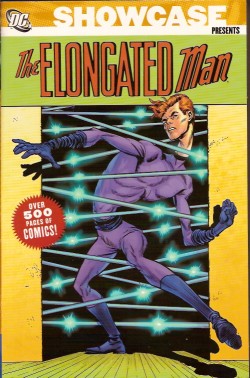
Showcase Presents The Elongated Man


By Gardner Fox, John Broome, Carmine Infantino, Murphy Anderson, Irv Novick, Gil Kane, Neal Adams, Mike Sekowsky, Sid Greene & various (DC Comics)
ISBN: 978-1-4012-1042-2 (TPB)

Once upon a time, American comics editors believed readers would become jaded if characters were over-used or over-exposed and so to combat that potential danger – and for sundry other commercial and economic reasons – they developed back-up features in most of their titles. By the mid-1960s the policy was largely abandoned as resurgent superheroes sprang up everywhere and readers just couldn’t get enough…but there were still one or two memorable holdouts.

In late 1963 Julius Schwartz took editorial control of Batman and Detective Comics and finally found a place for a character who had been lying mostly fallow ever since his debut as a walk-on in the April/May 1960 Flash.

The Elongated Man was Ralph Dibny, a circus-performer who discovered an additive in soft drink Gingold which seemed to give certain people increased muscular flexibility. Intrigued, he refined the chemical until he had developed a serum which gave him the ability to stretch, bend and compress his body to an incredible degree. Then Ralph had to decide how to use his new powers…

A quirky chap with his own small but passionate band of devotes, in recent years the perennial B-lister has become a fixture of the latest Flash TV series, but his many exploits are still largely uncollected in either print or digital formats. The only archival asset is this charming, witty and very pretty compilation which gathers his debut and guest appearances from Flash issues #112, 115, 119, 124, 130, 134, and 138 (spanning April/May 1960 to August 1963) and the Stretchable Sleuth’s entire scintillating run from Detective Comics #327-371 (May 1964-January 1968).

Designed as a modern take on the classic and immensely popular Golden Age champion Plastic Man, Dibny debuted in Flash #112’s ‘The Mystery of the Elongated Man!’ as a mysterious, masked yet attention-seeking elastic do-gooder, of whom the Scarlet Speedster was nonetheless highly suspicious, in a cunningly crafted crime caper by John Broome, Carmine Infantino & Joe Giella.

Dibny returned in #115 (September 1960, inked by Murphy Anderson) when aliens attempted to conquer the Earth and the Vizier of Velocity needed ‘The Elongated Man’s Secret Weapon!’ as well as the guest-star himself to save the day.

In Flash #119 (March 1961), Flash rescued the vanished hero from ‘The Elongated Man’s Undersea Trap!’ which introduced the vivacious Sue Dibny (as a newlywed “Mrs Elongated Man”) in a stirring tale of sub-sea alien slavers by regular creative team Broome, Infantino & Giella.

The threat was again extraterrestrial with #124′s alien invasion thriller ‘Space-Boomerang Trap!’ (November 1961) which featured an uneasy alliance between the Scarlet Speedster, Elongated Man and sinister rogue Captain Boomerang who naturally couldn’t be trusted as far as you could throw him…

Ralph collaborated with Flash’s junior partner in #130 (August 1962) only just defeating the wily Weather Wizard when ‘Kid Flash Meets the Elongated Man!’ but then sprang back into action with – and against – the senior partner in Flash #134 (February 1963). Seemingly allied with Captain Cold in ‘The Man Who Mastered Absolute Zero!’ Dibny excelled in a flamboyant thriller that almost ended his budding heroic career…

Gardner Fox scripted ‘The Pied Piper’s Double Doom!’ in Flash #138 (August 1963), a mesmerising team-up which saw both Elongated Man and the Monarch of Motion enslaved by the sinister Sultan of Sound, before ingenuity and justice ultimately prevailed.

When the back-up spot opened in Detective Comics (a position held by the Martian Manhunter since 1955 and only vacated because J’onn J’onzz had been promoted to lead position in House of Mystery) Schwartz had Ralph Dibny slightly reconfigured as a flamboyant, fame-hungry, brilliantly canny globe-trotting private eye solving mysteries for the sheer fun of it.

Aided by his equally smart but thoroughly grounded wife, the short tales were patterned on classic Thin Man filmic adventures of Nick and Norah Charles, blending clever, impossible crimes with slick sleuthing, garnished with the outré heroic permutations and frantic physical antics first perfected in Jack Cole’s Plastic Man.

These complex yet uncomplicated sorties, drenched in fanciful charm and sly dry wit, began in Detective #327 (May 1964) with ‘Ten Miles to Nowhere!’ (by Fox & Infantino, who inked himself for all the early episodes). Here Ralph, who publicly unmasked to become a (regrettably minor) celebrity, discovered that someone had been stealing his car every night and bringing it back as if nothing had happened. Of course, it had to be a clever criminal plot of some sort…

A month later he solves the ‘Curious Case of the Barn-door Bandit!’ and debuts his direly distressing trademark of manically twitching his expanded nose whenever he detects “the scent of mystery in the air” after which he heads for cowboy country to unravel the ‘Puzzle of the Purple Pony!’ and play cupid for a young couple hunting a gold mine in #329.

Ralph and Sue were on an extended honeymoon tour, making him the only costumed hero without a city to protect. When they reach California, Ralph is embroiled in a ‘Desert Double-Cross!’ when hostage-taking thieves raid the home of a wealthy recluse, after which Detective #331 offered a rare full-length story in ‘Museum of Mixed-Up Men!’ (by Fox, Infantino & Joe Giella) as Batman, Robin and the Elongated Man unite against a super-scientific felon able to steal memories and reshape victims’ faces.

Returned to a solo support role in #332, the Ductile Detective discovers Sue has been replaced by an alien in ‘The Elongated Man’s Other-World Wife!’ (with Sid Greene joining as new permanent inker). Of course, nothing is as it seems…

‘The Robbery That Never Happened!’ occurred when a jewellery store customer suspiciously claims he had been given too much change, whilst ‘Battle of the Elongated Weapons!’ in #334 concentrates on a crook who adapts Ralph’s Gingold serum to affect objects, after which bombastic battle it was back to mystery-solving when EM is invited by Fairview City to round up a brazen bunch of uncatchable bandits in ‘Break Up of the Bottleneck Gang!’

While visiting Central City again, Ralph is lured to the Mirror Master‘s old lair and only barely survives ‘The House of “Flashy” Traps!’ before risking certain death in the ‘Case of the 20 Grand Pay-off!’ by replacing Sue with a look-alike – for the best possible reasons – but without her knowledge or permission…

Narrowly surviving his wife’s wrath by turning the American tour into a World cruise, Ralph then tackles the ‘Case of the Curious Compass!’ in Amsterdam, foiling a gang of diamond smugglers, before returning to America and ferreting out funny-money pushers in ‘The Counterfeit Crime-Buster!’

Globe-trotting creator John Broome returned to script ‘Mystery of the Millionaire Cowboy!’ in Detective #340 (June 1965) as Ralph and Sue stumble onto a seemingly haunted theatre and find crooks at the heart of the matter, whilst ‘The Elongated Man’s Change-of-Face!’ (Fox, Infantino & Greene) sees a desperate newsman publish fake exploits to draw the fame-fuelled hero into investigating a town under siege, and ‘The Bandits and the Baroness!’ (Broome) has the perpetually vacationing couple check in at a resort where every other guest is a Ralph Dibny, in a classy insurance scam story heavy with intrigue and tension.

A second full-length team-up with Batman filled Detective Comics #343 (September 1965, by Broome, Infantino & Giella), in ‘The Secret War of the Phantom General!’; a tense action-thriller pitting the hard-pressed heroes against a hidden army of gangsters and Nazi war criminals, determined to take over Gotham City.

Having broken Ralph’s biggest case, the happy couple head for the Continent and encounter ‘Peril in Paris!’ (Broome, Infantino & Greene) when Sue goes shopping as an ignorant monolingual American and returns a few hours later a fluent French-speaker…

‘Robberies in Reverse!’ (Fox) boasts a baffling situation as shopkeepers begin paying customers, leading Ralph to a severely skewed scientist’s accidental discovery, whilst #346’s ‘Peephole to the Future!’ (Broome) finds Elongated Man inexplicably developing the power of clairvoyance. It sadly clears up long before he can use it to tackle ‘The Man Who Hated Money!’ (Fox); a bandit who destroys every penny he steals.

‘My Wife, the Witch!’ was Greene’s last ink job for a nearly a year: a Fox thriller wherein Sue apparently gains magical powers whilst ‘The 13 O’clock Robbery!’, with Infantino again inking his own work, sees Ralph walk into a bizarre mystery and deadly booby-trapped mansion, before Hal Jordan‘s best friend seeks out the Stretchable Sleuth to solve the riddle of ‘Green Lantern’s Blackout!’ – an entrancing, action-packed team-up with a future Justice League colleague, after which ‘The Case of the Costume-made Crook!’ find Ralph ambushed by a felon using his old uniform as an implausible burglary tool.

Broome devised ‘The Counter of Monte Carlo!’ as the peripatetic Dibnys fall into a colossal espionage conspiracy at the casino and afterward become pawns of a fortune teller in ‘The Puzzling Prophecies of the Tea Leaves!’ (Fox), before Broome dazzles and delights one more time with ‘The Double-Dealing Jewel Thieves!’ wherein a museum owner finds that his imitation jewel exhibit is indeed filled with fakes…

As Fox assumed full scripting duties, Mystic Minx Zatanna guest-starred in #355’s ‘The Tantalising Troubles of the Tripod Thieves!’, as stolen magical artefacts lead Ralph into conflict with a band of violent thugs, whilst ‘Truth Behind the False Faces!’ sees Infantino bow out on a high note as Elongated Man helps a beat cop to his first big bust and solves the conundrum of a criminal wax museum.

Detective #357 (November 1966) featured ‘Tragedy of the Too-Lucky Thief!’ (by Fox, Murphy Anderson & Greene) as the Dibnys discover a gambler who hates to win but cannot lose, whilst Greene handled all the art on ‘The Faker-Takers of the Baker’s Dozen!’ wherein Sue’s latest artistic project leads to the theft of an ancient masterpiece.

Anderson soloed with Fox’s ‘Riddle of the Sleepytime Taxi!’, a compelling and glamorous tale of theft and espionage, and when Ralph and Sue hit Swinging England in Detective #360 (February 1967, Fox & Anderson) with ‘London Caper of the Rockers and Mods!’, they meet the reigning monarch and prevent warring kid-gangs from desecrating our most famous tourist traps, before heading home to ‘The Curious Clue of the Circus Crook!’ (Greene). Here Ralph visits his old Big-Top boss and stops a rash of robberies which had followed the show around the country.

Infantino found time in his increasingly busy schedule for a few more episodes, (both inked by Greene) beginning with ‘The Horse that Hunted Hoods’, a police steed with uncanny crime solving abilities, and continuing in a ‘Way-out Day in Wishbone City!’ wherein normally solid citizens – and even Sue – go temporarily insane and start a riot, after which unsung master Irv Novick stepped in to delineate the mystery of ‘The Ship That Sank Twice!’

‘The Crooks who Captured Themselves!’ (#365, by Greene) recounts how Ralph loses control of his powers before Broome & Infantino reunited one last time for ‘Robber Round-up in Kiddy City!’ as, for a change, Sue sniffs out a theme-park mystery for Ralph to solve.

Infantino finally bowed out with the superb ‘Enigma of the Elongated Evildoer!’ (written by Fox and inked by Greene) as the Debonair Detectives tackle a thief in a ski lodge who seems to possess all Ralph’s elastic abilities…

The Atom guest-starred in #368, helping battle clock-criminal Chronos in ‘The Treacherous Time-Trap!’ by Fox, Gil Kane, Greene, and iconoclastic newcomer Neal Adams illustrated the poignant puzzler ‘Legend of the Lover’s Lantern!’, after which Kane & Greene limned the intriguing all-action ‘Case of the Colorless Cash!’.

The end of the year signalled the end of an era as Fox, Mike Sekowsky & Greene finished off the Elongated Man’s expansive run with the delightfully dizzy lost-loot yarn ‘The Bellringer and the Baffling Bongs’ (#371, January 1968).

With the next issue Detective Comics became an all Bat-family title and Ralph and Sue Dibny temporarily faded from view until revived as bit players in Flash and finally recruited into the Justice League of America as semi-regulars. Their charismatic relationship and unique, genteel style have, sadly, not survived: casualties of changing comics tastes and the replacement of sophistication with angsty shouting and testosterone-fuelled sturm und drang…

Witty, bright, clever and genuinely exciting, these smart stories from a lost age are all beautiful to look at and a joy to read for any sharp kid and all joy-starved adults. This book is a shining tribute to the very best of DC’s Silver Age and a volume no fan of fun and adventure should be without. It should not, however, be the only place you can stretch out and enjoy such classic fare…
© 1960, 1961, 1962, 1964, 1965, 1966, 1967, 1968, 2006 DC Comics. All Rights Reserved.

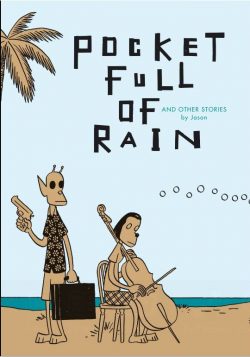
Pocket Full of Rain and Other Stories


By Jason, edited and translated by Kim Thompson (Fantagraphics Books)
ISBN: 978-1-56097-934-0 (TPB)

John Arne Sæterøy works under the pen-name Jason. He was born in Molde, Norway in 1965, and exploded onto the international cartoonists scene at age 30 with a series of short – often autobiographical – strips and graphic novels. His anthological first book, Lomma Full av Regn won the Sproing Award (Norway’s biggest comics prize) and forms the meat of this review. This is it translated into English and you can read it in paperback or digital editions.

He followed up with the series Mjau Mjau (winning another Sproing in 2001) and in 2002 turned almost exclusively to producing graphic novels. He is now an international icon, basking in fame and critical status, winning seven major awards as far afield as France, Slovakia and the USA and all areas in-between.

Later stories utilise a small repertory cast of anthropomorphic animal characters (as well as occasional movie and pop culture monsters), delivered in highly formal page layouts telling dark, wry and sardonically bleak tales – often pastiches, if not outright parodies – rendered in a coldly austere and Spartan manner. This seemingly oppressive format somehow allows a simply vast range of emotionally telling tales on a wide spectrum of themes and genres to hit home like rockets whether the author’s intention was to make readers smile or cry like a baby.

Drawing in a minimalist evolution of Hergé’s Claire Ligne style, Jason’s work bores right into the reader’s core, but here fans and students can see the development of that unique vision in a series of pictorial tales – many clearly experimental in nature from – taken from Mjau Mjau, Forresten, Fidus, TEGN, Lomma Full av Regn and Humorparaden as the young artist grasps his muse but still hunts for a style vehicle to carry his thoughts…

An Introduction by novelist and educator James Sturm is preceded by an observational encounter with a human derelict and followed by short absurdist slice-of-life moments including an unpleasant confrontation in the desert and a manhunt across the world and beyond it that evolves into an examination of love.

The experimental procession is followed by edgy cartoon hijinks and therapeutic café discourses in anthropomorphic yarn ‘Carl Cat in What Time is It?’, after which an age-old masculine dilemma is covered in ‘What Shall I Do When I Lose My Hair?’

Autobiographical introspection informs single pagers ‘Film’, ‘Night’ and an untitled gag about playing solitaire, before ‘Bus’ and croquet-playing nuns give way to the tragic tale of ‘Edwin!’ whilst ‘Two Yrs’ deals with isolation and meagre youthful aspirations and ‘Invasion of the Giant Snails’ offers an early mash-up of genre movie scenes before we see that the Truth is not necessarily Out anywhere in spoof strip ‘XPilt’.

‘Corto Meowtese’ provides a loving salutation to classic European strips before ‘Space Cat’ offers similar tribute to Basil Wolverton’s legendary Space Hawk, whilst echoes of Samuel Beckett shade a tense situation involving Earnest Hemingway in ‘Papa’. Mordant laughs trace ‘My Life as a Zombie’ and penal absurdity triumphs in extended act of whimsy ’10, 9, 8, 7, 6, 5, 4, 3, 2, 1 …Lift Off!’ before relationship woes and human interaction are scrutinised in ‘Falling’.

Nightmarish surrealism underpins vignettes ‘Kill the Cat’, school shocker ‘Chalk’, home invasion chiller ‘Glass’ and police drama ‘the thief’ to conclude the narrative efforts but there’s still plenty to enjoy. The tales thus far have been monochrome strips interspersed with pin-up style images and found art and they are now supplemented with a wealth of multihued material including Colour covers for Mjau Mjau (#2, 4, 5), hilariously irreverent strip ‘Playing Trivial Pursuit with God’, Sleppefest and so much more.

A full Table of Contents then lists the origins of each offering with publishing information and author’s commentary.

Jason’s comic tales are strictly for adults but allow us all to look at the world through wide-open childish eyes, exploring love, loss, life, death and all aspects of relationship politics without ever descending into mawkishness or simple, easy buffoonery.

He is a taste instantly acquired and a creator any true fan of the medium should move to the top of their “Must-Have” list.
All characters, stories, and artwork © 2008 Jason. Lomma Full av Regn and Mitt Liv Som Zombie published in Norway by Jippi Forlag. All right reserved.

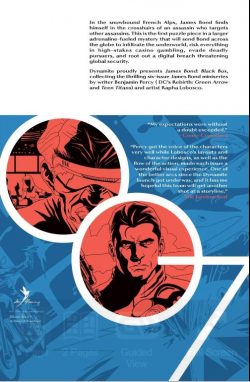
James Bondâ„¢ volume 3: Black Box


By Benjamin Percy, Rapha Lobosco, Chris O’Halloran, Simon Bowland & various (Dynamite Entertainment)
ISBN: 978-1-5241-0409-2

James Bond is the ultimate secret agent. You all know that and have – thanks to the multi-media empire that has grown up around Ian Fleming’s masterful creation – your own vision of what he looks like and what he does. That’s what dictates how you respond to the latest movie, game or novel.

Amongst those various iterations are some exceedingly enjoyable comicbook and newspaper strip versions detailing the further exploits of 007 which have never truly found the appreciation they rightly deserve. This collection is one of the most recent, compiling a 6-issue miniseries from licensing specialists Dynamite Entertainment. Their take was originally redefined by Warren Ellis & illustrator Jason Masters, who jettisoned decades of gaudy paraphernalia accumulating around the ultimate franchise hero, opting instead for a stripped-down, pared-back, no-nonsense iteration who is all business.

Benjamin Percy accepted the poisoned chalice of following on, and here blends the austere power of the reboot with his own tributes to the movie contributions of the Roger Moore era. Capably and effectively handling the visuals is Rapha Lobosco, with colours and letters supplied by Chris O’Halloran, and Bowland respectively.

It begins with Bond in the French Alps, stalking an assassin, but his licence to kill proves unnecessary as his target is lethally excised by another sharpshooter, who then escapes him in a rollercoaster ski race down the mountain slopes. Perhaps 007 was distracted by her skill or maybe her great – albeit slightly scarred – beauty…

Returning to MI6 HQ in Vauxhall Cross, Bond picks up his next assignment: eradicating the perpetrators of a hack which has captured vital Crown political information and recovering the stolen data.

The hack originated in Tokyo and soon Bond is executing Operation Black Box, supported and supplied by department armorer Boothroyd. The wily technician is also – unofficially – helping to ascertain the identity of the woman who bested Bond in the Alps…

The hacker’s trail leads to the nefarious Shinjuku District and a plush Yakuza gambling den, where the British agent meets and calamitously clashes with aging billionaire Saga Genji. The tech wizard is the proud culprit of the data grab and almost succeeds in gruesomely removing the interfering agent until the mysterious woman resurfaces to murderously intervene…

When CIA comrade Felix Leiter shows up, the terrifying global scope of Genji’s plans becomes apparent and a race to secure the Black Box (for the rulers of a host of greedily ambitious nations) turns allies into merciless competitors with the entire world’s dirty secrets as the prize.

Meanwhile, Genji has supplemented his loyal army of thugs with a barely human serial killer dubbed No Name: an unstoppable psychopath who takes faces for his keepsakes and is now utterly devoted to adding Bond and his annoying female accomplice to his tally at any cost…

With the clock ticking down to international information Armageddon and bloody death and destruction constantly dogging them, Bond and his enigmatic ally overcome all odds to invade Genji’s secret base and secure all the World’s dirty laundry, only to discover at the end that their aims are not entirely similar…

Packed with all the traditional set-pieces such as exotic locales, spectacular car chases and astoundingly protracted fight sequences, this is a rip-roaring romp fans will love, supported by Bonus Material including a gallery of covers by Dominic Reardon and a host of variants from John Cassaday, Jason Masters, Goni Montes, Moritat, Lobosco, Giovanni Valletta, Patrick Zircher and Matt Taylor; an interview with author Percy by Will Nevin first seen in the Oregonian and the full script for issue #1, accompanied by its equivalent line art.

This thrill-filled espionage episode is fast, furious and impeccably stylish: in short, another perfect James Bond thriller.

Try it and see for yourselves…
© 2017 Ian Fleming Publications, Ltd. James Bond and 007 are ™ Danjaq LLC, used under license by Ian Fleming Publications, Ltd. All rights reserved.