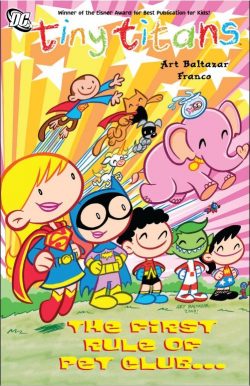
Tiny Titans: The First Rule of Pet Club…


By Art Baltazar & Franco with Geoff Johns & various (DC Comics)
ISBN: 978-1-4012-2892-7 (TPB)

DC’s Cartoon Network imprint was a potent and fun bastion of children’s comics in America and consolidated the link between TV and 2D fun and thrills with stunning interpretations of such television landmarks as Ben 10, Scooby Doo, Powerpuff Girls, Dexter’s Laboratory and others. The comics line also produced some truly exceptional material based on TV iterations of their proprietary characters such as Legion of Super Heroes, Batman: Brave and the Bold and Krypto the Super Dog as well as original material like Billy Batson and the Magic of Shazam! which was merely indistinguishable in tone and content.

Perhaps the imprint’s finest release was a series ostensibly aimed at early readers but which quickly became a firm favourite of older fans – and a multi-award winner too.

Superbly mirroring the magical wonderland inside a child’s head where everything is happily mixed up together, Tiny Titans became a sublime nostalgia-weaponised antidote to continuity cops and slavish fan-boy quibbling by reducing the vast cast of the Teen Titans animated series, the greater boutique of mainstream comicbooks and, eventually, the entire DC Universe to little kids and their parents/guardians in the wholesome kindergarten environment of Sidekick City Elementary School.

It’s a scenario spring-loaded with in-jokes, sight-gags and beloved yet gently mocked paraphernalia of generations of strip readers and screen-watchers….

Collecting issues #19-25 (spanning October 2009 – April 2010) of the magically madcap and infinitely addictive all-ages mini-masterpiece, this fourth volume begins on a romantic note with Deep in Like.

Art Baltazar and co-creator Franco (Aureliani) mastered a witty, bemusingly charming style of storytelling that just happily rolls along, with assorted characters getting by, trying to make sense of the great big world and just coincidentally having “Adventures in Awesomeness”. The method generally involves stringing together smaller incidents and moments into an overall themed portmanteau tale and it works astoundingly well.

After a handy and as-standard identifying roll-call page, ‘Imagine Me and You…’ finds scary blob Plasmus and tiny winged Bumblebee brighten up each other’s drab day, before a similar cupid moment affects the Brain and M’sieu Mallah even as diligent Robin (accompanied by faithful Bat-hound Ace) finds his earnest attempts to finish his homework disturbed by a succession of pesky young ladies including Starfire, Batgirl and Duella all caught up in a ‘Like Triangle’.

‘Dates’ sees Bumblebee and Plasmus inadvertently causing chaos during an afternoon movie monster mash – and even the ‘Intermission’ – after which a sly sight gag for us oldies highlights the company’s many Wonder Girls in ‘Jump Rope’.

The hallowed anthropoid obsession of DC is highlighted in ‘New Recruits’ when Beast Boy chairs a meeting of the Titans Ape Club before regular feature The Kroc Files depicts ultimate butler Alfred, roguish reptilian star Kroc and Plasmus each demonstrating ‘How to Enjoy a Lollipop’ in their own signature manner…

The issue closes with a word puzzle whilst the next promises to disclose The Hole Truth about Raven: beginning with a daybreak disaster at ‘Home with the Trigons’. Raven’s dad is an antlered, crimson trans-dimensional devil-lord – and a teacher at Sidekick Elementary – so when he oversleeps, his sorceress scion gets him to work on time by simply opening a few wormholes.

Of course, leaving those dimensional doors around is just asking for trouble…

Meanwhile it’s washday at Wayne Manor, but Alfred won’t let Robin, Beast Boy or Aqualad go down ‘To the Batcave’. Sadly, even the dapper domestic can’t withstand united pester-power and eventually gives in… and learns to regret it…

Following a perplexing maze game-page, the All Pet Club Issue! launches as Starfire and mean sister Blackfire write home for their beloved critters Silky and Poopu, so that they can go to the oh-so-secret social event, whilst can-do kid Cyborg actually builds himself a brace of chrome companions in ‘Pet-Tronics’…

With ‘Club Hoppin”, the entire school gathers with their uniquely compatible pets and interview some potential new members – specifically tongue-tied and thunderstruck Captain Marvel Junior and his fuzzy pal Hoppy, the Marvel Bunny. With so many members, the club then has to find roomier quarters, leading to a painful tryst for Beast Boy and Terra in ‘Meanwhile, on the Moon…’

There’s a brilliant vacuum-packed bonus pin-up of the Tiny Titans in space from Franco before Hot Dogs, Titans, & Stretchy Guys! finds the kids back on solid ground and wrapped up with the DCU’s many flexible fellows as ‘Offspring into Action’ introduces Plastic Man‘s excitably boisterous bonny boy.

In ‘Just Playing and Bouncing’ Bumblebee spends some time with the diminutive Atoms Family but loses control of their Teeny-Weeny, Super Duper Bouncy Ball and accidentally gets Plastic Man, Offspring, Elongated Man and Elastic Lad all wound up before helplessly watching it bowl over Principal Slade and Coach Lobo in ‘Coffee Dog Latte’.

Thankfully, Robin has exactly the right gimmick in his utility belt to set things straight, but can’t stay since he’s en route to his Bird Scouts meeting. Here potential new members Hot Spot and Flamebird are trying out for Hawk, Dove, Raven and Talon. Distressingly, when shiny Golden Eagle turns up, the girls want to make him the new leader…

The semi-regular ‘Epilogue’ page often supplies one more punch-line to cap each themed issue and this one leads directly into a convoluted and confounding Elastic Four pin-up/cover which in turn precedes a spookily uproarious tale of Bats, Bunnies, and Penguins in the Batcave! Oh My!...

It all begins in ‘Ice to Meet Ya!’ when Wayne Manor’s extraordinarily large penguin population get into a turf war with the house rabbits, displacing the Batcave’s regular inhabitants in ‘Driving Me Batty’. The conflict escalates in ‘All in the Batman Family’ before Robin gets a rather stern admonition from his senior partner to put things right or else…

Happily, ever-so-cute and capable Batgirl is willing to lend a hand – but (unfortunately) so too are the kids she’s baby-sitting (Tim and Jason: you’ll either get that or you won’t, bat-fans) and impishly infuriating Batmite…

With even Batcow helping out, things soon start calming down, but ‘Meanwhile, at the Titans’ Treehouse…’ not all of the fugitive Bat-bats have heard the good news…

Once your ribs have stopped hurting you can then enjoy a Tiny Titans Aw Yeah Pin-up by Franco before The All Small Issue! starts with assorted big kids accidentally drinking ‘Milk! Milk!’ from the Atoms’ fridge and shrinking away to nearly nothing.

Good thing the Atomic nippers think to call their dad, who’s with fellow dwindlers Ant, Molecule and substitute Atoms Adam and Ryan (another in-continuity howler targeting dedicated fans) for a Team Nucleus meeting…

That compressive cow-juice causes more trouble in the ‘Epilogue’ before a Blue Beetle puzzle clears the mind prior in advance of an outrageous ending in Superboy Returns! in a fairly cosmic crossover – with additional scripting by Geoff Johns.

When Conner Kent shows up, all the girls are really impressed and distracted, whilst across town Speedy is trading a lot of junk he shouldn’t be touching to Mr. Johns’ Sidekick City Pawn Shop and Bubblegum Emporium in ‘Brightest Day in the Afternoon!’

When Starfire and Stargirl then buy the seven different coloured “mood rings” from the shop, they and BFFs Duella, Batgirl, Wonder Girl, Terra and Shelly, are turned into Green, Red, Yellow, Orange, Blue, Violet and Indigo Lanterns!

Soon, the Tiny Titans are up in the air again and annoying the Guardians of the Universe and their Green Lantern Corps.

It all ends well though, first in an Emerald ‘Epilogue’ and a lavish pin-up of a passel of pistachio-painted interplanetary peace-keepers…

Available in trade paperback and digital formats and despite being ostensibly aimed at super-juniors and TV kids, these wonderful, wacky yarns – which marvellously marry the heart and spirit of such classic strips as Peanuts and The Perishers with something uniquely mired and marinated in pure comic-bookery – are deliciously hilarious tales no self-respecting fun-fan should miss: accessible, entertaining, and wickedly intoxicating. Go mellow out with some kids’ stuff, now, okay?
© 2009, 2010 DC Comics. All Rights Reserved.
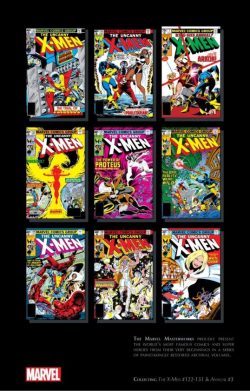
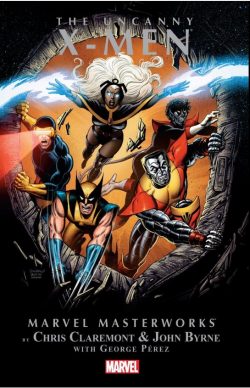
Uncanny X-Men Marvel Masterworks volume 4


By Chris Claremont, John Byrne, Terry Austin, George Pérez & various (Marvel)
ISBN: 978-0-7851-1630-1 (HB) 978-0-7851-5869-1 (TPB)

In the autumn of 1963, The X-Men #1 introduced Scott (Cyclops) Summers, Bobby (Iceman) Drake, Warren (Angel) Worthington, Jean (Marvel Girl) Grey and Hank (The Beast) McCoy: very special students of Professor Charles Xavier.

The teacher was a wheelchair-bound telepath dedicated to brokering peace and integration between the masses of humanity and the emergent off-shoot race of mutants dubbed Homo superior; considered by many who knew him as a living saint.

After nearly eight years of eccentrically spectacular adventures the mutant misfits virtually disappeared at the beginning of 1970 during another periodic downturn in superhero comics sales. Just like in the closing years of the 1940s, mystery men faded away as supernatural mysteries and traditional genre themes once more dominated the world’s entertainment fields…

Although the title was revived at the end of the year as a cheap reprint vehicle, the missing mutants were reduced to guest-stars and bit-players throughout the Marvel universe and the Beast was refashioned as a monster fit for the global uptick in scary stories until Len Wein & Dave Cockrum revived and reordered the Mutant mystique with a brand-new team in Giant Size X-Men #1 in 1975.

To old foes-turned-friends Banshee and Sunfire was added one-shot Hulk hunter Wolverine, and all-original creations Kurt Wagner, a demonic German teleporter codenamed Nightcrawler, African weather “goddess” Ororo Monroe AKA Storm, Russian farmboy Peter Rasputin, who transformed at will into a living steel Colossus, and bitter, disillusioned Apache superman John Proudstar who was cajoled into joining the makeshift squad as Thunderbird.

The revision was an instantaneous and unstoppable hit, with Wein’s editorial assistant Chris Claremont writing the series from the second story onwards. The Uncanny X-Men reclaimed their own comicbook with #94 and it quickly became the company’s most popular – and high quality – title.

Cockrum was succeeded by John Byrne and as the team roster shifted and changed the series rose to even greater heights, culminating in the landmark (and with this tome, imminently ensuing) Dark Phoenix storyline which saw the death of arguably the book’s most beloved and imaginative character.

In the aftermath team leader Cyclops left but the epic cosmic saga also seemed to fracture the epochal working relationship of Claremont and Byrne. Within months of publication they went their separate ways: Claremont staying with the mutants whilst Byrne moved on to establish his own reputation as a writer on series such as Alpha Flight, Incredible Hulk and especially his revolutionised and freshly-groundbreaking Fantastic Four…

After Apache warrior Thunderbird became the team’s first fatality, the survivors slowly bonded, becoming an infallible fighting unit under the brusque and draconian supervision of Cyclops.

This Fabulous fourth compilation (available in luxurious hardcover, trade paperback and eBook editions) is perfect for newbies, neophytes and even old lags nervous about reading such splendid yarns on fragile but extremely valuable newsprint paper. It celebrates the unstoppable march to market dominance through the pivotal early stories: specifically, X-Men #122-131 plus the X-Men Annual #3 of the decidedly “All-New, All-Different” – spanning June 1979 to March 1980.

The drama resumes with Byrne producing light breakdowns and regular inker Terry Austin stepping up to produce full art finishes for issue #122’s ‘Cry for the Children!’ as the long-missing heroes finally return to the Xavier School only to find their home boarded up and deserted.

Months previously, following a catastrophic battle against Magneto in which Beast and Phoenix believed themselves the only survivors, heartbroken Professor X had grieved for his fallen pupils and left Earth to be with his fiancée Empress Lilandra of the far-flung extragalactic Shi’ar Imperium. In the interim, Jean Grey – reborn as the cosmic-powered Phoenix – went globetrotting to bury her woes and is currently in Scotland, unaware that she has been targeted by one of the team’s oldest enemies for a cruel assault.

As the weary team slowly settle in at the mansion again, they try to resume their previous routines but psychological stress testing shows Russian teen Colossus is having second thoughts about deserting his family and country…

In New York, Storm has at last taken the time to trace her roots, visiting the old home of her American dad, only to find it now a disgusting junkie squat filled with doped-up, feral kids who viciously attack her…

Stabbed and bleeding, she lashes out and only the sudden arrival of hero for hire Luke Cage and his friend Misty Knight (coincidentally Jean’s Manhattan room-mate) prevents a tragedy. None of them are remotely aware that they have been targeted by the world’s most outrageous hit-man…

With Byrne back in full penciller mode, Uncanny X-Men #123 includes a cameo from Spider-Man as jolly psycho-killer Arcade proceeds to pick off the oblivious mutants and run them through his fatal funfair Murder World in ‘Listen… Stop Me if You’ve Heard It… But This One Will Kill You!’: subjecting the abductees to perils mechanical and psychological.

The former prove understandably ineffectual but family guilt and cunning conditioning soon transform the already homesick and despondent Colossus into a vengeful mind-slave dubbed The Proletarian, determined to smash his former comrades in concluding chapter ‘He Only Laughs When I Hurt!’ Happily, his inner child and the assorted heroes’ gifts and training prove too much for the maniacal killer clown…

X-Men Annual #3 then offers a fantastic interlude as extradimensional barbarian warlord Arkon the Magnificent returns to Earth courtesy of Claremont, George Pérez & Austin. ‘A Fire in the Sky!’ sees him again seeking to save his unstable world of Polemachus from eternal darkness. Last time the Avenger Thor provided the lightning necessary to illuminate his world, but with the Asgardian unavailable, Arkon decides Storm will do. He never learned how to ask, though, and his violent abduction of his target provokes a furious response from the X-Men…

With Byrne doing the drawing, Jean re-enters the picture in #125, when her stay with biologist Moira MacTaggert leads to the release of a long-secret family shame in ‘There’s Something Awful on Muir Island!’ Throughout her long holiday, Phoenix has been gradually weakened and psychically seduced by a psionic predator: groomed for a life of refined cruelty and debauchery by a man calling himself Jason Wyngarde, whose intention is to create a callous and wicked “Black Queen” for the mysterious organisation known as the Hellfire Club…

At the other end of the galaxy, Charles Xavier reviews records of how Phoenix once reconstructed the entire fragmenting universe and is gripped with terror at the thought of all that power in the hands of one frail human personality, whilst in his former home the Beast checks a tripped alarm and discovers his long-mourned friends are all alive.

The reunited heroes’ first thought is to tell Jean the incredible news, but no sooner is a transatlantic call connected than a scream echoes out and the line goes dead…

Issue #126 resumes frantic hours later as the X-Men approach Muir Island in their supersonic jet. With all contact lost and no telepath aboard, Cyclops assumes the worst and the squad infiltrate in battle formation, only to find a withered corpse and badly shaken comrades Lorna Dane, Havok, Madrox, Moira and Jean slowly recovering from a psionic assault.

In ‘How Sharper Than a Serpent’s Tooth…!’ Dr. MacTaggert bitterly reveals the attacker is a psychic bodysnatcher imprisoned on Muir for years. He’s also her son…

Rapidly burning out one of Madrox’s duplicate bodies, the monster has already reached the mainland, but as the mutants disperse to hunt him down Jean is hampered by a torrent of seductive mirages projected by the smugly confidant Wyngarde, allowing the predatory Proteus to ambush the X-Men and try to possess Wolverine.

It is his first mistake. Metal has an inimical effect on the formless horror and the feral fury’s Adamantium skeleton forces him to flee his victim in screaming agony. It is then the creature unleashes his most terrifying power: warping reality to drive Wolverine and Nightcrawler to the brink of madness. Only the late-arriving Storm prevents their immediate demise but soon she too is at the edge of destruction…

‘The Quality of Hatred!’ finds the badly shaken team undergoing desperate “tough-love” remedies from Cyclops to regain their combat readiness whilst Moira tries to make up for her dangerous sentimentality by putting a bullet into her deadly offspring.

Frustrated by the idealistic Cyclops but having divined the path Proteus is taking, she then heads for Edinburgh and an unpleasant reunion with her former husband: brute, bully, Member of Parliament and father of most merciless monster the world has yet produced…

As Jean finally shrugs off her distractions and telepathically homes in on Proteus, the team swing into action a little too late: the sinister son has possessed his scurrilous sire and created an unstoppable synthesis of world-warping abomination…

With Edinburgh and perhaps the entire world roiling and rebelling as science goes mad, X-Men #128 sees the valiant champions strike back to spectacularly triumph in ‘The Action of the Tiger!’ after which ‘God Spare the Child…’ sees another happy reunion as the heroes (all but the now retired Banshee) discover Charles Xavier awaiting them when they reach Westchester.

Jean is increasingly slipping into visions of a former life as a spoiled, cruel child of privilege, contrasting sharply with her renewed love for Scott, but the home atmosphere is troubled by another discordant factor. Xavier is intent on resuming the training of the team, haughtily oblivious that this group are grizzled, seasoned veterans of combat, rather than the callow teenagers he first tutored.

Elsewhere a cabal of mutants and millionaires plot. Black King Sebastian Shaw, White Queen Emma Frost and the rest of the Hellfire Club hierarchy know Wyngarde is an ambitious and presumptuous upstart, but the possibility of subverting the Phoenix to their world-dominating agenda is irresistible…

When two new mutants manifest, Xavier splits the team to contact both, taking Storm, Wolverine and Colossus to Chicago and meeting the nervous parents of naive 13-year old Kitty Pryde who has just realised that along with all the other problems of puberty, she can now fall through floors and walk through walls…

However, no sooner does Professor Xavier offer to admit her to his select and prestigious private school than they are all attacked by war-suited mercenaries and shipped by Emma Frost to the Hellfire Club. Only Kitty escapes, but instead of running she stows away on the transport; terrified but intent on saving the day…

The other mutant neophyte debuts in X-Men #130 as Cyclops, Phoenix and Nightcrawler head to Manhattan’s club district to track down a disco singer dubbed ‘Dazzler’ unaware that they too have been targeted for capture. However little Kitty’s attempts to free the captives at the Hellfire base forces the villains to tip their hand early and with the assistance of Dazzler Alison Blair – a musical mutant who converts sound to devastating light effects – the second mercenary capture team is defeated…

The drama concludes for now in #131 where Kitty is forced to frantically ‘Run for Your Life!’ – fortunately straight into the arms of the remaining X-Men. Soon the plucky lass – after an understandable period of terror, confusion and kvetching – leads an incursion into the lair of the White Queen to free Wolverine, Colossus and Xavier as Frost faces off in a deadly psionic showdown with a Phoenix far less kind and caring than ever before…

For many fans these tales – and those in the next volume – comprise the definitive X-Men look and feel: some of the greatest stories Marvel ever published; entertaining, groundbreaking and painfully intoxicating. These adventures are an invaluable grounding in contemporary fights ‘n’ tights fiction no fan or casual reader can afford to ignore.
© 1979, 1980, 2014 Marvel Characters, Inc. All rights reserved.

Batman: The Brave and the Bold: Emerald Knight


By Landry Q. Walker, Sholly Fisch, Adam Schlagman, Robert Pope, Eric Jones, Carlo Barberi & various (DC Comics)
ISBN: 978-1-4012-3143-9 (TPB)

The Brave and the Bold premiered in 1955 as an anthology adventure comic featuring short complete tales about a variety of period heroes: a format which mirrored that era’s filmic fascination with flamboyant if fanciful historical dramas. Devised and written by Bob Kanigher, issue #1 led with Roman epic Golden Gladiator, medieval mystery-man The Silent Knight and Joe Kubert’s now legendary Viking Prince. Soon the Gladiator was alternated with Robin Hood, but the adventure theme carried the title until the end of the decade when the burgeoning costumed character revival saw B&B transform into a try-out vehicle like Showcase.

Used to premiere concepts and characters such as Task Force X: The Suicide Squad, Cave Carson, Hawkman and Strange Sports Stories as well as the epochal Justice League of America, the comic soldiered on until issue #50 when it provided another innovative new direction which once again truly caught the public’s imagination.

That issue paired two superheroes – Green Arrow and Martian Manhunter – in a one-off team-up, and was followed by other ones: Aquaman and Hawkman in #51, WWII “Battle Stars” Sgt. Rock, Captain Cloud, Mme. Marie & the Haunted Tank in #52 and Atom & Flash in #53.

The next team-up – Robin, Aqualad and Kid Flash – quickly evolved into Teen Titans and after Metal Men/the Atom and Flash/Martian Manhunter appeared, a new hero debuted in #57-58: Metamorpho, the Element Man.

From then it was back to the increasingly popular superhero pairings with #59, and although no one realised it at the time, that particular conjunction – Batman with Green Lantern – would be particularly significant….

After a return engagement for the Teen Titans, two issues spotlighting Earth-2 champions Starman and Black Canary and Earth-1’s Wonder Woman with Supergirl, an indication of things to come came when Batman duelled hero/villain Eclipso in #64: an early acknowledgement of the brewing TV-induced mania mere months away.

Within two issues (following Flash/Doom Patrol and Metamorpho/Metal Men), B&B #67 saw the Caped Crusader take de facto control of the title and the lion’s share of the team-ups. With the late exception of #72 and 73 (Spectre/Flash and Aquaman/Atom) the comic was henceforth a place where Batman invited the rest of company’s heroic pantheon to come and play…

Decades later, the Batman Animated TV series masterminded by Bruce Timm and Paul Dini in the 1990s revolutionised the Dark Knight and subsequently led to some of the absolute best comicbook adventures in his seventy-year publishing history with the creation of the spin-off print title…

With constant funnybook iterations and tie-ins to a succession of TV cartoon series, Batman has remained popular and a sublime introducer of kids to the magical world of the printed page. One fun-filled incarnation was Batman: The Brave and the Bold, which gloriously celebrated the team up in both its all-ages small-screen and comicbook spin-off.

Shamelessly and magically plundering decades of continuity arcana in a profusion of alliances between the Dark Knight and DC’s other heroic creations, the show was supplemented by a cool kid’s periodical full of fun, verve and swashbuckling dash, cunningly crafted to appeal as much to the parents and grandparents as those fresh-faced neophyte kids…

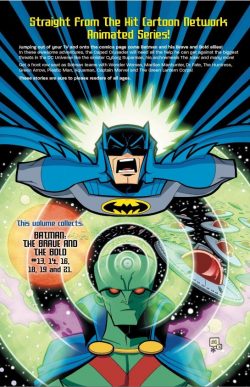
This stellar trade paperback and digital collection re-presents issues #13, 14, 16, 18, 19 and 21 in an immensely entertaining package suitable for newcomers, fans and aficionados of all ages originally released between March and November 2010. Best of all, although not necessary to the reader’s enjoyment, a passing familiarity with the TV episodes will enhance the overall experience…

Following the format of the TV show, each tale opens with a brief vignette adventure before telling a longer tale. Issue #13 sees the Caped Crimebuster break a leg while working with Angel O’Day and Sam Simeon (the astonishingly daft but wonderful Angel & The Ape) and laid up for main feature ‘Night of the Batmen’ (by Sholly Fisch, Robert Pope & Scott McRae) as an army of (uninvited and unwelcome) heroic comrades – including Green Arrow, Plastic Man, Aquaman and Shazam!-powered Captain Marvel among others – impersonate the Dark Knight to keep Gotham safe from fiends such as Bane, Killer Croc, Penguin, Deadshot and Catwoman. However, when the Joker joins the party, it results in the real deal ending his recuperation early…

Crafted by Landry Q. Walker & Eric Jones, the next yarn opens with Bats and Plastic Man tackling the Scarecrow before the Gotham Gangbuster meets the Huntress. She is having trouble with a costumed crazy with a nasty obsession and ends up briefly ‘Captured by Mr. Camera!’…

The same creative crew return for #16 as a battle with the Teen Titans against Nocturna hatches a sinister sub-plot in ‘Egg Hunt! or: The Evil of Egg Head!’ as the ovoid mastermind revives antediluvian elder god Y’ggphu Soggoth (offering a guilty treat for old fans of truly naff supervillains) and Batman needs the aid of Wonder Woman to scramble the scheme…

Batman: The Brave and the Bold #18 alters the format slightly with a brace of linked tales from Walker & Jones. ‘Life on Mars’ features Batman and Martian Manhunter J’onn J’onzz defeating the human extermination plans of super-psionic shapeshifting White Martian Ma’alefa’ak before a strangely off-kilter Dark Knight calls in mystic master Doctor Fate to diagnose and treat a case of possession in follow-up thriller ‘All in the Mind’…

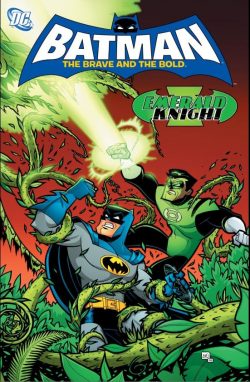
The last two yarns collected here both co-star Hal Jordan and other stalwarts of the Green Lantern Corps. From #19 and by Adam Schlagman, Carlo Barberi & Terry Beatty, ‘Emerald Knight’ details how the ring-slinger is captured by ultimate tech pirate Cyborg Superman and robotic Manhunters. Unable to prevail alone, Jordan temporarily bequeaths his power to Batman who lead his comrades in the Corps to victory, after which a brief interlude battling dinosaur gangsters beside the Lady Blackhawks leads to the Gotham Guardian and the fully-restored Jordan uniting to defeat ‘The Menace Known as Robert’. Another Walker & Jones production, this depicts the calamitous threat of a primordial alien horror invading Earth and the terrifying lengths Batman will go to save the world…

Despite being ostensibly aimed at TV-addicted kids, these mini-sagas are also wonderful, traditional comics thrillers no self-respecting fun-fan should miss: accessible, well-rendered yarns for the broadest range of excitement-seeking readers. This is a fabulously fun rollercoaster ride and confirms the now-seamless link between animated features and comicbooks. After all, it’s just adventure entertainment in the end; really unmissable entertainment…

What more do you need to know?
© 2010, 2011 DC Comics. All Rights Reserved.
Will Eisner’s Hawks of the Seas


By Will Eisner & various
ISBN: 1569714274 (Dark Horse)

ISBN: 0-87816-022-1 (HB) ISBN: 0-87816-023-X (TPB) (Kitchen Sink Press)

It is pretty much accepted today that Will Eisner was one of the prime creative forces that shaped the comicbook industry, but still many of his milestones escape public acclaim in the English-speaking world. This is one long overdue for fresh efforts and digital immortality.

From 1936 to 1938 Eisner worked as a jobbing cartoonist in the comics production firm known as the Eisner-Eiger Shop, creating strips to be published in both domestic US and foreign markets.

Using the pen-name Willis B. Rensie he wrote and drew the saga of the mysterious American adventurer known only as “The Hawk”, who sailed the 18th century Caribbean seas with his piratical band. An intellectual and dreamer, the freebooter had been taken as a slave, and now dedicated his life to destroying the slave trade and punishing injustice.

With a stalwart and scurvy crew of characters at his back, this charismatic blend of Robin Hood, Sir Francis Drake and the Count of Monte Cristo captivated readers all over the world in single-page instalments of swashbuckling thrills delivered via spectacular bravura art and narrative ingenuity: appearing in newspapers and weekly magazines as far apart as England, South America, France, and Australia.

After years as a lost classic, it was gathered into an awesome collected edition (measuring 376 x 270) by Dennis Kitchen, thanks mainly to happenstance and the good graces of another comics legend, Al Williamson. He had been a huge fan of the strip when it ran in Paquin – a weekly strip anthology magazine he’d read growing up in Bogota, Colombia.

Years later, now revered professional artist Williamson acquired an almost complete run of publisher’s proof sheets – in Spanish – which when translated and re-lettered would form the basis of this volume. Fellow well-wishers in France, England and Australia also contributed pages for an almost complete run.

Almost lost again, Hawks of the Seas was re-issued in 2003 by Dark Horse as part of their Will Eisner Library (although at a more modest and bookshelf-friendly size) and stands as a fascinating insight into this creator’s imaginative power, moral and philosophical fascinations and spellbinding ability to tell a great story with magical pictures. It’s also a thumping good tale of pirates and derring-do that will captivate kids of all ages, so let’s some savvy publisher makes the necessary moves soon.

Forget Jack Sparrow: get on the trail of The Hawk…
© 1986 Kitchen Sink Press. 2003 Will Eisner. All rights reserved.

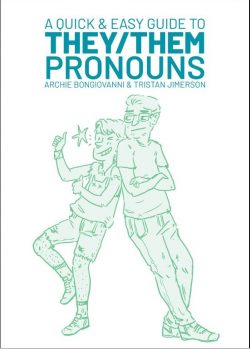
A Quick & Easy Guide to They/Them Pronouns


By Archie Bongiovanni & Tristan Jimerson (Limerance/Oni Press)
ISBN: 978-1-62010-499-6 (PB) eISBN: 978-1-62010-500-9

Comic strips have long been acknowledged as an incredibly powerful tool to educate, rendering tricky or complex issues easily accessible. They also have an overwhelming ability to affect and change behaviour and have been used for centuries by politicians, religions, the military and commercial concerns to modify how we live our lives.

Here’s a splendid example of the art form using its great powers for good…

Despite what the old adage might say, words are not only harmful, but also shape how people react to or regard… well, everything.

Semantic shading is prevalent in all aspects of human communication, and predisposes us to respond in certain manners; frequently in contradiction to all other data. I still have a scar on my finger from when I was nine and picked up a cute, cuddly, playfully welcoming kitten, clearly in a manner it found inappropriate and uncomfortable.

In the social contract we all live under, every person (and almost all of the animals and some complex machinery) should expect to be treated with courtesy and in terms they find comfortable and acceptable. I have used nine different pen-names in a long and undistinguished creative career and respond to them equally, as readily as my own name (no matter how badly mangled it might be by people I don’t expect to possess any facility or familiarity with the Eastern European pronunciation or syntax it stems from).

I don’t even care if people call me “madam” or late for dinner.

I’m somewhat less sanguine about rude or aggressive people using “oi, mate”, “baldy” or “hey you”. I have no patience at all for those who smugly tell me I’m saying my own name wrong…

At least I’m fortunate enough to fall into a broad category of cisgendered folk who unthinkingly share appropriately-gendered pronouns. That’s not a situation everybody enjoys, but is one that can and should be rectified. Misgendering (intentional or otherwise) is arrogant, lazy, impolite and selfish: It’s 2019 and we should all be accepted on our own terms by now.

All it takes is willingness and a little effort… and – if these concepts are new to you – this extremely engaging little paperback guide, crafted by two lifelong friends addressing the issue from the most different of positions.

Archie Bongiovanni is non-binary: identifying as a genderqueer artist who feels “Him” and “Her” are not pronouns that apply or are relevant. As part of a widely diverse and continually diversifying society, they (that was me doing the gender pronoun thing, there) feel those terms can – and should – be supplemented by other, neutral words: in this specific case “They” or “Them”.

Tristan Jimerson is a cisgendered man who works as a copywriter and runs a restaurant. As part of an inherited social majority he had no choice in originally defining, he is keen to adjust the way he refers to people so as be inclusive, polite and non-discriminatory.

The book they created together is inexpensive, informative, great fun and available in physical and digital editions (so you should get loads of copies and start giving them to everybody you know).

It also means the only terms you’re getting for free here are the aforementioned Non-Binary – meaning someone who does not identify as either male or female – and Cisgender – which translates as a person who agrees and accepts the gender they were assigned at birth. If you need clarification on terms like “gender” or “pronoun” that’s what books and search engines are for; and check back to what I just said about being lazy…

As well as simple, affable explanations, tips and hints, you’ll find here cartoon reference charts and lists clarifying what to say, to whom and when, with examples and suggestions for why you should rethink your viewpoint if you’re feeling reluctant, or recalcitrant. Readers will be gently introduced to concepts such as ‘YOLO’, ‘Why Pronouns Matter’ and ‘How to use They/Them pronouns in Everyday life: A Practical Guide!’ as well as profiting from sections ‘For Folks Identifying with Alternative Pronouns’ and much more…

A handy guide to simple courtesy and common human decency, this is a marvellous attempt to help us all get along a little more easily. Maybe we should find an equivalent publication dealing with climate change, commercial expediency and political short-termism…?
A Quick & Easy Guide to They/Them Pronouns ™ & © 2018 Archie Bongiovanni & Tristan Jimerson. All rights reserved.

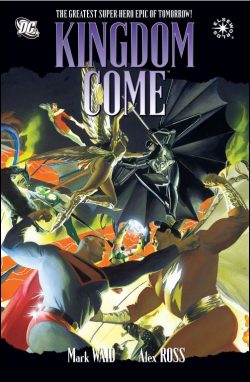
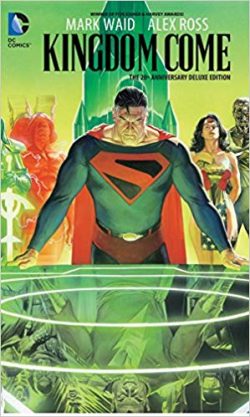
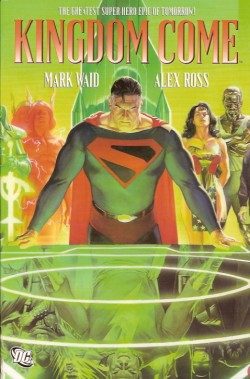
Kingdom Come


By Mark Waid & Alex Ross, with Todd Klein & various (DC Comics)
ISBN: 978-1-4012-6082-8 (20th Anniversary HB) 978-1-4012-2034-1 (TPB

In the mid-1960s a teenaged Jim Shooter wrote a couple of stories about the Legion of Super-Heroes set some years into the team’s own future. Those stories of the adult Legionnaires revealed hints of things to come that shackled the series’ plotting and continuity for decades as eager, obsessed fans (by which I mean all of us) waited for the predicted characters to be introduced, presaged relationships to be consummated and heroes to die.

By being so utterly impressive and similarly affecting, Kingdom Come accidentally repeated the trick decades later, subsequently painting the entire post Crisis on Infinite Earths DC Universe into the same creative corner until one of the company’s periodic continuity reboots…

Envisaged and designed by artist Alex Ross as DC’s answer to epic groundbreaking Marvels, Kingdom Come was originally released as a 4-issue Prestige Format miniseries in 1996 to rapturous acclaim and numerous awards and accolades. Although set in the future and an “imaginary story” released under DC’s Elseworlds imprint, it almost immediately began to affect the company’s mainstream continuity.

Set approximately twenty years into the future, the grandiose saga details a tragic failure and subsequent loss of Faith for Superman and how his attempt to redeem himself almost leads to an even greater and ultimate apocalypse.

The events are seen through the eyes and actions of Dantean witness Norman McCay, an aging cleric co-opted by Divine Agent of Wrath the Spectre after the pastor officiates at the last rites of dying superhero Wesley Dodds. As the Sandman, Dodds was cursed for decades with precognitive dreams which compelled him to act as an agent of justice.

Opening chapter ‘Strange Visitor’ reveals a world where metahumans have proliferated to ubiquitous proportions: a sub-culture of constant, violent clashes between the latest generation of costumed villains and vigilantes, all unheeding and uncaring of the collateral damage they daily inflict on the mere mortals around and in all ways beneath them.

The shaken preacher sees a final crisis coming, but feels helpless until the darkly angelic Spectre comes to him. Taken on a bewildering voyage of unfolding events, McCay is to act as the ghost’s human perspective whilst the Spirit of Vengeance prepares to pass final judgement on Humanity.

First stop is the secluded hideaway where farmer Kal-El has hidden himself since the ghastly events which compelled him to retire from the Good Fight and the eyes of the World. The Man of Steel was already feeling like a dinosaur when newer, harsher, morally ambiguous mystery-men began to appear. After the Joker murdered the entire Daily Planet staff and hard-line new hero Magog executed him in the street, the public applauded the deed. Heartbroken and appalled, Superman simply disappeared for a decade. His legendary colleagues also felt the march of unwelcome progress and similarly dropped from sight.

With Earth left to the mercies of dangerously irresponsible new vigilantes, civil unrest soon escalated. The younger heroes displayed poor judgement and no restraint, with the result that within a decade the entire planet had become a chaotic arena for metahuman duels.

Civilisation was fragmenting. Flash and Batman retreated to their home cities and made them secure, crime-free solitary fortresses. Green Lantern built an emerald castle in the sky, turning his eyes away from Earth and towards the deep black fastnesses of space. Hawkman retreated to the wilderness, Aquaman to his sub-sea kingdom whilst Wonder Woman retired to her hidden paradise. She did not leave until Armageddon came one step closer…

When Magog and his Justice Battalion battled the Parasite in St. Louis, the result was a nuclear accident which destroyed all of Kansas and much of Iowa, Missouri and Nebraska. Overnight the world faced starvation as America’s breadbasket turned into a toxic wasteland. Now with McCay and the Spectre invisibly observing, Princess Diana convinces the bereft Kal-El to return and save the world on his own terms…

In ‘Truth and Justice’ a resurgent Justice League led by Superman begins a campaign of unilateral action to clean up the mess civilisation has become: renditioning “heroes” and “villains” alike, imprisoning every dangerous element of super-humanity and telling governments how to behave, blithely unaware that they are hastening a global catastrophe of Biblical proportions as the Spectre invisibly gathers the facts for his apocalyptic judgement.

In the ensuing chaos, crippled warrior Bruce Wayne rejects Superman’s paternalistic, doctrinaire crusade and allies himself with mortal humanity’s libertarian elite – Ted (Blue Beetle) Kord, Dinah (Black Canary) Lance and Oliver (Green Arrow) Queen – to resist what can only be considered a grab for world domination by the meta-human minority. As the helpless McCay watches in horror, Wayne’s group makes its own plans; another dangerous thread in a tapestry of calamity…

At first Superman’s plans seem blessed to succeed, with many erstwhile threats flocking to his banner and his doctrinaire rules of discipline, but as ever there are self-serving villains with their own agendas. Lex Luthor organises a cabal of like-minded compatriots – Vandal Savage, Catwoman, Riddler, Kobra and Ibn Al Xu’ffasch (Son of the Demon Ra’s Al Ghul) – into a “Mankind Liberation Front”.

With Shazam-empowered Captain Marvel as their slave, this group are determined the super-freaks shall not win. Their cause is greatly advanced once Wayne’s clique joins them…

‘Up in the Sky’ sees events spiral into a deadly storm as McCay, still wracked by his visions of Armageddon, is shown the Gulag where all recalcitrant metahumans have been dumped. He also witnesses how it will fail, learns from restless spirit Deadman that the Spectre is the literal Angel of Death and watches with growing helplessness as Luthor’s plan to usurp control from the army of Superman leads to a shocking confrontation, betrayal and a deadly countdown to the End of Days…

The deadly drama culminates in a staggering battle of superpowers, last moment salvation and a second chance for humanity in a calamitous world-shaking ‘Never-Ending Battle’…

Thanks to McCay’s simple humanity, the world gets another chance and this edition follows up with an epilogue ‘One Year Later’ which end this ponderous epic on a note of renewed hope…

This edition – available as a 20th Anniversary deluxe hardback, a standard trade paperback and in digital formats – comes with an introduction by author and former DC scribe Elliot S. Maggin, assorted cover reproductions and art-pieces, an illustrated checklist of the vast cast list plus a plethora of creative notes and sketches in the ‘Apocrypha’ section, and even hints at lost glories in ‘Evolution’: notes, photos and drawings for a restored scene that never made it into the miniseries.

Epic, engaging and operatically spectacular, Kingdom Come is a milestone of the DC Universe and remains to this day a solid slice of superior superhero entertainment, worthy of your undivided attention.
© 1996, 2008, 2016 DC Comics. All Rights Reserved.
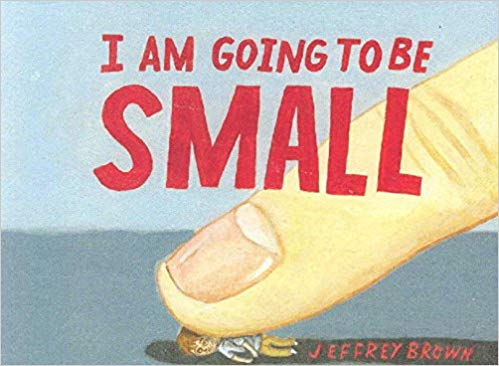
I Am Going to Be Small


By Jeffrey Brown (Top Shelf Productions)
ISBN: 978-1-891830-86-0 (PB)

If you’re a fan of Jeffrey Brown’s cartoon exploits you might understandably admit to a small degree of confusion. In 2012 he scored his first global best-seller with a hilarious spin on the nurturing side of the Jedi experience in Darth Vader and Son, following up with equally charming and hilarious sequels such as Vader’s Little Princess, Star Wars: Jedi Academy and others. He added contributions to the expanded Star Wars franchise’s dramatic comics canon and has directed music videos, created film posters, worked for public radio and co-written the feature film Save the Date.

Before that another Jeffrey Brown was the sharply sparkling wit who had crafted slyly satirical all-ages funny stuff for The Simpson’s Treehouse of Horror, Marvel’s Strange Tales, Incredible Change-Bots and similar visual venues. His current big thing is the Lucy & Andy Neanderthal series of books.

There is yet another Jeffrey Brown: instigator and frequent star and stooge of such quirkily irresistible autobiographical Indy comics classics as Bighead, Little Things, Funny, Misshapen Body, Undeleted Scenes and the 4-volume “Girlfriend Trilogy” comprising Clumsy, Unlikely, AEIOU and Every Girl is the End of the World for Me…

Whichever Brown’s your preferred choice, he’s a cartoonist of rare insight and unflinching integrity who still makes you laugh out loud when not prompting you to offer a big consoling hug. That’s what this landscape landmark (available in paperback and eBook editions) is about – “a collection of gag and humour cartoons 1997-2006”…

Brown was raised in Michigan; relocating to Chicago in 2000 to attend the School of the Arts Institute and study painting. Before graduating he had switched to drawing comics and in 2002 Clumsy was released. A poignant and uncompromising dissection of a long-distance relationship, it quickly became a surprise hit with fans and critics alike. A little later – and in the same vein – he produced Unlikely (or How I Lost My Virginity) a True Love Story: “250+ pages of young love, sex, drugs, heartbreak & comedy” involving the long and agonisingly extended process of “becoming a Man”….

Here, those evergreen themes are constantly revisited and expanded upon: a succession of painful torments, frustrations and moments of unparalleled joy, but rubbing pimply shoulders with straight-up whimsy, surreal and gross-out gags, observational comedy and anything the swiftly-developing cartoonist deemed worthy of his brief attention. The result is painfully funny…

Here you will find uplifting homilies gone awry, college days captured in all their bleakness, sports – and sportsmen – dissected, movies reviewed and trashed, faux ads and products, the magic of boxes, religion, excess and guilt, god and Jesus, animal crackers, food, dining, unicorns, atrocious puns, the wonder of toys, war and the military, ex-girlfriends, babies, torture and mutilation and lots of observations on the dating arena.

There, at the rear end of the book, is a selection of anthropomorphic yet sophisticated mishaps featuring of a bunch of animals – Bunny, Bear, Bird and Cat – enduring the torment of interspecies attraction (and repulsion), all gathered together under the umbrella title ‘Cuticle’…

The material is both delicious and agonising in its forthright simplicity: brimming with shameful glee and subversive wit, this a fabulous voyage of graphic and comedic self-indulgence for everybody who has passed the raging hormones stage of existence and is happy to enjoy the plight of others still suffering…

It is to laugh…
© 2006 Jeffrey Brown.

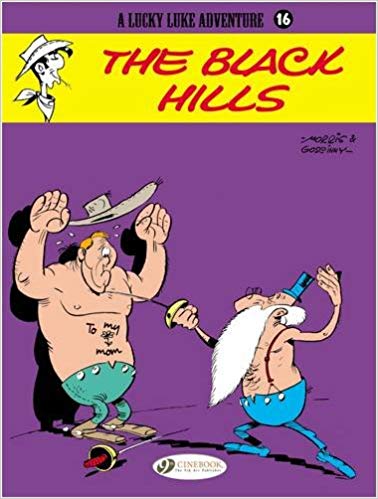
Lucky Luke volume 16 – The Black Hills


By Morris & Goscinny, translated by Luke Spear (Cinebook)
ISBN: 978-1-905460-83-0 (PB Album)

Doughty but dependable cowboy champion Lucky Luke is a rangy, good-natured do-gooder able to “draw faster than his own shadow”. He amiably roams the fabulously mythic Old West, enjoying light-hearted adventures on his rather sarcastic know-it-all wonder-horse Jolly Jumper. The taciturn nomad constantly interacts with a host of historical and legendary figures as well as even odder folk…

His unceasing exploits over 7 decades years have made him one of the best-selling comic characters in Europe – if not the world – generating upwards of 85 individual albums and sales totalling in excess of 300 million in 30 languages… so far…

That renown has led to a mountain of spin-off toys, computer games, animated cartoons, a plethora of TV shows and live-action movies and even commemorative exhibitions. No theme park yet but who knows when…?

The brainchild of Belgian animator, illustrator and cartoonist Maurice de Bévère (“Morris”) and first seen in Le Journal de Spirou‘s seasonal Annual L’Almanach Spirou 1947, Luke sprang to laconic life in 1946, before ambling into his first weekly adventure ‘Arizona 1880’ on December 7th 1946.

Working solo until 1955, Morris produced nine albums of affectionate sagebrush spoofery before teaming with old pal and fellow trans-American tourist Rene Goscinny, who became regular wordsmith as Luke attained dizzying, legendary, heights starting with Des rails sur la Prairie (Rails on the Prairie). This began serialisation in Spirou on August 25th 1955.

In 1967, the six-gun straight-shooter switched sides, joining Goscinny’s own magazine Pilote with ‘La Diligence’ (The Stagecoach). Goscinny co-created 45 albums with Morris before his untimely death, from whence Morris soldiered on both singly and with fresh collaborators.

Morris died in 2001, having drawn fully 70 adventures, plus numerous spin-off sagas crafted with Achdé, Laurent Gerra, Benacquista & Pennac, Xavier Fauche, Jean Léturgie, Jacques Pessis and others, all taking their own shot at the venerable vigilante…

Lucky Luke has previous in this country too, having first pseudonymously amused and enthralled British readers during the late 1950s, syndicated to weekly anthology Film Fun. He later rode back into comics-town in 1967 for comedy weekly Giggle, where he used the nom de plume Buck Bingo.

In each of these venues – as well as many attempts to follow the English-language album successes of Tintin and Asterix – Luke laconically puffed on a trademark roll-up cigarette which hung insouciantly and almost permanently from his lip. However, in 1983 Morris – amidst pained howls and muted mutterings of “political correctness gone mad” – deftly substituted a piece of straw for the much-travelled dog-end, thereby garnering for himself an official tip of the hat from the World Health Organization. For historical veracity, that tatty dog-end has been assiduously restored for this particular tale and indeed all of Cinebook’s fare – at least on the interior pages…

The Kent-based publisher is the most successful in bringing Lucky Luke to our shores and shelves, and it’s clearly no big deal for today’s readership as we’re at 73 translated books and still going strong.

Les collines noires was Morris & Goscinny’s 12th collaboration, originally serialised in 1963 (and the 21st album release in 1971): a tale of epic exploration and devious skulduggery that begins in Washington DC as a senate proposal to invite settlers into the untrammelled wilderness of the Cheyenne-infested Wyoming territory is provisionally passed despite the ardent proselytizing of passionate Senator Orwell Stormwind.

The measure is, however, made contingent upon a full scientific expedition and feasibility study of the region. All they need is a skilled guide to lead and defend the assessing team of cityfied scientists… someone tough, brave and extremely capable…

As Lucky Luke prepares for the expedition – consisting of utterly unprepared, naive and aging Professors Simeon Gurgle (Biology), Ira Doublelap (Geology), Darryl Bundlofjoy (Geometry) and Gustav Frankenbaum (Anthropology) – he is unaware that certain wealthy parties are taking steps to ensure that the expedition comes to a nasty end…

The trek west begins – and almost immediately concludes – with a lengthy and eventful rail journey with shady gunman Bull Bullets commencing a cunning campaign of sabotage. He has not reckoned on the perspicacity of Luke…

When framing the boffins for heinous crimes fails, the owlhoot steals the train, but even wrecking the “Iron Horse” proves insufficient to halt the convoy as the researchers take stagecoaches, other wheeled overland vehicles and even dabble painfully with horseback in their determined progression to the fabled and deadly Black Hills…

By the time they reach the Great Plains of the Midwest, Bull is running out of ploys and simply subcontracts to local killer the Nebraska Kid, but the plan to kill the ancient sages in highly-suspect duels comes a cropper at the first hurdle when old Frankenbaum reveals some unsuspected but still handy skills gained during his student days in Vienna…

Against all odds, the bumbling boffins make it to the edge of civilisation and open their appraisal of the terra incognita of Wyoming, forcing Bull Bullets to take direct action. His schemes to incite the Cheyenne to bloody slaughter don’t go the way he intended, though. The quartet of wise men – with the covert aid of Lucky – soon have the Indians on side and providing a full explanation of who and why their expedition has been targeted by villains unknown…

This is another perfect all-ages confection by unparalleled comics masters, affording an enticing glimpse into a unique genre for today’s readers who might well have missed the romantic allure of an all-pervasive Wild West that never was…
© Dargaud Editeur Paris 1971 by Goscinny & Morris. © Lucky Comics. English translation © 2009 Cinebook Ltd.

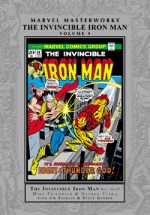
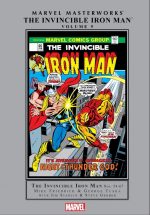
Iron Man Marvel Masterworks volume 9


By Mike Friedrich, Jim Starlin, Steve Gerber, Bill Everett, George Tuska, P. Craig Russell, & various (Marvel)
ISBN: 978-0-7851-9190-2 (HB)

Arch-technocrat and supreme survivor Tony Stark has changed his profile many times since his debut in Tales of Suspense #39 (March 1963) when, whilst a VIP visitor in Vietnam observing the efficacy of the munitions he had designed, the inventor was critically wounded and captured by sinister, savage Communists.

Put to work building weapons with the dubious promise of medical assistance on completion, Stark instead created the first Iron Man suit to keep himself alive and deliver him from his oppressors. From there it was a simple jump to full time superheroics as a modern Knight in Shining Armour…

First conceived in the wake of the Cuban Missile Crisis at a time when Western economies were booming and “Commie-bashing” was an American national obsession, the emergence of a new and shining young Thomas Edison, using Yankee ingenuity, wealth and invention to safeguard the Land of the Free and better the World, seemed an obvious development. Combining the then-sacrosanct faith that technology and business in unison could solve any problem, with the universal imagery of noble knights battling evil, Stark – the Invincible Iron Man – seemed an infallibly successful proposition.

Of course, whilst he was the acceptable face of 1960s Capitalism – a glamorous millionaire industrialist/scientist and a benevolent all-conquering hero when clad in the super-scientific armour of his alter-ego – the turbulent tone of the 1970s soon relegated his suave, “can-do” image to the dustbin of history.

With ecological disaster and social catastrophe from the myriad abuses of big business the new zeitgeists of the young, the Golden Avenger and Stark International were soon confronting a few tricky questions from the increasingly politically savvy readership.

With glamour, money and fancy gadgetry not quite so cool anymore the questing voices of a new generation of writers began posing uncomfortable questions in the pages of a series that was once the bastion of militarised America …

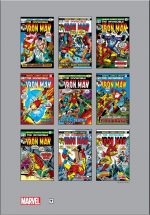
This grand and gleaming chronological compendium – available in hardback and digital editions – navigates that transitional period; reprinting Iron Man #54-67 (January 1973 to April 1974) and offering tone and context for the times comes courtesy of main writer Mike Friedrich’s Introduction.

Issue #54 found Stark in California and drawn into what became one of Marvel’s most successful crossover epics. ‘Sub-Mariner: Target for Death!’ debuted pitiless alien researcher Madame MacEvil – later re-branded during the Thanos Saga as Moondragon after this opening salvo – a bald, sexy siren who manipulated Iron Man into attacking the Prince of Atlantis in a spectacular bout with the bonus of additional art from the legendary Bill Everett supplementing the efforts of Friedrich, George Tuska & Vince Colletta…

The Thanos story moved into full gear in Iron Man #55, as Friedrich scripted illustrator Jim Starlin’s opening gambit ‘Beware The… Blood Brothers!’ introducing haunted humanoid powerhouse Drax the Destroyer, trapped by extraterrestrial invader Thanos under the Nevada desert and in dire need of rescue…

(This was all merely a prelude to the full saga which appeared in Captain Marvel #25-33, Marvel Feature #12 and Avengers #125, and has been collected in such compilations as The Life of Captain Marvel and others.)

Iron Man #56 was a literally magical palate-cleanser, as Steve Gerber joined Starlin & Mike Esposito to tell the satirically hilariously tragedy of ‘Rasputin’s Revenge’, wherein a street corner doom-prophet accidentally gains the power to fulfil his prognostications but still falls sadly short of engineering the apocalypse…

It was back to business as usual with Gerber, Tuska, Esposito & Frank Giacoia in #57 as a devastating ‘Strike!’ hits troubled Stark Industries, engineered by an insidious old enemy who inevitably overplays his be-ringed hand in concluding episode ‘Mandarin and the Unicorn: Double-Death!’ (with Friedrich returning to script Gerber’s plot) after which ‘A Madness in Motown!’ sees Stark battling the revenge-maddened anti-capitalist Firebrand whilst unknowingly falling for the torrid terrorist’s sister Roxie Gilbert.

Another 2-part clash follows – this time against a deadly technology-thief – which began with ‘Cry Marauder!’ after a masked malcontent steals Stark’s experimental space shuttle, culminating in ‘Death Knells over Detroit!’ as the purloined prototype is unerringly aimed like a monstrous missile into the heart of Motor City, leaving a crippled Iron Man only seconds to save the day…

Don’t fret folks; it all turned out alright in the end…

With Mike Friedrich scripting, the action stays in Detroit where Stark is inspecting one of his factories until former Maggia assassin ‘Whiplash Returns!’ (illustrated by P. Craig Russell, Esposito, Giacoia & John Romita Sr.). The crazed killer is raging for revenge and especially ticked off that his girlfriend has been made his boss…

An extended epic began in #63 with ‘Enter: Dr. Spectrum’, illustrated by Tuska & Esposito. Here, as Stark relentlessly – and fruitlessly – romantically pursues pacifist dissident Roxie Gilbert in Detroit, obnoxious Ugandan financier and diplomat Dr. Kinji Obatu visits the Long Island plant and is attacked by a gang of masked thugs.

The assault is repelled thanks to the timely assistance of stand-in Iron Man Eddie March, who is promptly offered a bodyguard job by the creepy ambassador and invited to accompany him to a meeting with Stark in “Motor City”.

On arrival, photonic fiend Dr. Spectrum ambushes the inventor, before being driven off by the Armoured Avenger after a titanic and costly struggle. A far more serious problem emerges later when old friend Happy Hogan accuses Tony of having an affair with his wife Pepper…

Spectrum strikes again in the next issue, with a similar lack of success, before Happy blows his top and takes a swing at Stark, but that confrontation is curtailed when a gigantic monster kidnaps the just-arrived Obatu in ‘Rokk Cometh!’ When the beast targets Roxie, the exhausted Iron Man intervenes but is too drained to resist the relentless Spectrum…

Issue #65 exposes ‘The Cutting Edge of Death!’ when the Golden Avenger learns the true parasitical nature of Spectrum’s Power Prism as it transfers itself from the wilfully disobedient villain Obatu to the worn-out hero.

Its glee is short lived though, as the possessed Iron Man is challenged by recently arrived comrade Thor, resulting in a blockbusting ‘Battle Royal!’ which only ends after the Thunderer crushes the crystal conqueror to discovered the dying man inside the armour is neither Stark nor Obatu…

As a consequence of that climactic clash of myth and mechanism, IM #67 sees the impostor Iron Man temporarily mutated by Stark’s medical miracle machine the Cobalt Enervator into a rampaging monster in ‘Return of the Freak!’ but no sooner do the genuine Armoured Avenger and surgeon Don Blake (who we all know was Thor back then) stop and save the berserk victim than Stark is drawn into another conflict in South East Asia…

To Be Continued…

With this volume (which also offers a stunning original art gallery of pages and covers by Tuska, Everett, Starlin, Romita and Gil Kane), Marvel completely entrenched itself in the camp of the young and the restless who experienced at first hand and every day the social upheaval America was undergoing.

Their rebellious teen sensibility and increased political conscience permeated the company’s publications as their core audience moved beyond Flower Power protests towards a generation of acutely aware activists. Future tales would increasingly bring reformed capitalist Stark into many unexpected and outrageous situations…

But that’s the meat of another review, as this engrossing graphic novel is done. From our distant vantage point the polemical energy and impact might be dissipated, but the sheer quality of the comics and the cool thrill of the eternal aspiration of man in perfect partnership with magic metal remains.

These Fights ‘n’ Tights classics are amongst the most underrated but impressive tales of the period and are well worth your time, consideration and cold hard cash…
© 1973, 1974, 2017 Marvel Characters, Inc. All rights reserved.

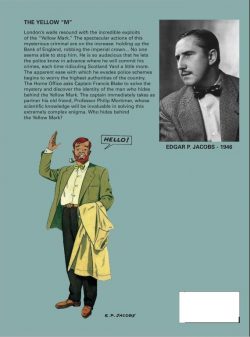
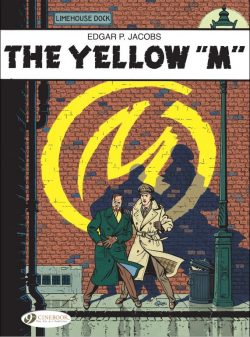
The Adventures of Blake and Mortimer: The Yellow “M”


By Edgar P. Jacobs, translated by Clarence E. Holland (Cinebook)
ISBN: 978-1-905460-21-2

Master storyteller Edgar P. Jacobs pitted his distinguished duo of Scientific Adventurers Captain Francis Blake and Professor Philip Mortimer against a wide variety of perils and menaces in stunning action thrillers which merged science fiction, detective mysteries and supernatural thrillers in the same timeless and universally engaging Ligne Claire style which had done so much to make intrepid boy reporter Tintin a global sensation.

The strip debuted in Le Journal de Tintin #1 (26th September 1946): an anthology comic with editions in Belgium, France and Holland. The new anthology was edited by Hergé, with his eponymous star ably supplemented by a host of new heroes and features…

Le Marque Jaune was the third astounding exploit of the peerless pair, originally serialised from August 6th 1953 to November 3rd 1954, before being collected as the sixth drama-drenched album in 1956.

This moody stand-alone extravaganza was the first in the modern Cinebook sequence with the True Brits for once on home soil as they struggle to solve an eerie mystery and capture an apparently superhuman criminal…

The tale begins a few days before Christmas on a night raining cats and dogs. The guards at the Tower of London are dutifully going about their appointed tasks when a sudden power cut douses all the lights.

By the time Beefeaters and Yeomen can find alternative lighting the damage is done. The Jewel Room is ransacked, the Imperial Crown missing and the wall is defaced: emblazoned with a large letter M in a bold circle of yellow chalk.

The shocking travesty is but the latest in an outrageous series of incredible crimes by a mysterious malefactor the newspapers have taken to calling The Yellow M…

Incensed and humiliated by the latest outrage, the Home Office assigns MI6 to the case and their top man Blake is seconded to assist Chief Inspector Glenn Kendall of Scotland Yard. So serious is the matter that Blake instantly cables his old comrade Professor Mortimer, dragging the bellicose boffin back from a well-deserved vacation in Scotland.

London is ablaze with rumour and speculation about the super-bandit. The crafty old warhorses adjourn to the Centaur Club in Piccadilly to discuss events, but as they settle in for a chinwag, Mortimer gets a fleeting impression that they are being spied upon…

Suddenly they are interrupted by four fellow members also hotly debating the case. Sir Hugh Calvin is a judge at the Central Criminal Court; Leslie Macomber edits the Daily Mail and Professor Robert Vernay is a prominent figure in the British Medical Association. They are all hotly disputing Dr Jonathan Septimus – of the Psychiatric Institute – who propounds a theory that the phantom felon is a prime example of his pet theory of “The Evil Influence of Cellular Development”…

The enlarged group continues the verbal back-and-forth into the small hours, and when they finally break up Vernay follows his habit of walking home. He does not make it. The police find only his hat and a chalked letter in a circle…

The flamboyant rogue seems to be everywhere. When Blake and Mortimer interview Macomber, Calvin and the terrified Septimus next day, the invisible enigma somehow gets close enough to leave his mark on the MI6 officer’s coat, before sending a mocking cable warning the Mail’s Editor that more and worse is coming…

That night Macomber is abducted from his office in plain view of his staff and Kendall is found in a dazed state after failing to protect Judge Calvin from a mystery intruder…

Septimus concludes that he is next and convinces Blake to get him out of London. The pair board a train for Suffolk with a complement of detectives, but even these precautions are not enough. The psychiatrist is impossibly plucked from the Express before it is wrecked in a horrific collision with another train.

In London, cerebral Mortimer has been researching another angle with the assistance of Daily Mail archivist Mr. Stone. The veteran investigator has found a decades-old link between the missing men…

It all revolves around a controversial medical text entitled “The Mega Wave” and a scandalous court case, but when the Professor tries to secure a copy of the incredibly rare volume from the British Museum Library, he is confounded by the Yellow M who invisibly purloins the last known copy in existence…

That evening Mortimer shares his thoughts with the returned Blake, unaware that his house has been bugged. Hours later, a mysterious cloaked intruder breaks in but has a fit after passing some of Mortimer’s Egyptian souvenirs. The noise arouses the household and the masked burglar is confronted by Blake, Mortimer and burly manservant Nasir. Incredibly, the villain defeats them all with incredible strength and electrical shocks, even shrugging off bullets when they shoot him…

Exploding through a second story window, the M laughs maniacally as they continue futilely firing before running off into the London night. In their shock the adventurers return to the drawing room and trip over the intruder’s listening devices…

Later, the recovered Kendall visits just as a package arrives. It contains an anonymous note from someone wishing to share information and directs Blake to a late-night rendezvous at Limehouse Dock. The message also contains a desperate note from the missing Septimus begging Blake to comply…

Well aware that it’s a trap and over Mortimer’s strenuous protests, Blake and Kendall lay plans to turn the meeting to their advantage. Left at home, the Professor is surprised by a late visit from Stone. The remarkably efficient researcher has found a copy of The Mega Wave and rushed over to show Mortimer.

As Blake manfully braves the foggy waterfront and walks into deadly danger, Mortimer is reading the tome, deducing who is behind the plot and perhaps even how the malign miracles are pulled off…

In Limehouse, the empty commercial buildings become a spectacular battleground as Blake and the police confront the masked man. The villain easily holds them all at bay with incredible feats of speed and strength, before breaking out of the supposedly impenetrable blue cordon and escaping.

However, in his destructive flight he tumbles into the frantic Mortimer who is dashing to warn his old friend. Changing tack, the boffin gives chase, doggedly following the superhuman enigma through parks and sewers. Eventually the pursuit leads underground and he finds himself in a hidden basement laboratory being assaulted by mind-control devices devised by the sinister mastermind actually behind the entire campaign of vengeance and terror…

As the smirking villain gives an exultant speech of explanation, triumph and justification, Mortimer sees the fate of the abducted men and meets the human guinea pig who has been terrorising London at the behest of a madman. It is the very last person he ever expected to see again, but even as he reels in shock, Blake and Kendall are on his trail, thanks to the efforts of an avaricious cabbie with a good memory for faces…

As Christmas Day dawns, Blake and Kendall lead a raid on the hidden citadel to rescue Mortimer, but the wily savant has already taken dramatic steps to secure his own release and defeat his insane, implacable opponent…

Fast-paced, action-packed, wry and magnificently eerie, this fabulously retro weird science thriller is an intoxicating moody mystery and a sheer delight for lovers of fantastic fiction. Blake & Mortimer are the graphic personification of the Bulldog Spirit and worthy successors to the likes of Sherlock Holmes, Allan Quatermain, Professor Challenger, Richard Hannay and all the other valiant stalwarts of lost Albion: All valiant champions with direct connections to and allegiance beyond shallow national boundaries…

In 1986 this story was reformatted and repackaged in a super-sized English translation, the last of six volumes with additional material (mostly covers from the weekly Tintin added to the story as eye-catching splash pages): part of a European push to win some of the lucrative Tintin and Asterix market here. They failed to find an audience and there were no more translations until January 2007 when Cinebook released this tome to far greater approval and much success. We’re now at 25 translated volumes and counting…

Gripping and fantastic in the truest tradition of pulp sci-fi and Boy’s Own Adventures, Blake and Mortimer are the very epitome of dogged heroic determination; always delivering grand, old-fashioned Blood-&-Thunder thrills and spills in timeless fashion and with astonishing visual punch. Any kid able to suspend modern mores and cultural disbelief (call it alternate earth history or bakelite-punk if you want) will experience the adventure of their lives… and so will their children.

This Cinebook edition – available in paperback album and digital formats – also includes a selection of colour cover sketches and roughs, plus a biographical feature and chronological publication chart of Jacobs’ and his successors’ efforts.
Original editions © Editions Blake & Mortimer/Studio Jacobs (Dargaud-Lombard s.a.) 1987 by E.P. Jacobs. All rights reserved. English translation © 2007 Cinebook Ltd.