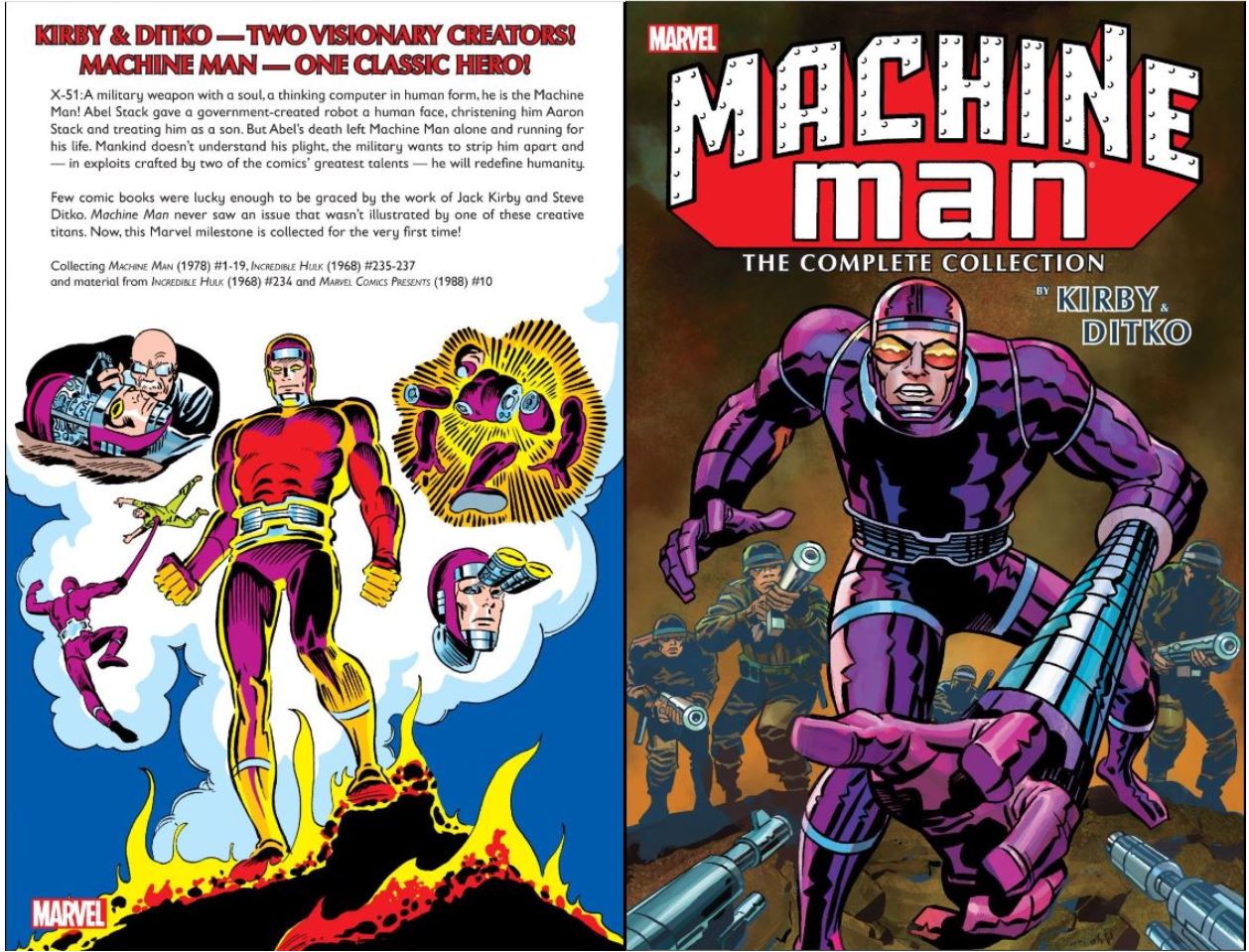
By Jack Kirby, Steve Ditko, with Marv Wolfman, Tom DeFalco, Roger Stern, Mike Rockwitz, Sal Buscema, Dave Cockrum & various (Marvel)
ISBN: 978-0-7851-9577-1 (TPB), 978-1-3024-8926-7 (Digital edition)
This book includes Discriminatory Content produced in less enlightened times.
Win’s Christmas Gift Recommendation: Bright, Shiny, Timeless and Evergreen …8/10
Jack Kirby was – and nearly 30 years after his death remains – the most important single influence in the history of American comics. There are innumerable accounts of and testaments to what the man has done and meant, and you should read those if you are at all interested in our medium. Kirby was a man of vast imagination who translated big concepts into astoundingly accessible and enduring symbols for generations of fantasy fans. If you were exposed to Kirby as an impressionable child you were his for life. To be honest, the same probably applies whatever age you jump aboard the “Kirby Express”.
For those of us who grew up with Jack, his are the images which furnish and clutter our interior mindsets. Close your eyes and think “robot” and the first thing that pops up is a Kirby creation. Every fantastic, futuristic city in our heads is crammed with his chunky, towering spires. Because of Jack we all know what the bodies beneath those stony-head statues on Easter Island look like, we are all viscerally aware that you can never trust great big aliens parading around in their underpants and, most importantly, we know how cavemen dressed and carnosaurs clashed…
In the late 1930s, it took a remarkably short time for Kirby and creative collaborator Joe Simon to become the wonderkid dream-team of the new-born comic book industry. Together they produced a year’s worth of the influential monthly Blue Bolt, dashed off Captain Marvel Adventures (#1) for overstretched Fawcett and, after Martin Goodman appointed Simon editor at Timely Comics, co-created a host of iconic characters such as Red Raven, the original Marvel Boy, Mercury, Hurricane, The Vision, Young Allies and of course million-selling mega-hit Captain America. When Goodman failed to make good on his financial obligations, Simon & Kirby were snapped up by National/DC, who welcomed them with open arms and a fat chequebook. Bursting with ideas the staid industry leaders were never really comfortable with, the pair were initially an uneasy fit, and given two moribund strips to play with until they found their creative feet: Sandman and Manhunter.
They turned both around virtually overnight and, once established and left to their own devices, switched to the “Kid Gang” genre they had pioneered at Timely. Joe & Jack created wartime sales sensation Boy Commandos (and Homefront iteration The Newsboy Legion) before being called up to serve in the war they’d been fighting on comic pages since 1940.
Once demobbed, they returned to a very different funnybook business, and soon after left National to create their own little empire…
Simon & Kirby heralded and ushered in the first age of mature American comics – not just by inventing the Romance genre, but with all manner of challenging modern material about real people in extraordinary situations – before seeing it all disappear again in less than eight years. After years of working for others, S&K had established their own publishing house, producing comics for a far more sophisticated audience, only to find themselves in a sales downturn and awash in public hysteria generated by an anti-comicbook pogrom. Their small stable of magazines – generated for the association of companies known as Prize, Crestwood, Pines, Essenkay and/or Mainline Comics – blossomed and as quickly wilted when the industry abruptly contracted throughout the 1950s.
Hysterical censorship-fever spearheaded by US Senator Estes Kefauver and opportunistic pop psychologist Dr. Frederic Wertham led to witch-hunting Senate hearings. Caving in, most publishers adopted a castrating straitjacket of draconian self-regulatory rules. Horror titles became milder Fantasy sagas produced under the Comics Code Authority: sanitised, anodyne affairs in terms of Shock & Gore. Though other mass-entertainment markets continued to slake a public appetite for suspense and the uncanny, comics moderated themselves out of the running. Crime comics also vanished and mature themes challenging an increasingly stratified and oppressive society were suppressed. Thus, Simon quit the business for advertising.
However, Jack soldiered on, taking his skills and ideas to many safer, more timid and conventional – and less experimental – companies. As the panic abated, Kirby returned briefly to DC where he worked on mystery tales and Green Arrow (at that time a mere back-up page-filler in Adventure Comics and World’s Finest Comics) whilst concentrating on his passion project: newspaper strip Sky Masters of the Space Force. During that interlude Kirby re-packaged an original superteam concept that had been kicking around in his head since he and Joe Simon had closed their innovative, ill-timed ventures. At the end of 1956, Showcase #6 premiered the Challengers of the Unknown.
After three more test issues they won their own title with Kirby in command for the first eight. Then a legal dispute with Editor Jack Schiff exploded and the King was gone. He found fresh fields and an equally hungry new partner in Stan Lee at ailing Atlas Comics (which had once been mighty Timely) and there created a revolution in superhero comics storytelling…
After a decade of never-ending innovation and crowd-pleasing wonderment, Kirby felt increasingly stifled. His efforts had transformed the dying outfit into industry-pioneer Marvel Comics. but now he felt trapped and in a rut. Thus, he moved back to DC for another burst of sheer imagination and pure invention.
Kirby always understood the fundamentals of pleasing his audience and strived diligently to combat the appalling state of prejudice about the comics medium; especially from industry insiders and professionals who despised the “kiddies world” they felt trapped in.
After his controversial, grandiose Fourth World titles were cancelled, Kirby looked for other projects that would stimulate his own vast creativity yet still appeal to a market growing ever more fickle. These included science fictional heroes Kamandi and OMAC, supernatural star The Demon, war stories starring WWII squad The Losers, and even a new Sandman (co-created with old Joe Simon). Sadly, although the ideas kept coming (Atlas, Kobra, Dingbats of Danger Street), again editorial disputes increased. Reluctantly, Jack left again, choosing to believe in promises of more creative freedom elsewhere…
His return to Marvel in 1976 was much hyped and eagerly anticipated at the time, but again proved controversial. New works such as The Eternals and Devil Dinosaur found friends rapidly, but his return to earlier creations Captain America and Black Panther divided the fanbase. Kirby was never slavishly wedded to tight continuity, and preferred, in many ways, to treat his stints on titles as a “Day One”: a policy always at odds with the close-continuity demanded by a strident, growing faction of the readership.
Kirby was fascinated by the evolution of humanity and how it was ultimately defined. Gods, devils, ascension, devolution and especially artificial intelligence were themes he regularly revisited. As early as 1957, in his second Challengers of the Unknown yarn, tragic Ultivac was a misunderstood mechanoid built by war criminals who spontaneously achieved sentience, sapience and a profound sense of self-preservation. This concept of machine soul re-emerged constantly in characters as diverse as King Kra, Recorder 211, Torgo, Mother Box and many others, but found its greatest expression in a strip spun off from licensed property 2001: A Space Odyssey.
Although not included here (or ANYWHERE at the moment!), Machine Man actually debuted in July to September 1977 in #8-10 of that series – so Marvel are being a tad generous with the term “complete” in this epic trade paperback/digital compilation. X-51/Aaron Stack/Mister Machine was a government-built war droid who achieves passionate, unique self-actualisation after an encounter with the enigmatic alien Monolith of Kubrick and Clarke’s movie classic. When the publishing license expired, Jack’s metal miracle catapulted into his own eccentric series and a little slice of history was made…
Spanning cover-dates April 1978 to January 1989) this volume collects the 19-issue run of Machine Man and also includes material from Incredible Hulk #234-237 and Marvel Comics Presents #10: offering a rare chance to see how a single character can fare under the widely differing and unique artistic visions of the visual founders of the Marvel Universe.
As crafted by Kirby & Mike Royer who brush over the embargoed origins, a fully sentient but unschooled and inexperienced ‘Machine Man’ on the run from the US Army exploded into the Marvel Universe in his first issue. As X-51, he had been condemned to eradication when his 50 predecessor/prototypes malfunctioned, attacking the soldiers they were designed to replace…
Aaron was different, however. He had been reared as human in the household of psychologist Dr. Abel Stack. When the official order came to scrap all X-models, Stack gave his life to remove his “son’s” self-destruct trigger, sending the socially-unschooled innocent out to find his place in the world. On his trail was veteran warrior Colonel Kragg, maimed sole survivor of a brutal X-robot rebellion…
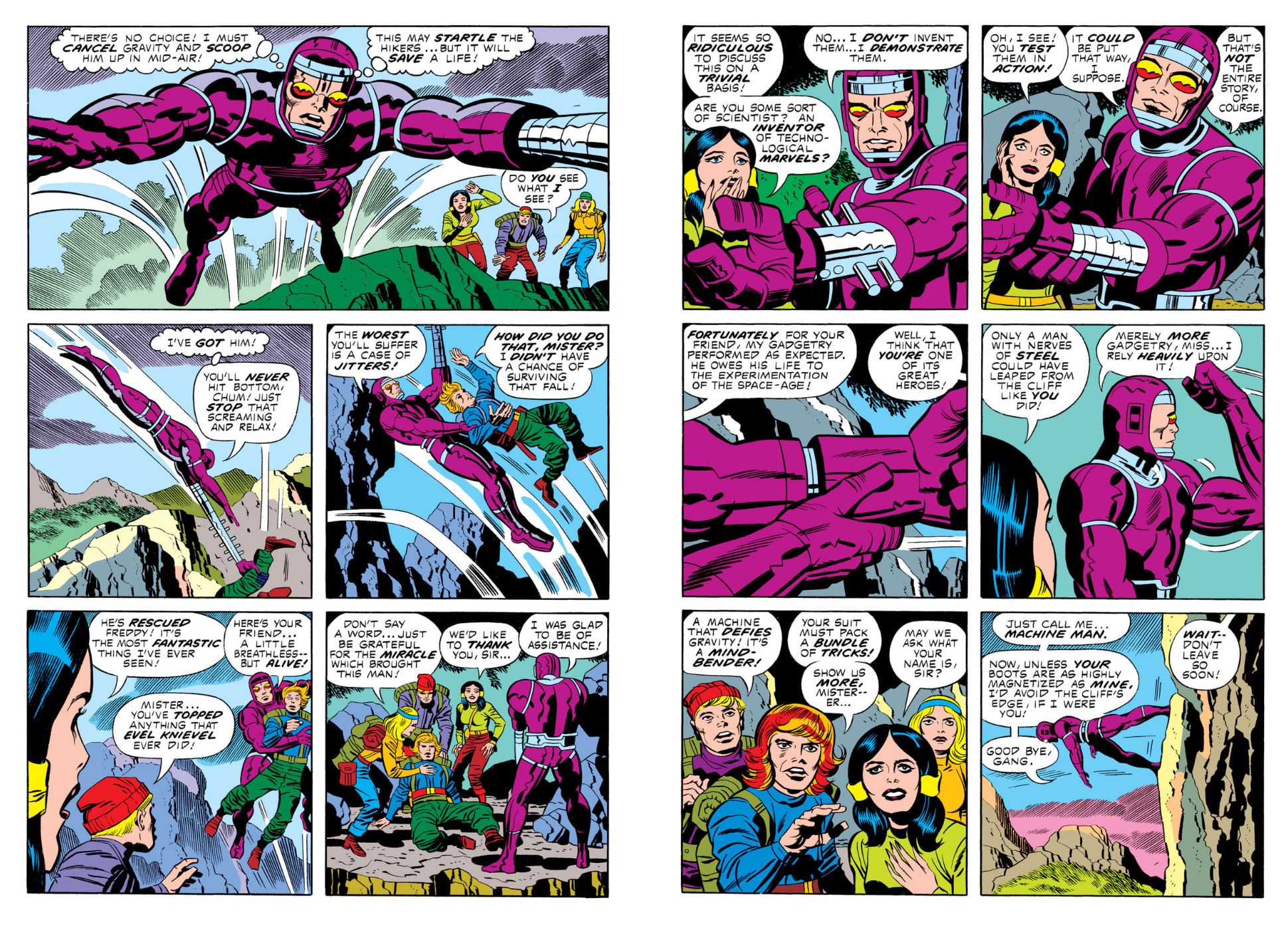
On the run and plagued by nightmares, Aaron makes friends easily in the easygoing, post-Hippie region around Central City, California, and holes up in the asylum run by psychiatrist Dr. Peter Spalding. As they debate the nature of existence, soldiers close in and a fresh crisis is triggered in the ‘House of Nightmares’ when an inmate psionically connects to an alien being about to die countless light years away…
Stack’s on-board technologies confirm the contact is no delusion, and empathy moves the assembled earthlings to open a door for the dying stranger. Unfortunately, ‘Ten-For, the Mean Machine’ is a devious, arrogant seasoned world-conqueror who believes his kind of mechanical life superior to organics and commences adding Earth to the Autochron empire, just as Kragg’s forces breach the building…
The Colonel is no fan of artificial beings but is soon overwhelmed, leaving Machine Man to ‘Battle on a Very Busy Street’, before briefly abandoning humanity and questioning the point of his tormented existence. Aaron’s status as a despised ‘Non-Hero’ changes after attending a wild party and meeting empathetic communications executive Tracy Warner, who inspires the metal marvel to defeat the rapidly-approaching invasion fleet with a ‘Quick Trick’…
Machine Man #7 opens in the aftermath as a Special Congressional Committee convened to rule on the robot’s sentience, intellectual autonomy… and continued existence. ‘With a Nation Against Him!’ displays humanity’s prejudices and willingness to exploit Aaron, and when Spalding is kidnapped, Congressman Miles Brickman sees a way to ride all that unleashed bigotry right into the White House…
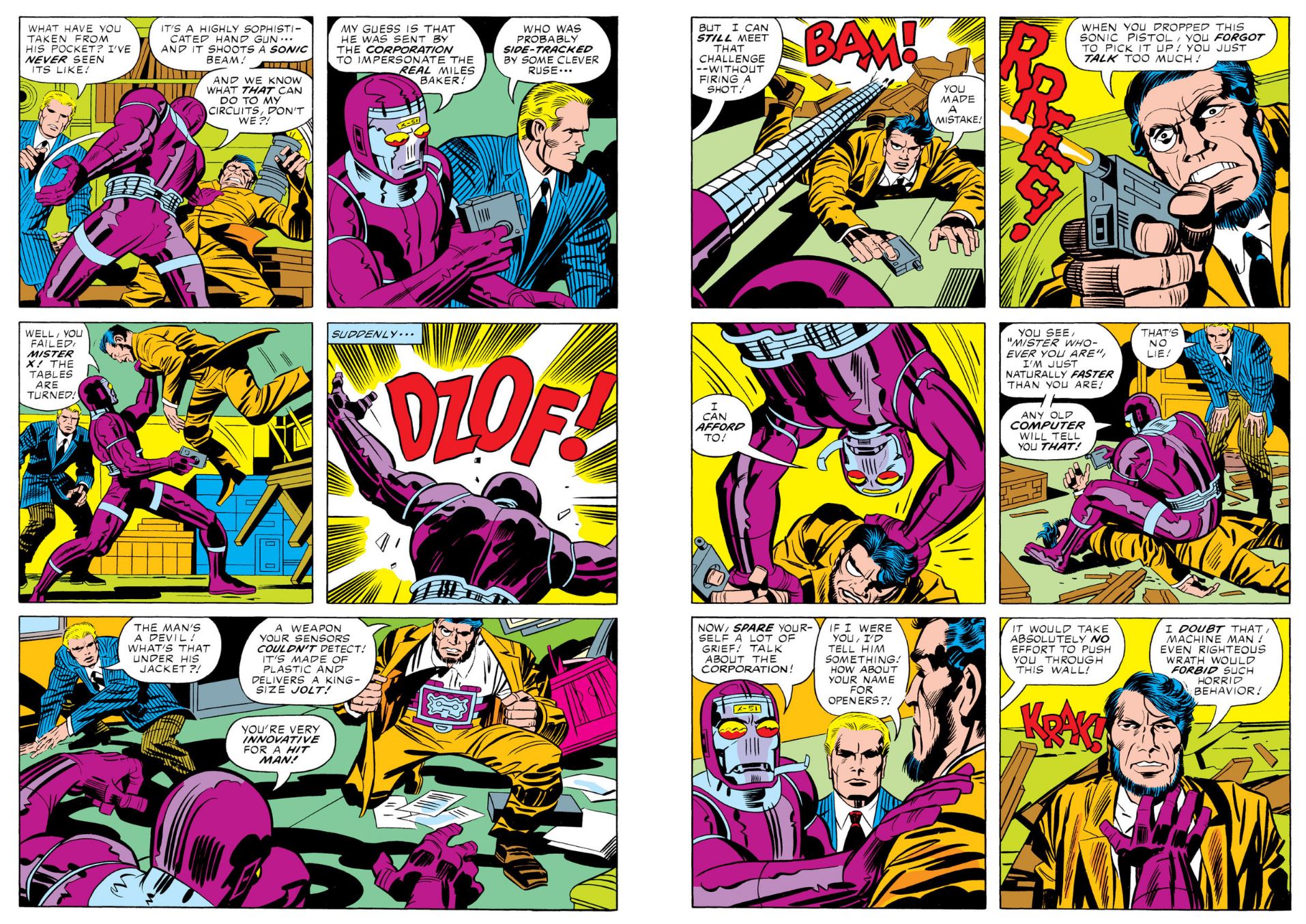
As Aaron seeks to save Peter from nefarious super-capitalist criminal cabal The Corporation, Kragg undergoes a change of heart and helps foil their plans to mass-produce knock-off X-Units, resulting in a spectacular ‘Super-Escape’ and a tenuous détente between mankind and Machine Man as they cooperate ‘In Final Battle!’ (Machine Man #9, December 1978)…
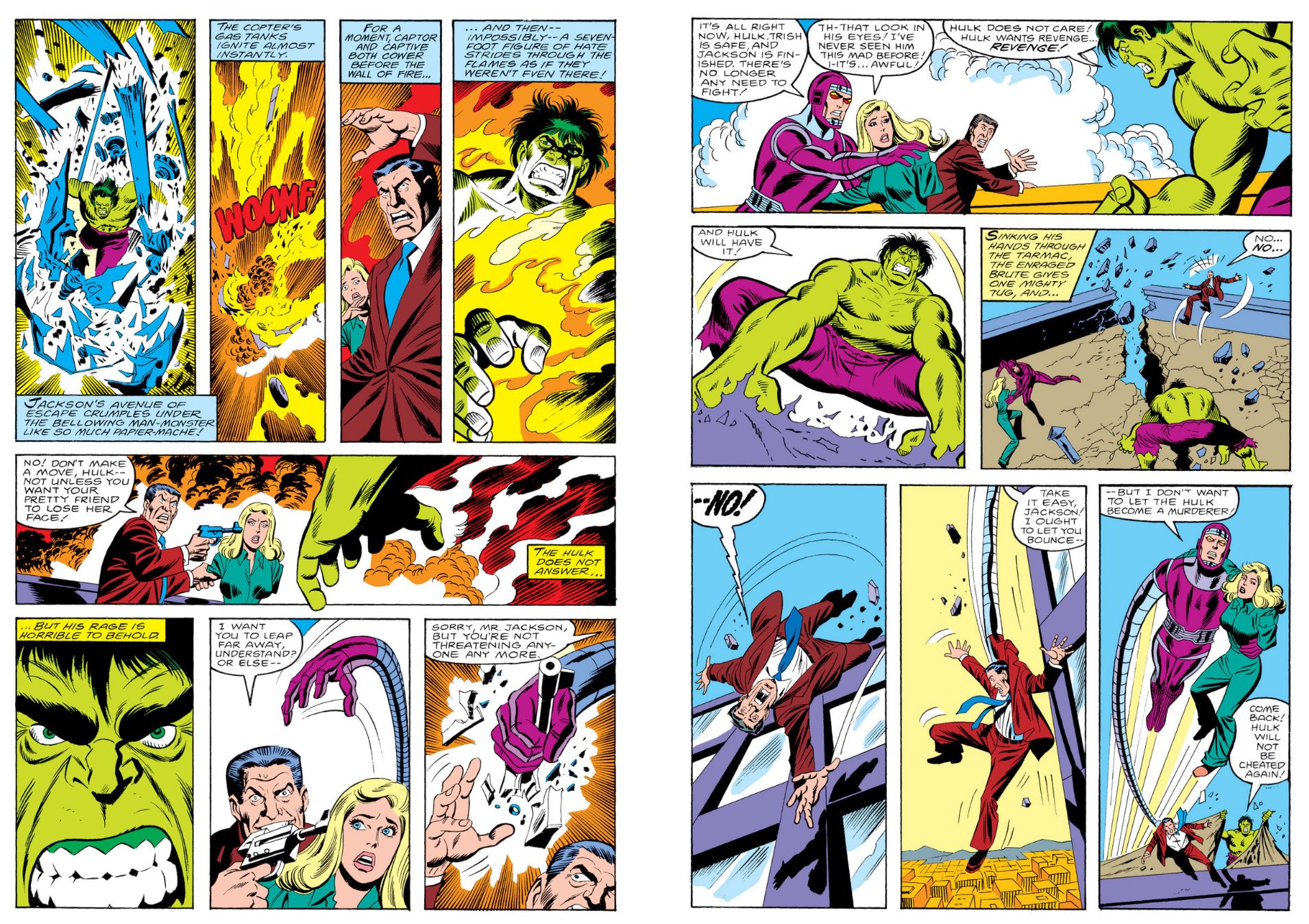
The series ended there, with the many unresolved issues carrying over to a story arc in Incredible Hulk. In this volume a 6-page extract from #234’s ‘Battleground: Berkeley’ (April 1979 by Roger Stern, Sal Buscema & Jack Abel) finds Corporation high-flyer Mr. Jackson framing Machine Man for kidnapping Hulk’s friend Trish Starr, before luring the Jade Juggernaut to a covert corporate citadel in Central City…
Followed by the entirety of #235-237, the resultant clash gears up the metal marvel for a prospective fresh run, opening with ‘The Monster and the Machine’ (Stern, Sal Buscema & Mike Esposito) as the Hulk runs amok and shreds the real Aaron Stack, whilst in Washington DC, opportunistic Brickman is elevated to the Senate…
The rematch in #236 furiously escalates in ‘Kill or Be Killed!’, but by the time the truth has emerged, the Hulk is beyond all reason and turns his wrath on Jackson with horrific effect in concluding chapter ‘When a City Dies!’ (by Stern, S Buscema & Abel)…
One month later Machine Man returned to his own title but couldn’t have been more different…
In an industry and medium packed with imaginative graphic iterations of mechanoid marvels and malcontents, nobody ever drew robots like Steve Ditko. He was one of comics’ greatest and most influential talents and – during his lifetime – probably America’s least lauded. Reclusive and reticent by inclination, his fervent desire was always to just get on with his job, telling stories the best he could: letting his work speak for him. Whilst the noblest of aspirations, that attitude was a minor consideration (and even actual stumbling block) for those commercial interests which controlled comics production and still exert overwhelming influence upon the bulk of the industry’s output.
In 1966, after Ditko’s disagreements with Stan Lee led to the artist quitting Marvel, he found work at Warren Comics and resumed his career-long association with Charlton Comics. That company’s casual editorial attitudes had always offered the most creative freedom, if not financial reward, but in 1968 their wünderkind editor Dick Giordano was poached by rapidly-slipping industry leader National Comics. He took key creators with him, but whilst Jim Aparo, Steve Skeates, Frank McLaughlin & Denny O’Neil found a new home, Ditko began only a sporadic yet phenomenally productive association with DC.
It was during that heady, unsettled period that initial strips stemming from Ditko’s interpretation of Ayn Rand’s Objectivist philosophy began appearing in indie publications like Witzend & The Collector, whilst for the “over-ground” publishing colossus, he devised cult classics The Hawk and the Dove & Beware the Creeper. Later efforts included Shade, the Changing Man, Stalker and The Odd Man, plus anthological sci fi & horror yarns; truly unique interpretations of Man-Bat, (Kirby’s) The Demon, Legion of Super-Heroes and so many more.
In 1979, Ditko grudgingly returned to Marvel to work on Micronauts, Captain Marvel, Fantastic Four, Captain Universe, numerous all-ages and licensed properties and new characters like Speedball, Squirrel Girl and the automaton in question…
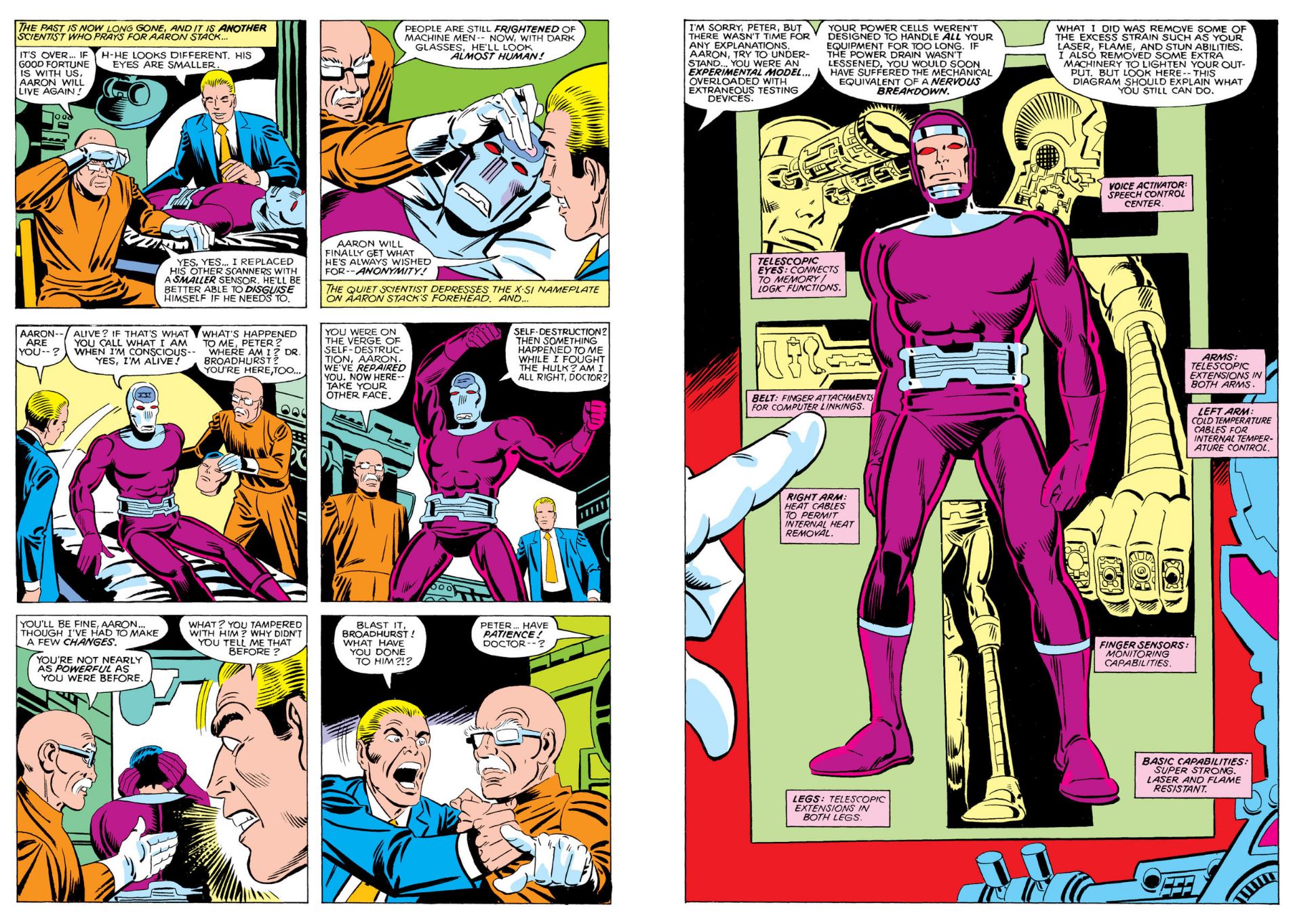
Courtesy of Marv Wolfman & Steve Ditko, Machine Man #10 offered ‘Renewal!’. Severely damaged in combat, the artificial avenger is frantically rebuilt by Spalding and (no, not mutants!!) X-Project originator Dr. Broadhurst, at the cost of much of his awesome armament. This arbitrary adjustment forces Aaron to reassess his status and condition, and – after finding a pre-recorded message from Abel Stack – the root resolves to chart a fresh course as part of the human race.
Even after Aaron saves the Senator from certain death, Brickman pins his future career on capturing the “mechanical menace”, but Aaron perseveres and a battle with a high-tech thief in ‘Byte of the Binary Bug!’ leads to a new secret identity… as an insurance investigator; a new confidante in businessman Byron Benjamin and a new nemesis in exotic millionaire Khan of Xanadu…
Then, as a freak accident turns ordinary mortals into ascendant angels in #12’s ‘Where Walk the Gods!’ Aaron is forced to confront his own biases and moral imperatives to save his life, and learns the value of mercy from a small child, before Khan returns in ‘Xanadu!’ intent on achieving immortality by occupying Aaron’s mechanical body! Wolfman & Ditko sought to humanise Machine Man through a broad cast of quirky co-workers at Delmar Insurance, like freeloading lazy moocher Eddie Harris and office vamp Maggie Jones, but the true mirror of and counterbalance to Aaron is Brickman. The scoundrel announces his run for the White House based on a publicity pogrom against the synthetic superhero in #14, with the action stemming from ‘The Man Who Could Walk Through Walls’. This is a tragic scientist accidentally turned super-dense menace, hired by the Senator’s assistants to impersonate and defame the robot hero…
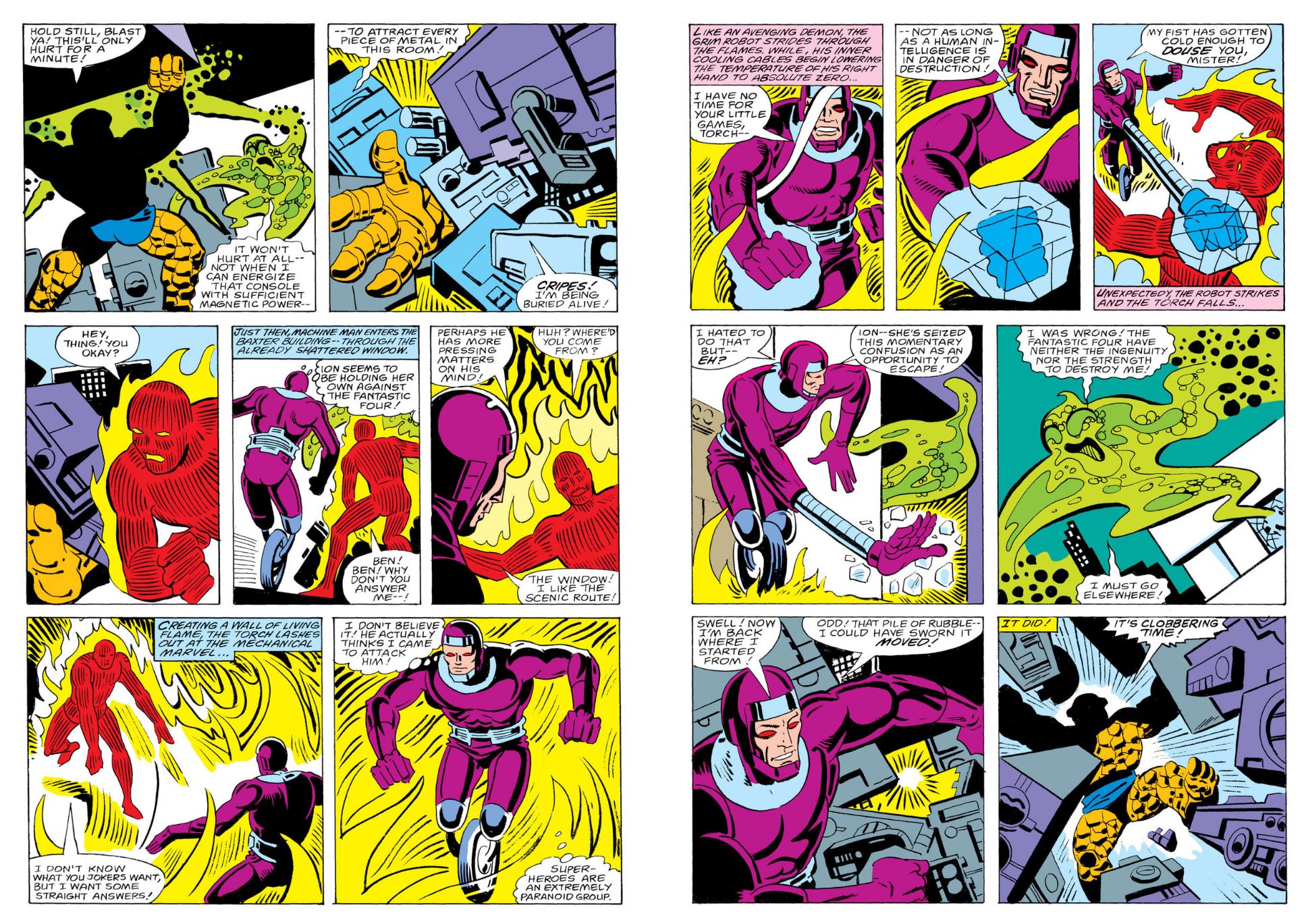
Further inroads into mainstream continuity come as Tom DeFalco joins Ditko from #15 onwards. Transformed into a cloud of energized gas, Dr. Voletta Todd calls herself Ion and – demanding ‘Kill Me or Cure Me’ – crushes Machine Man. As the robot is repaired by garrulous blue-collar engineering prodigy Gears Garvin, The Thing & Human Torch can barely handle the deranged suicidal monster and are grateful for Aaron’s last-minute save…
MM #16 debuts the first in a string of maniacal baddies as ‘Baron Brimstone and His Sinister Satan Squad!’ go on a magic-fuelled crime spree, before #17 introduces evil industrialist Sunset Bain and macabre Madame Menace who all seek to profit from selling Aaron’s stolen limbs in ‘Arms and the Robot!’
Brickman makes his move in #18, exploiting dubious political connections and outright lies to trick Canadian super-agents Sasquatch, Aurora and Northstar into attacking the metal marvel. He stands ‘Alone Against Alpha Flight!’ until the series ends in style with #19 (February 1981) and a brutal battle against a manic mercenary: a cruel clash that leaves Aaron dejected, deformed and dispirited after being ‘Jolted by Jack O’Lantern!’
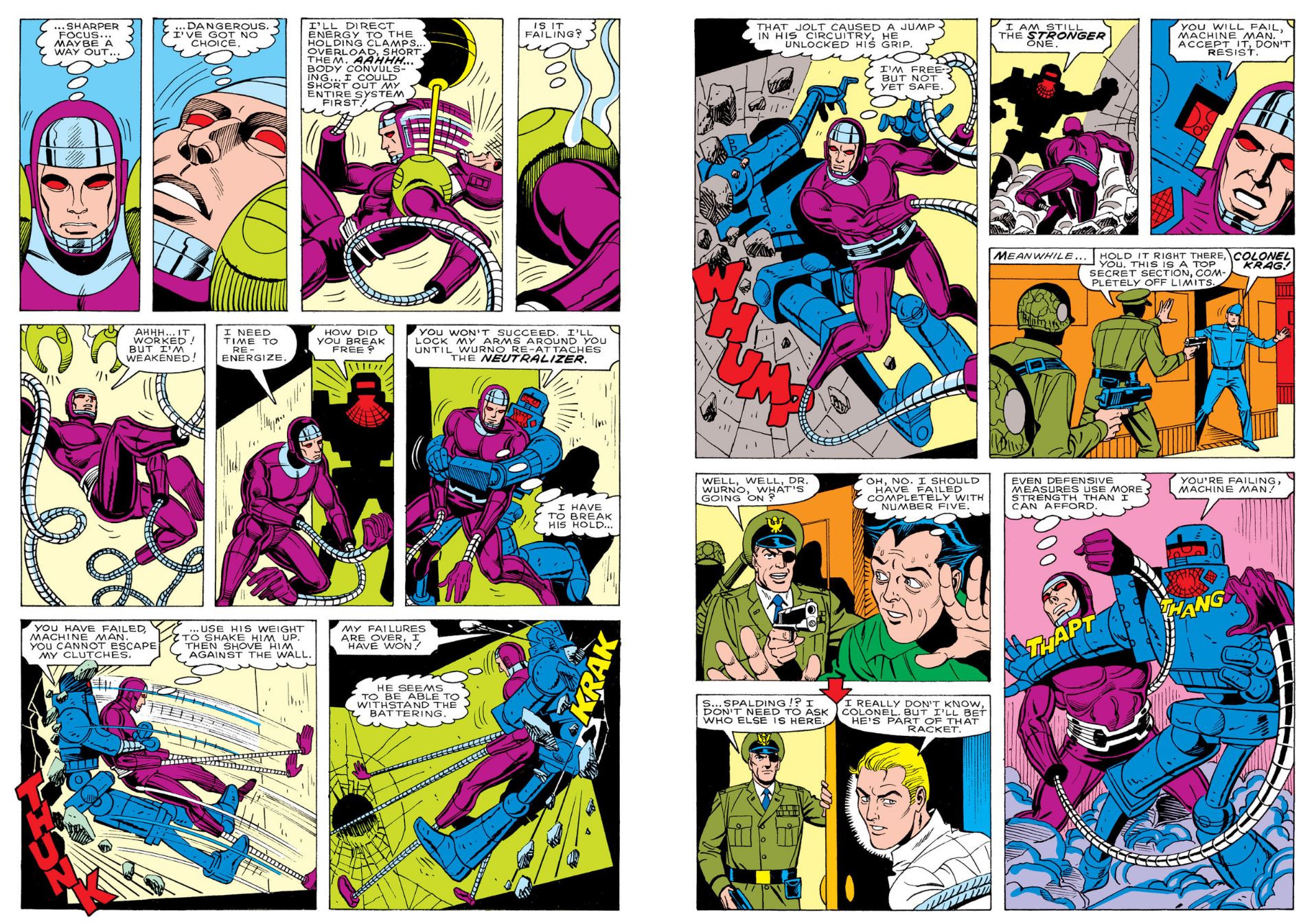
Written by Ditko & Mike Rockwitz with Dave Cockrum inking the abstract master’s pencils, Marvel Comics Presents #10 (January 1989) offers one last hurrah as ‘Machine Man Meets the F.F…Failure Five’ with Aaron Stack targeted by a robot fiasco determined to continue his own existence by occupying the astounding X-51 frame… regardless of who might already be using it.
Illo 6
With extras including a complete cover gallery by Kirby, Ditko, Royer, Al Milgrom, Frank Giacoia, Dan Green, Joe Sinnott, Steve Leialoha, Walter Simonson, John Byrne, Rich Buckler & Frank Miller, plus a quartet of ‘Machine Mail’ editorials by Kirby; house ads; original art pages (by both titans) and unused cover art of the period and full biographies of the founding fathers, this compilation is a dose of utter, uncomplicated comics magic. Bold, brash, and completely compelling… how can you possibly resist the clarion call of sheer eccentric escapism?
© 2016 Marvel Characters, Inc. All rights reserved.