Children of the Night Tide

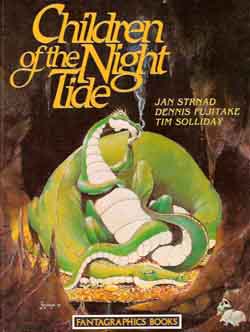
Children of the Night Tide

By Jan Strnad, Dennis Fujitake & Tim Solliday (Fantagraphics Books)
ISBN: 0-930193-24-5

In terms of variety and creativity the 1980s were a fabulous time for comics, with an expansion in every aspect of the market, except general sales, where, in fact, the decline of all printed reading matter continued. Comics died as a mass-market medium, becoming too expensive to sell on corners and in general stores, but developed their own methods of direct distribution, allowing different formats and most especially a broader spread of genre and cross-genre storytelling. Artists too, for good or ill, were no longer tied to house-styles or chimerical fashion.

This lovely slim volume of classic fantasy comes courtesy of then-fledgling publisher Fantagraphics who have since gone on to become the leading proponent and champion of both the American industry’s most radical, experimentalists and the World art-form’s fascinating and endangered history and antecedents.

Best known for his television and film work today Jan Strnad worked sporadically with a number of leading comics figures such as Richard Corben. He garnered well-deserved praise and attention for the satirical science-fiction series Dalgoda, which he co-created with the wonderfully stylistic Dennis Fujitake, and wrote a number of short serials for the fantasy anthologies that sprang up with the rise of the direct market. Here in ‘Sea Dragon’ they combine to tell the salutary tale of Winston, a young Wyrmling who dared to aspire, and of his consequent fate in a glorious fairytale for modern kids of all ages.

This brief saga (18 pages) is accompanied by the far more traditional story ‘Goblin Child’ which expands on the theme of children stolen by the Night Folk to tell a truly moving and compelling tale of mother’s love, power, pride and sacrifice. It’s drawn by Tim Solliday, better known today as a painter and illustrator, in a loose, linear manner that evokes memories of Everett Raymond Kinstler and Roy G. Krenkel (people you need to look up NOW if the names are unfamiliar – this internet stuff’s great, innit?) and one of his early paintings adorns the back cover. His eerie black and white line-work is a perfect fit for the script and it’s a pure shame that he’s produced so few strips.

This delightful book is happily still available from the publisher – and, I’m sure, elsewhere – and will impress any story fan or aficionado of traditional fairytales as well as the usual comics suspects.

Sea Dragon © 1986 Jan Strnad and Dennis Fujitake.
Goblin Child © 1986 Jan Strnad and Tim Solliday. All Rights Reserved.

Catwoman: Catwoman Dies

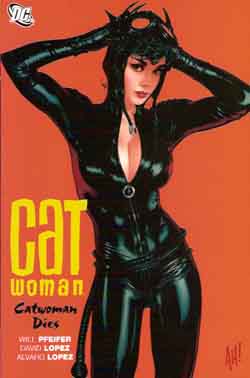
Catwoman Dies

By Will Pfeifer, David Lopez & Alvaro Lopez (DC Comics)
ISBN: 978-1-84576-774-7

This action-heavy compilation starts the clean-up process as the current series prepares for cancellation by taking a number of the key premises of this incarnation and negating them. Rather than go for the favoured comics ploys of re-writing reality the creators have opted for Selina Kyle enlisting the aid of trusted friends to cover her tracks and “disappear” her.

Collecting issues #66-72, and featuring a somewhat muddled and misguided cross-over with the DC Universe Event Amazons Attack!, super-thief, single mum, and unelected guardian of Gotham’s East Side Catwoman is driven to finally forsake her life due to her increasingly high profile on the radar of such villains as Lex Luthor, the Calculator, Blitzkrieg and especially the relentless, revenge-obsessed Soviet superhumans Hammer and Sickle.

Although still a good solid read, the end is in sight and creators Pfeifer, Lopez and Lopez know they’re on clean-up detail. Necessary and enjoyable for established fans, but this isn’t the book to start with if you’re a new reader.

© 2007 DC Comics. All Rights Reserved.

Booster Gold: 52 Pickup

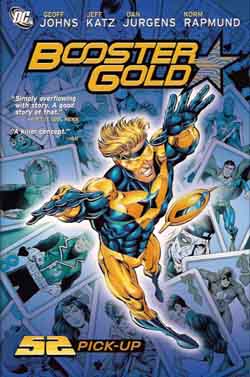
Booster Gold: 52 Pickup

By Geoff Johns, Jeff Katz, Dan Jurgens & Norm Rapmund (DC Comics)
ISBN13: 978-1-84576-847-8

Spinning off from the weekly series 52 and by extension Infinite Crisis, this intriguing take on Heroism features Booster Gold – a hero traditionally only in it for fame and fortune – acting as a secret saviour, repairing the cracks in Reality caused by all the universe-warping shenanigans of myriad universal, multiversal Crises. Working at the instruction of the enigmatic Rip Hunter: Time Master, Booster forgoes all his dreams of acclaim to save us all over and over again.

In this volume (collecting issues #1-6 of the monthly series) whilst undertaking this monumental plastering job, Hunter and Booster find themselves at war with a gang of villains using time-travel to eradicate superheroes before they can begin their careers. In short order he reinstates the events that lead to the creation of Green Lantern, both the Barry Allen and Wally West Flashes, and via a unique team-up with butt-faced bounty hunter Jonah Hex, even Superman himself.

Along the way he has to take steps to ensure his own birth by introducing his 20th century ancestor to his future wife and is attacked by another relative using the Supernova outfit he used in 52. Complex, no?

The book ends on a semi-cliffhanger that depends on one of Hunter’s prime Maxims being wrong. After a salutary lesson involving Batgirl and the Joker (based on Batman: The Killing Joke) falls on deaf ears, Booster ignores the warning that the past cannot safely be changed, and with the aid of past and future incarnations deliberately thwarts the murder of the Ted Kord Blue Beetle. With his best friend restored to him he feels ready for anything, but surely, nothing is ever that easy for the Greatest Hero Never Known?

Fast-paced and deeply imbedded in various DC continuities this is a light but readable thriller, but might be a little hard going for readers new to the DCU. However writers Geoff Johns and Jeff Katz do a fine job keeping things accessible whilst Dan Jurgens and Norm Rapmund capably handle the vast cast of characters just passing through. Worth a look, but if you’re unsure, perhaps you should wait for the paperback edition.

© 2007, 2008 DC Comics. All Rights Reserved.

Boneyard, Vol 6

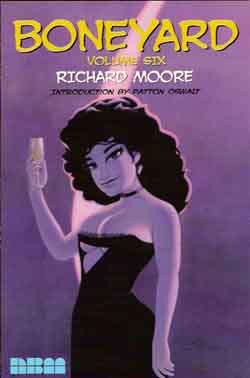
Boneyard vol 6

By Richard Moore (NBM)
ISBN: 978-1-56163-510-8

Boneyard goes from strength to strength. This sixth black and white collection features more frantic antics of a decent young guy who inherited a cemetery with an extremely engaging – and lively -gang of goblins, monsters and weirdoes in situ.

Michael Paris is developing much more than a crush on Abbey the Hot Vampire Chick, but life – and unlife – is made really complicated by an over-amorous fish-woman, the jock (think “Grease” not Glasgow) werewolf and all the assorted demons and monsters he’s nominally responsible for.

Nevertheless he’s finally summoned up the courage to ask her for a date when pernicious fate sticks out another hobnail-booted foot for him to trip over. That’s how he ends up attending a formal ball held by the Over-God with the power and duty to eradicate all misbehaving supernatural creatures. And then somebody spiked his date’s drink…

Charming, touching and wickedly funny, this is one of the best comics comedies of the last thirty years and should be on everybody’s bookshelf.

© 2006, 2007 Richard Moore. All Rights Reserved.

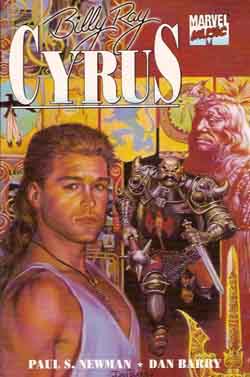
Billy Ray Cyrus

Billy Ray Cyrus

By Paul S. Newman & Dan Barry (Marvel Music)
ISBN: 0-7851-0086-5

No, I’m not kidding.

Enterprise and quality should always be applauded and during the desolate 1990s when sales were dwindling and new markets were desperately needed Marvel went looking for fresh fields to create comics in (as opposed to now when the company claims to be a media franchising outfit that just happens to print funny books – and if you dispute that check out their financial reports and see just how far down the list of products publishing comes).

In the search for fresh markets back then Marvel tapped religion (please don’t make me talk about their Christian Comics line) and popular music to augment their home-grown stable of stars and the prodigious line of toy, cartoon and film licenses, with admittedly, mixed results.

Still and all, a good comic read is a good comic read so this astoundingly impressive general adventure package which just happens to have an Achey-Breaky country singer as the star should come as no surprise to long-time fans and collectors. After all, the immediate post-Golden Age of American comics was littered with product based on the “real-life exploits” of celebrities such as Judy Canova, Alan Ladd, Dean Martin & Jerry Lewis, Bob Hope, and many others.

As high profile franchises they were handled by top artists and writers. Buster Crabbe and John Wayne Adventures frequently featured Al Williamson, Frank Frazetta, Roy G. Krenkel, Joe Orlando, George Evan and Harvey Kurtzman. Dell’s Roy Rogers has issues by the great John Buscema, Pat Boone… No, here, at least, I’m kidding.

The music is side-lined by “King of Comic Book Writers” Paul S. Newman (possibly the most prolific scripter in the business; creator of Solar, Man of the Atom, Turok, Son of Stone and writer of both comic-book and newspaper strip Lone Ranger as well as stories for a host of other companies) and Dan Barry, an artist who quit comics such as Captain America, the Heap and Airboy for the strips Tarzan and Flash Gordon before returning in the 1990s to write and draw Indiana Jones for Dark Horse. Here they spin a couple of traditional yarns, dotted with sly humour, featuring plucky kids encountering a haunted US cavalry fort and a time-jaunt to the court of Edward I of England (that’s Edward Longshanks, 1239-1307, history buffs), ripping yarns that can suspend common sense enough to provide the maximum thrills and spills.

The basics of good comics often get subsumed nowadays by flash, dazzle and “Big Thinking Concepts”, but sometimes the old ways are really the best. I don’t know if you’ll be able to find a retailer with the nerve to stock such an uncool item as Billy Ray Cyrus, but I hope you do because it’s what comics are all about: using compelling pictures to tell a story well: something that’s increasingly a lost art.

© 1995 Billy Ray Cyrus. All Rights Reserved.

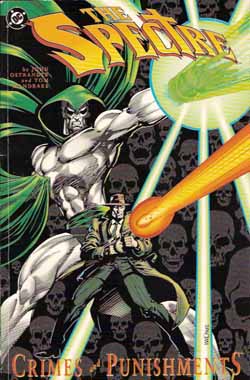
The Spectre: Crimes and Punishment

The Spectre: Crimes and Punishment

By John Ostrander & Tom Mandrake (DC Comics)
ISBN: 1-56389-127-1

The Spectre is one of the oldest characters in DC’s vast stable of characters, created by Jerry Siegel and Bernard Baily in 1940 for More Fun Comics #52 and 53. And just like Siegel’s other iconic creation, he suffers from a basic design flaw: he’s just too darn powerful. But, unlike Superman, he’s already dead, so he can’t really be dramatically imperilled. Starting as a virtually omnipotent ghost, he evolved, over various returns and refits into a tormented soul bonded to the incarnation of the biblical Wrath of God.

With his superb version from the early 1990s, John Ostrander shifted the narrative onto the Tabula Rasa that was Jim Corrigan, a depression era cop whose brutal murder released The Spectre into the world of costumed heroes. This take on the character ran for nearly five years and lent a tragic, barbaric humanity to a hero who was simply too big and too strong for periodical comics.

Collected here is the first four-part story-arc wherein the troubled and Earth-bound Corrigan meets the vulnerable Amy Beitermann, a social worker who is the target of a serial killer – and somehow a living link to the detective’s own murder fifty years ago.

Powerful and often shocking, the developing relationship forces The Spectre’s mortal aspect to confront the traumas of his long suppressed childhood as he relives his own death and the ghastly repercussions of his return. With intense, brooding art by long-time collaborator Tom Mandrake, this incarnation of the character was by far the most accessible – and successful. If it had launched a year or so later and it might well have been a star of the budding Vertigo imprint.

The masterful interpretation seems largely forgotten these days but hopefully with DC trawling its back catalogue for worthy book-fodder this tale – and the issues that followed it – might make a speedy reappearance on book store shelves. Let’s hope so…

© 1992, 1993 DC Comics. All Rights Reserved.

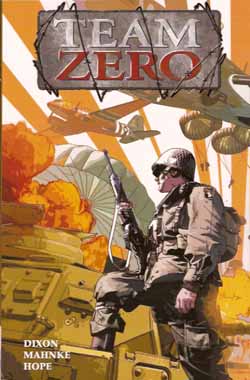
Team Zero

Team Zero

By Chuck Dixon, Doug Mahnke & Sandra Hope (WildStorm)
ISBN: 1-84576-856-0

Short and sweet: this collection of the six-issue miniseries is a superb modern war story set in the final days of World War II featuring a number of characters such as Deathblow and Grifter who would eventually become mainstays of the WildStorm Universe. In this case however having no prior knowledge of the cast will work to your advantage since you’ll have no advance knowledge of who will survive…

As the Russians and American forces race to Berlin in deepest winter, a crack team of hand-picked specialists parachute into a secret rocket base directly in their path. The team has been ordered to capture scientists and technology. Should the booty be impossible to retrieve, at all costs it must be prevented from falling into Soviet hands…

As the hot war ends a Cold one begins the doomed team capably get the “Dirty Dozen” treatment in this gripping, twisty thriller from top creators who are specialists themselves in the field of all-out, testosterone fuelled action. This would make a perfect movie and many cinema-goers would love this brutal and bloody tale.

© 2006, 2008 WildStorm Productions, an imprint of DC Comics. All Rights Reserved.

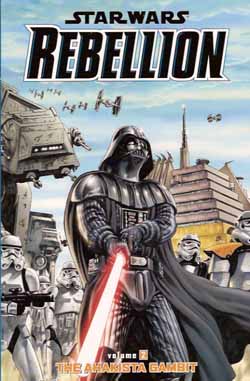
Star Wars: Rebellion volume 2 – The Ahakista Gambit

Star Wars: Ahakista Gambit

By Brandon Badeaux, Rob Williams & Michel LaCombe (Dark Horse Books)
ISBN: 978-1-84576-750-1

Set just after the conclusion of the film Star Wars IV: A New Hope, this moody spin-off of the franchise follows the fortunes of Wyl Tarson, general thug and leg-breaker for crime-lord and information broker Raze. One fact the mastermind didn’t have was that Tarson was a secret informant for the ascendant Rebel Alliance. Until now…

Implanting a bomb in Tarson’s brain Raze sends him to the backwater world of Ahakista, forcing him to bring along a team of Rebel operatives. The planet might be a worthless mudball, but the Empire has a big secret hidden there, otherwise why would someone as important as Darth Vader be involved with the petty insurrection of the lower classes against the local aristocracy?

Moreover, has Tarson’s noble resolve lead to disaster? When he recruited his team, he picked Rebel rejects and Alliance outcasts, since he thought that their deaths couldn’t harm the Cause, but now he finds that this is a mission the Rebellion cannot afford to have fail…

Reprinting issues #6-10 of the comicbook Star Wars: Rebellion, written by Brandon Badeaux and Rob Williams with art from Michel LaCombe and painted colour by Wil Glass, this is a tense and highly engaging “Caper” yarn, which rattles along like a freight train and delivers the maximum amount of top-notch thrills and spills. Aimed at a slightly older audience this is nonetheless an accessible and inviting read for fans and new readers alike.

Star Wars © 2007, 2008 Lucasfilm Ltd. & ™. All Rights Reserved.

Outside Over There

Outside Over There

By Maurice Sendak (many editions such as Puffin or Red Fox are available)
ISBN: 978-0-09943-292-0

If you don’t know the work of Maurice Sendak you’re denying yourself a profound experience. Born in 1928, this uniquely skewed genius has been creating wonderment for children of all ages for over half a century. Apparently after a brief period drawing comics, the Brooklyn born artist switched to children’s book illustration during the 1950s before writing and illustrating the astounding and controversial ‘Where the Wild Things Are’ in 1963. An instant critical success, after initial commercial resistance the book grew into a genuine modern classic.

Between illustrating other author’s work he – all too infrequently – continued to produce his own books. Among his other landmarks are the 1971 ‘In the Night Kitchen’ and the volume under discussion here. Sendak’s works are not what you’d expect of kids’ stories. They are often powerfully unsettling, even creepy, or resonate with a dark psychological disquiet underpinning them. The art is always beautiful – he is an absolute master of many styles and media – but sometimes it’s not an accessible or comprehensible beauty.

Nine year old Ida has been told to look after her baby sister but she is reluctant and when her guard is down Goblins steal her, leaving a baby made of ice in her place. Her father is still at sea and her mother in a daydream in the garden: thus she must pursue the Goblins to rescue the baby herself.

Often cited as the source for the film Labyrinth (although I’d imagine the author A.C.H. Smith takes umbrage at that) there are indeed many superficial similarities, but Sendak’s tale is subtle and truly beguiling, with no maudlin sentiment to temper the events, and with level upon level of meaning in these watercolours that just can’t be equalled in a budget-conscious, collaborative production like movie-making.

This is as close to pure, raw poetry that graphic narrative ever comes and I’m sure many college dissertations could be written on the symbolism on every page, in every well chosen word and fragment of lush picture. The author is reputed to have systematically reduced over 100 draft scripts to the telling 360 words rendered by calligrapher Jeanyee Wong and the minutiae of detail in each illustration is as information-heavy as any Bosch or Bruegel canvas. Referents have been identified for everything from Mozart’s Magic Flute to the works of the Pre-Raphelites (both art and poetry) to his own sister who had to baby-sit him when he was an infant.

This is a small booked packed and layered with meaning. Every detail of each luxurious, sumptuous, magnificent painting has deep meaning for the knowing and the curious. There is sheer artistic loveliness for those yet too young to find symbolism. It’s also a powerfully moving experience and a tale so very well told. An undeniable “must-see” for every devotee of graphic narrative.

© 1981 Maurice Sendak. All rights reserved.

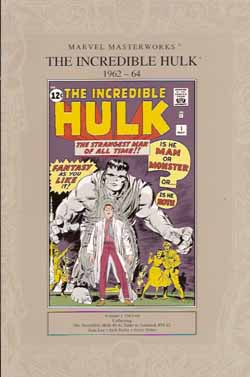
Marvel Masterworks: The Incredible Hulk 1962-64

(UK EDITION)

 Marvel Masterworks: The Incredible Hulk

By Stan Lee, Jack Kirby, Dick Ayers, Steve Ditko & various (Marvel/Panini UK)
ISBN: 978-1-905239-89-4

Despite covering three years of publication this chronological compendium only collects The Incredible Hulk #1-6 and Tales to Astonish #59-62, since the Jekyll-and-Hyde Jade Giant was one of early Marvel’s rare failures – possibly because it so resembled an old-fashioned “monster-mag” in a market frantically re-embracing the Super-Hero concept.

After six bi-monthly issues the series was cancelled and Lee and Kirby retrenched, making the character a perennial guest-star in other Marvel titles (Fantastic Four #12, Amazing Spider-Man #14, The Avengers from #1, and so forth) until such time as they could restart the drama in their new “Split-Book” format in Tales To Astonish where Giant-Man was rapidly proving to be a character who had outlived his time.

Cover-dated May 1962 the first issue saw puny atomic scientist Bruce Banner, sequestered on a secret military base in the desert, perpetually bullied by the bombastic commander General “Thunderbolt” Ross as the clock counts down to the World’s first Gamma Bomb test. Besotted by Ross’s daughter Betty, Banner endures the General’s constant jibes as the clock ticks on and tension increases.

At the final moment he sees a teenager lollygagging at Ground Zero and frantically rushes to the site to drag the boy away. Unknown to him the assistant he’s entrusted to delay the countdown has an agenda of his own…

Rick Jones is a wayward but good-hearted kid. After initial resistance he lets himself be pushed into a safety trench, but just as Banner is about to join him The Bomb detonates…

Miraculously surviving the blast Banner and the boy – Rick Jones – are secured by soldiers but that evening as the sun sets the scientist undergoes a monstrous transformation. He grows larger; his skin turns a stony grey…

In six simple pages that’s how it all starts, and no matter what any number of TV or movie reworkings or comicbook retcons and psycho-babble re-evaluations would have you believe that’s still the best and most primal take on the origin. A good man, an unobtainable girl, a foolish kid, an unknown enemy and the horrible power of destructive science unchecked…

Written by Stan Lee, drawn by Jack Kirby with inking by Paul Reinman, ‘The Coming of the Hulk’ barrels along as the man-monster and Jones are kidnapped by Banner’s Soviet counterpart the Gargoyle for a rousing round of espionage and Commie-busting. In the second issue the plot concerns invading aliens, and the Banner/Jones relationship settles into a traumatic nightly ordeal as the scientist transforms and is locked into an escape-proof cell whilst the boy stands watch helplessly. Neither ever considers telling the government of their predicament… ‘The Terror of the Toad Men’ is formulaic but viscerally and visually captivating as Steve Ditko inks Kirby, imparting a genuinely eerie sense of unease to the artwork.

The third issue presents a departure in format as the longer, chaptered epic gave way to discrete complete short stories. Dick Ayers inked Kirby in the transitional ‘Banished to Outer Space’ which radically alters the relationship of Jones and the Hulk, the story so far is reprised in the three page vignette ‘The Origin of the Hulk’ and that Marvel mainstay of villainy the Circus of Crime debuts in ‘The Ringmaster’. The Hulk goes on an urban rampage in #4’s first tale ‘The Monster and the Machine’ and aliens and Commies combine with the second adventure ‘The Gladiator from Outer Space!’

The Incredible Hulk #5 is a joyous classic of Kirby action, introducing the immortal Tyrannus and his underworld empire in ‘The Beauty and the Beast!’ whilst those pesky commies are in for another drubbing when our Jolly Green freedom-fighter prevents the invasion of Llhasa in ‘The Hordes of General Fang!’

Despite the sheer verve and bravura of these simplistic classics – some of the greatest, most rewarding comics nonsense ever produced – the series was not doing well, and Kirby moved on to more profitable arenas. Steve Ditko handled all the art chores for the final issue, another full-length epic and an extremely engaging one. ‘The Incredible Hulk vs the Metal Master’ has superb action, sly and subtle sub-plots and a thinking man’s resolution, but nonetheless the title died with this sixth issue.

After shambling around the nascent Marvel universe for a year or so, usually as a misunderstood villain-cum-monster, the Emerald Behemoth got another shot. Giant-Man was the star feature of Tales to Astonish but by mid-1964 the strip was floundering. In issue #59 the Master of Many Sizes was tricked by an old foe into battling the man-monster in ‘Enter: The Hulk’ by Lee, Ayers and Reinman; a great big punch-up that set the scene for the next issue wherein his second series began.

‘The Incredible Hulk’ found Banner still working for General Ross, and still afflicted with uncontrollable transformations into a rampaging, if well-intentioned, engine of destruction. The ten page instalments were uncharacteristically set in the Arizona/New Mexico deserts, not New York and espionage and military themes were the narrative backdrop of these adventures.

Lee scripted, Ditko drew and comics veteran George Roussos – under the pseudonym George Bell – provided the ink art. The first tale concerned a spy who stole an unstoppable suit of armour, concluding in the next episode ‘Captured at Last’. The cliffhanger endings such as the Hulk’s imprisonment by Ross’s military units would be instrumental in keeping readers onboard and enthralled. The last tale in this volume ‘Enter… the Chameleon’ has plenty of action and suspense but the real stinger is the final panel that hints at the mastermind behind all the spying and skulduggery – the enigmatic Leader – who in another volume will show why he became the Hulk’s ultimate nemesis…

These early tales are fast-paced, classically simplistic comics-in-the-raw and a testament to the abilities of the creators who wouldn’t let the monster die, and this lovely collection is a fun-filled ticket to easier, boisterously enjoyable escapist entertainment. What could possibly top that?

© 1962, 1963, 1964, 2008 Marvel Characters, Inc. All Rights Reserved.