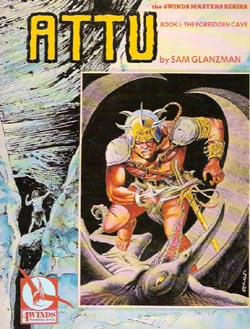
Attu, Book 1: The Forbidden Cave

Attu, Book 1: The Forbidden Cave

By Sam Glanzman (4Winds Publishing Group)
ISBN: 0-922173-04-4

Shamefully, Sam Glanzman is one of the least highly-regarded creators in American comics, despite having one of the longest careers and certainly one of the most unique styles. His work, in genres from war to mystery to fantasy to graphic autobiography, is raw, powerful, subtly engaging and irresistibly compelling.

On titles such as Kona, Voyage to the Deep, Jungle Tales of Tarzan, Hercules, Haunted Tank and especially his two graphic novels A Sailor’s Story and Wind, Dreams and Dragons he produced magnificent action-adventure tales that fired the imagination and stirred the blood, selling copies and winning a legion of fans amongst his fellow artists if not from the small but over-vocal fan-press.

In later years he worked with Tim Truman’s 4Winds company, and as well as high profile projects like The Lone Ranger and Jonah Hex, drew the wonderful fantasy volume featured here. Attu is a caveman in Gondwana – the super-continent of 137 million B.C. Known as the Truth Seeker, he troubles the rest of his mountain-dwelling tribe and is banished to the lowlands, a place of giant tigers, terrible beasts and even dinosaurs. He also finds a cave where a beautiful woman sleeps in a tube of clear, warm ice…

An unrepentant fabulist adventure combining pre-history, monsters, super-science and even time-travel, this is a magical slice of old-fashioned comics fun, rendered in stark, savage black and white; a brilliant paean to a bygone style and age. Moreover, it’s still not too late to urge this wonderful graphic master to sort out the next volume…

© 1989 Sam Glanzman. All Rights Reserved.

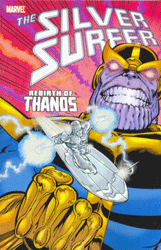
Silver Surfer: Rebirth of Thanos

Silver Surfer: Rebirth of Thanos

By Jim Starlin, Scott Edelman, Ron Lim, Mike Zeck & various (Marvel)
ISBN13: 978-0-7851-2046-9

The Silver Surfer was always a pristine and memorable character when handled well – and sparingly – yet once he gained and sustained a regular comic book presence he became somewhat diminished; less… special. After a strong start his adventures became formulaic and even dull.

Thanos, the death-obsessed master-villain of the 1970’s was a critical and commercial success in his battles with Captain Marvel, the Avengers, the Thing and Spider-Man, and his destruction at the hands of Adam Warlock was an absolute highpoint in superhero storytelling. So why trample on such a classic by reviving him?

But it happened anyway. Brought back from the beyond, Thanos sets about redressing an imbalance between the Living and the Dead to please his mistress, the personification of Death, for whom he intends to kill one half of all living things. Opposed at first just by the Silver Surfer, this mission escalated into an all-out war for control over all reality when the demented villain set out to obtain six mystic gems that would give him absolute control over every aspect of creation, and in effect make him the Supreme Being.

Reprinting issues #34-38 of Silver Surfer and Thanos Quest #1-2, plus a vignette from the back of Logan’s Run #6 (a battle with Drax the Destroyer), the tome is very much a re-run of the Mad Titan’s first attempt to conquer (see The Life of Captain Marvel, ISBN: 0-87135-635-X), but without that saga’s fresh-faced energy and infectious enthusiasm.

Unable to stop Thanos alone the Surfer gathers a band of heroes to defeat the villain and it all ends up in a tremendous punch-up. It also leads to the Cosmic Crossovers Infinity Gauntlet, Infinity War and Infinity Crusade.

Which answers the ‘motive’ part of the question: Publishing is a business and this outing was an obvious way to stir interest in a moribund series which actually paid off big. But as to why it worked…?

By no means Jim Starlin’s best writing, and with mediocre art (I’m being charitable here) from Ron Lim, the first part of the book has very little to recommend it yet is highly regarded by fans – and I must admit that it is inexplicably readable. The latter Quest for the Infinity Gems is marginally better but still not material of any quality, yet it still fired up the fans enough to buy the massive crossovers and subsequent tie-ins that followed.

The strip narrative medium is an odd thing. Stories and characters often achieve a popularity despite rather than because of themselves, and bizarrely, some stories attain favour without any apparent or even discernable merit. This book simply isn’t very good (and is the kind of comic book that sends adult newcomers away screaming and sneering) but there’s some indefinable something that makes it impossible to wholeheartedly condemn…

©1990, 1992, 1993 Marvel Entertainment Group/Marvel Characters, Inc. All Rights Reserved.

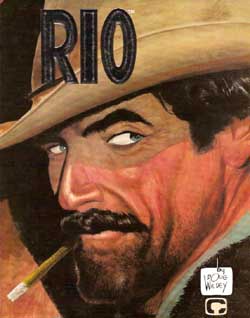
Rio

rio

By Doug Wildey (Comico: The Comic Company)
ISBN: 0-938965-04-2

There have been a lot of very bad Western comics over the years, most of them American, and most of those banged out as commercial fodder to feed a fashion during periods when other media such as television enjoyed a re-emergence of the genre. Rio is most definitely not one of those.

Crafted over many long years, virtually isolated from the mainstream comics world, the late Doug Wildey – famed animator and comic strip artist (his Outlaw Kid strips for Marvel were a rare high-point during the 1950’s Western boom following the rise of TV ownership in the USA) – produced an iconic and elegiac character in Rio. An old gunfighter and badman in the dog days of the Wild West, the rangy loner wandered the country just ahead of creeping civilisation, trying to live the rest of his life as best he could.

This initial volume, collecting material first presented in Eclipse Monthly, finds the weary rover on a tricky and dangerous mission. Offered a full pardon by President Ulysses S. Grant in return for stopping the decimation of the Buffalo herds by “Sporting Specials”, Rio vainly attempts to reason with the Railway Boss. These train excursions, wherein customers could slaughter the animals from the comfort of their seats, nearly wiped out the Buffalo, and consequently almost starved the Indians who lived off them to their own extinction.

Deemed a threat to profits and framed for murder, Rio must hunt down an army of gunmen before he can know any real peace…

Wildey was a master storyteller and a Western Historian of some note. His art has graced many galleries and museums, but his greatest achievements can be seen in this book and its two sequels, where his artistry brings that lost and fabled world briefly back to vibrant life, in spirit as well as look. This is the best work of a master and no comic fans should deprive themselves of the joy of seeing it.

© 1983, 1984, 1987 Doug Wildey. All Rights Reserved.

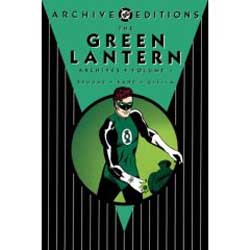
DC Archive: Green Lantern, Vol 1

DC Archive: Green Lantern, Vol 1

By John Broome, Gil Kane & various (DC Comics)
ISBN: 1-56389-087-9

After the successful revival and reworking of The Flash, DC (or National Comics as they then were) was hot to capitalise on the resurgent superhero trend. Showcase #22 (September-October 1959) hit the stands at the same time as the fourth issue of the new Flash (#108) and once again the guiding lights were Editor Julie Schwartz and writer John Broome.

The Space Age reworking of the Golden-Age superhero with the magic ring replaced mysticism with super-science. Hal Jordan was a young test pilot in California when an alien policeman crashed on Earth. Mortally wounded, Abin Sur commanded his ring, a device which could materialise thoughts, to seek out a replacement ring-bearer, honest and without fear. Scanning the planet it selected Jordan and brought him to the crash-site. The dying alien bequeathed his ring, the lantern-shaped Battery of Power and his profession to the astonished Earthman.

In six pages ‘S.O.S Green Lantern’ establishes the characters, scenario and narrative thrust of a series that would increasingly become the spine of DC continuity, leaving room for another two adventures in that premiere issue. ‘Secret of the Flaming Spear!’ and ‘Menace of the Runaway Missile!’ were both contemporary thrillers set against the backdrop of the aviation industry at a time when the Cold War was at its height.

Unlike the debut of The Flash, the editors were now confident of their material. The next two issues of Showcase carried the new hero into even greater exploits. ‘Summons from Space’ sends Green Lantern to another world: Saving an emerging race from a deadly threat at the behest of the as-yet-unknown leaders of the Green Lantern Corps, whilst ‘The Invisible Destroyer’ pits the Emerald Gladiator against the earthbound but eerie menace of a psychic marauder.

Showcase #24 (January-February, 1960) featured another spy-ring in ‘The Secret of the Black Museum!’ but Hal Jordan’s complex social life took centre-stage in ‘The Creature That Couldn’t Die!’ when the threat of an unstoppable monster pales before the insufferable stress of being his own rival. Hal’s boss Carol Ferris, left in charge of the aviation company by her father (a radical concept in 1960) won’t date an employee but is happy for him to set her up with the glamorous, mysterious Green Lantern.

Six months later Green Lantern #1 was released. All previous tales had been dynamically drawn by Gil Kane and inked by Joe Giella, in a visually arresting and exciting manner, but the lead tale here, ‘Planet of Doomed Men’ was inked by the uniquely gifted Murphy Anderson, and his fine line-work elevated the tale (of more emergent humans rescued from another monster) to the status of a minor classic. Joe Giella returned for the second tale, ‘Menace of the Giant Puppet!’, in which Green Lantern fights his first – albeit rather lame – super-villain, the Puppet Master.

The next issue originated a concept that would be pivotal to the future of DC continuity. ‘The Secret of the Golden Thunderbolts!’ featured the Antimatter Universe and the diabolical Weaponers of Qward, a twisted race who worshipped Evil, and whose “criminals” (i.e. people who wouldn’t lie, cheat, steal or kill) wanted asylum on Earth. This lead tale was also inked by Anderson, and is an early highpoint of tragic melodrama from an era where emotionalism was actively downplayed in comics. ‘Riddle of the Frozen Ghost Town!’ is a crime thriller that highlights the developing relationship between the hero and his Inuit (then “Eskimo”) mechanic ‘Pieface’.

The Qwardians returned in the next issue’s ‘The Amazing Theft of the Power Lamp!’ and Jordan’s love-life again spun out of control in ‘The Leap Year Menace!’, whilst GL#4 saw the hero trapped in the antimatter universe in ‘The Diabolical Missile from Qward!’ which is nicely balanced by the light and frothy mistaken-identity caper ‘Secret of Green Lantern’s Mask!’ (this last apparently crafted by a veritable raft of pencillers including Kane, Giella, Carmine Infantino, Mike Sekowsky and Ross Andru).

The last story in this volume is the full length thriller which introduced Hector Hammond, GL’s second official super-villain in ‘The Power Ring that Vanished!’ a saga of romantic intrigue and evolution gone wild.

These highly enjoyable traditional costumed romps are in themselves a great read, but when considered as the building blocks of all DC continuity they become vital fare for any fan keen to make sense of the modern superhero experience.

© 1959-1961, 1993, 2007 DC Comics. All Rights Reserved.

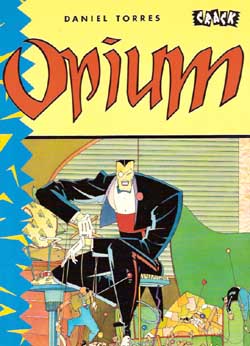
Opium

Opium

By Daniel Torres (Knockabout Crack Editions)
ISBN: 0-86166-047-1

This little lost gem is an absurdist and over-the-top pastiche of hard-boiled detective fiction seamlessly blended with retro-science-fiction motifs and just a dash of colonial imperialism a la “The Yellow Peril”. The good citizens of The City are assaulted in both overt and covert ways by that insidious master of menace ‘Sir Opium’ and his evil gang of ne’er-do-wells, but the clear-headed, clean-cut decency of TV host Ruben Plata and his faithful girlfriend Blanche White will surely prove a match for the bounders.

Replete with 1950s fashions, flying cars and Rock-and-Roll, this Pop-culture melange is a graphic delight, raucous and very racy, outrageous and starkly tongue-in-cheek. Clever yet daftly sophisticated, this is a simply superb piece of cartooning – and in the interest of tempting you as much as possible I’ll just mention that Comics Legend Eddie Campbell lettered the translation. Now you’ve just got to have it, right?

©1983 Daniel Torres. Translation ©1986 Elias Garcia & Mike Steel. All Rights Reserved.

Charley’s War Book IV: Blue’s Story

Charley's War Book IV: Blue's Story

By Pat Mills & Joe Colquhoun (Titan Books)
ISBN: 1-84576-323-8 ISBN-13: 978-1-84576-323-7

The fourth instalment of the magnificent anti-war comic strip picks right up from the cliffhanging ending of the previous volume and shows the hairbreadth escape of boy-soldier Charley Bourne and his mum from the Silvertown munitions factory targeted by a Zeppelin bombing London, before launching into the experimental narrative of the eponymous ‘Blue’.

Writer Mills fully exercised his own political and creative agendas on this First World War series, and as his own commentary relates, was always amazed at what he got away with and what novelties his editors pulled him up on. Firstly, for a weekly war comic like Battle it was rare to allow the hero time away from the action, but here Charley spent the entire story on leave – although hardly safe or sound. Secondly, although unwittingly embroiled in the black market trade in new identities for deserters by his unscrupulous brother-in-law, the hero’s humanity compels him to side against the dictates of patriotism and duty.

Most importantly, whilst aiding the escape of Blue – an Englishman serving with the French Army in the living Hell of Verdun – the episodes become depictions of Blue’s War: A story within a story with the strip’s lead character reduced to an avid and appalled listener.

The horrors of Verdun (the longest single battle in history), related by a British rebel (based on the real-world ‘Monocled Mutineer’ Percy Toplis) wrapped in a tense flight from Military Police and the fearsome ‘Drag Man’ (a obsessive hunter of Deserters) through the eerie streets of a bombed out London, makes for one of the most sophisticated and adult dramas ever seen in fiction, let alone the pages of a kid’s war comic. It is compelling, emotionally draining and dauntingly earnest. But it works.

Lifted to dizzying heights of excellence by the phenomenal artwork of Joe Colquhoun, ‘Blue’s Story’ is a masterpiece of subversive outrage within the greater marvel that is Charley’s War. I pray it never becomes a film or TV series, but I’d bribe Ministers to get these wonderful books onto the National Curriculum.

© 2007 Egmont Magazines Ltd. All Rights Reserved

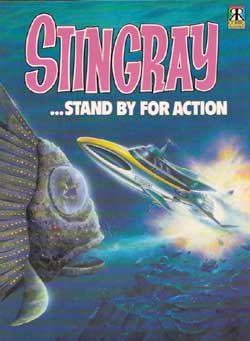
Stingray… Stand By for Action

(Stingray comic album volume 2)

Stingray… Stand By for Action
By Ron Embleton, with Steve Kite, written, edited and compiled by Alan Fennel (Ravette Books/Egmont)
ISBN: 1-85304-457-1

This album from the early 1990s (when Gerry Anderson’s unforgettable creations enjoyed a popular revival on TV and in comics publishing) reprints three unforgettable strip thrillers from the legendary weekly comic TV21. Launching in late January 1965, TV Century 21 (its full title – the unwieldy “Century” was eventually dropped) captured the hearts and minds of millions of children in the 1960s.

Filled with high quality art and features, printed in glossy photogravure, TV21 featured such strips as Fireball XL5, Lady Penelope (Frank Bellamy’s Thunderbirds did not begin until the second year of publication), Supercar and Stingray. Anderson’s epic submarine series featured a crack team of aquanauts pitted against a bizarre and malevolent plethora of beings who lived beneath the waves. The BBC were represented by a full-colour strip starring The Daleks.

Although the reproduction leaves something to be desired, ‘The Monster Jellyfish’, ‘Curse of the Crustavons’ and ‘the Atlanta Kidnap Affair’ – all written by Alan Fennell – are cracking fantasy rollercoaster rides full of action and drama and illustrated with captivating majesty by the incredible Ron Embleton.

He supplemented his lush colour palette and uncanny facility for capturing likenesses with photographic stills from the TV shows, and whether for expediency or artistic reasons the effect on impressionable young minds was electric. This made the strips “more real” then and the effect has not diminished with time. This is a superb treat for fans of all ages, and this series is also long overdue for a deluxe collected edition.

© 1992 ITC Entertainment Group Ltd. Licensed by Copyright Promotions Ltd. All Rights Reserved.

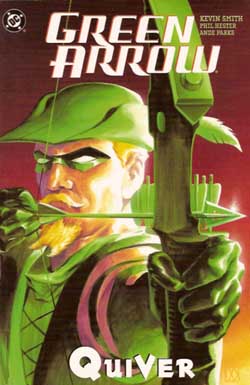
Green Arrow: Quiver

Green Arrow: Quiver

By Kevin Smith, Phil Hester & Ande Parks (DC Comics)
ISBN 1-84023-509-8

Green Arrow has been a fixture in the DC Universe since the early 1940s and was one of the few costumed heroes to survive the end of the Golden Age. He carried on adventuring in the back of other heroes’ comic books, joined the Justice League and became the spokes-hero of the anti-establishment during the 1960’s Relevancy period in comics publishing, courtesy of Denny O’Neil and Neal Adams. Under Mike Grell’s stewardship he became a headliner, an urban hunter who dealt with corporate thugs and serial killers rather than costumed goof-balls. And then he was killed.

This revival, from the unconventional Kevin Smith (yes, Silent Bob!) and the wonderful art-team of Phil Hester and Ande Parks, brings him back from Heaven in the most refreshing manner I’ve seen in nearly five decades of comic reading. Collecting issues #1-10 of the monthly series this gloriously enjoyable refining of Green Arrow embraces the fundamental daftness of superhero comics to revitalise them. Replete with guest-stars, jam-packed with action and intrigue and wallowing in fun thanks to the sly, snappy dialogue of Smith, this is a costume-drama in a thousand and I’m certainly not going to spoil your fun by giving away any details.

Buy it, read it, love it!

© 2001, 2002 DC Comics. All Rights Reserved.
House of Clay

House of Clay

By Naomi Nowak (NBM)
ISBN13: 978-1-56163-511-5

Painter and illustrator Naomi Nowak paints a dreamy exploration of the uses and abuse of love in her tale of a young girl who turns her back on her wealthy family and identity. Calling herself Josephine she travels to the coast and takes a dreadful job in a sweatshop, sewing clothes for unpleasant bosses amongst broken women and girls.

Her off-duty wanderings bring her to an obnoxious old fortune teller and her fantasies lead her to some life changing conclusions in this stylish tale of emancipation and empowerment that manages to stay firmly grounded in the unreal.

Colourful, lyrical, sometimes bordering on the pretentious, but eminently readable and beautiful to look at, this different sort of graphic narrative has a great deal to offer the reader looking for more than fistfights or funny stuff.

© 2007 Naomi Nowak. All Rights Reserved.

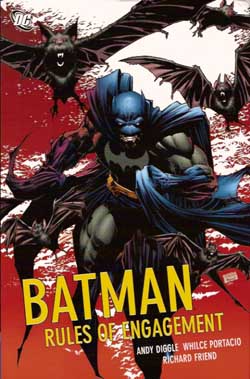
Batman: Rules of Engagement

Batman: Rules of Engagement

By Andy Diggle & Whilce Portacio (DC Comics)
ISBN13: 978-1-84576-619-1

Collecting the first six-part story-arc from the monthly comic book Batman Confidential, this impressive if perhaps overly-glossy high-tech adventure pits an inexperienced Batman against Superman’s arch-nemesis Lex Luthor.

During the first year of the Caped Crusader’s career, a prostitute is murdered in front of her baby, catapulting Batman into a hazy web of corruption and murder involving the US military and the shady world of corporate bidding for government contracts. Somehow at the bottom of it all is the financial monolith of Lexcorp. Can all the subterfuge, death and destruction simply be about money or has the wily billionaire another agenda?

Fast-paced, frenetic and concentrating more on gadgets and technology than mood or mystery, this sharp and shiny thriller from Andy Diggle and Whilce Portacio will perhaps delight the fans of the cinematic more than comic-book Dark Knight, but is an engrossing read for all that.

© 2006, 2007 DC Comics. All Rights Reserved.