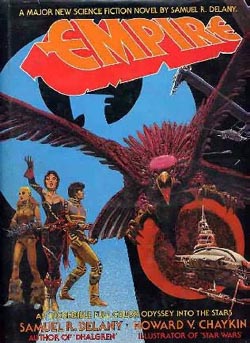
Empire

Empire

By Samuel R .Delaney, illustrated by Howard Chaykin (Berkley/Putnam)
SBN: 399-12245-1

There was a time when Howard Chaykin was about more than lewdness, and potty-mouthed confrontation (not that I’m opposed in any way to those highly entertaining facets of his work): Once he was the darling of the swashbuckling science fiction crowd, both in comics like Monark Starstalker (Marvel) or his own Cody Starbuck, and in the superb paperback covers he produced. In 1976, before he began adapting Star Wars for Marvel, he started a project for Byron Priess Visual Publications with acclaimed author Samuel R .Delaney. It took nearly three years but when it was released Empire was an instant classic and a genuine contender for the title “First Graphic Novel”.

Vast, lush and expansive, this is the story of Wyrn, a young archaeologist who becomes embroiled in a race to recover the separated segments of an artefact that will bring down the dictatorship of the Information-Barons of the Kūndūke. Seduced as much by the charismatic rebel leader Qrelon as by the thirst for adventure and knowledge, the search takes him across the universe and into the heart of corruption in a non-stop thrill-ride of fantastic, exotic adventure.

Perhaps a little simplistic by modern standards, this high-speed, high-concept romp is magnificently illustrated in an engagingly painterly manner whilst Delaney’s poetic style creates a seductive blend of action and political thriller richly steeped in technological philosophy. Whilst the elements of young rebels and sprawling evil dictatorships has now become common currency, the sheer style of this book keeps it a high point of the genre and a worthwhile read for any fan.

© 1978 Byron Preiss Visual Publications Inc. All Rights Reserved.

Night and the Enemy

limited edition hardcover

Night and the Enemy

By Harlan Ellison & Ken Steacy (Comico)
ISBN: 0-936211-07-5

Harlan Ellison’s dark and chilling space war tales are always eminently readable. This volume sees five of the best – all taken from the long-running sequence of novellas and short-stories detailing Mankind’s last-ditch struggle against star-spanning conquerors – adapted in a variety of visual formats by air-brush wizard Ken Steacy, together with a new prose framing-sequence from the author.

The battle against the Kyben lasted ten generations and involved all manner of technologies including time travel. Probably the most famous of these is the award-winning Demon with a Glass Hand, adapted as both an episode of The Outer Limits (1964) and as a DC Graphic Novel (ISBN13: 978-0-9302-8909-6), but that’s a book for another time.

Here we have some of the earliest tales in that epic conflict, beginning with the apocalyptic ‘Run for the Stars’, a traditional panels and balloons strip, followed by ‘Life Hutch’, a grim survival tale combining blocks of text with large images in both lavish colour and stark monochrome.

‘The Untouchable Adolescents’ is a bright and breezy art job disguising a tragic and powerful parable of good intentions gone awry, whilst the sardonic two-pager ‘Trojan Hearse’ rates just one powerful, lonely illustration. ‘Sleeping Dogs’ is a moody epic that fitting concludes the adaptations but fans will be delighted to find this volume carries an original entry in the annals of the Earth-Kyba conflict with the prose and picture ‘The Few… The Proud’: Ellison’s first new story for the series in fifteen years.

This spectacular book is an innovative and compelling treat for both old-time fans of the writer and comic readers in general.

Run for the Stars, Life Hutch, The Untouchable Adolescents, Trojan Hearse, Sleeping Dogs and all additional text © 1987 The Kilimanjaro Corporation.
Art and cover © 1987 Ken Steacy. All Rights Reserved.

Popeye: The First Fifty Years

Popeye: The First Fifty Years

By Bud Sagendorf (Virgin Books)
ISBN: 0-907080-16-2

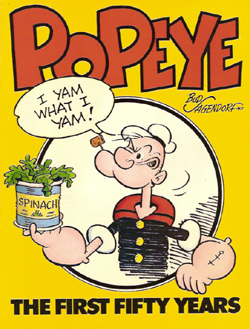
There are few comic characters that have entered world consciousness, but a grizzled, bluff, uneducated, visually impaired old sailor with a speech-impediment is possibly the most well known of that select bunch. Elzie Segar had been producing Thimble Theatre since December 19th, 1919, but when he introduced a coarse, brusque “Sailor man” into the saga of Ham Gravy and Castor Oyl on January 29th, 1929 nobody suspected the heights that walk-on would reach.

Rather than explore the genius of Segar here, let’s concentrate on a general overview of Popeye in this anniversary book from 1981. Compiled and written by his assistant Bud Sagendorf (who took over the strip, the comic book and the merchandise design in 1958) it is a glorious primer into the huge, rich history and vast cast of the strip, with lavishly illustrated features on everything Popeye from Spinach to Collectibles, Notable Quotes to Maps and diagrams of the wild world the Sailor roams.

After Segar’s tragic death in 1938, Doc Winner, Tom Sims, Ralph Stein and Bela Zambouly all worked on the strip as the animated features brought Popeye to the World. When Sagendorf took over in 1958 his loose, rangy style and breezy scripts brought the strip itself back to the forefront of popularity and made reading it cool again. He wrote and drew Popeye until Bobby London took over in 1994.

This book is a gem for fans and casual readers alike. I’m hoping that with the 80th Anniversary so close now that King Features are planning something as good if not better for that landmark event.

©1981 King Features Syndicate, Inc. and Virgin Books, Ltd. All Rights Reserved.

Firkin Collection

Firkin Collection

By Hunt Emerson & Tym Manley (Knockabout)
ISBN: 0-861661443

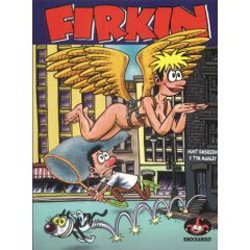
Once again the adult magazine industry has provided a comic strip classic, and this time it’s in the scraggy form of a black and white cat. Running for more than twenty years in the top-selling Fiesta, Firkin (more correctly “that Firkin Cat…”) has observed and commentated, advised and mocked the frankly insane mating habits of Homo (not so very) Sapiens.

In two page instalments the wise and ignoble Moggy has lectured the horny and lovelorn, touching upon every aspect of sexuality in an unbroken string of hilarious, grotesque, bawdy and baroque strips from the fevered minds of writer Tym Manley and cartoon Renaissance Man Hunt Emerson.

For the detail-minded, Firkin is the office mouser of adult photographers and has therefore seen it all – although he’s also been a secret agent, superhero and everything else in between, too. Rude, crude, unbelievably vulgar and pant-wettingly funny, these strips are an international hit too, being translated into eight languages. If you’re an open-minded and amusable grown-up these cat’s tales are an addictive treat and hold the secret of the truest love of all…

© 1981-2000, 2007 Hunt Emerson & Tym Manley. All Rights Reserved.

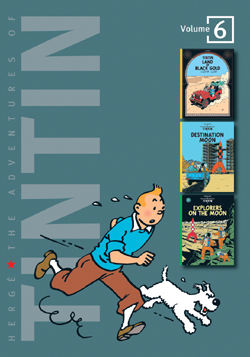
The Adventures of Tintin, Volume 6

The Adventures of Tintin, Volume 6

By Hergé, translated by Leslie Lonsdale-Cooper & Michael Turner (Egmont UK)
ISBN 13: 978-1-4052-2899-2

With World War II over and his reputation restored, Hergé entered the most successful period of his artistic career. He had mastered his storytelling craft, possessed a dedicated audience eager for his every effort and was finally able to say exactly what he wanted in his work, free from fear or censure. But although these freedoms seemed to guarantee a new beginning the life of the creator was far from trouble-free.

In 1949 he returned to Land of Black Gold which had been abandoned when the Nazis invaded Belgium. He then suffered a nervous breakdown and could not work for four months. It is a tribute to his skills that the finished tale reveals none of his personal problems, but is an almost seamless and riveting yarn of political and criminal gangsterism, exotic, hilarious and breathtakingly exciting.

The story concerns a plot to destabilise the World by sabotaging oil. All fuel is somehow made more flammable, causing engines to explode when refuelled. Tintin traces the sabotage to the freighter ‘Speedol Star’, which he joins as Radio Officer. The Detectives Thomson and Thompson are also aboard, but are much less discreet, and soon all three are the targets of a numbers of attacks and assaults. When the ship reaches the Arabian port of Khemikhal they are all framed as drug smugglers and arrested.

But Tintin is abducted by rebel tribesmen who believe he is a gunrunner and the now vindicated Detectives go in search of their friend in the desert. After many hardships the intrepid boy and Snowy discover the villainous spy Doctor Müller (last seen in The Black Island: Adventures of Tintin Volume 3 – ISBN 13: 978-1-4052-2897-8) is trying to ingratiate himself with the Oil-rich Emir. Mohammed Ben Kalish Ezab is wise and tolerant but cursed with a wilful and spoiled son, Abdullah, who is kidnapped when he rejects the doctor’s offers. Tintin befriends the Ruler and goes undercover to find the Prince.

Tracking down Müller Tintin attempts to rescue the boy (whose practical jokes have made him a most unpopular captive) only to be trapped in a brutal fire-fight in the catacombs beneath the spy’s villa. From nowhere Captain Haddock effects a rescue and the plot is revealed and thwarted.

Action-packed and visually delightful, this breezy mystery-thriller is full of humour and chases, with only the last-minute arrival of the dipsomaniac sea captain to slightly jar the proceedings. Presumably the original pages were recycled as much as possible with the popular Haddock inserted at a new breakpoint. He first appeared after the original Land of Black Gold was abandoned, in The Crab with the Golden Claws (see Adventures of Tintin Volume 4 ISBN 13: 978-1-4052-2897-8) and would increasingly steal the spotlight from his juvenile partner – never more so than in the next two adventures, also included in this collected edition.

On a personal note: I first read Destination Moon in 1964, in a huge hardcover album edition (as they all were in the 1960s) and was blown completely away. I’m happy to say that except for the smaller pages – and there’s never a substitute for “Big-ness” – this taut thriller and its magnificent, mind-boggling sequel are still in a class of their own in the annals of science fiction comic strips.

This tale begins with the boy reporter and Captain Haddock returning to Marlinspike Hall only to discover that Professor Calculus has disappeared. When an enigmatic telegram arrives the pair are off again to Syldavia (see King Ottokar’s Sceptre also in Adventures of Tintin Volume 3) and a rendezvous with the missing scientist.

Although suspicious, Tintin soon finds that the secrecy is for sound reasons. In Syldavia Calculus and an international team of boffins are completing a grand project to put a man on the Moon! In a turbulent race against time and amidst huge security the scheme nears completion, but Tintin and Haddock’s arrival coincides with a desperate increase in espionage activity. An enemy nation is determined to steal the secrets of Calculus’s atomic motor at all costs, and it takes all Tintin’s ingenuity to keep ahead of the villains.

As the incidents increase in intensity and frequency if becomes clear that their may be a traitor in the project itself, but at last the moment arrives and Tintin, Haddock, Calculus, Dr. Wolf – and Snowy – blast off for the Moon!

Cold, clinical and superbly underplayed, Destination Moon is completely unlike the flash-and-dazzle razzamatazz of British and American tales from that period – or since. It is as if the burgeoning Cold War mentality (this tale was first serialised in 1950) has infected even Tintin’s bright clean world. Once again the pressure of work and Hergé’s troubled private life resulted in a breakdown and a hiatus in the strip – but this time some of that darkness transferred to the material – although it only seems to have added to the overall effect of claustrophobia and paranoia. Even the comedy set-pieces are more manic and explosive: This is possibly the most mature of all Tintin’s exploits.

If Destination Moon was an exercise in tension and suspense, Explorers on the Moon is sheer bravura spectacle. En route to Luna the explorers discover that Thomson and Thompson have accidentally stowed away, and along with Captain Haddock’s illicit whisky and the effects of freefall, provide brilliant comedy routines to balance the eerie isolation and dramatic dangers of the journey. And lurking in the shadows there is still the very real threat of a murderous traitor to be dealt with…

Studio Hergé was formed in 1950 to produce the adventures of Tintin as well other features and Bob De Moor became an invaluable and permanent addition to the production team, filling in backgrounds and most notably rendering the unforgettable Lunar landscapes that once seen can never be forgotten. This so-modern yarn is a high point in the series, blending heroism and drama with genuine moments of irresistible emotion and side-splitting comedy. The absolute best of the bunch in my humble opinion, and still one of the most realistic space comics ever produced. If you only ever read one Hergé book it simply must be this volume of the Adventures of Tintin.

Land of Black Gold: artwork © 1950, 1977 Editions Casterman, Paris & Tournai.
Text © 1972 Egmont UK Limited. All Rights Reserved.
Destination Moon: artwork © 1959, 1981 Editions Casterman, Paris & Tournai.
Text © 1959 Egmont UK Limited. All Rights Reserved.
Explorers on the Moon: artwork © 1954, 1982 Editions Casterman, Paris & Tournai. Text © 1959 Egmont UK Limited. All Rights Reserved.

Jonah Hex: Origins

Jonah Hex: Origins

By Jimmy Palmiotti, Justin Gray, Jordi Bernet, and others (DC Comics)
ISBN13: 978-1-84576-629-0

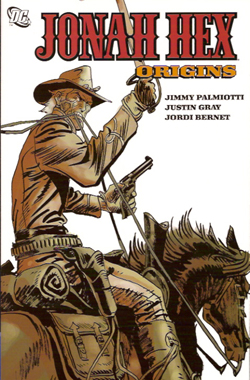
Jonah Hex is probably the most memorable western comic character ever created. He’s certainly the darkest and most grippingly realised, as is the brutal and uncompromising world he inhabits. A ruthless demon with gun or knife, he hunts men for the price on their heads in the years following the American civil war, and the scars inside him are more shocking even than the ghastly ruin of his face.

This collection (reprinting issues #13-18 of the most recent monthly series) retells his origin and offers fascinating insights not only in the gripping lead tale ‘Retribution’, illustrated by the utterly superb Jordi Bernet, but also in the haunting and nihilistically evocative ‘The Ballad of Tallulah Black’ (with beguiling, painterly art by Phil Noto), and the blackly comic ‘I Walk Alone’, drawn with unsuspected subtlety by Val Semeiks.

Jonah Hex was always billed as a “Western for people who didn’t like Westerns” and cliché aside, this is still true. One of the best strips currently coming out of America, this is a perfect book for any adult beginning or returning to comics.

© 2007 DC Comics. All Rights Reserved.

Calvin and Hobbes Lazy Sunday Book

Calvin and Hobbes Lazy Sunday Book

By Bill Watterson (Andrews McMeel)
ISBN13: 978-0-83621-852-7

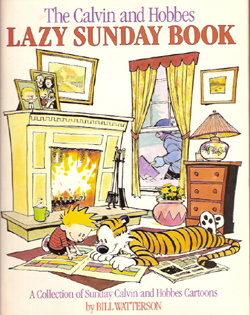
Calvin is the child in us all; Hobbes is the Tiger of our Aspirations; no, wait… Calvin is this little boy, an only child with a big imagination and a stuffed Tiger that is his common sense and moral sounding board… No; Calvin is a little Boy and Hobbes talks only to him. That’s all you need or want.

A best selling strip and critical hit for ten years, Calvin and Hobbes came and went like a comet and we’re poorer for its passing. It redefined the “Eyes of Wonder” which children all possess, and made all us adults laugh, and often cry too. We all wanted a childhood like that kid’s, bullies and obnoxious little girls and all. At least we could visit…

This slim tome collects some of the earliest full-colour Sunday pages from the strip, and includes a new 10 page adventure painted in staggeringly lovely watercolours. Imaginative, dazzling, unforgettably captivating, these are some of the best of Watterson’s work. You should have them in your house.

Calvin and Hobbes is also now available as a complete boxed set – and not before time – so there’s no reason for you not to make this brilliant example of our art form a permanent part of your life. And you’ll thank me for it, too…

© 1989 Universal Press Syndicate. All Rights Reserved.

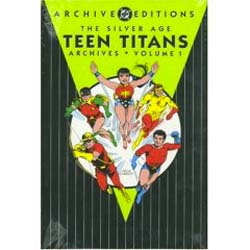
Silver Age Teen Titans

DC ARCHIVE EDITION VOLUME 1

Silver Age Teen Titans

By Bob Haney, Nick Cardy & various (DC Comics)
ISBN: 1-4012-0071-0

The concept of kid hero teams was not a new one when the 1960s Batman TV show finally prompted DC to trust their big heroes’ assorted sidekicks with their own regular comic in a fab, hip and groovy ensemble as dedicated to helping kids as they were to stamping out insidious evil. The biggest difference between such wartime groups as The Young Allies, Boy Commandos and Newsboy Legion or such 1950s holdovers as The Little Wise Guys or Boys Ranch and the creation of the Titans was quite simply the burgeoning phenomena of “The Teenager” as a discrete social and commercial force. These were kids who could be allowed to do things themselves without constant adult help or supervision.

As early as the June-July 1964 issue of The Brave and the Bold (#54), the powers that be had tested the waters with a gripping tale by writer Bob Haney superbly illustrated by unsung genius Bruno Premiani. ‘The Thousand-and-One Dooms of Mr. Twister’ united Kid Flash, Aqualad and Robin, the Boy Wonder in a desperate battle against a modern wizard-cum-Pied Piper who had stolen the teen-agers of Hatton Corners. The young heroes had met in the town by chance when students invited them to mediate in a long-running dispute with the town adults.

This element of a teen “court-of-appeal” was often the motivating factor in many of the group’s cases. One year later the team reformed for a second adventure (The Brave and the Bold #60, and by the same creative team) and introduced two new elements. ‘The Astounding Separated Man’ featured more misunderstood kids – this time in the coastal hamlet of Midville – threatened by an outlandish monster whose giant body parts could move independently. The young heroes added Wonder Girl (not actually a sidekick, or even a person, but rather an incarnation of Wonder Woman as a child – a fact the writers of the series seemed blissfully unaware of) and they finally had a team name: ‘Teen Titans’.

Their final try-out appearance was in Showcase (issue #59, November-December 1965), birthplace of so many hit comic concepts, and was the first to be drawn by the brilliant Nick Cardy (who became synonymous with the series). ‘The Return of the Teen Titans’ pitted the team against teen pop trio ‘The Flips’ who were apparently also a gang of super-crooks, but as was so often the case the grown-ups had got it all wrong…

The very next month their own comic debuted (#1 was dated January-February 1966 – released mere weeks before the Batman TV show aired on January 12th) with Robin the point of focus on the cover – and most succeeding ones. Haney and Cardy produced an exotic thriller entitled ‘The Beast-God of Xochatan!’ which saw the team act as Peace Corps representatives involved in a South American drama of sabotage, giant robots and magical monsters. The next issue held a fantastic mystery of revenge and young love involving ‘The Million-Year-Old Teen-Ager’.

‘The Revolt at Harrison High’ cashed in on the teen craze for drag-racing in a tale of bizarre criminality. Produced during a historically iconic era, many readers now can’t help but cringe when reminded of such daft foes as ‘Ding-Dong Daddy’ and his evil biker gang, and of course the hip, trendy dialogue (it wasn’t even that accurate then, let alone now) is pitifully dated, but the plot is a strong one and the art magnificent.

‘The Secret Olympic Heroes’ guest-starred the Green Arrow’s teen partner Speedy in a very human tale of parental pressure at the Olympics, although there’s also skulduggery aplenty from a terrorist organisation intent on disrupting the games.

This volume concludes with ‘The Perilous Capers of the Terrible Teen’ as the Titans face the dual task of helping a troubled young man and capturing a super-villain called the Ant, despite all the evidence indicating that they’re the same person…

Although perhaps dated in delivery, these tales were a liberating experience for kids when first released. They truly betokened a new empathy with independent youth and tried to address problems that were more relevant to that specific audience. That they are so captivating in execution is a wonderful bonus. This is absolute escapism and absolutely delightful.

© 1964, 1965, 1966, 2003 DC Comics. All Rights Reserved

The Sleeze Brothers File

The Sleeze Brothers File

By John Carnell & Andy Lanning (Marvel UK)
ISBN: 1-85400-242-2

I first reviewed this as a mini-series for the excellent Slings & Arrows Comic Guide a few years back and I didn’t have a awful lot of good things to say about it then, but it came up in conversation recently and someone whose opinion I respect (not a full-on comics fan) reckoned it a “not bad read” so I thought I’d give it another look in the context of a broader audience.

In the future, El Ape and Deadbeat Sleeze are doing their very best – which is very bad – to make a living as private detectives. But this useless pair of futuristic gumshoes are in trouble with Police Sergeant Pigheadski as often as from such scurrilous rogues as The Reverend Smiler While, Orsum Wurlds, J. Edgar Hairdryer, Marilyn Blondeclone and the truly repugnant Bwokenpotee and Andrexia of the subterranean Aarsouls faith.

Aimed at a mature audience (and I’m saying a big nothing here) this pastiche blends sci-fi sagas and the seminal movie The Blues Brothers to capture the very worst of British humour but at least manages to recycle many of the universe’s oldest jokes one last time – hopefully.

Originally released as six issue miniseries from Marvel’s Epic imprint this volume contains extra story material although I can’t imagine why, since my now reconsidered opinion is that it’s ‘Still Rubbish – But Some People Might Like It’.

It takes all sorts I suppose…

© 1990 John Carnell & Andy Lanning. All Rights Reserved.

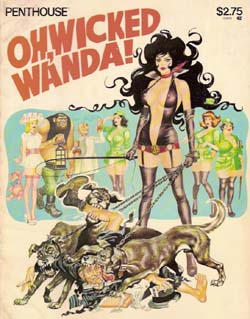
Oh, Wicked Wanda!

Oh, Wicked Wanda!

By Frederic Mulally & Ron Embleton (Penthouse)
No ISBN

Not all comics are for kids nor ever were they. The men’s magazine trade has often featured graphic narratives, usually sexual in nature, often highly satirical, invariably of a much higher quality than their mainstream contemporaries and always much better regarded and financially rewarded. Where Playboy had Little Annie Fanny (created by Harvey Kurtzman and Will Elder, it ran intermittently from 1962 until 1988, and revived in 1998, illustrated by Ray Lago and Bill Schorr), publishing rival Bob Guccione wanted the same but better for his publication Penthouse.

He hired journalist, editor (of left-wing magazine Tribune), columnist, novelist and political writer Frederic Mulally to script the exotic, erotic adventures of Wanda Von Kreesus, the richest woman in the world, Candyfloss, her insatiable jailbait paramour and an outrageous coterie of faithful employees including an all-girl army, a mad scientist and a brutal looking thug with the soul of a poet. To illustrate he secured the talents of oil painter and comic strip veteran Ron Embleton (who had astounded comic readers with his lush and vibrant strip Wulf the Briton in Express Weekly and his illustrations in Look and Learn).

Oh, Wicked Wanda! was originally a prose serial illustrated by Bryan Forbes, beginning in 1969 before becoming, in 1973, the unbelievably lavish and torrid strip reprinted here, continuing until 1980 when it was replaced by Sweet Chastity, also painted by Embleton, and scripted by Penthouse proprietor Guccione.

The bored and mischievous hellion is a sexually adventurous woman from a time when sexual politics and liberation were huge issues, and therefore prime targets for low comedy and high satire. Mulally peppered his scripts with topical references (many, sadly which would escape today’s casual reader, I’m sure) and the phenomenal Embleton would depict them with hyper-realistic accuracy. Harold Wilson, Edward Heath, Ted Kennedy, Richard Nixon, Henry Kissinger, Fidel Castro, Lyndon Johnson, Spiro Agnew, Mao Tse-tung, showbiz icons such as John Wayne or Bob Hope and even comic strip greats like Pogo, Mutt and Jeff or Krazy Kat, all meandered through the glossy pages, a cross between a Greek Chorus and pictorial ad-libs.

Many celebrities were actively parodied participants. Henry Kissandrun, mafia Don Marlon Blondo/Burpo, Jane Fondle and demented California Governor Ronald Reekin’ all found themselves victims of the wilful minx and her team. Also classical and contemporary erotic allusions abound ranging from a little nymphette lounging about reading William Burroughs’s Naked Lunch to visual and verbal references to Shelley’s Leda and the Swan.

This slim album reprints the earliest adventures as Wanda collects the rich and the famous for a museum of deviancy, takes on the Mafia, the CIA and the Cubans and does her bit to solve the Oil Crisis. Later adventures saw her romp through the ages in a time machine but to my knowledge these tales have never been reprinted – although they really should be.

Perhaps a little dated, definitely for easy-going adults only, Oh, Wicked Wanda! is nonetheless still a funny read and inarguably one of the most beautiful British strips ever made. It is a tragedy that such work is unavailable to aficionados of comic art.

© 1973, 1974, 1975 Penthouse International Ltd. All Rights Reserved.