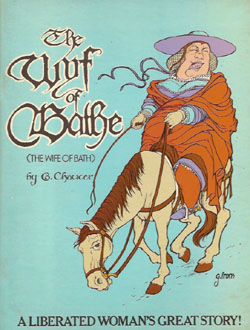
The Wyf of Bath (The Wife of Bath)

The Wyf of Bath (The Wife of Bath)

By Geoffrey Chaucer, illustrated by Greg Irons (Bellerophon Books)
ISBN: 0-88388-023-7

I’m just showing off now, but this lost treasure, published in conjunction with a colouring book (The Chaucer Coloring Book, which collected the original woodcut illustrations from Caxton’s 1484 edition of The Canterbury Tales) is a terrific and logical blending of High Art and Our Art and one so very worthy of being republished.

Chaucer’s Canterbury Tales, as well as being a venerable and lauded landmark of English literature, was a ribald, earthy, popular classic, full of humanity’s every foible and peccadillo. It was rude, crude, action packed, and even had talking animals. Thematically, how much closer can you get to the general opinion and popular conception of the comic book?

Marry that with the art of the irreverent, subversive art and attitude of the San Francisco underground movement of the early 1970’s and you have a brilliant piece of pop-art history that actually has lasting social relevance and educational value.

The text of the Wife of Bath is typeset and in the original continental accentual-syllabic metre which Chaucer used to champion the London-dialect dominance of Middle English. So this will make a lot more sense if read aloud phonetically (the book not my review). Or you could simply look at the stonkingly brilliant and funny, ribald pictures drawn by the astounding Greg Irons.

Some college or publishing house simply has to get this book back into print, ASAP!

Artwork © 1973 Greg Irons. All Rights Reserved.

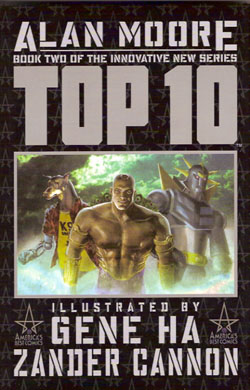
Top 10: Book 2

Top 10: Book 2

By Alan Moore, Gene Ha & Zander Cannon (America’s Best Comics)
ISBN 1-56389-876-4

Collecting issues #8-12 of the comic-book series, this volume carries ongoing threads and storylines, so readers would be advised to read volume 1 first. Like that previous volume (ISBN: 1-84576-1491-6) this seductive blend of police procedural drama and the whacky world of full-on superhero universes isn’t really about the narrative though; its joys are to be found in the incidentals, the sidebars and the shared in-jokes.

Top 10, based in Neopolis, is a precinct of a pan-dimensional police force, in a city populated entirely by paranormal and super-powered beings. Like any good cop story, cases run in parallel, at different rates and often in opposition, and the large cast all have their own lives which are impossible to completely divorce from “The Job”.

The “one-day-at-a-time” storytelling commences with ‘The Overview’, as a major traffic accident draws most of the day-shift’s resources. A couple of teleporting dimensional travellers have catastrophically intersected, but by the end of the clear-up it’s clear the tragedy wasn’t a simple accident. Meanwhile, influential friends are trying to quash the case against the monstrous serial killer known as Libra, and Voodoo officer King Peacock is sent to Grand Central, the head office of the police force…

‘Rules of Engagement’ finds Peacock being given a particularly deadly form of the old run-around whilst the war between the Utramice and the Atomcats in Duane’s mother’s apartment has escalated to cosmic levels, in a brilliant swipe at comicbook mega-crossovers. And a long-running investigation is starting to look like a case for Internal Affairs…

‘Music for the Dead’ sees the death of one of the major cast members as the corruption suspicions are horrible confirmed in a brutal incident that also closes the Libra killer case for good.

‘His First Day on the New Job’ sees Joe Pi, the new (robotic) rookie experiencing some rather unsettling prejudice from his fellow officers and the funeral of the beloved colleague he’s replacing: And the volume – in fact, the original series – concludes with ‘Court on the Street’, with an atypical clear win for the Good Guys when they go after the influential cronies of the deceased Libra Killer.

This cross-genre mix is immensely entertaining reading and the subtle shades of the writing are matched in full by Gene Ha’s beautiful, complex, detail-studded art. This is a must-read series for jaded fans and newcomers with an open, imaginative mind. Although the series finished here there were a number of follow-up miniseries.

© 2005 America’s Best Comics LLC. All Rights Reserved.

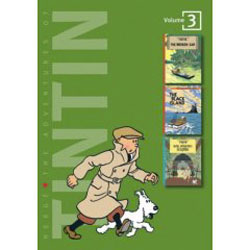
The Adventures of Tintin, Vol 3

The Adventures of Tintin, Volume 3

By Hergé, translated by Leslie Lonsdale-Cooper & Michael Turner (Egmont UK)
ISBN 13: 978-1-4052-2897-8

Hergé was approaching his mastery when he began The Broken Ear: His characterisations were firm in his mind, he was creating a memorable not to say iconic supporting cast, and the balance between crafting satisfactory single instalments and building a cohesive longer narrative was finally being established.

The version reprinted in this delightfully handy hardback compendium was repackaged by the artist and his studio in 1945, although the original ran in two page weekly instalments from 1935-1937, and there are still evident signs of his stylistic transition in this hearty, exotic mystery tale that makes Indiana Jones look like a boorish amateur.

Back from China, Tintin hears of an odd robbery at the Museum of Ethnography, and rushing over finds the detectives Thompson and Thomson already on the case in their own unique manner. A relatively valueless carved wooden Fetish Figure made by the Arumbaya Indians has been taken from the South American exhibit. Bafflingly, it was returned the next morning, but the intrepid boy reporter is the first to realise that it’s a fake, since the original statue had a broken right ear. And a minor sculptor is found dead in his flat…

So begins a frenetic and enthralling chase to find not just who has the real statue but also why a succession of rogues attempts to secure the dead sculptor’s parrot, with the atmospheric action encompassing the urban metropolis, an ocean-going liner and the steamy and turbulent Republic of San Theodoros, where the valiant lad becomes embroiled in an on-again, off-again Revolution. Eventually though, the focus moves to the deep Jungle as Tintin finally meets the Arumbayas and a lost explorer, getting one step closer to solving the mystery.

Whilst unrelenting in my admiration for Hergé I must interject a necessary note of praise for translators Leslie Lonsdale-Cooper and Michael Turner here: Their light touch has been integral to the English-language success of Tintin, and their skill and whimsy is never better seen than in their dialoguing of the Arumbayas. Just read aloud and think Eastenders…

The slapstick and mayhem build to a wonderfully farcical conclusion with justice served all around, and a solid template is set for many future yarns, especially those that would perforce be crafted without a political or satirical component during Belgium’s grim occupation by the Nazis.

However, Hergé’s developing social conscience and satirical proclivities are fully exercised here in a telling sub-plot when rival armaments manufacturers gull the leaders of both San Theodoros and its neighbour Nuevo-Rico into a war simply to increase their sales, and once again oil speculators would have felt the sting of his pen – if indeed they were capable of any feeling…

The Black Island followed. It ran from 1937-1938, (although this is the revised version released in 1956) and the doom-laden atmosphere that was settling upon the Continent even seeped into this dark tale of espionage and criminality. When a small plane lands in a field, Tintin is shot as he offers help. Visited in hospital by Thompson and Thomson, he discovers they’re en route to England to investigate the crash of an unregistered plane. Discharging himself and with Snowy in tow he catches the boat-train but is framed for an assault and becomes a fugitive. Despite a frantic pursuit he makes it to England, still pursued by the murderous thugs who set him up as well as the authorities.

He is eventually captured by the gangsters – actually German spies – and uncovers a forgery plot, which leads him to the wilds of Scotland and a (visually stunning) “haunted” castle on an island in a Loch. Undaunted, he investigates and discovers the gang’s base, which is guarded by a monstrous ape.

This superb adventure, powerfully reminiscent of John Buchan’s The Thirty-Nine Steps, highlight the theme that as always virtue, pluckiness and a huge helping of comedic good luck lead to a spectacular and thrilling denouement.

Older British readers have reason to recall the final tale in this tome. Many of them had an early introduction to Tintin and his dog (then called Milou, as in the French editions) when the fabled Eagle comic began running King Ottokar’s Sceptre in translated instalments on their prestigious full-colour centre section in 1951. Originally created by Hergé in 1938-1939, this tale was one of the first to be revised (1947) when the political fall-out settled after the war ended.

Hergé continued to produce comic strips for Le Soir during the Nazi Occupation (Le Petit Vingtième, the original home of the strip was closed down by the Nazis), and in the period following Belgium’s liberation was accused of being a collaborator and even sympathiser. It took the intervention of Resistance hero Raymond Leblanc to dispel the cloud over Hergé, which he did by simply vouching for the cartoonist and by providing the cash to create the magazine Tintin which he published. The anthology comic swiftly achieved a weekly circulation in the hundreds of thousands.

The story itself is pure escapist magic as a chance encounter via a park-bench leads our hero on a mission of utmost diplomatic importance to the European kingdom of Syldavia. This picturesque Ruritanian ideal stood for a number of countries such as Czechoslovakia that were in the process of being subverted by Nazi insurrectionists at the time of writing.

Tintin becomes a surveillance target for the enemy agents and after a number of life-threatening near misses flies to Syldavia with his new friend. The sigillographer Professor Alembick is an expert on Seals of Office and his research trip coincides with a sacred ceremony wherein the Ruler must annually display the fabled sceptre of King Ottakar to the populace or lose his throne. When the sceptre is stolen it takes all of Tintin’s luck and cunning to prevent an insurrection and the overthrow of the country by enemy agents.

Full of dash, as compelling as a rollercoaster ride, this is classic adventure story-telling to match the best of the cinema’s swashbucklers and as suspenseful as a Hitchcock thriller, balancing insane laughs with moments of genuine tension. As the world headed into a new Dark Age, Hergé was entering a Golden one.

These ripping yarns for all ages are an unparalleled highpoint in the history of graphic narrative. Their constant popularity proves them to be a worthy addition to the list of world classics of literature.

The Broken Ear: artwork © 1945, 1984 Editions Casterman, Paris & Tournai.
Text © 1975 Egmont UK Limited. All Rights Reserved.
The Black Island: artwork © 1956, 1984 Editions Casterman, Paris & Tournai.
Text © 1966 Egmont UK Limited. All Rights Reserved.
King Ottokar’s Sceptre: artwork © 1947, 1975 Editions Casterman, Paris & Tournai.
Text © 1958 Egmont UK Limited. All Rights Reserved.

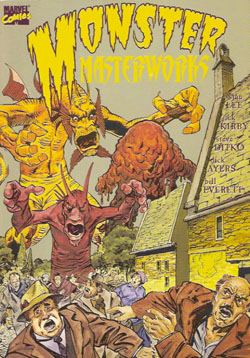
Monster Masterworks

Monster Masterworks

By Stan Lee, Jack Kirby, Steve Ditko, Dick Ayers & Bill Everett (Marvel)
ISBN: 0-8713-5592-2

To dyed-in-the-wool comic-book fanboys there’s a much beloved period in history when a frankly daft and woefully formulaic trend produced utter, joyous magic. We look back on it now and see only the magnificent art, or talk with loving derision of the crazy (often onomatopoeic) names, but deep down we can’t shake the exuberant thrill inside or the frisson of emotion that occurs when we see or even think of them.

Before Jack Kirby and Stan Lee brought superheroes back to Marvel Comics, the company was on its last legs. Trapped in a woefully disadvantageous distribution deal, the company’s output was limited to some sixteen titles. But there was hope. The outside world was gripped in an atomic B-movie monster craze, and Lee, Kirby and Steve Ditko capitalised on it in the anthology mystery titles Journey into Mystery, Strange Tales, Tales to Astonish and Tales of Suspense.

In brief novelettes, dauntless and canny humans outsmarted a succession of bizarre aliens, mad scientists, an occasional ghost or sorcerer (this was, after all, the heyday of the Comics Code Authority and the supernatural was BAD) and a horde of outrageous beasties in a torrent of wonders best described by the catchphrase “monsters-in-their-underpants”.

Simplistic, moralistic, pictorially experimental yet reassuringly predictable in narrative, these Outer Limits-style yarns are sheer fun with no redeeming social context.

This volume (culled from the 1970’s reprints of those 1950s classics) features such by-gone menaces as ‘Groot, the Monster from Planet X!’, ‘The Glop!’, ‘Taboo, the Thing from the Murky Swamp!’, ‘The Blip!’, The Creature from Krogar!’, ‘X – the Thing that Lived!’, ‘Kraa the Unhuman!’, ‘Zzutak – the Thing that Shouldn’t Exist!’, ‘Titan!’, ‘Gigantus!’, Fin Fang Foom and an inhuman host of others, that just cry out to be defeated, and by golly, they brilliantly are, without a single superhero in sight!

Humans – one, Monsters – didn’t.

© 1968-1973, 1989 2007 Marvel Characters Inc. All Rights Reserved.

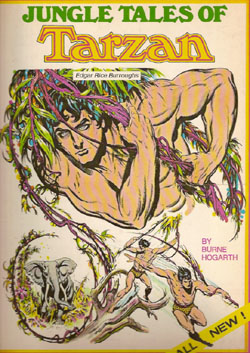
Jungle Tales of Tarzan

Jungle Tales of Tarzan

By Burne Hogarth (Watson-Guptill Publications)
ISBN: 0-8230-2576-4

Following his return to graphic narrative with his bravura adaptation of Tarzan of the Apes (ISBN: 0-600-38689-9) Burne Hogarth produced this adaptation of the short tales that formed the novel The Jungle Tales of Tarzan. The book is a series of episodes reminiscent of Kipling’s “Just So” stories, set before the first fateful meeting with Jane and his introduction to civilisation wherein the Lord of the Jungle confronts various cognitive stages in his own development.

If that sounds dry, it’s not. Edgar Rice Burroughs was a master of populist writing and his prose crackles with energy and imagination. With this book he was showing how the Ape-man’s intellectual progress was a metaphor for Man’s social, cerebral and even spiritual growth from beast to human. He also never forgot that people love action.

Hogarth was an intellectual – as the lengthy discussion of his graphic symbolism by Walter James Miller in the preface shows – and the four tales he adapted afforded him vast scope to explore the cherished perfect temple that was the Ideal Man. His flowing organic compositions are strengthened by the absence of colour, allowing the classicism of his line-work to create stark divisions of form and space that contribute to the metaphysical component of ‘Tarzan’s First Love’, ‘The Capture of Tarzan’, ‘The God of Tarzan’ and ‘The Nightmare’. But you don’t need a dictionary to enjoy this work; all you need are eyes to see and a heart to beat faster.

This is vital, violent motion, stretching, running, fighting, surging power and glory. This work needs to be back in print, if only to give comic lovers a thorough cardio-vascular work-out.

© 1976 Edgar Rice Burroughs, Inc. All Rights Reserved.

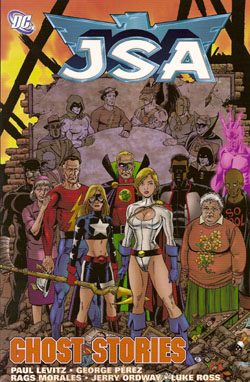
JSA: Ghost Stories

JSA: Ghost Stories

By Paul Levitz & various (DC Comics)
ISBN 1-84576-441-2

With the cancellation of the monthly comic book an open secret, sentiment seemed to prevail in the DC offices and veteran Justice Society scribe Paul Levitz returned to write the “final” story-arc of the original super-team, before the company wide reboot of the DC universe took permanent hold (Permanent being defined as “until we decide to change our minds again”).

Ghost Stories is a simpler tale from a more traditional perspective, and I suspect, produced for a die-hard audience like myself. It begins with Power Girl learning of and experiencing a 1950’s exploit of Superman and Batman involving the mysterious ‘Gentleman Ghost’. Drawn by George Perez and inked by Bob Smith, ‘Ghosts in the House’ is as much pastiche as prologue, and leads into the next chapter which fell under the umbrella of DC’s One Year Later relaunch.

When the spirits of the dead start appearing to modern day JSA-ers and their families, the heroes mobilise and soon confront the Gentleman Ghost who wants not only revenge but also to live again, which he can only achieve by killing the team. ‘Who’s Afraid of Ghosts?’, ‘When the Dead Call…’ and ‘…The Living Must Answer!’ are illustrated by Rags Morales and Dave Meikis, with flashback sequences by Luke Ross.

Long-time fan and fan-favourite Jerry Ordway returns to draw the series to a close in ‘Where the Highwaymen Rode…’ and ‘Ghost in the Castle’, with the plain, honest indomitable good-defeating-overwhelming-evil plot coming triumphantly together to close the current series in a deeply satisfying manner. This tense, action-packed old-fashioned romp is a fitting close to a possibly over-extended chapter in the long history of this greatest of super-teams. Although possibly not to everyone’s taste, this is a series with more highs than lows for the fan of costumed do-gooding.

© 2006 DC Comics. All Rights Reserved.

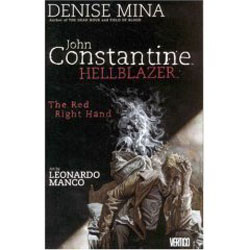
Hellblazer: The Red Right Hand

Hellblazer: The Red Right Hand

By Denise Mina & Leonardo Manco Green (Vertigo)
ISBN 1-84576-568-0

Continuing the epic saga begun in Empathy is The Enemy (ISBN 1-84576-382-3) (see previous review) Denise Mina and Leonardo Manco complete the horrendous storm of events created when a Christian sect accidentally contact an entity that abides in a third spiritual space neither Heaven nor Hell.

A plague of Empathy has infected Glasgow, and ordinary mortals cannot survive other people’s pain. An epidemic of suicides results in the quarantining of the city, but the soldiers policing the cordon will soon be the first new victims as the effect of the mystical Empathy Engine begin to spread.

Degenerate and dissolute trickster magician John Constantine and his dwindling band of resistors are trapped in the city, desperately striving to fix the problem before it goes global, but their resources, and time itself is running out…

Mina and Manco crafted a moody and awesomely daunting premise and carried it to a brilliant conclusion. That they fittingly end it all with an ideal solution that manages to be the wickedly last word in the centuries old rivalry between the Scots and the English is an absolute comedy masterstroke. In a long and varied career, John Constantine has seldom been better.

© 2006, 2007 DC Comics. All Rights Reserved.

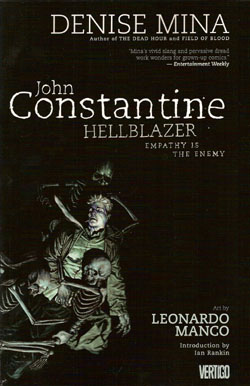
Hellblazer: Empathy is the Enemy

Hellblazer: Empathy is the Enemy

By Denise Mina & Leonardo Manco Green (Vertigo)
ISBN 1-84576-382-3

If a bloke came up to you in a pub and started telling you he felt things too intensely, you’d be pretty suspicious – nervous too, I’ll bet – and for all the right reasons. If you’re John Constantine those reasons include nasty black magic and the imminent destruction of humanity – as usual.

This empathy is crushing, overpowering and contagious. When the spiritually calloused magician gets a sobering dose of debilitating fellow-feeling, he returns to Glasgow with the overly emotional victim on the trail of a decidedly new kind of menace, but one that could spell the end of humanity, unless Constantine is prepared to make a supreme and wholly uncharacteristic sacrifice.

Novelist Denise Mina’s take on Hellblazer is both captivating and surprisingly fresh, and all without iconoclastically breaking the toy she’s been lent. Juggling human horrors such as abuse and isolation with ancient Christian cults, cosmic horrors from the outer dark, angry ghosts, hungry goblins and evangelical do-gooders she has crafted a subversively gripping thriller with a memorable punch and delightful charm. As ever Leonardo Manco’s moody illustration impresses by its subtle understatement.

A wonderful debut (originally published in issues #216-222 of the monthly comic-book), but the impatient might want to ensure that they have the sequel readily to hand before they start this compelling thriller…

© 2006 DC Comics. All Rights Reserved.

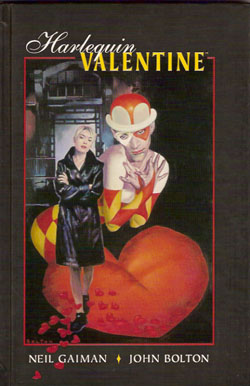
Harlequin Valentine

Harlequin Valentine

By Neil Gaiman & John Bolton (D H Comics)
ISBN: 1-84023-411-3

This pretty but slight romantic horror story features a modern spin on the Commedia dell’arte scenarios performed by the travelling players of Italy’s 15th century. If you’re interested in the details, the history of the art form – which can be traced back to ancient Greece, if not further – are readily researchable on the internet and in many, many books, but for our purposes the cast (archetypes for different characters, drives and philosophies) perform dramas of the most primal and human sort and resonance for the delectation of paying crowds, each in a highly proscribed and defined form. If you get this book there is a very useful Dummies guide by Gaiman at the back.

Possibly the most well known character today is Harlequin the clown (although Punch would come a close second if we still had Punch and Judy men) and this character opens our proceedings by telling we readers directly (in the accepted manner) that he is in love…

Missy is thoroughly modern lass, and her pursuit by the tricky, ruthless supernatural Harlequin makes for a clever exercise but is oddly lacking in passion for such a torrid subject. As ever John Bolton’s photo-realistic art is beautiful and technically brilliant, but it too seems devoid of any emotionalism. Is that perhaps the point? Am I missing something really obvious here?

I’m always happy to see any comic material that breaks out of the mould and these are two of the industry’s most high-profile creators. I’m just a little worried that this one isn’t as clever as it thinks, and after all, nobody likes a smart-ass or a show-off…

Harlequin Valentine™ © 2001 Neil Gaiman. Illustrations © 2001 John Bolton. All Rights Reserved.

Can’t Get No

Can't Get No

By Rick Veitch (Vertigo)
ISBN 1-4012-1059-7

The terrorist atrocity of September 11th, 2001 changed the world and in our own small corner, generated a number of graphic narrative responses of varying quality not to mention deep emotional honesty. Rick Veitch’s Can’t Get No is as powerful and heartfelt as any, but benefits also from a little time and distance.

Chad Roe’s company sold the world’s most permanent and indelible marker pen, the “Eter-No-Mark”. Everyone was flying high but then the lawsuits hit all at once. A cheap, utterly irremovable felt-pen is a godsend to street-artists and the most virulent graffiti weapon to building owners. As his universe collapses on him Chad goes on a bender, picks up two hippie-artist-chicks in a bar and wakes up a human graffiti, covered literally from head to toe in swirling, organic, totally permanent designs.

Even then he tries so very hard to bounce back. A walking abstract artwork, he is ostracized by mockery, unable to conceal his obvious “otherness”, and neither self-help philosophies, drugs, nor alcohol can make him feel normal again. Defeated, reviled and ultimately spiritually crushed, trapped in a downward spiral, he meets the girls again and find solace and uncomplicated joy in the artist’s world of sex, booze and dope. Lost to “normal” society, he goes on a road-trip with the women but they haven’t even left the city before they’re arrested. It is morning on September 11th. As the girls violently resist the policemen an airplane flies overhead, straight towards the centre of Manhattan…

With no-one looking at him, just another part of the shocked crowd, he watches for an eternity, and then no longer anything but another stunned mortal, he drives away with an Arab family in their mobile home.

And thus begins a psychedelic, introspective argosy through America’s philosophy, symbolism and meta-physicality. With this one act of terrorism changing the nation, Chad is forced on a journey of discovery to find an America that is newborn both inside and out. His travels take him through vistas of predictable cruelty and unexpected tolerance, through places both eerily symbolic and terrifyingly plebeian, but by the end of this modern Pilgrim’s Progress, both he and the world have adapted, accommodated and accepted.

Rick Veitch is a criminally undervalued creator, with a poet’s sensibilities and a disaffected Flower-Child’s perspectives informing a powerful social and creative consciousness – and conscience. Can’t Get No is landmark experiment in both form and content which deserves careful and repeated examination.

Black and white in a landscape format, and eschewing dialogue and personal monologues for ambient text (no word balloons or descriptive captions, just the words that the characters encounter such as signs, newspapers, faxes etc.) this graphic narrative screams out its differences to usual comic strip fare. But the truly magical innovation is the “text-track”, a continual fluid, peroration of poetic statements that supply an evocative counterpoint to the visual component.

Satirical, cynical, strident: Lyricism employed for examination and introspection, in perhaps occasionally over-florid, but nonetheless moving and heartfelt free verse and epigrams don’t make this an easy read or a simple entertainment. They do make it a piece of work every serious consumer of graphic narrative should attempt.

© 2006 Rick Veitch. All Rights Reserved.