Buster Brown

Early Strips in Full Color

Buster Brown

By Richard F. Outcault with an introduction by August Derleth (Dover Publications)
ISBN: 0-1-486-23006-6

Richard F. Outcault is credited with being the father (fans and historians are never going to stop debating this one, but Outcault is one of the prime-est contenders) of the modern comic strip with his creation The Yellow Kid for Joseph Pulitzer’s New York World in 1895 (the feature was actually entitled Hogan’s Alley). He was legendarily fickle and quickly tired of his creation, and of the subsequent features he created for William Randolph Hearst in the New York Journal during that period of bitter newspaper circulation warfare that gave rise to the term “Yellow Journalism”.

In 1902, he created a Little Lord Fauntleroy style moppet called Buster Brown, but the angelic looks concealed a boy perpetually wedded to mischief, pranks and poor decision making. Once again he quickly became bored and moved on, but this strip was another multi-media sensation, which captured public attention and spun off a plethora of franchises.

Buster was a merchandising Bonanza. By a weird circumstance, Buster Brown Shoes became one of the biggest chain-stores in America, and in later years produced a periodical comic book Premium (a giveaway magazine free to purchasers) packed with some of the greatest comic artists and adventure stories the industry had ever seen. Outcault may have dumped Buster, but the little darling never quit comics.

In this reproduction of a collection from 1904 entitled Buster Brown and his Resolutions, featuring fifteen glorious full colour strips from the first two years of the run, we meet the seemingly angelic Hellion and his faithful dog Tige, and see that if unfortunate happenstance doesn’t create chaos in the ordered and genteel life of the well-to-do Mr. and Mrs. Brown, little Buster is always happy to lend a hand. Each lavish page, rendered in a delightfully classical, illustrative line style – like Cruickshank or perhaps Charles Dana Gibson – ends with a moral or resolution, but one that is subversively ambiguous. As Buster himself says “People are usually good when there isn’t anything else to do.”

Historically pivotal, Buster Brown is also thematically a landmark in content, and a direct ancestor of the mischievous child strip that dominated the family market of the 20th century. Could Dennis the Menace (“Ours” or “Theirs”), Minnie the Minx or Bart Simpson have existed without Buster or his contemporary rivals The Katzenjammer Kids? It’s pointless to speculate, but it’s no waste of time to find and enjoy this splendid strip.

© 1974 Dover Publications. All Rights Reserved.

House

House

By Josh Simmons (Fantagraphics Books)
ISBN: 978-1-56097-855-8

A young man walks through the woods, until he sees a ramshackle old house. Outside he meets two young women and they strike up a conversation. Filled with high spirits they decide to explore the dilapidated old mansion.

The place is a wreck. As they cautiously move deeper into the vast manse the boy and blonde girl feel an attraction. When they discover that the back of the house has collapsed and is under water, forming an inviting pool, all three all dive in and play in the water.

In a submerged room the boy and the blonde share a kiss. The dark girl knows something has happened, that all the relationships have shifted. With a new tension they continue to explore, but nothing feels innocent now. And then the staircase collapses…

Josh Simmons has set himself a daunting task. This entire tale is told without words. Settings, scenario and character are established and the narrative undertaken purely by making pictures and by manipulating light and dark and panel and space.

The manner in which an idyll becomes a terrifying, crushing, tragic nightmare is powerful, seductive and truly overwhelming in its delivery. Simmons has succeeded in crafting a true graphic narrative, a thrilling story in a manner and with a force that no other medium could.

Silent, compelling, wonderful: This is a book no serious reader should ignore and no budding creator should miss.

© 2007 Josh Simmons. All Rights Reserved.

The Adventures of Jo, Zette & Jocko

MR. PUMP’S LEGACY
Part 1 of THE STRATOSHIP H.22

The Adventures of Jo, Zette & Jocko

By Hergé, translated by Leslie Lonsdale-Cooper & Michael Turner (Egmont UK)
ISBN 13: 978-1-4052-1245-8

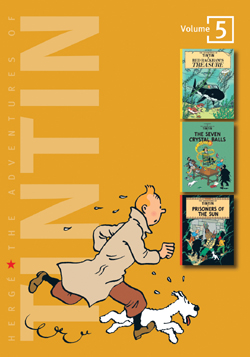
George Remi, world famous as Hergé, had a long creative connection to Catholicism. He had created Tintin at the behest of the Abbot Norbert Wallez, editor of the Catholic newspaper Le XXe Siécle, before moving on to such strips as the mischievous ‘Quick and Flupke’, ‘Tim the Squirrel in the Far West’, ‘The Amiable Mr. Mops’, ‘Tom and Millie’ and ‘Popol Out West’, all while continuing the globe-trotting adventures of the dauntless boy reporter and his faithful dog.

In 1935, between working on The Blue Lotus and The Broken Ear he was approached by Father Courtois, the director of the French weekly newspaper Coeurs Vaillants (‘Valiant Hearts’). The paper already carried Tintin, but Courtois also wanted a strip that would depict the solid family values and situations that the seemingly orphaned boy reporter was devoid of. He also presumably wanted something less subversive than the mischievous, trouble-making working-class boy rascals ‘Quick and Flupke’.

He needed a set of characters that would typify a good, normal family: A working father, a housewife and mother, young boy, a sister, even a pet. Apparently inspired by a toy monkey called Jocko, Hergé devised the family Legrand. Jacques was an engineer, and his son Jo and daughter Zette were average kids; bright, brave, honest, smart and yet still playful. Mother stayed home, cooking and being concerned a lot, and they had a small, feisty monkey for a pet – although I suspect as Jocko was tailless, he might have been a baby chimpanzee, which “As Any Fule Kno” is actually a species of ape.

The first adventure was ‘The Secret Ray’ which is not currently available in English. A ripping yarn of scientific bandits, gangsters, mad professors, robots and, regrettably, some rather ethnically unsound incidences of cannibal savages, this is very much a product of its time in too many respects. Although Hergé came to deeply regret (and wherever possible amend) his many early uses of that era’s racial stereotyping, the island dwelling natives in Le “Manitoba” Ne Répond Plus and L’ Éruption Du Karamako (which first ran in Coeurs Vaillants from January 19th 1936 to June 1937) will now always be controversial.

It’s a true pity that such masterful and joyous work has to be viewed with caution, read strictly in context and be ascribed subtext and values that simply weren’t intended, merely because the medium is pictorial and its meaning passively acquired rather than textual, and which can therefore only be decoded by the conscious effort of reading. I also wonder how much was a quiet, sensitive artist led by an aggressively proselytising, missionary Church’s doctrine and policy… How much Church opposition was there to Mussolini’s invasion of Ethiopia in October 1935 for example? And don’t get me started on Nazi Germany and the Vatican…

‘Mr. Pump’s Legacy’ is much less culturally and commercially troublesome. When septuagenarian millionaire-technocrat, speed-fiend (that’s velocity, not pharmacology) and adrenalin junkie John Archibald Pump, the “American Collar-Stud King” dies in a car crash (at 155 mph, so he probably went surprised but happy) he leaves a ten million dollar prize: The first person or persons to fly non-stop between New York and Paris at an average speed of 1000 kilometres per hour will secure said cash. But if nobody wins within one year the money will revert to his ne’er-do-well nephews.

The contest captures world imagination in the Age of Speed, and many try for the prize, including S.A.F.C.A., the aeronautical company that Jacques Legrand works for. Very soon both the engineer and his family become the targets of skulduggery and sabotage as his groundbreaking design gradually becomes a beautiful flying machine. Assaults, poison-pen letters and threats, murder attempts, blackmail and even kidnapping, nothing can stop the project whilst the canny Jo and Zette are there to foil them. Even when the completed plane is targeted by an aerial bombardment, the resourceful children have a solution. Starting the plane, they fly away from the bomber, but become lost in the night and clouds.

With their fuel almost exhausted they spot a tiny island in a vast sea and manage to land the plane safely. How can they return the ship in time to win the Prize? Without food, water, fuel or any idea where they are, can they survive long enough to be found?

Combining all-ages thrills and slap-stick comedy with magical art and superb designs, the masterful Hergé, a creator rapidly reaching the peak of his powers, has produced in this cliff-hanging volume of adventure a lost classic, and one worthy of much greater public attention. With Christmas looming it could be the best £6.99 you’ll spend this year…

© 1951, 1979, 2007 Editions Casterman, Paris& Tournai. All Rights Reserved.
English text © 1987, 2005 Egmont UK Limited. All Rights Reserved.

Star Trek: The Next Generation — The Gorn Crisis

Star Trek: The Next Generation — The Gorn Crisis

By Kevin J. Anderson, Rebecca Moesta & Igor Kordey (WildStorm)
ISBN 1-56389-754-7

The Star Trek franchise has had many comic book homes. This effort published by DC/WildStorm is set during the period when Deep Space 9 was being broadcast and tangentially informs the seasons-long storyline that featured an intergalactic war between the Federation and its Alpha Quadrant allies on one side and the J’em Haddar warriors of The Dominion on the other.

The Gorn are an aggressive civilisation of Reptiles who appeared in an episode of the original 1960s TV show. It was an adaptation of a classic SF short story by Fred Brown entitled “Arena”, in which Captain Kirk and his Gorn opposite number are selected by a super-advanced race to represent their species in a duel for galactic supremacy. The loser race would be curbed to avoid horrendous and bloody space-war.

A century later the Federation is at war with the Dominion and desperate for allies. Jean-Luc Picard has been dispatched to the Gorn planet to broker an alliance, but the USS Enterprise arrives just as the reptile’s Warrior Caste stages a bloody coup and launches an all-out attack on neighbouring worlds. The way in which Picard, Riker, and all the Next Generation stalwarts act to quell the uprising won’t just dictate how the humans and reptiles will co-exist in the future, it might well decide if they exist at all…

Although not to everybody’s taste, and despite a certain rough hesitancy in Igor Kordey’s fully painted artwork, not to mention a somewhat perfunctory script, this tale does rattle along in the manner Star Trek fans would hope for, and even casual readers will come away with a sense of expectation fulfilled.

© 2000 Paramount Pictures. All rights reserved.

Hellblazer: Hard Time

Hellblazer: Hard Time

By Brian Azzarello & Richard Corben (Vertigo)
ISBN 1-84023-255-2

John Constantine is many things: Magician, con-man, world-saver, hero, villain, thief. He’s a chain-smoker who’s tricked the doctors and the Devil, but can’t ever seem to keep a friend. Not as friends and usually not even alive. He’s walked through a world of death and horror, leaving a clear trail of bloody footprints.

So when he ends up in a grim high security jail in the USA, nobody’s surprised. But in a universe of deadly men and extreme factionalism nothing can cow him and nobody can divine his intentions.

The brutal cage-behaviour of deadly men with nothing to lose is as nothing to the subtle horror of John Constantine unleashed and teaching scum what intimidation and punishment really means…

Brian Azzarello and alternative comics legend Richard Corben plumb the darkest depths of humanity in this savage prison drama, blending mystery, thriller and horror genres and presenting a compelling example of just how nasty a comic-book can get.

Superb storytelling, but not for the faint-hearted, easily shocked or under-aged.

© 2001 DC Comics. All Rights Reserved.

Chronicles of Conan vol 2: Rogues in the House

Chronicles of Conan vol 2: Rogues in the House

By Roy Thomas & Barry Windsor-Smith (Dark Horse Books)
ISBN: 1-84023-785-6

The second Dark Horse collection of Marvel’s 1970’s Conan epics covers a period when the character had taken the comics world by storm, and features two creators riding the crest of a creative wave. Reprinting issues #9-13 and #16 of the monthly comic-book this volume opens with ‘Garden of Fear’, adapted by Thomas and Smith, with inks by Sal Buscema from the short story by Robert E. Howard, a battle with an antediluvian survivor in a lost valley.

Returning to the big city, our hero must ‘Beware the Wrath of Anu!’, another Howard tale, as is the eponymous ‘Rogues in the House’, an early masterpiece of action and intrigue. ‘Dweller in the Dark’ is an all original yarn of monsters and maidens, notable because artist Barry Smith inked his own pencils, and indications of his detailed fine-line illustrative style can be seen for the first time. Fantasy author John Jakes plotted ‘Web of the Spider-God’, a sardonic tale of the desert scripted by Thomas and inked by Buscema.

Chronologically, a two part team-up guest-starring Michael Moorcock’s Elric of Melniboné should follow but that’s held in abeyance and this book concludes with ‘The Frost Giant’s Daughter’, a haunting, racy tale written by Howard and originally adapted in black and white for Savage Tales #1.

This was an early attempt to enter the more adult magazine market, and when the story was reprinted in Conan #16, Smith’s art had to be censored to obscure some female body parts that youngsters might be corrupted by. Even so it’s still a beautiful pencil and ink job by Smith. It was also supposedly his last as he quit the series with that issue.

These re-mastered issues are a superb way to enjoy some of American comics’ most influential – and enjoyable moments. They should have a place on your bookshelf.

©1971-1972, 2003 Conan Properties International, LLC. All Rights Reserved.

Captain Marvel: First Contact

Captain Marvel: First Contact

By Peter David, ChrissCross & various (Marvel Comics)
ISBN 0-7851-0791-6

This character has one of the most convoluted back stories in comics so if you are unfamiliar with him this might be a tad confusing for a first exposure, but light, fun super-hero comics are rare, so it is worth considering.

Captain Marvel was a soldier for a pan-galactic civilisation called the Kree. He was dispatched to Earth on a reconnaissance mission after the Fantastic Four destroyed a robotic Kree Sentinel left on Earth thousands of years previously. Adopting an Earth identity he spied on mankind but became increasingly disenchanted by Kree Imperialism and “went native”, becoming one of Earth’s greatest heroes.

Due to a cosmic accident his atoms were merged with professional sidekick Rick Jones. Only one of them could occupy space in our universe at a time, whilst the other was suspended in the anti-matter dimension called the Negative Zone. By striking together the “Nega” wristbands they each wore one could trade atoms with the other and live part of a single existence. Eventually they escaped their fate and separated. After saving the world and the universe a few times Captain Marvel died.

After his death his lover used his genetic material to create a son, named Genis (or sometimes Legacy) and he ultimately acquired the Negabands and inherited the title. He also found himself bonded to the cosmically unlucky Jones in the same situation his father had to endure – switching atoms and leading half a life. This incarnation devolves directly out of Avengers Forever (ISBN: 0-7851-0756-8) and reprints issues #0 and 1-6 of the third volume of the monthly comic – I said it was confusing, right? Now read on…

Bonded together, Jones and Genis are currently back on Earth and trying to reach an accommodation but the “Cosmically-Aware” hero is battling menaces and monsters that no-one can see, and the resultant collateral destruction is making the wrong sort of headlines. Either that or Genis is delusional and a menace himself…

There are guest appearances by The Hulk, Moondragon, Drax the Destroyer, and the Micronauts in a light-hearted and very funny string of adventures from Peter David, ChrissCross, Ron Lim, James Fry, Walden Wong, Mark McKenna and Nelson Decastro, and although this really is a treat for long-time fans with a good grounding in Marvel Minutiae, the determined neophyte might be rewarded with a hearty laugh and some angst-free thrills.

This volume includes a brief recap-cum-scorecard section so newbies might feel it’s worth a shot…

© 1999, 2000 2001 Marvel Characters, Inc. All Rights Reserved.

Tom Strong Book 3

Tom Strong Book 3

By various (America’s Best Comics)
ISBN 1-84576-148-0

A light touch is something sadly scarce in super-hero comics these days, so the third compilation of Science’s Ultimate Hero (collecting issues # 15-19 of the monthly comic-book) is a welcome distraction as it features a few old friends and foes – and plots. ‘Ring of Fire’ by Moore and Sprouse with inking by Karl Story sees the living volcano-man Val Var Garm entice the strong Family into his under-Earth city before joining them on a more formal basis as Tesla’s live-in boyfriend (see Tom Strong Book 2 for more information and thrills).

A three eyed galactic drifter then turns up just ahead of a three part Alien Invasion in a tale first hinted at in ‘Lost Mesa’ (Book 2 again). Summoning all the help they can the heroes head for interplanetary space to destroy an armada of giant ants in ‘Some Call Him the Space Cowboy’ and ‘The Weird Rider: Gone to Croatoan’, ‘Ant Fugue’ and ‘The Last Round-up’ all by Moore, Sprouse and Story.

The follow-up was another short-stories issue with Howard Chaykin illustrating Moore’s adventure of Sexual Impolitics in ‘Electric Ladyland!’, Leah Moore, Shawn McManus and Steve Mitchell reviewed the last moments of arch-villain Paul Saveen in ‘Bad to the Bone’ and Alan, Chris and Karl close the book with surreal fourth-wall-ery as Tom and Tesla become trapped inside a comic-book in ‘The Hero-Hoard of Horatio Hogg!’

With an extended section of pin-ups, this knowing, clever pastiche of a simpler time in comics is a fine way to reminisce with some thing new.

© 2005 America’s Best Comics, LLC. All Rights Reserved.

Simpsons Comics A Go-Go

Simpsons Comics A Go-Go

By Various (Titan Books)
ISBN: 1-84023-151-3

Here’s another knowing laugh-fest culled from the pages of the Simpsons comic book (featuring material originally printed in issues# 10 and #32-35). ‘Rhymes and Misdemeanours’ (by Jeff Rosenthal, Tim Bavington, Stephanie Gladden, Phil Ortiz, Bill Morrison, Jeannine Black and Nathan Kane) is a sly and sarcastic pastiche of Beat Poets and Young Love as Lisa and portly intellectual Martin Prince are gripped in a savage war of sonnets and odes when poetry becomes a spectator sport at McBeans Coffee House.

Scott M. Gimple scripts the wonderful alternate unreality tale ‘The Great Springfield Frink-Out’ as the outlandish Professor Frink screws up the multiverse in a tale drawn, inked, lettered and coloured by Ortiz, Bavington, Black and Kane. ‘Burnsie on Board’ by Rob Hammersley, Gladden, Eric Tran, Tim Harkins, Black and Kane reveals how the parsimonious Mr. Burns develops some sporting spirit when he buys the Winter Olympics, and ‘To Live and Diaper in Springfield’ is the saga of how the monumental “Krusty’s Kids DayKare” monopoly was challenged by Mrs. Simpson’s homely little “Marge’s Charges”. The reckless baby-endangerment gags are courtesy of Billy Rubenstein, Ortiz, Bavington, Black and Kane.

The last long story is a tasteless tale of smuggling, tax-evasion and cheap gratification as Homer and family “win” a holiday from Mr. Burns. ‘Fan-Tasty Island’ is by Rosenthal, Luis Escobar, Bavington, Morrison, Robert Kramer, David Mowry, Richard Starkings Comicraft, Nathan Kane and Electric Crayon. Also included are the short features ‘Principal Skinner’s Bottom 40’, ‘Tiger-Teen’ (a magazine feature on those Barbershop heavyweights the Be Sharps) and the ‘Simpsons Supporters’ Suggestion Spin Cycle’ with Ian Boothby, Dan Studley, Jim Lincoln and Chris Ungar accompanying previous culprits in the creative mayhem. As ever Matt Groening takes the final blame for all the hilarity and offence in this sharp, funny and thoroughly enjoyable spin-off book.

© 1992, 1995, 1997, 1998, 2000 Bongo Entertainment, Inc. All rights reserved.

Ultimate Spider-Man, Vol 2: Learning Curve

Ultimate Spider-Man, Vol 2: Learning Curve

By Brian M. Bendis, Mark Bagley & Art Thibert (Marvel)
ISBN: 0-7851-0820-3

After Marvel’s problems of the mid 1990s, the company came back swinging, and one new concept was the remodelling and modernising of their core characters for the new youth culture. The ‘Ultimate’ imprint abandoned the monumental continuity that had been Marvel’s greatest asset and the company’s major characters were given a separate universe to play in and makeovers to appeal to a contemporary, 21st century audience.

Puberty is hard enough for anybody, but if you’re the high school science geek, every bully’s target of choice, suddenly the man-of-the-house and soon-to-be-breadwinner, life is horrible. Compound that with the suspicion that the Most Beautiful Girl in the World might have the hots for you – or might not – and that you’re a superhero driven by overwhelming guilt to risk your life fighting monsters and super-villains every chance you get, and what you have is the second collection of the other, newer Peter Parker: Spider-Man.

Highlights in this highly readable tome include Peter getting a job at the Daily Bugle, Aunt May’s attempt at the “Birds and Bees” talk with her hapless nephew, Mary Jane’s reaction to learning one of Peter’s secrets and of course the Die Hard-inspired assault on the overlord of crime’s skyscraper fortress as Spiderman tries to destroy the Kingpin of Crime.

The early incorporation of old Spidey foes such as The Enforcers and Kingpin into the new mythos was a canny move. Neither is as outlandish as many old villains and at the start establishing the hero as the most uncanny element was important. Even the inclusion of Electro was low key, and his costuming restrained. Using Crime rather than World Conquest kept the fantasy realism intact. But soon enough the baroque nature of superheroes will be straining at sensibilities and credibilities again…

This is a sharp, credible effort to make a teen icon relevant again and a funny, thrilling read for the old and jaundiced.

© 2000, 2001 Marvel Characters, Inc. All Rights Reserved.