Papyrus volume 1: The Rameses’ Revenge


By Lucien De Gieter, translated by Luke Spear (Cinebook)
ISBN: 978-1- 905460-35-9

British and European Comics have always been keener on historical strips than our American cousins, and the Franco-Belgian contingent in particular have made an art form out of combining the fascinations of past lives with drama, action and especially broad humour in a genre uniquely suited to beguiling readers of all ages and tastes.

Papyrus is the astoundingly addictive magnum opus of Belgian cartoonist Lucien de Gieter. Launched in 1974 in legendary weekly Le Journal de Spirou, it eventually ran to 35 collected albums and spawned a wealth of merchandise, a TV cartoon series and video games.

De Gieter was born in Etterbeek, Belgium on September 4th 1932 and, after attending Saint-Luc Art Institute in Brussels, worked as an industrial designer and interior decorator before moving into comics in 1961.

Initially he worked on inserts (fold-in half-sized-booklets known as ‘mini-récits‘) for Spirou, such as the little cowboy Pony, and produced scripts for established Spirou creators such as Kiko (Roger Camille), Jem (Jean Mortier), Eddy Ryssack and Francis (Bertrand). He then joined Peyo’s (Pierre Culliford) studio as inker on Les Schtroumpfs – which you’ll know as The Smurfs – and soloed as latest creator on long-running newspaper comic cat strip Poussy.

After originating mermaid strip Tôôôt et Puit in 1966 and seeing Pony graduate to the full-sized pages of Spirou in 1968, De Gieter relinquished his Smurfs gig, but kept himself busy producing work for Le Journal de Tintin and Le Journal de Mickey. From 1972-1974 he assisted Flemish cartooning legend Arthur Berckmans (AKA Berck) on comedy science-fiction series Mischa for the German Rolf Kauka Studios anthology magazine Primo, whilst preparing the serial which would occupy his full attention – as well as that of millions of avid fans – for the next four decades.

The annals of Papyrus encompass a huge range of themes and milieu; mixing Boy’s Own adventure with historical fiction, fantastic action and interventionist mythology. The enthralling Egyptian epics gradually evolved from standard “Bigfoot” cartoon style and content to a more realistic, dramatic and authentic iteration. Each tale also deftly incorporated the latest historical theories and discoveries into the beguiling yarns.

Papyrus is a fearlessly forthright young fisherman favoured by the gods who rises against all odds to become an infallible champion and friend to Pharaohs. As a youngster the plucky Fellah (peasant or agricultural labourer, fact fans) was singled out and given a magic sword courtesy of the daughter of crocodile-headed Sobek before winning similar boons and blessings from many of the Twin Land’s potent pantheon.

The youthful champion’s first accomplishment was liberating supreme deity Horus from imprisonment in the Black Pyramid of Ombos and restoring peace to the Double Kingdom, but it was as nothing compared to his current duties: safeguarding Pharaoh’s wilful, high-handed and insanely danger-seeking daughter Theti-Cheri – a dynamic princess with an astounding knack for finding trouble …

The Rameses’ Revenge is actually the seventh collected album, originally released on the Continent in 1984 as La Vengeance des Ramsès and finds Papyrus en route to the newly finished temple at Abu-Simbel on a royal barge; part of a vast flotilla destined to commemorate the magnificent Tomb of Rameses II.

Although his sedate Nile journey is plagued with frightful dreams, great friend and companion Imhotep tells him not to worry. Nevertheless, the boy hero dutifully consults a priest and is deeply worried when the sage declares the dreams are a warning…

That tension only grows when headstrong, impatient Theti-Cheri informs him that she has permission to go on ahead of the Pharaoh’s retinue in a small, poorly-armed skiff. Unable to dissuade her, Papyrus is furious when she imperiously orders him to remain behind. As they set off, the Princess and Imhotep are blissfully unaware that a member of her small guard has been replaced by a sinister impostor…

The vessel is well underway before they discover Papyrus has stowed away, but before the furious girl can have him thrown overboard, the boat is hit by an implausibly sudden storm and attacked by a pair of monsters.

Although boy hero Papyrus valiantly drives them away with his sword, Theti-Cheri sees nothing, having been knocked out in the storm. Still seething, she refuses to believe him or Imhotep and orders the expedition onward to Abu-Simbel. The next morning Papyrus and the guards are missing…

Pressing on anyway, the Princess and her remaining attendants reach the incredible edifice only to be seized by the band of brigands who have captured it. They want the enormous treasure hidden within the sprawling complex and already hold Papyrus prisoner.

If Theti-Cheri or the hostage Temple Priests won’t hand over the booty, the boy will die horribly…

The repentant Princess cannot convince the clerics to betray their holy vows, however, and in desperation declares that she will surrender herself instead. Appalled and moved by her noble intention, High Priest Hapu determines that only extreme measures can avenge the bandits’ sacrilegious insult and calls on mighty Ra to inflict the vengeance of the gods upon them…

The astounding, spectacular, terrifying result perfectly concludes this initial escapade and will thrill and delight lovers of fantastic fantasy and bombastic adventure.

Papyrus is another superb addition to the all-ages pantheon of continental champions who combine action and mirth with wit and charm, and even though UK publisher Cinebook haven’t released a new adventure since The Amulet of the Great Pyramid in 2015, anybody who has worn out their cherished Tintin, Spirou and Fantasio, Lucky Luke and Asterix collections would be well rewarded by checking out the six epic volumes still available (in paperback or eBook editions) and even harassing the publishers to start translating the rest of the fantastic canon…
© Dupuis, 1984 by De Gieter. All rights reserved. English translation © 2007 Cinebook Ltd.

Sgt. Fury and His Howling Commandos Masterworks volume 2


By Stan Lee & Dick Ayers, with George Roussos, Steve Ditko, Frank Giacoia, Vince Colletta, Chic Stone, Carl Hubbell & various (Marvel)
ISBN: 978-0-7851-2928-8 (HB)

Sgt. Fury and his Howling Commandos began as an improbable, decidedly over-the-top and raucous WWII combat comics series similar in tone to later ensemble action movies such as The Magnificent Seven, The Wild Bunch and The Dirty Dozen. The surly squad of sorry reprobates premiered in May 1963, one of three teams concocted by men-on-fire Jack Kirby & Stan Lee to secure fledgling Marvel’s growing position as a publisher to watch.

Two years later Fury’s post-war self was retooled as the big-name star of a second series (beginning with Strange Tales #135, August 1965) when espionage shows like The Man from U.N.C.L.E. and the 007 film franchise became global sensations.

Nick Fury, Agent of S.H.I.E.L.D. combined Cold War tensions with sinister schemes of World Domination by subversive all-encompassing hidden enemy organisations: with captivating super-science gadgetry and iconic imagineering from Jack Kirby and Jim Steranko.

For all that time, however, the original wartime version soldiered on (sorry: puns are my weapon of choice), blending a uniquely flamboyant house-bravado style and often ludicrous, implausible, historically inaccurate, all-action bombast with moments of genuine heartbreak, unbridled passion and seething emotion.

Sgt. Fury started out as a pure Kirby creation. As with all his various combat comics, The King made everything look harsh and real and appalling: the people and places all grimy, tired, battered yet indomitable.

The artist had served in some of the worst battles of the war and never forgot the horrific and heroic things he saw – and more graphically expressed in his efforts during the 1950s genre boom at a number of different companies. However, even at kid-friendly, Comics Code-sanitised Marvel, those experiences perpetually leaked through onto his powerfully gripping pages.

Kirby was – unfortunately – far too valuable a resource to squander on a simple war comic (or indeed the X-Men and Avengers: the other series launched in that tripartite blitz on kids spending money) and quickly moved on leaving redoubtable fellow veteran Dick Ayers to illuminate later stories, which he did for almost the entire run of the series (95 issues and Annuals) until its transition to a reprint title with #121 (July 1974). The title then carried on until its ultimate demise in December 1981 with #167.

Following an enticing and revelatory reminiscence from Ayers in his Introduction, this second hardback and eBook compendium re-presents the contents of Sgt. Fury and his Howling Commandos #14-23 and the first Annual (collectively spanning January to October 1965) opening with a Lee scripted, George Roussos/Bell inked milestone as harassed Adolf Hitler decrees the creation of a Nazi answer to Fury’s elite attack force.

All ‘The Blitzkrieg Squad of Baron Strucker!’ had to do was lure the Howlers to a V2 rocket base and spring their trap… Yeah, that was all…

Regular supplemental feature Weapons of War then provides all the gen on the ‘B-26 Martin Marauder’ to inform and entertain in equal amounts.

Steve Ditko stepped in to ink Ayers in issue #15 as ‘Too Small to Fight, Too Young to Die’ related an ill-fated mission in Holland to destroy the dykes and flood the occupation forces. The job soon goes drastically wrong and the Howlers “flee” back to Britain with nothing but a broken-hearted boy named Hans Rooten – who had no idea that his despised quisling father was in fact the Allies’ top spy in the region…

The boy is adopted as the Howlers’ plucky mascot but can’t accompany them when the squad is despatched to Africa in #16 to eradicate yet more Nazi super-weapons in ‘A Fortress in the Desert Stands!’ (inked by Frank Giacoia using the pseudonym Frankie Ray). From there it’s only a short camel-ride south until the ragtag rovers encounter spear-wielding natives and nasty Nazis engaged in a battle of Hearts & Minds ‘While the Jungle Sleeps!’ (by Lee, Ayers & Vince Colletta).

All this time the chalk-and-cheese romantic relationship between Nick and English aristocrat Lady Pamela Hawley had been developing to the point where the Yankee lout was ready to propose. That all ends in #18 when, whilst the unit is busy sinking a German battleship in a Norwegian port, she is ‘Killed in Action!’ (Chic Stone inks).

Crushed and crazy, Fury goes AWOL in the next issue, remorselessly hunting down the leader of the bomber flight which had targeted the hospital she worked in before extracting ‘An Eye for an Eye!’ in a satisfyingly shocking Stan Lee story sensitively rendered by Ayers & Giacoia. The Howlers go along for the ride, but whether to help their leader or hold him back is debatable…

A far grimmer Fury is still in the mood for cathartic carnage in #20, so when ‘The Blitz Squad Strikes!’ features the German Kommandos invading a Scottish castle filled with imprisoned Nazi airmen, he and the Howlers are more than delighted to lead the sortie to retake it.

In the next issue the long-running rivalry with First Attack Squad; Baker Company again results in frantic fisticuffs before being interrupted by another last-ditch rescue mission in Czechoslovakia ‘To Free a Hostage!’ (inked by Golden Age legend Carl Hubbell, as was the next issue).

However, even after Allied scientist and captive daughter are reunited, the bubbling beef with B Company doesn’t diminish and when both units are subsequently sent to sabotage the oil refinery at Ploesti the defending forces capture everybody. However, after the gloating Nazis try making Fury and his opposite number to kill each they quickly learn ‘Don’t Turn Your Back on Bull McGiveney!’ and even Strucker’s Blitz Squad can’t contain the devastating destruction that follows…

The final WWII exploit contained herein is the Giacoia-inked saga of ‘The Man Who Failed!’, wherein a rescue jaunt to Burma to save nuns and orphans results in shameful revelations from English Howler Percy Pinkerton‘s past: simultaneously supplying close insight into why our True Brit upper lips are so stiff…

This combat compendium then concludes with the 15-page lead story from Sgt. Fury and his Howling Commandos King Size Annual #1 (1965) as the post-war Howlers are called up and mustered to the 38th Parallel to defend democracy from Communist aggression. This particular escapade sees them rescuing former Commanding Officer Colonel Sam Sawyer and results in Fury winning a battlefield ‘Commission in Korea!’ to at last become a Lieutenant in a rousing romp by Lee, Ayers & Giacoia. Also extracted from that that might special are pictorial features ‘A Re-introduction to the Howlers’; ‘A Birds Eye View of HQ, Able Company – Fury’s Base in Britain’; ‘Plane’s-Eye View of Base Tactical Area, Sub-Pen, Dock and Air-Strip!’ and ‘Combat Arm and Hand Signals’ before a 2-page house ad feature for the hero’s super-spy iteration as ‘Nick Fury, Agent of S.H.I.E.L.D.’ wraps everything up in Marvel’s military fashion.

Whereas close rival DC increasingly abandoned the Death or Glory bombast at this time in favour of humanistic, almost anti-war explorations of war and soldiering, Marvel’s take always favoured action-entertainment and fantasy over soul-searching for ultimate truths. On that level at least, these early epics are stunningly effective and galvanically powerful exhibitions of the genre.

Just don’t use them for history homework.
© 1965, 2017 Marvel Characters Inc. All rights reserved.

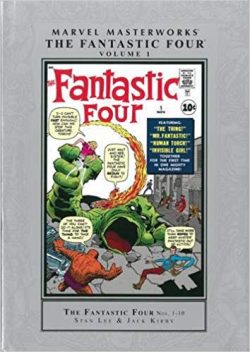
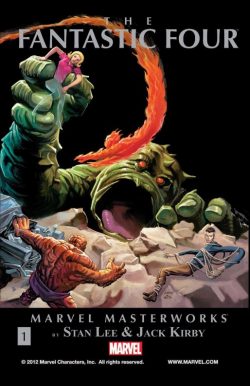
Fantastic Four Marvel Masterworks volume 10


By Stan Lee, Jack Kirby, Joe Sinnott, Frank Giacoia, John Romita, Ron Frenz, John Verpoorten & various (Marvel)
ISBN: 978-0-7851-2061-2 (HB)                    : 978-0-7851-8839-1 (TPB)

Cautiously bi-monthly and cover-dated November 1961, Fantastic Four #1 (by Stan Lee, Jack Kirby, George Klein & Christopher Rule) was crude: rough, passionate and uncontrolled excitement. Thrill-hungry kids pounced on it and the raw storytelling caught a wave of change starting to build in America. It and succeeding issues changed comicbooks forever.

In eight short years FF meteorically grew into the indisputable core-title and most consistently groundbreaking series of Marvel’s ever-unfolding web of cosmic creation: bombarding readers with a ceaseless salvo of new concepts and characters at a time when Kirby was in his conceptual prime and continually unfettering his vast imagination on plot after spectacular plot. Clearly inspired, Stan Lee scripted some of the most memorable superhero sagas Marvel – or any publisher, for that matter – had or has ever seen.

Both were on an unstoppable roll, at the height of their creative powers, and full of the confidence that only success brings, with The King particularly eager to see how far the genre and the medium could be pushed…

However, with this tenth Masterworks collection of tales from “The World’s Greatest Comics Magazine” the dream-team of Kirby and Stan Lee was shockingly sundered and a reeling Marvel entered a new epoch of uncertain futures and bold new directions – which is rather ironic since it was the company’s reticence to give the artist creative freedom which led to Kirby’s jumping ship to National/DC in the first place…

This epic and extras-packed tome covers the final days of the King’s reign on Marvel’s flagship title and encompasses the shaky start of a new era, covering Fantastic Four #94-104 (January to November 1970), plus diverse bonus treats including Fantastic Four: The Lost Adventure – a rejected, recovered, recycled tale to delight all aficionados and only finally released in April 2008.

Four Those Who Came in Late: As seen in that unforgettable premier issue, maverick scientist Reed Richards, his fiancé Sue Storm, their close friend Ben Grimm – with Sue’s tag-along teenaged brother Johnny – survived an ill-starred private space-shot after Cosmic Rays penetrated their ship’s inadequate shielding and mutated them all.

Richards’ body became elastic, Sue gained the power to turn invisible and the kid could turn into living flame, but poor, tragic Ben horrifically devolved into a shambling, rocky freak…

Following another frothy, backward-looking Lee Introduction, the magic resumes with Joe Sinnott inking Fantastic Four #94, launching a string of single-issue stories via the doom-laden debut of eldritch babysitter/governess Agatha Harkness in ‘The Return of the Frightful Four!’ The recalcitrant rogues make a major mistake believing they could catch the FF off-guard by attacking when the heroes are interviewing a new nanny for the latest addition to the Fantastic Family…

At a time when superhero sales were in a slump and magical mystery themes resurgently returned, this rollercoaster ride of action, battle and suspense is most significant for finally giving Sue and Reed’s baby a name – Franklin Benjamin Richards – after literally years of shilly-shallying…

The Monocle was a technological super-assassin determined to trigger global nuclear Armageddon in #95’s ‘Tomorrow… World War Three!’ – in the middle of which Johnny’s Inhuman girlfriend Crystal is astoundingly abducted by her own family – before ‘The Mad Thinker and his Androids of Death!’ (inked by Frank Giacoia) once again ambush the team and yet more prove no match for the fab foursome…

A tense and moody episode further cashing in on the growing trend for creepy creatures and supernatural shenanigans manifests as ‘The Monster from the Lost Lagoon!’ in #97, offering a decidedly different take on the horror-movies it gloriously homaged as the First Family try to combine a quick tropical vacation with a little rumour-busting sea-beastie hunt…

Both Sinnott and the robotic Sentry Sinister return in #98’s turbulently-topical ‘Mystery on the Moon!’ as the global fervour over the first lunar landing in 1969 (conveniently forgetting, of course, the FF’s own numerous visits to our satellite beginning with issue #13) results in a cracking yarn wherein the team savagely stymie the intergalactic Kree Empire from sabotaging mankind’s first steps into space.

In FF #99 heartsick Johnny Storm at last snaps, invading the hidden home of the Inhumans. His intent is to reunite with his lost love at all costs, but of course tempers fray, everything escalates and ‘The Torch Goes Wild!’…

With a restored Crystal happily in tow, the 100th anniversary adventure features a daft, extremely rushed but nonetheless spectacular all-out battle against robotic replicas of their greatest enemies in ‘The Long Journey Home!’

With the anniversary cataclysmically concluded, issue #101 provides a far more intriguing imbroglio when dastardly criminal combine the Maggia buy the team’s skyscraper HQ in a cunning, quasi-legal ploy to appropriate Reed Richards’ scientific secrets, resulting in total ‘Bedlam in the Baxter Building!’

Fantastic Four #102 sported the first cover not drawn by The King as John Romita (senior) prepared to jump into the artistic hot-seat following Kirby’s abrupt move to the home of Superman, Batman and Wonder Woman.

After an incomprehensibly vast catalogue of creativity an unthinkable Changing of the Guard occurred when the increasingly discontented King of Comics jumped ship from the House of (mostly His) Ideas for arch-rival National/DC where he crafted his Fourth World Magnum Opus as well as a host of other game-changing comicbook classics…

An era ended at Marvel when the King abdicated his seemingly divinely-ordained position. Left to pacify and win back the stunned fans were Lee and a couple of budding talents named Romita and Buscema…

Kirby was not quite gone, however, as he and Sinnott opened an impressive extended epic wherein the mutant menace Magneto uses guile and subterfuge to turn ‘The Strength of the Sub-Mariner’ and his undersea armies against the FF and entire surface world…

Romita and inker John Verpoorten took over the story in mid-flow, depicting an embattled America ‘At War with Atlantis!’ before malign Magneto inevitably turns on Namor, inspiring the Prince to ally with the Fantastic Four to prevent the mutant’s dream of ‘Our World… Enslaved!’…

That was more or less the end. Romita drew a couple more issues and eventually John Buscema took up the challenge, although a later issue baffled us fans by inexplicably pairing the new artist with a somehow returned Kirby…

Fantastic Four #108 contained ‘The Monstrous Mystery of the Nega-Man!’, “reintroducing” a character never before seen by recycling portions of a near-complete but rejected Kirby tale modified with new sequences illustrated by Buscema and Romita. In the published story (not included in this volume) the mysterious Janus had tapped into the anti-matter power of the Negative Zone once and now “returned” to steal more by crashing through the portal in Reed’s lab. Unfortunately, this attracts the attention of extinction-event predator Annihilus, who had long sought entry into our life-rich universe…

The origins of that yarn are convoluted and circuitous but are eruditely explained by archivist John Morrow in his article ‘Fantastic Four #108: Kirby’s Way’, supplemented by (almost) the entire original story reproduced from photostats of Kirby’s pencils and published pages from #108.

In 2007 those fragments and Kirby’s story notes were used by Lee, Joe Sinnott and Ron Frenz to reconstruct the tales as the King drafted it. The result was ‘Fantastic Four: The Lost Adventure’ which offered a glorious slice of times past as the team (circa 1970) tackled a seemingly schizophrenic super-villain in ‘The Menace of the Mega-Men!’

It doesn’t really fit anywhere into continuity but it is a superbly nostalgic rush for devotees of the classics…

Rounding out the Kirby Kommemorations are a selection of testimonials, recollections and retrospective reminiscences from past collaborators, including ‘Inspiration by Dick Ayers’; ‘On, and On! by Joe Sinnott’ and ‘The Fall of ’61’ by Roy Thomas, complete with contemporary photos, before former Kirby assistant and associate Mark Evanier discusses ‘The World’s Greatest Comics Magazine’ and Greg Theakston offers one final assessment in ‘The Changing of the Guard’ closes down the show.

Did I say closes? Not quite; as this tome still finds room for a selection of unused covers, production art, house ads, creator biographies and a complete index of the dream team’s achievements in ‘The First One Hundred (And Two) Days: A Lee/Kirby Fantastic Four Lexicon’.

These are the stories which confirmed Jack Kirby as the absolute master of superhero storytelling and gave Marvel the impetus to overtake the decades-dominant DC. They’re also some of the very best comics ever produced and as thrilling and compulsive now as they ever were. This is a book no addict of graphic narratives can be without.
© 1970, 2017 Marvel Characters, Inc. All rights reserved.

Superman: The Man of Steel


By John Byrne & Dick Giordano (DC Comics)
ISBN: 978-0-93028-928-7

In 1985 when DC Comics decided to rationalise, reconstruct and reinvigorate their continuity with Crisis on Infinite Earths they used the event to simultaneously regenerate their key properties at the same time.

The biggest gun they had was Superman and it’s hard to argue that the change was not before time.

The big guy was in a bit of a slump, but he’d weathered those before. So how could a root and branch retooling be anything but a pathetic marketing ploy that would alienate the real fans for a few fly-by-night Johnny-come-latelies who would jump ship as soon as the next fad surfaced? This new Superman was going to suck…

He didn’t.

The public furore began with all DC’s Superman titles being “cancelled” (actually suspended) for three months, and yes, that did make the real-world media sit-up and take notice of the character everybody thought they knew for the first time in decades. However, there was method in this seeming corporate madness.

The missing mainstays were replaced by a 6-part miniseries running from October to December 1986. Entitled Man of Steel it was written and drawn by Marvel’s mainstream superstar John Byrne and inked by venerated veteran Dick Giordano.

The bold manoeuvre was a huge and instant success. So much so that when it was first collected as a stand-alone compilation album in the 1980s (currently redesigned and available in trade paperback and digital editions as volume 1 of an ongoing series of far too occasional reprint editions), it became one of comics’ premiere ‘break-out’ hits in a new format that would eventually become the industry standard for reaching mass readerships. Nowadays very few people buy the periodical pamphlets but almost everybody has read a graphic novel…

From that overwhelming start the Action Ace seamlessly returned to his suspended comicbook homes with the addition of a third monthly title premiering that same month.

Superman, Adventures of Superman, and Action Comics (which acted as a fan-pleasing team-up book guest-starring other favourites of the DC Universe, in the manner of the cancelled DC Comics Presents) were instant best-sellers.

So successful was the relaunch that by the early 1990’s Superman would be carrying four monthly titles as well as Specials, Annuals, guest shots and his regular appearances in titles such as Justice League.

Quite a turnaround from the earlier heydays of the Man of Steel when editors were frantic about never overexposing their meal-ticket.

In Superman’s 80th year of more-or-less consecutive and continuous publication, this collection offers six self-contained stories from key points in Superman’s career, newly readjusted for contemporary consumption in the wake of that aforementioned worlds-shattering Crisis.

Starting with a startling new and bleakly dystopian view of Krypton, ‘From Out of the Green Dawn’ follows the child’s voyage in a self-propelled birthing matrix to a primitive world.

Discovered by childless couple Jonathan and Martha Kent, the alien foundling spends his years growing secretly in Smallville, indistinguishable from other earthlings until strange abilities begin to gradually manifest.

Eighteen years after his arrival the boy learns of his extraterrestrial origins and leaves home to wander the world. Clark Kent eventually settles in Metropolis and we get a rapid re-education of what is and isn’t canonical as he performs his first public super-exploit, meets with Lois Lane, joins the Daily Planet and gets an identity-obscuring costume…

Lois takes centre-stage for the second issue, scheming and manipulating to secure the first in-depth interview with the new hero before losing out to neophyte colleague Kent whose first big scoop becomes ‘The Story of the Century!’

The third chapter recounts the Metropolis Marvel’s first meeting with Batman as ‘One Night in Gotham City’ reveals a fractious and reluctant team-up to capture murdering thief Magpie. The unsatisfactory encounter sees the heroes part warily, not knowing if they will become friends or foes…

‘Enemy Mine…’ in MoS #4 expands and redefines the new Lex Luthor: a genius, multi-billionaire industrialist who was the most powerful man in Metropolis until the Caped Crime-buster appears. When the tycoon overreaches himself in trying to suborn the hero, he is publicly humiliated and swears vengeance and eternal enmity…

By ‘The Mirror, Crack’d’ in issue #5 Luthor is Superman’s greatest foe – albeit one who scrupulously maintains a veneer of respectability and plausible deniability. Here, Luthor’s clandestine attempt to clone his own Man of Tomorrow results in a monstrous flawed duplicate dubbed Bizarro and introduces Lois’ sister Lucy to play hapless victim in a moving tale of triumph and tragedy.

The reimagination concludes with ‘The Haunting’ as a troubled Clark/Superman returns to Smallville. Reuniting with childhood sweetheart Lana Lang (who shares his secrets and knows as much as he of his alien origins), the strange visitor finally learns of his Kryptonian origins when the birthing matrix projects a recorded message from his long-dead parents and their hopes and plans for him…

The shock and reaction of his foster family only affirms his dedication and connection to humanity…

John Byrne was a controversial choice at the time, but he magnificently recaptured the exuberant excitement and visually compelling, socially aware innovation which informed and galvanised Jerry Seigel and Joe Shuster’s inspired creation. Man of Steel granted a new generation the same kind of intoxicating four-colour fantasy that was the original Superman, and made it possible to be a fan again, no matter your age or prejudice. Superman had always been great, but Byrne had once again made him thrilling. Rivetingly so.

A saga well worth your time and your money and a genuine Must-Have for any serious collector and reader.
© 1987, 2005 DC Comics. All Rights Reserved.

Buz Sawyer: The War in the Pacific


By Roy Crane (Fantagraphics Books)
ISBN: 978-1-60699-362-0 (HB)

Modern comics evolved from newspaper comic strips, and these pictorial features were until relatively recently utterly ubiquitous and hugely popular with the public – and highly valued by publishers who used them as an irresistible sales weapon to guarantee and increase circulation and profits.

It’s virtually impossible for us to today to understand the overwhelming power of the comic strip in America (and the wider world) from the Great Depression to the end of World War II. With no television, broadcast radio far from universal and movie shows at best a weekly treat for most folk, household entertainment was mostly derived from the comic sections of daily and especially Sunday Newspapers. “The Funnies” were the most common recreation for millions who were well served by a fantastic variety and incredible quality.

From the very start humour was paramount; hence the terms “Funnies” and “Comics”, and from these gag and stunt beginnings – a blend of silent movie slapstick, outrageous fantasy and the vaudeville shows – came a thoroughly entertaining mutant hybrid: Roy Crane’s Wash Tubbs.

Debuting on April 21st 1924 Washington Tubbs II was a comedic gag-a-day strip that evolved into a globe-girdling adventure serial. Crane crafted pages of stunning, addictive quality yarn-spinning whilst his introduction of moody swashbuckler Captain Easy in the landmark episode for 6th May, 1929 led to a Sunday colour page that was possibly the most compelling and visually impressive of the entire Golden Age of Newspaper strips (as seen in Roy Crane’s Captain Easy, Soldier of Fortune: The Complete Sunday Newspaper Strips volume 1).

Almost improving minute by minute Crane’s imagination and his fabulous visual masterpieces achieved a timeless immediacy that made each page a unified piece of sequential art. The influence of those pages can be seen in the works of near-contemporaries such as Hergé, giants-in-waiting like Charles Schulz and comics creators like Alex Toth and John Severin ever since.

The work was obviously as much fun to create as to read. In fact, the cited reason for Crane surrendering the Sunday strip to his assistant Les turner in 1937 was the NEA/United Features Syndicate’s abrupt and arbitrary demand that all its strips must henceforward be produced in a rigid panel-structure to facilitate their being cut up and re-pasted as local editors dictated – although the compelling text features in this book dedicated to his second masterpiece reveal a few more commercial and professional reasons for the jump from the small and provincial syndicate to the monolithic King Features outfit.

At the height of his powers Crane just walked away from the astounding Captain Easy page, concentrating on the daily feature, and when his contract expired in 1943 he left United Features to create the World War II aviation strip Buz Sawyer; lured away by the grandee of strip poachers William Randolph Hearst.

The result is 75 years old this year and still one of the freshest and most engaging comics strips of all time…

Where Wash Tubbs was a brave but comedic Lothario and Easy a surly tight-lipped he-man, John Singer “Buz” Sawyer was a happy amalgam of the two: a plain and simple, good-looking popular country-boy who went to war because his country needed him.

After the gripping and informative text feature ‘Crane’s Great Gamble’ by Jeet Heer, the strip explodes into action on Christmas Eve 1942, as new Essex Class Aircraft Carrier USS Tippecanoe steams for the Pacific Theatre of Operation carrying 100 fighter-bombers and an extremely keen pair of cartoon paladins.

Buz Sawyer is a fun-loving, skirt-chasing, musically-inclined pilot and his devoted gunner Rosco Sweeney a bluff, simple ordinary guy – as well as one of the best comedy foils ever created.

The strip is a marvel of authenticity: picturing not just the action and drama of the locale and situation but more importantly capturing the quiet, dull hours of training, routine and desperate larks between the serious business of killing whilst staying alive.

Like contemporaries Bill Mauldin and Milton Caniff, Crane was acutely aware that all his readers had someone involved in the action and therefore felt he had a duty to inform and enlighten as well as entertain. Spectacular as the adventure was, the truly magical moments focus on the off-duty camaraderie and candid personal interactions that pepper the daily drama.

This beautiful archival hardback covers the entire war years of the strip from November 1st 1943 to October 5th 1945, wherein the great artist perfected his masterly skill with Craftint (a mechanical monochrome patterning effect used to add greys and halftones which Crane employed to add miraculous depths and moods to his superb drawing) and opens with the lovable lads shot down whilst tackling a Japanese carrier.

Marooned, their life raft washes up on a desolate desert island where they’re hunted by enemy troops and discover a marooned German farmer and his beautiful daughter. At first hostile, lovely fräulein April soon succumbs to Buz’s boyish charm. Helping Buz and Roscoe escape, the trio only make it as far as the next islet where fellow pilot and friendly rival Chili Harrison has also been stranded since his plane went down.

Eventually rescued, the Navy fliers return to “the Tip” for training on new planes (Curtiss SB2C Helldivers; in case you were wondering) in preparation for the push to Japan. Amidst spectacular action sequences shipboard life goes on, but during a raid on an occupied island Buz and Sweeney are once more shot down. In the middle of a fire-fight they effect repairs and head back to the Tippecanoe, but not without cost. Rosco has been hit…

Sawyer’s exemplary exploits haven’t gone unnoticed and, whilst Sweeney is recovering from wounds, the hero is selected for a secret mission deep into enemy territory; ferrying an intelligence agent to a meeting with enigmatic underground leader the Cobra.

It all goes tragically wrong and the American agent is captured. With the enemy hunting high and low for the pilot, Buz then falls back on his most infuriating ability: falling into the willing laps of beautiful women…

‘Sultry’ is a gorgeous collaborator high in the favour of the occupying Japanese, but she too finds the corn-fed aviator irresistible. Of course, it might simply be that she’s also Cobra…

This extended epic is a brilliant, breathtaking romp blending action, suspense, love and tragedy into a compelling thriller that carries Buz all the way to December 1944.

As a result of his trials, the hero is sent back to America on a 30-day leave – enabling Crane to reveal some enticing background and invoke all the passions, joys and heartbreaks of the Home Front.

Buz doesn’t want to go but orders are orders, so to make things a little more bearable he takes the still-recuperating Sweeney with him. It isn’t that the young flier despises his origins – indeed, his civilian life is a purely idyllic American Dream – it’s simply that he wants to get the job done against the enemy. Nevertheless, with a warrior’s grace under pressure, he resigns himself to peace and enjoyment whilst his comrades soldier on. If he knew the foe he would face in his little hometown, Buz would probably have gone AWOL…

Crane’s inspirational use of the War at Home was a masterstroke: it’s not a world of spies and insidious Bundists, but just an appetising little burg filled with home-comforts and proud people: the kind of place soldiers were fighting to preserve and a powerful tool in the morale-builder’s arsenal. It’s also a place of completely different dangers…

Buz is the son of the town’s doctor; plain, simple and good-hearted. In that egalitarian environment the kid was the sweetheart of the richest girl in town, and when Tot Winter‘s upstart nouveau riche parents hear of the decorated hero’s return they hijacked the homecoming and turn it into a self-serving publicity carnival.

Moreover, ghastly, snobbish Mrs. Winter conspires with her daughter to trap the lad into a quick and newsworthy marriage. Class, prejudice, financial greed and social climbing are enemies Buz and Sweeney are ill-equipped to fight, but luckily that annoying tomboy-brat Christy Jameson has blossomed into a sensible, down-to-earth, practical and clever young woman. She’s scrubs up real pretty too…

After a staggeringly smart and compelling soap opera sequence that would do Eastenders or Coronation Street proud, Buz ends up (accidentally) engaged to Tot after all. Mercifully the leave ends and he and Sweeney must return to the war… but even then they are disappointed to discover that they won’t immediately be fighting again.

Posted to Monterey, California, they are to be retrained for new planes and a new squadron, reuniting with rowdy rival Chili Harrison: but Mrs Winter is determined to have a war hero in the clan and pursues them with Tot in tow, determined to get Buz married before he returns to the Pacific.

Insights into another aspect of the military experience (Crane had almost unfettered access, consultation privileges and the grateful willing cooperation of the US Navy) are revealed to readers as the whiz-kid is suddenly back in school again – and usually in the dog-house because of his hot-dogging.

Dramatic tension divides evenly between Buz’s apparent inability to be a team-player and the increasingly insistent and insidious ploys of Mrs. Winter.

Moreover, the squadron’s training commander has an uncanny ability to predict which pilots will die in training or combat and Buz’s name is high on that list…

At last the training concludes and – miraculously alive and unmarried – Buz and Sweeney ship out back to the Pacific and the relatively easy task of ending the war. Part of a massive fleet mopping up the island fortresses en route to Tokyo, they are soon flying combat missions and before long, shot down once more. This time they are taken prisoner aboard an enemy submarine…

After another incredible escape and rousing triumph, the war ends, but Crane actually ratcheted up the tension by covering the period of American consolidation and occupation as Buz and Sweeney await demobilisation. Whilst posted to a medical facility in Melatonga, the boys and Chili encounter a woman from Buz’s chequered past they had all believed long dead…

When their discharge papers finally arrive (in the episode for September 9th 1945) an era of desperate struggle ends. However, with such a popular and pivotal strip as Buz Sawyer that only means that the era of Globe-Girdling adventure is about to begin…

This superb monochrome hardback also contains a selection of Sunday strips in full colour. The eternal dichotomy and difficulty of producing Sunday Pages (many client papers would only buy either dailies or Sunday strips, not both) meant that many strip creators would produce different story-lines for each feature – Milt Caniff’s Steve Canyon being one of the few notable exceptions.

Crane handled the problem with typical aplomb: using the Sundays to tell completely unrelated stories. For Wash Tubbs he created a prequel series starring Captain Easy in adventures set before the mismatched pair had met; with Buz Sawyer he turned over the Sabbath slot to Rosco Sweeney for lavish gag-a-day exploits, big on laughs and situation comedy.

Set among the common “swabbies” aboard ship it was a far more family-oriented feature and probably far more welcome among the weekend crowd of parents and children than the often chilling or disturbing realistically and sophisticated saga that unfolded Mondays to Saturdays.

Also included here – and spanning November 28th 1943 to 25th February 1945 in delicious full-page fold outs – are fifteen of the best (many with appearances by Buz): a cheerily tantalising bonus which will hopefully one day materialise as an archival collection of their own. Whilst not as innovative or groundbreaking as Captain Easy, they’re still proficient works by one of the grand masters of our art-form.

This initial collection is the perfect means of discovering or rediscovering Crane’s second magnum opus – spectacular, enthralling, exotically immediate adventures that influenced generations of modern cartoonists, illustrators, comics creators and storytellers.

Buz Sawyer: War in the Pacific ranks as one the greatest strip sequences ever created: thrilling, rousing, funny and moving yarn-spinning that is unforgettable, unmissable and utterly irresistible.
Strips © 2010 King Features Syndicate, Inc. This edition © 2011 Fantagraphics Books, all other material © the respective copyright holders. All rights reserved.

Nick Fury, Agent of S.H.I.E.L.D. Marvel Masterworks volume 1


By Stan Lee, Jack Kirby, Dennis O’Neil, Roy Thomas, John Severin, Joe Sinnott, Don Heck, Howard Purcell, Ogden Whitney, John Buscema, Joe Sinnott, Jim Steranko & various (Marvel)
ISBN: 978-0-7851-2686-7 (HB)

Veteran war-hero and superspy Nick Fury debuted in Fantastic Four #21 (cover-dated December 1963): a grizzled, world-weary and cunning CIA Colonel at the periphery of the really big adventures in a fast-changing world.

What was odd about that? Well, the gruff, crudely capable combat everyman was already the star of the minor publisher’s only war comic, set twenty years earlier in (depending on whether you were American or European…) the beginning or middle of World War II.

Sgt. Fury and his Howling Commandos was an improbable, decidedly over-the-top and raucous combat comics series, similar in tone to later movies such as The Wild Bunch or The Dirty Dozen and had launched in May of that year.

Nevertheless, Fury’s latter-day self soon emerged as a big-name star once espionage yarns went global in the wake of popular TV sensations like The Man from U.N.C.L.E. and the elder iteration was given a second series beginning in Strange Tales #135 (cover-dated August 1965).

Nick Fury, Agent of S.H.I.E.L.D. combined Cold War tensions with sinister schemes of World Conquest by a subversive, all-encompassing, hidden enemy organisation. The unfolding saga came with captivating Kirby-designed super-science gadgetry and – eventually – iconic and game-changing imagineering from Jim Steranko, whose visually groundbreaking graphic narratives took the comics art form to a whole new level…

For those few brief years with Steranko in charge, the S.H.I.E.L.D. series was one of the best strips in America – if not the world – but when the writer/artist left just as the global spy-fad was fading, the whole concept faded into the background architecture of the Marvel Universe…

This astounding full-colour compendium (available in hardcover and digital editions) deals with the outrageous, groundbreaking, but still notionally wedded-to-mundane-reality iteration which set the scene.

Here Jack Kirby’s genius for graphic wizardry and gift for dramatic staging mixed with Stan Lee’s manic melodrama to create a tough and tense series which the new writers and veteran artists that followed turned into a non-stop riot of action and suspense, with Steranko’s late arrival only hinting at the magic to come…

These epic early days of spycraft encompass Strange Tales #135-153 and Tales of Suspense #78, collectively covering August 1965 to February 1967 and guaranteeing timeless thrills for lovers of adventure and intrigue.

Following a little history lesson from Kirby scholar John Morrow in his Introduction, the main event starts with ST #135 as the Human Torch solo feature is summarily replaced by Nick Fury, Agent of S.H.I.E.L.D. – which back then stood for Supreme Headquarters International Espionage Law-enforcement Division…

In the rocket-paced first episode, Fury is asked to volunteer for the most dangerous job in the world: leading a new counter-intelligence agency dedicated to stopping secretive subversive super-science organisation Hydra. With assassins dogging his every move, the Take-Charge Guy with the Can-Do Attitude quickly proves he is ‘The Man for the Job!’ in a potent twelve-page thriller from Lee, Kirby & Dick Ayers.

Even an artist and plotter of Kirby’s calibre couldn’t handle another strip at that busiest of times, so from the next issue “The King” cut back to laying out episodes, allowing a variety of superb draughtsmen to flesh out the adventures. Even so, there’s probably a stunning invention or cool concept on almost every page that follows…

‘Find Fury or Die!’ brought veteran draughtsman John Severin back to the company; pencilling and inking Kirby’s blueprints as the new Director becomes the target of incessant assassination attempts and we are introduced to masked maniac the Supreme Hydra…

The tension ramps up for the next instalment as a number of contenders are introduced – any of whom might be the obscured overlord of evil – even as S.H.I.E.L.D. strives mightily but fails to stop Hydra launching its deadly Betatron Bomb in ‘The Prize is… Earth!’

Despite the restrictions of the Comics Code, these early S.H.I.E.L.D. stories were stark and grim and frequently carried a heavy body count. Four valiant agents died in quick succession in #137 and the next issue underscored the point in ‘Sometimes the Good Guys Lose!’ with further revelations of Hydra’s inner workings.

Fury and fellow Howling Commando war heroes Dum-Dum Dugan and Gabe Jones meanwhile played catch-up after Hydra assassins invade S.H.I.E.L.D.: almost eliminating Fury and munitions genius Tony Stark – the only man capable of destroying the nuclear sword of Damocles hanging over the world. Although Nick saves the inventor, he is captured in the process…

Tortured by Hydra in #139’s ‘The Brave Die Hard!’ (with Joe Sinnott replacing Severin as finisher), Fury finds an unlikely ally in Laura Brown: Supreme Hydra’s daughter and a young woman bitterly opposed to her father’s megalomaniacal madness.

Even with only half a comicbook per month to tell a tale, creators didn’t hang around in those halcyon days and #140 promised ‘The End of Hydra!’ (by Don Heck & Sinnott over Kirby) as a S.H.I.E.L.D. squad invades the enemy’s inner sanctum to rescue the already-free-and-making-mayhem Fury. In the meantime, Stark travels into space to remove the Betratron Bomb with his robotic Braino-Saur system. The end result leaves Hydra temporarily headless…

Strange Tales #141 has Kirby return to full pencils (inked by Frank Giacoia pseudonymously moonlighting as Frank Ray) for the mop-up before ‘Operation: Brain Blast!’ introduces Mentallo – a renegade from S.H.I.E.L.D.’s ESP division – who joins with technological savant the Fixer to attack the organisation as the first step in an ambitious scheme to rule the world.

The momentous raid begins in ‘Who Strikes at… S.H.I.E.L.D.?’ (illustrated by Kirby with Mike Demeo – AKA Esposito) with the deadly rogues hitting hard and fast: seizing and mind-controlling Fury before strapping him to a mini-H-bomb. With Howard Purcell & Esposito embellishing Kirby’s layouts, Dugan and the boys come blasting in ‘To Free a Brain Slave’ in #143…

A new and deadly threat emerges in #144 as ‘The Day of the Druid!’ as a mystic charlatan targets Fury and his agents with murderous flying techno-ovoids. Happily, new S.H.I.E.L.D. recruit Jasper Sitwell is on hand to augment the triumphant fightback in ‘Lo! The Eggs Shall Hatch!’ (finished by Heck & Esposito).

As Marvel continuity grew evermore interlinked, ‘Them!’ details a Captain America team-up for Fury in the first of the Star-Spangled Avenger’s many adventures as a (more-or-less) Agent of S.H.I.E.L.D.

Taken from Tales of Suspense #78 (June 1966): scripted by Lee with Kirby full pencils and Giacoia inks, the story depicts the WWII wonders battling an artificial assassin with incredible chemical capabilities, after which Nick seeks the creature’s mysterious makers in Strange Tales #146, ‘When the Unliving Strike!’ (Kirby, Heck & Esposito).

Proclaiming themselves a technological Special Interests group, Advanced Idea Mechanics courts S.H.I.E.L.D.’s governmental and military masters, promising potent and incredible new weapons if only they sacked that barbaric slob Fury, but the surly supremo is getting close to exposing A.I.M.’s connection to “Them” and an old enemy thought long gone…

A concerted whispering campaign and “briefing-against” seemingly sees Fury ousted in ‘The Enemy Within!’ and put on trial in ‘Death Before Dishonor!’ (scripted by Kirby with Heck & Esposito finishing his layouts), but it’s all part of a cunning counter-plan which delivers a shattering conclusion and ‘The End of A.I.M.!’ in #149 (scripted by Denny O’Neil, with art by Kirby & Ogden Whitney).

Then, revealed by Lee, Kirby, John Buscema & Giacoia, a malign and devilishly subtle plan is finally exposed in Strange Tales #150 as Fury’s team puts together clues from all the year’s past clashes to come to one terrifying conclusion: ‘Hydra Lives!’…

The shocking secret also hints at great events to come as newcomer Steranko assumes the finisher’s role over Lee & Kirby for ‘Overkill!’ with Fury targeted by the new Supreme Hydra who devises a cunning scheme to infiltrate America’s top security agency and use his enemy as the means of triggering global Armageddon…

Although the Good Guys seemingly thwart that scheme, ‘The Power of S.H.I.E.L.D.!’ is actually helpless to discern the villain’s real intent as this initial dossier of doom ends on a cliffhanger after ‘The Hiding Place!’ (ST #153 and scripted by Roy Thomas) closes with the arch villain comfortably ensconced in Fury’s inner circle and ready to destroy the organisation from within…

To Be Continued…

Although the S.H.I.E.L.D. saga stops here, there’s an added bonus still to enjoy: the aforementioned FF #21. This revealed Fury as a wily CIA agent seeking the team’s aid against a sinister demagogue called ‘The Hate-Monger’ (Lee & Kirby, inked by comics veteran George Roussos, under the protective nom-de-plume George Bell) just as the 1960s espionage vogue was taking off, inspired by James Bond films and TV shows like Danger Man.

Here Fury craftily manipulates Marvel’s First Family into invading a sovereign nation reeling in the throes of revolution in a yarn crackling with tension and action…

Fast, furious and fantastically entertaining, these high-octane vintage yarns are a superb snapshot of early Marvel Comics at their creative peak and should be part of every fanboy’s shelf of beloved favourites.

Don’t Yield! Back S.H.I.E.L.D.!
© 1965, 1966, 1967, 2018 Marvel Characters, Inc. All rights reserved.

Tintin in the Congo


By Hergé & various; translated by Leslie Lonsdale-Cooper and Michael Turner (Egmont)
ISBN: 978-2-20309-650-9 (2016 HB)           :978-0-78595-830-7 (1987 HB)
:978-1-40526-651-2 (PB)

Georges Prosper Remi, known universally as Hergé, created a true masterpiece of graphic literature with his many tales of a plucky boy reporter and his entourage of iconic associates.

Singly, and later with assistants including Edgar P. Jacobs, Bob de Moor and the Hergé Studio, Remi completed 23 splendid volumes (originally produced in brief instalments for a variety of periodicals) that have grown beyond their popular culture roots and attained the status of High Art.

Like Charles Dickens with the Mystery of Edwin Drood, Hergé died in the throes of creation, and final outing Tintin and Alph-Art remains a volume without a conclusion, but still a fascinating examination – and a pictorial memorial of how the artist worked.

It’s only fair though, to ascribe a substantial proportion of credit to the many translators whose diligent contributions have enabled the series to be understood and beloved in 38 languages. The subtle, canny, witty and slyly funny English versions are the work of Leslie Lonsdale-Cooper & Michael Turner.

On leaving school in 1925, Remi worked for Catholic newspaper Le XXe Siécle where he seems to have fallen under the influence of its Svengali-like editor Abbot Norbert Wallez. The following year, the young artist – himself a dedicated boy-scout – produced his first strip series – The Adventures of Totor – for the monthly Boy Scouts of Belgium magazine and by 1928 was in charge of producing the contents of Le XXe Siécle’s children’s weekly supplement Le Petit Vingtiéme.

He was unhappily illustrating The Adventures of Flup, Nénesse, Poussette and Cochonette (written by the staff sports reporter) when Abbot Wallez urged Remi to create a new adventure series. Perhaps a young reporter who would travel the world, doing good whilst displaying solid Catholic values and virtues?

And also, perhaps, highlight and expose some the Faith’s greatest enemies and threats…?

Having recently discovered the word balloon in imported newspaper strips, Remi decided to incorporate this simple yet effective innovation into his own work. He would produce a strip that was modern and action-packed. Beginning on January 10th 1929, Tintin in the Land of the Soviets appeared in weekly instalments in Le Petit Vingtiéme, eventually running until May 8th 1930. The boy-hero – a combination of Ideal Good Scout and Remi’s own brother Paul (a soldier in the Belgian Army) would be accompanied by his dog Milou (Snowy to us Brits) and report back all the inequities from the “Godless Russias”.

The strip’s prime conceit was that Tintin was an actual foreign correspondent for Le Petit Vingtiéme…

The odyssey was a huge success, assuring further – albeit less politically charged and controversial exploits – to follow. At least that was the plan…

Whereas the originally serialised tale was simply black and white and episodic, Tintin in the Congo as a book is much more stylistically familiar to modern readers. This saga, which originally ran in Le Petit Vingtiéme from June 1930 to June 1931, was radically restructured in 1946 for release as a collected album, and later, a rather shocking page featuring a rhinoceros, a hand-drill and a stick of dynamite was deftly replaced with a much funnier scene…

Moreover, this tale was unavailable to English-readers for years due to its depiction of ethic people and its white Eurocentric bias: a situation confronted and addressed head-on in the 2016 Collectors Edition in a forthright and contextualising Forward…

So, making allowances for the time frame, what’s here?

Still hampered by his weekly, episodic format, Tintin and Snowy take ship for the Belgian Congo where they perforce have many little adventures, but also incredibly uncover a plot by US gangster Al Capone to take control of Africa’s diamond trade…

The book version features a Tintin retrofitted for both artistic and commercial reasons. By 1946 Hergé had completed thirteen full Tintin adventures and the characters were fully developed. It was both logical and preferable that new readers be presented with a consistent vision. Moreover, as Hergé had grown as both author and artist, the album editions gave him an opportunity to rectify some earlier decisions that he had long regretted.

When producing work for a perpetual deadline not only are you trapped by the urgent need to finish and move on, but you are imprisoned in the context of your own times. When ‘The Congo’ ran in 1930-1931, representations of ethnicities and more importantly the attitudes of a Belgium that was still a Colonial and Imperial Power informed the text and indubitably influenced the Catholic newspaper then paying for the strip.

In later years Hergé admitted to deeply regretting much of his early work and took every opportunity to repair it.

A scene in which natives are taught that they are happy Belgians was gladly replaced with a maths lesson and many images and scenes were subtly altered to enhance the standing and image of native Africans. The ongoing controversy regarding ethnic depictions in historical comics (and remember, this tale is almost ninety years old) seems doubly cynical and politically self-serving when one considers that Hergé was rectifying what he saw as racial slurs in the 1940s whilst modern society is still denying that there’s a problem. For every black African waving a spear and shield in this story there’s another in a suit, a uniform or tee shirt.

This yarn might be potentially controversial but it is also the transitional outing that confirmed the boy-hero’s drawing power: a highly readable, joyously thrilling, exuberant and deeply informative adventure romp for any fan of the comic strip medium.

And, although each exploit can be read singly, since Hergé was an early proponent of extended continuity, this early epic is actually necessary reading if you want a better understanding of the Tintin masterpieces to come.

Tintin in the Congo: artwork © 1946, 1974, 2016 Editions Casterman, Paris & Tournai.
Text © 2005 Egmont UK Limited. All Rights Reserved.

Sub-Mariner Marvel Masterworks volume 1


By Stan Lee, Roy Thomas, Wally Wood, Gene Colan, Jack Kirby, Bill Everett, Jerry Grandenetti & various (Marvel)
ISBN: 978-0-7851-0875-7(HB)                      978-0-7851-5068-8 (TPB)

Prince Namor, the Sub-Mariner is the offspring of a water-breathing Atlantean princess and an American polar explorer; a hybrid being of immense strength, highly resistant to physical harm, able to fly and exist above and below the waves. Created by young, talented Bill Everett, Namor technically predates Marvel/Atlas/Timely Comics.

He first caught the public’s attention as part of the fire vs. water headlining team in Marvel Comics #1 (October 1939 and soon to become Marvel Mystery Comics) sharing honours and top billing with The Human Torch, but he had originally been seen (albeit in a truncated black and white version) in Motion Picture Funnies: a weekly promotional giveaway handed out to moviegoers earlier in the year.

Quickly becoming one of the company’s biggest draws Namor gained his own title at the end of 1940 (cover-dated Spring 1941) and was one of the last super-characters to go at the end of the first heroic age. In 1954, when Atlas (as the company then was) briefly revived its “Big Three” (the Torch and Captain America being the other two) costumed characters, Everett returned for an extended run of superb fantasy tales, but even so the time wasn’t right and the title sunk again.

When Stan Lee & Jack Kirby started reinventing comic-books in 1961 with the Fantastic Four, they revived the all-but forgotten awesome amphibian as a troubled, semi-amnesiac, and decidedly more regal and grandiose anti-hero. The returnee despised humanity; embittered at the loss of his sub-sea kingdom (seemingly destroyed by American atomic testing) whilst simultaneously besotted with the FF‘s Sue Storm.

Namor knocked around the budding Marvel universe for a few years, squabbling with other assorted heroes such as the Hulk, Avengers and X-Men, before securing his own series as one half of Tales to Astonish.

Marvel’s “split-books” had been devised as a way to promote their burgeoning stable of stars whilst labouring under a highly restrictive distribution deal limiting the number of titles they could release each month. In 1968 the company ended this commitment and expanded exponentially.

This first celebratory volume – available as a hardback, trade paperback and eBook – collects Tales to Astonish #70-87, Daredevil #7 and a crossover chapter from Tales of Suspense #80, spanning April 1965-January 1967 and opens with the now traditional Stan Lee Introduction.

Prior to the Tales to Astonish serial the Sub-Mariner had appeared in numerous established titles as guest villain du jour. One last guest shot with Namor acting as a misunderstood bad-guy was Daredevil #7 (April 1965) which kicks off proceedings here in spectacular style.

The tale is a perfect comicbook and a true landmark: to my mind one of the Top Ten Marvel Tales of all Time. Lee and creative legend Wally Wood concocted a timeless masterpiece with ‘In Mortal Combat with… Sub-Mariner!’ as Prince Namor of Atlantis – recently reunited with the survivors of his decimated race – returns to the surface world to sue mankind for their crimes against his people.

To expedite his claim, the Prince engages the services of Matt Murdock‘s law firm; little suspecting the blind lawyer is also the acrobatic Man without Fear.

Whilst impatiently awaiting a hearing at the UN, Namor is informed by his lover Lady Dorma that his warlord, Krang, has usurped the throne in his absence. The tempestuous monarch cannot languish in a cell when the kingdom is threatened, so he fights his way to freedom through the streets of New York, smashing battalions of National Guard and the dauntless Daredevil with supreme ease.

The hopelessly one-sided battle with one of the strongest beings on the planet shows the dauntless courage of DD and the innate nobility of a “villain” far more complex than most of the industry’s usual fare at the time.

Augmented by a rejected Wood cover repurposed as ‘A Marvel Masterwork pin-up: Namor and D.D.’ this yarn is the perfect prequel and a few months later Tales to Astonish #70 heralded ‘The Start of the Quest!’ as Lee, Gene Colan (in the pseudonymous guise of Adam Austin) & Vince Colletta set the Sub-Mariner to storming an Atlantis under martial law. The effort is for naught and the returning hero is rejected by his own people. Callously imprisoned, the troubled Prince is freed by the oft-neglected and ignored Lady Dorma…

As the pompous hero begins a mystical quest to find the lost Trident of King Neptune – which only the rightful ruler of Atlantis can hold – he is unaware that the treacherous Krang allowed him to escape, the better to destroy him with no witnesses…

The serialised search carries Namor through a procession of fantastic adventures and pits him against a spectacular array of sub-sea horrors: a giant octopus in ‘Escape… to Nowhere’; a colossal seaweed man in ‘A Prince There Was’ and a demented wizard and energy-sapping diamonds in ‘By Force of Arms!’

However, as the end approaches in ‘When Fails the Quest!’, revolution breaks out in Atlantis, and Namor seemingly sacrifices his kingdom to save Dorma from troglodytic demons the Faceless Ones.

In issue #75 ‘The End of the Quest’ finds the Prince battling his way back into Atlantis with a gravely-injured Dorma, before the saga concludes in ‘Uneasy Hangs the Head…!’ as the status quo is restored and Namor finally regains his stolen throne. Back in charge, the Prince once more turns his thoughts to peace with the surface world and resolves ‘To Walk Amongst Men!’, but his mission is derailed when he encounters a deep-sea drilling platform and promptly finds himself battling the US military and retired Avengers Henry Pym and Janet Van Dyne.

That fracas was abruptly curtailed in #78’s ‘The Prince and the Puppet’ as an old adversary once again seizes control of the amphibian’s fragile mind…

Inked by the brilliant Bill Everett, ‘When Rises the Behemoth’ has Namor struggling against the Puppet Master‘s psychic control and confronting the US Army in the streets of New York, before returning to clash with a cataclysmic doomsday monster in Atlantis. Dick Ayers stepped in to ink the tense conclusion in #80’s ‘To the Death!’, wherein Warlord Krang returns, blackmailing Dorma into betraying her beloved Prince…

Heartbroken and furious, Namor follows them to New York in ‘When a Monarch Goes Mad!’ (TTA#81): a violent melodrama that crossed over into the Iron Man feature in sister title Tales of Suspense #80.

‘When Fall the Mighty!’ (Lee, Colan & Jack Abel, using the pen-name Gary Michaels) offered a spectacular combat classic which only gets more incredible as it continues into Tales to Astonish #82.

Colan was a spectacular illustrator, but no one could ever match Jack Kirby for bombastic battle scenes, and when the former contracted flu after delivering two pages The King stepped in to produce some of the finest action-art of his entire Marvel career, fully displaying ‘The Power of Iron Man’, with neophyte scribe Roy Thomas supplying the fractious dialogue…

Kirby stayed on for #83’s ‘The Sub-Mariner Strikes!’ wherein the enraged prince finally catches Krang and Dorma, only to once again lose his memory and become the pawn of would-be world-conqueror Number 1 of the Secret Empire in ‘Like a Beast at Bay!’ (Colan & Ayers).

The embattled monarch regains his senses just in time to terrorise a New York already reeling from the Incredible Hulk’s mindless depredations in ‘…And One Shall Die!’ (inked again by Everett) before ‘The Wrath of Warlord Krang!’ (Lee, Jerry Grandenetti & Everett) results in the metropolis being inundated by an artificial tsunami.

Naturally blamed for the catastrophe, Namor faces a ‘Moment of Truth’ as he finally deals with Krang and reconciles with Dorma: a conclusion made doubly delightful as Wild Bill Everett at last took full artistic charge of his greatest creation…

Supplemented with House ads, a full cover gallery and creator biographies, this assemblage of tales feature some of Marvel’s very best artists at their visual peak, and although a few of the stories no longer bear a critical scrutiny, the verve and enthusiasm still shine through.

Perhaps more vicarious thrill than fan’s delight, many early Marvel Comics are more exuberant than qualitative, but this volume, especially from an art-lover’s point of view, is a wonderful exception: a historical treasure that fans will find irresistible.
© 1965, 1966, 1967, 2018 Marvel Characters, Inc. All rights reserved.

Kabul Disco Book 1: How I Managed Not to be Abducted in Afghanistan


By Nicolas Wild, translated by Mark Bence & Fabrice Sapolsky (Life Drawn/Humanoids Inc.)
ISBN: 978-1-59465-868-6

Fiction and reality frequently blur, but stories – True, mostly True, totally True or Officially Confirmed by a Government Official and therefore Utterly Fallacious – told in comics form somehow always acquire an instant edge of veracity and patina of authenticity that is hard to dispute or refute.

Kabul Disco is a superb case-in-point: an example of sophisticated yet simple Euro-cartooning designed to charm and challenge in equal amounts. It is also the initial release of trans-Continental publisher Humanoids’ new Down-to-Earth, Real-World graphic novel imprint Life Drawn.

This fabulous monochrome travel memoir is the debut episode in a sequence by French writer/artist Nicholas Wild and details his globe-trotting quest for employment: a worthy endeavour which took the wide-eyed political innocent to Afghanistan in 2005.

Remember This: there’s always a war going on somewhere. That’s just the way it is. The enemy are always monsters and our side – there’s no leeway to not take sides anymore – are always justified in what they do. Heaven forfend if you slip up and start thinking of rivals or adversaries or opponents or even those who disagree with you as no more than people – with or without grievances or differing opinions…

In January 2005, Wild was in Paris; gripped by ennui and lack of inspiration and only mildly galvanised by lack of money and imminent homelessness. Responding to an online ad he applied to a Communications Agency looking for a comics artist and was astounded to find himself accepted for a short commission. The job was overseas…

‘Part One: A Winter in Kabul’ follows the culture-shocked scribbler as he arduously transitions to a country in the throes of enforced reconstruction and modernisation, joining the somewhat sketchy and rather dubious NGO Zendagui Media as they work to bring the war-torn region into the arena of modern nations.

Wild’s proposed task is to help define the fancy notion of democracy for the still-largely illiterate populace through comicbook versions of Afghanistan’s new Constitution…

The artist’s early difficulties in adjusting to the primitive conditions and superb gift for wry commentary then afford the reader a brilliant example of the complex made simple as Wild succinctly unpicks Afghanistan’s convoluted history through the 20th century via a cartoon political primer that brilliantly defines how the place got to be such a corrupt mess. I certainly wish I’d had more comics like this when I studied modern history…

Days pass and Nicholas settles in, toiling against impossible deadlines, conversely feeling locked in or anxiously exposed whenever he goes exploring; always aware that in this place foreigners go missing every day…

Although the security situation remains tense, trouble seems to only strike elsewhere and eventually Nick assimilates: befriending ordinary Afghanis, shopping, visiting Shiite mosques, eating in restaurants and even sightseeing in the stunning Bamiyan Valley…

All too soon the job is done and Wild is afraid he’s going to be let go…

‘Part Two: No Spring in Kabul’ finds Wild on April 1st 2005, happy to be retained, albeit on a 3-month contract as a graphic designer for Zendagui’s new project. The brief is to supply materials for a US military-sponsored push to recruit native Afghanis for the new National Army. The thought of crafting military propaganda is not a comforting or comfortable one…

Spiced with further insights about his improbable and unpredictable bosses and new eating experiences, the real kicker is meeting new recruit Laurie White: a political communications expert who worked with the 2000 Bush Election Campaign…

Trips to the University of Herat and enjoyable days amidst the villagers soon cement the visitor’s sense of belonging but that all takes a hard knock as the political situation intensifies and overconfidence leads to Wild getting lost in old Kabul…

When a fresh kidnapping results in a full lockdown for Zendagui staff, Laurie teasingly reveals the true story of Bush’s “victory” in Florida but once the panic subsides it’s back to work. Even though Al Qaeda and the Taliban are ramping up their activities, Nick is sent to the far end of the Jalalabad Road to observe the filming of a recruitment ad even as Laurie is despatched to consult on the new voting form for a nation of more than two dozen different tribes and sects who don’t speak the same language and can’t read…

And so it goes, with fond reveries and razor-sharp observations peppering Wild’s irresistible account of an ordinary job in extraordinary times and a magical place: with idiocy and contradiction piling up but progress somehow being made until it’s time to go home again…

But is it for good?

Although rendered in beguiling black and white, Kabul Disco also provides a stunning, full colour ‘Bonus Section’ comprising candid personal photographs of Wild’s stay, plus extensive examples of Yassin & Kaka Raouf: the 10-volume educational comicbook he illustrated to explain the new Constitution for the newly democratised country.

Captivating, warm, funny, scarily informative and unobtrusively polemical, Kabul Disco is a wittily readable, non-discriminating reverie that informs and charms with surprising effect: the perfect response to the idiocy of war and dangers of corporate imperialism as well as a sublime tribute to the potent indomitability of human nature. I can’t wait for the second volume scheduled for later this year – although I’m just going to have to.

Moreover, the quality of this book augers exceedingly well for Life Drawn’s other imminent releases (Vietnamese Memories: Leaving Saigon by Clément Baloup; Louisa: Now and Then by Carole Maurel &‎ Mariko Tamaki; Madame Cat by Nancy Peña): a barrage of personal stories certain to challenge any comics fan’s definition of fantastic fiction and true-life drama.
© 2018, Humanoids Inc., Los Angeles (USA). All rights reserved. First published in France as Kabul Disco Tome 1: Comment je ne me suis pas fait kidnapper en Afghanistan, © 2007 La Boîte à Bulles & Nicholas Wild. All rights reserved.

Superman Secret Origin


By Geoff Johns, Gary Frank, Jon Sibal & various (DC Comics)
ISBN: 978-1-4012-2697-8(HC)                     978-1-4012-3299-3(TPB)

One of the perennial dangers of comicbook longevity is the incessant – and, as you get older, apparently hyper-accelerated – revisionism afflicting origin stories. Characters with any measure of success or staying power are continually reinvented to appeal to new readers and generally appal or gradually disaffect veteran aficionados.

Moreover, nowadays it seems to happen sooner and sooner into a rebooted hero’s run.

Batman and Superman in particular seem accursed by this situation, as much because of their broad mass-media appeal as their perfectly simple bedrock concepts. In recent years DC has been sedulously and assiduously editing, in-filling and cross-fertilising its icons until – whether through movies, animated cartoons, TV shows, video games or the comics themselves – followers of the World’s Finest Heroes can be assured that the ephemera and backstory always remain consistent and reliably reconcilable.

The upside of this is that as long as we fanboys can sufficiently stifle our chagrin and curb our umbrage, every so often we can enjoy a fresh but not condescending, vivacious but not fatuous, re-imagining of our best-beloved childhood touchstones…

Through 2009 and 2010 Geoff Johns & Gary Frank remastered the Man of Tomorrow with 6-issue miniseries Superman: Secret Origin which, whilst reinstating many formerly-erased elements of the classic Silver Age mythology and incorporating much of John Byrne’s groundbreaking 1986 reboot (as collected in the Man of Steel), created a new version in tune with Mark Waid, Lenil Francis Yu & Gerry Alanguilan’s 2003 (Smallville TV-show inspired) Superman: Birthright.

Moreover, the resultant story similarly legitimised and fully absorbed the Christopher Reeve Superman movies into the canon, with Frank’s supremely authentic renditions making the actor’s appearance and demeanour – as both Action Ace and klutzy Clark Kent – the definitive comicbook look for the Action Ace.

This particularly well-known folk-tale-retold (available in hardcover, trade paperback and digital editions) opens with an Introduction by screenwriter, producer and occasional comics scribe David S. Goyer before the drama commences with ‘The Boy of Steel’, honing in on Clark Kent’s formative years with the Kansas farmboy beginning to realise just how truly different he is from his friends and classmates…

Traumatised when he accidentally breaks the arm of best pal Pete Ross while playing football, Clark’s only confidante is Lana Lang – who has long known about his incredible strength and durability – but even she can offer no solace. The strange boy’s abilities are growing every day and his father is increasingly advising him to distance himself from ordinary kids.

When Lana kisses Clark, his eyes blast forth heat rays which nearly set the school on fire, prompting Jonathan and Martha Kent to reveal an incredible truth to their troubled son. Buried under the barn is a small spaceship, and when Clark touches it, a recorded hologram message from his birth-parents Jor-El and Lara shockingly discloses the orphan’s incredible origins as Kal-El; Last Son of the dead planet Krypton…

As the stunned and traumatised youth flees into the night, in another part of Smallville an equally unique youngster discovers a glowing green meteor fragment…

In the confused days that follow, Clark, weighed down by a new sense of responsibility and isolation, begins the life-long masquerade that will forever deflect attention from the being he really is. In the meantime, Martha uses materials from the fallen star-ship to make her son an outfit based on the garments she saw in the alien’s message. They bear the proud family crest of the House of El…

On the day of the County Fair, Clark meets Lex Luthor and feels sick for the first time in his life when the arrogantly abrasive boy-genius shows him a green rock he had found in the fields. At that moment a tornado strikes the little town and Lana is swept to her doom in the skies until, incredibly, Clark chases after her and flies her to safety…

Issue #2 features ‘Superboy and the Legion of Super-Heroes’: disclosing how Smallville is seemingly protected by an invisible guardian angel who mysteriously saves people and property. Clark is lonelier than ever and, with only Lana and his folks to talk to, tries to strike up a friendship with Lex, but the aggressively disdainful and disparaging prodigy can only dream of escaping the revoltingly provincial backwater and moving to the big city of Metropolis…

Everything changes when the scion of Krypton encounters a trio of super-powered strangers from the future. Saturn Girl, Lightning Lad and Cosmic Boy have travelled back to meet the youth who inspired a thousand years of heroism and show it by taking the Boy of Steel on a breathtaking vacation into the fabulous future.

…And when he eventually returns home, there’s one more glorious surprise after Superboy intercepts an extraterrestrial projectile and is reunited with his long-lost Kryptonian pet…

Things are looking up for Luthor too. His despised but fully-insured father having just conveniently died, the brilliant boy and his little sister are now on their way to bigger and better things…

‘Mild-Mannered Reporter’ begins as, after years of travelling, bumbling, mild-mannered and meek Clark Kent begins work at the Metropolis Daily Planet; a once-great newspaper on the verge of bankruptcy in a once-great city. The venerable rag is slowly dying; suffering and expiring by degrees for the crucial mistake of trying to expose the billionaire plutocrat who currently owns most of the vast conurbation: swaggering self-styled philanthropist Lex Luthor.

Even so, Editor Perry White, intern and aspiring photo-journalist Jimmy Olsen and especially lead reporter Lois Lane are determined to go down fighting…

Every day Luthor appears on the balcony of his corporate HQ: deigning to grant the tawdry request of one of the fawning, desperate rabble gathered beneath him, but his gloating is spoiled when Lane and her new stooge Kent break through security and disrupt the demonstration of a new high-tech fighting-suit. In the melee, Lois and a helicopter are knocked off the skyscraper roof and somehow saved by a flying blue and red Adonis…

Fully revealed to the world, the mysterious Superman captures humanity’s imagination. Soon exclusive reports and Olsen’s photos in the Planet turn the paper’s fortunes around. Luthor instinctively knows he has a rival for Metropolis’ attention and approbation and savagely dedicates all his vast resources to destroying his foe…

An early opportunity comes when destitute, grasping janitor Rudy Jones accepts Luthor’s daily benison and is accidentally mutated by exposure to Green Rock waste into a life-absorbing energy-leeching monster.

‘Parasites’ sees the Man of Tomorrow’s spectacular victory thrown in his face by Luthor who publicly brands the hero an alien spy and vanguard of invasion…

Tension escalates in ‘Strange Visitor’ when Lois’s estranged father General Sam Lane collaborates with Luthor to capture Superman; using the military man’s pet psycho Sgt. John Corben. The elder Lane personally selected and groomed him to marry Lois and “set her straight” and his frustration at her furious response drives the creepy stalker into calamitously piloting an armoured war-suit powered by the mysterious Green Rock.

When the naïve Kryptonian hero agrees to be interviewed by the army he is ambushed by crack attack units and Corben. Valiantly fighting his way free, the Caped Crimebuster critically injures the war-suit wearer in the process and, sensing a unique opportunity, Luthor then rebuilds the broken soldier, inserting Green Rock into his heart to create a relentless, anti-Superman cyborg weapon: Metallo…

The voyage of rediscovery concludes in ‘Man of Steel’ wherein the desperate hero, hunted by Lane’s troops through the city, faces the berserk Cyborg in the streets and wins over the fickle public with his overarching nobility, instilling in the venal masses who were once Luthor’s cowering creatures a renewed spirit of hope, optimism and individuality…

The Adventure Begins… Again…

Inspiring and grandly mythic, this epic retelling (containing also a baker’s dozen of covers, variants and an unused extra) combines modern insights and innovations with unchanging Lore: paying lip service to TV’s Smallville and venerating the movies whilst still managing to hew closely to many of the fan-favourite idiosyncrasies that keep old duffers like me coming back for more.

This sterling reinvigoration and visually intoxicating reworking is one that shouldn’t offend the faithful whilst providing an efficient jump-on guide for any newcomers and potential converts.
© 2009, 2010, 2011 DC Comics. All Rights Reserved.