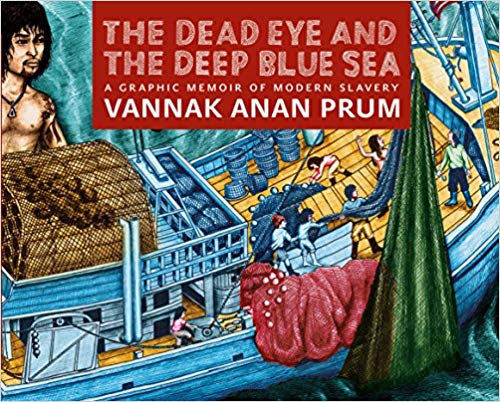
The Dead Eye and the Deep Blue Sea – a Graphic Memoir of Modern Slavery


By Vannak Anan Prum, as told to Ben & Jocelyn Pederick and translated by Lim Sophorn (Seven Stories Press)
ISBN: 978-1-6098-0602-6

This book made me furiously angry, but that’s good because it was supposed to.

Despite years of shocking scoops and in-depth news reports, far too many first world citizens seem blissfully unaware that human slavery still thrives.

In fact, the practise of enforced, unpaid labour props up a vast number of businesses and industries; from migrants and homeless people used as beasts of burden by British gangs masquerading as builders (like the Rooney family recently sentenced to decades in prison) to young hopefuls trafficked into a global sex market or entire populations captured or conned and compelled to till fields or man fishing boats for companies and “entrepreneurs” little better than racketeers and petty tyrants.

At the root of all this appalling exploitation and upheaval is one unchanging factor: a desperate need to escape overwhelming poverty.

This breathtakingly low key and matter-of-fact tale is the testimony in cartoon form of Cambodian Vannak Anan Prum who went looking for work to pay for his pregnant wife’s medical care and was gone for years…

Bracketed by a fact-filled and frankly nightmare-inducing Foreword from activist and cartoon journalist Anne Elizabeth Moore (Unmarketable, Truthout), an equally sobering Introduction by Minky Worden – Director of Global Initiatives for Human Rights Watch – and a laudatory appreciation and call to arms by Kevin Bales (Professor of Contemporary Slavery and Research Director at the Rights Lab: University of Nottingham) in his Afterword, a compelling human-scaled odyssey unfolds here.

Rendered with the gently seductive warmth and deceptively comfortable lushness of a Ladybird early reader book, the saga of endurance and survival against the cruellest of fates begins with a ‘Prologue’ as a stranger enters a Cambodian village…

Vannak Anan Prum started life ‘Drawing in the Dirt’. He was born the year the Khmer Rouge were beaten by the Vietnamese, but his early life was still one of hardship, privation and family abuse. Barely more than a boy, he fled his home seeking ‘Adventure’, becoming first a soldier, then a monk and finally an artisan sculptor toiling in a workshop making tourist trinkets and statues.

His constant hunt for work led him to farming and he met the girl who became ‘My Wife’. When she fell pregnant, he had to make more money to pay for her hospital care. With village friend Rus Vannak followed a lead to Thailand and contacted ‘Moto & the Middleman’. After helping them in ‘Crossing the Border’ they soon changed from chummy helpers to sinister guards…

Apparently, the great secret to successful slave-taking is convincing the victims that the police, army and authorities are ruthless and will punish undocumented illegals and economic migrants: constantly dangling hope of good pay and promises of eventual freedom to keep their captives quiescent.

For Vannak and Rus ‘The Writing on the Wall’ is a clear but anticlimactic moment and after relatively painless incarceration they are shipped onto facilities ship ‘The Took Tho’. This vessel services a vast fleet of illegal fishing boats, pirating catches in other nations’ waters and manned by hundreds of men who only wanted to better themselves. Most never see land again once they are taken…

One such is ‘The Old Man’, whose fate led to Vannak being transferred to primitive fishing factory ship ‘The Took Oh’. Eventually, crushing routine takes hold, only barely broken by what happens to ‘Rus’…

‘Life on the Boat’ ruled Vannak’s world and any number of candidates for ‘The Deadliest Job’ were gratefully handled before the new man’s status was slightly elevated. After he started tattooing himself with makeshift tools, his ‘Writing on the Skin’ led to others wanting such decoration… and paying for it.

His artistic gifts were useless when the ship was chased by the Indonesian navy resulting in ‘Fire at Sea’ and Vannak’s trading to ‘The New Boat’…

Fresh horrors awaited here: murder, beatings and the shocking fate of the ‘Two Guys’ from Thailand, but there were also more serene moments with ‘My Friend K’Nack’.

Adding to the alternating dire tedium and frantic hardship, ‘Storms at Sea’ and consequent becalmed periods made ‘Days Stretch Out’…

At last, after the craft surprisingly neared land, a chance came for ‘Escape’. With Thai compatriot Chaya, Vannak chanced everything on ‘The Swim’ to an unknown jungle beach and kept going…

Once again hope quickly gave way to despair. In ‘The Monkeys and the Man Waiting for Us’ an idyllic pause and the aid of some helpful citizens took the escapees to ‘Police and the Chinese Man’, who promptly sold them both to a plantation owner known as ‘Crazy Boss’…

More months of slavery in what eventually turned out to be Malaysia followed, but again Vannak’s artistic skills proved invaluable and he made enough to obtain ‘The Phone’.

Contact established with the outside world, he prepared to be rescued, but when a drunken party dissolved into ‘The Fight’ Vannak and “co-worker” Theara were wounded by machetes and dumped into the custody of the local police who grudgingly took them to ‘Hospital’…

And here’s where the real injustices start piling up as the victims suffer ‘Yo-Yo Justice’. Although Theara is soon claimed by his family, illegal worker Vannak is arrested. However, in ‘Prison’ he is interviewed by German NGO worker Manfred Hornung who begins the convoluted process of freeing the abducted and enslaved Cambodian.

Sadly, that process takes months, and is perpetually hampered by police interference and the revelation of just who – and how influential – Crazy Boss is…

It’s still a long and torturous ordeal before the LICADHO (Cambodian League for the Promotion and Defense of Human Rights) can ferry the relieved and apprehensive Vannak ‘Home’…

This crushingly sedate, oppressively action-deprived story is an astounding testament to the will to survive, but that doesn’t mean it lacks power, merit or moment. Life simply isn’t a three-act summer blockbuster with exploding helicopters, sexy vamps and Mikado-esque just deserts doled out to the endless chain of truly evil, corrupt bastards entrenched at every stage of the modern slavery system, with hands out and blind eyes turned to the plight of those they’re supposed to protect and serve.

In actual fact, the only thing they really fear is exposure and that began when Vannak – still desperately seeking to earn a living – started drawing his five awful years of experiences as strips. These were seen by film makers Ben & Jocelyn Pederick and one of the results and repercussions is this book…

As seen in ‘Epilogue’, there will be more to come…

A truly remarkable story of a quietly indomitable man who turned survival into a waiting game and patience into his weapon, The Dead Eye and the Deep Blue Sea is a book everyone should read and every exploiter should dread.
Text and images © 2018 Vannak Anan Prum. Foreword © 2018 Anne Elizabeth Moore. Introduction © 2018 Minky Worden. Afterword © 2018 Kevin Bales. All rights reserved.
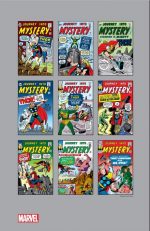
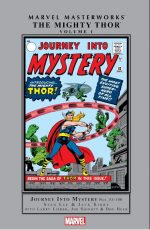
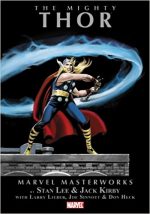
Mighty Thor Marvel Masterworks volume 1


By Stan Lee, Jack Kirby, Larry Lieber, Robert Bernstein, Joe Sinnott, Al Hartley, Don Heck & various (Marvel)
ISBN: 978-0-7851-1267-9 (HB)                    : 978-0-7851-4568-4 (TPB)

The Mighty Thor was the comic series in which Jack Kirby’s restless fascination with all things Cosmic was honed and refined through his dazzling graphics and captivating concepts. The King’s examination of space-age mythology began in a modest little fantasy/monster title called Journey into Mystery where – in the summer of 1962 – a tried-and-true comicbook concept (feeble mortal transformed into god-like hero) was revived by the fledgling Marvel Comics to add a Superman analogue to their growing roster of costumed adventurers.

This spectacular tome – in hard cover, trade paperback and eFormats – re-presents those pioneering Asgardian exploits from JiM #83-100, spanning August 1962 to January 1964 in a blur of innovation and seat-of-the-pants legend-revising and universe-building…

Following a typically frothy Introduction from Stan Lee, the wonderment begins with the lead tale from anthological Journey into Mystery #83, which saw a bold costumed warrior jostling aside the regular fare of monsters, aliens and sinister scientists in a brash, vivid explosion of verve and vigour.

The initial exploit followed crippled American doctor Donald Blake who takes a vacation in Norway only to encounter the vanguard of an alien invasion. Fleeing, he is trapped in a cave where he finds an old, gnarled walking stick. When in his frustration he smashes the stick into a huge boulder obstructing his escape, his puny frame is transformed into the Norse God of Thunder Mighty Thor!

Plotted by Lee, scripted by his brother Larry Lieber and illustrated by Kirby and inker Joe Sinnott (at this juncture a full illustrator, Sinnott would become Kirby’s primary inker for most of his Marvel career), ‘The Stone Men of Saturn’ is pure early Marvel: bombastic, fast-paced, gloriously illogical and captivatingly action-packed. The hugely under-appreciated Art Simek was the letterer and logo designer.

It was clear that they whey were making it up as they went along – not in itself a bad thing – and all that infectious enthusiasm shows in the next adventure…

‘The Mighty Thor Vs. the Executioner’ is a “commie-busting” tale of its time with a thinly disguised Fidel Castro wasting his formidable armies in battle against our hero. Dr. Blake’s nurse Jane Foster debuts; a bland cipher adored from afar by the Norse superman’s timid alter-ego.

The creative team settled as Dick Ayers replaced Sinnott, and with #85’s ‘Trapped by Loki, God of Mischief!’ the final element fell into place with the “return” of a suitably awesome arch-foe; in this case the hero’s half-brother. The evil magician and compulsive trickster escaped divine incarceration and his first thought was to bedevil Thor by causing terror and chaos on the world of mortals he was so devoted to…

Here a new and greater universe was first revealed with the tantalising hints and glimpses of the celestial otherworld and more Nordic gods…

Issue #86 introduced another recurring villain. Zarrko, bristling at the sedentary ease of 23rd century life, voyages back to 1962 and steals an experimental “C-Bomb”, forcing the Thunderer into a stirring hunt through time and inevitable clash with super-technology ‘On the Trail of the Tomorrow Man!’

On his return Blake became a target of Soviet abductors. Those sneaky spies even managed to make Thor a ‘Prisoner of the Reds!’ before our epic warrior eventually emerges unscathed and triumphant…

‘The Vengeance of Loki’ sees the god of Mischief’s return in #88: a malevolent miscreant uncovering Thor’s secret identity and naturally menacing Jane Foster after which ‘The Thunder God and the Thug’ offers adventure on a much more human scale as a gang boss runs riot over the city and roughshod over a good woman’s heart, giving the Asgardian a chance to demonstrate his more sophisticated and sympathetic side by crushing Thug Thatcher and freeing her from his brutal influence.

Issue #90 was an unsettling surprise as the grandeur of Kirby & Ayers was abruptly replaced by the charming yet angst-free art of Al Hartley, who illustrated Lee & Lieber’s stock alien-invasion yarn ‘Trapped by the Carbon-Copy Man!’ A month later the Storm Lord tackles ‘Sandu, Master of the Supernatural!’, with Sinnott handling pencils and inks in a thriller starring a carnival mentalist who – augmented by Loki’s magic – comes catastrophically close to killing our hero…

Sinnott illustrated JiM #92’s ‘The Day Loki Stole Thor’s Magic Hammer’ (scripted by Robert Bernstein over Lee’s plot) which moves the action fully to the mythical realm of Asgard for the first time as Thor seeks to recover his stolen weapon after Loki enchants the magnificent mallet.

Kirby & Ayers momentarily returned for Cold War/Atom Age thriller ‘The Mysterious Radio-Active Man!’ – again scripted by Bernstein – as Mao Tse Tung unleashes an atomic assassin in retaliation for Thor thwarting China’s invasion of India.

Such “Red-baiting” was common in early Marvel titles, but their inherent jingoistic silliness can’t mar the eerie beauty of the artwork. With this tale the rangy, raw-boned Thunder God completed his slow metamorphosis into the husky, burly blonde bruiser who dominated any panel he was drawn in.

Sinnott illustrated the next three somewhat pedestrian adventures, ‘Thor and Loki Attack the Human Race!’, ‘The Demon Duplicator’ and ‘The Magic of Mad Merlin!’, but these mediocre tales of magic-induced amnesia, scientifically-manufactured evil doppelgangers and an ancient mutant menace were the last of an old style of comics. Lee took over full scripting with Journey into Mystery #97 and a torrent of awesome action wedded to soap opera melodrama resulted in a fresh style for a developing readership.

‘The Lava Man’ in #97 was again drawn by Kirby, with the subtly-textured inking of Don Heck adding depth to the tale of an invader summoned from the subterranean realms to menace humanity at the behest of Loki. More significantly, a long running rift between Thor and his stern father Odin is established after the Lord of Asgard refuses to allow his son to love the mortal Jane.

This acrimonious triangle was a perennial sub-plot fuelling many attempts to humanise Thor, because already he was a hero too powerful for most villains to cope with. Most importantly this issue was notable for the launch of a spectacular back-up series. Tales of Asgard – Home of the mighty Norse Gods gave Kirby a vehicle to indulge his fascination with legends.

Initially adapting classic fables of the Elder Eddas but eventually with all-new material particular to the Marvel pantheon, he built his own cosmos and mythology, to underpin the company’s entire continuity. This first yarn, scripted by Lee and inked by George Bell (AKA old Golden Age collaborator George Roussos), outlined the origin of the world and the creation of the World Tree Yggdrasil.

‘Challenged by the Human Cobra’ introduced the serpentine villain (bitten by a radioactive cobra, would you believe?) in a tale by Lee & Heck, whilst Kirby – with them in attendance – offered ‘Odin Battles Ymir, King of the Ice Giants!’: a short, potent fantasy romp laying more groundwork for decades of cosmic wonderment to come.

The same format held for issues #99 and #100 with the main story (the first 2-part adventure in the run) introducing the ‘Mysterious Mister Hyde’ – and concluding a month later with ‘The Master Plan of Mr. Hyde!’

The modern yarn dealt with a contemporary chemist who could transform into a super-strong villain at will who frames Thor for his crimes, whilst in primordial prehistory Kirby detailed Odin’s war with ‘Surtur the Fire Demon’ and latterly (with Vince Colletta inking) crafted an exploit of the All-Father’s so different sons in ‘The Storm Giants – a tale of the Boyhood of Thor’. As always, Lee scripted these increasingly influential comicbook histories…

These early tales of the God of Thunder reveal the development not only of one of Marvel’s core narrative concepts but, more importantly, the creative evolution of perhaps the greatest imagination in comics. Set your common sense on pause and simply wallow in the glorious imagery and power of these classic adventures for the true secret of what makes comicbook superheroes such a unique experience.
© 1962, 1963, 1964, 2017 Marvel Characters, Inc. All rights reserved.

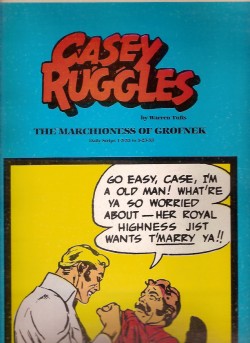
Casey Ruggles: The Marchioness of Grofnek


By Warren Tufts (Western Winds Productions)
No ISBN

The newspaper strip Casey Ruggles – a Saga of the West used Western motifs and scenarios to tell a broad range of stories stretching from shoot-’em-up dramas to comedy yarns and even the occasional horror story.

The strip debuted in 1949, a centenary tribute to the California Gold Rush, and its ever-capable hero was a dynamic ex-cavalry sergeant and sometime US Marshal making his way to that promised land to find his fortune (this was the narrative engine of both features until 1950 where daily and Sunday strips divided into separate tales), meeting historical personages like Millard Fillmore, William Fargo, Jean Lafitte and Kit Carson in gripping two-fisted action-adventures.

Warren Tufts was a phenomenally talented illustrator and storyteller born too late. He is best remembered now – if at all – for creating two of the most beautiful western comics strips of all time: Ruggles and the elegiac, iconic Lance.

Sadly, Tufts began his career at a time when the glory days of newspaper syndicated strips were gradually giving way to the television age and ostensibly free family home entertainment. Had he been working scant years earlier in adventure’s Golden Age he would undoubtedly be a household name – at least in comics fans’ homes.

Born in Fresno, California on Christmas Day 1925, Tufts was a superb, meticulous draughtsman with an uncanny grasp of character, a wicked sense of storytelling and a great ear for dialogue whose art was effective and grandiose in the representational manner, favourably compared to both Hal Foster’s Prince Valiant and the best of Alex Raymond.

On May 22nd 1949 he began Ruggles as a full-colour Sunday page and supplemented it with a black and white daily strip on September 19th of that year.

Tufts worked for the United Features Syndicate, owners of such popular strips as Fritzi Ritz and L’il Abner, and his lavish, expansive tales were crisply told and highly engaging, but – a compulsive perfectionist – he regularly worked 80-hour weeks at the drawing board and often missed deadlines. This led him to use many assistants such as Al Plastino, Rueben Moreira and Edmund Good. Established veterans Nick Cardy and Alex Toth also spent time working as “ghosts” on the series.

Due to a falling-out with his syndicate Tufts left his first wonderful western creation in 1954 and Al Carreño continued the feature until its demise in October 1955. The departure came when TV producers wanted to turn the strip into a weekly television show but apparently United Features baulked, suggesting the show would harm the popularity of the strip.

During a year spent creating the political satire feature Lone Spaceman Tufts formed his own syndicate for his next and greatest project, Lance (probably the last great full page Sunday strip and another series crying out for an archival collection). He then moved peripherally into comic-books, working extensively for West Coast outfit Dell/Gold Key, illustrating various westerns and cowboy TV show tie-ins like Wagon Train, Korak son of Tarzan, The Amazing Chan and the Chan Clan as well as a long run on the Pink Panther comicbook.

Eventually he quit drawing completely, working as an actor, voice-actor and eventually in animation on such shows as Challenge of the Super Friends.

Tufts had a lifelong passion for flying, even designing and building his own planes. In 1982 whilst piloting one, he crashed and was killed.

During the early 1980s, the Pacific Comics Club collected many “lost strip classics”, including six volumes (to my knowledge) of Casey Ruggles adventures. This fourth stupendous monochrome tome (approximately 15 x 10 inches, or 381 x 254 mm) contains stories that highlighted Tufts’ splendid grasp of irony and love of comedy…

The first, however, is a stirring and chilling cowboy thriller featuring a legendary Western figure return of an old foe. ‘A Real Nice Guy’ originally ran from 5th January to 23rd February 1953, and found Ruggles and old scout Christopher “Kit” Carson heading towards Shasta City in a deadly snowstorm just as a devoted and loving wife murders the sheriff to free her murderous husband from the brand new Jail. As the blizzard hits hard the fugitives take refuge in a line-shack also sheltering Carson and Ruggles…

When the storm subsides the killers steal the heroes’ guns, horses, boots and even Carson’s trousers to combat the cold, leaving them to die as they flee for warmer climes. However the determined lawmen break free and track the pair through horrific polar conditions in a tense and deadly race to survive before the next lethal ice storm strikes…

The second adventure jumps from fraught life and death to something far more serious as ‘The Marchioness of Grofnek’ arrives in Shasta in all her resplendent Eastern European glory. With her comes an army of nobles, pots of cash and jewels and a burning desire to marry again…

This surreal and hilariously wry yarn ran from February 24th to 11th April and brilliantly depicted the true nature of friendship as Carson tried to get Ruggles hitched and the canny Marshall countered every ploy with one of his own…

The final tale in this stupendous monochrome collection is a marvellous slapstick wheeze which completely ignores the titular hero to feature the further exploits of a returning “villain”.

Running from 13th April – 23rd May 1953, ‘The Highwaymen’ marked the reappearance of Old Ancient. This guy was a grizzled dime-store owlhoot and wicked parody of silver screen cowboy William Boyd whose super-sanitized Hopalong Cassidy wowed generations of movie and TV viewers who might perhaps have been better served by picking up a history book instead.

The scofflaw cunningly offered to help out destitute blacksmith Cyril by teaching him the finer points of hold-ups, stage robbing and banditry. Of course the mouthy old coot had no chance of making a success of his criminal crash-course but did provide some of the most side-splitting cock-ups ever seen on a comics page.

Equal parts Keystone Cops, Destry Rides Again, Buster Keaton’s Go West and Carry on Cowboy, this delightfully fast-paced and razor-barbed spoof perfectly closes this charming, twice-lost comic strip treasure-trove…

Human intrigue and fallibility, bombastic action and a taste for the ludicrous reminiscent of John Ford or Raoul Walsh movies make Casey Ruggles the ideal western strip for the discerning modern audience. Westerns are a uniquely perfect vehicle for drama and comedy, and Casey Ruggles is one of the very best produced in America: easily a match for the generally superior European material like Tex, Comanche or Lieutenant Blueberry.

Surely the beautiful clean-cut lines, chiaroscuric flourishes and sheer artistic imagination and veracity of Warren Tufts can never be truly out of vogue? These great tales are desperately deserving of a wider following, and at a time when so many great strips are finally being revisited, I’m praying some canny publisher knows another good thing when he sees it…
© 1949, 1950, 1953 United Features Syndicate, Inc. Collection © 1981 Western Winds Productions. All Rights Reserved.

First Names: Emmeline Pankhurst and First Names: Elon Musk


By Haydn Kaye & Michael Cotton-Russell (David Fickling Books)
By Tracey Turner & Mike Smith (David Fickling Books)
ISBN: 978-1-910989-61-6 (Emmeline) 978-1-910989-62-3 (Elon)

Since its premiere in 2012, The Phoenix has offered humour, adventure, quizzes, puzzles and educational material in a traditional-seeming weekly comics anthology for girls and boys. The vibrant parade of cartoon fun, fact and fantasy has won praise from the Great and the Good, child literacy experts and the only people who really count – a dedicated and growing legion of totally engaged kids and parents who read it avidly…

The potent periodical is rapidly approaching its 300th issue and shows no signs of slowing down. In fact, parent company David Fickling Books is expanding its output through a range of graphic novels and a new imprint of cartoon and strip illustrated biographies highlighting historical and contemporary groundbreakers and earthshakers.

The First Names imprint gets readers on intimate terms with a number of worthy achievers rightly deemed role models and launches in August with the two books under scrutiny today. Further enticing stalwarts promised in future include Harry Houdini, Abraham Lincoln and Amelia Earhart…

Devised along the lines of the mega-successful, eternally-engaging Horrible Histories books, these prose paperbacks come with a superabundance of monochrome cartoon illustrations to keep the pace of learning fast and fact-packed.

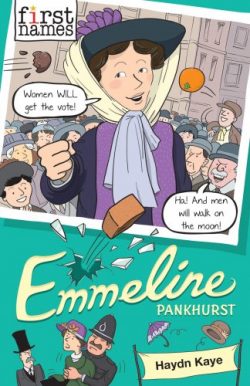
Written by Haydn Kaye, Emmeline Pankhurst traces the life of the great Suffrage campaigner, deftly navigating a rather grim tale of oppression and imparting a great deal of necessary detail in a most delicate but effective manner through such enlightening chapters as ‘Emmeline Falls Out with her Father’, ‘Emmeline Kicks Up a Fuss’ and ‘Emmeline Forgives and Forgets’… Aiding and abetting, illustrator Michael Cotton Russell provides witty contextualising drawings on almost every page, with absorbing sidebars such as ‘Emmeline Explains Politics’ and ‘A Miserable Life for Match Girls’.

Working in tandem and conspicuous light-hearted good taste, the creators here have delivered a topical and timeless introduction to a woman who changed the world and deserves to be on First Name basis with every kid who’s claimed “It’s not Fair!”

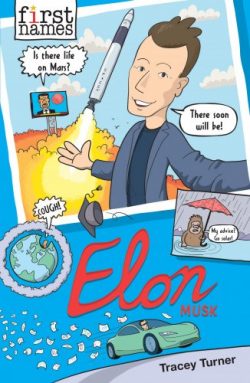
Still very much in the news and attempting to change the world, the eccentric life and career of Elon Musk is traced by scribe Tracey Turner and cartoonist Mike Smith from his earliest explosive beginnings through a string of highly bankable innovations to his current elevated status as premier exponent of green technologies and interplanetary colonisation.

Beginning in ‘Pretoria, South Africa 1981’ the astounding progress is charted through ‘Elon’s Easter Eggs and Blasting Stars’ through ‘Elon Makes Millions’ and ‘Elon on Mars’ to ‘What Elon Did Next’.

It’s one heck of a ride and is engagingly limned by Mike Smith who provides contextual illustrations, charts recipes and family trees, illuminates maps and codifies micro-lectures such as ‘Elon Explains Solar Energy and Fossil Fuels’, ‘Elon Explains Silicon Valley’ and ‘Elon Explains Space Rockets’.

You may not like him or believe him, but this guy is at the forefront of today’s Thinkers and Do-ers, so you should at least have some idea of what he’s done and what he wants…

Invoking the heady baby boomer days of factual entertainment comics such as Look and Learn and Tell Me Why, these extremely enticing books promise – and resoundingly deliver – a measured and informative window on a most complex and potentially daunting maze of past-and-present Stuff To Know and do it with great charm and efficiency.

More Please!

First Names: Emmeline Pankhurst Text © Haydn Kaye 2018 and illustrations © Michael Cotton-Russell 2018. All rights reserved.
First Names: Elon Musk Text © Tracey Turner 2018 and illustrations © Mike Smith 2018. All rights reserved.

First Names: Emmeline Pankhurst and First Names: Elon Musk will be published on August 2nd and are available for pre-order now.

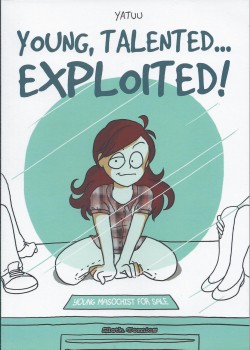
Young, Talented… Exploited!


By Yatuu, translated by FNIC (Sloth Publishing)
ISBN: 978-1-908830-02-9

Much as we’d like to think otherwise, the world of work is no longer possessed of purely national characteristics. These days we all slave under a universal system that sidesteps borders in the name of global corporate philosophy. Thus, this stunning glimpse of one French woman’s frustrated struggle against modern employment practise is one that’s being repeated all over the planet every day.

In this case however, Capitalism picked on the wrong person because Yatuu has enough spark, gumption and talent to fight back…

When Cyndi Barbero graduated from college and began looking for a job, all she was offered were unpaid internships. Eventually, she took one, still believing the mantra everyone with a job repeated: “if you work hard enough they may offer a permanent position”.

The work-placement role ran its legally-mandated course and she was promptly replaced by another sucker. After the third time it happened she began to blog (www.yatuu.fr/en) about and sharing her experiences, venting her opinions on such a manifestly unfair system and derive a soupçon of justifiable payback…

Just in case you’re unaware: An Intern takes a position in a company to learn the ropes, develop good working habits and establish contacts in order to make them more employable. The system used to work even though most kids ended up doing scut-work and never really learned anything useful.

Such positions are unpaid and eventually most employers realised that they could get free low-grade temporary labourers and thereby cut their own running costs. Using, abusing and discarding the seemingly endless supply of optimistic hopefuls has become an accepted expense-control measure at most large businesses. Even those employers who originally played fair had to change at some stage, because the exploitative tactics gave business rivals an unfair financial advantage…

I used to know of only one large company where interns were paid – and that’s only because the CEO put his foot down and insisted. When he retired and the company was sold the intern program quickly shifted to the new normal…

This subtly understated, over-the-top manga-styled, savagely comedic exposé tracks one exhilarated graduate’s progress from college to the world of no work through ‘At the End of the First Internship’ via ‘At the End of the Second Internship’ to ‘At the End of the Third Internship’ when even she began to smell a rat.

That didn’t daunt her (much) and, after much soul-searching, she took her dream job at a major Ad Agency. At least it would have been, were she not the latest addition to a small army of interns expending their creative energies for insane hours, zero thanks or acknowledgement and at their own financial expense…

From ‘Some Words Get Instant Reactions at Interviews’ through her ‘First Day’ – via vivid and memorable digressions on expected behaviour and hilariously familiar vignettes of types (I spent 30 years as an advertising freelancer and I think I’ve actually gone drinking with many of these guys’ British cousins…) – to the accepted seven-days-a-week grind of ‘This Place is Great Because You Learn to Laugh on Cue’ and ‘Nothing Out of the Ordinary’, Yatuu grew accustomed to her voluntary slavery… although her barely-suppressed sense of rebellion was unquenchable.

Amongst so many short pithy lessons compiled here we see and sympathise with ‘Intensive Training’, observe ‘The Pleasure of Feeling Useful’ and realise there’s ‘Nothing to Lose’, before an intriguing game of office ‘Dilemma’ explores whether to have lunch with the Employees or Interns and what to do if asked to do ‘Overtime’…

As much diary as educational warning, this beguiling collection reveals how the hapless ever-hopeful victim developed survival strategies – such as finding a long-suffering workmate prepared to lend a floor, couch or bed for those frequent nights when the last train leaves before you do…

Mostly however, this addictive collection deals with the author’s personal responses to an untenable but inescapable situation for far too many young people: revealing insane episodes of exhaustion, despondency and work (but, tellingly not Job)-related stress, such as too many scary midnight cab rides home, constant nightmares and grinding daily insecurity.

What’s amazing is that it’s done with style, bravery and an astonishing degree of good-natured humour – especially when dealing with ‘The Idea Thief’, planning ‘Retaliation’ or perfecting ‘The Ultimate Revenge Technique!!!’…

Originally collected as Moi, 20 Ans, Diplômée, Motivée… Exploitée, Yatuu’s trenchant cartoon retaliations were published in English a few years ago (so are long overdue for a new edition) and make for fascinating reading.

Although it really should be, you probably won’t find Young, Talented… Exploited! discussed in any school Careers lessons or part of any college Job seminar and it’s almost certainly banned from every employers’ Orientation and Training package, but that’s just a sign of how good it is.

Best get your own copy and be ready for the worst scams, indignities and excesses that the Exploiters and Bosses will try to spring on you…

At least once you’ve paid for it you can be assured that it will deliver on its promise…
© 2013 Yatuu & 12bis. English translation and layout © 2013 Sloth Publishing, Ltd.

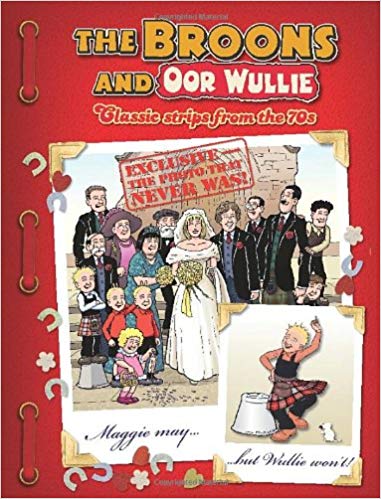
The Broons and Oor Wullie: Classic Strips from the 70s


By Tom Lavery, Morris Heggie, Leslie Stannage & various (DC Thomson)
ISBN: 978-1-84535-494-7

Published eternally in perfect tandem, The Broons and Oor Wullie are two of the longest running newspaper strips in British history, having appeared almost continuously in the Scottish Sunday Post since their dual debuts in the March 8th 1936 edition.

Both the boisterous boy and the gregariously engaging inner-city clan were co-created by writer and Editor Robert Duncan Low in conjunction with Dudley D. Watkins; a man who would become DC Thomson’s greatest – and signature – artist.

Three years later the strips began being collected in reprint editions as Seasonal Annuals; alternating stars and years right up to the present day and remaining best-sellers every single time.

Low (1895-1980) began at the publishing monolith as a journalist, rising to the post of Managing Editor of Children’s Publication and launching, between 1921 and 1933, the company’s “Big Five” story-papers for boys: Adventure, The Rover, The Wizard, The Skipper and The Hotspur.

His next brilliant idea was the Fun Section: an 8-page pull-out comic strip supplement for Scottish national newspaper The Sunday Post. The illustrated accessory launched on 8th March 1936 and from the very outset The Broons and Oor Wullie were its unchallenged stars…

Low’s shrewdest move was to devise both strips as domestic comedies played out in the charismatic Scottish idiom and broad vernacular. Ably supported by features such as Auchentogle by Chic Gordon, Allan Morley’s Nero and Zero, Nosey Parker and other strips, they laid the groundwork for the company’s next great leap.

In December 1937 Low launched the DC Thomson’s first weekly pictorial comic. The Dandy was followed by The Beano in 1938 and early-reading title The Magic Comic the year after that.

War-time paper shortages and rationing sadly curtailed this burgeoning strip periodical revolution, and it was 1953 before the next wave of cartoon caper picture-papers appeared. The Topper started the ball rolling again (with Oor Wullie in the logo and masthead, but not included amongst the magazine’s regular roster) in the same year that Low & the great Ken Reid created Roger the Dodger for The Beano…

Throughout this innovative period Low’s greatest advantage was his prolific illustrator Dudley Dexter Watkins, whose style, more than any other, shaped the look of DC Thompson’s comics output until the bombastic advent of Leo Baxendale shook things up in the mid-1950s. Watkins soldiered on in unassailable homely magnificence for decades, drawing some of the most lavishly lifelike and winningly hilarious strips in illustration history. He died at his drawing board on August 20th 1969. For all those astonishingly productive years, on top of his many assignments in DCT’s comics he had unflaggingly drawn a full captivating page each of Oor Wullie and The Broons every week, and his loss was a colossal blow to the company.

DC Thomson’s chiefs preferred to reprint old Watkins episodes of the strips in both the newspaper and the Annuals for seven years before a replacement was agreed upon. The Dandy reran Watkins’ Desperate Dan stories for twice that length of time.

An undeniable, rock-solid facet of Scots popular culture from the very start, the first Broons Annual (technically Bi-Annual) appeared in 1939, alternating with the first Oor Wullie book a year later (although, due to wartime paper restrictions, no annuals at all were published between 1943 and 1946). To this day, for millions of readers no year can truly end without them.

So What’s the Set Up?: The gregarious Brown family inhabit a tenement flat at 10 Glebe Street, in the timelessly metafictional Scottish industrial metropolis of Auchentogle (sometimes Auchenshoogle); a scenario based on the working class Auchenshuggle district of Glasgow.

As such it’s always been a character-rich environment and ideal setting in which to tell gags, relate events and fossilise the deepest and most reassuring cultural archetypes for sentimental Scots wherever in the world they might actually be residing.

And naturally, such a region is the perfect sounding board to portray all kinds of social, cultural and economic changes that come with every passing year…

The adamant, unswerving cornerstone of the Broon family feature is long-suffering, ever-understanding Maw, who puts up with cantankerous, cheap, know-it-all Paw, and their battalion of stay-at-home kids.

These always-underfoot worthies comprise hunky Joe, freakishly tall Hen (Henry), sturdy Daphne, classically gorgeous Maggie, brainy Horace, mischievous twins Eck and the unnamed “ither ane”, plus a wee toddling lassie referred to only and always as “The Bairn”.

Not officially in residence but always hanging around is sly, patriarchal buffoon Granpaw – a comedic gadfly who spends more time at Glebe Street than his own cottage; constantly attempting to impart his decades of out-of-date, hard-earned experience to the kids… but do they listen?

Offering regular breaks from inner-city turmoil and many chances to simultaneously sentimentalise, spoof and memorialise more traditional times, the family frequently repair to their But an’ Ben (a dilapidated rustic cottage in the Highlands) where they fall foul of the weather, the countryside and all its denizens: fish, fowl, farm-grown, temporary and touristic…

As previously stated, Oor Wullie also launched on March 8th 1936, with his own collected Annual compilations subsequently and unfailingly appearing in the even years.

The basic set-up is sublimely simply and eternally evergreen, featuring an imaginative, scruff with a weakness for mischief, talent for finding trouble and no hope of ever avoiding parental retribution when appropriate…

Wullie – AKA William MacCallum – is an archetypal good-hearted rascal with time on his hands who can usually be found sitting on an upturned bucket at the start and finish of his page-a-week exploits.

His regular cast includes Ma and Pa, local copper P.C. Murdoch, assorted teachers and other interfering adults who either lavish gifts or inflict opprobrium upon the little pest and an array of pals including Fat Boab, Soapy Joe Soutar, Wee Eck and others. As a grudging sign of changing times, in later volumes such as this, he’s occasionally caught in the company of fetching schoolgirls like Elizabeth and Primrose…

A compilation in monochrome with some full-colour pages, Classic Strips from the 70s was released in 2012 as part of a concerted drive to keep earlier material available to fans new or old: a lavishly sturdy hardback (still readily available through internet vendors) but deviated somewhat from the norm in that rather than re-presenting exemplar strips from the decade, the book follows a rare experiment in continuity storytelling…

When, in 1976, the strip returned to new material following the Watkins reprint run, artist Tom Lavery (you might remember his run on The Numskulls) was given the daunting task of following the master on both The Broons and Oor Wullie.

He soldiered on until 1982, followed by John Polland, Bob Nixon, Ken H. Harrison and, currently, Peter Davidson. Sadly, the authors of the features are far harder to pin down now.

Although the Oor Wullie strips remained consistently episodic and broadly comedic affairs, a long-running plotline was introduced to the Broons with the debut of rugged, affable Dave McKay in 1977.

As the weeks went by, and despite a mixed bag of reactions from the clan and readership, Maggie Broon’s new boyfriend and his flash car became a fixture. An engagement was announced, a house was bought, unsuspected and potentially fractious connections to the prospective In-Laws were revealed and overcome before, in 1979, the countdown to a wedding began…

It was never to be. For reasons still undisclosed (both writer and artist were no longer around to ask at the time this book was released) Dave vanished between instalments and was never seen again.

Life slowly – but not too slowly – returned to what passes for normal in Glebe Street but thanks to writer editor Morris Heggie and illustrator Leslie Stannage, the 4-page ‘Wedding of the Year’ and ‘The Cooperative Ha” offers a Sliding Doors-style possible ending here. Ahh, closure…

The dramady is accompanied throughout by clever sidebar features including faux love letters and mementoes in a brace of ‘Be My Valentine!’ spreads; ‘And the Gifts Were Returned’ letters from Maggie; gag pages disclosing ‘The Funny Side of Auld Romantics’ and ‘Oor Wullie’s Wedding Invitation’ plus newspaper photo sections on other infamous weddings of the era and more…

The last half of the book returns to funny business as usual, with Daphne, Maggie, Hen and Joe back on the hunt for fresh romantic partners, while the rest of the family resume acting like the assorted brats they eternally are: squabbling, showing off, snaffling food and enduring embarrassing domestic, fashion and sporting culture shocks…

Following joke ensemble ‘The Funny Side of Seventies Romance’ the Broons are back about their business – referencing trending topics such as the movie Grease and timeless themes such as birthday blues, leaving the remainder of this titanic tome to an examination of being young in the seventies courtesy of Oor Wullie…

The nostalgic wonderment begins with a full-colour photomontage of the decade’s comics covers and a frankly disturbing fashion parade of the wee lad, Primrose, Fat Bob and Soapy Joe in the era’s more outrageous apparel. Then it’s back to basics with waggish behaviours: dodging school, playing pranks, avoiding haircuts, going on holiday, snaffling contraband grub, finagling snacks and trying loads of get-rich-quick schemes.

Careers attempted include artist, Red Indian (70s, remember? Different tastes, OK?), paperboy, sound recorder and much more…

Supplementing these strips are features such as a colour retrospective of Oor Wullie Annuals, photo-features ‘Faces of the 70s’, pop quiz ’20 Scots Smashers! From the 70s’ and soccer celebration ‘Fitba Crazy!’ as well as a brace of vintage Funland Puzzle Pages.

Unchanged and always welcome are wry and weighted comparisons of the good old days with mere modernity, rib-tickling scenes of sledding and skating, stolen candies, Christmas revels, torn clothes, recycled comics, breakings into one’s own home, sparring school kids, ladies and lassies lost and found, harmless practical jokes and social scandals: stories always designed to take our collective mind off troubles abroad and at home, and for every thwarted romance or embarrassing fiasco, there’s an uproarious chase, riotous squabble and no-tears scrap for the little ‘uns and their should-know-better elders…

You’ll almost certainly being buying this oversized hardback tome second-hand, so if possible ensure that the tipped in premiums are present. These include a CD of 20 traditional wedding tunes played by a Pipe Band and Maggie Broon’s Wedding Planner pack…

Overflowing with all-ages fun, rambunctious homespun hilarity and deliriously domestic warmth, these examples of comedic certainty and convivial celebration are a sure cure for post-modern glums… and you can’t really have a happy summer holiday without them, can you?
The Broons and Oor Wullie ®© D.C. Thomson & Co., Ltd. 2012.

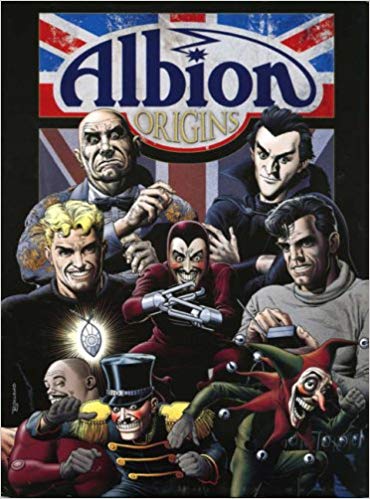
Albion: Origins


By Tom Tully, Scott Goodall, Ken Mennell, Solano Lopez, Eric Bradbury & various (Titan Books)
ISBN: 978-1-84576-172-1

Here’s a truly superb collection of British comic strips from the glory days of the 1960s courtesy of Titan Books and originally released to support and cash in on the profile-raising American Albion miniseries and collection.

In this stunning, non-nonsense monochrome hardback are four complete early exploits of some of Britain’s weirdest comic strip heroes.

Kelly’s Eye featured ordinary, thoroughly decent chap Tim Kelly who came into possession of the mystical “Eye of Zoltec”: a fist-sized gem that kept him free from all harm… as long as held on to it.

You won’t be surprised to discover that, due to the demands of weekly boys’ adventures, Tim lost, dropped, misplaced and was nefariously deprived of that infernal talisman pretty darned often – and always at the most inopportune moment…

The moody and compelling artwork of Argentinean Francisco Solano Lopez was the prime asset of this series, with the story reprinted here being about a Seminole Indian uprising threatening modern Florida. Complete with eerie evil witch doctor, supernatural overtones from a demonic drum and consumer America imperilled, this story is a classic. Tom Tully & Scott Goodall were the usual scripters for this little gem of a series.

And yes, due to the pressure of these weekly deadlines, occasionally fill-in artists had to pinch-hit in most British strip-series every now and then. Such was the breakneck pacing though, that us kids hardly even noticed and I doubt you will either. Still. If you are eagle-eyed, you might spot such luminaries as Reg Bunn, Felix Carrion, Carlos Cruz, Franc Fuentesman, and Geoff Campion in this volume. But you probably won’t…

House of Dolman was a curious and inexplicably absorbing blend of super-spy and crime-buster strip from Tully and utterly wonderful master illustrator Eric Bradbury. Dolman’s cover was as a shabby ventriloquist (I digress, but an awful lot of “our” heroes were tatty and unkempt – we had “Grunge” down pat decades before the Americans made a profit out of it!) who designed and constructed an army of specialised robots which he disguised as his puppets.

Using these as his shock-troops, the enigmatic Dolman waged a dark and crazy war against the forces of evil…

Featured here are a number of his complete 4-page thrillers wherein he defeats high-tech kidnappers, rascally protection racketeers, weapons thieves, blackmailers and the sinister forces of arch super-criminal ‘The Hawk’.

Janus Stark was a fantastically innovative and successful strip. Created by Tully for the relaunch of Smash in 1969, the majority of the art was from Solano Lopez’s studio, providing an aura of eerie, grimy veracity well suited to this tale of a foundling who grew up in a grim orphanage only to become the greatest escapologist of the Victorian age.

The Man with Rubber Bones also had his own ideas about retribution and justice and would joyously sort out those scoundrels the Law couldn’t or wouldn’t touch. A number of creators worked on this feature, which survived until the downsizing of the publisher’s comics division in 1975 – and even beyond – since Stark escaped oblivion by emigration.

When the series ended in Britain it was continued in French publications – even unto Stark’s eventual death and succession by his son. Here though, we get to see his earliest feats and I for one was left hungry for more. Encore!

The last spot in this sturdy hardback treasury falls to the Spooky Master of the Unknown Cursitor Doom. This series is the unquestioned masterpiece of Eric Bradbury – an artist who probably deserves that title as much as his visual creation.

Writer Ken Mennell, who usually invented characters for other writers to script, kept Doom for himself and the result is a darkly brooding Gothic thriller quite unlike anything else in comics then or since. If pushed, I’ll liken it most to William Hope Hodgson’s Karnacki the Ghost Breaker novelettes – although that’s more for flavour than anything else and even that doesn’t really cover it.

Doom is a fat, bald, cape-wearing foul-tempered know-it-all who just happens to be humanity’s last-ditch defence against the forces of darkness. With his strapping and rugged young assistant Angus McCraggan and Scarab, a trained raven (or is it, perhaps, something more?), Cursitor crushed without mercy any threat to humanity’s wellbeing.

Re-presented here is the ‘Dark Legion of Mardarax’ wherein a cohort of Roman soldiers extracted from the mists of antiquity rampages across the British countryside, intent on awaking an ancient and diabolical monstrosity from the outer Dark!

Perhaps these tales are a thrill for me because I first read them when I was just an uncomprehending nipper, but I don’t think so. It’s a tremendous thrill now to realise that despite all the age, wisdom, and sophistication I can now muster, that these strips really were – and are – as great if not better, than most of the comics I’ve seen in fifty-plus years of reading. Don’t take my word for it: track down this book and see if you’re not as hungrily avid for more of the same…
© 2005 IPC Media Ltd. All rights reserved.

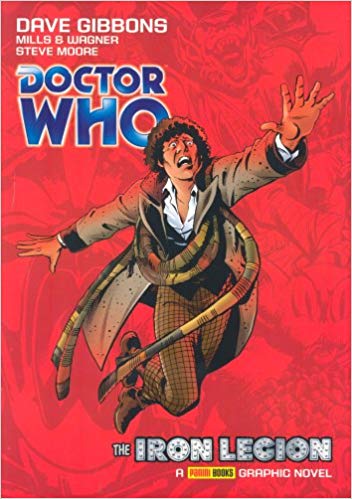
Doctor Who Graphic Novel #1: The Iron Legion


Illustrated by Dave Gibbons and scripted by Pat Mills, John Wagner & Steve Moore (Panini Books)
ISBN: 978-1-904159-37-7

The British love comic strips and they love celebrity and they love “Characters.” The history of our homegrown graphic narrative has a peculiarly disproportionate amount of radio comedians, Variety stars and film icons and television actors: such disparate legends as Charlie Chaplin, Flanagan & Allen, Shirley Eaton (“The Modern Miss”), Arthur Askey, Winifred Atwell, Max Bygraves, Jimmy Edwards, Charlie Drake and so many more long forgotten.

As well adored and adapted were actual shows and properties such as Whacko!, ITMA, Our Gang (a British version of the Hal Roach film sensation by Dudley Watkins ran in The Dandy as well as the American comicbook series by Walt Kelly), Old Mother Riley, Supercar, Thunderbirds, Pinky and Perky, The Clangers and literally hundreds more.

Hugely popular anthology comics such as Radio Fun, Film Fun, TV Fun, Look-In, TV Tornado, TV Comic and Countdown translated our viewing and listening favourites into pictorial joy every week, and it was a pretty poor star or show that couldn’t parley the day job into a licensed comic property…

Doctor Who premiered on black-&-white televisions across Britain on November 23rd 1963 with the first episode of ‘An Unearthly Child’. In 1964 his decades-long association with TV Comic began: issue #674 offered the premier instalment of ‘The Klepton Parasites’.

On 11th October 1979 (although adhering to the US off-sale cover-dating system so it says 17th), Marvel’s UK subsidiary launched Doctor Who Weekly. It became a monthly magazine in September 1980 (#44) and has been with us – under various names – ever since. All of which only goes to prove that the Time Lord is a comic hero with an impressive pedigree.

Panini’s UK division is in the ongoing process of collecting every strip from its archive in a uniform series of over-sized graphic albums, each concentrating on a particular incarnation (those in the know refer to them as “regenerations”) of the deathless wanderer. This particular tome was the very first, gathering 36 weekly monochrome strips from the first 38 weeks, all drawn, inked and lettered by International Treasure Dave Gibbons and published between 11th October 1979 and July 3rd 1980.

In fact, the Doctor Who stories were amongst the last regular comics work the artist created for the British market before being scooped up by the Americans as part of the early 1980s “British Invasion”.

All that and more is covered in the comprehensive ‘Dave Gibbons Interview’ conducted by Alan Woollcombe which precedes the frantic tales plucked from the annals of history featuring the Fourth Doctor (AKA Tom Baker). Thanks to the skills of writers Pat Mills & John Wagner (who plotted the yarns together but alternated as solo-scripters for completed stories) and latterly Steve Moore, the adventuresome episodes combine thrills, fights and scares with a suitable degree of surreal humour and whimsical Anglophilic cultural nonsense…

The cosmic comics carnage kicks off with a ‘The Iron Legion’ (originally seen in Doctor Who Weekly #1-8: 11th October to December 5th 1979) with Mills providing dialogue as the wandering Time Lord lands in a contemporary English village just as it is attacked by robot soldiers from a parallel plane where the Roman Empire never fell.

Taken as a prisoner across the dimensional divide, The Doctor faces formidable opposition from the tyrannical mechanical General Ironicus, bratty boy-Emperor Adolphus and his terrifying mother Juno.

However, as the gob-smacked Gallifreyan strives to survive the worst trials and tribulations the all-conquering empire can throw at him, he realises that there is an even greater evil controlling the toga-draped elite: immortal alien devil Magog and his arcane brethren The Malevilus.

Escape is no longer the issue: The Doctor needs to stop a ghastly scheme to enslave and consume the entire universe…

Wagner did the typing for next serial ‘City of the Damned’ (DWW #9-16: 12th December 1979 – January 30th 1980) as our hero attempts to enjoy a little downtime in placid Benidorm but instead ends up in grim metropolis Zombos, where all emotion has been outlawed and the citizens submit to mind-altering procedures to keep the all-pervasive state sound and stable.

Captured by the passionless Moderators, The Doctor is only saved from surgically-induced emotional lobotomy by daring – possibly deranged – rebels fighting to restore feeling to the People.

When one of their number unleashes a doomsday bio-weapon that thrives on the lack of emotion, the Time Lord and his ZEPO (Zom Emotional People’s Organisation) allies. The immortal wanderer has to think – and feel – fast to save the population and restore feeling to the endangered masses…

The next two tales were fill-ins and our ongoing saga resumes with the strip from #19 as, still searching for a seaside retreat, The TARDIS next dumps the increasingly harried Doctor in the English town of Blackcastle. The BBC news is full of denials that a starship has crashed into the local steelworks, but schoolgirl Sharon Davies and her friend Fudge know better. After all, they have already befriended ‘The Star Beast’ (February 20th – April 9th) that was hiding in the wreckage and promised to hide it from its enemies…

The Doctor has already met them but believes he’s successfully escaped the contingent of Wrarth Warriors. He is blissfully unaware that they have implanted a devasting bomb in his stomach for the moment he finally meets their elusive prey Beep the Meep…

Even after escaping that near-death experience, the gullible Gallifreyan is unaware of quite who and what’s he’s dealing with in a devious tale where no-one and nothing are quite what they seem…

And to make things even more complicated, by the time the stardust settles, Sharon has moved into the TARDIS as his latest companion…

The Mills & Wagner stories – originally created as prospective TV adventures – conclude in deep space and an indeterminate future as The Doctor and Sharon encounter space truckers Joe Bean and Babe, servicing the colony worlds of the New Earth System. What nobody knows at this stage is that the planets are under attack by highly infectious lycanthropic horrors dubbed ‘The Dogs of Doom’ (DWW #27-34: 10th April – June 5th).

As the creatures ravage the young planets, eradication seems certain, and doubly so once the infected Doctor discerns that the werewolves are merely tools of his greatest enemies – the Daleks!

This stunning, sterling trade paperback concludes with the first story by veteran British comics stalwart Steve Moore and the threat of ‘The Time Witch’ (DWW #197-202: June 12th to 3rd July).

Before Earth formed, psychic adept Brimo was imprisoned in a timeless cell for misusing her powers. From her crystal cage she saw galaxies rise and fall and raged to be free…

That joyous moment occurred when the dashing time meddler’s TARDIS accidentally interfaced with a blank universe, freeing her and granting her the power to reshape reality. Unfortunately for her, The Doctor realised that those conditions applied to anybody trapped in that unformed region, and in a battle of wills and imagination his brain was second to none…

Sheer effusive delight from start to finish, this is a splendid book for casual readers, a fine shelf addition for dedicated fans of the show and a perfect opportunity to cross-promote our particular art-form to anyone minded to give comics another shot…
All Doctor Who material © BBCtv. Doctor Who, the Tardis, Dalek word and device mark and all logos are trademarks of the British Broadcasting Corporation and are used under licence. Dalek device mark © BBC/Terry Nation 1963.All other material © its individual creators and owners. Published 2004 by Panini. All rights reserved.

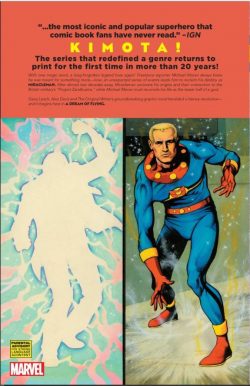
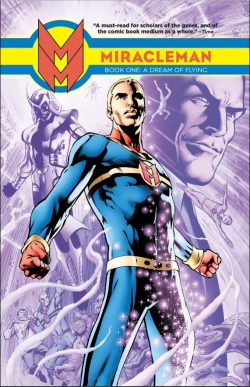
Miracleman Book One: A Dream of Flying


By the Original Writer, Mick Anglo, Garry Leach, Alan Davis, Don Lawrence, Steve Dillon, Mick Austin, Paul Neary & various (Marvel)
ISBN: 978-0-7851-5462-4 (HB)

I got my start in comics as the most junior of juniors on a rather iconoclastic and sensational magazine named Warrior. It was an incredible learning experience but producing arguably Britain’s most influential comic magazine was a tense, fraught, high energy, cauldron-like existence for all involved and some of those comrades-in-arms barely talk to each other these days.

That’s part of the story behind the fact that the incredible author of most of the stories in this premier compilation doesn’t want his name anywhere near it.

As that’s the case I’m happy to respect his wishes. It is a shame, though, as this is a work which changed the shape and nature of superhero comics forever, even if during the latter days of it in Warrior, we all thought the bloody strip was cursed…

If you’re interested in rumour, speculation and divided perspectives on ancient history, there are plenty of places online to visit for other information, but today let’s just discuss one of the very best superhero stories ever crafted…

This book is available in a variety of formats and although some of the back-up contents might vary in essence it is a lavish, remastered full re-presentation of the original Marvelman saga A Dream of Flying; stuffed with extra story content and page after page of lush behind-the-scenes material, production art and more.

Just in case you weren’t aware: the hero of this tome was originally created by jobbing artist and comics packager Mick Anglo for publisher L. Miller and Son in 1954 to replace a line of extremely popular British weekly monochrome reprints starring the Marvel Family as originally generated by US outfit Fawcett.

When a decade-long legal dispute between Fawcett and National/DC arguing copyright infringement ended just as the superhero trend nosedived in America, the defendant simply closed down most of its comics line. Overnight this act deprived British – and other foreign clients’ – firms of one of their most popular reprint strands.

In a feat of slippery brilliance, Anglo rapidly retooled defunct Yank heroes Captain Marvel, Captain Marvel Junior and Mary Marvel into Marvelman, Young Marvelman and Kid Marvelman, subsequently detailing their simplistic, charming adventures until 1963, when falling sales and changing tastes finally caught up with them all and they vanished into comicbook limbo.

In 1982 the characters and concepts were picked up by Dez Skinn for his proposed new independent and proudly British venture and quite soon magic was being created again…

The second end began when a certain US comics publisher started suing Warrior for using the word “Marvel” even though when Marvelman was created they were still calling themselves “Atlas”. (No, of course I’m over it now…)

An inescapable truism of modern life is that money trumps fact every time…

This compelling volume opens with ‘Prologue 1956: The Invaders from the Future’ (originally created by Anglo and the great Don Lawrence but subtly tweaked by our unnamed “original writer”) as a scene-setting foretaste of what might have been before the deconstructionist main event opens.

In that idealised past epoch, invulnerable time-travellers from 1981 are beaten back by the intrepid trio of superheroes before the real story begins in the drab, humdrum and utterly ordinary world of Thatcherite Britain, circa 1982…

Over-the-hill freelance journalist Mike Moran is plagued by ‘A Dream of Flying’ (illustrated by Garry Leach) as a godlike gleaming superman before being blown up by atom bombs…

This morning, however, he can’t let it stop him getting to the opening of the new atomic power station at Larksmere, even if his concentration is ruined by another of his crippling headaches and the agonising frustration of a word he’s forgotten lurking just beyond the tip of his tongue…

The press launch is an unmitigated disaster. When a band of terrorists attack the site, Mike collapses and while he’s being dragged off something happens. That word comes back to him and, in a catastrophic salvo of heat and light and noise, he transforms into the creature of his dreams before comprehensively dealing with the gunmen and flying off into space…

In ‘Legends’ the glittering paragon returns to Mike’s wife and attempts to explain the impossible events and his restored memories of being a superhero in Fifties Britain. Liz Moran cannot help but laugh at the canon of ridiculous absurdities this incredible creature spouts even if to all intents and purposes he is her husband. After all, if his restored memories are correct, why has nobody ever heard of him?

To augment the drama (and pad out the comicbooks this compilation is taken from), ‘Miracleman Behind the Scenes’ devotes space to pages offering a wealth of pre-production work: sketches, design roughs, pencilled panels and complete original art, colour-indications, pertinent ads, pin-ups and covers by Leach.

These are supplemented by ‘Kimota! The Secret Origin of Mick Anglo’s Marvelman’ by British comics historian and journalist Mike Conroy, and ‘Mick on Mick’ sees Marvel Chief Creative Officer Joe Quesada interviewing Mick Anglo before a brace of the veteran’s strips (from Marvelman #25, February 3rd 1954) reveal what all the post-war fuss was about.

‘Marvelman and the Atomic Bomber’ finds precocious newsboy Micky Moran on the trail of deadly spies after which ‘Marvelman and the Stolen Radium’ has the Atomic Warrior foiling dastardly bandits led by Professor Hatz and saving England from fatal contamination…

Further vintage thrills materialise in ‘The Stolen Reflections’ (Marvelman #32, March 24th 1954) when mad scientist Gargunza builds a machine to animate mirror images…

Returning to modern times and full colour, aging Mike’s insane situation is exacerbated next morning ‘When Johnny Comes Marching Home’. Technological guru and self-made billionaire John Bates calls out of the blue and Mike suddenly remembers the amiable little lad with superpowers who was his jolly sidekick before being caught in the same atomic blast that eradicated his own memories.

After he and Liz visit the unctuous mogul, Mike realises with horror that his fawning junior partner never changed back to human but has been slowly using his gifts to dominate the world for the last eighteen years…

Rumbled, Bates ferociously attacks in ‘Dragons’, using abilities which have grown and evolved in two decades of constant if covert use to beat the recently returned Miracleman near to death. However, the horrific super-duel is abruptly curtailed by a sudden jump into what we thought back then would be the near-future…

Warrior #4 was sold as a summer special in August 1982. It led with a bold fill-in set three years into the story time-line. The editorial long-term plan had been to create a “Justice League” of Warrior characters and ‘The Yesterday Gambit’ – with art by Steve Dillon, Alan Davis & Paul Neary – starred two of them in an interlude from their final battle with an ultimate nemesis.

The complex plot involved trans-dimensional teleporting alien samurai Aza Chorn (as yet unintroduced) who ferried Miracleman through time to battle himself at different stages of his career. The expended energies of the cataclysmic combats would be harvested by the gallant Warpsmith to use against their unstoppable future foe…

The ‘Miracleman Behind the Scenes’ offers more pre-production work: sketches, designs for Bates, complete original art, and covers by Leach, supplemented by ‘A Short History of British Comics’ by Mike Conroy plus a brace of 1950s classics.

‘The Birth of Marvelman’ (Marvelman #65, November 1st 1954) was the eagerly-anticipated origin tale of how reclusive astro-scientist Guntag Barghelt first gifted plucky young Micky Moran with the greatest power in the universe, after which issue #102 (July 30th 1955) saw a newly-minted boy hero rescuing innocent kids unjustly accused of being juvenile delinquents in ‘Introducing Kid Marvelman’…

The appalling supra-normal duel of metahuman gods resumes next: spectacularly devastating much of London. Pencilled by Alan Davis and inked by Leach, ‘Fallen Angels, Forgotten Thunder’ emphasises the true horror of para-powered combat and only ends when the smugly overconfident former Kid Miracleman accidentally defeats himself…

The first inklings of the incredible truth begin to emerge in ‘Secret Identity’ (Davis & Leach) as Sir Dennis Archer of mothballed, clandestine organisation “The Spookshow” despatches his top assassin to find and sanction a threat he’s long-believed eradicated in a flash of atomic fire decades past.

Mike and Liz meanwhile head for Dartmoor to test Miracleman’s abilities in private.

Their marriage has suffered since the initial transformation, especially as Mike insists he and his alter-ego are two different people and Miracleman has got Liz pregnant after his own fruitless years of trying…

Davis fully took over the art chores with ‘Blue Murder’ as Archer’s highly capable investigator/hitman Evelyn Cream tracks down and brilliantly takes out Moran with a minimum of fuss…

Following Mick Austin’s award-winning cover to Warrior #7, ‘We Are Warpsmiths!’ reintroduces the hero’s prospective alien allies through covers, sketches and design roughs, culminating with the stranger creatures’ initial storyline as first seen in Warrior #9 and 10.

Reproduced here in captivating full colour and showcasing the bizarre and exotic realms the militaristic peacekeepers are sworn to defend, ‘Cold War, Cold Warrior’ sees a family group of stellar sentinels critically overreact to a suspected incursion into their protectorate…

The unending, extended conflict with their cosmic antithesis The Qys results in constant, deadly politicking and here innocent kids and two members of their own Warpsmith cadre are sacrificed to expediency and a greater agenda…

By the advent of ‘Out of the Dark’ (first seen in Warrior #9, January 1983) the enigmatic killer Cream has inexplicably switched sides, aiding Miracleman as he seeks out the truth of his origins in a top-secret military bunker which contains deadly defences, another – lesser – superhuman and more. The human resources prove as nothing to the sparkling juggernaut in their midst but the Spookshow has one last card to play: a deformed and inadequate leftover superhuman dubbed Big Ben…

‘Inside Story’ reveals at last what happened when British Intelligence happened upon the find of an epoch and how they foolishly sought outside assistance to utilise it. Tragically, that single misjudgement led to a catalogue of others…

Soon Miracleman understands how recovered and reverse-engineered alien DNA techniques, cruel and callous genetic experimentation and the paranoia of one deranged, debauched scientist who grew supermen and programmed them to compliance using comicbook fantasies led to his current predicament in culminating chapter ‘Zarathustra’…

To Be Continued…

The remainder of this stunning collection is rounded out with tantalising snippets from Warrior‘s then-gestating shared universe, beginning with ‘Saturday Morning Pictures’ – illustrated by Davis as a framing device in the Marvelman Special – which originally featured a number of classic, remastered Anglo-era adventures and a fascinating peek into what might have been…

The nomadic multiplanar policemen called Warpsmiths reappear in ‘Ghostdance’ (originally published in A1 #1, October 1989) in a direct continuation of the first saga, as the surviving dutiful sentinels grieve and move on in their own uniquely inexplicable manner…

This last is accompanied by more ‘Miracleman Behind the Scenes’ material from Leach, tracing the development of the Warpsmiths and augmented by a selection of house ads, even more original art pages and found background material.

Wrapping things up is a stunning gallery of covers and variants by Leach, Davis, Austin, Joe Quesada, Danny Miki, Richard Isanove, John Cassady, Paul Mounts, Leinil Yu, Gerry Alanguilan, Laura Martin, Skottie Young, Mark Buckingham, D’Israeli, Jerome Opena, Dean White, Steve Oliff, Neal Adams, Frank Martin, Mark Farmer, Arthur Adams, Peter Steigerwald, Mike Perkins, Andy Troy, Mike McKone, Paulo Rivera, Mike Deodato, Rain Beredo, J.G Jones, Javier Rodriguez, John Tyler Christopher, Gerald Parel and Bryan Hitch, generated for Marvel’s 2013 relaunch of the property.

One of the greatest superhero comics sagas ever. There’s simply nothing else to say…
© 2014 Marvel Characters Inc. All rights reserved.

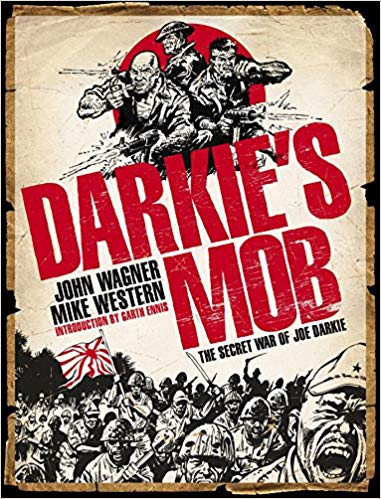
Darkie’s Mob: The Secret War of Joe Darkie


By John Wagner & Mike Weston (Titan Books)
ISBN: 978-1-84856-442-8

Britain has always had a solid tradition for top-notch comic strips about the Second World War but the material produced by one radically different publication in the 1970s and 1980s surpassed all previous efforts and has been acknowledged as having transformed the entire art form.

Battle was one of the last great British weekly anthologies: a combat-themed anthology comic which began as Battle Picture Weekly on 8th March 1975 and, through absorption, merger and re-branding became Battle Picture Weekly & Valiant, Battle Action, Battle, Battle Action Force and ultimately Battle Storm Force before itself being combined with the too-prestigious-to-cancel Eagle on January 23rd 1988.

Over 673 gore-soaked, epithet-stuffed, adrenaline-drenched issues, the contents of the blistering periodical gouged its way into the bloodthirsty hearts of a generation, consequently producing some of the best and most influential war stories ever. These include Major Eazy, D-Day Dawson, The Bootneck Boy, Johnny Red, HMS Nightshade, Rat Pack, Fighter from the Sky, Hold Hill 109, Fighting Mann, Death Squad!, Panzer G-Man, Joe Two Beans, The Sarge (star-artist Mike Western’s other best work ever), Hellman of Hammer Force and the stunning and iconic Charley’s War among many others.

The list of talented contributors was equally impressive: writers Pat Mills, John Wagner, Steve McManus, Mark Andrew, Gerry Finley-Day, Tom Tully, Eric & Alan Hebden, with art from Colin Page, Pat Wright, Giralt, Carlos Ezquerra, Geoff Campion, Jim Watson, Mike Western, Joe Colquhoun, Carlos Pino, John Cooper, Mike Dorey, Cam Kennedy and more.

One of the most harrowing and memorable series during that reign of blood and honour was an innovative saga of group obsession and personal vengeance set in the green hell of Burma in the months following the Japanese invasion and rout of the entrenched British Empire in Spring 1942.

As delivered by John Wagner & Mike Western, Darkie’s Mob is a phenomenally – and deservedly – well-regarded classic of the genre, wherein a mysterious maniac adopts and subverts a lost, broken, demoralised and doomed squad of British soldiers. His intent is to on use them to punish the Japanese in ways no normal man could imagine…

This glorious oversized monochrome hardback compilation collects the entire uncompromising saga – which originally ran from 14th August 1976 to 18th June 1977 – in a deluxe edition which also contains a comprehensive cover gallery and ‘Dead Men Walking’: an effusive introduction by unabashed fan and occasional war-writer Garth Ennis.

The tale opens as a frenetically fast-paced mystery-thriller beginning in 1946 when Allied troops discover the blood-soaked combat journal of Private Richard Shortland, reported missing along with the rest of his platoon during the frantic retreat from the all-conquering Japanese.

The first entry and the opening initial episode are dated May 30th 1942 and describe a slow descent into the very heart of darkness…

Beaten and ready to die, the rag-tag remnants of the British Army are rescued from certain death by the uncompromising, unconventional and terrifyingly pitiless Captain Joe Darkie who strides out of the hostile Burmese verdure and instantly asserts an almost preternatural command over the weary warriors. The men are appalled by Darkie’s physical and emotional abuse of them and his terrifying treatment of an enemy patrol he encounters whilst leading them out of their predicament.

They’re even more shocked when they discover that he’s not heading for the safety of their lines but guiding them deeper into Japanese-held territory…

Thus begins a guerrilla war like no other, as Darkie moulds the soldiers – through brutal bullying and all manner of psychological ploys – into fanatics with only one purpose: hunting and killing the enemy.

In rapid snatches of events culled from Shortland’s account we discover that Darkie is a near-mythical night-terror to the invaders, a Kukri-wielding, poison-spitting demon happy to betray, exploit and expend his own men to slaughter his hated foes. He is equally well-known to the enslaved natives and ruthlessly at home in the alien world of the Burma jungles and swamps. What kind of experiences could transform a British Officer into such a ravening horror?

An answer of sorts quickly comes after Shortland intercepts a radio communication and discovers that the Army has no record of any soldier named Joe Darkie, but the dutiful diarist has no explanation of his own reasons for keeping the psycho-killer’s secret to himself…

For over a year the hellish crusade continued with the Mob striking everywhere like bloody ghosts; freeing prisoners, sabotaging Japanese bases, destroying engineering works and always killing in the most spectacular manner possible. Eventually after murdering generals, blowing up bridges and casually invading the most secure cities in the country, the Mob become the Empires’ most wanted men as both Britain and Japan hunt the rogue unit with equal vehemence and ferocity.

Darkie wants to kill and not even Allied orders will stop him…

The mob are gradually whittled away by death, insanity and fatigue as Darkie infects them with his hatred and nihilistic madness until all the once-human soldiers are nothing more than Jap-hating killing machines ready and willing to die just as long as they can take another son of Nippon to hell with them…

The descent culminates but doesn’t end with the shocking revelations of Darkie’s origins and secret in Shortland’s incredible entry for October 30th 1943, after which the inevitable end inexorably drew near…

This complete chronicle also includes a heavily illustrated prose tale from the 1990 Battle Holiday Special and I’m spoiling nobody’s fun by advising you all to read this bonus feature long before you arrive at the staggering conclusion…

A mention should be made of the language used here. Although a children’s comic – or perhaps because it was – the speech and interactions of the characters contains a strongly disparaging and colourful racial element.

Some of these terms are liable to cause offence to modern readers – but not nearly as much as any post-watershed TV show or your average school playground – so please try and remember the vintage and authorial directives in place when the stories were first released.

Battle exploded forever the cosy, safely nostalgic “we’ll all be alright in the end” tradition of British comics; ushering an ultra-realistic, class-savvy, gritty awareness of the true horror of military service and conflict, pounding home the message War is Hell.

With Darkie’s Mob Wagner and Western successfully and so horrifyingly showed us its truly ugly face and inescapable consequences.
Darkie’s Mob © 2011 Egmont UK Ltd. All Rights Reserved. Dead Men Walking © 2011 Garth Ennis.