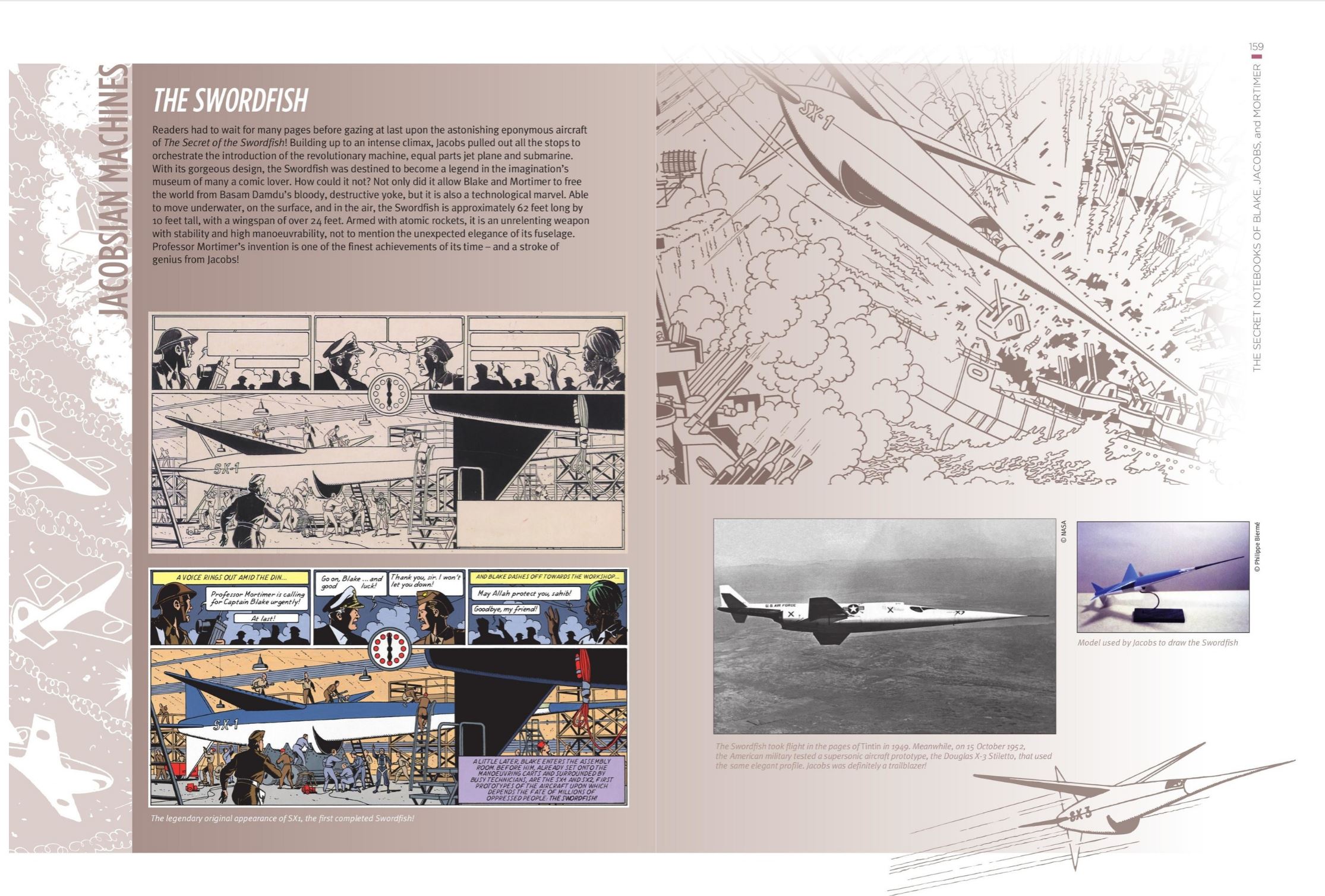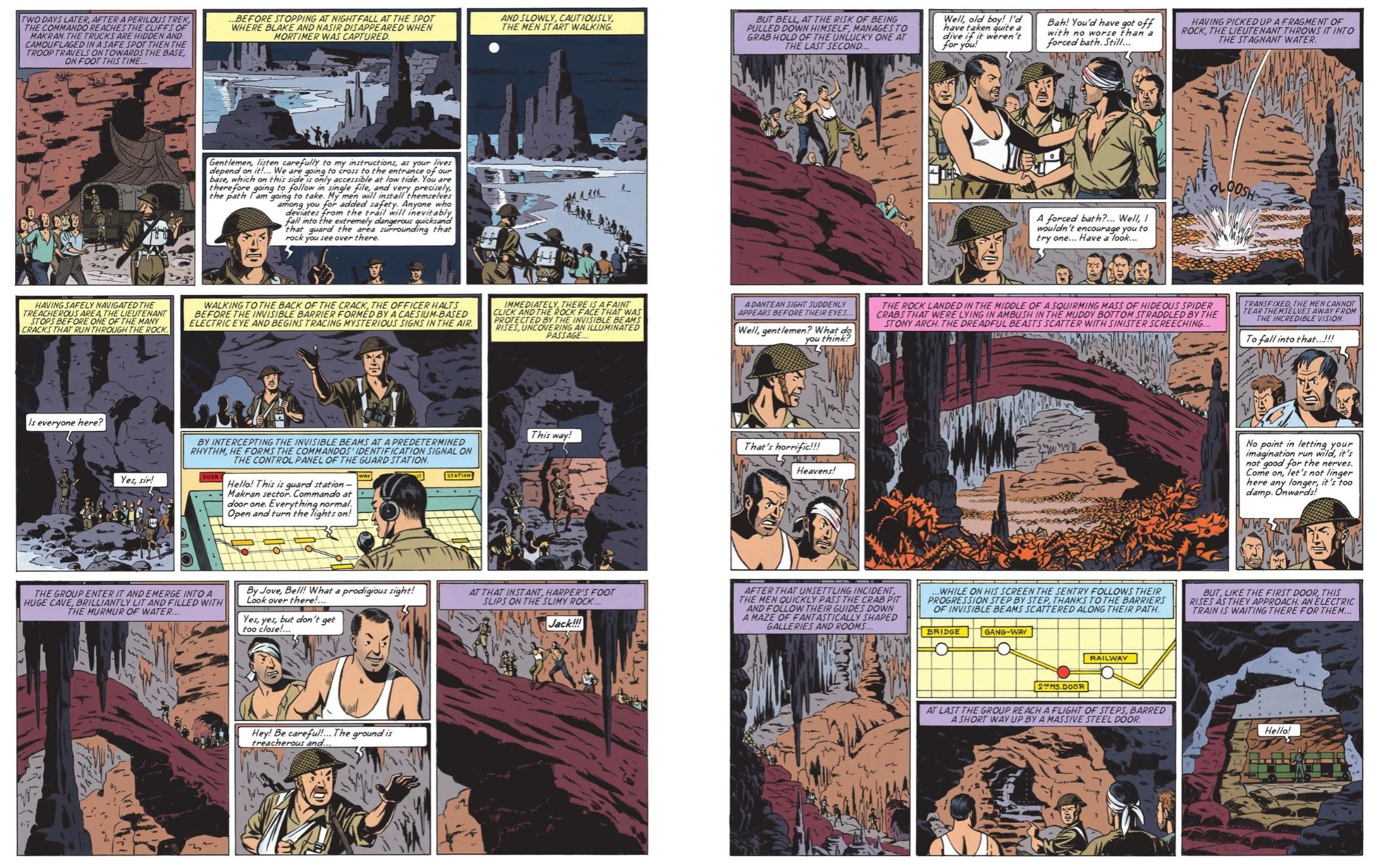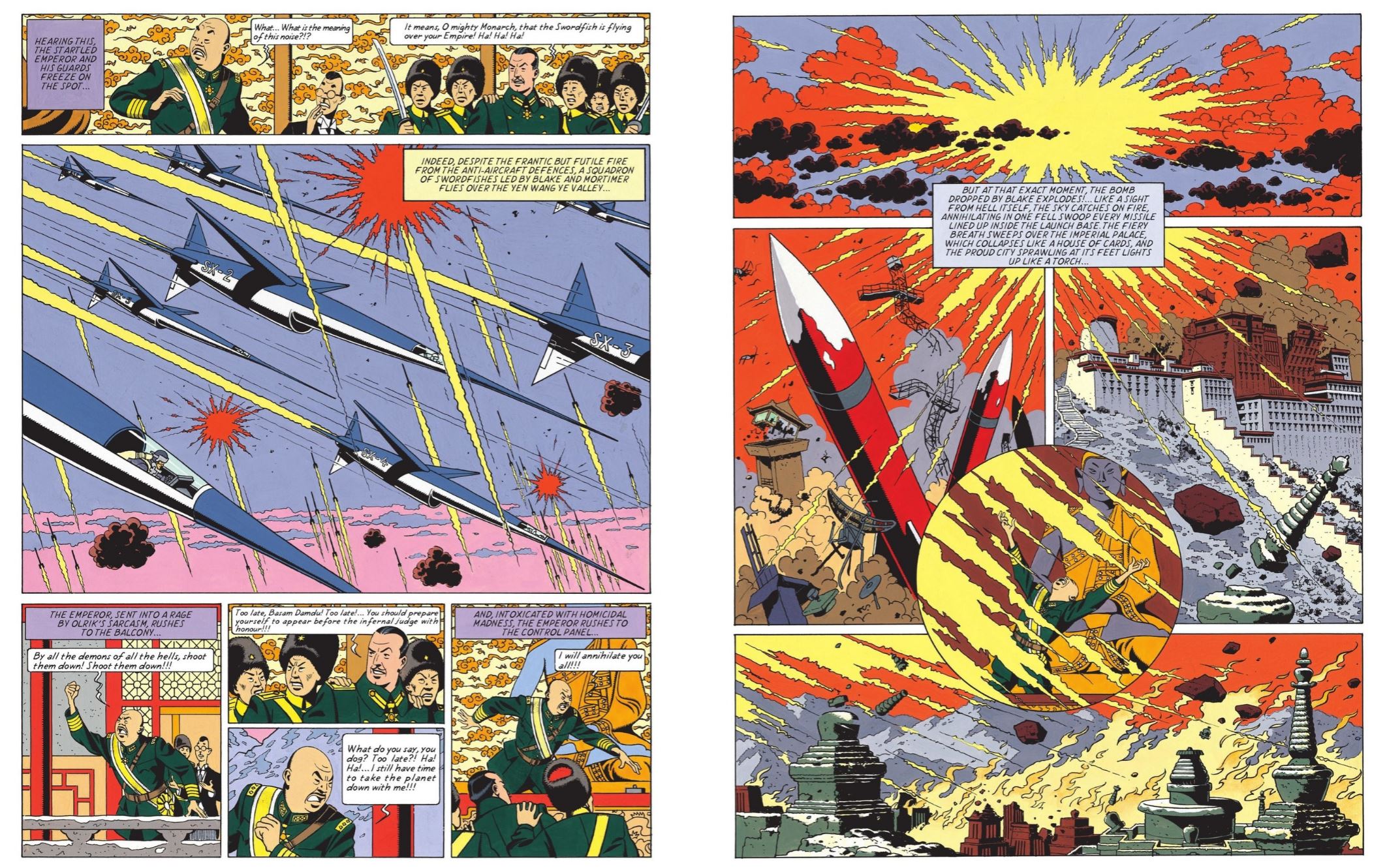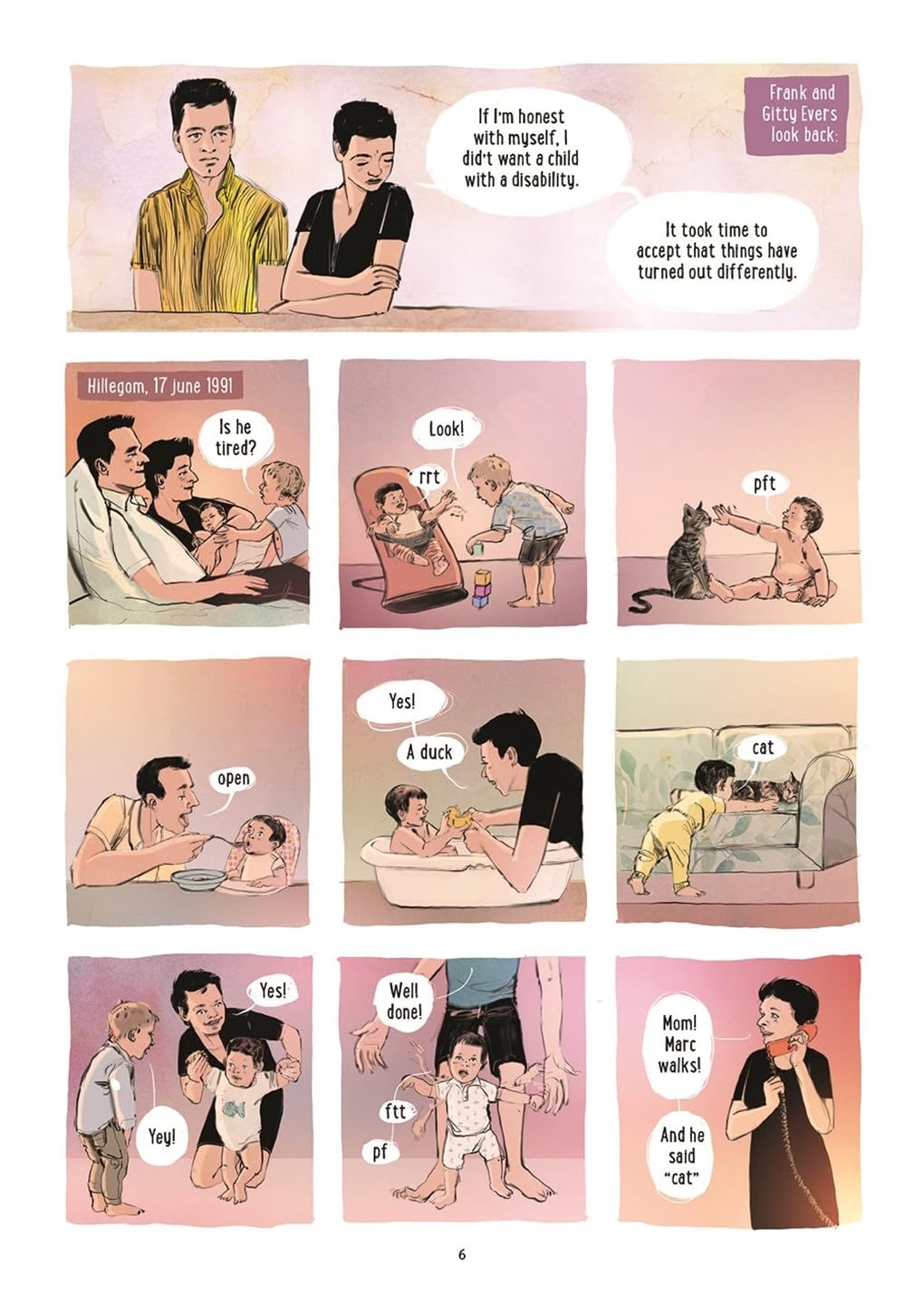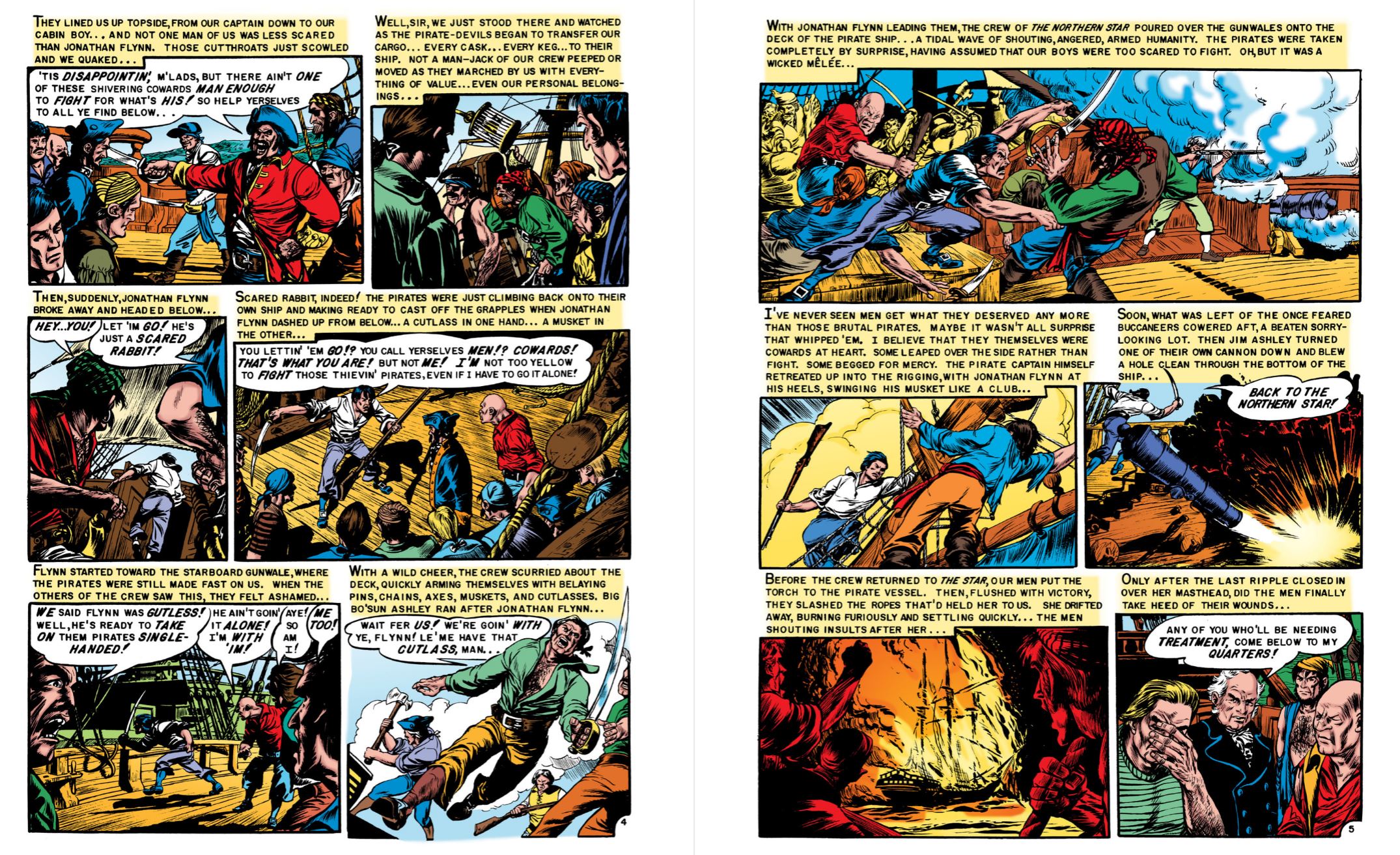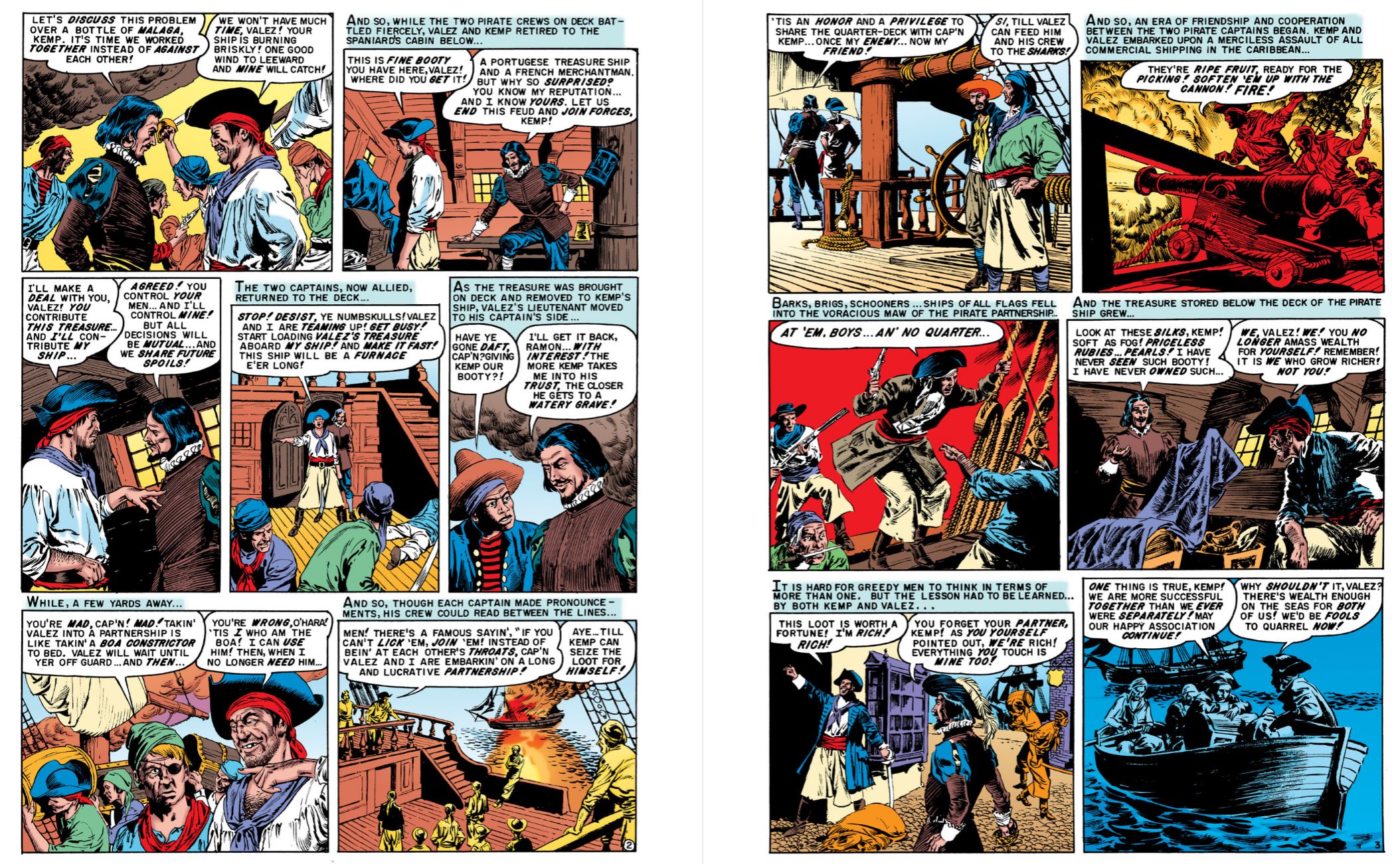
Buz Sawyer volume 2: Sultry’s Tiger


By Roy Crane  & various (Fantagraphics Books)
ISBN: 978-1-60699-499-3 (HB)

This book includes Discriminatory Content produced in less enlightened times.

Modern comics evolved from newspaper comic strips, and these pictorial features were, until relatively recently, utterly ubiquitous. Immensely information-efficient, hugely popular with the public and highly valued by publishers who used them as irresistible weapons to guarantee sales and increase circulation, the strips seemed to find their only opposition in the short-sighted local paper editors who often resented the low brow art form, which cut into advertising and frequently drew complaint letters from cranks…

It’s virtually impossible for us today to understand the overwhelming allure and power of the comic strip in America (and the wider world) from the Great Depression to the end of World War II. With no television, broadcast radio far from universal and movie shows at best a weekly treat for most folk, household entertainment was mostly derived from the comics sections of daily – and especially Sunday – newspapers. “The Funnies” were the most universally enjoyed recreation for millions who were well served by a fantastic variety and incredible quality of graphic sagas and humorous episodes over the years.

From the very start comedy was paramount; hence our terms Funnies and Comics, and from these gag-&-stunt beginnings, a blend of silent movie slapstick, outrageous fantasy and the vaudeville shows, came a thoroughly entertaining mutant hybrid: Roy Crane’s Wash Tubbs.

Debuting on April 21st 1924, Washington Tubbs II was a comedic, gag-a-day strip which evolved into a globe-girdling adventure serial. Crane produced pages of stunning, addictive and influential high-quality yarn-spinning for years, until his eventual introduction of moody swashbuckler Captain Easy ushered in the age of adventure strips with the landmark episode for 6th May, 1929. This in turn led to a Sunday colour page for the good captain that was possibly the most compelling and visually imaginative of the entire era (see Roy Crane’s Captain Easy, Soldier of Fortune: The Complete Sunday Newspaper Strips vol 1 ).

Practically improving minute by minute, the Sunday strip benefited from Crane’s relentless quest for perfection his imaginative, fabulous compositional masterpieces achieving a timeless immediacy that made each page a unified piece of sequential art. The influence of those pages can be seen in the works of near-contemporaries such as Hergé, giants-in-waiting like Charles Schulz and comic book masters like Alex Toth and John Severin ever since.

The material was obviously as much fun to create as to read. In fact, the cited reason for Crane surrendering the Sunday strip to his assistant Les Turner in 1937 was NEA/United Features Syndicate’s abrupt and arbitrary demand that all its strips must henceforward be produced in a rigid panel-structure to facilitate their being cut up and re-pasted as local editors dictated.

They just didn’t lift the artist any more, so Crane stopped making them.

At the height of his powers Crane just walked away from the astounding Captain Easy Sunday page to concentrate on the daily feature, and when his contract expired in 1943 he left United Features, lured away by that grandee of strip poachers William Randolph Hearst. The result was a contemporary aviation strip set in still-unfolding World War II: Buz Sawyer.

Where Wash Tubbs was a brave but largely comedic Lothario and his pal Easy a surly, tight-lipped he-man, John Singer “Buz” Sawyer was a joyous and sharp amalgam of the two: a good-looking, popular country-boy who went to war because his country needed him..

Buz was a fun-loving, skirt-chasing, musically-inclined naval aviator daily risking his life with his devoted gunner Rosco Sweeney: a bluff, brave and simply ordinary Joe – and one of the most effective comedy foils ever created. The wartime strip was – and remains – a marvel of authenticity: depicting not just the action and drama of the locale and situation but, more importantly, capturing the quiet, dull hours of training, routine and desperate larks between the serious business of killing and staying alive. However – and crucially – when the war ended the action-loving duo – plus fellow pilot and girl-chasing rival Chili Harrison – all went looking for work that satisfied their penchant for adventure and romance wherever they could find it…

Crane was a master of popular entertainment, blending action and adventure with smart drama and compellingly sophisticated soap opera, all leavened with raucous comedy in a seamless procession of unmissable daily episodes. He and his team of creative assistants – which over the decades comprised co-writer Ed “Doc” Granberry and artists Hank Schlensker, Clark Haas, Al Wenzel, Joel King, Ralph Lane, Dan Heilman, Hi Mankin & Bill Wright – soldiered on under relentless deadline pressure, producing an authentic and exotic funny romantic thriller rendered in the signature monochrome textures of line-art and craftint (a mechanical monochrome patterning effect used to add greys and halftones to the superb drawing for miraculous depths and moods) as well as the prerequisite full-colour Sunday page.

This primarily black-&-white tome contains an impressive but far too meagre selection of those colour strips – although Crane quickly came to regard them only as a necessary evil which plagued him for most of his career…

The eternal dichotomy and narrative/continuity problems of producing Sunday Pages (many client papers would only buy either Dailies or Sunday strips, but not both) meant that most creators had to produce different story-lines for each feature – Milt Caniff’s Steve Canyon being one of the few notable exceptions. Whereas Dailies needed about three weeks lead-in time, hand-separated colour plates for the sabbath sections meant finished artwork and colour guides had be at the engravers and printers a minimum of six weeks before publication. Crane handled the problem with typical aplomb; using Sundays to tell completely unrelated stories.

For Wash Tubbs he created the aforementioned prequel series starring Captain Easy in sagas set before the mismatched pair had met, whilst in Buz Sawyer he turned the slot over to Roscoe Sweeney for lavish gag-a-day exploits, packed with slapstick laughs and situation comedy. During the war years it was set among the common “swabbies” aboard ship: a far more family-oriented feature and probably better suiting the weekend crowd of parents and children than the often chilling or disturbing realistically saucy/sexy sagas that unfolded Mondays to Saturdays. A year before Steve Canyon began, Crane tried telling a seven-days-a-week yarn in Buz Sawyer (with resounding success, to my mind, and you can judge for yourself here) but found the process a logistical nightmare. At the conclusion he returned to weekday continuity whilst Sundays were restored to Roscoe with only occasional guest-shots by the named star.

This second lush, sturdily archival hardback re-presents the tense and turbulent period from October 6th 1945 to July 23rd 1947 wherein de-mobilised adrenaline addict Buz tries to adjust to peacetime life whilst looking for a job and career – just like millions of his fellow former servicemen…

Before getting out, though, he had returned home on leave and ended up accidentally engaged. Buz was the son of the town’s doctor: plain, simple and good-hearted. In that ostensibly egalitarian environment the school sporting star became the sweetheart of ice-cool and stand-offish Tot Winter, the richest girl in town. Now when her upstart nouveau riche parents heard of the decorated hero’s return they hijacked the homecoming and turned it into a publicity carnival. Moreover, the ghastly, snobbish Mrs. Winter conspired with her daughter to trap the lad into a quick and newsworthy marriage.

Class, prejudice, financial greed and social climbing were enemies Buz and Sweeney were ill-equipped to fight, but luckily, annoying tomboy-brat/girl-next-door Christy Jameson had blossomed into a sensible, down-to-earth, practical and clever young woman. She’d scrubbed up real pretty too and showed Buz that his future was rife with possibility. Mercifully soon, the leave ended and he & Sweeney returned to the war. The Sawyer/Winter engagement fizzled and died. When their discharge papers finally arrived (in the episode for September 9th 1945), the period of desperate struggle was over. However, that only meant that the era of globe-girdling adventure was about to begin…

Before the comics wonderment resumes, Jeet Heer and Rick Norwood discuss ‘The Perfectionist and his Team’. Concentrating initially on ‘After the War’, the fascinating explorations also delve deep into detail of the auteur’s troubled and tempestuous relationship with ‘Crane’s Team’ before offering ‘A Word on Comic Strip Formats’ and the censorious iniquities local newspaper editors regularly inflicted upon Crane’s work.

With all the insightful stuff over, cartoon adventure begins anew as civilian Mr. Sawyer returns home to a life of indolence before his own restless nature starts him fretting again. The old town isn’t the same. Tot has inherited her father’s millions and moved to New York and even Christy is gone; she’s away attending his old alma mater…

After a brief interlude wherein he visits the cheery Co-Ed and debates the merits of returning to college on the G.I. Bill, Buz instead opts for fulltime employment and heads to the Big Apple where Chili Harrison has a new job offer and an old flame waiting. As he turns East, Buz chooses to ignore his instincts and the huge mysterious guy who seems to turn up everywhere he goes…

In NYC, aloof, alluring Tot Winter is the cream of polite “arty” society, but her wealth and clingy new fiancé – opera singer Count Franco Confetti – are all but forgotten when “the one who got away” appears again and she finds her interest in her High School beau rekindled. Buz has moved in with Chili, blithely unaware that the strangely ubiquitous giant has inveigled himself into the apartment next door and is now actively spying on him…

Sawyer wants a job flying, but is frankly only one of hundreds of war-hero pilots looking for a position at International Airways. Moreover, his reputation as a hot-shot risk-taker makes him the last person a commercial carrier might consider. Happily, after implausibly well-connected Chili intercedes with a major player in the company, something does come up…

The truth about Buz’s hulking stalker comes out when the Maharani of Batu’s yacht docks in New York. The exotic Asian princess is one of the wealthiest women on Earth and cuts a stunning figure with her tiger on a leash. Yet when Buz first met her she was simply “Sultry”, a ferocious, remorseless resistance fighter helping him kill the occupying Japanese on her Pacific island.

She never forgotten him and will ensure no other woman can have him…

Sultry moves into the penthouse adjoining Tot’s and is witness to the ploys of the Winter woman as she sidelines sleazy sneaky Confetti and makes her play for Buz. She is also a key figure in the tragic heiress’ sudden death…

Just prior to Tot’s gruesome demise, Buz had finally met the unconventional Mr. Wright of International Airways. That doughty executive had no need for pilots but wanted a quick-thinking, capable fighter who could solve problems in the world’s most troubled conflict zones. He even has a spot open for good old Roscoe Sweeney. Buz is all set for his first overseas assignment when the cops decide he’s the other prime suspect in Tot’s murder and, with Sawyer and Count Confetti in jail, Sultry tries to flee America before the truth comes out. Sweeney and the freshly exonerated Buz soon track her down, but Sultry turns the tables on them and shanghaies her erstwhile lover, imprisoning him on her yacht, determined to make him her permanent boytoy, far, far away from American …

Never short of an idea and blessed with the luck of the damned, Buz’s escape results in a terrifying conflagration and the seeming death of his obsessed inamorata… but Sultry’s body isn’t recovered…

It takes a lot of pleading to get Mr. Wright to give him another chance but, soon after, Buz & Sweeney are winging north to Greenland to stop a crazed sniper taking pot-shots at aircraft passing over the “Roof of the World”. This savage, visceral extended saga soon reveals the shooter to be a deranged leftover Nazi and his hapless attendants, but the heroes’ astonishing hunt for and capture of the Teutonic trio is as nothing compared to the harrowing trek to get them back to civilisation, especially since poor Roscoe is putty in the hands of lovely Frieda, devil-daughter of the utterly mad Baron von Schlingle.

Before Buz get the survivors home safely, he loses his plane, must forcibly trek across melting floes, get them all stranded on a iceberg and even has his pretty-boy face marred forever. Worst of all, by the time he gets back to civilisation, his job no longer exists. Mr. Wright has quit and moved on to another company…

It’s not all bad news. Wright has euphemistically become “Personnel Director” for Frontier Oil: a truly colossal conglomerate active all over Earth and now wants Buz to carry on his unique problem-solving career for his new employers.

Despite a large bump in salary, the weary war hero is undecided until he hears Christy is helping her dad in Central American nation Salvaduras in his role as a geologist for Frontier Oil. This happily ties in with an outstanding missing persons case; said vanished victim being Bill Daniels, playboy son of a prominent company executive. It takes very little to convince Wright to despatch Buz & Roscoe south of the border to investigate, opening floodgates to a spectacular epic of light-hearted romantic adventure a world apart from his previous harrowing cases. The story also saw Crane and Co. merging the Daily and Sunday strips into a single storyline (with the Sundays primarily illustrated by Schlensker) as the action boys tried to trace the missing American in a country that seems locked in fear and poverty…

After initially hitting a wattle-and-daub wall, Buz takes time off for a picnic with Christy and, after a close call with a faux Mexican bandit (in actuality a Yankee fugitive from justice with an atrocious fake accent), declares his undying love for her.

He is not rebuffed and there’s the hint of wedding bells in the air…

First, though, he and Sweeney need to finish the mission, and help comes from a brave peon who breaks the regional code of silence to put them on the trail of the mysterious Ranch of the Caves and its American émigré who rules the isolated canton with blood and terror. After romancing the daughter of vicious Don Jaime, Buz and Roscoe infiltrate the desolate fiefdom and the gang boss’ international band of thugs, discovering not only the very much alive missing playboy but an incredible lost Mayan treasure trove!

Mission accomplished, Buz returns to New York to marry Christy, only to find he’s already needed elsewhere. Christy too is having doubts, worried that she will always play second fiddle to her man’s addiction to action, whereas in truth the real problem is that trouble usually comes looking for Buz. Boarding a Frontier plane for the Yukon, Sawyer is merely a collateral casualty when the ship’s other passenger is kidnapped. The mysterious menabducting plastic surgeon Dr. Wing take their helpless hostages all the way to deepest Africa where they expect the medic to change the face of an infamous madman everybody in the world believes died in a Berlin Bunker. Tragically, the fanatics are not prepared for the physician’s dauntless sense of duty and sacrifice nor Buz’s sheer determination to survive…

The latter part of this tale describes Buz’s epic river trek with mercenary turncoat honey-trap Kitty as they flee from vengeful Nazis. However, even after reaching the coast and relative safety, the insidious reach of the war-criminals is not exhausted and one final attack looms…

Eventually, Buz returns to New York alone and wins enough time from slave driving Mr. Wright to settle things with Christy. He follows her to Nantucket Sound, but even their romantic sailboat ride turns into a life-changing adventure…

To be Continued for decades to come…

This splendid collection is the perfect means of discovering – or reconnecting with – Crane’s second magnum opus: spectacular, enthralling, exotically immediate romps that influenced generations of modern cartoonists, illustrators, comics creators and storytellers. Buz Sawyer ranks amongst the very greatest strip cartoon features ever created: rousing, enthralling, thrilling, outrageously funny and deeply moving tale-telling that is irresistible and utterly unforgettable.
Buz Sawyer: Sultry’s Tiger © 2012 Fantagraphics Books, all other material © 2012 the respective copyright holders. All Strips © 2010 King Features Syndicate, Inc All rights reserved.
Today in 1890, landmark British magazine Comic Cuts began publication. See what we started?

This date in 1928 scripter/screen writer George Kashdan (Tomahawk, Congo Bill, Tommy Tomorrow, Mysto, Magician Detective, hundreds of DC genre anthology tales, Superman/ Aquaman Hour of Adventure) as born, with Dutch creator Piet Wijn (Aram, Douwe Dabbert) coming a year later. Dave (Cerebus) Sim popped up in 1956 and Linda Medley (Castle Waiting, Justice League America, Doom Patrol, Galactic Girl Guides) in 1964.

Today saw the loss of Mutt and Jeff ghostwriter Aurthus “Bugs” Baer in 1969, ULTIMATE Batman artist Dick Sprang in 2000 and Mad’s The Lighter Side cartoonist Dave Berg in 2002.
Upside Dawn


By Jason (Fantagraphics Books)
ISBN: 978-1-68396-652-4 (HB/digital edition)

This book includes Discriminatory Content included for dramatic, comedic and ironic effect.

Born in 1965 in Molde, Norway, John Arne Sæterøy is known by enigmatic, utilitarian nom de plume Jason. The shy & retiring auteur first took the path to cartoon superstardom in 1995, once debut graphic novel Lomma full ay regn (Pocket Full of Rain) won Norway’s biggest comics prize: the Sproing Award. From 1987 he had contributed to alternate/indie magazine KonK while studying graphic design and illustration at Oslo’s Art Academy.

From there he took on Norway’s National School of Arts and, on graduating in 1994, founded his own comic book Mjau Mjau. Constantly refining his style into a potent form of meaning-mined anthropomorphic minimalism, Jason has cited Lewis Trondheim, Jim Woodring & Tex Avery as primary influences. He moved to Copenhagen, working at Studio Gimle alongside Ole Comoll Christensen (Excreta, Mar Mysteriet Surn/Mayday Mysteries, Den Anden Praesident, Det Tredje Ojet) and Peter Snejbjerg (Den skjulte protocol/The Hidden Protocol, World War X, Tarzan, Batman: Detective 27).

Jason’s efforts were internationally noticed, making waves in France, The Netherlands, Slovenia, Spain, Germany and other Scandinavian countries as well as the Americas and he won another Sproing in 2001 – for self-published series Mjau Mjau – before in 2002 turning nigh-exclusively to producing graphic novels. He won even more major awards.

Jason’s breadth of interest is wide & deep: comics, movies, animated cartoons, music, literature, art, history and pulp fiction all feature equally with no sense of rank or hierarchy. Jason’s puckish, egalitarian mixing & matching of inspirational sources always and inevitably produces picture-treatises well worth a reader’s time. Over a succession of tales he has built and re-employed a repertory company of stock characters to explore deceptively simplistic milieux based on classic archetypes distilled from movies, childhood yarns, historical and literary favourites. These all role-play in deliciously absurd and surreal sagas centred on his preferred themes of relationships and loneliness. Latterly, Jason returned to such “found” players as he built his own highly esoteric universe, and even has a whole bizarre bunch of them “team-up” or clash…

As always, visual/verbal bon mots unfold in beguiling, sparse-dialogued, or even as here silently pantomimic progressions, with compellingly formal page layouts rendered in a pared back stripped-down interpretation of Hergé’s Claire Ligne style: solid blacks, thick outlines dominating settings of seductive monochrome simplicity augmented by a beguiling palette of stark pastels and muted primary colours.

A master of short-form illustrated tales, many Jason yarns have been released as snappy little albums before later inclusion in longer anthology collections. The majority of tales brim with bleak isolation, swamped by a signature surreality even in the most comedic of moments. They are largely populated with cinematically-inspired, darkly comic, charmingly macabre animal people ruminating on inescapable concerns whilst re-enacting bizarrely cast, bestial movie tributes. That’s a style that has never been more apropos than right here, as the more modern Art Forms bow before the onslaught and tirade of organised anti-art philosophers, socially intellectual terrorists, wandering pop stars and a lost Vulcan…

Here the auteur returns to short individual pieces – or are they? – and fondly dabbles with words, terms and aural meanings whilst opening with an understandable failure to communicate over a meal in ‘Woman, Man, Bird’ before noted cerebral French auteur/filmmaker and playfully adrift word-&-meaning warper Georges Perec is repositioned as a hardboiled gumshoe searching for a missing woman in a yarn laced with omissions, mis-hearings and misapprehensions. Nevertheless, if you’re looking for a truth – any truth – ‘Perec PI’ is on the case…

A rapid pictorial transit to a peregrination through a typical life is recalled at full pelt in ‘I Remember’ after which ‘Vampyros Dyslexicoa’ dips deep into literary hinterlands in a pastiche/homage to Joseph Sheridan Le Fanu’s 1872 Gothic novella Carmilla. However the sordid obsessions of sapphic vampire Mircalla are only the entrée to wilder scriptorial regions and a nasty case of creative anachronism as ‘Seal VII’ takes us deep into modern “Scandi” folklore when a certain Knight and Death meet up for a game in Sweden in 1357 and don’t really cotton to the notion of chess for souls…

The scenes shifts to Prague in 1919 where a certain agent of the crown abruptly quits his job and is renditioned to a strange, picturesque high-tech surveillance Village where he has to wear a blazer as ‘The Prisoner in the Castle’ prior to popping back to St Peterburg in 1865 to gorily relive the trials and tribulations of Great Russian Literature at first hand via some eccentric ‘Crime and Punishment’

As much as Jason has played with visual meaning and manipulated derived imagery-context in his past forays, the later relater is here gripped by the confusing potentials of words and verbal meanings. Such facile surface fascinations are apparent during Leopold Bloom’s rather violent visit with the absolute master of “what did that mean” Dublin in June offers a walk with James Joyce, a leprechaun, Stephen Dedalus and Molly as we ponder stuff and not-nonsense in ‘Ulysses’. Then ‘Ionesco’ introduces random judgement to the final days of avant-garde playwright Eugène Ionesco, as a parade of bizarre celebrities and notables eulogise or defame him before he goes…

Slipping into a partial colour palette (yellow, if you care), ‘What Rhymes with Giallo?’ uses rhyming couplets to detail a sordid stabbing spree before resuming monochromatic mode as the tense future proves too much for one scientific stoic. Stress compels Mr Spock to desert the Enterprise and migrate to Montparnasse, Paris in ‘The City of Light, Forever’. It’s 1925 and he finds contentment as a minor Japanese painter (of cats) until Captain Kirk comes looking for him. If you follow Jason, this is where you start to realise that a lot of his work overlaps and intercepts itself in the strangest places…

Adding red and blue to black & white, ‘Who Will Kill the Spider?’ is a classic child’s nightmare of terror and confusion as Dad uses escalating tools and allies to deal with a bug in the bedroom who just won’t quit, after which words literally fail us in ‘One Million and One Years B.C.’: a silent science spoof of dinosaurs, cave-folk, time-travelling soldiers and stupid assumptions which leads into tribute diptych ‘EC Come…’ (a bloody tale of domestic ghouls and zombies) and ‘…EC Go’ (pointed satire of the comic company’s sublime Ray Bradbury adaptations of interplanetary First Contacts).

Then inevitably it devolves into a spoofing shot at the Sci Fi Fifties care of Curt Siodmak via Ed Wood in alien invasion ‘From Outer Space’ before ‘Etc.’ stages a celebrity-stacked movement-moment that begins in London circa 1972 as immortal musketeer Athos meets David Bowie meets a mummy meets Elvis meets Moses meets Sinatra meets Van Gogh meets Frank Zappa meets Death ad infinitum for a miasmic, abstractly construed big finish…

Visually mesmerising, this cunningly concocted Dadaist picture salad conceals underlying connections you really have to stay untuned for, referring relentlessly to modern icons and ancient shibboleths in equal measure, and perpetually sampling the feeling and furniture of war films, scary stories, true romances gone bad, Monty Python, Star Trek, a million movies, books, tunes and comics and even his own burgeoning “Jason-verse”. Upside Dawn absolutely should not be your first dip into his works, but don’t let that stop you from getting them all and getting all caught up…
All characters, stories, artwork and translation © 2022 Jason.
This edition of Upside Dawn © 2022 Fantagraphics Books, Inc. All rights reserved.

Today in 1892 Scots artist and future Charlie Chaplin comics illustrator Wally Roberson was born, followed in 1912 by John Liney (who limned the Henry strip), and in 1917, Hal Seeger who wrote & drew Betty Boop and later Leave it to Binky. In 1925 eventual East German cartoonist Hannes Hegen (Mosaik) arrived, with US letterer-to be Stan Starkman (Batman, Doom Patrol, Metamorpho) coming along in 1927. 3D comics guy Ray Zone was born in 1947, the same day and year that we lost the astounding Reg Perrott, artist on Roly and Poly the Two Bear Cubs, Land of the Lost People, Whirling Around the World, Wheels of Fortune, Red Ryder, The Young Explorers, The Golden Arrow, Golden Eagle, Sons of the Sword and more, as well as becoming producer/studio manager of UK mainstay Mickey Mouse Weekly.

In 1952 Hägar the Horrible artist Chris Browne was born, as was Chester Brown (Yummy Fur, Louis Riel) in 1960 and John Arne Sæterøy/Jason in 1965.

This date in 1964 Malcom Judge’s Billy Whizz first hurtled into the hearts of Beano readers, and in 2012 marked the passing of comic book workhorse Ernie Chan (Conan, Batman, Dracula Kull, The Hulk).

Walt Disney’s Donald Duck by Carl Barks: volume 6 – The Old Castle’s Secret


By Carl Barks & various (Fantagraphics Books)
ISBN: 978-1-60699-653-9 (HB/Digital edition)

This book includes Discriminatory Content produced in less enlightened times.

Donald Duck ranks among a small number of fictional characters who have transcended the bounds of reality to become – like Sherlock Holmes, Tarzan, Popeye and James Bond -meta-real. As such, his origins are complex and convoluted. His official birthday is June 9th 1934: a dancing, nautically-themed bit-player in the Silly Symphony cartoon short The Wise Little Hen. However, that date is based on the feature’s release, as announced by distributors United Artists and latterly acknowledged by the Walt Disney Company. Recent research reveals the piece was initially screened at Carthay Circle Theatre in Los Angeles on May 3rd, part of a Benefit show. The Wise Little Hen officially premiered on June 7th at the Radio City Music Hall in New York City, before a general release date was settled.

The animated feature was adapted by Ted Osborne & Al Taliaferro for the Silly Symphonies Sunday comic strip and thus classified by historians as Donald’s official debut in Disney comics. Controversially, though, he was also deemed to have originated in The Adventures of Mickey Mouse strip which had begun 1931. Thus the Duck has more “birthdays” than the Queens and Kings of England (plus the generally dis-United Kingdom and gradually diminishing Commonwealth) which probably explains why he’s such a bad-tempered old cuss. Today is not so much a birthday as graduation party…

Visually, Donald Fauntleroy Duck was largely the result of animator Dick Lundy’s efforts, and, with partner-in-fun Mickey Mouse, is one of TV Guide’s 50 Greatest Cartoon Characters of All Time. The Duck has his own star on the Hollywood walk of fame and has appeared in more films than any other Disney player. During the 1930s his screen career grew from background/supporting roles to a team act with Mickey and Goofy, to a series of solo cartoons that began with 1937’s Don Donald, which also introduced love interest Daisy Duck and nephews Huey, Louie and Dewey.

By 1938 Donald was officially more popular than signature company icon Mickey, especially after the brash bird’s service as a propaganda warrior in a series of animated morale boosters and information features during WWII. The merely magnificent Der Fuehrer’s Face took the 1942 Academy Award (that’s an Oscar to you and me) for Animated Short Film

Crucially for our purposes, Donald is also planet Earth’s most-published non-superhero comics character, and has been blessed with some of the greatest writers and illustrators ever to punch a keyboard or pick up a pen or brush. A publishing phenomenon and mega star across Europe – particularly Italy, Germany, the Netherlands, Greece, Sweden, Denmark, Norway, Finland and Iceland – Donald & Co have spawned countless original stories and characters. Sales are stratospheric there and in the more than 45 other countries they export to. Japanese manga publishers have their own carefully-tailored iterations too…

The aforementioned Silly Symphonies adaptation and Mickey Mouse newspaper strip guest shots were trumped in 1937 when Italian publisher Mondadori launched an 18-page story by Federico Pedrocchi in comic book format. It was quickly followed by a regular serial in Britain’s Mickey Mouse Weekly. The comic was produced under license by Willbank Publications/Odhams Press and ran from 8th February 1936 to 28th December 1957.

In #67 (May 15th 1937) it launched Donald and Donna (a prototype Daisy Duck girlfriend), drawn by William A. Ward. Running for 15 weeks it was followed by Donald and Mac before ultimately settling on Donald Duck, and became a solid fixture until the magazine folded. That comic inspired similar Disney-themed publication across Europe, with Donald regularly appearing beside company mascot Mickey.

In the USA, a daily Donald Duck newspaper strip launched on February 2nd 1938, with a colour Sunday strip added in 1939. Writer Ted Karp joined Taliaferro in expanding the duck cast, adding a signature automobile, dog Bolivar, cousin Gus Goose, grandmother Elvira Coot and even expanded the roles of both distaff ducks Donna and Daisy

In 1942, Donald’s licensed comic books canon began with October cover-dated Dell Four Color Comics, Series II #9. As Donald Duck Finds Pirate Gold it was conceived by Homer Brightman & Harry Reeves, scripted by Karp and illustrated by Disney Studios employees Carl Barks & Jack Hannah. That was the moment everything changed…

Carl Barks was born in Merrill, Oregon in 1901, and raised in rural areas of the West during some of the leanest times in American history. He tried his hand at many jobs before settling into the profession that chose him. His early life is well-documented elsewhere if you need detail, but briefly, Barks was an animator before quitting in 1942 to work in the new-fangled field of comic books. With studio partner Jack Hannah (another future strip illustrator) Barks adapted Karp’s rejected script for an animated cartoon short into Donald Duck Finds Pirate Gold, and although not his first published comics work, it was the story that shaped the rest of Carl’s career.

From then until his official retirement in the mid-1960s, Barks operated in self-imposed seclusion: writing, drawing and devising a vast array of adventure comedies, gags, yarns and covers that gelled into a coherent Duck Universe of memorable – and highly bankable – characters. These included Gladstone Gander (1948), Gyro Gearloose (1952), Magica De Spell (1961) and the nefarious Beagle Boys (1951) to supplement Disney’s stable of cartoon actors. The greatest creation was undoubtedly the crusty, energetic, paternalistic, money-mad giga-gazillionaire Scrooge McDuck: the World’s wealthiest winged nonagenarian.

Whilst producing all that landmark material Barks was also just a working guy, generating cover art, illustrating other people’s scripts when asked, and contributing stories to a burgeoning canon of Duck Lore. After Gladstone Publishing began re-packaging Barks material amongst other Disney strips in the 1980s, he discovered the well-earned appreciation he never imagined existed. So potent were his creations that they inevitably fed back into Disney’s animation output, even though his brilliant comic work was done for Dell/Gold Key and not directly for the studio. The greatest tribute was undoubtedly animated TV series Duck Tales: heavily based on his classic Uncle Scrooge tales.

Barks was a fan of wholesome action, unsolved mysteries and epics of exploration, and this led to him perfecting the art and technique of the blockbuster tale: blending wit, history, plucky bravado and sheer wide-eyed wonder into rollicking rollercoaster romps that utterly captivated readers of every age and vintage. Without the Barks expeditions there would never have been an Indiana Jones

During his working life Barks was blissfully unaware that his efforts (uncredited by official policy, as was all Disney’s comics output) had been recognised by a rabid and discerning public as “the Good Duck Artist”. When some of his most dedicated fans finally tracked him down, a belated celebrity began.

In 2013, Fantagraphics Books began chronologically collecting Barks’ Duck stuff in wonderful, carefully curated archival volumes, tracing his output year-by-year in hardback tomes and digital editions that finally do justice to the self-closeted creator. These will comprise the Complete Carl Barks Disney Library. The physical copies are sturdy and luxurious albums – 193 x 261mm – that would grace any bookshelf, with volume 6 re-presenting works from 1948 – albeit not in strict release order. I should also note that all Four Color issues come from Series II of that mighty anthological vehicle and all covers are by Barks.

It begins eponymously with ‘The Old Castle’s Secret’ (FC #189, June 1948) as a financial crisis in McDuck’s empire triggers a mission for Donald and the nephews: accompanying Scrooge to the ancestral pile in Scotland to search for millions in hidden treasure. Apparently the craggy citadel is haunted, but what they actually encounter is both more rationalistically dangerous and fantastically unbelievable…

Two single-page gags from the same issue follow, with ‘Bird Watching’ exposing the hidden perils of the hobby before superstition is painfully debunked in ‘Horseshoe Luck’ after which ‘Wintertime Wager’ (Walt Disney’s Comics and Stories #88, January) introduces annoying cousin Gladstone Gander. Amidst chilling winter snows, the miraculously lucky, smugly irksome oik invites himself over for Christmas and soon he and Donald are involved in an escalating set of ordeals that might cost the Duck his house. Thankfully, Daisy and the boys are there to solve the problem…

Gainful employment was a regular dilemma for Donald, so February’s ‘Watching the Watchman’ (WDC&S #89) finds him taking a midnight-to-daybreak job at the docks, despite being pitifully unable to alter his sleep patterns. Once again, Huey, Louie & Dewey offer outrageous assistance but this time it’s the Duck’s failure to stay awake that foils a million dollar heist. The kids are actually Donald’s rivals in ‘Wired’ (WDC&S #90, March) when all seek big bucks as telegram messengers. Sadly, millionaires are not generally friendly, welcoming or prone to giving giant gratuities…

A dedicated social climber, Donald plans a garden party in WDC&S #91 (April), but his notion of fancy dress and family solidarity utterly enrage the boys, who retaliate with manic mesmerism in ‘Going Ape’, after which March of Comics #20 finds butterfly-hunter Donald at war with avaricious lepidopterist Professor Argus McFiendy across two continents. Donald’s sharp and ruthless tactics inspire onlooker Sir Gnatbugg-Mothley to fund a safari to ‘Darkest Africa’ in search of the rarest butterfly on Earth. The daunting quest for Almostus Extinctus is frenetically fraught, astoundingly action-packed and fabulously fun-filled but please be aware that despite Barks’ careful research and diligent, sensitive storytelling some modern folk could be upset by his depictions of indigenous peoples in terms of the accepted style of those decades-distant times…

Nevertheless, the bombastic war ends with a delicious sting in the tail.

In case you were wondering: March of Comics releases were prestigious promotional giveaways tied to retail products and commercial clients like Sears, combining licensed characters from across Whitman/KK/Dell’s joint catalogue. The often enjoyed print runs topping 5 million copies per issue. Being a headliner for them was a low key editorial acknowledgement of a creator’s capabilities and a franchise’s pulling power…

In the regular comics world, Donald’s eternal war of nerves with the kids boiled over in FC #189 (June) as ‘Bean Taken’ saw his obsessive side dominant in a guessing game, a single-pager preceding another exploring the downside of sandlot baseball in ‘Sorry to Be Safe’ (FC #199, October) and standard 10-page romp ‘Spoil the Rod’ (WDC&S #92, May). Here passing do-gooder Professor Pulpheart Clabberhead seeks to stop Donald’s apparent abuse of Huey, Louie and Dewey – but only until he gets to know them…

Although the science fiction boom and flying saucer mania was barely beginning in 1948, Barks was an early advocate and ‘Rocket Race to the Moon’ (WDC&S #93, June) sees newspaper-seller Donald suckered into piloting an experimental lunar exploration ship. Sadly, Professors Cosmic and Gamma seem more concerned with a large cash-prize contest than advancing knowledge, and rival rocketman Baron De Sleezy is a ruthless schemer, but no one – not even the stowaway nephews – was prepared for what lived on the moon…

Patriotism inspires our bellicose birdbrain to enlist as ‘Donald of the Coast Patrol’ (WDC&S #94, July) but it’s his gullibility and bad temper that helps him bag a bunch of spies before true wickedness rears its downy head as ‘Gladstone Returns’ (WDC&S #95, August). The ghastly Gander was designed as a foil for Donald, intended to be even more obnoxious than the irascible, excitable film fowl and this originally untitled tale reintroduces him as a big super-lucky noxious noise every inch as blustery a blowhard as Donald. Here, both furiously boast and feud, trying to one-up each other in a series of scams that does neither any good – especially once the nephews and Daisy join the battle…

Arguably Barks’ first masterpiece, ‘Sheriff of Bullet Valley’ was the lead tale from Dell Four Color Comics #199, drawing much of its unflagging energy and trenchant whimsy from Barks’ own love of cowboy fiction, albeit seductively tempered with his self-deprecatory sense of absurdist humour. For example, a wanted poster on the jailhouse wall portrays the artist himself, offering the princely sum of $1000 and 50¢ for his inevitable capture.

Donald is, of course, a self-declared expert on the Wild West (he’s seen all the movies) so when he and the boys drive through scenic Bullet Valley, a wanted poster catches his eye and his imagination. Soon he’s signed up and sworn in as a doughty deputy, determined to catch rustlers plaguing the locals. Unfortunately for him, the good old days never really existed and today’s bandits use radios, trucks, tommy guns and ray machines to achieve their nefarious ends. Can Donald’s impetuous boldness and the nephews’ collective brains and ingenuity defeat the ruthless high-tech raiders? Of course they can…

That same issue provided a brace of short gags, beginning with ‘Best Laid Plans’ as Donald’s feigned illness earns him extra hard labour rather than a malingering day in bed, and closing with ‘The Genuine Article’, wherein suspicions of an antique’s provenance leads to disaster…

The lads’ plans to go fishing are scuppered – but not for too long – when Donald demands their caddying services in ‘Links Hijinks’ (WDC&S #96, September), but it all really goes south once Gladstone horns in and Donald’s competitive spirit overwhelms everybody…

That tendency to overreact informs ‘Pearls of Wisdom’ (WDC&S #97, October) when the nephews find a small pearl in a locally-sourced oyster and big-dreaming Donald goes overboard in exploiting the “hidden millions” presumably peppering the ocean floor, before we close with another mission for Uncle Scrooge.

To close a deal with British toff Lord Tweeksdale, McDuck must prove his family pedigree by excelling in the most “asinine, stupid, crazy, useless sport in the world”: fox hunting. Designating Donald his champion, the Downy Dodecadillionaire of Duckburg is thankfully unaware Huey, Louie & Dewey also consider themselves ‘Foxy Relations’ (WDC&S #98, November), injecting themselves covertly into proceedings with catastrophic repercussions…

The visual verve over, we move on to validation as ‘Story Notes’ offers commentary for each Duck tale and Donald Ault relates ‘Carl Barks: Life Among the Ducks’, before ‘Biographies’ explain why he and commentators Alberto Beccatini, R, Fiore, Craig Fischer, Jared Gardner, Leonardo Gori, Rich Kreiner, Ken Parille, Stefano Priarone, Francesco (“Frank”) Stajano and Mattias Wivel are saying all those nice and informative things. We close with examination of provenance as ‘Where Did These Duck Stories First Appear?’ explains the somewhat byzantine publishing schedules of Dell Comics.

Carl Barks was one of the greatest exponents of comic art the world has ever seen, and almost all his work featured Disney’s Duck characters: reaching and affecting untold millions of readers across the world and he all too belatedly won far-reaching recognition. You might be late to the party but it’s never too soon to climb aboard the Barks Express.

Walt Disney’s Donald Duck “The Old Castle’s Secret” © 2013 Disney Enterprises, Inc. All contents © 2013 Disney Enterprises, Inc. unless otherwise noted. All rights reserved.
Today in 1937 Donald Duck began his solo comics career.

In 1897 journalist turned strip writer Glenn Chaffin (Tailspin Tommy) was born, as was legendary fan artist John G. Fantucchio (Rocket’s Blast Comicollector (RBCC), The Collector, The Buyer’s Guide for Comic’s Fandom, Fantastic Fanzine, Comic Crusader) in 1938, and inker, illustrator and production god John Verpoorten in 1940. A year later along came Underground Commix and Graphic Novel pioneer Jaxon AKA Jack Jackson (God Nose, Comanche Moon, The Secret of San Saba)…

The date saw the deaths of both Golden Age star/political cartoonist Gill Fox (Torchy, Plastic Man, The Spirit daily) and Disney animator and story-maker Jack Bradbury in 2004, and legendary humour artist Will Elder (Mad, Little Annie Fanny) in 2008.

In 2006, Mark Tatulli’s silent strip Li? launched today.

Marvel Visionaries: Gil Kane


By Gil Kane, with Stan Lee, Jack Kirby, Roy Thomas, Jim Shooter, Tony Isabella, Dan Slott, Mike Esposito, Joe Sinnott, Dan Adkins, Frank Giacoia, Dick Giordano, Klaus Janson, Jim Mooney & various (MARVEL)
ISBN: 978-0-7851-0888-7 (TPB), 978-1-3029-3737-9 (Digital edition)

This book includes Discriminatory Content produced in less enlightened times.

This year marks the centenary of Eli Katz, who, as Gil Kane, worked from the Golden Age until his death (on January 31st 2000) to make comics the art form it is today. Diligent, resolute and always challenging himself, Kane was a trendsetting pioneer in style, in form and in comics philosophy. He was also a visual architect of the superhero revival in the Silver Age and a key component in the evolution of the Graphic Novel.

Kane started young and toiled as an artist all his life. An ever-more effective and influential one, he drew and wrote for many companies since his debut (thus far verified as inking Carl Hubbell on The Scarlet Avenger in Zip Comics #14 and cover-dated May 1941): illustrating superheroes, action/adventure, war, mystery, romance, horror, movie adaptations and, perhaps most importantly, Westerns and Science Fiction tales. In the 1950s he was one of DC editor Julius Schwartz’s go-to artists for regenerating the superhero. Yet by 1968, at the top of his (admittedly much denigrated) profession, this relentlessly revolutionary and creative man felt so confined by juvenile strictures of the industry that he struck out on new ventures, jettisoning job security, and the editorial format bounds of comic books for new visions and media. However, the time was not right and after brief forays at other companies (like Dell and Tower) and attempting to create graphic narratives outside the comic book industry – such as His Name Is Savage and Blackmark – Kane began selling his services to Marvel Comics…

Kane’s earliest comic book output included Boy Commandos, Young Allies & Newsboy Legion, Doll Man, Zip Comics, Airboy Comics and many more, but by the Fifties he was settled at National/DC and working on Johnny Thunder, Jimmy Wakely, Matt Savage, Hopalong Cassidy, Rex the Wonder Dog and hundreds of genre yarns – romance, war, sci fi, western and horror. When Superheroes returned, he co-created Green Lantern and The Atom, and generated countless pages and captivating covers for Plastic Man, Batman, Superman, Flash, Teen Titans, Robin, Batgirl, Hawk and Dove, Captain Action and everything in between. Then, in 1966, with ever-increasing bureaucracy and panic over a new upstart rival gripping DC, Kane tentatively – and initially using the pseudonym Scott Edwards – began looking at other publishers, leading to breakthrough art for T.H.U.N.D.E.R. Agents, U.N.D.E.R.S.E.A. Agent, Dell Four Color, The Lost World, Brain Boy, The Frogmen, dozens of TV westerns and other licensed properties, and began his long association with modern Marvel Comics.

Initially a poor fit (he was asked to draw The Hulk over Jack Kirby’s layouts!), Kane persisted, going on to spectacularly redefine if not pictorially reinvent Amazing Spider-Man, Conan, Captain America and Captain Marvel; co-create Adam Warlock, Morbius, and Iron Fist and put his indelible stamp on Thor, Hulk, Ka-Zar, Daredevil, Marvel Team-Up and all the rest. Kane adapted John Carter, Warlord of Mars and other literary adventure-fantasy properties and reinvigorated dozens of horror-hero and superhero stalwarts, all while filling in on seemingly every character and cover going. Restless and craving what the medium could still achieve, he worked on newspaper strips too. Even before co-creating Star Hawks in 1977 with Ron Goulart, he had limned the daily Flash Gordon for King Features in the 1960s, and Tarzan Sunday pages.

Kane’s latter career included animation/design, and choice comics book outings as well as numerous special projects like Jason Drum for Le Journal de Tintin and The Ring of the Nibelung.

Although Marvel Visionaries: Gil Kane was originally released in 2002, it’s still readily available as it was digitally rereleased in 2021, so if you can read this you can find that…

Offering a brief selection of the many tales crafted by Kane, this tome re-presents gems first seen in Tales to Astonish #76; Tales of Suspense #88-#91; Captain Marvel #17; Amazing Spider-Man #99; Marvel Premiere #1 & 15 and Daredevil #146 plus material from What If #3 & #24 and Marvel Comics Presents #116, as well as offering a host of appealing production and art extras at the far end.

The trek through Marvel History begins with a fulsome appraisal of the artist’s career and achievements from frequent collaborator Roy Thomas in his foreword ‘The Mark of Kane’ after which it’s “on with the motley” and that first foray from Tales to Astonish #76. Cover-dated February 1966, this was on sale from November 4th 1965 and saw Kane draw – over Kirby layouts and under Mike Esposito finishes – an episode of a time-bending sequence with the Green Goliath helplessly trapped in a compounded by a doom-drenched duel with time-lost Asgardian immortal The Executioner

Assume and accept that you will need to find other collections to experience the full force of these extracted snippets and then move on to those portions of Tales of Suspense #88-#91 (cover-dates April -July 1967) that featured Captain America. Here Lee scripts all four chapters of a classic clash as Kane takes his first run on the character. The extended saga comprises ‘If Bucky Lives…!’ and ‘Back from the Dead!’, as inked by Kane before Joe Sinnott joins as embellisher for ‘…And Men Shall Call Him Traitor!’ and ‘The Last Defeat!’ for a superb thriller of blackmail and betrayal starring the Red Skull. The fascist felon had baited a trap with a robotic facsimile of Cap’s dead partner, triggered it with malign super-hirelings Power Man and The Swordsman whilst blackmailing the Star-Spangled Sentinel into betraying his country and stealing a new atomic submarine. It all turned out okay in the end though…

Next up is Captain Marvel #17 (cover-date October 1969), sole example from a stunning and influential run on the Kree Captain Mar-Vell. Captain Marvel as we know him really begins with this reinvention wherein Thomas, Kane & Dan Adkins totally retooled and upgraded the character.

‘And a Child Shall Lead You!’ sees the imperilled star warrior inextricably bonded to voice-of-a-generation/professional sidekick Rick Jones who – just like Billy Batson (the boy who turned into the original Fawcett hero by shouting “Shazam!”) – switched places with a mighty adult hero when danger loomed by striking together a pair of ancient, wrist-worn “Nega-bands”. This allowed them to temporarily trade atoms: one active in our universe whilst the other floated, a ghostly untouchable, ineffectual voyeur to events glimpsed from the ghastly Negative Zone. As thrilling and as revolutionary as the idea of a comic written from the viewpoint of a teenager was, the real magic comes from Kane’s experimental page layouts and phenomenally kinetic artwork, and whose mesmeric staging of proportionally warped yet somehow still perfect human-form-in-motion rewrote the playbook on superhero illustration with this series.

Kane’s ascendancy was confirmed as he became the regular illustrator on Marvel’s greatest hit. A monumental first run on the wallcrawler is marked here by Amazing Spider-Man #99 (August 1971) portraying ‘A Day in the Life of…’: an all-action, social drama-tinged palate-cleanser with Peter Parker and Gwen Stacy finally getting their love-life back on track, only marginally diverted by a prison breakout easily quelled by the Arachnid Avenger, whilst highlighting the growing scandal of prison conditions…

Jump forward to tumultuous turbulent November 1971 where the April cover-dated Marvel Premiere #1 boldly proclaimed on its cover The Power of… Warlock. Inside, the stunning fable by Thomas, Kane & Adkins declared ‘And Men Shall Call Him… Warlock’ neatly recapitulated artificial man Him’s origins as a lab experiment concocted by rogue geneticists eager to create a superman they could control for conquest. Also on view is the manufactured man’s face off with the Fantastic Four, and clash with Thor over the rights to a mate before returning to an all-encompassing cosmic cocoon to evolve a little more.

Now that shell is plucked from the void thanks to the moon-sized ship of self-created god The High Evolutionary. Having artificially ascended to godhood, he is wrapped up in a bold new experiment…

Establishing contact with Him as he basks in his cocoon, the Evolutionary explains that he is constructing from space rubble a duplicate planet Earth on the opposite side of the sun. Here he will replay the development of life, intending that humanity on Counter-Earth will evolve without the taint of cruelty and greed and deprived of the lust to kill. It’s a magnificent scheme that might well have worked, but as the Evolutionary wearies, his greatest mistake intervenes…

Man-Beast was over-evolved from a wolf and gained mighty powers, but also ferocious savagery and ruthless wickedness. Now he invades the satellite, despoiling humanity’s rise and ensuring the new world’s development exactly mirrors True-Earth’s. The only exception is the meticulous exclusion of enhanced individuals. The beleaguered orb has all Earth’s woes but no superheroes to save or inspire its people. A helpless witness to the desecration, the golden being furiously crashes free of his cocoon to save the High Evolutionary and rout Man-Beast and his bestial cronies (all similarly evolved animal-humanoids called “New-Men”). When the despondent, enraged science god recovers, he decides to erase his failed experiment but is stopped by his rescuer. As a helpless observer, Him saw the potential and value of embattled humanity. Despite all their flaws, he believes he can save them from imminent doom caused by their own unthinking actions, wars and intolerance. When his pleas convince the Evolutionary to give this mankind one last chance, the wanderer is hurled down to Counter-Earth, gifted and graced with a strange “Soul Gem” to focus his powers, on a divine mission to find the best in the fallen and a name of his own…

Enjoying and thriving in an era and atmosphere of experimentation, Kane returned to Marvel Premiere with #15 (May 1974) for the debut of masked martial artist Iron Fist. His saga began on a spectacular high with Thomas, Kane & Dick Giordano’s ‘The Fury of Iron Fist!’, as a teenaged masked warrior defeats the cream of a legendary combat elite in a fabled other-dimensional city before returning to Earth.

Ten years previously little Daniel Rand had watched his father and mother die at the hands of Harold Meachum whilst the party of millionaire adventurers risked Himalayan snows to find the legendary city of K’un Lun. Little Danny had travelled with his parents and business partner Meachum in search of the fabled city – which only appeared on Earth for one day every decade. Wendell Rand had some unsuspected connection to the fabled Shangri La but was killed before they found it, whilst Danny’s mother sacrificed herself to save the child from wolves and her murderous pursuer.

As he wandered alone in the wilderness, the city found Danny. The boy spent ten years training: mastering all forms of martial arts in a militaristic, oriental, feudal paradise while enduring countless arcane ordeals, living only for the day he would return to Earth and avenge his parents. After conquering all comers and rejecting immortality, the Iron Fist returned to Earth, a Living Weapon able to channel his force of will into a devastating super-punch…

Alternate worlds vehicle What If? #3 (June 1977) provided one of the most memorable stories of the era and one of Kane’s greatest triumphs. Scripted by Jim Shooter and inked by Klaus Janson ‘What If the Avengers Had Never Been?’ diverted from established Marvel Continuity at the end of Avengers #2 when Hulk quit the still-forming team. In this instance, the act sunders the entire squad who go their own ways with shocking, spectacular and ultimately tragic consequences. If you buy this book for only one tale it will be this one…

That same month in Daredevil #146 the artist again demonstrated his brilliance in staging dramatic fight scenes. Scripted by Shooter and inked by Jim Mooney, ‘Duel!’ saw the sightless swashbuckler searching Manhattan for maniac marksman Bullseye even as his quarry was setting up a lethal showdown. The brutally bruising climax came when the crazed killer took an entire TV studio hostage but ended with his being soundly defeated yet again…

With Tony Isabella writing and Frank Giacoia inking, Kane revisited one of his greatest comics triumphs in What If? #24 (December 1980), as ‘What If Gwen Stacy had Lived?’ explored an Alternity where Spider-Man saved his fiancée from Green Goblin Norman Osborn and went on to marry her before losing everything he loved to the obsessive hatred of J. Jonah Jameson

This compelling compilation notionally concludes with a late treat from Marvel Comics Presents #116 (cover-dated November 1992) with future superstar scripter Dan Slott taking Kane back to his cowboy roots for a short rip-roaring romp featuring the Two-Gun Kid. Here the occasional Avenger and prototype Marvel Mystery-man hero serves up ‘Just Deserts’ to vicious scheming owlhoots John Baker and the Unlucky Thirteen Gang before marching the sole survivor back across the searing Devil’s Cauldron back to Tombstone city jail…

Providing pertinent covers by Kane, this tome offers additional pictorial treats including Kane’s favourite cover (Mighty Marvel Western #44) plus a gallery of others such as Western Gunfighters #31, Kid Colt, Outlaw #161, Sub-Mariner #44 & Captain Marvel #23), the extras also deliver a vast selection of page layouts, design roughs, fully-pencilled pages and covers as well as inked and completed pages of marvels.

Also working as Gil Stack, Scott Edward, Stack Til, Stacktil, Pen Star and Phil Martell, Gil Kane became a foundation stone of comics and remains a vivid, vital inspiration to future generations of creators and readers. With all that in mind why not have a far too brief look at some of the man’s early Marvel superhero triumphs and gently remind the Powers-that-Be that this is only the tip of a graphic iceberg that includes plenty of room for barbarian, sci fi and horror collection one day…
© 2021 MARVEL.

Born today in 1924, cartoonist Brad Anderson (Marmaduke), Belgian illustrator Willy Lambillotte AKA Lambil (Sandy, The Bluecoats, Pauvre Lampil) in 1936 and cartoonist/illustrator Norm Fueti (Retail, Gil, The King of Kazoo) in 1970.

Today we lost someone you’ve probably never heard of: letterer, designer and production artist/manager Gerda Gattel (October 28th 1908 – May 14th 1993). She was filling the ballons and fixing pages for Timely-Atlas from 1947 to the company’s implosion and then moved across town to National DC where she did the same thing from 1958 to her retirement as Production Coordinator in 1973.

Lucky Luke volume 25: The Stagecoach


By Morris & Goscinny, translated by Luke Spear (Cinebook)
ISBN: 978-1-84918-052-8 (Album PB), 978-1-84918-519-6 (Digital edition)

This book includes Discriminatory Content produced in less enlightened times. This book also includes Discriminatory Content added for comedic effect.

Lucky Luke debuted in 1946, created by Belgian animator, illustrator and cartoonist Maurice de Bévère (AKA “Morris”), initially riding out in Le Journal de Spirou that summer sans title or banner, and only in the French-language edition. The Lone Rider’s official launch came in Christmas Annual L’Almanach Spirou 1947, before beginning his first official serial – ‘Arizona 1880’ – in December 7th 1946’s multinational weekly issue.

Doughty, dashing, dependable cowboy “good guy” Lucky is a rangy, implacably even-tempered do-gooder able to “draw faster than his own shadow”. He amiably ambles around the mythic Old West, having light-hearted adventures on his petulant and rather sarcastic wonder-horse Jolly Jumper. For 80 years (Joyeux anniversaire, Mon Brave!), his exploits have made him a top-ranking global comic character, filling more than 90 individual albums and spin-off series like Kid Lucky and Ran-Tan-Plan, with sales upwards of 300 million copies in 30 languages. That renown translated into a mountain of merchandise, toys, games, animated cartoons, TV shows and live-action movies and even commemorative exhibitions. No theme park yet, but you never know…

Lucky’s global dominance resulted from a decades-long, 45 volume collaboration with superstar scripter René Goscinny, spanning Des rails sur la Prairie/Rails on the Prairie beginning August 25th 1955 to La Ballade des Dalton et autres histoires/The Ballad Of The Daltons And Other Stories in 1986. On Goscinny’s death, Morris worked alone again and with others, forming a posse of legacy creators including Lo Hartog van Banda, Achdé & Laurent Gerra, Xavier Fauche, Benacquista & Pennac, Jean Léturgie, Jacques Pessis and more, all taking their own shots at the venerable vigilante. Morris soldiered on singly and with these successors before his own passing in 2001, having drawn fully 70 adventures, plus numerous sidebar and spin-off sagebrush sagas.

Our taciturn trailblazer draws on western history as much as movie mythology, regularly meeting historical figures as well as even odder fictional folk in tales drawn from key themes of classic cowboy mythology – as well as some uniquely European notions or interpretations. As previously hinted, our sixgun star is not averse to being a figure of political change and Weapon of Mass Satire, but here spoofs his own antecedents and venerated movie schtick for a delicious drive down memory lane…

Inspired by John Ford’s 1939 classic movie Stagecoach, La diligence was first serialised in weekly Le Journal de Spirou #1504 – 1525  (February 9th – July 6th 1967) – before becoming Morris & Goscinny’s 32nd album and the 47th chronological Lucky Luke album in 1968. The saga blends the usual sagebrush silliness and crop of daft characters with another actual historical figure – gentleman bandit Charles E. Boles AKA Black Bart, who robbed stage coaches really politely and left little poems to console the recently impoverished…

Preceded with a small fact feature on Boles (here called Charles E. Bolton), the comic roars along rapidly. The plot is short and sweet as Lucky is hired by Mr. Oakleaf of the Denver office of Wells Fargo & Co. to counter a transport credibility crisis. With all the firm’s trips to San Francisco falling foul of thieves and robbers, they need to prove the service is still worth using and therefore want Luke to escort a tantalising gold shipment to the west coast…

He won’t be alone. They have their best driver – Hank Bully – riding “whip” on the trip and, since every little bit helps, there will even be a few brave and/or desperate paying passengers aboard. These include prospector Digger Stubble (whose gold the coach is transporting), charming card-sharp Cat Thumbs, aspiring photographer Jeremiah Fallings, preacher Sinclair Rawler and diminutive accountant Oliver Flimsy and his truly terrifying wife Annabella.

However, the people aren’t the real worry for Lucky. As the thing is a promotional stunt to assuage public doubts, the whole fiasco has been heavily advertised and every owlhoot and gun-toting chancer knows what they are carrying and the route they’ll be taking…

After foiling the first few dozen robbery attempts and getting fed up with Wells Fargo food at the numerous staging posts en route, Lucky decides that it’s time to alter the travel plans and start doing things his way if they are all going to make it to San Francisco. It might even have worked if all the crooks had been outside the vehicle waiting for them and not actually in the coach itself…

Packed with wry digs at beloved old films and loaded with visual guest shots of esteemed stars and directors, the tale sees the rapidly-bonding voyagers overcome hostile terrain, marauding savages (not actually that savage, really), the temptations of sin and even each other to complete the trip, but that merely presents one last mystery to bedevil them. Of course, as always Lucky has it covered…

These youthful forays of an indomitable hero offer grand joys in the wry tradition of Destry Rides Again and Support Your Local Sheriff, superbly executed by a master storyteller: a wonderful introduction to a unique genre for modern kids who might well have missed the romantic allure of the Wild West that never was…

© Dargaud Editeur Paris 1968 by Goscinny and Morris. © Lucky Comics. English translation © 2010 Cinebook Ltd.

Today in 1926 comics empresario/artist/co-originator of 3D comics Norm Maurer (Three Stooges, Mighty Mouse) was born, as was writer Marv Wolfman (New Teen Titans, Spider-Woman, Tomb of Dracula) in 1946; cartoonist Margeaux – neé Andrew Pepoy (Little Orphan Annie, Batman, Superman, Dick Tracy) in 1969.

This date in 1955 saw the last episode of Jack Williamson & Lee EliasBeyond Mars strip published, whereas Jim Toomey’s Sherman Lagoon launched today in 1991 and is still going strong…

Superman: The Man of Steel volume 3


By John Byrne, Jerry Ordway, Ron Frenz, Dan Jurgens, Jim Starlin, Arthur Adams, , Curt Swan, Karl Kesel, John Beatty, Brett Breeding, Dick Giordano, Steve Montano, Roy Richardson, Leonard Starr, Keith Williams & various (DC Comics)
ISBN: 978-1-7795-0966-6 (HB), 978-1-7795-1378-6 (Digital edition)

This book includes Discriminatory Content produced in less enlightened times.

In 1985 when DC Comics rationalised, reconstructed and reinvigorated their continuity with Crisis on Infinite Earths they used the event to simultaneously regenerate key properties. The biggest gun they had was Superman and it’s hard to argue that change was not before time. The big guy was in a bit of a slump, but he’d weathered those before. So how could a root & branch retooling be anything but a pathetic marketing ploy that would alienate “real” fans for a few fly-by-night Johnny-come-latelies who would jump ship as soon as the next fad surfaced? The new Superman was going to suck…

They couldn’t have been more wrong.

It began with all Superman titles being “cancelled” (actually suspended) for three months, and yes, for the first time in decades, that did make real-world media sit-up and take notice of the character everybody thought they knew. However, there was method in this seeming corporate madness. The missing mainstays were replaced by a 6-part miniseries running from October to December 1986. Entitled Man of Steel, it was written and drawn by Marvel’s mainstream superstar John Byrne; fresh off a spectacular, groundbreaking run on Fantastic Four and inked by venerated veteran Dick Giordano. The bold manoeuvre was a huge and instant success. So much so that when first collected-as-a-stand-alone compilation album in 1991, it became one of comics’ premiere “break-out” hits in the new format that would eventually become the industry standard for reaching mass readerships. Nowadays few people buy the periodical pamphlets but almost everybody has read a Graphic Novel…

From that overwhelming relaunch the Action Ace seamlessly returned to his suspended comic book homes, enjoying the addition of a third monthly title that premiered that same month. Superman, Adventures of Superman, and Action Comics (which became a fan-pleasing team-up title guest-starring other favourites of the DC Universe, in the manner of the cancelled DC Comics Presents) were instant best-sellers. The back-to-basics approach lured many readers to – and, crucially back to – the Superman franchise, and the sheer quality of the stories and art convinced them to stay. Such cracking, clear-cut superhero exploits are a high point in the Man of Tomorrow’s near- nine decade career, and these collections are certainly the easiest way to enjoy one of the most impressive reinventions of a comic book icon.

So successful was the new look that by the early 1990’s Superman was carrying four monthly titles as well as numerous Specials, Annuals, guest shots and regular appearances in titles like Justice League – quite a turnaround from the earlier heydays of the Man of Steel when editors were frantic about never overexposing their meal-ticket. In Superman’s 85th year of more-or-less consecutive and continuous publication, a new sequence of collections brought Byrne & Co.’s tales to a new generation of fans, and at long last we’re getting around to plugging the third one…

This monumental compilation traces the Never-Ending Battle in unfolding, overlapping story order, not chronological release dates, spanning cover-dates October 1987 to May 1988, re-presenting Superman #12-15; Action #594-597; Adventures of Superman #436-438 and each title’s first Annual. Also included are crossover issue Booster Gold #23 and one-shot Superman: The Earth Stealers with relevant informative bio-pages from Who’s Who Update ‘87 #5 and Who’s Who Update ‘88 #2. Covers throughout are by Arthur Adams, Giordano, Ron Frenz, Brett Breeding, Dan Jurgens, Jim Starlin, Byrne and Jerry Ordway.

The magic kicks off with ‘Skeeter’, originally published in Action Comics Annual #1. A vampire shocker written by Byrne and illustrated by Art Adams & Dick Giordano, it plays out in the swamplands of Fayerville, South Carolina, with guest star Batman hunting a deceptively deadly bloodsucker before being forced to call in the biggest Big Gun he knows.

The brutal ending serves to underscore the big differences between the Post-Crisis Dark Knight and Man of Steel…

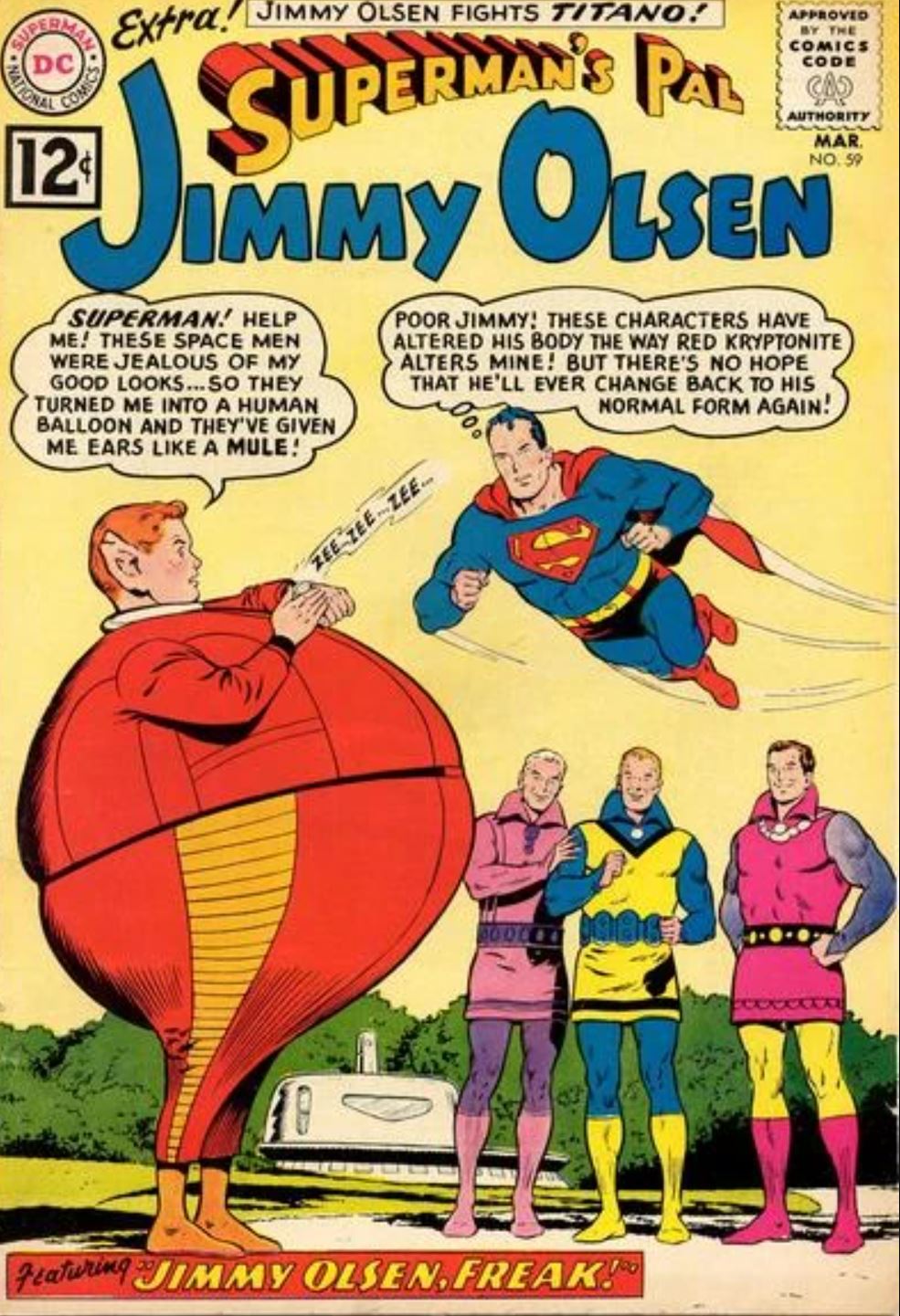
Next is a poignant updating of a Silver Age classic. ‘Tears for Titano’ (Byrne, Frenz & Breeding) first saw print in Superman Annual #1 cover-dated August 1987 and puts a modern spin on the sorry saga of a giant ape that menaced Metropolis. It all starts when Lois Lane objects to the treatment of a lab chimp by her old nemesis Dr. Thomas Moyers. The heartless, ambitious energy research scientist’s callous disregard for procedure, or even simple humanity, results in the anthropoid mutating into a colossal out-of-control rampaging menace only Superman can stop… even if he doesn’t want to…

The Adventures of Superman Annual #1 spawned ‘The Union’ by Jim Starlin, Jurgens & Steve Montano, wherein Superman is asked by President Ronald Reagan and über-Fed Sarge Steel to ferret out what happened to the people formerly living in the instant ghost-town of Trudeau, South Dakota. This edgy, chilling by-the-numbers sci-fi shocker showed audiences that the new Man of Steel wasn’t the guaranteed winner he used to be, and set the scene for a momentous future confrontation with the monstrous alien life-consumer Hfuhruhurr the Word-bringer., as well as showing the limits of a pledge to never take life…

In the monthly periodicals ‘All that Glisters’ (Byrne & Keith Williams) comes from November 1987’s Action Comics #594: a big battle team-up with fugitive from the future Booster Gold sneakily and accidentally orchestrated by Lex Luthor employing his robot duplicates. The acrimonious clash carried over and concluded in Booster Gold #23, with ‘Blind Obsession’ (art/story by Jurgens, inked by Roy Richardson) seeing the bad guy billionaire (is there any other kind?) thwarted and frustrated again…

Next up is the magical retelling of another classic Wayne Boring Superman tale. ‘Lost Love’ (Superman #12, by Byrne & Karl Kesel) recounts the tragic tale of college boy Clark Kent’s brief affair with mysterious Lori Lemaris, a unique girl he twice loved and lost. Then, Action Comics #595 brings us back to the present with a bump in the night. Courtesy of Byrne & Williams ‘The Ghost of Superman’ introduces eerie, life-stealing Silver Banshee in a mystery team-up with a sneaky superstar who saves Metropolis from terror and dread and whose Big Identity Reveal I’m not going to spoil for you…

Next come the Kryptonian corners of DC’s third inter-company mega-crossover event. After Crisis on Infinite Earths and Legends there was Millennium, which saw writer Steve Englehart expand on an iconic tale from his Justice League of America run (#140-141) as well as his tenure on the Green Lantern Corps title. But first, a little background…

Billions of years ago robotic peacekeepers known as Manhunters rebelled against their creators. The Guardians of the Universe were immortal and desired a rational, orderly, emotionless cosmos – a view not shared by their own women. The Zamarons abandoned the Guardians on planet Oa at the inception of their grand scheme but, after billions of years, the two factions had reconciled and left our Reality together. Now they had returned with a plan to midwife a new race of immortals on Earth, but the Manhunters – who had since infiltrated all aspects of every society throughout the universe – were determined to thwart the plan, whether by seduction, connivance or just plain brute force. Earth’s heroes were summoned by the reunited immortals and subsequently gathered to see the project to completion but were continually confronted by Manhunters in their own private lives… and their own comics.

DC Comics third braided mega-series was a bold effort intended to touch all corners of their universe, introduce new characters, tie-in titles and do so on a weekly, not monthly, schedule. In addition to the 8 weekly issues of the miniseries itself, Millennium spread across 21 titles for two months – another 37 issues – for a grand total of 44 comic books, with the Superman-related crossover craziness opening here with ‘Toys in the Attic!’ (Superman #13, by Byrne & Kesel) .

In Metropolis, elderly British craftsman Winslow Percival Schott opens a campaign of murder and wanton destruction targeting Lex Luthor, the ruddy Yank who ruined his little company and forced him to become the murderous Toyman. No sooner has the Man of Tomorrow intervened in that fracas than he’s drawn back to sleepy hometown Smallville in ‘Junk’ (Adventures of Superman #436, script by Byrne, art by Ordway & John Beatty) to discover trusted confidant Lana Lang has for years been an agent of the Manhunters.

In truth the insidious mechanoids have been watching the Last Son of Krypton since before that world died, but had botched capturing the space infant when he first arrived on Earth. As a back-up plan, Manhunters replaced local medical practitioner Doc Whitney and he subsequently turned every child born since into a mind-controlled sleeper agent. With Clark a key factor in the Millennium, Whitney rallies his forces to capture Superman, but utterly underestimates the power and resourcefulness of the Man of Steel. Although victorious, Superman’s triumph is tainted by tragedy. In defeat, all Whitney’s unwitting agents – two generations of Smallville’s young folk – keel over dead…

Then, in Action Comics #596, ‘Hell is Where the Heart Is…’ (Byrne & Williams) as Ghostly Guardian The Spectre is drawn to the catastrophe and facilitates Superman’s odyssey to the Spiritual Realms to rescue all the recently and unjustly departed deceased…

Byrne & Kesel’s Superman #14 offered a bombastic team-up with Green Lantern Hal Jordan wherein Emerald Gladiator and Action Ace chase colossal super-Manhunter Highmaster through uncanny dimensions as that mechanical maniac seeks to attack the sequestered, enervated Guardians and Zamarons in ‘Last Stand!’, after which events take a far more moody turn in Adventures of Superman #437. A twinned tale by Byrne, Ordway & Beatty, ‘Point of View’ simultaneously reveals how Luthor attempts to seduce one of the Millennium candidates to his evil side even as Lois Lane helplessly watches the brutally crippling struggle of merely mortal vigilante JoseGangbuster” Delgado against Lex’s hyper-augmented cyborg warrior Combattor

The repercussions of that clash are examined in ‘Visitor’ (Action Comics #597) wherein Byrne, Leonard Starr & Williams impishly referenced Silver Age catfights between Lois Lane and Lana Lang, whilst the story itself establishes the false premise that Superman was raised as Clark’s adopted brother to throw off Lois’ growing suspicions…

With the Millennium complete, Superman #15 returned to regular wonderment as Superman is asked to find Metropolis Police Captain Maggie Sawyer’s missing daughter Jamie, just as the city is hit with a rash of flying bandit children. ‘Wings’ (Byrne & Kesel) debuts repulsive monster Skyhook: a horrific bat-winged Fagin who beguiles and mutates runaways whilst concealing even greater ghastly secrets…

The Fights ‘n’ Tights fun intensifies with Adventures of Superman #438 (March 1988, by Byrne, Ordway & Beatty) and another modern-day re-imagination of a past icon. ‘…The Amazing Brainiac’ sees a trip to the circus disastrously coincide with drunken mentalist Milton Fine developing uncanny psionic abilities and going wild. Despite his mental assaults being particularly effective against the Man of Steel, Superman eventually overcomes the furiously frantic performer, but is the defeated man simply deranged by his own latent abilities, or are his ravings of being possessed by an alien named Vril Dox of Colu somehow impossibly true?

This collection concludes with one-shot “Prestige Format” special Superman: The Earth Stealers by writer Byrne, inker Ordway and colourist Bill Wray who augment a post-Crisis return to the Action Ace for lifelong Super-Artist Curt Swan. Here the whole world is confiscated by a plundering alien seeking to sell it for scrap and resources, but the fiend and his brutal gladiator/legbreaker Gunge have not reckoned on this latest easy score being home to the last of the fabled and feared Kryptonians…

The bonus bit at the back consists of a ‘Cover gallery’ of previous MoS collections by Ordway, Byrne & Kesel, with excerpts from Who’s Who Update ‘87 #-5 and Who’s Who Update ‘88 #2, featuring illustrated fact-snacks concerning Booster Gold ( by Jurgens & Mike DeCarlo); Titano (Frenz & Byrne); Lori Lemaris (Byrne); Silver Banshee (Mike Mignola & P. Craig Russell) before a big bold pin-up of the Man of Steel finalises the fun for now.

Against all contemporary expectation the refitted Man of Tomorrow was a huge critical and commercial success. As one of the penitent curmudgeons who was proved wrong at the time, I can earnestly urge you not to make the same mistake. These are magically gripping and memorable comic gems to be enjoyed over and over again. So the sooner you get these books the sooner you can start the thrill ride reinvention of the ultimate comic book icon.
© 1987, 1988, 1989, 2021 DC Comics. All Rights Reserved.

Today in 1844 Spanish painter/illustrator/cartoonist Josep Lluis Pellicer was born, followed by Disney comics maestro Tony Strobl in 1915, and comics editor, publisher and historian catherineCatyronwoode in 1947. The post-war Fifties greeted cartoonist Tom Armstrong (Marvin) in 1950; artist/publisher Neil D. Vokes (Robotech, Fright Night, Eagle) in 1954 and Elizabeth Smith (Action Comics, Lex Luthor) in 1958.

Deaths this date include legendary British licensed properties artist British artist/illustrator George William Wakefield (Laurel & Hardy, Ben Turpin, Jackie Coogan, George Formby, The Funniosities of Fatty Arbuckle, The Screen Screams of Ford Sterling, Jolly Rover, Freddie Flip and Uncle Bunkle, Abbott & Costello) in 1942; US cartoonist/writer Dick Calkins (Uncle Bob’s Story Book, Buck Rogers, Skyroads) in 1962; children’s book illustrator/cartoonist Syd Hoff (Danny the Dinosaur, I Can Read…, Tuffy, Laugh It Off) in 2004 and legendary Belgian all star Eddy Paape (Valhardi, Buck Danny, Mark Dacier, Luc Orient, Surcouf, Johnny Congo) in 2012.

The Detection Club parts 1 & 2


By Jean Harambat, coloured by Jean-Jacques Rouger translated by Allison M. Charette (Europe Comics)
eISBN: 979-1-032809-95-2 (part 1), 979-1-032809-96-9 (part 2)

This book includes Discriminatory Content included for dramatic and literary effect.

Apparently, everybody loves mystery to chew on. With that in mind, here’s a brace of superb cartoon conundrums from the continent, based on an unlikely but actual historical convocation.

As seen on Wikipedia, – The Detection Club was a literary society of British crime writers, founded in 1930, with the likes of G.K. Chesterton, Dorothy L. Sayers and Agatha Christie as early Presidents. In 1936, American émigré John Dickson Carr became the first non-Brit elected to the august body; and probably pretty snarky elitist gathering.

They did stuff, wrote stories, held events and upheld (Ronald) Knox’s Commandments which detailed the proper rules of mystery writing. The group is the basis of later media McGuffin’s such as Batman’s Mystery Analysts of Gotham City and every bunch of screen authors matched against evil geniuses everywhere…

I’m pretty sure the story here collected in two volumes by award-winning cartoonist, screenwriter, graphic novelist, historian, philosopher and journalist Jean Harambat (Les Invisibles, Ulysses, the Songs of Return, Operation Copperhead) is apocryphal, but you never know…

Originally released in 2019, our case du jour opens in a prologue, with the reciting of those Knox commandments and the confirmation of Mr. Dixon Carr at a slap-up feed at London hostelry Ye Olde Cheshire Cheese – a pub that doesn’t seem to mind the odd celebratory gunshot…

Present are President Chesterton, Dixon Carr, Christie, Sayers, Baroness Emma Orczy, Major A.E.W. Mason and Monsignor Ronald Knox himself, and – as the posh repast winds down – proceedings are somewhat disturbed by the arrival of a flying, talking robotic bird bearing a strange invitation…

Eccentric man of means Mr. Roderick Ghyll wishes the company of the sagacious society at his extraordinary domicile on April 1st. Briarcliff House is situated on a private island where Ghyll wishes to celebrate the future through his latest contrivance, therefore promising “challenges”, “enchantments” and “the renaissance of crime fiction”…

Chapter I opens with the scribes and scribblers approaching ‘An Island in Cornwall’ and still heatedly debating the motives of the mystery man. Ghyll greets them effusively before zooming off in a bizarre electric unicycle leaving them to make their way to his palatial manse: a gleaming tribute to sleek, tripped down modernism – if not actual futurism…

Apart from the domestic staff chef Alphonse, maid Madeline, implacable (not to say positively “inscrutable”) Asian manservant Fu, and stepdaughter Millicent, the only other human present is technical assistant Dr. Zumtod and Ghyll’s haughty beautiful wife Honoria. A future generation would call her a “trophy”…

The old plutocrat is a deeply unpleasant and smugly overbearing host who boasts of one more personage that the sharp-minded, brain-testing authors must meet. With smugness and great ceremony he introduces Eric: a mechanical man with more than human insight who can outwit any mortal and easily determine the culprit in any tale they might concoct…

Although challenged with the details of a string of classic novels – which Eric easily and correctly concludes with the name of the perpetrators – the writers remain insulted and unconvinced. Dixon Carr even oversteps the bounds of polite decency by probing the automaton in search of a pre-prepped dwarf or amputee and the display is halted for dinner where Ghyll continues to advocate a world filled with his “metal friends”…

The evening wears on with the usual social distractions balanced by heated argument on many topics sparked by Eric’s existence and the magnate’s pronunciations that art and literature must make way for a machine-run world. At last, the affair breaks up with the guests retiring to their assigned rooms in a state of high dudgeon…

That all ends in esteemed literary tradition, with screams and the writers breaking into Ghyll’s savagely disarrayed bedroom to discover electronic Eric inert in a chair and clear evidence of ‘The Billionaire Out the Window’. Far below, a dressing gown sinks beneath choppy waves and subsequent frantic searches result in no sign of their host…

Well-versed if not actually experienced in investigation, the writers set about interviewing the staff and then the residents. Zumtod then suggests the painfully obvious: turning Eric loose on the problem. The response is as rapid as the answer is shocking…

While waiting for the outer world to re-establish contact with the isolated isle, “Queen of Crime” Christie bonds with the presumed widow and probes the step-daughter, whilst Chesterton continues to scour the entire vicinity. He’s suspicious of everything – including whether there has been any crime at all – and rapidly unearths many unsuspected secrets even as each writer cleaves to their particular speciality, makes their own assessment and forms a personal hypothesis.

…And then a body washes ashore…

The Detection Club’s second volume begins with third chapter ‘Seven Amateur Detectives’ and an armada of late-arriving constabulary. Led by Inspector Widgeon they proceed to interview the drawing room sleuths. Mounting tensions, contrary theories and wounded pride quickly drive all concerned into fractious conflict, even as potential heir Millicent’s banished and outcast twin Watkyn re-emerges. Has he only returned because of his despised step-father’s demise or was he actually back just before it happened?

Events seemingly come to a head when Christie expounds her latest theory and provokes a minor hostage crisis until the villain is apprehended through unlikely team work. As the constabulary step in with the handcuffs however, new evidence emerges that sets the cogitators back on the murder-trail… until straightforward ratiocination leads one author to the only possible solution…

Wry, witty, and decidedly well-plotted, with smart characterisations and devastatingly sharp, catty dialogue (kudos to translator Allison M. Charette), this lively, lovely lark is also charmingly limned: a grand and glorious tribute to days gone by and superb stylists who tested our wits and expanded our entertainment horizons. This is a tale no whimsy-inclined crime fan can afford to miss.
© 2020 – DARGUAD – HARAMBAT. All rights reserved.

Today in 1911, Canuck-by-migration Ed Furness (Freelance, Commander Steel, “Canadian Whites publications” era) was born, followed by Dick Tracy collaborator Mike Curtis in 1953; Matt Feazell (Amazing Cynicalman) in 1955 and original Men in Black artist Sandy Carruthers arrived in 1962.

On this date we lost Chester Gould (Dick Tracy) in 1985 and Italian megastar artist Ferdinando Tacconi (Journey into Space and Jeff Hawke in Junior Express, Sciuscià, Susanna, Gli Aristocratici, Uomini senza gloria, L’uomo di Rangoon, Nick Raider, Dylan Dog) in 2006. Pioneering Filipino artist Tony DeZuñiga (Black Orchid, Outlaw, Jonah Hex, practically every character at DC & Marvel) died in 2012.

After 1269 weekly issues UK girls comic Mandy folded today in 1991. It had debuted on 21st January 1967.

Can’t Get No


By Rick Veitch (Sun Comics/Vertigo)
ISBN: 978-1-4012-1059-5 (TPB Vertigo),
ISBN: 978-1-7241-3814-9 (TPB/Digital edition Sun Comics remastered second edition)

Born on May 7th 1951, Rick Veitch is a criminally undervalued creator who has lived through post-war(s) America’s many chimeric social revolutions. He has a poet’s sensibilities and a disaffected Flower-Child’s perspectives informing a powerful creative consciousness – and conscience. Can’t Get No is a landmark experiment in both form and content which deserves careful and repeated examination.

The shockwaves from the terrorist atrocity of September 11th 2001 changed the world and in our own small insulated corner, generated a number of graphic narrative responses of varying quality, not to mention deep emotional honesty. Rick Veitch’s 2006 Can’t Get No was as powerful and heartfelt as any, and benefited greatly from the little time and distance that bestowed perspective on raw emotional reactions.

Chad Roe‘s company sold the world’s most permanent and indelible marker pen, the Eter-No-Mark. Everyone involved in selling them was flying high, but then the lawsuits hit all at once. A cheap, utterly irremovable felt-pen is a godsend to street-artists and becomes the most virulent of vandalistic weapons to property owners with nice clean tempting walls…

As his universe collapsed on him, Chad went on a bender, picked up two hippie-artist-chicks in a bar and woke up a human scribble-board, covered literally from head to toe in swirling, organic, totally permanent designs.

Even then he tried so very hard to bounce back. A walking abstract artwork, he was ostracized by mockery, and unable to conceal his obvious “otherness”, and neither self-help philosophies, drugs, or alcohol could make him feel normal anymore. Defeated, reviled and eventually crushed in spirit, he was trapped in a downward spiral. Then Chad met the pen-wielding girls again and found solace and uncomplicated joy in the artist’s world of sex, booze and dope.

Lost to “normal” society, Chad took a road-trip with the women, but they hadn’t even left the city before they were all arrested. This was morning on September 11th and as the girls violently resisted the cops, an airplane flew overhead, straight towards the centre of Manhattan…

With no-one looking at him, just another part of the shocked crowd, Chad watched for an eternity, and then – no longer anything but another stunned mortal – drove away with an Arab family in their mobile home…

And thus began a psychedelic, introspective argosy through US philosophy, symbolism and meta-physicality. With this one act of terrorism forever changing the nation, Chad is forced on a journey of discovery to find an America that is newborn both inside and out. His travels take him through vistas of predictable cruelty and unexpected tolerance, through places both eerily symbolic and terrifyingly plebeian, but by the end of this post-modern Pilgrim’s Progress, both he and the world have adapted, accommodated and accepted.

Black & white in landscape format, and eschewing dialogue and personal monologues for ambient text (no word balloons or descriptive captions, just the words that the characters encounter such as signs, newspapers, faxes etc.) this graphic narrative screams out its great differences to usual comic strip fare, but the truly magical innovation is the “text-track”: a continual fluid, peroration of poetic statements that supply an evocative counterpoint to the visual component.

Satirical, cynical and strident with lyricism deployed for examination and introspection, and perhaps occasionally over-florid, but nonetheless moving and heartfelt free verse and epigrams do not make this an easy read or a simple entertainment. They do make it a piece of work every serious consumer of graphic narrative should experience… before it’s too late for all of us.
© 2006, 2019 Rick Veitch. All Rights Reserved.

Today in 1900, Alley Oop originator V.T. Hamlin was born, followed in 1905 Puerta Rico by Golden Age cover maestro Alex Schomburg, whilst in 1957, Classics Illustrated mainstay Henry C. Kiefer died. Franz Frazetta hung on until today in 2010 at which time he was 82 years old.

This date in 1943, Jack Sparling began his newspaper strip Clare Voyant, and in 2004 Jeff Smith apparently drew the final page of Bone.

Marvel Two-In-One Epic Collection volume 3 (1977-1979): Remembrance of Things Past


By Marv Wolfman, Jim Starlin, Roger Slifer, Tom DeFalco, David Anthony Kraft, Ralph Macchio, Peter B. Gillis, Alan Kupperberg, Bill Mantlo, Jo Duffy, John Byrne, Steven Grant, Allyn Brodsky, David Michelinie, Ron Wilson, Sal Buscema, Bob Hall, Chic Stone, Frank Miller, Jim Craig, Pablo Marcos, Josef Rubinstein, Jim Mooney, Alfredo Alcala, Sam Granger, Frank Giacoia, Dave Hunt, Tex Blaisdell, Gene Day, Joe Sinnott, Bob McLeod, Bruce Patterson, Mike Esposito & various (MARVEL)
ISBN: 978-1-3029-5564-9 (TPB/Digital edition)

This book includes Discriminatory Content produced in less enlightened times.

Above all else, Marvel has always been about team-ups. The concept of team-up books – an established star pairing, or battling (often both) with less well-selling company characters – was not new when Marvel awarded their most popular hero the same deal DC had with Batman in The Brave and the Bold. Although confident in their new title, they wisely left options open by allocating an occasional substitute lead: the Human Torch. In those long-ago days, editors were acutely conscious of potential over-exposure – and since super-heroes were actually in a decline they may well have been right.

Nevertheless, after the runaway success of Spider-Man’s guest vehicle Marvel Team-Up, the House of Ideas carried on the trend with a series starring bashful, blue-eyed Ben Grimm – the Fantastic Four’s most iconic and popular member. They began with a test run in Marvel Feature #11-12, before awarding him his own team-up title, with this third power-packed compendium gathering in the contents of Marvel Two-in-One #37-52; MTIO Annuals #2-4 and Avengers Annual #7, covering November 1977 to June 1979.

The action begins with ‘The Final Threat’ (by Jim Starlin & Joe Rubinstein) from Avengers Annual #7, wherein Kree warrior Captain Marvel and Titanian mind-goddess Moondragon return to Earth with vague anticipations of impending cosmic catastrophe. Their premonitions are confirmed when galactic wanderer Adam Warlock arrives with news that death-obsessed Thanos has amassed an alien armada and built a Soul-gem powered weapon to snuff out the stars like candles. Broaching interstellar space to stop the scheme, the united heroes forestall interstellar incursion and prevent the Mad Titan destroying the Sun, but only at the cost of Warlock’s life…

Then Marvel Two-in-One Annual #2 undertakes a ‘Death Watch!’ (Starlin & Rubinstein): finding Peter Parker plagued by prophetic nightmares disclosing how Thanos had snatched victory from defeat and now holds the Avengers captive whilst again preparing to extinguish Sol. With nowhere else to turn, anguished, disbelieving Spider-Man heads for the Baxter Building to borrow a spacecraft, unaware The Thing also has history with the terrifying Titan. Although utterly outpowered, the mismatched champions of Life subsequently upset Thanos’ plans, allowing the Avengers and the Universe’s true agent of retribution to end the Titan’s threat forever… or at least until next time…

Marvel Two-In-One’s apparent function as a clearing-house for old, unresolved series and plot-lines was then briefly put on hold as issue #37 teamed Ben with Matt Murdock (not alter ego Daredevil) for Marv Wolfman, Ron Wilson & Pablo Marcos’ legal drama ‘Game Point!’

Ben had been framed for monstrous acts of wanton destruction, and when the case went badly, he faced decades in jail. However, the Man Without Fear and eccentric street punk Eugene the Kid determined the Mad Thinker was behind the plot to place the ‘Thing Behind Prison Bars’ (Roger Slifer, Wilson & Jim Mooney): tackling the maniac whose ultimate game plan is to corner the future, mass-producing his own squadron of the synthezoid Avenger in #39’s conclusion ‘The Vision Gambit’ (inked by Marcos).

Slifer, Tom DeFalco, Wilson & Marcos then detail a spooky international yarn as the Black Panther is involved in a monstrous reign of terror with a zombie-vampire stalking the streets and abducting prominent African Americans. Concluding chapter ‘Voodoo and Valor!’ – by David Anthony Kraft, Wilson & Marcos – sees Jericho Drumm/Brother Voodoo volunteer his extremely specialised services to Ben and T’Challa in hopes of ending the crisis. The trail takes our heroes to Uganda for a confrontation with Doctor Spectrum and the far more dangerous real-world crazed killer Idi Amin

Crafted by Ralph Macchio, Sal Buscema, Alfredo Alcala & Sam Grainger, Marvel Two-In-One #42 then debuts a future mainstay of Marvel Universe continuity as Project Pegasus premiers in ‘Entropy, Entropy…’

The Federal research facility designated Potential Energy Group/Alternate Sources/United States is dedicated to investigating new and exotic power sources and naturally became the most sensible place to dump energy-wielding super-baddies once they were subdued. Ben finds and begins trashing the place whilst tracking down his educationally – and emotionally -challenged ward Wundarr after the kid was renditioned by the Government. The furious Thing is soon confronted and contained by Captain America in his role as security advisor and together they stumble over a sabotage scheme by martial maniac Victorius who unleashes a deadly new threat in the ghostly form of Jude, the Entropic Man. This phantasmic force easily trounces Cap and Ben but finds the macabre Man-Thing far harder to handle in concluding chapter ‘The Day the World Winds Down’ from Macchio, John Byrne & Friends & Bruce Patterson)…

The third Marvel Two-In-One Annual then hosts a great big, old-fashioned world-busting blockbuster wherein Nova the Human Rocket battles beside Ben to free captive alien princesses and save Earth from colossal cosmos-marauding space invaders: a simple yet entertaining tussle entitled ‘When Strike the Monitors!’ all crafted by Wolfman, Sal Buscema, Frank Giacoia & Dave Hunt… after which, back in the monthly comic book, issue #44 strays away from standard fare with ‘The Wonderful World of Brother Benjamin J. Grimm’ (Wolfman, Bob Hall & Frank Giacoia) with the Thing telling rowdy kids a fanciful bedtime story concerning his recent partnership with Hercules to free Olympus from evil giants…

Marvel Two-In-One #45’s sees Kree Captain Marvel warned by his Cosmic Awareness that the Thing had been targeted by vengeful Skrulls in ‘The Andromeda Rub-Out!’ (Peter Gillis, Alan Kupperberg & Mike Esposito), after which the Incredible Hulk’s new TV show compels an outraged Ben to head for Hollywood, only to become accidentally embroiled in a ‘Battle in Burbank!’ (Kupperberg & Chic Stone)…

The Thing’s self-appointed gadflies The Yancy Street Gang headlined in MT-I-O #47 as ‘Happy Deathday, Mister Grimm!’ (Bill Mantlo & Stone) sees a cybernetic tyrant long believed dead take over Ben’s old neighbourhood… until the hero pays a visit. The invasion exposed, it is quickly concluded once awesome alien energy powerhouse Jack of Hearts joins the fight against ‘My Master, Machinesmith!’ (in #48 by Mantlo, Stone & Tex Blaisdel).

Mary Jo Duffy, Alan Kupperberg & Gene Day piled on spooky laughs in #49 as the ‘Curse of Crawl-Inswood’ highlights how Doctor Strange manipulates Ben into helping crush a paranormal incursion in a quaint and quiet seaside resort…

Anniversary issue #50 was everything a special issue should be. ‘Remembrance of Things Past’ by Byrne & Joe Sinnott takes a powerful and poignant look at the Thing’s history as a monster outcast and posits a few what-might-have-beens…

Following another failure by Reed Richards to cure Ben’s rocky state, The Thing steals the chemical and travels into his own past, determined to use the remedy on his younger, less mutated self. However, his bitter, brooding, brittle earlier incarnation is hardly prepared to listen to another monster and, inevitably, catastrophic combat ensues…

Issue #51 was even better. ‘Full House… Dragons High!’ by Peter Gillis, up-&-coming artist Frank Miller & Bob McLeod, details how a weekly poker session at Avengers Mansion is interrupted by rogue US General Pollock, who again tries to conquer America with stolen technology. Happily, Ben and Nick Fury find Ms. Marvel (not today’s teenager Kamala Khan but current Captain Marvel Carol Danvers), Wonder Man and The Beast better combat comrades than poker opponents…

A note of sinister paranoia creeps in with Marvel Two-In-One #52’s ‘A Little Knight Music!’ (Steven Grant, Jim Craig & Marcos), as the mysterious Moon Knight joins Ben in stopping CIA Psy-Ops master Crossfire brainwashing the city’s superheroes into killing each other, prior to MTIO Annual #4 providing an old-fashioned, world-busting fantasy finale – for now – as ‘A Mission of Gravity!’(plotted by Allyn Brodsky, scripted by David Michelinie, limned by Craig, Bob Budiansky & Patterson) unites Ben and Inhuman monarch Black Bolt (and Good Boi Lockjaw!) to stop unstable maniac Graviton turning into a black hole and taking the world with him…

Backed up by the covers of Starlin, Rubinstein, Wilson, Sinnott, Marcos, Terry Austin, George Pérez, Walt Simonson, Sal Buscema, Hall, Giacoia, Keith Pollard, Layton, Stone, Budiansky, and Al Milgrom, there is also a big bold bonus section including contemporary house ads, covers from reprint title The Adventures of the Thing (by Sam Keith, Mike Mignola & Joe Quesada) and original art pages by Starlin, Rubinstein, Perez & Sinnott.

This tome of tales from Marvel’s Middle Period are admittedly of variable quality. They are, however, offset by truly timeless classics, still as captivating today as they ever were. Most fans of Costumed Dramas will have little to complain about and there’s lots of fun to be found for young and old readers. So why not lower your critical guard and have an honest blast of pure warts ‘n’ all comics craziness? You’ll almost certainly grow to like it…
© 2025 MARVEL.

This date in 1754 – and attributed to Benjamin Franklin – the first American newspaper cartoon “Join, or Die” was published in The Pennsylvania Gazette.

Somewhat less momentously – perhaps – today in 1893 Wonder Woman co-creator William Moulton Marton was born as was Short Ribs cartoonist Frank O’Neal in 1921; Half Hitch and Henry illustrator Dick Hodgins, Jr. in1931 and multi-directional art scribe Barbara Slate (Yuppies From Hell, Angel Love, Sweet XVI, Ms. Liz) in 1947. They were joined in 1953 by writer Pat McGreal (Chiaroscuro; The Private Lives of Leonardo DaVinci, Veils, I, Paparazzi and more Disney comics than seems humanly possible); in 1955 by American Splendor illustrator Brian Bram; inveterate comics publisher David Campiti in 1958, and the astoundingly funny Ty Templeton (Stig’s Inferno, Batman Adventures, The Simpsons) in 1962.

Today in 1991 The Simpsons episode “Three Men and a Comic Book” aired, giving Comic Book Guy to the world…

Doctor Doom Epic Collection volume 1 (962-1969): Enter Doctor Doom


By Stan Lee & Jack Kirby, Steve Ditko, Larry Lieber, Roy Thomas, Don Heck, Gene Colan, Frank Giacoia, Joe Sinnott, Dick Ayers, George Roussos, Chic Stone, Vince Colletta, John Tartaglione & various (MARVEL)
ISBN: 978-1-3029-6612-6 (TPB/Digital edition)

This book includes Discriminatory Content produced in less enlightened times.

As the world’s greatest supervillain (Sorry, Donny Littlehands!) prepares for his next big screen debut, expect to see a bunch of books featuring the dark side of the eternal war between Good and Evil. And if that isn’t the perfect metaphor for the Master of Latveria I don’t know what is…

Doctor Doom is one of the most monumental villains in comics: definitely Top 3 and to many the absolute number 1 nemesis. Once upon a time, you hadn’t really made it as a Marvel superhero (or villain) until you’d clashed with him. Victor Von Doom is a troubled genius who escaped the oppression heaped on his Romani people in a backwards looking Balkan autocracy via an ultimately catastrophic scholarship to America. Whilst there proud, arrogant Victor succumbed to an intense rivalry with young Reed Richards, even then perhaps the most brilliant man alive.

The smug, openly hostile student performed unsanctioned experiments which went wrong and marred his formerly-perfect features, leading him down a path mastering and merging super-science and sinister sorcery, and fuelled his overwhelming hunger for ultimate power and total control. From the ashes of his failure, Von Doom rebuilt his life, returned to seize control of his homeland and become a danger to the world and the multiverse.

This carefully curated compendium traces his public progress and greatest battles via landmark moments of triumph and tragedy, collecting wholly or in part material from Fantastic Four (1961) 5-6, 10, 16-17, 23, 39-40, 57-60, 73; Fantastic Four Annual (1963) 2-3; Amazing Spider-Man (1963) #5; Avengers (1963) #25; Daredevil (1964) #36-38 and Marvel Super-Heroes (1967) #20 and opens without preamble as it must, with that debut in Fantastic Four #5 cover-dated July 1962 and on sale from April 10th.

At that time, aliens and especially monsters played a major part in young Marvel’s output. However, after a tentative start, Stan Lee & Jack Kirby’s recreation of superheroes embraced the unique basics of the idiom, and took a full bite out of the Fights ‘n’ Tights apple by introducing the first full-blown, unrepentant supervillain to their budding Marvel Universe. Mole Man debuted in FF #1, but that tragic little gargoyle, for all his world-dominating schemes, wouldn’t truly acquire the persona of a costumed foe until his more refined second appearance in FF #22.

Inked by the sublimely slick and perfectly polished Joe Sinnott, ‘Prisoners of Doctor Doom!’ had it all. A brazen attack by a mysterious enemy from Reed ‘Mr. Fantastic’ Richards’ past; bizarre fringe-science, magic, lost treasure, time-travel, and even pirates. Ha-Haar, me ‘earties!

The tale is sheer comics magic and the creators knew they were on to a winner as the deadly Doctor returned in the very next issue, teaming with the recently revived and recalcitrantly reluctant Sub-Mariner to attack our heroes as ‘The Deadly Duo!’ in the first Super-Villain Team-Up of the Marvel Age…

Prince Namor, the Sub-Mariner was the second superstar of the Timely Age of Comics – but only because he followed cover-featured Human Torch in the running order of Marvel Mystery Comics #1 in 1939. He has had, however, the most impressive longevity of the company’s original “Big Three” – Torch, Subby & Captain America. The Marine Marvel was revived in Fantastic Four #4; once again a conflicted but noble villain, and remains prominent in the company’s pantheon to this day.

Inked by Dick Ayers, FF #6 reintroduced the concept of antiheroes as Namor was promptly betrayed by Doom, and ended up saving the quirky quartet from death in space. This created a truly complex dynamic with his fellow rogue monarch and the FF. The Devil Doctor’s inevitable betrayal has coloured the relationship of both sinister sovereigns ever since.

1963 was a pivotal year in the development of Marvel. Lee & Kirby had proved their new high concept – human heroes with flaws and tempers – had a willing audience. Now they would extend that concept to a new pantheon of heroes and even the bad guys. Here is where that second innovation came to the fore. Previously, superheroes were sufficient unto themselves and shared adventures were rare. Now, however there was a shared universe where characters often tripped over each other, sometimes fighting each other’s enemies! The creators themselves might turn even up in a Marvel Comic!

Cover-date January 1963, Fantastic Four #10 was released in October of 1962 and saw ‘The Return of Doctor Doom!’ Here, the archvillain used Stan & Jack themselves to lure Richards into a trap where his mind is switched with the bad Doctor’s. Unfortunately the scheme does not survive his own impatience as alien body-swap techniques come undone because Doom cannot keep up the sham long enough to spring his shrinking-ray ambush on the rest of the team…

Thematic follow-up Fantastic Four #16 explores ‘The Micro-World of Doctor Doom!’ in a spectacular romp guest-starring emergent superhero Ant-Man. Despite his resounding rout, the steel-shod villain promptly returned to the larger universe with more infallible, deadly traps a month later in ‘Defeated by Doctor Doom!’ (#17, August 1963, and on sale from May 9th). Of course, they actually weren’t and soon sent the sinister tyrant packing in what seemed a fall to his death…

Doom was the most frequent threat to the FF, and the first foe to break another unspoken rule by going after other heroes in the cohesive shared universe Lee & Kirby were building. Cover-dated October 1963 and with Ditko on pencils & inks, Amazing Spider-Man #5 saw the webspinner ‘Marked for Destruction by Dr. Doom!’ and not so much winning as surviving his unwanted duel against the deadliest man on Earth. In a titanic comedy of errors Doom seeks another super-powered pawn in his war on humanity, but utterly underestimates his obviously juvenile opponent. Moreover, in this tale, Peter Parker’s nemesis, jock bully Flash Thompson, first displayed depths beyond the usual in contemporary comic books, beginning one of the best love/hate buddy relationships in popular literature…

Fantastic Four #23 (February 1964) heralded ‘The Master Plan of Doctor Doom!’, and introduced his frankly mediocre minions the Terrible TrioBull Brogin, Handsome Harry and Yogi Dakor. Even after they were augmented by Doom’s science these goons were sub-par opponents for the FF, but the Iron Dictator’s uncannily menacing “Solar Wave” was enough to raise the hackles on my 5-year-old neck… and still does! (Do I need to qualify that with: all of me was five but only my precious neck had developed hackles worth boasting of back then?)

The one-dimensional evil genius was recast as a tragic figure forever shackled by his flaws thanks to the primary contents of Fantastic Four Annual #2 (September 1964) wherein Chic Stone inked ‘The Fantastic Origin of Doctor Doom!’ A short (12 page) scene-setter, this momentously detailed how a brilliant “gypsy” youth remade himself into the most dangerous man in creation, ruthlessly overcoming obstacles such as ethnic oppression, crushing poverty and the shocking stigma of being the son of a sorceress. That past informed the present as the ultimate villain again attacked old college classmate Reed Richards and is left falsely believing he has achieved ‘The Final Victory of Dr. Doom!’ However, he has actually suffered his most ignominious defeat after Richards turned the despot’s guile, subterfuge and mind-control tools against him. This clash also introduced a long-running and bewildering plot thread connecting the Monstrous Monarch to time-travelling tyrant Rama Tut/Kang the Conqueror

Jumping forward to the summer of 1965, FF #39 (cover-dated June, and on sale from March 11th, with Frank Giacoia AKA “Frank Ray” inking) saw the team deprived of their powers. Having remembered he had not beaten his enemies at last, an enraged Doom targets the helpless heroes in ‘A Blind Man Shall Lead Them!’ with sightless swashbuckling vigilante Daredevil stepping up to provide their only hope of staying alive. The tale concluded in #40’s ‘The Battle of the Baxter Building’ with Vince Colletta inking a bombastic battle revealing the undeniable power, overwhelming pathos and indomitable heroism of the brutish Thing as – deprived of his greatest wish and cruelly restored to his monstrous mutated form – Ben Grimm hands Doom the most humiliating defeat of his life…

After a brief but significant tenure, Colletta signed off by inking one of the most crowded Marvel stories ever. Fantastic Four Annual #3 famously featured every hero, most of the villains and lots of ancillary characters in the company pantheon… such as teen-romance stars Patsy Walker & Hedy Wolf and even Stan and Jack themselves. ‘Bedlam at the Baxter Building!’ spectacularly celebrates the Richards-Storm nuptials, despite a massed attack by an army of baddies mesmerised by the diabolical Doctor into crashing the wedding party. In its classical simplicity it signalled the end of one era and the start of another…

With inker Ayers backing up Lee & Don Heck, Avengers #25 (cover-dated February 1966 but released before Christmas 1965. The still-learning but ever-improving new squad of Captain America, Hawkeye, Quicksilver and the Scarlet Witch face their greatest test yet after being lured to Latveria and captured by the deadliest man alive in ‘Enter… Dr. Doom!’ With the entire nation imprisoned under an energy the trainees are forced to fight their way out of the tyrant’s utterly cowed, hyper-militarised kingdom…

Quiet for almost a year, the Iron Dictator exploded back into the forefront of comics with an absolute epic spanning Fantastic Four #57-60 released in the last four months of 1966. After a sequence of yarns introducing The Inhumans, Black Panther, Silver Surfer and Galactus, Lee & Kirby were at their sublime best and concocted what for many was the ultimate Doom saga.

Packed with unbearable tension, breathtaking drama and shattering action on all fronts it sees the most dangerous man on Earth steal and empower himself with the Silver Surfer’s cosmic forces, even as in a parallel story arc, those long-imprisoned Inhumans at last win their freedom even as we learn the tragic secret of mute Black Bolt in all his awesome fury. It begins with a jailbreak by Sandman in #57’s ‘Enter… Dr. Doom!’, escalates in ‘The Dismal Dregs of Defeat!’ as Doom tests his limitless stolen power and crushes all earthly resistance; builds to a crescendo in ‘Doomsday’ with the FF’s total defeat and humiliation before culminating in brains and valour saving the day – and all humanity – in truly magnificent manner in ‘The Peril and the Power!’

Read it, not about it!

Daredevil 37-38 (February & March 1968 and available December 12th 1967 and January 9th 1968 respectively) saw an early crossover event. In the interests of completeness they are preceded by the cliffhanging final page from DD #36 (Lee Gene Colan & Giacoia) wherein the injured Man Without Fear is captured by Doom.

With John Tartaglione on brushes, DD is penned in the Latverian Embassy and the full story unfolds in #37. ‘Don’t Look Now, But It’s… Doctor Doom!’ reveals how the Iron Tyrant uses his old body swap gimmick to trade meatsuits with Matt Murdock, while sharing the secret of how he escaped the judgement of Galactus after depowering the Silver Surfer.

Initially helpless before the Iron Dictator, DD is trapped in ‘The Living Prison!’ (Giacoia inks) as Doom anticipates a perfect sneak attack on his despised foes. However, after warning the FF, DD outwits Doom anyway… but forgets to notify them. Thus Doom’s devilish ploy culminates in a stupendous Lee, Kirby & Sinnott crafted clash in Fantastic Four #73. Outmatched and unable to convince the Human Torch, Thing and Mr. Fantastic any other way, DD enlists currently de-powered Thor and the ever-eager Spider-Man to solve the problem Marvel style – with a spectacular, pointless and utterly riveting punch-up: ‘The Flames of Battle…’

Closing this first annal of atrocity, is a yarn from experimental try-out title Marvel Super-Heroes #20 (May 1969) which awarded the villain his first full-length solo shot. Written by Larry Lieber & Roy Thomas, and illustrated by Lieber, Giacoia & Colletta, ‘This Man… This Demon!’ restated Doom’s origins and revealed a youthful dalliance with an innocent Romani maid named Valeria. In the now, that failed relationship is exploited by demon alchemist Diablo who claims to need an ally and partner but truly seeks a mighty slave. Doom deals with the charlatan in typically effective style…

This villain vehicle led to the Master of Menace winning his own solo series in Astonishing Tales #1-8, but that’s a topic for another time…

With covers by Kirby, Sinnott, Ayers, Stone, Ditko, Colan, Wood, Giacoia, Lieber, Colletta, Gil Kane, John Romita Sr., Sal Buscema, John Buscema, John Verpoorten and more, the bonus treat selection begins with landmark house ads for Doom’s earliest appearances by Kirby, Bob Powell and Marie Severin; a selection of Doom pinups from Fantastic Four Annual #1 (1963, by Kirby) and Amazing Spider-Man Annual #1(1964, by Ditko) and Kirby original art pages.

These are backed up by a series of reprint and premium covers from Marvel Triple Action; Marvel Treasury Edition #11 (1976); Spider-Man Classics #6 (Ron Frenz & Terry Austin, September 1993); Spider-Man Collectible Series #11 (Frenz & Milgrom, October 2006); Essential Fantastic Four vol. 2 (1999 by Alan Davis & Marie Javins): Mighty Marvel Masterworks: The Fantastic Four vol. 3 (2023 by Leonardo Romero): Doctor Doom: The Book of Doom Omnibus (2023 by Greg Land & Frank D’Armata) and Fantastic Four Facsimile Editions #5, 6 & 10 (all 2025 by Ryan Brown, Ema Lupacchino, Rachelle Rosenberg, Mark Buckingham & Alex Sinclair).

This graphic grimoire contains sheer comic enchantment, and is a book no lover of fantastic fiction and appreciator of arcane evil can afford to ignore – just as long as they remember which side they’re on…
© 2025 MARVEL.

Today in 1909, Golden Age All Star Everett E. Hibbard (Flash, Justice Society of America) was born, as was erotic comics artist Tom of Finland/AKA Touko Valio Laaksonen in 1920 and master mangaka Kazuo Koike (Lone Wolf and Cub, Lady Snowblood, Crying Freeman) in 1936.

Today in 1938 Filipino artist Adrian Gonzales (All-Star Squadron, Arak, Son of Thunder, Super Powers) and French master Jean Giraud/Moebius (Blueberry, Arzach, The Incal) showed up for the first time, like Full Metal Alchemist creator Hiromu Arakawa in 1973, Planetes mangaka Makoto Yukimura in 1976 and Jamie McKelvie (The Wicked + the Profane, Phonogram, Young Avengers) in 1980.

In 1961, Nicholas P. Dallis & Alex Kotzky’s strip Apartment 3-G began on this date but we lost UK humour stalwart Thomas Watson Williams (Creature Teacher, Peter Pest, Stevie Star for Shiver and Shake, Whizzer and Chips, Monster Fun and Cor!!) in 2002, and the irreplaceable Maurice Sendak in 2012.