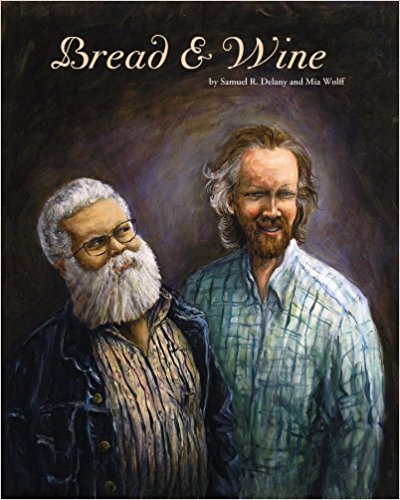
Bread & Wine – an Erotic Tale of New York


By Samuel R. Delaney & Mia Wolff (Fantagraphics Books)
ISBN: 978-1-60699-632-4

The demands of drama dictate that true love never runs smooth but that’s not the case in real life. The trade-off is that those actual romances which stand the test of time and tedium are painfully devoid of the remarkable circumstance and miraculous “gosh-wow” moments of fiction.

But this remarkable account proves That Ain’t Necessarily So…

In 1999 independent publisher Juno released a small graphic novel memoir, written by Samuel R. Delaney and illustrated by Mia Wolff (Catcher), which recounts how a celebrated gay black literary giant, college professor and social theoretician with a mantelpiece crowded of awards, and a teenaged daughter in tow, met and romanced one of society’s most outcast and forgotten souls.

At the time of publication, they had been a couple for some years and they are together still, more than 25 years later. Julia Roberts and Richard Gere won’t be in this movie and not a single dragon or muscle car had to die…

Following an Introduction from Alan Moore, this welcome and long-overdue new edition reveals how “Chip” Delaney took a walk on New York’s Upper West Side, bought a book from homeless Dennis and struck up a conversation with the kind of person most people refuse to acknowledge the very existence of…

In seamlessly seductive understated style the words and pictures detail how gradually, gently, unsurprisingly they became first friends and then lovers.

In the manner of all lasting true romances, this is the history of two full equals who accidentally find each other, not some flimsy rags-to-riches Cinderella tale of predestination and magical remedies. The brilliance and position of one is perfectly complemented by the warmth, intelligence and quiet integrity of the other, and although far from smooth – or rose scented – their path to contentment was both tension-fraught and heart-warming.

Oh, and there’s sex: lots of rapturously visualised sex, so if you’re the kind of person liable to be upset by pictures of joyous, loving fornication between two people separated by age, wealth, social position and race who happily possess and constantly employ the same type of naughty bits on each other, then go away and read something else.

In fact, as I keep on saying, just please go away.

And that’s all the help you get from me. This lyrical, beguiling tale is embellished throughout with interwoven extracts from the poem Bread and Wine by German lyric poet Friedrich Hölderlin and illustrated in a mesmerising organic monochrome variety of styles by artist and Delaney family friend Mia Wolff, and you really need to have it unfold for you without my second-hand blether or kibitzing…

This is one of the sweetest, most uplifting comics love stories ever written: rich with sentiment, steeped in literary punch and beautiful to behold. Moreover, this lavish, stout and steadfast hardback (also available in digital formats) also includes a celebratory commentary by Chip, Dennis and Mia and other protagonists in the Afterword, plus a sketch-packed, earnest and informative interview with the creative participants.

Strong, assertive, uncompromising and proudly unapologetic, this is love we should all aspire to, and Bread & Wine is another graphic novel every adult should know.
Introduction © 2013 Alan Moore. Contents © 2013 Samuel R. Delaney & Mia Wolff. This edition © 2013 Fantagraphics Books. All rights reserved.

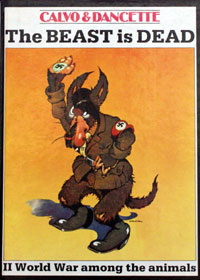
The Beast is Dead: World War II Among the Animals


By Edmond-François Calvo, Victor Dancette & Jacques Zimmerman (Abi Melzer Productions)
ISBN: 978-1-40766-637-2

As the European phase of World War II staggered to its bloody and inevitable conclusion, the enslaved nations began to reclaim their homelands and rebuild various national prides in a glorious wave of liberation.

All over the Old World, long suppressed stories and accounts – true or otherwise – began to be shared. During France’s occupation publishing was strictly controlled – even comics – but the Nazis couldn’t suppress creative spirit and many conquered citizens resisted in the only ways they safely could.

For sculptor, artist, caricaturist and social satirist Edmond-François Calvo (26th August 1892 – 11th October1958) that was by drawing. Watched by his adoring apprentice-artist Albert (Asterix) Uderzo and inspired by the Gallic graphic giant Daumier, the venerable creator of such joyous anthropomorphic classics as ‘Patamousse’, ‘Anatomies Atomiques’, ‘Les Aventures de Rosalie’, ‘Monsieur Royal Présente’, ‘Grandeur et Décadente du Royaume des Bêtes’ and ‘Cricri, Souris d’Appartement’ worked quietly and determinedly on his own devastating secret weapon for the war-effort.

In later years he specialised in sparkling, socially aware and beautiful family-friendly strips such as ‘Moustache et Trottinette’, ‘Femmes d’Aujourd’hui’, ‘Coquin le Petit Cocker’ and a host of fairy tale adaptations for Le Journal de Tintin, Baby Journal, Cricri Journal, Coq Hardi, Bravo!, Pierrot Âmes Vaillantes and Coeurs Vaillants.

Beginning as a caricaturist for Le Canard Enchaîné in 1938, Calvo eventually moved into strip stories, but also had to moonlight with “real” jobs such as woodcarver and innkeeper. By the time France fell to the Germans in June 1940 he was working for Offenstadt/S.P.E. press group, contributing ‘Le Chevalier Chantecler’, ‘D’Artagnan’, ‘Les Grandes Aventures’, ‘Robin des Bois’, ‘Les Voyages de Gulliver’ and the initial three chapters of ‘Patamouche’ to Fillette, L’Épatant, L’As and Junior plus‘La Croisière Fantastique’, ‘Croquemulot’ and ‘Un Chasseur Sachant Chasser’ to Éditions Sépia.

Most of this anodyne material was produced under the stern scrutiny of the all-conquering censors – much like his comics contemporary Hergé in Belgium – but Calvo somehow found time to produce material far less placatory or safe.

With both Editor Victor Dancette and writer Jacques Zimmermann providing scripts, and beginning as early as 1941, Calvo began translating the history of the conflict as seen from the sharp end into a staggeringly beautiful and passionately vehement dark fable, outlining the betrayal of the European nations by literal Wolves in the Fold.

After years of patient creation – and presumably limited dissemination amongst trusted confreres – the first part of La Bete est Mort!‘When the Beast is raging’ was published in 1944, followed a year later with the concluding ‘When the Animal is Struck Down’. Both were colossal hits even before the war ended and the volumes were continually reprinted until 1948 when the public apparently decided to move on with their lives and look forward rather than back…

The saga is related in epic full-page painted spreads and captivating, luscious strip instalments with the smooth, slick glamour of Walt Disney’s production style co-opted to present the list of outrages to be addressed and a warning to the future, with each nation being categorised by a national totem.

The French were rabbits, the Italians hyenas and the Japanese monkeys. Britain was populated by bulldogs, Belgium by lions, Russia by polar bears and America by vast herds of buffalo…

Hitler’s inner circle of monsters got special attention: such as Goering the Pig and Himmler the Skunk, but so did the good guys: General de Gaulle was depicted as a magnificent Stork…

A fiercely unrepentant but compellingly lovely polemic by a bloody but unbowed winning side, The Beast is Dead was forgotten until republished in 1977 by Futuropolis. This particular English-language, oversized (225 x 300mm or 9 inches x 12) hardback edition was released in 1985 and includes the introduction from a contemporaneous Dutch edition plus a dedication from Uderzo and a monochrome selection of Calvo’s wartime and post-war cartoons.

With the current political scene as fractious and volatile as it is, how this epic remains unreprinted totally bewilders me. Magnificent, compelling radiant, hugely influential (without this there would never have been Maus), astoundingly affecting and just plain gorgeous, this modern horror tale of organised inhumanity is out of print but still available if you look hard or speak languages other than English.
© 1944-1945 Éditions G.P. © 1977 Éditions Futuropolis. © 1984 Abi Melzer Productions.

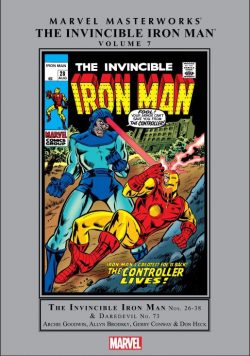
Iron Man Marvel Masterworks volume 7


By Archie Goodwin, Allyn Brodsky, Mimi Gold, Gerry Conway, Don Heck, George Tuska, Gene Colan & various (Marvel)
ISBN: 978-0-7851-5044-2

Created in the aftermath of the Cuban Missile Crisis and at a time when “Red-baiting” and “Commie-bashing” were American national obsessions, the emergence of a brilliant new Thomas Edison employing Yankee ingenuity, invention and wealth to safeguard and better the World seemed inevitable.

Combined with the then-sacrosanct belief that technology and business could solve any problem with the universal imagery of noble knights battling evil, the concept behind the Invincible Iron Man seems an infallibly successful proposition.

Of course where once Tony Stark was the acceptable face of 1960s Capitalism: a glamorous millionaire industrialist/inventor and a benevolent all-conquering hero when clad in the super-scientific armour of his metal alter-ego, the tumultuous tone of the times soon resigned his suave, fat cat image to the dustbin of history and, with ecological disasters and social catastrophe from the abuse of industry and technology the new mantras of the young, the Golden Avenger and Stark International were soon confronting some tricky questions from the increasingly socially conscious readership.

All of a sudden maybe that money and fancy gadgetry weren’t quite so fun or cool anymore…?

This sterling hardback – or eBook – compilation covers the period June 1970 through June, re-presenting Iron Man #26-38 and incorporating a tumultuous team-up with the Man Without Fear from Daredevil #73 which held a key portion of a rather complex comics crossover.

Following Gerry Conway’s informative retrospective Introduction ‘Iron in the Fire’ original Iron Man artist Don Heck returned for the fantasy-fuelled romp ‘Duel in a Dark Dimension!’ (scripted by Archie Goodwin and inked by Johnny Craig) with guest villain The Collector kidnapping Tony Stark’s right-hand man Happy Hogan in an arcane plot to secure an extradimensional super-sword…

America’s mounting racial tensions take centre-stage in ‘The Fury of the Firebrand!’, introducing an inflammatory radical with a secret and highly personal agenda of hate aimed squarely at Stark and the fat cats he represents. The incendiary fiend is also a human napalm grenade…

Goodwin bowed out with #28’s riotous return match ‘The Controller Lives!’, wherein the mind parasite attacks Tony Stark and SHIELD agent Jasper Sitwell through an old girlfriend, after which Mimi Gold scripted an old-fashioned commie-buster yarn, drawn by Heck and inked by Chic Stone in #29, as Iron Man liberates a tropical paradise from its enslaving socialist overlords in ‘Save the People… Save the Country!’.

Impressive new kid on the block Allyn Brodsky took over as scripter with #30’s ‘The Menace of the Monster-Master!’: a rousing rampage full of Maoist menace as a giant lizard ravages Japan until the Golden Avenger steps in, takes charge and uncovers a cunning plot…

Far more intriguing is ‘Anything… For the Cause!’ wherein back-to-nature hippie protesters and outraged teen radicals are manipulated by an unscrupulous local businessman. This social drama also adds cool, young Irish brainbox Kevin O’Brian to the regular cast.

Then in #32’s ‘Beware… The Mechanoid!’ (illustrated by George Tuska & “Joe Gaudioso”) relates a salutary tale of a benign alien explorer who makes the lasting mistake of exploring America whilst disguised as a black man…

Heck & Gaudioso (actually moonlighting Mike Esposito) handled the art for ‘Their Mission: Destroy Stark Industries!!’ as corporate raider Spymaster unleashes his Mission: Impossible-inspired team the Espionage Elite to deprive America of both the inventor and his company. This fast-paced thriller concluded in bombastic finale ‘Crisis… and Calamity!!’ which saw the near-death of a cast regular and the advent of a darker, more driven Armoured Avenger…

Something of a comics wunderkind, Gerry Conway assumed the writer’s reins in Iron Man #35 as the traumatised hero seeks ‘Revenge!’ on the Spymaster but is distracted by an ongoing battle between Daredevil, Nick Fury, Madame Masque and the global criminal network called Zodiac – all contesting ownership of an extra-dimensional wish-granting super weapon.

That battle spills over into Daredevil #73 and a mass abduction into another dimension in ‘Behold… the Brotherhood!’ (by Conway, Gene Colan & Syd Shores) before messily and inconclusively concluding halfway through Iron Man #36 (illustrated by Heck & Esposito).

The battle for the Zodiac Key is necessarily shelved as the Steely Centurion is waylaid by terra-forming aliens in ‘…Among Men Stalks the Ramrod!’

Incapacitated and with his recently transplanted new heart critically damaged, Stark reveals his secret to Kevin O’Brian ‘In This Hour of Earthdoom!’ (inked by Jim Mooney) before retrenching and ultimately repelling the invaders. The drama pauses here in hard-boiled fashion and a pleasantly low-key note in an engaging gangster caper from Conway, Tuska & Esposito wherein Iron Man is forced to respond quite assertively ‘When Calls Jonah…!’

The galvanised wonderment also includes the cover of Iron Man Annual #1 and a selection of house ads to wrap up this collection with the Golden Gladiator being politically repositioned at a time when Marvel solidly set itself up at the vanguard of a rapidly changing America increasingly at war with itself.

With this volume Marvel firmly set itself in the camp of the young and the restless experiencing first-hand the social upheaval America was undergoing. This rebellious teen sensibility and increased political conscience permeated the company’s publications as their core audience grew from Flower Power innocents into a generation of aware activists. Future tales would increasingly bring reformed capitalist Stark into many unexpected and outrageous situations…

But that’s the meat of another review, as this engrossing graphic novel is done. From our distant vantage point the polemical energy and impact might be dissipated, but the sheer quality of the comics and the cool thrill of the perennial dream of man in perfect synchrony with magic metal remains. These superhero shenanigans are some of the most underrated but impressive tales of the period and are well worth your time, consideration and cold hard cash…
© 1970, 1971, 2017 Marvel Characters, Inc. All rights reserved.

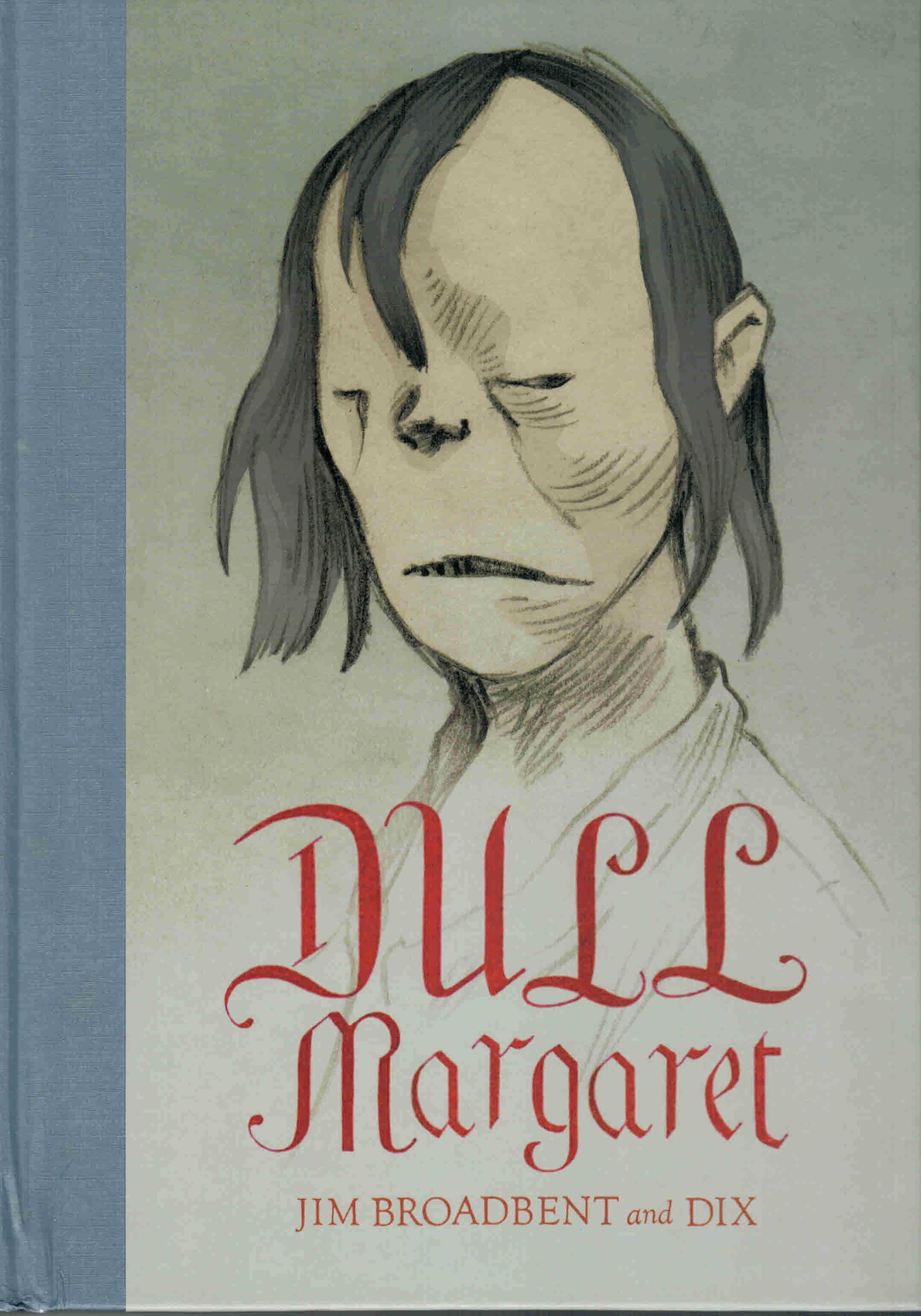
Dull Margaret


By Jim Broadbent & DIX (Fantagraphics Books)
ISBN: 978-1-68396-098-0

Sequential graphic narrative is arguably the most effective and all-encompassing art form we possess, able to depict the most colossal spectacles and conflicts involving entire populations or the most obscure, internalised, micro-expressive emotional minutiae of a single character (human or otherwise) with equal bombast or subtlety.

It’s also a medium capable of the both broadest brushstrokes and forensic incisiveness, whether the creative intention is big belly laughs, moral outrage or heartbreaking empathy. The only thing that comes close to its infinite variety is acting.

Jim Broadbent is an actor. He’s won Oscars and BAFTAs and Emmys and more, and you’ve seen or heard him in stuff as varied as Brazil and Black Adder, Iris and Moulin Rouge, Harry Potter and Game of Thrones, King Lear and Teletubbies. He has a keen understanding of human foibles, motivations and how life shapes actions.

He once had an idea for a film after being inspired by Pieter Bruegel The Elder’s painting Dulle Griet but couldn’t find the necessary finance. Another avenue presented itself when he began reading DIX’s mordant cartoon strip Roll Up! Roll Up! in The Guardian newspaper…

DIX began his artistic career at British comics publisher Fleetway before moving into grown up political and satirical cartooning with the co-creation of legendary magazine Purr. Since then he graduated to the big time with Roll Up! Roll Up! and recently released the graphic novel KLAXON with collaborator Si Spencer.

When actor met illustrator a kindred sentiment was confirmed and they began turning that Bruegel-triggered idea into a moody masterwork of isolation, privation and misery endured. Set long, long ago in the bleak marshes and salt flats of Broadbent’s Norfolk childhood, the result is Dull Margaret: a pocket-baroque in the grand grotesque tradition and a cautionary tale of Faustian consequences.

In the flat, drear wastes where mud flats meet the sea, a worn-down woman of indeterminate vintage lives alone, combing the mires for interesting articles and catching eels to sell in the local town market. She is bluff, determined, utterly alone and almost certainly a bit mad…

Lost in her own head too much, she ekes out a drear existence in a bleak and unrelentingly austere locale. Even her too-infrequent interactions with her customers only lead to humiliation, disappointment and even robbery/assault…

Eventually, it’s all too much and Margaret fulfils the promise of her fetid appearance by trying her hand at a bit of witchcraft. As always, it’s a cack-handed affair and the muddy crone isn’t sure if she’s accomplished anything…

Two favours she asked of the unheeding unknown: untold riches and a friend to love, but she’s prepared to settle for either or lose both…

And then something happens when a barge is stranded on the mud flats…

Hope, aspiration, greed and loneliness are all viewed through a world-weary lens as a series of events unfold with confounding inexorability, but always the grey mire of her days is pulling Margaret back and down…

Enticing and loathly, this sorry soggy fable abounds with rich mordant humour and powerfully seductive sentiment, all compellingly realised by DIX’s muted palette and amorphous, soft-edged designs. Dull Margaret is a dark delight of character and circumstance to beguile readers who have had their fill of shallow flash and dazzle.
Dull Margaret is © 2018 Jim Broadbent & Dix. This edition © 2018 Fantagraphics Books. All rights reserved.

Dull Margaret is published on 17th July 2018 and available for pre-order. Copies are available now from selected retailers.

For those in London, Jim Broadbent and DIX will be attending events (and presumably signing copies and prints) at Gosh Comics on Wednesday 27th June and Waterstones Piccadilly on Thursday 28th June.

Clean Cartoonists’ Dirty Drawings


By Craig Yoe and many and various (Last Gasp)
ISBN: 978-0-86719-653-5

Despite the somewhat prurient and sensationalistic – not to say salacious – title, this compilation of cartoons and illustrations – culled from the private files and bins of a number of our industry’s greatest stars (and also many from the drawing boards of those infamous scallywags of the animation industry) – is a rather charming insight into the capabilities, accomplishments and professional ethics of a talented crowd of individualists.

To European eyes there is very little amiss here, but one needs to remember just how prudish and censorious (I personally prefer the terms “daft” and “ridiculous”) the American “family values” lobby is and always has been.

Two brilliantly telling examples would be the covering of Flossie the Cow‘s udders; first by a skirt (1932) and eventually (1939) by a full dress. She also had to stop walking on all-fours because it was unladylike.

Or perhaps you’d like to consider Mort Walker’s navel collection. Apparently, a syndicate editor had a problem with belly buttons and always returned Beetle Bailey strips that featured one. Walker would scalpel them off the artwork and collect them in a pot on his desk.

Collected and compiled by fan, historian, Renaissance man and cool bloke Craig Yoe (among his many accomplishments he counts being Creative Director of the Muppets – bet you want to Google him now, don’t you?) and with an introduction by a proper “Dirty” cartoonist Robert Crumb, this is a frothy book of rather chaste naked lady pictures (and often not even that) in colour and monochrome, crafted by some of the best artists and cartoonists in modern history – although you might want to check the oddly incongruous contributions of Gustave Doré and Thomas Rowlandson before giving a copy to your 8-year old.

So if you’re unflappable, incorruptible or just not from a red state, you might want to sneak a peek at this stellar cast of incorrigibles which includes Jack Kirby, James Montgomery Flagg, George Herriman, Joe Shuster, Steve Ditko, Charles Schulz, Milton Caniff, Alex Raymond or Chuck Jones.

Just as potentially corrupting are delightful and delicious contributions by Dr, Seuss, Carl Barks, Bob Kane, Rube Goldberg, Bruce Timm, Alex Toth, Fred Moore, Dan DeCarlo, Dave Berg, Ernie Bushmiller, Sergio Aragonés, Jack Davis, Billy De Beck, Hal Foster, Harry G. Peter, Paul Murray, Neal Adams, Al Jaffee, Wally Wood, Nick Cardy, Hank Ketcham, Johnny Hart, Walt Kelly , Adam Hughes, Alex Schomburg, Al Williamson, Henry Boltinoff, Stan Drake, Dik Browne, Matt Baker, Otto Soglow, Al Capp, John Severin, Jim Steranko, Jack Cole, Bill Everett, Grim Natwick, Will Eisner and many others.

Art is all about establishing a relationship with the beautiful, shocking or thought-provoking. Why not turn your attention to these lesser-known efforts from some of the most familiar names in our business and see what occurs to you?
© 2007 Gussani-Yoe Studio, Inc. All illustrations are © 2007 their respective artist and/or © holders.

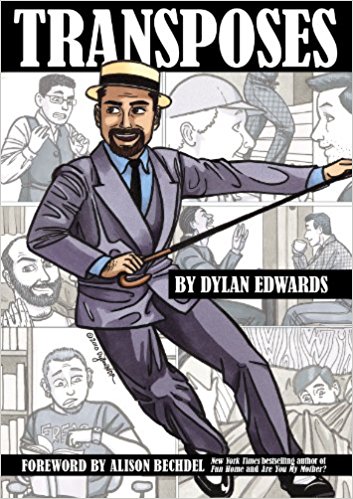
Transposes


By Dylan Edwards (Northwest Press)
ISBN: 978-0-9845940-8-5

I don’t hold many unflinching beliefs; but one of the few is that I, you and certainly no church, government or pressure group has any damn right to dictate what consenting adults do with or to their bodies. And yes, that includes parents, families and partners. Discuss, debate, disagree but never, ever demand…

I may reserve the right to privately snigger at some of the more ambitious or physically-ill-judged things consenting adult people get up to in order to get their rocks off, but I can’t help that: after all I’ve lived through Flower Power, Free Love, New Men, flared jeans (twice!) and an era when both religions and politicians tolerated gays and evolution, and believed women were (in principle, at least) equal to men.

I’m more than happy for anybody to assert, clarify or reassign their gender identity or lack thereof as they see fit, and as for when “Life begins” and what you’re born as, I’m far more concerned by the fact that the most vocal advocates “know” exactly when, what and how it begins whilst it’s inside a human yet feel no compunction or duty of care or wellbeing for any baby – or mother – as soon as the (still developing until age 30 years or more) agglomeration of cells is out of the womb and into the world…

Whilst we’re sharing, I also feel we should probably all pass an exam before we’re allowed to vote or voice an opinion; and require every person seeking office to endure weekly sobriety tests, financial background checks and regular psychiatric evaluations, but maybe that’s just me…

There are a lot of acronyms in today’s book and I’m not going to play translator or decoder interminably, so if we miss linking any just use that search engine OK? This is comics, not University Challenge…

LGBT comics have long been the best place in the graphic narrative business to portray real romance: an artefact, I suppose, of a society that seems determined to simultaneously establish sex and love as two utterly separate beasts and exactly the same thing.

I’d still love to think that in the 21st century we’ve all outgrown the juvenile, judgemental bad old days and can simply appreciate powerful, moving and funny comics about people of all sorts without any kind of preconception…

Unless we’re talking girl/vampire/werewolf menageries à trois: that stuff is just plain wrong…

The very fact of being adjudged “different” now seems to be an increasingly common badge of courage in a world where fanatics and bigots become daily more rabid, and actual religious leaders can claim with straight faces that God so hates homosexuals and fornicators (or atheists or scientists or ginger-haired, left-handed people or…) that in His wisdom He sends fires and floods or tornados and tsunamis every year to wreck the homes of the faithful and worshipful – presumably because they ain’t doin’ nothin’ ’bout it…

Dylan Edwards, AKA NDR, is a graphic artist, cartoonist and sculptor: author of Politically InQueerect, sports strip The Outfield and many others, plus the creator of really cute monsters – as seen on his Feeping Creatures site. In Transposes he masterfully employs comics to celebrate the history of seven ordinary souls just living their lives as FTMs (Females Transitioning to Males).

Dylan – who extensively interviewed each star before crafting these elucidating mini-epics – encapsulates their unconventional existences for the wider world with disarming candour and certified charm. Of course, all the “hot button issues” touted by a hypocritically moralising media (coming out, bullying, role models, gay identity, promiscuity vs. monogamy, childhood sexual abuse, risky sex and/or partners, STIs, parental approval and rejection) are present here – which only goes to show just how widespread and universal these perennial difficulties are…

Regardless of that, this collection comes off as a wonderfully positive and affirming chronicle celebrating determination and difference and, after an effusive and informative Introduction by Alison Bechdel (cartoonist, author of Fun Home and Are You My Mother? and inadvertent deviser of the truly transformative Bechdel Test), there’s an engaging comic strip Foreword by storymaker Dylan Edwards explaining the process that led to the impressive pictorial reportage that follows.

Delivered with jokey aplomb, this savvy and smart ice-breaker gently eases the uninitiated into issues of transgender, cisgender and that subset-within-a-subset defined here as “queer-identified female-to-male-transpersons” before the terrific tale-spinning begins…

Over coffee ‘Cal’ tells of his trip to physically hook-up with an adventurously like-minded internet contact and how it all led to a few surprises, a whole new set of skills and a great story to dine off for months to come…

The gloriously hilarious ‘Henry’ scrupulously – perhaps even compulsively – recorded every aspect of his satisfyingly unconventional life and was quite content to share insights and horror stories from the astounding Museum of Natural Henry…

Confusion and insecurity were a way of life for ‘Adam’ until he met Marni, who, after an intense and nurturing time, helped her beau discover that she really wasn’t the girl for him, whilst for ‘Blake’ an intoxicating brief encounter led to unexpected and life-long repercussions.

Scholarly, happily-in-control ‘Avery’ learned his greatest lessons early from an intolerant father and the wise, understanding and joyously gay uncle the family had ostracised, after which the cavalcade of human drama ends with a gloriously moving, entwined tale of two young outsiders simply destined for each other in the parallel-lives journey of ‘Aaron & James’; ending our odyssey on a fabulous, happy high note…

We are then comfortingly caught-up by a brief Epilogue in which all the participants are revisited and updated on life since their interviews to re-emphasise that feeling of pleasing continuance…

Comics as a medium is already a symbolically intensive one; honed and irresistibly one-step-removed from the mundane faux reality of film or photography. As such its powers to skin away confusing or misleading surface and reveal unalloyed intent and meaning are without parallel.

Don’t take my word for it. Check out any political caricature by Hogarth, Scarfe or Steve Bell…

It’s an admission of annoying embarrassment to me that I’ve felt compelled to put in so much equivocating background and bumph before coming to the meat of this review. In the final analysis Transposes is a subtly sensitive, evocative, romantic and humorously rewarding collection of “people stories” which any open-minded fan will adore.

There’s not much fighting, but plenty of punch, and in an ideal world, this book would be readily available in every school library for any confused kid in need of inspiration, comfort, understanding, encouragement and hope.

Sadly, because it deals openly and frankly with sex and gender, it’s probably banned in more than half of the United States and still pilloried in our free and impartial Press…

Well, if nothing else this meagre, reminding poke will garner some publicity and be useful in ensuring that folk who need to can still find it…
© 2012 Dylan Edwards. All rights reserved.

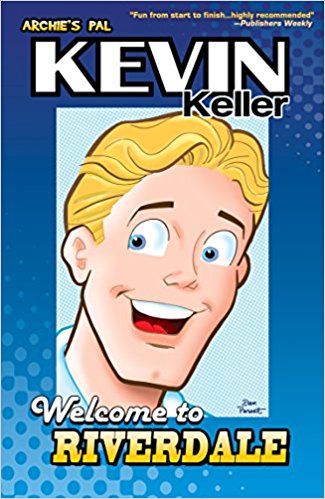
Kevin Keller: Welcome to Riverdale


By Dan Parent & Rich Koslowski & various (Archie Comics)
ISBN: 978-1-936975-23-5 (TPB)

Created by writer/artist Dan Parent and inker Rich Koslowski, Kevin Keller debuted in Veronica #202 (September 2010), a charming, good-looking and exceedingly together lad who utterly bowled over the rich go-getter. She was totally smitten with him whilst he was far more interested in food, sports and hanging out with Jughead…

When Kevin finally explained to Veronica why she was wasting her time, she became his best buddy: after all they had a lot in common – stylish clothes, shopping and boys…

Immensely popular from the outset (Veronica #202 was the first comicbook in the company’s long history to go into a second printing), Kevin struck a chord with the readership and soon guest shots evolved into a miniseries before the new kid on the block inevitably won his own ongoing title.

Trade paperback & eBook compilation Kevin Keller: Welcome to Riverdale collects the first four issues of his groundbreaking solo monthly title and opens here with handy text feature ‘Kevin Keller: Catch up with the Characters’: reintroducing the bonny lad, his (retired army colonel) dad Thomas, mum Kathy and feisty sisters Denise and Patty.

The feature also brings newcomers up to speed on recent history as seen in the previous volume) before the mirth and merriment kick off with ‘There’s a First Time for Everything’ from issue #1 wherein the much-travelled, journalism-obsessed “Army Brat” finally begins settling in at Riverdale High.

In short order he is elected Class President, has his first commercial writing published and reveals a shocking secret…

For all his accomplishments Kevin has never gone on a real date, and when a certain someone asks him out, the Keller kid turns to Betty for some confidence-boosting advice. He isn’t a complete neophyte; there was something like a date before, but due to his catastrophic nervousness it turned into a major disaster…

Unfortunately, Reggie overhears their huddled conversation and the self-proclaimed romance expert elects to give Kevin the benefit of his vast masculine experience…

The exuberant preparations turn into a catalogue of horror and, as more well-meaning friends get involved, it looks certain that Kevin will repeat that horrific experience…

Thankfully a few stabilising words from love-hating Jughead and an eventful morning with the remarkably understanding Colonel Keller quickly restore some necessary calm and equilibrium…

The next tale moves from straight slapstick to heart-warming empathy as Class President Kevin is asked to organise a prom in ‘May I Have this Dance?’ Only then does he discover that he has a secret admirer. Of course, once Veronica finds out it’s not a secret for long…

As the seventies-themed fashion disaster begins to take shape, further furtive communications reveal that the clandestine would-be wooer is someone still not fully at ease with his sexual orientation; forcing Kevin to be at his most understanding and forgiving…

Contentious themes and prejudices are tackled in ‘Stranded in Paradise’ when the summer vacation begins and Kevin gets a job as a lifeguard.

The beach is the time-honoured hangout of all Riverdale kids, but when spoiled princess Cheryl Blossom and her rich Pembroke School cronies invade the space, sparks soon fly. The grubby “Townies” are challenged to a surfing contest for possession of the sands with Kevin a star competitor and secret weapon for the home team. The fair-minded stalwart has, however, completely underestimated the vicious tactics of loathsome homophobe Sloan…

The comics portion of this tome concludes with an international epic set at the 2012 London Olympics. ‘Games People Play’ sees Colonel Keller – who has dual British and American citizenship – invited to be a torchbearer.

Having spent four years in England, Kevin is delighted to be going back for a visit and reconnecting with old pal Brian. He doesn’t even mind when shopping-crazy Veronica inveigles an invite to join the family.

Moreover, when his nominated-runner Dad falls foul of London’s Underground at a crucial moment, Kevin is ready and more-or-less willing to step in for what appears to be the unluckiest and most dangerous section of the entire torch route…

Following a moving and appreciative ‘Afterword’ by Dan Parent there’s also a splendid section of ‘Official Kevin Keller Bonus Features’ including ‘Retro Fashion’ pages, ‘Kevin’s Prom Style’, ‘Kevin’s Summer Style with B & V’, ‘Kevin Keller & Friends Style’ and a triptych of ‘Unreleased Promotional Sketches’.

With a cover gallery that includes modern cartoon masterpieces and remastered classic Archie images retrofitted to suit our 21st century all-star, this is a superb, hilarious and magically inclusive collection for you, your kids and grandparents to enjoy over and over again…
© 2012 Archie Comics Publications, Inc. All rights reserved.

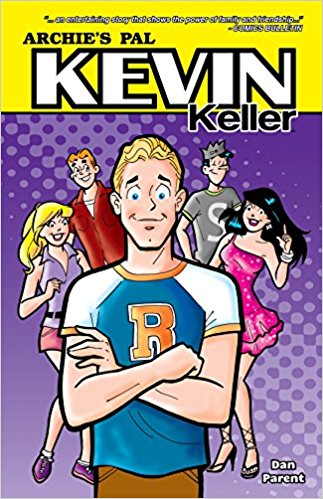
Archie’s Pal Kevin Keller


By Dan Parent, Rich Koslowski, Jack Morelli & Digikore Studios (Archie Comics)
ISBN: 978-1-87979-493-1 (HC)

Following the debut of Superman, MLJ were one of many publishers to jump on the “mystery-man” bandwagon, concocting their own small but inspired pantheon of gaudily clad crusaders. In November 1939 they launched Blue Ribbon Comics, and swiftly followed up with Top-Notch and Pep Comics. The content was the era’s standard mix of masked champions, clean-cut two-fisted adventurers, genre prose pieces and gags.

Not long after, Maurice Coyne, Louis Silberkleit and John Goldwater (hence MLJ) spotted a gap in the blossoming yet crowded market. In December 1941 the Fights ‘n’ Tights, heaving He-Man crowd were gently nudged aside by a far less imposing hero; an ordinary teenager having mundane adventures just like the readership, but with the companionable laughs, good times and romance emphasised.

Goldwater developed the youthful everyman protagonist concept and tasked writer Vic Bloom & artist Bob Montana with making it work. Inspired by and referencing the successful Andy Hardy movies (starring Mickey Rooney), their new notion premiered in Pep Comics #22. The unlikely star was a gap-toothed, freckle-faced, red-headed kid obsessed with impressing the pretty blonde next door.

A 6-page untitled tale introduced hapless boob Archie Andrews and wholesomely fetching Betty Cooper. The boy’s wry and unconventional best friend and confidante Jughead Jones also debuted in that vignette, as did idyllic small-town utopia Riverdale. It was a huge hit and by the winter of 1942 the kid had won his own series and then a solo-starring title.

Archie Comics #1 was MLJ’s first non-anthology magazine and with it began an inexorable transformation of the entire company. With the introduction of ultra-rich, raven-haired Veronica Lodge, all the pieces were in play for the industry’s second Genuine Phenomenon…

By 1946 the kids were in charge, and MLJ officially reinvented itself as Archie Comics, retiring most of its costumed characters years before the end of the Golden Age and becoming, to all intents and purposes, a publisher of family-friendly comedies.

The hometown settings and perpetually fruitful premise of an Eternal Romantic Triangle – with girl-hating Jughead to assist or deter and scurrilous love-rat rival Reggie Mantle to test, duel and vex our boy in their own unique ways – the scenario was one that not only resonated with fans but was somehow infinitely fresh and engaging…

Like Superman’s, Archie’s success forced a change in content at every other US publisher (except Gilberton’s dry and po-faced Classics Illustrated), creating a culture-shifting multi-media brand which encompassed TV, movies, newspaper strips, toys and merchandise, a chain of restaurants and (in the swinging sixties) a pop music sensation when Sugar, Sugar – from the animated TV cartoon – became a global summer smash hit.

Clean and decent garage band “The Archies” has been a fixture of the comics ever since…

The perennial eternal triangle has generated thousands of charming, raucous, gentle, frenetic, chiding and even heart-rending humorous dramas ranging from surreal wit to frantic slapstick, with the kids and a constantly expanding cast of friends (boy genius Dilton Doily, genial giant jock Big Moose and occasional guest Sabrina the Teenage Witch amongst so many others), growing into an American institution and part of the American cultural landscape.

The feature has thrived by constantly refreshing its core archetypes; boldly and seamlessly adapting to the changing world outside its bright and cheerful pages, shamelessly co-opting youth, pop culture, fashion trends and even topical events into its infallible mix of comedy and young romance.

Each and every social revolution has been painlessly assimilated into the mix and over the decades the company has confronted most social issues affecting youngsters in a manner both even-handed and tasteful.

Constant addition of new characters such as African-American Chuck Clayton and his girlfriend Nancy Woods, fashion-diva Ginger Lopez, Hispanic couple Frankie Valdez and Maria Rodriguez, student film-maker Raj Patel and spoiled home-wrecker-in-waiting Cheryl Blossom all contributed to a wide and refreshingly broad-minded scenario.

In 2010 Archie jumped the final hurdle – for decades a seemingly insurmountable one for kids comicbooks – when openly gay student Kevin Keller became an admirable advocate capably tackling and dismantling the last major taboo in mainstream comics.

Created by writer/artist Dan Parent and inker Rich Koslowski (lettered by Jack Morelli and coloured by Digikore Studios), Kevin debuted in Veronica #202 (September 2010). It was the first comicbook in the company’s long history to go into a second printing…

This landmark hardback (and eBook) compendium gathers that delightful debut from Veronica #205 plus the 4-issue Kevin Keller miniseries which cemented the new star’s popularity.

It all begins with context-establishing essay ‘Get to Know Kevin Keller’ before comic introductions are made in ‘Isn’t it Bro-Mantic’ as Veronica encounters a charming, good-looking and exceedingly-together lad who utterly bowls her over.

She is totally smitten with him even though he can out-eat human dustbin Jughead and loves sports. Although suave Kevin inexplicably loves hanging out with the ghastly Jones boy she is determined to make him exclusively hers.

Jughead (who clearly possesses fully-functioning gaydar) is truly cool with his new pal, and soon sees an opportunity to pay Ronnie back for many of the mean things she has said and done over the years…

When Kevin finally explains to Veronica why she is wasting her time, she takes it fabulously well and soon they are hanging out as best buds. After all, they have so much in common: chatting, stylish clothes, shopping, boys…

Immensely popular from the outset, Kevin struck a chord with the readership and returned a few months later in ‘The Buddy System’, with Veronica’s bombastic dad giving the obviously perfect new student the all-clear to monopolise his daughter’s time. The following fun-filled days do have one major downside however, as poor Betty is increasingly neglected…

You’d think Archie would be jealous too, but he’s just glad that someone “safe” is keeping other guys away from “his” Ronnie. It seems the ideal scenario for everyone but Betty, but then man-hunting, filthy rich over-privileged and entitled princess Cheryl Blossom hits town and puts everything back into perspective…

The repeat guest shots rapidly evolved into a miniseries, expanding Kevin’s role whilst answering many questions about his past. It started with ‘Meet Kevin Keller’ wherein we learned he was an army brat, born in Britain but raised all over the world, and now lives in Riverdale with his dad (retired and invalided army colonel) Thomas, mum Kathy and feisty sisters Denise and Patty.

It also reveals Kevin is a typical guy: he loves practical jokes as much as food and sports…

Whilst sharing these facts with Betty and Ronnie, he also lets slip some less impressive details: how he was a nerdy, braces-wearing late-developer who was frequently the target of bullies…

‘The Write Stuff’ is set during the build-up to his father’s surprise birthday party and discloses how Kevin plans to serve in the army before becoming a journalist, whilst also showing the gentle hero’s darker side after he is compelled to intervene – and end – the persecution of a young Riverdale student by bullies…

In ‘Let’s Get it Started’ the newcomer is ambushed and pressganged by his new friends into participating in a scholastic TV quiz show where his nerves almost get the better of him. Happily, Ronnie inadvertently breaks his paralysing stage-fright with a humiliating gaffe, but that’s just a palate cleanser for a potent object lesson in the concluding chapter…

As Kevin steps in to shelter and help one of the kids who used to torment him long ago, ‘Taking the Lead!’ also finds him reluctantly running for Class President at the insistent urging of Ronnie and the gang.

It’s not that he wants the position particularly, but when bigoted jock and star school quarterback David Perkins starts a campaign based on intolerance, innuendo and intimidation, Kevin feels someone has to confront the smugly-macho, “real man” who boasts he is the most popular boy in school…

And despite a smear campaign and dirty tactics any Presidential candidate would be proud of, truth, justice and decency win out…

This breezy and engaging collection concludes with ‘An Interview with Kevin Keller’ offering further background direct from the horse’s mouth and also includes a host of covers, variants and remastered classic Archie images retrofitted to suit our 21st century star. Archie’s Pal Kevin Keller is a joyous and magically inclusive collection for you and everyone you know and like to enjoy over and over again.
© 2012 Archie Comics Publications, Inc. All rights reserved.

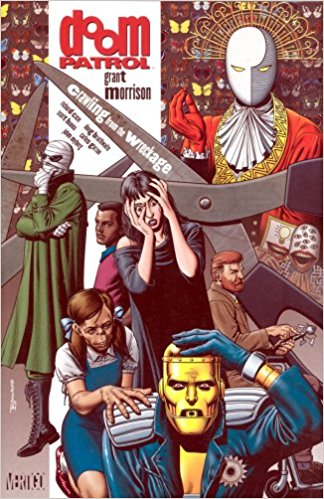
Doom Patrol volume 1: Crawling from the Wreckage


By Grant Morrison, Richard Case, Doug Braithwaite, Scott Hanna & various (DC Comics)
ISBN: 978-1-56389-034-5

In 1986, mega-monster continuity reboot Crisis on Infinite Earths led to DC overwriting fifty years of continuity and revamping or reinventing their major properties. The massive spring cleaning exercise led to a swathe of bold, innovative titles and a fresh look at how comicbooks could be done.

A revival that began quite conventionally almost overnight became the one of company’s most radical enterprises. Despite having solid roots back in the Silver Age, Doom Patrol was a series that really dared to be different…

In 1963 DC/National Comics – without no prior warning – converted venerable anthology-mystery title My Greatest Adventure into a (remarkably fringe) superhero team-book with the 80th issue.

The debut tale introduced a startling squad of arguably disabled champions with their thematic roots still firmly planted in the B-movie monster films of the era which had for so long informed the tone and timbre of the parent title.

That aesthetic subtly shaped the progression of the strip – which took total control of the comic within months, prompting a title change to The Doom Patrol with issue #86 – and throughout its 6-year run, made the series one of the most eerily innovative and happily hip reads of that generation.

No traditional team of masked adventurers, the cast comprised a robot, a mummy and a pliable 50-foot woman in a mini-skirt, who joined forces with and were guided by a brusque, domineering, paraplegic mad scientist; each and all equally determined to validate themselves by fighting injustice their way…

Those damaged champions comprised competitive car racer Cliff Steele, but only after he had “died” in a horrific pile up, with his undamaged brain transplanted into a fantastic mechanical body… without his knowledge or permission…

Test pilot Larry Trainor had been trapped in an experimental stratospheric plane and become permanently and lethally radioactive, with the dubious benefit of gaining a semi-sentient energy avatar which could escape his body to perform incredible stunts for up to a minute at a time. To pass safely amongst men Trainor had to constantly wrap himself in specially-devised radiation-proof bandages.

Former movie star Rita Farr had been exposed to mysterious swamp gases which gave her the unpredictable and, at first, uncontrolled ability to shrink or grow to incredible sizes.

These outcasts were brought together by brilliant but enigmatic Renaissance Man Niles Caulder who, as The Chief, sought to mould marginalised misfits into a force for good. The wheelchair-bound savant directed the trio of solitary strangers in many terrifying missions as they slowly grew into a uniquely bonded family…

Even the way the series ended was radical for its time. Final issue Doom Patrol #121 (September/October 1968) saw three quarters of the team sacrifice their lives to save a village of inconsequential nobodies.

Over succeeding years clever backwriting revived them all, but to us readers at the time, that issue was shocking and incomprehensible.

In 1987, supplemented by new team-mates, the Doom Patrol – now based in Kansas City – returned to muddle along for 18 issues (and a few one-shots and specials), before again being devastated by death and living up to their perhaps ill-considered name. Following an invasion by an alliance of alien races, a “gene bomb” was detonated in Earth’s atmosphere which warped, erased or triggered the powers of many metahumans.

In the resulting fallout, the team suffered appalling losses…

Thus here, as neophyte Scottish import and unknown quantity Grant Morrison began his American writing career, Negative Man has been separated from his human host, Cliff Steele has suffered a psychological collapse, energy-caster Tempest has ceased using his abilities and teenaged trainee Lodestone lies in a coma…

This collection gathers Doom Patrol volume 2 #19-25 (the monthly issues from February-August 1989, as first collected in one of DC’s earliest trade paperbacks in 1992), wherein traditional team super-heroics were abruptly and ignominiously jettisoned in favour of Big Concept science, “sophisticated suspense” and macabre creeping terror.

A less celebrated but equally crucial component of the revolutionary change was penciller Richard Case, whose stylish, low-key interpretation of some of the (at that time) strangest scripts, situations and characters ever seen in mainstream comics imbued the wildest conceptions with plausible veracity. The illustrator was usually aided and abetted by the steady assured assistance of unflappable inker Scott Hanna.

Here, however, the opening chapter is inked by Carlos Garzón as an eerie, eponymous adventure begins with ‘Crawling from the Wreckage’ with a nightmare-wracked Cliff Steele receiving a visitor in the sanatorium where he voluntarily languishes.

Robotics wunderkind Dr Will Magnus – who created the Metal Men and had rebuilt and reconstructed Cliff from the scraps which survived the explosion which ended the first Doom Patrol – has come calling, eager to fix his former patient and repair this latest glitch…

As intense, obsessive Niles Caulder browbeats burned out Josh Clay (AKA Tempest) into staying with the team in a “non-combat” capacity, over at the Alamance Memorial Hospital Larry Trainor is recovering from major injuries and revelling in the fact that he is no longer a radioactive freak hosting a bizarre energy parasite.

The only down side is the cost: the death of his partners and protégés and the persistent comatose state of youthful new team-mate Rhea Jones, the magnetically-empowered Lodestone.

Larry’s complacency is shattered when he starts seeing the Negative force again, howling to be let back in…

As Magnus struggles to counsel Cliff, the energy apparition moves again on Larry, possessing both him and his attending doctor Eleanor Poole coldly remoulding them all into an eerie three-part, multiple-gendered amalgamated being calling itself Rebis…

Magnus meanwhile plays his last card: with Robotman locked in self-pity and self-loathing, the master engineer switches tactics by appealing to Cliff’s heroic humanity and abiding compassion. He introduces the man of metal to fellow-patient Kay Challis: a young woman known to all as Crazy Jane.

Afflicted with multiple personality disorder, she manifests as (at least) 64 very different people, and since the gene bomb detonation, each one has manifested a different super power…

And elsewhere, a hideously burned crash victim who takes far too long to die drops a very strange black book and stops muttering the phrase “the Scissormen”. Federal agents on the scene resignedly realise this case needs the unique attention of Niles Caulder and his band of freaks…

Strange phenomena begin to proliferate globally in ‘Cautionary Tales’ (inked by Hanna) culminating in reports of many disappearances. Each vanished victim is marked by the silhouetted hole he or she leaves in reality…

As Caulder is cautiously recruiting hyper-intelligent, emotionally distant Rebis, across town Magnus cannot believe the change in Cliff. With Jane now his inseparable companion, Steele has regained much of his previous poise and lucidity: so much so, that Magnus offers to rebuild him a new body with sensors and feedback systems which will restore or approximate all the physical senses lost since becoming a brain trapped inside an ambulatory metal jail cell…

Apparently also back is Robotman’s gift for attracting trouble, as his evening walk with Jane is interrupted by a plummeting body screaming about “Scissormen”. With arcane abductions and cross-dimensional incursions mounting, the sanatorium becomes ground zero for packs of terrifying, gibberish-spouting, blade-handed invaders who attack staff and inmates, with only Jane’s arsenal of new abilities keeping her and Cliff out of the scything clutches and apparent extra-dimensional excisions…

All over the world bizarre phenomena and uncanny events mount…

More information – if not understanding – accrues with ‘Worlds in Collision’ as Kansas City begins to merge with a ghastly otherplace metropolis. Cliff and Alice battle macabre and unnatural foes all the way to the Doom Patrol’s new HQ in the Rhode Island mountain that was the original sanctuary of the Justice League of America.

Here, Caulder deduces their enemy is actualised metafiction stemming from a philosophical thought experiment that escaped its own boundaries to invade consensual reality but before he can formulate a response an army of Scissormen converge on their location and cut Josh out of existence. With no other choice and fed up with running, Cliff leads Rebis and Alice on a counterstrike into the heart of ‘The Ossuary’ to demolish the predatory city of Orqwith from within using brute force and pedantic logic…

With a semblance of normality restored just in time, the Doom Patrol settle in and welcome hirsute simian pre-teen Dorothy Spinner into the fold. Her uncontrolled ability to manifest monsters from her memory and imagination is only the most minor of annoyances, however, compared to the incursion of an ancient extradimensional hunter who abducts Lodestone’s comatose body from the hospital.

Thankfully, Crazy Jane has just the personality and powerset to follow ‘The Butterfly Collector’…

Divining his many names and history of slaughtering women throughout history, she leads the team’s break in to ‘The House that Jack Built’ where the red-handed butcher’s many outrageous claims and sadistic acts prove ultimately no proof against the Patrol and a suddenly awake if not aware Lodestone…

This initial trade paperback (and digital) compilation concludes with a smaller-scaled but still potentially lethal tale of ‘Imaginary Friends’. Illustrated by Doug Braithwaite & Hanna it focuses on shy, meek little Dorothy Spinner and her growing relationship with Josh Clay. A key point in her life is almost derailed and turned to bloodbath when her burgeoning biology catastrophically interacts with her thought-materialisation power and a leftover (but-still-active) trophy from the JLA’s past…

Including a context-building Introduction from Tom Peyer and ‘A Word from the Author’ first seen in DP #20, this collection of strange brews were – and remain- a magnificent mission statement for the revitalised DC Universe, offering gritty, witty fancifully cohesive and contemporary stories that appealed not just to Fights ‘n’ Tights fanatics but also lovers of wild concepts, beguiling metafiction and thrilling supercrime capers. As such they are still perfect fodder for today’s so-sophisticated, informed and ultimately sensation-hungry readers.
© 1987, 2005, 2015 DC Comics. All Rights Reserved.

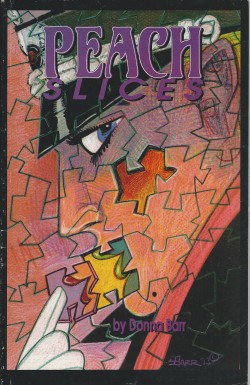
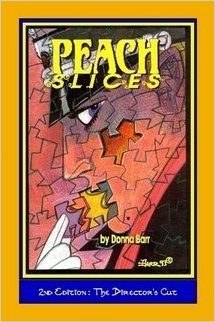
Peach Slices


By Donna Barr (Aeon/Mu)
No ISBN:                    : 978-1-89225-325-5 (2006 Director’s Cut edition)

The Desert Peach is the supremely self-assured and eminently efficient gay brother of Erwin Rommel, the legendary German soldier universally hailed as “the Desert Fox”.

Set mostly in Africa during World War II, this priceless gem of a series effortlessly combines hilarity, absurdity, profound sensitivity and glittering spontaneity, with stories describing the dalliances and daily tribulations of Oberst Manfred Pfirsich Marie Rommel. This younger sibling also served, albeit as an unwilling but dutiful cog in the iniquitous German War Machine, yet one determined to remain a civilised gentleman under the most adverse and unkind conditions.

However, although in his own ways as formidable as his beloved brother, the caring, gracious and genteel Peach is a man who loathes causing harm or giving offence. Thus, he spends his service commanding the dregs of the military in the ghastly misshapes of the 469th Halftrack, Gravedigging & Support Unit of the Afrika Korps, daily endeavouring to remain stylish, elegant, civil and ever-so patient with and to the assorted waifs, wastrels and warriors on both sides of the unfortunate all-encompassing conflict.

It’s a thankless, endless task: the 469th harbours the very worst the Wehrmacht has ever conscripted, from malingerers and malcontents to useless wounded, shiftless conmen, screw-ups and outright maniacs.

Pfirsich unilaterally applies the same decorous courtesies to the sundry natives inhabiting the area and the rather tiresome British and Anzac forces – not all of whom are party to a clandestine non-aggression pact Pfirsich has agreed with his opposite numbers in the amassed Allied Forces. In fact, the only people to truly annoy the peace-loving Peach are boors, bigots, bullies and card-carrying Blackshirts…

The romantic fool is also passionately in love with and engaged to Rosen Kavalier: handsome Aryan warrior and wildly manly Luftwaffe Ace, but arguably the real star of these fabulous frothy epics is the Peach’s long-suffering, unkempt, crafty, ill-mannered, bilious and lazily scrofulous orderly Udo Schmidt.

This is a man (we’re at least assured of that!) of many secrets whose one redeeming virtue is his uncompromising loyalty and devotion to the only decent man and tolerable officer in the entire German army.

This eccentric aggregation of extras, excerpts and exotica was first released in 1993, re-presenting extraneous material from a variety of sources and covering the period 1987-1993: as much an affectionate art-book as delicious dose of non- or mis-canonical hi-jinks.

The entire package was subsequently re-released in 2006 in a Director’s Cut edition which added issue #25’s WWI Transylvanian Hammer-Horror pastiche ‘Beautiful’ to the mix and includes reminiscences, background commentary and creator-kibitzing regarding all the esoteric tales and titbits.

The gloriously visual treat begins with an Unused Pin Design and a splendid Badge Design from the San Diego Comic-Con 1989 after which a quartet of stunning and bizarre Beer Labels (for ales created by micro brewer Wendell Joost in 1988) precedes ‘Peach on Earth’ from A Very Mu Christmas 1992 – one of the very best Christmas stories ever produced in the notoriously twee and sentimental comics field.

Set in the harsh December of 1945, it follows the demobbed and repatriated Pfirsich as he wanders through his broken and occupied homeland, avoiding trouble and American troops but not the gnawing starvation and freezing snows which would kill so many returning, defeated German soldiers. On the verge of despair and death the Peach is brusquely adopted by a strange, brittle and utterly fearless little boy who has only known the Fatherland in the throes of decline, but still looks eagerly to a brighter tomorrow…

This is followed by a rather risqué Rosen Kavalier pinup from Paper Phantasies (1991) and an unused strip originally commissioned by Rip Off Press after which ‘Whipping Boy’ offers a full-on adult escapade of the unconventional lovers as is ‘I Am What I Am… (I Think)’. This was a “Desert Peach Pitt Stop” that also languished unpublished until this collection preserved it.

Bits ‘n’ Pieces was a short-lived self-published magazine the indefatigable author used to disseminate assorted works which never made it into the regular, normal-length Desert Peach title.

‘The Veteran’ comes from the first issue in 1991, returning focus to the motley cast of the hapless 469th for a deliciously philosophical foray starring a most peculiar and innocent warrior named Thommi, whilst, following a frolicsome Desert Peach pinup from the 1989 Amazing Heroes Swimsuit Special, ‘Hindsight’ (Bits ‘n’ Pieces #1 1991) dabbles into personal politics before ‘Reflections’ from #3 offers a few New Year’s observations on the cast and stars from Barr herself.

The 1991 San Diego Comic-Con booklet provided another beguiling Pinup before ‘Udo and the Phoenix’ (from Xenophon #1, 1992) relates another tale of the spirited Arab horse accidentally owned by Udo and cared for by the equally magnificent Pfirsich.

Next ‘Reluctant Affections’ (from Bits ‘n’ Pieces #1 1991, before being redrawn as ‘Pigeonholed’ for Gay Comics #16) explores a tender, fragile moment and adorable chink in the macho armour of uber-Mensch Rosen…

‘The More Things Change’ from benefit book Choices in 1992 debates the abortion issue with characteristic abrasive aplomb after which ‘Sweet Delusions’ (Wimmin’s Comix #16 1991) gets down to the eye-watering nitty-gritty of Rosen & Pfirsich’s love life and ‘Wet Dream’ (Bits ‘n’ Pieces #3 1991) follows up with more of the same in a hilariously wry maritime moment.

Barr’s creations are never far from always internally consistent flights of extreme fantasy, as deliciously seen in glorious diversion ‘The Oasis’ (Centaurs Gatherum 1990) with Pfirsich and brother Erwin finding a militarily priceless waterhole with a fantastic secret and forced to spend a truly outrageous time trapped as hybrid half horses…

This captivating chronicle concludes with a selection of ‘Peach Pits’ miscellanea: illustrations, roughs and small press items culled from the Desert Peach Musical books, T-shirts and posters. There’s some fascinating rough layouts from the aforementioned ‘Peach on Earth’, an unused page from DP #17 (the superb ‘Culture Shock’ as seen in The Desert Peach: Marriage & Mayhem) and assorted stuff from Zine Zone #13, 1992. Even more extras comprise covers from Germanophilic Amateur Press Association magazine ‘Krauts’ and shirt designs before the whole outrageous affair ends well with an implausibly “true tail” starring half-horse Stinz Löwhard, Pfirsich and Erwin in a ‘Character Revolt’ from 1987’s Fan’toons 19.

Desert Peach adventures are always bawdy, raucous, satirical, authentically madcap and immensely engaging: bizarre (anti) war stories which rank amongst the very best comics of the 1990s. Even now they still pack a shattering comedic kick and – if you’re not quite braced – poignantly emotional charge.

The Desert Peach ran for 32 intermittent issues via a number of publishers and was subsequently collected as eight graphic novel collections (1988-2005). A prose novel, Bread and Swans, a musical, and an invitational collection by other artists entitled Ersatz Peach were also created during the strip’s heyday. A larger compendium, Seven Peaches, collected issues #1-7 and Pfirsich’s further exploits continued as part of the Modern Tales webcomics collective…

Illustrated in Barr’s fluidly seductive wood-cut and loose-line style, this book is another must-have item for lovers of wit, slapstick, high drama and belly-laughs as well as grown-up comics in general.

All the collections are pretty hard to find these days but if you have any facility with the digital world they can still be found. You might want to start with these addresses: http://www.donnabarr.com or http://thedesertpeach.com and if you just have to own your own Peach product http://www.lulu.com/desertpeach offers a huge double collection that also comes as economical loadable files and The Desert Peach (plus Stinz and Bosom Enemies) are all re-printed with colour extras at http://www.Indyplanet.com at marvellously economical rates.

So you should do all that, Macho Schnell, before the month is out!
© 1987-1993 Donna Barr. All rights reserved. The Desert Peach is ™ Donna Barr.