Star Trek Classics volume 1 – The Gorn Crisis


By Kevin J. Anderson, Rebecca Moesta & Igor Kordey (IDW)
ISBN: 978-1-61377-129-7

The Star Trek franchise has had many comic book homes. This action-heavy paperback tome (also available digitally) was originally released in the early years of the 21st century by DC/WildStorm and is narratively positioned during the period when Deep Space 9 was first being broadcast on television.

The book therefore tangentially informs and contributes to a seasons-long storyline featuring an intergalactic war between the Federation and its Alpha Quadrant allies on one side and the J’em Haddar warriors of The Dominion on the other. So if you’re a bugbear, completist or unfamiliar with the mileau, you might be left feeling a little bewildered. Nevertheless if you’re of a forgiving mien this adventure is a real ripsnorter…

In case you were wondering, The Gorn were an aggressive civilisation of reptiles who appeared in an episode of the original 1960s Star Trek TV show. The story was in fact an adaptation of a classic SF short story by Fred Brown entitled “Arena”, in which Captain Kirk and his Gorn opposite number were co-opted by a super-advanced race to represent their species in a brutal duel for galactic supremacy. The loser race would be curbed to avoid horrendous, bloody and nigh-eternal space-war.

A century later mankind and its intergalactic partners are losing just such a conflict with the Dominion and desperately seeking fresh allies. Thus Captain Jean-Luc Picard has been dispatched to the embargoed Gorn solar system to renew relations and broker a military alliance, but the USS Enterprise arrives just as the reptile’s own black-crested Warrior Caste – frustrated by a century of enforced peace – stages a bloody coup and subsequently launches an all-out attack on neighbouring worlds.

These planets are now, perhaps unwisely, packed with human colonists and Federation/Klingon bases…

Beaming down just in time to be captured amidst the remains of the Administrative caste, Picard, Dr. Beverly Crusher and their Away Team are promptly captured and can only subtly influence the outcome as Commanders Will Riker and amazing android Data battle with brilliance on two very different fronts to stop the marauding Gorn war-lovers…

With no back-up available from hard-pressed Starfleet, the Next Generation stalwarts must act independently and ingeniously to quell the barbarous uprising, restore order and build that elusive alliance with the Gorn. Their efforts won’t just dictate how the humans, Federation and reptiles will co-exist in the future, but might well decide if they exist at all…

Although not to everybody’s taste, and despite an occasional certain rough hesitancy in Igor Kordey’s fully-painted artwork, this tale from Kevin J. Anderson & Rebecca Moesta does rattle along in the approved Star Trek manner, and even casual readers will come away with a sense of expectation fulfilled.

Moreover, augmenting the interstellar excitement is a comprehensive fact-file on the sinister sarurians entitled ‘The Gorn Dossier’, contributed by illustrator Kordey who apparently moonlights as a “Federation Anthropologist”. Here he highlights his root and branch redesign of the alien antagonists with biology, language, symbology, livery and weaponry all updated for discerning modern readers

Fast, fierce fun for lovers of high quality Space Opera so boldly go and give it a look.
Star Trek ® & © 2011 CBS Studios, Inc. All Rights Reserved.

Hellboy volume 10: The Crooked Man and Others


By Mike Mignola, Richard Corben, Duncan Fegredo, Joshua Dysart, Jason Shawn Alexander, Dave Stewart & Clem Robins (Dark Horse Books)
ISBN: 978-1-59582-740-1

As a baby Hellboy was taken – on December 23rd 1944 – from Nazi cultists by American superhero The Torch of Liberty and a squad of US Rangers. They had interrupted a satanic ritual predicted by Allied parapsychologist Professor Trevor Bruttenholm and his associates.

They were waiting at a ruined church in East Bromwich, England when an abominable infant with a huge stone right hand materialised in a fireball. Raised by Bruttenholm, the child grew into a mighty warrior fighting a never-ending secret war. The Professor trained the infernal foundling whilst forming an organisation to destroy supernatural threats – the Bureau for Paranormal Research and Defense.

After years of such devoted intervention, education and warm human interaction, in 1952 the neophyte hero began destroying unnatural threats and supernatural monsters as lead agent for the BPRD. “Hellboy” rapidly became its top operator… the world’s most successful paranormal investigator…

As the decades unfolded, Hellboy gleaned snatches of his origins, learning he was a supposedly corrupted creature of dark portent: born a demonic messiah, destined to destroy the world and bring back ancient powers of evil. It was a fate he despised and utterly rejected…

This creepy tenth collection re-presents the 3-issue miniseries Hellboy: the Crooked Man, one-shot Hellboy: In the Chapel of Moloch, the extremely rare Hellboy: They That Go Down to the Sea in Ships computer game premium and a short story from Free Comic Book Day 2008: Hellboy: once again relating tales set at various stages of his globe-trotting, world-saving fifty year career batting the arcane, occult and unknown…

Following an expansively effusive Introduction from cartoonist Gahan Wilson, this collation of chillers commences with Eisner Award-winning saga ‘The Crooked Man’, limned by Richard Corben, with colours and letters by regular support crew Dave Stewart and Clem Robins.

It’s preceded by an introductory commentary from author Mignola where he acknowledges the influence of and debt to pulp, comics, magazine and novel-writer Manly Wade Wellman and how he helped shaped the supernatural shocker which follows…

Roaming the Appalachian Mountains of Virginia in 1958, Hellboy encounters a plague of witches and meets a fellow victim of fate in wandering Tom Ferrell.

As they jointly seek a cure for a hexed woman they encounter an old friend of Tom’s who has been lured into the craft by the Devil. Having met the infernal fiend in his local guise as the Crooked Man, Tom reveals a dark secret of his own…

Years ago when he was a stupid kid, Ferrell was seduced by teen temptress Effie Kolb who lured him into making a pact with the Crooked One. His reward was great power – in the form of a lucky wishing bone – but the boy was so shocked by the experience that he fled the Appalachians in terror: joining the army, becoming a globe-trotter and never, ever calling upon the demonic power at his command…

And now he’s been drawn home to settle accounts…

Witches and devils are waiting for him with many cruel punishments in store but, with Hellboy beside him, Tom pushes on up the mountains to the seat of the monsters’ power. Here, a dedicated, unswerving preacher holds out on the last piece of consecrated ground in the entire district, and with his divine support the damned heroes confront all the powers of Hell and temptations of Perdition to banish the dark forces.

As always, however, there is a price to pay…

Written by Mignola and Joshua Dysart with art by Jason Shawn Alexander ‘They That Go Down to the Sea in Ships’ was created as a comic premium given away with a computer game. The scene is Newburyport, Massachusetts in 1986, where a hustling fortune teller steals – or is perhaps glamoured by – the skull Blackbeard the Pirate.

A month later Hellboy and amphibian agent Abe Sapien are called to Ocracoke Island, North Carolina where the brain-slaved conman is attempting to unite the piratical pate with its former body to resurrect the bloodiest murderer in history to his old red-handed antics…

Even Hellboy’s great strength seems unable to still the unquiet ghost, but other vengeful forces have also been awakened by the rowdy Blackbeard…

‘In the Chapel of Moloch’ is an all-Mignola affair set in 1992 wherein the weird wanderer visits an old friend in southern Portugal and is drawn into an eerie case of possession. They investigate the disappearance of a painter who has been beguiled by the works of Francisco Goya and apparently summoned to Earth the personification of a biblical devil, and discover something old and fierce and deadly on the loose…

The comics cavalcade of chills and thrills ends with a whimsical vignette by Mignola & Duncan Fegredo from Free Comic Book Day 2008: Hellboy. As the B.P.R.D. top gun spends a little downtime in England with some old – and largely deceased – pals, he has a bit of an extended fright after one of them points out ‘The Mole’ growing on the arcane agent’s hand…

This capital collection of Chthonic capers is accompanied by a gallery of covers by Mignola and Corben and supplemented by a copious ‘Hellboy Sketchbook’ assemblage with art from all stages of production and commentary from the author and artists Alexander, Fegredo & Corben before closing with an erudite and tantalising biographic appreciation of ‘Manly Wade Wellman: American Mythmaker’ by author, archivist and historian John Pelan.

Spooky, suspenseful and explosively action-packed, this is another uniquely unsettling rollercoaster ride to delight horrorists of very stripe and character.
© 2008, 2009, and 2010 Mike Mignola. Hellboy is ™ Mike Mignola. Introduction © 2010 Gahan Wilson. All rights reserved.

Mac Raboy’s Flash Gordon volume 2


By Don Moore & Mac Raboy (Dark Horse)
ISBN: 978-1-56971-911-X

By almost every metric Flash Gordon is the most influential comic strip in the world. When the hero debuted on Sunday January 7th 1934 (with the superb Jungle Jim running as a supplementary “topper” strip) as an answer to the revolutionary, inspirational, but quirkily clunky Buck Rogers (by Philip Nolan & Dick Calkins and also began on January 7th albeit in 1929) two new elements were added to the wonderment; Classical Lyricism and poetic dynamism. It became a weekly invitation to stunningly exotic glamour and astonishing beauty.

Where Buck Rogers mixed traditional adventure with groundbreaking science concepts, Flash Gordon reinterpreted fairy tales, heroic epics and mythology, spectacularly draping them in the trappings of the contemporary future, with varying “Rays”, “Engines” and “Motors” substituting for trusty swords and lances – although there were also plenty of those – and exotic craft and contraptions standing in for galleons, chariots and magic carpets.

It was a narrative trick which made the far-fetched satisfactorily familiar – and one initially continued by Mac Raboy and Don Moore in their run of Sunday strips. Look closely though and you’ll see cowboys, gangsters and of course, flying saucer fetishes adding contemporary flourish to the fanciful fables in this second superb volume…

Most important of all, the sheer artistic talent of Raymond, his compositional skills, fine line-work, eye for clean, concise detail and just plain genius for drawing beautiful people and things, swiftly made this the strip that all young artists swiped from.

When original material comicbooks began a few years later, literally dozens of talented kids used the clean-lines of Gordon as their model and ticket to future success in the field of adventure strips. Almost all the others went with Milton Caniff’s masterpiece of expressionism Terry and the Pirates (and to see one of his better disciples check out Beyond Mars, illustrated by the wonderful Lee Elias).

Flash Gordon began on present-day Earth (which was 1934, remember?) with a wandering world about to smash into our planet. As global panic ensued, polo player Flash and fellow passenger Dale Arden narrowly escaped disaster when a meteor fragment downed their airliner. They landed on the estate of tormented genius Dr. Hans Zarkov, who imprisoned them in the rocket-ship he had built.

His plan? To fly the ship directly at the astral invader and deflect it from Earth by crashing into it…!

Thus began a decade of sheer escapist magic in a Ruritanian Neverland: a blend of Camelot, Oz and a hundred fantasy realms which promised paradise yet concealed hidden vipers, ogres and demons, all cloaked in a glimmering sheen of sleek futurism. Worthy adversaries such as utterly evil yet magnetic Ming, emperor of the fantastic wandering planet; myriad exotic races and shattering conflicts offered a fantastic alternative to drab and dangerous reality for millions of avid readers around the world.

With Moore doing the bulk of the scripting, Alex Raymond’s ‘On the Planet Mongo’ ran every Sunday until 1944, when the artist joined the Marines. On his return he forsook wild imaginings for sober reality: creating gentleman-detective Rip Kirby so the public’s unmissable weekly appointment with wonderment perforce continued under the artistic auspices of Austin Briggs – who had drawn the daily monochrome instalments since 1940.

In 1948, eight years after beginning his career drawing for the Harry A. Chesler production “shop” comicbook artist Emmanuel “Mac” Raboy took over illustrating the Sunday page. Moore remained as scripter and began co-writing with the new artist.

Raboy’s sleek, fine-line brush style – heavily influenced by his idol Raymond – had made his work on Captain Marvel Jr., Kid Eternity and especially Green Lama a benchmark of artistic quality in the early days of the proliferating superhero genre. His seemingly inevitable assumption of the extraordinary exploits led to a renaissance of the strip and in a rapidly evolving post-war world, Flash Gordon became once more a benchmark of timeless, hyper-real quality escapism which only Hal Foster’s Prince Valiant could touch.

This second 260-page paperback volume, produced in landscape format and printed in stark black-&-white (although one or two strips appear to have been scanned from printed colour copies) covers May 17th 1953 to February 23rd 1958 and opens with a scholarly Introduction on ‘Comic Strip Godfathers’ from Bruce Jones before the previous volume’s cliffhanger is addressed…

With a new spaceship, far-flung travellers Flash, Dale and Zarkov set off for Earth but are forced to land on the Moon where a secret human base had been established. For unknown reasons Dr. Stella and her thuggish aide Marc detain and delay them, but when an increasing number of close shaves and mysterious accidents occur, a little digging by our heroes reveals that they are the unwitting guests of ruthless space pirates…

After expediently dealing with the planetary privateers our heroes head for Earth, only to be promptly seconded to spearhead an urgent exploratory expedition to a newly discovered satellite body. Suitably dutiful, they hurtle off into the void again…

‘(Life on) Titan’ ran from 14th June to September 20th 1953 and details how the little world is populated by giants. However, after capturing one of the hulking inhabitants Zarkov is forced to conclude that the truth is far stranger than the Earthmen could have imagined…

The tireless boffin then builds a single-seater spaceship and required Flash to take a test run out to Jupiter’s moon ‘Callisto’ (27th September 1953 to 17th January 1954). A sudden illness causes the dauntless pilot to crash and Flash awakens in the care of elderly hermit Phylo, who cunningly embroils the troubleshooter in his own struggle against invisible psychic dictator The Mind…

After overthrowing the hidden tyrant the indomitable Earthman heads home and actually enjoys a little rest before an ancient mystery unfolds in ‘Flash Gordon and the Thanatos’ (17th January-2nd May).

After archaeologist Dr. Sark finds incontrovertible evidence of an atomic blast in the Libyan desert in prehistoric times, our ever-inquisitive action man uncovers an alien in a bottle but is too late to save Dale from being abducted by the mind-bending survivor of an antediluvian starship crash…

Dashing in pursuit as his beguiled beloved heads off-world, Flash is drawn into the parallel dimension or Cortinus where god-like beings dwell. They welcome the intruders from fondly-remembered Earth but are sadly unaware that one of the visitors carries the malevolent spirit of their outcast brother Loki…

Once freed the villain proudly boasts how he influenced and dominated many bellicose humans such as Alexander, Julius Caesar and Genghis Khan and now intends ruling two realms for his own benefit. Sadly for him, nigh-omnipotent Loki vastly underestimates the ingenuity and resolve of his mortal opponents…

With a ship donated by head deity Zustra, Flash and Dale re-cross the dimensional divide and arrive in deep space to encounter a scene of horrific barbarity at an Observatory Station. When the ‘Outlaw of the Asteroids’ (9th May-25th July) stole the outpost’s oxygen the crew almost died in hibernation. After pausing to revive the deep-frozen scientists the adventurers set off after the ruthless bandit and discover the reason for his heinous theft was both noble and desperate. The bandit perishes for his sins, but not before leaving young space orphan Pebbles with the only humans he can trust…

By the time Flash, Dale and Pebbles reach Earth the next exploit is already well underway as ‘The Star Tree’ (1st August-17th October) seed survives a meteor crash in the Amazon and immediately propagates itself in fertile soil. By the time our valiant wanderers accidentally land in the region, it has been transformed into an arctic wilderness where a gigantic plant is voraciously consuming every living thing its grasping branches can seize…

The vegetable invasion is no accident and as Flash leads the frozen rain forest’s native inhabitants in spirited resistance, cold-blooded aliens appear. They lived on Earth when it was a giant ice ball and after eons on Pluto want their original world back…

They would have succeeded too, had not one of the invaders found his heart warming to the plight of the disputed world’s current tenants…

With that threat ended normality returns but soon after packing Pebbles off to boarding school Flash, Zarkov and many other unsuspecting Earth folk are shanghaied by eerie metal globes and transported to ‘The Lonely Planet!’ (24th October 1954 to 9th January 1955)…

Here Herculean extraterrestrial barbarians and wily midgets conspire and compete to find fresh fodder for gladiatorial contests, but with the aid of a usurped king, Flash quickly upsets the unlikely alliance and overthrows the twisted regime. However, just as the liberated Earthlings enter home orbit, their always-embattled birthworld is attacked by the insectoid Antomni who require a fresh colony to exploit. The bug beings expect little resistance as they posses the power of Time Migration…

The invaders travel millions of years ‘Into the Past’ (16th January-27th March) to prevent the evolution of humanity but accidentally catch Flash and Zarkov in their temporal backwash, allowing our heroes to inspire a band of dawn men to exterminate the insectoids before returning to their proper time and place…

Always restless, Zarkov then organises an exploratory expedition to ‘Venus’ (3rd April – 19th June) where Flash and Dale find a feudal civilisation in turmoil beneath the planet’s impenetrable cloud layers. Before long they are assisting scientific prodigy Viko and his fellow exiled “Mistiks” in overturning the oppressive, superstition-ruled authorities and introducing rational enlightenment to the Second Planet from the Sun…

Soon after, Africa is beset by a strange sleeping plague and investigations reveal the source is escaped gasses from an unsuspected ‘City Within the Earth’ (26th June – 28th August). The accident also allows toxic oxygen to contaminate the subterranean metropolis of Centra and when its bravest warriors surface to investigate, a concatenation of misfortunes compel them to take Flash captive. Imprisoned and soon to become the treasured possession of flamboyant Princess Amara, Gordon is rescued by the indomitable Dale who braves the depths and deadly air to save her man and seal off the underworld forever…

‘The Dark Planet’ (4th September – 6th November) has lurked undetected at the edge of the solar system for all of humanity’s history but that occlusion ends when murderers Stragg, Rust and Tula are exiled from their advanced culture on the distant world of Ur and dumped on the frigid world.

When Flash, Dale and Zarkov’s planetary mapping mission brings them to the bleak outpost they are ambushed by the killers who then steal their ship. The aliens have never encountered human sneakiness though, and are soon back where they started and engaged in a lethal duel for control of the ship and their liberty…

Human trafficking underpins the saga of ‘Station Crossroads’ (13th November 1955 – 15th January 1956) as our heroes stumble upon a scheme to kidnap and sell human technicians to scientifically backward aliens. The vile human mastermind behind the plot operates out of Earth’s most popular orbital rest-stop but before the slavers are finally crushed Flash discovers a close friend is deeply involved in the abductions…

When Gordon discovers a hidden base at Earth’s North Pole is being used by aquatic aliens he becomes embroiled in an ‘Arctic adventure’ (22nd January-March 25th) where unscrupulous Earthmen use the freezing waters as a cost-free fish-farm to grow giant monsters for mysterious offworlders to consume…

After a far-distant world experiences an atomic accident the aftermath produces a voracious ‘Radioactive Man’ (1st April – 3rd June) who can only exist by absorbing deadly fallout. The authorities’ solution is to blast the mutant into the void where, after years of lonely travel, atomic exile Djonn Toth lands on the planet Rota just as Flash and Dale arrive for a visit.

Before long the humans’ vast troubleshooting experience is employed in defeating Toth’s efforts to enslave the population and consume all their radium…

When the fantastic planet’s eccentric orbit again intersects with Earth, Flash, Dale and Zarkov ‘Return to Mongo’ (10th June 1956 – 13th January 1957) for the first time in six years. However their proposed sightseeing trip inevitably involves them in an icily arctic cold war between Wolf Men and Walrus Men, a battle of wills with would-be supreme tyrant Gant, and clashes with leather-winged Dactyl Men.

This leads to capture by the arrogant cloud dwellers of Paxora where an outbreak of robot duplicates intent on conquest ends Mongo’s most secretive sub-culture. Upsetting the artificial men’s plan eliminates all but one of the inimical automatons, but ‘Rok’ (13th January – 10th March) is like no android the Earthlings have ever encountered before: both patronising protector and unstable enemy in one.

Although safeguarding the humans through the wildest regions of Mongo, the mechanoid’s ultimate aims are always unclear and his manner of demise most unexpected…

Brought to the edge of civilisation Flash, Dale and Zarkov enter a spaceship race, intent on winning a craft able to take them home to Earth, but the ‘Suicide Run’ (17th March-19th May) almost proves their undoing as most of the other competitors indulge in sabotage and subterfuge of every sort to secure the glittering prize…

Eventually victorious, our heroes ‘Escape from Mongo’ only to be lured into ‘The Space Tomb’ (26th May – 14th July) of nebula-dwelling desperado the Gatherer who wants to imprison them beside a legion of other valiant explorers in his vast Sargasso of Space. After outwitting the deranged collector the humans resume their homeward flight but are again diverted, this time by ‘The Space Genie’ (21st July-1st September): a fearsome yet affable, lethally literal-minded being who brings them to planetary paradise Superba.

The inhabitants are not pleased: they only just survived the Genie’s last visit and used all their ingenuity and wish-making ability to get rid of the interstellar pest…

Flash’s argosy home is then interrupted by a string of short interconnected adventures (‘Space Voyage/Strange World/The Wheel Men’: spanning 8th September to 24th November) detailing clashes with space moths, elastic primitives and woman-stealing whirling dervishes engaged in all-out war with sky-residing Gyromen. After brokering a lasting peace between the eccentric extraterrestrials, the humans finally reach Earth in a borrowed Flying Saucer only to fall prey to ‘The Mystery of the Lonely Crowds!’ (1st December 1957 through January 12th 1958). A telepathic plague of depression and rapidly-spreading isolation has an otherworldly cause but is not intended to be a menace. It still culminates in tragedy, however…

This second non-stop rollercoaster ride concludes with the merest start of ‘Missiles from Neptune’ (19th January 1958 to the cliffhanging last page of February 23rd) as the Tyrant of Neptune decides to impress the captive populace by testing his latest Weapons of Interplanetary Destruction against the Earth, prompting Flash and Co to go and discourage him…

Every week that he toiled on the strip Mac Raboy produced ever-more expansive artwork filled with distressed damsels, deadly monsters and all sorts of outrageous adventure that continued until the illustrator’s untimely death in 1967. Perhaps that was a kindness…

Raboy was the last of the great Golden Age romanticist pencillers; his lushly lavish, freely flowing adoration of the perfect human form was beginning to stale in popular taste (for example the Daily feature had already switched to the solid, chunky, He-Manly burly, realism of Dan Barry and Frank Frazetta) but here at least the last outpost of ethereally beautiful heroism and pretty perils prevailed, and thanks to Dark Horse you can visit as easily and often as Flash and Dale popped between planets, just by tracking down this book and the ones which followed…
© 2003 King Features Syndicate Inc. ™ Hearst Holdings, Inc. All Rights Reserved.

Stark Plug Book.com


By Chap (Rolling Tire Productions)
ISBN: 978-0-329-9759318-3-7 (PB)              eISBN: 978-0-329-9759318-2-0

One of my greatest joys is reading work by creators who clearly get off on the sheer joy of cartooning and that is definitely the case in this outrageously addictive tome offering “A Nice Alternative to Television”…

Obviously and enticingly inspired by the graphic absurdity of Gilbert Shelton and his Fabulous Furry partners Dave Sheridan and Paul Mavrides, Wisconsin-based printmaker and illustrator Steven C. Chappell has concocted a delicious dose of warmly witty strips combining keen observational humour and slapstick shenanigans with splendidly surreal visual hijinks and capers featuring life-battered wage-slave everyman Stark Plug.

The artist then generously gathered them all in a wonderfully engaging softcover album – mainly black and white, but with judiciously and mischievously applied spot and full-colour sections – and self-deprecatingly allowed the material to do its job… to the delight of anyone savvy enough to read it.

Following a handy pictorial introduction to ‘The Primary Cast of Characters’, all manner of wry and supremely engaging jollity commences with ‘Another Day… at the Job’ as overstretched screen-monkey Stark is informed by his bullying boss that he now has to do the work of three for the same wage and resoundingly assured yet again “no raise for you!”.

Inundated with tedious repetitive keyboard-tapping, Mr. Plug’s mind starts to wander into realms both bizarrely graphical and enticingly metaphysical…

Another day brings oversleeping, fresh anxiety and a mad dash through Madison’s snowbound streets – past local ambulatory busking landmark Bernie the Banjo Bum – and culminates in a close shave with icy death, before the tedious toil resumes. At least Stark can enjoy official breaks with co-worker Stacy whilst expounding on the joys of the “Fry It Diet”…

He may consume copiously and unhealthily, but our man keeps fit, as seen in the purely visual, rainbow-hued and wildly experimental peregrination ‘Stark Walks’, after which ‘Power Outage!’ sees office and city plunged into stygian gloom, giving the workers license to get a bit daring with their habits and clothing…

Whilst out with his dog Dioji, Stark’s mind is set to wandering after overhearing ‘Jump Rope Jabber with Those Crazy Kids!’ before taking in an extensive tour of life’s finer things during ‘A Day at the City Gallery’. After enjoying the colour-enhanced delights of an entrancing Wood Block Print Show he consequently descends into a ‘Mid-Life Crisis…’ which entails quitting his doleful, penurious job to become a cartoon character in newspaper strip Memphis and Harry, playing straight man to a weirdly-drawn cat…

When the strip is cancelled due to catnip-fuelled excess, it’s back to the terminal grind of his old job where the pressure can only be relieved by frenetic dancing in ‘Stark Raving Mad’…

A much needed ‘Coffee Break’ leads to Stark learning more than he ever wanted to about Stacy and her friend Rita so he indulges himself by devising ‘The Most Hilarious Comic Strip Ever!’ – a potentially lethal stunt involving fake moustaches, male nudity, bicycles, flying, the dome of the Wisconsin State Capitol and an army of gun-happy cops – which can only be balanced by a moment of ‘Stark Meditation ‘ before the madcap buffoonery concludes in mellow contemplative manner as Stark Plug and Dioji indulge in a gentle nocturnal ‘Moon Walk’…

The entire experience is then topped off with quirky Ads for ‘Stark Plug Schwag’ (I got a cool bunch of stuff with my review copy – yay! – so I can thoroughly recommend this bit) bringing to a close the funniest book I’ve read this year… and it’s already March…
© 2017 Steven C. Chappell (Chap). All rights reserved.

For further information check out the book’s title, or if that’s too much work type this – starkplugbook.com – into a computer.

Solomon Kane volume 2: Death’s Black Riders


By Scott Allie, Mario Guevara, Juan Ferreyra & various (Dark Horse)
ISBN: 978-1-59582-590-2

Following on from their revitalisation – if not actual creation – of the comicbook Sword and Sorcery genre in the early 1970s with their magnificent adaptation of pulp superstar Conan the Barbarian, Marvel Comics quite naturally looked for more of the same, and found ample material in Robert Ervin Howard’s other warrior heroes such as King Kull, Bran Mac Morn and dour Puritan Avenger Solomon Kane.

The fantasy genre had undergone a global prose revival in the paperback marketplace since the release of soft-cover editions of Lord of the Rings (first published in 1954), and the 1960s resurgence of two-fisted action extravaganzas by such pioneer writers as Edgar Rice Burroughs, Otis Adelbert Kline and Fritz Lieber. This led to a generation of modern writers such as Michael Moorcock and Lin Carter kick-starting their literary careers with contemporary interpretations of man, monster and mage. Without doubt, though, nobody did it better than the tragic Texan whose other red-handed stalwarts and tough guys such as El Borak, Steve Costigan, Dark Agnes and Red Sonya of Rogatino excelled in a host of associated genres and like milieux.

As a prose paragon, Solomon Kane debuted in the August 1928 issue of Weird Tales in a gripping tale of vengeance entitled “Red Shadows”; thereafter making seven more appearances before abruptly vanishing in 1932 as his creator concentrated on the far more successful Conan.

Three more tales, some epic poems and a few unfinished ideas and passages remained unpublished until 1968 when renewed interest in the author’s work prompted publishers to disinter and complete the yarns.

Apart from two noteworthy 4-colour exceptions, during the 1970s and 1980s, Marvel was content to leave Solomon Kane to monochrome adaptations of canonical Howard stories in Dracula Lives, Savage Sword of Conan, Monsters Unleashed and other older-reader magazines, but with his 21st century transfer to the Dark Horse stable, the Holy Terror has flourished in broader, lavishly-hued and much-expanded interpretations of the short stories and assorted unfinished snippets left when the prolific Howard took his life in 1936.

Beginning in 2008 and released as a succession of miniseries, these almost-new adventures offer modern fans a far darker and more moody iteration of the driven, doom-laden wanderer. This second volume features as graphic narrative short story Rattle of the Bones combined with a mere fragment of recovered prose latterly dubbed Death’s Black Riders, with scripter Scott Allie fleshing out the meagre fare for modern audiences. The strips were originally published in 4-issue miniseries Solomon Kane: Death’s Black Riders and are supplemented here by an all-new short continued saga which originally ran online in MySpace Dark Horse Presents #27 and 28.

For the uninitiated: Kane is a 17th century disenfranchised English soldier-of-fortune on a self-appointed mission to scour the Earth doing God’s Work. He interprets that to mean punishing the wicked and destroying devils and monsters. With no seeming plan, the devout Puritan lets fate guide his footsteps ever onwards towards trouble…

The drama opens here where the previous collection left off. Having survived epic clashes with demon wolves, devilish pagans and satanic thralls, the surly pilgrim is still lost in Germany’s vast and foreboding Black Forest and eager to find his way out.

Sadly, his wanderings merely lead to more conflict as he encounters the remains of a band of slaughtered gypsies where an extremely capable Frenchman named Gaston battles against a vile pack of voracious double-mouthed, distressingly equine talking horrors.

Joining the fray, the chilling churchman kills three of ‘Death’s Black Riders’, but not in time to save any but Gaston from the beast’s butchery…

Although something about the Frenchman disturbs and unsettles him, Kane accompanies the sole survivor as they make their way on foot through the benighted forest, eventually coming upon a lonely inn, blithely unaware that the hostelry is afflicted by ‘The Rattle of Bones’…

The deeply suspicious landlord is far from welcoming but the wanderers’ misgivings are offset by inclement weather and the fact that the four-legged devils are still at large and probably close at hand. Despite gaining entry behind the stout walls and sturdy doors the travellers are cautiously on guard as they assess their temporary dwelling, especially after discovering their room cannot be secured from the inside…

Searching for bars and barricades, they come upon a room with a skeleton chained to a wall and Gaston – in an act of courage-bolstering bravado – smashes the aged links with his sword. Not long after, the Frenchman makes his long-delayed move, ambushing Kane and attempting to steal his purse. Too late the puritan recognises infamous bandit Gaston the Butcher, but before he can save himself the demented innkeeper strikes…

This madman had been preying on visitors for years, despatching those unfortunate enough to share his hospitality. The lunatic even managed to kill a travelling sorcerer and was wise enough to chain up his corpse so that the enchanter could not strike back at from beyond the grave…

Thus, although recently added to the murderer’s tally, Gaston’s revenge comes as the skeleton prowling the inn finds the target it has waited decades to meet again, and in the gory aftermath the aghast Kane prepares to take his chance with the forest when a pounding comes upon the door. It is a terrified Catholic priest and at his heels is a pack of ravening horse-like monsters…

The terrifying tension rises to fever pitch as ‘The Black Riders Return’ to lay siege to the inn with puritan and priest trading doctrinal sallies whilst battling the bludgeoning beasts outside and evading the unquiet sorcerer’s unburied corpse within the house…

As a shattering storm rages, the war of Good and Evil reaches an appalling crescendo, and when day breaks only one man walks away…

A non-stop parade of peril and explosive action, the art here is both beguiling and emphatically evocative with Mario (The Lone Ranger and Tonto) Guevara’s pencils ably augmented by the potent palette of colourist Juan Ferreyra (Rex Mundi), but the tone changes utterly as Guy Davis assumes the illustration chores for Allie’s eerie follow-up ‘All the Damned Souls at Sea’…

Here the exhausted, world-weary horror hunter takes ship for his long-missed England, intent on seeing once more his beloved childhood haunts of Devon.

Typically, however, Kane clashes with a witch before boarding and, as he reminisces during the crossing of his previous voyages battling the Spanish navy, an uncanny transformation grips the ship, remaking it into a predatory beast hungry for sailors’ souls…

As always, this turbulent battle-scarred tome is packed with fascinating artistic extras and behind-the-scenes bonuses such as a gallery of covers and art pieces from Mike Mignola, Jason Shawn Alexander and Darick Robertson plus creative insights via ‘The Art of Solomon Kane’ with sketches, designs, process art and commentary by Guevara, Davis, Chad Vaughn and Allie.

Powerful, engaging and sumptuously spooky, this fight-filled fantasy fear-fest will delight both fans of the original canon and all lovers of darkly dreaming, ghost-busting thrillers.
© 2009 Solomon Kane Inc. (“SKI”). Solomon Kane and all related characters, names and logos are ™ and ® SKI.

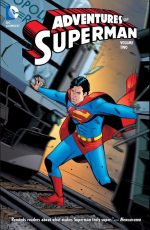
Adventures of Superman volume 1


By Jeff Parker, Jeff Lemire, Justin Jordan, JM DeMatteis, Joshua Hale Fialkov, Michael Avon Oeming, Bryan J.L. Glass, Matt Kindt, Dan Abnett, Andy Lanning, Tom DeFalco, Rob Williams, Nathan Edmondson, Kyle Killen, Chris Samnee, Riley Rossmo, Giuseppe Camuncoli, Sal Buscema, Joëlle Jones, Stephen Segovia, Wes Craig, Craig Yeung, Pete Woods, Chris Weston, Yildiray Cinar, Pia Guerra & various (DC Comics)
ISBN: 978-1-4012-5344-8

Nearly 79 years ago Superman started the whole modern era of fantasy heroes: indomitable, infallible, unconquerable, outlandish and flamboyant. He also saved a foundering industry and created an entirely new genre of storytelling – the Super Hero.

Since June 1938 he has grown into a mighty presence in all aspects of art, culture and commerce even as his natal comicbook universe organically grew and expanded. Periodically the Man of Tomorrow has been radically rebooted such as in the aftermath of Crisis on Infinite Earth in 1985-86.

There were subsequent minor tweaks in that continuity to accommodate different creators’ tenures from then until 2011 when DC root-&-branch re-imagined their entire comics line once more. Superman and his universe underwent a drastic, fan-infuriating all-encompassing revivification.

Probably to mitigate the fallout DC created a number of fall-back options such as this intriguing package…

Adventures of Superman began as a “digital first” series appearing online before later gathering chapters into issues of a new standard comicbook. As conceived and concocted by a fluctuating roster of artists and writers, the contents highlighted previous eras and incarnations of the Man of Steel’s stellar career – plus some wildly innovative alternative visions – offering a wide variety of thrilling, engaging and sincerely fun-filled moments for both old-timers and neophytes to treasure.

The comicbook iteration was enough of a success to warrant its own series of trade paperback compilations which – in the fullness of time and nature of circularity – gained their own digital avatars as eBooks too.

This first full-colour paperback collection contains Adventures of Superman 1-5 (July-November 2013) and displays a wealth of talent and cornucopia of different visions, beginning with ‘Violent Minds’ by Jeff Parker & Chris Samnee wherein Metropolis is devastated by a psionic marauder able to control Superman’s actions. Nobody is aware that the doomed desperado is merely another dupe of exploitative billionaire and clandestine archenemy Lex Luthor, still looking for a way to destroy the Man of Tomorrow…

Jeff Lemire then seamlessly blends childhood daydreams with a mythic war between Superman and his entire rogues’ gallery into a heart-warming parable of kid-fuelled nostalgic inundation in ‘Fortress’ before Justin Jordan & Riley Rossmo detail ‘Bizarro’s Worst Day’ with the Man of Steel finally finding a humane solution to the recurring problem of his monstrous other…

J.M. DeMatteis, Giuseppe Camuncoli & Sal Buscema play hob with our expectations as the Caped Kryptonian chases a seeming phantom through ‘The Bottle City of Metropolis’, after which Joshua Hale Fialkov & Joëlle Jones describe what a ‘Slow News Day’ means for Clark Kent, Lois Lane and the Action Ace. Michael Avon Oeming & Bryan J.L. Glass then pit Superman’s future against the security of the entire timeline when a chronal Guardian demands baby Kal-El must be sacrificed for the ‘Best Intent’…

In ‘Faster Than a Bullet’ Matt Kindt & Stephen Segovia explore in epic and spectacular terms just what Superman can accomplish if he really pushes himself, even as Lois and Luther indulge in a no less astounding and deadly battle of wits and wills, after which Dan Abnett, Andy Lanning, Wes Craig & Craig Yeung gleefully explore Lex’s obsession with murdering the Man of Tomorrow in ‘A Day in the Life’…

‘The Deniers!’ by Tom DeFalco & Pete Woods delves back into Golden Age mode and whimsically sees Superman the subject of furious discussion by a coterie of ordinary Joes and doubting Thomases whilst Rob Williams & Chris Weston offer a host of last-minute rescues by the ‘Savior’ before sharing with us the Man of Steel’s proudest and most cherished moments…

‘Infant in Arms’ from Nathan Edmondson & Yildiray Cinar extrapolates on what might occur if Superman is involved in a replay of his own origins as another interstellar foundling crashes to Earth. Now the hero must save the baby from alien assassins and America’s overreaching authorities, leaving Kyle Killen & Pia Guerra to conclude this initial compilation with a thought-provoking examination of the hero’s earliest days as ‘The Way These Things Begin’ sees young Luthor setting up the new Superman to fail whilst patiently laying the groundwork for an army of allies united against the Man of Steel…

Augmented by a spectacular cover gallery from Bryan Hitch, Samnee & David Baron, Camuncoli & Tony Avina, Segovia & Jay David Ramos, Bruce Timm & Nick Filardi and Cinar & Matthew Wilson, this is a spectacular celebration of Superman’s indisputably infinite variety which has resulted in decades of sheer delight for adventure addicts and promises even more to come for future generations.
© 2013, 2014 DC Comics. All Rights Reserved.

The Dead Rider: Crown of Souls


By Kevin Ferrara (Dark Horse)
ISBN: 978- 1-61655-750-8

Westerns are very much in the eye of the beholder. Some of my very favourites are The Seven Samurai, The Thirteenth Warrior and Outland …and not a Six-gun or Stetson in the bunch.

I think that it’s all about tone and themes and timbre; motivation and resolution, rather than just slavish attention to genre forms. Trappings and locations are not as important as the Why and the How…

A fascinating case in point is Dead Rider. Conceived and crafted by writer, artist and historian Kevin Ferrara (Aliens/Predator, Green Lantern, Creepy) it offers a miasmic merging of classical EC-styled tongue-in-cheek horror with grittily familiar cowboy themes and locales, resulting in a beautifully rendered if somewhat meandering yarn about true love, magical misery and vengeance forestalled, but never escaped…

Originally released as two issues the saga came to an abrupt ending before concluding, but in this graphic album the entire tale is finally told…

Near the frontier town of Magruder, Nevada in the 1890s a vile owlhoot calling himself the Cobra is hunting a man. Having successfully diverted a similarly employed cavalry troop into a wild goose chase, the villain relishes the prospect of tackling the legendary gunman known as the Dead Rider. He has no idea what he is about to confront, or that his prospective prey is being watched over by an Indian shaman with much more than skin in the game…

After brutalising and terrorising the entire township, Cobra secures the lead he needs and rides off to his date with destiny whilst the shaman rushes to warn the much sought after rider who currently resides in an old iron mine. The décor doesn’t trouble the wanted man much. After all, he’s been an ambulatory rotting corpse for years now and physical feeling is long-forgotten luxury…

Once, Jacob Bierce was a gentle, loving man whose only desire was to wed his adored paramour Sarah. However, due a string of cruel accidents and malign misfortunes, Jacob fell under the power of a scheming and manipulative Bog Witch who made him immortal by turning him into a walking corpse. The downside was that he retained his mind and conscience, even during those appalling and frequently recurring moments when the sorceress possessed his body to go on killing sprees…

Thus the revenant’s formidable reputation, the authorities pragmatic despatching of deranged General Cavanaugh and a troop of soldiers to capture the notorious Dead Rider and Cobra’s obsession with immortalising his own reputation by killing the zombie fugitive…

Now all the disparate players are converging for a final showdown, but the Witch has one last eldritch card to play: she has been collecting the last vestiges of the dead to build a potent artefact known as the Crown of Souls but has not fully appreciated the power of true friendship, love from beyond the grave and the obsessive nature of glory-crazed military men…

Although the plot contains some gaping inconsistencies and the dialogue is often uninspired, The Dead Rider is rendered in a spectacularly lush manner reminiscent of the best of Graham Ingels, Bernie Wrightson, Scott Hampton or Thomas Yeates and fairly rockets along, offering plenty of action and wry humour as well as a classic tragedy-laced horror hero that would certainly score well with today’s movie-going genre aficionados.

Fast, fun and fabulous, this turbulent tome comes with a Gallery of sketches, roughs, covers and unused art pages complete with accompanying commentary and is a sure-fire guilty pleasure for fans looking for quality art and a tale outside the tried-&-true comicbook mainstream.
© 2007, 2008, 2015 Kevin Schnaper. All rights reserved.

Thor Epic Collection: When Titans Clash


By Stan Lee, Jack Kirby, Chic Stone, Frank Giacoia, Vince Colletta & various (Marvel)
ISBN: 978-0-7851-9446-0

The Mighty Thor was the title in which Jack Kirby’s restless fascination with all things Cosmic was honed and refined through his dazzling graphics and captivating concepts. The King’s career-defining string of power-packed signature pantheons all stemmed from a modest little fantasy/monster title called Journey into Mystery where – in the summer of 1962 – a tried-and-true comicbook concept (feeble mortal transformed into god-like hero) was revived by fledgling Marvel Comics to add a Superman analogue to their growing roster of costumed adventurers.

This bombastic full-colour tome – also available in eFormats – offers more pioneering Asgardian exploits from JiM #110-125 and the cunningly and appropriately retitled Thor #126-130: collectively covering November 1964 to July 1966, and includes a satirically silly snippet from Not Brand Ecch #3 (October 1967) in a blur of innovation and seat-of-the-pants myth-revising and universe-building…

Once upon a time lonely, lamed American doctor Donald Blake took a vacation in Norway only to encounter the vanguard of an alien invasion. Trapped in a cave, Blake found a gnarled old walking stick, which when struck against the ground turned him into the Norse God of Thunder!

Within moments he was defending the weak and smiting the wicked. As months swiftly passed, rapacious extraterrestrials, Commie dictators, costumed crazies and cheap thugs gradually gave way to a vast panoply of fantastic worlds and incredible, mythic menaces.

By issue #110, the magnificent warrior’s ever-expanding world of Asgard was a regular feature and mesmerising milieu for the hero’s earlier adventures, heralding a fresh era of cosmic fantasy to run beside the company’s signature superhero sagas.

Every issue also carried a spectacular back-up series that grew to be a solid fan-favourite. Tales of Asgard – Home of the Mighty Norse Gods gave Kirby space to indulge his fascination with legends and allowed both complete vignettes and longer epics – in every sense of the word.

Initially adapted myths, these little yarns grew into sagas unique to the Marvel universe where Kirby built his own cosmos and mythology, underpinning the company’s entire continuity.

The action opens here with ‘Every Hand Against Him’ (Stan Lee, Kirby & Chic Stone) as Asgardian evildoer Loki and earthly miscreants Cobra and Mr. Hyde kidnap and wound nigh unto death Thor’s merely mortal beloved Jane Foster, even as Odin once again overreacts to Thor’s affections for the human girl.

Following a stunning Kirby & Stone Pin-up Thor Pin-up, and balancing that tension-drenched clash of Good and Evil, is a crafty vignette starring the Young Thor describing ‘The Defeat of Odin!’ with an old and silly plot sweetened by breathtaking battle scenes.

The concluding clash with Hyde and his serpentine ally redefines ‘The Power of the Thunder God’ and features a major role for Balder the Brave, further integrating “historical” and contemporary Asgards in a spellbinding epic of triumph and near-tragedy, after which a Loki Pin-up precedes a short fable co-opting a Greek myth (Antaeus if you’re asking) as ‘The Secret of Sigurd’ by Lee, Kirby and inker Vince Colletta …

Journey into Mystery #112 gave the readers what they had been clamouring for with ‘The Mighty Thor Battles the Incredible Hulk!’: a glorious gift to all those fans who perpetually ask “who’s stronger…?”

Possibly Kirby & Stone’s finest artistic moment, it details a private duel between the two super-humans that apparently appeared off-camera during a free-for-all between The Avengers, Sub-Mariner and the eponymous Green Goliath. The raw power of that tale is balanced by an eagerly anticipated origin in ‘The Coming of Loki’ (Colletta inks): a retelling of how Odin came to adopt the baby son of Laufey, the Giant King.

In #113 ‘A World Gone Mad!’ by Lee, Kirby & Stone, the Thunderer, after saving the Shining Realm from invasion, once more defies his father Odin to romantically pursue the mortal nurse Jane – a task made rather hazardous by the return of the petrifying villain Grey Gargoyle.

A long-running plot strand – almost interminably so – was the soap-opera tangle caused by Don Blake’s love for his nurse – a passion his alter ego shared. Sadly, the Overlord of Asgard refused to allow his son to love a mortal, which acrimonious triangle provided many attempts to humanise and de-power Thor, already a hero few villains could cope with.

The mythic moment then exposed ‘The Boyhood of Loki!’ (inked by Colletta), a pensive, brooding foretaste of the villain to be.

JiM #114 began a two-part tale introducing a new villain of the sort Kirby excelled at: a vicious thug who suddenly lucked into overwhelming power. ‘The Stronger I Am, The Sooner I Die!’ finds Loki imbuing hardened felon Crusher Creel with the power to duplicate the strength and attributes of anything he touches, but before he is treated to ‘The Vengeance of the Thunder God’ (inked by Frank Giacoia as the pseudonymous Frankie Ray) we’re graced with another Asgardian parable – ‘The Golden Apples’. Issue #115’s back-up mini-myth was ‘A Viper in our Midst!’ with young Loki clandestinely cementing relations with the sinister Storm Giants – sworn enemies of the Gods….

A longer Thor saga began in #116, as Colletta settled in as regular inker for both lead and support feature. ‘The Trial of the Gods’ revealed more aspects of fabled Asgard as Thor and Loki undertake a brutal ritualised Trial by Combat, with the god of mischief cheating at every step, after which ‘Into the Blaze of Battle!’ finds Balder protecting Jane Foster even as her godly paramour travels to war-torn Vietnam seeking proof of his step-brother’s infamy.

These yarns are supplemented by stellar novellas ‘The Challenge!’ and ‘The Sword in the Scabbard!’ in which Asgardian cabin-fever develops into a quest to expose a threat to the mystic Odinsword, the unsheathing of which could destroy the universe…

Journey into Mystery #118’s ‘To Kill a Thunder God!’ ramps up the otherworldly drama as Loki, attempting to cover his tracks, unleashes an ancient Asgardian WMD – the Destroyer. When it damages the mystic hammer of Thor and nearly kills our hero in ‘The Day of the Destroyer!’, the God of Mischief is forced to save his step-brother or bear the brunt of Odin’s anger.

Meanwhile in Tales of Asgard the Quest further unfolds with verity-testing talisman ‘The Crimson Hand!’ and ‘Gather, Warriors!‘ with a band of hand-picked “Argonauts” joining Thor’s flying longship in a bold but misguided attempt to forestall Ragnarok…

With Destroyer defeated and Loki temporarily thwarted, Thor returns to America ‘With My Hammer in Hand…!’ only to clash once more with the awesome Absorbing Man. However, before that bombastic battle there’s not only the next instalment of the Asgardian Argonauts who boldly ‘Set Sail!’ but also the admittedly superb digression of the lead story from Journey into Mystery Annual #1, wherein in undisclosed ages past the God of Thunder fell into the realm of the Greek Gods for landmark heroic hullabaloo ‘When Titans Clash! Thor vs. Hercules!’…

This incredible all-action episode is augmented here by a beautiful double-page pin-up of downtown Asgard – a true example of Kirby magic.

The Thunderer’s attack of the Absorbing Man resumes in ‘The Power! The Passion! The Pride!’ seemingly set to see the end of Thor: a cliffhanger somewhat assuaged by ‘Maelstrom!’ wherein the Argonauts epically encounter an uncanny storm…

In JiM #122’s ‘Where Mortals Fear to Tread!‘ the triumphant Crusher Creel is abducted by Loki to attack Asgard and Odin himself: an astounding clash leading to a cataclysmic conclusion ‘While a Universe Trembles!’

Meanwhile ‘The Grim Specter of Mutiny!’ invoked by seditious Loki is quashed in time for valiant Balder to save the Argonauts from ‘The Jaws of the Dragon!’ in the ever-escalating Ragnarok Quest.

With the contemporary threat to Asgard ended and Creel banished, Thor returns to Earth to defeat the Demon, a witchdoctor empowered by a magical Asgardian Norn Stone left behind after the Thunder God’s Vietnamese venture. Whilst the Storm Lord was away Hercules was dispatched to Earth on a reconnaissance mission for Zeus. ‘The Grandeur and the Glory!’ opened another extended story-arc and action extravaganza, which bounced the Thunderer from bruising battle to brutal defeat to ascendant triumph.

Issue #125 ‘When Meet the Immortals!’ was the last Journey into Mystery: with the following month’s ‘Whom the Gods Would Destroy!’ the comic was re-titled The Mighty Thor and the drama amped up unabated, culminating with ‘The Hammer and the Holocaust!’

In short order Thor crushed the Demon, seemingly lost beloved Jane to Hercules, was deprived of his powers and subsequently thrashed by the Grecian Prince of Power, yet still managed to save Asgard from unscrupulous traitor Seidring the Merciless who had usurped Odin’s mystic might…

Meanwhile in the Tales of Asgard instalments the Questers homed in on the cause of all their woes. ‘Closer Comes the Swarm’ pitted them against the flying trolls of Thryheim, whilst ‘The Queen Commands’ saw Loki captured until Thor answered ‘The Summons!’, promptly returning the Argonauts to Asgard to be shown ‘The Meaning of Ragnarok!’

In all honestly these mini-eddas were, although still magnificent in visual excitement, becoming rather rambling in plot, so the narrative reset was neither unexpected nor unwelcome…

Instead of ending, the grandiose saga actually grew in scope with Thor #128 as ‘The Power of Pluto!’ introduced another major foe. The Greek God of the Underworld had tricked Hercules into replacing him in his dread, dead domain, just as the recuperated Thunder God was looking for a rematch, whilst in Tales of Asgard Kirby pulled out all the creative stops to depict the ‘Aftermath!’ of Ragnarok: for many fans the first indication of what was to come in the King’s landmark Fourth World tales half a decade later…

‘The Verdict of Zeus!’ condemns Hercules to the Underworld unless he can find a proxy to fight for him, whilst at the back of the comic the assembled Asgardians faced ‘The Hordes of Harokin’ as another multi-chaptered classic begins, but for once the cosmic scope of the lead feature eclipses the little odysseys as ‘Thunder in the Netherworld!’ reveals Thor and Hercules carving a swathe of destruction through an unbelievably alien landscape – the beginning of a gradual side-lining of Earthly matters and mere crime-fighting.

Thor and Kirby were increasingly expending their efforts in greater realms than ours…

‘The Fateful Change!’ then reveals how the younger Thunder God trades places with the Genghis Khan-like Harokin… leaving the drama on a tense cliff hanger until the next collected volume…

However there’s one last reading treat in store as Marvel’s superhero spoof title Not Brand Echh #3 provides a barbed and pitiless pastiche of the Asgardian (Jazzgardian, in fact!) life in ‘The Origin of Sore, Son of Shmodin!’ by Lee, Kirby & Giacoia, as well as a glimpse at a 1965 T-Shirt design by Kirby and Dick Ayers, a selection of original art pages from the stories in this volume and a gallery of classic covers modified by painter Dean White…

These transitional Thor tales show the development not only of one of Marvel’s fundamental continuity concepts but more importantly the creative evolution of the greatest imagination in comics. Set your common sense on pause and simply wallow in the glorious imagery and power of these classic adventures for the true secret of what makes graphic narrative a unique experience.
© 1964, 1965, 1966, 1967, 2016 Marvel Characters, Inc. All rights reserved.

Hellboy volume 9: The Wild Hunt


By Mike Mignola, Duncan Fegredo, Dave Stewart & Clem Robins (Dark Horse Books)
ISBN: 978-1-59582-431-8

On December 23rd 1944 an uncanny baby was confiscated from Nazi cultists by American superhero The Torch of Liberty and a squad of US Rangers moments after his unearthly nativity on Earth. The Allied forces had interrupted a satanic ritual predicted by parapsychologist Professor Trevor Bruttenholm and his associates who were waiting for Hell to literally come to Earth…

The heroic assemblage was stationed at a ruined church in East Bromwich, England when the abominable infant with a huge stone right hand materialised in an infernal fireball. This “Hellboy” was subsequently raised by Bruttenholm, and grew into a mighty warrior engaged in fighting a never-ending secret war against the uncanny and supernatural. The Professor trained the happy-go-lucky foundling whilst forming and consolidating an organisation to destroy arcane and occult threats – the Bureau for Paranormal Research and Defense.

After years of such devoted intervention, education and warm human interaction, in 1952 the neophyte hero began hunting all agents of the malign unknown from phantoms to monsters as lead agent for the BPRD. Hellboy rapidly became its top operative; the world’s most successful paranormal investigator…

As decades unfolded, Hellboy gleaned snatches of his origins and antecedents, learning he was a supposedly corrupted beast of dark portent: a demonic messiah destined to destroy the world and bring back ancient powers of evil.

It is a fate he despised and utterly rejected…

This ninth necromantic collection re-presents the climactic 8-issue miniseries Hellboy: The Wild Hunt from 2008-2009, drawing together many subtly scattered clues disseminated throughout his innumerable tempestuous exploits and at last providing the conclusion to more than fifteen years of slowly boiling magical suspense… as well as the incredible answers to the enigma of the horrific hero’s doom-drenched double destiny…

Creator Mignola reunites with illustrator Duncan Fegredo – supplemented as always by colourist Dave Stewart and letterer Clem Robins – as the fey folk and other creatures of ancient mythology and legend are fading into non-existence in the face of a rising of witches.

The malevolent hags have a new queen who promises blood and slaughter and domination of the world by her kind whilst the only being who might stop her inexorable ascendance is missing…

Following an Introduction from Mark Chadbourn the drama opens in rural Italy as Hellboy receives a letter from a most ancient and august society. The paranormal paragon has been hiding; avoiding having to deal with a hard-wired cosmic fate which will not let him go…

Nevertheless, on receipt of the missive Hellboy returns to England and meets the oldest members of the aristocratic secret society known as the Wild Hunt.

They have been clandestinely defending the Sceptr’d Isles from mystic assault for centuries and – more aware of Hellboy’s destiny-drenched antecedents than the hero himself – want him to join them in exterminating a band of giants set to ravage the Realm…

Sadly the entire affair is a trap, but the mortal warriors are no match for Hellboy who defeats his duplicitous opponents before also despatching the giants in an uncontrollable burst of warrior-madness…

In a faraway place the ensorcelled goblin known as the Gruagach of Lough Leane reflects on the long-ago slight inflicted upon by Hellboy which has been the cause and trigger of all the carnage and world-shattering destruction about to unfold when the new Queen of Witches is ready. Perhaps he repents it all, just a shade…

The subject of his hate is currently in Ireland, renewing the acquaintance of Alice whom he saved from being abducted as a baby by the Little People. The decades have been uncannily kind, as if some elfin magic rubbed off on her…

As the Red Queen cruelly consolidates her power in England, Hellboy and Alice are visited by former pixie potentate Queen Mab who reveals another missing part of a decades-long puzzle and hints that there might be way to thwart this oppressive, inescapable destiny.

However when another supposed ally betrays them and Alice is wounded unto death, Hellboy is approached by ancient legend Morgan Le Fay who offers to trade for the mortal girl’s life.

She reveals that although the hell-born hero is certainly the son of the devil his human mother could trace her own line back to Arthur Pendragon. Hellboy is the doom of mankind but also the True King of England and she is his many-times removed grandmother…

If he wants to save humanity from an army of darkness he has his own to call upon – one comprising millennia of the noble dead of Britain. All Morgan’s heir has to do is take up the Sword in the Stone. It should be easy. His new occult opponent – now calling herself the Mor-Rioghain – also wants to awaken the dragons from the beginning of time and wipe out humanity: the fore-ordained role Hellboy has sworn never to enact…

With horror Hellboy realises he has not been running from one unwanted Destiny, but two…

With his fate closing in all around him Hellboy is uncharacteristically nonplussed, but an ethereal visitation prompts him to ferocious action and as he confronts his own inherently evil nature he finally throws off all the sly influences attempting to sway him and once again chooses his own path…

Offering astounding supernatural spectacle, amazing arcane action, mounting mystical tension and the imminent end of decades of slowly unfolding wonderment, this epic adventure is supplemented by a copious Sketchbook Section from Mignola and Fegredo, offering unused covers, roughs, designs, and informative commentary.

Unfolding with the pace of a mythic epic of enthralling power, the saga and mystery of Hellboy is a true landmark of comics storytelling and one every fan and aficionado should read.
™ and © 2008, 2009, 2010 Mike Mignola. Hellboy is ™ Mike Mignola. Introduction © 2010 Mark Chadbourn. All rights reserved.

Your Favorite… Crab Cakes – A Crankshaft Collection


By Tom Batuik & Chuck Ayers (Andrews McMeel Publishing)
ISBN: 978-0-7407-2666-8

Although in a sharp decline, extended-narrative comics strips still have a place in modern cartooning. Indeed in the case of creators like Tom Batuik the slide into continuity is almost inescapable.

Thomas Martin Batuik was born in Akron, Ohio in March 1947 and attended the famous (for all the wrong reasons) Kent State University. He graduated in 1969 with a Bachelor of Fine Arts (Painting) and became a Junior High School art teacher. This endeavour soon inspired the creation of his legendary newspaper strip Funky Winkerbean.

The long-lived (originally gag-a-day) school-based strip launched on March 27th 1972 and over the years developed strong soap opera tendencies and a potent attention to contemporary social issues to compliment the humour.

It also spawned two separate spin-off strips: John Darling (1979-1990) and today’s star turn Crankshaft which began in 1987 and is still going strong seven days a week, with syndication in more than 300 newspapers across the world.

Batuik scripts and fellow scion of Akron Chuck Ayers illustrates the ongoing saga of a curmudgeonly senior citizen barely getting by in a rapidly-changing modern world. Ayers has also contributed cartoons to the Akron Beacon Journal, New York Times, Washington Post, Forbes and others and illustrated a number of school textbooks.

Deeply invested in nostalgia, family and day-to-day existence, the strip details how crusty old fart Ed Crankshaft grows ever older disgracefully and with great discontent. Ed has a job driving a school bus and derives much delight from annoying parents by driving off without their kids, reversing over mailboxes and holding up traffic whenever he can. In fact, these are all popular sports every school board bus driver indulges in…

Ed’s supporting cast include his wilful cat Pickles, two adult daughters Chris and Pam, son-in-law Jeff and grandchildren Max and Mindy, and, whereas the kids get to see him at his gruff sentimental best, the grown-ups usually get the raw edge of his confusion and ire with the increasingly chaotic state of contemporary life…

Ed was once a pro baseball player and in many episodes his skill in throwing missiles generates lots of laughs, but that eccentric career also provided one of the series’ most rewarding themes of social interest. Ed never learned to read and very late on began adult literacy classes, highlighting an issue that impacts a vast number of older readers.

Of equal import and power is a long running storyline with Crankshaft regularly accompanying old pal Ralph to the Sunny Days Nursing Home where Ralph’s wife Helen is slowly succumbing to Alzheimer’s Disease. Even here there’s a regular fount of golden-aged humour since Ed is a constant target for the amorous attentions of the institution’s army of love-starved widows…

This particular collection of strips – they’re all equally enjoyable and praiseworthy – spends a great deal of time depicting the road-raging joys of the School Run, explores Ed’s ongoing war with the newspaper delivery girl, his literal penny-pinching, a spate of funerals and weddings, the always-inclement Mid-Western weather and the coffee made by bus depot secretary Lena. Rumours are that it might well be considered a weapon of mass destruction…

Justice and Due Process take a holiday when Crankshaft serves on a jury, but those outbursts are balanced by wry reminiscences when Ed takes Max and Mindy on an extended tour of his scrapbooks…

Ed declares a vendetta on the mailbox of neighbour Mr. Keesterman, gleefully operates a bug-zapper that can be seen from space and proudly, loudly makes a spectacle of himself at doctor, dentist, barber, opticians and supermarket, but shows his softer side in visits with Ralph to Sunny Days a well as a school trip to the National War Memorial in Washington DC. Another milestone is reached when he wins a certificate for his reading proficiency but that only leads to more grief as he’s then expected to start using the Library computer…

…And then there are the kids who manage – despite all his efforts – to board Ed’s bus every morning. They may have the numbers, but he has experience, ruthlessness and a working knowledge of terror-tactics to keep the little monsters in line if they do get into his big yellow fortress…

He must love the little perishers really: after all, in vacation time he drives an ice cream truck to take the edge off the searing heat… if they can catch him…

Gently funny, powerfully engaging and offering some of the best zingers and put-downs in the comedy business, the assorted chronicles of Crankshaft are a family treat to shared and compared by all fans of cartooning excellence.
© 2002 Media Graphics, Inc. All rights reserved.