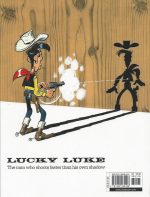
Lucky Luke volume 9: The Stage Coach


By Morris & Goscinny, translated by Luke Spear (Cinebook)
ISBN: 978-1-905460-40-3

Win’s Christmas Gift Recommendation: Classic Seasonal Adventure… 9/10

One could quite convincingly argue that the USA’s greatest cultural export has been the Western. Everybody everywhere thinks they know what Cowboys and Indians are and do, but the genre has migrated and informed every aspect or art and literature all over the planet. Comics particularly have benefited from the form, with Europe continuing to produce magnificent works even in these latter years when sagebrush sagas are less dominant in America than they have been for decades.

This side of the pond, westerns were a key component in every nook and cranny of popular fiction from the earliest days. Newspapers were packed with astoundingly high quality strips ranging from straight dramas such as Gun Law and Matt Marriott to uniquely British takes like Bud Neill’s outrageous spoof Lobey Dosser, whilst our weekly anthology kids comics abounded with the episodic exploits of Texas Jack, Desperate Dan, Colorado Kid, Davy Crockett, Kid Dynamite and more.

As previously mentioned, Europe especially embraced the medium and expanded the boundaries of the genre. In Italy Tex (Willer) remains as vital as ever as it approaches its 70th anniversary, far outdistancing later revered and much-exported series such as Captain Miki, Il Grande Blek, Cocco Bill,  Zagor, Larry Yuma, Ken Parker, Magico Vento and Djustine.

The Franco-Belgian wing also has a long tradition and true immortals amongst its ponderosa Pantheon: from all ages-comedic treats such as Yakari, OumPah-Pah, Chick Bill or The Bluecoats to monolithic and monumental mature-reader sagas like Jerry Spring, Comanche, Sergeant Kirk, La Grande Saga Indienne, Buddy Longway or the now-legendary Blueberry…

Topping them all in terms of sales and fame however is a certain laconic lone rider…

Lucky Luke is seventy years old this year: a rangy, good-natured, lightning-fast quick-draw cowboy who roams a fabulously mythical Old West on his super-smart horse Jolly Jumper, having light-hearted adventures and interacting with a host of historical and legendary figures of the genre.

He’s probably the most popular Western star in the world today. His unbroken string of laugh-loaded exploits has made him one of the best-selling comic characters in Europe (83 albums selling well in excess of 300 million copies in 30 languages at the last count), with spin-off toys, computer games, animated cartoons and even a passel of TV shows and live-action movies.

As alluded to above he was dreamed up in 1946 by Belgian animator, illustrator and cartoonist Maurice de Bévère (“Morris”) for that year’s Seasonal Annual (L’Almanach Spirou 1947) of Le Journal de Spirou, before launching into his first weekly adventure ‘Arizona 1880’ on December 7th 1946 in the famed weekly comic.

Prior to that, Morris had become acquainted with future comics super-stars Franquin and Peyo while working at the CBA (Compagnie Belge d’Actualitiés) cartoon studio and by contributing caricatures to weekly magazine Le Moustique. He quickly became one of “la Bande des quatre” (The Gang of Four) comprising creators Jijé, Will and Franquin: all leading proponents of the loose, free-wheeling art-style dubbed the “Marcinelle School” which dominated Spirou in aesthetic contention with the “Ligne Claire” style used by Hergé, EP Jacobs and other artists in rival magazine Tintin.

In 1948 the Gang (all but Will) visited the USA, meeting American creators and sightseeing. Morris stayed for six years, encountering fellow Franco-tourist René Goscinny and scoring some work from newly-formed EC sensation Mad whilst making copious notes and sketches of the swiftly vanishing Old West.

That research resonates on every page of his life’s work.

A solo act until 1955, Morris produced another nine albums worth of affectionate parody before formally teaming up with Goscinny, who became the cool cowboy’s regular wordsmith. Luke rapidly attained the dizzying heights of superstardom, commencing with ‘Des rails sur la Prairie’ (Rails on the Prairie), which began serialisation in Spirou with the August 25th 1955 edition.

In 1967 the six-gun straight-shooter switched sides, transferring to Goscinny’s own magazine Pilote with ‘La Diligence’ (The Stagecoach). Goscinny & Morris produced 45 albums together before the author’s death in 1977, after which Morris continued both singly and with fresh collaborators.

Morris passed away in 2001, having drawn fully 70 adventures, plus launching the spin-off comics careers of Rantanplan (“dumbest dog in the West” and a charming spoof of cinema canine Rin-Tin-Tin). The immortal franchise was left to fresh hands, beginning with Achdé, Laurent Gerra, Benacquista & Pennac who have carried on the undying tradition.

Curiously, apart from the initial adventure, Lucky (to appropriate a quote applied to the thematically simpatico Alias Smith and Jones) “in all that time… never shot or killed anyone”. He did however smoke prodigiously, like all the cool cowboys and – if the stereotype still applies – most Frenchmen…

Lucky Luke was first seen in Britain syndicated to weekly comic Film Fun, then reappeared in 1967 in Giggle, renamed Buck Bingo. In all these venues – as well as the numerous attempts to follow the English-language successes of Tintin and Asterix albums from Brockhampton and Knight Books – Luke had a trademark cigarette hanging insouciantly from his lip, but in 1983, Morris – no doubt amidst both pained howls and muted mutterings of “political correctness gone mad” – substituted a piece of straw for the much-travelled dog-end, which garnered him an official tip of the hat from the World Health Organization.

Unquestionably, the most successful attempt at bringing Lucky Luke to our shores and shelves is the most recent. Cinebook – who have rightly restored the foul weed to his lips on the interior pages, if not the covers – have translated 60 albums thus far with the 61st scheduled for a December release.

The Wagon Train was their ninth – still readily available both on paper and as an e-book – and first published on the Continent in 1964 as Lucky Luke – La Caravane: the 24th European release and Goscinny’s fifteenth collaboration with Morris. It’s also one of their most traditional tales; playing joyously with the tropes and memes of the genre and clearly having as much fun as the future readers were going to…

In begins in dusty Nothing Gulch as a bedraggled procession of “Prairie Schooners” limp into town. Expedition head Andrew Boston is arguing with unscrupulous guide Frank Malone who is demanding even more money before completing his commission to bring the hopeful settlers to California. When heated words are replaced with gunplay, a dusty observer ends the fracas before blood is shed…

Boston has heard a lot about Lucky Luke and promptly starts a multi-pronged charm offensive to get the Sagebrush Stalwart to take over guiding the party to the fabled Golden State. Our hero is flattered but not interested, until Boston wheels out his big guns and has the kids ask in their own unique ways…

Despite being prepared to use children to emotionally twist the cowboy’s arm, the twenty or so wagon-loads of pioneers are an affable if odd bunch from all over the world and soon Luke is leading them across prairies and through deserts and mountains.

However as the days pass an exceedingly large number of accidents and mishaps occur and before long it cannot be denied that somebody is clearly attempting to sabotage the expedition…

As close calls and near-death escapes mount Lucky splits his attention between blazing a trail and playing detective but the list of suspects is just so large. Anybody from the undertaker in his hearse to the inventor in his constantly evolving horseless converter-car (there’s more than a passing similarity to TV’s Whacky Races here!); the suspiciously French Barber/Surgeon, creatively foul-mouthed mule driver or even the no-nonsense School Marm could be the culprit. But then again there are so many others who act out of the ordinary…

Nevertheless, the voyage proceeds and as the would-be homesteaders survive the temptations of bad towns and other dens of vice and iniquity, bad food, and inclement weather a sense of community builds. Sadly that’s soon tested to the limit when word comes of that Sioux Chief Rabid Dog is on the warpath…

Despite all these traditional trials and tribulations Luke persists and before long the Promised Land is reached and a vile villain is finally exposed…

Cleverly barbed, wickedly ironic and joyously packed with classic cowboy set-pieces, this splendidly slapstick spoof of a crucial strand of the genre is another grand old hoot in the tradition of Destry Rides Again and Support Your Local Sheriff (maybe Paint Your Wagon, Evil Roy Slade or Cat Ballou are more your style?), superbly executed by master storytellers for any kids who might have missed the romantic allure of an all-pervasive Wild West that never was…

And in case you’re worried, even though the interior art still has our hero chawin’ on that ol’ nicotine stick, trust me, there’s very little chance of anyone craving a quick snout, but quite a strong probability that they’ll be addicted to Lucky Luke Albums…
© Dargaud Editeur Paris 1971 by Goscinny & Morris. © Lucky Comics. English translation © 2007 Cinebook.

Doctor Who Graphic Novels #23: The Highgate Horror


By Mark Wright, Jonathan Morris, Steve Lyons, Roger Langridge, Jacqueline Rayner, Scott Gray, David A. Roach, Mike Collins, John Ross, Adrian Salmon, Martin Geraghty, Dave Gibbons, John Ridgway, Dan McDaid & various (Panini Comics)
ISBN: 978-1-84653-749-3

Win’s Christmas Gift Recommendation: Timeless Tradition… 9/10

The British love comic strips and they love celebrity and they love “Odd Characters.”

The history of our graphic narrative has a peculiarly disproportionate amount of radio comedians, stars of theatre, film and TV: folk like Charlie Chaplin, Arthur Askey, Winifred Atwell, Max Bygraves, Charlie Drake and their ilk, as well as actual shows and properties such as Whacko!, ITMA, Our Gang, (a British version of the Hal Roach film sensation by Dudley Watkins in The Dandy as well as the American comicbook series by Walt Kelly), Old Mother Riley, Supercar, Pinky & Perky and literally hundreds more.

Anthology variety comics such as Radio Fun, Film Fun, TV Fun, Look-In, TV Tornado, TV Comic and Countdown amongst others translated our viewing and listening favourites into pictorial escapism every week, and it was a pretty poor lead or show which couldn’t parley the screen job into a licensed comic property.

Television’s Doctor Who premiered with part one of ‘An Unearthly Child’ on November 23rd 1963, and the following year a decades-long association with TV Comic began in issue #674 and the first instalment of ‘The Klepton Parasites’.

On 11th October 1979 (although, adhering to US off-sale cover-dating system, it says 17th) Marvel’s UK subsidiary launched Doctor Who Weekly, which regenerated into a monthly magazine in September 1980 (#44), efficiently entitled Doctor Who Monthly. It has been with us through various title-changes ever since. All of which only goes to prove that the Time Lord is a comic hero with an impressive pedigree and big shoes to fill.

Panini’s ongoing process of collecting every strip from the prodigious annals and archives in a uniform series of over-sized graphic albums – each concentrating on a particular incarnation of the deathless wanderer – reaches its twenty-third volume here as the Twelfth Doctor returns in another (inter)stellar line-up of comic strip sagas.

This particular tome gathers stories from DWM #484 and #489-500; spanning March 2015 to July 2016; starring Peter Capaldi’s irascible old chrononaut and his saucy sidekick Impossible Girl Clara Oswald in unforgettable action across the universe and every Elsewhen imaginable.

The adventures of the Grumpy Gallifreyan are – as always – described and delineated by a rapidly rotating roster of British creators who also provide a treasure-trove of background information in the Commentary section at the back, comprising story-by-story background, history and insights from the authors and illustrators, supplemented by scads of sketches, roughs, designs, production art and photos.

None of which is relevant if all you want is a darn good read. However all the imagineers involved have managed the ultimate task of any artisan – to produce engaging, thrilling, fun work which can be enjoyed equally by the merest beginner and the most slavishly dedicated and opinionated fans imaginable.

That feast of fun – coloured throughout by James Offredi and lettered by the multi-talented Roger Langridge – opens with ‘Space Invaders!’ by Mark Wright, Mike Collins & David A. Roach as The Doctor and Clara fetch up at an orbiting storage facility just as the owners start their latest sell-off of unclaimed items. Sadly, the time-travellers are not quite quick enough to stop the avid bargain-hunters opening a container full of just hatched planet-eating monster eggs…

Following smart social satire is a multi-part action romp. ‘Spirits of the Jungle’ by Jonathan Morris & John Ross sees our heroes joining an extraction mission to recover lethal intelligent weapons-tech before apparently walking into trap on a planet where the forests have their own definition of World Wide Web…

Gothic horror and vintage thrills permeate Wright, Roach & Collins’ superb chiller ‘The Highgate Horror’ wherein Clara, her immortal straight man and neophyte Companion Jess Collins hunt vampires and satanic covens in a 1970s London cemetery and instead encounter a race of ancient predators who want far worse than mere blood…

As conceived and realised by Steve Lyons & Adrian Salmon, ‘The Dragon Lord’ was a radical activist attempting to save magnificent saurians from human fun-seekers who hunted them for sport on a medieval-themed fantasy resort world. By the time our wandering troubleshooters turn up however, things have turned decidedly bloody and it looks like nobody is getting out alive…

Roger Langridge then offers an all-him treat as Harry Houdini sends out a distress call and old pal The Doctor dutifully answers. Sometimes even fakers and charlatans have power and really resent being de-bunked by upstart human escapologists playing in the ‘Theatre of the Mind’…

A new time-bending miscreant debuts in Jacqueline Rayner, Martin Geraghty & Roach’s epic tale of persecution and justice as temporal prankster Miss Chief infiltrates Clara’s workspace. After causing havoc at Coal Hill School the trickster drops Miss Oswald in the vicious clutches of Witchfinder General Matthew Hopkins, leaving The Doctor to either participate in a time duel or somehow search the entire 17th century for his missing school chum in a ‘Witch Hunt’ with potentially fatal and final consequences…

Our temporal tintinnabulations conclude with a splendidly appropriate anniversary party get-together of old friends and foes that will delight long-tern fans without baffling newbies or casual readers.

Written by editor Scott Gray, ‘The Stockbridge Showdown’ returns The Doctor to the alien-beleaguered British village just as cosmic corporate conqueror Josiah W. Dogbolter thinks he’s finally leveraged the keys to time itself.

As the universe nears a shocking “Going Out of Business” sale, the wily Gallifreyan and many allies from the past 500 issues unite to teach the richest man in creation the paucity of his resources and the lesson of his life in a tale crafted by artists past and current, including Dave Gibbons, Langridge, Salmon, Dan McDaid, Ross, Collins, John Ridgway, Geraghty and Roach…

This is another marvellous book for casual readers, a fine shelf-addition for dedicated fans of the show and a perfect opportunity to cross-promote our particular art-form to anyone minded to give comics one more go…
All Doctor Who material © BBCtv. Doctor Who, the Tardis and all logos are trademarks of the British Broadcasting Corporation and are used under licence. Licensed by BBC Worldwide. Tardis image © BBC 1963. Daleks © Terry Nation. All commentaries © 2016 their respective authors. Published 2013 by Panini UK Ltd. All rights reserved.

Green Lantern: The Silver Age volume 1


By John Broome, Gardner Fox, Gil Kane, Mike Sekowsky & various (DE Comics)
ISBN: 978-1-4012-6348-5

Win’s Christmas Gift Recommendation: Timeless Wholesome Entertainment… 9/10

After their hugely successful revival and reworking of The Flash, DC (or National Comics as they were) were keen to build on the resurgent superhero trend. Showcase #22 hit the stands at the same time as the fourth issue of the new Flash comicbook – #108 – and once again the guiding lights were Editor Julie Schwartz and writer John Broome. Assigned as illustrator was action ace Gil Kane, generally inked by Joe Giella

This fabulous paperback compilation gathers Showcase #22-24 (September/October 1959 to January/February 1960) and Green Lantern #1-9 (July/August 1960-November 1961) and reveals how a Space Age reconfiguration of the Golden-Age superhero with a magic ring replaced mysticism with super-science.

Hal Jordan was a young test pilot in California when an alien policeman crashed his spaceship on Earth. Mortally wounded, Abin Sur commanded his ring – a device which could materialise thoughts – to seek out a replacement officer, honest and without fear. Scanning the planet it selected Jordan and brought him to the crash-site. The dying alien bequeathed his ring, the lantern-shaped Battery of Power and his profession to the astonished Earthman.

In six pages ‘S.O.S Green Lantern’ established characters, scenario and narrative thrust of a series that would increasingly become the spine of DC continuity, leaving room for another two adventures in that premiere issue. ‘Secret of the Flaming Spear!’ and ‘Menace of the Runaway Missile!’ were both contemporary thrillers set against the backdrop of the aviation industry at a time when the Cold War was at its height.

Unlike the debut of The Flash, the editors were now confident of their ground. The next two issues of Showcase carried the new hero into even greater exploits. ‘Summons from Space’ sent Green Lantern to another world: saving an emerging race from a deadly threat at the behest of the as-yet-unnamed leaders of the Green Lantern Corps, whilst ‘The Invisible Destroyer’ pitted the neophyte Emerald Gladiator against the earthbound but eerie menace of a psychic marauder that lived on atomic radiation.

Showcase #24 (January/February 1960) featured another spy-ring in ‘The Secret of the Black Museum!’ but Jordan’s complex social life took centre-stage in ‘The Creature That Couldn’t Die!’ when the threat of an unstoppable monster paled before the insufferable stress of being his own rival. Hal’s boss Carol Ferris, controversially left in charge of her father’s aviation company (a radical concept in 1960 when most women were still considered faint-fodder fluff) won’t date an employee, but is deliriously happy for him to set her up with the glamorous, mysterious Green Lantern.

Six months later Green Lantern #1 was released. All previous tales had been dynamically drawn by Kane & Giella, in a visually arresting and exciting manner, but the lead tale here, ‘Planet of Doomed Men’ was inked by the uniquely gifted Murphy Anderson, and his fine line-work elevated the tale (more emergent humans in need of rescue from another monster) to the status of a minor classic. Giella returned for the second tale, ‘Menace of the Giant Puppet!’, in which GL fought his first – albeit rather lame – super-villain, the Puppet Master.

The next issue originated a concept that would be pivotal to the future of DC continuity. ‘The Secret of the Golden Thunderbolts!’ featured an Antimatter Universe and the diabolical Weaponers of Qward, a twisted race who worshipped Evil, and whose “criminals” (i.e. people who wouldn’t lie, cheat, steal or kill) wanted asylum on Earth. Also inked by Anderson, this is an early highpoint of tragic melodrama from an era where emotionalism was actively downplayed in comics.

The second story ‘Riddle of the Frozen Ghost Town!’ is a crime thriller highlighting the developing relationship between the hero and his Inuit (then “Eskimo”) mechanic Tom ‘Pieface’ Kalmaku.

The Qwardians returned in the all-Giella-inked  #3, leading with ‘The Amazing Theft of the Power Lamp!’ and Jordan’s love-life again spun out of control in ‘The Leap Year Menace!’, whilst GL #4 saw the hero trapped in the antimatter universe in ‘The Diabolical Missile from Qward!’ (Anderson inks) nicely balanced by the light-and-frothy mistaken-identity caper ‘Secret of Green Lantern’s Mask!’ This last apparently crafted by a veritable raft of pencillers including Kane, Giella, Carmine Infantino, Mike Sekowsky and Ross Andru…

Issue #5 was a full-length thriller which introduced Hector Hammond, GL’s second official super-villain in ‘The Power Ring that Vanished!’: a saga of romantic intrigue, mistaken identity and evolution gone wild.

This was followed by another, pure science fiction puzzler ‘The World of Living Phantoms!’ (Kane & Giella) which introduced avian Green Lantern Tomar Re and opened up the entire universe to avid readers…

Having shown us other GLs, Broome immediately trumped himself with the next episode. ‘The Day 100,000 People Vanished!’ brought the Guardians of the Universe into the open to warn of their greatest error: a renegade Green Lantern named Sinestro who, in league with the Qwardians, had become a threat to the entire universe. This tense shocker introduced one of the most charismatic and intriguing villains in the DCU and the issue still had room for a dryly amusing, whimsical drama that introduced Tom Kalmaku’s fiancée Terga in ‘Wings of Destiny’.

In the early 1960s DC production wizard Jack Adler created a process to add enhancing tone to cover illustrations. The finished result was eye-catching and mind-blowing, but examples, such as the cover of #8, really don’t work with the glossy pages and digitised colour-tints of modern reproduction.

Never mind, though, since the contents of that issue, ‘The Challenge from 5700AD!’ comprise a fantasy tour de force: the Emerald Gladiator is shanghaied through time to save the future from a invasion of mutant lizards…

Sinestro returned in the next issue – the last in this astounding cosmic collection – with his own super-weapon in ‘The Battle of the Power Rings!’ (with Anderson once more substituting for Giella) but the real gold is ‘Green Lantern’s Brother Act’ which introduces Hal’s two brothers and a snoopy girl reporter convinced young Jim Jordan is the ring-slinging superhero. This wry poke at DC’s house plot-device shows just how sophisticated Schwartz and Broome believed their audiences to be.

In those long ago days costumed villains were always third choice in a writer’s armoury: clever bad-guys and aliens always seemed more believable to creators back then. If you were doing something naughty would you want to call attention to yourself? Nowadays the visual impact of buff men in tights dictates the type of foe more than the crimes committed, which is why these glorious adventures of simpler yet somehow better days are such an unalloyed delight.

These Fights ‘n’ Tights romps are in themselves a great read for most ages, but when also considered as the building blocks of all DC continuity they become vital fare for any fan keen to make sense of the modern superhero experience. Judged solely on their own merit, these are snappy, awe-inspiring, beautifully illustrated captivatingly clever thrillers that amuse, amaze and enthral both new readers and old devotees. This lovely collection is a must-read item for anybody in love with our art-form and especially for anyone just now encountering the hero for the first time through his movie incarnations.
© 1959, 1960, 1961, 2016 DC Comics. All Rights Reserved.
If You Loved Me, You’d Think This Was Cute – Uncomfortably True Cartoons About You


By Nick Galifianakis (Andrews McMeel)
ISBN: 978-0-7407-9947-1

Win’s Christmas Gift Recommendation: Exposing the Tinsel and Glitter of Romance… 9/10

Delivering biting wit, a groundbreaking revelation or an excoriating assault with an unforgettable drawing and a few well-chosen words is one of the greatest gifts humans can possess. Even those stuck-up holdouts who pointedly claim to have “never read a comic” certainly enjoy strips or panels: a golden bounty of brief amusement demanding no commitment other than a moment’s close attention.

Truth be told, it’s probably in our genes…

According to the text preface by Carolyn Hax in this astoundingly funny collection, the cartoons gathered here by immensely gifted illustrator Nick Galifianakis were originally intended as little pictorial add-ons to accompany and supplement her nationally syndicated Advice Column (cited by Time magazine as America’s best…).

Apparently, Nick kept making them so funny that the pictures became an intrinsic and unmissable companion and in 2010 a whole bunch of the very best of them turned into this book.

Also included are an outrageous Foreword by his cousin Zach – yes, that movie comedian guy – sharing the kind of intimate incident insights and past humiliations only a close family member can; as well as a vast Acknowledgments section and insider information on the way Nick works in his Introduction. There are also concrete clues that his one true love is his dog ZuZu…

All that aside, what’s on offer here is a spellbinding examination of human relationships as seen from a natural raconteur’s perspective: devastatingly penetrating, sharp to the point of cruelty, warmly sympathetic, ultimately understanding and forgiving and, most importantly, laugh-out-loud, Horlicks-jetting-out-of-your-nose funny.

Or whatever your shared evening tipple of choice might be. I’m not saying that his gags make your body mysteriously manufacture Horlicks. That would be weird…

In this delicious monochrome paperback (or eBook: you choose; it’s a free world and you’re most likely some sort of consenting adult) you will find all the perilous wonders and tribulations of human relationships and the search for love reduced to simple, forthright categories stuffed with beautifully rendered line drawings exemplifying the rights and wrongs of finding and keeping – or satisfactorily jettisoning – a partner.

It kicks off with the male perspective as seen through female eyes in ‘The Bastard Files’ before naturally offering the opposing viewpoint in ‘The Unfair Sex’…

The eternal hunt is deconstructed in ‘Finding the Ones(s)’ and expanded in ‘So This Was The One’ before negotiating deadly traps and bile-filled traumas of ‘The Bridal Industrial Complex’.

Weddings survived, everybody’s all reconciled to being one great big joyous clan, as proved here in the acerbically astute ‘Putting the Eff in Family’, but Love’s all about the children really, isn’t it? Thus a close-up-and-personal dissection of procreation in ‘Just Kidding’ which leads to the conclusion that some sons and daughters don’t ever grow up in ‘When We’re Five We’re All Artists’…

When confused or in trouble, the natural thing to do is depend on your closest comrades in the Battle of the Sexes, but ‘With Friends Like These’ clarity and understanding are early casualties. Still, if we’re being truly honest we can only trust our ‘Lusting Impressions’ before settling for ‘A Little Something on the Side’ to avoid getting ‘Ego-Tripped’.

At least our animal companions still offer us unconditional love. don’t they? Perhaps not, if the bestial examples in ‘Ark Types’ are to be believed, if you ‘Catch My Riff’…

When all’s said and done then, perhaps it’s best to play safe and just try the ‘Flair of the Dog’ when looking for a truly lasting love…

With recurring themes including Frogs and Princesses, malevolent Cupids, uncomprehending Adams and Eves, weary Saint Peter at the Pearly Gates and the absolutely crucial role of Lawyers and Counsellors in all relationship matters, this compendium of situational quandaries and unromantic entanglements is a superbly cathartic look at love and one every new home and generational estate should have in pride on place on the mantelpiece – near the heavy candlesticks, poker, poisons and stun guns…
© 2010 by Nick Galifianakis. All rights reserved.

Spirou and Fantasio volume 11: The Wrong Head


By André Franquin, translated by Jerome Saincantin (Cinebook)
ISBN: 978-1-84918-313-0

Win’s Christmas Gift Recommendation: Classic Madcap Mirth and Melodrama… 9/10

Spirou (which translates as both “squirrel” and “mischievous” in the Walloon language) was created by French cartoonist François Robert Velter using his pen-name Rob-Vel for Belgian publisher Éditions Dupuis in direct response to the phenomenal success of Hergé’s Tintin for rival outfit Casterman.

Thus, a soon-to-be legendary weekly comic entitled Spirou launched on April 21st 1938 with a rival red-headed lad as lead in an anthology which bears his name to this day.

The eponymous boy was originally a plucky bellboy/lift operator employed by the Moustique Hotel (a sly reference to the publisher’s premier periodical Le Moustique) whose improbable adventures with pet squirrel Spip gradually evolved into high-flying, far-reaching and surreal comedy dramas.

Spirou and his chums have spearheaded the magazine for most of its life, with a phalanx of truly impressive creators carrying on Velter’s work, beginning with his wife Blanche “Davine” Dumoulin who took over the strip when her husband enlisted in 1939. She was assisted by Belgian artist Luc Lafnet until 1943 when Dupuis purchased all rights to the property, after which comic-strip prodigy Joseph Gillain (“Jijé”) took the helm.

In 1946 Jijé’s assistant André Franquin assumed the creative reins, gradually sidelining the well-seasoned short gag vignettes in favour of epic adventure serials; introducing a broad, engaging cast of regulars and eventually creating phenomenally popular magic animal the Marsupilami to the mix.

First seen in Spirou et les héritiers in 1952, the elastic-tailed anthropoid eventually spun-off into his own strip series; becoming also a star of screen, plush toy store, console games and albums. Franquin continued concocting increasingly fantastic tales and spellbinding Spirou sagas until his resignation in 1969.

He was followed by Jean-Claude Fournier who updated the feature over the course of nine stirring adventures which tapped into the rebellious, relevant zeitgeist of the times: offering tales of environmental concern, nuclear energy, drug cartels and repressive regimes.

By the 1980s the series seemed outdated and without direction: three different creative teams alternated on the feature, until it was at last revitalised by Philippe Vandevelde – writing as Tome – and artist Jean-Richard Geurts AKA Janry, who adapted, referenced and in many ways returned to the beloved Franquin era.

Their sterling efforts revived the floundering feature’s fortunes and resulted in fourteen wonderful albums between 1984 and 1998. As the strip diversified into parallel strands (Spirou’s Childhood/Little Spirou and guest-creator specials A Spirou Story By…) the team on the core feature were succeeded by Jean-David Morvan & José-Luis Munuera, and in 2010 Yoann & Vehlmann took over the never-ending procession of amazing adventures…

Cinebook have been publishing Spirou & Fantasio’s exploits since 2009, alternating between Tome & Janry’s superb reinterpretations of Franquin and earlier efforts from the great man himself.

André Franquin was born in Etterbeek, Belgium on January 3rd 1924. Drawing from an early age, he only began formal art training at École Saint-Luc in 1943. When war forced the school’s closure a year later, he found work at Compagnie Belge d’Animation in Brussels. There he met Maurice de Bévère (AKA Lucky Luke creator “Morris”), Pierre Culliford (Peyo, creator of The Smurfs) and Eddy Paape (Valhardi, Luc Orient). In 1945 all but Peyo signed on with Dupuis and Franquin began a career as a jobbing cartoonist and illustrator; producing covers for Le Moustique and Scouting magazine Plein Jeu.

In those early days Franquin and Morris were tutored by Jijé – the main illustrator at Spirou. He turned the youngsters and fellow neophyte Willy Maltaite AKA Will (Tif et Tondu, Isabelle, Le jardin des désirs) into a smooth creative bullpen known as the La bande des quatre or “Gang of Four”.

They later reshaped and revolutionised Belgian comics with their prolific and engaging “Marcinelle school” style of graphic storytelling…

Jijé handed Franquin all responsibilities for the flagship strip part-way through Spirou et la maison préfabriquée, (Spirou #427, June 20th 1946) and the new guy ran with it for two decades; enlarging the scope and horizons until it became purely his own. Almost every week fans would meet startling new characters such as comrade/rival Fantasio or crackpot inventor and Merlin of mushroom mechanics the Count of Champignac.

Spirou and Fantasio became globe-trotting journalists, travelling to exotic places, uncovering crimes, exploring the fantastic and clashing with a coterie of exotic arch-enemies such as Zorglub and Fantasio’s rascally cousin Zantafio.

In a splendid example of good practise, Franquin mentored his own band of apprentice cartoonists during the 1950s. These included Jean Roba (La Ribambelle, Boule et Bill), Jidéhem (Sophie, Starter, Gaston Lagaffe) and Greg (Bruno Brazil, Bernard Prince, Achille Talon, Zig et Puce), who all worked with him on Spirou et Fantasio over the years.

In 1955 contractual conflicts with Dupuis droved Franquin to sign up with rival outfit Casterman on Tintin. Here he collaborated with René Goscinny and old pal Peyo whilst creating the raucous gag strip Modeste et Pompon. Although Franquin soon patched things up with Dupuis and returned to Spirou – subsequently co-creating Gaston Lagaffe in 1957 – Franquin was now contractually obliged to carry on his Tintin work too…

From 1959 on, co-writer Greg and background artist Jidéhem increasingly assisted Franquin but by 1969 the artist had reached his limit and resigned.

His later creations include fantasy series Isabelle, illustration sequence Monsters and bleak adult conceptual series Idées Noires, but his greatest creation – and one he retained all rights to upon his departure – is Marsupilami.

Plagued in later life by bouts of depression, Franquin passed away on January 5th 1997. His legacy remains; a vast body of work which reshaped the landscape of European comics.

Originally serialised in Spirou # 840-869 in 1954 and subsequently released on the continent in 1957 as hardcover album Spirou et Fantasio 8La mauvaise tête, this sinister yarn begins as Spirou visits his short-tempered pal Fantasio and finds the house a shambles. The intrepid reporter has ransacked his home in search of missing passport photos but his insensate fury abates a bit after Spirou convinces him to come play paddleball.

However, whilst looking for a lost ball in the woods, Spirou finds one of the missing photos but thinks nothing of it…

That evening strange events begin: Spirou sees Fantasio acting oddly in town and when a jeweller is robbed, a brutalised merchant identifies Fantasio as the smash-and-grab thief…

Seeds of suspicion are sown and Spirou doesn’t know what to think when a solid gold Egyptian mask is stolen on live TV. The bandit is clearly seen to be his best pal…

Spirou is still trying to reason with Fantasio when the police arrive and, with nobody believing the reporter’s ridiculous story of being in Paris on a spurious tip, watches with helpless astonishment as the accused makes a bold escape bid…

Still astounded, Spirou wanders to the ramshackle house where he found the missing photo and finds a strange set-up: a plaster cast of Fantasio and weird plastic goo in a mixing bowl…

His snooping is suddenly disturbed by screams and sounds of a struggle. Following the cacophony he finds one man holding the stolen gold mask and another on the floor. The standing man is too quick to catch and drives away with a third stranger, but as Spirou questions the beaten victim he learns that the loser of the fight is a sculptor who was hired to make astounding life-like masks of a certain journalist…

Soon Spirou is hot on the trail of the criminal confederates and uncovers a diabolical scheme to destroy Fantasio by an old enemy they had both discounted and almost forgotten…

Fast-paced, compellingly convoluted and perfectly blending helter-skelter excitement with keen suspense and outrageous slapstick humour, the search for The Wrong Head is a terrific romp to delight devotees of easy-going adventure.

As if the criminal caper and its spectacular courtroom drama climax is not enough, this tome also includes a sweet early solo outing for the marvellous Marsupilami as ‘Paws off the Robins’ finds the plastic pro-simian electing himself guardian of a nestful of newborn hatchlings in Count Champignac’s copious gardens, resolved to defend the chicks from a marauding cat at all costs…

Stuffed with fabulously fun, riotous chases and gallons of gags, this exuberant tome is a joyous example of angst-free action, thrills and spills. Easily accessible to readers of all ages and drawn with beguiling style and seductively wholesome élan, this is pure cartoon gold: an enduring comics treat, certain to be as much a household name as that other kid reporter and his dog…
Original edition © Dupuis, 1957 by Franquin. All rights reserved. English translation 2016 © Cinebook Ltd.

Baggywrinkles – A Lubber’s Guide to Life at Sea


By Lucy Bellwood with Joey Weiser & Michele Chidester (Toonhound Studios)
ISBN: 978-0-9882202-9-4

Win’s Christmas Gift Recommendation: For those Quiet Moments after all the Mainbraces have been properly Spliced… 10/10

Everybody needs an abiding passion in their lives, and born storyteller Lucy Bellwood seems blessed with two as this superb paperback compilation – also available as an ebook – of her comics about tall ships and the history of sailing delightfully proves.

In her Introduction she describes how at seventeen she fell under the spell of rigging, sheets and wind after spending a few life-changing weeks crewing aboard the Lady Washington – a fully functioning replica of a 1790s Brig.

How that inspired her to produce a succession of strips detailing her time afloat and many of the things she learned then and since make up the first seafaring snippet ‘The Call of the Running Tide’: a funny, fact-packed evocation of the immortal allure of sea and stars.

Following that is an utterly absorbing data page deftly describing and exactly explaining ‘What is a Baggywrinkle?

I now know; so does my wife and one of our cats, but I’m not telling you because it’s truly cool and I’m not going to spoil the surprise…

‘Sea of Ink’ describes with captivating charm and sheer poetic gusto ‘The Baggywrinkles Official Guide to Nautical Tattoos’, covering the history, development and specific significance of the most popular symbols worn by mariners across the centuries. It’s followed by a definitive ‘Fathom Fact’ and an account of Bellwood’s first days at sea traversing ‘Parts Unknown’ whilst nailing down the very basics of the ancient profession. It is backed up by the nitty-gritty of sea-man’s staple ‘Hard Tack’…

‘The Plank’ hilariously and wittily debunks the accumulated misleading mythology surrounding the pirates’ most infamous human resources solution and is counterbalanced by an evocative look at the first Lady Washington and her forgotten place in history. ‘Pacific Passages’ details how, in 1791, the Boston trader and accompanying sloop Grace deviated slightly from their journey to Shanghai and discovered Japan by anchoring in the Oshima Bay.

A tale of remarkable restraint and mutual respect which ended happily for all concerned, but the real trouble started 63 years later when Commodore Matthew Perry showed up and forced isolationist Japan to open her doors to foreign trade…

The heart-warming tale is supplemented by a ‘Glossary’ of Japanese and English terms and is followed by a superb and succinct history of the greatest scourge ever to afflict nautical travellers.

‘Scurvy Dogs’ relates the effects, causes and raft (sorry!) of solutions postulated and attempted by every stripe of learned man in the quest to end the debilitating condition’s toll of attrition. It’s followed by ‘Scurvy Afterword’: an engrossing essay by Eriq Nelson relating how we’re not out of the woods yet and why Scurvy still blights the modern world from individual picky eaters to millions suffering in refugee camps…

Wrapping up this magnificently beguiling treat is ‘The Scurvy Rogues’: an outrageously enticing and informative ‘Guest Art Gallery’ with strips and pin-ups from fellow cartoon voyagers Lissa Treiman, Betsy Peterschmidt, Adam T. Murphy, Kevin Cannon, Ben Towle, Steve LeCouilliard, Isabella Rotman, Dylan Meconis and Beccy David. And while we’re at it let’s not forget to applaud the colouring contributions of Joey Weiser & Michele Chidester…

Meticulously researched, potently processed into gloriously accessible and unforgettable cartoon capsule communications, the stories shared in Baggywrinkles are brimming with verve and passion: a true treat for all lovers of seas, wild experiences, comfy chairs, good company and perfect yarn-spinning.
© 2010-2016 Lucy Bellwood. All Rights Reserved.

Zig and Wikki in Something Ate My Homework


By Nadja Spiegelman & Trade Loeffler (Toon Books/Raw Junior)
ISBN: 978-1-935179-02-3 (HC)                    ISBN: 978-1-935179-38-2 (PB)

Win’s Christmas Gift Recommendation: Take Me to Your Leader’s Bookshelf… 9/10

These days there’s a wealth of comics and cartoon books for the young to cut their milk-teeth on and amongst the most entertaining are those produced by Toon Books.…

This particular treat by writer Nadja Spiegelman & Trade Loeffler follows the escapades of a couple of alien kids cutting classes when they should be doing homework.

In space, however, teachers can still track you down wherever you are, and when an urgent call reminds Zig he has to complete his science project – bringing a pet in to class – he reluctantly lands on the blue-green planet he’s passing and goes hunting for an animal to adopt…

Thus begins a grand odyssey as Zig and his electronic know-it-all pal Wikki interview and pursue a range of earthly creatures for the role, only slightly hampered by the detail that they both are approximately the size of Earth mice. At least they have a shrinking ray with them…

Aimed at 5-and-over age-ranges, this splendidly child-sized (236 x162 mm) full-colour landscape format tome is a gloriously evocative, sleekly exciting kid-friendly caper, produced in hardback, paperback and e-book editions. Fast-paced, charming and packed with learning content as Wikki’s face-screen provides photos and gloriously gross fun facts about Flies, Dragonflies, Frogs and Raccoons, Zig’s quest to “bring ’em back alive” is a sweet blend of science and fiction that will keep kids and parents enthralled.
© 2010 RAW Junior, LLC. All rights reserved.

Why not check out the scene at: http://www.toon-books.com/zig-and-wikki-in-something-ate-my-homework.html

Marvel Masterworks: Golden Age Captain America volume 1 – Revised Review


By Joe Simon & Jack Kirby and various (Marvel Comics)
ISBN: 0-7851-1619-2 (HC);  978-0785157939 (PB)

Win’s Christmas Gift Recommendation: An Evergreen Hit… 8/10

The success of DC’s Archive imprint – luxury hardback chronological collections of rare, expensive and just plain old items out of their mammoth back-catalogue – gradually resulted in a shelf-buckling array of Golden and Silver Age volumes which paid worthy tribute to the company’s grand past and still serves a genuine need amongst fans of old comics who don’t own their own software company or Money Bin. Even if production of the series seems to have been generally sidelined in recent months…

From DC’s tentative beginnings in the 1990’s Marvel, Dark Horse and other publishers have since pursued this (presumably) lucrative avenue, perhaps as much a sop to their most faithful fans as an exercise in expansion marketing.

DC’s electing to spotlight not simply their World Branded “Big Guns” but also those idiosyncratic yet well-beloved collector nuggets – such as Doom Patrol, Sugar and Spike or Kamandi – was originally at odds with Marvel’s policy of only releasing equally expensive editions of major characters from “the Marvel Age of Comics”, but eventually their Timely and Atlas era material joined the procession…

A part of me understands Marvel’s initial reluctance: sacrilegious as it may sound to my fellow fan-boys, the simple truth is that no matter how venerable and beloved those early stories are, no matter how their very existence may have lead to true classics in a later age, in and of themselves, most early Marvel tales – and other “Golden Age Greats” – just aren’t that good by today’s standards.

This Marvel Masterworks Captain America – now also available as an ebook – volume  reprints more or less the complete contents of the first four issues of his original title (spanning March to June 1941) and I stress this because all the leading man’s adventures have often been reprinted before, most notably in a shoddy, infamous yet expensive 2-volume anniversary boxed set issued in 1991.

However, the groundbreaking and exceptionally high quality material by Joe Simon & Jack Kirby seen here is not really the lure … the real gold nuggets for us old sods are those rare back-up features from the star duo and their small team of talented youngsters. Reed Crandall, Syd Shores, Alex Schomburg and the rest worked on main course and filler features such as Hurricane, the God of Speed and Tuk, Caveboy; strips barely remembered yet still brimming with the first enthusiastic efforts of creative legends in waiting.

Captain America was devised at the end of 1940 and boldly launched in his own monthly title from Timely – the company’s original name – with none of the customary cautious shilly-shallying.

Captain America Comics, #1 was cover-dated March 1941 and was an instant monster, blockbuster smash-hit. Cap was instantly the absolute and undisputed star of Timely’s “Big Three” – the other two being the Human Torch and Sub-Mariner – and one of the very first to fall from popularity at the end of the Golden Age.

Today, the huge 1940s popularity of the other two just doesn’t translate into a good read for modern consumers – excluding, perhaps, those far-too-few Bill Everett crafted Sub-Mariner yarns.

In comparison to their contemporaries at Quality, Fawcett, National/All American and Dell, or Will Eisner’s The Spirit newspaper strip, the standard of most Timely periodicals was woefully lacklustre in both story and most tellingly, art. That they survived and prospered is a Marvel mystery, but a clue might lie in the sheer exuberant venom of their racial stereotypes and heady fervour of jingoism at a time when America was involved in the greatest war in world history…

I suspect given the current tone of the times politically, such sentiments might be less controversial now than they have been for quite a while…

However, the first ten Captain America Comics are the most high-quality comics in the fledgling company’s history and I can’t help but wonder what might have been had National (née DC) been wise enough to hire Simon & Kirby before they were famous, instead of after that pivotal first year?

Of course we’ll never know and though they did jump to the majors after a year, their visual dynamic became the aspirational style for superhero comics at the company they left and their patriotic creation became the flagship icon for them and the entire industry.

This compelling and exceptional volume opens with ‘Case No. 1: Meet Captain America’ by Simon & Kirby (with additional inks by Al Liederman) wherein we first see how scrawny, enfeebled young patriot Steven Rogers, continually rejected by the US Army, is recruited by the Secret Service.

Desperate to counter a wave of Nazi-sympathizing espionage and sabotage, this passionate man is invited to become part of a clandestine experiment intended to create physically perfect super-soldiers. However, when a vile Nazi agent infiltrates the project and murders its key scientist, Rogers became the only successful graduate and America’s not-so-secret weapon.

Sent undercover as a simple private he soon encounters Bucky Barnes: a headstrong, orphaned Army Brat who becomes his sidekick and costumed confidante. All of that is perfectly packaged into mere seven-and-a-half pages, and the untitled ‘Case No. 2’ takes just as long to spectacularly defeat Nazi showbiz psychics Sando and Omar as they spread anxiety and fear amongst the Americans.

‘Captain America and the Soldier’s Soup’ is a rather mediocre and unattributed prose tale promptly followed by a sinister 16-page epic ‘Captain America and the Chess-board of Death’ with our heroes thrashing more macabre murdering Nazi malcontents before the groundbreaking introduction of the nation’s greatest foe…

Solving ‘The Riddle of the Red Skull’ proves to be a thrill-packed, horror-drenched master-class in comics excitement…

The first of the B-features follows next as Hurricane (Son of Thor) and the last survivor of the Greek Gods – don’t blame me; that’s what it says – sets his super-fast sights on ‘Murder Inc.’ in a rip-roaring but clearly rushed battle against fellow-immortal Pluto (so not quite the last god either; nor exclusively Norse or Greek…) who is once more using mortals to foment pain, terror and death.

Hurricane was a rapid reworking and sequel to Kirby’s ‘Mercury in the 20th Century’ from Red Raven Comics #1 (August 1940) whereas ‘Tuk, Caveboy: Stories from the Dark Ages’ is all-original excitement as a teenaged boy in 50,000 BC and raised by a beast-man determines to regain the throne of his antediluvian kingdom Attilan from the usurpers who stole it.

This is an imaginative barbarian spectacular that owes as much to Tarzan as The Land that Time Forgot but it certainly delivers the thrills we all want…

Historians believe Kirby pencilled this entire issue and although no records remain, inkers as diverse as Liederman, Crandall, Bernie Klein, Al Avison, Al Gabrielle, Syd Shores and others may have been involved in this and subsequent issues…

Captain America Comics #2 screamed onto the newsstands a month later and spectacularly opened with monster mash-up ‘The Ageless Orientals Who Wouldn’t Die’, blending elements of horror and jingoism into a terrifying thriller with a ruthless American capitalist exposed as the true source of a rampage against the nation’s banks…

‘Trapped in the Nazi Stronghold’ sees Cap and Bucky in drag and in Europe to rescue a pro-British financier kidnapped by the Nazis whilst ‘Captain America and the Wax Statue that Struck Death’ returned to movie-thriller themes in the tale of a macabre murderer with delusions of world domination.

The Patriotic Pair then deal with saboteurs in the prose piece ‘Short Circuit’ before Tuk tackles monsters and mad priests in ‘The Valley of the Mist’ (by either the King and a very heavy inker or an unnamed artist doing a passable Kirby impression) and Hurricane – now “Master of Speed” swiftly and spectacularly expunges ‘The Devil and the Green Plague’ in the fetid heart of the Amazon jungles.

17-page epic ‘The Return of the Red Skull’ led in #3 – knocking Adolf Hitler off the cover-spot he’d hogged in #1 and #2 – with Kirby opening up his layouts to utterly enhance the graphic action with a veritable production line of creators (including Ed Herron, Martin A, Burnstein, Howard Ferguson, William Clayton King, and possibly George Roussos, Bob Oksner, Max Elkan and Jerry Robinson) joining the art team.

Whilst eye-shattering scale and spectacle unite with non-stop action and eerie mood as key components of the Sentinel of Liberty’s exploits horror elements dominated in ‘The Hunchback of Hollywood and the Movie Murder’ as a patriotic film is plagued by sinister “accidents”.

Stan Lee debuts with text tale ‘Captain America Foils the Traitor’s Revenge’ before Simon & Kirby – and friends – recount ‘The Queer Case of the Murdering Butterfly and the Ancient Mummies’; blending eerie Egyptian antiquities with a thoroughly modern costumed psychopath.

Then Tuk (drawn by either Mark Schneider – or perhaps Marcia Snyder) reaches ‘Atlantis and the False King’ after which Kirby contributes a true tale in ‘Amazing Spy Adventures’ before Hurricane confronts ‘Satan and the Subway Disasters’ with devastating and final effect…

The final issue in this fabulous chronicle opens with ‘Captain America and the Unholy Legion’ as the star-spangled brothers-in-arms crush a conspiracy of beggars terrorising the city, before taking on ‘Ivan the Terrible’ in a time-bending vignette and thereafter solving ‘The Case of the Fake Money Fiends’. The all-action extravaganzas culminate in magnificent fashion when our heroes then expose the horrendous secret of ‘Horror Hospital’…

After Lee-scripted prose-piece ‘Captain America and the Bomb Sight Thieves’ young Tuk defeats ‘The Ogre of the Cave-Dwellers’ and Hurricane brings down a final curtain on ‘The Pirate and the Missing Ships’.

An added and very welcome bonus for fans is the inclusion of all the absolutely beguiling house-ads for other titles, contents pages, Sentinels of Liberty club bulletins and assorted pin-ups…

Although lagging far behind DC and despite in many ways having a much shallower vintage well to draw from, with this particular tome at least the House of Ideas has a book that will always stand shoulder to shoulder with the very best that the Golden Age of Comics could offer and should be on every fan’s “never-miss” bookshelf.
© 1941, 2005, 2012 Marvel Characters, Inc. All rights reserved.

The Fifth Beatle: Brian Epstein Story


By Vivek J. Tiwary, Andrew C. Robinson, Kyle Baker & various (M-Press/Dark Horse Books)
ISBN: 978-1-61655-835-2

Win’s Christmas Gift Recommendation: A Picture Story that truly Sings… 10/10

Graphic biographies are all the rage at the moment and this one – multi-award winning and originally released in 2013 – is probably one of the best and the most likely to reach a large mainstream audience. It certainly deserves to…

Written by Broadway Producer and author Vivek J. Tiwary and playfully illustrated by Andrew C. Robinson (Dr Blink: Super Hero Shrink, Dusty Star, JLA) – with additional material by Kyle Baker – it traces the meteoric rise of impresario Brian Epstein, who pretty much invented the role and function of modern management as he steered The Beatles from scruffy oiks playing dingy clubs and caverns to fabulous wealth and global mega-stardom in less than a decade.

The story is a pretty tragic one as Gay, Jewish record shop manager Epstein steered a trailblazing course for his charges at a time when his religion still provoked derision and prejudice and his sex life got him beaten up and threatened with prison.

In a deliciously light, enthusiastically joyous and smoothly welcoming manner this tale follows the Fab Four’s rise, as orchestrated by a man who dressed them and schooled them; sorting out tours and merchandise, toys and cartoon shows at a time when such crucial ephemera had never been seen before. He especially ensured that they got most of the money they earned…

Epstein was no one-trick wonder, but managed other star acts such as Cilla Black, Gerry and the Pacemakers and Billy J. Kramer (who provides loving Introduction ‘When I Got a Call From Brian, That’s When I Grew Wings’) and genuinely cared that his boys were left alone to make the music he loved…

If you know your history you know this tale is a proper injustice-laced tear-jerker without a happy ending, but Tiwary and Robinson – with Kyle Baker lending a superb animation-style meta-reality to the Beatles catastrophic visit to the Philippines – keep the spirits high without losing any of the edge, impact or inherent tragedies and indignities Epstein endured to succeed.

Brian Samuel Epstein first saw the Beatles perform in 1961 and by the time he died in August 1967 – of an overdose of sleeping pills – had seen them conquer the world in terms of sales and change the nature of music with the release of Sgt. Pepper’s Lonely Heart’s Club Band. He was 32.

How the world and the music industry have gradually made amends and returned him to the history he has for so long been excised from is covered in the author’s thought-provoking Afterword ‘This Feeling That Remains…’, and reiterated by pioneering cartoonist Howard Cruse in a feature on LGBTQ advocacy organisation Freedom for All Americans.

Also adding to the massive enjoyment is copious sketch and commentary section ‘With a Little Help from my Sketchbook: a Ticket to Ride to Selected Drawings, Preliminaries, Designs, and More’ by Robinson. offering insights and creative commentary plus more of the same from Kyle Baker in ‘The Places I Remember’.

Wrapping up festivities are a batch of features by Tiwary: ‘The Birth of the Beatles and Impossible Dreams’, ‘The Curtain Rising: Brian Epstein’s Induction into the Rock & Roll Hall of Fame’ and a memorabilia fan’s dream as ‘The Past Was Yours, But the Future’s Mine’ shares ticket stubs, posters, greetings card and other unique snippets of pop history.

This is an astoundingly readable and beautifully rendered treasure for comics and music fans alike: one that will resonate for all the right reasons with anybody who loves to listen and look.
Text and illustrations of The Fifth Beatle: Brian Epstein Story Expanded Edition © 2013, 2016 Tiwary Entertainment Group Ltd. All rights reserved.

The Flash: The Silver Age volume 1


By John Broome, Robert Kanigher, Carmine Infantino & various (DE Comics)
ISBN: 978-1-4012-6110-8

Win’s Christmas Gift Recommendation: Timeless Wholesome Entertainment… 9/10

No matter which way you look at it, the Silver Age of the American comic book began with The Flash. It’s an unjust but true fact that being first is not enough; it also helps to be best and people have to notice. MLJ’s The Shield beat Captain America to the news-stands by over a year yet the former is all but forgotten today.

America’s comicbook industry had never really stopped trying to revive the superhero genre when Showcase #4 was released in late summer of 1956. The newsstands had already been blessed – but were left generally unruffled – by such tentative precursors as The Avenger (February-September 1955), Captain Flash (November 1954-July 1955), a revival of Marvel’s Human Torch, Sub-Mariner and the aforementioned Captain America (December 1953-October 1955). Both DC’s own Captain Comet (December 1953-October 1955) and Manhunter from Mars (November 1955 until the end of the 1960’s and almost the end of superheroes again!) had come and made little mark. What made the new Fastest Man Alive stand out and stick was … well, everything!

Once DC’s powers-that-be decided to serious try superheroes once more, they moved pretty fast themselves. Editor Julie Schwartz asked office partner, fellow editor and Golden-Age Flash scripter Robert Kanigher to recreate a speedster for the Space Age: aided and abetted by Carmine Infantino and Joe Kubert, who had also worked on the previous incarnation.

The new Flash was Barry Allen, a forensic scientist simultaneously struck by lightning and bathed in exploding chemicals from his lab. Supercharged by the accident, Barry took his superhero identity from a comicbook featuring his predecessor (a scientist named Jay Garrick who was exposed to the mutagenic fumes of “Hard Water”). Designing a sleek, streamlined bodysuit (courtesy of Infantino – a major talent rapidly approaching his artistic and creative peak), Barry Allen became point man for the spectacular revival of a genre and an entire industry.

This splendidly economical full colour paperback compilation superbly compliments Infantino’s talents and the tone of the times. These stories have been gathered many times but here the package – matt-white, dense paper stock – offers punch, clarity and the ineffably comforting texture of the original newsprint pulp pamphlets.

This is what a big book of comics ought to feel like in your eager, sweaty hands…

Collecting all four Showcase tryout issues – #4, 8, 13 and 14 – and the first full dozen issues of his own title (The Flash volume 1 #105-116, October 1956 to November 1960) the high-speed thrills begin with the epochal debut tales from Showcase #4.

‘Mystery of the Human Thunderbolt’ (scripted by Kanigher) sees Barry endure his electrical metamorphosis and promptly goes on to subdue bizarre criminal mastermind Turtle Man after which ‘The Man Who Broke the Time Barrier!’ – written by the brilliant John Broome – finds the newly-minted Scarlet Speedster batting a criminal from the future before returning criminal exile Mazdan to his own century, proving the new Flash was a protagonist of keen insight and sharp wits as well as overwhelming power. These are slickly polished, coolly sophisticated short stories introducing the comfortingly suburbanite new superhero and firmly establishing the broad parameters of his universe.

Showcase #8 (June 1957) led with another Kanigher tale. ‘The Secret of the Empty Box’, a perplexing if pedestrian mystery, saw veteran Frank Giacoia return as inker, but the real landmark was the Broome thriller ‘The Coldest Man on Earth’.

With this yarn the author confirmed and consolidated the new costumed character phenomenon by introducing the first of a Rogues Gallery of outlandish super-villains. Unlike the Golden Age, these new super-heroes would face predominantly costumed foes rather than thugs and spies. Bad guys would henceforth be as memorable as the champions of justice. Captain Cold would return time and again. Broome would go on to create every single member of Flash’s pantheon of classic super-foes.

Joe Giella inked the two adventures in Showcase #13 (April 1958). ‘Around the World in 80 Minutes’ was written by Kanigher and displayed Flash’s versatility as he tackled atomic terrorists, battled Arabian bandits, counteracted an avalanche on Mount Everest and scuttled submarine pirates in the specified time slot.

Broome’s ‘Master of the Elements’ then premiered the outlandish Mr. Element, who utilised the periodic table as his arsenal.

Showcase #14 (June 1958) opened with Kanigher’s eerie ‘Giants of the Time-World!’: a masterful fantasy thriller and a worthy effort to bow out on as Flash and girlfriend Iris West encounter extra-dimensional invaders with the strangest life-cycle imaginable.

The issue closed with a return engagement for Mr. Element sporting a new M.O. and identity – Doctor Alchemy. ‘The Man Who Changed the Earth!’ is a classic crime-caper with serious psychological underpinnings, as Flash struggles to overcome the villain’s latest weapon: mystic transmutational talisman the Philosopher’s Stone…

When the Scarlet Speedster graduated to his own title John Broome was the lead writer, supplemented eventually by Gardner Fox. Kanigher would return briefly in the mid-1960s and would later write a number of tales during DC’s ‘Relevancy’ period.

Taking its own sweet time, The Flash #105 launched with a February-March 1959 cover-date (so it was out for Christmas 1958) and opened with Broome, Infantino and Giella’s sci-fi chiller ‘Conqueror From 8 Million B.C.!’ before introducing yet another money-mad super-villain in ‘The Master of Mirrors!’

Issue #106 introduced one of the most charismatic and memorable baddies in comics history. Gorilla Grodd and his hidden race of telepathic super-simians instantly captured the fan’s attentions in ‘Menace of the Super-Gorilla!’ and even after Flash thrashed the hairy hooligan Grodd promptly returned in the next two issues.

Presumably this early confidence was fuelled by DC’s inexplicable but commercially sound pro-Gorilla editorial stance (for some reason any comic with a substantial simian in it spectacularly outsold those that didn’t in those far-ago days) but these tales are also packed with tension, action and engagingly challenging fantasy concepts.

Offering an encore here is ‘The Pied Piper of Peril!’: a mesmerising musical criminal mastermind, stealing for fun and attention rather than profit…

Issue #107 led with the ‘Return of the Super-Gorilla!’ by regular team Broome, Infantino and Giella, a multi-layered fantasy thriller that took our hero from the African (invisible) city of the Super-Gorillas to the subterranean citadel of antediluvian Ornitho-Men, and closed with ‘The Amazing Race Against Time’ which featured an amnesiac who could outrun the Fastest Man Alive in a desperate dash to save all of creation from obliteration. With every issue the stakes got higher whilst the dramatic quality and narrative ingenuity got better!

Frank Giacoia inked #108’s high-tech death-trap thriller ‘The Speed of Doom!’ featuring trans-dimensional raiders stealing fulgurites (look it up, if you want) but Giella was back for ‘The Super-Gorilla’s Secret Identity!’ wherein Grodd devises a scheme to outwit evolution itself by turning himself into a human…

The next issue saw ‘The Return of the Mirror-Master’ with the first in a series of bizarre physical transformations that would increasingly become a signature device for Flash stories, whilst the contemporary Space Race provided an evocative maguffin for a fantastic undersea adventure in the ‘Secret of the Sunken Satellite’. Here Flash encountered an unsuspected sub-sea race on the edge of extinction whilst enquiring after the impossible survival of an astronaut trapped at the bottom of the sea.

The Flash #110 was a major landmark, not so much for the debut of another worthy addition to the burgeoning Rogues Gallery in ‘The Challenge of the Weather Wizard’ (inked by Schwartz’s artistic top-gun Murphy Anderson) but rather for the introduction of Wally West, who in a bizarre and suspicious replay of the lightning strike that created the Vizier of Velocity became a junior version of the Fastest Man Alive.

Inked by Giella, ‘Meet Kid Flash!’ introduced the first teenaged sidekick of the Silver Age (cover dated December 1959-January 1960 and just pipping Aqualad who premiered in Adventure Comics #269 which had a February off-sale date).

Not only would Kid Flash begin his own series of back-up tales from the very next issue (a sure sign of the confidence the creators had in the character) but he would eventually inherit the mantle of the Flash himself – one of the few occasions in comics where the torch-passing actually stuck.

Anderson also inked ‘The Invasion of the Cloud Creatures’ in # 111, which successfully overcomes its frankly daft premise to deliver a taut, tense sci-fi thriller which nicely counterpoints the first solo outing for Kid Flash in ‘The Challenge of the Crimson Crows!’

This folksy parable has small-town kid Wally use his new powers to rescue a bunch of kids on the slippery slope to juvenile delinquency. Perhaps a tad paternalistic and heavy-handed by today’s standards, in the opening months of 1960 this was a strip about a boy heroically dealing with a kid’s real dilemmas, and the occasional series would remain concerned with human-scaled problems, leaving super-menaces and world saving for team-ups with his mentor.

In Flash #112 ‘The Mystery of the Elongated Man’ introduced an intriguing super stretchable newcomer to the DC universe – who might have been hero or villain – in a beguiling tantaliser whilst Kid Flash tackled juvenile Go-Carters and corrupt school-contractors in the surprisingly gripping ‘Danger on Wheels!’

Mercurial mania The Trickster launched his crime career in #113’s lead tale ‘Danger in the Air!’ and the second-generation speedster took a break so that his senior partner could defeat ‘The Man Who Claimed the Earth!’: a full-on cosmic epic wherein the ancient alien Po-Siden attempts to bring the lost colony of Earth back into the galaxy-spanning Empire of Zus.

Captain Cold and Murphy Anderson returned for ‘The Big Freeze’, where the smitten villain turns Central City into a glacier just to impress Barry’s girlfriend Iris. Meanwhile her nephew Wally saves a boy unjustly accused of cheating from a life of crime when he falls under the influence of the ‘King of the Beatniks!’

Then Flash #115 offered another bizarre transformation, courtesy of Gorilla Grodd in ‘The Day Flash Weighed 1000 Pounds!’, and when aliens attempt to conquer Earth the slimmed down champion needs ‘The Elongated Man’s Secret Weapon’ as well as the guest-star himself to save the day. Once again Murphy Anderson’s inking gave the over-taxed Joe Giella a breather whilst taking art-lovers’ breath away in this beautiful, fast-paced thriller.

This gloriously rewarding volume concludes with Flash #116 as ‘The Man Who Stole Central City’ sees a seemingly fool-proof way of killing the valiant hero, which took both time-tinkering and serious outwitting to avoid whilst Kid Flash returned in ‘The Race to Thunder Hill’; a father-son tale of rally driving, but with car-stealing bandits and a young love interest for Wally to complicate the proceedings.

These earliest tales were historically vital to the development of our industry but, quite frankly, so what? The first exploits of The Flash should be judged solely on their merit, and on those terms they are punchy, awe-inspiring, beautifully illustrated and captivating thrillers that amuse, amaze and enthral both new readers and old devotees. This lovely collection is a must-read item for anybody in love with our art-form and especially for anyone just now encountering the hero for the first time through his TV incarnation.
© 1956, 1957, 1958, 1959, 1960, 2016 DC Comics. All Rights Reserved.