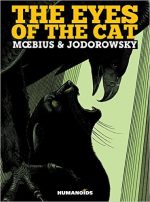
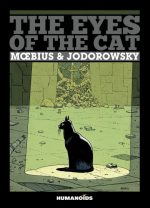
The Eyes of the Cat


By Moebius & Jodorowsky (Humanoids)
ISBN: 978-1-59465-032-1                  978-1594650420 (Yellow Edition)

Some of the world’s greatest comics exponents are cruelly neglected these days. It’s not because they are out of vogue or forgotten, it’s simply that so much of their greatest material lies temporarily out of print. This little gem is one of the few exceptions…

Born in Tocopilla, Chile in 1929, Alejandro Jodorowsky Prullansky is a filmmaker, playwright, actor, author, world traveller, philosopher, spiritual guru and comics writer.

The modern polymath is most widely known for such films as Fando y Lis, El Topo, The Holy Mountain, Sante Sangre, The Rainbow Thief, The Dance of Reality and others, plus a vast and influential comics output, including Anibal 5 (created whilst living in Mexico), Le Lama blanc, Aliot, The Meta-Barons, Borgia, Madwoman of the Sacred Heart and so many more, created with some of South America and Europe’s greatest artists.

His decade-long collaboration with Moebius on the Tarot-inspired adventure The Incal (1981-1989) completely redefined and reinvented what comics could aspire to and achieve.

Most widely regarded for his violently surreal avant-garde films, loaded with highly-charged, inspired imagery – blending mysticism and what he terms “religious provocation” – and his spiritually-informed fantasy and science fiction comics tales, Jodorowsky is also fascinated by humanity’s inner realms and has devised his own doctrine of therapeutic healing: Psychomagic, Psychogenealogy and Initiatic massage.

He still remains fully engaged and active in all these creative areas to this day.

He has never stopped creating and most of his lifelong themes and obsessions are seamlessly wedded together in this glorious re-release of his first comics collaboration with the creator most inextricably associated with him.

Jean Henri Gaston Giraud was born in the suburbs of Paris on May 8th 1938 and raised by his grandparents after his mother and father divorced in 1941.

In 1955, he attended the Institut des Arts Appliqués where he became friends with Jean-Claude Mézières who, at 17, was already selling strips and illustrations to magazines such as Coeurs Valliants, Fripounet et Marisette and Spirou. Giraud apparently spent most of his college time drawing cowboy comics and left after a year.

In 1956 he travelled to Mexico, staying with his mother for eight months, before returning to France and a full-time career drawing comics, mostly westerns such as Frank et Jeremie for Far West and King of the Buffalo, A Giant with the Hurons and others for Coeurs Valliants in a style based on French comics legend Joseph Gillain AKA “Jijé”.

Giraud spent his National Service in Algeria in 1959-1960, where he worked on military service magazine 5/5 Forces Françaises and on returning to civilian life became Jijé’s assistant in 1961, working on the master’s long-running (1954-1977) Western epic Jerry Spring.

A year later, Giraud and Belgian writer Jean-Michel Charlier launched the serial Fort Navajo in Pilote #210, and soon its disreputable, anti-hero lead character Lieutenant Blueberry became one of the most popular European strips of modern times. In 1963-1964, Giraud produced a number of strips for satire periodical Hara-Kiri and, keen to distinguish and separate the material from his serious day job, first coined his pen-name “Moebius”.

He didn’t use it again until 1975 when he joined Bernard Farkas, Jean-Pierre Dionnet and Philippe Druillet – all inspired science fiction fans – as the founders of a revolution in narrative graphic arts created by “Les Humanoides Associes”. Their groundbreaking adult fantasy magazine Métal Hurlant utterly enraptured the comics-buying public and Giraud again wanted to utilise a discreet creative persona for the lyrical, experimental, soul-searching material he was increasingly driven to produce: series such as The Airtight Garage, The Incal and the mystical, dreamy flights of sheer fantasy contained in Arzach…

To further separate his creative twins, Giraud worked inks with a brush whilst the futurist Moebius rendered with pens…

After a truly stellar career which saw him become a household name, both Giraud and Moebius passed away in March 2012.

As explained in Jodorowsky’s Foreword, this magnificently macabre minimalist monument to imagination came about as brief tale in a free, promotional premium “Mistral Edition” of Métal Hurlant constituted their very first collaboration – outside the creative furnace that was the pre-production phase of the aborted movie Dune where they first met (also included in that imaginative dream-team was Dan O’Bannon, Douglas Trumbull, H.R. Giger and Chris Foss) and secrets of that time are also shared here).

Les Yeux du chat was realised between 1977 and 1979: a dark fable that is sheer beauty and pure nightmare, rendered in stark monochrome and florid expansive grey-tones. Text is spartan and understated: more poetic goad than descriptive excess or expositional in-filling.

There’s a city, a boy at a window, an eagle and a cat. When their lives intersect, shock and horror are the result…

Available in a number of formats since 2011, this is a visual masterpiece no connoisseur of comics can afford to miss.
© 2013 Humanoids, Inc. All rights reserved.

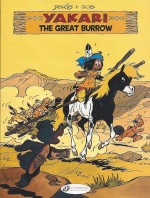
Yakari and the Great Burrow


By Derib & Job, coloured by Dominque and translated by Jerome Saincantin (Cinebook)
ISBN: 978-1-84918-272-0

Children’s magazine Le Crapaud à lunettes was founded in 1964 by Swiss journalist André Jobin who then wrote for it under the pseudonym Job. Three years later he hired fellow French-Swiss artist Claude de Ribaupierre who chose the working name “Derib”. He had begun his own career as an assistant at Studio Peyo (home of Les Schtroumpfs), working on Smurfs strips for venerable weekly Spirou. Together they created the splendid Adventures of the Owl Pythagore before striking pure comics gold a couple of years later with their next collaboration.

Launching in 1969, Yakari detailed the life of a young Sioux boy on the Great Plains; sometime after the introduction of horses by the Conquistadores and before the coming of the modern White Man.

Overflowing with gentle whimsy, the beguiling strip explores a sublimely bucolic existence at one with nature and generally free from strife. For the sake of our entertainment however the seasons are punctuated with the odd crisis, generally resolved without fame or fanfare by a little lad who is smart, compassionate, brave… and can converse with all animals…

Derib – equally excellent in both enticing, comically dynamic “Marcinelle” cartoon style yarns and with devastatingly compelling meta-realistic action illustrated action epics – went on to become one of the Continent’s most prolific and revered creators. It’s a crime that such groundbreaking strips as Celui-qui-est-né-deux-fois, Jo (the first comic on AIDS ever published), Pour toi, Sandra and La Grande Saga Indienne) haven’t been translated into English yet, but we wait in hope and anticipation…

Many of his stunning works over the decades feature his beloved Western themes, magnificent geographical backdrops and epic landscapes and Yakari is considered by most fans and critics to be the feature which catapulted him to deserved mega-stardom.

Originally released in 1984, Le Grand Terrier was the tenth European album and recently became Cinebook’s lucky 13th, but chronology and continuity addicts won’t suffer unless they are of a superstitious turn of mind since this tale is both stunningly simple and effectively timeless; offering certain enjoyment from a minimum of foreknowledge…

It all begins one bright sunny morning as the boy brave boldly follows a succession of strange arrows in the grass: a unique trail designed to lure him into a cunning mystery.

Riding four-legged friend Little Thunder, Yakari treks far across the prairie but only finds a taunting voice challenging him to return tomorrow if he thinks he’s a “real Sioux”…

The next day, as he enters a wooded area he’s pelted with little stones and furiously chases two bear cubs into a deep tunnel in the earth. It’s merely the start of a vast network of tunnels and dead-ends: an underground maze which seems to promise a slow doom. Lost and despondent, when things look their very bleakest, Yakari learns the truth when his animal friends Linden Tree the beaver, Black Mask the raccoon and little bears Huckle and Berry erupt into the subterranean chamber. The fun-loving youngsters have turned an old hibernation hole into a terrific den for adventures and prank-playing…

With Yakari a willing partner, the assorted cubs then collaborate to drive the bears’ parents crazy. It works far too well, however, and when the ponderous hairy heavyweights collide in a frenzy of frustrated pursuit, their terrific impact shakes the earth and collapses the kids’ escape tunnels…

Bolting sunwards in panic, the youngsters head for the surface… but only three of them make it…

Now it’s a frantic race against time as Yakari assembles all his beastly buddies in a mammoth rescue attempt before time and air run out…

Always visually spectacular, seductively smart and happily heart-warming, Job’s smart yet spartan script again affords Derib a splendid opportunity to go wild with the illustrations; crating a momentous, claustrophobic scenario which only makes the eventual happy ending even more unlikely until it actually happens…

The exploits of this valiant little voyager who speaks to animals and enjoys a unique place in an exotic world is a decades-long celebration of joyously gentle, marvellously moving and enticingly entertaining adventure, honouring and eulogising an iconic culture with grace, wit, wonder and especially humour.

These seductive sagas are true landmarks of comics and Yakari is a strip no fan of graphic entertainment should ignore.
Original edition © 1984 Derib + Job – Editions du Lombard (Dargaud- Lombard s.a.) English translation 2015 © Cinebook Ltd.

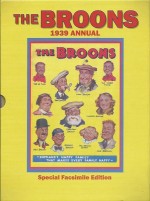
The Broons: Facsimile Edition of the First Ever Broons Annual


By R.D. Low & Dudley D. Watkins (D.C. Thomson/Aurum)
ISBN: 978-0-85116-

The Broons is one of the longest running newspaper strips in British history, having appeared well-nigh continuously in Scottish periodical The Sunday Post since the March 8th edition of 1936. That same issue launched equally timeless cartoon stable-mate and icon of Hibernian tradition Oor Wullie: a mischievous wee laddie who epitomises carefree youthful excess.

Both the boisterous boy and the gregariously engaging working class family were co-created by journalist, writer and Editor Robert Duncan Low in conjunction with DC Thomson’s most celebrated cartoonist Dudley D. Watkins. Both were overnight hits and instantly unmissable so within a few short years the weekly episode strips began to be collected in reprint editions as Seasonal Annuals. Those books alternated stars and years right up to the present day.

The book under discussion here comes from 2006: a magnificent recreation of that first Broons Annual compendium as launched in 1939. It’s a sturdy hardback with monochrome interiors, crammed full of gags and wholesome family fun delivered with gleeful exuberance by masters of the comedy comics form, lavishly presented in its own card slipcase.

Low (1895-1980) began at the Scottish publishing monolith as a journalist and quickly rose to the post of Managing Editor of Children’s Publication. Between 1921 and 1933 he created the company’s “Big Five” story-papers for boys: Adventure, The Rover, The Wizard, The Skipper and The Hotspur. These were text-base adventure weeklies liberally illustrated and in 1936 his next brilliant idea was the Fun Section: an 8-page pull-out comic strip supplement for Scottish national newspaper The Sunday Post.

As cited above this landmark illustrated accessory began on 8th March and from the very outset The Broons and Oor Wullie were its undisputed top draws…

Low’s shrewdest notion was to devise both strips as comedies played out in the charismatic Scottish idiom and broad unforgettable vernacular where – supported by features such as Auchentogle by Chic Gordon, Allan Morley’s Nero and Zero, Nosey Parker and other strips – they laid the groundwork for the company’s next great leap.

After some devious devising in December 1937 Low premiered the first DC Thomson weekly comic. The Dandy was followed by The Beano in 1938 and early-reading title The Magic Comic in 1939.

War-time paper shortages and rationing sadly curtailed the strip periodical revolution, and it was 1953 before the next wave of cartoon caper picture paper releases. The Topper started the ball rolling again (with Wullie in the logo and masthead but not included in the magazine’s regular roster) in the same year that Low & the great Ken Reid created Roger the Dodger for Beano…

Low’s greatest advantage was his prolific illustrator Dudley Dexter Watkins, whose style, more than any other, shaped the look of DC Thompson’s comics output until the bombastic advent of Leo Baxendale shook things up in the mid-1950s.

Watkins (1907-1969) had started life in Manchester and Nottingham as a genuine artistic prodigy before entering Glasgow College of Art in 1924. It wasn’t long before he was advised to get a job at burgeoning, Dundee-based DCT, where a 6-month trial illustrating boys’ adventure stories led to comic strip specials and some original cartoon creations.

Percy Vere and His Trying Tricks and Wandering Willie, The Wily Explorer made him a dead cert for both lead strips in the Sunday Post‘s proposed Fun Section and, without missing a beat, Watkins later added The Dandy‘s Desperate Dan to his weekly workload in 1937, eventually including The Beano‘s placidly and seditiously outrageous Lord Snooty seven months after.

Watkins soldiered on in unassailable triumph for decades, drawing some of the most lavishly lifelike and winningly hilarious strips in illustration history. He died at his drawing board on August 20th 1969.

For all those astonishingly productive years he had unflaggingly drawn a full captivating page each of Oor Wullie and The Broons every week, and his loss was a colossal blow to the company.

DC Thomson’s chiefs preferred to reprint old Watkins episodes of both strips in the newspaper and the Annuals for seven years before a replacement was agreed upon, whilst The Dandy reran Watkins’ Desperate Dan stories for twice that length of time.

An undeniable, rock-solid facet of Scots popular culture from the very start, The Broons reflected changing times and ordinary life for generations of readers; sharing trials and triumphs and celebrating each changing year with unflagging wit, warmth and inspired, self-deprecating buffoonery. For fans outside Scotland – like me – they always conjure feeling of holidays and special moments, so on this wet Bank Holiday (it’s always raining somewhere on a public vacation day) I’m reliving a halcyon time…

So What’s the Set Up?: the multigenerational Brown family inhabit a tenement flat at 10 Glebe Street, in the timelessly metafictional Scottish industrial everytown of Auchentogle (or sometimes Auchenshoogle), based in large part on the working class Glasgow district of Auchenshuggle. As such it’s an ideal setting in which to tell gags, relate events and fossilise the deepest and most reassuring cultural archetypes for sentimental Scots wherever in the world they might actually be residing. And yes, a huge part of the laugh track comes from the gloriously rich accent humour deriving from the Scots idiom and cultural consciousness.

If it’s good enough for Sir Harry Lauder, Andy Stewart, Stanley Baxter, Bill Forsyth, Chic Murray, Billy Connolly, Craig Ferguson, Frankie Boyle, Susan Calman…

As is always the case, the adamant, unswerving cornerstone of any family feature is long-suffering, understanding Maw, who puts up with cantankerous, cheap know-it-all Paw, and a battalion of stay-at-home kids comprising hunky Joe, freakishly tall Hen (Henry), sturdy Daphne, gorgeous Maggie, brainy Horace, mischievous twins Eck and the unnamed “ither ane” plus a wee toddling lassie referred to only as “The Bairn”.

Not officially in residence but always hanging around is gruffly patriarchal clod Granpaw – a comedic gadfly who spends more time at Glebe Street than his own cottage and constantly tries to impart his decades of hard-earned but painfully outdated experience to the kids… but do they listen?

In later years they family would grow a bit better off, taking regular breaks from the inner city turmoil whilst simultaneously sentimentalising, spoofing and memorialising more traditional times at their But ‘n’ Ben (a dilapidated rustic cottage in the Highlands) but in these initial pre-war tales the range of any excursion is simply the inner city and wherever a day-trip by charabanc or steam train can take the bustling, boisterous clan…

The endless escapades of these formative strips comprise timeless subject-matter such as oldster’s teasing young ‘uns about their beaus, males thinking they know best whether its cleaning fire-grates, mopping floors or organising parties, or females jockeying for social status. You can learn the real cost of a “bargain”, the wisdom of holding your tongue and the value of one night of actual peace and quiet…

All the kids live in a comfortably secure world of playing, pranking and stopping out late, whilst neighbours are equal parts pains-in-the-necks and salts-of-the-earth. But as well as slapstick shenanigans – ranging from plumbing pitfalls, decorating disasters, fireplace fiascos, food foolishness, dating dilemmas, appliance atrocities, fashion freak-outs, party panics, bothered Bobbies, excessive exercising, chore-dodging, galling goofs, family frolics and sly jests – there’s a sense of unified purpose and progress made, with the Broons part of a proper working community.

The overall impression is that, unlike today when the phrase is no more than cynically exploitative lip-service from a crass, glib plutocracy intent on disempowering everyone poorer than themselves, folks back then were genuinely “all in it together” just to get by.

And Low and Watkins made it funny and rewarding…

Packed with all-ages fun, rambunctious hilarity and deliriously domestic warmth, this exemplary example of happy domesticity convivially celebrates a mythic lost life and time and is a sure cure for post-modern glums…
The Broons ™ and © D.C. Thomson & Co., Ltd. 2006.

Booster Gold volume 3: Reality Lost


By Chuck Dixon, Dan Jurgens & Norm Rapmund (DC Comics)
ISBN: 978-1-4012-2249-9                  978-1-84856-250-9 (Titan Books UK edition)

After the cosmos-crunching Crisis on Infinite Earths re-sculpted the DC Universe in 1986, a host of characters got floor-up rebuilds for the tougher, no-nonsense, straight-shooting New American readership of the Reagan era.

Corporate buy-outs such as Blue Beetle, Captain Atom and The Question were assimilated into DC’s roster beside revamped versions of their own hotly hyped solo titles. There were even all-new launches for the altered sensibilities of the Decade of Excess: tradition-challenging concepts such as Suicide Squad and a shiny, happy, headline-hungry hero named Booster Gold.

The cobalt & yellow paladin debuted amidst plenty of hoopla in his own title (February 1986 – the first post-Crisis premiere of the freshly integrated superhero line) presenting wholly different approaches to DC’s army of old-school costumed boy-scouts.

Created, written and drawn by Dan Jurgens, the saga featured a brash, cockily mysterious metahuman golden-boy jock who had set up his stall as a superhero in Metropolis, actively seeking corporate sponsorships, selling endorsements and with a management team in place to maximise the profit potential of his crusading celebrity.

Accompanied everywhere by sentient, flying, football-shaped robot Skeets, the glitzy showboat soon encountered high-tech criminal gang The 1000 and a host of super-villains, earning the ire of many sinister masterminds and the shallow approbation of models, actresses, headline-hungry journalists, politicians and the ever fickle public…

His time came and went and Booster’s title folded, but he lived on as part of Justice League International where he became roughly half of comics’ funniest double-act riffing off the aforementioned Blue Beetle.

Booster and Ted Kord (technically the second Blue Beetle) were the class clowns of billionaire Maxwell Lord‘s League: a couple of obnoxiously charming frat-boys who could save the day but never get the girl or any respect. When Lord murdered Beetle, precipitating an Infinite Crisis, Booster was shattered but eventually redefined himself as a true hero in the multiversal conflagrations of 52 and Countdown.

In landmark weekly maxi-series 52 and ultimately Infinite Crisis, the intriguing take on Heroism diverged down strange avenues when Booster – a hero traditionally only in it for fame and fortune – became a secret saviour, repairing the cracks in Reality caused by all the universe-warping shenanigans of myriad multiversal Crises and uncontrolled time-travel.

Working at the instruction of enigmatic and irascible mentor Rip Hunter: Time Master, Booster relinquished his dreams of fame and acclaim to save us all over and over and over again.

This third time-bending full-colour collection gathers issues #11, 12 and 15-19 of the Booster Gold comicbook (volume 2, spanning October 2008 to June 2009), revealing further progress in the time-guardians’ never-ending battle to keep history on track and mankind in existence.

The action opens with Jurgens & Norm Rapmund illustrating a sequence scripted by Batman scribe Chuck Dixon. ‘Vicious Cycle’ finds Rip, Booster and his freshly resurrected sister Michelle at a loss after a recent Gotham visit. After Batman, Robin and Batgirl rout B-list bad guy Killer Moth at Gotham Museum, a simultaneous robbery by meekly ineffectual Wiley Dalbert causes the dynamic trio to blink out of existence…

After experiencing the urban hell of Gotham without Batman, the team start trying to rectify the situation and learn Killer Moth’s score was planned by Dalbert as cover so that the little time traveller could swipe an ancient Egyptian knife.

Popping back further to sneakily replace the Moth, Booster clandestinely carries out the fateful robbery and stops Wiley too… but that only makes the restored reality infinitely worse…

Forced to try again – this time with Booster as Batman and Michelle impersonating Batgirl – events spiral into even crazier and more contorted convolutions (humiliating too!) before an approximate restoration of history is re-established…

Sadly the time-team’s ultra-secret efforts have brought them to the attention of stretchable sleuth Ralph Dibny, the Elongated Man…

Following a two-part battle against Chronos and Starro the Conqueror – not collected in this edition- the temporal turbulence resumes with ‘Reality Lost’ from #15-18 plus #19’s ‘Reality Lost: Epilogue’; written and pencilled by Jurgens with Rapmund again handling the inking chores.

Having dragged Michelle from her surprise role as Da Vinci’s muse, Booster tries to return them to Rip’s secret lab only to find it no longer exists. Thanks to Skeets’ encyclopaedic history files and temporal processors, the stranded chrononauts discover the current crisis stems from unfinished business at the museum where they met Wiley Dalbert…

Booster sets his Wayback Machine for that apparently accursed night, and walks into a trap and is attacked by Dibny. A few years from then they would be best friends in Justice League International, but at that instant the blue and gold figure is nothing more than a bold bandit as far as the Ductile Detective is concerned…

Concealing the horrors which would soon destroy Dibny’s life, Booster nevertheless convinces Elongated Man of his bona fides before enlisting his aid in tracking down the time anomaly playing hob with reality. The root cause is the ancient knife, but the real problem is that it’s been taken by Booster’s villainous, time-bending dad Rex Hunter, precipitating a perilous odyssey through the ages to recover it…

Leaving Ralph and Michelle to search time for Rip Hunter, Gold starts to hunt for the accursed blade…

Poignant pit-stops in World War I, ancient Egypt and his personal time-line result in deadly encounters with Enemy Ace Hans von Hammer, pre-lightning bolt Barry Allen, time-bandit Chronos, and even his own earlier, surlier, self-absorbed self. Through it all Booster learns the true price and value of his secret career.

Preserving the way things are causes pain and humiliation, costs everything he ever cared about and promises nothing but frustration and early death. He even had a chance to save Ted Kord after meeting Max Lord’s father before the maniac was born but lacked the guts to do what he wanted to…

After the triumph and tragedy, a potent vignette by Jurgens & Rapmund wraps things up with a recap of Booster’s ‘Origins and Omens’ of his immediate future: first seen as a teaser produced during the lead-up to twinned publishing events Blackest Night and Brightest Day

Sadly, despite its dark and foreboding appeal, moments of sheer comedy gold and fast-paced action throughout, this engaging rollercoaster ride is ultimately a true fans’ story for die-hard Fights ‘n’ Tights devotees. That’s a great shame since this is also a fabulously well-crafted story that a wider audience would certainly appreciate if only they had sufficient back-grounding.

Perhaps DC’s current TV iterations will generate enough interest to get new readers picking up old stories and joining in the fun that’s still waiting to be had…
© 2008, 2009 DC Comics. All Rights Reserved.

Showcase Presents Batman volume 6


By Dennis O’Neil, Frank Robbins, Robert Kanigher, Len Wein, Marv Wolfman, Neal Adams, Irv Novick, Bob Brown, Dick Giordano & various (DC Comics)
ISBN: 978-1-4012-5153-6

After three seasons the overwhelmingly successful Batman TV show ended in March, 1968. It had clocked up 120 episodes plus a theatrical-release movie since its premiere on January 12, 1966; triggering a global furore of “Batmania” and causing hysteria for all things costumed, zany and mystery-mannish.

Once the series foundered and crashed, humanity’s fascination with “camp” superheroes burst as quickly as it had boomed, and the Caped Crusader was left to a hard core of dedicated fans and followers who hoped they might now have “their” hero back.

For comicbook editor Julius Schwartz – who had tried to keep the most ludicrous excesses of the show out whilst still cashing in on his global popularity – the solution was simple: ditch the tired shtick, gimmicks and gaudy paraphernalia and get Batman back to basics; solving baffling mysteries and facing life-threatening perils.

That also meant phasing out the boy sidekick…

Although the college freshman Teen Wonder would still pop back for the occasional guest-shot yarn, this sixth astoundingly economical monochrome monument to comics ingenuity and narrative brilliance features him only sporadically. Robin had finally spread his wings and flown the nest for a solo back-up slot in Detective Comics, alternating with caped newcomer Batgirl.

Chronologically collecting Batman’s cases from February 1971 to September 1972 – issues #229-244 of his own title as well as the front halves of Detective Comics #408-426 – the 33 tales gathered here (some Batman issues were giant reprint editions, so only their covers are reproduced within these pages) were written and illustrated by forward-thinking creators determined make the masked manhunter relevant and interesting on his own terms once more.

One huge factor aiding the transition was the fact that the publishers now acknowledged that a large proportion of their faithful readership were discerning teens or even adults, not just kids looking for a quick, disposable entertainment fix. Working through other contemporary tropes – most notably a renewed global fascination in all things supernatural and gothic – the creative staff deftly reshaped Batman into a hero capable of actually working within the new “big things” in comics: realism, organised crime, social issues, suspense and even horror…

During this period the long road to our modern obsessive, scarily dark Knight gradually revealed a harder-edged, grimly serious caped crusader, whilst carefully expanding the milieu and scope of Batman’s universe – especially his fearsome foes, who all ceased to be harmless buffoons and inexorably metamorphosed back into the macabre Grand Guignol murder-fiends which typified the villains of the early 1940s.

This mini-renaissance also resulted in a groundbreaking experiment now lauded as one of the first great extended Batman epics…

The moody mayhem begins with ‘Asylum of the Futurians’ by Robert Kanigher, Irv Novick & Frank Giacoia from Batman #229, which pitted the astounded hero against a sect of self-proclaimed mutants who might simply have been the craziest, most self-deluding killers he had ever faced.

Detective Comics #408 offered a short sharp shocker by neophyte scripters Len Wein and Marv Wolfman. Limned by Neal Adams & Dick Giordano, ‘The House That Haunted Batman’ showcased spectral apparitions, the apparent death of Robin and a devilish mystery perpetrated by one of the Gotham Guardian’s most sinister enemies. Frank Robbins, Novick & Giordano then addressed an ongoing social revolution as our hero stopped a juvenile delinquent gang-war. When the now-united kids’ occupied a palatial new building the ‘Take-Over of Paradise’ (Batman #230) led to a vicious murder. Luckily the Caped Crimebuster was on hand to solve the case before a renewed bloodbath began…

Detective Comics #409 pitted Batman against a disfigured lunatic slashing portraits and killing their subjects in ‘Man in the Eternal Mask’ (Robbins, Bob Brown & Giacoia) whilst the next issue proved to be another chilling and memorable murder-mystery from the most celebrated creative team of the decade. ‘A Vow from the Grave!’ by Denny O’Neil, Adams & Giordano at their visually spectacular best, featured an exhausted Batman hunting one ruthless killer and inadvertently stumbling into another murder in an enclave of retired circus freaks…

Multi-talented Dick Giordano was the inker of choice for the Darknight Detective at this time; his slick, lush line and brushwork lending a veneer of continuity to every penciller. Unless I say otherwise, please assume it’s him on every cited story from now on…

The Dark Knight was lured to Vietnam to save an airliner full of hostages in Batman #231 (Robbins, with Novick pencils), barely surviving a vicious vengeance scheme triggered by the ‘Blind Rage of the Ten-Eyed Man’.

Then the first subtle plot-strands were woven in a breathtakingly ambitious saga unlike anything seen in comics before. Detective Comics #411 found Batman still in the East, undercover and hunting Dr. Darrk; leader of the lethally clandestine League of Assassins so casually introduced in #405. The pursuit led ‘Into the Den of the Death-Dealers’ (O’Neil, Brown) where a climactic struggle resulted in the monster’s death and freedom for an exotic hostage he was holding. Her name was Talia…

We learned more of her in Batman #232 where O’Neil & Adams introduced her father – immortal eco-terrorist Râ’s Al GhÅ«l – in a whirlwind adventure which became one of the signature high-points of the entire Batman canon.

‘Daughter of the Demon’ is a timeless globe-girdling mystery yarn that draws the increasingly dark detective from Gotham’s concrete canyons to the Himalayas in search of hostages Robin and Talia, purportedly captured by forces inimical to both Batman and the mysterious figure who claims to working in secret to save the world…

Ra’s was a contemporary, more acceptable visual embodiment of the classic inscrutable ultimate foreign devil (as typified in a less forgiving age as the “Yellow Peril” or Dr. Fu Manchu). This kind of alien archetype permeates popular fiction and is still an astonishingly powerful villain-symbol, although the character’s Arabic origins – neutral at the time – seem to uncomfortably embody a different kind of ethnic bogeyman in today’s post 9/11 world.

The concept of a villain who has the best interests of the planet at heart is not a new one, but Ra’s Al Ghul, whose avowed intent is to reduce teeming humanity to viable levels and save the world from our poison, hit a chord in the 1970s – a period where ecological issues first came to the attention of the young. It was a rare kid who didn’t find a note of sense in what “the Demon’s Head” planned.

The spectacular tale ended with a shocking pronouncement of what Ra’s intended for Batman…

A return to relative normality came in ‘Legacy of Hate!’ (Detective Comics #412 by Robbins, Brown) as Bruce Wayne headed to Northern England for a convocation of kin gathered to settle the ownership and disposition of ancient Waynemoor Castle. Sadly, even Batman could not separate the spate of attempted murders which followed into purely human perpetrators and the manor’s vengeful ghost knight…

Issue #413 blended the spooky tone of the times with a healthy dose of social inclusion as ‘Freak-Out at Phantom Hollow!’ (Robbins, Brown) found Batman saving two abused hippie kids being picked on in a rural hamlet, only to become embroiled in a witch’s curse and mad bomber’s plot. Batman #233 was an all-reprint edition after which #234 featured the stellar return of one of the hero’s most tragic foes.

As comics became increasingly more anodyne in the 1950s, psychologically warped actualised schizophrenic Two-Face was dropped from Batman’s roster of rogues, but with ‘Half an Evil’ (O’Neil, Adams & Giordano) he resurfaced at the forefront of grimmer, grittier stories.

When a string of bizarre and brutal robberies afflicting Gotham, the baffled Batman has to use all his ingenuity to discern the reasoning and discover the identity of a ruthless hidden mastermind in time to thwart a diabolical scheme…

An aura of Film Noir redemption colours O’Neil & Novick’s ‘Legend of the Key Hook Lighthouse!’ from Detective Comics #414, as Batman tracks gunrunners to a haunted coastal bastion in Florida. However, only a supernatural intervention enables him to save bystanders who, whilst not exactly innocent, certainly don’t deserve the fate psychotic banana republic despot General Ruizo planned for them…

In Batman #235’s ‘Swamp Sinister!’ (O’Neil, Novick) some early insights into the true character of Talia and her ruthless sire manifest as the Dark Knight races to recover a stolen bio-weapon whilst over in Detective Comics #415 Robbins & Brown’s ‘Challenge of the Consumer Crusader’ sees the Gotham Gangbuster uncover an extortion ring inside the nation’s most respected product-testing organisation.

Detective Comics #400 had introduced a dark counterpoint to the Gotham Gangbuster wherein driven scientist Kirk Langstrom created a serum to make him superior to Batman and paid a heavy price. Over two further exploits Langstrom and his fiancée Francine had endured his monstrous transformations until Batman found a cure. Now that trilogy was expanded in #416 as Frank Robbins pencilled and inked his own script ‘Man-Bat Madness!’ wherein Kirk seemingly slipped back into his transformative madness. Luckily, Batman had the faith to look beyond appearances and discern a hidden factor in the scientist’s inexplicable recidivism…

‘Wail of the Ghost-Bride!’ (Batman #236, Robbins, Novick) blends mysticism with an solid murder-plot, cover-up and blistering action after which a journalist tries to become ‘Batman for a Night’ (Detective Comics #417, Robbins, Brown & Giordano) but only succeeds after experiencing a similar crime-created loss…

‘Night of the Reaper!’ – by O’Neil, Adams & Giordano from Batman #237 – is one of the most revered tales of the era: a harrowing Halloween epic which finds Robin working with his old mentor to solve a string of barbarous killings only to uncover a pitifully deranged perpetrator as much sinned-against as sinner…

Following the cover of reprint giant Batman #238, Detective Comics #418 writes a temporary finish to the short-lived career of The Creeper as ‘…And Be a Villain!’ (O’Neil, Novick) pits the Gotham Guardian against a former hero being simultaneously killed and driven crazy by his own powers. At the heart of the problem is the criminal scientist forcing Creeper to steal in return for a promised cure, but that’s no help as Batman battles a foe faster, stronger, more agile and far scarier than he…

A corpse weighed down with Batman figurines leads the hero into an underworld imbroglio packed with shameful family freaks, a ruthless master smuggler and the pitiful ‘Secret of the Slaying Statues!’ (Detective #419 from O’Neil & Novick) whilst Christmas classic ‘Silent Night, Deadly Night!’ (O’Neil & Novick in Batman #239) sees the masked manhunter striving to save a desperate, poverty-struck single-parent from making the worst decision of his life – with a little seasonal help from a higher power…

Robbins again solos for Detective Comics #420’s ‘Forecast for Tonight… Murder!’ as a radioactive dead man stalks one of Gotham’s greatest philanthropists; easily outwitting Batman’s every preventative measure. It only gets tougher when the hero discovers he might be safeguarding the wrong injured party…

The long-brewing war between Batman and Ra’s Al Ghul went to Def Con 3 in Batman #240 when O’Neil, Novick & Giordano set the scene for the groundbreaking “series-within-a-series” soon to follow. When Batman uncovers one of his opponent’s less worthy and far more grisly projects he is forced to compromise his principles and deliver ‘Vengeance for a Dead Man!’ The end-result will be open war between Batman and the Demon’s Head…

Batman had to break a blackmailer who knew all Gotham’s dirty secrets out of prison during a full-scale riot in ‘Blind Justice… Blind Fear!’ (an all-Robbins affair from DC #421) whilst in the following issue O’Neil, Brown & Giordano had the Dark Knight expose a cunning hijacking ring using radical methodology for corporate reasons in ‘Highway to Nowhere!’

Another sociopathic killer debuted in Batman #241 as the hero hunts for freelance spy Colonel Sulphur whose extortion scheme revolved around his threat to kill a Pentagon officer’s wife. ‘At Dawn Dies Mary McGuffin!’ by O’Neil & Novick sees Batman scouring Gotham in a tense race against the clock in direct counterpoint to Detective #423’s ‘The Most Dangerous Twenty Miles in Gotham City’ (Robbins, Brown) wherein the masked manhunter’s cognitive skills are tested trying to slip a Russian agent past a gang of ultra-patriots. The killers don’t care that he’s being exchanged for a captive American, they just want to kill a commie and send a message…

Batman #242-244 (and the epilogue from #245 not included in this volume) formed a single extended saga taken out of normal DC continuity. It promised to relate the final confrontation between two opposing ideals. O’Neil, Novick & Giordano opened the campaign in Batman #242 with ‘Bruce Wayne – Rest in Peace!’ With his civilian identity taken off the board, Batman gathers a small team of specialist allies – comprising criminal alternate-identity Matches Malone, scientific advisor Dr. Harris Blaine and Ra’s’ top assassin Ling – to destroy the Demon forever.

Meanwhile it was business as usual in Detective #424 where ‘Double-Cross-Fire!’ – by Robbins & Brown – played out an astoundingly cunning murder plot with Batman challenging Commissioner Gordon (and us readers) to spot the telltale clue which gave the game away. O’Neil & Novick then get all Shakespearean in #425 where ‘The Stage is Set… for Murder!’ with Batman carefully seeking to glean which thespian was plotting a big, bloody finish before the curtain comes down forever…

O’Neil, Adams & Giordano returned with the second chapter of their landmark epic as Batman #243 sees the team – plus latecomer Molly Post – bombastically invade Ra’s’ Swiss citadel moments after their intended target passes away…

Nobody suspected the ageless villain’s resources included ‘The Lazarus Pit’ which could revive the dead…

In Detective Comics #426, a spate of inexplicable suicides amongst the wealthy leads Batman to suave gambler Conway Treach: a man who just can’t lose. Soon however, the huckster learns that his grim opponent has his own system for winning ‘Killer’s Roulette!’; another suspenseful Robbins masterpiece which leads chronologically and conclusively to Batman #244 and the fateful finale wherein ‘The Demon Lives Again!‘ Sadly, despite all his supernal gifts and forces, Ra’s cannot escape the climactic vengeance of his implacable foe in dream-team O’Neil, Adams & Giordano’s compulsive climax.

With the game-changing classics in this volume, Batman finally returned to the commercial and critical top flight he had enjoyed in the 1940s reviving and expanding upon his original conception as a remorseless, relentless avenger of injustice. The next few years would see the hero rise to unparalleled heights of quality so stay tuned: the very best is just around the corner… that dark, dark corner…
© 1971, 1972, 2015 DC Comics. All rights reserved.

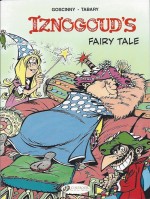
Iznogoud’s Fairy Tale


By Goscinny & Tabary, translated by Jerome Saincantin (Cinebook)
ISBN: 978-1-84918-260-7

For the greater part of his far-too-short lifetime René Goscinny (1926-1977) was one of the world’s most prolific and widely-read writers of comic strips.

He still is.

Amongst his most popular and enduring comic collaborations are Lucky Luke, Le Petit Nicolas, Signor Spaghetti and, of course, Asterix the Gaul, but there were so many others, such as the despicably dark deeds of a dastardly usurper whose dreams of diabolical domination perpetually proved to be ultimately no more than castles in the sand…

In the rueful aftermath of the Suez crisis, the French returned – by way of comics, at least – to the hotly contested Arabian deserts as Goscinny teamed with hugely gifted Swedish émigré Jean Tabary (1930-2011) – who numbered Richard et Charlie, Grabadu et Gabaliouchtou, Totoche, Corinne et Jeannot and Valentin le Vagabond amongst his other hit strips – to deliriously detail the innocuous history of imbecilic Arabian (im)potentate Haroun el-Poussah.

However, as is so often the case, it was the strip’s villainous foil – power-hungry vizier Iznogoud – who stole the show… possibly the conniving little blackguard’s only successful coup.

The first kernel of inspiration came as a piece of background shtick in early 1960s kids’ cartoon book Les Vacances du Petit Nicholas (which we all saw as Nicholas on Holiday). A fuller formation and development came with Les Aventures du Calife Haroun el Poussah, created for Record: debuting in the January 15th issue of 1962.

A petite hit, the feature subsequently jumped ship to Pilote – a new comic created and edited by Goscinny – where it was artfully refashioned into a starring vehicle for the unpleasant little upstart who had been hogging all the laughs and limelight.

The Vile Vizier went from strength to strength. According to the brief introduction in this volume, the unwieldy catchphrase “I want to be Caliph instead of the Caliph!” quickly became part of casual French idiom and, in October 1974, the wee rascal won his own socio-political commentary column in newspaper Journal du Dimanche.

Insidious Iznogoud is Grand Vizier to Haroun Al Plassid, the affable, easy-going Caliph of Ancient Baghdad, but the sneaky little second-in-command has loftier ambitions, or as he is always declaiming “I want to be…”

The retooled rapscallion resurfaced in Pilote in 1968, quickly becoming a massive hit, resulting in 29 albums to date (17 by dream team Goscinny & Tabary), his own solo comic, a computer game, animated film, TV cartoon show and even a live-action movie.

Like all great storytelling, Iznogoud works on two levels: for youngsters it’s a comedic romp with adorably wicked baddies invariably hoisted on their own petards and coming a-cropper, whilst older, wiser heads can revel in pun-filled, witty satires and superbly surreal antics.

Following Goscinny’s death in 1977, Tabary began scripting tales, switching to book-length complete adventures rather than the short, snappy vignettes which typified his collaborations. Upon his own passing, Tabary’s children Stéphane, Muriel and Nicolas took over the franchise.

The deliciously malicious whimsy is resplendent in its manic absurdity, cleverly contemporary cultural critiques, brilliantly delivered creative anachronisms and fourth-wall busting outrages which serve to keep the assorted escapades bizarrely fresh and hilariously inventive.

Le conte de fée d’Iznogoud (Iznogoud’s Fairy Tale) was originally released in 1976; wracking up an even dozen deliciously daft album compilations, and proffering a potent remarkable quartet of trend-setting tales with our ambitious autocrat as ever scheming to seize power from his good but gullible Lord and Master.

Following the aforementioned Introduction and a preface page reintroducing our constant cast, the merry madness kicks off with ‘Fairy Tale’ as extremely inept Fairy Godmother Blunderbell – in search of an impoverished princess to assist – lands instead in the truculent toad’s lap.

Once she’s convinced him that even if her spells don’t go exactly to plan, the recipient of her magic experiences astounding transformations, it’s not long before she’s gulled into making him the Caliph instead of the Caliph.

…At least that was the plan: have we mentioned that Blunderbell’s not the most accurate spell-caster in the world?

Mystic mayhem also abounds in ‘Mirror Image’ as, on the eve of the ten-yearly vote to reaffirm the Caliph as supreme ruler, Iznogoud is accosted by Al Hiss the Genie from the other side of his looking glass. The fantastic land is completely the same as but exactly reversed from home, and Iznogoud’s shenanigans actually succeed in fixing this election. However although the little schemer actually ousts the Caliph, he has forgotten one crucial factor…

Newly arrive tradesman Tremolo has a strong line in enchanted furnishings. After an astonishingly annoying bout of window shopping the Vizier and his foolish flunky Wa’at Alahf take possession of a fearsomely final divan of despatch dubbed ‘The Send-Away Bed’…

Whoever lies in it vanishes forever, but thanks to visiting dignitaries and the world’s worst case of coffee-nerves, the machinations needed to get the normally sleep-loving Caliph to try it out are doomed to failure… as is Iznogoud…

All the rules and much of the internal logic are thrown away for the closing, epic length saga of ‘The Magic Minarets’ as the strips disgruntled fans rise up in revolt, demanding a proper resolution to the Vizier’s schemes.

What they actually get is a madcap metaphysical odyssey as Iznogoud is sucked into a fantastic realm where he must competitively quest for ten wizardly ideals whilst his moral fibre is tested. The prize for success is the granting of his greatest desire…

However, even after cheating his way to victory, fate has a way of upsetting his game…

Such convoluted witty, fast-paced hi-jinks and craftily crafted comedy set pieces have made this addictive series a household name in France where “Iznogoud” is also common parlance for a certain kind of politician: over-ambitious, unscrupulous – and frequently insufficient in inches (or should that be centimetres?).

Desiring to become “Caliph in the Caliph’s place” is a popular condemnation in French, targeting those perceived as overly-ambitious, and, since 1992 the Prix Iznogoud is awarded annually to “a personality who failed to take the Caliph’s place”.

Nominees are chosen from prominent French figures who have endured spectacular defeats in any one year and been given to the likes of Édouard Balladur (1995) and Nicolas Sarkozy (1999). The jury panel is headed by politician André Santini, who gave himself one after failing to become president of Île-de-France in regional elections in 2004.

When first released in Britain during the late 1970s and 1980s (and latterly in 1996 as a periodical comicbook) these tales made little impression on British audiences, but at last this wonderfully beguiling strip has deservedly found an appreciative audience among today’s more internationally aware, politically jaded comics-and-cartoon savvy connoisseurs…
Original edition © 2012 IMAV éditions by Goscinny & Tabary. All rights reserved. English translation © 2015 Cinebook Ltd.

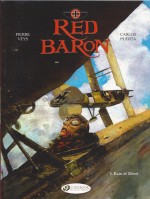
Red Baron volume 2: Rain of Blood


By Pierre Veys & Carlos Puerta, translated by Mark Bence (Cinebook)
ISBN: 978-1-84918-211-9

The sublimely illustrated, chillingly conceived fictionalised re-imagination of legendary German Air Ace Manfred von Richthofen continues in stunningly scary form with this second no-nonsense instalment from Pierre Veys & Carlos Puerta. Baron rouge: Pluie de sang debuted Continentally in 2013 and here resumes its fascinating, faux-autobiographic course as notionally described by the titular flier…

Scripted with great style and Spartan simplicity by prolific bande dessinée writer Pierre Veys (Achille Talon, Adamson, Baker Street, Boule et Bill, les Chevaliers du Fiel), the drama is stunningly illustrated by advertising artist and veteran comics painter Carlos Puerta (Los Archivos de Hazel Loch, Aeróstatas, Tierra de Nadie, Eustaquio, Les Contes de la Perdition) in a staggeringly potent photo-realistic style.

In the first volume we saw how young military student Manfred discovered he had an uncanny psychic gift: when endangered he could read his opponents intentions and counteract every attack. Immediate peril seemed to trigger his gift and he subsequently tested the theory by heading for the worst part of town to provoke the peasants and rabble. He never questioned how or why the savage exercise of brutal violence – especially killing – made him feel indescribably happy…

As a cavalry officer when the Great War began, Manfred found further proof of his talent when he casually acted on a vague impulse and avoided a lethal shelling from a threat he could neither see nor anticipate…

He could never convince his only friend Willy of this strange gift, even after he transferred to the Fliegertruppen (Imperial German Flying Corps) as gunner in a two-man reconnaissance craft …

The saga recommences here as Von Richthofen barely survives his first taste of sky-borne dogfighting and instantly resolves to learn how to fly. Never again will he trust his life to someone else’s piloting skills…

Sadly he is far from a natural pilot and only hard work and persistence allow him to qualify as a flier. Even after his first kill, he still can’t stop his elite comrades laughing at his pitiful landings…

Things begin to change after he modifies his two-man Albatross C.111 so that he can fire in the direction of his flight rather than just behind or to the sides. Now a self-propelled machine-gun, Von Richthofen takes to the skies and scores a delicious hit on a hapless British pilot…

Days later his joy increases when Willy is assigned to his squadron.

Sharing the spoils of occupation life, Von Richthofen relates his earliest war exploits as a cavalryman pushing east into Russia. A grisly escapade with a single Uhlan against a company of Cossacks is again greeted with tolerant disbelief and Willy is only mildly surprised by the callous indifference Manfred displays when recalling how he hanged some monks whilst moving through Belgium to the Western Front.

The affronted boaster is determined to prove his powers are real. The opportunity comes when they come across enlisted men indulging in a boxing match. Lieutenant Von Richthofen orders them to let him join in: facing down hulking brute Stoph, who was German national champion before hostilities started.

As Willy watches his slightly-built school chum easily avoid every lethal blow before slowly and methodically taking his opponent apart, he finally believes. He also begins to fear…

To Be Concluded…

A sharp mix of shocking beauty and distressingly visceral violence, Rain of Blood blends epic combat action with grimly beguiling suspense. The idea of the semi-mythical knight of the clouds as a psychic psycho-killer is not one many purists will be happy with, but the exercise is executed with mesmerising veracity and Puerta’s illustration is both astoundingly authentic and gloriously enthralling.

A decidedly different combat concoction: one jaded war lovers should definitely try.
Original edition © Zephyr Editions 2012 by Veys & Puerta. All rights reserved. English translation 2014 © Cinebook Ltd.

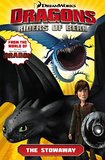
Dreamworks Dragons – Riders of Berk volume 4: The Stowaway


By Simon Furman, Iwan Nazif & various (Titan Comics)
ISBN: 978-1-78276-079-5

DreamWorks Dragons: Riders of Berk and its follow-up Defenders of Berk are part of one of the most popular cartoon franchises around. Loosely adapted from Cressida Cowell’s gloriously charming children’s books, the show is based upon and set between the How to Train Your Dragon movies. Of course if you have children you are almost certainly already aware of that already.

Having wowed young and old alike across the globe, the series has also spawned a series of comic albums and this third digest-sized collection features two stellar incendiary serpentine sagas scripted as ever by the ever-enthralling Simon Furman.

In case you’re not absolutely au fait with the exhilarating word of winged reptiles: brilliant but introverted boy-hero Hiccup saved his island people from being overrun by hostile dragons by befriending them. Now he and his unruly teenaged compatriots of the Dragon Rider Academy gleefully roam the skies with their devoted scaly friends, getting into trouble and generally saving the day.

When not squabbling with each other, the trusty teens strive to keep the peace between the vast variety of wondrous Wyrms and isolated Berk island’s bellicose Viking settlers.

These days, now the dragons have all been generally domesticated, those duties generally involve finding, taming and cataloguing new species whilst protecting village and farms from constant attacks by far nastier folk such as Alvin the Treacherous and his fleet of piratical Outcasts and, all too often, fresh horrors…

As usual, before the comic confrontations commence action takes wing there’s a brace of handy information pages reintroducing Hiccup and his devoted Night Fury Toothless, as well as tomboyish Astrid on Deadly Nadder Stormfly, obnoxious jock Snotlout and Monstrous Nightmare Hookfang, portly dragon-scholar Fishlegs on ponderous Gronckle Meatlug and the terribly dim yet jovially violent twins Tuffnut and Ruffnut on double-headed Zippleback Belch & Barf. There’s also a quick intro for big boss Stoick and chief armourer Gobber…

Eponymous epic ‘The Stowaway’ (illustrated by Iwan Nazif with the colouring wizardry of Digikore and lettering from Jim Campbell) opens with our young champions joyously training in the sky when a trading ship docks. The merchants of the Fraghen have had to fight their way through an Outcast blockade to deliver their wares, but don’t seem too badly damaged. Moreover, as well as trade-goods they bring a gorgeous lad named Hroar: a real devotee of dragons who had somehow managed to stow away on the long-ship all the way from distant Knaff…

The brawny young barbarian Adonis is gregarious, makes friends easily and says all the right things. Hiccup wishes he could like him, but there’s just something too perfect about his colleagues’ new best friend.

…And besides, Toothless clearly doesn’t trust him…

Astrid does, though, and Hroar also does everything he can to make himself liked by the other dragon riders. Nevertheless, whenever a minor spat or problem with the flying reptiles disrupts the daily routine, the stowaway is there. In fact there are a lot of little incidents. The big beasts all seem very fractious these days…

The bonny boy is popular with the adults too, particularly Hiccup’s father Stoick who pressures his son to admit Hroar to the Dragon Academy. Bowing to the inevitable, Hiccup maliciously pairs the neophyte with the ferocious Typhoomerang Torch. After far too short an interval, the boy from Knaff is showing them all up…

Convinced something untoward is going on, Hiccup starts questioning the trader crew and reaches a shocking conclusion. Sadly it’s just a shade too late as Hroar has already lured Astrid into a trap on distant Dragon Island.

Now it’s up to Hiccup and his friends to save her from a sinister villain with a secret power no dragon rider has ever seen before…

Cue spectacular climactic battle, hard-won victory and satisfying comeuppance…

Although ostensibly crafted for excitable juniors and TV kids, this is another sublimely smart and funny saga no self-indulging fun-fan or action aficionado of any age or vintage should miss: compelling, enticing, and wickedly wonderful.
©2015 DreamWorks Animation L.L.C.

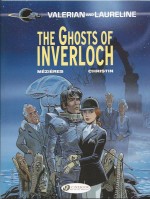
Valerian and Laureline volume 11: the Ghosts of Inverloch


By Méziéres & Christin, with colours by E. Tranlé; translated by Jerome Saincantin (Cinebook)
ISBN: 978-1-84918-263-8

Valérian: Spatio-Temporal Agent debuted in weekly Pilote #420 (9th November 1967) and was an instant smash-hit. The feature soon became Valérian and Laureline as his feisty distaff sidekick quickly developed into an equal partner – if not scene-stealing star – through a string of fabulously fantastical, winningly sly and light-hearted time-travelling, space-warping romps.

Packed with cunningly satirical humanist action, challenging philosophy and astute political commentary, the stellar yarns struck a chord with the public and especially other creators who have been swiping, “homaging” and riffing off the series ever since.

Initially Valerian was an affably capable yet unimaginatively by-the-book space cop tasked with protecting the official universal chronology (at least as it affects humankind) by counteracting and correcting paradoxes caused by incautious time-travellers.

When he travelled to 11th century France in debut tale Les Mauvais Rêves (Bad Dreams and still not yet translated into English), he was rescued from doom by a tempestuously formidable young woman named Laureline whom he had no choice but to bring back with him to Galaxity: the 28th century super-citadel and administrative capital of the Terran Empire.

The indomitable female firebrand crash-trained as an operative and accompanied him on subsequent missions – a beguiling succession of breezy, space-warping, social conscience-building epics. This so-sophisticated series always had room to propound a satirical, liberal ideology and agenda (best summed up as “why can’t we all just get along?”), constantly launching telling fusillades of commentary-by-example to underpin an astounding cascade of visually appealing, visionary space operas.

This eleventh Cinebook translation – beginning another multi-album epic – is especially significant. Each Valérian adventure was first serialised in Pilote before being collected in book editions, but after this adventure – which concluded in The Rage of Hypsis (January 1st – September 1st 1985) the publishing world shifted gears. From the next tale and every one thereafter, the mind-bending sagas were released as all-new graphic novels. The switch in dissemination affected all popular French comics characters and almost spelled the end of periodical comics publication on the continent…

(One clarifying note: in the canon, “Hypsis” is counted as the twelfth tale, due to the collected albums being numbered from The City of Shifting Waters: the second actual story but the first to be compiled in book form. When Bad Dreams was finally released as a European album in 1983, it was given the number #0.)

Les Spectres d’Inverloch originally appeared in then-monthly Pilote (#M110-117, spanning July 1983 to February 1984) and opens here as Laureline enjoys the comforts of a palatial manor in Scotland, somewhere at the tail end of the 20th century. Unflappable dowager Lady Charlotte is the most gracious host and is happy to share all the benefits of life in Clan McCullough, even though her young charge can’t help but wonder why she has to cool her heels with the old biddy in this odd time and place…

Once again the Spatio-Temporal partners-in-peril are separated by eons and light years. Valerian is at the other end of everything: impatiently stuck on water-world Glapum’t, trying to capture a hulking aquatic beast who easily defies his every stratagem. Finally, once brute, force, commando tactics and super-science have all proved ineffectual, the frustrated agent tries bribery. Naturally, the tasty morsels he offers are heavily drugged…

However, as he carries the second phase of his orders, a real problem crops up. Valerian can’t establish contact with Galaxity…

Far ago and elsewhere, London is enduring a paralysing wave of industrial actions. The strikes are particularly galling to volubly affable, infuriatingly unrushed and always tardy Mr. Albert. Galaxity’s 20th century information gatherer/sleeper operative is trying to get to Scotland, but wonders if he’s ever going to get out of the English capital…

On far-flung Rubanis, dictatorial secret police chief Colonel Tlocq is having a duel of wits with the engagingly ruthless data-brokers known as the Shingouz. Naturally, the spymaster is utterly outmanoeuvred by the devious little reptiles who gleefully take off with the secret they required. All-in-all, they are rather enjoying working for Earth…

Way back in West Virginia, Lady Charlotte’s husband Lord Seal is consulting with the CIA. The dapper Briton is a past master of “tradecraft” and remains unperturbed even after reviewing the terrifying situation facing both the Communist Bloc and Free World. Something is making all persons in charge of nuclear weapons – politicians and military alike – go mad. There have been numerous near-misses and even a couple of swiftly hushed-up actual disasters on both sides of the Iron Curtain. Moreover, the Americans have got hold of strange little devices used to cause the insanity. Somebody is deliberately trying to spark atomic Armageddon…

Only the veteran spy’s swift actions prevent the entire assembly going the same way, when a concealed insanity-gadget goes off during their top-secret meeting…

As Seal jets off home, the scene switches to Galaxity. The super-city, impregnable bastion of human dominance, is deserted. Only its supreme master remains, and as the fortress and Terran empire start dissolving into nothingness he makes a desperate jump into time…

On a clear autumn afternoon, Lady Charlotte and Laureline are enjoying the view from Castle Inverloch’s rear windows when the immaculate, lovingly-manicured-for-centuries lawns are wrecked by the crash-landing of a Shingouz shuttle. Naturally, the visitors are granted every gracious vestige of hospitality, even after Lord Seal arrives in flamboyantly bombastic fashion and sees his beloved grass…

Aplomb and grace under pressure alone cannot account for the elderly couple’s acceptance, and when Albert pops in and Valerian shows up – much to the detriment of what remains of the lawns – it becomes clear that the elderly gentry know much more about the workings of the universe than everybody else in this century…

Even the previously-captive Glapumtian – who likes to be called “Ralph” – has a part to play in the baffling, pre-ordained proceedings.

What exactly that means starts to become clear after Lord and Lady Seal introduce their outré guests to the legendary ghost of Inverloch. Valerian usually just calls him “boss”…

Soon the Spatio-Temporal Agents are being made painfully aware of a monumental threat to the universe which has already unmade the events leading to the birth of Galaxity and the Terran Empire and which now poses a threat to all that is…

To Be Concluded…

Smart, subtle, complex and frequently hilarious, this sharp trans-time tale beguilingly lays the groundwork for an epic escapade. This is one of the most memorable romps Méziéres & Christin ever concocted, and heralded the start of a whole new way to enjoy the future…
© Dargaud Paris, 1983 Christin, Méziéres & Tran-Lệ. All rights reserved. English translation © 2016 Cinebook Ltd.

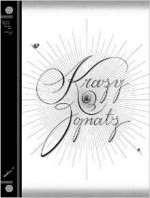
Krazy & Ignatz volume 1 1916-1918: Love in a Kestle or Love in a Hut


By George Herriman, edited by Bill Blackbeard (Fantagraphics Books)
ISBNs: 978-1-60699-316-3

I must admit to feeling like a fool and a fraud reviewing George Herriman’s winningly surreal masterpiece of eternal unrequited love. Although Krazy Kat is unquestionably a pinnacle of graphic innovation, a hugely influential body of work which shaped the early days of the comics industry and a paragon of world literature, some readers – from the strip’s earliest antecedents in 1913 right up to five minutes ago – just cannot “get it”.

All those with the right sequence of genes (“K”, “T”, “Z” and “A”, but not, I suspect “Why”) are lifelong fans within seconds of exposure whilst those sorry few oblivious to the strip’s inimitable charms are beyond anybody’s meagre capacity to help.

Still, since every day there’s newcomers to the wonderful world of comics I’ll assume my inelegant missionary position once more and hope to catch and convert some fresh souls – or, as today’s indisputable pictorial immortal might put it, save some more “lil Ainjils”…

Krazy Kat is not and never has been a strip for dull, slow or unimaginative people who simply won’t or can’t appreciate the complex multilayered verbal and pictorial whimsy, absurdist philosophy or seamless blending of sardonic slapstick with arcane joshing. It is the closest thing to pure poesy that narrative art has ever produced.

Think of it as a visual approximation of Dylan Thomas and Edward Lear playing “I Spy” with James Joyce amongst beautifully harsh and barren cactus fields whilst Gabriel García Márquez types up the shorthand notes and keeps score…

George Herriman was already a successful cartoonist and journalist in 1913 when a cat and mouse who had been cropping up in the corners and backgrounds of his outrageous domestic comedy strip The Dingbat Family/The Family Upstairs finally graduated to their own feature.

Krazy Kat the strip debuted in William Randolph Hearst’s New York Evening Journal on October 28th 1913 and, mainly by dint of the publishing magnate’s overpowering direct influence, spread throughout his vast stable of papers.

Although Hearst and a host of the period’s artistic and literary intelligentsia (which included Frank Capra, e.e. Cummings, John Alden Carpenter, Gilbert Seldes, Willem de Kooning, H.L. Mencken and Jack Kerouac) utterly adored the strip, many local editors -ever-cautious of the opinions of the hoi-polloi who actually bought newspapers – did not, and took every career-threatening opportunity to eject it from the comics section.

Eventually the feature found a home in the Arts and Drama section of Hearst’s vast empire of periodicals. Protected by the publisher’s patronage, the strip flourished unharmed by editorial interference and fashion, running until Herriman’s death in April 1944.

The basic premise of the eccentric enterprise is simple: in an arid, anthropomorphic region of America bordering the mighty Rio Grande dwells Krazy; an effeminate, dreamy, sensitive and romantic feline of indeterminate gender, in uncompromising total love with rude, crude, brutal, mendacious and thoroughly scurrilous, married-with-children (so very many children) bad boy Ignatz Mouse.

Ignatz is a real Man’s Muridae; drinking, stealing, cheating, carousing, neglectful of his spouse and progeny. He revels in spurning Krazy’s genteel advances by regularly, repeatedly and obsessively belting the cat with a well-aimed and mightily thrown brick (obtained singly or in bulk, generally by legitimate purchase from noted local brickmaker Kolin Kelly).

The third member of the classic eternal triangle is lawman Offissa Bull Pupp, hopelessly in love with Krazy, well-aware of the Mouse’s true nature, but bound by his own timidity and sense of honour from removing his rival for the cat’s affections. Krazy is, of course, blithely oblivious of Pupp’s true feelings and dilemma…

Also populating the dusty environs are a stunning supporting cast of inspired anthropomorphic bit players such as Joe Stork, (deliverer of babies), the hobo Bum Bill Bee, larcenous Don Kiyoti, busybody Pauline Parrot, Walter Cephus Austridge, Chinese mallard Mock Duck, Joe Turtil and a host of other audacious characters – all capable of stealing the limelight and even supporting their own features.

The episodes occur in and around the Painted Desert environs of Coconino (based of the artist’s vacation retreat Coconino County, Arizona) and the surreal playfulness and fluid ambiguity of the flora and landscapes are perhaps the most important members of the cast.

These strips are a masterful mélange of wickedly barbed contemporary social satire, folksy yarn-telling, unique experimental art, strongly referencing Navajo art forms and sheer unbridled imagination and delightfully expressive language: alliterative, phonetically and even onomatopoeically joyous and compellingly musical (“He’s simpfilly wondafil”, “A fowl konspirissy – is it pussible?” or “I nevva seen such a great power to kookoo”), yet for all that these adventures are timely, timeless, bittersweet, self-referential, fourth-wall bending, eerie, idiosyncratic and utterly hilarious escapades encompassing every aspect of humour from painfully punning shaggy dog stories to riotous silent-movie slapstick.

The Krazy & Ignatz series of collected Sunday pages was originally contrived by Eclipse Comics and the Turtle Island Foundation and taken over by Fantagraphics when the first publisher succumbed to predatory market conditions in the 1990s. Through diligence and sheer bloody determination matching Hearst’s own, the series was finally completed in 2015.

After years of scarily hand-to-mouth publishing, the entire Katty canon of magnificent Sunday pages has been collected in fabulous compilations and this first colour and monochrome volume opens with ‘And the First Shall Be the Last: A History of Kat Reprints’ and A Word from the Publisher by Kim Thompson delineating at length the eccentric orbit which finally resulted in Herriman’s masterpiece being collected in a complete, uniform, visually stunning 13 volume edition.

That’s followed by ‘The Kat’s Kreation’ from series Editor Bill Blackbeard; a fulsome, fascinating and heavily illustrated history tracing the development of the frankly freakish feline as briefly outlined above, and ‘Before He Went “Krazy”: George Herriman’s Aughts’, offering a liberal sampling of examples of the cartoonists many pre-Coconino strips and features such as ‘Lariat Pete’, ‘Bud Smith, the Boy Who Does Stunts’, ‘Rosy’s Mama’, ‘Zoo Zoo… (Goes Shopping, Entertains, And the Christmas Pie)’, ‘Alexander’ and ‘Daniel and Pansy’, spanning 1903 to 1909, with many sporting a certain prototype mad moggy in the corners…

From there it’s a short hop to the first cautious yet full-bodied escapades from 1916, delivered every seven days from April 23rd to December 31st.

Within that first year, as war raged in Europe and with America edging inexorably closer to the Global Armageddon, the residents of Coconino sported and wiled away their days in careless abandon but totally embroiled within their own – and their neighbours’ – personal dramas.

Big hearted Krazy adopts orphan kitties, accidentally goes boating and ballooning, saves baby birds from predatory mice and rats, survives pirate attacks, constantly endures assault and affectionate attempted murder and does lots of nothing in an utterly addictive, idyllic and eccentric way.

…And gets hit with bricks. Many, heavy and always evoking joyous, grateful raptures and transports of delight from the heart-sore hard-headed recipient…

In 1917 (specifically January 7th to December 30th), the eternal game played out as usual and with an infinite variety of twists, quirks and reversals. However there were also increasingly intriguing diversions to flesh out the picayune proceedings, such as recurring explorations of terrifying trees, grim ghosts and obnoxious Ouija Boards, tributes to Kipling as we discover why the snake rattles, meet Ignatz’s aquatic cousin, observe an invasion of Mexican Jumping Beans and a plague of measles, discover the maritime value of “glowerms”, learn who was behind a brilliant brick-stealing campaign of crime and at last see Krazy become the Bricker and not Brickee…

Fully in control of his medium, Herriman switched into poetic high gear as America finally entered the Great War in 1918.

With strips running from January 6th to December 29th, uncanny brick apparitions scotched somebody’s New Year’s resolutions, cantankerous automobiles began to disrupt the desert days, fun of a sort was had with boomerangs and moving picture mavens began haunting the region. There were deeply strange interactions with weather events, whilst music was made and occasional extended storylines began with the saga of an aberrant Kookoo Klock…

Surreal voyages were undertaken but over and again it was seen that there is literally no place like Krazy and Ignatz’s home. There was only one acknowledgement of Kaiser Bill and it was left to the missile-chucking mouse to deliver it…

And then it was Christmas and a new year and volume lay ahead…

To complete the illustrious experience and explore the ever-shifting sense of reality amidst the constant display of visual virtuosity and verbal verve this big, big book (305 x 230 mm and superbly designed by Chris Ware) ends with rare and informative bonus material such as ‘A Genius of the Comic Page’: a contemporaneous appreciation and loving deconstruction of the strip – with new illustrations from Herriman – by the astoundingly perspicacious and erudite critic Summerfield Baldwin taken from Cartoons Magazine and an oddly enigmatic biography of the reclusive creator in ‘George Herriman 1880-1944′ by Bill Blackbeard.

‘The Ignatz Mouse Debaffler Page’ then closes the show, providing pertinent facts, snippets of contextual history and necessary notes for the young and potentially perplexed…

Herriman’s epochal classic is a genuine Treasure of World Art and Literature. These strips shaped our industry, galvanised comics creators, inspired auteurs in fields as disparate as prose fiction, film, sculpture, dance, animation and jazz and musical theatre whilst always delivering delight and delectation to generations of devoted, wonder-starved fans.

If however, you are one of Them and not Us, or if you actually haven’t experienced the gleeful graphic assault on the sensorium, mental equilibrium and emotional lexicon carefully thrown together by Herriman from the dawn of the 20th century until the dog days of World War II, this glorious parade of cartoon masterpieces are your last chance to become a human before you die…

That was harsh, I know: not everybody gets it and some of them aren’t even stupid or soulless – they’re just unfortunate…

Still, There Is A Heppy Lend Furfur A-Waay if only you try to see…
© 2010 Fantagraphics Books. All rights reserved.