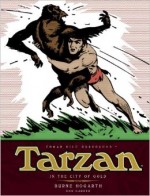
Tarzan in the City of Gold (The Complete Burne Hogarth Comic Strip Library volume 1)


By Burne Hogarth and Don Garden (Titan Books)
ISBN: 978-1-78116-317-7

Modern comics and graphic novels evolved from newspaper comic strips.

These daily pictorial features were – until very recently – extremely popular with the public and highly valued by publishers who used them as a powerful weapon to guarantee and even increase circulation and profits. From the earliest days humour was paramount; hence the terms “Funnies” and of course, “Comics”.

Despite the odd ancestor or precedent like Roy Crane’s Wash Tubbs (comedic when it began in 1924, but gradually moving through mock-heroics to light-action and becoming a full-blown adventure serial with the introduction of Captain Easy in 1929, the vast bulk of strips produced were generally feel-good humour strips with the occasional child-oriented fantasy.

The full blown adventure serial started with Buck Rogers – which began on January 7th 1929 – and Tarzan (which debuted the same day). Both were adaptations of pre-existing prose properties and their influence changed the shape of the medium forever.

The 1930s saw an explosion of action and drama strips launched with astounding rapidity and success. Not just strips but actual genres were created in that decade which still impact on not just today’s comic-books but all our popular fiction.

In terms of sheer quality of art, the adaptations of Edgar Rice Burroughs’ novels starring jungle-bred John Clayton, Lord Greystoke by Canadian commercial artist Harold “Hal” Foster were unsurpassed, and the strip soon became a firm favourite of the reading masses, supplementing movies, books, a radio show and ubiquitous advertising appearances.

As fully detailed in Tarzan historian and author Scott Tracy Griffin’s informative overview ‘Burne & Burroughs: The Story of Burne Hogarth and Edgar Rice Burroughs’, Foster initially quit the strip at the end of the10-week adaptation of Tarzan of the Apes. He was replaced by Rex Maxon, but returned (at the insistent urging of Edgar Rice Burroughs) when the black-&-white daily was expanded to include a lush, full colour Sunday page of new tales.

Leaving Maxon to capably handle the Monday through Saturday series of novel adaptations, Foster produced the Sunday page until 1936 (233 weeks) after which he momentously moved to King Features Syndicate to create his own landmark weekend masterpiece Prince Valiant in the Days of King Arthur – which debuted on February 13th 1937.

Once the four month backlog of material he had built up was gone, Foster was succeeded by a precociously brilliant 25-year old artist named Burne Hogarth: a young graphic visionary whose superb anatomical skill, cinematic design flair and compelling page composition revolutionised the entire field of action/adventure narrative illustration.

The galvanic modern dynamism of the idealised human figure in comicbooks can be directly attributed to Hogarth’s pioneering drawing and, in later years, educational largesse.

When he in turn finally left the strip Hogarth eventually found his way into teaching (he was the co-founder – with Silas H. Rhodes – of the Cartoonist and Illustrators School for returning veterans which evolved into the New York School of Visual Arts) and produced an invaluable and inspirational series of art textbooks such as Dynamic Anatomy and Dynamic Figure Drawing, which influenced a generation of aspiring and wannabe pencillers. I can see my own well-worn copies from where I sit typing this.

In the early 1970s Hogarth was lured back to the leafy domain of the legendary Lord Greystoke, producing two magnificent volumes of graphic narrative in the dazzling style that had captivated audiences more than thirty years previously. The large bold panels, vibrantly coloured, with blocks of Burroughs’ original text, leapt out at the reader in a riot of hue and motion as they retold the triumphant, tragic tale of the orphaned scion of the British nobility raised to puissant manhood by the Great Apes of Africa in Tarzan of the Apes and The Jungle Tales of Tarzan.

Burroughs cannily used the increasingly popular strip feature to cross-market his own prose efforts with great effect. Tarzan and the City of Gold was first serialised in the pulp magazine Argosy in 1932 and released as book the following year. So by May 17th 1936, Hal Foster’s new and unconnected Tarzan in the City of Gold could be described as a brand new adventure on one hand, whilst boosting the already impressively constant book sales by acting as a subtle weekly ad for the fantastic fantasy novel.

As discussed and précised in ‘Hal Foster’s Tarzan in the City of Gold – the Story So Far’, the illustrator and regular scripter Don Garden’s final yarn began with the 271st weekly page and revealed how the incessantly wandering Ape-Man had stumbled upon a lost outpost built by ancient refugees from Asia Minor in a desolate region of the Dark Continent.

The city of Taanor was so rich in gold that the material was only useful for weather-proofing the roofs and domes of houses, but when white ne’er-do-wells Jim Gorrey and Rufus Flint discovered the fantastic horde they had marshalled a mercenary army, complete with tanks and aircraft, to conquer and plunder the lost kingdom.

Tarzan meanwhile had become the war-chief of noble King Dalkon and his beautiful daughter Princess Nakonia and was determined to use every trick and stratagem to smash the invaders…

After 51 weekly episodes of the epic, Foster was gone and we pick up the story of ‘Tarzan in the City of Gold’ (episodes #322-343, 9th May to October 3rd 1937) when the drama took a bold new direction as the embattled Jungle Lord led a slow war of attrition against would-be conquerors whilst simultaneously recruiting a bizarre battalion of beasts comprising apes, lions and elephants to convincingly crush the greedily amassed armaments of 20th century warfare with fang and claw, sinew and muscle…

In those halcyon days the adventure was non-stop and, rather than cleanly defined breaks, storylines flowed one into another. Thus, Tarzan allowed the victorious Taanorians to believe he had perished in battle and journeyed to familiar territory, revisiting the cabin where he had been born and the region where he was raised by the she-ape Kala – stopping to punish a tribe of natives hunting and tormenting his old family/band of apes before Hogarth’s first full epic really began.

‘Tarzan and the Boers Part I’ (pages #344-377; 10th October 1937 – 29th May 1938) found the erstwhile Greystoke lured to the assistance of the duplicitous chieftain Ishtak who craved the Ape-Man’s assistance in repulsing an “invasion” by white pioneers from South Africa.

It wasn’t too long however before Tarzan discovered that Ishtak was playing a double game: having sold the land in question to the families led by aged Jan Van Buren, the avaricious king intended to wipe them out and keep his tribal territories intact…

When Tarzan discovered the plot he naturally sided with the Boers and, over many bloody, torturous weeks, helped the refugees survive Ishtak’s murderous campaign of terror and eventually establish a sound, solid community of honest farmers…

When Hogarth first took over the strip he had used an affected drawing style which mimicked Foster’s static realism, but by the time of ‘Tarzan and the Chinese’ (#378-402, 5 June – 20th November 1938) he had completed a slow transition to his own tautly hyper-kinetic visual methodology which perfectly suited the electric vitality of the ever-onrushing feature’s exotic wonder.

Here, after leaving the new Boer nation Tarzan founded a vast, double-walled enclosure and ever curious, climbed into a fabulous hidden kingdom populated by the descendents of imperial Chinese colonists.

Once again he was happily in time to prevent the overthrow of the rightful ruler: firstly by rebels and bandits, then a treacherous usurper and latterly by invading African tribesmen, before slipping away to befriend another tribe of Great Apes and be mistaken for an evolutionary missing link by Professor John Farr in ‘Tarzan and the Pygmies’ (#403-427, 27th November 1938 – 14th May 1939).

However, the scientist’s nefarious guide Marsada knew exactly who and what the Ape-Man was and spent a great deal of time and efforts trying to kill Tarzan, who had destroyed his profitable poaching racket years before and, most infuriatingly, had caught the passionate fancy of Farr’s lovely daughter Linda…

Following an extended clash with actual missing links – a mountain tribe of primitive, bestial half-men – Tarzan and Linda fell into the brawny hands of magnificent (white) tree-dwelling viragos who all wanted to mate with a man who was their physical equal. The trials and tribulations of ‘Tarzan and the Amazons’ (#428-437, 21st May-23rd July 1939) only ended when the jungle Adonis faked his own death…

All these relatively aimless perambulations took the hero again to the young homeland of his Afrikaans friends and ‘Tarzan and the Boers Part II’ (#438-477, 30th July 1939-28th April 1940) found him perfectly matched against a cunning and truly monstrous villain named Klaas Vanger.

This wandering diamond hunter had discovered a mother-lode of gems on Jan Van Buren’s farm and, after seducing his way into the family’s good graces by romancing impressionable daughter Matea, he tried to murder them all. When this didn’t work Vanger instigated another war between the settlers and the natives; meanwhile absconding with a cache of diamonds and massacring a tribe of baboons befriended by Tarzan…

These vile shenanigans led to a horrific boom town of greedy killers springing up on the Boers’ lands, leading Tarzan, baby baboon Bo-Dan and hulking tongue-tied lovelorn farmhand Groot Carlus to take a terrible and well-deserved vengeance on the money-crazed monster and his minions whilst rescuing the crestfallen Matea from the seducer’s vile clutches…

Edgar Rice Burroughs was a master of populist writing and always his prose crackled with energy and imagination. Hogarth was an inspired intellectual and, as well as gradually instilling his pages with ferocious, unceasing action, layered the panels with subtle symbolism. Even the vegetation looked spiky, edgy and liable to attack at a moment’s notice…

His pictorial narratives are all coiled-spring tension or vital, violent explosive motion, stretching, running, fighting: a surging rush of power and glory. It’s wonderful that these majestic exploits are back in print – especially in such a lavish and luxurious oversized (330 x 254mm) hardback format – even if only to give us comic lovers and other couch potatoes a thorough cardio-vascular work-out…

Beautifully rendered and reassuringly formulaic these masterful interpretations of the utterly authentic Ape-Man are a welcome addition to any comics’ connoisseurs’ cupboard and you would be crazy not to take advantage of this beautiful collection; the first in a proposed Complete Burne Hogarth Comic Strip Library.
Tarzan ® &© 2014 ERB, Inc. All Rights Reserved. All images copyright of ERB, Inc 2014. All text copyright of ERB, Inc 2014.
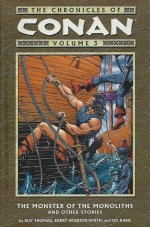
Chronicles of Conan volume 3: The Monster of the Monoliths and Other Stories


By Robert E. Howard, Roy Thomas, Barry Windsor-Smith, Gil Kane & various (Dark Horse Books)
ISBN: 978-1-59307-024-3

During the 1970’s the American comic book industry opened up after more than fifteen years of cautious and calcified publishing practises that had come about as a reaction to the censorious oversight of the self inflicted Comics Code Authority. This body was created to keep the publisher’s product wholesome after the industry suffered their very own McCarthy-style Witch-hunt during the 1950s.

One of the first genres revisited was Horror/Mystery comics and from that came the pulp masterpiece Conan the Cimmerian, via a little tale called ‘The Sword and the Sorcerers’ in anthology Chamber of Darkness #4 (April 1970), whose hero Starr the Slayer bore no little thematic resemblance to the Barbarian. It was written by Roy Thomas and drawn by Barry Smith, a recent Marvel find, and one who was just breaking out of the company’s still-prevalent Kirby house-style.

Despite some early teething problems – including being cancelled and reinstated in the same month – the comic-strip adventures of Robert E. Howard’s brawny warrior were as big a success as the revived prose paperbacks which had heralded a world flowering in tales of fantasy and the supernatural.

This third Dark Horse volume collects #14-15 and #17 through 21 of the monthly Marvel Conan the Barbarian comic-book, covering March to December 1972 (a period when the character was swiftly becoming the darling of the Comics world), and features two creators riding the crest of that creative wave.

Moreover the masterful storytelling is enhanced by a rich new colouring make-over that does much to enhance Smith’s ever-evolving intricate and meticulous art style, meaning work which was crafted for a much more primitive reproduction process is now full-bodied, substantial and beguilingly lush.

The fabulous fantasy opens with a tempestuous transatlantic team-up as Conan meets Michael Moorcock’s groundbreaking Elric of Melniboné in a two part tale freely adapted by Thomas, Smith & Sal Buscema from a treatment by the exceedingly English cult author and his frequent collaborator James Cawthorn.

Elric is a landmark of the Sword and Sorcery genre: last ruler of a pre-human civilization. The denizens of Melniboné are a race of cruel, arrogant sorcerers: dissolute creatures in a slow, decadent decline after millennia of dominance over the Earth.

An albino, Elric VIII, 428th Emperor of his line, is physically weak and of a brooding, philosophical temperament, caring for nothing save his beautiful cousin Cymoril, even though her brother Prince Yrrkoon openly lusts for her and his throne.

Elric doesn’t even really want to rule, but it is his duty, and he is the only one of his race to see the newly evolved race of Man as a threat to the Empire. He owns – or is possessed by – a black sword called Stormbringer: a magical blade which sucks out the souls of its victims and feeds their force and vitality to the albino.

His life is all blood and tragedy, exacerbated by his despised dependence on the black sword and his sworn allegiance to the chimerical Lord of Chaos Arioch…

Heady stuff for those simpler comicbook times: the White Wolf was the complete antithesis of roistering lusty, impetuous Conan, who was drawn into a trans-dimensional conflict when he rescued old associate Zephra from a pack of marauding Chaos Warriors in ‘A Sword Called Stormbringer!’

The comely wench was the daughter of Zukala: a wizard who strangely bore no animosity towards the barbarian youth who shattered his power and maimed his face the last time they clashed. In fact the mage wanted to hire Conan to stop rival wizard Kulan Gath from rousing a sleeping demon queen from another realm…

The promise of much gold convinces the normally magic-avoiding warrior to accept the commission and soon he and Zephra are riding hard for the lake beneath which Terhali of Melniboné lies, but they are unaware that Xiombarg, Queen of Swords (and rival Lord of Chaos) has despatched her own warriors to intercept them…

As they near the haunted mere the humans meet a gaunt, eerie albino with his own reasons for seeking out Terhali.

After a violent misunderstanding Conan and Elric call a suspicious truce, intent on stopping Kulan Gath, his patron Xiombarg and a small army of Chaos killers, but once the unlikely trio of world savers reach the submerged city of Yagala, they find that ‘The Green Empress of Melniboné!’ is wide awake and intent on making her own apocalyptic mark on the Hyborian Age…

It takes the callous intervention of Arkyn, Lord of Order and the willing sacrifice of Zephra to end the emerald menace and the heartsick heroes part; each riding towards his own foredoomed destiny…

As revealed in detail in Thomas’ informative ‘Behind the Swords’ Afterword, ‘The Gods of Bal-Sagoth’ was created after Barry Smith resigned – citing the punishing deadlines and poor reproduction values of the now monthly title – whereafter a frantic scrabble for a replacement happily brought forth avid RE Howard fan Gil Kane, who lent his galvanic dynamism to a stunning 2-part adaptation of a prose short story originally starring Celtic adventurer Black Turlogh O’Brien…

Inked by Ralph Reese the tale began as Conan clashed again with former foe and current pirate chief Fafnir, before the ship they rode in foundered in a storm.

The only survivors, Cimmerian and Vanirman washed ashore on a mist-enshrouded island and fell into a savage power struggle between ambitious castaway Kyrie – who claimed to be the incarnation of goddess Aala – and High Priest Gothan who ruled the oldest kingdom in the world through sorcery and his puppet king Ska…

Now the faux deity utilised an ancient prophecy concerning two warriors from the sea to make her play, but only slaughter and cataclysm awaited after the insurgency released ‘The Thing in the Temple’ (inked by Dan Adkins)…

Clearly refreshed and re-inspired, Smith returned with #19 to begin the magnum opus of the early Conan canon as the Cimmerian and Fafnir, only survivors of drowned Bal-Sagoth, were picked up and pressed into service with the invasion fleet of a power-hungry prince…

Developed and adapted from Howard’s lost historical classic The Shadow of the Vulture, the War of the Tarim was a bold epic that embroiled our young wanderer in a Holy War between the city-state of Makkalet and expansionist Empire of Turan, led by the ambitious Prince Yezdigerd, who would become a bitter, life-long enemy of our sword-wielding swashbuckler.

‘Hawks of the Sea’ opens slowly as the outlanders learn the ostensible reason for the conflict – the stealing of the current fleshly receptacle of the Living God Tarim – but soon kicks into high gear when Yezdigerd’s initial beachhead in Makkalet is repulsed by sorcery. Only Conan’s inimitable prowess and ingenuity allows the survivors to escape back to the relative safety of their ships…

In the next instalment the Cimmerian is part of a commando raid to steal back the man-god and meets a “temple-wench” who turns out to be the city-state’s embattled queen. However the mission goes bloodily awry when Machiavellian high priest Kharam-Akkad unleashes the citadel’s ‘Black Hound of Vengeance!’

Barely surviving the beast’s fury, Conan returns to Yezdigerd’s flagship where, upon discovering what the invaders have done with their own burdensome wounded, he maims the Turanian prince and jumps ship…

The story element of this epic volume ends with ‘The Monster of the Monoliths!’ (heroically inked by Adkins, P. Craig Russell, Val Mayerik & Sal Buscema) as Conan, at risk of his life, defects to the side of besieged Makkalet and is promptly commissioned by ineffectual King Eannatum to ride through the lines with a small company of men to seek allies and assistance amongst the Queen’s noble but distant family.

Little does he realise that’s he’s been designated a worthwhile and expendable sacrifice for an arcane antediluvian horror from beyond the mortal realms… but then again little does the loathsome travesty of nature understand the nature of the man it’s being offered…

Augmented by Thomas’s insightful observations and intriguing reminiscences, this rousing, evocative, beautiful and deeply satisfying collection is a superb slice of savage escapism that any red-blooded, action-starved armchair adventurer would kill for, and these re-mastered issues are a superb way to enjoy some of American comics’ most influential – and enjoyable – moments. They certainly deserve a prized place on your bookshelf.
©1972, 2003 Conan Properties International, LLC. All Rights Reserved.

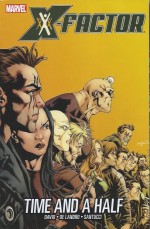
X-Factor volume 7: Time and a Half


By Peter David, Valentine De Landro, Marco Santucci & various (Marvel)
ISBN: 978-0-7851-3836-5

Since its debut in 1982, X-Factor has been a splendidly effective umbrella title for many uniquely off-kilter iterations of Marvel’s mutant phenomena. Perhaps the most impressive and enduring was created by writer Peter David in 2006; mixing starkly violent suspense with cool detective mystery, laugh-out-loud comedy, fantastic Fights ‘n’ Tights action and even slyly addressing social issues in a regular riot of superbly adult Costumed Drama.

The abiding premise saw Jamie Madrox, the Multiple Man and veteran of the formerly government-sponsored (and controlled) team appropriating the name for his own specialist metahuman private detective agency: X-Factor Investigations.

Setting up shop in the wake of “The Decimation” which had reduced the world’s mutant population to a couple of hundred empowered individuals and millions of distressingly humanised (ex) Homo Superior, he and his perpetually fluctuating team began by trying to discover why and how it had happened…

What We Already Knew: crossover event House of M saw reality overwritten when mutant Avenger Scarlet Witch had a mental breakdown, changing history and reality so that mutantkind out-competed base-line humans, droving “sapiens” to the brink of extinction.

It took every hero on Earth, a huge helping of luck and a strange little girl named Layla Miller to correct that situation… but in the aftermath, the abhorred inheritor species had been winnowed to less than 200 super-powered souls …

This temporally-twisted tome collects X-Factor volume 3 #39-45 (April-October 2009) and opens with the long awaited birth of Jamie and Theresa “Siryn” Cassidy‘s child: the result of a drunken debauch both barely recall and are deeply ashamed of…

Madrox and Co. had relocated to scenic Detroit to avoid interference from old boss and Office of National Emergency bureaucrat Valerie Cooper but she and her Federal flunkies had pursued, and in a tense confrontation with the mum-to-be and former mutant Julio Richter (AKA Rictor) shots had been fired.

Cooper was wounded but Theresa trumped that by going into labour…

Scripted throughout by David, the adventure continues with ‘Multiple Birth’ – illustrated by Valentine De Landro & Craig Yeung – as Jaime joins still-a-mutant Theresa in the hospital just in time for her contractions to trigger her shattering sonic scream…

Following a difficult birth via C-section, everything seems under control and Madrox takes time to visit Cooper, fitfully recuperating after being shot by her own guards. He’s almost forgiven her for threatening to impound the baby when it was born…

Heading back to Theresa and his new son Sean Madrox is utterly unaware of what horror and tragedy are… until he picks up his boy and is helpless to prevent the infant from being reabsorbed into his body.

The baby is gone: never more than the progeny of one of his body duplicates.

Shocked, reeling and feeling like he’s eaten his baby, Jamie barely registers the beating the hysterical Theresa delivers before collapsing…

Madrox’s duplicates are autonomous facsimiles of him. Often displaying one particular aspect of his emotional makeup they can live their own lives for years… until he touches them and they are reabsorbed whether they want to be or not.

Being self-aware, some abscond, never wanting to come back and “die”.

Such a one became priest John Maddox and ‘Slings and Arrows’ (inked by Pat Davidson) opens with him acting as a negotiator in a tense convenience store hostage situation. Unfortunately, one of the captives is a bearded, bedraggled and utterly broken Jaime Madrox who defuses the scenario in a most unlikely manner before stalking the priest home to the wife and kids. In a terse and despondent conversation the Multiple Man ponders how a shallow facsimile can excel at everything his progenitor sucks at before telling Maddox of how another “Dupe” and little Layla Miller disappeared into a hostile future… and only the copy ever returned.

He knows all it about only because when he reabsorbed the clone, he took on all its memories… as well as the disturbing “M” eye-brand that denotes being a mutant in that sorry tomorrow…

Madrox’s real reason for the confessional confrontation comes with a warning that Maddox’s kids might not be all they seem. After wearily incapacitating the priest who mastered living better than he, Jamie puts a gun to his own tired, tortured head…

He is only saved by a nun walking in and telling him he’s not going to die.

She might be a grown woman now, but Layla Miller still “knows stuff”: after all, isn’t it her mutant power?

The time-bending madness resumes in ‘Back and There Again’ (De Landro, Marco Santucci, Davidson) as the happy reunion stalls when Jamie realises she’s just a projection asking him to rejoin him the future. Reluctantly he agrees, completely missing the gun-toting goon creeping up on him…

Elsewhere, brittle Theresa takes over at X-Factor Investigations, taking on a stalking case for frightened ex-mutant Lenore Wilkinson. She’s convinced someone is trying to kill her and delighted that de-powered “Rictor” and especially the astoundingly attractive Longshot are going to be watching over her…

Back at the church the thug has opened fire on Jamie, but when the detective turns the table on his would-be killer the assassin ends himself whilst uttering the word “cortex”…

Next thing Jamie knows, it’s the future and a colossal Sentinel is trying to kill both him and Layla…

In the now and all at sea, Guido “Strong Guy” Carosella, super-woman Monet St. Croix – AKA “M” – and new recruit Armando Muñoz or Darwin are enjoying themselves chasing down operatives of the Karma Project; a gang of science renegades who captured and experimented on the ever-evolving latter mutant.

Back in the future though there’s no fun to be found when Jamie meets Ruby Summers and finds himself neck-deep in another war against Homo Superior…

De Landro, Santucci, Davidson, Patrick Piazzalunga & Yeung all pitch in to illustrate #42 as Lenore makes a move on the naive and credulous Longshot whilst Guido and Rictor go looking for Jamie but find John Maddox instead…

Eighty years later the object of their search is coming to terms with the new normal as Ruby and Layla explain what “The Summers Rebellion” is and how he can help them not lose it, even as more death-laden Sentinels scream into the attack…

In old Detroit Val Cooper finally gets her meeting with Theresa as future mutants Hecat’e and Daemon overcome the artificial assassins attacking Jamie, whilst the real trans-time menace is making his move against Longshot and Lenore…

‘Timely Events’ finds Darwin stumbling into a hit on Lenore, helping save the victim from being killed by her own mind-controlled mother, whilst in the future Madrox is reunited with elderly mutant legend Scott Summers.

Somehow the doom-drenched Cyclops has survived every grim trial and tribulation, fathered generations of kids and is even now still fighting for his embattled species. Things don’t look so rosy in the past however as Guido and Rictor are stonewalled in their search for Jamie, and increasingly strange events are occurring around Darwin, Longshot and Lenore…

Madrox knows nothing about any of it: he’s helplessly falling for and sucking face with the aggravatingly annoying Layla in a world that makes less and less sense every minute. For a start the always dismissive Scott trusts him to be a detective and discover how and why people are disappearing and rematerialising with no memory of the act, whilst simultaneously blaming the temporally shanghaied Jamie for making the future the way it is…

In a Detroit hospital the guys have called in Monet to scan the mind of Lenore’s comatose mum but the procedure goes terribly wrong when M herself is taken over. Attacking Longshot and Darwin she utters the name “Cortex”…

Back at the church Rictor and Guido are similarly inconvenienced when team mate Shatterstar tries to kill them, incoherently mumbling the same word…

‘Dirty, Sexy Monet’ opens in the future where Jamie and Layla’s relationship deepens and the detective suggests a possible solution Cyclops doesn’t want to hear, whereas in the then-and-now M apparently regains her senses and loses her morals.

As the future mutants reluctantly follow Madrox’s advice and consult a super-genius, in the past M is back to normal-ish but incomprehensibly choosing to dress like a tart as she sensibly transfers the embattled XF guys and terrified Lenore to a safe house. Once there, however, she plies the client with booze until she conks out before making a flagrant pass at wide-eyed innocent Darwin…

Only when Monet strips off to reveal a body totally infected by technoid mechanisms does he realise that Cortex never really lost control of her…

This emphatically, wonderfully bewildering collection concludes with a bang as – in the world that’s coming – Madrox, Layla and Ruby consult the aged and senile Victor Von Doom about their recurring reality problems, whilst in the past crafty, craven Cortex overextends himself simultaneously mentally manipulating Shatterstar and Monet to kill their comrades.

As Dr. Doom tantalises with possible solutions to the time-based crisis brewing, Future America’s President ponders the cost of sending Cortex back to pre-emptively deal with X-Factor and foolishly intervenes before the chronal killer can complete his mission, giving Shatterstar an opportunity to shrug off the mind-control and prove his loyalty to his team mates in a most unconventional, if not shocking, manner…

To Be Continued…

Complex, compelling, compulsive and always maturely hilarious in a way most adult comics just aren’t, X-Factor is a splendid example of Fights ‘n’ Tights fantasy for everyone who needs wit to underpin their superhero soap opera shenanigans, and this volume also includes a cover gallery by Mike McKone, David Yardin & & Nathan Fairbairn and a selection of Shatterstar design sketches by Valentine De Landro.
© 2009 Marvel Characters, Inc. All Rights Reserved.

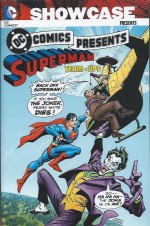
Showcase Presents DC Comics Presents Superman Team-up volume 2


By Gerry Conway, Len Wein, Martin Pasko, Roy Thomas, Paul Levitz, Jim Starlin, Curt Swan, José Luis García-López, Rick Buckler, Irv Novick, Kurt Schaffenberger, Joe Staton & various (DC Comics)
ISBN: 978-1-4012-4048-6

From the moment a kid first sees his second superhero the only thing he/she wants is to see how the new gaudy gladiator stacks up against the first. From the earliest days of the funnybook industry (and, according to DC Comics Presents editor Julie Schwartz, it was the same with the pulps and dime novels that preceded it) we’ve wanted our entertainment idols to meet, associate, battle together – and, if you follow the Timely/Marvel model, that means against each other – far more than we want to see them trounce their archenemies together…

The concept of team-up books – an established star pairing or fighting (usually both) with less well-selling company characters – was far from new when DC awarded their then biggest gun (it was the publicity-drenched weeks before the release of Superman: the Movie, and Tim Burton’s Batman was over a decade away) a regular arena to have adventures with other stars of their firmament, just as Batman had been doing since the middle of the 1960s in The Brave and the Bold.

Actually the Man of Steel had already embraced the regular sharing experience at the beginning of the decade when World’s Finest Comics briefly ejected the Caped Crusader and Superman battled beside a coterie of heroes including Flash, Robin, Martian Manhunter, Teen Titans, Dr. Fate and others (WF #198-214, November 1970 to October/November 1972) before the immortal status quo was re-established.

This second stout and superbly economical monochrome collection re-presents DC Comics Presents #27-50 and the first Annual (spanning November 1980 to October 1982) of the star-studded monthly, and opens the show with a trilogy of interlinked thrillers.

Unlike The Brave and the Bold, which boasted a regular artist for most of its Batman-starring team-up run, a veritable merry-go-round of creative talent contributed to DCCP and #27 proved the value of such tactics when Len Wein, Jim Starlin, Dick Giordano & Frank McLaughlin collaboratively changed the shape of Superman mythology by introducing alien marauder Mongul in ‘The Key that Unlocked Chaos!’

The deposed despot of a far away planet kidnapped Lois Lane, Jimmy Olsen and Steve Lombard to force Superman to attack former JLA member J’onn J’onzz. This was because the Martian Manhunter had successfully driven off the rapacious fiend when he attacked New Mars in search of an artefact that would grant the possessor control of the universe’s most terrible weapon…

Now Mongul wanted the Man of Steel to get it for him and, although the resulting planet-shaking clash between old allies did result in the salvation of his friends, Superman subsequently failed to keep the crystal key out of the villain’s gigantic hands…

The tale continued in #28 as Supergirl joined her Kryptonian cousin in scouring the cosmos for the vanished tyrant and ancient doom weapon ‘Warworld!’ (Wein, Starlin & Romeo Tanghal).

Unfortunately, once they found it, Mongul unleashed all its resources to destroy his annoying adversaries and in the resultant cataclysm the mobile gun-planet was demolished. The resultant detonation blasted Kara Zor-El out of existence…

The triptych concluded a month later as The Spectre intervened to stop the heartsick Man of Tomorrow following his cousin ‘Where No Superman Has Gone Before!’ Happily after the customary clash of egos and flexing of muscles the nigh-omnipotent Ghostly Guardian set things right and restored the lost girl to the land of the living…

Courtesy of Gerry Conway, Curt Swan & Vince Colletta, DC Comics Presents #30 saw Black Canary plagued by nightmares starring her deceased husband, but upon closer investigation Superman showed that the diabolical Dr. Destiny was behind ‘A Dream of Demons!’, whilst in ‘The Deadliest Show on Earth!’ (Conway, José Luis García-López & Giordano) Man of Steel and original Robin, the Teen Wonder Dick Grayson conclusively crushed a perfidious psychic vampire predating the performers at the troubled Sterling Circus…

Wonder Woman spurned amorous godling Eros in #32’s ‘The Super-Prisoners of Love’ (Conway, Kurt Schaffenberger & Colletta) leading to the frustrated brat using his arrows to make her and Superman fall passionately in lust. It took the intervention of goddess Aphrodite and a quest into the realms of myth to set their head and hearts aright again…

Conway, Roy Thomas, Rich Buckler & Giordano then began a 2-part epic in DCCP #33 as ‘Man and Supermarvel!’ found the Action Ace and Captain Marvel helplessly swapping powers, costumes and Earths, thanks to the mirthless machinations of Fifth dimensional imp Mr. Mxyzptlk and malevolent alien worm Mr. Mind.

Despite the intervention of Mary Marvel and Captain Marvel Junior in the next issue the villains’ sinister manipulations allowed antediluvian revenant King Kull to become ‘The Beast-Man that Shouted “Hate” at the Heart of the U.N.!’ (Thomas, Buckler & Giordano). The consequent battle across myriad dimensions only went the heroes’ way after they stumbled upon the garish homeworld of Lepine Avenger Hoppy the Captain Marvel Bunny…

Some semblance of sanity returned in #35 as Superman and Man-Bat hunted for ‘The Metamorphosis Machine!’ (Martin Pasko, Swan & Colletta) which might save Chiropterist Kirk Langstrom‘s baby daughter from death. All they had to do was beat murderous maniac Atomic Skull and his minions to the device…

Paul Levitz & Starlin then revealed ‘Whatever Happened to Starman?’ as Mongul turned his nefarious attention to Gavyn, ruler of a distant alien empire and a stellar powered crusader. After snatching the monarch’s beloved Merria, Mongul tried to take over the masked hero’s interplanetary empire but was thwarted again by the timely arrival of the Man of Steel and the vengeful fury of the Starman…

Hawkgirl got a rare chance at some solo action in #37 as ‘The Stars Like Moths…’ (Thomas & Starlin) saw the Thanagarian cop-turned-archaeologist uncover an ancient Kryptonian vault, solve a baffling mystery that had vexed the House of El for generations and save its last son from the dimensional doom which killed Superman’s great-grandfather…

DC Comics Presents #38 united the Man of Steel and The Flash as an extra-dimensional tyrant attempted to foment a high velocity war between Earth’s fastest heroes in ‘Stop the World – I Want to Get Off Go Home!’ (Pasko & Don Heck), after which #39 catapulted Superman into the weirdest case of his career as he and Plastic Man trailed ‘The Thing That Goes Woof in the Night!’ (Pasko, Joe Staton & Bob Smith) to a Toymakers Convention where third-rate super-villains Fliptop and Dollface were trying to rob freshly reformed, barely recovering maniac Toyman…

In DCCP #40 Metamorpho the Element Man seemed to be the logical culprit for uncanny disasters occurring on ‘The Day the Elements Went Wild!’ (Conway, Irv Novick & McLaughlin), but when Superman tried to bring him in the real menace proved to be the least likely person possible…

In #41, ‘The Terrible Tinseltown Treasure-Trap Treachery!’ (Pasko, García-López & McLaughlin) proved that the Man of Tomorrow’s powers were no match for the lethal Hollywood hi-jinks perpetrated by The Joker and Prankster as they callously duelled for the props and effects of a dead comedy legend…

Immortal espionage ace and unsung war hero The Unknown Soldier haunted the shadows of issue #42, subtly guiding Superman towards saving Earth from imminent nuclear Armageddon in ‘The Specter of War!’ by Levitz, Novick & McLaughlin, whilst The Legion of Super-Heroes joined the Metropolis Marvel ‘In Final Battle’ against remorseless Mongul and his captive Sun-Eater in an all-action exploit by Levitz, Swan & Dave Hunt from DCCP #43.

Bob Rozakis, E. Nelson Bridwell, Novick & McLaughlin added to the ongoing mystery of New England town Fairfax, when Clark Kent was assigned to discover why so many heroes, villains and monsters appeared there. What Superman found was teenagers Chris King and Vicki Grant (who used mysterious artefacts to Dial “H” for Hero and transform into most of the Fairfax freak and champion community) under attack by ‘The Man Who Created Villains!’

Firestorm the Nuclear Man stole the show in #45 as Conway, Buckler & Smith teamed him and the Man of Steel against terrorist Kriss-Kross who took over the nation’s electronic military defences to implement ‘The Chaos Network’, after which international heroes united as The Global Guardians at the command of enigmatic Doctor Mist to defeat a coalition of magic foes and prevent the resurrection of ‘The Wizard Who Wouldn’t Stay Dead!’ (Bridwell, Alex Saviuk & Pablo Marcos).

A franchising bonanza occurred in DC Comics Presents #47 as Superman met the toy/cartoon sensations of Masters of the Universe: travelling to another dimension and aiding He-Man and his comrades against wicked Skeletor in the exceedingly kid-friendly yarn ‘From Eternia – with Death!’ by Paul Kupperberg, Swan & Mike DeCarlo.

Aquaman resurfaced in #48 seeking the Man of Tomorrow’s aid against a mysterious plague of sub-sea mutations, only to discover an alien wielding ‘Eight Arms of Conquest!’ (Dan Mishkin, Gary Cohn, Novick & McLaughlin), after which ‘Superman and Shazam!’ (Thomas, Kupperberg, Buckler & John Calnan) saw the immortal wizard enlist the Action Ace’s assistance to create a Captain Marvel for Earth -1.

When it didn’t work out the original had to step in from his own world to stop the depredations of devil-hearted Black Adam…

DC Comics Presents Annual #1 then reintroduced the world where good and evil are transposed as ‘Crisis on Three Earths!’ by Marv Wolfman, Buckler & Hunt saw the Supermen of Earth-1 and Earth-2 again thrash their respective nemeses Lex and/or Alexei Luthor only to have the villains flee to another universe…

In Case You Were Wondering: soon after the Silver Age brought back an army of costumed heroes, ‘Flash of Two Worlds’ (Flash #123 September 1961) introduced alternate Earths to the continuity which resulted in the multiversal structure of the DCU, Crisis on Infinite Earths and all succeeding cosmos-shaking crossover sagas since.

During a benefit gig Flash (police scientist Barry Allen) accidentally slipped into another dimension where he discovered the 1940s comicbook hero upon whom he’d based his own superhero identity actually existed.

Every adventure he’d avidly absorbed as an eager child was grim reality to Jay Garrick and his mystery-men comrades on the controversially named Earth-2. Locating his idol, Barry convinced the elder to come out of retirement just as three vintage villains Shade, Thinker and the Fiddler made their own wicked comeback…

The story generated an avalanche of popular and critical approval (big sales figures, too) so after a few more trans-dimensional test runs the ultimate team-up was delivered to slavering fans. ‘Crisis on Earth-One’ (Justice League of America #21, August 1963) and ‘Crisis on Earth-Two’ (in #22) became one of the most important stories in DC history and arguably one of the most important tales in American comics.

When ‘Flash of Two Worlds’ introduced the concept of Infinite Earths and multiple heroes to the public, pressure had begun almost instantly to bring back the actual heroes of the “Golden Age”. Editorial powers-that-be were hesitant, though, fearing too many heroes would be silly and unmanageable, or worse yet put readers off. If they could see us now…

Most importantly there was no reason to stop at two Earths.

Justice League of America #29-30 featured Crisis on Earth-Three’ and ‘The Most Dangerous Earth of All!’ which reprised the team-up of Justice League and Justice Society of America, when the super-beings of yet another alternate Earth discovered the secret of multiversal travel.

Unfortunately Ultraman, Owlman, Superwoman, Johnny Quick and Power Ring were super-criminals on a world without heroes and they saw the costumed champions of the JLA and JSA as living practise dummies to sharpen their evil skills upon.

With this cracking two-part thriller the annual summer team-up became solidly entrenched in heroic lore, giving fans endless joys for years to come and making the approaching end of school holidays less gloomy than they could have been…

Back at the DCCP annual, the vanished Luthors reappeared on Earth-3 and began trans-dimensional attacks on their arch enemies: even tentatively affiliating with Ultraman of the Crime Syndicate of Amerika, whilst treacherously planning to destroy all three Earths…

This potential cosmic catastrophe prompted the brilliant and noble Alex Luthor of Earth-3 to abandon his laboratory, turn himself into his world’s very first superhero and join the hard-pressed Supermen in saving humanity three times over…

This power-packed black and white compilation concludes with the anniversary DC Comics Presents Annual #50 wherein ‘When You Wish Upon a Planetoid!’ (Mishkin, Cohn, Swan & Schaffenberger) saw a cosmic calamity split Superman and Clark Kent into separate entities…

Designed as introductions to lesser known DC stars, these tales are wonderfully accessible to newcomers and readers unfamiliar with the minutia of burdensome continuity and provide an ideal jumping on point for anybody who just wants a few moments of easy comicbook fun and thrills.

These short, pithy adventures are a perfect shop window for DC’s fascinating catalogue of characters and creators; delivering a breadth and variety of self-contained, exciting and satisfying entertainments ranging from the merely excellent all the way to utterly indispensable, making this book the perfect introduction to the DC Universe for every kid of any age and another delightful slice of ideal Costumed Dramas from simpler, more inviting times…
© 1980, 1981, 1982, 2013 DC Comics. All Rights Reserved.

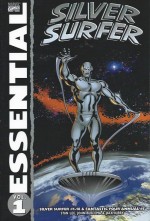
Essential Silver Surfer volume 1


By Stan Lee, John Buscema, Jack Kirby & various (Marvel)
ISBN: 978-0-7851-2008-7

Although pretty much a last minute addition to Fantastic Four #48-50’s ‘Galactus Trilogy’, Jack Kirby’s scintillating creation the Silver Surfer quickly became a watchword for depth, allegory and subtext in the Marvel Universe and a character Stan Lee kept as his own personal toy for many years.

Tasked with finding planets for space god Galactus to consume, and despite the best efforts of intergalactic voyeur Uatu the Watcher, one day the Silver Surfer discovered Earth, where the latent nobility of humanity reawakened his own suppressed morality; causing the shining scout to rebel against his master and help the FF save the world.

In retaliation, Galactus imprisoned his one-time herald on Earth, making him the ultimate outsider on a planet remarkably ungrateful for his sacrifice.

The Galactus Saga was a creative highlight from a period where the Lee/Kirby partnership was utterly on fire. The tale has all the power and grandeur of a true epic and has never been surpassed for drama, thrills and sheer entertainment. It’s not included here: for that treat you’ll need to see Essential Fantastic Four volume 3 or many other Marvel collections…

In 1968, after increasingly frequent guest-shots and even a solo adventure in the back of Fantastic Four Annual #5 (thankfully included at the back of this tome), the Surfer finally got his own (initially double-sized) title. This occurred at the time when Marvel had finally escaped from a draconian distribution deal which limited the company to 16 titles per month.

That change resulted in a huge expansion in output which also saw Iron Man, Captain America, The Hulk, Sub-Mariner, Doctor Strange, Nick Fury and Captain Marvel all explode into their own titles.

This stunning and economical monochrome chronicle collects the entire 18 issue run of the Soaring Skyrider’s controversial first solo series as well as the aforementioned vignette from FF Annual #5 spanning November 1967 1968 to September 1970 and naturally enough begins with begins with ‘The Origin of the Silver Surfer!’ by Lee, John Buscema & Joe Sinnott who, after a prolonged flashback sequence and repeated examples of crass humanity’s brutal callousness and unthinking hostility, detailed how Norrin Radd, discontented soul from an alien paradise named Zenn-La, became the gleaming herald of a terrifying planetary scourge.

Radd had constantly chafed against a civilisation in comfortable, sybaritic stagnation, but when Galactus shattered their vaunted million years of progress in a fleeting moment, the dissident offered himself without hesitation as a sacrifice to save his world from the Devourer’s hunger.

Converted into an indestructible gleaming humanoid meteor Radd agreed to scour the galaxies looking for (preferably uninhabited) worlds rich in the energies Galactus needed to survive, thus saving planets with life on them from destruction. Sadly, he didn’t always find them in time…

The stories in this series were highly acclaimed – if not commercially successful – both for Buscema’s agonised, emphatic and stunningly beautiful artwork as much as Lee’s deeply spiritual and philosophical scripts; with the isolated alien’s travails and social observations creating a metaphoric status akin to a Christ-figure for an audience that was maturing and rebelling against America’s creaking and unsavoury status quo.

The second 40 page adventure detailed a secret invasion by extraterrestrial lizard men ‘When Lands the Saucer!’, forcing the Surfer to battle the sinister Brotherhood of Badoon without human aid or even awareness in ‘Let Earth be the Prize!’…

A little side-note for sad nit-picking enthusiasts like me: I suspect that the original intention was to drop the page count to regular 20-page episodes from #2, since in terms of pacing both the second and third issues divide perfectly into regular 2-parters, with cliffhanger endings and splash page/chapter titles that were dropped from #4 onwards.

Silver Surfer #3 was pivotal in the ongoing saga as Lee & Buscema introduced Marvel’s Satan-analogue in ‘The Power and the Prize!’

Mephisto back then was the one-and-only Lord of Hell and saw the Surfer’s untarnished soul as a threat to his evil influence on Earth. To crush the anguished hero’s spirit the demon abducted Radd’s true love Shalla Bal from still-recovering Zenn-La and tormented the Sentinel of the Spaceways with her dire distress in his sulphurous nether-realm…

The concluding chapter saw the alien but mortal angel of light and undying devil of depravity conduct a spectacular ‘Duel in the Depths’ wherein neither base temptations nor overwhelming force were enough to stay the noble Surfer’s inevitable triumph.

Just as wicked a foe then attempted to exploit the Earth-bound Surfer’s heroic impulses in #4’s ‘The Good, The Bad and the Uncanny!’ (inked by new art collaborator Sal Buscema) wherein Asgardian God of Evil Loki offered lies, deceit and even escape from Galactus’ terrestrial cage to induce the Silver Stalwart to attack and destroy the Mighty Thor.

The scheme resulted in a shattering, bombastic clash that built and built as the creative team finally let loose and fully utilised their expanded story-proportions and page count to create a smooth flowing all-action epic.

The tragedy of strictly human prejudice and bigotry was then highlighted in a powerful parable about race, ignorance and shared humanity when the Surfer was befriended by ostracised and sidelined black physicist Al Harper in ‘…And Who Shall Mourn Him?’

As the two outcasts bonded the scientist realised he might have a way to free the Surfer from his Galactine incarceration, but as they put their plan into operation remorseless alien entity The Stranger turned up, determined to erase the potential threat mankind offered to the rest of the universe.

To stop him both Harper and Radd had to sacrifice everything they cherished most for a world that didn’t care if they lived or died…

‘World Without End!’ in issue #6 embraced dystopian fantasy as the Surfer reasoned that by breaking the time barrier he might escape the energy shield binding him to Earth. Tragically, although the plan worked, the lonely wanderer discovered that the far future held little life, and what there was owed fealty and its own precarious continuation to a monstrous mutant who lived simply to conquer and kill.

Appalled, overwhelmed and utterly unable to beat the horrific Overlord, all Norrin could do to preserve life in Creation was escape back into time and try to prevent the murderous freak from ever being born…

Times and tastes were slowly changing and by the August 1969 release of Silver Surfer #7 the Comics Code injunctions against horror stories were being eroded away. Thus ‘The Heir of Frankenstein!’ and his misshapen but noble assistant Borgo debuted to terrorise their small Balkan community and tap into the growing monster movie zeitgeist of the era. The last maniac of a sullied line of scientists wanted to outdo his infamous ancestor and achieved his aim by his tricking the Skyrider into becoming the victim of a deadly duplication experiment.

As a result the Silver Surfer had to battle a cosmic-fuelled facsimile with all his power but none of his noble ideals or merciful intentions…

Despite some truly groundbreaking comics creativity the Silver Surfer remained a disappointing seller and with #8 (September 1969) the title was reduced to a standard 20 page story format and boosted to monthly frequency in an attempt to bolster and build on the regular readership.

With Dan Adkins lavishly inking John Buscema, Lee’s stories also became more action-adventure and less contemporary Passion Play, with ‘Now Strikes the Ghost’ bringing back Mephisto to further plague and imperil the shining sentinel by resurrecting and augmenting the tortured spectre of cruel and callous mariner Captain Joost Van Straaten, promising that phantom eternal peace in return for crushing Norrin Radd.

The Lord of Lies’ sinister scheme ‘…To Steal the Surfer’s Soul!’ concluded in #9 when the hero’s compassion trumped the tormented Flying Dutchman‘s greed and Mephisto’s satanic lust for victory, after which events took another convoluted turn for the solitary starman…

In ‘A World He Never Made!’ Shalla Bal hitched a ride with ambitious and lustful Zenn-Lavian Yarro Gort, who had built a starship to ferry her to Earth and prove he was a more worthy paramour than the long-gone Norrin Radd.

Her silver-metal lover meanwhile had again attempted to integrate with humanity, becoming embroiled in a South American war and saving dedicated rebel Donna Maria Perez from the marauding soldiers of sadistic dictator El Capitan. When the freedom fighter thanked him with a kiss, Gort made sure his ship’s scanners picked up the gesture for Shalla’s benefit…

Issue #11 then saw the sleek star-craft shot down by El Capitan’s forces and Gort join the dictator to build world-conquering weaponry. The combined villains were still no match for the Surfer’s fury, however, but Radd’s joy at being reunited with his true love was quickly crushed when Shalla was gravely injured and he had to despatch her back beyond Galactus’ barrier to be healed in ‘O, Bitter Victory!’

In Silver Surfer #12 Lee, Buscema and Adkins mixed a few genres as ‘Gather Ye Witches!’ found a British coven accidentally summoning gamma-ray mutation the Abomination from exile on a far planet rather than a supernatural slave from Hell and leaving the Skyrider no choice but to battle the brute through the ruins of London, whilst ‘The Dawn of the Doomsday Man!’ in the following issues saw seemingly repentant scientist Dr. Kronton implore the Surfer to destroy an apparently unstoppable killer robot stored in a US military bunker.

The sinister savant only wanted the trusting alien to give him access to a prototype Cobalt bomb, but their unwise invasion triggered the assassin automaton’s awakening anyway…

With sales still falling #14 saw the creative team resort to team-up tactics and ‘The Surfer and the Spider!’ detailed how a typical Marvel misunderstanding led a fighting mad and humiliated Spider-Man to repeatedly attack the gleaming extraterrestrial, accidentally endangering a young boy in the process…

A similar misunderstanding in ‘The Flame and the Fury!’ pitted an angry and distrustful Surfer against former ally the Human Torch, when Norrin Radd misconstrued a military request for aid as a betrayal. The shock and shame left the humbled exile easy prey when a wicked devil hungry for the Surfer’s soul resurfaced in #16’s ‘In the Hands… of Mephisto!’

Inked by Chic Stone, the tale revealed how the tempter abducted the now-healed Shalla Bal from Zenn-La and forced his anguished target to betray his principles to ensure her safety. The saga concluded in ‘The Surfer Must Kill!’ when the vile seducer ordered his victim to destroy peacekeeping espionage force S.H.I.E.L.D., and clandestinely hid the Surfer’s beloved amidst the agents, intending that she die by her oblivious lover’s cosmic-powered hand…

Happily the scheme was foiled, though more by luck than intent, and the poor lass was apparently returned home, but the Surfer’s fate was not so fortunate.

With nothing else working to boost sales, Marvel’s miracle worker returned to his creation but it was too late. Silver Surfer #18 (September 1970) featured ‘To Smash the Inhumans!’ by Lee, Jack Kirby & Herb Trimpe and saw the puzzled, embattled alien philosopher overtaken with rage against all humanity after surviving a misguided attack by Black Bolt and the warriors of hidden city Attilan.

However the “Savagely Sensational New Silver Surfer” promised at the end of that unfinished tale was never seen. Kirby was on his way to DC to create his magnificent Fourth World Trilogy and the bean counters at the House of Ideas had already decreed the Skyrider’s publishing demise.

He vanished into the Limbo of fond memory and occasional guest-shots which afflicted so many costumed characters at the beginning of the 1970s, making way for a wave of supernatural heroes and horrors that capitalised on the periodic revival of interest in magic and mystery fare. It would 1981before Norrin Radd would helm his own title again…

That’s not quite the end of this spectacular monochrome tome, however. As well as information pages starring the Surfer and Mephisto culled from the ever-informative Marvel Universe Handbook, this compulsive comicbook chronicle concludes with the eventful and groundbreaking vignette from Fantastic Four Annual #5 – released in November 1967 – wherein the rapidly rising star-in-the-making got his first solo shot.

‘The Peerless Power of the Silver Surfer’ by Lee, Kirby & Frank Giacoia is a pithy fable of cruel ingratitude that reintroduced the Mad Thinker‘s lethal A I assassin Quasimodo…

The Quasi-Motivational Destruct Organ was a malevolent murder machine trapped in a static computer housing which dreamed of being able to move within the real world. Sadly, although its pleas initially found favour with the gullibly innocent stranger from the stars, the killer computer itself had underestimated the power and conscience of its foolish saviour and the gleaming guardian of life was explosively forced to take back the boon he had impetuously bestowed in a bombastic and bravura display of Kirby action and Lee pathos…

The Silver Surfer was always a pristine and iconic character when handled well – and sparingly – and these early forays into a more mature range of adventures, although perhaps a touch heavy-handed, showed that there was far more to comicbooks than cops and robbers or monsters and misfits.

That exploratory experience and mystique of hero as Christ allegory made the series a critically beloved but commercially disastrous cause celebre until eventually financial failure killed the experiment.

After the Lee/Kirby/Ditko sparks had initially fired up the imaginations of readers in the early days, the deeper, subtler overtones and undercurrents offered by stories like these kept a maturing readership enthralled, loyal and abidingly curious as to what else comics could achieve if given half a chance. This fabulously engaging Essential compilation offers the perfect way to discover or recapture the thrill and wonder of those startlingly different days and times.
© 1967, 1968, 1969, 1970, 2005 Marvel Characters, Inc. All rights reserved.

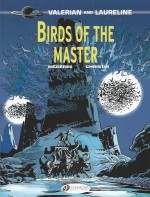
Valerian and Laureline volume 5: Birds of the Master


By Méziéres & Christin, with colours by J. Goffard and translated by Jerome Saincantin (Cinebook)
ISBN: 978-1-84918-152-5

Valérian is the most influential straight science fiction comics series ever drawn – and yes, that includes even Buck Rogers, Flash Gordon, Dan Dare and Judge Dredd.

Although to a large extent those venerable strips defined or re-defined the medium itself, anybody who has seen a Star Wars movie or that franchise’s overwhelming tsunami of homages, pastiches and rip-offs has been exposed to substantial doses of Jean-Claude Méziéres & Pierre Christin’s brilliant imaginings (which the filmic phenomenon has shamelessly plundered for decades): everything from the character and look of alien races and cultures to the design of the Millennium Falcon and even Leia‘s Slave Girl outfit …

Simply put, more humans have experienced and marvelled at the uniquely innovative, grungy, lived-in authentic futurism and light-hearted swashbuckling rollercoaster romps of Méziéres & Christin than any other cartoon spacer.

Valérian: Spatio-Temporal Agent launched in the November 9th 1967 edition of Pilote (#420) and was an instant hit. In 1977 the fervour surrounding Greg & Eddy Paape’s Luc Orient and Philippe Druillet’s Lone Sloane, combined with Valérian’s popularity, led to the creation of adult graphic sci-fi blockbuster Métal Hurlant.

Valérian and Laureline (as the series became) is a light-hearted, wildly imaginative time-travelling, space-warping fantasy steeped in wry, satirical, humanist action and trenchant political commentary, starring – in the early days at least – an affable, capable yet unimaginative by-the-book cop tasked with protecting the official universal chronology by counteracting paradoxes caused by incautious time-travellers.

When Valérian travelled to 11th century France in the initial tale Les Mauvais Rêves (‘Bad Dreams’ and still as yet unavailable in English), he was rescued from doom by a fiery, capable young woman named Laureline whom he brought back to 28th century Galaxity: super-citadel and administrative capital of the Terran Empire,.

The indomitable lass subsequently trained as a Spatio-Temporal operative and began accompanying him on all his missions.

Every subsequent Valérian romp was initially serialised weekly until the 13th ‘The Rage of Hypsis’ concluded, after which further yarns were solely published as all-new graphic novels. Tragically the whole spectacular saga resolved and ended in 2010.

Birds of the Master originally ran in Pilote #710-720 (June 14th to September 16th 1973) and follows the constantly bickering couple as they are drawn into an eerie space Sargasso and marooned on a planetoid that has become a cemetery for spaceships.

Swept away by a tidal wave over a colossal waterfall, they are drowning amidst beds of kelp when a motley band of fisherfolk – comprised of many different species – haul the Spatio-Temporal agents aboard a ramshackle boat. In the skies high above, a vast cloud of malevolent birds circle, the same incredible creatures which had brought down their astroship.

Compelled to join in gathering the seaweed, they soon learn that the crop is destined for a mysterious unseen overlord dubbed The Master and the critically circling ugly avians are his enforcers: violent creatures that inflict madness with a bite…

The workers are nothing but slaves and bitterly discontented recent arrival Sül takes it upon himself to teach Valerian and Laureline what they need to know to stay alive as the cargo is torturously shipped across the bleak, unforgiving and forlorn terrain. As they go they observe an entire society all dedicated to providing vast amounts of food for the hidden overlord.

At the central gathering point where assorted food items from a hundred different sources are reduced to a liquid mass dubbed “Klaar” one of the starving toilers cracks, seeking to consume a morsel of the Master’s provender, and is immediately set upon by the Birds of Madness. Furious Sül breaks too and, dashing to the worker’s aid, is also attacked. Cautious Valerian can barely stop his partner using her concealed ray-weapons in a futile attempt to save them…

When the Birds are done the battered survivors can barely speak and one believes he can fly whilst Sül is left a babbling, aggressive shadow of his former self.

With the Klaar safely dispatched through a complex system of pipes to a distant hidden destination, the emaciated workers fall upon the spilled scraps before hurling the latest victims of the birds into the Pit of Crazies. Despite being thoroughly beaten in the melee, our heroes follow and join Sül in a peculiar enclave of deranged beings, each manifesting their own brand of bewilderment but all sharing the same strange and disturbing speech impediment…

Valerian and Laureline are again viciously attacked when they seek aid from the “sane” slaves so instead opt to follow the pipeline with the most ambulatory of the insane, heading deep into increasingly inhospitable country to confront the hidden cause of all their woes.

At first frantically followed by the outraged slave force, the strange crew eventually outdistance their pursuers as they continue deep into the harsh and barren wastelands until they are attacked by the ever-circling birds. As a result the Spatio-Temporal agents are also infected by the speech-wrecking madness…

Pressing on regardless, the raving rovers follow an eerie glowing mist and at last face the appalling and hideous creature which has lured, trapped and enslaved so many sentient beings, only to be subjected to an overwhelming psychic assault that no single mind – sane or otherwise – could resist.

Happily, it had never faced anyone as ingenious as Laureline and her desperate plan enables the assembled “Loonies” to fight back and drive the Master off-planet and into the depths of space…

With the creature’s pernicious influence dispelled, the voyagers feel their senses returning and return to the settlements where the slaves have descended into a food-fuelled debauch. Surprisingly, however, once Valerian and Laureline have freed and repaired their astroship from the stellar graveyard, only Sül wants to leave with them…

Expansive, thrilling, funny, clever and holding back one last wry twist in the tale, The Birds of the Master might be one of the lesser galactic classics of this superb series, but it still packs a gripping narrative punch and some of the most impressive artwork ever to grace sci-fi comics.
© Dargaud Paris, 1973 Christin, Méziéres & Goffard. All rights reserved. English translation © 2013 Cinebook Ltd.

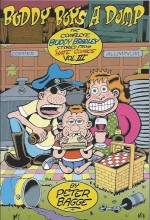
Buddy Buys a Dump: the Complete Buddy Bradley Stories from “Hate” volume III


By Peter Bagge with Joanne Bagge (Fantagraphics Books)
ISBN: 978-1-60699-745-1

Peter Bagge is best regarded these days as a fiery, cauldron-mouthed, superbly acerbic and well-established award-winning cartoonist, animator and musician, responsible for incredibly addictive, sharply satirical strips examining contemporary American life, through a small but memorable cast of sharply defined characters compellingly reflecting his views.

Born in Peekskill, Westchester County, New York in December 1957, he was one of four kids in a ferociously Catholic military family. Like esteemed colleague Robert Crumb a generation earlier, Bagge escaped that emotionally toxic, fight-filled environment as soon as possible, moving to New York City in the mid-1970s to study at the celebrated School of Visual Arts.

He soon dropped out and began working in the vibrant alternative publishing field, producing strips and panels for Punk Magazine, Screw, High Times, East Village Eye, World War Three and others.

Meeting like-minded artists he began self- and co-publishing comics, and when Crumb saw copies of Comical Funnies (produced with new chum John Holstrom in 1981 and the birthplace of the unsavoury star of this collection), Bagge was offered space in and eventually the Editorship of the seminal commix magazine Weirdo in 1983.

He augmented his 3-year tenure there with various paying gigs at Screw, Swank, Video X, Video Games Magazine, The Rocket, Bad News and elsewhere.

In 1984 Bagge relocated to Seattle, Washington State and began his association with alternative/Independent publisher Fantagraphics. The following year his spectacularly idiosyncratic cartoon magazine Neat Stuff launched as a thrice-yearly vehicle of outrageous personal expression and societal observation.

His stark, manic, topically surreal strips, starring old creations like Studs Kirby, Junior, Girly Girl and quintessential ineffectual rebel Buddy Bradley swiftly turned the cartoonist into a darling of the emerging West Coast Grunge scene, and before too long Neat Stuff and its successor Hate made Bagge a household name… at least in more progressive households…

As the 90’s became the next century, Bagge’s quasi-autobiographical Buddy starred in a succession of titles and strips (collected in Buddy Does Seattle and Buddy Does New Jersey); the cartoon character’s excitable existence mirroring typical life in that chaotic lost decade. In 2001 the author began releasing Hate Annuals wherein, amongst other strident graphic treats, middle-aging Buddy was seen having fully transitioned from angry teen slacker to working dad with a family to support…

This deliciously hilarious and painfully uncompromising full-colour collection gathers those traumatic middle years of Harold “Buddy” William Bradley Jr.– originally seen in Hate Annual #1-9, 2001-2011 – and opens with ‘Are You Nuts?’ as the irascible everyman is almost beguiled by crazy friend and occasional co-worker Jay Spano into buying a dilapidated aquabus and going into the guided-tour business in scenic New Jersey.

Naturally, his certifiably crazy wife Lisa has a few opinions on the matter…

A year later ‘A-Rod Goes to the Moon’ featured the catastrophic day when the Bradley women go for a “Ladies weekend” and leave Buddy in charge of not only his own baby boy, but sister Bab’s maladjusted brood. Soon however with half the kids in the neighbourhood tagging along, Buddy realises the depths of his folly and opts for a tried and true solution to his unwanted responsibilities…

‘The Domestication of Lisa Leavenworth-Bradley’ focuses on the little woman’s obsession with homemaking and search for a way to occupy her dull, dire days which translates to Buddy having to look for a better place for them to dwell, whilst in ‘Buddy Bradley gets a “Real” Job’ the old collectibles shop gets so stale that our hero takes gainful employment as a UPS delivery man.

However the shocking scams and appalling attitudes of his fellow honest workers soon drive him back to the relatively honourable profession of trading in junk, nostalgia and dreams…

‘Fuddy Duddy Buddy’ saw a drastic change in the visual aspect of the family man as, after a medical scare, he shaved his head, began sporting an eye-patch and took to wearing a naval captain’s cap. He also made a move to the nastier part of Jersey to fulfil his lifelong dream of running a rubbish dump…

With Lisa and toddler Harold safely if reluctantly ensconced in the big house attached to the tip, ‘Skeletons in the Closet’ then focuses on Buddy and Jay’s shift into the surprisingly lucrative scrap metal business, and the resurfacing of the most unsavoury of Buddy’s siblings and their childhood hoodlum friends. It seems folks are asking unwelcome questions about old Stinky Brown (a pal of Buddy’s who disappeared years ago), prompting gun-nut brother Butch Bradley and his cronies to move the body… but only finding that someone had already taken it…

‘The Future’s in Scrap!’ surprisingly finds Buddy and Jay prosperous if shabby partners in an exponentially expanding business, whilst ‘Lisa Leavenworth-Bradley Discovers her Creative Outlet’ details how the bored mother seeks out a fresh hobby and new friends only to finds herself embarrassingly embroiled in an all-girl band with strip club ambitions…

With things looking pretty sweet and stable in ‘Heaven’, the abrasive, raucous comedy takes a darkly observational turn in ‘Hell’ when Lisa drags the family back to Seattle to meet her ferociously religious mom and obnoxious dad.

It transpires that the parents she despises are both in dire health and legal straits and, after meeting her creepy fundamentalist foster brother and sex offender cousin, Buddy realises why his wife became the neurotic mess she is.

When Buddy and Harold return to the East Coast Lisa isn’t with them…

Everything wraps up without really ending in ‘Fuck it’ as, whilst Lisa struggles to cope with her folks’ decline in Seattle, back in the Garden State the man and his boy make big dramatic and definitely felonious changes to their lives…

Just like the eponymous star character, the hopefully still unfolding story of Buddy Bradley has slowly matured from razor-edged, broadly baroque, comedically clamorous observations and youthful rants into sublimely evocatively enticing treatises on getting by and getting older, although the deliciously fluid drawings and captivating cartoon storytelling remains as fresh and innovative as ever.

Bagge has always been about skewering stupidity, spotlighting pomposity and generally exposing the day-to-day aggravations and institutionalized insanities of modern life, but the strips in Buddy Buys a Dump also offer a beguiling view of passion becoming, if not wisdom, certainly shrewd appreciation of the unchanging verities of life: a treat no cartoon-coveting, laughter-loving rebel should miss…
© 2013 Peter Bagge. This edition © 2013 Fantagraphics Books. All rights reserved.

Wolverine: Killable


By Paul Cornell, Alan Davis, Mirco Pierfederici, Mark Farmer & Karl Kesel (Marvel/Panini UK)
ISBN: 978-1-84653-541-3

Perennially punching-above-his-weight, feral fury James Howlett, AKA Logan, AKA Wolverine has been many things in his very long life, but some of the most significant changes have only occurred in recent years.

Possibly the most significant new deal comes in this cruelly cutting collection written by Paul Cornell which was originally released as issues #7-13 of Wolverine volume 5 (cover-dated September 2013 to March 2014) and presaged a new look, new title and potentially new character to come…

At the conclusion of the previous saga the Canadian Crusader and a desperate coterie of S.H.I.E.L.D. agents had repulsed an invasion by a sentient virus from an incredible alien “microverse” which almost united humanity under one all-dominant intellect.

However, although Wolverine’s astounding healing factor had proven crucial in defeating the infective invasion, the defeated pathogenic plunderer had managed to turn off his mutant healing ability in the final encounter, leaving the formerly immortal warrior little more than a tough old guy with enhanced senses and really heavy metal bones…

Before this transformative  unfolds, ‘Mortal’ (illustrated by Mirco Pierfederici & Karl Kesel) describes how the barely recuperating James Howlett adapts to his new normal and realises for the first time just how much of his previous moment-to-moment existence revolved around instantly healing from everything ranging from a shaving cut to jumping off a building.

Now aging and feeling constant and protracted niggling pain, he realises he has to unlearn all the instincts and reactions of at least one lifetime. He simply cannot fathom how to continue as a hero and hunter, no matter how much advice is offered by the likes of sympathetic comrade warriors Nick Fury Jr., the Beast, Thor and Storm…

Rattled, unsure and perhaps afraid for the first time in his life, he doesn’t need the call to arms that comes when the news arrives that mutants and metahumans who can control viruses are being systematically murdered all over the planet…

Alan Davis & Mark Farmer return to illustrate the 6-part ‘Killable’ which begins as Wolverine sneaks a hand-picked team into African world power Wakanda, seeking to steal crazed criminal The Host from custody.

She is the last remaining being with the power to affect micro-organisms…

S.H.I.E.L.D. needs to confirm that the recently repulsed Virus has returned and may be controlling one of the most technologically advanced and paranoid nations on Earth but as Storm, Fury and unflappable surgeon Victoria Frankenstein (she pronounces it “Fronken-schteen”) spring the incarcerated metahuman, Wolverine is inevitably confronted by the lethally efficient Black Panther and is soon in a ferocious fight he can’t win.

With some relief he accepts a truce when the Feline Avenger offers it. It seems the Panther was well aware of the viral threat and was simply using the infiltration to make it tip its communal hand…

However even as the mission winds down Wolverine receives a shocking communication. Murderous mutant Mystique has invaded his home at the Jean Grey School for Higher Learning and threatened the students under his care…

By the time he reaches America it’s all over, but instead of killing kids the spitefully manipulative witch has simply trashed all his possessions and stolen his most treasured memento – an ancient Katana.

It doesn’t take much to deduce her motives. She’s messing with his head whilst issuing a challenge on behalf of her new boss Sabertooth…

Victor Creed is Wolverine’s most despised and tenacious foe, possessed of the same powers and skills he once boasted but now leader of a manic deviant sect of ninja cult The Hand…

Promising the assembled X-Men not to do anything stupid, Wolverine nevertheless sneaks off to track down Creed and his sword. He hasn’t fooled Kitty Pryde however and she follows him, even as elsewhere S.H.I.E.L.D. technos attempt to weaponise the furiously unstable Host in their plan to destroy the Virus which is slowly taking over the planet…

It’s clearly open season on Wolverine. En route to his rendezvous with Mystique his aircraft is blasted out of the sky by mercenary Batroc the Leaper who sees an easy chance to enhance his rep by killing the most infamous mutant on Earth. Instead the blistering battle only inspires Logan to some semblance of his former combative self. He and Kitty continue their pursuit of Creed’s creatures to Montana where another ambush – by acupuncture assassin Fiber – is narrowly circumvented, but not without more long-term damage to Wolverine’s ailing body…

The world is falling city by city to the Virus as The Host’s power slowly builds, and as she marshals her expanding resources she lets slip that only the microversial microbe monster could restore Wolverine’s healing factor…

Mystique’s trail leads to Alberta, Canada and a shopping mall built on the site of the estate where James Howlett was born in the 18th century. Wolverine’s birthplace seems like a suitably poetic venue for a final showdown, but the innocent bystanders still inside only add distraction and potential disaster to the mix.

Reluctantly enlisting the aid of local cops, Pryde and Wolverine search the near-deserted complex and are not surprised when the building goes into lockdown, trapping them in the dark with fanatical ninjas and a gauntlet of aggrieved old enemies including Lord Deathstrike and Silver Samurai.

The embattled mutants are also keenly aware that shapeshifting Mystique could be any one of their enemies… or allies…

And in the greater world S.H.I.E.L.D.’s latest data indicates that the Virus is only thirty minutes away from infecting the entire world’s population…

As Kitty and Wolverine battle for their lives in Canada, the hyper-energised Host is deployed to attack the Virus, but that means little to exhausted, punch-drunk, pushed beyond his limits Logan who abandons every vestige of humanity in his struggle to survive.

And when he is at his lowest ebb, Sabertooth attacks…

Beaten, crushed and demoralised, Wolverine lies bleeding on the floor as one of the bystanders approaches him.

The body is the last host of the defeated and globally retreating Virus. With no chance of victory it offers to restore his healing powers and return him to all he was if he will only offer it sanctuary…

As Wolverine sees another bizarre vision of the cosmic observer known as The Watcher (indicating that whatever is going on it’s of significance to the entire universe), he croaks “No”…

To Be Continued…

Non-stop visceral action and shocking suspense carry this explosive yarn from high-octane start to explosive finish and this gripping yarn also includes a beautiful gallery of covers and variants by Davis & Farmer, Matthew Waite, Leinil Francis Yu and David Lopez. Also upping the entertainment ante are the now-standard added extras provided by of AR icon sections (Marvel Augmented Reality App) which give access to story bonuses once you download the code – for free – from marvel.com onto your smart-phone or Android-enabled tablet.

™ & © 2013 and 2014 Marvel & Subs. Licensed by Marvel Characters B.V. through Panini S.p.A. All rights reserved. A British Edition published by Panini Publishing, a division of Panini UK, Ltd.

Superior Spiderman: the Superior Venom


By Dan Slott, Christos N. Gage, Humberto Ramos & Victor Olazaba, Javier Rodriguez & Álvaro López and various (Marvel/Panini UK)
ISBN: 978-1-84653-584-0

With this superb reinterpretation of the Amazing Arachnid iteration clearly approaching an ending or final resolution, the tension in this sublime series is again ratcheted up by scripter Dan Slott in The Superior Venom which collects issues #22-25 of Superior Spider-Man (4th September-13th November 2013) and Superior Spider-Man Annual #1.

Where Were You When…?: in an apocalyptic final battle Peter Parker apparently died and Doctor Otto Octavius took over his body. The hero’s mind had been imprisoned in the dying body of the super-villain where, despite his every desperate effort, at last Peter perished with and within that decrepit, expiring frame.

This left the coldly calculating Octopus permanently installed in the Wondrous Wallcrawler’s body and successfully living out Parker’s life, albeit with a few minor but necessary alterations, upgrades and improvements…

At first the situation did not seem utterly hopeless. As his foe exulted in triumph, Parker had inflicted his full unvarnished memories on the psychic invader, forcing unwary Otto to experience every ghastly moment of tragedy and sacrifice which combined to make Spider-Man the compulsive do-gooder that he was.

From that enforced emotional turmoil came a bitter understanding. Ock had a change of heart and swore to live the rest of his stolen life in tribute to his greatest enemy; earnestly endeavouring to carry on Spider-Man’s self-imposed mission, guided by Peter’s abiding principle: “with great power comes great responsibility”…

However Octavius’ ingrained monomania proved impossible to suppress and the usurper constantly toiled to prove himself the better man: augmenting Parker’s paltry gadgets and slapdash methodology with millions of spy robots to patrol the entire city at once, constantly adding advanced tech and refining new weaponry to the suit and even acting pre-emptively rather than merely reacting to crises as the original had…

Otto even took Parker’s frame back to college because he arrogantly refused to live life without a doctorate and even briefly tried to rekindle his new body’s old relationship with Mary Jane Watson.

The new, ultra-efficient Spider-Man became New York’s darling and even Mayor J. Jonah Jameson embraced the Web-spinner; practically adopting Spider-Man as his deputy – to the utter incredulity of an imperceptible psychic fragment of Peter which still screamed in frustration within the deepest recesses of the hero’s overwritten consciousness…

The helpless ghost was an unwilling passenger, unsuspected by Octavius yet increasingly privy to the villain’s own barely-suppressed memories. Simultaneously, more and more of Parker’s oldest friends began to suspect something amiss…

Police CSI Officer and ex-girlfriend Carlie Cooper knew Peter’s secret identity and recalled the last time Spidey fought Doc Ock, when the killer broke her arm. He claimed then that he was Peter trapped in the villain’s body…

The public initially seemed happy with how Spider-Man had changed. Not only was he more efficient, but far more brutal too. This new hard-line attitude actually increased the webslinger’s approval rating and, following a hostage siege, his status peaked after he executed the psychotic perpetrator Massacre…

Eventually Octavius realised there was a noble passenger in his head and eradicated the last vestiges of his enemy’s presence – at the cost of many of Parker’s useful memories – but the trade-off was a fully liberated mind able to make darker decisions whilst instigating his revolution in crime-fighting.

Helping Jameson after Spider-Slayer and other super-felons rioted on The Raft, the hero blackmailed the Mayor into donating the now empty edifice as a base of operations. The superior wallcrawler designed a new costume, built giant Arachnaut war-tanks and even hired a gang of henchmen to help him clean up the city for the decent, law-abiding citizens.

Despite winnowing “Parker’s” personal life to a less distracting level, Ock still wanted that elusive doctorate and whilst negotiating the petty bureaucracy of Academia Parker began a romance with brilliant Anna Maria Marconi …

From his transformed citadel on the now-renamed Spider Island II, Spider-Man watches over his city through the electronic eyes of thousands of tiny Spider-bots, keeping a special lookout for resurgent hidden criminal mastermind Goblin King (an updated and even crazier Green Goblin Norman Osborn) who was slowly completing his own campaign to take over the underworld with his Goblin Army Cult.

To that end the emerald maniac transformed young Phil Urich – latest iteration of The Hobgoblin – into a Goblin Knight to lead his armies to inevitable victory…

Meanwhile, Carlie shared her suspicions about Spider-Man with friend and Police Captain Yuri Watanabe (who secretly moonlights as costumed vigilante The Wraith) and together they set about gathering definitive proofs of their suspicions regarding the Wallcrawler.

Since Spidey now has an Island fortress and a mercenary gang to pay for, they even had a money trail to follow…

However Carlie’s investigations alerted all the wrong people and she was abducted by the Goblin Army…

This rocket-paced chronicle opens with ‘Hostage Crisis’ from Superior Spider-Man Annual #1, scripted by Christos N. Gage and illustrated by Javier Rodriguez & Álvaro López, which sees potential disaster stemming from the leaked (cover) story that Peter Parker is the technical wizard building all the Superior Spider-Man’s gadgets.

The secretly embedded hero/villain is just starting to repair his relationship with Aunt May and her wealthy husband (J. Jonah’s dad Jay Jameson): helplessly re-experiencing the lad’s abiding affection for the gracious old lady when vampiric villain Blackout kidnaps her.

The darkness-generating undead psychopath has got wind of the Parker connection and wants Peter to sabotage Spider-Man’s gadgets, but he has not reckoned on the insane degree of sadistic violence the new hardline Superior Wallcrawler might inflict on anyone threatening those under his protection…

Sadly for the increasingly complacent Octavius, he is equally unaware that May is a witness to the ferocious punishment beating the Webslinger delivers. Thus, even though the upshot of the rescue is that the Parker clan is categorically “off-limits” to every rational denizen in the criminal fraternity, May now wants Peter to sever all ties to the monstrous Spider-Man…

And even more disturbing, nobody ever accused the Green Goblin of rationality…

Over in Superior Spider-Man the 4-part saga ‘Darkest Hours’ commences with ‘Beginnings’ as Betty Brant investigates a new Crime Master, terrified that he may be her wayward brother Bennet when old boyfriend Eugene “Flash” Thompson intervenes.

He still has feelings for the plucky journalist and is prepared to risk his top-secret, covert US operative job for her…

Once upon a time Spider-Man spawned an implacable enemy called Venom: a deranged and disgraced reporter named Eddie Brock who bonded with Parker’s alternate costume: a semi-sentient alien parasite called the Symbiote which the wallcrawler first picked up during Secret Wars.

Brock became a savage, shape-changing, dark-side version of the Wallcrawler, but after numerous spectacular clashes, the arachnid adversaries eventually reached a brooding détente and Venom became a “Lethal Protector”, dispensing a highly individualistic brand of justice everywhere but New York City.

Since thenmany other hosts have bonded with the ebony parasite, including Brock’s wife Ann Weying, Mac Gargan AKA the Scorpion, mobster Angelo Fortunato, Mayoral assistant Edward Saks and even Franklin Richards and members of the Fantastic Four.

Eventually the Government took control of the Symbiote and offered it – with strings attached – to Flash: Spider-Man’s greatest fan and a war-hero who came back from Afghanistan without his legs.

A recovering alcoholic, Eugene became the star of a military black-ops operation which uses the Symbiote to carry out under-the-radar missions vital to US security.

In return, Thompson gets to be a hero (of sorts), feel useful again, serve his country and get out of his wheelchair prison for 48 hours at a time. Agent Venom even became a Secret Avenger, serving directly under Steve Rogers.

Of course there were drawbacks: the parasite is a voracious deadly menace, constantly seeking to permanently bond to its wearer, and is classed as one of the most dangerous entities on the planet. If the new Venom should go berserk, or if the human host stays bonded for more than two days, his war-room controllers will simply detonate explosives attached to Thompson’s body and start the project over with another volunteer. It’s what they had to do with the previous wearer, after all…

Now however Flash is risking everything for Betty, infiltrating the gang with his shapeshifting abilities…

Elsewhere his oldest friend Dr. Peter Parker is taking things to a new level by launching his own tech start-up company. Apparently gripped by exuberance – if not monomania – the very proud owner of Parker Industries is showing around his major investors, May and Jay Jameson, introducing them to medical maverick Elias Wirtham and offering his aunt the gift of a lifetime…

The doughty old lady has lived with chronic pain ever since her leg was injured in a criminal attack, but now Peter has devised a cybernetic implant which will enable her to walk normally again…

In a seedier part of town Captain Watanabe searches for her missing partner Carlie Cooper and comes to the understandable but erroneous conclusion that Spider-Man is responsible for her abrupt disappearance…

As the Spider henchmen continually scan the city for signs of the Goblin Gang they notice Venom battling Crime Master’s gang and alert their boss. Soon the entirety of the Spider force is tracking what they perceive as one of the most dangerous entities on the planet…

In ‘Complications’ the spectacular clash results in Flash’s defeat, but the new Spider-Man has no recent memory of Parker’s school days bully so when Venom escapes the Wallcrawler sets off in relentless, obsessive pursuit.

Deep in a hidden place Carlie is suffering at the hands of the Green Goblin who is desperate to glean all she knows about Spider-Man (information the troubled Osborn has himself forgotten)…

Eager to introduce May and Jay to new significant other Anna Maria, “Peter” arranges a dinner party at his apartment, but the preparations are interrupted when wheelchair-bound Flash turns up, looking to his old friend for shelter…

Another plot strand begins in the Mayor’s office where Jonah Jameson, fed up with Spider-Man’s exploitative extortion, commissions shady genius Tyler Stone of Alchemax to build a new generation of Spider-Slayer robots to protect the city.

The unscrupulous technologist is happy to turn the project over to his new protégé Michael O’Mara who unbeknownst to any is the temporally stranded Spider-Man of 2099…

The dinner party is a disaster. Peter is obsessively concentrating on Flash and doesn’t realise how disturbed old-fashioned May is that the prospective mother of the next generation of Parkers is a “little person”. After all, he never once mentioned Anna Marie’s dwarfism…

Too furious and impatient to play it cautiously, Peter shrugs off all the nonsensical emotionalism, concentrating on tricking Thompson – and the precious Symbiote – into his labs with the lure of fully responsive cybernetic legs…

The bait works and soon Spider-Man joins Dr. Wirtham (who moonlights as Robin Hood bandit Cardiac) in overseeing a procedure whose real purpose is to separate the man from the Symbiote.

It all goes horrifically awry and the ghastly invader attaches itself to the Wallcrawler, consequently reawakening the very worst instincts of the insane old Doctor Octopus and the fanatical, amalgamated defender of the weak becomes a sinisterly new horror: ‘The Superior Venom’…

As the diabolically driven creature goes on a crimebusting rampage, treating muggers, murders and litterbugs with equal savagery, the Green Goblin declares war on his rival (and cheap knock-off) Roderick Kingsley who has been franchising super-villain gigs as the Hobgoblin.

On a roll and finally losing patience with his cop captive, Osborn doses Carlie with mutagenic chemicals to transform her into one of his faithful acolytes. The forcibly crazed new Monster seems delighted to join his vile viridian family…

The Parker clan’s troubles also peak when Mary Jane Watson attempts to broker a peace between May and Peter and only succeeds in forcing her ex to terrifyingly transform into Venom before everybody’s appalled eyes. Luckily Yuri arrives to drive him off, giving MJ time to call in the Avengers to take down the out of control über-symbiote…

In ‘Conclusion’, with the city being devastated by the alien horror Flash – unable to survive without the ravening parasite – manages to trick the beast back into his body, seemingly giving the now coolly rational Octavius a golden opportunity to claim all his recent aberrant violent behaviour was caused by previous exposures to the creature.

…But whilst Parker’s friends and family are prepared to accept that line, ever-suspicious Iron Man has secured proof that the Superior Spider-Man has been lying from the very start…

Worst of all, the possession of Otto by the beast has awaked an aggravating ghost in his head he had thought long dead……

To Be Continued…

This carnage-crammed chronicle includes a covers-&-variants gallery by J.G. Jones, J. Scott Campbell, Humberto Ramos, Skottie Young, Stefano Caselli & Frank Kozik and more up-to-the minute AR icon sections (Marvel Augmented Reality App pages which provide access to story bonuses and content on your smart-phone or Android-enabled tablet).

Spider-Man has been reinvented so often it’s almost become commonplace, but this iteration – for however long it lasts – is one no lover of relentless action and diabolically devious drama should miss: clever, cunning, shocking and completely addictive.

™ & © 2013 and 2014 Marvel & Subs. Licensed by Marvel Characters B.V. through Panini S.p.A. All rights reserved. A British Edition published by Panini Publishing, a division of Panini UK, Ltd.

The Chimpanzee Complex volume 1: Paradox


By Richard Marazano & Jean-Michel Ponzio, translated by Jerome Saincantin (Cinebook)
ISBN: 978-1-84918-002-3

One thing French comics creators excel at is challenging, mind-blowing, astoundingly entertaining science fiction. Whether the boisterous, mind-boggling space opera of Valerian and Laureline, the surreal spiritual exploration of Moebius’ Airtight Garage or the tense, tech-heavy brooding of Orbital, our Gallic cousins always got it: the genre is not about tech or monsters; it’s about people encountering new and uncanny ideas…

Prolific, multi-award winning Richard Marazano was born in Fontenay-aux-Roses in 1971. He initially pursued a career in science before switching to Fine Arts courses in Angoulême and debuted in bande dessinée in the mid 1990s. Although an extremely impressive artist and colourist when illustrating his own stories (Le Bataillon des Lâches, Le Syndrome d’Abel), he is best known for his collaborations with other artists such as Michel Durand (Cuervos), Marcelo Frusin (L’Expédition) and Xavier Delaporte (Chaabi) to name but a few.

His partnerships with artist Jean-Michel Ponzio are especially fruitful and rewarding. As well as Le Complexe du Chimpanzé – the trilogy under discussion here – the daring duo have also produced the taut, intricate social futurism of Genetiksâ„¢ and high-flying paranoic cautionary tale Le Protocole Pélican.

Jean-Michel Ponzio was born in Marignane and, after a period of scholastic pick-&-mix during the 1980s, began working as a filmmaker and animator for the advertising industry. He moved into movies, designing backgrounds and settings; listing Fight Club and Batman and Robin among his many subtle successes.

In 2000 he started moonlighting as an illustrator of book covers and edged into comics four years later, creating the art for Laurent Genfort’s T’ien Keou, before writing and illustrating Kybrilon for publisher Soliel in 2005. This led to a tidal wave of bande dessinée assignments before he began his association with Marazano in 2007. He’s still very, very busy and his stunning combination of photorealist painting, 3D design and rotoscoping techniques grace and enhance a multitude of comics from authors as varied as Richard Malka to Janhel.

Cinebook began publishing The Chimpanzee Complex in 2009 with the beguiling and enigmatic ‘Paradox’ which introduces the world to a bizarre and baffling cosmic conundrum.

February 2035: experienced but frustrated astronaut Helen Freeman is still reeling from the latest round of cutbacks which have once again mothballed NASA’s plans to send an expedition to Mars. The young mother is resigned to living an Earthbound life in Florida with the daughter she has neglected for so long, but just as she tentatively begins to repair her relationship with young, headstrong Sofia her world is again turned upside down when a call comes from her ex-bosses.

Bowing to the inevitable despite Sophia’s strident objections, she and her old boss Robert Conway are whisked away under the tightest of security conditions to a US aircraft carrier in the Indian Ocean under the draconian control of Top Brass Spook Konrad Stealberg.

Here they learn that, days previously, an unidentified object splashed down from space and was recovered by divers.

The artefact was the Command Module of Apollo 11 and it carried the still-living Neil Armstrong and Buzz Aldrin: legendary heroes and the first men to walk on the moon. Baffled and bewildered, the recovered astronauts have steadfastly refused to speak to anybody except NASA representatives…

Helen is the first to get any information from them, and whilst Stealberg’s technician’s check every bolt, wire and component of the capsule, she and Robert carefully quiz their greatest idols. When the lost astronauts learn they have been in space for 66 years they are horrified. When they learn that history records they returned safely and died unremarkably years later they go ballistic: exhibiting what Freeman describes as the traumatic shock response peculiar to space voyagers categorised by NASA as “the Chimpanzee Complex”…

Impatient martinet Stealberg has harder questions: if – as every test they can think of indicates – these men are the real thing, who or what landed on Earth all those decades ago?

And most importantly, when they were feted by the world in 1969, was third astronaut Michael Collins one of us or one of “them”?

Exerting military privilege he peremptorily kicks Conway out whilst press-ganging Helen onto his staff, and transfers mystery men and their capsule to his ultra secure Red Hills Creek Base in Colorado…

Helpless but conflicted, Freeman plays along, enjoining Robby to explain and take care of Sofia. If she had been angry before, the daughter’s reaction to this further enforced absence from a mother she feels doesn’t want her will be terrible…

Events move very fast at the paranoid levels of the Military-Industrial complex, and as Helen continues her interviews with the biologically perfect astronauts she begins to discover inconsistencies and memory-lapses in their stories.

That’s enough for Stealberg to initiate other, harsher procedures but before they can be implemented Helen is awoken from fantastically real dreams of exploring Mars to a new crisis: Armstrong and Aldrin are dead. From the state of their corpses they have been for decades…

In Florida Robby is still trying to assuage Sofia’s feelings, telling her that Mum will be home soon. There’s no chance of that, however, as Stealberg has moved on with his plans and arranged a private meeting with the President.

The result is the re-commissioning of the completed but mothballed Mars exploration shuttle with the intention of revisiting the site of the Apollo moon landings. As NASA’s top flier and an expert on the Mars vehicle Helen is going too… whether she wants to or not.

Twelve days later, amidst massive public uproar and speculation at the ludicrous cover story for the sudden moon-shot, Helen and her crew are introduced to the rest of the exploration team and she realises with horror that her professional career is based on a lie.

NASA has never had an American monopoly on spaceflight: the military had been running a clandestine, parallel program since the very start, funded by siphoning the Agency’s operating budget and personally instigated by ex-Nazi rocket pioneer Werner von Braun…

The launch is televised around the world, trumpeted as a final shakedown flight before closing the costly space program forever. Aboard the blazing javelin, Helen and close companion Aleksa ponder the coincidence of heading for the moon in the week they were originally scheduled to take off for Mars, but are more concerned that mission leader Stealberg has filled the shuttle with mysterious, classified containers…

All too soon the vehicle establishes orbit over the moon and a Lander touches down on the most hallowed site in the history of technology.

It’s a huge shock: the paraphernalia left by the missions doesn’t match the records and there is a strange trail of footprints. Following them the terrified explorers discover the mummified, space-suited, long dead bodies of Armstrong and Aldrin, even as high above pilot Kurt matches velocities with a piece of space junk and discovers the Apollo 11 Command Module…with Collins’ corpse in it…

Moreover, there’s a recorded distress message in the primitive computers: a 66-year old Russian cry for aid originating from Mars…

And that’s when Stealberg reveals his biggest secret, summoning booster rockets and a second-stage shuttle from deep orbit whilst breaking out the cryogenic coffins that will keep the crew alive as they travel on to Mars and an appointment with the truth, whatever it might be…

This is a stunning hard-science magical mystery tale, dripping with wide-eyed wonder, leavened by solid, reassuring cynicism in Marazano’s economical script and brought to intoxicating life by the hyper-realism of Ponzio. A deft blend of intrigue, hope, paranoia and abiding curiosity, The Chimpanzee Complex is a tale no lover of fantasy and suspense should ignore.

© Darguad, Paris, 2007 by Marazano& Ponzio. All rights reserved. English translation © 2009 Cinebook Ltd.