
Battened down in storm-lashed Kent we had a bit of a power problem yesterday and couldn’t produce or post but we’re back now and will catch up with the cool comics ASAP – Electrickery Willing…
Madison Square Tragedy
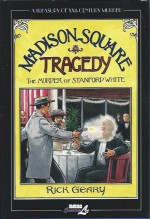
By Rick Geary (NBM/ComicsLit)
ISBN: 978-1-56163-762-1
Master cartoonist Rick Geary is a one-of-kind cartoon presence: proficient in and dedicated to both comics and true crime literature.
His compelling dissections in the form of graphic novel reconstructions have revitalised many of the world’s most infamous “cold cases†and groundbreaking murder mysteries since policing began and these pictorial dossiers never fail to darkly beguile or entertain.
This particular review copy plunked onto my mat on Christmas Eve (always a time of drawn knives and frayed tempers) and really made my Holiday Season complete, so I felt I had to share the dark tidings with you as soon as possible…
Combining a superlative talent for laconic prose, incisive observation and detailed visual extrapolation with his fascination for the nastier aspects of human nature, Geary’s past works include biographies of J. Edgar Hoover and Trotsky and the 8-volume Treasury of Victorian Murder series.
In 2008 he then turned his forensic eye on the last hundred years or so for his ongoing Treasury of XXth Century Murder series and this sixth volume focuses on a little-remembered sordid scandal which seared the headlines during the “Gilded Ageâ€.
Madison Square Tragedy – The Murder of Stanford White relates a tale with no unsolved mystery but still laden with all the appalling ingredients of a tabloid reporter’s dreams, and opens after a bibliography and the author’s handily informative map of Central Manhattan with ‘The City of the New Century’ describing the great and the good of the breathtaking modern metropolis New York in 1901 and setting the scene for a grim tragedy and lust, depravity and madness…
‘Stanny’ covers the history, career and character of prominent architect and personage Stanford White: bon vivant, theatre patron, dashing roué and secret deflowerer of young ladies, whose fascination with one particular damsel led to his untimely – if not entirely undeserved – demise.
The arch cad – a notable bastion of the city’s Cultured elite – had a secret hideaway: luxurious, opulent and infamously fitted with a red velvet swing where he indulged his urges…
The lady who brought about his demise was ‘Evelyn’: Florence Evelyn Nesbit – a sensation of turn-of-the-century New York. Only 16 years old, she was already a famous artist’s model (Charles Dana Gibson immortalised her as “The Eternal Questionâ€), much photographed and cover-featured in the period’s periodicals and journals. She soon turned her talents to the stage as both actress and dancer, catching White’s eye – as she also had many millionaires young and old.
White was patient. Befriending Evelyn’s mother, he was soon known as the girl’s de facto guardian. Eventually he brought her to his lair and date-raped her, subsequently carrying on the dalliance until he was bored, after which he moved on to fresher fields…
Hushing up her disgrace, Evelyn began a chaste relationship with cartoonist Jack Barrymore (of the legendary acting dynasty) but her mother and White enrolled her in private boarding school to end the affair.
There she languished until one of her former admirers entered the picture…
‘Harry’ describes the third face in the tragedy as wealthy scion (drug addict, closet sadist and psychopath) Harry K. Thaw relentlessly pursues and eventually weds Evelyn. This was only after a protracted courtship which culminated in her revealing what Stanford White had done.
Harry married her anyway, but was a much an abuser as the architect was. Moreover he became increasingly obsessed with destroying the ravisher of innocence…
The actual murder occurred on ‘The Fatal Night’ of June 25th 1906 in a crowded restaurant in front of hundreds of well-to-do patrons, after which the most fascinating component of the crime began: the astonishing permutations and multiple ‘Trials and Tribulations’ which saw Harry retried numerous times as his powerful, dominating mother scrambled to preserve some shred of the family prestige and dignity whilst her son proclaimed his justified guilt and poor Evelyn was skewered in the harsh spotlight of tawdry publicity…
This is a shocking tale with no winners and Geary’s meticulous and logical presentation as he dissects the crime, illuminates the major and minor players and dutifully pursues all to their recorded ends is utterly compelling.
The author is a unique talent in the comic industry not simply because of his manner of drawing but because of the subject matter and methodology in the telling of his tales. Geary always presents facts, theories and even contemporary minutiae with absorbing pictorial precision, captivating clarity and devastating dry wit, re-examining the case with a force and power Oliver Stone would envy.
Seductive storytelling, erudite argument and audacious drawing give these tales an irresistible dash and verve which makes for unforgettable reading and such superb storytelling is an ideal exemplar of how graphic narrative can be so much more than simple fantasy entertainment. These merrily morbid murder masterpieces should be mandatory reading for every mystery addict and crime collector.
© 2013 Rick Geary. All rights reserved.
Merry Christmas, Boys and Girls!
In keeping with my self-imposed Holiday tradition here’s yet another selection of British Annuals selected not just for nostalgia’s sake but because it’s my blog and I just want to…
After decades when only American comics and nostalgia items were considered collectable or worthy, these days the resurgence of interest in home-grown comics and stories means there’s a lot more of this kind of material out there and if you’re lucky enough to stumble across a vintage volume, I hope my words can convince you to acquire it.
Topping my Xmas wish-list would be further collections from those fans and publishers who have begun to rescue this magical material from print limbo in affordable new collections…
Great writing and art is rotting in boxes and attics or the archives of publishing houses, when it needs to be back in the hands of readers once again. As the tastes of the public have never been broader and a selective sampling of our popular heritage will always appeal to some part of the mass consumer base, let’s all continue rewarding publishers for their efforts and prove that there’s money to be made from these glorious examples of our communal childhood.
The Beano Book 1974
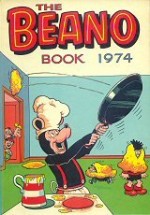
By various (DC Thomson & Co., Ltd.)
Retroactively awarded ISBN: 978-0-85116-077-1
For many British readers – whether comics fans or not – fans, the Holiday Season can only mean The Beano Book, so I’ve once more highlighted another of the venerable, beloved tomes as particularly representative of the time of year.
Way back when, many annuals were produced in a wonderful “half-colour†which British publishers used to keep costs down. This was done by printing sections or “Signatures†of the books with only two plates, such as Cyan (Blue) and Magenta (Red) or Yellow and Black.
The sheer versatility and colour range provided was simply astounding. Even now this technique inescapably screams “Holiday Extras†for me and my aging contemporaries and none more than in this spectacular example which would have hit shop shelves in September of 1963.
As is so often the case, my knowledge of the creators involved is appallingly sub-standard, but I’ll hazard my usual wild guesses in the hope that someone with more substantial information will correct me when I err …
This anarchically rousing compilation kicks off with a double-page splash of ‘Peculiar Pets’ Picture Gallery’ (by Robert Nixon, I think) displaying a number of comics stars and their companion animals of choice, after which Minnie the Minx (Jim Petrie) and a few chums and latterly Biffo the Bear with human pal Buster (by David Sutherland) introduce this year’s annual before Ron Spencer’s Baby-Face Finlayson (“The Cutest Bandit in the Westâ€) imagines life as a giant and not a pipsqueak…
“Fastest Boy on Earth†Billy Whizz (drawn superbly as ever by Malcolm Judge) then learns to respect the power of traffic signs – in his house – before the crafty campaigns of ‘The Nibblers’ (John Sherwood) wins them a grand Christmas nosh-up and sanctuary from the seasonal snows.
Back then The Beano still had the odd adventure strip and perhaps the greatest of these was boy superhero Billy the Cat. Sutherland next proves his astounding visual versatility in The Bash Street Kids where the pupils plump for pop and resist the calming charms of classical music – leading to a camera-shattering pinup of ugly mug Plug – before switching to action mode as the acrobatic champion – now teamed with his cousin as Billie the Cat and Katie – jointly recapture an escaped convict and preserve their secret identities from curious school chums in a splendid rollercoaster romp.
Petrie’s Minnie the Minx then painfully learns that she’s not cut out for pony riding, after which Nixon panoramically maps out ‘A Funny Look at “Beano-Town‑ whilst Bob McGrath details the sub-zero antics of The Three Bears as they try to find fuel to heat their chilly cave.
Also ably illustrated by the tireless Sutherland, Biffo and Buster return as rivals clashing in a man-powered flight competition, after his Pin-up Pup! of Dennis the Menace’s perilous pooch Gnasher leads into a custard-coloured clash between his master and simpering swot Walter.
Spencer’s Little Plum experiences a mysterious clean-up whilst sleepwalking before Nixon’s Lord Snooty and his snowballing pals at Bunkerton Castle get some startling help from the estate’s star stag Angus even as elsewhere – and keeping up the Hibernian humour – Haggis hunters The McTickles (by Vic Neill?) fall foul of their canny shaggy prey…
Pup Parade starring the Bash Street Pups (Gordon Bell) finds the mini-mutts (eventually) enjoying an old dinosaur bone before a dedicated and extended niche chapter from Nixon. Here in an expansive section of his own, Roger the Dodger’s Special Mini-Book offers the rollicking tale of the ‘Disappearing Dodger’, a pin-up, his hilarious, historically inaccurate ‘Family Tree’, ‘A Dodger’s Outfit’, and an informative peek at ‘A Dodger’s Den’ before closing with the final pin-up ‘Dreaming of Dodges’…
Biffo’s back – and points south – endure a battering due to the bear’s interest in buttercups (Sutherland) before Nixon reveals how the obstreperous Grandpa still catastrophically refuses to act his age and The Nibblers (Sherwood) again overcome malicious moggy Whiskers to fill their bellies with purloined goodies.
The riddle of Billy Whizz’ footwear replacement is solved in a quick-fire yarn by Judge before Bell’s Pup Parade starring the Bash Street Pups tale discloses the secret of their unlikely alliance with a very big cat…
Heading out West, The Three Bears (McGrath) find – and lose – a mountain of gold, The McTickles lose a skirmish with the wily Stilt-legged McHaggises, and Baby-Face Finlayson rewrites a few favourite nursery rhymes before Teacher and even Head have another go at civilising the Bash Street Kids with music – appended with a stomach-churning pin-up of Cuthbert Cringeworthy in Teacher’s Pet’s Picture Gallery…
Ron Spencer stretches his artistic muscles providing ghastly genealogical ‘Fun with the Finlayson Family’ and illustrating how Little Plum gets into big trouble trying to recapture girlfriend Little Peach‘s pet parrot, before Billy the Cat and Katie swing back into action, turning on the town’s Christmas lights and tracking down a hold-up gang (Sutherland).
Another gloriously funny Lord Snooty strip from Robert Nixon segues into Minnie the Minx’s hilarious crush on an American boy-band – and older readers will cringe with mirth at Jim Petrie’s hilarious spoof of then-sensation Donny Osmond – before Nixon strikes back with a Grandpa yarn involving the old codger’s inability to stay clean…
Beano star Dennis the Menace was only slightly involved in the Annuals of this period as he had his own Christmas Bumper book to run riot in, but he closes this tumultuous tome with an funny educational strip that’s a thinly disguised advert for his solo venture before the merriment closes here with another superb dose of Nixon’s ‘Peculiar Pets’ Picture Gallery’ …
This is supremely entertaining book, and even without legendary contributors Dudley Watkins, Leo Baxendale and Ken Reid there’s still an abundance of satisfyingly madcap, infectious insanity. With so much merriment on offer I can’t believe this 40-year old book is still sprightlier and more entertaining than most of my surviving friends and relatives. If ever anything needed to be issued as commemorative collections it’s these fabulous DC Thomson annuals…
Divorcing the sheer quality of this brilliant book from nostalgia may be a healthy exercise – perhaps impossible, but I’m quite happy to luxuriously wallow in the potent emotions this annual still stirs. It’s a fabulous laugh-and-thrill-packed read from a magical time, and turning those stiffened two-colour pages is always an unmatchable Christmas experience, happily still relatively easy to find these days.
© 1973 DC Thomson & Co., Ltd.
Pow! Annual 1970
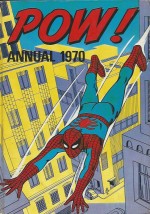
By various (Odhams Books)
ASIN: B003VUO2SC
This splendidly intriguing item is one of my favourite childhood delights: addictively captivating at the time and these days a fascinating indicator of the perceived tastes of Britain’s kids. Most importantly it’s still a surprisingly qualitative read with its blend of American adventure strips playing well with a selection of steadfastly English and wickedly surreal comedy material.
With Scotland’s DC Thomson steadily overtaking their London-based competitors throughout the 1960s, the sheer variety of material the southerners unleashed to compete offered incredible vistas in adventure material and – thanks especially to the defection of Leo Baxendale and Ken Reid to monolithic comics publishing giant Amalgamated Press (created by Alfred Harmsworth at the beginning of the twentieth century) – had finally found a wealth of anarchic comedy material to challenge the likes of the Bash Street Kids, Dennis the Menace, Minnie the Minx and their unruly ilk.
During that latter end of the period the Batman TV show sent the entire world superhero crazy and Amalgamated had almost finished absorbing all its rivals such as Eagle‘s Hulton Press to form Fleetway/Odhams/IPC.
Formerly the biggest player in children’s comics, Amalgamated had stayed at the forefront of sales by latching onto every fad: keeping their material contemporary, if not fresh. The all-consuming company had been reprinting the early successes of Marvel comics for a few years; feeding on the growing fashion for US style adventure which had largely supplanted the rather tired True Blue Brit style of Dan Dare or DC Thompson’s Wolf of Kabul.
“Power Comics†was a sub-brand used by Odhams to differentiate those periodicals which contained reprinted American superhero material from the company’s regular blend of sports, war, western adventure and gag comics – such as Buster, Lion or Tiger. During the Swinging Sixties these ubiquitous weeklies did much to popularise the budding Marvel characters and universe in this country, which was still poorly served by distribution of the actual American imports. Fantastic and its sister paper Terrific were notable for not reformatting or resizing the original artwork whilst in Wham!, Pow! or Smash!, an entire 24-page yarn could be resized and squeezed into 10 or 11 pages over two weeks…
Pow! launched with a cover date of January 31st 1967, combining home-grown funnies such as Mike Higgs’ The Cloak, Baxendale’s The Dolls of St Dominic’s, Reid’s Dare-a-Day Davy, Wee Willie Haggis: The Spy from Skye and many others, British originated thrillers such as Jack Magic and The Python and resized US strips Spider-Man and Nick Fury, Agent of S.H.I.E.L.D.
After 53 weekly issues the title merged with Wham!, that combination running until #86 when it was absorbed into Smash! Nevertheless, the title generated a number of annuals, even though, by 1969 when this annual was released, the trend generated by TV Batmania was dying.
Interest in superheroes and fantasy in general were on the wane and British weeklies were diversifying. Some switched back to war, sports and adventure stories whilst with comedy strips on the rise again, others became largely humour outlets.
This was one of the last Odhams Christmas compendia to feature imported Marvel material: from then on the Americans would handle their own Seasonal books rather than franchise out their classics to mingle with the Empire’s motley, anarchic rabble.
The content is eclectic and amazingly broad, beginning with a complete but compacted retelling of Sgt. Fury and His Howling Commandos #5 by Stan Lee & Jack Kirby from January 1964.
The full-colour WWII tale found the doughty warrior ‘At the Mercy of Baron Strucker’; beaten and humiliated in a duel with an Aryan nobleman. Soon filmed footage was used as a Nazi propaganda tool and Fury hero was a broken man – until one of his men realised the nonplussed noncom had fallen for the oldest trick in Hollywood’s playbook. The riotous rematch went rather better…
This was followed by a welter of gag strips beginning with an outing for Graham Allen’s The Nervs (revolting creatures that lived inside and piloted unlovely schoolboy Fatty) after which The Swots and the Blots (probably drawn by Mike Lacey) ushered in the economical 2-colour section with another Darwinian example of schoolboy Good vs. Evil and an unnamed substitute for Mike Higgs rendered the comedy caper The Cloak vs. Cloakwoman…
Next up is a short Marvel sci fi thriller as ‘Escape into Space!’ (from Tales of Suspense #42 June 1963 by Lee, Larry Lieber & Matt Fox) sees a convict escape to freedom into the void – or does he…? – before Wee Willie Haggis – the Spy from Skye scotches a plot to nobble Scotland’s prime (in)edible export and Percy’s Pets finds the obsessed animal enthusiast in deep water after getting hold of a hyena and crocodile…
Sgt. Fury and His Howling Commandos #5 provides a factual page devoted to ‘Weapons of War: Light Machine Guns of World War II’ to restart the full colour fun, which continues with another Swots and the Blots romp ‘n’ riot after which idiot espionage continues with The Cloak vs. Blubberman…
Back then to red-&-black for the not-resized Amazing Spider-Man #36 (May 1966, by Lee and Steve Ditko) as the Wallcrawler faces deranged super strong thief the Looter in ‘When Falls the Meteor!’
The magnificently strange comic villain Grimly Feendish then fails in another bid to get rich nefariously before tiny terror Sammy Shrink restarts a final segment of full-colour wonders with more boyish pranks, after which the reformatted ‘Death of a Hero’ (Fantastic Four #32, November 1964, by Lee, Kirby & Chic Stone) uncovers the secret of Sue and Johnny Storm‘s father: a convict who gains incredible power as the rampaging Invincible Man…
This is a strange and beloved book for me and these are all great little adventures, even though I suspect it’s more nostalgia for a brilliant childhood rather than any intrinsic merit. Feel perfectly free to track this down and contradict me if you like though…
© 1969 The Hamlyn Publishing Group Limited.
Superboy Annual 1964-1965
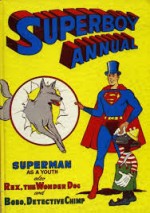
By various (Atlas Publishing/K.G. Murray)
No ISBN:
Before DC Comics and other American publishers began exporting directly into the UK in 1959 our exposure to their unique brand of fantasy fun came from licensed reprints. British publishers/printers like Len Miller, Alan Class and bought material from the USA – and occasionally, Canada – to fill 68-page monochrome anthologies – many of which recycled the same stories for decades.
Less common were (strangely) coloured pamphlets produced by Australian outfit K.G. Murray and exported here in a rather sporadic manner. The company also produced sturdy and substantial Christmas Annuals which had a huge impact on my earliest years (I strongly suspect my adoration of black-&-white artwork stems from seeing supreme stylists like Curt Swan, Carmine Infantino, Gil Kane and Murphy Anderson uncluttered by flat colour).
This particular tome of was of the last licensed UK DC comics compilations before the Batman TV show turned the entire planet Camp-Crazed and Bat-Manic, and therefore offers a delightfully eclectic mix of material far more in keeping with the traditionally perceived interests of British boys than the suited-&-booted masked madness that was soon to follow in the Caped Crusader’s scalloped wake.
Of course this collection was still produced in the cheap and quirky mix of monochrome, dual-hued and weirdly full-coloured pages which made the Christmas books such a bizarrely beloved treat.
The sublime suspense and joyous adventuring begins with a rare treat as ‘The Origin of the Superman-Batman Team!’ (by Jerry Coleman & George Papp from Adventure Comics #275, August 1960) offers an alternate view of the Dark Knight.
Teenaged Bruce Wayne was sneaking out on his still-living parents to fight crime as the Flying Fox and the Boy of Steel undertook to give some pre-heroic training after seeing their future partnership in a time scanner.
The task was made simple after the Waynes moved to Smallville but soon an odd rivalry developed…
British books always preferred to alternate action with short gag strips and the Murray publications depended heavily on the amazing DC output of cartoonist Henry Boltinoff. Here a jungle jape starring explorer ‘Shorty’ and a court appearance for ‘Casey the Cop’ herald the start of the duo-colour section (blue and red) before ‘Superboy’s First Day at School’ (Otto Binder & Papp from Superboy #75, September 1959) reveals how another attempt by Lana Lang to prove Clark Kent was the Boy of Steel prompts the lads Super-Recall and reveals how, on their first day in primary school, he inadvertently displayed his powers to her several times…
A big hit during the 1950s, Rex the Wonder Dog featured a supremely capable German Shepherd – and his owners – experience a wide variety of incredible escapades. Here ‘The Valley of the Thunder King!’ by John Broome, Gil Kane & Bernard Sachs from The Adventures of Rex the Wonder Dog #14 March-April 1954, finds the dog and soldier Major Danny Dennis discover a lost tribe of Aztecs in Mexico just as a volcano erupts…
‘How Luthor Met Superboy!’ (by Jerry Siegel & Al Plastino from Adventure Comics #271, April 1960) revealed how young scientist Lex and Superboy became friends, and how the genius became deranged after a laboratory fire extinguished by the Teen Titan caused him to lose his hair. Enraged beyond limit, the boy inventor turned his talents to crime…
Boltinoff’s ET gag strip ‘On the Planet Og’ temporarily terminates the two-tone tales and leads into a black-&-white section wherein Rex’s support feature Detective Chimp takes over.
Bobo was the pet, partner and deputy of Sheriff Chase of Oscaloosa County, Florida: a chimpanzee who foiled crimes and here experienced ‘Death Walks the High Wire!’ (Broome, Irwin Hasen & Joe Giella from The Adventures of Rex the Wonder Dog #8 March-April 1953), solving the murder of a circus trapeze artist.
The amazing hound then became ‘Rex, Dinosaur Destroyer!’ (Robert Kanigher, Kane & Sy Barry, from The Adventures of Rex the Wonder Dog #11-September-October 1953) after an atomic test blast opened a subterranean rift packed with survivors from another age…
‘Little Pete’ and another ‘Casey the Cop’ by Boltinoff augur a return to red and blue tones and an epic 2-part Superboy tale as ‘The Mystery of Mighty Boy! and ‘Superboy’s Lost Friend!’ (Binder & Papp; Superboy #85, December 1960) see the Boy of Steel travel to distant planet Zumoor and a teen hero whose life closely mirrors his own. They quickly become firm friends, but Superboy soon finds good reason to abandon Mighty Boy forever…
Comedy courtesy of Boltinoff’s ‘Professor Eureka’ leads into ‘Superboy’s Nightmare Dream House’ (Superboy #70, January 1959 by Alvin Schwartz & John Sikela) which finds the Teen of Tomorrow teaching a swindler a life-changing lesson before ‘Peter Puptent’ and ‘Casey the Cop’, after which Detective Chimp uncovers ‘Monkey Business on the Briny Deep!’ (Broome, Hasen & Giella, The Adventures of Rex the Wonder Dog #10 July-August 1953) whilst Rex and Danny Dennis Jr. head out west to climb a mountain for charity and brave the perils of ‘The Eagle Hunter!’ (Kanigher, Kane & Barry from The Adventures of Rex the Wonder Dog #14 March-April 1954).
This thrilling collection returns to full-colour for one last Boltinoff ‘Doctor Rocket’ funny before ‘The Super Star of Hollywood’ (Siegel & Papp Adventure Comics #272, May 1960) reveals how super-dog Krypto becomes spoiled and big-headed after starring in a Hollywood movie – until Superboy applies a little clandestine reality check…
© National Periodical Publications, Inc. Published by arrangement with the K.G. Murray Publishing Company, Pty. Ltd., Sydney.
These Christmas Chronicles are lavish and laudatory celebrations of good times and great storytelling but at least they’re not lost or forgotten, and should you care to try them out the internet and a credit card are all you’ll need.
Merry Christmas, a fruitful New Year and Happy Reading from Everybody at Now Read This!
Paul Robeson for Beginners
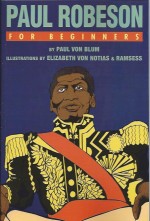
By Paul Von Blum, illustrated by Elizabeth Von Notias & Ramsess (For Beginners)
ISBN: 978-1-934389-81-2
The For Beginners series of books are heavily illustrated text primers: accessible graphic non-fiction foundation courses in a vast variety of subjects from art to philosophy, politics to history and much more, all tackled in an accessible yet readily respectful manner. This particular volume was written by Paul Von Blum, author and Senior Lecturer in African American Studies and Communication Studies at UCLA with a wealth of strips and illustrations by graphic design specialist Elizabeth Von Notias and self-taught multi-media creator Ramsess.
If remembered at all, Paul Robeson (April 9th 1898 – January 23rd 1976) is thought of by most people as that African American singer/actor with an incredible bass voice. Maybe some will recall that he was a left wing political activist who fell foul of Joe McCarthy during America’s infamous “Red-baiting†witch-hunting period.
That’s true enough, but he was also one of the most accomplished and gifted individuals in the nation’s history: a true Renaissance man who was cheated of his ultimate potential simply because his skin was the wrong colour…
The Introduction lists Robeson’s astonishing accomplishments – all the more amazing when you realise the lack of opportunities if not outright repression facing negroes in a segregated America at the time of his birth and not truly tackled until the Civil Rights movement began gaining traction in the late 1950s.
As told in more telling detail – both in word and pictures in ‘The Early Days’, ‘Paul Robeson the Athlete’, ‘Paul Robeson the Stage Actor’, ‘Paul Robeson the Screen Actor’ and ‘Paul Robeson the Singer’ – he was born in Princeton, New Jersey; the son of a preacher.
He was the last of five children in a time and place rigidly defined by class and race divisions.
A brilliant student, he graduated Somerville High School in 1915 and won a four-year scholarship to Rutgers University where, despite initial hostility and actual physical assaults – he became the star of the Football, Baseball, Basketball and athletics squads, twice designated “All-Americanâ€.
From there he attended New YorkUniversityLawSchool, before transferring to ColumbiaUniversityLawSchool.
Talented and seemingly tireless, he turned an interest in the dramatic arts into a part-time stage career and became a professional Football player in 1920. He got married, acted, sang, played Pro ball and kept on studying, graduating Columbia in 1923 and worked as a lawyer at a prestigious law firm until the bigotry he experienced from his own subordinates became too much.
In 1924 he switched from stage acting to movies but still carried on a glittering international career: starring as Othello in London and playing in many hit plays and musicals such as Showboat, Emperor Jones, Stevedore and All God’s Chillun’s Got Wings…
Always politically active, he visited the Soviet Union in 1934, spoke out against Fascism during the Spanish Civil War, co-founded the anti-colonial Council on African Affairs and used his name and fame to agitate for social and legal changes in such contentious areas as Southern lynch law and trade union legislation.
Such activities made him a prime target in the USA and in 1941 J. Edgar Hoover ordered the FBI to open a file on him…
In 1950 the US government took away his passport because he refused to recant his pro-Soviet, pro-socialist stance and he became an exile in his own country. He was unable to leave America for eight years, until a Supreme Court ruling decreed the State Department had no right to revoke passports due to an individual’s political beliefs.
Robeson’s life was filled with such landmarks. Once free to travel again, he became an international political celebrity and social commentator, using his concerts and stage appearances in places as disparate as Wales, Australia, Russia, East Germany and elsewhere to promote a dream of World “Freedom, Peace and Brotherhoodâ€â€¦
His beliefs, struggles achievements and failures are then examined in ‘Paul Robeson the International Activist’, ‘Paul Robeson the Domestic Political Activist’ before a thorough appreciation in ‘The Final Years and His Lasting Legacy’…
Augmented by a ‘Bibliography’, ‘Selected Chronology’ and creator biographies, this absorbing documentary proves again the astounding power of visual narrative when wedded to the life story of a truly unique individual.
© 2013 Paul Von Blum. Illustrations © 2013 Elizabeth Von Notias & Ramsess. All rights reserved. A For Beginners Documentary Comic Book © 2013.
Superior Spider-Man volume 4: Necessary Evil
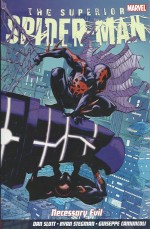
By Dan Slott, Ryan Stegman, Giuseppe Camuncoli, Livesay & John Dell (Marvel/Panini UK)
ISBN: 978-1-84653-581-9
Amazing Spider-Man #700 began one of the most impressive reboots of the Spider-Man mythology and was certainly the most striking and compelling character shake-up of all the MarvelNOW! relaunches.
In that issue, all that was Peter Parker apparently died when Doctor Otto Octavius took over his body. The hero’s mind had been transferred and trapped in the dying body of the super-villain where, despite his every desperate effort, in the end Peter perished with and within that decrepit, expiring frame, arguably becoming a wholly Superior Spider-Man.
Now the coldly calculating Octopus is permanently installed in the Wondrous Wallcrawler’s body and successfully living Peter’s life, albeit with a few minor but necessary alterations, upgrades and improvements…
At first the situation did not seem completely hopeless. At the moment of the monster’s greatest triumph Parker inflicted his full unvarnished memories on the psychic invader, forcing Octavius to experience every ghastly moment of tragedy and sacrifice which combined to make Spider-Man the compulsive do-gooder that he was.
From that enforced emotional turmoil came a bitter understanding. Otto had a change of heart and swore to live the rest of his stolen life in tribute to his greatest enemy; earnestly endeavouring to carry on Spider-Man’s self-imposed mission, guided by Peter’s abiding principle: “with great power comes great responsibilityâ€â€¦
However Octavius’ ingrained monomania proved hard to suppress and the usurped web-spinner constantly toiled to prove himself the better man: augmenting Parker’s paltry gadgets and methodology with millions of spy robots to patrol the entire city at once, constantly adding advanced tech and refining new weaponry to the suit and even acting pre-emptively rather than merely reacting to crises as the original had…
Otto went back to college because he arrogantly refused to live life without a doctorate and even briefly tried to rekindle his new body’s old relationship with Mary Jane Watson.
The new, ultra-efficient Spider-Man became New York’s darling and even Mayor J. Jonah Jameson embraced the Web-spinner; all but adopting the Arachnid as his deputy – to the utter incredulity of an imperceptible psychic shard of Peter which still screamed in frustration within the deepest recesses of the hero’s overwritten consciousness…
The helpless ghost was an unwilling passenger, unsuspected by Octavius yet increasingly privy to the villain’s own barely-suppressed memories. Moreover, more and more of Parker’s oldest friends began to suspect something amiss…
Police CSI Officer and ex-girlfriend Carlie Cooper knew Peter’s secret identity and recalled the last time Spidey fought Doc Ock, when the killer broke her arm. He claimed then that he was Peter trapped in the villain’s body…
The public seems happy with how Spider-Man has changed. Not only is he exceedingly more efficient, but far more brutal too: practically crippling bad guys like Boomerang, Vulture and Scorpion. This new hard-line attitude actually increased the webslinger’s approval rating and, after a hostage siege, his status peaked after he executed the psychotic perpetrator Massacre…
Eventually Octavius realised there was a noble passenger in his head and eradicated the last vestiges of his enemy’s presence – at the cost of many of Parker’s later memories and fully liberated extended his campaign of modernised crime-fighting.
Helping Jameson after the Spider-Slayer and other super-felons broke loose on The Raft penitentiary, Spider-Man then blackmailed the Mayor into donating the now empty edifice for a base. The Superior wallcrawler designed a new costume, built giant war-tanks and even hired henchmen to help him clean up the city for the decent, law-abiding citizens.
“Parker’s†personal life is all but over and he’s constantly harassed for a lack of productivity by employer Max Modell at technological think-tank Horizon Labs. He still wants that elusive doctorate, however, and is prepared to put up with lots of grief from his lecturer Dr. Lamaze – even though the oaf is a bumbling fool even more stupid than when he was Otto Octavius’ college lab partner. At least Parker’s blossoming romance with brilliant Anna Maria Marconi is still progressing satisfactorily…
From his transformed citadel on the now-renamed Spider Island II, Spider-Man watches over his city through the electronic eyes of thousands of tiny Spider-bots…
There’s still lots he doesn’t see though: resurgent and hidden criminal mastermind Goblin King (former Green Goblin Norman Osborn) is successfully completing his own campaign to take over the underworld with his Goblin Army Cult.
To that end he has transformed young Phil Urich – latest iteration of The Hobgoblin – into his latest living weapon: a Goblin Knight to lead his armies to inevitable victory…
Meanwhile, Carlie Cooper has shared her suspicions about Spider-Man with her friend and Captain Yuri Watanabe (who secretly moonlights as costumed vigilante The Wraith). Together the women have been gathering definitive proofs of their suspicions regarding the Wallcrawler; and now with an Island fortress and a mercenary gang to pay for they have a money trail to follow…
Most dangerous of all, disgraced former Horizon employee Ty Stone is still free: a malevolent genius and subtle manipulator with a deadly agenda all his own slowly building his own powerbase…
This latest collection ties in to the various time travel stories and stems from the after-effects generated by the disruptions in the (Marvel) universes caused by the Avengers unmaking the Age of Ultron, but don’t fret as the stories work well enough on their own…
Illustrated by Ryan Stegman & John Livesay, the 3-part story-arc Necessary Evil begins with ‘Let’s Do the Time Warp Again’ and a glimpse at Nueva York in 2099, where Miguel O’Hara is knee-deep in a chronal crisis. His entire world is unravelling, with dinosaurs and other time-lost threats materialising even as his archenemy (and biological father) Tyler Stone of world-owning corporation Alchemax is gradually disappearing thanks to some threat to an ancestor in 2013…
A Word to the Wise: At a time when Marvel’s product quality was at an all time low, and following a purported last minute dispute between the company and prodigal son John Byrne (who had re-invented himself by re-inventing Superman), the House of Ideas launched a whole new continuity strand with all-new heroes (and franchise extensions) set more than a century into the future.
The world was a corporate dystopia, the scenarios were fantastical and the initial character-pool was predictable if not actually uninspired. A lot of the early material was by any critical yardstick sub-par. But there was also Spider-Man 2099.
Some analogue of the wall-crawler is always going to happen in any Marvel imprint (anybody remember Peter Porker, the Spectacular Spider-Ham?), and in those insane days of speculator-led markets (where greedy kids – and adults – dreamed of cornering the market in “Hot Issues†and becoming instant squillionaires) the future wallcrawler was a spectacular example of quality creators producing superior work (don’t take my word for it, just check out Spider-Man 2099: Genesis)…
In 2099 world governments were openly in the capacious pockets of huge multi-national corporations which controlled every aspect of society. All superheroes had been gone for decades, although their legends still comforted the underclass living at the fringes – and below the feet – of the favoured ones who could survive in a society based on unchecked, rampant free-marker capitalism.
Miguel O’Hara was a brilliant young geneticist fast-tracked and swiftly rising through the ranks of Alchemax. He enjoyed the privileges that his work (creating super-soldiers for the company) won him. He loved solving problems and despite interference from salary-men and corporate drudges he made a major breakthrough: a technique to alter genetic make-up and combine it with DNA from other organisms…
Following a demonstration which went grotesquely awry the arrogant scientist made a big mistake and threatened to quit. Unwilling to lose such a valuable asset CEO Tyler Stone poisoned O’Hara with the most addictive drug in existence – one only available from Alchemax – to keep him loyal.
The boy wonder was then forced to use his genetic modifier, resetting his physiology to purge the addiction from his cells. However one of the lab assistants he used to bully saw a chance for some payback and sabotaged the attempt, adding spider DNA to the matrix…
Miguel became the ultimate rebel in his time and was at the cutting edge of a new “Age of Heroes†fighting Stone and Alchemax as well as many other menaces. He eventually discovered the other reason for his privileged fast tracking: his mother’s long-ago affair which had resulted in a son…
Now O’Hara had to ally with Stone and stop the temporal threat in 2013 – to save his world and his own life…
In New York, Horizon labs are under threat: a corporate takeover by Allan Chemical (owned by Parker’s old school flame Liz Allan-Osborn) but orchestrated by the conniving Ty Stone, who had been sabotaging the Think-Tank’s experiments and stock price for months.
The geniuses there use experimental time-tech to record Stones perfidious deeds, but when they first turn on the machine Spider-Man 2099 explodes out of it, desperate to stop the chronal anomaly before his future dies. Before too long however he is confronted by this era’s wondrous webslinger.
O’Hara’s not worried: after all he and his predecessor have met before and fought as allies. Unfortunately that adventure is not one that remained in his memory after Ock removed the last vestiges of Peter’s consciousness…
Because of this, ‘Smack to the Future’ finds the Spider-Men in savage combat, leaving Ty Stone to continue his machinations unobstructed: absorbing Horizon and taking over the company that results from the hostile takeover.
He’s thinking perhaps… Al-Chem-Max?
With the future rapidly unravelling, the scene changes to the Caribbean where Yuri and Carlie are chasing down the final piece in their detective jigsaw puzzle in the concluding chapter ‘Event Horizon’, where a last minute save sees the Superior Spider-Man and his notional legatee vanish into an explosive time glitch. Only one reappears when the crisis is over and Parker/Octavius has no memory of what has happened…
And in 2099, Tyler Stone gloats; his world is safe and, by destroying Alchemax’ time tech, he has stranded “his†Spider-Man where nobody can save him…
It’s back to business with artists Giuseppe Camuncoli & John Dell as ‘Still Standing’ takes a look back to just after Octavius triumphed in stealing Spider-Man’s body and life. Following that cataclysmic clash a John and Jane Doe were admitted to hospital. She was considerably disturbed by hallucinations in which she saw the “Great Web coming undone†and “all the Spiders dying†whilst he kept deliriously demanding where Otto Octavius was…
Retuning to the present day, the ever-efficient Spider-Man encounters super-thief and some-time adventure Black Cat. As a former lover, the feline felon expects her former beau to go easy on her as usual, but is astonished at his new attitude and the savage beating she receives before he leaves her to the cops…
In the meantime the hospitalised John Doe is released, intent on some secret task to perform, as the increasingly acerbic and domineering Peter Parker wheedles money from his Aunt May and her husband to start his new tech company – backing up that investment with the last of Dr. Octopus’ off-shore hidden funds.
Carlie is tracking those accounts and sets off to give her findings to the Avengers but she doesn’t make it…
And at his Doctoral Board meeting the exultant Parker gets a stunning shock after his successful presentation is ruined by Lamaze who accuses the candidate of plagiarising the work of another scientist: his old college chum Otto Octavius…
This portentous package concludes with ‘Lethal Ladies’ as Doc Ock’s old girlfriend Stunner goes on a rampage, tearing up the town in her solid hologram form, forcing the Superior Spider-Man into a battle he just doesn’t want to fight.
As Carlie discovers that there’s no corpse in the tentacled super-villain’s grave, only to be abducted, Spider-Man uses Stunner’s equipment to solve his Doctoral problem with Don Lamaze, utterly unaware that the Goblin Army Cult now possesses Carlie’s proof of who’s really living in Peter Parker’s skull…
To Be Continued…
Scripted as ever by Dan Slott, Necessary Evil collects issues #17-21 of the fortnightly Superior Spider-Man (4th September-13th November 2013), ramping up the tension in advance of truly shocking revelations to come, and this titanic time-busting tome includes a covers-&-variants gallery by Stegman, Camuncoli, Humberto Ramos, Mike McKone, J.G. Jones, Olivier Coipel, Leonel Castellani, J. Scott Campbell & Adi Granov
This up-to-the minute tech-heavy reinvention is naturally accompanied with some AR icon sections – Marvel Augmented Reality App pages which provide access to story bonuses and content on your smart-phone or Android-enabled tablet.
Spider-Man has been reinvented so often it’s almost become commonplace, but this iteration – for however long it lasts – is one no lover of high-octane adventure should miss: smart, shocking and incredibly addictive.
™ & © 2013 and 2014 Marvel & Subs. Licensed by Marvel Characters B.V. through Panini S.p.A. Italy. All rights reserved. A British Edition published by Panini Publishing, a division of Panini UK, Ltd.
JLA Classified: New Maps of Hell
New, revised review
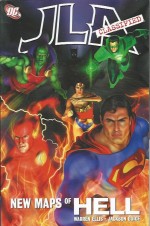
By Warren Ellis & Jackson Guice (DC Comics)
ISBN: 978-1-4012-0944-5
It’s been quite a while since we covered a good old-fashioned straightforward and no-strings-attached superhero blockbuster: one which any old punter can pick up with no worry over continuity or identification and where good guys and bad guys are clearly defined.
That’s due in large part to the fact that nobody makes many of those anymore, but at least it gives me the opportunity to take another look a tale I didn’t much like when it first came out in 2006, but which has definitely grown on me after a recent re-read.
Produced at a time when the Justice League of America was enjoying immense popularity and benefiting from a major reboot courtesy of Grant Morrison, the end-of-the-world epic – starring Superman, Batman, Wonder Woman, Flash, Green Lantern, Oracle and Martian Manhunter – originally ran in issues #10-15 of ancillary spin-off title JLA Classified (September 2005-February 2006) with gritty futurist super-scribe Warren Ellis upping the angst-quotient on a hoary old plot whilst hyper-realist illustrator Jackson Guice adds a terrifying veracity to events.
The drama begins as Clark Kent and wife Lois Lane stumble onto a dirty little secret. Assorted, and presumably unconnected, scientists and bean-counters at President Luthor‘s Lexcorp conglomerate have committed suicide in large numbers and the intrepid reporters suspect something very nasty is going on…
In Gotham City Batman learns the police have been turned away from an extremely unconventional crime-scene by Feds and a private security company, and he too begins to dig…
In the Bermuda triangle, a group of researchers are invited to the Amazon’s ancient library of knowledge only to die when the sky-floating island explodes in a horrendous detonation.
Wally West has terrible dreams of his beloved predecessor Barry Allen which lead him to a similar catastrophic conflagration, whilst Green Lantern Kyle Rayner ruminates on a primordial legend of the Corps’ origins until a wave of explosions rouses him to action.
In the ruins of each disaster the scattered, hard-pressed heroes find an ancient parchment of alien hieroglyphs and, when Superman recovers another page of the same from the shredded remnants of a plummeting space station, the call goes out to activate the League…
Tasking cyber-savant Oracle and aged Martian sole survivor J’onn J’onzz with digging up information, the team learn of an antediluvian scourge which wracked the red planet million’s of years past. A God/Devil which tested species’ right to survive and heralded its coming through a written code…
Luthor’s scientist’s had found such writings in remnants of ancient Sumeria and begun deciphering the text…
Mobilising to stop the summoning, the heroes confront Luthor in the White House but are too late. In Las Vegas the bowels of Hell vomit horrors into the streets and as the frantic team rushes to battle they are snatched up separated by the malign entity which has spent eons traversing the universe testing the worth of intelligent races and individually putting them to their sorest tests.
However the monstrous terror has never faced beings like the JLA before, or a mind like Batman’s, and soon its own darkest secret is exposed and its fatal weakness exploited to devastating effect…
With a painted cover gallery by Michael Stribling, this book offers simple, solid Fights ‘n’ Tights fun gilded with a sly and cynical post-modern edge: a sound example of contemporary action blockbuster comics at their best.
© 2005, 2006 DC Comics. All Rights Reserved.
X-Men Noir: the Mark of Cain
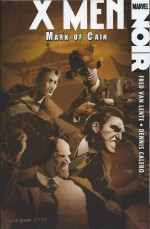
By Fred Van Lente & Dennis Calero (Marvel)
ISBN: 978-0-7851-4437-3
When fictional heroes and villains become really popular – to the point where fans celebrate their births and deaths and dress up like them at the slightest opportunity or provocation – eventually a tendency develops to explore other potential character facets that the regular, cash-cow continuity might normally prohibit.
DC invented a whole company sub-strand of “Imaginary Stories†and Marvel asked “What If…?†sharing glimpses of alternate realities. Even television series got into the act with shows like Star Trek, Roswell and Stargate SG-1 offering coolly jarring, different takes on their established stars and scenarios.
The little dark gem of alternate continuity on offer today comes from an intriguing experiment in 2009 wherein Marvel took many of their biggest stars and reconfigured them for a universe drenched in the tone, lore and ephemera of pulp fiction and Film Noir: a dark land where shiny gleaming super-powered heroes were replaced by bleakly paranoid, deeply flawed and self-serving individuals just trying to get by as best they could…
X-Men Noir: the Mark of Cain is actually a sequel to the initial foray and benefits from not having to explain or differentiate the so-similar seeming stars from the bastions of the regular continuity. It ran as a 4-issue miniseries from February-May 2010 offering a moody glimpse of a world with no heroes, only shades of villainy. Nevertheless it still provides a satisfying slice of suspenseful entertainment for Fights ‘n’ Tights fans in search of something genuinely edgier than their regular fare. After all, the big draw for the jaded is that these folks might actually die and stay that way…
What You Need to Know: situated in the 1930s, these X-Men are not mutants with incredible, science-defying powers but rather a gang of mentally disturbed juvenile delinquents. They had been lab rats for rogue psychiatrist Charles Xavier in his School for Gifted Youngsters, where he strove to exacerbate rather than cure their various anti-social behaviours.
The batty boffin believed that sociopathy was the next stage in human behavioural development and spent his days training and refining the criminal talents and tendencies of his disturbed charges – until he was exposed and thrown in jail on Riker’s Island Prison.
The truth came out after the body of one of his “students†was washed up on the shore, covered in odd, three bladed knife slashes…
There is one costumed mystery man on the scene during these parlous times. Nosy, troublesome reporter Tom Halloway is not-so-secretly also a violent vigilante dubbed The Angel and the hunt for him preoccupied many familiarly different characters such as corrupt Chief of Detectives Eric “Magnus†Magnisky, his troubled children Peter and Wanda, casino owner Remy LeBeau, mobster Unus the Untouchable and drug runner Sean Cassidy…
This sequel volume opens with a public scandal as the government’s secret prison camp at Genosha Bay is exposed. Charges of torture and Applied Eugenics are levelled against the operators but despite rising protests the prison still carries on its inhumane treatments on the legion of sociopaths held there without Due Process or Representation.
In other news: due to lack of evidence, “Professor of Crime†Xavier is freed from Riker’s, arrogantly swearing to track down the killer of his recently assassinate “friend†Magnus…
A continent and ocean away, some of his former successes are cutting their way through the jungles of Madripoor and hordes of berserk headhunters as they try to find the lost temple of Cyttorak and retrieve a fabulous gem.
Sharpshooter Scott “Cyclops†Summers and unpredictable seagoing brawler Captain Logan are temporarily with the Angel, following a map provided by bootlegger and mercenary Cain Marko. They don’t give much credence to the native legends of vengeance inflicted on transgressors by Cyttorak’s “Juggernaut†but that soon changes when Marko is found in the no-man’s land around GenoshaBay, crushed to pulp. Of the enormous jewel there is no trace…
Peppered with evocative flashbacks, the story and trail leads Angel – who learned most of his nasty bag of tricks from Cain – to the USA’s extraterritorial prison and the shocking revelation that Xavier is secretly in charge…
Despite being captured and subjected to the Professor X’s methods of persuasion – administered by the warped woman Warden Frost – Halloway soon breaks free and begins pursuing the how and the who of Marko’s murder.
Fighting his way past the Professor of Crime’s newest protégés, a big burly Russian and an exotic black woman with a white Mohawk haircut, he is recaptured before he can reach Logan’s boat and sometime allies Cyclops and Eugene “Puck†Judd.
Undergoing more of Xavier’s “treatmentsâ€, the Angel is then confronted with the scientist’s secret weapon: his own thoroughly crazy – sociopathic – twin brother Robert Halloway…
The period drama and sinister suspense kick into compelling overdrive as the various parties hunting the Gem clash when the action shifts from noir detective to pulp sci-fi and the Professor’s true plan emerges. With the government’s covert connections exposed, and all surviving participants trapped aboard a huge flying battleship, the real value of the Gem of Cyttorak is revealed and, amidst flying fists, double- and triple-crosses abound.
As the agendas of all interested parties crash together thousands of feet above Manhattan, only antisocial violence works and at last a kind of justice is won…
Bleak, cynical and trenchantly effective, this excellent thriller by scripter Fred Van Lente and illustrator Dennis Calero provides a huge helping of thrills and chills that would work equally well even if you had never heard of Marvel’s mighty mutants.
This pocketbook sized collection also includes a covers and variants gallery by Calero as well as a dozen original art pages shot prior to the digital colouring stage.
© 2009, 2010 Marvel Characters, Inc. All rights reserved.