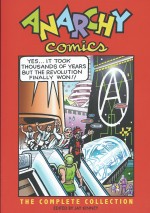
Anarchy Comics – The Complete Collection


By various, compiled and edited by Jay Kinney (PM Press)
ISBN: 978-1-60486-531-8

During the “anything goes” 1960s and early1970s when issues of personal freedom, sexual liberation, mind-altering self-exploration, questioning of authority and a general rejection of the old ways gripped the young and terrified the establishment, artists and cartoonists began creating the kind of comics and art they wanted. The Underground Comix movement was at the forefront of the “radicalisation” of many young intellectuals inAmericaand throughout the world, and consequently led to the establishment of the acceptance of comics narrative for adults.

Whenever anybody discusses the history and influence of the Underground and Counter-Culture movements, the focus is generally on the exuberant and often offensive expressions of comedic or violent excess – especially in regard to sex and drugs – but that’s a rather cruel oversimplification. The whole phenomena stemmed from rebellion and the exercise of new-found freedoms and equally apparent was a striving for new ways of living one’s life – and that’s politics, pure and simple.

By 1978 that unchecked artistic flourishing had died back in every sphere – especially the creation of comics – and the mainstream world, having assimilated what it liked of the explosively fresh thought and deeds, appropriated or adopted some of the tone and tenets of the movement before getting back to making money and suppressing the masses in a “new normal”…

However once creative passions have been aroused they are had to suppress. There is no more powerful medium of expression or tool of social change than graphic narrative – although music and poetry come close – and some kids found it harder to surrender their ideals than others.

In 1977, as Disco, indolence, hedonism and the pursuit of money obsessed both media and populace, a bunch of intellectual, left-leaning liberal cartoonists got together inSan Franciscoto create a comics anthology dedicated to propounding the ideals of willing co-operation, personal responsibility and a rejection of unwanted oppressive authority – governmental, religious or corporate. By entertaining and educating through cartoons they intended to highlight issues of inequality and iniquity: in short they went to bat for Anarchy…

Just as the global Punk movement began to take hold in the next generation of angry, powerless and disenfranchised Youth, in San Francisco cartoonist, satirist designer, editor, Socialist and political activist Jay Kinney – who had co-created the seminal underground title Young Lust (and yes that was a pun; sue me…) – got in touch with some like-minded old associates such as Paul Mavrides with the intention of creating an international comicbook to promulgate their world view.

Kinney had been corresponding with British Anarchist artist Clifford Harper (Class War Comics) and had similarly inclined West German cartoonist Gerhard Seyfried kipping on his floor at that time, so the idea of a forum for the graphic expression of political ideas must have seemed like a no-brainer…

Of course there’s no such thing as slavish doctrinaire consensus in Anarchist idealism – that’s pretty much the whole point – and the comic was envisioned more as a platform to present wide-ranging Left-Libertarian ideas through satire and historical reportage as a basis for further debate.

How the project developed from there and its ultimate effects and influence is fully described in author/historian Paul Buhle’s ‘Anarchy Comics Revisited’ and Kinney’s own expansive, evocative ‘Introduction’ before the entire 4-issue, nine-year run is re-presented in all its monochrome glory beginning with Anarchy Comics #1 from 1978, sporting a witty cover by Kinney and deliciously wry intro page Inside Cover by Kinney & Seyfried.

The editor then led off the attack with ‘Too Real’ using collaged images from comicbook ads to spoof the American Dream of prosperity and suburban bliss, after which counter-culture legend Spain Rodriguez recounted the story of ‘Nestor Makhno’ whose fight for independence led to his betrayal by his Soviet allies in the early days of the Revolution.

Kinney’s ‘Smarmy Comics’ presented a decade of strip spoofs dedicated to exposing ‘Fascism: the Power to Finance Capital Itself’ after which the amazing Melinda Gebbie constructed a strident feminist call to arms against female oppression in the educational diatribe ‘The Quilting Bee’ before Spain returned with a brutal true tale of the Spanish Civil War in ‘Blood and Sky’ and an Underground superstar offered a frightening prognostication in ‘Gilbert Shelton’s Advanced International Motoring Tips’…

For someone with no appreciable budget or resources, Kinney was astonishingly successful in securing international contributions. From France’s L’echo Des Savannes #29 came a translated tale of more Bolshevik perfidy in ‘Liberty Through the Ages: Kronstadt’ by Yves Frémion AKA Épistolier & Volny (François Dupuy) wherein a local dispute escalated into a horrific early instance of merciless repression in the People’s Paradise, and Bay area cartoonist John Burnham opted to challenge the future with his polemical ‘What’s the Difference?’

True Brit Clifford Harper produced a moving and witty account of grass roots resistance in the tale of ‘Owd Nancy’s Petticoat’ set in the aftermath of the Peterloo Massacre, after which Kinney offered wry Comic Strip parodies ‘Safehouse’, ‘On Contradiction’ and ‘Today’s Rhetoric’ – complete with faux ad – before Mavrides hilariously attacked the utopian/dystopian debate with ‘Some Straight Talk about Anarchy’.

The issue ended with a stylish ad for like-minded publications from Kinney & Seyfried, which last also crafted a humorous depiction of a mass anarchist demonstration in Tiananmen Square 11 years before the tragic, monstrous real thing…

Issue #2 didn’t appear until 1979 and opened with a photographic punk cover by Ruby Ray & Kinney, whilst the latter & Seyfried collaborated on another hilarious introductory page before the fireworks kicked off with Steve Stiles’ chilling account of his brush with Military Intelligence. Once the brass realised he might have had associations with turn-of-the-century Labour Movement the Industrial Workers of the World, the baffled soldier-boy found himself suspected of crimes he didn’t know existed. How the ‘Wobblies!’ could subvert a hapless GI in 1967 is still unclear to the author of this smart but scary tale…

‘Believe It!’ by Sharon Rudahl exposed true but crazy beliefs from history whilst

‘Kultur Dokuments’ (Kinney & Mavrides) brilliantly mixed styles and metaphors to harangue the working world in a clever tale that started as pictograms and ended with a vicious swipe at Archie Comics…

Clifford Harper then powerfully adapted and co-opted “Bert” Brecht’s grim ballad ‘The Black Freighter’ (perhaps better known in English as “Pirate Jenny” from Kurt Weill’s Threepenny Opera), Spain detailed the life of Civil War freedom-fighter Buenaventura ‘Durruti’ and Dutch artist Peter Pontiac exposed sexual fantasy and other anti-spontaneity heresies in ‘Romantic! Anarchy’ before Kinney dryly restored order with his spoof talk-show ‘Radical Reflections’.

Épistolier & Michel Trublin then related how radicals Jerry Rubin and Abbie Hoffman changed the smugly complacent nature of Wall Street in ‘Liberty Through the Ages: The Yippies at the Exchange’ whilst Melinda Gebbie powerfully illustrated ‘Quotes from Red Emma’ (Goldman) after which ‘The Bizarre yet Familiar World of Commodity Fetishism!’ by Kinney embellished an Inside back-cover ad by Seyfried – and the glorious whole was finished off by a painted Black Velvet portrait of Chairman Mao by Mavrides.

Anarchy Comics #3 didn’t appear until 1981, sporting a traditional anarchic rampaging rogue by Pontiac & Guy Colwell and, after a clever introduction by Kinney & Mavrides followed up with the American Anarchist duo’s hilariously dark time-travel epic ‘No Exit’ which showed how even the perfect future can’t please some activists. Next is Épistolier & Trublin’s trenchant examination of Church repression of workers in ‘Anarchy in the Alsace: The Revolt of the Rustauds’ and a welcome appearance for Donald Rooum‘s iconic feline thought-experiment Wildcat.

Rooum is a spectacularly talented, gentle, fiercely pacifist freedom-fighter and educator who has contributed brilliant cartoons to British comics, magazines and the Anarchist press for over 60 years. His latest collection of Wildcat cartoons was released last year.

Here though, the merriment continues with ‘The Act of Creation According to Bakunin’ by Dutch cartoonist Albo Helm, giving the creation myth a thorough re-evaluation, after which Briton Clifford Harper interpreted French politician and philosopher Pierre-Joseph Proudhon’s pointed ‘What is Government?’ with telling graphic savagery.

More of Kinney’s ‘Radical Reflections’ follow before Spain (with Adam Cornford & Kinney) examined the rise of the Red Brigade through Italian labour agitation and student unrest with ‘Roman Spring’, whilst Steve Laffler restored some much-needed absurdity through the deployment of rude, anti-Capitalist superhero the ‘Naked Avenger’.

Seyfried crated a superbly sharp display of police mentality in ‘Walkie Talkie’ whilst relative newcomer Gary Panter played with the traditional bomb-throwing view of anarchists in his vicious comedy ‘Awake, Purox, Awake!’, Gebbie & Cornford collaborated to produce a psychedelic tribute to ‘Benjamin Peret: Poet as Revolutionary’ and Rudahl returned with a slyly effective castigation of workers’ children-turned-capitalists in ‘The Treasure of Cabo Santiago’.

Comix iconoclast Greg Irons is represented here with moodily scary tale ‘Who’s in Charge Here?’ whilst Canadian cartoonist David Lester tackled sexual politics and the New Man in Men Strips: ‘Men March On’, ‘The Amazing Colossal Men’ and ‘The March of Men’ and Marian (now just brooke) Lydbrooke spoofed marital oppression in ‘At Home With…’ and Kinney entered similar territory with ‘New Age Politics’.

Matt (Amazing Cynicalman) Feazell debuted here with an impressive bug-eyed view of class warfare and divisive manipulation by the bosses in the excellent ‘Pest Control’ before Kinney & Seyfried cobbled together an inside back-cover ‘Bulletin Board’ and the garrulous German ended the issue with a classy spoof ad touting ‘New! Improved! Anarchy’ to end all our global pest woes…

After the third issue Kinney’s time was increasingly taken up with other projects, and it wasn’t until 1987 that new editor Mavrides released Anarchy Comics #4, with both cover and introduction page the product of his sublimely prolific satirist’s pen.

He nonetheless collaborated again with Kinney on the apocalyptic parody on the End of Days ‘Armageddon Outahere!’ before the always challenging Harper contributed a terrifyingly true case regarding British poet Jimmy Heather-Hayes’ death in police custody at Ashford Prison, Kent ‘On the Night of March 3, 1982’.

Norman Dog crafted a choose-your-own-ending role-playing strip in ‘You Rule the World!’ and Spain detailed the fall of Emperor Napoleon III, the entire Franco-Prussian War and the meteoric coming and going of the Communards in ‘1871’ after which Melinda Gebbie detailed her own clash with British censorship in a magically metaphoric fable ‘Public Enemy’.

‘Mr. Helpful’ was a more traditional cartoon quandary posed by Norman Dog whilst S. Zorca’s prose vignette ‘Executive Terrorism’ took a welcome swipe at Presidential Privilege and “R. Diggs” went for the jugular in his logical extension of economic Darwinism ‘Korporate-Rex’.

The last issue ended with Harry S. Robins tapped into his Church of the SubGenius roots to address the apparent dichotomy of the philosophy in ‘Anarchy = Panarchy’ before Byron Werner’s ‘One-page strip’ suggested the only way we could rationally deal with intelligent extraterrestrial life, Mavrides & Kinney clashed with the Military-Industrial Complex in ‘Cover-up Lowdown’ and the final Back Cover offered a photo of Hiroshima after all the dust settled…

As you’d expect, this fabulous collection doesn’t stick to tradition, and after the standard section of contributing Cartoonist Biographies, and a sumptuous colour section including all the covers, Outtakes, Sketches Roughs and a fulsome photographic Anarchy Comics Family Album, a New Comix addendum features a stunning new strip which would certainly have been in a fifth issues if there had been one.

‘The Amazing Tale of Victoria Woodhull’ by Sharon Rudahl depicts the life of the most incredible woman you’ve never heard of: a libertine, suffragette, opportunist and crusader for women’s rights and female emancipation who started out as an American white trash huckster and died the wife of a British aristocrat.

This is followed by Sketchbook Drawings and Outtakes from Kinney, revealing abortive ideas and graphic dead ends such as Anarchy Chic, Shoot-Out at the Circle A Ranch, Revolt, Sectarianism, Marx my Words, spoof political mags, the Amazing Rhetoric Translator and the marvellous Oppressive Dichotomies – all strips that might well have found fans… if…

A wonderful reminiscence of a time when we thought the world could still be changed and, hopefully, a stark example for the current generation of kids who just won’t take it anymore, Anarchy Comics is still, funny, powerful and inspirational.

And that’s not up for debate.
© 2013 Jay Kinney, Paul Mavrides and respective writers & artists. All rights reserved.
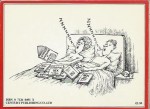
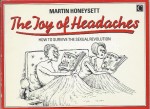
The Joy of Headaches – How to Survive the Sexual Revolution


By Martin Honeysett (Century Publishing)
ISBN 10: 0-7126-0491-X,      ISBN 13: 978-0712604918

I’ve got a dose of the post-Christmas glums today so it’s probably time to roll out another cartoon compendium and indulge in a bit of safe smirks. This time it’s a little known collection of cartoons about British bedtime habits from one of our best modern gagsters.

Of course it’s really just another excuse to bemoan the loss of those once-ubiquitous cheap ‘n’ cheerful gag-filled paperbacks which are now all-but-forgotten fossils of a once mighty industry; fast fading as the much more important sounding Graphic Novels and Trade Collections carve a niche in our psyches and on our bookshelves.

…And, having glanced at daytime TV over the break, I’ve since firmly fixated on another frightening thought – how many modern homes even have bookshelves any more?

None of which matters a jot or tittle as I call to your attention to a particularly fine example of a lost Artform: themed gag-books which sadly became the last commercial gasp in a tradition of pictorial entertainments that began with Punch and evolved into a saucy standby of British life for nearly a century before fading away, to only haunt bargain bins, Jumble sales and junk shops…

Martin Honeysett was born in Hereford in 1943 and, after the traditional wandering about not knowing what to do with himself, at the end of the 1960s became an animator, illustrator, award-winning cartoonist, painter and educator whose prolific works regularly appeared in the aforementioned Punch, as well as Daily Mirror, Private Eye, Radio Times, The Oldie, The Spectator, Evening Standard, Sunday Telegraph and Observer amongst others. He was a visiting professor at theKyotoSeikaUniversity, Faculty of Art,Japan, from 2005 to 2007.

These days he’s probably best known for magnificently illustrating books for children and adults, such as Bert Feggs Nasty Book, scripted by Terry Jones & Michael Palin, The Queen and I by Sue Townsend, Dick King-Smith’s H. Prince and Ivor Cutler’s mesmeric poetry books Gruts, Fremsley and  Life in a Scotch Sitting Room.

Way back when in 1984, he was an edgy, wryly sharp observer and commentator upon the absurdity of contemporary life, and this collection is a grippingly intriguing discourse on our nasty monkey mating habits and social gaffe-ability, stitched together with a running theme of how the more things change the more they stay the tedious same…

Warning: this hilarious treatise contains lots of wickedly naked people making a mess, frightening the horses, scandalising the neighbours, boring the kids and generally being rudely funny…

Beginning with a trenchant examination of with-it parents in a “permissive society”, what kids already know, lots of spoofs on the peccadilloes of the aristocracy, love amongst the Poor, a history of sex – especially the Swinging Sixties -, social nudity, commercial innovations and the latest technical improvements, before the emphasis easily shifts to niche areas of the intercoursing game.

There are examinations into School Sex Education, fidelity, promiscuity, international mores and incongruities, the mania for manuals and furtive practising leading to a thorough exploration of personal relationships, exploding long-held myths and getting to grips with that contentious size issue…

Much mention is made of medical matters, physical functions, foreign imports and tactics, the nature of consent and the roles of School, Church and State concerning private Citizens’ and citizen’s Privates…

With telling observations on birth control, marital norms, porn, assorted forms of human neutering, infections and disease control, the nuanced differences between “kinky” and “perverted” – as well as taboo, illegal and just plain wrong – addressed, readers will soon be assured that they too can do it right, do it often and do it well into old age.

…Even if the range and choice of partner(s) might cause a few sharp intakes of breath.

Rest assured, however, that there’s still room for old-fashioned Romance.

Sort of.

Dedicated to the certain premise that (other) people having sex is simultaneously better than yours but still truly hilarious, this snappy little monochrome tome is a cut above much of the era’s rather tawdry treatment of the subject, superbly rendered and still marvellously entertaining even in these liberally licentious times – and for a change, this one is still readily available from a range of internet retailers…

British cartooning has been magnificently served over the centuries by masters of form, line, wash and most importantly smart ideas, repeatedly poking our funny bones, pricking our pomposities, stroking our happy places and feeding our fascinations, and this sort of thing used to be bread ‘n’ butter in our game. We’re all going to really miss them if they disappear forever, so why not get a bookshelf if you don’t have one yet and start filling it with magical material like this…
© 1984 Martin Honeysett. All Rights Reserved.

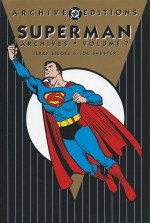
Superman Archives volume 7


By Jerry Siegel, Joe Shuster, Don Cameron, Bill Finger, Ed Dobrotka, George Roussos, Sam Citron, Ira Yarbrough, Wayne Boring, Fred Ray & various (DC Comics)
ISBN: 978-1-4012-1051-9

It’s almost incontrovertible: the American comicbook industry – if it existed at all – would have been an utterly unrecognisable thing without Superman. His unprecedented invention and adoption by a desperate and joy-starved generation quite literally gave birth to a genre if not an actual art form.

Spawning an impossible army of imitators and variations, within three years of his 1938 debut, the intoxicating blend of eye-popping action and social wish-fulfilment which hallmarked the early Man of Steel had grown to encompass cops-and-robbers crime-busting, socially reforming dramas, science fiction, fantasy, whimsical comedy and, once the war in Europe and the East embroiled America, patriotic relevance for a host of gods, heroes and monsters, all dedicated to profit through exuberant, eye-popping excess and vigorous dashing derring-do.

In comicbook terms at least Superman was master of the world, having already utterly changed the shape of the fledgling industry. There was the phenomenally popular newspaper strip, a thrice-weekly radio serial, games, toys, as much global syndication as the war would allow and the perennially re-run Fleischer studio’s astounding animated cartoons.

Despite all the years tat have passed since then, I – and so many others – still believe that superhero comics were never more apt or effective than when they were whole-heartedly combating the agents of Fascism (and yes by heck, even the dirty, doggone, Reds-Under-the-Beds Commies, who took their place in the 1960s too!) with explosive, improbable excitement and mysterious masked marvel men.

The most evocative and breathtaking moments of the genre seem to come when those gaudy gladiators soundly thrashed – and please forgive the offensive contemporary colloquialism – “Nips and Nazis”. However, even in those long-ago dark days, comics creators were wise enough to augment their tales of espionage and invasion with a range of gentler, more whimsical four-colour fare. By the time of the tales in this stunning seventh Superman coterie of classics – collecting #25-29 (November/December 1943 to July/August 1944) of the Man of Tomorrow’s solo title – the intense apprehension of the early war years had been replaced with eager anticipation of tyranny’s forces were being rolled back on every Front.

Superman was the premier, vibrant, vital role model whose startling abilities and take-charge, can-do attitude had won the hearts of the public at home and the troops across the war-torn world. Now, although the shooting was far from over, the stirring, morale-boosting covers were being phased out in favour of gentler and even purely comedic themes. After an informative Foreword: Siegel, Shuster & Associates by author and historian Ron Goulart (offering commentary and scrupulously detailing the working secrets of the Superman Studio at that troubled time), the only cover by Jack Burnley in this book shows Superman teaching kids to draw, before the quartet of thrillers behind that front image commenced with a full-on patriotic call to arms.

The Man Superman Refused to Help!’ by Jerry Siegel, Ira Yarbrough & George Roussos exposed the American Nazi Party – dubbed the “101% Americanism Society” – whilst offering a rousing tale of social injustice as an American war hero is wrongly implicated in the fascists’ scheme… until the Man of Steel investigated.

This is followed by a much reprinted and deservedly lauded patriotic classic.

‘I Sustain the Wings!’ by Mort Weisinger & Fred Ray, was created in conjunction with the Army Air Forces Technical Training Command under Major General Walter R. Weaver and designed to boost enlistment in the maintenance services of the military. In it Clark Kent attends a Technical Training Command school as part of the Daily Planet’s attempt to address a shortfall in vital services recruitment – a genuine problem at this time in our real world – but still finds time to delightfully play cupid to a love-struck kid who really wants to be a hot shot pilot not a mere “grease monkey”…

Siegel, co-creator Joe Shuster & Yarbrough then gloriously bit the hand that fed them by spoofing the budding superhero genre with the ‘King of the Comic Books’ as a disenchanted cartoonist is taught to value the worth of his mighty creation Geezer. Good thing too, as Adolf Hitler, totally fed up with being lampooned by the strip, had dispatched his best assassins to shut up the Verdammte artist for goot – sorry – good…

The issue ended with an exceptional crime thriller by Bill Finger, Ed Dobrotka & Roussos wherein the Metropolis Marvel tangled with ‘Hi-Jack – Jackal of Crime!’: an arrogant maniac determined to make a lasting name in the annals of villainy. But, as was so often the case, there was far more to the mastermind than first appeared…

Wayne Boring & Roussos provided a stunning anti-Nazi cover for #26 with the Man of Might giving the enemy propaganda minister a sound slapping, before ‘The Super Stunt Man!’ (Finger, Shuster, Yarbrough & Roussos) saw the Kryptonian Crimebuster restore the nerve, prospects and humour of a disgraced circus daredevil, whilst in ‘Comedians’ Holiday!’ by Don Cameron & Yarbrough, an aging vaudevillian film troupe gets a boost and new lease on life when Lois and Clark investigate their manager – a shady cove named J. Wilbur Wolfingham.

The scurvy scoundrel – a magnificent pastiche of W. C. Fields as an utterly heartless Mr. Micawber – would return over and over again to bedevil honest folk and greedy saps…

Andy Hoops was a no-good kid capitalising on an honest man’s tale of woe. When he blackmailed the Action Ace, ‘Superman’s Master!’ (by Siegel, Yarbrough & Roussos) tragically overstepped the mark and too late learned a very final lesson in decency, whilst ‘The Quicksilver Kid!’ (Cameron, Sam Citron & Roussos) pitted Superman against a revived and utterly amoral god Mercury who only wanted a little fun and exercise, but couldn’t handle their persistent alien protector…

Boring & Roussos depicted Superman cheekily teaching Lois to type on the cover of #27, whilst Cameron & Dobrotka produced all the interior wonders beginning the murderous Toyman‘s roguish return to bedevil honest citizens of Metropolis with ‘The Palace of Perilous Play!’ – a novelty arcade with perilous purpose. It wasn’t Superman-proof though…

Stuck in the woods pursuing a story, Lois and Clark met old lumberjacks and heard what happened after legendary logger Paul Bunyan met the Man of Steel in ‘When Giants Meet!’ after which, safely back in civilisation, Superman came to the aid of hayseed farmer Hiram Pardee who came to Metropolis to collect his millionaire inheritance and fell foul of shysters and brigands in the ‘Robber’s Roost!’ before ‘Dear Diary’ blended the journal-keeping habits of ambitious financier Randall Rocksell, gang-boss and conman Goldie Gates and Lois Lane in a heart-warming cautionary tale of greed and redemption, courtesy of a uniquely Kryptonian brand of problem-solving…

The cover of Superman #28 (May/June 1944) saw Boring & Stan Kaye combine to comedically compare the Metropolis Marvel with mythical monoliths Hercules and Atlas whilst the interior opened with the return of a certain swindling charlatan in ‘Lambs versus Wolfingham!’ (Cameron, Yarbrough & Roussos) which saw Clark, his alter ego and Lois save a town of sheepherders from the unscrupulous land-grabbing attentions of the roguish reprobate, simultaneously dispensing a hard lesson in business ethics to the shameless schemer, whilst Sam Citron pencilled ‘The Golden Galleons!’ in which a model-building competition in the Daily Planet led to bullying, cheating, skulduggery and even attempted murder amongst the poorest faction of Metropolitan society…

Scripted by an anonymous author and fully realised by Roussos, ‘Be a Magician – Turn Waste Paper into War Weapons!’ offered sage patriotic public service advice to the readership before Cameron & Dobrotka inaugurated a radical new series with ‘Lois Lane, Girl Reporter: The Suicidal Swain’.

In those turbulent times the interpretation of the plucky news-hen was far less derogatory than the post-war sneaky minx of the 1950s and 1960s. Lois might have been ambitious and life-threateningly precipitate but it was always to advance her own career, help underdogs and put bad guys away, not trap a man into marriage.

This premier 4-page vignette offered a breathless, fast-paced screwball comedy-thriller wherein the canny lass fails to talk a crazed jumper down from a ledge but still saves his life in a far more flamboyant manner, reaping the just reward of a front page headline.

The issue the ended with ‘Stand-In for Hercules!’ by Siegel, Yarbrough & Roussos, in which Superman travelled back to Ancient Greece to help out a dying scientist and ended up carrying out a dozen good deeds for an ailing legend. Of course the tale had a solidly humorous basis and a sneaky sting included…

Issue #29’s cover was a peacefully patriotic one as Boring & Roussos showed Lois entertaining “her Supermen” – a Soldier, Sailor and Marine – after which malign mischief-maker The Prankster became ‘The Wizard of Wishes!’, exploiting people’s dreams for personal profit until Superman put his foot down in a classy thriller by Cameron & Dobrotka.

Bill Finger then scripted ‘The Tycoon of Crime!‘ for Dobrotka, in which the Action Ace tackled a retired and very bored businessman who turned gangster to alleviate his ennui and managed to mass market villainy after he hypnotised the Man of Steel, after which

‘Lois Lane, Girl Reporter: The Bakery Counterfeiters’ by Cameron, Dobrotka & Roussos, found the peerless newshound turn her demotion to the women’s cookery pages into another blockbusting scoop.

This convivial collection then concludes with a cleverly moving yarn by Joe Samachson & Dobrotka wherein Clark is mistaken for a missing heir and incurs the wrath of a host of greedy, frustrated relatives eager to get rid of ‘The Pride of the Kents’…

As fresh and thrilling now as they ever were, these endlessly re-readable epics are perfectly situated in these glorious hardback Archive Editions; a worthy, long-lasting vehicle for the greatest and most influential comics stories the art form has ever produced.

So what are you waiting for…?
© 1943, 1944, 2006 DC Comics. All Rights Reserved.

R.E.B.E.L.S. volume 2: Strange Companions


By Tony Bedard, Andy Clarke, Claude St. Aubin, Karl Moline, Derec Donovan, Kalman Andrasofszky & various (DC Comics)
ISBN: 987-1-4012-2761-6

Once upon a time, DC’s vast pantheon of characters was sensibly scattered, segregated and wholly distinct: separated and situated on a variety of alternate Earths which comprised Golden Age hold-overs, contemporaneous Silver Age stars and later-created heroes. Further Earths were subsequently introduced for every superhero stable the company scooped up in a voracious and protracted campaign of acquisition over the decades. Charlton, Fawcett, Quality Comics and others’ characters resided upon their own globes, occasionally meeting in trans-dimensional alliances and apparently deterring new readers from getting on with DC.

Latterly, when DC retconned their entire ponderous continuity following Crisis on Infinite Earths in 1985-1986, ejecting the entire concept of a multiverse and re-knitting time so that there had only been one world literally festooned with heroes and villains, many of their greatest characters got a unique restart, with the conceit being that the characters had been around for years and the readership were simply tuning in on just another working day.

Of course now the multiverse concept is back and not confusing at all (no! seriously?) but whatever the original reasons, that dramatic 1980s refit did provide for some utterly astounding and cleverly cohesive stories…

In the aftermath of that event, the hero-packed planet Earth was targeted by a coalition of alien races and endured a full-on Invasion which was repulsed by the indomitable resistance of the World’s assembled heroes and villains and a few selected extraterrestrial allies. When the cosmic dust settled a few of these stayed together and formed cops-for-profit outfit dubbed L.E.G.I.O.N., led by a lying, scheming, manipulative obsessive super-genius bastard named Vril Dox: notional son of the villainous super-villain Brainiac of Colu and one of the most superciliously smug creatures in creation.

Overcoming all odds and the general distaste of his own chief lieutenants, Dox moulded his organisation into a force for justice and peace in the universe, with over 80 client worlds happily prospering, until his own son Lyrl – whilst still a baby – usurped control of the organisation: hunting Vril and his core agent team across the universe as desperate R.E.B.E.L.S. ruthlessly pursued by their own intergalactic commercial police force.

By the end of that run of comicbooks in 1996, order and the status quo were fully restored and the Licensed Extra-Governmental Interstellar Operatives Network went back to scrupulously and competently doling out all the peace and security solvent worlds could afford…

In the first volume, Dox’s organisation was snatched from his implacable grasp by an alien incursion from another galaxy, led by a terrifying mystery despot who had apparently subjugated the predatory Starros and turned their mind-sucking, power-leeching abilities to the creation of an unbelievably vast inter-galactic empire, policed by an unstoppable host of super-slaves and subservient legions.

Acting upon information received from his own descendent in the 31st century, Dox began assembling a super-powered strike force from across known space: old allies and pawns, new heroes – and even villains and monsters. Whoever he couldn’t coerce or co-opt Dox created, such as with the crippled Anasazi girl he transformed into a ball of sentient space-spanning energy he dubbed Wildstar…

However, just as he was compiling his arsenal of living weapons and preparing to take back control of L.E.G.I.O.N., events overtook him again. From far outside our galaxy an impossible army of invaders burst through a space rift, all enslaved by and connected to a telepathic starfish creature named Starro, yet somehow controlled by a humanoid master who had learned how to psychically dominate the universally-feared pentagram predators…

Within hours the Armada had destroyed the impregnable homeworld of the dreaded Dominators and were preparing to spread across the Milky Way, until Dox, with typical reckless brilliance, locked the entire quadrant within an impenetrable forcefield stalling the invasion by trapping hundreds of worlds – and his ragtag R.E.B.E.L.S. unit with them – in an inescapable cage with the most rapacious creatures in creation…

Collecting issues #7-9 of the revived comicbook series and the first R.E.B.E.L.S. Annual: Starro the Conqueror (all from 2009), the drama is scripted as ever by Tony Bedard and continues with ‘No Way Out’ (illustrated by Andy Clarke) wherein the only Dominator to escape the fall of his own species’ ancient empire goes hunting for allies and revenge. Dox too is seeking outside help – with as little success – from planetary dictators such as Despero or Kanjar Ro and extremist regimes such as the bellicose Khunds: all elements he used to be paid good money to keep away from decent sentients and his client worlds…

The aquatic, methane breathing mega-teleporters of Gil’Dishpan at least agreed to a meeting with both Dox and the Dominator, keenly aware that their inherent space-shifting capabilities presented Starro’s forces with an irresistible opportunity to break out of the vast but impenetrable force cage frustrating their outward expansion…

The venal Gil’Dishpan had actually planned to give their diplomatic guests to Starro in return for a neutrality pact but the invaders instead attacked the methane-dwellers, ultimately forcing Dox and the last Dominator to make absolutely sure no teleporters remained for the starfish to mind-control…

In ‘Stealth’ (Clarke art again) the ragtag band of resistors track down the banished and now teenaged Lyrl Dox, press-ganging the former tiny tyrant into the fight just as Starro’s metahuman brigade turned their unstoppable attentions upon the Khundish empire – with the now inevitable result of total submission through horrendous bloodshed.

On another front the insidious Psions contrived a ghastly biological cloaking mechanism and despatched the far-from happy Omega Men through the still-open space rift to the Horde’s mysterious point of origin…

The titular ‘Strange Companions’ – lavishly rendered by Claude St. Aubin & Scott Hanna – pulls more threads into the swiftly expanding cosmic tapestry as Wildstar goes in search of other allies trapped within the contained quadrant whilst the Omega Men discover disquieting, unsuspected secrets on the other side of the sky.

As Starro lieutenant Smite personally crushes all resistance on Kanjar Ro’s fortress world Dhor, the dictator is rescued at the last moment by his archenemy Adam Strange, another recruit to Dox’s resistance movement as is Earthling mutant superman Captain Comet.

The assembled rebels don’t have long to catch their breath however as the frustrated Smite arrives in blockbusting manner leading a squad of Starro super-soldiers and tasked with capturing – or is that liberating? – Lyrl Dox: a lad who’s been correctly assessed as even smarter and more ruthless than the father he’s always hated…

To Be Continued…

The rest of this volume reprints the Annual; offering a quintet of tales uncovering secrets and disclosing hidden facts about the unbeatable enemy forces. The eponymous framing sequence ‘Starro the Conqueror’ (illustrated by St. Aubin & Hanna) connects five powerfully revelatory chapters beginning with ‘The Doom that Came to Kalanor’ as the supreme master of the invaders personally destroys the diabolical Despero – a brutal juggernaut who has killed billions in his day. That day, though, is soon done…

The action continues by revealing the backgrounds of the pitiless, uncompromising invaders beginning with the tragic ‘Daughter of Storms’ (with art from Karl Moline & Mark Pennington): life-giving goddess of a world who lost everything when the starfish landed in her skies…

This is followed by an introduction to the worst Starro can offer as St. Aubin & Hanna convene ‘The High Vanguard’: brutal monsters who serve the as the semi-autonomous elite of the rapacious Horde, after which Derec Donovan delineates the story of Smite who was ‘Scourge of the Stars’ even before falling to the unrelenting overlord of infinity…

This volume concludes with the horrific origin of ‘The Star Conqueror’ (art by Kalman Andrasofszky) which shows how a gentle holy man defeated an intolerable invading interplanetary predator and unwittingly unleashed a far greater menace upon all of creation…

With a spectacular cover gallery by Andy Clark & Andrasofszky, this slim tome offers a deliciously intoxicating blend of space opera and cosmic action that will push every button for lovers of staggering science fiction thrills, cut with sharp, mature dialogue and sublimely beautiful artwork. More straight and simple, mind-boggling, slyly cynical, riotous rollercoaster fun no fan of fantasy should do without…
© 2009, 2010 DC Comics. All Rights Reserved.

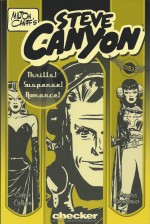
Milton Caniff’s Steve Canyon 1953


By Milton Caniff with Dick Rockwell (Checker Books)
ISBN: 978-1-93316-057-3

Steve Canyon began on 13th January 1947, after a canny campaign to boost public anticipation following creator Milton Caniff’s very conspicuous resignation from his previous and world-famous comic strip masterpiece Terry and the Pirates.

Caniff, a true master of suspense and expert in the dark art of forcing reader attention, didn’t show his new hero until four days into the first adventure – and then only in a ‘file photograph’. The primed-and-ready readership first met Stevenson Burton Canyon, bomber pilot, medal-winning war-hero, Air-Force flight instructor and, latterly, independent airline charter operator in the first Sunday colour page, on January 19th 1947.

Almost instantly Caniff was working at the top of his game, producing material exotically familiar and – as ever – bang on the money in terms of the public zeitgeist and taste.

Dropping his hero into the exotic climes he had made his own on Terry, Caniff modified that world based on real-world events, but this time the brooding, unspoken menace was Communism not Fascism. Banditry and duplicity, of course, never changed, no matter who was nominally running the show…

Caniff was simply being marketably contemporary, but he was savvy enough to realise that with the Cold War “hotting up”, Yankees were going to be seen as spies in many countries, so he made that an intrinsic part of the narrative. When Canyon officially re-enlisted, the strip became to all intents and purposes a contemporary War feature…

Over the decades the Steve Canyon strip honestly embraced the philosophy of America as the World’s policeman, becoming a bastion of US militarism and remaining true to its ideals even as the years rolled by and national tastes and readership changed…

Steve foiled plots and chased his true love Summer Olsen around the globe for thirty years: continually frustrated that fate and his many antagonists cruelly kept them unhappily apart until they finally wed in 1970. Canyon had remained a far-ranging agent of Air Force Military Intelligence, even though by this time the Vietnam War had made the Armed Forces an extremely hot potato…

This seventh volume covers the period May 15th 1953 to August 5th 1954 and shows how, as the Korean conflict stuttered to a weary impasse, Caniff smoothly changed tack but not gears reinstating characters, plots and situations he had shelved when the fighting began. Now, his charismatic cast were edging into another post-war world…

Steve Canyon stories seldom had a recognisable beginning or end and the narrative continually flowed and followed upon itself, but for convenience the publishers have broken the saga into generally discrete tales which begin here with ‘The Princess and the Doctor’ which ran from May 15th to September 12th 1953 and saw the veteran adventurer “requested” by his USAF superiors to ferry a doctor into the heart of Red China.

The tale started with a clever code message readers were invited to solve – with a $100 prize offered by the magnificent showman and publicist Caniff – before Steve and Chinese American medic Dr. Louis Shu sneak through Indian passes behind the Bamboo Curtain to save anti-communist rebel Princess Snowflower from a mystery malady that even her psychotically devoted American mentor and former shiftless Soldier-of-Fortune Dogie Hogan can’t handle (for full details of these incredible characters a thorough re-reading of Milton Caniff’s Steve Canyon 1949 is advised and much recommended…).

The Princess and her fanatically loyal forces have been holding out against the Chi-Com for years from an impregnable mountain fastness but her weakened condition is causing her devoted warriors to doubt their cause and Steve is needed to shore up the resistance movement within the new totalitarian monolith…

However Canyon and Hogan are old rivals who have butted heads since the fall of Imperial China and the grizzled veteran sees no reason to welcome the flashy air force know-it-all. He’d have been better advised to keep the good-looking surgeon away from the lonely, impressionable young girl…

And of course, to cap matters the Chinese have a new wonder general who thinks he can finally break the years-long impasse of the infernal royalist modern Masada…

Packed with tension, blistering action, love, anger, betrayal, smouldering sex and withering comedy, this epic saga also features the welcome return of one of the strip’s most unique supporting characters before Steve leaves with his mission more or less accomplished, but with enough dangling plot threads to guarantee another tempestuous visit in the years to come…

The soap opera shufflings and Cold War shenanigans were briefly sidelined in ‘The Halls’ (13th September – December 30th) wherein Canyon, travelling incognito through the contentious region, is mistaken for a Russian spy by overzealous border guards and wrongfully imprisoned in a small non-aligned nation between India and the USSR. Happily even that postage-stamp state has a US Consulate.

Homer Hall, his capable, beautiful and blind wife Gil and their imaginative daughter Hollister never expected much trouble, but when Holly and her pal Lise from the French Embassy discover an American in the city dungeons the romance-starved girls contrive his escape, even as the city’s inevitable cabal of true communist agents engineer a riot to spring their “Soviet Comrade”.

With Mr. Hall trapped outside the capital and riot in the streets, the girls free Steve and he valiantly returns the favour by saving Mrs. Hall from death in her own blazing Consulate building…

With a measure of order restored and Steve cleared of spying charges, his major difficulty is letting down Holly who has conceived the notion that Steve loves and wants to marry her. Mrs. Hall too harbours feeling for the rugged he-man…

The situation is swiftly exacerbated when the Hall Women are evacuated by train to safety in Indiaand the Consul asks Steve to escort them, only to have all three valuable Americans kidnapped by bandits eager for ransom. However the village of thieves panic when they see that Gil Hall is blind, as such women are bad luck, but their attempts to kill her are foiled by their charismatic chieftain Cobra Johnny, a lover of all things American – especially guns and money…

The robber king’s hold on his men soon slips however when smallpox breaks out in the village. With the men clamouring for the head of the “no-see woman”, Gil begins treating the ailing mothers and children: after all the disease took her sight years ago and she has nothing left to lose…

As events escalate Steve and Holly manage to signal the Indian forces searching for them but not before Johnny discovers their ploy and decides to cut his losses…

After extricating himself from that menace the rescued aviator escapes mother and daughter’s unwanted attentions by faking a telegram from his long-lost love Summer Olsen and heads for points west but doesn’t get far. Called into the local Air Force office he is “invited” to help with a little contraband problem.

‘Heroin Smuggler’ ran from December 31st 1953 to April 30th 1954 and saw Lieutenant Colonel Canyon go undercover to catch a diabolical murderer and expose a clever scheme wherein an old acquaintance was somehow running Chinese drugs into the West, past every trap and safeguard the British and Americans could devise…

In a brilliant mystery thriller by the utterly on-form Caniff, Steve’s problem was not discovering how independent airline magnate Herself Muldoon had managed to become the East’s first and foremost drug trafficker, but how to stop his old foe when every agency in the area seemed to work for her. The horrific answer came when one of her ex-service-man pilots finally lost control of the monkey on his back…

The subsequent tale of tragedy was one of the earliest and still most harrowing depictions of the nature and consequences of narcotics addiction ever seen in comics, and the far-from-clean but coldly plausible resolution a moving reminder of the insidious power of the medium to inform and affect…

The worldly, war-weary, Canyon was a mature adventurer who could be sent literally anywhere and would appeal to the older, wiser readers of Red-Menaced, Atom-Age America, now a fully active player on the world stage. Canyon also reflects a more mature creator who has seen so much more of human nature and frailty than even the mysterious Orient could provide. A young Shakespeare could write “Romeo and Juliet” but maturity & experience were needed more than passion to produce “the Tempest” or “King Lear”, but in the final tale in this marvellous monochrome collection the author blends classic drama with sophisticate modern romance by finally allowing another bittersweet, ultimately frustrating reunion of his own star-crossed lovers…

Widow and proud single parent Summer has been forced to take a high-powered, well-paying job with Steve’s industrialist nemesis Copper Calhoun, unaware that the sadistic millionairess was also obsessed – or perhaps infatuated – with Canyon; the one man she could not buy.

Now in ‘Triangle’ (May 1st – August 5th 1954) a long simmering plot boiled over as Canyon finally returned toAmerica and sought out Summer. Neither frustrated lover was aware that Calhoun had been using her vast resources to keep tabs on the pair and even intercept their communications; determined to keep them both separate and miserable…

As the Colonel hit USsoil, Copper despatched Summer and her son Oley on a long-overdue vacation to a fabulousFlorida resort.

Naturally with the pressure off, plenty of time and money on her hands, convivial company and the ardent attentions of dashing playboy Clarke Netherland, Summer’s head was turned – and that’s when the indomitable ingenious Steve burst in, having spent almost all his furlough tracking down his intended…

After battering his way through all of Calhoun’s many obfuscations the last thing the Colonel expected was to have to fight a wooing campaign, but as the tale evolved into a delicious take on the sparkling, glamorous sophisticated Philadelphia Story/High Society movie comedies of the time, no one was aware of the dark secret the enigmatic Mr. Netherland harboured nor just what his conscience would eventually force him to do…

…And as a bitter Steve again buried himself in another dangerous Air Force mission Summer, once more abandoned and bereft, at last discovered some brutal truths and had a final showdown with her boss the Copperhead…

Resulting in some of the most impressive and mature storytelling of his undeniably stellar career, Caniff seamlessly moved from hot combat to Cold War and from exotic locations to homespun soap opera at this time: his skilful passion-play perfectly showing a sublime ability to delineate character and mood.

The art here is some of the most subtly refined of his career and the brilliantly enacted storylines firmly put the series back on the original narrative tracks suspended by the Korean conflict …and there was even better still to follow…

Steve Canyon is comic storytelling at its best. Beautifully illustrated, mesmerising black and white sagas of war, espionage, romance, terror, justice and cynical reality: a masterpiece of graphic narrative every serious fan and story-lover should experience. …And that’s not to in any way disparage the astounding artistic contributions of Dick Rockwell who began assisting with the artwork in 1952, pencilling the scripts which Caniff authored and then inked.

As the Master’s health gradually failed over the years, Rockwell invisibly assumed more and more of the strip’s visual aspect. When Caniff passed away in 1988, Rockwell continued and concluded the final adventure ‘The Snow Princess’ before the series was finally retired with honour on Sunday, June 5th 1988.

Most cartoonists – or workers in any field of artistic endeavour – go to their graves never attaining the giddy heights of being universally associated with a signature piece of unequivocally supreme work. How incredible then when a guy achieves that perfect act of creation, not once but twice – and does so seven days a week for 64 years? Enticing, enthralling, action-packed and emotionally overwhelming, Steve Canyon is an unequivocal high-point of graphic narrative: a full-immersion thrill and a passport to the halcyon glory of another age.

Comics just don’t get better than this.
© Checker Book Publishing Group 2006, an authorized collection of works © Ester Parsons Caniff Estate 1953. All characters and distinctive likenesses thereof are trademarks of the Ester Parsons Caniff Estate. All rights reserved.

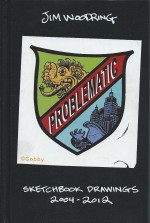
Problematic: Sketchbook Drawings 2004-2012


By Jim Woodring (Fantagraphics Books)
ISBN: 978-1-60699-594-5

Some creators in the world of comics just defy description and their graphic novels and collections are beyond the reviewer’s skills (mine certainly) to elucidate or encapsulate. Some are just so pedestrian or mind-numbingly bad that one simply can’t face writing about them. Others are so emphatically wonderful that no collection of praise and analysis can do them justice.

At the apex of that tricky funnybook pyramid is Jim Woodring: a position he has maintained for years and clearly appears capable of holding for years to come. Woodring’s work is challenging, spiritual, philosophical, funny, beautiful and extremely scary. And, even after reading that sentence, you will have absolutely no idea of what you will be seeing the first time you read any of it.

Moreover, even if you have scrupulously followed cartoonist, animator, Fine Artist, toy-maker and artistic Renaissance Man James William Woodring through an eccentric career spanning his first mini-comics in 1980, the groundbreaking Fantagraphics magazine series such as Jim (1986), the notional spin-off Frank (of which Weathercraft was the latest incredible instalment), Tantalizing Stories, Seeing Things, Congress of the Animals or his more mainstream features such as Star Wars and Aliens tales for Dark Horse, you’ll still have no idea how you will respond to his newest work.

Woodring delivers surreal, abstract, wild, rational, primal cartooning: his clean-mannered art a blend of woodblock prints, Robert Crumb style, wry humour and eerie conviviality, Dreamscape, religious art and monstrous phantasmagoria. His works form a logical, progressional narrative pockmarked with multiple layers of meaning but generally void of speech or words, magnificently dependent on the intense involvement of the reader as a fully active participant.

So you can imagine what his first formative thoughts, passing observations and moments of wild unfettered graphic whimsy must be like…

This stunning little hardback opens the gates of dream just a crack and offers selected graphic snippets from his sketchbooks covering the superbly productive period following the millennium and offering a few choice views of the other graphic avenues he could have travelled if the world of harnessed hallucinations had not such a strong hold…

In his ‘Introduct’ Woodring describes his abandonment of traditional graphic tomes for diminutive “Moleskine” doodle-pads, using the flimsy palm-sized books to capture ideas roughly, quickly and with intense immediacy …and the gimmick clearly works.

The material collected here – mostly enlarged 140% up from the originals – simply buzzes with life and energy.

Many Frank regulars appear, including the eponymous Krazy Kat-like ingénue himself, and there are absolute torrents of bizarre, god-like household appliances, vulture-things, frog-things, rhino-things, plant-things and unspeakable Thing-things, that inhabit the insanely logical traumic universe of his sensoria.

There are snippets of reportage, plenty of designs and even roughs and layouts from finished stories. Woodring also proves himself a pretty sharp pencil when it comes to capturing the weird moment of reality we all experience, a keen caricaturist and a deliciously funny “straight gag-man”, glamour artist and capturer of friends in idle moments – just like all of us sad art-school escapees who break into a cold sweat whenever we realise we’ve left the sketchbook at home and there’s only beer-mats and napkins to draw on….

Woodring is not to everyone’s taste or sensibilities – for starters, his drawings have a distressing habit of creeping back long after you’ve put the book down and scaring the bejeezus out of you – but he is an undisputed master of the form and an innovator always warping the creative envelope.

As such this welcome peek into his creative process and conceptual/visual syllabary offers encouragement and delight to artists and storytellers of every stripe, as well as being just plain wonderful to see.

All art-forms need such creators and this glorious hardback monochrome tome could well change your working and reading habits for life.

Go on, aren’t you tempted, tantalized or terrified yet? What about curious, then…?
© 2012 Jim Woodring. This edition © 2012 Fantagraphics Books. All rights reserved.

Wonder Woman Archives volume 3


By Charles Moulton (William Moulton Marston & Harry G. Peter) with Frank Godwin (DC Comics)
ISBN: 1-56389-814-4

Wonder Woman was conceived by polygraph pioneer William Moulton Marston and illustrated by Harry G. Peter in an attempt to offer girls a positive and forceful role model. She debuted as a special feature in All Star Comics #8 (December 1941), before springing into her own series and the cover-spot of new anthology title Sensation Comics a month later. An instant hit the Amazing Amazon quickly won her own eponymous supplemental title in late Spring of that year (cover-dated Summer 1942).

Once upon a time on a hidden island of immortal super-women, American aviator Steve Trevor of US Army Intelligence crashed to Earth. Near death, he was nursed back to health by young and impressionable Princess Diana.

Fearing her growing obsession with the creature from a long-forgotten and madly violent world, her mother Queen Hippolyte revealed the hidden history of the Amazons: how they were seduced and betrayed by men but rescued by the goddess Aphrodite on condition that they isolated themselves from the rest of the world and devoted their eternal lives to becoming ideal, perfect creatures.

However when goddesses Athena and Aphrodite subsequently instructed Hippolyte to send an Amazon back with the American to fight for global freedom and liberty, Diana overcame all other candidates and became their emissary – Wonder Woman.

On arriving in Americashe bought the identity and credentials of lovelorn Army nurse Diana Prince, elegantly allowing the Amazon to be close to Steve whilst enabling the heartsick medic to join her own fiancé in South America. Soon Diana also gained a position with Army Intelligence as secretary to General Darnell, ensuring she would always be able to watch over her beloved. She little suspected that, although the painfully shallow Steve only had eyes for the dazzling Amazon superwoman, the General had fallen for the mousy but superbly competent Lieutenant Prince…

Using the nom de plume Charles Moulton, Marston (with some help in later years from assistant Joye Murchison) scripted almost all of the Amazing Amazon’s many and fabulous adventures until his death in 1947, whereupon Robert Kanigher took over the writer’s role. Venerable veteran illustrator and co-creator H.G. Peter performed the same feat, limning practically every titanic tale until his own death in 1958. A couple of the very rare exceptions appear in this volume…

This third superbly luxurious full-colour deluxe hardback edition collects her every groundbreaking adventure from Wonder Woman #5-7 and Sensation Comics #18-24 from June-December 1943, and commences, after an appreciative Foreword from comics historian Les Daniels, with ‘The Secret City of the Incas’ from Sensation #18, illustrated by the superbly talented classical artist Frank Godwin, in which the Princess of Power rescued a lost Inca tribe from a despotic theocracy and ancient greed whilst in #19 (Godwin again)‘The Unbound Amazon’ responded to a little boy’s letter and stumbled onto big trouble in the far north woods. Of course Diana knew little Bobby from the Adventure of the Talking Lion (as seen in the previous Archive edition) and with wicked Nazi spy Mavis on the loose wasn’t about to take any chances.

This terrific thriller is notable for the revelation that if an Amazon removed her Bracelets of Submission she turned into a raving, uncontrolled engine of sheer destruction…

H. G. Peter drew the vast entirety of Wonder Woman #5 (June/July 1943), which presented an interlinked epic in the ‘Battle for Womanhood’ as war-god Mars (who instigated the World War from his HQ on the distant red planet through his earthly pawns Hitler,  Mussolini and Hirohito) returned to plague humanity. This time he enlisted the aid of a brilliant but deformed and demented misogynistic psychologist with psychic powers. The tormented Dr. Psycho used his talents to marry and dominate a medium named Marva, using her abilities to form ectoplasmic bodies as he sought to enslave every woman in the world.

Happily Wonder Woman countered his gods-sponsored schemes, after which prominent sidekicks ‘Etta Candy and her Holliday Girls’ comedically crushed a burglary before ‘Mars Invades the Moon’ returned to the overarching tale when the frustrated war-god was ousted by the Duke of Deception.

In attempting to take over the Moon – home of peace-loving goddess Diana – Mars made the biggest error of his eternal life as the Amazing Amazon led a spectacular rescue mission which resulted in the invaders’ utter rout.

The issue then concluded with ‘The Return of Dr. Psycho’ who had escaped prison and again perpetrated a series of ghastly attacks on America’s security and the freedom of women everywhere until the Holliday Girls and their demi-divine mentor stepped in…

Sensation #20 was also by Peter – who was slowly coming to grips with the increased extra workload of the explosively popular 64-page Wonder Woman series every three months – and ‘The Girl with the Gun’ saw Diana Prince investigate sabotage at a munitions factory and the murder of a General at WAACs training base Camp Doe. To the Amazon’s complete surprise the culprit appeared to be Marva Psycho, but there was far more going on than at first appeared…

Godwin handled the art for #21 as Steve and Diana tracked down insidious traitor the American Adolf as he conducted a murderous ‘War Against Society’ whilst issue #6 – another all-Peter extravaganza – introduced another macabre foe in ‘Wonder Woman and the Cheetah’.

Marston’s psychiatric background provided yet another deeply disturbed antagonist in the form of sugar sweet debutante Priscilla Rich who shared her own body with a jealously narcissistic, savage feline counterpart dedicated to murder and robbery. The Cheetah framed the Amazing Amazon and almost destroyed Steve, Etta and the Holliday girls before Wonder Woman finally quashed her wild rampages.

It wasn’t for long as the Cheetah returned to mastermind an espionage-for-profit ring in ‘The Adventure of the Beauty Club’ which resulted in the Perfect Princess being captured by Japan’s High Command before spectacularly busting loose for a final confrontation in ‘The Conquest of Paradise’. Here the Feline Fury infiltrated the home of the Amazons and almost irretrievably poisoned the minds of the super women sequestered there…

By this time Peter was fully adapted to his new schedule and in Sensation Comics #22 took the psychological dramas to new heights when a cured Priscilla Rich was seemingly attacked by her manifested evil self  after the Cheetah stole America’s latest weapon ‘The Secret Submarine’…

In issue #23 the creators tackled school bullying and women in the workplace as production line staff were increasingly stricken by ‘War Laugh Mania’. Only one of the problems was being promulgated by Nazi spies though…

It was back to straight action in #24 as ‘The Adventure of the Pilotless Plane’ saw Steve abducted by Japanese agents whilst investigating a new gas weapon which prevented US aircraft from flying. The vile villains had nothing that could stop Wonder Woman from smashing them and freeing him however, and the status quo was fully restored for the last saga in this lavish hardcover collection.

Wonder Woman #7 offered an optimistic view of the future in a fantastic fantasy tale ‘The Adventure of the Life Vitamin’ wherein America in the year 3000AD revealed a paradisiacal world ruled by a very familiar female President where a miracle supplement had expanded longevity to such an extent that Steve, Etta and all Diana’s friends were still thriving.

Sadly some old throwbacks still yearned for the days when women were second-class citizens subservient to males which meant there was still work for the Amazing Amazon to do…

‘America’s Wonder Women of Tomorrow’ continued the wry but wholesome sex war with Steve going undercover with the rebel forces uncovering a startling threat in ‘The Secret Weapon’ before the focus returned to the present and a far more intimate crisis for wilful child Gerta whose mother Paula (fully reformed ex-Nazi Baroness Paula von Gunther) was forced to deal with a ‘Demon of the Depths’.

But was that the evil octopus at the bottom of the paddling pool or her daughter’s dangerously anti-authoritarian attitudes…?

Far too much has been made of supposed subtexts and imagery of bondage and submission in these early tales – and yes, there really are a lot of scenes with girls tied up, chained or about to be whipped – but I still don’t care. Whatever Marston and Peters might have intended, the plain truth is that the skilfully innovative dramas and incredibly imaginative story-elements influenced the entire nascent superhero genre as much as Superman or Batman, and we’re all the richer for it.

This sterling deluxe book of nostalgic delights is a marvel of exotic, baroque, beguiling and uniquely exciting wonder and these Golden Age adventures of the World’s Most Fabulous female are timeless, pivotal classics in the development of comicbooks and still provide astounding amounts of fun and thrills for anyone interested in a grand nostalgic read.
© 1943, 2002 DC Comics, Inc. All Rights Reserved.

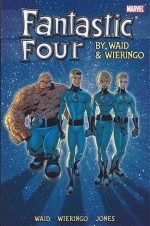
Fantastic Four by Waid & Wieringo Ultimate Collection Book 2


By Mark Waid & Mike Wieringo, with Casey Jones, Karl Kesel & Larry Stucker (Marvel)
ISBN: 978-0-7851-5658-1

The Fantastic Four has long been considered the most pivotal series in modern comics history, introducing both a new style of storytelling and a decidedly different manner of engaging readers’ imaginations and attention. Regarded by fans as more as a family than a team, the roster has changed many times over the years but one which inevitably reverts again to its original core group.

Those steadfast stalwarts are maverick genius Reed Richards, wife Sue, their tried and true friend Ben Grimm and Sue’s younger brother Johnny; survivors of a privately-funded space-shot which went horribly wrong after Cosmic Rays penetrated their ship’s inadequate shielding.

When they crashed back to Earth, the quartet found that they had all been hideously mutated into outlandish freaks. Richards’ body became astoundingly elastic, Sue gained the power to turn invisible and project force-fields, Johnny could turn into living flame, and poor, tormented Ben was transformed into a horrifying brute who, unlike his comrades, could not reassume a semblance of normality on command.

This compilation gathers issues #67-70 of the 3rd volume (before the series reverted to its original numbering) and then #500-502 plus bonus material from the Directors Cut edition of #500, highlighting the spectacular run by writer Mark Waid and much-missed illustrator Mike Wieringo, gloriously celebrating their “back-to-basics” approach which utterly rejuvenated the venerable property in 2003.

Key to that revival was a thorough reassessment and reappraisal of the team and their greatest enemy as seen in ‘Under her Skin’ (FF #67, May 2003, inked by Karl Kesel) wherein Victor Von Doom at last abandoned his technological gifts and inclinations, rejecting them for overwhelming sorcerous might to humiliate and destroy his greatest rival Reed Richards.

All he had to do was sacrifice his greatest love and only hope of redemption…

This terrifying glimpse into Doom’s past and shocking character study in obsession was the prologue to a 4-part epic entitled ‘Unthinkable’ which opened one month later and would end with the resumption of the title’s original numbering in Fantastic Four #500.

Waid’s greatest gift is his ability to embed hilarious moments of comedy into tales of shattering terror and poignant drama, and it’s never better displayed than here when the First Family of Superheroes suddenly find their daily antics and explorations ripped from them. The method is straightforward enough: Doom attacks them through their children, using baby Valeria as a medium for eldritch exploitation and sending firstborn Franklin to Hell, a payment to the demons to whom the debased doctor has sold the last dregs of his soul…

A supreme technologist, Richards had never truly accepted the concept of magic, but with Master of the Mystic Arts Dr. Strange oddly unwilling to help, the reeling and powerless Mr. Fantastic nonetheless leads his team to Latveria for a showdown, still unable to grasp just how much his arch-foe has changed.

Invading the sovereign – if rogue – nation, the team fight the greatest battle of their lives but lose anyway. The normally quicksilver mind of Richards seems unable to deal with the new reality and the FF are locked away in prisons specifically and sadistically designed to torment them. As a sign of his utter disdain, Doom locks his broken rival in a colossal library of grimoires and mystic manuscripts, knowing the defeated, dogmatic scientist can never make use of what is there. Big mistake…

Before attacking the FF, Doom had ensorcelled Dr. Strange, but had greatly underestimated Earth’s Sorcerer Supreme. Struggling to free himself, the mage establishes contact with Richards and begins to teach the unbelieving ultra-rationalist the basic of magic…

By the time Doom discovers his danger, Reed has freed his comrades and daughter and in the catastrophic battle which ensues the Iron Dictator replaces Franklin in as the hostage of Hell, but not before, in one final act of malice, he maims Reed Richards with a searing mystic retaliation, melting half his face by means which neither magic nor medicine can mend…

Although victorious, the Fantastic Four are far from winners. Doom’s assault upon the family has scarred them all, but none more so than Franklin, whose time in Hell has left him deeply traumatised and almost catatonic. In the 2-part follow-up ‘5th Wheel’ (illustrated by Casey Jones), Sue and Ben desperately search for treatments that can break through the boy’s wall of silence whilst Johnny begins a campaign to drag Reed out of a post-traumatic funk. The only thing that seems to motivate the obsessively brooding inventor is a half-baked scheme to use Doom’s captured time-machine and visit the dictator’s boyhood…

Meanwhile in the now, a visit to a funfair has resulted in a breakthrough – of sorts – forFranklin, but only reveals that the boy is still, in so many ways, trapped in hell. …And for Johnny there’s a terrifying realisation that his infallible, perfect Brother-in-Law is going to shoot the still innocent Victor Von Doom before the child can grow into the greatest menace in history…

Superbly entertaining, immensely exciting and genuinely challenging, this run of tales was a sublime renaissance for the “World’s Greatest Comics Magazine” and this collection also includes a wealth of bonus material from the Director’s Cut anniversary edition, including a cover gallery, deleted scenes and outtakes, with commentary from Waid & Wieringo, pencil cover sketches, unused draughts and designs, a rundown of the creative process from script to finished page, Stan Lee’s original treatment for Fantastic Four #1, a tribute section from cartoonist Fred Hembeck, and a reproduction of every cover in the series’ monumental run.

What more do you need to know?

© 2003, 2011 Marvel Characters, Inc. All rights reserved.

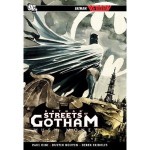
Batman: Streets of Gotham volume 1 – Hush Money


By Paul Dini, Dustin Nguyen & Derek Fridolfs (DC Comics)
ISBN: 978-0-85768-853-8

With all the furore and hype surrounding the epic death and inevitable resurrection of Batman cunningly orchestrated by Grant Morrison, everybody seemed so concerned with what was going to happen next that they apparently ignored what was actually occurring in the monthly comicbooks in their hands. Now with the dust long settled let’s take a look at one of the better sidebar-series to come out of the braided Batman R.I.P./Final Crisis/Last Rites/Batman Reborn/Return of Bruce Wayne publishing events…

In the aftermath of the epochal loss of the Gotham Guardian, a sustained and epic Battle for the Cowl ensued amongst the fallen hero’s closest allies. Eventually Dick Grayson succeeded his lost mentor, carrying on the tradition of the Dark Knight with Bruce Wayne’s assassin-trained son Damian continuing as the headstrong and potentially lethal latest iteration of Robin, the Boy Wonder…

This volume collects the contents of Detective Comics #852, Batman #685 (both March 2009), before re-presenting the first four tension-drenched issues of Batman: Streets of Gotham spanning June to September of that portentous year, and deals with the strange fact that although most of the masked hero community knew the tragic truth, the general populace was blithely unaware that the true Batman had been replaced…

As if all that complex crossover-ry wasn’t enough, also working hard to ensure that no reader would dare miss a single issue was a project dubbed ‘Faces of Evil’ in which DC villains took centre stage in every comicbook that month. Thus, in the aforementioned Detective #852 and Batman #685, one of the hero’s most pernicious and obsessive foes reappeared to rebuild his empire of evil after the last crushing defeat at the gauntleted hands of Batman…

Sublimely illustrated by Dustin Nguyen & Derek Fridolfs, the saga was another triumph for award-winning animator and director Paul Dini who once again proved himself the very best of contemporary Batman writers with a chilling, suspenseful epic of revenge and obsession featuring Bruce Wayne’s ultimate adversary Dr. Tommy Elliot, a beloved boyhood friend as warped by his own mother’s malign influence as the boy Bruce was transformed by the murder of his beloved parents Thomas and Martha Wayne.

Eminent surgeon Elliot became the twisted, sadistic and obsessive Hush to obtain vengeance on his only friend and childhood companion: one who had been perpetually held up to him as a perfect example of a son by Elliot’s disabled and deranged mother. Tommy even divined the billionaire’s greatest secret – the true identity of the Dark Knight…

After many deeply personal and lethally psychotic attacks on Wayne’s legacy and Batman’s friends, Hush took the ultimate step in his psychological war against his oldest pal by surgically transforming himself into Bruce’s doppelganger – attempting to entirely usurp his life.

After nearly killing Selina Kyle by literally stealing her heart, the faux-Bruce was only narrowly defeated and the captive Catwoman restored to some semblance of her former self (see Batman: Heart of Hush)…

Now in ‘Reconstruction’ a broken Elliot wanders the snowy shady docks ofGotham before tumbling into the freezing river. Everything is over: his best efforts to destroy the Wayne myth have all failed and, in revenge for his attack on her, Catwoman has tracked down all his hidden bank accounts and stolen every penny he had – $200 million dollars – giving it all away to bleeding-heart charities…

Expecting to die, Elliot awakes on a boat, saved by hard-working stiffs who believe they’ve rescued wild-partying playboy Wayne from a drunken accident. Inspired, Elliot doesn’t disabuse them and begins to trade on his stolen looks to rebuild his fortune and take another stab at revenge…

Luck is with him: for some reason no one has seen either Bruce Wayne or Batman for weeks. Using the playboy’s reputation, Hush makes his way to the Caribbean, leaving a well-concealed trail of bodies and empty wallets behind him. By the time he reaches Australia he’s feeling pretty cocky but after being spotted by shapeshifting local hero Tasmanian Devil, Elliot heads for Vietnam, eager to put more miles and far less friendly borders between him and his inevitable pursuers. It’s a near-fatal mistake…

The tale concludes in ‘Catspaw’ as “Bruce Wayne” is kidnapped by bandits from an animal poaching ring and finds himself face-to-stolen-face with Catwoman who has taken over the pet traders to actually save endangered species. Always willing to bear a grudge, she is delighted with the opportunity to put her former tormentor at the top of that list…

However the cat burglar has gotten in too deep and her greedily impatient gang are fed up with their animal-loving leader. Sensing a coup, Selina agrees to a truce with Elliot until they can escape the jungles and the bandits. To that end, she despatches her two most faithful henchmen to bring Hush to safety, but unfortunately nobody could leave a trail like Elliot’s and not be noticed by the well-schooled heirs of the World’s Greatest Detective…

Streets of Gotham debuted scant months later with Elliot an utterly isolated prisoner of the new Batman and Robin…

In ‘Ignition!’ a fresh era began with a reformed Harley Quinn making a nuisance of herself and distracting the Dark Dynamic Duo’s attention from a real threat. In the power vacuum following all the concatenating crises, many of Arkham Asylum’s inmates had absconded and were loose in the city, and flamboyant gangster Black Mask was celebrating his victory over rivals Two-Face and the Penguin – and subsequent elevation to supreme boss of the underworld – by recruiting the more biddable escaped maniacs to his team…

With a mysterious new vigilante called Abuse adding to the general atmosphere of tension, one of Black Mask’s wildest employees finally slipped into total psychosis. Third-rate arsonist Garfield Lynns suddenly stopped torching buildings as Firefly and began turning random civilians into spontaneously combusting human torches…

Taking full advantage of the situation in ‘City on Fire’, Hush then broke out of his velvet-lined cage whilst Batman and Robin tackled the utterly demented arsonist and again used his perfect imposture of Bruce Wayne to outmanoeuvre his foes.

Before Grayson, Damian and former Robin Tim Drake could react, Elliot made a very public appearance on TV and offered to bankrupt “himself” to rebuild Gotham’s shattered infrastructure and decimated industries…

The Batman Family had never accepted that their mentor was dead and all their actions were predicated upon the premise that he would eventually return to reclaim his mantle. Thus as ‘Hush Money’ opened, they were all forced to publicly accept and even join the returned “Bruce Wayne” as he effectively dismantled the lost hero’s life’s work to popular adulation…

Simultaneously in the city’s darkest nooks and crannies Black Mask’s disciples began to chafe under his increasingly oppressive and unpredictable yoke. The mobster’s most radical action was to give free rein to knife-wielding serial killer Victor Zsasz, offering to bankroll the butcher’s scheme to industrialise and mass-produce his particular brand of bloodletting…

As the new Batman finally finds a way to neutralise Hush’s bold imposture, this initial volume concludes with a dark and nasty tale following Zsasz’s escalation of terror and slaughter by focussing on the tightrope-thin line career criminals must walk in Gotham. ‘Business’ invades the personal space of illicit fixer the Broker as the premier “go-to guy” in the city at last discovers to his surprise that there some things he won’t – can’t – do, no matter how big the pay-off might be…

With astounding covers by Andrew Robinson, Alex Ross, J. G. Jones & Dustin Nguyen, this visceral, imaginative and deliciously off-balance frantic psycho-thriller sets the scene for even darker strides down the darkest avenues in all of comics…

© 2009, 2011 DC Comics. All Rights Reserved.

Cable volume 3: Stranded


By Duane Swierczynski, Paul Gulacy, Gabriel Guzman, Mariano Taibo & various (Marvel)
ISBN: 979-0-7851-4167-9

The son of X-Man Scott Summers and a clone of Jean Grey, Nathan Christopher Summers was infected with a techno-organic virus as a baby. He was only saved by being sent through time, subsequently spending his formative years in the far future where he became an unlikely and largely unwilling saviour of assorted humankinds against mutant overlord Apocalypse and his vile minions such as the clone-warrior Stryfe.

Afflicted with a stubborn certainty that he always knew best – probably due to his hard-earned foreknowledge and weary experience of how bad the days to come would be – Nathan evolved into time-travelling super-soldier Cable and gradually inserted himself into the lives of key figures in mutant history: figures such as Professor Charles Xavier and his own father Cyclops – the Moses and King David of mutant-kind…

Using his phenomenal psionic abilities to hold at bay the incurable, progressive condition inexorably consuming his flesh and only held in check by the victim’s indomitable force of will, the mysterious grizzled veteran slowly began interacting with and reshaping the past…

Hope Spalding-Summers was the first Homo Superior born on Earth after M-Day, when the temporarily insane mutant Avenger Scarlet Witch used her reality-warping powers to eradicate almost all fellow members of her terrifying sub-species from existence.

Considered by many to be some sort of mutant messiah, the newborn girl was “appropriated” by militant warrior Cable – no stranger to the role of Sole Saviour – who raised her in the furious future, training her in all manner of lethal survival skills before she inevitably found her way back to the present where she was adopted by X-Men supremo Scott Summers AKA Cyclops.

Hers was a horrifically memorable childhood as this slim, satisfying collection (gathering issues #16-20 of the monthly Cable comicbook from July-November 2009) will surely attest…

From the start Hope had implacable foes hunting her. The most resourceful was another time-tossed former X-Man, Lucas Bishop, who was convinced the child would cause the diabolically dystopian alternate reality he originated in. To prevent such horror ever occurring, Bishop determined to kill her before she could become a mutant anti-Christ and not even Cable’s frequent temporal relocations would deter him…

With the entire time-busting saga scripted by Duane Swierczynski, the action here begins with the 2-part ‘Too Late for Tears’ – illustrated by legendary comics icon Paul Gulacy – as Cable and nine-year-old Hope prepare to again jump into the safely camouflaging corridors of chronality after a particularly contentious battle.

However, the increasingly rebellious girl strikes out at her protector during a fateful moment and the time-shift goes wrong…

Hope materialises in the same post-apocalyptic location but two years earlier in time and, with no further information to go on, endeavours to make herself secure until Cable finds her. Stuck in her future, Cable patiently waits for her to “catch up” but his techno-viral contagion flares up and threatens to end his appalling life before she gets then…

And 127 years prior to Cable’s latest crisis Bishop activates his own time-machine and remorselessly continues his pursuit of Hope…

Stuck, but not without resources, the girl explores a dying Earth where only two warring cities are still inhabited. Soon she is approached by a young boy named Emil who is instantly smitten by the lethally self-sufficient waif…

Just as Cable forces back his latest bout of all-consuming transmogrification by invasive code, Bishop arrives and a deadly destructive but ultimately inconclusive battle breaks out. The follower’s plan is obsessively simple: as soon as he sees Hope he will end her by detonating a nuclear device inside his body.

But she isn’t with Cable any longer…

In another era, Emil has gradually broken Hope’s wall of distrust but, just as she feels she can finally relax, the girl discovers that the revered spiritual head of the boy’s band of survivors is her very familiar foe. The “Arch-Bishop” has been so patiently waiting for his time-bending bête-noir to resurface…

The seemingly benevolent holy man has no problems wiping out his entire flock to finish her for good but Hope perpetually avoids him and Bishop just can’t trigger the nuke until he’s absolutely certain.

And two long years later, Cable moves into one of the two cities, makings plans, winning allies and waiting, waiting, waiting…

When at last 11-year old Hope is reunited with Cable, it’s as both cities are on the verge of mutual destruction and the mutant has no time for her protests. He has spent his time constructing a working space ship and after forcibly dragging his furious charge aboard takes off for the safety of space leaving a heartbroken Emil behind. Happily for the lovesick lad the wonderful Archbishop can also construct star-craft. Very soon they will all be reunited…

Artists Gabriel Guzman & Mariano Taibo take over for the eerie alien encounter ‘Brood’ beginning with ‘Bishop Takes Pawn’ wherein Bishop and Emil lead their people into a final battle with Cable’s ship and crew on the edges of the solar system. Thankfully the boy finds Hope before the mutant hunter does and she convinces her long-lost paramour of the deranged cleric’s true intentions before falling to Bishop’s murderous rage.

With nuclear obliteration seconds away events overtake all the manic participants as both ships – locked together in the vacuum of deep space – are invaded by creatures even more ferociously dangerous…

The Brood are ghastly alien parasites and rapacious intelligent body-stealers who lay eggs in hosts and use the victims’ genetic material to augment their unborn generations. For uncounted centuries they have greedily hungered for the exceptional advantages gained by infecting mutants and metahumans…

In ‘Queen Takes Bishop’ the disgusting matriarch of the invading beasts specifically targets Hope as her overwhelming spawn decimate the last remnants of humanity aboard both ships. However, the little lass has met Brood before and knows just how to deal with them. Elsewhere Bishop and Cable also manage to survive the appalling assault, both obsessed with finding Hope for their drastically opposing reasons…

As an entire space fleet of the noxious beasts zero in on the last humans alive, Bishop utterly succumbs to his obsession by allying himself with the Brood Queen to ensure the final fate of Hope, but has completely underestimated the child’s resiliency, Cable’s compulsive dutiful determination, and the unmatchable power of young love in the blazing conclusion ‘Checkmate’…

Time-travel tales often disappoint and frequently make people’s heads hurt, but this bombastic romp (augmented by covers and variants by Dave Wilkins & Rob Liefeld) manages to always stick to the point, offering sly tributes – and some not so much – to Les Miserables and Alien whilst following the pain-wracked consumption of Cable by of his own non-fleshly invaders through a clever and poignant Fights ‘n’ Tights sci fi horror drama that will impress and delight older fans of the genre(s).

© 2009, 2010 Marvel Characters Inc. All rights reserved.