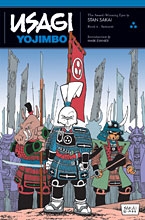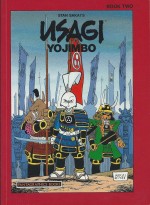

Usagi Yojimbo: Yokai


By Stan Sakai (Dark Horse)
ISBN: 978-1-59582-362-5

One of the very best and most adaptable survivors of the 1980s black and white comicbook explosion/implosion is a truly bizarre and wonderful synthesis of historical Japanese samurai fiction and anthropomorphic animal adventure, as well as a perfect example of the versatility and strengths of a creator-owned character.

Usagi Yojimbo (which translates as “rabbit bodyguard”) first appeared as a background character in multi-talented creator Stan Sakai’s anthropomorphic peripatetic comedy feature The Adventures of Nilson Groundthumper and Hermy, which launched in furry ‘n’ fuzzy folk anthology Albedo Anthropomorphics #1 (1984) subsequently appearing there on his own terms as well as in Critters, Amazing Heroes, Furrlough and the Munden’s Bar back-up in Grimjack.

Sakai was born in 1953 in Kyoto, Japan before the family emigrated to Hawaii in 1955. He attended University of Hawaii, graduating with a BA in Fine Arts, and pursued further studies at Pasadena’s Art Center College of Design after moving to California.

His first comics work was as a letterer, most famously for the incredible Groo the Wanderer, before his nimble pens and brushes, coupled with a love of Japanese history and legend and hearty interest in the filmic works of Akira Kurosawa and his peers, combined to turn a proposed story about a historical human hero into one of the most enticing and impressive – and astoundingly authentic – fantasy sagas of all time.

The deliciously rambling and expansive period fantasy series is nominally set in a world of sentient animals and specifically references the Edo Period of Feudal Japan (how did we cloth-eared Westerners ever get “Japan” from Nihon” anyway?) as well as classic cultural icons as varied as Lone Wolf and Cub, Zatoichi and even Godzilla whilst detailing the exploits of Miyamoto Usagi, a Ronin (masterless, wandering freelance Samurai) whose fate is to be drawn constantly into a plethora of incredible situations.

And yes, he’s a rabbit – a brave, sentimental, gentle, long-suffering, honourable, conscientious and heroic bunny who cannot turn down any request for help…

The Lepine Legend appeared in Albedo #2-4, The Doomsday Squad #3 and seven issues of Critters (1, 3, 6-7, 10-11 and 14) before leaping into his own series which, as usual, I haven’t got around to yet, but really, really will…

The Sublime Swordsbun has changed publishers a few times but has been in continuous publication since 1987 – with over 25 graphic novel collections to date – and has guest-starred in numerous other series, such as Teenage Mutant Ninja Turtles and its TV incarnation – he even almost made it into his own small-screen show but there’s still time yet and fashions can revive as quickly as they die out…

There are high-end collectibles, art prints, computer games and RPGs, a spin-off sci fi comics serial and lots of toys.

Sakai and his creation have won numerous awards both within the Comics community and amongst the greater reading public and in 2009 current publisher Dark Horse Comics commissioned an all-new, fully painted anniversary tale which allowed the creator to hone his considerable skills with watercolours.

Yokai is a generic term that translates (as required) as ghosts, phantoms, spirits or even strange, otherworldly apparitions, all of whom hold a peculiarly eclectic place in Japanese folklore, being simultaneously mischievous and helpful, malevolent and miraculously beneficial. Generally they have animal heads or are amalgams of diverse objects or body parts…

This scintillating scary story occurs over one night – an Oborozuki-Yo (“Night of the Hazy Moon”) – when the assorted Yokai are particularly restless, and this is a tale that grippingly explores the Japanese equivalent of our Halloween as the noble, gloom-shrouded Ronin wanders lonely roads in search of a bite to eat and a place to sleep.

Seeing a light in the nearby woods, Miyamoto leaves the path hoping to find a welcoming peasant hearth for the evening but is harassed by a taunting Kitsune (trickster-fox spirit) and becomes lost. Soon however he hears sobbing and is drawn to a weeping noblewoman…

The lovely distressed lady is Fujimoto Harumi whose pilgrimage to a temple was disrupted when a Kitsune stole her young daughter Hanako away. Pleading with the wisely reluctant Ronin, the lady convinces the wayfarer to plunge deeper into the wild woods to rescue the lost girl, leading to an epic series of contests against a horde of fantastic hostile creatures. The valiant warrior almost succumbs until he is unexpectedly saved by an old comrade, the mystic demon-queller Sasuke…

It seems that this very evening is the dreaded Hyakki Yako, “Night Parade of a Hundred Demons”, when the haunts and horrors of the netherworld form a procession into the world of people, seeking to subjugate all mortals. They simply need a living soul to lead them, a final sacrifice to light their way here…

Terrified for the stolen waif, the Ronin and the devil-slayer engage with an army of horrific, shape-shifting, fire-spitting, tentacle-wielding monstrosities to save an innocent and the entire world, but there are forces in play the rapidly-tiring Miyamoto is painfully unaware of and, without the luck of the gods and the tragedy of an old friend, all will be inescapably lost…

Fast-paced yet lyrical, funny, thrilling and stuffed with spooky, all-ages action and excitement, Yokai is a magical tribute to and celebration of the long-lived Lepus’ nigh-universal irresistible appeal that will delight devotees and make converts of the most hardened hater of “funny animal” stories. This petite but power-packed chronicle also contains a fascinating behind-the-scenes look at how the artist created the stunning visuals in ‘The Real Magic Behind Yokai: an interview with Stan Sakai’ that will further beguile any prospective creators and cartooning hopefuls in the audience.

Sheer comicbook poetry: the good kind, not mere doggerel…
Text and illustrations © 2009 Stan Sakai. All rights reserved.

X-Men: Pixie Strikes Back


By Kathryn Immonen & Sara Pichelli (Marvel)
ISBN: 978-0-7851-4676-6

Pixie is Megan Gwynn, a purportedly Welsh mutant with fairy wings, a sparkly dust which causes hallucinations, a talent for mass teleportation and an affinity for sorcery. In her earlier appearances she battled necromantic monster Belasco and former New Mutant Magik and gained an eldritch super-weapon called the Souldagger which usually reposes safely inside her chest.

Originally something of a minor pest and a perennial X-Man-in-training, she has become a key player in the fortunes of the World’s Most Harried sub-species, having survived the numerous slaughters which have decimated her classmates, perpetual mystic attacks from assorted devils and elder gods such as the N’Garai and repeated assaults by mutant-hunters of all description.

That’s pretty much all you need to know (although the rest of her immensely convoluted back-story does make for interesting and entertaining reading) to enjoy this delightful, game-changing tale – originally released as a 4-part miniseries in 2010 – which set up the elfin X-Man for a far bigger role in the madcap mutant multiverse.

Written by Kathryn Immonen in a breezy, sassy girl-power style and superbly illustrated by Sara Pichelli, the action kicks off with Megan and BFFs Ruth Aldine, Laura Kinney, Hisako Ichiki and Cessily Kincaid strutting their stuff as the most popular girls in High School – as usual.

Only thing is Pixie, Blindfold, X-23, Armor and Mercury aren’t simple spoiled human brats but mutant warriors in training, and none of them particularly like the fairy dust flinger anyway…

Megan is in some distress: the comforting reality of a normal – if appallingly obnoxious and privileged – life is constantly unravelling and revealing glimpses of demons, monsters and excessive violence. Why is she constantly seeing such things?

Meanwhile on Utopia Island, isolated enclave of Earth’s few remaining Homo Superior, Pixie’s mother – and a genuine Faerie elder – has come looking for her daughter with the news that her father wasn’t actually the man who sired her…

Moreover a headcount reveals Mercury, Armor, X-23 and Pixie are missing, leaving Blindfold and classmates Rockslide and Anole to reluctantly seek help from baffled and harassed teachers Psylocke and Nightcrawler…

The missing girls have been abducted by an ambitious and overreaching demon dubbed Saturnine who is feeding them all tailored illusions powered by Megan’s own hallucinogenic dust. The foul hell-beast had a plan to achieve ultimate power by bringing Megan’s dark side out and capturing her Fey mother, but increasingly, Pixie is reshaping the unreal fantasy world to suit her own tastes and everything is slowly sliding out of his control…

Back on Utopia, Nightcrawler and the kids have called in snarky headmistress Emma Frost, and the White Queen is extremely unhappy to be bothered with such trifles. Only when the precognitive Blindfold begins experiencing terrible future-flashes does Frost take executive action in her own draconian manner…

In the otherworldly demon-dungeon Pixie is beginning to turn, attacking her friends with the eldritch Souldagger just as her still-searching mother tracks down Megan’s siblings: equally aberrant daughters of her beguiling mutant birth-father.

It appears Megan is the child of one of the X-Men’s most insidious enemies…

In Saturnine’s lair things are not going well. Pixie’s resistance is threatening to overturn all his multifarious plans. Moreover, the mutant maid’s distress should have drawn her puissant mother into his trap but “Mrs. Gwynn” is still conspicuously absent. To cap it all, the X-Girls Pixie stabbed with her Souldagger have been cleansed of her mystic glamours and are attempting to break free…

It all hits the fan at once as Pixie rejects Saturnine’s illusions just as X-23, Mercury and Armor bust loose at the very instant Mrs. Gwynn and Megan’s extremely wicked step-sisters arrive. Hard on their heels are an extremely upset Emma Frost with a squad of X-Men and the chaotic battle lines are drawn for apocalyptic confrontation…

His plans all in tatters and resorting to mindless violence at last, the demonic guardian of the Road of Lost Souls and his unholy hordes are astounded when Pixie seemingly turns on her rescuers and allies before giving Saturnine a mighty soulsword all of his own and the key to ultimate power…

Fast-paced, action-packed but still laced with devilishly clever sharp-clawed humour, this is a uncomplicated Fights ‘n’ Tights thriller that should appeal as much to casual girl readers as died-in-the-spandex aging X-Fans.

© 2010 Marvel Characters, Inc. All rights reserved.

Sundiata, the Lion of Mali – A Legend of Africa


Retold by Will Eisner (NBM)
ISBN: 978-1-56163-332-6 (hb), 978-1-56163-340-2 (pb)

It is pretty much accepted today that Will Eisner was one of the pivotal creators who shaped the American comicbook industry, with most of his works more or less permanently in print – as they should be. Active and compellingly creative until his death in 2005, Eisner was the consummate storysmith and although his true legacy is making comics acceptable fare for adult Americans, his mastery and appeal spanned the range of human age and he was always as adept at beguiling the young as he was enchanting their elders…

William Erwin Eisner was born on March 6th 1906 in Brooklyn and grew up in the ghettos. They never left him. After time served inventing much of the visual semantics, semiotics and syllabary of the medium he dubbed “Sequential Art” in strips, comicbooks, newspaper premiums and instructional comics, he then invented the mainstream graphic novel, bringing maturity, acceptability and public recognition to English language comics.

From 1936 to 1938 he worked as a jobbing cartoonist in the comics production hothouse known as the Eisner-Eiger Shop, creating strips for both domestic US and foreign markets. Using the pen-name Willis B. Rensie he created and drew opening instalments for a huge variety of characters ranging from funny animal to historical sagas,

Westerns, Detectives, aviation action thrillers… and superheroes – lots of superheroes …

In 1940 Everett “Busy” Arnold, head honcho of the superbly impressive Quality Comics outfit, invited Eisner to take on a new challenge. The Register-Tribune newspaper syndicate wanted a 16-page weekly comicbook insert for the Sunday editions and Eisner jumped at the opportunity, creating three series which would initially be handled by him before two of them were delegated to supremely talented assistants. Bob Powell inherited Mr. Mystic and distaff detective Lady Luck fell into the capable hands of Nick Cardy (then still Nicholas Viscardi) and later the inimitable Klaus Nordling.

Eisner kept the lead feature for his own, and over the next twelve years The Spirit became the most impressive, innovative, imitated and talked-about strip in the business. However, by 1952 he had more or less abandoned it for more challenging and certainly more profitable commercial, instructional and educational strips, working extensively for the US military in manuals and magazines like Army Motors and  P*S, the Preventative Maintenance Monthly, generally leaving comicbooks behind.

After too long away from his natural story-telling arena Eisner creatively returned to the ghettos of Brooklyn where he was born and he capped a glittering career by inventing the mainstream graphic novel for America, bringing maturity, acceptability and public recognition to English language comics.

In 1978 a collection of four original short stories in strip form were released as a single book: A Contract With God and Other Tenement Stories. All the tales centred around 55 Dropsie Avenue, a 1930’s Bronx tenement, housing poor Jewish and immigrant families. It changed the American perception of cartoon strips forever. Eisner wrote and drew a further 20 further masterpieces, opening the door for all other comics creators to escape the funnybook and anodyne strip ghettos of superheroes, funny animals, juvenilia and “family-friendly” entertainment. At one stroke comics grew up.

Eisner was constantly pushing the boundaries of his craft, honing his skills not just on the Spirit but with years of educational and promotional material. In A Contract With God he moved into unexplored territory with truly sophisticated, mature themes worthy of Steinbeck and F. Scott Fitzgerald, using pictorial fiction as documentary exploration of social experience.

If Jack Kirby was the American comicbook’s most influential artist, Will Eisner remains undoubtedly its most venerated and exceptional storyteller. Contemporaries originating from strikingly similar Jewish backgrounds, each used comic arts to escape from their own tenements, achieving varying degrees of acclaim and success, and eventually settling upon a theme to colour all their later works. For Kirby it was the Cosmos, what Man would find there, and how humanity would transcend its origins in The Ultimate Outward Escape. Will Eisner went Home, went Inward and went Back, concentrating on Man as he was and still is…

Naturally that would make him a brilliant choice to illustrate primal folktales and creation myths from our collective past and this stunning, slim yet over-sized tome (288 x 224mm) again proves his uncanny skill in exhibiting the basic drives and passions of humanity as he lyrically recounts a key myth of West Africa.

The historical Sundiata Keita brought the Mandinka People out of bondage and founded the Mali Empire in the 13th century AD and is still celebrated as a staple of the oral tradition handed down by the tribal historians, bards and praise-singers known as “Griots”.

Rendered in a moody, brooding wash of sullen reds, misty greys and dried out earth-tones, the tale begins; narrated by the Great Gray Rock, foundation stone of the world.

Once only the beasts were masters of Africa, but when people came they sought to rule the land instead. The consulted the ghosts of Good and soon became the masters of the beasts and the land.

However Evil ghosts also lurked and once ambitious and greedy Sumanguru, King of Sasso had conquered all he could see yet still seethed with dissatisfaction, the Gray Rock of Evil accosted him…

Sasso was a poor, arid country and when the wicked stone offered the king dark magical powers to conquer all the surrounding lands, Sumanguru eagerly accepted. Soon all the neighbouring nations were smouldering ruins as the Sasso warriors and their mad lord’s control of the elements demolished all resistance.

Still Sumanguru was not content and, when a trader brought news of a rich, fertile land settled by peaceful gentle people, the king wanted to rule them too. The unctuous merchant also related how Nare Famakan, wise king of Mali, had recently passed away, leaving eight youthful healthy sons and a ninth who was weak and lame…

Ignoring the rock of Evil’s advice to beware the “frog Prince”, Sumanguru led his mighty armies against Mali, unaware that the double-dealing trader, denied a reward due to the mad king’s parsimony, had warned the nine princes that the warriors of Sasso were coming.

Lame little Sundiata also wished to defend his land, but his brothers laughed and told him to stay home, trusting to their superior tactics to repel the invasion. Indeed, their plans were effective and the battle seemed to go their way until Sumanguru summoned an eldritch wind to destroy the army of Mali and added the defeated land to his possessions.

Gloating, he mocked Sundiata but ignoring the advice of the Gray Rock of Evil allowed the frog prince to live…

As the unstoppable, insatiable Sumanguru ravaged every tribe and nation, an aged shaman showed Sundiata how to overcome his physical shortcomings. Years passed and the boy learned the ways of the forests and grew tall and mighty. Now a man, he prepared for vengeance and when Sumanguru heard and tried to have him killed he fled and rallied an army of liberation.

On the eve of battle an uncle revealed Sumanguru’s one mystic weakness to Sundiata and the stage was set for a spectacular and climactic final confrontation before, as will always happen, Evil inevitably betrayed itself…

Epic and intensely moving, this is a superb all-ages fable re-crafted by a master storyteller, well-versed in exploring the classic themes of literature and human endeavour, whilst always adding a sparkle and sheen of his own to the most ancient and familiar of tales.

A joy not just for Eisner aficionados but all lovers of mythic heroism.
© 2002 Will Eisner.All rights reserved.

Arzach


By Moebius (Les Humanoides Associes)
No ISBN:

I’m breaking my own self-imposed rules today to present something just a little bit different and celebrate the talents of France’s most famous master of the comic arts.

Jean Henri Gaston Giraud was born in the suburbs of Paris on May 8th 1938 and raised by his grandparents after his mother and father divorced in 1941.

In 1955 he attended the Institut des Arts Appliqués where he became friends with Jean-Claude Mézières who, at 17 was already selling strips and illustrations to magazines such as Coeurs Valliants, Fripounet et Marisette and Spirou. Giraud apparently spent most of his time drawing cowboy comics and left after a year.

In 1956 he travelled to Mexico, staying with his mother for eight months, before returning to France and a full-time career drawing comics, mostly westerns such as Frank et Jeremie for Far West and King of the Buffalo, A Giant with the Hurons and others for Coeurs Valliants in a style based on French comics legend Joseph “Jijé” Gillain.

Giraud spent his National Service in Algeria in 1959-1960, where he worked on military service magazine 5/5 Forces Françaises and on returning to civilian life became Jijé’s assistant in 1961, working on the master’s long-running (1954-1977) Western epic Jerry Spring.

A year later, Giraud and Belgian writer Jean-Michel Charlier launched the serial ‘Fort Navajo’ in Pilote #210, and soon its disreputable, anti-hero lead character Lieutenant Blueberry became one of the most popular European strips of modern times. In 1963-1964, Giraud produced a number of strips for satire periodical Hara-Kiri and, keen to distinguish and separate the material from his serious day job, first coined his pen-name “Moebius”.

He didn’t use it again until 1975 when he joined Bernard Farkas, Jean-Pierre Dionnet and Philippe Druillet – all inspired science fiction fans – to become the founders of a revolution in narrative graphic arts as “Les Humanoides Associes”. Their groundbreaking adult fantasy magazine Métal Hurlant utterly enraptured the comics-buying public and Giraud again wanted to utilise a discreet creative persona for the lyrical, experimental, soul-searching material he was increasingly driven to produce: series such as The Airtight Garage, The Incal and the mystical, dreamy flights of sheer fantasy contained in Arzach

To further separate his creative twins, Giraud worked inks with a brush whilst the futurist Moebius rendered with pens…

Generally I review material produced or translated into English and indeed Arzach did make it into the language of Shakespeare, Keats, Byron and Alan Moore in the 1987 Epic Comics/Titan Books Moebius volume 2 – Arzach & Other Fantasy Stories, but to really appreciate the magics and majesty you should try and get hold of the 1976 hardback album or any other early iteration where the tales can be appreciated and enjoyed in splendid isolation and consideration.

Produced utterly without words, the four episodes depict the lonely contemplative flights of a solitary explorer – some say warrior – observing an incredible world and its inhabitants from the lofty perch of a flying lizard.

The first strip ‘Arzach’ finds the silent skyglider passing between the spires of an incredible city, peeking into enticing windows until an angry citizen confronts him. Dealing summarily with his enraged antagonist, the voyeur returns for his seductive reward and gets a big surprise…

In ‘Harzak’ the explorer mysteriously gains and swiftly loses a pack-pterodactyl to carnivorous plants. Woefully short on rations, he then encounters a colossal ape-like monster which reluctantly provides diversion, entertainment and eventually distraction for the cloud-voyager whilst in ‘Arzak’ a fusty old world technician motors across a blistering desert to a fantastic temple. Inside listless creatures mope dejectedly. Enduring physical assault, the sparks enters a bunker and sets about fixing things as, on a screen, the wind-rider paces in frustration, with his ungainly, featherless steed prone and unmoving. With the twist of a wrist a handy screwdriver sets the world to rights…

‘Harzakc’ opens with the lizard rider again spying on a beautiful undraped woman before flying off into a succession of increasingly bewildering and astoundingly spectacular alien scenes of…

Well, that’s for you to decide.

This work more than any other led to an outpouring of fanciful, lavish and enchanting fantasy creations from all over the world, inspiring movie, makers, writers and even comics creators as disparate and far-ranging as Stan Lee and Hayao Miyazaki. These apparently simplistic peregrinations are magnificent visual panoplies open to many interpretations, tapping into oneiric realms of the subconscious and woven with wry humour, but they are not stories in any traditional sense.

Think of them perhaps as staggeringly detailed goads to the imagination of the reader…

Moebius famously created these strips in reaction to his perceived predominance of American superhero comics and consciously stove to reinvigorate the genres and scenarios of the entire comics industry – with terrific results.

A sheer unadulterated dose of primal imaginary power and superlative skill and craft, Arzach is a tome that belongs on the bookshelf of every fan of the art of comics.

Jean Giraud and Moebius passed away on March 10th 2012.
Edition © Les Humanoides Associes 1976. Arzach © 2012 the estate of Jean Giraud. All rights reserved.

The Moon Looked Down and Laughed – a Holy Cross graphic novel


By Malachy Coney & Paul J. Holden (Fantagraphics Books)
ISBN: 978-1-56097-263-7

The Irish have always rightly prided themselves on their ability to tell a tale and comics especially have long-benefited from that blessed gift. One writer especially gifted and yet inexplicably not world famous yet is Malachy Coney, who first started turning heads in Fleetway’s socially informed Crisis in 1989 when he was invited by Pat Mills to co-write a sequence of the controversial serial Third World War set in Ireland.

Coney was raised in the Ardoyne area of Belfast during the time of “The Troubles” and much of his work deals with the politics of the era and issues of gender and gay rights.

In 1993 he scripted the miniseries Holy Cross for Fantagraphics: three separate tales all linked by history, geography and incidental characters Jimmy and Davy – a local gay couple – illustrated respectively by Davy Francis, Chris Hogg and P. J. Holden. That lost delight happily led to the lovely book under discussion today.

Since then Coney, who is also a cartoonist and publisher, has written a number of Gay-themed superhero tales (Major Power and Spunky, The Dandy Lion, The Simply Incredible Hunk), socially aware material such as The Good Father and Catholic Lad, and worked with Garth Ennis on Top Cow’s The Darkness and Steven Grant on Vampirella.

Active in the arts in Northern Ireland, he has contributed to DNASwamp, Small Axe and Fortnight, produced material for the internet and self-publishes his own Good Craic Comics.

Paul Jason Holden is also from Belfast and, as well as working closely with Coney on the Holy Cross stories, The Dandy Lion and The Simply Incredible Hunk, has illustrated Mike Carey’s ‘Suicide Kings’ and worked for Warhammer Monthly, 2000AD, Judge Dredd Megazine, Image Comics, Garth Ennis’ Battlefields and Strip Magazine. He is also active in developing web- and app-based comics…

Rendered in stark and seductive black and white, The Moon Looked Down and Laughed is again set in the Holy Cross district of Belfast and is narrated by hopeful writer Tommy Doherty, a decent and sentimental young man just starting to learn the way of the world.

He’s always got time to listen to his old dad’s stories about the bad days past, especially the one when he was a young man doing odd jobs for a mean, rich old sod named Burke. That privileged, demented swine used to work him like a slave every day and then set the dog on him if he stayed on his land one second after quitting-time. Sometimes Burke even deliberately kept him late just to see him run…

That all changed on the fateful day Pa Doherty’s watch stopped and the vicious landowner gloatingly watched as the manic canine brought him down…

Of course that was the day sheer terror made the worm turn and a scared lad learned another use for the hated shovel in his hands…

From that he learned a hard but necessary lesson: there are mad dogs everywhere and usually the shovel is the only way of dealing with them…

With thoughts of wildlife documentaries, carnivores and prey in his head, Tommy heads for the pub and a drink with his outrageous pals Jimmy and Davy and obliquely encounters the district’s apex predator when Francie O’Neill‘s gang of thugs and troublemakers harass him for hanging out with “faggots”…

It had only been weeks since the pack of jackals had beaten up Jimmy and Davy in one more gay-bashing incident. O’Neill had been a bully since they were all at school but always managed to come off like some roguish golden boy. Nobody could understand why the loveliest girl in class had married him, especially Tommy, for whom Annie would always be “the one”, ever since that incident when they played “spin-the-bottle” as nippers…

Now she was shackled to a possessive, brutal thug, permanently pregnant and with all the life leaching out of her.

Staggering away at closing time, Tommy and the boys spot Francie stalking the streets, looking for a fight to start and, not for the first time, the writer ponders the worth of pens against swords and why people like that are allowed to get away with so much…

Pa Doherty’s pride and joy is his allotment garden and on the way there next day, father and son see an ambulance rushing away. It seems poor fat Big Junior has had a breakdown and harmed himself. The lad wasn’t the same since his ma died and the constant bullying and sadistic harassment by certain people has pushed him over the edge…

As they watch Annie O’Neill and her two oldest pass by, Pa invites them to spend time in his garden. The kids have the best day of their life just playing and, with a bit of peace at last, Annie idly chats about the old days with Tommy…

The next day the writer answers a desperate call: his father is in a bad way. It seems someone has destroyed his precious beloved garden; razed it to rubble and ruins…

Consoling the heartbroken and despondent elder, Tommy sees Francie’s unmistakable signature to the despicable act. Soon after, finding the psychotic lout terrorising his own wife and children, the frustrated scribe realises he has found his own mad dog…

Disposing of the body on the nearby railway tracks, the shell-shocked and traumatised writer is unaware that Jimmy and Davy have been witnesses to the whole thing…

And that’s just the start of Tommy Doherty’s road from boy to man in this superbly told tale, blending wry humour and bucolic Celtic charm with shatteringly personal conflicts that test the miraculous bonds of childhood loyalty and friendship, revealing not only the horrific acts good men can be pushed to but how deeds shape character and how little the universe case…

Long overdue for re-issue preferably in a bumper edition collecting the three-issue Holy Cross miniseries and the fabled unpublished fourth issue as well, this is a wonderfully beguiling and incisive story of human life at its most vibrant and compelling…
© 1997 Malachy Coney & Paul J. Holden. This edition © 1997 Fantagraphic Books. All rights reserved.

The Adventures of Blake and Mortimer: The Secret of the Swordfish volume 1 – Ruthless Pursuit


By Edgar P. Jacobs translated by Clarence E. Holland (Blake and Mortimer Editions)
ISBN: 978-9-06737-002-8

Belgian Edgard Félix Pierre Jacobs (March 30th 1904 – February 20th 1987) is considered one of the founding fathers of the Continental comics industry. Although his output is relatively meagre compared to some of his contemporaries, the iconic series he worked on practically formed the backbone of the art-form in Europe, and his splendidly adroit yet roguish and thoroughly British adventurers Blake and Mortimer, created for the very first issue of Le Journal de Tintin in 1946, swiftly became an unmissable staple of post-war European kids’ life the way Dan Dare would in Britain in the 1950s.

Edgar P. Jacobs was born in Brussels, a precocious child who began feverishly drawing from an early age but was even more obsessed with music and the performing arts – especially opera.

He attended a commercial school but, determined never to work in an office, pursued art and drama following graduation in 1919. A succession of odd jobs at opera-houses – scene-painting, set decoration, working as an acting and singing extra – supplanted his private performance studies, and in 1929 Jacobs won an award from the Government for classical singing.

His proposed career as an opera singer was thwarted by the Great Depression, however, as the arts took a nosedive following the global stock market crash.

Picking up whatever dramatic work was going, including singing and performing, Jacobs switched to commercial illustration in 1940. Regular work came from the magazine Bravo; as well as illustrating short stories and novels he famously took over the syndicated Flash Gordon strip, after the occupying German authorities banned Alex Raymond’s quintessentially All-American Hero and the publishers desperately sought someone to satisfactorily complete the saga.

Jacob’s ‘Stormer Gordon’ lasted less than a month before being similarly embargoed by the Nazis, after which the man of many talents created his own epic science-fantasy feature in the legendary Le Rayon U, a milestone in both Belgian comics and science fiction adventure.

The U Ray‘ was a huge hit in 1943 and scored big all over again a generation later when Jacobs reformatted the original “text-block and picture” material to incorporate speech balloons and ran the series again in the periodical Tintin with subsequent release as a trio of graphic albums in 1974.

I’ve read differing accounts of how Jacobs and Tintin creator Hergé got together – and why they parted ways professionally, if not socially – but as to the whys and wherefores of the split I frankly I don’t care. What is known is this: whilst creating the weekly U Ray, one of Jacob’s other jobs was scene-painting, and during the staging of a theatrical version of Tintin and the Cigars of the Pharaoh Hergé and Jacobs met and became friends. If the comics maestro was unaware of Jacob’s comic work before then he was certainly made aware of it soon after.

Thereafter, Jacobs began working on Tintin, colouring the original black and white strips of The Shooting Star from the newspaper Le Soir for an upcoming album collection. By 1944 he was performing a similar role for Tintin in the Congo, Tintin in America, King Ottokar’s Sceptre and The Blue Lotus. By now he was also contributing to the drawing too, working on the extended epic The Seven Crystal Balls/Prisoners of the Sun.

Jacob’s love of opera made it into the feature as Hergé – who loathed the stuff – teasingly created the bombastic Bianca Castafiore as a comedy foil and based a number of bit players (such as Jacobini in The Calculus Affair) on his long-suffering assistant.

After the war and liberation publisher Raymond Leblanc convinced Hergé, Jacobs and a number of other comics creatives to work for his new venture. Launching publishing house Le Lombard, he also commissioned Le Journal de Tintin, an anthology comic with editions in Belgium, France and Holland edited by Herge, starring the intrepid boy reporter and a host of newer heroes.

Beside Hergé, Jacobs and writer Jacques van Melkebeke, the comic featured Paul Cuvelier’s ‘Corentin’ and Jacques Laudy’s ‘The Legend of the Four Aymon Brothers’. Laudy had been a friend of Jacobs’ since they worked together on Bravo and the first instalment of the epic thriller serial ‘Le secret de l’Espadon’ starred a bluff, gruff British scientist and an English Military Intelligence officer (who was closely modelled on Laudy): Professor Philip Mortimer and Captain Francis Blake…

The initial storyline ran from issue #1 – 26th September 1946-8th September 1949 – and cemented Jacobs’ status as a star in his own right. In 1950, with the first 18 pages slightly redrawn, The Secret of the Swordfish became Le Lombard’s first album release with the concluding part published three years later. These volumes were reprinted nine more times between 1955 and 1982 with an additional single complete edition released in 1964.

In 1984 the story was reformatted and repackaged as three volumes with additional material – mostly covers from the weekly Tintin – added to the story as splash pages, and the first of these forms the basis for the English language book under discussion today.

Hergé and Jacobs purportedly suffered a split in 1947 when the former refused to grant the latter a by-line on new Tintin material, but since the two remained friends for life and Jacob’s continued to produce Blake and Mortimer for the weekly comic, I think it’s fair to say that if such was the case it was a pretty minor spat. I rather suspect that The Secret of the Swordfish was simply taking up more and more of the brilliant, diligent artist’s time and attention…

The U Ray also provided early visual inspiration for Blake, Mortimer and implacable nemesis Colonel Olrik, who bear a more than passing resemblance to the heroic Lord Calder, Norlandian boffin Marduk and viperous villain Dagon from that still lauded masterwork…

Although all the subsequent sagas have been wonderfully retranslated and published by CineBook in recent years, this initial epic introductory adventure and its concluding two volumes remain frustratingly in the back-issue twilight zone, probably due to its embracing of the prevailing prejudices of the time.

By having the overarching enemies of mankind be a secret Asiatic “Yellow Peril” empire of evil, there’s some potential for offence – unless one actually reads the text and finds that the assumed racism is countered throughout by an equal amount of “good” ethnic people and “evil” white folk, so with no other version available I’m happily using the huge (312 x 232mm) 1986 iteration for this review.

All the subsequent tales by Jacobs and his successors have been successfully released by Cinebook and, although I’ll be reviewing them in due course, don’t wait for me but go out and get them all now!

Here and now, however, the incredible journey begins with ‘Ruthless Pursuit’ as a secret army in the Himalayas prepares to launch a global Blitzkrieg on a world only slowly recovering from its second planetary war. The wicked Basam-Damdu, Emperor of Tibet, has assembled an arsenal of technological super-weapons and the world’s worst rogues such as the insidious Colonel Olrik in a bid to seize control of the entire Earth.

However a bold British-Asian spy has infiltrated the hidden fortress and surrenders his life to get off a warning message…

In England, physicist and engineer Philip Mortimer and MI5 Captain Francis Blake discuss the worsening situation at an industrial installation where the boffin’s radical new aircraft engine is being constructed. When the warning comes that the war begins that night, the old friends swing into immediate action…

As the super-bombers rain destruction down on all the world’s cities, Mortimer’s dedicated team prepares his own prototype, the Golden Rocket, for immediate launch, taking off just as Olrik’s bombers appear over the desolate complex. Despite heavy fire the Rocket easily outdistances the rapacious Empire forces, leaving ruined homes behind them as they fly into a hostile world now brutally controlled by Basam-Damdu…

Whilst seeking to join British Middle East resistance forces who have another prototype super-plane, teething troubles and combat damage create tense moments in the fugitives’ flight. When the Rocket is attacked by a flight of jets the test ship’s superior firepower enables it to fight free but only at the cost of more structural deterioration. Failing now, the Rocket goes down in the rocky wilds between Iran and of Afghanistan. Parachuting free of the doomed Rocket, Blake, Mortimer and the crew are machined gunned by pursuing Empire jets and only three men make it to the ground safely…

After days of struggle Blake, Mortimer and the indomitable Jim are cornered by Iranian troops who have joined Olrik’s forces. Sensing disaster, the Britons hide the plans to Mortimer’s super plane but one of the Iranians sees the furtive act. When no one is looking – even his superiors – Lieutenant Ismail hurriedly scoops up the document but misses one…

Under lock and key and awaiting Olrik’s arrival, the prisoners are accosted by Ismail, who sees an opportunity for personal advancement which the Englishmen turn to their own advantage. Denouncing him to his superiors, Blake instigates a savage fight between Ismail and his Captain. During the brief struggle Jim sacrifices himself, allowing Blake and Mortimer to escape with the recovered plans. Stealing a lorry, the desperate duo drive out into the dark desert night…

Followed by tanks into the mountain passes, the ingenious pair trap their pursuers in a ravine just as hill partisans attack. The Empire collaborators are wiped out and, after exchanging information with the freedom fighters, the Englishmen take one of the captured vehicles and head to a distant rendezvous with the second Rocket, but lack of fuel forces them to stop at a supply dump where they are quickly discovered.

By setting the dump ablaze the heroes escape again, but in the desert Olrik has arrived and found the sheet of notes left behind by Ismail. The cunning villain is instantly aware of what it means…

Fighting off aerial assaults from Empire jets and streaking for the mountains, Blake and Mortimer abandon their tank and are forced to travel on foot until they reach the meeting point where a British-trained native Sergeant Ahmed Nasir is waiting for them. The loyal Indian served with Blake during the last war and is delighted to see him again, but as the trio make their way to the target site they become aware that Olrik has already found it and captured their last hope…

Only temporarily disheartened, the trio use commando tactics to infiltrate Olrik’s camp, stealing not the heavily guarded prototype but the villainous Colonel’s own Red-Wing super-jet. Back on course to the British resistance forces, the seemingly-cursed trio are promptly shot down by friendly fire: rebels perceiving the stolen plane as just another enemy target…

Surviving this crash too, the trio are ferried in relative safety by the apologetic tribesmen to the enemy-occupied town of Turbat, but whilst there a spy of the Empire-appointed Wazir recognises Blake and Mortimer. When Nasir realises they are in trouble he dashes to the rescue but is too late to prevent Mortimer from being drugged.

Sending the loyal Sergeant on ahead, Blake tries frantically to revive his comrade as a platoon of Empire soldiers rapidly mount the stairs to their exposed upper room…

To Be Continued…

Gripping and fantastic in the best tradition of pulp sci-fi and Boy’s Own Adventures, Blake and Mortimer are the very epitome of True Brit grit and determination, always delivering grand old-fashioned Blood and Thunder thrills and spills in timeless fashion and with staggering visual verve and dash. Despite the high body count and dated milieu, any kid able to suspend modern mores and cultural disbelief (call it an alternative earth history if you want) will experience the adventure of their lives… and so will their children.
© 1986 Editions Blake & Mortimer. All rights reserved.

Joe’s Bar


By José Muñoz & Carlos Sampayo, translated by Jeff Lisle (Titan Books)
ISBN: 978-1-85286035-6

Argentinian José Antonio Muñoz was born on July 10th 1942 in Buenos Aires and studied at the prestigious Escuela Panamericana de Arte de Buenos Aires under comics geniuses Hugo Pratt and Alberto Breccia before joining the prolific Francisco Solano Lopez studio at the age of 18. Soon his work was appearing in Hora Cero and Frontera Extra and he was ghosting episodes of the legendary serial Ernie Pike for his old tutor Pratt.

Through the Argentine-based Solano Lopez outfit, he began working on material for British publishing giant Amalgamated Press/IPC, but had no real feeling for the material he was producing. Moreover, like so many others, he was increasingly uncomfortable in his homeland and was compelled to leave Argentina in December 1972 as the military junta tightened its totalitarian grip on the country and increasingly clamped down on free expression and the arts, as well as all forms of overt or covert dissent.

Moving to England, Spain and later Italy, Muñoz met again fellow émigré and creative soul-mate Carlos Sampayo in Barcelona in 1974 and convinced the poet, music critic, copywriter and author to try his hand at comics. The result was the stunning noir Private Eye expressionistic masterpiece of loss and regret Alack Sinner…

The poet Sampayo, born in 1943, grew up with all the same formative experiences as his artistic comrade and, after a similar dispiriting start (he had tried writing and being a literary editor before resigning himself to work in advertising), had moved to Spain in 1972.

The pair had first briefly met in 1971 when mutual friend Oscar Zarate (who wrote one of the two introductions in this collection) left Argentina in the forefront of the creative exodus sparked by the rise of “the Colonels”…

Urged by old mentor Hugo Pratt to “do something of your own” the pair began producing the adventures of an ex-New York cop turned Shamus, haunting the shadows of the world’s greatest, darkest city, encountering the bleak underbelly of the metropolis and all the outcasts, exiles and scum thrown together at its margins. The series debuted in experimental Italian anthology Alter Linus, then was picked up by Belgian giant Casterman for (A Suivre) and compiled in a number of albums.

Inexplicably there have been no English-language collections of the stunningly superb saga since a proposed 12-issue series from Fantagraphics was curtailed and cancelled after 5 volumes in the late 1980s, although a couple of short stories also appeared in anthology magazines Prime Cuts and Raw.

All that necessary preamble at last leads us to Joe’s Bar – which appeared as a dingy watering hole in the very first Alack Sinner story ‘The Webster Case’ – and soon began running as a parallel, occasional series featuring and indeed often debuting characters who would spring into stories and series of their own. In 1988 Titan Books released a British edition of Catalan Communications’ single volume of short stories from the place where nobody wants to know your name, and it remains one of the very best noir graphic novels ever released in English… and is similarly absent from modern publishing schedules.

The bar is situated in a multi-ethnic melting pot that covers the worst part of the city and acts as a crossroads and crucible for a vast cast of lost, lonely and desperate characters just trying to get by one night at a time and, following that aforementioned ‘Muñoz & Sampayo: a Profile’ by Zarate and an introduction from British comics historian Paul Gravett, the horror and heartache begins with a taciturn young man who earns his living cooking and cleaning in the greasy dive.

‘Pepe, the Architect’ is an illegal immigrant caught in the Green Card trap – no work without the card, no card without a job. Only Joe knows his secret, even the desperate lad’s girlfriend has no idea of his shameful status, but when the assassination of a foreign ambassador uptown sends hordes of cops into the teeming Diaspora district, Pepe sees himself inevitably exposed, captured and deported to the land where torturers eagerly await him…

Imagining hunters at every corner, the lad is picked up by a woman hungry for any kind of warmth but Pepe’s paranoia overwhelms his lust and he attacks her, leaving her for dead before heading back to the Bar. Unable to work, swiftly getting far too drunk, the fugitive architect shares his story with an old black man who’s seen far too much misery, unaware that the night holds more grief in store…

‘Rusty Stories’ opens as broken-down, punch-drunk old fighter Moses Man shambles through the grimy the streets, until he’s recognised by current wrestling champ Tigran Pacha. The latest hotshot offers the shattered legend a big purse for an “exhibition match” – grappler versus boxer – simultaneously wondering how such a legend could fall so low. With Man cleaning up for his big comeback, the memories return and, with visions of gamblers and gangsters, mad hubris and the wrong kind of woman boiling in his battered brain, when he finally gets back in the ring he ignores the fix and things get far too serious…

Muñoz & Sampayo brilliantly rewrote the rules that make comics work with their stark, vivid, ugly pictures describing deep, often elliptical personal journeys of complex characters with no beginning and often no appreciable end. Moreover individual tales frequently intersected and overlapped, as with the meat of the next piece.

‘Ella’ is a photographer. She’s often taken candid shots of that P.I. Sinner, Pepe the dishwasher, the bum Moses Man and all the other hopeless characters at the Bar, but now she’s the one in the depths. Convinced she is dying, she constantly re-examines her brief passionate affair with that mysterious black guy and wonders if race really does matter. Why did he leave her that way? What was going on? And then, on the bustling street she sees him and everything becomes clear…

The drama ends with the tragic ‘Fifth Story’ wherein a guy in prison shares his story with a cellmate…

Everything was going okay for young Mike Weiss. The store was doing fine and he’d finally blundered into asking that Feldman girl out – over ice cream and in the bar, yet. Of course she eventually had to take the initiative but that was fine too. Then his beloved old man got the cancer and started wasting way. As his father shrivelled Mike retreated into food, gorging himself into a stupor as his father dwindled into a dry husk filled with pain.

Even Rosa couldn’t reach him then. All he wanted was bad food and release from his father’s ghastly, continual pleas. Anyway, what kind of parent begs a loving son to kill him?

When life couldn’t get any worse, Mike was jumped by thugs in the street who dealt him another shattering blow which galvanised the poor schmuck into finally ending his dad’s pain. But even in jail poor Mike’s woes hadn’t quite ended…

Whilst the plots are deliberately generic, pimping starting points from a hundred pulp stories and noirish B-movies, the choice, fresh meat of the stories comes from the spotlight shining on those grotesque, useless inconsequential strangers and bystanders left behind once the flawed, noble heroes and glittering sultry sirens have moved on, especially once Muñoz casts his highly stylised, excoriatingly expressionistic vision upon them and their harsh, uncompromising, inescapable world.

Concentrating on the peripheral shadows and unturned corners of that grim shared universe where Raymond Chandler, Mickey Spillane, Jim Thompson, James M. Cain and the rest ply their trade, Muñoz & Sampayo have created a fierce and unforgettable environment that is truly and uniquely pure comics.

Dark, bleak, sordid and tawdry, the lives coinciding and congealing at Joe’s Bar offer a truly astonishing view of the other side of the world, one that no lover of truly mature fiction could bear to tear appalled yet fascinated eyes away from.
© 1987 Carlos Sampayo & José Muñoz. Introductions © Oscar Zarate, Paul Gravett & Art Spiegelman.

Japan Inc. – an introduction to Japanese Economics


By Shōtarō Ishinomori, translated by Betsey Scheiner (University of California Press)
ISBN: 978-0-52006-289-4

It’s often been said, but bears repeating here: “Comics are an integral part of Japanese life”. There’s no appreciable difference to Eastern eyes between sequential pictures and prose, so it makes sense that such a medium should be used to educate and elucidate as well as entertain. After all the US military reached the same conclusion after WWII when they commissioned comics legend Will Eisner to design instruction manuals in strip form, and produce similar instructive material for Services magazines like P*S, the Preventative Maintenance Monthly, which even the least schooled G.I. could understand…

In late 1986 Nihon Keizai Shimbun, Japan’s analogue of the Wall Street Journal, commissioned manga star Shōtarō Ishinomori to adapt a serious economic text – Zeminaru Nihon keizai nyÅ«mon published by the newspaper – into a mass market comicbook. Manga Nihon keizai nyÅ«mon sold more than half a million copies in its first year…

Soon after, Securities and Investment companies were using strip brochures to explain the complexities of their latest stock market products and by the mid 1980s benkyō and jitsumu manga (“study comic” and “practical comic”) were an integral part of school and college libraries. Naturally, there were sequels to Manga Nihon keizai nyūmon…

Shōtarō Ishinomori (nee Onodera and Ishimori; January 25th 1938 – January 28th 1998) is officially the World’s most prolific comics artist. After his death the Guinness Book of Records posthumously recorded his 128,000+ pages – often generated at the rate of 200-300 pages a month! – the most ever produced by a single creator.

In 1955, when the boy was simply keen fan of Manga pioneer Osamu Tezuka, the God of Comics took the lad on as his assistant and apprentice, beginning with the iconic Tetsuwan Atomu – or Astro Boy to you and me…

Thereafter, until his death Ishinomori worked ceaselessly in Manga, Anime, Games and Tokusatsu (live action superhero shows such as Kamen Rider – a genre he practically invented) developing groundbreaking series such as Super Sentai, Cyborg 009, Sabu to Ichi Torimono Hikae, Ganbare!! Robokon and countless others.

There is a museum dedicated to his career in Ishinomaki, Miyagi and trains to and from the site are decorated throughout with his myriad cartoon creations.

Following a comprehensive and informative account on the development and growth of comics in Japan by Stanford University’s Peter Duus, this oddly engaging English-language edition reveals the way the Japanese perceived their own economy’s function and global position through the fictionalised lives of a small group of workers at the mythic conglomerate Toyosan Automobile Corporation and its affiliate the Mitsutomo Company.

The cast are idealised concepts of the nation’s business life: Kudo is a good and kind-hearted executive, always seeking to put profit in a social framework that benefits everybody, whilst his colleague and rival Tsugawa is a ruthless, go-getter to whom people are expendable and only the Bottom Line matters. Above them is wise manager Akiyama, with the women’s role exemplified by shy yet passionate Miss Amamiya, whilst young office junior Ueda portrays the verve, exuberance and inexperience of the next generation of Japan’s workers…

The elucidating episodes begin with ‘Trade Friction’ as in 1980 American car workers begin attacking imported Japanese cars. Ever hungry for a fast buck, the US motor industry lays off staff and attempts to force Washington into curtailing Japanese imports…

If the exporting nation is to maintain its growth, it may have to shift production to the USA and leave its own workers and subcontractors out in the cold. Soon there’s panic at Toyosan’s factory and the union is up in arms, but whilst Tsugawa has no problem with that, the ingenious Kudo is working on a plan to diversify and provide new jobs for the ordinary Japanese suffering under the outrageous US tactics…

‘Countering the Rise of the Yen’ sees the disparity in international exchange rates threaten Imahama City as their crucial export trade crumbles. When Tsugawa seizes the opportunity to buy the place cheap and turn it into a Mitsutomo amusement park, once more Kudo interferes, seeking a way to keep all the citizens of the district fully employed whilst delivering a sound lesson on the way to balance family life and duty to the company…

Geo-political affiliations and the ever-shifting balance of power in rogue states comes under scrutiny in ‘Industrial Structure’ when a Middle-Eastern country seeks to revive a secret industrial process and past alliance with Mitsutomo. The shady deals that were struck in the pursuit of guaranteed resources offer huge potential profit but a concomitant risk of disastrous political and financial fall-out if the scheme is exposed. Of course Tsugawa and Kudo and their respective mentors Toda and Akiyama are in the thick of things in a chapter dramatically illustrating how changes in international political climate reshape Japan’s industrial structure…

The nation’s welfare system is tested in ‘Deficit Finance’ as Ueda’s aged grandmother comes to visit and Japan’s social services are scrutinised by Tsugawa and Kudo, who learn the advantages and drawbacks of government-led initiatives whilst both learning some hard-hitting historical lessons about the last (in their case 1965) Recession…

‘A Monetary Revolution’ describes the inexorable global banking de-regulation of the 1970s and 1980s as Tsugawa visits London following the “suicide” of an Italian banker and falls into a hornet’s nest of trouble by involving Mitsutomo in a “Fi-Tech” scheme (covert financial speculation between banks, usually achieved by mutually monkeying with the proposed profit margin) that involves the Vatican’s Mafia-run Financial House… Anybody else positively dizzy with déjà vu…?

When it all comes bubbling to a head it’s only Kudo’s swift thinking and sharp dealing that turns an unmitigated catastrophe into a business triumph, after which the ‘Epilogue’ neatly sums up the subtly effective lessons learned throughout the book and depicts our cast as the look forward to what might lie ahead

Using a stylish soap-opera and captivatingly effective scenario to put a personal face on history – or indeed Global Finance in this case – is a technique the modern film industry has used for decades, with fictionalised accounts of historical figures and events as far-ranging as The King’s Speech to Flight 93 to Shakespeare in Love leading a vital veracity to even the most fanciful proceeding, and it works magnificently here whilst the subplots (sex, political intrigue, bribery, espionage, blackmail, sacrificing family life for the job and, of course, the war between prosperity and personal honour) all work perfectly to put a human frame to what might seem dry and dusty lecturing

Whilst not to everyone’s taste, this book certainly shows how emphatic and powerful a tool comics can be, whilst to my mind it has a far more lasting dramatic appeal than many of its contemporary money-worshipping entertainments such as Dallas, Dynasty or Wall Street…

One interesting point about this book is the perceptible subtext and open undercurrent describing a general mistrust of all politicians – shadings that most British scholarly texts are keen and careful to disguise at all costs. US President Ronald Reagan is constantly depicted as either a buffoon or a conniving demon but he gets off lightly compared to Japanese officialdom, from the lowliest local administrator or union rep all the way to the highest statesmen in the land…

Here the words and pictures don’t prevaricate: Business Good, Politicians Bad…

And on that I couldn’t possibly comment…

© 1988 the Regents of the University of California. © 1986 Shōtarō Ishinimori, reprinted by permission of Nihon Keizai Shimbun, Inc.

Bell’s Theorem volumes 1-3


By Matthias Schultheiss, translated by Tom Leighton & Bernd Metz (Catalan Communications)
ISBNs: 0-87416-037-5, 0-87416-062-6 and 0-87416-074-X

Although German, supreme sequential stylist Matthias Schultheiss, like so many other international comics creators, found widespread fame and success in France’s monumental bandes dessinées publishing culture.

Born in Nuremberg in 1946 the award-winning author and artist began his working life as an apprentice cabinet maker, before studying illustration at Hamburg’s Academy of Fine Arts. After graduation he freelanced in the commercial art field until 1981 when his graphic novel The Trucker began in the magazine Comics umgesetzt (the Comic Reader). After illustrating Charles Bukowski’s The Long Job, and Broken in the City, after which, in 1984, the artist self-penned the controversial Kalter Krieg (Cold War), which was “forbidden” by West Germany’s Federal Review Board and listed as a “harmful publication” due to perceived problems with its despondent political tone.

With The Trucker syndicating in Denmark, Schultheiss met with French publisher Albin Michel in 1985, producing shorts for the prestigious L’Écho des savanes. That same year he began the groundbreaking metaphysical thriller and philosophical tour de force Die Wahrheit über Shelby (The Truth about Shelby) under discussion here.

Three spectacular, challenging and uncompromising volumes Lebenslänglich, Die Verbindung and Der Kontakt (Lifetime, The Compound and The Contact) appeared between 1996-1988, to great international acclaim, and since then Schultheiss has produced a number of challenging, epic works for increasingly broader markets, including the triptych The Sharks of Lagos, The Track, Night Taxi, Talk Dirty amongst others.

In 1993 he produced the strikingly surreal superhero Propeller Man for Dark Horse Comics – to decidedly mixed American reception – after which he more or less abandoned comics for television writing, only returning in 2002 with The Puddle.

Since then he has produced Woman on the River for manga giant Kodansha, Travels with Bill, and Daddy, a controversial and pithy exploration of the Second Coming of Jesus…

Translated and released by Catalan Communications in the late 1980s, The Truth about Shelby became Bell’s Theorem and the three volumes were redubbed Lifer, The Connection and Contact, introducing a vicious, hard-as-nails career thug rechristened “Shalby” and following his inevitable path to destruction after he’s picked out by an incomprehensible universe to endure the cosmic vagaries of quantum mechanics in irresistible motion…

Just in case you were wondering: the new title comes from John Stewart Bell’s 1964 paper “On the Einstein Podolsky Rosen paradox”, in which the renowned Irish physicist addressed the objections cited by science giants Albert Einstein, Boris Podolsky and Nathan Rosen who didn’t fully accept the plausibility of a Theory of Quantum Mechanics.

Summed up in the statement “No physical theory of local hidden variables can ever reproduce all of the predictions of Quantum Mechanics”, Bell introduced the concept of Hidden Variable Theories to show how the old guard’s stipulations that the effects of Locality and Realism negated the possibility of quantum physics.

I’m sure I’ve got that all wrong, but suffice to say for the sake of the comic tale here, it means that all events are connected in ways we can’t necessarily perceive or understand…

Lifer introduces Shalby, a vicious criminal not long for this world. The other convicts are determined to kill him, but after the latest savage attack the callous thug finally accedes to the warden’s insistent offers and signs up for an experimental program in another jail. He doesn’t even care that much if the promised pardon for surviving the tests is real or not…

Deep in a desert complex under burning skies, Shalby is injected with drugs and strapped to a ghastly hi-tech torture chair. The first session reduces him to a bloody, leaking wreck and whilst recovering in the infirmary he is visited by another test-subject, sneaking in through an air-duct…

Even with half his face missing Frank seems to know what’s going on. The place is part of a top secret military project and the other prisoners have no chance of survival, but if Shalby can escape before he becomes too weak he can blow the whistle on the whole sordid mess…

With Frank’s aid Shalby kills one of doctors and makes his break; hopping a freight train and hitching rides to anywhere else. However the drugs in his system are still working: he’s feeling shaky and can’t stop bleeding. Luckily Frank gave him some pills and hypos to counteract the effects of the scientists’ experiments…

With cops hard on his tail, Shalby collapses and is rescued by a young doctor who hides him and tends to his many wounds. After two weeks the fugitive is fighting fit again and his saviour has also provided him with a car and money. Immune to gratitude, Shalby rapes her when she refuses to sleep with him before heading off into the night…

Determined to escape at all costs, Shalby heads north and buys passage to Canada on a smuggling plane, landing on a desolate stretch of seashore in Labrador, miles from anywhere…

The beach is strewn with maritime wrecks, debris and the skeletons of whales. Constantly far out to sea, Shalby’s only companions are more of the vast cetaceans, sporting in the cold uninviting waves.

However, his search for shelter only offers mystery as the brute discovers bizarre machines everywhere: peculiar contraptions of string and bone, sticks and scraps of metal…

When he falls into a pit he finds a mummified corpse wearing more of the impossible devices and headphones made from discarded tin-cans. The place is a bunker of sorts with science texts and esoteric notes scattered everywhere, but beggars can’t be choosers and Shalby repairs the roof and moves in.

The notes belong to Mark Amselstein, a physicist from Hamburg, who also left cash and a passport. The photo shows that Amselstein was a dead ringer for Shalby and his jottings describe an incredible experiment into insane connections in time and space. Moreover, whenever the whales appear, those tin headphones crackle with eerie, haunting sounds…

In all this time alone, Shalby has been unaware that there are hunters on his trail, but when he spots a plane circling above his beach the fugitive acts instantly, snatching up Amselstein’s papers, passport and whatever else he can carry, setting off inland just as winter hits the great wilderness.

Weeks later a weary, shaggy trapper walks into snowbound Montreal, rents a hotel room and emerges as Mark Amselstein, Ph. D. Buying as ticket to Hamburg and idly attempting to pick up a woman in the airport bar, the dapper doctor is abruptly accosted by two mysterious men…

Shalby, with the aid of an unsuspecting innocent bystander, savagely deals with the enigmatic agents and hurriedly boards his flight, but soon realises that he is experiencing horrifying, unimaginable hallucinations…

The Connection opens with Shalby recoiling from a dusty decaying spectre in a parka and goggles, who quickly resolves into a pretty fellow passenger. Shaken, he subsides into pensive speculation and when the plane lands quickly debarks and heads for Amselstein’s old address. Meanwhile in a sanatorium, the normally quiescent Paul begins to strain against his straitjacket. The attendants don’t understand why he keeps screaming “he’s here”…

Amselstein’s apartment is an empty hovel by the docks, deep in the infamous Red Light district of the Reeperbahn. However a clever clue leads the escaped convict to the missing physicist’s true base, an abandoned dredger deep in the ice-bound industrial wasteland of the Harbour.

His arrival has not gone unnoticed. One streetwalker in particular is keen to observe him, as are a number of furtive men haunting the area but utterly uninterested in the flesh on sale and for rent…

As Shalby investigates the old scow he finds more of the esoteric scrap-and-string constructions amidst the shambolic cabins but no immediate threat and, exhausted, dozes off.

Elsewhere his dogged followers are revealed as American spies, desperate to recover the missing scientist who was a vital part of their Star Wars Defence Initiative. At the highest level the decision is made: get Amselstein back, willing or otherwise…

Further exploring the deserted hulk, Shalby finds fresh food and more of the dead boffin’s notes. Baffled by concepts which impossibly stipulate that the universe is constantly created by the beings in it and that all times and places are one, the bewildered thug experiences all-consuming, full-sensory flashbacks and finds himself returned to the beach, playing underwater with cetaceans and on the dredger’s bridge all at once.

As the Americans search Amselstein’s deserted flat, far away the deranged Paul also experiences uncanny forces and as the spies find pointers to a harbour hideaway, the windows suddenly explode, killing one of them.

Bizarre things keep happening to Shalby. For a few terrifying moments the dredger is transported from its moorings to a shattering storm far out at sea, but more disturbingly the convict’s studies are making sense of a science that should be beyond him. The key passage seems to indicate that Amselstein had proved that he personally existed “on several levels without having any conscious knowledge of it” …

On a purely mundane level however, another mystery is solved when a skateboarding hooker comes aboard. She had been Amselstein’s girlfriend and has kept the galley stocked for his eventual return.

Ignoring his doubt and confusion and knowing the scientist intimately, she has no doubts as to his identity…

As Paul begins building his own string and stick machines, the Americans are closing in on Amselstein. When they finally corner their target they are utterly unprepared for the violent response of the supposedly sedentary scientist…

On the run again, Shalby cannot stop delving into Amselstein’s preposterous notes, even though his horrifying visions are occurring with greater frequency. Flashing back and forth across the world, swimming with whales, shifting in time, the episodes all leave him shocked and drained, giving the spies and their hired cronies an opportunity to corner him once more. Yet again however, his insatiable drive to be free saves Shalby and after seeking brief comfort with the still nameless prostitute, the rattled fugitive makes a crucial connection with an ever-present tramp who knows far more than he should…

With unexplained events such as uncontrolled levitation adding to his problems, Shalby is directed to visit the institutionalised Paul and learns how Amselstein’s attempts to pierce the curtain shrouding the walls of perception have done something to the myriad levels of Reality…

With illusions both men can see battering at the walls of the asylum, Paul warns Shalby that Amselstein is waiting for him in the bowels of the Earth…

The manic quest concludes in Contact as Paul unsurprisingly claims that Shalby is Amselstein and advises him that all the answers can be found on “the Black Tug”, but the baffled convict is more concerned by the Americans who are relentlessly pursuing him. Still, in every quiet moment Shalby is forced to dwell on the incredible, unbelievable things that keep happening. Could the ravings and rantings of madmen, bad men and dead men possibly be true?

Events are closing in and during a moment of chill resignation after his faithful, enigmatic hooker abandons him too, the distraught fugitive follows her to the Reeperbahn and, during a violent confrontation, kills her pimp. With vengeful whores, low-grade criminals, cops and the ever-present CIA operatives hot on their trail, Shalby and the girl flee back to the ice-locked harbour, dodging American snipers and police boats and even a helicopter.

The frantic scene is a recipe for blockbusting disaster and when Americans shoot the pilot, the German copter crashes into the convict’s vessel. Pushed beyond all endurance, the fugitive snatches up an axe and lets the old, primal Shalby loose on the aghast US spies…

Far away in the asylum, Paul passes away peacefully as Shalby finds his long-forgotten liberator Frank dying in the copter wreckage and at last accepts whatever is to come with stoic resignation.

Grabbing a bag of Amselstein’s things, the Quantum captive walks aimlessly across the icy scene of destruction and finds a colossal derelict submarine from the last war. Almost unthinking he climbs into the depths of the Black Tug and walks into an inconceivable, inescapable conclusion his entire life has been steering him towards…

Intense, complex, lyrical, contemplative yet still excessively violent and scarily sexually charged, this gripping, mind-bending fantasy keeps the tension honed from beginning to end while constantly pushing the conceptual envelope. It’s also astonishingly lovely to look at and long overdue for reissue – preferably in one extra-long, adults-only single serving…
© 1987-1989 Albin Michel, Paris. English language editions© 1987-1989 Catalan Communications. All rights reserved.

Let’s Be Perverts Book 1-4


By Youjung Lee (NetComics)
ISBNs: 978-1-60009-124-7, 978-1-60009-125-4, 978-1-60009-126-1,978-1-60009-127-8

If you look closely there are definite tonal and thematic differences in South Korean and Japanese comics (known as manhwa and manga respectively) – at least in the relatively few series that get translated into English.

Take for instance this bizarrely intriguing twisted love story from Youjung Lee: one aimed at a slightly older and more questioning and discerning audience.

What kind of parents name their son “Perverto”?

Although we never really learn the answer to that question, this peculiarly coy sex-comedy does introduce a very naïve, horny and troubled lad saddled with that disastrous moniker and a huge dose of adolescent misfortune as well…

Inescapably dubbed “pervert” by his classmates, the poor 17-year old virgin is forced to transfer to a new school after his catastrophically public first romance ended in utter, shameful disaster.

Unfortunately on his very first day another transfer student – a pretty, strong and fiercely independent tomboy named Hongdan – is groped on the subway and poor Perverto is framed for the assault, even though what he actually did was try to stop the real culprit.

Unknown to Hongdan the assailant was the new maths teacher Mr. Pi – and the obsessed and cunning deviant is planning on continuing his creepy campaign against the girl at every opportunity…

Perverto knows the truth, but can prove nothing to the girl. Moreover he begins to develop a major crush on her but cannot act upon his feelings.

Despite their poor start, Perverto and Hongdan grow close. In fact the dopey, bewildered sap is completely smitten with her until she makes an unexpected effort to intensify their friendly relationship, and the confused boy, mindful of his last painful and humiliating experience with a girl, violently rebuffs her. He still loves her though…

Hongdan has her own secrets too. Her glorious young body is frequently marred by unexplained bruises and, most shockingly, she has an possessive ex-girlfriend, Gaheul, who just won’t accept that her inamorata has moved on and certainly won’t let a boy named Pervert have her…

Strangest of all, although Mr. Pi is lurking in the background, still targeting her for clandestine attacks in public places, she doesn’t seem that bothered by the constant assaults…

Perverto and Hongdan are not the only frustrated time-bombs at the school – which like all places where adolescents congregate, is a seething hotbed of boiling hormones. One sadistic teacher is far too keen on beating students, a host of girls seem to be coming to school with no pants on and a classmate of Perverto’s is planning on raping a girl who rejected him…

Perhaps the dejected lad is fooling himself and he really is a pervert after all…?

Things are coming to a head (don’t: it’s beneath you and me) and the devious Mr. Pi is beginning to crack under the pressure of his increasingly insistent compulsion to assault Hongdan and Perverto’s knowledge of his shamefully irresistible affliction…

Driven to distraction the corrupted educator confronts Hongdan and finds her strangely complacent – even actively willing. Getting into his car she hears Pi’s disturbing history and considers his startling offer…

Meanwhile, since he might as well be a sleaze-hound, Perverto joins two equally frustrated classmates in a binge of illicit pornography and, after desperately egging each other on, the sex-starved virgins proposition girls in an online chat-room, offering money for sex.

To their horror one of them, “tomboy”, accepts and sets up an assignation…

Embarrassed and terrified, the trio keep the appointment but, when his friends bottle out and lock themselves in the bathroom at the last moment, the apoplectic Perverto is left alone and shaking to open the door to a girl from his own school class…

As the story concludes with a whimper and not a bang, the lives of Perverto and Hongdan have changed forever, but in ways neither of them ever expected or wanted…

Targeting sophisticated older kids, this tale is beautifully illustrated but might contain a little too much soft-focus, genteel nudity for some readers, even though its extremely moral theme is an examination of temptation and perception.

Clever, thought-proving, complicated, always surprising and just a little bit scary, this is a compelling fantasy of love, desire and obsession, viewed through the lens of a truly different culture and social code; both extremely engaging and terrifically appealing. Even if you aren’t a fan of manga or the far edgier Korean manhwa equivalent, this enticing adult romance series might just open your jaded old eyes…
© 1996, 1997 Youjung Lee. All Rights Reserved. English text © 2006, 2007 NetComics.