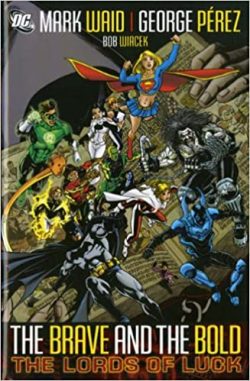
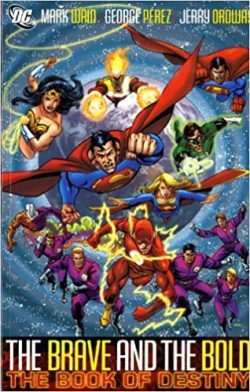
The Brave and the Bold volumes 1 & 2: The Lords of Luck and The Book of Destiny


The Lords of Luck By Mark Waid & George Pérez & various (DC Comics)
ISBN: 978-1-84576-649-8 (US HB) 978-1-84576-649-8 (TPB)

There are so many great graphic novels and compilations available these days that it’s always a shock when I realise how many more are still out of print. Here’s a classic example just begging for revival and digital editions…

The Brave and the Bold: The Lords of Luck collects the first 6 issues of another revival of a venerable DC title (technically volume 3 and spanning April -September 2007): returning it not only to the fitting team-up format we all enjoyed, but doing so with such style, enthusiasm and outright joy that I’m reduced to a gawping, drooling nine-year-old again.

Here Mark Waid, George Pérez and inkers Bob Wiacek & Scott Koblish crafted an intergalactic romp through time and nether dimensions, ripping across the DC Universe in a funny, thrilling and immensely satisfying murder-mystery-come-universal-conquest saga.

When Batman and Green Lantern (in part one ‘Roulette’ and concluding episode ‘The Girl Who Knew Too Much’) discover absolutely identical corpses hundreds of miles apart it sets them on the trail of probability-warping aliens and the missing Book of Destiny – a mystical chronicle of everything that ever was, is, and will be!

And yes, that makes this a notional tie-in to The Sandman series by Neil Gaiman and his coterie of classy creatives…

Each issue/chapter highlights a different team-up and eventually the hunt by Adam Strange, Blue Beetle (‘The Lord of Time’), Destiny (of the Endless, no less in chapter 4 ‘The Garden of Destiny’), the Legion of Super Heroes (‘The Batman of Tomorrow’), Lobo, Supergirl (‘Ventura’) and a mystery favourite from long-ago (you’ll thank me for not blowing the secret, honestly!) plus an incredible assortment of cameo stars coalesces into a fabulous free-for-all that affirms and reinforces all the reasons I love this medium.

With the value-added bonus of an annotated exploration of Waid & Pérez’s creative process to entrance the aspiring creator-of-tomorrow, this is a great story with great art, and is perfect for all ages to read and re-read over and over again. So let’s hope that happens soon…

© 2006, 2007 DC Comics. All Rights Reserved.


The Book of Destiny

By Mark Waid, George Pérez, Jerry Ordway, Bob Wiacek & Scott Koblish (DC Comics)

ISBN: 978-1-4012-1838-6 (HB) 978-1-4012-1861-4 (TPB)

The Book of Destiny is a mystical ledger which charts the history, progress and fate of all Reality and everything in it – except for the four mortals entrusted with its care at the end of The Brave and the Bold: The Lords of Luck. The death-defying Challengers of the Unknown – cool pilot Ace Morgan, indomitable strongman Rocky Davis, intellectual aquanaut Prof. Haley and daredevil acrobat Red Ryan – live on borrowed time and were bequeathed the terrifying tome by Destiny of the Endless since their lives are no longer included within its horrifying pages…

After the staggering spectacle of the previous Brave and the Bold story-arc, here Waid & Pérez, with inkers Bob Wiacek & Scott Koblish are joined by co-penciller Jerry Ordway for a stunning sequel featuring most of the DC universe…

This compilation collects issues #7-12 (volume 3 from December 2007-June 2008) of the high-energy, all-star revival of the venerable DC title: playing novel games with traditional team-up format as a mysterious mage begins manipulating heroes and villains in a diabolical alchemical scheme to transform the cosmos fundamentally and forever…

Beginning with ‘Scalpels and Chainsaws’ – wherein Wonder Woman and the ever-abrasive Power Girl rub each other the wrong way (oh please, what are you, ten!?) whilst tackling an undead invasion, the case takes a stranger turn and Kara-Zor-L accidentally discovers the Caped Kryptonian has been brainwashed into trying to murder her cousin Superman

Their ill-tempered investigations lead to the fabled Lost Library of Alexandria and a disastrous confrontation with the deranged Dr. Alchemy, but he too is only a pre-programmed pawn – of a sinister presence called Megistus – who needs Power Girl to use the mystical artefact known as the Philosopher’s Stone to turn the Fortress of Solitude into pure Red Kryptonite…

Thanks to Wonder Woman’s battle savvy, the plot is frustrated and the stone thrown into the sun… just as Megistus intended…

All this has been perused in the mystic chronicle by the Challengers and their fifth member Dr. June Robbins – whose merely mortal existence and eventual doom are tragically recorded in the Book. They rush off to investigate a universe-rending menace even as ‘Wally’s Choice’ brings The Flash and his rapidly aging children Jai and Iris West into unwelcome contact with manipulative genius Niles Caulder and his valiant Doom Patrol. “The Chief” claims he can cure the twins’ hyper-velocity malady, but Caulder never does anything for selfless reasons…

With no other hope, Wally and wife Linda acquiescence to the mad genius’ scheme – which relies on using elemental hero Rex Mason to stabilise their kids’ critical conditions. It might have worked, had not Metamorpho been mystically abducted mid-process – consequently transforming the children into bizarre amalgams of Negative Man and Robot Man

Worst of all, Flash is almost forced to choose which child to save and which should die…

Thinking faster than ever, the Scarlet Speedster beats the odds and pulls off a miracle but, in a distant place, the pages of the Book are suddenly possessed and abruptly attack the Challengers…

‘Changing Times’ features a triptych of short team-up tales which play out as the Men that History Forgot battle a monster made of Destiny’s pages, beginning as the robotic Metal Men joined forces with young Robby Reed who could become a legion of champions whenever he needs to Dial H for Hero.

Sadly not even genius Will Magnus could have predicted the unfortunate result when crushingly shy robot Tin stuck his shiny digit in the arcane Dial…

Next, during WWII the combative Boy Commandos are joined by The Blackhawks in battling animated mummies intent on purloining the immensely powerful Orb of Ra from a lost pyramid, after which perpetually reincarnating warrior Hawkman joined All-New Atom Ryan Choi in defending Palaeolithic star-charts from the marauding Warlock of Ys.

None of them are aware that they are doing the work of malignly omnipresent Megistus…

The fourth chapter paralleled the Challengers’ incredible victory over the parchment peril with a brace of tales seeing the Man of Steel travel to ancient Britain to join heroic squire Brian of Kent (secretly the oppression-crushing Silent Knight) in bombastic battle against a deadly dragon, whilst the Teen Titan’s untold second ever case finds Robin, Wonder Girl and Kid Flash in Atlantis for the marriage of Aquaman and Mera.

Unfortunately Megistus’ drone Oceanus crashes the party, intent on turning Aqualad into an enslaved route map to the future…

And in California, the Challengers attempted to save Green Lantern’s Power Battery from being stolen only to find it in the possession of an ensorcelled Metamorpho…

As the Element Man easily overwhelms Destiny’s Deputies, Jerry Ordway assumed the penciller’s role for issues #11-12.

‘Superman and Ultraman’ saw the natural enemies initially clash and then collaborate at the behest of an alternate universe’s Mr. Mixyezpitelik, who reveals the appalling scope and nature of Megistus’ supernal transformational ambitions, leading to a gathering of the heroic clans and a blistering Battle Royale in the roaring heart of the Sun…

With the fate of reality at stake and featuring a veritable army of guest stars ‘The Brave and the Bold’ concludes the saga with a terrible, tragic sacrifice from the noblest hero of all, whilst subtly setting the scene for the then-upcoming Final Crisis

With fascinating designs and pencil drawings from Ordway to tantalise the art lovers, this second captivating collection superbly embodies all the bravura flash’n’dazzle thrills superhero comics so perfectly excel at. This is a gripping fanciful epic with many engaging strands perfectly coalescing into a frantic and fabulous free-for-all overflowing with all the style, enthusiasm and exuberant joy you’d expect from top costumed drama talents.

The Brave and the Bold: The Book of Destiny is another great story with great art, ideal for kids of all ages to read and re-read over and over again.
© 2007, 2008 DC Comics. All Rights Reserved.
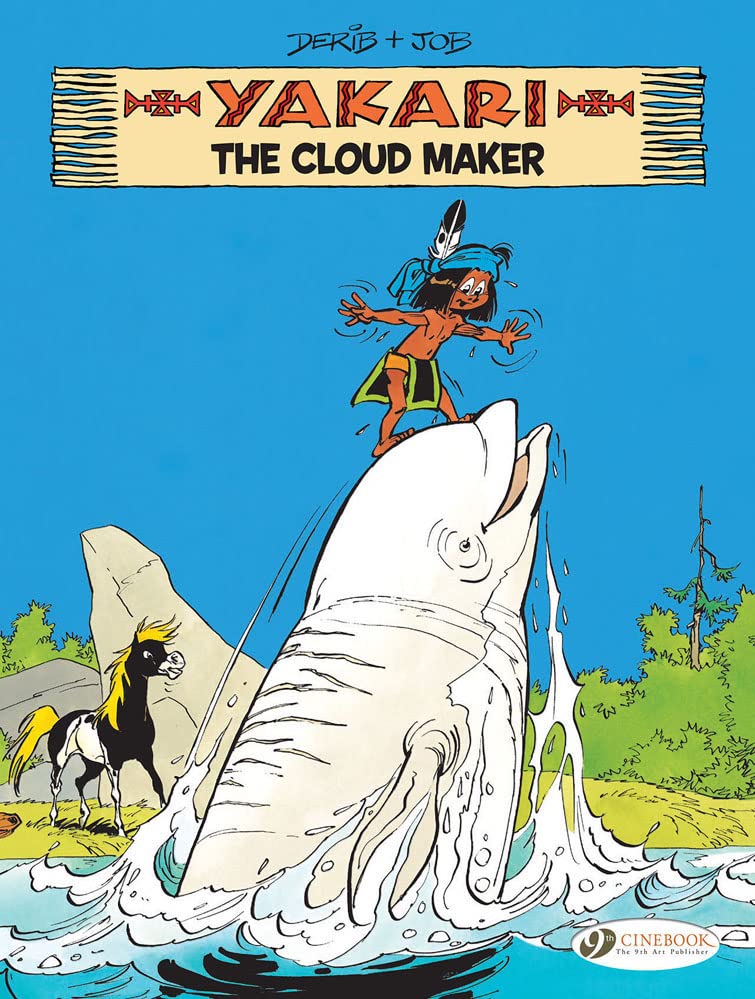
Yakari volume 20: The Cloud Maker


By Derib & Job, coloured by Dominique and translated by Jerome Saincantin (Cinebook)
ISBN: 978-1-80044-074-6 (Album PB/Digital edition)

In 1964 children’s magazine Le Crapaud à lunettes was founded by Swiss journalist André Jobin, who then wrote for it under the pseudonym Job. Three years later he hired fellow French-Swiss artist Claude de Ribaupierre AKA “Derib”. The illustrator had launched his own career as an assistant at Studio Peyo (home of Les Schtroumpfs): working on The Smurfs strips for venerable weekly Le Journal de Spirou.

Thereafter, together they created the splendid Adventures of the Owl Pythagore before striking pure comics gold a few years later with their next collaboration. Derib – equally au fait with enticing, comically dynamic “Marcinelle” cartoon style yarns and devastatingly compelling meta-realistic action illustrated action epics – went on to become one of the Continent’s most prolific and revered creators. It’s a crime that groundbreaking strips such as Buddy Longway, Celui-qui-est-nà-deux-fois, Jo (first comic to deal with AIDS), Pour toi, Sandra and La Grande Saga Indienne) haven’t been translated into English yet, but we still patiently wait in hope and anticipation…

Over the decades, much of Derib’s stunning works have featured his beloved Western themes: magnificent geographical backdrops and epic landscapes. Yakari is considered by fans and critics to be the strip which led him to his deserved mega-stardom.

Debuting in 1969, it traces the eventful, nomadic life of a young Oglala Lakota boy on the Great Plains – according to this tale, in the vicinity of the Great Lakes Basin. The stories are set sometime after the introduction of horses by the Conquistadores, but before the coming of modern Europeans.

The series – which also generated two separate animated TV series and a movie – is up to 42 albums thus far: a testament to its evergreen vitality and brilliance of its creators, even though originator Job moved on and Frenchman Joris Chamblain took on the writing in 2016.

Overflowing with gentle whimsy and heady compassion, little Yakari enjoys a largely bucolic existence: at one with nature and generally free from privation or strife. For the sake of our delectation, however, the ever-changing seasons are punctuated with the odd crisis, generally resolved without fuss, fame or fanfare by a little lad who is smart and brave – and can, thanks to a boon of his totem guide the Great Eagle, converse with all animals…

In 1995, Le souffleur de nuages was the 21st European album, but – as always with the best books – the content and set-up are both stunningly simple and sublimely accessible, affording new readers total enjoyment with a minimum of familiarity or foreknowledge required…

Here and now it is painfully topical as Yakari’s wandering people are stranded as springtime rains inundate the entire region. When the downpour finally stops, the land is devasted by flooding and the little wonder and his valiant pony decide to check on all their animal pals. Happily, Little Thunder is an excellent swimmer…

They don’t go far before meeting beaver patriarch Thousand-Mouths, whose frantic efforts to rally the clan for a major repair job to the lodge and dams is being hampered by bone idle slacker Wooden Bed. Just like any teenager, he just wants to sleep…

Water is everywhere, and the landscape is a sea broken by tiny islands. The prairie dog colony are marooned on one, waiting until it all recedes so they can clear out their great burrow. They are also nervously contemplating the ominously cloud-filled sky…

Pressing on, the horse and his boy reach a flooded forest and find raccoon Black Mask and his kin fractiously sharing a tree with grumpy owl. Nobody is happy, but all are resigned to waiting out the weather…

That night, back in camp and very much appreciating being warm and dry, Yakari has one of his special, prophetic dreams. It shows him more rains washing away his tipi (tent) until it is washed up onto a big white cloud…

Happily, morning brings better news. The waters have clearly receded, but – still perplexed by his vision – Yakari rides Little Thunder back along yesterday’s route just to check. Everywhere, industrious animals are clearing up and making good, and with so much to see and beasts to check on, the pair are far from home when the sun sets.

Bedding down under a large rock, they are later awakened by an odd cry coming from the river. Closer examination in the morning reveals the disturbance came from a pond linked to the swiftly flowing waters. Oddly, a small cloud is escaping from the turbulence. When Yakari dives in for a closer look, he is abruptly raised up into the air by a giant white fish surfacing under him!

The incredible snow-white monster turns out to be a chatty and gregarious beast calling itself a “white whale”. The curious Beluga had travelled along the swollen river from the “Great Water” Yakari had seen when travelling with spirit creature Nanabozho. Soon they are all trading life stories…

The boy names his new chum Peeleepee because of the cry it constantly utters, and discovers that despite living in the ocean, the newcomer needs air to live, water to support his weight and makes clouds from the top of his head…

In a remarkably short time they are all great friends and have learned lots of each other’s worlds. The boy and the beluga even trade tricks and acrobatic games, but the idyl is rudely shattered when a passing toad points out that, while they’ve been romping, the waters have further evaporated. The great white wonder is now trapped in an isolated pond far from the river it needs to live or get home by…

Snotty but smart, the amphibian then suggests a possible solution, but it takes all of Yakari’s friends working together, sheer luck, applied physics and the boy’s considerable negotiating skills to ensure the safety of the stranded newcomer before this ending turns out happy…

Yakari is one of the most unfailingly absorbing all-ages strips ever conceived and should be in every home, right beside Tintin, Uncle Scrooge, Asterix and The Moomins. It’s never too late to start reading something wonderful, so why not get back to nature as soon as you can?
Original edition © Derib + Job – Editions du Lombard (Dargaud – Lombard s. a.) – 2000. All rights reserved. English translation 2022 © Cinebook Ltd.

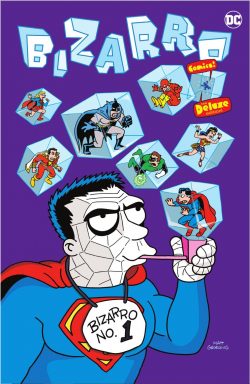
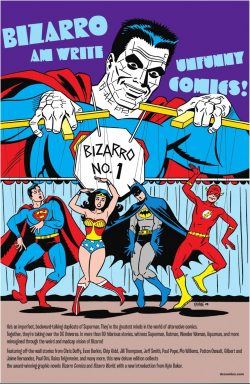
Bizarro Comics! – The Deluxe Edition


By a big bunch of very funny people AKA Jessica Abel, Todd Alcott, Rick Altergott, Peter Bagge, Kyle Baker, Gregory Benton, Charles Berberian, Aaron Bergeron, Nick Bertozzi, Ariel Bordeaux, Rand & David Borden, Ivan Brunetti, Eddie Campbell, Jim Campbell, Dave Cooper, Leela Corman, Mark Crilley, Jef Czekaj, Farel Dalrymple, Brian David-Marshall, Paul Dini, Paul Di Filippo, D’Israeli, Evan Dorkin, Mike Doughty, Eric Drysdale, Ben Dunn, Philippe Dupuy, Sarah Dyer, Phil Elliott, Hunt Emerson, Maggie Estep, Bob Fingerman, Abe Foreu, Ellen Forney, Liz Glass, Paul Grist, Matt Groening, Tom Hart, Dean Haglund, Tomer & Asaf Hanuka, Dean Haspiel, Danny Hellman, Sam Henderson, Gilbert Hernandez, Jaime Hernandez, Matt Hollingsworth, Paul Hornschemeier, Dylan Horrocks, Nathan Kane, John Kerschbaum, Chip Kidd, Derek Kirk Kim, James Kochalka, John Krewson, Michael Kupperbaum, Tim Lane, Roger Langridge, Carol Lay, Jason Little, Lee Loughridge, Matt Madden, Tom McCraw, Pat McEown, Andy Merrill, Scott Morse, Peter Murrietta, Tony Millionaire, Jason Paulos, Harvey Pekar, Will Pfeifer, Paul Pope, Patton Oswalt, Brian Ralph, Dave Roman, Johnny Ryan, Alvin Schwartz, Marie Severin, R. Sikoryak, Don Simpson, Jeff Smith, Jay Stephens, Rick Taylor, Raina Telgermeier, Craig Thompson, Jill Thompson, M. Wartella, Andi Watson, Steven Weissman, Mo Willems, Kurt Wolfgang, Bill Wray, Jason Yungbluth, & various (DC Comics)
ISBN: 978-1-7795-1012-9 (HB/Digital)

Here am big, dull shopping list of top-ranking cartoonists from beginning of twenty-oneth century. Bunch of names not very entertaining, but what they draw and write am, especially when taking loving pot-shots at beloved DC Comics icons and moments…

I’ll happily go on record and say that practically all of the fun and true creativity in comics has come out of the ‘alternative’ or non-mainstream writers and artists these days. To prove my point I’d list a bunch of things, and very near the top of that list would be this book -actually two older, smaller books sensibly nailed together in 2021.

In its near 90 years of comics publishing, DC Comics has produced many of the most memorable, most engaging and most peculiar comic characters and concepts you could imagine. For all that, they also managed to stir echoes and forge a deep and abiding affection in the hearts and minds of some of the most creative people on the planet.

As I’ve already said, the material in this titanic tome of titters (sorry, apparently I’m channelling my inner Frankie Howerd today) first emerged in a brace of cartoon anthology volumes: Bizarro Comics and Bizarro World in 2001 and 2005, disrespectively.

They delivered fast and furious skits, sketches and gags by profoundly engaged – often deeply disturbed – fans turned pros. There was a heavy dependence on small-press and self-published creators all used to having complete control of their work…

It was all meant to make you laugh and feel longing for simpler whackier times, and the Introduction by Kyle Baker should be all you need to steer you through what follows.

If I were you, I’d stop here and just buy the book, but just in case you’re a stubborn holdout, I’m going to add to my editor and proof-reader’s many woes by listing exactly who is in the thing, what they did and even add a few critical comments, just to earn my keep.

Then I’ll make my poor staff read the book too, just to cheer them up after all my word salad…

Following Matt Groening’s Bizarro Comics cover (which you get here for free) lurks a hilarious framing sequence, as a monstrous unbeatable creature attempts to conquer Mr Mxyzptlk’s 5th dimensional home. Chris Duffy & Stephen DeStefano – aided by legendary cartoonist and colourist Marie Severin – tell a weird and wonderful tale of outlandish failed Superman clone Bizarro that begins in ‘Bizarre Wars Part One’ and diverges into a wonderland of individual battles against cosmic games player A.

As the appointed defender of the entire endangered dimension, Bizarro resorts to a heretofore unsuspected ultimate power: producing comic strips featuring unfamiliar adventures of DC’s most recognizable heroes that come to life …ish.

Cue a veritable Who’s Who of the cool and wonderful of modern comics creating a plethora of wacky, dreamy, funny, wistful and just plain un-put-downable strips that would delight any kid who read comics but then accidentally grew up.

In rapid rollercoaster fashion and Fighting the Goof Fight for reality come ‘Bizarro-X-Ray One’ by Gregory Benton, Bizarro-X-Ray Two’ by John Kerschbaum and Bizarro-X-Ray Three’ by Gilbert Hernandez – all coloured by Tom McCraw. Sam Henderson & Bob Fingerman reconvene the ‘Super-Pets’ whilst Duffy & Craig Thompson expose Green Lantern in ‘The Afterthoughts’. Chip Kidd & Tony Millionaire revisit early days of ‘The Bat-Man’ in stylish monochrome before Henderson, Dean Haspiel, Bill Oakley & Matt Madden recount the silly charm-packed saga of ‘Captain Marvel and the Sham Shazam’

Baker & Elizabeth Glass test the mettle of ‘Letitia Lerner, Superman’s Babysitter!’ and Aquaman endures double trouble as Evan Dorkin, Brian David-Marshall, Bill Wray & Matt Hollingsworth draw attention to ‘Silence of the Fishes’ before Andy Merrill & Jason Little douse the Sea King in ‘Porcine Panic!’

Fingerman, Pat McEown, Oakley & Hollingsworth inflict ‘The Tinnocchio Syndrome’ on The Metal Men before Andi Watson, Mark Crilley & Lee Loughridge orchestrate ‘Wonder Girl vs Wonder Tot’ and James Kochalka, Dylan Horrocks & Abe Foreau pit Hawkman against ‘The Egg-Napper!’, even as ‘The GL Corps: The Few, The Proud’ glean more story glory courtesy due to Will Pfeifer, Jill Thompson, Clem Robins, Rick Taylor & Digital Chameleon.

Horrocks, Jessica Abel & Madden then see Supergirl and Mary Marvel have a moment in ‘The Clubhouse of Solitude’ whilst Nick Bertozzi & Tom Hart tune in to ‘Kamandi: The Last Band on Earth!’ before Jeff Smith, Paul Pope & Loughridge depict Bizarro demanding ‘Help! Superman!’ as Jef Czekaj & Brian Ralph confront Aquaman with ‘The Man Who Cried Fish!’ in advance of Wonder Woman pondering ‘One-Piece, Two-Piece, Red-Piece, Blue-Piece’ on a shopping trip organised by Fingerman & Dave Cooper.

Ellen Forney, Ariel Bordeaux & Madden probe a young girl’s ‘Bats Out of Heck’ and Eddie Campbell, Hunt Emerson, Rick Taylor & Digital Chameleon went full-on Batmaniacal in ‘Who Erased the Eraser’ before Crilley & Watson negotiate a shocking ‘First Contact’ with The Atom, after which The Batman invites us ‘Inside the Batcave’ with Pope & Jay Stephens as tour guides.

Dorkin, D’Israeli & Digital Chameleon expose ‘Solomon Grundy: Bored on a Monday’ before Alvin Schwartz, Roger Langridge & Loughridge debut ‘The Most Bizarre Bizarro of All’ and Ivan Brunetti, Dorkin & Sarah Dyer reveal ‘That’s Really Super, Superman!’ to The World’s Finest Team whilst Dorkin, Carol Lay, Tom McCraw & Digital Chameleon invite everyone to ‘The J’onn J’onzz Celebrity Roast’ before Bordeaux, Forney & Madden share ‘Wonder Woman’s Day Off’

The initial volume and that framing Mxyzptlk yarn are coming to a close as Dorkin, Wray, John Costanza & Hollingsworth craft ‘Unknown Challenges of the Challengers of the Unknown’ and Dorkin, Steven Weissman & Dyer go to bat for all the forgotten creature sidekicks in ‘Without You, I’m Nothing’ before Duffy, DeStefano, Phil Felix, Severin & Digital C reunite for the climactic conclusion of ‘Bizarre Wars – Part Two’

If you haven’t heard of anybody on that overwhelming list then get Googling. Then get this book and get enjoying.

No? that’s okay… There’s More…

The turn of this century was a particularly fraught time – aren’t they always? – and one of the best ways to combat the impending travail was to make people laugh. A follow up to the remarkably successful Bizarro Comics again invited a coterie of alternative comics creators (and guests!) to make sport of various hallowed DC icons. Superman, Batman, Wonder Woman and all the lesser gods were dragooned into more tales humorous, dolorous and just plain peculiar, drawn in an eye-wrenching range of styles. Many of those involved continued to display a disturbing knowledge of, if not respect for, the DC continuity of the 1960s whilst others seem to centre on the TV and Movie interpretations, but the fondness for times gone by was readily apparent throughout.

Behind a Bizarro World cover from Jaime Hernandez, Rian Hughes & Coco Shinomiya is unsurprisingly story ‘Bizarro World’ by Duffy, Scott Morse, Rob Leigh & Dave Stewart as a couple of unwary kids fall into a universe stuffed to overflowing with everyday super people…

Answers come from a crusty reporter with extensive files and notes from many stringers…

Kidd, Millionaire & Jim Campbell review ‘Batman with Robin the Boy Wonder’ and Merrill, Langridge & Madden get seasonally silly in ‘Jing Kal-El’, whilst Mo Willems, Forney & Madden reveal ‘The Wonder of it All’ for the youthful feminist before Foreu, Kochalka & Madden have shapeshifter Chameleon Boy ask ‘Where’s Proty?’

Nostalgia and childish wish-fulfilment masterfully merge in pants-wettingly funny ‘Batman Smells’ by American National Treasures Patton Oswalt, Fingerman & Stewart, whilst Duffy & Craig Thompson channel ‘The Spectre’ and Jasons Yungbluth & Paulos confirm with Hal Jordan that ‘It’s Not Easy Being Green’ even as Aaron Bergeron & Kerschbaum revel in ‘The Power of Positive Batman’

Mike Doughty & Danny Hellman’s Fish-out-of-water ‘Aquaman’ segues into another true Stand Out story: ‘Batman: Upgrade 5.0’ by Dean Haglund & Peter Murrieta, illustrated by Don Simpson, before comics bad boy John Ryan joins Dave Cooper to explore being ‘Super-Dumped’ via the sad story of Clark and Diana

Elsewhere, Dorkin & M. Wartella retroactively introduce Batman to ‘Monkey, the Monkey Wonder’ whilst comics verité legends Harvey Pekar & Dean Haspiel declare ‘Bizarro Shmizarro’ just as Dylan Horrocks, Farel Dalrymple & Paul Hornschemeier proposition ‘Dear Superman’ on behalf of a youngster with a secret…

‘The Red Bee Returns’ courtesy of Peter Bagge, Gilbert Hernandez & Madden, after which Eric Drysdale, Tim Lane, Oakley & Madden organise ‘The Break’ for the JLA. Dorkin & Watson then find The Legion of Super-Heroes ‘Out with the In Crowd’ just as Todd Alcott, Michael Kupperman & Ken Lopez detail the ‘Ultimate Crisis of the Justice League’

Tomer & Asaf Hanuka join Lopez & Campbell to define ‘Batman’ whilst Paul Dini & Carol Lay have the very last word on ‘Krypto the Superdog’ and Ariel Bordeaux & Rick Altergott unwisely launch ‘Legion.com’ before mercurial Harvey Dent enjoys a ‘Dinner for Two’ thanks to Dorkin & Iva Brunetti…

Maggie Estep & Horrocks take on ‘Supergirl’ and her horsey history before Leela Corman & Tom Hart steer a ‘Power Trip’ for Batgirl, Wonder Woman and the Girl of Steel, whilst Eddie Campbell, Paul Grist & Phil Elliott schedule ‘A Day in the Life in the Flash’ before hilariously reprising their manic madness via ‘The Batman Operetta’

Bizarro returns in an activity page from his ‘Daily Htrae’ – by Dorkin & R. Sikoryak – and the GL Corps turn Japanese in ‘Lantern Sentai’ from Rand & David Borden of Studio Kaiju, manifested by multi-talented Benn Dunn. Philippe Dupuy & Charles Berberian then offer a continental touch in ‘Batman of Paris’, Kurt Wolfgang & Brian Ralph have fun with ‘The Demon’ and John Krewson, Dorkin & Dyer expose ‘Kamandi, The Laziest Boy on Earth’.

Despite all the craziness, the best has wisely been left until last and end begins with The Justice League of America regretting ‘Take Your Kids to Work Day’ (by Dave Roman & Raina Telgemeier) whilst ultimate manservant Alfred Pennyworth conducts his master’s business as a “Personal Shopper” thanks to Kyle Baker & Elizabeth Glass, before we finish with Deadman who learns with horror – from Paul Di Filippo & Derek Kirk Kim – that ‘Good Girls Go to Heaven. Bad Girls Go Everywhere’

What do you get if you give a whole bunch of vets and alternative comics creators carte blanche and a broad brief? You should get this.
© 2001, 2005, 2021 DC Comics. All rights reserved.

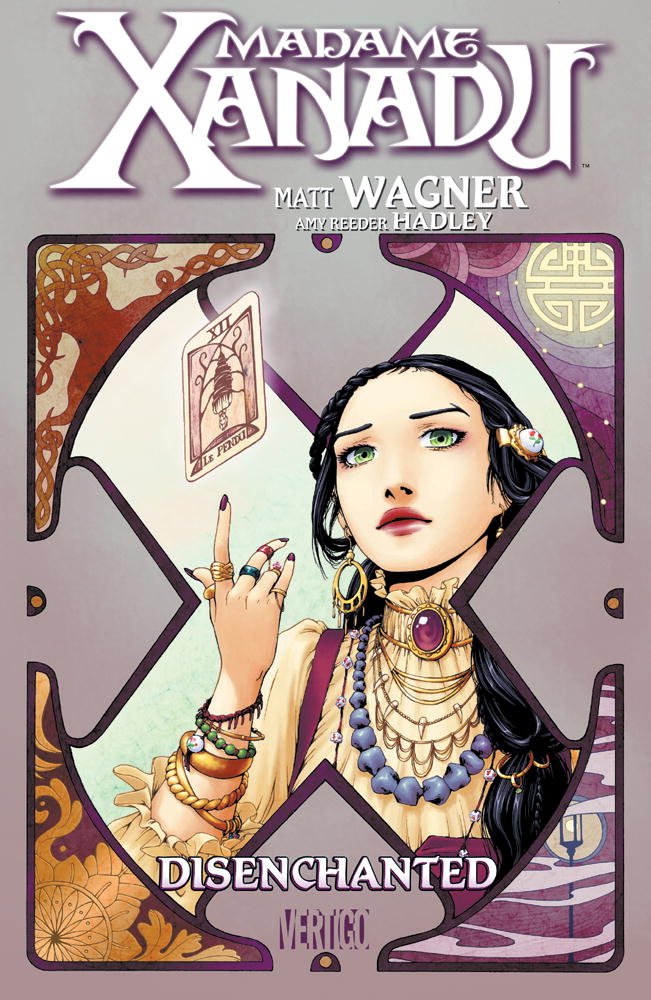
Madame Xanadu volume 1: Disenchanted


By Matt Wagner, Amy Reeder Hadley, Richard Friend & various (DC/Vertigo)
ISBN: 978-1-4012-2291-8 (TPB)

After the Vertigo imprint carefully aligned a number of DC properties beyond an iron curtain of sophisticated suspense and grown-up tale telling, in the early 21st century Matt Wagner was at the forefront of reuniting the divided camps. He successfully blurred the boundaries between mainstream DC continuity and the story-driven experimentation of mature, independent Vertigo. Although it still drives continuity mavens raving bonkers, stuff like this graphic gold – a superbly fetching yarn which tells a stand-alone tale for newcomers whilst also being a smart piece of historical in-filling for dedicated readers – is steeped in the arcane magical lore of DC’s multiverse, allowing old guard readers to pick and mix with spectacular effect. This sort of subtle side saga eventually led to the full integration of storylines in the “New 52” and after…

Collecting the first 10 issues of the lovely, thoughtful monthly comic that was the third volume of Madame Xanadu, Disenchanted finally provided an origin for one of the most mysterious characters in the company’s pantheon, and made her a crucial connection and lynchpin in the development of a number of the company’s biggest stars.

Madame Xanadu originally debuted in Doorway to Nightmare #1 (cover-dated February 1978): one of DC’s last 1970’s mystery stable, and a rare deviation from the standard anthology format. As designed by Michael William Kaluta & Joe Orlando, she was a wilfully enigmatic but benign tarot reader who became (peripherally) involved in the supernatural adventures of her clients.

The incarnation ended after only five issues although four further tales appeared in The Unexpected, and one last solo adventure was released as a one-shot billed as DC’s second “Direct Sales only” title.

After lurking in the musty, magical corners of the DCU for decades, she finally got another shot at the limelight. It was well worth the wait.

In the final days of Camelot, the fairy Nimue, Mistress of the Sacred Grove and sister to the Lady of the Lake and haughty Morgana, is disturbed by growing chaos in the land. However, when the puissant clairvoyant is unexpectedly visited by a Stranger who urges her to act on her visions, she is proud and reluctant, and drives him away.

Meanwhile, her lover Merlin is making dire preparations for inevitable battle, and lets his loving mask slip. His dalliance with her is clearly exposed as mere pretence to obtain her secrets of immortality…

As Camelot falls and the land burns, Merlin summons a demon from Hell to protect him and leaves it loose after the castle falls. The stranger returns, urging Nimue to beware Merlin’s intentions, but although she is wary of the wizard, she will not believe him capable of harming her.

She learns otherwise almost too late, and seeks to bind Merlin in a magical snare, but the wizard’s retaliation is terrible as – with his last vestige of power – he destroys her enchanted nature. With her potions, she will still know magic, but never again will she be magical…

Centuries later she is seer for mighty Kublai Khan when the stranger appears again: guiding the expedition conveying Marco Polo to his heady destiny. Once again, the enigma’s warnings are unwelcome but true, and again Nimue’s complacent sheltered life and innocent friends suffer because she will not listen.

She departs, painfully aware that the Stranger believes he serves a purpose more important than innocent lives. When she confronts him he vanishes – as always – like a Phantom…

Time marches on: in France, she advises Marie Antoinette, both before and after she is dragged to the Bastille, and begs the ubiquitous stranger to save the tragic queen to no avail. When she finally returns to England she hunts Jack the Ripper, unable to fathom how the stranger can believe any cause more important than stopping such a monster. The episodic epic pauses for now in 1930s New York, during the fleeting moments before masked avengers and costumed supermen burst onto the world stage. Here Nimue finally discovers what the stranger’s mission is, learning how her ancient antics shaped it…

Despite hosting a huge coterie of magical guest-stars, from Etrigan to Zatarra to Death of the Endless and delightfully disclosing close ties to key moments of DC’s shared history, this is a fabulous, glorious, romantic, scary stand-alone tragedy starring one of the most resilient women in comics, and a classic long overdue for revival and one that any fervid fantasy fan and newcomer to comics could easily read… and really must.
© 2008, 2009 DC Comics. All Rights Reserved.
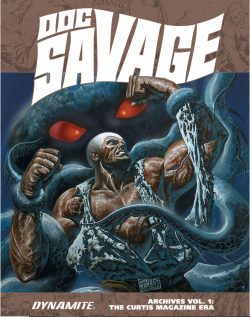
Doc Savage® Archives volume One: The Curtis Magazine Era


By Doug Moench, John Warner, John Whitmore, illustrated by John Buscema, Tony DeZuñiga, John Romita, Rico Rival, Marie Severin, Neal Adams, Marshall Rogers, Val Mayerik, Rich Buckler, Klaus Janson, Ed Davis, Tom Sutton, Ernie Chan, Bob Layton, Dick Giordano & various (Dynamite Entertainment)
ISBN: 978-1-60690-514-2 (HB/Digital edition)

Before comic books, thrill-starved readers endured the travails of the Great Depression by regular doses of extraordinary excitement derived from cheaply produced periodical novels dubbed – due to the low-grade paper they were printed on – “pulps”. There were hundreds published every month, ranging from the truly excellent to the pitifully dire: seemingly catering to every conceivable style, taste and genre.

The process spawned a new type of star and kind of story: damaged modern knights who were mysterious, implacable and extraordinary to the point of superhumanity, confronting uncanny overwhelming evil. In this fresh adventure medium, two-star characters outshone all others. The first was The Shadow – a true trendsetter who pioneered and beta-tested most of the methodology and mystique later mastered by Batman and most superheroes. Soon after him came the Superman of his day: Doc Savage, the Man of Bronze

In the early 1930s, The Shadow was a dark, relentless, unstoppable and much-imitated creature of the night preying on the wicked and dispensing his own terrifying justice (and for more about him check out the Dark Avenger review). A true game changer tailor-made by a committee of wise heads and a superb scripter, Street & Smith Publications’ The Shadow set the world on fire, and those savvy savants sensibly sought to repeat the miracle. The result was a modern Hercules, Plato, Hippocrates, King Arthur, Sherlock Holmes and Einstein rolled into one gleaming, oversized paragon of physical perfection.

The big man and his team of globe-trotting war-buddy science specialists had been cobbled together by publisher Henry W. Ralston, editor John L. Naonvic and writer Lester Dent, using the same gameplan that had materialised The Shadow. Editorial notions and sale points of the bosses were fleshed out, filled in and made to work by Dent, who – under house pen-name Kenneth Robeson – wrote 159 of the 181 original novels released between March 1933 (Happy Birthday Doc!) and Fall 1949. The other exploits were handled in whole or in part by ghost writers and assistants Harold A. Davis, Ryerson Johnson, Laurence Donavan, Martin E. Baker, William G. Bogart and Alan Hathway.

The core premise is delicious and instantly engaging. Clark Savage Jr. had been trained from infancy in all arts and sciences, even as he underwent a carefully-devised program and regimen of physical training and sensory stimulation to make him impossibly fast, strong, hardy, acute, astute and – to be honest – pretty smug.

The perfect “Competent Man” was forever solving manic mysteries and protecting the helpless – when not quietly puttering away improving the lot of humanity with his inventions and pioneering medical procedures. However, this self-appointed hero and champion was what we’d probably now call an overachieving abuse survivor. For example, his unique viewpoint deemed it sound and reasonable to cure “evil tendencies” with brain surgery…

Despite such caveats (different times, right?) “Doc” Savage and his militarily-distinguished apex troubleshooters, Renny, Johnny, Long Tom, Ham and Monk were hugely popular in prose, print, radio and comics: a fascinating prototype example of a superhero team.

They regularly aided the oppressed and exploited: battling mad geniuses, would-be world conquerors, scary monsters, weird forces, dictators and uncommon criminals, before fading from view as the 1940s closed. They stormed back into popular culture during the 1960s, revived as part of global fantasy boom which also resurrected The Shadow, Conan, the C’thulu mythos and so many other pulp stars and craftsmen. Doc was particularly memorable thanks to such magazine exploits being reprinted in iconic Bantam Books paperbacks sporting stunning covers by James Bama…

Savage and his “fabulous five” had been funnybook stars since 1940: firstly in Street & Smith’s own The Shadow #1-3, and then in their own Doc Savage Comics (1940-1943). He thereafter appeared intermittently in The Shadow and Supersnipe Comics until 1948.

In November 1966, an abortive movie of The Thousand-Headed Man came to nothing, but did result in a one-shot tie-in from Gold Key Comics by Leo Dorfman & Jack Sparling. It also sported a lovely cover by Bama…

During an era of nostalgia, Marvel secured rights to publish Doc Savage comics: adapting the novels Man of Bronze, Brand of the Werewolf, Death in Silver and The Monsters over 8 regular issues between October 1972 and January 1974. There was also a giant-sized special and Doc entered Marvel continuity by teaming with Spider-Man and The Thing.

George Pal’s movie Doc Savage: The Man of Bronze was released in June 1975. Heavily hyped but an eventual flop, it nevertheless prompted Marvel to revive their license: creating a monochrome magazine version combining interviews and articles with darker, more mature comics adventures. The movie was fun but misunderstood and underappreciated, but it allowed true fans to see how their hero should always have been handled…

This hefty compilation re-presents all the material originally included in Doc Savage Magazine #1-8, spanning cover-dates August 1975 to Spring 1977. It is called the “Curtis Magazine Era” because that’s the name of the affiliated distribution company Marvel were part of at the time, and indicated a separate imprint producing comics outside the remit of the restrictive Comics Code Authority rules.

Thus, following Roger Kastel’s stunning full-colour painted cover (based on a movie poster) and a publicity photo frontispiece of actor Ron Ely beside an iconic Bama cover painting, Doc Savage #1 opens with Marv Wolfman’s ‘An Editorial in Bronze’ and John Romita (Sr.) & Tony DeZuñiga’s potent ‘Pin-up art’. This is mere prelude to an extra-long, peril-packed period drama by writer Doug Moench and illustrators John Buscema, Romita & DeZuñiga whose cunning comics chills commence with ‘The Doom on Thunder Isle!’.

When a Manhattan skyscraper is razed to rubble by lightning, Doc and his team are drawn into a missing persons case involving socialite Angelica Tremaine, her architect brother Winston and fiancé Thomas J. Bolt

A complex plot rapidly unfolds, involving her, them and a suicidally fanatical kidnap gang seemingly based in the clouds, before Doc deduces the actual tropical island location of the foe. Deploying his many signature war-machines and leading his team in a brief but brutal clash against mutant beasts, super-science weapons and ancient madness, Doc learns even he cannot foil or fix all the cruel experiments of the insane Silver Ziggurat

Following a contemporary body building ad (!), Jim Harmon & Chris Claremont interview director/producer ‘George Pal… The Man Who Made Doc Savage’ to end the first foray…

Scots artist Ken Barr painted the other covers, the first of which precedes Marv Wolfman’s editorial in #2 asking ‘Why Couldn’t Ron Ely Be Short and Ugly?’ (augmented by Marie Severin cartoons) before dark doom and destruction arrives in another extravagant mystery in Moench & DeZuñiga’s ‘Hell-Reapers at the Heart of Paradise’

Here a property tycoon’s abduction by an apparently crazed and definitely radioactive Viking pitches Savage and Co. into a lethal and terrifying treasure hunt for a galleon lost since 1504. The search expands to include a flotilla of missing ships vanished over centuries in the Arctic, and concludes spectacularly with civil war in a lost paradise packed with monsters…

More hilariously outdated macho ads bracket a ‘Ron Ely: the Man of Bronze!’ interview conducted by John Warner with photos by Michelle Wolfman…

Doc Savage Magazine #3 sees another Barr cover, frontispiece ‘Pin-up art’ by Rich Buckler & Klaus Janson and letters page ‘Mail of Bronze’ preface Moench, Buscema & DeZuñiga’s  titanic 45-page tale ‘The Inferno Scheme!’ When robot beasts plunder gems all across New York City, enigmatic, enticing Contessa De Chabrol points the finger at her brother, hoping Savage and his “brothers in arms” can keep the police out of the affair and save her deranged sibling from himself. With utterly smitten engineer Renny suitably distracted, they head upstate to Chabrol’s fortress to find the villain has mastered the science of lasers as well as robotics…

Well, almost. He still needs Renny to fine-tune his death ray cannon, but even as the captive’s comrades render a rescue mission, one last tragic betrayal awaits them…

Ape-shaped chemist/comedic relief Lieutenant Colonel Andrew Blodgett Mayfair then stars in a solo tale when Monk! experiences ‘A Most Singular Writ of Habeas Corpus’ by Moench & Rico Rival. When his eternal rivalry with lawyer Ham (Brigadier General Theodore Marly Brooks) leads to the legal fashion plate losing his latest suit to the Monk’s pet pig, it results in everyone being abducted by a ruthless racketeer seeking to ace out the competition through clever chemistry…

More classic ads neatly segue into a stripped-down DSM #4 wherein Moench, Marie Severin & DeZuñiga detail how ‘Ghost-Pirates from the Beyond!’ imperil the world. It begins in February 1936 as assassins kill high-ranking police officers in Casablanca before targeting Clark Savage Jr.’s friend Charles Villiers in the Big Apple. Seemingly murdered by a ghostly sheik, the criminologist’s demise is forensically deconstructed by Doc, who brings his team to Morocco and scotches a scheme to garner millions in lost treasure and foment rebellion in the fractious French Protectorate…

Another ‘Mail of Bronze’ section and more ads (where did I put those X-ray Spex?) takes us #5 where ‘The Doc Savage Oath’ is illustrated by Neal Adams and more ‘Mail of Bronze’ sets up a colossal comics clash with ‘The Earth Wreckers!’. Here Moench & DeZuñiga see our planet in peril in summer 1933, as Doc Savage traverses the globe, raiding lairs on six continents to ruthlessly secure the components for a device intended to end humanity. This tale introduces Doc’s formidable cousin Pat Savage who is dragged into the impending calamity by shy, retiring whistle-blower Hiram Meeker. As usual, there’s more going on than first appears and the climactic battle against maniac super-extortionist Iron Mask beneath Loch Ness affords many shocks before order is finally restored…

Pin-up art’ of Doc and the gang by Marshall Rodgers bisects Bob Sampson’s comprehensive feature on ‘The Pulp Doc Savage!’ and David Anthony Kraft’s photo-feature ‘An Interview with: Mrs. Lester Dent’ before more daft ads herald Doc Savage Magazine #6.

Another Barr classic cover, supported by anonymous ‘Pin-up art’ (that looks like early Mike Zeck to me) and editorial ‘Onward, the Man of Bronze’ written by John Warner & limned by Keith Pollard springs directly into wild action into Moench & DeZuñiga’s main feature ‘The Sky-Stealers!’ as supposed Egyptian gods employ astounding super science to wipe out the mining town of Plainville, Utah. When Doc investigates, he leans that not only was the bank looted, but all the freshly-procured uranium is also gone…

As neighbouring town Union is also eradicated, lawyer Ham and archaeologist Johnny strike gold: uncovering maverick savant Professor Johnathan Wilde whose theories on “pyramid power” led to his ostracization and eventual disappearance. The hunt inexorably leads the squad to the New York Museum of Natural History, the pyramid of Cheops in Giza and repeated clashes with beast-headed supermen before deranged mastermind Horus and his armies finally fall to Doc’s strategies and sheer determination to punish the unjust…

Bob Sampson’s prose biography of ‘Renny’ is supported by illustrations from art prodigies Frank Cirocco & Brent Anderson, ‘Mail of Bronze’ and ‘Pin-up art’ by Ron Wilson (?).

Penultimate issue DSM #7 offers ‘Pin-up art’ by Ed Davis, before storming straight into a monster-mash masterpiece with Moench, Val Mayerik & DeZuñiga detailing how ‘The Mayan Mutations!’ unleash giant terrors in Peru. It’s June 1941 and America is still officially neutral whilst most of the world is at war, but when missionary Vesper Hope seeks the team’s aid on behalf of her native companion Myrrana, the quest takes them back to south America’s rain forests where white men have enslaved the indigenous people and created devils to destroy everything.

The champions don’t even leave New York before the terrors target them, too…

Ultimately, our heroes clean up the green hell and uncover the shocking truth of the monsters, but this time not all the damage can be fixed…

More ‘Pin-up art’ by Ed Davis leads to Sampson’s article on ‘Johnny’ before the historical heroic hijinks halt with issue #8. Tom Sutton’s ‘Pin-up art’ frontispiece precedes Warner’s farewell in ‘Editorializing on the Bronze Side in Two Parts’ before he, John Whitmore, Moench & Ernie Chan unleash ‘The Crimson Plague’.

When Doc leads the team to Acapulco in search of an old medical colleague, they uncover an uncanny monster leaving brain-addled victims and corpses. The octopoid horror follows them back north and haunts Brooklyn before Savage uncovers human agency behind the scarlet death “disappearing” scientists and threatening the world’s greatest cities. The imminent crisis demands the Fabulous Five split up, but when that ploy fails it falls to Doc to save the day and destroy the ghastly culprit behind the plot…

Wrapping up the issues – and this epic collection – is one last ‘Mail of Bronze’ feature, and more ‘Pin-up art’: Long Tom and friends’ courtesy of Davis and Savage by Bob Layton & Dick Giordano, all tantalising bolstered by a tantalising promo for a new collected serial (stay tuned for that later in this Savage anniversary year!)…

Bold, bombastic and truly beloved, these yarns have been published by Marvel, DC and Dynamite: truly timeless tales of the perfect and prototypical man of wonders. These are stories no action-loving, monster-hunting, crime-busting armchair hero can be without.

So, is that you?
® and © 2014 Conde Nast. Used under license.

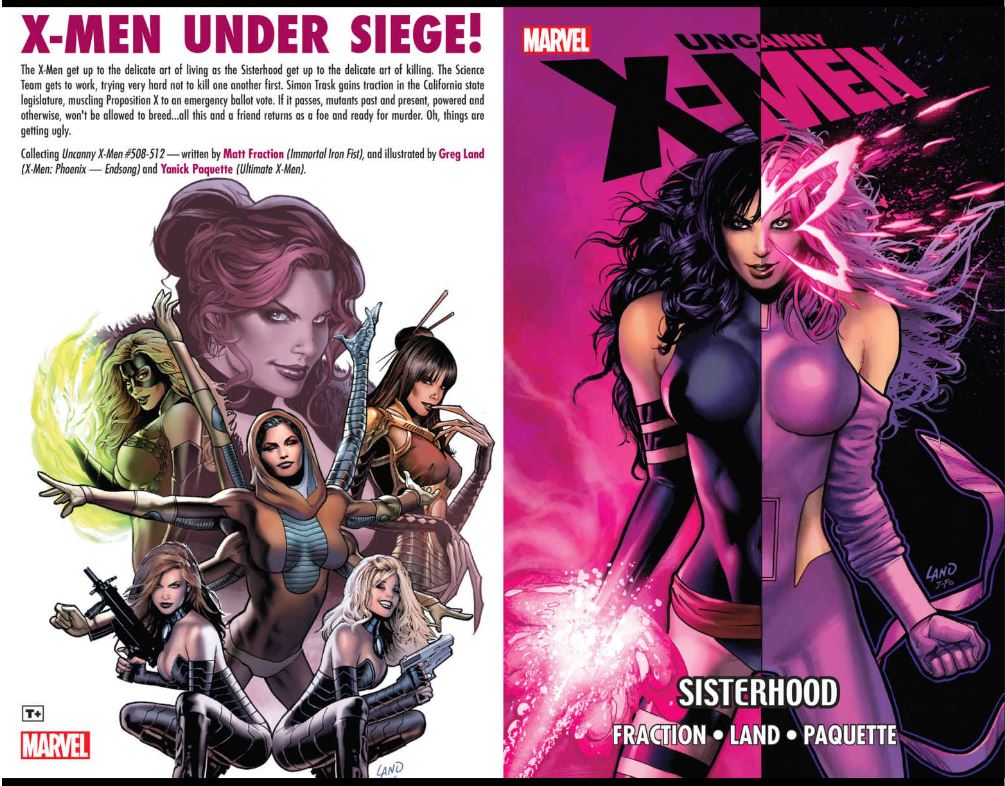
Uncanny X-Men: Sisterhood


By Matt Fraction, Greg Land, Yanick Paquette, Terry Dodson, Jay Leisten, Karl Story & various (Marvel)
ISBN: 978-0-7851-4105-1 (TPB/Digital edition)

Ever since the spectacular “All-New” revival of 1975, Marvel’s Mutant franchise has always strongly featured powerful and often controversial female characters, and the balance has never rested solely on the side of light.

For every valiant woman – or indeed super-powered, cutely-conflicted teenage girl – fighting the good fight, there has been a shady lady playing for the dark side. This compendium – re-presenting Uncanny X-Men #508-512, and spanning cover-dates June to August 2009 – primarily features a colossal clash between the maligned, misunderstood mutant mavericks and a dastardly coterie of extremely wicked women warriors, whilst also offering a fascinating insight into the occluded history of one of the endangered species’ most enigmatic survivors…

At this point in time, the evolutionary offshoot dubbed Homo Sapiens Superior was at its lowest ebb. As seen in both House of M and Decimation storylines, Scarlet Witch Wanda Maximoff had been ravaged by madness and her own reality-warping powers and – with three simple words – “No More Mutants” – reduced Earth’s multi-million plus mutant population to a couple of hundred individuals…

Most of the remaining genetic outsiders accepted a generous and earnest offer to relocate to San Francisco but, of course, trouble was always happy to make long-distance house calls…

Scripted throughout by Matt Fraction, 4-part saga ‘Sisterhood’– illustrated by Greg Land, Jay Leisten & colourist Justin Ponsor – opens following the shocking news of a massacre in Cooperstown, Alaska. Terrorists have razed the isolated outpost to burning rubble thanks to reports that the first mutant baby since The Decimation had been born there…

Anti-mutant activist and passionate bigot Simon Trask is quick to stir the flames of panic and prejudice with his Humanity Now Coalition pushing the government to end the threat of mutants forever. As hysteria mounts, even previously neutral outcasts start making their way to the mutant enclave of the Greymalkin Industries Facility on the Marin Headlands. However, even with an ever-growing host of feared and despised genetic pariahs housed in her city and the entire population potentially at risk from fanatics and mutant-hunters, Mayor Sadie Sinclair stands firm on her offer of sanctuary…

The dark drama continues in a secluded private cemetery in Tokyo as the Sisterhood of Evil Mutants disinter a body. They are interrupted by probability-bending sometime X-ally Domino whose main talent seems to be landing in the wrong place at the right time.

Sadly, even her odds-altering powers and superspy training are not enough to stop the grave-robbing, and Regan and Martinique Wyngarde (daughters of malevolent illusion-caster Mastermind), psychic assassin Chimera, cyborg assassin Lady Deathstrike, extra-dimensional witch Spiral and the infernal spirit of Red Queen Madelyne Pryor escape with the corpse of legendary ninja Kwannon

In San Francisco, Henry McCoy convenes his newly convened X-Club: a unique think tank comprising human geneticist Kavita Rao, mutant tech-savant Madison Jeffries, atomic mutation expert Dr. Yuriko Takiguchi and former Nazi-hunting mutant mystery man James Bradley – AKA Doctor Nemesis.

The Beast carefully outlines their goal: finding a means to reactivate and restore the millions of mutants “cured” by the Scarlet Witch. Their first session quickly concludes that she has somehow switched off the power-sparking “X-Gene” in the majority of the mutant population, but they must know more about the origin of their own species before they can turn them all on again…

Elsewhere in the city, the Sisterhood have resurrected the purloined corpse and filled the body with a former soul-host… or at least one of them…

Long ago (in Uncanny X-Men #256-258) priests of ninja cult The Hand mystically transposed the mind of telepath Betsy Braddock – AKA Psylocke – into the physical shell of a lethally effective adherent called Kwannon. The brainwashing/mystic body-swapping turned the English Rose into a sultry, sexy Chinese bodyguard/concubine/siren… and perfect gift for the undisputed overlord of the criminal Orient, The Mandarin.

After much ado, myriad battles and many years, both mind-moved incarnations died in combat, but now the Red Queen has successfully reunited the long-separated soul and form of the elite killer…

As the X-Men reach out – enlisting former Canadian mutant hero and media-savvy global Gay celebrity Jean-Paul Beaubier (former Alpha Flight operative Northstar), the sinister Sisterhood moves on to the next stage of Pryor’s convoluted game-plan…

With the enclave happily acclimatising and being welcomed by mellow Californians, demagogue Trask springs his latest nasty surprise from Washington DC. Proposition X demands legislation to ensure the mandatory sterilisation of mutants and all humans carrying the X-Gene…

The news drives Greymalkin’s younger mutants into a fury, whilst in the science labs cooler heads have devised a potential plan to study the origins of their kind: all they must do is travel back in time and secure blood samples from the first humans to conceive a mutant child…

Outmanoeuvred, the usually reticent and inspirationally obnoxious Bradley is forced to admit having been born in 1906, and that his own parents might well be the most likely prospects…

Before they can act, the Sisterhood attack, using a prisoner in the detention centre to deactivate all psychic security provisions. The devastating assault catches the heroes off guard, but Pryor’s big mistake is underestimating the sheer bloody-mindedness of student heroes X-23, Armor, Pixie and telepathic gestalt the Stepford Cuckoos

Following that counterstrike, the swift recovery and retaliation of adult X-folk quickly drives the Sisterhood out, but Wolverine is forced to admit that the invaders got what they came for: a lock of hair from Jean Grey that he’s been treasuring since her death. The sample may provide the ghostly Pryor with genetic material needed to grow herself a new body – one with all the power of the nigh-omnipotent Phoenix

The conclusion (with additional art from Terry & Rachel Dodson) sees desperate X-Men rush to foil the plot and spectacularly triumph, not only ending the terror of cosmic resurrection but incidentally reclaiming one of their own fallen from the grave…

Following that all-out cosmic clash ‘The Origin of the Species’ (limned by Yanick Paquette & Karl Story) offers steam-punk and tragedy as that deferred jaunt to the dawn of the Mutant Age finally gets underway.

Accompanied by restored Psylocke and Archangel, Beast’s “X-Club” of super science geeks pop back to San Francisco in 1906 on an extremely tight deadline to get blood samples from Dr. Nemesis’ parents but stumble into the birth of their worst nightmare…

Inventor Nicola Bradley and wife Catherine have been striving to complete a generator to provide free, unlimited broadcast power for humanity but are increasingly being threatened by thugs and brigands determined to steal it. Cornelius Shaw and his mentor Lord Molyneux are using the sybaritic Hellfire Club to fund Bradley’s experiments but they want his incredible engine for purposes far darker than lighting the world.

Molyneux has visions of mankind crushed under the monstrous heel of a new superior race – “Overmen” – and needs the battery to power his colossal mechanical Sentinel. Against that, even the aberrations-to-come will be helpless…

He’s also behind the attempted raids; hedging his bets in case Bradley cannot complete the job, so when the freakish X-Club show up he knows it’s time to act…

Thankfully – and perhaps instinctively inspired by his wife’s pregnancy – Bradley solves the final problem, but regrets his actions once the Hellfire lords take his device and unleash a marauding mechanical myrmidon upon the populace.

…And that’s when the strangers with wings, blue fur and other incredible abilities reveal themselves…

Concluding in calamity, catastrophe and cruel, heartbreaking irony, this smart slice of time-tampering neatly wraps up a superb sample of Mutant Mayhem: exciting, enthralling and exceptionally entertaining.

This slim, stirring, supremely sensuous Fights ‘n’ Tights tome also offers a selection of cover reproductions and variants by Land, Ponsor, Paquette, Edgar Delgado, Laura Martin, J. Scott Campbell & Stéphane Roux, delivering a treasure trove of treats for all.
© 2009 Marvel Characters In. All rights reserved.

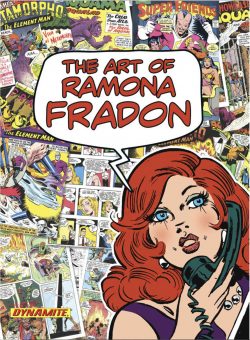
The Art of Ramona Fradon


By Ramona Fradon; interviewed by Howard Chaykin (Dynamite Entertainment)
ISBN: 978-1-60690-140-3 (HB/Digital edition)

Although present in comic books from the start, women – like so many other non-white male “minorities” – have been largely written out of history. One of the very few to have weathered that exclusion is Ramona Fradon. This excellent commemorative art collection celebrates not only her life and contribution, but thanks to its format – a free and unexpurgated extended interview with iconoclastic creator Howard Chaykin – offers the artist’s frank and forthright views on everything from work practise to the power of fans…

It all begins with an Introduction from Walt Simonson who proclaims ‘Meet your Idol… and discover They’re even Cooler than you Thought!’, before the early days are revealed in ‘Part One: Setting the Scene’ and ‘Part Two: In the Beginning’

Ramona Dom was born on October 2nd 1926 to an affluent Chicago family with many ties to commercial creative arts. Her father was a respected artisan, letterer and calligrapher who had designed the logos for Camel cigarettes, Elizabeth Arden and other major brands, and also formulated the fonts Dom Casual and Dom Bold. He had plans for his daughter, urging her to become a fashion designer…

The family moved to (outer) New York when Ramona was five., Ramona initially attended The Parsons School of Design, where she discovered she had absolutely no interest in creating clothes. Although she had never read comic books, she had been a voracious reader of illustrated books like the Raggedy Anne and Andy series by John Barton Gruelle, and a devoted fan of newspaper strips. Her favourites included Dick Tracy, Bringing Up Father, The Phantom, Alley Oop, Flash Gordon, Terry and the Pirates and Li’l Abner (all represented here by examples from the 1930s) and she transferred to the New York Art Students League, a hotbed of cartooning…

There she met and married Arthur Dana Fradon, who would become a prolific illustrator, author and cartoonist and a regular contributor to The New Yorker between 1948-1992. They wed in 1948 and he actively encouraged her to seek work in the still young funnybook biz.

‘Part Three: Gingerly Breaking into Comics’ reveals how her first forays at Timely Comics led to DC/National Comics and a Shining Knight story published in Adventure Comics #165 (cover-dated June 1951), ten months later taking over the long-running Aquaman feature in #167. Fradon was one of the first women to conspicuously and regularly illustrate comic books, drawing the strip throughout the 1950s and shepherding the sea king from B-lister to solo star and Saturday morning TV pioneer.

In the first of a series of incisive and informative mini biographies, ‘Sidebar: Murray Boltinoff’ reveals the influence of the much-neglected and under-appreciated editor. ‘Part Four: Queen of the Seven Seas’ and ‘Part Five: Man of 1000 Elements’ show how occasional stints on The Brave and the Bold team-ups led to her co-creation of Sixties sensation Metamorpho, the Element Man. However in 1965 – at the pinnacle of success – she abruptly retired to raise a daughter, only returning to the fold in 1972 for another stellar run of landmark work.

‘Sidebar: George Kashdan’ tells all about the multi-talented scripter before ‘Part Six: Ramona Returns to Comics… At Marvel???’ details how the House of Ideas lured the artist back to her board and highlights her difficulties working “Marvel-style” on assorted horror shorts, The Claws of the Cat and Fantastic Four, all presaging a return to DC…

‘Sidebar: Joseph Patterson’ looks into the astounding strip Svengali who green lit Dick Tracy, Little Orphan Annie, Gasoline Alley and more before ‘Part Seven: Back Home at DC Comics’ where she was busier than ever. As well as horror and humour shorts, Fradon drew a new Metamorpho try-out, superhero spinoff Freedom Fighters and her twin magnum opuses: revived comedy superhero Plastic Man and TV tie-in Super Friends. The revelations are bolstered by ‘Sidebar: E. Nelson Bridwell’, exploring the life of the man who knew everything about everything…

In 1980, Fradon took over Dale Messick’s long-running Brenda Starr newspaper strip, drawing it for 15 years. ‘Part Eight: Leaping From Books to Strips’ explores the painful and unpleasant chore in sharp detail, supplemented by ‘Sidebar: Brenda Starr’ outlining the feature’s history and reprinting those episodes when the ageless reporter met a certain cop, allowing Fradon to finally draw childhood idol Dick Tracy

The most fascinating stuff is left until last as ‘Part Nine: Ramona the Author’ discusses her career post-Brenda: drawing for Bart Simpson and Spongebob Squarepants comics, returning to higher education and writing a philosophical historical mystery novel – The Gnostic Faustus: The Secret Teachings Behind the Classic Text – as well as illustrated kids book The Dinosaur That Got Tired of Being Extinct.

Packed throughout with candid photos, and stunning pencil sketches, painted pictures and privately commissioned works of her stable of past assignments – like Aquaman, assorted Super Friends, Superman, Batman, Wonder Woman, Robin; the Metal Men, Aqualad, Brenda Starr, Black Canary, Shazam/Captain Marvel, Shining Knight, The Atom, The Spirit, Metamorpho and cast, Marvel Girl, Miss America, Power Girl, Catwoman, Hawkman, numerous illustrations from The Story of Superman book, and convention sketches, this celebration concludes with even more fabulous sleek super art images in ‘Part Nine: Ramona Today’ and ‘Part Eleven: Bibliography’

This is an amazing confirmation of an incredible career and any nostalgiac’s dream package. Amongst the gems unearthed here are complete Aquaman stories ‘The Kid from Atlantis!’ (Adventure Comics #269, 1960), ‘A World Without Water’ (Adventure Comics #251, 1958) and ‘How Aquaman Got his Powers!’ (Adventure Comics #260, 1959), plus tales from Star Spangled War Stories (#184, 1975) and ‘The Invisible Bank Robbers!’ from Gangbusters (#30, 1952).

Also on show are unpublished sample strips by Dana & Ramona Fradon and a monumental cover gallery depicting unforgettable images from Super Friends #3, 5-8, 10, 11, 13, 17, 19, 21, 22, 24-27, 31, 33, 36-39 & 41; Plastic Man #16-20; The Brave and the Bold #55, 57, 58, Showcase #30 & 33, Metamorpho, the Element Man #1-5, Namora #1 (2010), Fantastic Four #133 and Freedom Fighters #3.

These are supported by selected interior pages in full colour or monochrome from Star Spangled War Stories #8; Adventure Comics #190; Metamorpho, the Element Man #1; 1st Issue Special #3; Fantastic Four #133; The Brave and the Bold #57; House of Secrets #116 & 136; Secrets of Haunted House #3 & 14; House of Mystery #232 & 273; Plop! #5; Freedom Fighters #3 & 5; Plastic Man #14; Super Friends #6-8, 10, 13, 16, 19, 21, 23 & 25 and the Super DC Calendar 1977.

A truly definitive appreciation of the Comic Book Hall of Fame inductee 2006, this oversized (229 x 305 mm) hardback reproduces hundreds of pages and covers, plus a wealth of out-industry artwork and commissioned wonders, as accompaniment to an astonishingly forthright testament and career retrospective of a phenomenal and groundbreaking talent.

The Art of Ramona Fradon will delight everyone who wants to see a master in their element showing everybody how it should be done….

Marvel Characters © and ™ 1941-2013 Marvel Characters, Inc. DC Comics Characters © and ™ DC Comics. Brenda Starr™ © 2013 Tribune Media Services. All Rights Reserved

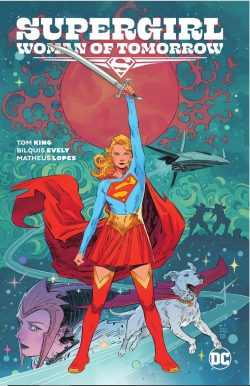
Supergirl: Woman of Tomorrow


By Tom King, Bilquis Evely, Matheus Lopes, Clayton Cowles & various (DC Comics)
ISBN: 978-1-7795-1568-1 (TPB/Digital edition)

As a rule, superhero comics don’t generally do whimsically thrilling anymore. They especially don’t do short or self-contained. Modern narrative momentum concentrates on continuous extended spectacle, major devastation and relentless terror and trauma. It also helps if you’ve come back from the dead once or twice and wear combat thongs and thigh boots…

Although there’s nothing intrinsically wrong with that – other than a certain inappropriateness in striving to adjust wedgies during a life-or-death struggle – sometimes the palate just craves a different flavour…

Once upon a time, angsty in-continuity cataclysm was the rule, not the exception, but ever since DC readmitted all its past epochs into one vastly welcoming expansion multiverse via the Dark Night: Death Metal, Future State and Infinite Frontier mega-events, a spirit of joyous experimentation has resulted in some truly memorable storytelling.

This decidedly backward-looking modern fable harks back to simpler days of clearly defined plots, solid, imaginative characterisation and suspensefully dramatic adventure, by way of an almost alternative take on redoubtable Kara Zor-El, late of Krypton’s Argo City and another illegal alien immigrant on Earth.

Supergirl first gained popularity as a back-up feature in Action Comics: a tag-along (and trademark protection device) to her more illustrious cousin. After years of faithful service, in 1985 she was killed as a sales gimmick in the groundbreaking Crisis on Infinite Earths. Since then, a number of characters have used the name – but none with the class or durability of the original.

This latest incarnation cunningly references much of the original’s trappings, but combines stellar whimsy, dark modern attitudes and an edgier twist, as befits today’s readership. Written by Tom King (Mister Miracle, The Vision, The Sheriff of Babylon, Omega Men, Strange Adventures, Batman) and delightfully illustrated by Brazilian artist Bilquis Evely (Wonder Woman, The Dreaming, Detective Comics, Shaft: a Complicated Man) in a deliriously addictive, retro-futurist pulp style, it examines the concepts of justice and power of reputation through the wide eyes of a worshipful child who is both outraged orphan and lonely sidekick/secret weapon in waiting…

After a few intriguing concept-tweaking test-runs, the first true Girl of Steel debuted as a future star of the ever-expanding Superman pocket universe in Action Comics #252 (cover-dated May 1959). Superman’s cousin had been born on a city-sized fragment of Krypton, hurled intact into space when the planet exploded. Eventually, Argo turned to Kryptonite like the rest of the detonated world’s debris, and Kara’s dying parents, observing Earth through their viewer scopes, sent their daughter to safety even as they apparently perished.

Crashlanding, she immediately and fortuitously met the Metropolis Marvel, who created a cover-identity: hiding “Linda Lee in an orphanage in bucolic Midvale so that she could adjust to and learn about her new world whilst mastering her powers in secrecy and safety.

…And isolation. At no stage did anyone consider moving the recent orphaned newcomer in with her only surviving family. Kara reached her maturity without the closeness Clark Kent’s human parents provided …although she was eventually adopted by Earth couple Fred and Edna to become Linda Lee Danvers

Supergirl experienced her own secret double life in the rear of Action Comics: gradually moving from Superman’s covert secret weapon to an independent star turn, and from minor player to acclaimed public celebrity. From the back of the book to the front of the house is always a reason to celebrate, right?

For decades, DC couldn’t make up their minds over Supergirl. I’ve actually lost count of the number of different versions to have cropped up over the years, and never been able to shake a queasy feeling that above all else she’s a concept that was cynically shifted from being a way to get girls to reading comic books to one calculated to ease young male readers over the bumpy patch between sporadic chin-hair outbreaks, voice-breaking and that nervous period of hiding things under your mattress where your mum never, never ever looks…

Her popularity waxed and waned until her attention-grabbing death during Crisis on Infinite Earths. However, in the aftermath – once John Byrne had successfully rebooted the Man of Steel and negated her existence along with all other elements of doomed Krypton – non-Kryptonian iterations began to appear: each accumulating a legion of steadfast fans. Ultimately, early in the 21st century, DC’s Powers-That-Be decided the real Girl of Steel should come back… sort of…

The New 52 company-wide reboot recast her as an angry, obnoxious distrustful teen fresh from Argo, before the 2016 DC: Rebirth event unwrote most of those changes: bringing back much of that original origin material whilst aligning the comic book iteration with the popular TV series broadcast from October 2015 to November 2021. Then under the aegis of the Infinite Frontier revolution, King, Evely, colourist Mat Lopes & letterer Clayton Cowles crafted 8-issue limited series Supergirl: Woman of Tomorrow (cover-dated August 2021-April 2022).

This focussed on a major moment in the hero’s life and how it changed everything…

King was inspired by Charles Portis’ 1968 novel True Grit – and both movie adaptations – to cast Supergirl as mentor to a vengeance-obsessed child: tracing how a united quest/journey reshaped both of them. Employing the latitude afforded by IF’s umbrella premise, he incorporated iconic characters and trappings from various iterations of Kara’s many super-lives. The result is pure magic, made real by Bilquis and her visual collaborators.

Wordy and wondrous, colours and calligraphy are key components of this space opera, which opens with youthful narrator Ruthye Marye Knoll disclosing how she first met an alien voyager after merciless bandit Krem of the Yellow Hills butchered her father…

Intent on rightful retribution, little Ruthye tracks the killer to a tavern in ‘Men, Women, and Dogs’, encountering a violent drunken woman from another world. Supergirl was on this unnamed backwater red sun world with frivolous intent: it was her 21st birthday and she wanted to get really, really drunk…

Things go bad when Supergirl tries to help her get justice. The intergalactic warrior seriously underestimates Krem, and nearly dies when he puts three arrows through her chest, before apparently killing her dog Krypto and stealing her spaceship…

Barely alive, Kara agrees to let Ruthye help her hunt Krem down: travelling so very slowly by commercial starship and encountering the full annoying range of sentient lifeforms – and a deadly space dragon – in ‘Wounded, Stranded, and Impotent’, before finally reaching a region of space where yellow suns can recharge her…

Stranded on tourist trap Coronn for weeks, they jointly expose appalling racist atrocity in ‘Modest, Calm, and Quiet’ and learn the quarry has joined Barbond’s Brigands: a marauding fleet of space plunderers who become Supergirl’s greatest concern after their latest raid exterminates an entire species in ‘Restraint, Endurance, and Passion’.

Repeated close encounters with them result in furious frustration as Krem has mastered a mystic banishment spell that deposits his pursuers all over the cosmos. Slowly, steadily, Supergirl and Ruthye close in, with the latter honing her skills in eager anticipation of bloody revenge, despite anything Kara can say to dissuade her. Repeatedly fighting a succession of colossal lizard beasts, and enduring a slow painful death and resurrection, does nothing to help their moods either in ‘The Lake, the Trees, and the Monsters’

Finally – reinforced by magical superhorse Comet – the seekers capture Krem and spectacularly engage the brigands in ‘Home Family, and Refuge’ and ‘Hope, Help, and Compassion.’, but the outcome is shockingly unexpected …and tragic.

Final chapter ‘Ruthye, Supergirl, and Krem of the Yellow Hills’ delivers major emotional and conceptual payoffs as antagonists and protagonists take their vendetta to its foregone conclusion. The vengeful child fulfils her quest, but learns some adult truths…

Supplemented by a covers-&-variants gallery by Evely, Lopes, Gary Frank & Alex Sinclair, Lee Weeks, David Mack, Rose Besch, Amy Reeder, Steve Rude, Nicola Scott & Annette Kwok and Janaina Medeiros, this book includes a stunning swathe of character and costume designs, to augment a tale profoundly and consciously mythic in scope and execution.

The apparent maiming and deaths of beloved characters – and animals at that! – and epic transitions and evolutions of the twin leads are potently and evocatively depicted against a universe of inspirational wonders and casual horrors, allowing us to see how heroes are forged, and the device of using a childlike Boswell to define Supergirl’s humanity is both compelling and revelatory.

A cosmic odyssey in the grandly poetic idiom of Jack Vance and Samuel R. Delaney, realised via retro-futuristic visuals reminiscent of Roy G. Krenkel, Jack Katz and Michael William Kaluta, Supergirl: Woman of Tomorrow is a mesmerising mix of space opera and superhero drama exploring the mechanics of myths and power of storytelling on a multitude of levels.

It’s also a sublime rollercoaster ride of vivid, cathartic joy for old fans and newcomers alike: one every fantasy and adventure lover must see.
© 2022 DC Comics. All Rights Reserved.
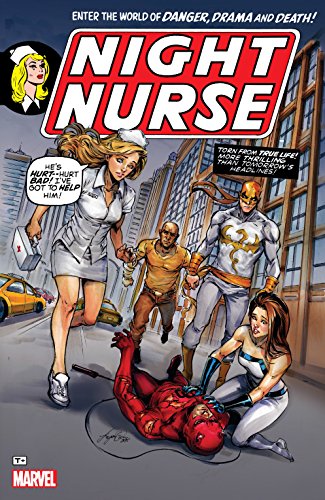
Night Nurse


By Jean Thomas, Linda Fite & Win Mortimer; Brian Michael Bendis & Alex Maleev, & various (MARVEL)
No ISBN: Digital-only edition

During the costumed hero boom of the 1960s, Marvel experimented with a solo title shot for Inhuman anti-hero/political refugee Madame Medusa (Marvel Super-Heroes #15, July 1968) and a solo series for established supporting character The Black Widow (Amazing Adventures # 1-8, August 1970 – September 1971). Both were sexy, reformed supervillains, not wholesome girl-next-door heroines like long-domesticated costumed chicks The Invisible Girl, Marvel Girl and The Wasp… and neither lasted solo for long.

The other two actual action women – rather than simple romantic-complication fodder – of that early Marvel era were The Scarlet Witch (mutant/ex-villain/occasional Avenger) and superspy Sharon Carter/Agent 13 of S.H.I.E.L.D.

Just for the sake of completeness: post-World War II, Timely/Atlas Comics embraced and published fiercely independent, capable female operators like Miss America, Namora, Golden Girl, Sun Girl, Blonde Phantom, Venus and more. None survived the insidious social domestication movement that drove American women out of the workplace and back into kitchens and bedrooms: a period that (coincidentally?) generated a growing fascination with captivating jungle women living wild and free in primal freedom – in space as well as on Earth – and a huge explosion in straight romance comics where decent white girls competed for the best husband…

When the costumed crazies craze began to subside in the 1970s, newly-promoted Publisher Stan Lee and his editor-in-chief Roy Thomas looked into creating a girl-friendly boutique of proper “heroines” for the changing tastes of the nation. Written by women, they sought to address and satisfy a wider market than simple boy-fuelled superheroics ever could.

The early 1970s was an era of turbulent social change, with established notions, traditions and laws being constantly challenged. Banner headlines and TV news everywhere confirmed that women’s rights were now being fought for – and thus consequently fiercely resisted – just as vigorously as the Civil Rights movement that had polarised and incensed Americans a handful of years previously…

Marvel’s opening shots in this mini-liberation war were in established genres and both cover-dated November 1972. Claws of the Cat – by Linda Fite, Marie Severin & Wally Wood – added a female superhero to the pantheon, whilst Night Nurse combined contemporary daytime television medical dramas with Marvel’s long-established romance/“career girl” tradition. New post-Feminism jungle goddess Shanna the She-Devil – by Carole Seuling & George Tuska – debuted in December 1972.

Despite impressive creative teams, none of these fascinating and trailblazing experiments lasted beyond a fifth issue, but the characters have all since then become fully established in the greater continuity…

That certainly applies to today’s pioneer. Collecting Night Nurse #1-4 and a stunning reinvention from Marvel Knights Daredevil (volume 2) #80 – also numbered #460 as a result of renumbering nonsense you really don’t need to care about. This digital-only compilation gathers the entire melodrama-drenched saga of a tough and determined young woman looking to make a difference. The print equivalent is the 2015 Night Nurse one-shot: cover-dated July and published to capitalise on the traction her appearance in the mainstream MU generated.

With covers by Winslow Mortimer, John Romita Sr., Frank Giacoia & Joe Sinnott, and adapting the character and concepts first seen in Linda Carter: Student Nurse (#1-9, spanning cover-dates September 1961-January 1963), Night Nurse saw writer Jean Thomas and illustrator Mortimer reintroduce our star as her-long-deferred graduation day approached: peeking behind the curtain of professionalism to reveal ‘The Making of a Nurse!’

Carter and her roomies – ghetto child Georgia Jenkins and disgraced, disinherited rich kid Christine Palmer – have all been learning-by-working at vast and prestigious Metro General: enduring a relentless regimen of complex hands-on training adapting them to the constant high pressure demands of their proposed careers. Particularly difficult was the suffering they were daily exposed to, and how each student coped with it…

Things start to get truly complicated when Linda falls for wealthy good-looking patient Marshall Michaels. His whirlwind courtship leads to a marriage proposal and wedding plans… until he reveals that no wife of his will ever prioritise a job over running his home…

Georgia, meanwhile, finds her ghetto roots still dragging her down when – in the midst of a city-wide power-outage – her brother Ben and his activist friend Rocky try to blow up Metro’s back-up generator. When she and Linda discover them the result is tragedy…

In the second issue, a ‘Night of Tears… Night of Truth!’ sees Carter save a VIP life during a hit-and-run incident, only to endure an acclaimed and ultra-rich surgeon parachuted in to conspicuously fix the patient and reap temporary glory.

Arrogant Dr. Sutton subsequently offers well-bred rebel Palmer a job as his permanent assistant: a position that comes with amorous assumptions and intent. However, the snobbish surgeon underestimates her resolve and loathing of the unspoken code dictating that the wealthy should stick together and he can’t understand why Christine calls the cops when she finds out his side hustle business, how he uses his prescription privileges and one other secret he’s been keeping from all his powerful friends and associates…

Linda, meanwhile, is getting far too friendly with hunky doctor Jack Tryon

Events escalate in ‘Murder Stalks Ward 8!’ when Carter is the only witness to a gangland killing that leads back to major mobster Victor Sloan: a crime kingpin connected to Georgia’s wayward brother Ben. When Sloan is admitted to Metro, nurse Jenkins finds her dedication and resolve severely tested, especially after rival crooks invade the hospital looking for payback and Jack and Linda have to play detective and bodyguard…

There’s an abrupt change of pace in final issue #4 and a touch of gothic romance in the air as Thomas and co-writer Linda Fite focus on Christine. Rocked by scandal, Dr. Sutton’s betrayal and repeated rejection by her elitist father, nurse Palmer seeks a different career path and answers an ad for a live-in nurse/physiotherapist in Boston.

Illustrated by Mortimer, ‘The Secret of Sea-Cliff Manor!’ revels in all the trappings of gothic mystique typifying that period, as Christine meets and manages moody, magnificently angry paraplegic Derek Porter, his sweet Aunt Edna, and spooky old manservant Harold: dispensing care and comfort whilst being dragged deep into a manic murder plot…

The series terminated there, although the nurses popped up occasionally in various titles over the years. Then in Marvel Knights Daredevil volume 2 #58 (May 2004) Linda Carter returned without warning and in an extremely specific role: running a sort-of secret underground clinic in NYC as the enigmatic “Night Nurse”. The facility catered exclusively to metahumans – mostly the heroic or vigilante ones – who needed fixing and couldn’t trust the regular hospital system…

Inexplicably, that yarn is not included here. Instead we have Marvel Knights Daredevil volume 2, #80 (February 2006): fifth chapter 5 of ‘The Murdock Papers’ wherein Brian Michael Bendis, Alex Maleev and colourist Dave Stewart detail how Matt Murdock is almost fatally shot after his secret identity is made public.

On the run, his occasional ally and paramour Elektra drags his failing form to the clinic where it transpires Murdock is a frequent flyer. As the mysterious medic seeks to stabilise him, heroes like Jessica Jones, Luke Cage, Iron Fist and Black Widow rush to his side. It’s a smart move since Kingpin Wilson Fisk, an army of irate Feds and ninja cult The Hand have all zeroed in on the dying man, all determined to complete their unfinished business with Daredevil

From this revival and revision, Night Nurse evolved into a crucial component of both the print and cinematic Marvel Universes, playing a role in the Civil War and Secret Invasion storylines; working with The Young Avengers, Captain America, Doctor Strange, Iron Man and all the above-mentioned street level champions…

A tribute to Marvel’s ceaseless commitment to reinvention, reappraisal and rebirth, Night Nurse is an intriguing example of how the role of women has evolved in comic books and will delight both incurably addicted fans and those casual dabblers looking for different flavours of Marvel medicine.
© 2013 Marvel Characters, Inc. All rights reserved.

Legion of Super-Heroes: The Silver Age volume 1


By Otto Binder, Jerry Siegel, Edmond Hamilton, Robert Bernstein, Al Plastino, George Papp, Jim Mooney, Curt Swan, John Forte & various (DC Comics)
ISBN: 978-1-4012-8157-1 (TPB/Digital edition)

Once upon a time, in the far future, a super-powered kids from dozens of alien civilisations took inspiration from the greatest legend of all time and formed a club of heroes. One day those Children of Tomorrow came back in time and invited that legend to join them…

And thus began the vast and epic saga of the Legion of Super-Heroes, as first envisioned by writer Otto Binder & artist Al Plastino in early 1958, just as the revived comic book genre of superheroes was gathering an inexorable head of steam. Since that time the fortunes and popularity of the Legion have perpetually waxed and waned, with their future history tweaked and rebooted, retconned and overwritten again and again to comply with editorial diktat and popular whim.

This glorious, far-and-wide ranging collection assembles the numerous preliminary appearances of the valiant Tomorrow People and their inevitable progress towards and attainment of their own feature. It includes all pertinent material from Adventure Comics #247, 267, 282, 290, 293, and 300-310, Action Comics #267, 276, 287, 289, Superboy #86, 89, 98 and Superman #147, cumulatively spanning April 1958 through July 1963.

Happy anniversary!

The many-handed mob of juvenile universe-savers eponymously premiered in Adventure Comics #247 (cover-dated April 1958) in Superboy tale ‘The Legion of Super-Heroes!’ wherein three mysterious kids invited the Boy of Steel to the 30th century to join a club of metahuman champions inspired by his life.

Devised by Otto Binder & Al Plastino, the throwaway concept gripped public imagination and, after frequent further appearances throughout Superman Family titles, the LSH eventually took over the Boy of Steel’s lead spot in Adventure for their own far-flung, quirky escapades, with the Caped Kid Kryptonian reduced to merely “one of the in-crowd”…

However, here the excitement is still gradually building as the kids return 18 months later in Adventure #267 (December 1959) for Jerry Siegel & George Papp to play with. In ‘Prisoner of the Super-Heroes!’ the teen wonders attack and incarcerate the Boy of Steel because of a misunderstood ancient record they have uncovered…

The following summer Supergirl met the Legion in Action Comics #267 (August 1960, by Siegel & Jim Mooney) as Lightning Lad, Saturn Girl and Cosmic Boy secretly travel to “modern day” America and invite the Maid of Might to join the team, in a repetition of their offer to Superboy 15 years previously (in nit-picking fact they claimed to be the children of the original team – a fact glossed over and forgotten these days: don’t time-travel stories make your head hurt?).

Due to a dubious technicality, young and overeager Kara Zor-El fails her initiation task at the hands of ‘The Three Super-Heroes’ and is asked to reapply later – but at least we get to meet a few more Legionnaires, including Chameleon Boy, Invisible Kid and Colossal Boy

With editors still cautiously testing the waters, it was Superboy #86 (cover-dated January 1961 but on sale in November 1960) before ‘The Army of Living Kryptonite Men!’ (by Siegel & Papp) turned the LSH into a last-minute Deus ex Machina to save the Smallville Sentinel from juvenile delinquent Lex Luthor’s most insidious assault.

Two months later in Adventure #282, Binder & Papp introduced Star Boy as a romantic rival for the Krypton Kid in ‘Lana Lang and the Legion of Super-Heroes!’

For Action #276 (May 1961) Siegel & Mooney debuted ‘Supergirl’s Three Super Girl-Friends’, which finally saw her crack the plasti-glass ceiling and join the team, sponsored by Saturn Girl, Phantom Girl and Triplicate Girl. We also met for the first time Bouncing Boy, Shrinking Violet, Sun Boy and potential bad-boy love-interest Brainiac 5 (well, at least his distant ancestor Brainiac was a very bad boy…)

Next comes a pivotal tale as ‘Superboy’s Big Brother’ (by Robert Bernstein & Papp from Superboy #89, June 1961) reveals how an amnesiac, super-powered space traveller crashes in Smallville, speaking Kryptonese and carrying star-maps written by the Boy of Steel’s long-dead father…

Jubilant, baffled and suspicious in equal amounts, Superboy eventually, tragically discovers ‘The Secret of Mon-El’ after accidentally exposing the stranger to a lingering, inexorable death, before providing critical life-support by desperately depositing the dying alien in the timeless Phantom Zone until a cure can be found…

With an August 1961 cover-date Superman #147 unleashed ‘The Legion of Super-Villains!’ (Siegel, Curt Swan & Sheldon Moldoff): a stand-out thriller featuring the adult Luthor and correspondingly mature wicked future bad guys coming far too close to destroying the Action Ace …until the temporal cavalry arrives…

Bernstein & Papp seemingly give Sun Boy a starring role in ‘The Secret of the Seventh Super-Hero!’ (Adventure #290, November 1961), followed by a clever tale of redemptive second chances followed in #293 (February 1962) in a gripping thriller from Siegel, Swan & George Klein. ‘The Legion of Super-Traitors’ posits the future heroes turning evil, prompting Saturn Girl to recruit a Legion of Super-Pets including Krypto, Streaky the Super Cat, Beppo, the monkey from Krypton and magical Superhorse Comet to save the world…

Siegel & Mooney set ‘Supergirl’s Greatest Challenge!’ in Action #287 (April 1962) seeing her visit the Legion (quibblers be warned: for some reason it was mis-determined as the 21st century in this story) to save future Earth from invasion. She also met a telepathic descendent of her cat Streaky. His name was Whizzy (I could have omitted that fact but chose not to – once again for smug, comedic effect and in sympathetic solidarity with cat owners everywhere…)

Action #289 originally hosted ‘Superman’s Super-Courtship!’ wherein the Girl of Steel scours the universe for an ideal mate for her cousin. One highly possible candidate is the adult Saturn Woman, but for some reason her husband Lightning Man objects…

Modern sensibilities might quail at the conclusion but at that time his obvious perfect match was a doppelganger of Supergirl herself… albeit thankfully a little bit older…

By the release of Superboy #98 (July 1962), the decision had been made. The buying public wanted more Legion stories and after ‘The Boy with Ultra-Powers’ (Siegel, Swan & Klein) introduced a mysterious lad with greater powers than the Boy of Steel, focus shifted to Adventure Comics where #300 (cover-dated September 1962) proudly saw the futuristic super-squad finally land their own gig: even occasionally taking an alternating cover-spot from the still top-featured Boy of Steel.

Tales of the Legion of Super-Heroes opened its stellar run with ‘The Face Behind the Lead Mask!’ by Siegel, John Forte & Plastino: a fast-paced premier pitting Superboy and the 30th century champions against an impossibly unbeatable foe until Mon-El, long-trapped in the Phantom Zone, briefly escapes a millennium of confinement to save the day…

In those halcyon days humour was as important as action, imagination and drama, so many early exploits were light-hearted and moralistic. Adventure #301 offered hope to fat kids everywhere with ‘The Secret Origin of Bouncing Boy!’ by regular creative team Siegel & Forte, wherein the process of open auditions was instigated.

These provided fans with dozens of truly bizarre and memorable applicants over the years but here allows the rebounding human rotunda to deliver a salutary pep talk and inspirational account of heroism persevering to triumph over adversity.

Adventure #302 featured ‘Sun Boy’s Lost Power!’ with the golden boy forced to resign until fortune and boldness restore his abilities, after which ‘The Fantastic Spy!’ in #303 sparks a tense tale of espionage and potential betrayal by new member Matter-Eater Lad.

The happy readership was stunned by the events of #304 when Saturn Girl engineered ‘The Stolen Super-Powers!’ to make herself a one-woman Legion. Of course, it was for the best possible reasons, but still didn’t prevent the shocking murder of Lightning Lad…

As a result she was elected Legion leader – at that time the first female to ever lead a comic book team.

With comfortable complacency utterly destroyed, #305 further shook everything up with ‘The Secret of the Mystery Legionnaire!’ who turns out to be long-suffering Mon-El, finally cured and freed from his Phantom Zone prison.

Normally I’d try to be more obscure about story details – after all my intention is to get new people reading old comics – but these “spoiler” revelations are crucial to further understanding here and besides you all know these characters are still around, don’t you?

Pulp sci fi author Edmond Hamilton took over the major scripting role with Adventure #306, introducing ‘The Legion of Substitute Heroes!’ (still quirkily, perfectly illustrated by John Forte): a group of rejected audition applicants selflessly banding together and clandestinely assisting the champions who had spurned them, after which transmuting orphan Element Lad joins the big league.

He seeks vengeance upon the space pirates who had wiped out his entire species in ‘The Secret Power of the Mystery Super-Hero!’ whilst in #308 readers seemingly saw ‘The Return of Lightning Lad!’

Actual Spoiler Warning: skip to the next paragraph NOW!!!

Otherwise you’ll find out it was actually his similarly empowered sister who – once unmasked and unmanned – took her brother’s place as Lightning Lass

Penultimate escapade ‘The Legion of Super-Monsters!’ was a straightforward clash with embittered applicant Jungle King who took his rejection far too personally and gathered a deadly clutch of space beasts to wreak havoc and vengeance, after which the future tension temporarily subsides with ‘The Doom of the Super-Heroes!’ from #310: a frantic battle for survival against an impossible foe

The Legion is undoubtedly one of the most beloved and bewildering creations in American comic book history and largely responsible for the growth of the groundswell movement that became Comics Fandom.

Moreover, these sparkling, simplistic and devastatingly addictive stories, as much as the legendary Julie Schwartz Justice League, fired up the interest and imaginations of a generation of young readers and built the industry we all know today.

These naive, silly, joyous, stirring and utterly compelling yarns are precious and fun beyond any ability to explain – even if we old lags gently mock them to ourselves and one another. If you love comics and haven’t read this stuff, you are the poorer for it and need to enrich your future life as soon as possible.
© 1958-1963, 2018 DC Comics. All Rights Reserved.