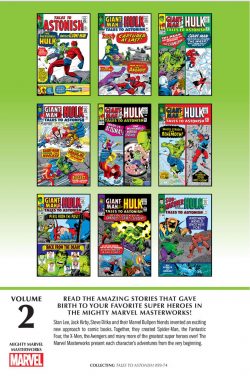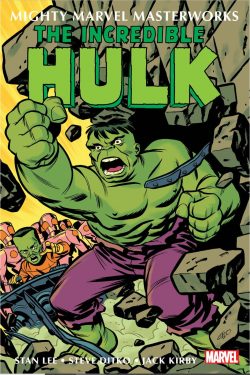
Mighty Marvel Masterworks The Incredible Hulk volume 2


By Stan Lee, Steve Ditko, Jack Kirby, Dick Ayers, Mike Esposito, Bob Powell & various (MARVEL)
ISBN: 978-1-3029-4623-4 (TPB/Digital edition)

Their stories are timeless and have been gathered many times before, but today I’m once more focusing on format before Fights ‘n’ Tights – or is that Rags ‘n’ Shatters?

The Mighty Marvel Masterworks line was expressly designed with economy in mind. Classic tales of Marvel’s key characters as realised by the founding creators and re-presented in chronological order have been a company staple since the 1990s, but always in lavish, expensive collectors editions. These nifty nuggets are far cheaper, albeit with some deletions – such as the occasional pin-up – and with far fewer bonus features. They’re printed on lower quality paper and – crucially – are physically smaller (152 x 227mm or about the dimensions of a B-format paperback book). Your eyesight might be failing and your hands too big and shaky, but they’re perfect for kids and if you opt for the digital editions, that’s no issue at all…

Bruce Banner was a military scientist caught in the world’s first gamma bomb detonation. As a result of ongoing mutation, stress and other factors cause him to transform into a giant green monster of unstoppable strength and fury.

After an initially troubled debut run, the Gruff Green Giant finally found his size 700 feet and a format that worked, becoming one of young Marvel’s most popular features. After his first solo-title folded, The Incredible Hulk shambled around a swiftly-coalescing Marvel Universe as guest star and/or villain du jour until a new home was found for him.

1962 was a big year for burgeoning Marvel, with plenty of star debuts who all celebrate six decades of glory this year. Most oldsters will cite the Amazing Spider-Man as the most significant premier, but this guy can probably claim equal star status…

This tome gathers the Hulky bits from Tales To Astonish #59-74: spanning September 1964 to December 1965, and seeing the nomadic antihero settle down in a new home to restart his march to global fame and misfortune…

Way back then, the trigger for the Hulk’s second chance was a reprinting of his origin in the giant anthology comic book Marvel Tales Annual #1. It was the beginning of the company’s inspired policy of keeping early tales in circulation, which did so much to make fervent fans out of casual latecomers. Thanks to reader response, “Ol’ Greenskin” was awarded a back-up strip in a failing title…

Giant-Man Hank Pym was the star turn in Tales to Astonish, but by mid-1964 the strip was visibly floundering. In issue #59 the Master of Many Sizes was used to introduce his forthcoming co-star in a colossal punch-up, setting the scene for the next issue wherein the Green Goliath’s co-feature began.

The second chapter of the man-monster’s career was about to take off and power-packed prologue ‘Enter: The Hulk!’ (Stan Lee, Dick Ayers & Paul Reinman) sees the Avengers inadvertently inspire woefully insecure Giant-Man to hunt down the Jade Giant Goliath.

Although Pym’s archfoe The Human Top devilishly engineered that blockbusting battle, Lee was the real mastermind as – with the next issue – The Hulk began starring in his own series (and on the covers) whilst Giant-Man’s adventures shrank down to a dozen or so pages.

The event was heralded by a raucous house ad which supplements the story here.

In TTA #60, ‘The Incredible Hulk’ opens with Banner still working for General Thaddeus “Thunderbolt” Ross, despite the military martinet’s deep disgust and distrust of the puny milksop who had won his daughter’s heart.

Aloof and standoffish, Banner keeps secret his astounding condition: an affliction which subjects him to uncontrollable transformations, becoming a rampaging, if well-intentioned, engine of destruction.

The 10-page instalments were uncharacteristically set in the Arizona/New Mexico deserts, not New York, and espionage and military themes were the narrative backdrop of these adventures. Lee scripted, Ditko drew and comics veteran George Roussos – “George Bell” – provided the ink art. The first episode details how an anonymous spy steals an unstoppable suit of robotic armour built by radiation-obsessed Banner, and concludes with a shattering battle in the next instalment wherein the Hulk is ‘Captured at Last!’

Cliffhanger endings such as the exhausted Man-Monster’s imprisonment by Ross’ military units at the end of the yarn would prove instrumental in keeping readers onboard and enthralled. Next chapter ‘Enter… the Chameleon!’ has plenty of action and suspense with the mercenary spy infiltrating Ross’ command, but the real punch is the final panel, hinting at the mastermind behind all the spying and skulduggery. The enigmatic Leader would become the Hulk’s ultimate and antithetical nemesis…

The minor Spider-Man villain worked well as a returning foe: his disguise abilities an obvious threat in a series based on a weapons scientist working for the military during the Cold War. Even the Leader himself has dubious connections to the sinister Soviets – when he isn’t trying to conquer the world for himself.

Preceded by a titanic Jack Kirby Marvel Masterwork Pin-up of the Green Goliath, ‘A Titan Rides the Train!’ (TTA #63, cover-dated January 1965) provides an origin for the super-intellectual menace whilst setting up a fresh subplot wherein new cast addition Major Glen Talbot begins to suspect Banner is a traitor. The action component comes when the Leader tries to steal Banner’s new anti-H-bomb device from a moving freight locomotive…

‘The Horde of Humanoids!’ features the return of guilt-stricken former sidekick Rick Jones who uses his Avengers connections to obtain a pardon for the incarcerated Banner by the simple expedient of letting the American President in on the secret of the Hulk! Ah… kinder times…!

Free again, Banner joins Talbot on an isolated island to test his hotly sought-after atomic device, only to be attacked by the Leader’s artificial warriors – providing a fine example of Ditko’s unique manner of staging a super-tussle.

The chaotic clash continues into the next issue as Ayers assumes the inking. Banner is taken prisoner by those darn Commies, and sees the Hulk go ballistic behind the Iron Curtain ‘On the Rampage against the Reds!’. This gratuitously satisfyingly onslaught spans three issues, with #66 – ‘The Power of Doctor Banner!’ inked by Vince Colletta and ‘Where Strides the Behemoth’ in #67 (inked by Frank Giacoia AKA “Frank Ray”), cumulatively demonstrating the brute’s shattering might.

His Commie-Busting fury finally expended, the Hulk reverts to human form and is captured by Mongolian bandits who see a chance to make lots of ransom money…

Jack Kirby returned as illustrator – supplemented by Mike (“Mickey Demeo”) Esposito – in #68. ‘Back from the Dead!’ sees dauntless Glen Talbot extricate and exfiltrate the tragic scientist, only to lose him again on the way back to America. Even so, Banner falls again into military custody and is ordered to activate his Atomic Absorbatron for one last test…

Yet again the process is interrupted by the Leader’s attacking Humanoids, but this time the Veridian Villain succeeds and the Hulk is ‘Trapped in the Lair of the Leader!’ …but only until the US Army bursts in…

Issue #70 saw Giant-Man benched and replaced by The Sub-Mariner, making Tales to Astonish a title dedicated to aggressive, savage anti-heroes. Increasingly, Hulk stories reflected this shift, and ‘To Live Again!’ sees the furious Leader launch a 500-foot tall Humanoid against a local US missile base, with the Jade Giant caught in the middle.

Kirby reduced his input to layouts and Esposito handles the lion’s share of the art in #71’s ‘Like a Beast at Bay!’: as the despondent Hulk actually joins forces with the Leader before ‘Within the Monster Dwells a Man!’ finds Talbot getting ever closer to uncovering Banner’s dark, green secret.

With legendary illustrator Bob Powell pencilling and inking over Kirby’s layouts, ‘Another World, Another Foe!’ details how the Leader dispatches Hulk to The Watcher’s homeworld to steal an ultimate weapon, just as an “unbeatable” alien rival arrives. ‘The Wisdom of the Watcher!’ ends the quest – and apparently The Leader – in an all-out, brutal action with a shocking climax…

The book closes with a glorious lost page of Ditko’s pencils: a superb unused pin-up of the antihero and his supporting cast, that is quite frankly worth the price of admission all on its own…

To Be Hulk-inued…

Hulk Smash! He always was, and because of stories like this, he always will be…
© 2022 MARVEL.

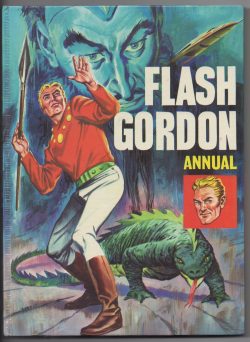
Flash Gordon Annual 1967


By anonymous staff of the Mick Anglo Studio, Dick Wood, Al Williamson, Don Heck & various (World Distributor’s [Manchester] Ltd.)
No ISBN – ASIN B000ZOP1GY

By most lights, Flash Gordon is the most influential comic strip in the world. When the hero debuted on Sunday January 7th 1934 (with the superb but rather dated Jungle Jim running as a supplementary “topper”) as response to revolutionary, inspirational, but clunky Buck Rogers (by Philip Nolan & Dick Calkins and which had also began on January 7th but in 1929), a new element was added to the realm of fantasy wonderment: Classical Lyricism.

Where Rogers had traditional adventures and high science concepts, this new feature reinterpreted Fairy Tales, Heroic Epics and Mythology. It did so by spectacularly draping them in the trappings of the contemporary future, with varying esoteric “Rays”, “Engine” and “Motors” substituting for trusty swords and lances – although there were also plenty of those – and exotic flying craft and contraptions standing in for Galleons, Chariots and Magic Carpets.

Most important of all, the sheer artistic talent of Raymond, his compositional skills, fine line-work, eye for concise, elegant detail and just plain genius for drawing beautiful people and things, swiftly made this the strip all young artists swiped from.

When all-original comic books began a few years later, literally dozens of talented kids used the clean lined Romanticism of Gordon as their model and ticket to future success in the field of adventure strips. Most of the others went with Milton Caniff’s expressionistic masterpiece Terry and the Pirates (which also began in 1934 – and he’ll get his go another day).

At the time of this annual a bunch of Gold Key and King Features Syndicate licenses were held by Mick Anglo, who provide strip and prose material for UK weekly TV Tornado. It combined British generated material with US comic book reprints in an era when the television influence of shows like Tarzan and Batman, and venerable features like Flash Gordon – who also had a small screen presence thanks to frequent re-runs of his cinema chapter plays. The project was extremely popular, even though not always of the highest quality…

In 1966, newspaper monolith King Features Syndicate briefly got into comic book publishing again: releasing a wave of titles based on their biggest stars. These were an ideal source of material for British publishers, whose regular audiences were profoundly addicted to TV and movie properties. Moreover, thematically they fitted with World Distributors’ other licensed properties, which repackaged Western’s comics material like Star Trek, Beverly Hillbillies or Voyage to the Bottom of the Sea with domestically generated material – usually crafted by Mick Anglo’s packaging company Gower Studios.

This Anglo-American (tee-hee!) partnership filled our Christmas needs for a generation, producing a range of UK Annuals – and the occasional Special – mixing full-colour US reprints with prose stories, puzzles, games and fact-features on related themes.

Flash Gordon Annuals appeared sporadically over the next few decades beginning with this release from 1967 which leaned heavily on generic prose space opera adventure leavened with some truly stunning comics tales.

In opening yarn, ‘The Tanks of Triton’ Flash, Dale Arden and Dr. Zarkov are recast as general space explorers and their voyage to unknown world Athene sees them saving an advanced and cultured pacifist species from barbaric underseas invaders, after which the explorers pop back to Mongo and visit the Unexplored Continent just in time to scotch the conquest plans on tyrants in waiting ‘The Doom Men’ .

Thus far the fictive text had been augmented by full-colour painted illustrations (and inset epigrammatic facts about Space) but the first full photo feature of rocket science takes centre stage in ‘Britain’s Contribution to Europe’s Satellite’ comes next, counterpointed by maze puzzle ‘Earth in Danger’ before vertical take-off jets are reviewed in ‘Look – No Runway!’

Natural history feature ‘It All Depends!’ discusses relative lifespans before prose yarn in two tone line art ‘Undersea Peril’ sees Flash, Dale and Zarkov discover yet another hidden aquatic kingdom and depose another crazed would-be world conqueror before we enjoy board game ‘Space Flight to Mongo’ and themed crossword ‘Space Fill-In’.

Full-colour comics wonderment begins with the eponymous lead strip from King Comics’ Flash Gordon #1, cover-dated September 1966. Possibly scripted by Archie Goodwin (or Larry Ivie?) ‘Flash Gordon’ was latterly credited to majestic illustrator Al Williamson. While we’re being detailed, the last page is supposedly inked by Gray Morrow…

The strip sees our terrific trio returned to Mongo, in search of desperately needed Radium to stave off a crisis on Earth. Packed with all the vast cast of the series it depicts how the visitors arrive just in time to thwart a coup d’état in frozen kingdom Frigia…

Williamson was one of the greatest draughtsmen to ever grace the pages of comic books and newspaper strip sections. He was born in 1931 in New York City, after which his family relocated to Columbia just as the Golden Age of syndicated adventure strips began.

The lad’s passion for “the Comics” – especially Raymond’s Flash Gordon and Jungle Jim – broadened as he devoured imported and translated US material and the best that Europe and Latin America could provide in anthology magazines as Paquin and Pif Paf. When he was twelve the Williamsons returned to America where, after finishing school, the prodigy found work in the industry that had always obsessed him.

In the early 1950s he became a star of E.C. Comics’ science fiction titles beside kindred spirits Joe Orlando, Wally Wood, Roy G. Krenkel, Frank Frazetta & Angelo Torres. He drew Westerns Kid Colt and Ringo Kid for Atlas/Marvel and during the industry’s darkest days found new fame and fans in newspaper strips, firstly by assisting John Prentice on Rip Kirby – another Raymond masterpiece – and, from 1967, on Secret Agent Corrigan.

Williamson drew Flash Gordon for King Comics and worked on mystery tales and westerns for DC whilst drawing Corrigan; eventually becoming go-to guy for blockbuster sci-fi film adaptations with his stunning interpretations of Blade Runner and Star Wars.

His poetic realism, sophisticated compositions, classicist design and fantastic naturalism graced many varied tales, but in later years he was almost exclusively an inker over pencillers as varied as John Romita Jr., Larry Stroman, Rick Leonardi, Mark Bright, José Delbo and a host of others on everything from Transformers to Spider-Man 2099, Daredevil to Spider-Girl. His magical brushes and pens also embellished many of Marvel’s Graphic Novel productions – such as The Inhumans and Cloak and Dagger: Predator and Prey.

Williamson died in June 2010.

In this Annual, it’s back to prose & painted illos for ‘The Green Horde’ as our heroes discover a new planet just in time to foil a secret invasion of Earth, after which ‘The Black Beasts of Prey’ takes the wanderers to planet Zeus in time to save a dying race of humanoids from fluing dinosaurs and set evolution back on its destined track…

US comic book Flash Gordon #1 also had a back-up starring fellow legendary stalwart Mandrake the Magician and it appears here: crafted by Dave Wood, Don Heck & Andre LeBlanc. ‘Midnight with Mandrake’ sees a gang of thieves unleash sleeping gas on a city crowd, only to have Mandrake change it from soporific to an hallucinogen that sends everyone on the trip of their lives…

It’s back to 2-tone and peerless prose as our heroes find ‘Ming the Merciless’ loose on Earth and stealing weapons tech to reconquer Mongo, after which gag page ‘Laughs in Space’ segues into a text told war of liberation for marsh dwelling primitives in ‘The Last of the Claymen’ and a ‘True or False ’ brain teaser page before we spectacularly end with the last strip from Flash Gordon #1, as the Terran Trio test Zarkov’s new mole machine and discover a lost civilisation deep under the crust of Mongo. Sadly, the locale of Krenkellium might be fresh and new but power, politics and peril seem to play out in a universal manner in ‘Flash Gordon and the Mole Machine’ (by Archie Goodwin & Williamson).

This kind of uncomplicated done-in-one media-tasty package was the basic unit of Christmas entertainment for millions of British kids at one time and still holds plenty of rewarding fun for those looking for a simple and straightforward nostalgic escape.
© MCMLXVI, MCMLXVII by King Features Syndicate, Inc. The Amalgamated Press.

Genre annuals

The comic has been with us a long time now and debate still continues about where, when and exactly what constitutes the first of these artefacts to truly earn the title. There’s a lot less debate about the Children’s Annual: a particularly British institution and one that continues – albeit in a severely limited manner – to this day.

It’s a rare and tragically deprived kid who never received a colourful card-covered compendium on Christmas morning; full of stories and comic-strips and usually featuring the seasonal antics of their favourite characters, whether from comics such as The Beano, The Dandy, Lion, Eagle and their ilk, or TV, film or radio franchises/personalities such as Dr Who, Star Wars, Thunderbirds, Radio Fun or Arthur Askey. There were even celebrity, sports and hobby annuals plus beautifully illustrated commemorative editions of the fact and general knowledge comics such as Look and Learn, and special events such as the always glorious Rupert Bear or Giles Annuals.

Here then is a brief celebration of the kinds of genre celebrations which delighted kids and their parents…

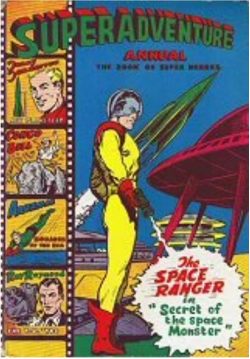
Superadventure Annual 1960-1961


By Jack Miller, Jack Schiff, Joe Millard, Otto Binder, Edmund Hamilton, Robert Bernstein, Gardner Fox, John Forte, Bob Brown, Ramona Fradon, Jim Mooney, Edwin J. Smalle Jr, Howard Sherman, Ruben Moreira, Henry Boltinoff & others (Atlas Publishing & distributing Co./K.G. Murray)
No ISBN:

Before 1959, when DC and other American publishers started exporting directly into the UK, our exposure to their unique brand of fantasy fun came mostly from licensed reprints. British publishers/printers like Len Miller, Alan Class and bought material from the USA – and occasionally, Canada – to fill 68-page monochrome anthologies – many of which recycled the same stories for decades. In Britain we began seeing hardcover Superman Annuals in 1950, Superboy Annuals in 1953, Superadventure Annuals in 1959 and Batman books in 1960. Since then many publishers have carried on the tradition…

Less common were the oddly coloured pamphlets produced by Australian outfit K.G. Murray and exported here in a somewhat sporadic manner. The company also produced sturdily substantial Christmas Annuals which had a huge impact on my earliest years (I strongly suspect my adoration of black-&-white artwork stems from seeing supreme stylists like Curt Swan, Carmine Infantino, Al Plastino, Wayne Boring, Gil Kane or Murphy Anderson utterly uncluttered by flat, limited colour palettes).

This particular tome comes from 1960 whilst a superhero craze was barely bubbling under, allowing us access a wide range of the transitional genre material that fell between the Golden and Silver Ages. Everything in comics was changing and this book offers a delightfully eclectic mix of material far more in keeping with the traditionally perceived interests of British boys than the caped-&-cowled masked madness soon to obsess us all…

This collection is all monochrome, soundly stiff-backed, and sublimely suspense and joyous, and begins with Space Ranger: a relatively new property seen in Showcase #16.

In America, Showcase was a try-out comic designed by DC to launch new series and concepts with minimal commitment of publishing resources. If a new character sold well initially, a regular series would follow. The process had been proved with Frogmen, The Flash, Challengers of the Unknown and Lois Lane, so Editorial Director Irwin Donenfeld urged his editors to create science fiction heroes to capitalise on the twin zeitgeists of the Space Race and the popular fascination with movie monsters and aliens.

Jack Schiff came up with a “masked” crimefighter of the future who premiered in issues #15 & 16 (1958). The hero was Rick Starr: interplanetary businessman who – thanks to incredible gadgets and the assistance of shape-shifting alien pal Cryll and capable Girl Friday Myra Mason – spent his free time battling evil and injustice from his base in a hollow asteroid.

A few months later, the State-side Space Ranger was transported to DC’s science fiction anthology Tales of the Unexpected, beginning with issue #40 (August 1959): holding the lead and cover spot for a 6-year run and enduring frequent revivals and reboots ever since…

Canonically, we start with his third published exploit as ‘The Secret of the Space Monster’ (plot by John Forte, scripted by pulp veteran Edmond Hamilton and illustrated by Bob Brown) sees Rick, Myra and Cryll investigating an impossible void creature and uncovering a band of alien revolutionaries testing novel super-weapons.

Continuity was practically unheard in these DC overseas editions – and I’m pretty sure the editorial staff never gave a monkey’s about reading cohesion. UK spellings and currency were scrupulously re-lettered, but stories were arbitrarily trimmed to fit the page count and layout, making endings unclear or uncertain. However, we loved the sheer eclectic exoticism (we didn’t call it that, though); we were just wide-eyed impressionable grateful kids, okay?

One of the few superheroes to survive the collapse at the end of the Golden Age was a rather nondescript and generally bland looking chap who solved maritime crimes, rescuing fish and people from sub-sea disaster.

Created by Mort Weisinger & Paul Norris in the wake of Timely Comics’ Sub-Mariner, Aquaman first set sail in More Fun Comics #73 (November 1941). Strictly a second stringer for most of his career, the Sea King nevertheless continued on far beyond many stronger features. He was primarily illustrated by Norris, Louis Cazeneuve and Charles Paris, until young Ramona Fradon took over the art chores in 1954, by which time the Sea King had settled into a regular back-up slot in Adventure Comics. All of the salty sagas here are illustrated by her, and limned every single adventure until 1960: indelibly stamping the hero with her unique blend of charm and sleek competence.

At the time this book was released, America’s Aquaman had been refitted. Showcase #4 (1956) rekindled the public’s taste for costumed crime-fighters. As well as re-imagining Golden Age stalwarts, DC updated its hoary survivors. The initial revamp ‘How Aquaman Got His Powers!’ (Adventure #260, May 1959) was the work of Robert Bernstein. That tale set a new origin – offspring of a lighthouse keeper/refugee from undersea Atlantis – and eventually all trappings of the modern superhero followed: themed hideout, sidekick, even super-villains! Moreover, continuity and the concept of a shared universe became paramount.

In this seasonal collection however, he’s still a charming, dedicated seagoing nomad with a tendency to find trouble as in ‘The Ocean of 1,000,000 B.C.’ (Adventure Comics #253, October 1958 by Bernstein & Fradon) where he swims through a time warp and helps a seashore-dwelling caveman against a marauding dragon.

Cartoonist Henry Boltinoff was a prolific and nigh-permanent fixture of DC titles in this period, providing a variety of 2, 1, and 1½ page gag strips to cleanse visual palates and satisfy byzantine US legal directives allowing publishers to sustain cheaper postal shipping rates. He’s here in strength: his gentle humour jibing perfectly with contemporary British tastes, in the first vignette starring space boffin Professor Eureka

Based on Alex Raymond’s newspaper star Jungle Jim, the next feature was very much of its time. Congo Bill debuted in More Fun Comics #56 (June 1940) and adventured there for a year (#67, May 1941) before upgrading to flagship title Action Comics with #37 (June 1941). A solid and reliable B-feature, his global safaris were popular enough to make him a star of his own movie serial and win his own 7-issue series (running from August/September 1954 to August/September 1955). His exploits followed trend slavishly: he faced uprisings, criminals, contemptuous rich wastrels, wars, plagues, evil witch-doctors, mad scientists, monsters, aliens – and every permutation thereof – in his monthly vignettes; gained a sidekick in Action Comics #191 (April 1954) and even evolved into a sort of superhero in Action #224 (January 1957) when he gained the power to body swap with golden gorilla Congorilla. He/they prowled in Action until #261 (February 1960), whereupon the feature moved into Adventure Comics, running from #270-283 (March 1960-April 1961). As comics folk are painfully, incurably nostalgic, the characters have been revived many times since…

Here Congo Bill – with Janu the Jungle Boy open their innings with ‘The Mystery of the Jungle Monuments!’ (Action Comics #206, July 1955) authorially uncredited but illustrated by Edwin J. Smalle, Jr., as they uncover a cunning smuggling plot before equally long-lived space patrolman/interplanetary Coast Guard operative Tommy Tomorrow pops in from the future to solve ‘The Puzzle of the Perilous Planetoid’ – from Action Comics #206 July 1955 and crafted – as were most of his missions – by Otto Binder & Jim Mooney.

The strip was a hugely long-running back-up strip which began in Real Fact Comics #6 (January 1947). Devised by Jack Schiff, George Kashdan, Bernie Breslauer, Virgil Finlay and Howard Sherman, it was a speculative science feature that returned in #8, 13 & 16 before shifting to Action Comics (#127-251, December 1948 to April 1959). Along the way Tommy became a Colonel in the peacekeeping Planeteers organisation…

With superheroes ascending again, he then moved into World’s Finest Comics (#102- 124, June 1959 to March 1962) and endured one final reboot in Showcase #41-42, 44 & 46-47 (1962-1963) before fading from sight and memory until rediscovered and reimagined by later generations…

Here the interstellar star of 2058 (so not long now) and his patrol partner Captain Brent Wood solve a titanic taxonomical conundrum before we switch from fantasy to contemporary showbiz…

When superheroes declined in the early 1950s, Detective Comics shed its costumed cohort for more rationalistic reasoners and grounded champions. One of the most offbeat was Roy Raymond, a TV personality who hosted hit series “Impossible… But True”. Illustrated by Ruben Moreira, it launched in #153 (November 1949): its formulaic yet versatile pattern being that his researchers or members of the public would present weird or “supernatural” items or mysteries for the arch-debunker to inevitably expose as misunderstanding, mistake or, as in this case, criminal fraud…

Produced throughout this book by Jack Miller & Moreira, Roy Raymond, TV Detective introduces ‘The Man with the Magic Camera’ (Detective Comics #246 August 1957) as a tinkerer with an X-ray camera is exposed as a cunning crook after which another Boltinoff Professor Eureka treat segues into Aquaman thriller, ‘The Guinea Pig of the Sea’ (by Joe Millard & Fradon from Adventure Comics #250, July 1958) with the Sea King abducted by a well-intentioned but obsessive researcher fed up with waiting for a moment in the hero’s hectic schedule to open up…

My earlier carping about continuity is confirmed here as Congo Bill and Janu face ‘The Five from the Future’. Crafted by Miller & Sherman, it comes from Action Comics #243 (August 1958) and sees the heroes facing an alien invasion of beasts. It reads well enough as is, but is actually the second part of a continued tale, with the first chapter appearing towards the end of this tome. I pity the little kid trying to make sense of that. Actually, no I don’t: we didn’t care that much – it’s just adults that worry about that instead of great art and fantastic thrills…

If you can find this book, just read part 1 at the back then flip back here, ok?

Tommy Tomorrow then makes a rare mistake by accidentally destroying ‘The Interplanetary Scarecrow’ (Action Comics #245, October 1958) before ending the seasonal menace it was intended to frighten off and – following another Professor Eureka moment – Roy Raymond heads to Africa and encounters ‘The Man who Charmed Wild Beasts’ (Detective Comics #256 June 1958).

Space Ranger is next in his very first tale (from Showcase #15 and seen in the US with a September/October 1958 cover-date). It commenced – without fanfare or origin – the ongoing adventures of the futuristic mystery man – beginning in ‘The Great Plutonium Plot’. Plotted by Gardner Fox, scripted by Hamilton and illustrated by Brown, it begins when Jarko the Jovian space pirate targets ships carrying a trans-uranic element. Rick Starr suspects hidden motives and, as Space Ranger, lays a cunning trap, exposing a hidden mastermind and a lethal ancient device endangering the entire solar system…

Keeping up a theme of times and space ‘At Sea in the Stone Age’ is an anonymously scripted Aquaman yarn limned by Fradon (Adventure Comics #184, January 1953) which sees another watery warp propel the Sea King into the distant past. Once again primordial men need help against ravening sea monsters and the hero is happy to oblige…

Bill and Janu then confront ‘The Riddle of the Roc!’ (illustrated by Sherman from Action Comics #244 September 1958) as crooked diamond prospector Ed Vance finds a giant egg and trains the hatchling into the perfect plundering weapon …until our great white hunter employs his trapping skills…

With his job and reputation on the line, Tommy Tomorrow solves ‘The Mystery of the Three Space Rookies’ (Action #244, September 1958) who are just too good to be true, before tantalising ads and public service announcement ‘The Atom – the Servant of Man’ – by Schiff, Morris Waldinger & Tony Nicolosi? – precede Miller & Fradon’s salty tale of Aquaman’s plight as ‘The Robinson Crusoe of the Sea’ (Adventure Comics #252, September 1958). It begins when a chemical spill makes the Sea King allergic to seawater and offers a charming sequence of clever crisis management by our hero’s octopus pal Topo

Miller & Smalle, Jr. pit Bill and Jungle Boy against ‘The Amazing Army of Apes!’ (Action #219, August 1956) as a soldier seemingly deranged by jungle fever goes on a rampage, after which Colonel Tommy Tomorrow is pressganged into a space tyrant’s retinue to stalk freedom fighters as one of ‘The Hunters of the Future!’ (Binder & Mooney from Action Comics #190 March 1954) and Boltinoff’s Moolah the Mystic has a close encounter on his flying carpet…

Roy Raymond exposes fraud and attempted murder in the case of accident-prone ‘Mr. Disaster’ (Detective #258, August 1958) before one final Space Ranger romp solves ‘The Riddle of the Lost Race’ (Fox, Hamilton & Brown from Showcase #16). The case takes Rick’s team on a whistle-stop tour of the Solar system in pursuit of a vicious criminal and hidden treasures of a long-vanished civilisation…

Aquaman scuppers ‘The Outlaw Navy’ of a modern pirate in a rip-raring romp by Millard & Fradon (Adventure Comics #194, November 1953) and the first part of Congo Bill’s alien adventure finds him and Janu the Jungle Boy facing Venusian marauder Xov on a ‘Safari from Space!’ (Miller & Sherman, Action Comics #242, July 1958). To confirm an old prospector’s bonanza claim Tommy Tomorrow assembles ‘The Strangest Crew in the Universe’ (Action Comics #241 June 1958) before the Superadventuring wraps up with Roy Raymond investigating apparently accursed timber from ‘The Fantastic Forest’ as seen in Detective Comics #260 October 1958). The festivities finish with a quick cartoon lesson in science feature Solar System Sizes!, revealing the wonders of comets and meteors.

Quirky and fun, this is a true delight for oldsters and casual consumers of comics and offers true fans their only real opportunity to see material DC doesn’t seem to care about any more…
© National Periodical Publications, Inc. Published by arrangement with the K.G. Murray Publishing Company, Pty. Ltd., Sydney.

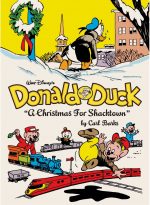
Walt Disney’s Donald Duck by Carl Barks volume 11: Christmas For Shacktown


By Carl Barks & various (Fantagraphics Books)
ISBN: 978-1-60699-574-7 (HB/Digital edition)

Win’s Christmas Gift Recommendation: Utter Acme of All-Ages Entertainment… 10/10

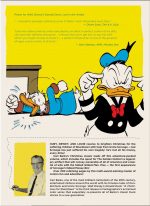
Carl Barks was born in Merrill, Oregon in 1901, growing up in the rural areas of the West during some of the leanest times in American history. He tried his hand at many jobs before settling into the profession that chose him. His early life is well-documented elsewhere if you crave detail, but briefly, Barks worked as an animator at Disney’s studio before quitting in 1942 to work in the new-fangled field of comic books.

With studio partner Jack Hannah (another animator turned occasional strip illustrator) Barks adapted a Bob Karp script for a cartoon short into Donald Duck Finds Pirate Gold. It was published in October of that year as Dell Four Color Comics Series II #9 and – although not his first published comics work – was the story that shaped the rest of Barks’ career.

From then until his official retirement in the mid-1960s, he worked in self-imposed seclusion, writing, drawing and devising a vast array of adventure comedies, gags, yarns and covers that gelled into a Duck Universe of memorable and highly bankable characters, including Gladstone Gander (1948), the Beagle Boys (1951), Gyro Gearloose (1952) and Magica De Spell (1961) to supplement Disney’s stable of illustrated actors.

His greatest creation was undoubtedly the crusty, paternalistic, money-mad giga-gazillionaire Scrooge McDuck: world’s wealthiest septuagenarian waterfowl and the harassed, hard-pressed, scene-swiping co-star of this tome.

Whilst producing all that landmark material, Barks was just a working guy, crafting covers, drawing other people’s scripts and contributing his stories to a burgeoning canon of Duck Lore. Only in the 1980s – after Gladstone Publishing began re-packaging his work and other Disney strips – did Barks discover the devoted appreciation he never imagined existed…

So potent were his creations that they inevitably fed back into Disney’s animation output, even though his brilliant comics were produced for licensing company Dell/Gold Key, and not directly for the Disney studio. The greatest tribute was undoubtedly the animated series Duck Tales: heavily based on his Scrooge comics output.

Barks was a fan of wholesome action, unsolved mysteries and epics of exploration, and this led to him perfecting the art and technique of the comedy blockbuster: blending wit, history, science, plucky bravado and sheer wide-eyed wonder into rollicking rollercoaster romps which captivated readers of every age and vintage. Without the Barks expeditions, there would never have been an Indiana Jones

Throughout his working life, Barks was blissfully unaware that his efforts – uncredited by official policy as was all Disney’s strip and comic book output – had been singled out by a rabidly discerning public as being by “the Good Duck Artist”. When some of his most dedicated fans finally tracked him down, Barks’ belated celebrity began.

In 2013 Fantagraphics Books started collecting his Duck materials in carefully curated archival volumes, tracing the output approximately year-by-year in hardback tomes and digital editions that finally did justice to the quiet creator. These will eventually comprise the Complete Carl Barks Disney Library

The physical copies are sturdy and luxurious albums – 193 x 261 mm – that would grace any bookshelf, with volume 5 – Walt Disney’s Donald Duck: “Christmas on Bear Mountain” (for reasons irrelevant here) acting as debut release and showcasing works from 1947. Today we’re revisiting 1951-1952, with volume 11 offering another landmark Seasonal tale that critically reshaped the supposedly throwaway, 2-dimensional miser into the richly rounded character beloved by billions…

It begins eponymously with Bark’s most enduring creation in top form. The elder McDuck had debuted in ‘Christmas on Bear Mountain’ (Four Color #178, December 1947): a handy comedy foil stemming from a Yuletide tale of woe and joy. He was a miserly relative who seethed in opulent isolation, hating everybody and meanly opting to share the gloom by tormenting his nephew Donald and his junior houseguests Huey, Louie and Dewey – by gifting them his mountain cabin for the Holidays. Scrooge schemed, intent on terrorising them in a bear costume, but fate had other ideas…

After the tale ended Barks realised that although the old coot was creepy, menacing and money-mad, he was also energetic and oddly lovable – and thus far too potentially valuable to be misspent or thrown away. Further appearances proved that he was right and his expedient maguffin was undoubtedly his greatest cartoon creation. The Downy Dodecadillionaire returned often, eventually expanding to fill all available space in tales set in the scenic metropolis of Duckburg.

Here. shifted slightly out of publishing chronology – because McDuck is not about wasting time or money – we open eponymously with the lead tale from Four Color #367. Cover-dated January 1952, ‘A Christmas For Shacktown’ begins as Donald’s nephews take a detour through the bad side of town and realise they cannot allow all the poverty-stricken children they see endure a festive season without food or toys…

Their discussion also inspires Daisy Duck, who resolves to organise a solution, and before long her women’s club is tapping Duckburg’s citizens for contributions. Daisy herself asks Donald – who’s experiencing a personal cashflow crisis and can’t afford his own Yule celebrations – who might make up her final $50 shortfall. When the nephews suggest Scrooge McDuck, Donald is reluctantly despatched to beg a donation, and does not relish the conversation…

That last 50 bucks is to buy turkeys and provide the joyless waifs with a train set, but after a titanic tussle, Donald can only get the skinflint to agree to $25… and that’s only for the food, not silly fripperies like toys…

Rapidly regrouping, Donald and Daisy are overwhelmed when the nephews hand over their savings and tell their “Unca Donald” to similarly donate the money put aside for their presents, but it’s still not enough and the trio then head off to shovel snow from sidewalks to make up the difference.

Ashamed and emboldened, Donald resolves to get what’s needed from Scrooge, embarking upon a series of increasingly wild stunts – including recruiting despicable rival Gladstone Gander – that culminates in disaster when Scrooge’s overloaded money vault collapses under the weight of its own reserves, plunging his entire fortune into the bowels of the Earth.

Confronted with penury, the despondent tycoon is saved by Donald and the boys who devise a means of retrieving the loot which gives the miser a new perspective on the value of toys: a view that rightly translates into Shacktown enjoying the best Christmas ever…

A month prior to that yarn, anthological Walt Disney Comics & Stories #135 (cover-dated December 1951) featured The Big Bin on Killmotor Hill’ wherein the old money magnate debuted his monolithic money bin, and invites Donald and the boys to inspect it… if they can get past all his baroque and byzantine security measures. Sadly, the visit also inspires the dastardly Beagle Boys to try to empty it…

WDC&S #136 (January 1952) then finds Donald suffering a braggart’s boasts again as his despised super-lucky rival recounts ‘Gladstone’s Usual Good Year’. Driven to distraction, Donald resorts to cheating just to raise his own spirits and something very unlikely occurs…

For #137, Donald and the nephews head to the mountains after he sells a song. Sadly, ‘The Screaming Cowboy’ is a particularly annoying tune that Donald smugly plays on every juke box in the region: the ominously named Avalanche Valley…

Scrooge returned in (WDC&S #138 March 1952), acting in a most uncharacteristic manner as ‘Statuesque Spendthrifts’ revealed him locked in financial combat with the proudly philanthropic Maharajah of Howduyustan to prove who was truly “the richest man in the world”. The battle revolved around who could donate the most ornate, ostentatious and gaudy monument of Duckburg’s founder…

When Huey, Dewey & Louie’s latest hobby – racing pigeons – inspires Donald’s disdain, the mean Unca attempts to sabotage and gaslight them, but learns his lesson when ‘Rocket Wing Saves the Day’ (WDC&S #139, April) after he has an accident…

The family – and even outrageous inventor Gyro Gearloose – are united in WDC&S #140, working to uncover annoying wastrel ‘Gladstone’s Terrible Secret’, and the chaos-creating boffin is back in #141, much to Donald’s dismay and the nephews’ delight: upsetting the natural order with machines giving beasts human attributes in ‘The Think Box Bollix’

Four Color #408 (July/August 1952) was an All-Donald/All Barks affair and opens with a brace of single page gags, starting with ‘Full-Service Windows’ as the wily retailer finds a cheap and easy way to clean his shop front and compounding interest with ‘Rigged-Up Roller’ (alternately called ‘Rigged Up Lawn’) wherein the nephews must find a new way to keep the yard maintained…

The main event was extended action adventure ‘The Golden Helmet’ wherein bored museum guard Donald stops a suspicious individual poking about in a Viking longship and uncovers a hidden deerskin map. It reveals how explorer Olaf the Blue discovered America in 901 AD, and left a golden helmet which confirms when and how the nation was born.

The museum authorities are exultant… but only until the meddler returns with his lawyer Sharky. Azure Blue claims to be the descendant of Olaf and invokes the ancient “code of discovery” law. It dictates that as proof of the event, the helmet also confers ownership of the continent on the heirs… but only if Azure finds it first…

Almost resenting his earlier dreams of adventure, Donald recruits his nephews and dashes off with the museum curator to Labrador. They are all intent on saving Americans from becoming Blue’s slaves: battling deadly weather, constant misfortune and the machinations of Azure and Sharky in a superb action romp anticipating, Dan Brown, The Librarian and the National Treasure screen franchise…

The fun finishes with Donald’s Nephews ‘Awash in Success’ beside a faulty drinking fountain, counterbalanced by a Donald and Scrooge single from Four Color #422, (cover-dated September/October 1952) with the money-wise miser benefitting from bulk buying in ‘Stable Prices’.

Back on track and sampling Walt Disney Comics & Stories (#142, July 1952) sees Donald drag the kids on a ‘Houseboat Holiday’ to keep their summer vacation pranks and hijinks at a manageable level. Instead, he finds himself at the centre of a storm of freak calamities and life-threatening disasters. Its only marginally less fraught one month later when he takes them to the desert as ‘Gemstone Hunters’ and is bamboozled by cunning fraudsters and again humiliated by Gladstone…

The remainder of Four Color #422 follows, opening with a follow-up action excursion. In ‘The Gilded Man’ avid stamp collector Donald believes he’s tracked down a hugely valuable item and heads for British Guiana, with the nephews in tow and Gladstone hot on his trail.

The quest is for fabled El Dorado, and the jungle trek ultimately leads them to victory of a sort after exposing the secrets of the ancient golden god…

Two more one-pagers wrap up the issue: detailing correct precautions for saving a cat in ‘Armored Rescue’ before adapting an old idea to avoid social commitments in ‘Crafty Corner’

Scrooge stole the spotlight again in WDC&S #144 (September) as another storage crisis in his vault compelled the old bird to try and learn a new trick. In an effort to make room, he hires insanely profligate Donald to share the secret of ‘Spending Money’ but is far from satisfied with what he learns…

The story portion of this tome terminates with the remainder of Four Color #367, with ‘Treeing Off’ showing how the nephews brighten up the Christmas decorating, after which Donald pays the price for presumption with mistletoe in ‘Christmas Kiss’ and the boys have the last word when adapting modern science to list writing in ‘Projecting Desires’ (AKA ‘Stamp-Sized Christmas List’).

The comics are augmented by a sublime Cover Gallery proving the Master’s gift for visual one-liners in Four Color (volume II) 367, 408 & 422, and Walt Disney Comics & Stories#135-144 which intercut context, commentary and validation in ‘Story Notes’ for each Duck tale gathered here. Following Donald Ault’s essay ‘Carl Barks: Life Among the Ducks’, ‘Biographies’ then introduces commentators Ault, R, Fiore, Craig Fischer, Jared Gardner, Rich Kreiner, Ken Parille, Stefano Priarone and Matthias Wivel and why they’re saying all those nice and informative things. We close as ever with an examination of provenance in ‘Where Did These Duck Stories First Appear?’

Carl Barks was one of the greatest exponents of comic art the world has ever seen, with almost all his work featuring Disney’s Duck characters: reaching and affecting untold billions across the world. You might be late to the party but don’t be scared: it’s never too late to climb aboard the Barks Express.

Walt Disney’s Donald Duck “A Christmas For Shacktown” © 2012 Disney Enterprises, Inc. All contents © 2015 Disney Enterprises, Inc. unless otherwise noted. All rights reserved.


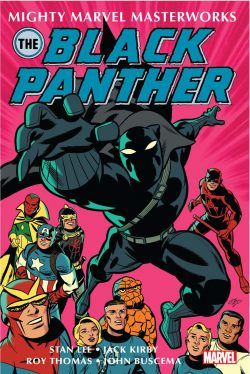
Mighty Marvel Masterworks Black Panther volume 1: The Claws of the Panther


By Stan Lee & Jack Kirby, Roy Thomas, John Buscema, Frank Giacoia, Barry Windsor-Smith & various (MARVEL)
ISBN: 978-1-3029-4709-5 (TPB/Digital edition)

Win’s Christmas Gift Recommendation: Golden Oldies for Kids of All Ages… 9/10

The Mighty Marvel Masterworks line was designed with economy in mind. Classic tales of Marvel’s key characters by the founding creators, re-presented in chronological order have been a staple since the 1990s, but always in lavish, expensive collectors editions. These books are far cheaper, but with some deletions like the occasional pin-up. They are printed on lower quality paper and – crucially – are physically smaller, about the dimensions of a paperback book. Your eyesight might be failing and your hands too big and shaky, but they’re perfect for kids and if you opt for the digital editions, that’s no issue at all…

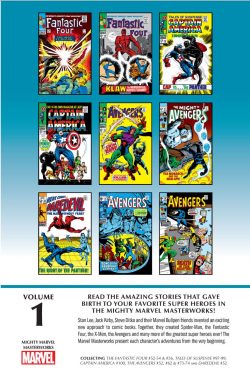
This tome gathers in whole or in part early Black Panther adventures from Fantastic Four #52-54, 56; Tales of Suspense #97-99; Captain America #100; The Avengers #52, 62, 73-74 and Daredevil #52 spanning July 1966-March 1970: including his debut and career as a peripatetic guest star before finally securing a series of his own…

Acclaimed as the first black superhero in American comics and one of the first to carry his own series, the Black Panther’s popularity and fortunes have waxed and waned since he first appeared in the summer of 1966.

As created by Jack Kirby & Stan Lee and inker Joe Sinnott, T’Challa, son of T’Chaka, is an African monarch whose secretive kingdom is the only source of vibration-absorbing wonder mineral Vibranium. The miraculous alien metal – derived from a fallen meteor which struck the continent in lost antiquity – is the basis of Wakanda’s immense wealth, making it one of the wealthiest and most secretive nations on Earth. These riches allowed the young king to radically remake his country, creating a technological wonderland even after he left Africa to fight as one of America’s mighty Avengers.

For much of its history Wakanda was an isolated, utopian technological wonderland with tribal resources and people safeguarded and led since time immemorial by a human warrior-king deriving cat-like physical advantages from secret ceremonies and a mysterious heart-shaped herb. This has ensured the generational dominance of the nation’s Panther Cult and Royal Family…

The highly guarded “Vibranium mound” had guaranteed the nation’s status as a clandestine superpower for centuries, but modern times increasingly found Wakanda a target for subversion, incursion and even invasion as the world grew ever smaller.

It all began with Fantastic Four #52-53 (cover-dated July and August 1966) as the innovative and unforgettable character launched in ‘The Black Panther!’: an enigmatic African monarch whose secretive kingdom was the only source of a vibration-absorbing alien metal. These mineral riches had enabled him to turn his country into a futuristic marvel who introduced himself by luring the FF into his savage super-scientific kingdom. Although the team was oblivious to the danger, it was all part of T’Challa’s extended plan to gain vengeance on the murderer of his father.

After battling the team to a standstill, the King revealed his tragic origin in ‘The Way it Began..!’, revealing how his father was murdered by marauding sonic science researcher Ulysses Klaw. However, even as the monarch details how he took vengeance and liberated his people, word comes of incredible solidified-sound monsters attacking the region. Klaw has returned at last…

The cataclysmic clash that follows set the scene for the African Warrior-Chieftain to guest star with a number of Marvel superstars before breaking out into the wider world, but it would years before he finally won his own solo series…

In the aftermath, Human Torch Johnny Storm and his tag-along college roommate Wyatt Wingfoot embark on a quest to rescue the Torch’s Inhuman lover Crystal (imprisoned with her people behind an impenetrable energy barrier in the Himalayas). Their journey is greatly assisted by the Panther’s incredible technology but here that means FF #54’s ‘Whosoever Finds the Evil Eye…!’ ends on page 8, and you’ll need to find a different collection to finish that tale…

The monarch and his personal nemesis returned in #56 when ‘Klaw, the Murderous Master of Sound!’ – reborn as a being of sentient sound energy – ambushes the team in their own home. Happily, the Panther is able to assist them in the nick of time…

Marvel’s inexorable rise to dominance in the American comic book industry really took hold in 1968, when a number of their characters finally got their own titles. Prior to that and due to a highly restrictive distribution deal, the company was tied to a limit of 16 publications per month. To circumvent this, Marvel developed titles with two series per publication, such as Tales of Suspense where original star Iron Man shared honours with late addition Captain America. When the division came, Shellhead started afresh with a First Issue, and Cap retained the numbering of the original title; thereby premiering with #100.

The last few issues of the run – ToS #97-99 and the freshly re-titled Captain America #100 opens with the Sentinel of Liberty having just retired from superhero service and revealed his secret identity to the world, However, he hurtles straight back into the saddle for S.H.I.E.L.D. in ‘And So It Begins…!’: a 4-part saga featuring the Black Panther.

It tells of the apparent return of long-dead Nazi war criminal and Master of Evil Baron Zemo who is attacking the world with an orbital death ray controlled from somewhere in Africa. The epic was scripted by Lee and bombastically plotted and drawn by King Kirby with Sinnott & Syd Shores inking, and sees chaos escalate in ‘The Claws of the Panther!’ and ‘The Man Who Lived Twice!’ before climactically closing in explosive action and a very Big Reveal in ‘This Monster Unmasked!’

As a result of his aid in ending the crisis, T’Challa was recommended by Cap and won his first regular slot in super team, beginning with The Avengers #52 (cover-dated May 1968). At that time, the active team had been reduced to Hawkeye, the Wasp and a recently re-powered Goliath. This changed when they belatedly welcomed new recruit Black Panther. That delay was because ‘Death Calls for the Arch-Heroes!’ was a fast-paced murder mystery by Roy Thomas, John Buscema & Vince Colletta which also introduced obsessive super-psycho The Grim Reaper, who had seemingly murdered the trio and let bewildered newcomer T’Challa take the rap…

After clearing his name and resurrecting the teammates, the Panther settled in as a high-profile international superhero but remained very much a mystery until Avengers #62 (March 1969, by Thomas. Buscema & George Klein), where in the aftermath of a mystic crisis in Africa, Hawkeye, The Vision and occasional ally Black Knight were invited to visit Wakanda…

‘The Monarch and the Man-Ape!’ was a revelatory if brief interlude in the hidden nation and a brutal exploration of the African Avenger’s history and rivals which resulted in a deadly coup attempt when a super-strong trusted regent turned usurper, declaring himself leader of a banned cult and living icon M’Baku the Man-Ape

Returned to America, the African Avenger stepped in as another acrobatic superhero loner struggled with identity issues.

Daredevil #52 (May 1969, by Thomas, Barry Windsor-Smith & Johnny Craig) saw the Scarlet Swashbuckler at his lowest ebb: battling robotics genius, Mad-Scientist-for-Hire and certified lunatic Starr Saxon. The war of wills was wickedly engaging: frantically escalating into a psychedelic thriller wherein Saxon uncovers the hero’s greatest secret after the Man Without Fear succumbs to toxins in his bloodstream and goes berserk.

That saga climaxes here in stunning style on ‘The Night of the Panther!’ as the African Avenger joins the hunt for the out-of-control Daredevil before subsequently helping thwart, if not defeat, the dastardly Saxon. The radically unsettling ending blew away all conventions of traditional Fights ‘n’ Tights melodrama and still shocks today…

These initial forays finish with another 2-part tale, beginning with Avengers #73 and ‘The Sting of the Serpent’. Another Thomas triumph – illustrated by Frank Giacoia & Sam Grainger – it pits the Panther (at the height of the Civil Rights campaign) against his natural prey in the form of seditious racist hate-mongers determined to set New York ablaze, leading to a spectacular and shocking clash between whole team and The Sons of the Serpent in ‘Pursue the Panther!’ when the sinister supremacists capture the hero and set a doppelganger loose to destroy his reputation…

With covers by Kirby, Sinnott, Gene Colan, Giacoia, Buscema, Klein, Marie Severin & Palmer, this tidy tome is a wonderful, star-studded precursor to the Black Panther’s solo exploits and a perfect accessory for film-fans looking for more context.
© 2022 MARVEL

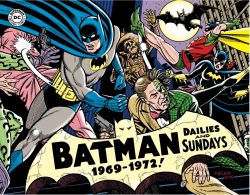
Batman: Silver Age Dailies and Sundays 1969-1972!


By Whitney Ellsworth, E. Nelson Bridwell, Al Plastino, Nick Cardy & various (IDW)
ISBN: 987-1-63140-263-0 (HB)

Win’s Christmas Gift Recommendation: Nuggets of Nostalgia to Delight All Ages… 8/10

For nearly eight decades in America newspaper comic strips were the Holy Grail cartoonists and graphic-narrative storytellers hungered for. Syndicated across the country and often the planet, winning millions of readers and accepted (in most places) as a more mature and sophisticated form of literature than comic books, it also paid better, with the greatest rewards and accolades being reserved for the full-colour Sunday page.

So it was always something of a poisoned chalice when a comic book character became so popular that it swam against the tide (after all, weren’t funny-books invented just to reprint strips in cheap, accessible form?) and became a syndicated serial. Superman, Wonder Woman, Blue Beetle and Archie Andrews made the jump soon after their debuts and many features have done so since.

Due to war-time complications, the first Batman and Robin newspaper strip was a late entry, but when the Dynamic Duo finally hit the Funny Pages, the feature proved to be one of the best-regarded, highest quality examples of the trend, both in Daily and Sunday formats.

Somehow, it never achieved the circulation it deserved, but at least the Sundays were eventually given a new lease of life when DC began issuing complete vintage stories in the Batman 80-page Giants and Annuals in the 1960s. The exceedingly excellent all-purpose adventures were ideal short stories that added an extra cachet of exoticism for young readers already captivated by simply seeing tales of their heroes that were positively ancient and redolent of History with a capital “H”.

Such was not the case in the mid-1960s when, for a relatively brief moment, mankind went bananas for superheroes in general and most especially went “Bat-Mad”. The comic book Silver Age revolutionised a creatively moribund medium cosily snoozing in unchallenging complacency, bringing a modicum of sophistication to the revived genre of mystery men.

For quite some time the changes instigated by Julius Schwartz (in Showcase #4, October 1956) which rippled out in the last years of that decade to affect all of National/DC Comics’ superhero characters generally passed by Batman and Robin. Fans buying Detective Comics, Batman, World’s Finest Comics and latterly Justice League of America would read adventures that – in look and tone – were largely unchanged from the safely anodyne fantasies that had turned the Dark Knight into a mystery-solving, alien-fighting costumed Boy Scout just as the 1940s turned into the 1950s.

By the end of 1963, however, Schwartz having – either personally or by example – revived and revitalised the majority of DC’s line (and, by extension and imitation, the entire industry) with his reinvention of the Superhero, was asked to work his magic with the creatively stalled and near-cancellation Caped Crusaders.

Installing his usual team of top-notch creators, the Editor stripped down the accumulated luggage and rebooted the core-concept. Down – and usually out – went the outlandish villains, aliens and weird-transformation tales in favour of a coolly modern concentration on crime and detection. Even the art-style itself underwent a sleek streamlining and rationalisation. The most visible change for us kids was a yellow circle around the Bat-symbol but, far more importantly, the stories changed. A subtle aura of genuine menace crept back in.

At the same time, Hollywood was in production of a TV series based on Batman and, through the sheer karmic insanity that permeates the universe, the studio executives had based their interpretation not upon the “New Look Batman” currently enthralling readers, but the wacky, addictively daft material DC was emphatically turning its editorial back on.

The Batman show premiered on January 12th 1966 and ran for three seasons of 120 episodes: airing twice weekly for the first two. It was a monumental, world-wide hit that sparked a vast wave of trendy imitation. Resultant media hysteria and fan frenzy generated an insane amount of Bat-awareness, no end of spin-offs and merchandise – including a cinema movie – and introduced us all to the phenomenon of overkill.

No matter how much we comics fans might squeal and froth about it, to a huge portion of this planet’s population Batman is always going to be that “Zap! Biff! Pow!” buffoonish costumed Boy Scout…

“Batmania” exploded across Earth and then as almost as quickly became toxic and vanished, but at its height led to the creation of a fresh newspaper strip incarnation. That strip was a huge syndication success and even reached fuddy-duddy Britain, not in our papers and journals but as cover feature of weekly comic Smash! (from issue #20 onwards).

The TV show ended in March 1968. As the series foundered and faded away, global fascination with “camp” superheroes – and no, the term had nothing to do with sexual stereotyping no matter what you and Mel Brooks might think – burst as quickly as it had boomed and the Caped Crusader was left with a hard core of dedicated fans and followers who now wanted their hero back…

That ennui also finally finished the Syndicated comic strip (at least until the 1989 Batman movie), but as this final compilation proves, by the end it was – if not a failed kidnap recovery – a mercy killing…

This third hardback compilation gathers the last hurrahs of the strip, from the time when the Gotham Guardians were being pushed out of their own series and highlights a time when contracts and copyrights proved far more potent than Truth, Justice and the American Way…

As well as re-presenting the last bright and breezy, sometimes zany cartoon classics of Batman with Robin the Boy Wonder, this tome is augmented by a wealth of background material, topped up with oodles of unseen scenes and background detail to delight the most ardent Baby-boomer nostalgia-freak as well as captivating contemporary examples of the massed merchandise the TV series and comic strip spawned – such as adhesive Adventures Stickers, and house ads from Smash!

The fun-fest opens with more informative and picture-packed, candidly cool revelations from comics historian Joe Desris in ‘A History of the Batman and Robin Newspaper Strip: Part 3’; sharing the communications between principal players and discussing how E. Nelson Bridwell became editor and then scripter on the rapidly evolving feature.

In January 1972, growing disputes between NPP (National Periodical Publications: DC’s parent company) and the Ledger Syndicate led to the latter attempting to exclude the former from the deal. When NPP withheld the strips it was contracted to produce, LS brought in an uncredited replacement creative team and published unsanctioned “bootleg” material that infringed DC’s copyright, beginning with the January 3rd episode. By the 31st, LS was completely rogue and as well as a generating a huge drop in both story and art quality, the replacements actively worked to undo all of Bridwell’s efforts to crosspollinate the strip and comic book continuities. On April 8th the syndicate dropped DC’s copyright from the strips prior to introducing their own hero – Galexo – to the feature on April 11th.

Although Bruce Wayne and Dick Grayson still occasionally appeared and the title masthead stubbornly remained attention-grabbing “Batman”, the newcomer and his sidekicks Solaria and Paul were now the panel-hogging stars.

Eventually, NPP secured their intellectual property and walked away, and the strip staggered to a natural demise without DC heroes. Full details are provided by Desris in his introduction, which also shares its ultimate fate and where the feature continued until it ended…

The Introduction also offers a wonderful taste of what might have been via the unpublished episodes by Bridwell, Al Plastino & Nick Cardy that should have run from January 3rd – 15th 1972, to counterbalance the actual published material seen at the end of the volume…

Chronologically incorporating monochrome 2-4 panel dailies and full-page full colour Sundays, the series was originally scripted by former DC editor (and the company’s Hollywood liaison) Whitney Ellsworth, who’s still in charge as we recommence with a saga that began in the previous volume, drawn as ever by Plastino.

Alfred John “Al” Plastino was a prodigious artist with a stellar career. He had been active in early comic books, with credits including Captain America and Dynamic Man before serving in the US Army. His design talents were quickly recognised and he was seconded to Grumman Aerospace, The National Inventors Council and latterly The Pentagon, where he designed war posters and field manuals for the Adjutant General’s office.

In 1948, he joined DC and soon became one of Superman’s key artists. He drew many landmark stories and, with writer Otto Binder, co-created Brainiac, The Legion of Super-Heroes and Supergirl. From 1960-1969 Plastino ghosted the syndicated Superman newspaper strip and whilst still drawing Batman, also took over Ferd’nand in 1970: drawing it until his retirement in 1989.

He was extremely versatile and seemingly tireless: in 1982-1983 he drew Nancy Sundays after creator Ernie Bushmiller passed away and was controversially hired by United Media to produce fill-in episodes of Peanuts when Charles Schulz was in dispute with the company. Al Plastino died in 2013.

The new policy of guest stars from DC’s comics pantheon made Plastino the ideal choice as the strip transitioned to a tone of straight dramatic adventure and away from the campy comedy shenanigans of the TV show…

The first week of My Campaign to Ruin Bruce Wayne’ (May 31st December 25th 1969) saw spoiled snob heiress Paula Vanderbroke and her brother Paul move into Wayne Manor and announce her intention of marrying Bruce. Here, when he tells her no, Paula – despite being bankrupt – dedicates all her remaining resources to crushing him and making him sorry.

Before she’s stopped, Wayne’s latest enterprise is sunk and the entire city suffers for her wounded pride and the Caped Crusader has succumbed to life-changing injuries…

Guest starring Superman, ‘Batman’s Back Is Broken!’ (December 26th 1969 to March 19th 1970) sees the Gotham Guardian laid low with the only surgeon who could fix him stuck in Mexico and unable to fly. That hurdle – amongst many others – is surmounted by the Man of Tomorrow who the steps in to impersonate Batman while he recuperates. Part of that program involves visiting a travelling show, sparking bad memories for Robin in ‘The Circus is Still Not For Sale!’ (March 20th – September 7th) as his senior partner retrains with the Fiore Family Circus. Almost immediately, a series of accidents imperil one and all, and physical therapy must give way to investigation and deduction. What that turns up is Mafia involvement…

When Wayne moves to end the threat by purchasing the show, a hidden mastermind makes a bold move by hiring a hitman to “cancel” him, but does not realise who he’s dealing with…

Bridwell began being credited as writer with the July 22nd instalment and immediately began dialling back the humorous tone in favour of darker drama, bringing the serial to a swift conclusion. With skulduggery exposed and thwarted the writer then began a bold move…

As DC’s continuity master, Bridwell began mirroring the dynamic changes punctuating a new age of relevancy in the company’s comic books, and adapted the big break-up between Batman and Robin as Dick Grayson went off to college.

‘Everything Will Be Different’ (September 8th 1970 – January 8th 1971) saw Wayne become a social activist, using his wealth to create the “Victim’s Incorporated Program” to help those who had suffered through crime. Shutting down the Batcave and Manor to work and live in the heart of Gotham City, Wayne and Alfred retooled to help the innocent as well as punish the guilty. The first survivor of crime was recent widow Mrs Whipp whose son Jeff had run away after his father was killed. She thought he might have gone to Star City to enlist the aid of Green Arrow

Meanwhile, Dick had settled in at nearby Hudson University, meeting scientist Dr Kirk Langstrom even as Batman joined his JLA comrade there. All three heroes’ paths converged when student radicals sought to kill the runaway in their murderous efforts to create chaos and bring down “the Establishment”.

Bridwell also began overlapping storylines and before Jeff could be saved, ‘I am… Man-Bat!’ (January 8th – 14th April 1971) saw Langstrom’s experiments mutate scholar into monster, with his frantic attempts to find a cure contributing to the plot’s failure and heroes’ triumph…

Trapped in freak form, Man-Bat stows away with Batman and Jeff, and stalks Gotham in ‘Too Many Riddles – Two Many Villains’ (15th April-October 5th 1971): inadvertently stopping The Penguin killing Batman before enlisting the Dark Knight’s aid in saving himself before further mutating and flying off in panic just as Robin meets Langstrom’s fiancée Francine Lee at Hudson U.

As they all converge on Gotham, the Bird Bandit rejoins Catwoman, Riddler and The Joker who ally with another old Bat-foe for a major coup…

Despondent Francine has found Kirk and is pondering a horrific life change, whilst an army of former Bat-foes assaults Gotham, seeking to restage the Mad Hatter’s Tea Party for profit. The sinister soiree has attracted Tweedledee and Tweedledum, The Scarecrow, Poison Ivy, Killer Moth and Two-Face, but also called Batgirl out of retirement …

With Nick Cardy adding powerful moody tones to the mix, the drama built to a potent crescendo as a massive heroin deal was exposed as prompting the evil army’s antics, but in the end the assembled Bat Squad proved sufficient to the task…

The slow-boiling Man-Bat plot then overheated in ‘Hideous Newlyweds’ (October 6th – November 4th 1971) as the heroes learned of Francine’s fate after she had willing become a monster like Kirk, and the era technically ended with ‘The Secrets in Grandma Chilton’s Scrapbook’ (November 5th 1971 – January 28th 1972). Extrapolated from a character from comics, the tale revealed how a young thug inherits Chilton’s worldly goods and sees in her scrapbook that she was the mother of the man who murdered Thomas and Martha Wayne… and turned their son Bruce into Batman…

As the housekeeper of his Uncle Philip Wayne, she had reared the orphan in his formative years and deduced his secret. Now, with her death, the son of “Joe Chill” learned how his own father died because of the Dark Knight and the cycle of vengeance begins again as the young man – armed with deadly knowledge – targets Wayne and everything he loves…

We’ll never know how that so-promising, tension-drenched drama should have concluded, as pinch hitters parachuted in during the aforementioned dispute wrap up the tale on autopilot and plunge straight into feeble fable ‘Dick Grayson: Kidnapped!’ (January 29th-March 7th).

When Wayne’s ward is snatched from college the distressed hero calls in Batgirl and Superman – but only in their plainclothes personas of Babs Gordon and Clark Kent -gratuitously along to pad out the done-by-numbers rescue…

The teen has no luck but bad and ‘Dick Grayson: Skyjacked!’ (March 8th – April 3rd 1972) then sees his passenger flight home seized by a terrorist, before the kid steps in to save himself this time…

The end comes none too soon in ‘The Duo Becomes a Trio’ (April 4th – 1972 and beyond) with Bruce and Dick recruiting mystery champion Galexo to help them put the team on a global footing. The World’s Worst dressed telepath has his own team but will join for now, beginning with the mastermind igniting volcanoes in Antarctica…

The book stops here but the strip apparently continued awhile longer in overseas papers – represented here in another 17 full pages of Batman with Robin and Galexo from Australian and Singapore papers. I found them utterly unreadable but maybe you’re tough enough to handle it…

The majority of stories in this compendium reveal how gentler, stranger times and an editorial policy focusing as much on broad humour as Batman’s reputation as a crime-fighter was swiftly turned to all-out action adventure once Batmania gave way to global overload and ennui. That was bad for the strip at the time but happily resulted in some truly wonderful adventures for die-hard fans of the comic book Caped Crusader. If you’re of a certain age or open to timeless thrills, spills and chills this a truly stunning collection well worth your attention.

Batman: Silver Age Dailies and Sundays 1969-1972! concludes huge (305 x 236 mm) lavish, high-end hardback collections starring the Caped Crusaders, and is a glorious addition to the superb commemorative series of Library of American Comics which has preserved and re-presented in luxurious splendour such landmark strips as Li’l Abner, Tarzan, Little Orphan Annie, Terry and the Pirates, Bringing Up Father, Rip Kirby, Polly and her Pals and so many other cartoon icons.

If you love the era, the medium or just graphic narratives, these stories are great comics reading, and this is a book you simply must have.
© 2016 DC Comics. All rights reserved. Batman and all related characters and elements ™ DC Comics

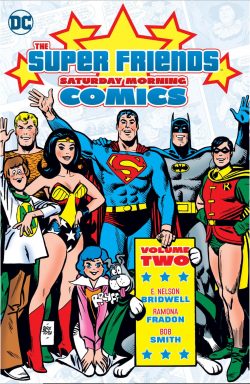
Super-Friends: Saturday Morning Comics volume 2


By E. Nelson Bridwell, Bob Rozakis, Martin Pasko, Bob Oksner, Ramona Fradon, Kurt Schaffenberger, Romeo Tanghal, Joe Staton, Bob Smith, Vince Colletta & Kim DeMulder with Alex Toth & various (DC Comics)
ISBN: 978-1-7795-0592-7 (HB/Digital edition)

Win’s Christmas Gift Recommendation: Absolute Entertainment Perfection… 9/10

Once upon a time comics were primarily created with kids in mind and, whilst I’d never advocate exclusively going back to those days, the modern industry has for the longest time sinned by not properly addressing the needs and tastes of younger fans these days. Happily, DC has latterly been rectifying the situation with a number of new and – most importantly for old geeks like me – remastered, repackaged age-appropriate gems from their vast back catalogue.

A superb case in point of all-ages comics done right is this massive tome. And don’t stress the title: it may celebrate the joys of past childhood shows but this is definitely a great big Sunday “settle back and luxuriate” treat…

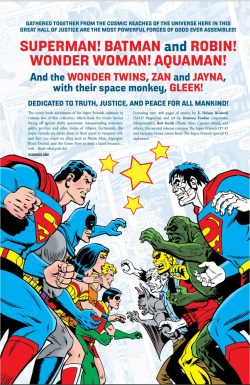
The Super Friends: Saturday Morning Comics gathers comic book tales spun off from a popular Saturday Morning TV Cartoon show of the 1970s: one that – thanks to the canny craftsmanship and loving invention of primary scripter E. Nelson Bridwell – became an integral and unmissable component of the greater DC Universe, as a well a key supplier of fresh fodder to enhance its all-encompassing omniverse. So very many of his supporting characters became superstars in their own right and trappings such as the junior characters, villains and the Hall of Justice are now key components of today’s overarching continuity…

The Super Friends was also one of the most universally thrilling and satisfying superhero titles of the period for older fans: featuring the type of smart and witty, straightforward adventures people my age grew up with, produced during a period when the entire industry was increasingly losing itself in colossal continued storylines and bombastic, convoluted, soap opera melodrama.

It’s something all creators should have tattooed on their foreheads: sometimes all you really want is a smart plot well illustrated, sinister villains well-smacked, a solid resolution and early bed…

Under various guises, the TV show Super Friends ran from 1973 to 1986: a vehicle for established television-alumni Superman, Batman and Robin, Aquaman and Wonder Woman, supplemented by a succession of studio-originated kids as student crimebusters. The show also offered airtime to occasional guest stars from the DCU on a case by case basis. The animated show made a hugely successful transition to print as part of the publisher’s 1976 foray into “boutiqued” comics which saw titles with television connections cross-marketed as “DC TV Comics”.

Child-friendly Golden Age revival Shazam! – the Original Captain Marvel had been adapted into a popular live action series and its Saturday Morning silver screen stablemate The Secrets of Isis consequently reversed the process by becoming a comic book. With the additions of hit comedy show Welcome Back Kotter and animated blockbuster Super Friends’ four-colour format, DC had a neat little outreach imprimatur tailor-made to draw viewers into the magic word of funnybooks.

At least, that was the plan: with the exception of Super Friends, none of the titles lasted more than 10 issues…

This massive mega-extravaganza (the second of 2) gathers Super Friends #27-47, The Super Friends Special #1, The Best of DC: Blur Ribbon Digest #3, Limited Collectors’ Edition C-41 and Super Friends!: Truth Justice and Peace! (collectively spanning December 1979 to August 1981), ending the initial run whilst sharing material from assorted reprints and one-shots.

The majority of stories were by E. Nelson Bridwell & Ramona Fradon (Aquaman; Batman; Metamorpho the Element Man; The Brave and the Bold; Brenda Starr, Reporter). Bridwell (Secret Six; Inferior Five; Batman; Superman; The Flash; Batman and Robin newspaper strip; Legion of Super-Heroes; Captain Marvel/Shazam!) had been one of the art form’s earliest mega-fans, turning his hobby into a career in the 1950s.

He was justly renowned as DC’s Keeper of Lore and Continuity Cop – thanks to an astoundingly encyclopaedic knowledge of publishing minutiae and ability to instantly recall every damn thing about anything! Thankfully, he was also an ingenious and supremely witty writer. Fradon was a pioneering artist who also got her start in the 1950s, graced with a uniquely smooth and accessible style. She became one of comics’ earliest (acknowledged!) female artists and was a fan-favourite for generations.

Neither Bridwell or Fradon considered working at the junior end of the market as in any way less important or prestigious than the auteur/adult drama sector just starting to manifest in the American industry…

When Super Friends first aired, the costumed champions were mentors to two kids and their pet: tasked with training the next generation of superheroes. Without warning or explanation, Wendy, Marvin and Wonderdog were replaced for the second television season by alien shapeshifters Zan and Jayna and their elastic-tailed space monkey Gleek. In the comics – with more room to extrapolate and far more consideration for the fans – Bridwell turned the cast change into an extended epic.

When two siblings from distant planet Exor – a girl able to transform into animals and a boy who can become any form of water from steam to ice – came to Earth with an urgent warning they saved the world and were marooned here.

Their integration became an ongoing plot strand with the adults (and Robin) not only training Zan and Jayna, but also jointly acclimating them and introducing them into human society…

This concluding compilation of thrilling fun resumes with The Super Friends #27 and ‘The Spacemen Who Stole Atlantis!’ (Bridwell, Fradon & inker Bob Smith) sees domed undersea city Poseidonis stolen away by ruthlessly curious alien scientists who had not factored in Earth’s greatest defenders.

Inked by Vince Colletta, the next issue detailed a ‘Masquerade of Madness!’ in a Halloween yarn packed with guest stars (including Etrigan the Demon, Solomon Grundy, Man-Bat, Swamp Thing and Jimmy “wolfboy” Olsen) as mystic malcontent Felix Faust crashes a costume ball, trapping attendees in their outfits until Bruce Wayne hands over a certain magical gem… And that’s when the other – untransformed – Super Friends step in…

Another extraterrestrial invasion by colonising invaders seeking to evict humanity manifests in #29, with the new bosses wielding technology that seems to make all resistance futile. However, Wonder Woman and the Wonder Twins find a work-around meaning the war can be won by the heroes making themselves ‘Invisible Defenders of Earth!’

The issue also offers an adventure of the Wonder Twins, who now have secret identities and live in the home of guardian Professor Carter Nichols – Bruce Wayne’s science advisor/time travel expert who debuted in Batman #24, August 1944.

Here Bridwell, Kurt Schaffenberger & Smith establish the ‘Scholars from the Stars’ as transfer students at Gotham Central High, but John and Joanna Fleming are soon being stalked by curious classmates eager to learn all they can about the strange newcomers…

Nichols plays a major role in #30 as Fradon-illustrated ‘Gorilla Warfare Against the Humans!’ sees the heroes battle super-primate Grodd and his ally Giganta as they deploy their new tech to transform men into apes…

Guest stars were always a big draw and #31’s ‘How to Trap an Orchid!’ (inked by Colletta) saw DC’s most enigmatic hero targeted and framed by a ruthless enemy and helped by the Friends before Schaffenberger pencilled and Smith inked #32’s ‘The Scarecrow Fights with Fear!’ as the Tyrant of Terror afflicts the heroes with crippling weaponised personal phobias that only teamwork and determination can overcome

Fradon & Colletta combine for ‘The Secret of the Stolen Solitaire!’ as obsessive old enemy Menagerie Man returns, still using trained animals to commit spectacular robberies. His schemes are derailed when Jayna becomes a famously extinct creature and is “captured”, leading the heroes and visiting VIP Hawkman to his lair and the Winged Wonder’s captive sidekick Big Red

With #34, two stories per issue became the norm, leading with Bridwell, Fradon & Colletta’s ‘The Creature That Slept a Million Years!’, in which a hibernating beast awakened on Earth causes inadvertent chaos, balanced by ‘The Boss and the Beast’ as John and Joanna Fleming help their favourite teacher by saving her husband from a crooked boss fitting him up for a life of crime…

Romeo Tanghal & Smith illustrate full-length spectacle ‘Circus of the Super-Stars’ as the Super Friends and their showbiz impersonators trade places to outwit crooks targeting a massive charity event, before #36 bifurcates with a brace of tales limned by Tanghal & Colletta. First up is ‘Warhead Strikes at Gotham’ with Plastic Man and Woozy Winks tracking a war-mongering maniac and overlapping with the Super Friends battle to stop a paramilitary criminal force, after which The Wonder Twins visit a museum in their school personas and discover the shocking truth about ‘The Dinosaur Demon!’

Fradon & Colletta depict #37’s ‘Bad Weather for Supergirl!’ as the Kryptonian Crime-crusher (in her then-current day job as teacher) brings a class to Gotham just as the Weather Wizard goes on a rampage. Kara’s problem is not the villain’s outrages but that her kids seem far more impressed by the late-arriving superteam than their own hometown hero…

Drama is balanced by rampant fantasy in support story ‘The Giant Who Shrunk Ireland!’, with Bridwell’s creation Jack O’Lantern using his magical gifts to save the Celtic fairy realms from an awakened Fomorean Giant.

Jack was one of a number of international heroes Bridwell and Fradon devised, who grew in popularity and were eventually retrofitted into a team dubbed the Global Guardians. Another debuted in a solo spot at the back of #38, after ‘The Fate of the Phantom Super Friends’ (art by Fradon & Colletta), which saw alien tyrant Grax recruit and arm Earth gangsters to take revenge on his enemies. Then Bob Oksner & DeMulder illustrate ‘The Seraph’s Day of Atonement’ as Bridwell relocates his Israeli holy warrior to a new Jewish settlement in disputed territory just in time to save it from bandits pretending to be Arab terrorists. When, in his righteous anger, he goes too far in punishing the evildoers, he faces divine consequences…

Another former foe resurfaces in #39 with a sinister scheme to create hyper-evolved clones of the only being he trusts… himself. However, ‘The ‘Future’ Son of Overlord!’ (Fradon & Colletta) proves insufficient to the demands and the demise of “Futurio” only results in Overlord cruelly retrenching, after which the human-seeming Wonder Twins discover nightclubs are another place crazy crime can occur in ‘The Boogie Mania Will Get You’ (Tanghal & Collett)…

Inked by Kim DeMulder, #40’s lead tale ‘Menace of the Mixed-Up Senses!’ pits the heroes against a vindictive scientist creating disasters by scrambling perceptions, before Jack O’Lantern returns to teach a smooth-talking conman a life lesson in ‘Blarney for Sale!’ (Bridwell, Tanghal & DeMulder)

Bob Rozakis joins Fradon & Colletta in detailing ‘The Toyman’s Tricky Thefts!’ as the veteran villain attacks a Christmas toy convention as prelude to his true diabolical plan, whilst the rear guard of #41 witnesses Oksner write & illustrate ‘Dry Earth… Stolen Waters’ as The Seraph foils an industrial spy stealing the secrets of an experimental desalination device…

In Seasonal Special #42, Bridwell, Tanghal & Colletta debut Brazilian hero Beatriz Da Costa (AKA Green Fury, Green Flame and/or Fire) who joins the Wayne Foundation just in time to help the Super Friends defeat a vegetation-controlling villain in ‘How Green Was My Gotham!’ and still leave room for the Wonder Twins to enjoy ‘A Christmas with Everything!’ in a heartwarming tale of family and little miracles…

Overlord tries again in #43, unleashing ‘Futurio Times Ten!’ to destroy the collegiate heroes, (and Green Fury) but fails when the over-evolved clone develops an unholy fascination with potential mate Wonder Woman, after which Plastic Man bounces back in ‘Mouth-Trap!’ by Pasko, Staton & Smith, taking down thieving shock jock Lou Kwashus – AKA Chatterbox

Issue #44 leads with Bridwell, Tanghal & Colletta’s ‘Peril of the Forgotten Identities!’ as a menace from the Wonder Twins’ homeworld warps the memories of the team leaving Zan, Jayna & Beatriz to save the day. As counterpoint, Jack O’Lantern then solves a snag in the (super)natural order by ensuring ‘The Death-Cry of the Banshee!’ is heard by the right person…

The “International Heroes” who would become Global Guardians (Rising Sun, Bushmaster, Olympian, Wild Huntsman, Godiva and Little Mermaid) were formally gathered by immortal wizard Doctor Mist in #45 and united with the Super Friends to defeat ‘The Man Who Collected Villains!’

Another classic by Bridwell, Tanghal & Colletta, it pits the merged squads against uber-baddie The Conqueror and his personal Doom Legion – Hector Hammond, Kanjar Ro, Queen Bee, Sinestro, Time Trapper and World-Beater – in a brutal clash that concludes in the next issue.

Before that though, courtesy of Pasko, Staton & Smith, Plastic Man & Woozy discover ‘One of Our Barbarians Is Missing!’ and must halt the rampage of a temporarily-deranged movie swordsman being manipulated by devious crooks…

The frantic Fights ‘n’ Tights clash then results in ‘The Conqueror’s Greatest Conquest!’ (Bridwell, Tanghal & Colletta) – and ultimate downfall before The Seraph battles an ‘Echo of Evil’ and the ghosts of Masada (look it up) in an all-Oksner thriller.

The comic book Super Friends ended with #47: a 25-page epic by Bridwell, Tanghal & Colletta detailing the origin of Green Fury, a plane of animal spirits and ‘The Demons from the Green Hell!’ whose actions sought to unmake the world until the team stepped up…

Times and tastes were changing and it would be years until superheroes – and not toy tie-ins – for kids were a viable option again: when once again TV led that march with breakthrough adaptations of Batman, Superman and Justice League Animated Series…

Here and now, this epic collation closes with series designer Alex Toth’s 1976 cover for Limited Collectors’ Edition C-41 and The Best of DC: Blur Ribbon Digest #3 (January-February 1980) cover by José Luis García-López & Bob Smith. Also on view is Ross Andru & Dick Giordano’s cover from The Super Friends Special #1 1981 and Toth’s frontage from the 2003 Super Friends!: Truth Justice and Peace! trade paperback collection.

Sublimely resplendent in the rich flavours and simple joys of DC’s Silver Age boom, and with covers by Fradon, Smith, Schaffenberger, Tanghal, & Colletta, this concluding compendium is superbly entertaining, masterfully crafted and utterly engaging. It offers stories of pure comics gold to delight children and adults in equal proportion. Truly generational in appeal, they are probably the closest thing to an American answer to the magic of Tintin or Asterix and no family home should be without this tome.
© 1976, 1979, 1980, 1981, 2003, 2020 DC Comics, Inc. All Rights Reserved.

JSA by Geoff Johns Book Two


By Geoff Johns, David S. Goyer, Stephen Sadowski, Michael Bair, Carlos Pacheco, Jesus Merino, Phil Winslade, Mike Perkins, Steve Yeowell, Keith Champagne, Buzz, Rags Morales, Dave Meikis, Paul Neary, Rob Leigh, Javier Saltares, Ray Kryssing, Andrew Pepoy & various (DC Comics)
ISBN: 978-1-4012-8154-0 (TPB/Digital edition)

Win’s Christmas Gift Recommendation: Pure Perfection for Superhero Connoisseurs… 9/10

After the actual invention of the comic book superhero – for which read the creation of Superman in 1938 – the most significant event in the genre, and indeed industry’s progress, was the combination of individual sales-points into a group. Thus, what seems blindingly obvious to us with the benefit of four-colour hindsight was proven – a number of popular characters could multiply readership by combining forces and readerships. Plus of course, a whole bunch of superheroes is a lot cooler than just one – or even one and a sidekick.

The Justice Society of America was created in the third issue of All-Star Comics (Winter 1940/1941), an anthology title featuring established characters from various All-American Comics publications, by the simple expedient of having the heroes gather around a table and tell each other their latest adventure. From this low-key collaboration, it wasn’t long before the guys – and they were all white guys (except the original Red Tornado, who only pretended to be one) until Wonder Woman premiered in the eighth issue – regularly joined forces to defeat the greatest villains and social ills of their generation.

Within months the concept had spread far and wide…

And thus, the Justice Society of America is rightly revered as a true landmark in the development of comics and, when Julius Schwartz revived the superhero genre in the late 1950s, a key moment would come with the inevitable teaming of the reconfigured mystery men into a Justice League of America.

From there it wasn’t long until the original and genuine returned. Since then we’ve enjoyed many attempts to formally revive the team’s fortunes but it wasn’t until 1999, on the back of both the highly successful revamping of the JLA by Grant Morrison & Howard Porter and the seminal but critically favoured new Starman by Golden Age devotee James Robinson, that the multi-generational team found a concept and fan-base big enough to support them.

It didn’t hurt that the writers – all with strong Hollywood connections – adored the original concept, but also knew what mass-market action audiences liked. And now that the JSA have cracked the large and small screen markets, my cup – at least – truly runneth over…

Their highly successful revival began as the last survivors of the original team reconvened after losing most of their membership to old age, infirmity or enemy action. Following the death of founding comrade Wesley Dodds/The Sandman, Wildcat, Flash and Green Lantern/Sentinel united with youthful inheritors of the old team’s legacy. These included members’ children and former Infinity Inc members Atom Smasher, Obsidian and Hourman, Dodds’ sidekick Sand, Stargirl (then called Star Spangled Kid), the third Dr. Mid-Nite, Starman and Mister Terrific plus new Hawkgirl Kendra Saunders, Black Canary and Wonder Woman (in actuality, her mother Hippolyta who was an active Nazi crusher during WWII).They all united to rescue three babies; one of which became the next incarnation of magical hero Doctor Fate. Once they were successful most of the squad stuck together to continue the traditions and train a new generation of heroes…

Shortly thereafter, as old guard Flash, Sentinel and Wildcat assumed the role of mentors for both current and future champions, the multi-generational unit was attacked by demented super-human (and current Man of the Moment) Black Adam: a magically empowered superman, who usually harassed agents of do-gooding wizard Shazam!. The bombastic battle served to introduce more very far-reaching plot threads and led to a fearsome clash with a new iteration old enemy outfit the Injustice Society

Officially concentrating on the efforts of Geoff Johns, this second volume re-presents in whole or in part Secret Origins of Super-Villains File 80-Page Giant #1, JSA #16-25, Our Worlds at War #1, JLA/JSA: Secret Files & Origins #1 and JLA/JSA: Virtue and Vice: bringing the revered, revived and very legendary Justice Society of America into DC’s modern pantheon and continuing the writer’s campaign to restore and re-induct all the classic stars by resurrecting the biggest name and most visually arresting of the originals – Hawkman.

It begins with a prelude from December 1999’s Secret Origins of Super-Villains File 80-Page Giant #1. Crafted by Johns & Goyer and illustrated by Phil Winslade & Mike Perkins, ‘Sorrow Ever More!’ sees demonically-tainted gang boss Johnny Sorrow break veteran villain Cameron Makent – AKA legacy JSA foe The Icicle – out of super penitentiary The Slab. The lachrymose liberator has connections with the original Icicle and expects the successor to join his war on modern heroes. He also knows an awful lot about the Makent family…

Major storyline Injustice be done opens with ‘Divide and Conquer’ (JSA #16, illustrated by Stephen Sadowski & Michael Bair) wherein an expanded Injustice Society – including Black Adam and in possession of the heroes’ most intimate secrets – ambushes them and fellow Golden Age champion Scarab whilst they’re off guard…

The blitz attack meets with significant success, and in ‘Cold Comfort’ mastermind Johnny Sorrow reveals his plans as the heroes begin their fight back, and we see his horrific origins in ‘Sorrow’s Story’ (with additional art Steve Yeowell), before the World goes to Hell with ‘Into the Labyrinth’ (extra inks by Keith Champagne) and the ghostly Spectre returns to save the day from Sorrow’s patron master The King of Tears.

And spectacularly fails…

The saga concludes in cataclysmic fashion with ‘Godspeed’ as Black Adam and Jakeem “J.J.” Thunder (heir of genie-wielding Johnny Thunder) join the team, but not before first Flash Jay Garrick is lost in time and space…

Compelling as it was, that entire saga was just a set-up for the eponymous ‘Return of Hawkman’ which I’ll get to after this necessary diversion…

One of the oldest and most revered heroes in comics, Hawkman premiered right behind Jay Garrick in Flash Comics #1 (January 1940). He was created by Gardner Fox & Dennis Neville, although the most celebrated artists to have drawn the Winged Wonder are Sheldon Moldoff and Joe Kubert, whilst young Robert Kanigher was justifiably proud of his later run as writer.

Carter Hall was a playboy archaeologist until he found a crystal knife that unlocked his memories. He knew that once he had been Prince Khufu of ancient Egypt, and that he and his lover Shayera had been murdered by High Priest Hath-Set. Moreover, with returned lives came the knowledge that his love and his killer were also nearby.

Using the restored knowledge of his past life, Hall fashioned a costume and flying harness, hunting his past and future murderer as the Hawkman. Inevitably triumphant, he and modern-day amour Shiera Saunders maintained their “Mystery-Man” roles: warring on modern crime and tyranny with weapons of the past.

Lost as the Golden Age ended, they were revived by Julie Schwartz’s crack creative cohort in the early 1960s (specifically Fox, Joe Kubert & Murphy Anderson) and – after a long career involving numerous revamps and retcons – “died” during the Zero Hour crisis.

Now in JSA #21 after the race of his life, lost Jay Garrick awakens in old Egypt: greeted by a pantheon of that era’s super champions. Nabu, the Lord of Order who created Doctor Fate, the original incarnation of Black Adam and Prince Khufu himself reveal the true origins of Hawkman whilst in the 21st century the JLA’s heavenly hero Zauriel informs the modern Hawkgirl just who and what she really is in ‘Guardian Angels’

The epic further unfolds as a major connection to the alien Hawkworld of Thanagar is clarified and explored in ‘Lost Friends’ and as Garrick returns to his home era, Hawkgirl is abducted to Thanagar by its last survivors, desperate to thwart the schemes of the insane death-demon Onimar Synn who has reduced the entire planet to a zombie charnel house.

As the JSA frantically follow their abducted member to distant Polaris in ‘Ascension’ Carter Hall makes his dramatic return from beyond and saves the day in ‘Icarus Fell’, before leading the team to magnificent victory in spectacular conclusion ‘Seven Devils

Illustrated by Buzz, Rags Morales, Sadowski, Bair, David Meikis and Paul Neary, this latest return not only led to Hawkman regaining his own title (more graphic novel magic to review ASAP) but also stands as one of the most cosmic and grand-scaled of all the JSA’s adventures.

The cosmic calamity continued as current DC Crossover Event “Worlds At War” – wherein an alien doomsday device/inimical manifested concept Imperiex almost destroyed the planet and unravelled the universe – tragically impacted the team. JSA: Our Worlds at War #1 saw the embattled planet calling on all its metahuman resources with Society members past, present – 28 in all – and simply affiliated gather as ‘The All-Stars’ (Johns, Javier Saltares & Ray Kryssing). Their mission is to take the war to Imperiex, assaulting its Jupiter-sized base-ship and even American President Lex Luthor is astounded by the result of the raid…

Billy Batson/Captain Marvel makes his troubled debut with the team via an introductory prelude in JLA/JSA: Secret Files & Origins #1 (January 2003). ‘The Day Before’, by Johns, Goyer, Sadowski & Andrew Pepoy, has the teen hero warned by his wizard mentor that an indiscernible threat menaces both teams of heroes. That conference leads directly into the last item on this agenda: JLA/JSA: Virtue and Vice (February 2003).

Once upon a time the Justice Society was Earth’s premiere super-team: formed to crush oppression and injustice while raising morale during World War II. When the Justice League debuted in 1960, their success led to the reintroduction of the originals – albeit now revealed to have worked on the alternate reality dubbed Earth-Two. After many years of annual team-ups, the heroes of both – and indeed other worlds – were merged in mega event Crisis on Infinite Earths.

A reordered history reduced the JSA to the role of elder statesmen of metahumanity and they became an organisation regularly saving the world whilst mentoring the next generation of superheroes.

Their inspired successors, the Justice League of America were currently the World’s Greatest Superheroes – and have all the characters who until very recently appeared on TV and in cartoons and movies. You now have all the background you need to read this superb Original Graphic Novel.

As they have done for years, the JLA and JSA have gotten together to celebrate Thanksgiving when suddenly alien conqueror Despero attacks them and the entire world by releasing the Seven Deadly Sins. These deadly demons promptly possess Batman, Power Girl, Mister Terrific, Dr. Fate, Green Lantern, Plastic Man and Captain Marvel (as today’s Shazam! was called back then)…

Can the remaining heroes defeat the Sins without killing their friends, and save humanity from total destruction at the hands of a hidden malign mastermind?

Of course they can; that’s the point. But seldom have they done it in such a spectacularly, well written and beautifully illustrated manner.

Crafted by Johns, Goyer, the much-missed Carlos Pacheco & Jesús Merino, this is the perfect conclusion to this sublime collection: a pure, iconic genre “Fights ‘n’ Tights bravura action romp that hits every target and pushes every button it should. If you love superhero comics, you will treasure this magnificent tale.

Complex and enthralling, these super shenanigans are the very best of their type: filled with wicked villains and shining, triumphant heroes, cosmic disaster and human tragedies, yet always leavening the doom and destruction with optimism and humour. Enticing, thrilling and stuffed with the biggest and best sort of superhero hijinks, if costume drama is your meat, this JSA compilation should be your prey…
© 1999, 2000, 2001, 2002, 2003, 2018 DC Comics. All Rights Reserved.

Doctor Doom: The Book of Doom Omnibus


By Stan Lee & Jack Kirby, Steve Ditko, Larry Lieber, Roy Thomas, Gerry Conway, Denny O’Neil, Chris Claremont, David Michelinie, John Byrne, Jim Shooter, Roger Stern, Walter Simonson, Mark Waid, Dwayne McDuffie& Ed Brubaker, Bob Layton, Tom DeFalco, Christopher Priest, Wally Wood, Gene Colan, Mike Sekowsky, Keith Giffen, Bob Hall, Frank Miller, Dave Cockrum, John Romita Jr., Mike Zeck, Mike Mignola, Mike Wieringo, Casey Jones & Pablo Raimondi, Frank Giacoia, George Tuska, John Buscema, Arthur Adams & Paolo Rivera, & many & various (Marvel)
ISBN: 978-1-3029-3420-0 (HB/Digital edition)

Win’s Christmas Gift Recommendation: One of Marvel’s Mightiest… 10/10

As a rule I’ve traditionally steered clear of reviewing the assorted Omnibus editions out there. For the longest time we felt that they were a bit elitist: phenomenally expensive and frequently only available in physical formats. The print version of this hardback book is 1336 pages and weighs 3.5 kilos – over 7½ pounds! – so if you’re old, infirm or have simply never developed any muscles because you’ve frittered away your life READING COMICS, that’s a big downside…

That’s all starting to change now, so here’s a review of the digital version – which is only as unwieldy as your preferred electronic reader of choice and cost me far less because of a discount sale…

Once upon a time, you hadn’t really made it as a Marvel superhero – or villain – until you’d clashed with Doctor Doom. Victor Von Doom is a troubled genius who escaped the oppression heaped on his Romani people via an ultimately catastrophic scholarship to America. Whilst there he succumbed to an intense rivalry with young Reed Richards, even then perhaps the most brilliant man alive.

The arrogant student performed unsanctioned experiments which went wrong and marred his perfect features, leading him down a path of super-science and sinister sorcery and fuelled his overwhelming hunger for ultimate power and total control. From the ashes of his failure, Von Doom rebuilt his life, returned to seize control of his Balkan homeland and become a danger to the world and the multiverse.

This truly king-sized and epically imperious compendium was released to celebrate the 60th anniversary of the Lord of Latveria, who debuted in Fantastic Four #5 April 1962. It gathers many of his greatest battles and other landmark moments of triumph and tragedy, and opens with a contextualising Introduction from Ralph Macchio before reprising the contents of Fantastic Four #5, 6, 39-40, 246-247, 258-260, 350, 352, 500; Amazing Spider-Man #5 & Annual #20; Marvel Super-Heroes #20; Giant-Size Super-Villain Team-Up #1-2 & Super-Villain Team-Up #13-14: Champions #16; Uncanny X-Men #145-147; Iron Man #149-150; Marvel Super-Heroes Secret Wars #10-12; Marvel Graphic Novel Emperor Doom; Marvel Graphic Novel Doctor Strange and Doctor Doom: Triumph and Torment; Fantastic Four (volume 2) #67-70; Fantastic Four Special (2005) #1 and Books of Doom #1-6, as well as material from Fantastic Four #236, 358 & Annual 2; Astonishing Tales #1-3, 6-8 and Marvel Double-Shot #2 collectively spanning July 1962-June 2006.

The drama begins as it must with that debut in Fantastic Four #5. At that time, aliens and especially monsters played a major part in earlier Marvel’s output. However, after a tentative start, Stan Lee & Jack Kirby’s recreation of super-heroes embraced the unique basics of the idiom: taking a full bite out of the Fights ‘n’ Tights apple by introducing the first full-blown, unrepentant super-villain to their budding Marvel Universe.

Admittedly the Mole Man had appeared in #1, but that tragic little gargoyle, for all his plans of world conquest, wouldn’t truly acquire the persona of a costumed foe until his more refined second appearance in FF #22.

‘Prisoners of Doctor Doom’ (inked by the sublimely slick and perfectly polished Joe Sinnott) had it all. An attack by a mysterious enemy from Mr. Fantastic’s past; super-science, magic, lost treasure, time-travel, even pirates. Ha-Haar, me ‘earties!

The tale is sheer comics magic and the creators knew they were on to a winner, as the deadly Doctor returned in the very next issue, teaming with the recently revived and recalcitrantly reluctant Sub-Mariner to attack our heroes as ‘The Deadly Duo!’ in the first Super-Villain Team-Up of the Marvel Age…

Prince Namor, the Sub-Mariner was the second super-star of the Timely Age of Comics – but only because he followed the cover-featured Human Torch in the running order of Marvel Mystery Comics #1 in 1939. He has had, however, the most impressive longevity of the company’s original “Big Three” – Torch, Subby and Captain America. The Marine Marvel was revived in 1962 in Fantastic Four #4; once again a conflicted noble villain, prominent in the company’s pantheon ever since.

Inked by Dick Ayers, FF #6 also introduced the concept of antiheroes as Namor was promptly betrayed by Doom and ended up saving the heroes from death in space: creating a truly complex dynamic with his fellow rogue monarch and the FF. The Master of Latveria’s inevitably betrayal colours the relationship of both kingly characters to this day…

Doom was frequent threat to the Fantastic Four, and was the first foe to break another unspoken rule by going after other heroes in the cohesive shared universe Lee & Kirby were building.

Cover dated October 1963, Amazing Spider-Man #5 found the webspinner ‘Marked for Destruction by Dr. Doom!’ – not so much winning as surviving his battle against the deadliest man on Earth. In this titanic comedy of errors the villain again sought super-powered pawns for his war against humanity, but seriously underestimated his juvenile opponent…

The one-dimensional evil genius was recast as a tragic figure forever shackled by his flaws thanks to the primary contents of Fantastic Four Annual #2 (September 1964) where Chic Stone inked ‘The Fantastic Origin of Doctor Doom!’

A short (12 page) scene-setter, it momentously detailed how brilliant “gypsy” youth Victor Von Doom remade himself into the most dangerous man in creation: ruthlessly overcoming obstacles such as ethnic oppression, crushing poverty and the shocking stigma of being the son of a sorceress. That past informed the present as the ultimate villain again attacks old friend Reed Richards and is left falsely believing he has achieved ‘The Final Victory of Dr. Doom!’ through guile, subterfuge and mind-control, but he has in fact suffered his most ignominious defeat. This clash also introduced a long-running plot thread connecting the Monstrous Monarch to time-travelling tyrant Rama Tut/Kang the Conqueror

Jumping forward to the summer of 1965 FF #39 (cover-dated June, with Frank Giacoia – as Frank Ray – inking) saw the team stripped of their powers and targeted by an enraged Doctor Doom in ‘A Blind Man Shall Lead Them!’ wherein sightless vigilante Daredevil stepped up and provided their only hope of staying alive.

The tale concluded in #40’s ‘The Battle of the Baxter Building’ with Vince Colletta inking a bombastic battle revealing the undeniable power, overwhelming pathos and indomitable heroism of the brutish Thing as – cruelly restored to his monstrous mutated form – he hands Doom the most humiliating defeat of his life…

Experimental try-out title Marvel Super-Heroes #20 (May 1969) awarded the villain his first full-length solo shot in ‘This Man… This Demon!’ Written by Larry Lieber & Roy Thomas, and illustrated by Lieber, Giacoia & Colletta, it restated Doom’s origins and revealed a youthful dalliance with an innocent Romani maid named Valeria. In the now, that failed relationship was exploited by demon alchemist Diablo who claimed to need an ally and partner but truly sought a slave. Doom dealt with the charlatan in typically effective style…

The metal-shod maniac profited from Marvel’s first big expansion and won his own solo-series (Astonishing Tales #1-8). It began with ‘Unto You is Born… the Doomsman!’ (July-August 1970) wherein Thomas & Wally Wood depicted the master manipulator’s daily struggle to maintain iron control over the Ruritanian kingdom of Latveria: building a super-robot to crush an incipient rebellion led by ousted Crown Prince Rudolfo and his mysterious sponsor.

However, the use of Victor von Doom’s lost love had the desired effect and the rebels almost succeeded in driving the tyrant from Doom Castle. In the attendant chaos the Doomsman device wandered away…

AT #2 declared ‘Revolution!’, proving Doom was not the only master of mechanoids as Rudolfo and the enigmatic Faceless One used the lost Doomsman to wreak havoc throughout Latveria, before the final assault in ‘Doom Must Die!’ (scripted by Lieber) saw all the tyrant’s enemies vanquished and the Monarch of Menace once more firmly in control…

Astonishing Tales #6 (June 1971, by Lieber, George Tuska & Mike Esposito) saw the Lord of Latveria invade African nation Wakanda in ‘The Tentacles of the Tyrant!’, resolved to seize its Vibranium, only to fall to the furious tenacity of its king and defender T’Challa the Black Panther in ‘…And If I be Called Traitor!’ (Gerry Conway, Gene Colan & Frank Giacoia).

A major plot and character strand was added for his final solo story in AT #8 (October 1971). ‘…Though Some Call it Magic!’ is a minor landmark entitled wherein Conway, Colan & Tom Palmer revealed the Devil Doctor’s darkest secret. On one night every year the ultimate villain duelled the rulers of Hell in the vain hope of liberating his mother’s soul. She had been a sorceress, and now burned in the inferno for the unholy powers she used in life, powers which her son also possesses.

Victor battled to free her from eternal torment and always failed: a tragic trial which punished both the living and the dead…

With this tormented tale even more depth and drama were added to the greatest villain in the Marvel universe. His residency ended without warning; Doom resumed his status as the MU’s premier antagonist until Giant-Sized Super-Villain Team-Up #1 (cover-dated March 1975): again bathing the Iron Dictator in a starring spotlight beside aggrieved acquaintance The Sub-Mariner. The special and its sequel led to significant series Super-Villain Team-Up and major crossovers in The Avengers and The Champions.

Giant-Sized Super-Villain Team-Up #1 detailed how Doom and Namor grudgingly reunited, in a framing sequence by Thomas, John Buscema & Sinnott interlaced with reprints of previous meetings.

In the intervening years since FF #6, Sub-Mariner had won and lost his own series, despite some very radical and attention-grabbing stunts. At the close, surface dwellers dumped nerve-gas into the sea, accidently but catastrophically altering Namor’s hybrid body, forcing him to wear a hydrating-suit to breathe. The same toxin had plunged the entire nation of Atlantis into a perpetual coma…

Here, in ‘Encounter at Land’s End!’, Prince Namor – alone and pushed to the brink of desperation – rescues Doom from a deadly plunge to Earth after the Iron Dictator’s latest defeat (at the hands of the FF and Silver Surfer) in an impressive and effective framing sequence bracketing two classic reprint tales (the aforementioned ‘This Man… This Demon!’ and ‘In the Darkness Dwells Doom!’ from Sub-Mariner #20 – and not included in this already too-heavy tome).

Sub-Mariner is in dire need of scientific wizardry to cure his sleeping kin and prepared to offer an alliance against mankind to get it. Initially refused and rebuked by Doom, Namor refuses to back down…

Following Thomas’ editorial ‘The Road to Land’s End’, Giant-Sized Super-Villain Team-Up #2 sees Doom reconsider the partnership deal in ‘To Bestride the World!’ (June 1975, by Thomas, Mike Sekowsky & Sam Grainger) after his own vast robot army rebels. The crisis is caused by the tyrant’s long-lost Doomsman droid – in its new guise of Andro – who returns and co-opts the mechanoids for a war against all organic life. As a result of the blistering battle and extensive carnage-wreaking, Namor and Doom triumph together and part as uneasy allies, only to regroup in the pages of Super-Villain Team-Up #1 (beginning August 1975) in a chaotic ongoing series…

SVTU #13 (August 1977) ended the sleeping Atlantis storyline as Doom finally fulfilled his oath, and resurrected the comatose mer-people, but only after a blistering sub-sea battle between Namor, amphibian arch-nemesis Krang and a Brobdingnagian sea beast in ‘When Walks the Warlord!’ courtesy of Bill Mantlo, Keith Giffen & Don Perlin).

With Atlantis and Namor restored, a new era began in Super-Villain Team-Up #14 (October 1977). ‘A World for the Winning!’, by Mantlo, Bob Hall, Perlin & Duffy Vohland found mutant villain Magneto tricked into a duel with Doom who was at that moment de facto master of the world after since seeding the planet’s atmosphere with mind-control gas. Ever the sportsman, the Lord of Latveria released Magneto from mental control, allowing him to liberate one other thrall and challenging them both to save the world from his ultimate dominance…

It was SVTU’s last issue and the story concluded in The Champions #16 (November 1977) as the Master of Magnetism and The Beast overcame all odds to save the day in ‘A World Lost!’ (Mantlo, Hall & Mike Esposito).

Despite appearing seemingly everywhere we pick up Doom three years later as Amazing Spider-Man Annual #14 (1980) sees Frank Miller & Tom Palmer perfectly recapture the moody mastery of Steve Ditko’s peak periods. That year’s summer offering was a frantic magical mystery masterpiece scripted by Denny O’Neil wherein Doctor Doom and extra-dimensional dark god Dread Dormammu attempt to unmake Reality by invoking the Arcane Armageddon of “The Bend Sinister”.

‘The Book of the Vishanti’ reveals how an unsuspecting dupe captures Doctor Strange for the malevolent allies, almost unleashing cosmic hell with only the wondrous wallcrawler left to literally save the world: a thrilling confection of magic and mayhem that deeply references and reverences the glory days of Ditko, by channelling the legendary first team-up of webspinner and wizard from Spidey’s second annual.

Gathering Uncanny X-Men #145-147 – spanning May to July 1981 – Chris Claremont, Dave Cockrum & Joe Rubinstein oversaw an extended clash of cultures with ‘Kidnapped!’ finding the mutant outcasts targeted by Doom. The assault was triggered through the machinations of deranged assassin Arcade, with half of the team – Storm, Colossus, Angel, Wolverine and Nightcrawler – invading the Diabolical Dictator’s castle whilst a substitute-squad consisting of Iceman, Polaris, Banshee and Havoc despatched to the latter maniac’s mechanised ‘Murderworld!’ to rescue innocent family and friends kidnapped as a preliminary to the plot…

Sadly, in the interim Doom triumphs over the invaders to his castle, but his act of entrapping claustrophobe Ororo backfires, triggering a ‘Rogue Storm!’ that threatens to erase the USA from the globe…

August and September 1981 heralded Iron Man #149-150, wherein David Michelinie, John Romita Jr. & Bob Layton crafted a time-travelling clash with Marvel’s deadliest villain. In ‘Doomquest!’ and ‘Knightmare’ the Armoured Avenger and Demon Doctor are trapped in the days of King Arthur and must unite to rebuild themselves and their tech as well as defeat evil Morgana Le Fey before they can return to their home time!

After achieving superstar status on The X-Men, writer/artist John Byrne moved on to carve out a one-man renaissance of the Fantastic Four, beginning with #232. He achieved his dream of relatively complete autonomy when assigned all the creative chores on Marvel’s flagship book and hit an early peak in #236’s ‘Terror in a Tiny Town’ (cover-dated November 1981).

His fifth issue was a 40-page epic crafted to celebrate the 20th anniversary of the team: reprising the classic origin and crafting a classic confrontation with both Doctor Doom and Puppet Master. It remains one of the very best non-Kirby tales of the entire canon.

The Lord of Latveria returned in a thematic sequel in Fantastic Four #246 & 247 (cover-dated September & October 1982) as ‘Too Many Dooms’ saw the Iron Tyrant escape incarceration to launch a retaliatory strike against all his enemies and reclaim his shattered but free kingdom in concluding chapter ‘This Land is Mine!’

Another extended Doom saga appeared in FF #258-260 (September – November 1983) beginning with ‘Interlude’ as the newly reinstalled ruler schools and programs his appointed heir Kristoff in statecraft and dominance whilst preparing his next strike against his American enemies. Recruiting cosmic marauder Terrax the Tamer, he launches that attack in ‘Choices’, only to apparently perish when the Silver Surfer joins the escalating battle ‘When Titans Clash!’

Regarded as dead and replaced by Kristoff as a legacy tyrant, Victor Von Doom became the star of Marvel Super Heroes Secret Wars: kickstarting the seemingly insatiable modern passion for vast, braided mega-crossover publishing events, which came about because of an impending action figures licensing deal with toy monolith Mattel.

Marvel Editor-in-Chief Jim Shooter, a great advocate of tales accessible to new, younger readers as well as the dedicated fan-base, apparently concocted the rather simplistic but engaging saga starring the House of Ideas’ top characters: building his tale around a torrent of unsolicited, inspirational mail from readers, all begging for one huge dust-up between all the heroes and villains…

The 12-issue Limited Series launched with a May 1984 cover-date and closed (April 1985) with a double-sized blockbusting battle that left many characters changed forever – or at least as “Forever” as comics get…

The premise was that all-powerful force The Beyonder abducted many Earth heroes and villains – and Galactus – in a quest to understand the emotion of desire. The enigmatic, almighty entity dumped the abducted on a purpose-built Battleworld created from and populated with fragments of other planets as a vast arena in which to prove which was better: “self-gratification or sacrifice”…

As crafted by Shooter, Mike Zeck & John Beatty, it saw Avengers, X-Men, FF, the Hulk, Spider-Man, Doom, Molecule Man, Ultron, Dr. Octopus, the Lizard, Enchantress, Absorbing Man, Kang the Conqueror, Wrecking Crew and Galactus teleported into the deep unknown…

After Doom fails to convince his fellow villains of the underlying threat, he tries to join the heroes before in exasperation, taking charge for himself…

Represented here by Secret Wars #10-12 (February-April 1985), ‘Death to the Beyonder!’ sees Doom makes his move, using a hastily constructed device to absorb all the omnipotent instigator’s power, using the stolen energies to rebuild himself and declare the Secret War over with Doom the sole victor…

In ‘…And Dust to Dust!’, he exults in the joys of becoming omnipotent, but the troubled new god finds it hard to hang on to lust for conquest, or even personal ambition after achieving all-consuming divinity, and his benign acts and vapid indolence betray a certain lack of drive and ambition…

With heroes and villains nervously awaiting the new supreme one’s next move, events take a subtly disturbing turn as a strange energy wisp begins to possess a succession of heroes, making its way ever closer to the Doom Deity…

The other heroes remain deep in conference, debating their response to the self-proclaimed but apparently benevolent saviour of the universe. At the moment they finally decide to oppose him they are all vaporised by a bolt of energy…

Of course it doesn’t end there as the resurgent Beyonder battles through heroic and villainous proxies to reclaim his purloined power and put everything to rights – sort of – in blockbusting finale ‘…Nothing to Fear!…’

Returned to mortal life, he appears here next as Emperor Doom (1987): an all-original graphic novel conceived by Mark Gruenwald, Michelinie and Shooter, scripted by Michelinie and illustrated by Bob Hall with additional inking by Keith Williams.

The plot itself is delightfully sly and simple: for once eschewing rash attacks against assembled superheroes, deadly dictator Doom has devised a scheme to dominate humanity through subtler means. Inviting Sub-Mariner to act as his agent, the master villain uses the sub-sea anti-hero to neutralise mechanical heroes and rivals prior to using a pheromone-based bio-weapon to make all organic beings utterly compliant to his will. Naturally, Doom then betrays his aquatic ally…

Meanwhile, energy being Wonder Man is undergoing a month-long isolation experiment to determine the nature of his abilities. When he exits the chamber, he discovers the entire planet has willingly, joyously accepted Doom as their natural and beloved ruler. Alone and desperate, the last Avenger must devise a method of saving the world from its contented subjugation…

Of course there’s another side to this story. Doom, ultimately utterly successful, has turned the planet into an orderly, antiseptic paradise: no war, no want, no sickness and no conflict, just happy productive citizens doing what they’re told. In this totalitarian triumph, all trains run on time and nobody is discontented. All Doom has to do is accept heartfelt cheers and do the daily paperwork.

Sadly, with the entire world an idealised clone of Switzerland, the Iron Despot is bored out of his mind…

So it’s with mixed emotion that Doom realises Wonder Man and a select band of newly liberated Avengers are coming for him, determined to free the world or die…

Tense and compelling this intriguingly low-key tale abandoned traditional all-out action for a far more reasoned and sinisterly realistic solution – disappointing and baffling a large number of fans at the time – but the clever premise and solution, understated illustration and wickedly tongue-in-cheek attitude remove this yarn from the ordinary Fights ‘n’ Tights milieu and elevate it to one of the most chillingly mature Avengers epics ever produced.

It’s followed by another OGN: Triumph and Torment by Roger Stern, Michael Mignola & Mark Badger.

This occult odd couple concoction is one of the very best Marvel Universe yarns; a powerful tale contrasting the origins of the two doctors to produce effective motivations for and deeper insights into both characters.

Stephen Strange was America’s greatest surgeon, a vain and arrogant man who cared nothing for the sick, except as a means to wealth and glory. When a drunken car-crash ended his career, Strange hit the skids until an overheard barroom tall tale led him to Tibet, an ancient magician, and eventual enlightenment through daily redemption. He battles otherworldly evil as Sorcerer Supreme and Master of the Mystic arts.

When a magical call goes out to all the World’s adepts, offering a granted wish to the victor in a contest of sorcery, both Doom and Strange are among those gathered. After mystic combat reduces the assemblage to the two doctors, Doom’s granted wish is to rescue his mother’s soul from Hell…

A classic quest saga, Triumph & Torment saw the twinned mages storming the Underworld in a mission of vain hope and warped mercy, battling the hordes of Mephisto and their own natures in a mesmerizing epic of power and pathos.

Stern was at his absolute writing peak here and the unlikely art team of Mignola and Badger defy any superlatives I could use. The art is simply magical, especially the mesmerising colouring, also courtesy of Mr Badger. It’s augmented here by Macchio’s Afterword to the original release.

Writer/artist Walt Simonson and inker Allen Milgrom then end years of confusion in ‘The More Things Change…! (Or… It’s the Real Thing…’ (Fantastic Four #350, cover-dated March 1991) as Doom, Kristoff and countless rogue Doombots all battle to decide who’s the real deal: a conflict mirrored by two overlapping iterations of the FF also deciding – far less lethally – who will stay in the official line up. With treachery and betrayal everywhere, the tale concludes in Fantastic Four #352 (May 1991) as ‘No Time Like the Present! (Or… It Ain’t Funny How Time Slips Away!’ sees both clashes coincide as time itself is sundered and the bureaucratic myrmidons of the Time Variance Authority step in…

Some crucial clarity into all that chaos comes in Fantastic Four #358 (November 1991) as Tom DeFalco & Arthur Adams provide ‘The Official Story’ (A Tale of Doom!)’ to reset reality and usher in a less confused cosmos…

A beautifully painted vignette from Marvel Double Shot #2 (February 2003 by Christopher Priest & Paolo Rivera), ‘Masks’ is a character piece revealing how a psychological assassin almost ends the tyranny of Doom before Fantastic Four (volume 3) #67-70 & (volume 1) #500 – cumulatively spanning May-September 2003 – sees the villain reinvent himself and almost win his eternal war against Reed Richards. This saga concluded the FF’s third volume before the series reverted to its original numbering with #500: capping a spectacular run by writer Mark Waid and illustrator Mike Wieringo, gloriously celebrating their “back-to-basics” approach which utterly rejuvenated the venerable property in 2003.

Key to that revival was a reassessment and reappraisal of their greatest foe as seen in ‘Under her Skin’ (#67, inked by Karl Kesel) wherein Doom abandons his technological gifts and inclinations, rejecting them for overwhelming sorcerous might to humiliate and destroy his greatest rival. All he must do is sacrifice his greatest love and only hope of redemption…

This terrifying glimpse into Doom’s past and shocking character study in obsession was but prologue to 4-part epic Unthinkable’ which opened one month later. Waid’s greatest gift is his ability to embed hilarious moments of comedy into tales of shattering terror and poignant drama, and it’s never better displayed than here when Marvel’s First Family suddenly find their daily antics and explorations ripped from them.

The method is straightforward enough: Doom attacks them through their children, using baby Valeria as a medium for eldritch exploitation and sending firstborn Franklin Richards to Hell as part payment to the demons to whom the debased doctor has sold the last dregs of his soul…

A supreme technologist, Richards had never truly accepted the concept of magic, but with Mystic Master Stephen Strange oddly unwilling to help, the reeling and powerless Mr. Fantastic nonetheless leads his team to Latveria for a showdown, still unable to grasp just how much his arch-foe has changed.

Invading the sovereign – if rogue – nation, the team fight the greatest battle of their lives and lose anyway. The normally quicksilver mind of Richards seems unable to deal with his new reality and the FF are locked away in prisons specifically and sadistically designed to torment them. As a sign of his utter disdain, Doom locks his broken rival in a colossal library of grimoires and mystic manuscripts, knowing the defeated, dogmatic scientist can never make use of what is there. Big mistake…

Before attacking the FF, Doom had ensorcelled Dr. Strange, but greatly underestimated the Sorcerer Supreme. Struggling to free himself, the mage established contact with Richards and began teaching the unbelieving ultra-rationalist the basics of magic…

By the time Doom discovers his danger, Reed has freed his comrades and daughter. In the catastrophic battle which ensues, the Iron Dictator replaces Franklin as the hostage of Hell, but not before, in one final act of malice, maiming Reed with searing mystic retaliation: melting half his face by means neither magic nor medicine can mend…

Although victorious, the Fantastic Four are far from winners. Doom’s assault upon the family has scarred them all, but none more so than Franklin, whose time in Hell left him deeply traumatised and near-catatonic.

Dwayne McDuffie, Casey Jones & Vince Russell then deliver a restrained psycho-drama in ‘My Dinner with Doom’ (Fantastic Four Special, February 2006). Here the rivals intellectually sparr: testing each other’s defences as the Latverian simultaneously seeks to wipe out all his lesser enemies.

The story portion of this book concludes as Ed Brubaker, Pablo Raimondi, Mark Farmer, Drew Hennessy & Robin Riggs revisit, in-fill, expand and apply mature modern nuance to Doom’s origins and life in Books of Doom #1-6 (January-June 2006) detailing again how a hounded boy became a wounded exile who overcame all obstacles – physical, emotional and ethical – to become supreme ruler of Latveria and menace to all mankind…

The comic classics are supplemented by a gallery of covers by Kirby – with Sinnott, Ayers, Wood & Giacoia; Ditko, Lieber, Colletta; Marie Severin, Bill Everett. John Buscema, John Verpoorten, Esposito, John Romita Sr., Herb Trimpe; Ron Wilson, Gil Kane, Giffen, Byrne, Terry Austin, Miller, Cockrum, John Romita Jr., Simonson, Zeck, Hall, Williams, Mignola, Paul Ryan, Joe Jusko, Wieringo, Kesel, Rivera and Leinil Francis Yu with even more to adore.

The graphic grimoire continues with a section of Doom pinups from Fantastic Four Annual #1 (1963, by Kirby), Amazing Spider-Man Annual #1(1964, by Ditko), Marvelmania Poster (1970, by Kirby) and Quotations from Chairman Doom 1984 (F.O.O.M. #4 Winter 1973, by Robert Cosgrove Kirby); Doom’s entry from the Official Handbook of the Marvel Universe Deluxe Edition (1985, by Gruenwald, Peter Sanderson, Byrne & Kirby), spoof ads from Marvel 1989: The Year in Review (by Mignola, Gregory Wright) plus a Marvel Masterwork Pin-up by Ron Frenz & Sinnott from Fantastic Four #358.

Dedicated art lovers can luxuriate in layouts, design sketches and unused art from Wieringo and the covers to The Villainy of Doctor Doom TPB (1999 by Kirby, Klaus Janson & Marie Javins) – plus Tom Brevoort’s Introduction to that tome – and earlier Doom depictions revisited in this big book.

These include covers to Marvel Masterworks Fantastic Four vol. 4 (Kirby & Dean White) and Fantastic Four Annual #7 (1969, Kirby & Sinnott); Spider-Man Classics #6 (Frenz & Austin, September 1993); Spider-Man Collectible Series #11 (Frenz & Milgrom, October 2006); X-Men Classic #49 & 51 (Steve Lightle, July & September 1990); Iron Man vs. Doctor Doom (Julie Bell, 1994); Greatest Villains of the Fantastic Four TPB (Vince Evans 1995), variant covers to Emperor Doom and Triumph and Torment, Fantastic Four #500 Directors Cut (2003 by Wieringo, Kesel & Richard Isanove.

Sheer comic enchantment, this a book no lover of the fantastic fiction can afford to ignore -just as long as they eat plenty of Spinach…
© 2022 MARVEL