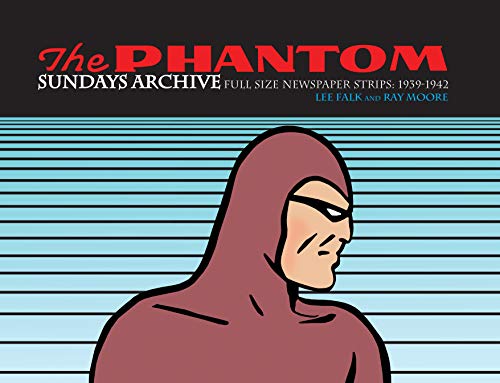
The Phantom Sundays Archive volume 1 – Full-Size Newspaper Strips: 1939-1942


By Lee Falk & Ray Moore: introduction by Daniel Herman (Hermes Press)
ISBN: ?978-1-61345-081-9 (HB/Digital edition), ?978-1-61345-091-8 (Limited Edition)

Win’s Christmas Gift Recommendation: Landmark and Lovely Comics Adventure… 9/10

Born Leon Harrison Gross, Lee Falk created the Jungle Avenger at the request of his King Features Syndicate employers who were already making history, public headway and loads of money with his first strip sensation Mandrake the Magician. Although technically not the first ever costumed champion in comics, The Phantom became the prototype paladin to wear a skin-tight body-stocking and the first to have a mask with opaque eye-slits…

The Ghost Who Walks debuted on February 17th 1936 in an extended sequence pitting him against an ancient global confederation of pirates. Falk wrote and drew the daily strip for the first two weeks before handing over illustration to artist Ray Moore. The spectacular and hugely influential Sunday feature gathered here began in May 1939.

For such a long-lived, influential series, in terms of compendia or graphic collections, The Phantom has been quite poorly served in the English language market (except in the Antipodes, where he has always been accorded the status of a pop culture god).

Numerous companies have sought to collect strips from one of the longest continually running adventure serials in publishing history, but in no systematic or chronological order and never with any sustained success. That began to be rectified when archival specialists Hermes Press began offering curated collections…

This particular edition is a lovely and large landscape hardback (but also available in digital formats), displaying a complete full colour Sunday per page. Released in May 2015, it was printed on matt paper to mimic the original newsprint experience: 160 pages measuring 310 x 430 mm, and also in a Special Limited Edition of 1000 copies, should you require your reading matter to double as an antiquarian artefact…

It’s still readily available in digital form and – stuffed with sumptuous visual goodies like movie posters, comics covers and original art – Daniel Herman’s ‘Introduction: The Phantom’s First Foray into Color’ – tells all you need to know about the character, his creators, and predecessor/co-star before the vintage magic begins…

It opens with a recapped origin: showing how 400 years previously, a British sailor survived an attack by pirates, and – washing ashore on the African coast – swore on the skull of his father’s murderer to dedicate his life and that of his descendants to destroying all pirates and criminals. The Phantom fights crime and injustice from a base deep in the jungles of Bengali, and throughout Africa and Asia is known as the “Ghost Who Walks”…

His unchanging appearance and unswerving war against injustice led to his being considered an immortal avenger by the uneducated, credulous and wicked. Down the decades, one champion after another has fought and died in an unbroken family line, with the latest wearer of the mask indistinguishable from the first and proudly continuing the never-ending battle.

‘The League of Lost Men’ spanned May 28th to October 15th 1939, detailing how a gang of white thugs led by untutored brute Twitchy began teaching rural tribes the concept of the “protection racket”. With villagers killed and entire communities aflame, the Ghost took action just as white entomologist Professor Thrush and his beautiful, dutiful daughter Helen stumbled into the army of criminals whilst searching for skull-emblazoned Death’s Head moths…

With the scientists as hostages, the Phantom was reduced to playing a waiting game, but detective work revealed his enemies comprised hundreds of convicts escaped from a foundered prison ship. Gravely outnumbered, our hero and lupine assistant Devil (that’s a wolf. Yes, in Africa. Just go with it…) employ psychological warfare, using those skull moths and combat skills in a war of attrition bringing the legion to doom or reincarceration…

International espionage and environmental terrorism informed ‘The Precious Cargo of Colonel Winn’ (October 15th 1939 March 10th 1940) as the Phantom fails to save an aging British agent and takes over his identity and mission: delivering a crucial coded message to India. As a consequence he soundly scuppers a scheme to blow up a major dam, drown hundreds of people and kill millions more through thirst…

Every saga featured powerful, capable and remarkably attractive women as both heroes and villains, but Falk & Moore went a step further with ‘The Fire Goddess’ (March 17th – July 21st 1940). Restored to Africa, the hero faced mass uprisings and the end of “The Phantom’s Peace” when the Mesabi people took up their belligerent old religion. Some diligent investigation uncovered another get-rich-quick scheme by white crooks and an elderly Mesabi seer who jointly conned and compelled a beautiful red-haired nightclub dancer into being their personal war deity.

Once the Ghost finally liberated Manna Day from her captors and inflicted his brand of justice, he assumed he’d seen the last of her but she was back immediately as ‘The Beachcomber’ (July 28th – December 29th 1940) found her rescuing deranged hobo Whitey, slowly expiring on an African shoreline.

Befriending the degenerate, she uncovered a horrific tale of injustice as her fellow American revealed how he was a fugitive: perfectly framed for murder by his own lawyer. Manna decided it was a case for her masked friend…

After dragging Whitey across the continent to the fabled Skull Cave, she convinced the hero to head for the USA where “Kit Walker” made them extremely conspicuous in New York, drawing the attention of a slick murder-for-hire mob, assassinating powerful people and duping innocents into carrying the can – just as they had with Whitey…

Infiltrating the group, Walker uses his new position to save an honest Judge before deftly dismantling the killer corporation.

Heading home, he was barely out of the judge’s house before the next escapade began as he overheard plans of ‘The Saboteurs’ (January 5th February 23rd 1941) at a railway station. With Devil beside him, The Ghost Who Walks tumbled into an escalating sequence of stunning action set-pieces involving trains, planes, automobiles – even oil pipelines and roller coasters! – as he wiped out the seditious enemy agents.

The remainder of this initial outing features movie-length extravaganza ‘The Return of the Sky Band’ (running March 2nd 1941 to February 22nd 1942). The first clash had been The Phantom’s second published case (originally published in black-&-white Daily form from 9th November 1936 to April 10th 1937): pitting the Grim Ghost against merciless aviators plundering passenger planes and cargo flights.

His crusade against cloud bandits ruthlessly raiding passenger planes and airships throughout the orient only shattered the gang – comprised solely of women – after his manly charms inadvertently drove a fatal wedge between deranged and deadly commander The Baroness and her ambitious second in command Sala

Now as the hero reaches home, news comes of more air piracy and The Phantom volunteers his services to an embattled air clipper company. All too soon, he’s matching wits with Sala again, hunting the new Sky Band’s secret island base. And once again he ends up in jail accused of masterminding their crimes…

However, before he can escape police custody, the air pirates make a fatal error, allying with an enemy power. Very soon the women learn that they are far from the apex predators they consider themselves. When the Phantom escapes, he’s not sure if he’s shutting them down or saving them.

Sala’s deputy Margo has no doubts or qualms though, delivering their potential saviour to the enemy military, only to have the Ghost Who Walks wreak awful vengeance on their sailors as they flee in a submarine…

However, even with a secret invasion foiled and Sala and Margo arrested, the danger is not over, and their attempts to get away leads to a horrific act of sabotage as the enemy submariners also break free…

Only another unlikely alliance saves the day, and sees a return to relative stability in a world teetering on the edge of another global war…

To Be Continued…

Taken from America’s immediate pre-war period, these brief encounters are uncomplicated fare, full of lost kingdoms and savage tribes, very bad guys and fallen but still redeemable dames; but thrilling yet reassuring entertainment for all that. Finally rediscovered, these lost treasures are especially rewarding as the material is still fresh, entertaining and addictively compelling.

But, even if it were only of historical value (or just printed for Australians – who have long been manic devotees of the implacable champion) surely the Ghost Who Walks is worthy of a little of your time?
The Phantom® © 1939-1942 and 2015 King Features Syndicate, Inc. ® Hearst Holdings, Inc.; reprinted with permission. All rights reserved. Introduction © 2015 Daniel Herman.
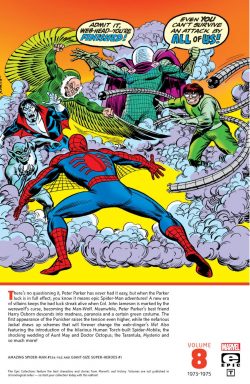
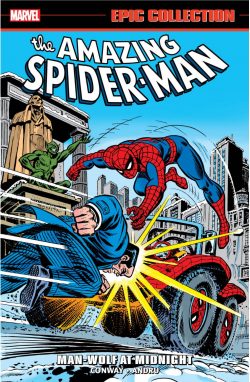
Amazing Spider-Man Epic Collection volume 8: Man-Wolf at Midnight 1973-1975


By Gerry Conway Ross Andru, Gil Kane, John Romita, Paul Reinman & various (MARVEL)
ISBN: 978-1-3029-3350-0 (TPB/Digital edition)

Win’s Christmas Gift Recommendation: Astounding Arachnid Amazement… 9/10

Amazing Spider-Man was a comic book that matured with – or perhaps just slightly ahead of – its fan-base. This epic compendium of chronological webspinning wonderment sees the World’s Most Misunderstood Hero facing even greater and evermore complex challenges as he slowly recovers from the trauma of losing his true love and greatest enemy in the same horrific debacle…

Once original co-creator Stan Lee replaced himself with young author Gerry Conway, the scripts acquired a more contemporary tone (which of course often feels quite outdated from here in the 21st century): purportedly more in tune with the times whilst the emphatic use of soap opera subplots kept older readers glued to the series even when the bombastic battle sequences didn’t.

Moreover, as a sign of those times, a hint of cynical surrealism also began creeping in…

Thematically, there’s a decline in old-fashioned gangsterism and a growing dependence on outlandish villains. The long-established balance of costumed super-antagonists with thugs, hoods and mob-bosses was gradually tipping and a global resurgence in supernatural stories resulted in more monsters and uncanny happenings…

Nevertheless, the wallcrawler was still indisputably mainstream comics’ voice of youth and defined being a teen for readers of the 1970s: facing incredible hardships, fantastic foes and the most pedestrian and debilitating of frustrations.

For newcomers – or those just visiting thanks to the latest Spider-Man movies: Smart-but-alienated Peter Parker was bitten by a radioactive spider during a school trip. Discovering strange superhuman abilities which he augmented with his own natural chemistry, physics and engineering genius, the kid did what any lonely, geeky nerd would do with such newfound prowess: he tried to cash in for girls, fame and money.

Making a costume to hide his identity in case he made a fool of himself, Parker became a minor media celebrity – and a criminally vainglorious one. To his eternal regret, when a thief fled past him one night he didn’t lift a finger to stop him, only to find when he returned home that his guardian uncle Ben Parker had been murdered.

Crazed and vengeful, Peter hunted the assailant who’d made his beloved Aunt May a widow and killed the only father he had ever known. He discovered to his horror that it was the self-same felon he had neglected to stop. His irresponsibility had resulted in the death of the man who raised him, and the traumatised boy swore to forevermore use his powers to help others.

Since that night, the Wondrous Wallcrawler tirelessly battled miscreants, monsters and madmen, with a fickle, ungrateful public usually baying for his blood even as he perpetually saves them.

Now the high school nerd has grown up and gone to college. Because of his guilt-fuelled double-life he struggles there too – even developing a stress ulcer – but finds abiding love with cop’s daughter Gwen Stacy… until she is murdered by the Green Goblin. Now Parker must pick up the pieces of his life…

This stunning compilation reprints Amazing Spider-Man #124-142 and Giant-Size Super-Heroes #1: collectively covering cover-dates September 1973 to March 1975, affirming an era of astounding introspective drama and captivating creativity.

As previously stated, at this time horror was on the rise and the trend permeated all aspects of Marvel continuity. In #124, J. Jonah Jameson’s astronaut son John was revealed to have picked up a strange gem during a unofficial moonwalk which later transformed him into a lupine beast bearing ‘The Mark of the Man-Wolf!’ by Conway, Gil Kane & John Romita.

Deranged and deadly, the hairy horror stalks his own fiancée Kristine Saunders as well as his scandal-obsessed, newspaper-publisher father, with a gravely-traumatised, fighting-mad Spider-Man reacting in a far more brutal manner than ever before…

The conclusion marked the official debut of the title’s next star penciller as Ross Andru joined Conway and Romita to delineate the end of the Man-Wolf saga in ‘Wolfhunt!’: offering a particularly grisly cure for the ethereally-altered astronaut…

In #126, a new subplot bloomed as a marketing firm hires the astounded and unbelieving arachnid to build a “Spider-Mobile” (thanks to a budding toy-merchandising deal Marvel was then negotiating) whilst an old and extremely inept enemy returns as ‘The Kangaroo Bounces Back!’ (drawn by Andru and inked by Jim Mooney).

Short of cash and desperate, Spidey ropes in best frenemy Johnny (Human Torch) Storm to help assemble the anticipated automobile, but is totally unprepared for his Australian attacker since bouncing bounder has endured a rapid and ultimately unwelcome power upgrade from a rogue – and extremely deranged – doctor named Jonas Harrow

Meanwhile, in the apartment Peter still shares with Harry Osborn (son of the Green Goblin), his flatmate finally succumbs to the mental illness that has been sucking him down since the death of dear old Dad…

Peter’s frivolous party-loving friend Mary Jane Watson comes under the spotlight in #127 as ‘The Dark Wings of Death!’ – inked by Frank Giacoia & Dave Hunt – finds her targeted by a strangely familiar monster who believes she witnessed his last kill. The mystery concludes in ‘The Vulture Hangs High!’ wherein an incredible truth about the avian atavist is revealed. Moreover, portents of future catastrophe manifest as Parker’s biology tutor Professor Miles Warren warns that the scholarship student’s grades are slipping and his position is far from secure…

Conway, Andru, Giacoia & Hunt crafted a true landmark in comics history in Amazing Spider-Man #129 with ‘The Punisher Strikes Twice!’: introducing not only the renegade gunslinger but also nefarious manic mastermind The Jackal.

Although one of the industry’s biggest hits from the late 1980s onwards, compulsive vengeance-taker Frank Castle was always an unlikely and uncomfortable star for comic books. His methods are always excessively violent and usually permanent. It’s intriguing to note that unlike most heroes who debuted as villains (Black Widow, Hawkeye and Wolverine immediately come to mind) The Punisher actually became more immoral, anti-social and murderous, not less: the buying public simply shifted its communal perspective as the Punisher never toned down or cleaned up his act…

He was created by Conway, Romita Sr. and Andru; an understandably sanitised and muted response to popular prose anti-heroes like Don Pendleton’s Mack Bolan: the Executioner: the cutting edge of a bloody tide of fictive Viet Nam vets who all turned their training and talents to wiping out organised crime in the early 1970s.

In this short, sharp shocker the man with the skull on his chest is duped by his manipulative partner into hunting Spider-Man. Still a suspect in the death of Norman Osborn, the hero is easy to frame for the murder of the Punisher’s personal armourer and gunmaker…

A long-running mystery over Aunt May’s connection to Doctor Otto Octavius is at last addressed in #130 as ‘Betrayed!’ finds up-&-coming gang boss Hammerhead prodded and provoked by the Jackal, just as arch-rival Doctor Octopus resurfaces.

Distracted by his now-completed Spider-Mobile, the webslinger is slow to react …until he finally discovers why May Parker is so important to the villain, but by then she’s in the process of becoming Mrs. Otto Octavius…

Spider-Man is just about to bust up the wedding in ‘My Uncle… My Enemy?’ when Hammerhead beats him to it. As the three-way war escalates, the truth comes out. May has inexplicably inherited a desolate Canadian island which just happens to be teeming with uranium deposit, and its own Fast Breeder Atomic Reactor, which both Ock and Hammerhead want to secure as the means to becoming an independent nuclear power. When the rival rogues furiously clash, it’s all Peter can do to get May out before the entire place becomes an atomic inferno…

Illustrated by John Romita Sr., Paul Reinman & Tony Mortellaro, fresh moody mystery welcomes the weary Spider-Man back to New York after saving Aunt May from becoming a collateral casualty of atomic armageddon as he stumbles into ‘The Master Plan of the Molten Man!’ It begins when old school flame Liz Allen resurfaces needing help. Peter has no idea she is secretly trying to help her criminal stepbrother…

As a super-strong metal-skinned bandit Mark Raxton was only a minor inconvenience to the wallcrawler, but now his chemically induced condition has worsened and he is swiftly turning into an incandescent human fireball. However, by the time ‘The Molten Man Breaks Out!’ in #133 – illustrated by new regular creative team Andru and inkers Giacoia & Hunt – there’s nothing the hero can do but fight until one of them is dead…

Slightly adrift of publishing chronology, next comes a classic monster action yarn from Giant-Size Super-Heroes #1. With the monster boom in full swing, Marvel during this period flooded newsstands with horror-themed heroes and antiheroes and cannily teamed two of the Amazing Arachnid’s eeriest enemies in a double-length epic as ‘Man-Wolf at Midnight!’ – by Conway, Kane & Mike Esposito – finds John Jameson again gripped by murderous moon-madness. This time, however, the tormented former astronaut has been enthralled by Living Vampire Morbius and used to help that bloodsucker secure a possible cure for his own appalling condition in ‘When Strikes the Vampire!’

That dynamic dust-up led directly into a flurry of over-sized Giant-Size Spider-Man editions, but as none of them are included in this volume we return to Amazing Spider-Man #134 (July 1974) wherein the webspinner again crosses paths with The Punisher after a South American bandit – trained to be his oppressive regime’s Captain America before going freelance – attempts to pirate, pillage and ransom a Manhattan tour boat in ‘Danger is a Man Named… Tarantula!’ (Conway, Andru, Giacoia & Hunt).

Once again unwilling allies, the ethically-estranged duo dutifully dismantle the villain’s larcenous schemes leading to a ‘Shoot-Out in Central Park!’ but the real danger is building elsewhere as Parker’s roommate Harry Osborn accepts at last the infamous inheritance of his devilish, recently departed dad…

The compelling, long-brewing clash of former friends kicks off with completely crazy Harry attempting to blow up Peter and Mary Jane in ‘The Green Goblin Lives Again!’…

Privy to his best friend’s secrets, the maniac then targets all Parker’s loved ones, precipitating a desperate, deadly duel as ‘The Green Goblin Strikes!’ resulting in doom, destruction, shocking revelations and another tragedy for Peter to feel forever responsible for…

‘Madness Means… the Mindworm!’ finds a still-reeling Parker evicted from his apartment and relocating downmarket to Queens, just in time to encounter a macabre psychic parasite feeding off the denizens of the district.

Issue #139 then introduces a bludgeoning brute with a grudge against J. Jonah Jameson on the ‘Day of the Grizzly!’ When Spidey intervenes, he is soundly thrashed and handed over to the costumed crazy’s silent partner the Jackal who melodramatically reveals he knows the hero’s true identity…

Even though Peter escapes his diabolical trap in ‘And One Will Fall!’ the major maniac flees and remains at large…

A long-running comedy thread ends as the ridiculous Spider-Mobile ends up in the river, but the wallcrawler barely has time to care as an apparently dead enemy returns in #141’s ‘The Man’s Name Appears to be… Mysterio!’ Despite aggressively escalating psychological assaults and our hero questioning his own sanity, the mystery is smartly resolved in ‘Dead Man’s Bluff!’, wrapping up this transitional period in the life of Peter Parker and setting the scene for another shocking epic, life-changing encounter next time…

These narrative delights are supplemented by Romita’s cover, frontispiece, contents page and back cover from the 1974 debut tabloid edition Marvel Treasury Edition #1: The Spectacular Spider-Man as well as a faux Daily Bugle feature by Conway & Marie Severin; plus House ads; Kane page and cover layouts; the original Punisher design sketch by Romita and original art covers and interior pages by Kane, Romita &Andru.

Also on show are the Romita-rendered entry from Mighty Marvel Calendar for 1975, and a text & photo feature on the first live action Spider-Man film.

Blending cultural veracity with superb art, and making a dramatic virtue of the awkwardness, confusion and imputed powerlessness most of the readership experienced daily always resulted in an irresistibly intoxicating read, especially when delivered in addictive soap-styled instalments, but none of that would be relevant if Spider-Man’s stories weren’t so compellingly entertaining.

This action-packed collection relives many momentous periods in the wallcrawler’s astounding life and is one every Fights ‘n’ Tights fanatic must see…
© 2022 MARVEL.

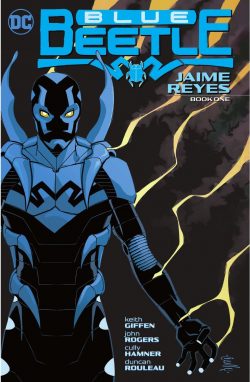
Blue Beetle Jaime Reyes Book One


By Keith Giffen, John Rogers, Cully Hamner, Duncan Rouleau, Rafael Albuquerque, Cynthia Martin, Kevin West, Phil Moy, Jack Purcell, Casey Jones & various (DC Comics)
ISBN: 978-1-77951-506-3 (TPB/Digital edition)

Win’s Christmas Gift Recommendation: All Action Superhero fun and Thrills… 9/10

As the most recent incarnation of the venerable Blue Beetle brand makes the jump from comic book limbo and kids’ animation reruns into live action movie madness, here’s a recent re-release of the first dozen of the superb 36-issue run that began in 2006: one of the most light-hearted and compelling iterations of the Golden Age stalwart and still a pure joy to behold…

The Blue Beetle first appeared in Mystery Men Comics #1, published by Fox Comics and cover-dated August 1939. The eponymous lead character was created by Charles Nicholas (AKA Charles Wojtkowski): a pulp-styled mystery man who was a born nomad. Over the years and crafted by a Who’s Who of extremely talented creators, he was also inexplicably popular and hard to kill: surviving the failure of numerous publishers before ending up as a Charlton Comics property in the mid-1950s.

After releasing a few issues sporadically, the company eventually shelved him until the superhero revival of the early 1960s when young Roy Thomas revised and revived the character for a 10-issue run (June 1964, February 1966) reinventing cop/adventurer Dan Garrett as an archaeologist, educator and scientist who gained super-powers whenever he activated a magic scarab with the trigger phrase “Kaji Da!”

Later that year, Steve Ditko (with scripter Gary Friedrich) utterly recreated the Blue Beetle. Ted Kord was an earnest and brilliant young researcher who had been a student and friend of Professor Garrett. When his mentor seemingly died in action, Kord trained himself to replace him: a purely human inventor/combat acrobat, bolstered by ingenious technology. This latter version joined DC’s pantheon during Crisis on Infinite Earths, earning his own series and a quirky immortality partnering with Booster Gold in Justice League International and beyond…

Collecting Blue Beetle (volume 7) #1-12 spanning May 2006 – April 2007, this saga follows the hallowed formula of a teenager suddenly gifted with great powers, and reveals how some heroes are remade, not born…

At the height of the Infinite Crisis (Link please, June 18 2008), El Paso high-schooler Jaime Reyes found a strange blue jewel shaped like a bug. That night, as he slept, it attached itself to his back, transforming him into a bizarre insectoid warrior. Almost immediately, he was swept up in the chaos, joining Batman and other heroes in a climactic space battle.

As this series opens on ‘Blue Monday’ (written by Keith Giffen & John Rogers and limned by Cully Hamner), he’s come home to El Paso, Texas; terrified for staying out late on a school night, and is suddenly attacked by Green Lantern Guy Gardner. The situation rapidly escalates as his sentient bug armour reacts instinctively and manically to the emerald energy of the foe…

As the fight builds in intensity, by way of flashbacks we see Jaime’s life before everything changed: meeting best buds and fellow high school inmates Paco and Brenda – who were with him when he found the scarab that messed up his life – and bratty little sister Milagro as well as his wonderfully cool parents…

The battle ends as soon as Gardner realises he’s fighting a child, but as when he flies off, the Lantern drops a shocking bombshell: whatever is empowering the kid and manifesting his talking, weapons-infested bug suit, it ISN’T magic…

The mystery intensifies in ‘Can’t Go Home Again’ as more recovered memories detail early clashes with local super-gangbangers The Posse and hint at big changes in Jaime. In the present, Reyes is slowly making his way back to his house, terrified over how his folks will react to his disappearance last night. It’s far worse than he could have imagined and a real shock when he discovers that he’s actually been missing for a year…

Illustrated by Cynthia Martin & Philip Moy ‘The Past is Another Country’ sees Jaime demonstrate his new powers to his gobsmacked family, only to be (initially) rejected and abandoned. Whilst the Reyes clans come to terms with their “dead” son resurrected as a bug monster, the stunned lad road tests his new powers and tracks down his old friends.

A lot has changed: Paco is now part of the Posse and those outcast teens are locked in a deadly war with the minions of local organised crime-boss La Dama… who just happens to be Brenda’s legal guardian Tia Amparo

Cully Hamner returns in #4 as Giffen & Rogers detail how Jaime starts looking into previous Blue Beetles and owners of the scarab and becomes a ‘Person of Interest’ to cyber-hero Oracle/Barbara Gordon who tests him with a view to making him one of her Birds of Prey. That doesn’t end well and presages far worse as militaristic mystery man The Peacemaker hits town on the down-low, secretly seeking old comrade and associate “Blue”…

Delivered in two parts over #5 and 6, ‘Secrets’ is illustrated by Duncan Rouleau, Martin, Kevin West, Moy & Jack Purcell. It reveals how The Phantom Stranger arrives, also hoping to clear up the mystery of this new Blue Beetle. Seeking to ascertain the teen’s place in the hierarchy of “the New Age of Magic” is something many factions are working on, from The Posse to La Dama’s pet goon the Diviner. Chaos reigns as all the investigators converge and clash when a baby of great power is stolen and Jaime at last learns that sometimes you just have to step up and do the right thing…

Following a brutal confrontation with plenty of shocking revelations ‘Secrets Pt 1 of 2’ sees a sharp redefinition of allegiances and anew status quo that almost immediately founders when Peacemaker reveals what nobody seemed able to discern – the true nature of Jaime’s scarab…

John Rogers is sole scripter for BB #7 as ‘Brother’s Keeper’ offers a guest-star packed recap of Reyes’ career to date: filling in many blanks since the night the new Beetle helped save the world. Illustrated by Hamner & Casey Jones and with Giffen back on board, ‘Road Trip’ sees Jaime, Brenda and Peacemaker go looking for even more answers: beginning by consulting young cyber-geek Dan Garrett – a self-proclaimed expert on all previous Blue Beetles.

As the original hero’s granddaughter she also has a fair claim to being the rightful owner of the gem, but a potential squabble and their research is interrupted by the return of a monstrous hunchbacked maniac determined to destroy the “demonic” new hero.

Following that Roleau renders ‘Inside Man’, telling why Peacemaker has so-unwillingly involved himself in Jaime’s life just as Brenda finds herself in a world of trouble…

Living with her aunt – the magic-wielding, arch crime boss of El Paso – in a felonious clearing house for stolen super-technology and magical artifacts, it was only a matter of time before Brenda stumbled upon something really dangerous. Whisked to an far-distant world in ‘Should’ve Taken that Left Turn at Albuquerque…’ (with art from Hamner and Rafael Albuquerque!), her disappearance forces an uneasy truce between Jaime and La Dama so that the Beetle can rescue Brenda, consequently encountering a selection of New Gods and hungry aliens before successfully bringing her back in ‘The Guns of Forever’ (by Rogers & Albuquerque, and we end on a thematic cliffhanger with ‘Meet the New Boss’ as Beetle and Peacemaker investigate cattle mutilations, battle a giant bug monster and meet its owner – an extraterrestrial envoy from extragalactic trading empire The Reach. He also claims to be the creator of the scarab…

With a gallery of variant covers, sketches and character designs by Hamner, this is a welcome return for a great series: one of precious few comic books to combine action and adventure, with comedy and suspense perfectly leavened with fun and wit. Blue Beetle Jaime Reyes offers an innovative and wryly engaging saga impossible to resist, especially with the artistic endeavours of Hamner, Martin, Albuquerque, Rouleau and Jones making each page a visual treat. Even 17 years on, Blue Beetle remains a fresh and delightful joy, so why not bug out and Go Read This!
© 2006, 2007, 2022 DC Comics. All Rights Reserved.

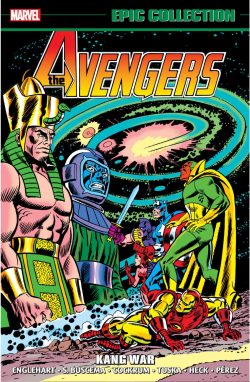
Avengers Epic Collection volume 8: Kang War 1974-1976


By Steve Englehart, Roy Thomas, Tony Isabella, Sal Buscema, Dave Cockrum, George Tuska, Don Heck, George Pérez, Keith Pollard, Joe Staton & various (MARVEL)
ISBN: 978-1-3029-3352-4 (TPB/Digital edition)

Win’s Christmas Gift Recommendation: Amazement Assembled!… 9/10

One of the most momentous events in comics (and now, film) history came in the middle of 1963 when a disparate gang of heroic individuals banded together to combat an apparently out of control Incredible Hulk.

The Avengers combined most of the company’s fledgling superhero line in one bright, shiny and highly commercial package. Over intervening decades the roster has never stopped changing, and now almost every character in the Marvel multiverse has at some time numbered amongst their colourful ranks…

After instigators Stan Lee & Jack Kirby moved on, the team prospered under the guidance of Roy Thomas who grew into one of the industry’s most impressive writers, directing the World’s Mightiest Heroes through adventures ranging from sublimely poetic to staggeringly epic. He then handed over the scripting to a young writer who carried the team to even greater heights…

This stunning compilation assembles Avengers #129-149 and Avengers  Giant-Size #2-4: collectively covering November 1974 to July 1976, to conclude an era of cosmic catastrophe and cataclysmically captivating creativity.

The Avengers have always proved that putting all one’s star eggs in a single basket pays off big-time: even when all Marvel’s classic all-stars such as Thor, Captain America and Iron Man were absent, it merely allowed the team’s lesser lights to shine more brightly. Of course, as in this volume, the founding stars were regularly featured due to the rotating, open door policy which meant that every issue included somebody’s fave-rave. The boldly grand-scaled stories and artwork are no hindrance either.

It all begins as Englehart explores the outer limits of Marvel history and cosmic geography to construct an epic revelation of universal structure, the true beginnings of Marvel time and the formative years of some of the most intriguing characters in comics…

The drama opens with Avengers #129 and ‘Bid Tomorrow Goodbye!’ (illustrated by Sal Buscema & Joe Staton) as Kang the Conqueror abruptly appears, determined to possess the legendary female figure he calls “the Celestial Madonna.”

Apparently, this anonymous being will birth the saviour of the universe, but since no records survive disclosing which of the three women in Avengers Mansion at that crucial moment – mutant sorcery student Scarlet Witch, martial artist Mantis and aged witch Agatha Harkness – she actually is, the time-reaver is resolved to capture all three and forcibly make himself the inevitable father of the child…

This time, not even the assembled Avengers can stop him and, after crushing and enslaving them, Kang makes off with his hostages, leaving only the recently-injured and swiftly declining Swordsman free to contest him…

The tale continues in Giant-Size Avengers #2, with ‘A Blast from the Past!’ (limned by Dave Cockrum) as reluctant returnee Hawkeye rushes to the fallen team’s rescue, uniting with old adversary/mentor Swordsman and enigmatic entity Rama-Tut – who eventually reveals himself as Kang’s reformed future self…

Against all odds, the merely mortal heroes manage to liberate the enslaved Avengers and rout the unrepentant Kang – but only at the cost of Swordsman’s life…

Avengers #130 posed ‘The Reality Problem!’ (with art from Sal B & Staton), depicting how heartbroken and much-chastened Mantis joins the team in Vietnam to investigate her mysteriously clouded past, only to be drawn into pointless combat with Soviet/Chinese Communist exiles and former Avenger foes Titanium Man, Radioactive Man and Crimson Dynamothanks to the devious manipulations of petty sneak thief The Slasher

Brief but heated battle concluded, the origin trail leads to ‘A Quiet Half-Hour in Saigon!’ during which the American adventurers are again attacked by Kang, who traps them in Limbo and unleashes against them a macabre Legion of the Unliving comprising mind-controlled, currently “dead” heroes plucked from the corridors of history…

With yet another chronal villain Immortus added to the mix, ‘Kang War II’ sees resurrected heroes and villains Wonder Man, 1940’s android Human Torch, the Monster of Frankenstein, martial arts assassin Midnight, the actually spectral Flying Dutchman and the first Baron Zemo decimate the team. Moreover, the trauma and tragedy are further exacerbated as Mantis keeps seeing the ghost of her dead lover…

This absorbing thriller by Englehart, Roy Thomas, Sal Buscema & Staton segues inexorably into Giant-Size Avengers #3’s ‘…What Time Hath Put Asunder!’ Illustrated by Cockrum & Joe Giella, it sees Earth’s Mightiest Heroes pulling victory from the ashes of defeat and receiving a unique gift from one of the assembled Masters of Time…

Avengers #133 voyages to ‘Yesterday and Beyond…’ (by Englehart, Sal B & Staton) as the shocked heroes accompany Mantis to the beginnings of recorded Galactic history to unravel of her true past, whilst The Vision is separately dispatched to glimpse his own obscure and complex origins: a double quest encompassing both the Kree and Skrull empires, the previously defeated monstrous Star-Stalker, long-deceased Priests of Pama, Thanos and telepathic Titan Moondragon, as well as a goodly portion of classic superhero history in ‘The Times That Bind!’ before #135 reveals how ‘The Torch is Passed!’ (limned by George Tuska & Frank Chiaramonte), before bringing all the disparate elements together in Giant-Size Avengers #4.

‘…Let All Men Bring Together’ (art by Don Heck & John Tartaglione) brings a satisfactory conclusion to the long-standing. pitfall-plagued romance between the Scarlet Witch and Vision and details another, far more cosmic union with a brace of weddings and the ultimate ascension of the Celestial Madonna – despite demonic extra-dimensional despot Dormammu attempting to despoil the matrimonial celebrations…

A new era was supposed to begin in Avengers #136 but a deadline was missed and instead ‘Iron Man: DOA!’ by Englehart, Tom Sutton & Mike Ploog was reprinted from Amazing Adventures #12, wherein the newly-mutated and furry Hank McCoy AKA The Beast had attacked the Armoured Avenger whilst mind-controlled by evil mutants. You can find the story here.

This book, however, only offers the spiffy cover by Gil Kane, Joe Sinnott & John Romita, before normal service resumed with the Assemblers addressing their staffing issues by declaring ‘We Do Seek Out New Avengers!!’

Illustrated by Tuska & Vince Colletta, #137 depicted an eclectic mix of applicants – including Moondragon, Yellowjacket and The Wasp and an athletic, enigmatic guy bundled up in a raincoat…

No sooner have introductions begun than a cosmic villain attacks, hunting the honeymooning Scarlet Witch and Vision, but at far from his expected level of puissance. Easily escaping imminent doom, our heroes smell a rat – but sadly, not before the Wasp is gravely injured, resulting in a blazing battle with a ‘Stranger in a Strange Man!’ who proves to be far from what he claims…

After all the intergalactic, hyper-cosmic extravaganzas and extended epic antics, Avengers #139’s ‘Prescription: Violence!’ and #140’s ‘A Journey to the Center of the Ant’ resort to mayhem on a comfortingly down-to-Earth scale as malevolent foe Whirlwind tries to murder the bed-ridden Wasp, even as her devoted defender and husband Hank Pym/Yellowjacket succumbs to a growing affliction which dooms him to exponentially expand to his death… but only until a refreshed, returned Vision and bludgeoning Beast save the day in an extraordinary riff on classic Avengers history (which you can see in Avengers #93, if you want to)…

A new Englehart saga starts in #141 which also welcomed George Pérez & Colletta as new art team. ‘The Phantom Empire!’ heralded another complex, multi-layered epic combining superheroic Sturm und Drang with searing – for 1975, at least – political commentary. It all starts when Beast is ambushed by mercenaries from corporate behemoth Roxxon Oil.

He’s saved by ex-Avenger Captain America who had been investigating the company on a related case and – after comparing notes – realises something very big and very bad is going on…

Linking up with Thor, Iron Man, trainee Moondragon and the newly-returned newlyweds Vision and Scarlet Witch, they learn of another crisis after Hawkeye goes missing: probably captured by time-tyrant Kang

Just as the Assemblage are splitting into teams, former child model Patsy Walker-Baxter (star of a bunch of Marvel’s girls’ market titles such as Patsy Walker and Patsy & Hedy) bursts in, threatening to expose Beast’s secret identity…

When he had first further mutated, McCoy had attempted to mask his anthropoid form, with Patsy helping in return for his promise to make her a superhero. Now she resurfaces, prepared to blackmail him into honouring his pledge. She is dragged along as one squad (Cap, Iron Man, Scarlet Witch and Vision) join Beast in returning to his old lab at Brand/Roxxon …where they are ambushed by alternate-Earth heroes The Squadron Supreme

Meanwhile, Moondragon and Thor co-opt sometime ally Immortus and follow Hawkeye back to 1873. Bushwhacked, they are soon battling Kang beside a coterie of cowboy legends (Kid Colt, Night Rider, Ringo Kid, Rawhide Kid and Two-Gun Kid) in ‘Go West, Young Gods!’, even as the present-day team learn their perilous plight involves a threat to two different dimensions…

Roxxon have joined with the corporations that rule the Squadron Supreme’s parallel-Earth America – thanks to the malignly mesmeric Serpent Crown of Set. Inked by Sam Grainger, Avengers #143 sees the Wild West showdown culminate with the apparent death of a deity in ‘Right Between the Eons!’

Elsewhen, the 20th century heroes have commenced a counterattack in the esoteric weaponry factory at Brand, and – whilst running rampant – liberate from a storeroom a technologically-advanced, ability-enhancing uniform originally belonging to short-lived adventurer The Cat. When Patsy dons it, the hero-groupie neophyte dubs herself Hellcat in ‘Claws!’ (Mike Esposito inks)…

Soon after, the Avengers are cornered by the Squadron and as battle resumes, Roxxon president Hugh Jones plays his trump card and transports all combatants to the other Earth…

The dreaded deadline doom hit just at this crucial juncture and issues #145-146 were taken up with a 2-part fill-in by Tony Isabella, Heck & Tartaglione, with additional pencils by Keith Pollard for the concluding chapter.

‘The Taking of the Avengers!’ reveals how a criminal combine takes out a colossal contract on the team, but even though ‘The Assassin Never Fails!’ the killer is thwarted and Captain America, Thor, Iron Man, Hawkeye, Beast, Vision and Scarlet Witch, Wasp, Yellowjacket and The Falcon are all safely returned to their various cases, untroubled by the vagaries of continuity or chronology… which makes this rather impressive yarn such an annoyance in this specific instance…

Trans-dimensional traumas resume in Avengers #147, describing a ‘Crisis on Other-Earth!’ courtesy of Englehart, Pérez & Colletta). With the corporate takeover of other-America revealed to have been facilitated by use of the serpent crown, the Scarlet Witch takes possession of the sinister helm as her teammates try desperately to keep the overwhelming Squadron Supreme from reclaiming it.

On our Earth, Hawkeye brings Two-Gun Kid to the modern world, but chooses to go walkabout rather than rejoin his comrades, even as Thor and Moondragon start searching for their missing colleagues…

‘20,000 Leagues Under Justice!’ (Grainger inks) begins the final showdown with the Avengers’ victory over a wiser and repentant Squadron Supreme, and as the heroes return to their home dimension ‘The Gods and the Gang!’ reunites them with Moondragon and the Thunder God in time to clean up Brand/Roxxon. However, the Corporate cabal has one nasty trick left to play: a colossal, biologically augmented Atlantean dubbed Orka, the Human Killer Whale!’ He’s not enough to save them…

Supplementing the circumstances above described is the cover to all-reprint Giant-Size Avengers #5 (by John Buscema & George Roussos) and contemporaneous features from Marvel’s FOOM magazine #12 which spotlighted the romance and weddings with a Vision cover by John B & P. Craig Russell, back cover image by Paty (Cockrum) & Al Milgrom; an overview of the awesome android in ‘Visions’ and ‘Vision, This is Your Life!’ and David Anthony Kraft’s ‘The Scarlet Witch: Meditations on a Ms.’ – all including early art contributions from John Byrne, Paty, Dave Wenzel – plus an extended family pin-up.

Also on view are a Charley Parker spoof strip starring ‘The Visage’, extended interviews ‘Steve Englehart Speaks!: Journey to the center of a Vision’ and ‘Roy Thomas Speaks!: Journey to the center of a Vision’.

The next issue would see a drastic changing of the guard, but this epic tome concludes with even more extras including the covers – by Jack Kirby & Frank Giacoia – and Frontispiece contents page of tabloid Marvel Treasury Edition #7; a wealth of rousing house ads; Neal Adams’ painted cover for Marvel Index #3, its back cover by Franc Reyes and Frontispiece by Peter Iro; the pre-corrections cover to Giant-Size Avengers #2 plus pages of original art by Sal Buscema, Staton, Tuska & Chiaramonte.

Roy Thomas and Steve Englehart were at the forefront of Marvel’s second generation of story-makers, brilliantly building on and consolidating the compelling creation of Lee, Kirby & Ditko: spearheading and constructing a logical, fully functioning miracle-machine of places and events that so many others were inspired by and could add to. Between them they also showed how much more graphic narratives could be, and these terrific tales are perfect examples of superhero sagas done just right.

This type of timeless heroic adventure set the tone for fantastic Fights ‘n’ Tights dramas for decades to come and can still boggle the mind and take the breath away, even here in the sleek, cool and permanently perilous 21st century…

No lovers of Costumed Dramas can afford to ignore this superbly bombastic book and fans who think themselves above superhero stories might also be pleasantly surprised…
© 2022 MARVEL.

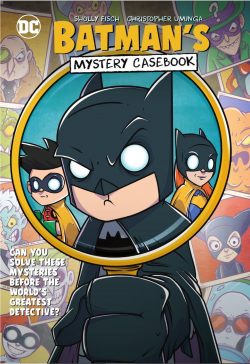
Batman’s Mystery Casebook


By Sholly Fisch, Christopher A. Uminga & various (DC Comics)
ISBN: 978-1-7795-0586-6 (TPB/Digital edition)

Win’s Christmas Gift Recommendation: Wonderfully Watching What’s What… 9/10

In recent years DC has opened up its shared superhero universe: generating Original Graphic Novels featuring its many stars in stand-alone adventures for the demographic so sadly misnamed Young Adult. To date, results have been rather hit or miss, but when they’re good, they are very good indeed…

Another sublime example of the process at its best is this cheery practical class in crimefighting: picking the brains and capitalising on the experience of Gotham’s greatest gangbusters and delivering details in the form of a comics activity book for all ages…

Author Sholly Fisch is no stranger to comics, having splendidly scripted Scooby Doo in various print incarnations and almost every DC superhero in All-New Batman: The Brave and the Bold and other animation-based spin-offs, Superman, Star Wars and so much more. When not doing that, he’s a developmental psychologist consulting for companies who make digital games and toys, with clients including Sesame Street, Cyberchase, The Magic School Bus Rides Again and The Cat in the Hat Knows a Lot About That. If you love fun superheroics and vintage comics trivia, you should seek out his work.

Cartoonist/designer/visualiser Christopher A. Uminga has worked for many media giants including DC Comics/Warner Bros., Lucasfilm, Foot Locker, Disney’s WonderGround Gallery and more, and is assisted in making this complex and arresting tome work by colourist Silvana Brys and lettering entity Andword Design (Morgan Martinez, Justin Birch & Deron Bennett)…

A quick word to the wise: Although for years DC’s mainstream continuity has depicted the Dark Knight as a driven and tormented borderline sociopath doing good for what seems to be all the wrong reasons, Batman has always been an archetype who works for all ages on vastly differing levels. This version is far more Caped Crimecrusher than Bat out of Hell, and reaffirms his reputation as “the World’s Greatest Detective” in a series of “fair play mystery” vignettes with the reader invited to pay close attention and participate at every moment of each case. Kids can enjoy alone or with the grandparents who watched the 1966 Batman TV phenomenon unfold and the parents who watched the 1990s movies and stunning Batman: The Animated Adventures series they spawned…

It begins in ‘Prologue: Whodunit?’ as Batman, Robin & Batgirl examine a crime scene and talk the readers through the clues left behind that lead to their deduction of the culprit…

With every reader fully briefed ‘Chapter 1: The Case of the Perilous Puzzles’ sees The Riddler running riot, obsessively dropping his verbal hints for us to solve, but don’t get so caught up that you miss the cunning visual clues scattered around since the Dynamic Duo might be too busy escaping death traps to spot them…

Each adventure is augmented by a quick lesson in historical criminology, deduction and data gathering (just like the old Dick Tracy Crime Stoppers feature) beginning with a foundation in forensic science courtesy of ‘Batcave Crime Lab: Crime Scene Investigation’ with Clayface inadvertently assisting enquiries…

Of course Two-Face stars in second chapter ‘The Case of the Dual Identity’ and the hunt offers many chances to study modus operandi before the boom is lowered, after which ‘Batcave Crime Lab: Fingerprints’ reveals the secrets of the ancient system…

World-weary cop Harvey Bullock and Catwoman are involved in third chapter ‘The Case of the Art Attack’ but Batgirl – and the reader! – can’t be rushed to hasty conclusions if they think things through, whilst ‘Batcave Crime Lab: Tracks’ offers a quick refresher on Locard’s Exchange Principle (weren’t you paying attention last chapter?) as we learn to watch where we – and everybody else – steps…

Bruce Wayne and Alfred Pennyworth show off their skills in civilian style for ‘The Case of the History Mystery’ which take us back to WWI and an encounter with Enemy Ace Hans von Hammer, augmented by some modern milestones in ‘Batcave Crime Lab: DNA’

We’re back in supervillain territory for chapter 5 as ‘The Case of the Cold Cash’ seems to prove chilly Mister Freeze is the bad guy… until our heroes take a closer look, complemented by the Terrific Trio taking stock of fraud in ‘Batcave Crime Lab: Fakes and Phonies’

Batgirl and Robin have their wits truly tested in ‘The Case of the Digital Ghost’ before ‘Batcave Crime Lab: Eyewitness Testimony’ wonderfully tests every reader’s memory and visual acuity – with helpful hints from Commissioner Gordon – as we rush to the conclusion in Chapter 7 as The Joker and Harley Quinn threaten appalling consequences for all in ‘The Case of the Perilous Parade’: a thrilling manhunt that literally demands your full attention…

‘Epilogue’ then provides a summation from Batman and a so-cool poster to declare “Case Closed!” on this vivid and vibrant anticrime primer… for now!

The caseload is done-in-one (hopefully only until we get a sequel and series puh-leeeze!) but this tome also offers a tantalising peek at Sara Farizan & Nicoletta Baldari’s Gotham-set tale of bullying and being the new kid My Buddy Killer Croc that’s also worth some of your time and attention…

Smart, compelling, brilliantly entertaining, astoundingly infectious and deliciously addictive, Batman’s Mystery Casebook is a superbly challenging activity and adventure romp packed with charm and wit to captivate fans and nervous neophytes alike: one introducing a new wondrous world with a rousing reminder that all is never as it seems…
© 2022 DC Comics. All Rights Reserved.

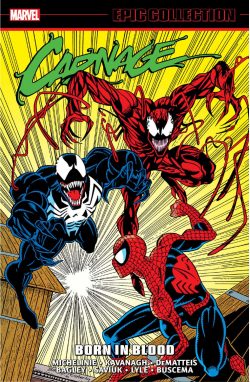
Carnage Epic Collection: Born in Blood 1991-1994


By David Michelinie, Tom DeFalco, Terry Kavanagh, J.M. DeMatteis, Mark Bagley, Ron Lim, Alex Saviuk, Tom Lyle, Sal Buscema, Steven Butler & various (MARVEL)
ISBN: 978-1-3029-4662-3 (TPB/Digital edition)

Win’s Christmas Gift Recommendation: Massive Marvel Mayhem… 7/10

After a shaky start in 1962 The Amazing Spider-Man soon became a popular sensation with kids of all ages, rivalling the creative powerhouse that was Lee & Kirby’s Fantastic Four. Soon the quirky, charming, action-packed comicbook soap-opera would become the model for an entire generation of younger heroes elbowing aside the staid, (relatively) old costumed-crimebusters of previous publications.

You all know the story: Peter Parker was a smart but alienated kid bitten by a radioactive spider during a school science trip. Discovering he had developed astonishing arachnid abilities – which he augmented with his own natural chemistry, physics and engineering genius – the kid did what any lonely, geeky nerd would do with such newfound prowess: he tried to cash in for girls, fame and money.

Making a costume to hide his identity in case he made a fool of himself, Parker became a minor media celebrity – and a criminally self-important one. To his eternal regret, when a thief fled past him one night he didn’t lift a finger to stop him, only to find when he returned home that his guardian uncle Ben Parker had been murdered.

Crazed with a need for vengeance, Peter hunted the assailant who had made his beloved Aunt May a widow and killed the only father he had ever known, finding, to his horror, that it was the self-same felon he had neglected to stop. His irresponsibility had resulted in the death of the man who raised him, and the traumatised boy swore to forevermore use his powers to help others…

Since that night the wondrous wallcrawler has tirelessly battled miscreants, monsters and madmen, with a fickle, ungrateful public usually baying for his blood even as he perpetually saves them.

In the anything-goes, desperate hurly-burly of the late 1980s and 1990s, fad-fever and spin-off madness obsessed the superhero genre in America as comics publishers hungrily exploited every trick to bolster flagging sales. In the mad melee Spider-Man spawned an intractable enemy called Venom: a disgraced and deranged reporter named Eddie Brock who bonded with Parker’s black costume (an semi-sentient alien parasite called the Symbiote) and become a savage, shape-changing dark-side version of the amazing arachnid.

Eventually the spidery adversaries reached a brooding détente and Venom became a “Lethal Protector”, dispensing a highly individualistic brand of justice everywhere but New York City.

However, the danger had not completely passed. When the Symbiote went into breeding mode it created a junior version of itself that merged with a deranged psycho-killer named Cletus Kasady (in Amazing Spider-Man #344, March 1991). The relevant pages by David Michelinie, Erik Larsen, Mark Bagley & Randy Emberlin open this collection…

Totally amoral, murderously twisted and addicted to both pain and excitement, Kasady became the terrifying metamorphic Carnage – a kill-crazy monster who carved a bloody swathe through the Big Apple before Spider-Man and Venom united to stop him.

Collecting a franchise-wide crossover which originally appeared in Amazing Spider-Man #331-363, 378-380, Web of Spider-Man #101-103 Spectacular Spider-Man #201-203, Spider-Man #35-37, and with material from Amazing Spider-Man #344-345, 359-360, Spider-Man Unlimited #1-2 and Amazing Spider-Man Annual #28 (spanning February 1991 to August 1993), this mammoth and extremely controversial summer event featured the inevitable return of the terrifying travesty and his bloodcurdling assault on everything Parker held dear: family, responsibility, love and the heartfelt faith that killing was never justifiable…

It all begins with pertinent extracts from Amazing Spider-Man #344 &345 (March & April 1991) and 359-360 (February – March 1992) as Michelinie, Chris Marrinan & Keith Williams detail Carnage’s escape and first kills before the beast’s proper debut in Amazing Spider-Man #361-363 as Michelinie, Bagley & Emberlin unleash the shapeshifting slaughterer on New York in ‘Savage Genesis!’, ‘Savage Alliance!’ and ‘Savage Grace!’, necessitating Spidey and the Human Torch breaking Venom out of his well-deserved incarceration to help stop a murder spree beyond imagining…

All that is mere aperitif to a monstrous main course of fast, furious and ferocious chaos that kicks off in‘Carnage Rising!’ by Tom DeFalco, Ron Lim & Jim Sanders III from Spider-Man Unlimited #1.

When a seemingly powerless Cletus Kasady is moved from ultra-high security penitentiary The Vault to an experimental lab at Ravencroft Asylum, ambitious psychiatrist Dr. Pournella believes she can cure the monster’s underlying psychosis. Those opinions die with her and the rest of the staff and security officers when the long-dormant Carnage entity manifests and breaks free…

Across town, tormented by guilt and shame, newlyweds Peter Parker and Mary Jane (nee Watson) are attending the funeral of their friend Harry Osborn – who had gone mad and perished battling Spider-Man as the second Green Goblin. As the downcast hero wallows in soul-searching and wonders at the point of his life, in Ravencroft a nihilistic scourge of insane bloodlust rampages through the facility until he is stopped in his tracks by another inmate.

Shriek is a creature after Carnage’s own heart: a survivor of appalling childhood abuse who found she possessed incredible powers to make all her vile drives and dreams come true…

Instantly attracted to each other, the pair join forces as a twisted “couple”, resolved to kill as often and as many as they can…

Escaping into New York they soon encounter and battle a mystical, nigh-mindless Spider-Man Doppelganger – which has been stalking the Webslinger since the end of the Infinity War crossover event – and adopt it. Together, the ultimate embodiment of a dysfunctional family set out to teach the city the pointlessness of life and the imminent inevitability of remorseless death…

Peter meanwhile has quarrelled with Mary Jane, but after making up, he hears of the bloodbath at Ravencroft and dutifully rushes off to recapture Carnage. Utterly unprepared for the trio of terror, he is savagely beaten: barely escaping with his life…

The tale continues in ‘Dark Light: Maximum Carnage  Part 2’ (Web of Spider-Man #101, by Terry Kavanagh, Alex Saviuk & Don Hudson) wherein the incapacitated Arachnid is accosted by street thugs hungry for vengeance and only saved by the appearance of homeless vigilantes Cloak and Dagger.

These nomadic teens are juvenile runaways who fell into the clutches of drug-pushing gangsters. Amongst a group of abducted kids they were used as guinea pigs for new designer drugs, but though all other test subjects died horribly, Tyrone Johnson and Tandy Bowen were mutated by the chemical cocktail into something more – and less – than human.

Isolated, alone, and vengeful they swore to help other lost kids by fighting drug dealers and all who preyed on the weak in the blackest corners of New York City.

Cloak is connected to a dimension of darkness: able to teleport, become intangible, amplifying and feeding on the wickedness in his targets. His unceasing hunger for negative emotions must be regularly – if only temporarily – sated by super-acrobat Dagger’s dazzling radiance. Her power too has advantages and hazards. The light can cleanse the gnawing dependency afflicting addicts, but constantly, agonizingly, builds up within her when not released. Thus Cloak’s incessant hunger can be assuaged by her light-knives and his apparently insatiable darkness.

Whilst tending to Spider-Man – whose injuries include cripplingly painful broken ribs – Cloak & Dagger are ambushed by the Carnage clan and the consequent catastrophic clash razes the church they are sheltering in.

Shriek especially revels in chaos. She has battled Cloak before and loathes him, taking sublime joy in tormenting him. Her greatest triumph comes when she uses her sonic powers to disintegrate his beloved Dagger before his horrified eyes…

Succeeding chapters open with ‘Demons on Broadway’ (Amazing Spider-Man #378, by Michelinie, Bagley & Randy Emberlin) ramp up the tension as Venom returns to New York, determined to exterminate the appalling threat he inadvertently created. Severely wounded, Spider-Man seeks to console Cloak who is crazed with grief and fury. Elsewhere Carnage, Shriek and Doppelganger are simultaneously gloating, planning further bloodshed and fighting each other…

When Cloak disappears in a blink of black torment the barely conscious Wallcrawler resumes his search for the trio of horrors and instead stumbles upon another old foe – Demogoblin.

Originally a science-powered super-crook, the mercenary killer was cursed: mystically transformed into a supernatural scourge dedicated to cleansing Earth of sin. To his diseased mind that means slaughtering humans because they are all sinners…

As the messianic devil thrashes the utterly exhausted and overstretched Spider-Man in Central Park, Venom tracks down Kasady but is similarly crushed by Doppelganger, Shriek and his sadistically exultant “offspring”…

Brock barely escapes with his life and crawls to Peter and Mary Jane’s apartment in Spider-Man #35, driving Mrs. Parker crazy with fear and resentment. It seems as if the entire city is on the edge and ready to explode in rage, negativity and violence…

As Spider-Man resigns himself to working again with his murderous worst nightmare, Demogoblin joins Carnage’s fiendish family. The good guys recruit Peter’s ex-girlfriend The Black Cat to even the odds in ‘Team Venom’ (Michelinie, Tom Lyle & Scott Hanna), but by the time they find their constantly bickering homicidal foes, Cloak has already impetuously attacked them and lies close to death…

As another blockbusting battle ends in defeat for the heroes, the Amazing Arachnid finds himself berated and deserted by his own allies. Taken to task for his foolish unwillingness to use lethal force, Peter questions his ingrained reluctance to go ‘Over the Line!’ (Spectacular Spider-Man #201, by J.M. DeMatteis & Sal Buscema) even as Carnage adopts another psychotic menace into his growing killer kin. Cadaverous mutated clone Carrion shares their ambitions and eagerly joins in their avowed mission to kill every human in New York.

The blood-soaked brood are aided in their task by the very citizens they imperil, as an inexplicable wave of fear and hatred grips the populace, sparking savage rioting and a tide of death. The inflamed innocents even attempt to lynch Spider-Man when he comes to their aid…

As Parker faces an overwhelming crisis of conscience in ‘Sinking Fast’ (Kavanagh, Saviuk & Hudson from Web of Spider-Man #102), Venom’s vengeance squad recruits another old Spider-Man foe in the ghastly shape of Michael Morbius – a science-spawned Living Vampire with an unquenchable appetite for human blood. After years of death and torment, the helpless victim had recently begun to seek a form of redemption by only slaking his thirst on the truly wicked…

With her husband insanely risking his life beside allies as bad as the villains, Mary Jane attempts to ease her own rage by going clubbing, just as Carnage’s “carnival of chaos” tears into the fashionable nightspot eager to display their warped philosophy of senseless death.

She is only saved by the appearance of Team Venom, with Spider-Man arriving far too late to help. After helping to drive off the macabre marauders a heartbroken Parker is forced to accept the antihero’s methods: rejoining the squad in time to confront ‘The Gathering Storm’ (Amazing Spider-Man #379, Michelinie, Bagley & Emberlin).

As the notional white hats again spectacularly and pointlessly clash with the cotillion of crazies – resulting in the collateral deaths of the NYPD’s Extreme Emergency Team – a new player enters the conflict.

Deathlok was pacifist scientist Michael Collins until his consciousness was imprisoned within a cyborg body built to be the ultimate battlefield weapon. Rebelling against the corporate monsters who doomed him to “life” as a mechanical zombie, Collins turned the war body into a macabre force for justice, so when he detected strange energies at work in town he immediately entered the fray – and is trashed by Clan Carnage, just as Spider-Man and Cloak recruit idealistic mutant Firestar to their side…

Fighting chaos and terror with logic, the webspinner reasons that since all Symbiote spawn are chronically susceptible to excessive heat (as well as high energy sonic assault) a champion capable of emitting microwaves could turn the tide in humanity’s favour…

As the heroes lay their plans, ‘Hate is In The Air’ (Spider-Man #36; Kavanagh, Lyle & Hanna) exposes Kasady’s horrific childhood and events that shaped the unrepentant kill-crazed fiend. Meanwhile, martial arts hero Iron Fist steps in to rescue the broken Deathlok before the Venom gang again engages Carnage’s crew. They almost succeed, but for the rallying efforts of the increasingly rebellious and independent Shriek…

A secret is revealed in ‘The Turning Point!’ (Spectacular Spider-Man #202, DeMatteis & Buscema) as a crazed mob attacks the battling metahumans, and Shriek discloses her powers enable her to broadcast her own madness to the entire city, driving everyone into paroxysms of despair and fury. With Spider-Man actively urging Firestar to kill Carnage, the heroes’ ethical collapse seems assured…

From the depths of his soul Peter’s moral core finally breaks through the madness and he stops the equally conflicted microwave mutant from committing the ultimate sin, just as inspirational legend Captain America arrives to take charge…

With both Avengers and Fantastic Four otherwise occupied, the Sentinel of Liberty has rushed back to save ‘Sin City’ (Kavanagh, Saviuk & Hudson, Web of Spider-Man #103) from Armageddon: instantly rallying the hard-pressed heroes and their more ambivalent allies.

Sadly, his presence causes a schism and as mysterious vigilante Nightwatch joins the dark defenders in still more reactive, pointless violence, ‘Soldiers of Hope’ (Amazing Spider-Man #380, Michelinie, Bagley & Emberlin) sees Parker at last use his brains rather than brawn. With Cap’s resources, the philosophical discipline of Iron Fist and technical skills of Deathlok, a weapon is devised to disable and even cure the frenzied killers running wild in the streets…

An even greater turnabout occurs in ‘The Light!’ (DeMatteis, Lyle, Hanna & Al Milgrom; Spider-Man #37) as, at the height of the most savage battle yet, all factions are stunned by the luminescent resurrection of Dagger, who spearheads a triumphant ‘War of the Heart!’ (Spectacular Spider-Man #203, DeMatteis & Buscema) that crushes the clan and kills Carnage…

Of course it’s never that easy and the cunning maniac is only shamming, as exhausted and traumatised Spider-Man and Venom discover when the blood-red maniac ambushes them in one last all-or-nothing attack in ‘The Hatred, the Horror, & the Hero!’ by DeFalco, Bagley, Lim, Sanders III & Sam de la Rosa (Spider-Man Unlimited #2). It almost works, but in the end, battered, bruised bloodied but ultimately uncompromised, the heroes are triumphant and the horrors are caged again…

By way of epilogue Amazing Spider-Man Annual #28 (1994) picks over ‘The Mortal Past’ (Michelinie, Steven Butler & Bud LaRosa) as Kasady escapes whilst being transported to the Vault and Spider-Man goes after him. More appalling secrets of the killer’s childhood are exposed and buckets of blood are spilled as the maniac takes refuge with his only friend… until the wallcrawler spoils that too and earns Carnage’s undying hatred all over again…

Also included are an unused cover and a bound-in poster and the 1993 Carnage TPB by Bagley & Emberlin; facts, pranks and illustrations from Marvel-Year-in-Review: Bring on the Bad Guys; the Official Handbook of the Marvel Universe Master Edition; A wraparound cover by Bart Sears from Wizard Magazine, and Micheline’s Introduction from another TPB, DeMatteis’ Afterword, plus covers of successive editions by Ron Lim, Emberlin, deleted and edited scenes. There is trading card art by Steve Lightle & Paul Mounts, the cover – by Lyle – and articles from Marvel Age #123 (April 1993), a wealth or original art pages by Bagley Emberlin & Lyle and variant and 2nd print covers.

If you love the extended hyperbolic, continual conflict which is at the core of all Costumed Dramas, this non-stop battle bonanza is a grand way to spoil yourself. Logic and pacing are subsumed into one long, escalating struggle, and a working knowledge of the players is largely unnecessary to the raw, brutal clash of wills, ideologies and super-powers. One fair warning however: although handled with a degree of reserve and taste, this yarn has an appalling body count and scenes of torture that might upset younger fans of the Amazing Arachnid.
© 2022 MARVEL.

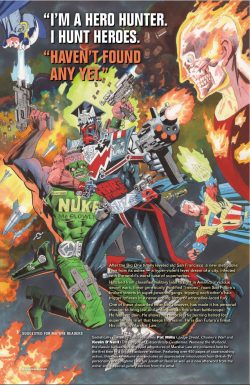
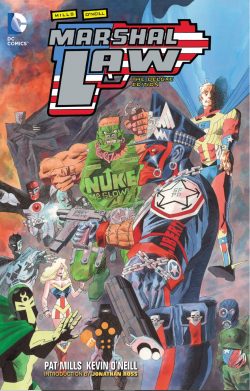
Marshal Law the Deluxe Edition


By Pat Mills & Kev O’Neill, with Mark A. Nelson & Mark Chiarello, lettered by Phil Felix, Steve Potter & Phil Oakley (DC Comics)
ISBN: 978-1-4012-3855-1 (HB/Digital edition)

Win’s Christmas Gift Recommendation: Ultimate Antihero Excess… 10/10

Hard to believe, I know, but not everybody likes superheroes.. Some folks actively loathe them. And then there’s Pat Mills & Kev O’Neill…

One of the greatest creative forces in British comics, Pat Mills began his career at DC Thomson. He wrote girls comics and humour strips; moved south to IPC and killed posh-comics-for-middle-class-kids stone-dead by creating Battle Picture Weekly (1975 with John Wagner & Gerry Finley-Day), as well as Action (1976), 2000AD (1977) and Starlord (1978). Along the way, he also figured large in the junior horror comic Chiller

As a writer he’s responsible for Ro-Busters, ABC Warriors, Nemesis the Warlock, Slaine, Button Man, Metalzoic, and Requiem Vampire Knight among many, many others. That also includes Battle’s extraordinary Charley’s War (with the brilliant Joe Colquhoun): the best war strip of all time and one of the top five explorations of the First World War in any artistic medium.

Unable to hide the passions that drive him, his most controversial work is probably Third World War which he created for the bravely experimental comics magazine Crisis. This fiercely socially conscious strip blended his trademark bleak, black humour, violence and anti-authoritarianism with a furious assault on Capitalism, Imperialism and Globalisation. It even contained elements of myth, mysticism, religion and neo-paganism – also key elements in his mature work.

Some of his most fruitful collaborations happened when teamed with the utterly unique and much-missed Kevin O’Neill. In 1988 O’Neill won the singular accolade of having his entire style of drawing – not a panel, not a story, but every single mark he left on paper – banned by the USA’s dried-up-but-not-quite-dead Comics Code Authority!

Not that it stopped the rise of his remarkable and truly unique talent in later triumphs such as Serial Killer, The League of Extraordinary Gentlemen and of course, Marshal Law

“Kev” was born in 1953 and, aged 16, began work as an office boy/art corrector for British weekly Buster. He worked in every aspect of the compartmentalised industry: lettering, art paste-up, logo design, colouring and more…

As the kids’ stuff began to pale, life changed in 1977, when author/editor Mills transferred him to a forthcoming, iconoclastic new science fiction comic. O’Neill became a mainstay of 2000 AD: producing covers, pinups and Future Shock short stories, whilst contributing to serials like Ro-Busters, satirical super parody Captain Klep, ABC Warriors and his personal breakthrough character Nemesis the Warlock.

From there on, America came calling in the form of DC Comics, but his efforts on edgier science fiction titles like Green Lantern and Omega Men, graphic novel Metalzoic (and Bat-Mite!) only reinforced how different he was. Happily just as his “style of drawing” was banned by the American Comics Code Authority the marketplace changed completely…

In 1987 Marvel’s creator-owned imprint Epic Comics published a 6-issue miniseries starring a hero superficially very much in the vein of Judge Dredd, but one who took the hallowed American creation of the superhero genre and gave it a thorough duffing-up, Brit-boy style. It was the wholly traditional tale of a (costumed) cop who did the Right Thing and did it His Way…

San Futuro is a vast metropolitan urban dystopia built on the Post-Big Quake remnants of San Francisco. America is recovering from another stupid, exploitative war in somebody else’s country, and – as usual – demobbed, discharged, discarded, damaged, brain-fried grunts and veterans are clogging the streets and menacing decent society. The problem is that this war was fought with artificially manufactured superheroes, who eventually came home to become a very dangerous embarrassment. Marshal Law was one of them, but now he’s a cop; angry and disillusioned but dedicated. His job is to put away bad guys, but it’s hard to tell them apart from the “good” ones. This establishing series was collected as Marshal Law: Fear and Loathing.

This hefty compilation gathers the ever-peregrinating strip as it appeared under many publishers’ banners. It gathers Marshal Law #1-6, Marshal Law: Crime and Punishment, Marshal Law Takes Manhattan, Marshal Law: Kingdom of the Blind, Marshal Law: The Hateful Dead, Marshal Law: Super-Babylon & Marshal Law: Secret Tribunal 1-2. It opens with an Introduction from comics megafan/TV personality Jonathan Ross and stunning and informative ‘Map of San Futuro’ offering a ‘Welcome to San Futuro – Home of Law and Disorder’ before Fear and Loathing: A Prologue’ introduces the world’s greatest hero. Colonel Buck Kaine AKA The Public Spirit has returned from a divine, ordained mission to the stars and his example inspired a certain young man to enlist in the SHOCC (Super Hero Operational Command & Control) program that created all the now-unwanted superbeings infesting Sat Futuro and the world…

Fear and Loathing begins with ‘Stars and Strippers’ as a rapist serial killer terrorises the city, distracting weary Marshal Law from his preferred targets: degenerates, thugs and thieves like Gangreen

Marshal Law was once a forgotten supersoldier like them, but now he’s a cop: burned-out, angry and extremely disillusioned. His job is to put away rogue masks and capes, but as bad as they are, the people he works for are worse. Some heroes like The Public Spirit have the official backing of the government and can do no wrong – which is a huge problem as the solitary Marshal is convinced that he’s also the deadly rapist/serial killer called the Sleepman

The case powerfully and tragically unfolds with bleak black humour, grim excess and raging righteous fury in ‘Evilution’, ‘Super Hero Messiah’, ‘Conduct Unbecoming’, ‘Mark of Caine’ and ‘Nemesis’: a savage parody of beloved genre stars and motifs, and uncompromising commentary and satirical attack on privilege, prestige, US policies and attitudes, in comics and the real world. However, Fear and Loathing is also a cracking good yarn for thinking adults with mature dispositions, open minds, and who love seeing injustice punished.

In the 1989 Epic Comics one shot ‘Marshal Law Takes Manhattan’, Mills & O’Neill – with additional inks by Mark A. Nelson and colours from Mark Chiarello – went after the entire (thinly disguised) Marvel Comics pantheon, with old zipper-face dispatched to New York to extradite a war criminal – and Law’s old army trainer – The Persecutor. Unfortunately (for them), the mass killer has hidden himself amongst the inmates of “The Institute”: a colossal Manhattan skyscraper housing all the Big Apple’s native superheroes. Each and every is one a brilliant, barmy, bile-filled parody of Marvel’s Mightiest …and they don’t stand a chance against disgust and righteous indignation…

Mills & O’Neill brought their new toy to British independent outfit Apocalypse, publishers of Toxic, a short-lived (March to October 1991) but talent-heavy rival to 2000 AD. Naturally, carnage and mayhem were the result, but not before author Mills slips a few well-aimed pops at US covert practices and policies in South America under the door.

That troubled, influential periodical was originally preceded by Marshal Law Special ‘Kingdom of the Blind’ at the end of 1990, which has been slotted in here…

Although played for more overt laughs than previous tales, the vented spleen and venom displayed in this captivating yarn is simply breathtaking, with the creators putting the boot into the most popular hero of the time. The Private Eye had trained himself to fight criminals ever since his parents were murdered in front of him. For decades he made the night his own, to universal acclaim: even Marshal Law thought he was the exception that proved the rule…

When circumstances force the Marshal to question his beliefs, he uncovers a snake-pit of horror and corruption that shakes even his weary, embittered sensibilities, and makes him wonder why nobody ever questioned how one hero could get through so many sidekicks…

Second Special ‘The Hateful Dead’ – lettered by Steve Potter – began a 2-part odyssey wherein the toughest cop in San Futuro faced an undead plague after a Toxic accident (tee-hee; d’you see what they did there?) resurrects a graveyard full of dead supermen – many of them put there by Marshall Law -as well as ordinary ex-citizens to bedevil the conflicted hero-hunter. The story ended on an incredible cliffhanger… and Apocalypse went bust.

After two years Law jumped back across the pond to Dark Horse Comics, concluding the yarn in ‘Super Babylon’ wherein the resurgent Bad Cop quelled the return of the living dead and – just by way of collateral damage – devastated assorted superhero pantheons by ending thinly disguised versions of the Justice Society and League as well as WWII super-patriots like the Invaders and Captain America. All this happened a decade before Marvel Zombies stirred in their graves or The Walking Dead pulled on their brain-stained boots…

In addition, the creators couldn’t resist one more mighty pop at American Cold-War Imperialism that’s both utterly over-the-top and hilarious – unless you’re a Republican, I suppose…

Additionally, there’s a wicked spoof as ‘Naked Heroes by Veegee’ shares the candid snaps of a super-celeb paparazzo and the art for Marshal Law’s feature in Hero Illustrated (May 1994)…

Less contentious – unless you’re a devoted fan of the Alien movies/comics or The Legion of Super Heroes – is Secret Tribunal. Lettered by Bill Oakley, it begins with Cape Fear’ as the Marshal is deployed to an orbiting Space Station where the government grows its manufactured superbeings, just as a nasty incursion of fast-breeding carnivorous space-beasts starts ripping the immature adolescent and primarily teenaged supermen and wonder women to gory gobbets…

Even though the hero hunter is ordered to bring with him a super-team (riffing off certain Marvel mutants…), in the end the only solution is a ruthless and highly personal ‘Court Marshal’

Supplemented by an ‘Afterword by Pat Mills’ that shares his reasons for “hating heroes” and a stunning ‘Shooting Gallery’ of covers, designs, foreign edition art, previous collection covers, retail posters, and more to augment the experience of Futuro shock, this is classically inappropriate mayhem: just who could resist it?

Mills’ incisive observation, sharp dialogue, brilliant scenarios, great characters, stunningly memorable one-liners and hilariously compelling stories full of twists and surprises are magnificently brought to life by the cruelly lush art and colours of O’Neill: an artist so crazed with the joys of creation that every panel overflows with so many visual and typographical ad-libs that you could read this book one hundred times and still find new treats to make you laugh and wince. So I’m thinking that perhaps you really should…
© 1987, 1988, 1989, 1990, 1991, 1992, 1993, 2013 Pat Mills & Kevin O’Neill. All Rights Reserved.

A Spirou & Fantasio Adventure: Volume 19 – The Visitor from the Mesozoic


By André Franquin with Greg & Jidéhem, translated by Jerome Saincantin (Cinebook)
ISBN: 978-1-80044-066-1 (Album PB/Digital edition)

Win’s Christmas Gift Recommendation: Marvellous Monster Madness… 9/10

Spirou (whose name translates as “squirrel”, “mischievous” and “lively kid” in the language of Walloons) was created by French cartoonist François Robert Velter – AKA Rob-Vel – for Belgian publisher Éditions Dupuis. He was a measured response to the success of Hergé’s Tintin at rival outfit Casterman. At first, Spirou (with his pet squirrel Spip) was a plucky bellboy/lift operator employed by the Moustique Hotel (an in-joke reference to Dupuis’ premier periodical Le Moustique) whose improbable adventures gradually evolved into astounding and often surreal comedy dramas.

The other red-headed lad debuted on April 21st 1938 in an 8-page, French-language tabloid magazine that bears his name to this day. Fronting a roster of new and licensed foreign strips – Fernand Dineur’s Les Aventures de Tif (latterly Tif et Tondu) and US newspaper imports Red Ryder, Brick Bradford and SupermanLe Journal de Spirou grew exponentially: adding Flemish edition Robbedoes on October 27th 1938, bumping up the page count and adding compelling action, fantasy and comedy features until it was an unassailable, unmissable necessity for Continental kids.

Spirou and chums spearheaded the magazine for most of its life, with many impressive creators building on Velter’s work, beginning with his wife Blanche “Davine” Dumoulin, who took over the strip when her husband enlisted in 1939. She was aided by Belgian artist Luc Lafnet until 1943, when Dupuis purchased the feature, after which comic-strip prodigy Joseph Gillain (“Jijé”) took over.

In 1946, Jijé’s assistant André Franquin inherited the strip. Gradually, he retired traditional short gag-like vignettes in favour of longer adventure serials; introducing a wide and engaging cast of regulars. He ultimately devised a phenomenally popular nigh-magical animal dubbed Marsupilami, who debuted in 1952’s Spirou et les héritiers.

Jean-Claude Fournier succeeded Franquin in 1969 and working for a decade: beginning a succession of reinventions by creator teams that included Raoul Cauvin & Nic Broca; Yves Chaland; and Philippe Vandevelde – writing as Tome” & artist Jean-Richard Geurts – AKA Janry.

These last reverently referenced the beloved, revered Franquin era: reviving the feature’s fortunes in 14 albums between 1984-1998. After their departure the strip diversified into parallel strands: Spirou’s Childhood/Little Spirou and guest-creator specials A Spirou Story By… before Lewis Trondheim and the teams of Jean-Davide Morvan/Jose-Luis Munuera and Fabien Vehlmann/Yoann stepped up.

By my count – which includes specials, spin-offs series and one-shots – they cumulatively bring the album count to upwards of 90, but for many of us the Franquin sagas are the epitome and acme of the Spirou experience…

Cinebook have been publishing Spirou & Fantasio’s exploits since October 2009, initially concentrating on translating Tome & Janry’s superb pastiche/homages of Franquin, but for this manic marvel (available in paperback and digitally) they reached back all the way to 1960 for some true Franquin-formulated furore.

Belgian superstar André Franquin was born in Etterbeek on January 3rd 1924. Drawing from an early age, he began formal art training at École Saint-Luc in 1943 but when the war forced the school’s closure a year later, Franquin found animation work at Compagnie Belge d’Animation in Brussels. Here he met Maurice de Bevere (Lucky Luke-creator “Morris”), Pierre Culliford (AKA The Smurfs creator Peyo), and Eddy Paape (Valhardi, Luc Orient).

In 1945 all but Culliford signed on with Dupuis, and Franquin began his career as a jobbing cartoonist/illustrator, crafting covers for Le Moustique and scouting magazine Plein Jeu. Throughout those days, Franquin and Morris were being trained by Jijé – at that time main illustrator at Le Journal de Spirou. He turned the youngsters and fellow neophyte Willy Maltaite – AKA Will (Tif et Tondu, Isabelle, Le jardin des désirs) – into a perfect creative bullpen known as the La bande des quatre or “Gang of Four”. They would revolutionise Belgian comics with their prolific and engaging “Marcinelle school” style of graphic storytelling.

Jijé handed Franquin all responsibilities for the flagship strip part-way through Spirou et la maison préfabriquée, (LJdS #427, June 20th 1946. He ran with it for two decades, enlarging the scope and horizons until it became purely his own. Almost every week fans would meet startling new characters like comrade/rival Fantasio and crackpot inventor the Count of Champignac. Along the way Spirou & Fantasio became globe-trotting journalists, endlessly expanding their weekly exploits in unbroken four-colour glory.

The heroes travelled to exotic places, uncovering crimes, finding the fantastic and clashing with a coterie of exotic arch-enemies like Zorglub and Zantafio, as well as one of the first strong female characters in European comics, rival journalist Seccotine (renamed Cellophine in the current English translation).

In a splendid example of good practise, Franquin mentored his own band of apprentice cartoonists during the 1950s. These included Jean Roba (La Ribambelle, Boule et Bill), Jidéhem (Sophie, Ginger, Starter, Uhu-Man, Gaston Lagaffe) and Greg author of Luc Orient, Bruno Brazil, Bernard Prince, Achille Talon, and Zig et Puce who all worked with him on Spirou et Fantasio.

In 1955, a contractual spat with Dupuis saw Franquin sign with rivals Casterman on Le Journal de Tintin, collaborating with René Goscinny and Peyo whilst creating the raucous gag strip Modeste et Pompon. Within weeks Franquin patched things up with Dupuis and returned to Spirou, subsequently co-creating Gaston Lagaffe (known in Britain as Gomer Goof), but was obliged to carry on his Casterman commitments too…

From 1959, writer Greg and background artist Jidéhem assisted Franquin, but by 1969 the artist had reached his Spirou limit. He quit, taking his mystic yellow monkey with him…

His later creations include fantasy series Isabelle, illustration sequence Monsters and bleak adult conceptual series Idées Noires, but his greatest creation – and one he retained all rights to on his departure – is Marsupilami, which, in addition to comics tales, has become a star of screen, plush toy store, console and albums.

Plagued in later life by bouts of depression, Franquin passed away on January 5th 1997, but his legacy remains: a vast body of work that reshaped the landscape of European comics.

Originally entitled Le voyageur du Mésozoïque and brought to you here as The Visitor from the Mesozoic this album combines a long tail (sorry couldn’t resist!) plus another, shorter adventure by the master crafted in collaboration with co-writer Greg (alias Michel Régnier) and artist Jidéhem – AKA Jean De Mesmaeker. The lead romp comes from 1957 having originated as a serial in Le Journal de Spirou #992-1018 and clearly and cleverly channelling that time’s penchant for rampaging, city-stomping giant monsters…

It begins in the Antarctic as the mushroom-mad Count de Champignac is rescued – much against his will – from his own experiments and frozen doom and brought back to France. He has with him a dinosaur egg that has been frozen for millions of years…

Getting the fragile, precious miracle back to his lab in bucolic Champignac-on-the-Sticks takes all the ingenuity and determination his pals Spirou and Fantasio can muster, but after much fuss and fluster the primordial ovum is stashed in the genius’ workshop and slowly thawing under the gimlet eyes of a handpicked team of fellow mad scientists including Doctors Nero, Schwartz, atomic pariah Sprtschk and Alexandre Specimen – “the Biologist”…

Their bumbling patience is tested to its limits when the mischievous Marsupilami becomes obsessed with the new ball toy and perhaps it’s his terrifying antics that finally force it to hatch…

Everyone is delighted when the mega-million-year-old herbivore pops out, but science is never patient and the bonkers boffins imprudently goose along its development with a little growth formula and aging extracts. Sadly, so does the Marsupilami and when everybody wakes up in the morning they’re greeted by a genial skyscraper saurian with a huge empty belly and a very bad cold…

Soon the big daft brute is shambling through the hamlet looking for browse and causing quite a commotion. The villagers might be used to weird happenings but the government respond with predictable hostility: sending in a tank column and a flight of warplanes…

They prove inefficient and quite ineffective, but the story also generates a wave of controversy. Stridently vocal, violently different pressure groups form: some wanting to save the poor endangered creature and others seeking to preserve the precious landmarks and monuments the beast is trampling. There’s even one guy who wants to make the dinosaur the latest taste sensation in his canned meat factory…

With chaos rampant Spirou looks for a solution to help the creature and finds one, but it depends on manoeuvring the monster to a certain isolated promontory. Thankfully, the Marsupilami has lost patience with his old toy and is ready to step in and step up…

Manic and wildly slapstick in tone and delivery, the story of the big beast is both charming and wickedly satirical and offers a happy ending films like Godzilla, Konga and Gorgo could never have imagined…

The rampaging silliness is counterbalanced by an equally funny but far more sinister pastiche also set in the wild world of the Merlin of Mushrooms. Back-up yarn ‘Fear on the Line’ stems from 1959, serialised as ‘La Peur au bout du fil’ in LJS #1086-1092. Notable for the first crossover appearance of comedy sluggard Gaston Lagaffe, the story details how Champignac distils the chemical essence of evil and accidentally drinks it instead of his coffee. Warned too late, Spirou and Fantasio must chase the now wicked prankster as he wreaks havoc in the village and plants bombs filled with his chemical concoctions. Happily, The Biologist is on hand to offer advice as the clock counts down to doom and our heroes give chase, but in the end it’s the Marsupilami who solves the crisis in his own bombastic manner…

The Visitor from the Mesozoic is the kind of lightly-barbed comedy-thriller that delights readers fed up with a marketplace far too full of adults-only carnage, testosterone-fuelled breast-beating, teen-romance monsters or sickly-sweet fantasy.

Easily accessible to readers of all ages and drawn with all the beguiling style and seductive yet wholesome élan which makes Asterix, Lucky Luke, and Iznogoud so compelling, this is a truly enduring landmark tale from a long line of superb exploits, and deserves to be a household name as much as those series – and even that other kid with the white dog…
Original edition © Dupuis, 1960 by Franquin. All rights reserved. English translation © 2022 Cinebook Ltd.

Iron Man Epic Collection volume 5: Battle Royal 1972-1974


By Roy Thomas, Jim Starlin, Steve Gerber, Bill Everett, George Tuska, Barry Windsor-Smith, P. Craig Russell, John Romita & various (MARVEL)
ISBN: 978-1-3029-3361-6 (TPB/Digital edition)

Win’s Christmas Gift Recommendation: Glittering Marvel Madness… 8/10

First conceived in the wake of the Cuban Missile Crisis at a time when the economy was booming and “Commie-bashing” was an American national obsession, the emergence of a new and shining young Thomas Edison, using Yankee ingenuity, wealth and invention to safeguard the Land of the Free and better the World, seemed an obvious development. Combining the then-sacrosanct faith that technology and business in unison could solve any problem, with the universal imagery of noble knights battling evil, Tony Stark the Invincible Iron Man – seemed an infallibly successful proposition.

Of course, whilst Tony Stark was the acceptable face of 1960s Capitalism – a glamorous millionaire industrialist/scientist and a benevolent all-conquering hero when clad in the super-scientific armour of his alter-ego – the turbulent tone of the 1970s soon relegated his suave, “can-do” image to the recycling bin of history.

With ecological disaster and social catastrophe from the myriad abuses of big business the new zeitgeists of the young, the Golden Avenger and Stark International were soon confronting a few tricky questions from the increasingly politically savvy readership.

With glamour, money and fancy gadgetry not quite so cool anymore, the questing voices of a new generation of writers began posing uncomfortable questions in the pages of a series that was once the bastion of militarised America…

This grand and gleaming chronological compendium navigates that transitional period, re-presenting Iron Man #47-67 and the period cover-dated June 1972 through April 1974, as the title experienced an unprecedented and often uncomfortable number of creative personnel changes whilst the country endured a radical and often divisive split in ideology.

It begins in the aftermath of best friend Kevin O’Brian’s pointless death and the gradual disintegration of his girlfriend Marianne Rodgers who is slowly being driven insane by her own psychic abilities.

After the funeral, Stark traumatically reviews his origins, twin careers and now-obscured objectives in ‘Why Must There be an Iron Man?’ (by Roy Thomas, Barry Windsor-Smith & Jim Mooney) after which, emotionally reinvigorated and rededicated to his life of service, the Armoured Avenger welcomes new scripter Mike Friedrich and established artists George Tuska & Vince Colletta to again face the ferocious threat of radical incendiary terrorist Firebrand in ‘The Fury and the Inferno!’

Meanwhile, whilst attempting a new start in life, Marianne’s final breakdown begins…

‘…There Lurks the Adaptoid!’ finds her experiencing horrifying precognitive visions of a power-mimicking robot attacking Iron Man, and leads to her accidental betrayal of the man she loves when the automaton actually arrives and evolves into an unbeatable new form in #50’s ‘Deathplay!’

This coincides with equally-troubled Z-list villain Princess Python attempting to kidnap Stark, just as our hero is being targeted by power-leeching sub-atomic tyrants, before the bizarre saga concludes with bombastic battle in ‘Now Stalks the Cyborg-Sinister!’

New Age mysticism and West Coast celebrity-cults informed Iron Man #52 as Stark faces ‘Raga: Son of Fire!: an emotion-fuelled, flaming maniac trained by an evil guru who subsequently takes over from his failed disciple when things get too hot…

With additional pencils from star-in-waiting Jim Starlin, concluding chapter ‘The Black Lama!’ shows that the master mage is also unable to destroy the Golden Avenger, but would subsequently return to become one of the hero’s greatest and most insidious foes of the period.

Issue #54 found Stark in California and drawn into what became one of Marvel’s earliest and most successful crossover epics. ‘Sub-Mariner: Target for Death!’ debuted pitiless alien researcher Madame MacEvil – later re-branded as Moondragon during the Thanos Saga…

She was a bald, sexy science siren who manipulated Iron Man into attacking the Prince of Atlantis in a spectacular blockbusting bout further enhanced by additional art from the legendary Bill Everett supplementing the efforts of Friedrich, Tuska & Colletta…

The Thanos story moved into full gear in Iron Man #55, as Friedrich scripted illustrator Jim Starlin’s opening gambit ‘Beware The… Blood Brothers!’: introducing haunted humanoid powerhouse Drax the Destroyer, who had been trapped by extraterrestrial invader Thanos under the Nevada desert and was in dire need of rescue…

(This was all merely a prelude to the full saga which appeared in Captain Marvel #25-33, Marvel Feature #12, Daredevil #106-107 and Avengers #125, and has been collected in many compilations…

Iron Man #56 was a literally magical palate-cleanser, as Steve Gerber joined Starlin & Mike Esposito to tell the satirically hilarious tragedy of ‘Rasputin’s Revenge!’, wherein a street corner doom-prophet accidentally gains the power to fulfil his prognostications but still falls sadly short of engineering an apocalypse…

It was back to business as usual with Gerber, Tuska, Esposito & Frank Giacoia in #57 as a devastating ‘Strike!’ hits troubled Stark Industries. The dissent has been engineered by an insidious old enemy who inevitably overplays his be-ringed hand in concluding episode ‘Mandarin and the Unicorn: Double-Death!’ (with Friedrich returning to script Gerber’s plot) after which ‘A Madness in Motown!’ sees Stark battling revenge-crazed anti-capitalist Firebrand whilst unknowingly falling for the torrid terrorist’s sister Roxie Gilbert.

Another 2-part clash follows – this time against a deadly technology-thief – opening with ‘Cry Marauder!’ after a masked malcontent steals Stark’s experimental space shuttle. Culmination comes with ‘Death Knells over Detroit!’ as the purloined prototype is aimed like a monstrous missile at the heart of Motor City, leaving a crippled Iron Man only seconds to save the day…

With Friedrich scripting, the action stays in Detroit as Stark inspects one of his factories until former Maggia assassin ‘Whiplash Returns!’ (illustrated by P. Craig Russell, Esposito, Frank Giacoia & John Romita Sr.). The crazed killer-for-hire is raging for revenge and especially ticked off that his girlfriend has been made his boss…

Illustrated by Tuska & Esposito, an extended epic began in #63 with ‘Enter: Dr. Spectrum’, seeing Stark relentlessly – and fruitlessly – romantically pursues pacifist dissident Roxie Gilbert in Detroit, whilst obnoxious Ugandan financier and diplomat Dr. Kinji Obatu visits the Long Island plant and is attacked by a gang of masked thugs…

The assault is repelled thanks to the timely assistance of stand-in Iron Man Eddie March, who is promptly offered a bodyguard job by the creepy ambassador and invited to accompany him to a meeting with Stark in Detroit.

On Stark’s arrival, photonic fiend Dr. Spectrum ambushes the inventor, before being driven off by the Armoured Avenger after a titanic and costly struggle. A far more serious problem emerges later when old friend Happy Hogan accuses Tony of having an affair with his wife Pepper

Spectrum strikes again in the next issue, with a similar lack of success, before Happy blows his top and takes a swing at Stark, but that confrontation is curtailed when a gigantic monster kidnaps just-arrived Obatu in ‘Rokk Cometh!’

When the beast then targets Roxie, exhausted Iron Man intervenes but is too drained to resist the relentless Spectrum…

Issue #65 exposes ‘The Cutting Edge of Death!’ when the Golden Avenger learns the true parasitical nature of Spectrum’s Power Prism as it transfers itself from wilfully disobedient villain Obatu to our worn-out hero.

Its glee is short lived though, as the possessed Iron Man is challenged by recently arrived comrade Thor, resulting in a blockbusting ‘Battle Royal!’ which only ends when the Thunderer crushes the crystal conqueror and discovers the dying man inside the armour is neither Stark nor Obatu…

As a consequence of that climactic clash of myth and mechanism, IM #67 sees the impostor Iron Man temporarily mutated by Stark’s medical miracle machine the Cobalt Enervator into a rampaging monster in ‘Return of the Freak’ but no sooner do the genuine Armoured Avenger and surgeon Don Blake (who we all know was Thor back then) stop and save the berserk victim than Stark is drawn into another conflict in South East Asia…

Sadly. That falls into the category of “To Be Continued”…

With covers by Kane, Colletta, Giacoia, Tuska, Starlin, Joe Sinnott, Rich Buckler, John Romita & Mike Esposito, the galvanised wonderment also includes many beautiful original art pages and covers by Windsor-Smith, Mooney, Tuska, Everett, Colletta, Starlin, Esposito, John Romita & Kane: wrapping up this collection with the Golden Gladiator being carefully politically repositioned at a time when Marvel solidly set itself up at the vanguard of a rapidly changing America increasingly at war with itself.

With this volume Marvel further entrenched itself in the camp of the young and the restless, experiencing first hand, and every day, the social upheaval America was undergoing. This rebellious teen sensibility and increased political conscience permeated Marvel’s publications as their core audience evolved from Flower Power innocents into a generation of acutely aware activists. Future tales would increasingly bring reformed capitalist Stark into many unexpected and outrageous situations…

That’s the meat of another review, as this engrossing ride is done. From our distant vantage point the polemical energy and impact might be dissipated, but the sheer quality of the comics and the cool thrill of the eternal aspiration of man in perfect partnership with magic metal remains. These superhero sagas are amongst the most underrated but impressive tales of the period and are well worth your time, consideration and cold hard cash.

Boo$ter Gold: Future Lost


By Dan Jurgens, with John Byrne, Steve Englehart, Joe Staton, Mike DeCarlo, Ty Templeton & various (DC Comics)
ISBN: ?978-1-7795-0672-6 (HB/Digital edition)

Win’s Christmas Gift Recommendation: The Shape of Fun to Come… 8/10

After the cosmos-crunching Crisis on Infinite Earths re-sculpted the DC Universe in 1986, a host of characters got floor-up rebuilds for the tougher, no-nonsense, straight-shooting New American readership of the Reagan era. Simultaneously, a number of corporate buy-outs such as Blue Beetle, Captain Atom and The Question joined DC’s roster with their own much-hyped solo titles. There were also some all-new launches for the altered sensibilities of the Decade of Excess – the superb Suicide Squad and Shiny, Happy Hero Booster Gold.

The cobalt & yellow paladin debuted amidst heaps of hoopla in his own title (February 1986 – and the first post-Crisis premiere of a freshly integrated superhero line), presenting wholly different approaches to DC’s army of old-school costumed boy-scouts.

Created, written and drawn by Dan Jurgens, the saga featured a brash, cockily mysterious metahuman golden-boy jock who had set up his stall as a superhero in Metropolis, actively seeking corporate sponsorships, selling endorsements and with a management team in place to maximise the profit potential of his crusading celebrity.

Over fraught, fight-filled months we learned Michael Jon “Booster” Carter had been a rising sports star in the 25th century before falling in with a gambling syndicate and fixing games for cash pay-outs. When he was caught and banned from competition, he could only find menial work as a night-watchman in The Space Museum. Whilst there, he struck up a friendship with automated tour-guide/security-bot Skeets and devised a bold plan to redeem himself.

Stealing a flight ring, force-field belt, energy-rods, alien super-suit and wrist-blasters, Booster used the Museum’s prize exhibit – Rip Hunter’s time machine – to emigrate to the fabled 20th Century Age of Heroes where he might earn all the fame and glory his mistakes had cost him in his own time…

Initial success led him forming a multi-faceted company where Business manager Dirk Davis and company PA Trixie Collins later hired hotshot scientist Jack Soo to construct a second super-suit that would enable Booster to hire a camera-friendly, eye-candy girly sidekick…

Accompanied everywhere by sentient, flying, football-shaped robot Skeets, the glitzy showboat soon encountered high-tech criminal gang The 1000 and a host of super-villains, earning the ire of many sinister masterminds and the shallow approbation of models, actresses, headline-hungry journalists, politicians and the ever-fickle public…

Created, primarily written and drawn by Dan Jurgens with inks usually by Mike DeCarlo, colours from Gene D’Angelo and letters by Steve Haynie, this glittering prize of a compilation covers the end of his early days, in Booster Gold volume 1 #13-25, Millennium #3, 4, 6 & 7 and Action Comics #594, plus material from Secret Origins #35 and Who’s Who Update ’87 #1 (collectively spanning February 1987 to December 1988).

The saga resumes in the aftermath of a conclusive victory. With the threat of the 1000 ended ‘The Tomorrow Run’ (inked by Gary Martin) finds Booster at death’s door, not because of his numerous injuries but because his 25th century body has succumbed to 20th century diseases.

Set during the Legends publishing event – which saw the public turn violently against costumed heroes – the dying Carter is rescued from a mob by Trixie wearing Soo’s completed super-suit. With no other options they take Michael back to the future where he can be properly treated, even though Booster’s offences carry a mandatory death penalty in his home era…

Recruiting young Rip Hunter (destined to become the Master of Time) Trixie and Dr. Soo accompany the distressed hero to a time where ruthless Darwinian capitalism rules and everything Michael Carter once dreamed of has turned to bitter ashes. ‘A Future Lost’ (inked by DeCarlo) follows Booster and Trixie as they search for a cure (and his missing twin sister Michelle) whilst Hunter and Soo seek a means to return them all to 1986.

Booster’s illness is only cured after they are arrested: the authorities believing it barbaric to execute anybody too sick to stand up, before ‘Runback’ (inked by Bruce D. Patterson) concludes the saga in fine style with the missing Carter twin saving the day and retreating to the 20th century with the time-lost travellers.

Booster’s close call has a salutary effect on his attitudes and character. Inked by Bob Lewis, ‘Fresh Start’ sees a kinder, gentler corporate entrepreneur re-establishing his heroic credentials with the celebrity-crazed public of Metropolis, to the extent that Maxwell Lord offers him membership in the newly re-formed Justice League, just as sultry assassin Cheshire raids a biotech company recently acquired by Booster Gold International…

‘Dream of Terror’ (inked by Arne Starr) reveals all as new owner Booster learns his latest corporate asset has been making bio-toxins to eradicate all “undeserving” individuals (for which read non-white and poor) and that its creator is currently loose in Mexico City with the lethal bug. Moreover, the deranged biochemist has bamboozled militant hero Hawk into acting as bodyguard while his plans to “save humanity from itself” take effect…

DeCarlo returned to ink ‘Showdown’ in #18, as a relentless lawman from Booster’s home-time tracks him down through history, resolved to render final judgement before ‘Revenge of the Rainbow Raider’ (Al Vey inks) pit the Man of Gold against the colour-blind and utterly demented Flash villain in a 2-part thriller that sees our hero rendered sightless and his future-shocked sister go native amongst the 20th century primitives.

The tale concludes with ‘The Colors of Justice’ as Dr. Soo saves Booster even as Michelle is being kidnapped by extra-dimensional invaders…

Up until this moment the art in this volume, whilst always competent, had been suffering an annoying hindrance, designed as it was for high quality, full-colour comic books, not stark, black and white reproduction. Although legible, discernible and adequate, much of the earlier art is fine-lined, lacking contrasting dark areas and often giving the impression that the illustrations lack solidity and definition.

With Booster Gold #21 the marvellous Ty Templeton became regular inker and his bold, luscious brush-strokes brought a reassuring firmness and texture to the proceedings. As if to affirm the artistic redirection the stories became a tad darker too…

‘Invasion From Dimension X’ has Booster’s search for his missing sister impinge on a covert intrusion by belligerent aliens first encountered and defeated by the Teen Titans. To make matters worse these extra-dimensionals are using Michelle as a power-source to fuel their incursion, resulting in ‘Tortured Options’ for Booster who must choose between saving Michelle or the city of Minneapolis when the invaders open their assault with a colossal kaiju attack…

Guest-starring Justice League International, the astounding battle climaxed in public triumph and personal tragedy after which the heart-broken, embittered Booster seemingly attacks Superman in ‘All That Glisters’ (Action Comics #594, November 1987, by John Byrne & Keith Williams): a terse, brutal confrontation that crosses over and concludes in Booster Gold #23, displaying ‘Blind Obsession’ (Jurgens & Roy Richardson) as the real Man of Gold crushes a Kryptonite-powered android doppelganger designed by the world’s most unscrupulous businessman to kill Superman and frame a commercial rival…

If only they had known that at that very moment Booster Gold International was being bankrupted by a traitor at the heart of the company…

After Crisis on Infinite Earths and Legends, DC’s third mega-crossover Millennium saw Steve Englehart, Joe Staton & Ian Gibson depict how robotic Manhunters had infiltrated Earth to abort the next stage in human evolution.

Billions of years ago the Manhunters had rebelled against their creators. The Guardians of the Universe were immortal and worked towards a rational, emotionless cosmos – a view not shared by their own women. The Zamarons had abandoned the Guardians at the inception of their grand scheme but after countless millennia the two factions had reconciled and left our reality together.

Now they had returned with a plan to midwife a new race of immortals on Earth, but Manhunters had infiltrated all aspects of society throughout the universe and were determined to thwart the plan, whether by seduction, connivance or just plain brute force. The heroes of Earth gathered to protect the project and confront the Manhunters in their own private lives… and their own comics.

In its original form each weekly instalment of Millennium acted as a catalyst for events which played out across the rest of the DC Universe titles. In addition to the miniseries itself, Millennium spread across 21 titles for two months – another 37 issues – for a grand total of 44 comic-books. Issues #24 and 25 of Booster Gold were two of them and are supplemented here by pertinent excerpts of the miniseries taken from Millennium #3, 4 & 6 before ‘Betrayal’ reveals that one of Michael Carter’s inner circle has been a Manhunter agent all along. It bankrupted the hero at the most propitious moment simply so that the robots could buy his loyalty during their assault on humanity and led to all-out battle bout ‘Down’ from Millennium #7 before the series came to a shocking climax in ‘The End’ as the scheme succeeds and Booster actually switches sides …or does he?

After the surprisingly satisfying and upbeat denouement, Booster became a perennial star of Justice League International where, with fellow homeless hero Blue Beetle, he became half of the one of funniest double-acts in comics.

As “Blue and Gold” the hapless, cash-strapped odd couple were always at the heart of the action – pecuniary or otherwise – and the final tale here ‘From the Depths’ (by Jurgens & Tim Dzon, as originally seen in Secret Origins #35, December 1988), reprises the early tragic days of Michael Jon Carter in a brief and exceedingly impressive tale played as much to tug the heartstrings as tickle the funny-bone…

This compilation then closes with the entry from Who’s Who Update ‘87 #1.

As a frontrunner of the new DC, Booster Gold was a radical experiment in character that didn’t always work, but which exponentially improved as months rolled by. Early episodes might be a necessary chore but by the time this volume ends it’s a real shame that the now thoroughly entertaining and enjoyable ride is over. Perhaps not to every Fights ‘n’ Tights fan’s taste, these formative fictions are absolutely vital to your understanding of the later classics and will make any fan happy and every reader a fan.
© 1987, 1988, 2020 DC Comics. All Rights Reserved.