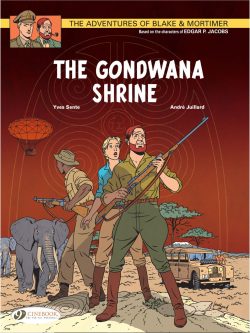
The Adventures of Blake and Mortimer volume 11: The Gondwana Shrine


By Yves Sente & André Juillard, coloured by Madeleine DeMille & translated by Jerome Saincantin (Cinebook)
ISBN: 978-1-84918-094-8 (Album PB/Digital edition)

Win’s Christmas Gift Recommendation: Blockbuster Thrills No Movie Can Match… 9/10

Edgar P. Jacobs devised one of the greatest heroic double acts in pulp fiction: pitting his distinguished scientific adventurers Professor Philip Mortimer and Captain Francis Blake against a daunting variety of perils and menaces in a sequence of stellar action-thrillers blending science fiction scope, detective mystery suspense and supernatural thrills. The magic was made perfect through his stunning illustrations, rendered in the timeless, infinitely accessible Ligne Claire style which had made intrepid boy-reporter Tintin a global sensation.

The Doughty Duo debuted on 26th September 1946: gracing the pages of the very first issue of Le Journal de Tintin: an ambitious international anthology comic with editions in Belgium, France and Holland. It was edited by Hergé, with his eponymous, world-famous star ably supplemented by new heroes and features for the rapidly-changing post-war world.

Blake and Mortimer are the graphic personification of Britain’s sadly lost and blighted Bulldog Spirit: and worthy spiritual successors to Sherlock Holmes, Allan Quatermain, Professor Challenger, Richard Hannay and all the other intrinsically decent stalwarts of lost Albion and valiant champions with direct connections to and allegiance beyond shallow national boundaries…

Following decades of fantastic exploits, the series apparently ended with the 11th album. The gripping contemporary adventure had been serialised between September 1971 and May 1972 in LJdT, but after Les trois Formules du professeur Sato: Mortimer à Tokyo was completed, Jacobs abandoned his story due to failing health and personal issues.

Edgard Félix Pierre Jacobs died on February 20th 1987, having never returned to the extended adventure. Concluding volume Les trois Formules du professeur Sato: Mortimer contre Mortimer was only released in March 1990, after the Jacobs family and estate commissioned veteran cartoonist Bob de Moor to complete the tale from the originator’s pencils and notes.

The long-postponed release led to re-release of the earlier volumes, and was followed in 1996 by new adventures from two separate creative teams hired by the Jacobs Studio who would henceforth produce complete books rather than weekly serials.

The first was L’affaire Francis Blake by Jean Van Hamme & Thierry “Ted” Benoit which settled itself into a comfortably defined, familiar 1950s scenario for a rousing tale of espionage and double-dealing. Controversially, it omitted the elements of futuristic fiction and fringe science which had characterised Jacobs’ tales and focused on the suave MI5 officer rather than bombastic, belligerent boffin and inveterate scene-stealer Mortimer…

The same was broadly true for the follow-up release, published in 1999, although references to the space race and alien infestation did much to restore those fantasy credentials in Yves (XIII, Le Janitor, Thorgal) Sente & André (Bohémond de Saint-Gilles, Masquerouge, Arno, Mezek) Juillard’s La machination Voronov.

The latter team eventually won the plum job of detailing the early days and origins of the lads in Les Sarcophages du 6e Continent, Tome 1: La Menace universelle and Les Sarcophages du 6e Continent, Tome 2: Le Duel des Esprits. The albums were the 16th and 17th published exploits of the peerless pair: a boldly byzantine epic spanning decades and stretching from India under the Raj to Cold War Europe and deep beneath Antarctic ice…

The tale revealed how Blake and Mortimer first met in India before WWII: introducing Philip Angus Mortimer, his tragic first love and diabolical maniac scientist Emperor Ashoka before jumping to 1958 when the resurrected villain’s incredible technology and Soviet subversion threatened the entire world…

Battling the menace, Mortimer clashed again with despised arch nemesis Olrik who had become a crucial but unwilling tool in Ashoka’s scheme. Olrik’s previous susceptibility to the telecephalscope of Professor Septimus (see The Yellow M) made him an ideal candidate for Ashoka’s ultimate weapon: a system capable of turning cerebral energy into planet-spanning power affecting electrical devices, heavy machinery and solid objects with tremendous force.

In the final accounting, as a secret Antarctic base collapsed around them, the bitter foes abandoned their bodies to fight as pure unleashed mental entities in the planet’s ether, before being restored to their mortal frames as everything fell apart and Gondwana Base vanished in a welter of fire and ice.

Mortimer was evacuated with moments to spare, leaving the enemy to his well-deserved fate…

Released in 2008 but chronologically occurring some months after Mortimer was rescued from the ice and Ashoka’s mind machines, Le sanctuaire du Gondwana opens in drought-parched Africa as German scholar Professor Ulrich Heidegang explores the Ngorongoro crater and discovers something truly beyond comprehension. He barely escapes with his life but his sanity is shattered. Nevertheless, he presents to the global media an artefact that will forever change the history of humanity…

Months later in London, Professor Mortimer is still being treated by Dr. Mark Levy for the aftereffects of his out-of-body experience. Suffering headaches, vision problems, mood swings, and still partially amnesiac, he’s slowly rebuilding his life and relationships with the aid of captain Francis Percy Blake – who has returned to his job with MI5 – and other close friends.

Especially helpful in recovering his old life is Mortimer’s assistant Nastasia Wardinska and landlady/housekeeper Mrs Benson but the doctor still won’t allow him to return to work…

Nastasia is particularly keen to resume research. When the Antarctic citadel was destroyed, volcanic action unearthed manufactured artefacts that have since been determined as being over 350 million years old and constructed of a currently-impossible amalgam of diamond-sheathed gold!

After consulting with Blake and the copious notes for his long-delayed and postponed memoires, Mortimer opts to use his enforced leisure time to solve the mystery. Blake and old colleague Labrousse are already investigating the Antarctic site, so the Professor plans an oblique approach…

Using current geological theory and recent reports collated by archivist Mr Stone of the Daily Mail as the basis of his research, the Prof will explore another region of the world that was connected to Antarctica 350 million years ago. Rather callously rekindling an old romance with celebrated ethnologist and archaeologist Sarah Summertown, he then leads a small team to the Olduvai Gorge in Africa, which Stone’s incredible memory has pinpointed as the source of an amazing scoop: an ancient artefact with markings of diamond and gold…

None of the enthralled explorers are aware that all their efforts are being closely monitored and steered by a mysterious stranger…

Soon all the preliminaries are done and Mortimer’s team are interviewing Heidegang in his hospital room in Nairobi. The explorer has been driven mad by his experiences: hearing voices and talking of Lycaon beast-men and pre-human civilisations on a single supercontinent. He does, however, reveal the location of his find…

Whilst the searchers set out for the Ngorongoro crater, the story shifts to the mysterious stalker, who is revealed as the presumed-dead Olrik. Stalking the party, he organises a deadly squad of ne’er-do-wells, surveilling their spectacularly eventful safari as it endures incredible hardships and tragedy and striking just as they make contact with the hidden remnants of an immortal super-race who claim to be the Guardians of Gondwana…

The story then shifts into turbulent top gear as many disparate plot-strands stunningly converge and a single shocking revelation discloses the true history and ownership of Earth whilst exposing one of the heroes as anything but…

It all leads to a ruthless resumption of the duel between Olrik and Mortimer and the staggering intervention of Earth’s unseen overlords, who remove the annoyances and leave them to sort out their immediate issues elsewhere…

Binding many vivid facets of the heroes’ prestigious past exploits and achievements into a vibrant sci fi romp, this epic extravaganza blends antediluvian mystery with a savage vendetta to create a rousing quest yarn that delight fans of many genres.

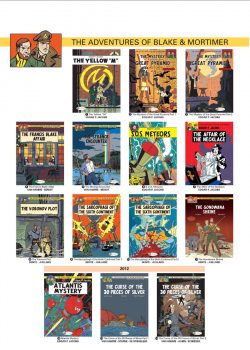
These Cinebook editions also include previews and tasty teaser excerpts for other albums – Atlantis Mystery by Jacobs, and Sente & Juillard’s The Voronov Plot – plus a biographical feature and chronological publication chart of Jacobs’ and his successors’ efforts.

Gripping and fantastic in the truest tradition of pulp sci-fi and Boy’s Own Adventures, Blake and Mortimer are the very epitome of dogged heroic determination; never failing to deliver grand, old-fashioned thrills and spills in timeless fashion and with astonishing visual punch.
Original edition © Editions Blake & Mortimer/Studio Jacobs (Dargaud-Lombard S.A.) 2008, by André Juillard & by Yves Sente. All rights reserved. English translation © 2011 Cinebook Ltd.
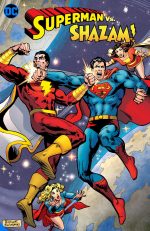
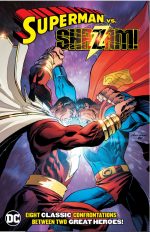
Superman vs. Shazam!


By Gerry Conway, Roy Thomas, Julie Schwartz, Paul Kupperberg, Joey Cavalieri, Mark Waid, Jerry Ordway, Judd Winick, Rich Buckler, Gil Kane, Alex Ross, Ian Churchill & various (DC Comics)
ISBN: 978-1-7795-0909-3 (TPB/Digital edition)

Win’s Christmas Gift Recommendation: Golden Grudge-Match Magic… 8/10

Superman debuted in Action Comics #1 in the summer of 1938. Created by Jerry Siegel & Joe Shuster, it proved extremely popular across many disparate media and sparked a new kind of hero and story form. You’re here right now because of him…

Another one of the most venerated and loved characters in American comics was created by Bill Parker & Charles Clarence Beck for Fawcett Publications as part of the wave of opportunistic creativity that followed that successful launch of Superman. Although there were many similarities in the early years, the “Big Red Cheese” moved swiftly and solidly into the area of light entertainment and even broad comedy, whilst as the 1940s progressed the Man of Tomorrow increasingly left whimsy behind in favour of action and drama.

Homeless orphan and thoroughly good kid Billy Batson was selected by an ancient wizard to battle injustice and subsequently granted the powers of six gods and mythical heroes. By speaking aloud the wizard’s name – itself an acronym for the six patrons Solomon, Hercules, Atlas, Zeus, Achilles and Mercury – Billy would transform from scrawny boy to brawny (adult) hero Captain Marvel.

At the height of his popularity, Captain Marvel hugely outsold Superman but, as the decade progressed and tastes changed, sales slowed. An infamous court case begun in 1941 by National Comics citing copyright infringement was settled and like so many other superheroes, the Captain disappeared, becoming a fond memory for older fans. A big syndication success, he was missed all over the world…

In Britain, where an English reprint line had run for many years, creator/publisher Mick Anglo had an avid audience and no product, and transformed Captain Marvel into atomic age hero Marvelman, continuing to thrill readers into the early 1960s.

Decades later, as America lived through another superhero boom-&-bust, the 1970s dawned with a shrinking industry and wide variety of comics genres servicing a base that was increasingly founded on collectors and fans rather than casual or impulse buyers. National Periodicals/DC Comics needed sales and were prepared to look for them in unusual places.

Since the court settlement with Fawcett in 1953 they had secured the rights to Captain Marvel and his spin-off Family. Now, though the name itself had been taken up by Marvel Comics (via a circuitous and quirky robotic character published by Carl Burgos and M.F. Publications in 1967), the publishing monolith decided to tap into that discriminating if aging fanbase.

In 1973, riding a wave of national nostalgia on TV and in the movies, DC brought back the entire beloved cast of the Captain Marvel crew in their own kinder, weirder universe. To circumvent the intellectual property clash, they named the new title Shazam! (…With One Magic Word…) after the memorable trigger phrase used by myriad Marvels to transform to and from mortal form and a word that had already entered the American language due to the success of the franchise the first time around.

Although the fortunes of Billy and Co have waxed and waned, one thing never did – the primal joy of all fans everywhere as they asked the eternal question of the golden age sales competitors: “Who would win if…?”

This rather hastily updated and rereleased volume is based on a 2013 edition but has come back presumably because it features so many stories starring surprise modern movie star Black Adam and gathers All-New Collectors’ Edition C-58, DC Comics Presents #33-34 & 49, DC Comics Presents Annual #3, Kingdom Come #4, Superman #216 and Power of Shazam #46 spanning 1978 to 2005. It’s by no means a comprehensive compilation with some notable omissions – such as my personal favourite ‘Make Way for Captain Thunder!’ from Superman # 276 (June 1974) – but there is plenty here to whet appetites and tantalise fading memories if you’re nearer the age of the Wizard than Billy…

The action begins ‘When Earths Collide’ as seen in May 1978’s tabloid-sized special All-New Collectors’ Edition C-58 as crafted by Gerry Conway, Rich Buckler & Dick Giordano. At this juncture, prior to Crisis on Infinite Earths, the Shazam Family lived on alternate Earth-S whilst the regular DC pantheon inhabited the universe dubbed Earth-One.

This epic yarn sees ancient Martian sorcerer Karmang the Evil attempt to merge both worlds by harvesting the energy of cataclysmic combat, to which end he resurrects long-dead Shazam-empowered Black Adam and the mystic Quarmer being that haunted Superman as the Sand Thing.

As they stalk and provoke the heroes, Karmang curses the champions with addictive rage, compelling them to attack each other and liberate the super-forces Karmang craves. Thankfully, Lois Lane, Jimmy Olsen and Supergirl join Mary Marvel and an unsuspected secret ally to sabotage the scheme before the Big Blue Boy Scout and Big Red Cheese pummel each other and the worlds out of existence…

Conway, Roy Thomas, Buckler & Giordano then craft a 2-part epic in DC Comics Presents #33 and 34 (May & June 1981) as ‘Man and Supermarvel’ finds the Action Ace and Good Captain helplessly swapping powers, costumes and Earths, thanks to the mirthlessly manic machinations of Fifth dimensional imp Mr. Mxyzptlk and malevolent alien worm Mr. Mind.

Despite the intervention of Mary Marvel and Captain Marvel Junior in the concluding issue, the villains’ sinister manipulations allow antediluvian revenant King Kull to become ‘The Beast-Man that Shouted ‘Hate’ at the Heart of the U.N.’ (Thomas, Buckler & Giordano).

The consequent confrontational clash rumbles across myriad dimensions and only goes the heroes’ way after they stumble upon the garish homeworld of Lepine Legend Hoppy the Captain Marvel Bunny

Black Adam takes centre stage in DC Comics Presents #49 (September 1982) as Thomas, Paul Kupperberg, Buckler & John Calnan detail how the troubled Billy Batson of Earth One is targeted by the immortal wizard in ‘Superman and Shazam!’

From his citadel in the Rock of Eternity, the mage seeks to empower a child and create a Marvel on Superman’s adopted homeworld. However, when he tries to enlist the Man of Steel’s assistance to create another Captain Marvel, everything goes badly wrong and the Earth-S original has to step in from his own world to stop the opportunistic depredations of his devil-hearted predecessor Teth Adam

Captain Marvel’s blend of charm, drama and whimsy made and remade many fans, even prompting a live action TV series, but never quite enough to keep the series going in such economically trying times. Despite cancellation, however, the series persevered in back-up slots in other magazines and the character still made the occasional bombastic guest-appearance such as 1984’s DC Comics Presents Annual #3.

As delivered by Thomas, Julie Schwartz, Joey Cavalieri and illustrator Gil Kane, ‘With One Magic Word’ is a cracking and witty 40-page romp which sees the Earth-S Doctor Sivana appropriate the mystic lightning that empowers Billy, leading to a monolithic multidimensional melee involving not just the Marvel Family but also the Supermen of both Earths One and Two (this was mere months before Crisis on Infinite Earths lumped all these heroes onto one terribly beleaguered and crowded world) before peace, sanity and the status quo was restored…

Envisaged and designed by artist Alex Ross, Kingdom Come was originally released as a 4-issue Prestige Format miniseries in 1996 to rapturous acclaim and numerous awards and accolades. Although set in the future and an “imaginary story” released under the Elseworlds imprint, it almost immediately began to affect the company’s mainstream continuity.

Set approximately twenty years ahead, the grandiose saga detailed a tragic failure and subsequent loss of Faith for Superman and how his attempt to redeem himself almost caused an even greater and ultimate apocalypse.

Scripted by Mark Waid, the events are seen through the eyes and actions of Dantean witness Norman McCay, an aging cleric co-opted by Divine Agent of Wrath The Spectre after the pastor officiated at the last rites of dying superhero Wesley Dodds. As The Sandman, Dodds had been cursed with precognitive dreams which compelled him to act as an agent of justice.

This is a world where metahumans have proliferated: spawning a sub-culture of constant, violent clashes between the latest generation of costumed villains and vigilantes, all uncaring of collateral damage they daily inflict on mere mortals around and in all ways beneath them.

The preacher sees a final crisis coming… but feels helpless until the Spectre takes him on a bewildering voyage of unfolding events, McCay must act as the ghost’s human perspective as the Spirit of Vengeance prepares to pass judgement on Humanity…

Seen here is the concluding chapter: a staggering battle of superpowers, one last moment of salvation and a second chance for humanity during a calamitous ‘Never-Ending Battle’…

At first Superman’s plans seemed blessed to succeed, with many erstwhile threats flocking to his banner and doctrinaire rules of discipline, but as ever there are self-serving villains with their own agendas. Lex Luthor had organised a cabal of like-minded compatriots such as Vandal Savage, Catwoman and Kobra – a “Mankind Liberation Front”. With Captain Marvel as their utterly corrupted slave, this group is determined the super-freaks will not win, but salvation hinges on the outcome of their tool’s clash with a despondent, embittered Man of Steel…

The emotional trauma is heaped on Billy in Power of Shazam #46 (February 1999) as he reels from his failure to stop an atomic atrocity that killed many of his friends. Deeply traumatised, he at first ignores the depredations of Black Adam and allows Superman to fight his foe in Fawcett City, but when turns when pushed to far unleashing his ‘Absolute Power’ and lashing out at family, friends and foes alike in a powerful and disturbing tale by Jerry Ordway & Giordano…

The Fights ‘n’ Tights furore ends here with another single chapter from a greater epic as Superman #216 (June 2005, by Judd Winick, Ian Churchill & Norm Rapmund) sees the heir of Shazam battling a Man of Steel controlled by rage-filled Demon of Darkness Eclipso in ‘Lightning Strikes Twice Part Three’ which was part of the build up to the Acts of Vengeance storyline…

Comics are such an interconnected, overlapping and entwined medium these days that I suppose my crusty old git reservations against incomplete stories can be ignored by most readers. That said, the material here is spectacular and thrilling and should gratify and satisfy new readers generated by movies or even word of mouth. With covers by Buckler, Giordano, Kane, Ross, Churchill & Dave Stewart and Ordway, this tome offers a quick glimpse of what’s great and topical, and for those in need of more there are entire worlds waiting for you to find them…
© 1978, 1981, 1982, 1984, 1996, 1999, 2005, 2013, 2018, 2021 DC Comics. All Rights Reserved.

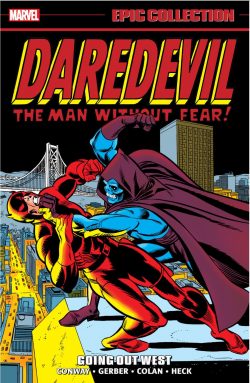
Daredevil Epic Collection volume 5: Going Out West 1972-1974


By Gerry Conway, Steve Gerber, Chris Claremont, Steve Englehart, Gene Colan, Don Heck, Sam Kweskin, Rich Buckler, Syd Shores, Jim Starlin, Bob Brown & various (MARVEL)
ISBN: 978-1-3029-3355-5 (TPB/Digital edition)

Win’s Christmas Gift Recommendation: Maximum Marvel Madness… 9/10

Matt Murdock is a blind lawyer whose remaining senses hyper-compensate, enabling him to accomplish astonishing acrobatic feats, and making him a formidable fighter and a living lie-detector.

Very much a second-string hero for most of his early years, Daredevil was nonetheless a striking and popular one, due in large part to the roster of brilliant artists who had illustrated the strip. He only really came into his own, however, after artist Gene Colan signed up for the long haul…

DD battled thugs, gangsters, an eclectic mix of established and new super-villains and even the occasional monster or alien invasion. He quipped and wise-cracked his way through life and life-threatening combat, utterly unlike the grim, moody quasi-religious metaphor he became under modern authorial regimes.

In these tales from an era when relevancy, social awareness and political polarisation was shifting gradually back to science fiction and fantasy, the Man Without Fear was also growing: becoming in many ways the judicial conscience of a generation turning its back on old values…

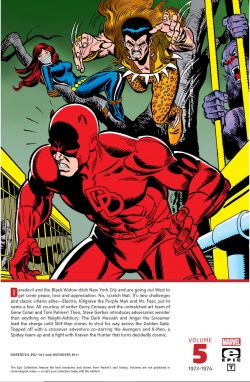
Covering May 1972 – January 1974, this rather trippy compilation chronologically re-presents Daredevil (and the Black Widow) #87-107, and a crossover into Avengers #11 wherein twin storylines converged and concluded. This tome sees the once-staid and so-very-Establishment Murdock mimic the shifting cultural mores as scripter Gerry Conway hands over the reins to cultural champion Steve Gerber. They also remove the Man Without Fear from his old haunts and relocate him and his new love to the Golden State… cohabiting with a notorious enemy of the State…

After spending years in a disastrous on-again, off-again relationship with his secretary Karen Page, Murdock took up with former client and Russian émigré, the infamous spy dubbed The Black Widow. Natasha Romanoff – sometimes called Natalia Romanova – is a Soviet-era Russian spy who came in from the cold and stuck around to become one of Marvel’s earliest and most successful female stars. She started life as a svelte, sultry honey-trap during Marvel’s early “Commie-busting” days, targeting Iron Man in her debut exploit (Tales of Suspense #52, April 1964).

Subsequently redesigned as a torrid tights-&-tech super-villain, she soon defected to the USA, falling for an assortment of Yankee superheroes before enlisting as an agent of S.H.I.E.L.D., freelance do-gooder and occasional Avenger.

Throughout her career she has always been considered ultra-efficient, coldly competent, deadly dangerous and yet somehow cursed to bring doom and disaster to her paramours. As her backstory evolved, it was revealed that Natasha had undergone experimental processes which enhanced her physical capabilities and lengthened her lifespan, as well as assorted psychological procedures which had messed up her mind and memories…

Here she had recently been railroaded and framed by villain Mr. Kline: accused of murder and prosecuted by Murdock’s best friend and law partner Foggy Nelson before the blind legal eagle cleared her…

Crafted by Conway, Colan & Tom Palmer. the new couple’s tentative romantic alliance coincides with finding a new home in San Francisco before stumbling into another old enemy looking for fresh opportunities in #87’s ‘From Stage Left, Enter: Electro!’

Establishing a fractious working relationship with pro-hero cop Lieutenant Paul Carson and his less sanguine boss Police Commissioner “Ironguts” Ohara, the newcomers endure more memory lane menaces in ‘Call Him Killgrave!’ as the mind-bending Purple Man emerges from the anonymous shadows, erroneously convinced his nemesis has tracked him down to queer his nefarious schemes.

As the origin of the Black Widow is revealed for the first time (something that has been overwritten, back-written and chucked in a plot blender interminably ever since) the sinister spellbinder attacks and is temporarily repulsed, only to regroup: aligning with Electro to again attack in ‘Crisis!’, just as a mysterious man from Natasha’s sordid Soviet spy past resurfaces with portentous news of a long-forgotten mission…

Daredevil #90 explores ‘The Sinister Secret of Project Four!’ as Hornhead begins to succumb to inexplicable, incapacitating panic attacks: explained a month later in ‘Fear is the Key!’ when Mister Fear strikes again… only to be revealed as far more than he seems…

Issue #92 finally bowed to the inevitable, officially became Daredevil and the Black Widow, just as a new menace manifests ‘On the Eve of the Talon!’ – and don’t blink or you’ll miss a brief but crucial cameo from the Black Panther!

As the Project Four saga roars to a conclusion, the introduction of industrialist and paranoid arms-dealer Damon Dran signals an escalation in weird events and deadly danger when the bonkers billionaire claims ‘A Power Corrupt!’ before being transformed into a proto-Kaiju, monolithic Indestructible Man rampaging through San Francisco…

Callously, arrogantly aware that ‘He Can Crush the World!’, Dran severely underestimates the power of superhuman heroism and falls to an ultimate sacrifice which tragically saves the day…

Again trawling the Scarlet Swashbuckler’s rogues gallery, DD/BW #95 hosts a ‘Bullfight on the Bay!’ as the metamorphic Man-Bull breaks jail and kicks off a storm of destruction to revenge himself upon Daredevil, forcing Natasha to do her very worst in #96’s concluding chapter ‘The Widow Will Make You Pay!’ (inked by Ernie Chan/Chua): a complex tale of love, obsession, revenge and mutagenic potions in the water supply…

With DD and the Widow firmly ensconced in San Francisco, Steve Gerber assumed scripting with #97 (from Conway’s plots and illustrated by Colan & Chan) with ‘He Who Saves’ as a street acrobat suffers a calamitous accident and is subsequently mutated into proto-godling the Dark Messiah by sinister hidden forces…

The already unstoppable Agent of Change is then joined by three equally awesome Disciples of Doom in #98’s ‘Let There be… Death!’, but even though physically overmatched, our heroic power couple’s psychological warfare proves fatally effective in ending the crisis, if not ferreting out the true villains…

Daredevil and the Black Widow #99 featured ‘The Mark of Hawkeye!’ by now-autonomous Gerber, with comics veterans Sam Kweskin & Syd Shores providing the pictures, and finds Natasha Romanoff’s old boyfriend turning up determined to “reclaim” her…

His caveman tactics lead to the Archer’s sound and well-deserved thrashing and result in a quick jump into Avengers #111. Crafted by Steve Englehart, Don Heck & Mike Esposito, ‘With Two Beside Them!’ sees the West Coast vigilantes join a much-depleted team of heroes to rescue a number of X-Men and Avengers enslaved by malevolent Magneto.

Dumped by Natasha and returning alone to the City by the Bay for his centenary issue, DD agonisingly relives his origins and danger-drenched life in ‘Mind Storm!’ (Gerber, Colan & John Tartaglione) just as a savage and embittered psionic terrorist launches a series of mind-mangling assaults on the populace. It culminates one month later in a shattering showdown between the blind hero and Angar the Screamer as well as a shaky reconciliation with the Widow in ‘Vengeance in the Sky with Diamonds!’ – illustrated by Rich Buckler & Frank Giacoia.

Scripted by Chris Claremont, and limned by Shores & Giacoia, ‘Stilt-Man Stalks the City!’ has Hornhead hunting psychedelic assassin Angar, accidentally bringing him into conflict with a merciless and similarly displaced old foe. The skyscraping scoundrel has kidnapped the daughter of an inventor in order to extort enhanced weaponry out of the traumatised tinkerer, but isn’t expecting interference from his oldest adversary… or the utterly ruthless Russian paramour he’s working with…

No sooner have DD and the Widow ended the mile-high miscreant’s rampage than #103 sees a team-up with Spider-Man after a merciless cyborg attacks the odd couple as they pose for roving photojournalist Peter Parker in ‘…Then Came Ramrod!’ by new regular team Gerber, Don Heck & Sal Trapani. The barely-human brute is after files in Murdock’s safe and hints of a hidden master, but ultimately his blockbusting strength is of little use against the far faster veteran heroes…

Even as the distracted Murdock realises that his own boss Kerwin J. Broderick is sabotaging the attorney’s cases, that mystery manipulator is hiring warped mercenary Sergei Kravinoff to make Daredevil ‘Prey of the Hunter!’ Matt’s priorities change when Kraven abducts Natasha, and even after the hero rescues her, the Hunter explosively returns to defeat them both, throwing the swashbuckler to his death…

Inked by Don Perlin, Daredevil #105 sees the Widow brutally avenging her man’s “murder”, but Murdock is far from dead, having been teleported from the jaws of doom by a ‘Menace from the Moons of Saturn!’

In a short sequence pencilled by Jim Starlin and tying into the then ongoing Captain Marvel/Thanos saga, earthborn Priestess of Titan Moondragon is introduced, disclosing how she has been dispatched to Earth to counter the schemes of a death-worshipping proto-god. She also inadvertently lets slip how she has allied with a respected man of power and authority, providing him with a variety of augmented agents such as Dark Messiah, Ramrod and Angar…

Gerber, Heck & Trapani bring the expansive extended epic closer to culmination as the manipulator is unmasked in ‘Life Be Not Proud!’ but not before the wily plotter redeploys all his past minions, shoots his misguided ally Moondragon, usurps a Titanian ultimate weapon and unleashes a life-leeching horror dubbed Terrex upon the world.

With all Earth endangered, DD, the Widow and guest-stars Kree warrior Mar-Vell and eternal sidekick Rick Jones must pull out all the stops to defeat the threat, and only then after a last-minute defection by the worst of their enemies and a desperate ‘Blind Man’s Bluff!’, all courtesy of Gerber, Bob Brown & Sal Buscema.

With covers by John Buscema, Gil Kane, Ralph Reese, Sal Buscema, Joe Sinnott, Colan, Palmer, Frank Giacoia, George Tuska, John Romita, Rich Buckler, Heck, Jim Starlin & Al Milgrom, this supremely enticing volume also offers extra treats: original art pages and covers by Colan, Kane, Palmer, Romita &Esposito and the promotional cover for #100 – which tied in with Rolling Stone magazine.

As the social upheaval of this period receded, the impressively earnest material was replaced by fabulous fantasy tales which strongly suggested the true potential of Daredevil was in reach. These beautifully illustrated yarns may still occasionally jar with their earnest stridency and dated attitudes, but the narrative energy and sheer exuberant excitement of such classic adventures are graphic joys no action fan will care to miss. And the next volume heads even further into uncharted territory…
© 2022 MARVEL.

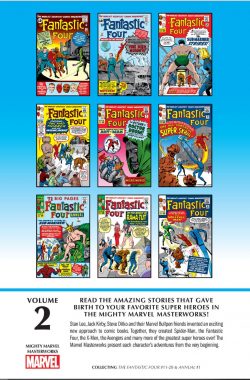
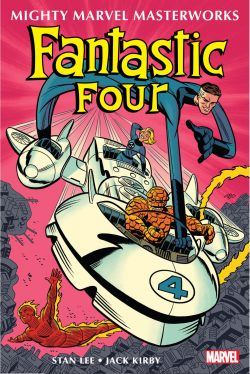
Mighty Marvel Masterworks – The Fantastic Four volume 2: The Micro-World of Doctor Doom


By Stan Lee & Jack Kirby, with Dick Ayers, Steve Ditko, George Klein, Sol Brodsky, Joe Sinnott & various (MARVEL)
ISBN: 978-1-3029-3436-1 (PB/Digital edition)

Win’s Christmas Gift Recommendation: Properly Ultimate Comics Creations… 10/10

I’m partial to controversy so we’re starting off by declaring that Fantastic Four #1 is the third most important American comic book in the industry’s astounding history. Just ahead of it are The Brave and the Bold #28, which brought superhero teams back via the creation of the Justice League of America, and always at the top Showcase #4, which introduced The Flash and therefore the Silver Age. Feel free to disagree…

After a troubled period at DC Comics – National Periodicals as it then was – and a creatively productive but disheartening time on the poisoned chalice of the Sky Masters newspaper strip Complete Sky Masters of the Space Force), Jack Kirby settled into his job at the small outfit that used to be publishing powerhouse Timely/Atlas.

He generated mystery, monster, romance and western material in an industry and marketplace he suspected was ultimately doomed but, as always, did the best job possible. That quirky genre fare is now considered some of the best of its kind ever seen.

However, his fertile imagination couldn’t be suppressed for long and when the JLA caught the readership’s attention, it gave him and writer/editor Stan Lee an opportunity to change the industry forever.

Depending upon who you believe, a golfing afternoon led publisher/owner Martin Goodman ordering his nephew Stan to try a series about a group of super-characters like the one DC was doing. The resulting team quickly took fans by storm. It wasn’t the powers: they’d all been seen since the beginning of the medium. It wasn’t the costumes: they didn’t have any until the third issue.

It was Kirby’s compelling art and the fact that these characters weren’t anodyne cardboard cut-outs. In a real and a recognizable location – New York City – imperfect, raw-nerved, touchy people banded together out of tragedy, disaster and necessity to face the incredible.

In most ways, The Challengers of the Unknown (Kirby’s prototype partners-in-peril project at National/DC) laid all the groundwork for the wonders to come, but the staid, almost hide-bound editorial strictures of National would never have allowed the undiluted energy of the concept to run all-but-unregulated. The Fantastic Four was the right mix in the right manner at the right moment and we’re all here now because of it. These stories are timeless and have been gathered many times before, so I’m digressing to talk about format here.

The Mighty Marvel Masterworks line was designed with economy in mind. Classic tales of Marvel’s key creators and characters re-presented in chronological order have been a staple since the 1990s, but always in lavish, expensive collectors editions. These new books are far cheaper, with some deletions like the occasional pin-up. They are printed on lower quality paper and – crucially – are physically smaller, about the dimensions of a paperback book. Your eyesight might be failing and your hands too big and shaky, but they’re perfect for kids and if you opt for the digital editions, that’s no issue at all…

Fantastic Four #1 (bi-monthly and cover-dated November 1961, by Lee, Kirby, George Klein & Christopher Rule) was crude: rough, passionate and uncontrolled excitement. Thrill-hungry kids pounced on it. That ground-breaking premier issue saw maverick scientist Reed Richards, his fiancé Sue Storm, close friend Ben Grimm and Sue’s bratty, teenaged brother in an ill-starred private space-shot after Cosmic rays penetrated their ship’s inadequate shielding… and mutated them all into beings unlike any others.

Richards’ body became elastic, Sue became invisible, Johnny Storm could turn into living flame and poor, tragic Ben devolved into a shambling, rocky freak. Despite these terrifying transformations, before long the quartet had become the darlings of the modern age: celebrity stalwarts alternately saving the world and shamefully squabbling in public…

This second full-colour compendium spans February to November 1963, collecting Fantastic Four #11-20 plus the first Annual, and we open sans preamble with more groundbreaking innovations as FF #11 offers two short stories instead of the usual book-length yarn. ‘A Visit with the Fantastic Four’ provides a behind-the-scenes travelogue and examination of our stars’ pre-superhero lives, after which ‘The Impossible Man’ proves to be a baddie-free, compellingly comedic tale about facing an unbeatable foe.

FF #12 featured an early example of guest-star promotion as the team are required to help the US army capture ‘The Incredible Hulk’: a tale packed with intrigue, action and bitter irony as the man-monster was actually being framed by a Russian spy for acts of sabotage. It’s followed by an even more momentous and game-changing episode.

‘Versus the Red Ghost and his Incredible Super Apes!’ is another cold war thriller pitting the heroic family against a Soviet scientist in the race to reach the Moon: a tale notable both for the moody Steve Ditko inking of Kirby’s artwork (replacing adroit Dick Ayers for one glorious month) and the introduction of the oxygen-rich “Blue Area of the Moon” as well as the omnipotent, omnipresent cosmic voyeurs called The Watchers

As the triumphant Americans rocket home, issue #14 touts the return of ‘The Sub-Mariner and the Merciless Puppet Master!’ – with one vengeful fiend made the unwitting mind-slave of the other. The romantic triangle of Reed, Sue and Namor added lustre and tantalising moral ambivalence to the mighty Sea King who was to become the company’s other all-conquering antihero in months to come…

That epic is followed by ‘The Mad Thinker and his Awesome Android!’. wherein a chilling war of intellects between driven super-scientists results in a cerebral duel and yet all-action clash with plenty of room for smart laughs to leaven the drama. There’s a pin-up extra this time: a candid group-shot of the entire team.

Fantastic Four #16 explores ‘The Micro-World of Doctor Doom!’ in a spectacular romp guest-starring new hero Ant-Man whilst also offering a Fantastic Four Feature Page outlining the powers and capabilities of elastic Mister Fantastic. Despite his resounding defeat, the steel-shod villain promptly returned with more infallible, deadly traps a month later in ‘Defeated by Doctor Doom!’ Of course, they actually weren’t and soon sent the sinister tyrant packing…

The shape-shifting aliens who challenged the team in their second adventure returned with a new tactic in #18 as the team tackle an implacable foe equipped with their own powers. ‘A Skrull Walks Among Us!’ is a potent prelude to greater, cosmos-spanning sagas yet to come…

The unused cover to Fantastic Four Annual #1 precedes the one that actually fronted one of the greatest tales in comics history. The colossal summer special comic book was a spectacular 37-page epic by Lee, Kirby & Ayers as – after finally reuniting with their sea-roving prince – the armies of Atlantis invade New York City and the rest of the world in ‘The Sub-Mariner versus the Human Race!’

A monumental tale by the standards of the time (and today!), the saga saw the FF repel the initially overwhelming undersea invasion through valiant struggle, brilliant strategy and technological innovation, as well as providing the hidden history of the secretive Homo Mermanus race and even an origin for the surly Sub-Mariner,,,

Nothing was really settled except a return to the original status quo, but the thrills are intense and unforgettable…

Also included are rousing pin-ups and fact file features. Interspersed by ‘A Gallery of the Fantastic Four’s Most Famous Foes!’ (potent pin-ups of The Mole Man, Skrulls, Miracle Man and Prince Namor, the Sub-Mariner). You can also enjoy by learning in ‘Questions and Answers about the Fantastic Four’: a diagrammatic trip ‘Inside the Baxter Building’, before the rogue’s gallery resumes with pin-ups of Doctor Doom, Kurrgo, Master of Planet X and The Puppet Master, and a bemusing short tale ‘The Fabulous Fantastic Four meet Spider-Man!’ This is an extended re-interpretation of the first meeting between the two most popular Marvel brands, extrapolated from the premiere issue of the wallcrawler’s own comic. Pencilled this time by Kirby, the dramatic duel was graced by Ditko’s inking to create a truly novel and compelling look.

One last dose of villainous mug-shots highlights The Impossible Man, Incredible Hulk, Red Ghost and his Indescribable Super-Apes and The Mad Thinker and his Awesome Android, before we return to the regular run as – cover-dated October 1963 – Fantastic Four #19 introduced another remarkable, top-ranking super-villain after the quarrelsome quartet travel back to ancient Egypt and become ‘Prisoners of the Pharaoh!’

This time-twisting tale has been revisited by so many writers that it’s considered one of the key stories in Marvel Universe history; introducing a future-Earth tyrant who would evolve into three overarching time menaces: Kang the Conqueror, Rama Tut AND Immortus

The vintage wonderment concludes here with one last universe-rending, keystone foe debut with the threat again overcome by brains not brawn. FF #20 (again preceded by another Kirby cover that didn’t make the final cut) shows how ‘The Mysterious Molecule Man!’ briefly menaces New York before being soundly outsmarted and removed…

Some might argue that these yarns might be a little dated in tone, but they these are still classics of comic story-telling illustrated by one of the world’s greatest talents approaching his mature peak. Fast, frantic fun and a joy to read or re-read, this comprehensive, joyous introduction/reintroduction to these immortal characters is a wonderful reminder of just how good comic books can and should be…
© 2021 MARVEL.

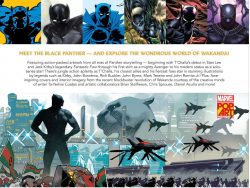
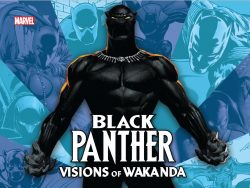
Black Panther: Visions of Wakanda


By Jess Harrold, Rodolfo Muraguchi & Adam Del Re with Stan Lee & Jack Kirby, Roy Thomas & John Buscema, Don McGregor, Rick Buckler, Billy Graham & Gene Colan, Ta-Nehisi Coates & Brian Stelfreeze and many & various (MARVEL)
ISBN: 978-1302919382 (HB/Digital edition)

Win’s Christmas Gift Recommendation: Categorically Picture Perfect… 9/10

Celebrated as the first black superhero in American comics and one of the first to carry his own series, the Black Panther’s popularity and fortunes have waxed and waned since the 1960s when he first attacked the FF (in Fantastic Four #52; cover-dated July 1966) as part of an elaborate plan to gain vengeance on the murderer of his father.

T’Challa, son of T’Chaka was revealed as an African monarch whose hidden kingdom was the only source of a vibration-absorbing alien metal upon which the nation’s immense wealth was founded. Those mineral riches – derived from a fallen meteor which struck the continent in primeval antiquity – had powered his country’s transformation into a technological wonderland. That tribal wealth had long been guarded by a hereditary feline-garbed champion deriving physical advantages from secret ceremonies and a mysterious heart-shaped herb that ensured the generational dominance of the nation’s warrior Panther Cult.

After being a steadfast if minor Marvel stalwart for decades, the character and his world finally achieved global stardom thanks to a series of stunning movie interpretations and is now an assured icon of planetary consciousness…

With accumulated years of superb comics material to fall back on, the company would be crazy not to use that in reprints and overviews like this one: creating a resource for new fans to consult and veterans to relish again.

They’re not crazy and this spiffy landscape edition – written by Jess Harrold and designed by Rodolfo Muraguchi & Adam Del Re – came out a couple of years ago. With a sequel in cinemas and the Holiday Season looming, it’s only sensible to point you in this direction if you’re seeking gift suggestions…

Following Introduction ‘Dear Brian…’ by 1990s scripter Christopher J. Priest, what follows is a series of informative, contextualising – but accessibly fun – essays, dotted with candid behind-the-scenes illustrations (like Kirby’s original concept of “The Coal Tiger”), quotes from contributing creators and artwork from classic issues and storylines: tracing the entire career of the Hero/Heroes who have steered Wakanda through Marvel Comics history…

It starts with Chapter One and ‘Enter… The Black Panther!’, with the aforementioned debut and early days supplemented by printed pages, and original art by Kirby & inker Joe Sinnott, highlighting not just the man but especially the astonishingly futuristic kingdom he ruled. As well as origins, there are introductions to concepts and villains who would shape the destinies of the characters and country…

After treading the guest star route, T’Challa got his first regular gig as Captain America’s replacement on the World’s Mightiest Supergroup. ‘Avengers Assemble!’ reprises those walk-ons and traces the solitary hunter’s career as part of a team, with excerpted art and covers from Kirby, John Buscema, Frank Giacoia, Sal Buscema, Rich Buckler, George Tuska, John Romita Sr., Arthur Adams, Marcos Stein and Phil Noto.

‘Panther’s Rage’ reveals how the King faced an existential threat in his homeland as, after policing the Marvel Universe, the summer of 1973 saw the Black Panther finally advance to solo star in his own series. In Jungle Action #6-18, Don McGregor scripted an ambitious epic of love, death, vengeance and civil war: inventing from whole cloth and Kirby’s throwaway notion of a futuristic jungle, the most unique African nation ever imagined…

With art from Rich Buckler, Klaus Janson and Billy Graham, the chapter highlights the unique structure and page design of what is arguably one of comics’ earliest graphic novels. Also provided are the first maps of Wakanda and hits of McGregor’s follow-up tale.

The Panther versus the Klan shifted focus from war stories to crime fiction, replacing exotic Africa for America’s poverty-wracked, troubled, still segregated-in-all-but-name Deep South for a head-on collision with centuries of entrenched and endemic racism. The multi-layered tale ended but did not conclude as Jungle Action was cancelled before its time…

Two months later, under the auspices of returning creative colossus Jack Kirby, a wholly different kind of Black Panther enjoying utterly unrelated adventures was launched, and ‘The Return of the King’ celebrates a new era of excitement.

Kirby’s return proved to be controversial. He was never slavishly wedded to tight continuity and preferred, in many ways, to treat his stints on titles as a “Day One”. His commitment was to wholesome, eye-popping adventure, breakneck action and breathless, mind-boggling wonderment. Combined with his absolute mastery of the comic page and unceasing quest for the Next Big Thrill, it made for a captivating read, but found little favour with those readers fully committed to the minutiae of the Marvel Universe.

With Black Panther #1, what they got was a rollercoaster ride of classic Kirby concept-overload as the Hereditary King of a miraculous Lost Kingdom gallantly pursued fabulous time machines, fought future men and secret samurai clans, thwarted the plots of super-rich artefact stealers and foiled schemes to nuke his hidden homeland, usurp his rule and even consume his faithful subjects. Kirby even introduced an entire, unsuspected extended Royal Family: a Panther clan who would become an intrinsic part of the new mythology.

All this is dynamically revealed in a wave of wonder from Kirby before ‘Where Prowls the Panther?’ explores the 1980s – and a relative dry spell for the hero. Primarily back as a guest star, T’Challa nevertheless completed the “The Klan” saga, revealed a childhood adventure with Storm of the X-Men and closed the decade with a politically-charged miniseries confronting Apartheid. Art contributors here include Jerry Bingham, Al Milgrom, John Byrne, Bob McLeod, Walter Simonson, Steve Rude and Denys Cowan.

Chapter Six examines ‘Panther’s Quest… Panther’s Prey’ when, – as the 1990s began – South Africa’s morally bankrupt ruling system was buckling and became an acceptable target in many creative fields. McGregor returned after years away from the comics mainstream, and with artists Gee Colan & Tom Palmer, spun a shocking tale of intolerance as an epic serial in 25 chapters (published in fortnightly anthology Marvel Comics Presents #13-37, from February to December1989).

One of the most thought-provoking mainstream comics tales ever released, Panther’s Quest reveals how T’Challa infiltrated totalitarian South Africa in search of Ramonda, the beloved stepmother he had believed dead for decades. His hunt for her uncovered conspiracy and abduction, whilst placing him at the forefront of the battle for survival daily endured by the black majority. The saga added pressure to the ever-growing Anti-Apartheid movement in comics and western media, by examining not only the condition of racial inequality but also turning a damning eye on sexual oppression.

It was followed by prestige Limited Series Panther’s Prey, set in Wakanda and again examining the dichotomy of tradition versus progress that had underpinned Panther’s Rage. McGregor’s chilling script was transformed by the art of Dwayne Turner, as seen here in numerous pages and covers from the series, counterpointed by excepts from 2018’s reprise of the tale illustrated by Daniel Acuña from Black Panther Annual #1.

As seen in ‘The Marvel Knight’, T’Challa’s story took a huge leap when Christopher Priest utterly revamped and modernised the hero – and Wakanda – in an epically transformational run. How and why is supported by sketches, designs, finished art and covers by Mark Texiera, Joe Quesada, Joe Jusko, Mike Manley, Sal Velluto, Norm Breyfogle, Andy Kubert, Jim Calafiore, Kyle Hotz, Tomm Coker. Bruce Timm and more.

Screenwriter Reginald Hudlin’s tenure is covered next with ‘Who is the Black Panther?’ as the king takes a wife and full charge of his country in truly perilous circumstances, just as the secret history of Wakanda is revealed at last…

This epic period of change and revelation was supported by many artists and included here are John Romita Jr., Janson, Esad Ribi?, Fran Cho, David Yardin, Scot Eaton, Olivier Coipel, Leinil Francis Yu, Michael Turner, Joseph Michael Linsner, Trevor Hairsine, Mike Deodato Jr., Gary Frank, Nico Henrichon, Simone Bianchi, Arthur Suydam, Cafu, Alan Davis, Francis Portela, Jason Pearson, Jefté Palo and Denys Cowan.

Tribal wealth had always been guarded by hereditary feline champions deriving physical advantages from secret ceremonies and a mysterious heart-shaped herb. This ensured the generational dominance of Wakanda’s warrior Panther Cult. However, in recent years, Vibranium made the country a target for increasing subversion and incursion. After clashes with Namor the Sub-Mariner and an attack by Doctor Doom, T’Challa was forced to render all earthly Vibranium inert, defeating the invader but leaving his homeland broken and economically shattered.

During that cataclysmic clash, the King’s flighty, spoiled brat half-sister Shuri took on the mantle of Black Panther, becoming clan and country’s new champion whilst her predecessor struggled with the disaster he had caused and also recuperated from near-fatal injuries.

Despite initially being rejected by the divine Panther Spirit, Shuri proved a dedicated and ingenious protector, serving with honour until she perished defending Wakanda from alien invader Thanos. When T’Challa resumed his position as warrior-king, one of his earliest tasks was resurrecting his sister. She had passed into the Djalia (Wakanda’s spiritual Plane of Memories) where she absorbed the entire history of the nation from ascended Elders. On her return to physicality, she gained mighty new powers as the Ascended Future…

That’s addressed in rapid succession via ‘Shuri… the Black Panther!’, ‘The Most Dangerous Man Alive!’ and ‘King of the Dead’ – with art from J. Scott Campbell, Ken Lashley, Paul Neary, Paul Renaud, Will Conrad, Romita Jr., Mike Del Mundo, Francesco Francavilla, Simone Bianchi, Andrea Silvestri, Patch Zircher, Giuseppe Camuncoli, Alex Maleev, Adam Kubert, Tom Raney, Steve Epting, Deodato Jr., Jim Cheung, Christian Ward, Valerio Schiti, Kev Walker, Esad Ribi? and Kenneth Rocafort – before ‘A Nation Under Our Feet’ shows how writer Ta-Nehisi Coates and artists Brian Stelfreeze imagined the concept.

That 2016 reinvention again tackled revolution in Wakanda, but also addressed democracy versus autocracy, science against magic, women’s rights, freedom of education and body autonomy whilst telling astounding powerful heroic tales. Stelfeeze’s art and designs are augmented by art and commentary from Chris Sprouse, Wilfredo Torres, Leonard Kirk, Paolo & Joe Rivers and Janie McKelvie & Matthew Wilson.

The series sparked a renaissance and flurry of spin-off titles and ‘The World of Wakanda’

examines that expanded universe, and utilises art by Alitha E. Martinez, Stelfreeze, Jen Bartel, John Cassaday, Butch Guice, Sprouse, Juan Ferreya, Ed McGuiness, Davis, Deodato Jr., Sam Spratt, Leonardo Romero and Kirbi Fagan.

The Panther’s tale pauses here with Coates final storyline ‘The Intergalactic Empire of Wakanda’ as T’Challa abandoned Earth to investigate a vast cosmic tyranny somehow based on his beloved country: a mystery gradually unfolded through the art of Stelfreeze, Acuña and Jen Bartel before we close with ‘Portraits of a Panther’ and a treasure trove of more incredible images that have resulted from the characters and stories preside here. This includes work and commentary by Bianchi, Mike McKone, Alex Ross, Kirby, Skottie Young, Coipel, Neal Adams, Yasmine Putri, Larry Stroman, Acuña, Mike Perkins, Sanford Greene, Jamal Campbell, Inhyuk Lee, Sophie Campbell, Tradd Moore, Natacha Bustos and Ribi?.

Emotionally engaging, powerfully inspirational, and cathartically thrilling, the fictive realm of the Panther People is one that every fan of thrills and lover of wonder should enjoy. This spectacular visual feast is certainly the only guidebook you should need…
© 2020 MARVEL.

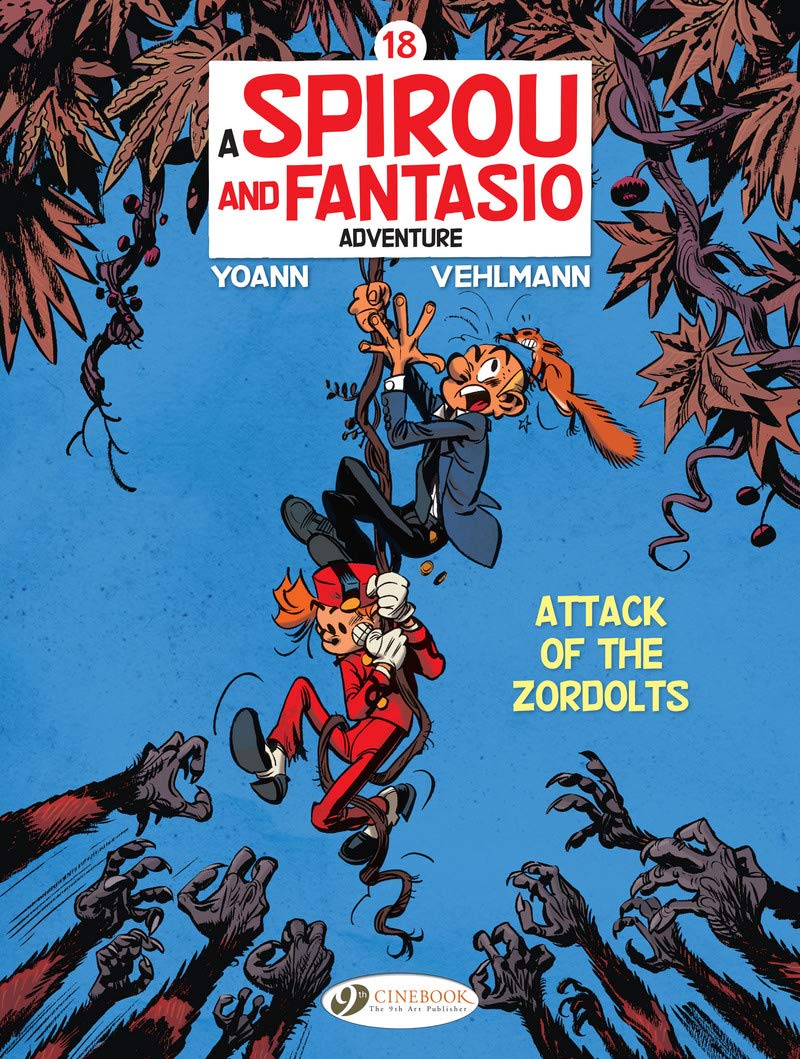
Spirou & Fantasio volume 18: Attack of the Zordolts


By Yoann & Vehlmann, designed by Fred Blanchard, colored by Hubert & translated by Jerome Saincantin (Cinebook)
ISBN: 978-1-80044-022-7 (Album PB/Digital edition)

Win’s Christmas Gift Recommendation: Manic Mirth and Mad Melodrama… 9/10

Spirou (which translates as both “squirrel” and “mischievous” in the Walloon language) was created by French cartoonist Françoise Robert Velter AKA Rob-Vel for Belgian publisher Éditions Dupuis in response to the phenomenal success of Hergé’s Tintin at rival outfit Casterman.

Soon-to-be legendary weekly comic Le Journal de Spirou launched on April 21st 1938 with a rival red-headed lad as lead feature in an anthology which bears his name to this day. The eponymous hero was a plucky bellboy/lift operator employed in the Moustique Hotel – a sly reference to the publisher’s premier periodical Le Moustique. His improbable adventures with pet squirrel Spip gradually evolved into far-reaching, surreal comedy dramas.

Spirou and his chums have spearheaded the magazine for most of its life, with a phalanx of truly impressive creators carrying on Velter’s work, beginning with his wife Blanche “Davine” Dumoulin who took over the strip when her husband enlisted in 1939. She was assisted by Belgian artist Luc Lafnet until 1943, when Dupuis purchased all rights to the property, after which comic-strip prodigy Joseph Gillain (Jijé) took the helm.

In 1946, his assistant André Franquin assumed the creative reins, gradually ditching the well-seasoned short gag vignettes in favour of epic adventure serials. He also expanded the cast, introducing a broad band of engaging regulars and eventually creating phenomenally popular magic animal Marsupilami.

Franquin was followed by Jean-Claude Fournier who updated the feature over nine stirring adventures tapping into the rebellious, relevant zeitgeist of the times: offering tales of environmental concern, nuclear energy, drug cartels and repressive regimes.

By the 1980s the series seemed outdated and lacked direction. Three different creative teams alternated on the feature, until it was overhauled and revitalised by Philippe Vandevelde (writing as Tome) and artist Jean-Richard Geurts AKA Janry. They adapted, referenced and in many ways returned to the beloved Franquin era.

Their sterling efforts revived the floundering feature’s fortunes, generating 14 wonderful albums between 1984 and1998. As the strip diversified into parallel strands (Spirou’s Childhood/Little Spirou and guest-creator specials A Spirou Story By…), the team on the core feature were succeeded by Jean-David Morvan & José-Luis Munuera. Then Yoann & Vehlmann took over the never-ending procession of amazing adventures…

Multi-award-winning French comics author Fabien Vehlman was born in 1972, began his comics career in 1996 and has been favourably likened to René Goscinny. He’s best known for Green Manor (illustrated by Denis Bodart), Seven Psychopaths with Sean Phillips, Seuls (drawn by Bruno Gazzotti and available in English as Alone), Wondertown with Benoit Feroumont and Isle of 1000,000 Graves with Jason.

He assumed the writing reins on Spirou and Fantasio in collaboration with Yoann. beginning with the book on review here – 2010’s Spirou et Fantasio – Alerte aux Zorkons.

Yoann Chivard was born in October 1971 and was drawing non-stop by the age of five. With qualifications in Plastic Arts and a degree in Communication from the Academy of Fine Arts in Angers, he became a poster and advertising artist whilst dabbling in comics. His creations include Phil Kaos and Dark Boris for British Indie publications Deadline and Inkling, Toto l’Ornithorynque, Nini Rezergoude, La Voleuse de Pere-Fauteuil, Ether Glister and Bob Marone and he has contributed to Trondheim & Sfar’s Donjon. In 2006, Yoann was the first artist to produce a Spirou et Fantasio one shot Special. It was scripted by Vehlmann…

Cinebook have been publishing Spirou & Fantasio’s exploits since 2009, alternating between the various superb reinterpretations of Franquin and earlier efforts from the great man himself. When Jijé handed Franquin all responsibilities for the strip part-way through Spirou et la maison préfabriqué (LJdS #427, June 20th 1946), the new guy ran with it for two decades; enlarging the scope and horizons until it became purely his own. Almost every week fans would meet startling new characters such as staunch comrade and rival Fantasio or crackpot inventor and Merlin of mushroom mechanics Pacôme Hégésippe Adélard Ladislas de ChampignacThe Count of Champignac

Spirou and Fantasio became globe-trotting journalists, travelling to dangerously exotic places, uncovering crimes, exploring the fantastic and clashing with a coterie of exotic arch-enemies such as Fantasio’s deranged and wicked cousin Zantafio and that maddest of scientists, Zorglub.

This old school chum and implacable rival of Champignac is an outrageous Bond movie-flavoured villain who constantly targets the Count. A brilliant engineer, his incredible machines are far less dangerous than his mesmerising mind-controlling “Zorglwave” and an apparently unshakable desire to conquer Earth and dominate the solar system from a base on the Moon…

This tale opens with the seemingly reformed plotter stealing some of Champignac’s most incredible mushroom-based miracles and triggering a massive mutational event in and around the bucolic generally placid hamlet of Champignac-in-the-Sticks.

The first Spirou and Fantasio hear of it is a desperate cell phone call from Pacôme, who has just reappeared after weeks amnesiac and missing. Driving back from a promotional tour, our heroes race across country only to find the placid region is now an armed camp, with soldiers in biohazard gear brutally decontaminating villagers.

The little valley has become a monstrous alien jungle dominated and transformed by weird and incredible plant/animal/fungus creatures, but neither they nor the military – who are keen on immediately nuking the geographical atrocity – can stop our dedicated reporters sneaking in to find their friends.

On locating the Count and his two new chums – hot Swedish science students Astrid and Lena – the lads learn that the brave new world is an accident and hideous side effect of Zorglub’s latest scheme, and that he’s sorrier than anyone at the state of the local environment.

He’s certainly keen enough on fixing the problem…

Other than the fact that everything wants to eat everything else, and that many of the human locals seem comfortable and accustomed to the changes, the main problem seems to be a rapidly proliferating and aggressive form of beast man. The jungle is now a superfast evolutionary Petri dish with everything in it part of an arms race to out-compete all rivals. These brutish bipeds have for some reason evolved immunity to Zorglub’s Zorglwave by having oodles of aggression and not enough intellect. They are ravening, unstoppable Zordolts…

Not sure what’s happening, but resolved to stop the Army bombing the village before foiling Zorglub, everybody works frantically together and succeeds in part one of the plan, but when the jests are repelled and the Zordolts stopped by Champignac’s newly-liberated dinosaur they find the villain vanished.

By the time Champignac has worked his mushroom magic in reverse and restored most of the status quo, the Master of the Z ray is long gone. If our heroes could look up high enough, they might see him well on his way to the moon with Astrid in Lena in tow and about to set his Great Masterwork in motion…

To be Continued…

Rocket-paced, action-packed, compellingly convoluted and with just the right blend of perfectly blending helter-skelter excitement and sheer daftness, Attack of the Zordolts is a terrific romp to delight devotees of easy-going adventure.

Stuffed with an astounding array of astonishing hi-tech spoofery, riotous chases and gazillions of sight gags and verbal ripostes, this exultant escapade is a fabulous fiesta of angst-free action and thrills. Readily accessible to readers of all ages and drawn with beguiling style and seductive energy and wit, this is pure cartoon gold, truly deserving of reaching the widest audience possible.

Buy it for you, get another for the kids and give copies to all your friends…
Original edition © Dupuis, 2010 by Vehlmann, Yoann, Blanchard & Hubert. All rights reserved. English translation 2021 © Cinebook Ltd.

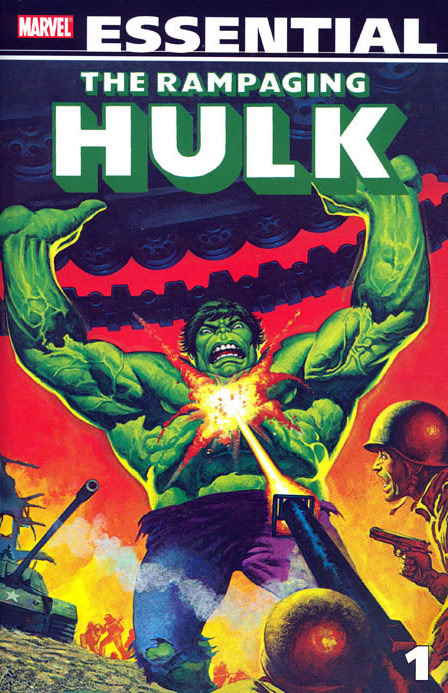
Essential Rampaging Hulk volume 1


By Doug Moench, John Warner, Walter Simonson, Alfred Alcala, Alex Niño, Jim Starlin, Keith Pollard, Tony DeZuñiga, Herb Trimpe, Sal Buscema, Ron Wilson, Bill Sienkiewicz, Rudy Nebres, Bob McLeod & various (Marvel)
ISBN: 978-0-7851-2699-7 (TPB)

The Incredible Hulk was Marvel’s second “superhero” title, although technically Henry Pym debuted earlier in a one-off yarn in Tales to Astonish #27 (January 1962). However, he didn’t become a costumed hero until the autumn, by which time Ol’ Greenskin was not-so-firmly established.

The Hulk crashed right into his own comic book and – after some classic romps by Young Marvel’s finest creators – crashed right out again. After six bi-monthly issues the series was cancelled and Lee retrenched, making the man-monster a perennial guest-star in Marvel’s other titles (Fantastic Four #12, Amazing Spider-Man #14, The Avengers from #1 and so forth) until such time as they restarted his own exploits in the new “Split-Book” format. The Jade Giant landed in Tales To Astonish where Ant/Giant-Man was rapidly proving to be a character who had outlived his time.

It all began in The Incredible Hulk #1 (cover-dated May 1962) which saw puny atomic scientist Bruce Banner sequestered on a secret military base in the desert, and perpetually bullied by bombastic commander General “Thunderbolt” Ross as the clock counted down to the world’s first Gamma Bomb test. Besotted by Ross’s daughter Betty, Banner endured the General’s constant jibes as the clock ticked on and tension increased. During the final countdown, Banner spotted a teenager lollygagging at Ground Zero and frantically rushed to the site to drag the boy away…

Rick Jones was a wayward but good-hearted kid. After initial resistance he let himself be pushed into a safety trench, but just as Banner was about to join him The Bomb detonated…

Miraculously surviving the blast, Banner and the boy were secured by soldiers, but that evening as the sun set the scientist underwent a monstrous transformation. He grew larger and his skin turned a stony grey…

In six simple pages that’s how it all started, and no matter what any number of TV, movie or comic book retcons and psycho-babble re-evaluations would have you believe, it’s still the best and most primal take on the origin. A good man, an unobtainable girl, a foolish kid, an unknown enemy and the horrible power of destructive science unchecked. It was clearly also the idea for a later iteration where continuity was rolled right back to the era of the first run: set in the Sixties and revealing previously “untold tales”…

In December 1976 that’s how the retrospective spin-off series began. Now a literal and figurative Marvel powerhouse, the Jade Juggernaut was awarded a monochrome magazine free of Comics Code supervision to augment his many in-continuity appearances. The Rampaging Hulk took the controversial tack of telling stories of what Banner, Jones and the Big Guy did next during the further formation of the nascent Marvel Universe…

Keeping up the theme, early issues featured tales of monster-hunter Ulysses Bloodstone, but you’ll need to look elsewhere for them…

The Hulk stories were set in 1963, after his own first series foundered, and – following a terse retelling of the classic origin cited above – scripter Doug Moench and illustrators Walt Simonson & Alfredo Alcala channelled primal Jack Kirby via a rather heavy grey-tone wash in a wild yarn of flying saucer sightings over Rome. The portentous sightings heralded invasion and, by also referencing the company’s early Sixties monster mag triumphs, the second-generation creators tacitly acknowledged their target audience: a supposedly older magazine readership who were presumably many of the same kids who had bought the original fantasy masterpieces…

Moench’s scripts and tone were wryly tongue-in-cheek, offering constant visual and verbal comedic touches whilst channelling early Marvel continuity and the tropes of the Sixties, if only as seen from the distant perspective of ten years after…

The magazine phenomenon had only a minor impact and effect on the Hulk’s four-colour adventures at that time, but, as always, the fury-fuelled fugitive was alternately aided or hunted by General Ross and met a variety of guest-star heroes and villains…

Opening gambit ‘The Krylorian Conspiracy’ saw Banner and Jones teaming up with alien rebel Bereet: a pacifist techno-artist hiding on Earth and seeking to prevent her bellicose shape-shifting people conquering humanity. The militaristic, monster-obsessed Krylorians – having failed to recruit the Gamma Goliath – attack Rome whilst enlisting the aid of The Hulk’s first super-foe: renegade Russian mutant The Gargoyle. Of course, they intend to betray him at the first opportunity…

It all ends up in a colossal clash with lots of spectacular smashing, with Bereet, Jones, Banner and The Hulk all resolved to stop the invasion at any cost…

Embellisher Alcala switched to a drybrush technique for the second issue as ‘And Then… The X-Men’ finds the wanderers in Paris, contesting more Krylorian shapeshifters, robots and crazy creatures, and subsequently attracting the attention of a certain band of mutant hunting teenagers. After the customary violent misunderstandings, the clandestine outsiders join forces with the Hulk to stop the razing of the City of Lights…

Another early foe returned as #3 shifted the action to the South of France where ‘The Monster and the Metal Master’ sees the treacherous Krylorians dupe and exploit another alien – a manic metal-moulding malcontent who appeared in the last issue of the original Hulk comic – into piloting their new weapon (“The Ferronaut”), whilst Rick, Bruce and Bereet seek to save little boy Spirou from being abused by his guardian and hotel-running employer. When they also find the invaders, all hell breaks loose and another Krylor base gets rocked to rubble…

The Rampaging Hulk #4 diverts from the overarching plot arc as Jim Starlin & Alex Niño take the tormented Green Giant to another time and place situated on ‘The Other Side of Night!’ Scripted by John Warner from Starlin’s plot, the tale reveals how extraterrestrial wizard Chen K’an abducts Banner and places his intellect into the Hulk’s body to make him the ideal comrade in a quest to defeat evil and save his dying, demon-infested world. The plan succeeds, but as is always the case with mages, Chen K’an has been less than honest about his ultimate intentions…

Back on Earth and his own era, the Hulk next meets his undersea antithesis in an epic 2-part continued tale from Moench, Keith Pollard, Alcala & Tony DeZuñiga. Beginning with ‘Lo, the Sub-Mariner Strikes!’ wherein Krylorians use manufactured sea monsters to assault Atlantis and provoke Prince Namor’s retaliation on Rome. The scheme explosively escalates as Sub-Mariner rescues and is captivated by Bereet, provoking a far from chivalrous response from the Hulk…

During the monumental battle that follows, Bereet is wounded and taken by Namor to Atlantis. The ever-enraged Hulk and Rick follow for cataclysmic climax ‘…And All the Sea With Monsters!’ arriving just in time to duel Namor in his own element until another Krylorian undersea attack puts them on the same side… for a moment…

Throughout the series, Bereet’s semi-sentient techno-creations had played a major role in aiding their efforts but in #7 a typical Hulk tantrum unleashes an inimical spirit inhabiting her bag of tricks and spawning a terrifying ‘Night of the Wraith!’ (Moench, Pollard & Jim Mooney) before the end of the reprised era begins with #8’s ‘A Gathering of Doom!’ – illustrated by Hulk veteran Herb Trimpe & Alcala.

The Hulk’s biggest boost after his debut title was cancelled came as he fought, joined, co-founded and left The Avengers: a saga that took up the first five issues of the new team title. Here that debt is acknowledged in another 2-parter as the Krylorians at last attack America and the valiant trio go after them.

With the shapeshifters impersonating recently emergent hero Iron Man, and the Hulk battling the doppelganger, other new champions are drawn to the conflict. However, when Thor, Ant-Man, The Wasp and the real Iron Man converge, another wrong conclusion is leapt to and the “Pre-Vengers” turn on the big green angry monster…

The shattering finale is by Moench, Sal Buscema & Rudy Mesina as all-out chaos explodes when the assembled titans clash. It’s exactly to wrong moment for the Krylorian fleet to distract everybody with a screaming attack, but that’s what they do, accidentally uniting the suspicious heroic strangers who join forces to ‘To Avenge the Earth’ and repel the invasion…

Originally released as newsprint magazine, The Rampaging Hulk abruptly transformed (and became the testing ground of the company’s “Marvelcolor” process) when a hugely successful TV show starring the Green Goliath took off. It saw the periodical upgraded to slicker paper stock. Sadly, that’s not apparent in this monochrome collection, but I’m sure that one day we’ll see the tales as they were meant to be…

The obliquely continuity-adjacent storylines were instantly shelved and the narrative tone adjusted to address the needs of casual curious readers and television converts. Although guest stars were dropped the scenario shifted back to present day as a solitary emerald outcast wandered the world looking for a cure or at least a little peace…

Supposedly a more sophisticated product, the book also offered a home to Moon Knight, who moved in for a series of darkly modern tales also outside standard superhero parameters.

Only a taste of those is included here, but before those begin, #10 of retitled The Hulk! magazine offers ‘Thunder of Dawn’ with Moench, Ron Wilson & Ricardo Villamonte depositing Hulk/Banner in the Pacific west and working in a local mine.

A born trouble-magnet, Banner takes up with Dawn – a whistle-blower investigating kickbacks and environmental abuses but his assistance only triggers tragedy, murder and a blockbusting battle against colossal digging machines…

The tale is divided by a brief prose vignette by David Anthony Kraft & Dwight Jon Zimmerman with spot illustrations by Ernie Chan. ‘The Runaway and the Rescuer!’ channels a key moment of a classic Universal Pictures Frankenstein film as the lonely misunderstood monster befriends a little girl with tragic and unexpected consequences…

Issue #11 (October 1978) continues the scary star’s picaresque perambulations with restless vagrant Banner joining a travelling circus, only to find his cherished anonymity threatened by ‘The Boy Who Cried Hulk!’ (inked by Fran Matera). When the abused kid’s plight coincides with a string of suspicious fires, Banner’s new friends (such as strongman Bruno) turn against him, and the Hulk is again unleashed…

Moench, Wilson & Chan return to Bruno in #12 as ‘The Color of Hate!’ sees the humiliated performer – now obsessed by the mysterious green brute – sign up for a science experiment and steal an exoskeleton to destroy his personal bête noire (or is that vert?)

The Hulk! #13 finds Banner flying to Zurich after a newspaper headline hints at a possible cure for The Hulk. Inked by Bob McLeod, ‘Season of Terror’ starts with the Green Goliath bringing down the airliner an increasingly stressed Banner was a passenger on – and that was before hijackers took control of the cockpit…

The enraged colossus redeems himself by (mostly) saving it from crashing into an alp with a minimum of fatalities, but that only means the terrorists are able to make hostages of the survivors. As a wary, weary Banner tries to keep everyone safe until rescue parties arrive, he is reminded again what true monsters look and act like…

With Rudy Nebres inking Wilson, the Swiss tragedy resolves into a spark of hope as the fugitive scientist finds ‘A Cure for Chaos!’ in the chateau/schloss of Dr. Hans Feldstadt. Sadly, not all researchers are as altruistic as Banner and the hope is extinguished amidst a wash of unleashed gamma rays and a flurry of huge flying fists…

This initial compilation concludes with Alcala back for #15 (June 1980) to ink Wilson on ‘The Top Secret’. Banner is again in his southwestern desert stomping grounds, and headed for his old subterranean secret lab, resolved to cure himself but the region is now home to bunch of crazed militarists seeking to gain a technological head start on the Soviet Union, telemetrically planting good American patriots in fearsome Cybortron warbots…

When they stumble across and even capture The Hulk, the researchers think they’ve found a way to upgrade the tech even further, but it’s never a good idea to let Banner or The Hulk near your machines or plans…

Just for once, the full contents of this issue are included in the form of a notional crossover between headliner and back-up star. As stated above, Moon Knight was building his reputation in the rear of this title and here is part of a single encounter told from two perspectives. Moench, Sienkiewicz & McLeod explored ‘An Eclipse, Waning’ with millionaire playboy Steven Grant indulging a neglected passion for astronomy by visiting an old pal in the countryside on the night of a total lunar occultation. The event brings brutal burglars out of the woodwork and Moon Knight is required to stop them, but, bizarrely, at the height of the eclipse, during the moment of utter darkness, the Lunar Avenger encounters something huge, monstrous and unbeatable, barely escaping with his life.

Answers come in ‘An Eclipse Waxing’ as on that same night, fugitive Bruce Banner stumbles into burglars breaking into an isolated house. Helplessly transforms into the Hulk just as total night falls, the monster briefly encounters an unseen foe of uncanny capabilities…

With painted covers by Ken Barr, Earl Norem, Starlin, Val Mayerik and Bob Larkin, plus pin-ups and frontispiece from occasional series ‘Great moments in Hulk History’ revisited and reprised by Moench and artists Ed Hannigan, John Romita, Jr. & Nebres, Al Milgrom, Chan, Terry Austin, Rich Buckler, Simonson, Mike Zeck and Gene Colan, this tome concludes with a house ad and a bargain bonus.

In regular monthly comic book The Incredible Hulk #269 (cover-dated March 1982 and by Bill Mantlo &Sal Buscema) it was revealed that the entire tranche of lost 1960s stories and Krylorian Saga was actual an art installation by alien artis Bereet. That 5-page sequence is included here to denote the character finally joining the official Marvel continuity…

The Hulk is one of the most well-known comics characters in the business, thanks in great part to his numerous assaults on the wider world of both large and small screens. The satisfyingly effective formula of radioactively-afflicted Bruce Banner wandering the Earth seeking a cure for his gamma-transformative curse whilst constantly pursued by authoritarian forces struck a particular chord in the late 1970s as the first live action TV show captured the hearts and minds of the viewing public. You can relive or at last sample that simplistic but satisfying situation just by stopping here for little while before inevitably moving on…
© 1976, 1977, 1978, 2010 Marvel Characters, Inc. All rights reserved.

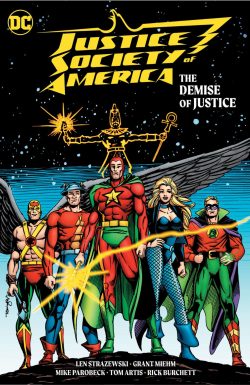
Justice Society of America: The Demise of Justice


By Len Strazewski, John Broome, Paul Levitz, Rick Burchett, Grant Miehm, Mike Parobeck, Tom Artis, Frank McLaughlin, Frank Giacoia, Arthur Peddy, Bernard Sachs, Joe Staton & various (DC Comics)
ISBN: 978-1-7795-0744-0 (HB/Digital edition)

Win’s Christmas Gift Recommendation: Golden Ageist Evergreen Enjoyment… 8/10

Released in 2021 to celebrate their 80th anniversary, here’s yet another DC core concept given fresh wings by a modern movie. If you can find it, this hardback/digital delight is good old fashioned fun and will make a perfect present for you or yours…

After the actual invention of the comic book superhero – the Action Comics debut of Superman in 1938 – the most significant event in the industry’s history was the combination of individual sales-points into a group.

Thus what seems blindingly obvious to us with the benefit of four-colour hindsight was proven: consumers couldn’t get enough of garishly-hued mystery men, and combining many characters inevitably increased readership. Plus, of course, a mob of superheroes is just so much cooler than one – or one-and-a-half if there’s a sidekick involved…

The creation of the Justice Society of America utterly changed the shape of the budding business and – technically – All Star Comics #3 (cover-dated Winter 1940-1941, released in December 1940) was the kick-off. However, in that landmark, the assembled heroes merely had dinner whilst recounting recent cases and didn’t actually go on a mission together until #4 (cover-dated April 1941).

With the simple notion that mighty mystery men hung out together, history was made and it wasn’t long before they started working together…

However, when WWII ended, superheroes gradually declined, and most companies had shelved them by 1950. The plunge in popularity led to a revival in genre-themed titles and characters, and it was a stripped-down team (Flash, Green Lantern, Hawkman, The Atom, Black Canary, Dr. Mid-Nite and Wonder Woman) who battled on in contemporarily tailored crime and science fiction sagas before the title abruptly changed into All Star Western with #58.

It would take a second age of superheroes to revive them, this time as the champions of a parallel universe dubbed Earth Two…

Gathered here is a near-forgotten limited series concerning the latter days of the team’s Golden Age that originally ran in Justice Society of America #1-8 (April to November 1991), augmented by the last tale of the original era as seen in All-Star Comics #57, (February/March 1951), plus a turning point tale from Adventures Comics #466 (December 1979). They are preceded a sparkling, informative and appreciative Foreword by Golden Age aficionado and super scripter Mark Waid.

The miniseries – subtitled Vengeance from the Stars! – that comprises the majority of this tome was scripted by journalist and educator Len Strazewski (Speed Racer, The Flash, Phantom Lady, Starman, The Fly, The Web, Prime, Prototype, Elven) and illustrated by a rotating team of artists, opening as Rick Burchett illustrates ‘Beware the Savage Skies’. Here recently-retired mystery man Ted Knight – AKA Starman – is attacked in his private New Mexico observatory by incredible astral energy beings. Broken and dispirited, he is then enslaved by an old enemy who purloins his wondrous gravity rod before luring Jay (Flash) Garrick into a deathtrap that results in power outages across America…

The plot thickens with ‘The Sack of Gotham’ (art by Grant Miehm) as radio and television executive Alan Scott seeks to keep the lights on in his city whilst Black Canary prowls the darkened streets deterring looters and career criminals. Distracted by a museum break-in, she finds herself punching way, way up as undead monster/moron Solomon Grundy and a gang of determined bandits help themselves to ancient Egyptian artefacts at the behest of a hidden client. By the time Scott arrives as Green Lantern, the Canary has been thrashed and captured, leaving him to battle an animated star constellation dubbed Sagittarius

Burchett inks the astoundingly talented Mike Parobeck in #3’s ‘Dead Air’, as the star thing blacks out Gotham and Scott struggles to stop it. Complications occur when Grundy – afflicted with an obsessive hatred of Green Lantern – forgets the orders from the mystery Machiavelli to attack his emerald enemy. Far away, Ted Knight learns that his gleeful foe intends to conquer Earth by eradicating modern technologies and attitudes and replace them with primordial magic and tyranny…

Tom Artis & Frank McLaughlin limn #4 as ‘Evil of the Ancients’ sees reincarnating Egyptian warrior Hawkman uncovering star-themed neolithic treasures in his day job as archaeologist Carter Hall. These findings expose the history and provenance of the constellation creatures, but also trigger the arrival of another…

Despite aerial valour and the US Army’s best efforts, deadly colossus Andromeda storms off with a clutch of atom bombs and only the sudden arrival of The Flash prevents utter disaster. The clash resumes in ‘Double Star Rising!’ by Parobeck & Burchett, as arcane knowledge and modern tech savvy combine to trace the stellar plunderer and the incredible pyramid of power it is constructing. When the heroes try to destroy it they are confronted with a second energy horror but find a way to defeat both at once, compelling the man behind the plot to finally take a personal hand in the fight…

Far across the country the Lantern and the Canary escape captivity in ‘Danger Flies the Skies’ (Artis & McLaughlin), thanks to some timely aid from valiant sidekick Doiby Dickles, and track west after the museum artefacts in time to reinforce Flash and Hawkman in ‘The Return of the Justice Society’ (art by Miehm & Burchett). Redeemed and reinspired, Knight once more takes up his costumed identity to end the villain’s plot in ‘Battle of the Stars!’

In the heady aftermath, the JSA ponder what the next decade will bring, unaware that political conspiracies, public paranoia and a wave of intolerance masquerading as social conformity was waiting to change the world in ways no one could anticipate…

In continuity terms, this was technically the antepenultimate adventure of the JSA, with the rousing romp slyly heralding mood swings in the heartland of Democracy. It is thus smartly supplemented by the team’s final appearance of the Golden Age (in All-Star Comics #57) and a chilling, thematically-aligned codicil from Adventures Comics #466.

Written by John Broome and illustrated by Frank Giacoia, Arthur Peddy & Bernard Sachs, All-Star Comics #57 was the JSA’s last hurrah as ‘The Mystery of the Vanishing Detectives!’ pitted them against criminal mastermind The Key. When he abducted Earth’s greatest criminologists in advance of a spectacular robbery spree, the superheroes were called in to solve the case and prevent an impending catastrophe. It took a lot of time and effort, but the JSA never fail…

The fallow period and gradual return of the JSA was a major success of fan power in the 1960s, but that decade too ended with superheroes on the wane. During the torrid and turbulent 1970s, many of the comics industry’s oldest publishing ideas were finally laid to rest. The belief that characters could be “over-exposed” was one of the most pernicious and long-lasting (although it never hurt Superman, Batman or the original Captain Marvel), garnered from years of experience in an industry which lived or died on that fractional portion of pennies derived each month from the pocket-money and allowances of children which wasn’t spent on candy, toys or movies.

By the end of the 1960s, comic book costs and retail prices were inexorably rising and a proportion of titles – especially the newly revived horror stories – were consciously being produced for older readerships. Nearly a decade of organised fan publications and letter writing crusades had finally convinced publishing bean-counters what editors already knew: grown-ups avidly read comics too. Moreover, they happily spent more than kids and craved more, more, more of what they loved.

Explicitly: If one appearance per month was popular, extras, specials and second series would be more so. By the time Marvel Comics Wunderkind Gerry Conway left The House of Ideas, DC was willing and ready to expand its variegated line-up with some oft-requested fan-favourite characters. Paramount among these was the Justice Society of America, the first comic book super-team and a perennial gem whose annual guest-appearances in the Justice League of America and other superhero titles had become a beloved tradition and treat.

Thus in 1976 writer/editor Conway marked his second DC tenure (he had first broken into the game writing horror shorts for Joe Orlando) by reviving All Star Comics with #58.

In 1951, the original title transformed overnight into All Star Western with the numbering running for a further decade for the home of cowboy crusaders like Strong Bow, The Trigger Twins, Johnny Thunder and Super-Chief. Now, set on Earth-Two, and in keeping with the editorial sense of ensuring a series be relevant to young readers too, Conway reintroduced the veteran team, leavened with a smattering of teen heroes forming a contentious, generation gap-fuelled “Super Squad”…

Augmented by Robin (a JSA-er since the mid-1960s in Justice League of America #55), Sylvester Pemberton/Star-Spangled Kid and a busty young thing who rapidly became the feisty favourite of a generation of growing boys: Kara Zor-L Power Girl. Closing this collection is a short piece as she and fellow newcomer Huntress discuss how the Golden Age ended…

Taken from massive 68-page anthology title Adventure Comics 466 where Paul Levitz & Joe Staton delivered a pithy history lesson exposing the reason why the team vanished at the beginning of the 1950s, ‘The Defeat of the Justice Society!’ shows how the American Government cravenly betrayed their greatest champions. Set during early days of the McCarthy era anti-communist witch-hunts, a sham trial provoked the mystery men into voluntarily withdrawing from public, heroic life. There they stayed until the costumed stalwarts of Earth-One started the whole Fights ‘n’ Tights scene all over again…

These exuberant, rapid-paced and imaginative yarns perfectly blend the naive charm of Golden Age derring-do with cynically hopeful modern sensibilities. Here you will be reassured that no matter what, in the end our heroes will always find a way to save the day. These are classic tales from simpler times and a glorious example of traditional superhero storytelling at its finest: fun, furious and ferociously engaging, excitingly written and beguilingly illustrated. No Fights ‘n’ Tights fan should miss these marvellous sagas.
© 1951, 1979,1991, 2020 DC Comics. All Rights Reserved.

Superman: Strange Attractors


By Gail Simone, Dan Abnett & Andy Lanning, John Byrne & Nelson (DC Comics)
ISBN 978-1-4012-0917-9 (TPB)

Here’s a Superman collection tailored to the fight fan, as the mighty Man of Steel takes on a bevy of baddies in terse tales designed as an antidote to an over-abundance of multi-chapter epics. I’m focussing on it here primarily because it’s also a complication- and continuity-light compendium featuring movie Man of the Moment Black Adam

Created by Otto Binder & C.C. Beck, Black Adam/Teth Adam debuted in The Marvel Family #1, cover-dated December 1945. There he was revealed as the power-corrupted predecessor of current magical superhero (the Original…) Captain Marvel. The Egyptian relic’s reign of evil ended with his death at the end of the story…

You can’t keep a good villain down though, and when the Golden Age Marvel was revived in the 1970s as Shazam!, the ancient antithesis eventually returned to bedevil the heroes. He even survived the continuity changing chaos of Crisis on Infinite Earths and numerous subsequent reboots.

For present purposes, the following is the backstory new readers should access…

Once upon a time Billy Batson was a little boy living on the streets of Fawcett City. His archaeologist parents had left him with an uncle when they went on a dig to Egypt. They never returned, his little sister vanished and Billy was thrown out so his guardian could steal his inheritance.

Sleeping in a storm drain and selling newspapers for cash, the indomitable lad grew street-smart and resilient, but when a shadowy stranger bade him follow into an eerie subway, the boy somehow knew it was all okay. Soon after, he met the wizard Shazam, who bestowed upon him the powers of six ancient Gods and Heroes.

Thus began an astounding career as wholesome powerhouse hero Captain Marvel. Billy eventually found lost sister Mary and shared his nigh-infinite power with her, as they both subsequently did with disabled friend Freddy Freeman.

They fought and eventually reached an accommodation with militant progenitor Black Adam, who was the wizard’s first superhuman champion, reborn in the body of Theo Adam – a distant descendant who had murdered the Batson’s parents. When a succession of crises arose, everything changed.

Immortal Shazam was murdered, Billy was exiled to the transcendent Rock of Eternity as his replacement and Freddy became a new Captain Marvel; his mighty gifts supplied by a completely different pantheon of patrons.

Meanwhile, Black Adam had found peace and redemption in the love of ascendant nature goddess Isis …until she was cruelly taken from him. The worst tragedies befell poor Mary. Deprived of her intoxicating powers she became an addict without a fix… until soul-sick Adam shared his dark energies with her. His corrupted spirit fatally tainted the once-vibrant innocent…

During his lost phase, the Egyptian warrior vacillated between hard-line hero and outright menace: joining the Justice Society of America but also arbitrarily administering his old testament brand of judgement whenever he felt the need…

This selection of Superman stories comes from Action Comics #827-828, and #830-835 (spanning July 2005 through March 2006). The run of was originally interrupted for the “Sacrifice” storyline (and collected as a graphic novel of the same name), so the volume reconvenes with the episode after…

First up is eponymous 2-part saga ‘Strange Attractors’ and Strange Attractors part 2 – Positive Reinforcement’: a battle against the incredibly bad and quite mad Master of Magnetism Dr Polaris, aided, if not abetted, by the resurrected reprobate Black Adam, currently holding a high position in supervillain army The Society

Following the aforementioned Sacrifice pause, we reconvene with #830’s ‘The Great Society’ as the Man of Tomorrow tackles Dr. Psycho. The old Wonder Woman villain is a physically stunted, sadistic psychologist with the power to control minds. When he arrives in Metropolis intent on mischief, Superman finds that every citizen is a foe and hostage at the same time.

Once again, Black Adam is on hand to render ambivalent assistance as ‘Black & Blue’ (a Villains United tie-in) sees Adam reassess his role before it all devolves into the obligatory fist fight.

Scripted by Dan Abnett & Andy Lanning ‘Old Ghosts’ sees Devil-surrogate Lord Satanus and the Spectre use the city as a phantasmal Ground Zero next, and, after refereeing that little cataclysm, Superman finds himself the target of a psychic and spiritual assault from old JLA foe The Queen of Fables in ‘Depths’ and ‘Awake in the Dark’ – with Norm Rapmund, Larry Stucker, Marc Campos, & Oclair Albert joining Nelson in applying inks to John Byrne’s pencils..

The furious ferocious fun concludes in a duel with Livewire, that perky punkette with absolute control of all things electrical who contracts ‘A Contagion of Madness’ with Gail Simone, John Byrne and inker Nelson delivering potent, punchy and self-contained mini-classics.

Not overly complicated, concentrating on exhilaration and excitement, but still managing to sustain some tense sub-plots involving Lois Lane-Kent and the rest of the venerable supporting cast, these stories are just plain fun. It’s a shame that the experiment doesn’t seem to have caught on …
© 2005, 2006 DC Comics. All Rights Reserved.

Ultimate Comics Thor


By Jonathan Hickman, Carlos Pacheco & Dexter Vines & various (Marvel)
ISBN: 978-0-7851-5187-6 (HB/Digital edition)

Distressing times never come singly. Yet again I’m spreading unhappy news as another comics great leaves us way too young. Our condolences go out to his family and we share the sadness of the millions of devoted fans now deprived of future glories. Now let’s look again at one of his most remarkable, influential and neglected works and ponder what’s gone… 

Carlos Pacheco Perujo (14th November 1961 – 9th November 2022) was born in Spain but found his greatest fame in the USA drawing the cream of the superhero crop.

After learning his craft creating covers, pin-ups, posters and transition art for Spanish reprints of Marvel Comics – and inventing his own Spanish superheroes – Pacheco got his big break illustrating Dark Guard for Marvel UK in 1992. Before long, his cleanly effective, realistic visualisations graced numerous Ultimate Comics and X-Men titles and spin-offs; The Fantastic Four; Captain America; The Inhumans; Superman; Superman/Batman; Flash; Green Lantern and Justice Society of America.

Despite indie triumphs such as Arrowsmith and Astro City, the writer/artist will always be remembered for his mainstream superhero virtuosity and landmark limited series like Final Crisis and Avengers Forever, and Original Graphic Novels such as JLA/JSA: Virtue and Vice.

In 2000, when Marvel retooled their traditional continuity into a separate, darker, grittier universe more relevant to the video game-playing, movie-watching 21st century readers, they started with the most popular characters and only gradually added analogues for the established characters and trademarks.

Even when the Avengers finally appeared in this continuity – as the Ultimates – readers were only sparingly brought up to speed on the assorted back-stories of these alternative heroes and villains – especially a wild, hammer-wielding warrior who couldn’t decide if he was Thorlief Golmen, mental patient, psychiatric nurse and anti-American radical protester or Thor, ancient Norse god of Thunder and battle.

After many struggles against his malicious, reality-warping brother Loki, incalculably mighty Thor is found here as a patient under the care of the European Union Super Soldier program. When their doctors call in linguistic expert/psychotherapist Donald Blake, the true and fantastic story of the patient’s origins unfold…

Eons ago, Asgard was a fantastic place of adventure and glory; an ideal paradise for the young warrior-brothers Balder, Thor and Loki to fight, carouse and enjoy life. But even gods grow older and apart…

The time was just prior to the start of World War II. Nazi Occult scientist Baron Zemo leads an army against Asgard, having already allied himself with the gods’ greatest enemies: Frost Giants…

All is not as it seems, however, and Zemo is no mortal invader. Moreover, his intention is to end all gods and bring about Ragnarok. Despite the magnificent heroics of the Norse deities, he eventually succeeds. But now it is revealed that the brothers did not die, but were reborn in mortal form on Earth.

Now as an Age of Supermen begins, the brothers awaken… and one of them is mad…

Compellingly scripted by Jonathan Hickman and beautifully illustrated by Pacheco with inks from Dexter Vines, Jason Paz, Jeff Het and colors by Edgar Delgado, J. Aburtov & Jorge Gonzalez, this spectacular yarn (originally released as a 4-issue miniseries) might be a mite confusing for readers unfamiliar with Thor’s other Ultimate appearances, or taking their cues from the movie iteration this version inspired.

It’s also quite choppy in delivery as it in-fills the missing portions of those stories but even so this is still a hugely engaging adventure that could easily act as an introduction to those other epics and is well worth your attention. And it is so very beautiful to look upon…
© 2020 MARVEL