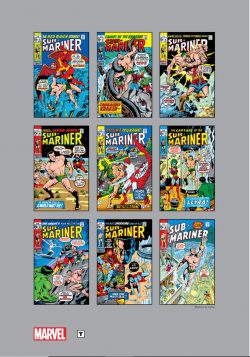
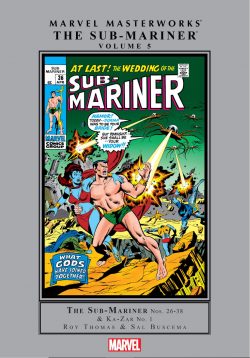
Sub-Mariner Marvel Masterworks volume 5


By Roy Thomas, Allyn Brodsky, Sal Buscema, Ross Andru, Frank Springer & various (Marvel)
ISBN: 978-0-7851-6619-1 (HB/Digital edition)

Prince Namor, the Sub-Mariner is the offspring of a water-breathing Atlantean princess and an American polar explorer; a hybrid being of immense strength, highly resistant to physical harm, able to fly, and thrive above and below the waves. Created by young, talented Bill Everett, Namor technically predates Marvel/Atlas/Timely Comics.

He first caught the public’s avid attention as part of an elementally appealing fire vs. water headlining team-up in the October 1939 Marvel Comics #1 (which renamed itself Marvel Mystery Comics from #2 onwards). The amphibian antihero shared honours and top billing with The Human Torch, but had originally been seen (albeit in a truncated, monochrome version) in Motion Picture Funnies: a promotional booklet handed out to moviegoers earlier in the year. Rapidly emerging as one of the industry’s biggest draws, Namor won his own title at the end of 1940 (cover-dated Spring 1941) and was one of the last super-characters to vanish at the end of the first heroic age.

In 1954, when Atlas (as the company then was) briefly revived its “Big Three” line-up – the Torch and Captain America being the other two – Everett returned for an extended run of superbly dark, mordantly timely fantasy fables. However, even his input wasn’t sufficient to keep the title afloat and eventually Sub-Mariner sank again.

In 1961, as Stan Lee & Jack Kirby were reinventing superheroes with the landmark title Fantastic Four, they revived the awesome, all-but-forgotten aquanaut as a troubled, semi-amnesiac antihero. Decidedly more bombastic, regal and grandiose, this returnee despised humanity: embittered and broken by the loss of his sub-sea kingdom which had been (seemingly) destroyed by American atomic testing. His rightful revenge became infinitely complicated after he became utterly besotted with the FF’s Susan Storm.

Namor knocked around the budding Marvel universe for a few years, squabbling with other star turns such as The Hulk, Avengers, X-Men and Daredevil before securing his own series as one half of Tales to Astonish, and from there graduating in 1968 to his own solo title.

This fifth subsea selection trawls Prince Namor, the Sub-Mariner #26-38 and portions of Ka-Zar #1, spanning June 1970 to June 1971, and opens with another heartfelt appreciation and more creative secret-sharing in an Introduction from life-long devotee – and primary scribe of this book – Roy Thomas. The drama recommences as recently self-appointed relentless guardian of the safety and ecology of all Earth’s oceans, the Prince of Atlantis furtively returns to the surface world.

In ‘“Kill!” Cried the Raven!’ by Thomas, Sal Buscema & Joe Gaudioso (AKA Mike Esposito) the Sub-Mariner has come to investigate reports of comatose superhuman Red Raven. He was the human emissary of a legendary race of sky-dwelling Birdmen recently encountered by The Angel of the X-Men in their last clash with Magneto. With the covert assistance of old friend Diane Arliss, Namor seeks to forge an alliance with the Avian race, but shocks, surprises and the Raven’s trauma-induced madness all conspire to sink the plan…

Back brooding in Atlantis in the wake of another failure, Namor’s mood is further plagued when a human pirate uses his giant monster-vessel to attack shipping with Atlantis bearing the brunt of blame ‘When Wakes the Kraken!’ His hunt for bizarre bandit Commander Kraken again involves Diane and ends only when the Sub-Mariner demonstrates what a real sea monster looks like…

Recuperating with her in New York City, Namor is incensed by the actions of an unrepentant industrial polluter and joins teen protestors fighting developer Sam Westman’s thugs and mega machines in ‘Youthquake!’ before we pause for a little diversion…

Beginning as a Tarzan tribute act relocated to a lost world in a sub-polar realm of swamp-men and dinosaurs, Ka-Zar eventually evolved into one of Marvel’s more complex and mercurial characters. Wealthy heir to one of Britain’s oldest noble families, his best friend is Zabu the sabretooth tiger, his wife is feisty environmental-crusader Shanna the She-Devil and his brother is a homicidal super-scientific bandit. Kevin Reginald, Lord Plunder is perpetually torn between the clean life-or-death simplicity of the jungle and the bewildering constant compromises of modern civilisation.

The primordial paragon even outranks Namor in terms of longevity, having begun as a prose pulp star, boasting three issues of his own magazine between October 1936 and June 1937. They were authored by Bob Byrd – a pseudonym for publisher Martin Goodman or one of a fleet of writers on his staff – and he was latterly shoehorned into a speculative new-fangled comic book venture Marvel Comics #1. There he roamed alongside another pulp mag graduate: The Angel, plus Masked Raider, the Human Torch and Sub-Mariner

When Ka-Zar reappeared all rowdy and renovated in 1965’s X-Men #10, it was clear the Sovereign of the Savage Land was destined for bigger things. However, for years all he got was guest shots as misunderstood foe du jour for Daredevil, Sub-Mariner, Spider-Man, and the Hulk.

In 1969, he took his shot with a solo saga in Marvel Super-Heroes and later that year – after Roy Thomas & Neal Adams used him so effectively in their X-Men run (issues #62-63) – was awarded a giant-sized solo title reprinting many previous appearances. The title also incongruously offered all-new stories of Hercules and the second, mutant X-Man Angel. That same month, Ka-Zar’s first regular series began in Astonishing Tales

That Hercules back up from Ka-Zar #1 (August 1970 by Allyn Brodsky, Frank Springer & Dick Ayers) is reprinted here as it impacts Namor’s exploits…

‘In his Footsteps… The Huntsman of Zeus!’ sees the potent Prince of Power on the run from an Olympian agent despatched by the King of the Gods. Following another bitter dispute with his sire Hercules returns to Earth, leaving Ares to foment trouble and prompt Zeus to set his terror-inducing Huntsman on the godling’s trail…

After seeking sanctuary with the Avengers, Hercules sees his mortal friends brutally beaten and flees once again…

The panicked rush takes him to Sub-Mariner #29 and the distant Mediterranean where the Huntsman ensorcells Namor and pits him against the fugitive. Although Hercules soon breaks the hypnotic spell, ‘Fear is the Hunter!’ reveals why the pursuer is so dreaded as he sends mythical terrors Scylla, Charybdis and Polyphemus against the heroes and the pitiful mortals of the region, until a valiant breakthrough ends the threat and forces a paternal reconciliation…

Another guest star treat materialises in #30 as ‘Calling Captain Marvel!’ sees Namor again reduced to a mesmerised puppet and attacking the Kree warrior and his human host Rick Jones. This time the condition is due to the amphibian’s falling in battle against toxic terrorist Mr. Markham who attempts to blackmail Earth by threatening to poison the seas with his molecular polluter. Once Captain Marvel batters Namor back to his right mind, they make quick work of the maniac in a concerted twin assault…

The fallout from his recent actions have unsettled Namor’s old friend Triton, and the Inhuman goes looking for the prince in #31 just as apparent Atlantean attacks on surface shipping mounts. Meeting equally concerned human Walt Newell (who operates as undersea Avenger Stingray) they finally find – and fight – the Sub-Mariner, only to learn the crisis has been manufactured by his old enemy who is now ‘Attuma Triumphant!’

The barbarian’s plans include destroying human civilisation, but he still has time to pit his captives against each other in a gladiatorial battle to the death; which of course is Attuma’s undoing…

Jim Mooney comes aboard as inker with #32 as a new and deadly enemy debuts in ‘Call Her Llyra… Call Her Legend!’ when fresh human atomic tests prompt Namor to voyage to the Pacific and renew political alliance with the undersea state of Lemuria. However, on arrival he finds noble Karthon replaced by a sinister seductress who lusts for war and harbours a tragic Jekyll & Hyde secret…

By the time he reaches Atlantis again the Sunken City is being ravaged by seaquakes and old political enemy Prince Byrrah is seizing control from Namor’s deputies and devoted paramour Lady Dorma. ‘Come the Cataclysm’ sees him first accuse surface-worlders before locating and defeating the true culprits – an alliance of Byrrah with failed usurper Warlord Krang and human mad genius Dr. Dorcas. In the throes of triumph, Prince Namor announces his imminent marriage to Dorma…

Antihero superteam The Defenders officially begin with Sub-Mariner #34-35 (cover-dated February & March 1971). As previously stated, the Prince of Atlantis had become an early and ardent activist and advocate of the ecology movement, and here he takes radical steps to save the planet by fractiously recruiting The Hulk and Silver Surfer to help him destroy an American Nuclear Weather-Control station.

In ‘Titans Three!’ and concluding chapter ‘Confrontation!’ (by Thomas, Sal Buscema & Jim Mooney) the always-misunderstood outcasts unite to battle a despotic dictator’s legions, the US Army, UN defence forces and the mighty Avengers to prevent the malfunctioning station from vaporising half the planet…

Inked by Berni Wrightson, Sub-Mariner #36 augurs a huge sea change in Namor’s fortunes that begins with time-honoured holy preparations for a happy event as ‘What Gods Have Joined Together!’ Elsewhere, arcane enemy Llyra is resuurected and seeks to steal the throne by abducting and replacing the bride-to-be whilst Namor is distracted by an invasion of Attuma’s hordes.

Ross Andru & Esposito take over illustration duties with #37 as an era ends and tragedy triumphs, leading to a catastrophic battle on ‘The Way to Dusty Death!’

Betrayed by one of his closest friends and ultimately unable to save his beloved, the heartbroken prince thinks long and hard before abdicating in #38 ‘Namor Agonistes!’: reprising his origins and life choices before choosing to henceforth pursue the human half of his hybrid heritage as a surface dweller…

To Be Continued…

More sunken treasures salvaged here include the cover to all-reprint Sub-Mariner Annual #1 (January 1971, and reprising the underwater portions of Tales to Astonish #70-73) plus Bill Everett’s pin-up of young Namor, contemporary House Ads and Marie Severin’s glorious cover sketch for #33, plus a huge Biographies section.

Many early Marvel Comics are more exuberant than qualitative, but this volume, especially from an art-lover’s point of view, is a wonderful exception: a historical treasure with narrative bite that fans will delight in forever. Moreover, with the Prince of Atlantis now a bona fide big screen sensation that no one’s ever heard of, now might be the time to get wise and impress your friends with a little insider knowledge…
© 2018 Marvel Characters, Inc. All rights reserved.
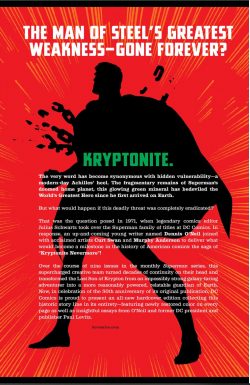
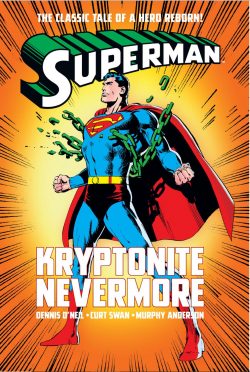
Superman: Kryptonite Nevermore


By Dennis O’Neil, Curt Swan, Murphy Anderson, Dick Giordano & various (DC Comics)
ISBN: 978-1-7795-0755 (HB/Digital edition)

Win’s Christmas Gift Recommendation: Total Entertainment Perfection… 10/10

Superman is the comic book crusader who started the whole genre and, in the decades since his 1938 debut, has probably undertaken every kind of adventure imaginable. With that in mind it’s tempting and very rewarding to gather up whole swathes of his inventory and periodically re-present them in specific themed collections, such as this hardback celebrating one his greatest extended adventures. The episodes contained within were originally released just as comics fandom was becoming a powerful – if headless – lobbying force reshaping the industry to its own specialised desires and remains a true landmark of the superhero genre.

When Julie Schwartz took over editorial responsibility for the Man of Steel in 1970, he was expected to shake things up with nothing less than spectacular results. To that end, he sagely incorporated many key characters and events that were simultaneously developing as part of fellow iconoclast Jack Kirby’s freshly unfolding “Fourth World”.

That bold experiment was a breathtaking tour de force of cosmic wonderment which brought a staggering new universe to fans: instantly and permanently changing the way comics were perceived and how the entire medium could be received.

Schwartz, meanwhile, was again breathing fresh life into a powerful but moribund icon – a job he had been excelling at since he more-or-less singlehandedly kickstarted the Silver Age of Comics. Superman had been a mega-media star since his launch, with internationally syndicated comics, books, newspaper strips, movie and cinema serials plus hugely successful radio and TV shows (live action and animated) making the franchise globally recognizable. Whenever that happens, inevitably overkill and overexposure inescapably set in and the core property needs to be carefully overhauled or vanish forever. I’ll bet you can think of plenty of really famous and ubiquitous things from your childhood that one day you simply stopped noticing. Happily, sometimes they can be reborn…

Schwartz knew his market and was open to new ideas, and his creative changes were just appearing in 1971. The new direction was also vanguard and trigger for a wealth of controversial and socially-challenging story content unheard of since the feature’s earliest days: a wave of tales ultimately described as “Relevant”…

The era itself and those vital changes are described and contextualised in Paul Levitz’s Introduction, after which the crucial radical shift in Superman’s vast mythology starts to unfold.

With iconic covers by Neal Adams, Dick Giordano, Carmine Infantino & Murphy Anderson, this titanic tome collects Superman #233-238 and #240-242, originally running from January to September 1971.

The groundbreaking epic was crafted by scripter Dennis J. “Denny” O’Neil, and veteran illustrators Curt Swan and Murphy Anderson – although stand-in Dick Giordano inked #240. A deliberate and very public abandonment of super-villains, fanciful Kryptonian scenarios and otherworldly paraphernalia instantly revitalised the Man of Tomorrow, attracting new readers and began a period of engagingly human-scaled stories which made Superman a “must-buy” character all over again.

The innovations began in ‘Superman Breaks Loose’ (Superman #233) when a government experiment to harness Kryptonite as an energy source goes explosively wrong. Closely monitoring the test, the Action Ace is blasted across the desert surrounding the isolated lab, but somehow survives a supposedly fatal radiation-bath. Then, reports begin filtering in from all over Earth: every piece of the deadly mineral has been transformed to harmless, common iron…

As he goes about his protective, preventative patrols, the liberated hero experiences an emotional high at the prospect of all the good he can now accomplish. He isn’t even phased when the Daily Planet‘s new owner Morgan Edge (a key Kirby character) shakes up his civilian life: summarily ejecting Clark Kent from the print game to remaking him as a roving TV journalist…

Meanwhile, the desert site of his recent crashlanding offers a moment of deep foreboding as Superman’s irradiated imprint in the sand shockingly grows solid and shambles away in ghastly parody of life…

The suspense resumes in #234’s ‘How to Tame a Wild Volcano!’ as an out-of-control plantation owner refuses to let his indentured native workforce flee an imminent eruption on the island of Boki. Handicapped by misused international laws, the Man of Tomorrow can only fume helplessly as the UN rushes towards a diplomatic solution. His anxiety intensifies when a sinister sand-thing inadvertently passes him and agonisingly drains him of his powers.

Crashing to Earth in a turbulent squall, the de-powered hero is attacked by work boss Boysie Harker‘s thugs and instantly responds to the foolish provocation, relying for a change on determination rather than overwhelming might to save the day…

The ‘Sinister Scream of the Devil’s Harp’ in #235 gave way to weirder ways – the industry was enjoying a periodic revival of interest in supernatural themes and stories – as mystery musician and apparent polymath Ferlin Nyxly reveals the secret of his ever-growing aptitudes and gifts is an archaic artefact which steals from living beings knowledge, talents and even Superman’s alien abilities.

The Man of Steel is initially unaware of the drain, as he’s trying to communicate with his eerily silent doppelganger, but once Nyxly graduates to a full-on raving super-menace self-dubbed Pan, the taciturn homunculus unexpectedly joins its living template to trounce the power thief…

Issue #236 offered a Batman cameo and a science fictional morality play as cherubic aliens seek Superman’s assistance to defeat a band of devils and rescue Kent’s friends from Hell. However, the ‘Planet of the Angels’ is nothing of the kind, and the Metropolis Marvel must pull out all the stops to save Earth from a very real Armageddon, after which Superman #237 sees him save an orbiting astronaut only to see him succumb to madness-inducing mutative disease. After another savage confrontation with the sand-thing further debilitates him, the harried hero is present as more mortals fall to the contagion.

Believing himself the cause, the ‘Enemy of Earth’ considers quarantining in space. As he decides, Lois Lane stumbles into another lethal predicament and the hero’s instinctive intervention seemingly confirms his earlier diagnosis, but another clash with the ever-present sandy simulacrum on the edge of space presents an incredible truth. Painfully debilitated, Superman nevertheless saves Lois and again meets the evermore human creature. Now able to speak, it offers a chilling warning and the Man of Steel realises exactly what it is taking from him and what it might become…

A mere shadow of his former self, the Man of Tomorrow is unable to prevent a band of terrorists taking over a magma-tapping drilling rig and endangering the entire Earth in #238’s ‘Menace at 1000 Degrees’. With Lois among their hostages and the madmen threatening to detonate a nuke in the pipeline, the Action Ace desperately begs his doppelganger to assist him, but its cold rejection forces the depleted hero to take the biggest gamble of his life…

Superman #239 was an all-reprint giant featuring the hero in his incalculably all-powerful days – so not included here – but the diminished Caped Kryptonian returned in #240 (with Giordano inks) to confront his own lessened state and seek a solution in ‘To Save a Superman’. The trigger is his inability to extinguish a tenement fire and the wider world’s realisation that their unconquerable champion is now vulnerable and fallible…

Especially interested are the Anti-Superman Gang who immediately allocate all resources to destroying their nemesis. After one particularly close call, Clark is visited by an ancient Asian sage who somehow knows his other identity and offers an unconventional solution…

From 1968 superhero comics began to decline – just as they had at the end of the 1940s – so publishers sought fresh ways to keep audience as tastes changed. Back then, the industry depended on newsstand sales, and if you weren’t popular, you died. Editor Jack Miller, innovating illustrator Mike Sekowsky and relatively new scripter Denny O’Neil came up with a radical proposal and made history by depowering the only female superhero then in the marketplace. They had the mystical Amazons leave our dimension, taking with them all their magic – including Wonder Woman‘s powers and all her weapons…

Reduced to mere humanity she chose to stay on Earth, assuming and legitimising her own secret identity of Diana Prince: resolved to fighting injustice as a mortal. Tutored by blind Buddhist monk I Ching, she trained as a martial artist, and quickly became a formidable enemy of contemporary evil.

I Ching claims he can repair Superman’s difficulties and dwindling might, but evil eyes are watching. Arriving clandestinely, Superman allows the adept to remove his Kryptonian powers as a precursor to restoring them, allowing the A-S Gang opportunity to strike. In the resultant brutal melee, the all-too-human hero triumphs in the hardest fight of his life…

The saga continues with “Swan-derson” back on art in #241 as Superman overcomes momentary but almost overwhelming temptation to surrender his oppressive burden and lead a normal life. Admonished and resolved, he then submits to Ching’s resumed remedy ritual and finds his spirit soaring to where the sand-being lurks before explosively reclaiming the stolen powers. Leaving the gritty golem a shattered husk, the phantom brings the awesome energies back to their true owner and a triumphant hero returns to saving the world…

Over the next few days, however, it becomes clear that something has gone wrong. The Man of Tomorrow has become arrogant, erratic and unpredictable, acting rashly, overreacting and even making stupid mistakes. In her boutique Diana Prince discusses the problem with Ching and the sagacious teacher deduces that whilst merely mortal and fighting AS gangsters, Superman received punishing blows to the head which have caused a brain injury that did not heal after his powers returned…

When the hero refuses to listen, Diana and Ching track down the dying sand-thing and beg its aid. The elderly savant recognises it as a formless creature from other-dimensional Quarrm and listens to the amazing story of its entrance into our world. He also suggests a way for it to regain some of what it recently lost…

Superman, meanwhile, has blithely gone about his deranged business until savagely attacked by a statue of a Chinese war-demon. Also able to steal his power, it has been possessed by a second fugitive from Quarrm. It has no conscience and wears ‘The Shape of Fear!…

The shocking saga concludes in ‘The Ultimate Battle’ as the second Quarrmer falls under the sway of two petty thugs who use it to put the again de-powered Superman into hospital…

Rushed into emergency surgery, the Kryptonian fights for his life as sand-thing confronts war-demon in the streets, but events take an even more bizarre turn once the latter drives off its foe and turns towards the hospital to finish off the flesh-&-blood Superman. Regaining consciousness – and a portion of his power – the Metropolis Marvel battles the beast to a standstill but needs the aid of his silicon stand-in to drive the thing back beyond the pale. With the immediate threat ended, Man of Steel and Man of Sand face off one last time, each determined to ensure his own existence no matter the cost…

The stunning conclusion was a brilliant stroke on the part of the creators, one which left Superman approximately half the man he used to be. Of course, all too soon he returned to his unassailable, god-like power levels but never quite regained the tension-free smug assurance of his 1950s-1960s self.

A fresh approach, snappy dialogue and more human-scaled concerns to balance outrageous implausible fantasy elements all wedded to gripping plots and sublime art make Kryptonite Nevermore one of the very best Superman sagas ever created. Also included are creator biographies, the iconic ‘House Ad’ by Swan & Vince Colletta which proclaimed the big change throughout the DC Universe, plus a thoughtful ‘Afterword by Dennis O’Neil’ to wraps things up with some insights and reminiscences every lover of the medium will appreciate.

A must-have graphic novel to sit on the same shelf as Watchmen, Batman: Year One, Segar’s Popeye, Gottfredson’s Mickey Mouse, Kirby & Lee’s Galactus Trilogy and Chaykin’s American Flagg!: a shining exemplar of action- adventure comics captured at their most perfect moment. Why don’t you have this yet?
© 1971, 2009, 2020 DC Comics. All Rights Reserved.

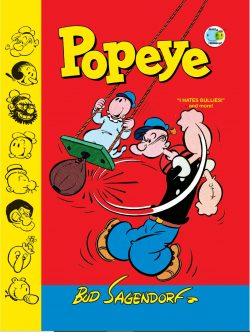
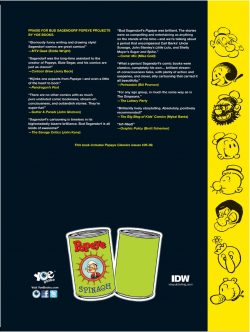
Popeye Classics volume 8: I Hates Bullies and More


By Bud Sagendorf, edited and designed by Craig Yoe (Yoe Books/IDW Publishing)
ISBN: 978-1-63140-676-8 (HB) eISBN: 978-1-68406-044-3

Win’s Christmas Gift Recommendation: Sweet & Sour Salty Sailor Celebrations… 9/10

How many cartoon classics can you think of still going after a century? Here’s one…

There are a few fictional personages to enter communal world consciousness – and fewer still from comics – but this grizzled, bluff, uneducated, visually impaired old tar with a speech impediment is possibly the most well-known of that august bunch.

Elzie Crisler Segar was born in Chester, Illinois on 8th December 1894. His father was a general handyman, and the boy’s early life was filled with the solid, dependable blue-collar jobs that typified the formative years of his generation of cartoonists. Segar was a decorator, house-painter and also played drums; accompanying vaudeville acts at the local theatre.

When the town got a movie-house, Elzie played silent films, absorbing all the staging, timing and narrative tricks from keen observation of the screen. Those lessons would become his greatest assets as a cartoonist. It was while working as the film projectionist, at age 18, that he decided to become a cartoonist and tell his own stories.

Like so many others in those hard times, he studied art via mail – W.L. Evans’ cartooning correspondence course out of Cleveland, Ohio – before gravitating to Chicago where he was “discovered” by Richard F. Outcault: regarded by most in the know today as the inventor of modern newspaper comic strips with The Yellow Kid and Buster Brown. The celebrated pioneer introduced Segar around at the prestigious Chicago Herald. Still wet behind the ears, the kid’s first strip, Charley Chaplin’s Comedy Capers, debuted on 12th March 1916.

In 1918, Segar married Myrtle Johnson and moved to William Randolph Hearst’s Chicago Evening American to create Looping the Loop, where Managing Editor William Curley foresaw a big future for Segar and promptly packed the newlyweds off to New York: HQ of the mighty King Features Syndicate. Within a year Segar was producing Thimble Theatre, (launching December 19th 1919) in the New York Journal: a smart pastiche of cinema and knock-off of movie-inspired features like Hairbreadth Harry and Midget Movies, with a repertory of stock players acting out comedies, melodramas, comedies, crime-stories, chases and especially comedies for vast daily audiences. It didn’t stay that way for long…

The core cartoon cast included parental pillars Nana & Cole Oyl; their lanky, cranky, highly-strung daughter Olive; diminutive-but-pushy son Castor and the homely ingenue’s plain and (so very) simple occasional boyfriend Horace Hamgravy (latterly, plain Ham Gravy).

Thimble Theatre had already run for a decade when, on January 17th 1929, a brusque, vulgar “sailor man” shambled into the daily ongoing saga of hapless halfwits. Nobody dreamed the giddy heights that stubbornly cantankerous walk-on would reach…

In 1924, Segar created a second daily strip. Surreal domestic comedy The 5:15 starred weedy commuter and would-be inventor John Sappo and his formidable spouse Myrtle. This strip endured – in one form or another – as a topper/footer-feature to accompany the main Sunday page throughout the author’s career, and even survived his untimely death, eventually becoming the trainee-playground of Popeye’s second great humour stylist – Bud Sagendorf.

After Segar’s premature passing in 1938, Doc Winner, Tom Sims, Ralph Stein and Bela Zambouly all took on the strip as the Fleischer Studio’s animated features brought Popeye to the entire world, albeit a slightly variant vision of the old salt of the funny pages. Sadly, none had the eccentric flair and raw inventiveness that had put Thimble Theatre at the forefront of cartoon entertainments. And then, finally, Bud arrived…

Born in 1915, Forrest “Bud” Sagendorf was barely 17 when his sister – who worked in the Santa Monica art store where Segar bought his drawing supplies – introduced the kid to the master cartoonist who became his teacher and employer as well as a father-figure. In 1958, after years on the periphery, Sagendorf finally took over the strip and all the merchandise design, becoming Popeye’s prime originator…

With Sagendorf as main man, his loose, rangy style and breezy scripts brought the strip itself back to the forefront of popularity and made reading it cool and fun all over again. Bud wrote and drew Popeye in every graphic arena for 24 years. When he died in 1994, his successor was controversial “Underground” cartoonist Bobby London.

Bud had been Segar’s assistant and apprentice, and in 1948 became exclusive writer/artist of Popeye’s comic book exploits. That venture launched in February of that year: a regular title published by America’s unassailable king of periodical licensing, Dell Comics.

On his debut, Popeye was a rude, crude brawler: a gambling, cheating, uncivilised ne’er-do-well, but was soon revered as the ultimate working-class hero. Raw and rough-hewn, he was also practical, with an innate, unshakable sense of what’s fair and what’s not: a joker who wanted kids to be themselves – but not necessarily “good”. Above all else he was someone who took no guff from anyone…

Naturally, as his popularity grew, Popeye mellowed somewhat. He was still ready to defend the weak and had absolutely no pretensions or aspirations to rise above his fellows, but the shocking sense of dangerous unpredictability and comedic anarchy he initially provided was sorely missed… except not in Sagendorf’s yarns…

Collected in this superb full-colour hardback/digital edition are Popeye #35-39, crafted by irrepressible “Bud”: collectively spanning January-March 1956 to January-March 1957.

Stunning, nigh stream-of-consciousness slapstick sagas are preceded by an effusively appreciative ‘Society of Sagendorks’ briefing by inspired aficionado, historian and publisher Craig Yoe, offering a mirthful mission statement, and enhanced by another tantalising display of ephemera and merchandise in ‘A Bud Sagendorf Scrapbook’. This time we focus on the 1980 Robert Altman movie with candid cast photos, Sagendorf illustrated tie-in magazine articles, and multi-lingual cartoon iterations.

We rejoin the ceaseless parade of laughs, surreal imagination and thrills with quarterly comic book #35, opening with a monochrome inside front cover gag concerning the latest hobby of the sailor’s ward after which ‘Thimble Theatre presents Popeye and Swee’Pea in “Wishing” or Spinach is Still King!”’, wherein the bored “infink” shambles upon an alien incursion and tricks the haughty invaders out of their irresistible, unbeatable Wish-o-Matic machine…

Soon the impressionable kid is king of the world and Popeye is forced into drastic action…

The family is afloat for follow-up bedtime tale ‘I Hates Bullies!’ as the mariner, Olive and Wimpy are lured to an exotic island and seduced into liberating its people from enslaving Boss Black Allen

Back-up feature Sappo was by now reduced to gullible foil and hapless landlord to the world’s worst lodger. Professor O.G. WotasnozzleThe Professor with the Atomic Brain would callously inflict the brunt of his genius on the poor schmuck. Here that means inventing super-fast growing redwoods but being too self-absorbed to keep the seeds out of the rain…

The issue ends with an endpaper prose fable about a scientist who regretted getting cats to chase his lab mice and a back cover gag of bath night for Swee’Pea…

Issue #36 (April-June) began with ‘King Popeye of Popilania!’ as the sailor man sets out to create the perfect country, but soon finds kinging it is a lot of work, especially if your friends are all ambitious traitors and other nations think they can push you around…

For a while things look bleak for the Popilania, until the desperate King unleashes secret weapon General Wimpy

An engaging Micawber-like coward, cad and conman, the insatiably ravenous J. Wellington Wimpy debuted in the newspaper strip on May 3rd 1931 as an unnamed, decidedly partisan referee in one of Popeye’s pugilistic bouts. Scurrilous, aggressively humble and scrupulously polite, the devious oaf struck a chord and Segar made him a fixture. Preternaturally hungry, ever-keen to solicit bribes and a cunning coiner of many immortal catchphrases – such as “I would gladly pay you Tuesday for a hamburger today” and “Let’s you and him fight” – Wimpy was the perfect foil for our straight-shooting action hero and increasingly stole the entire show… and anything else unless it was very heavy or extremely well nailed down. He proved to be the ultimate deterrent in an extended war that depended on keeping troops fed…

Popeye an’ Swee’Pea then turn the tables on villainous reprobate Poopdeck Pappy after the sailor’s crooked father fakes his own death in ‘Pappy’s Spook’, before Professor O.G. Wotasnozzle – The Atomic Brain! conjures fresh chaos with his terrifying reducing pills in advance of another text tale. ‘Canned Nuts’ details the downfall of a prudent squirrel who had a plan (but no tin-opener) in advance of a back cover gag of Popeye and Wimpy fishing…

Cover-dated July-September, Popeye #37 opens with a monochrome inside cover about Swee’Pea’s garden before main event ‘The Search for the Spinach Icebox’ sees our well-travelled hero targeted by secret society WAFPOM (World Association For Prevention Of Muscles) after he buys two million tons of the miraculous mineral rich vegetable. With attacks mounting, he needs someplace safe to store his leafy treasure and on Wimpy’s suggestion heads to Antarctica, where WAFPOM and even stranger foes are waiting…

‘Amateur Inventor!’ Sappo gives O.G. Wotasnozzle a taste of his own medicine next, before ‘The Big Sting’ heralds the end of another issue with the prose history of a bullying bee…

Issue #38 opens with a monochrome pet gag and an extended colour epic as Popeye and The Gang meet ‘The Dog Who Wore A Crown” – or – Going To the Dogs!’ A quick visit with King Blozo finds the scatty ruler absent and his dog ruling in his stead. Most annoyingly, the monarch has appointed Popeye Royal Dog Sitter. As the dutiful sailor surrenders to the inevitable, things get more complicated when the moody pooch – AKA “Birdseed” – decides Swee’Pea should be in charge…

‘Bottle Fish!’ sees the text fixture shift to the comic’s centre with the tale of a mean bully stuck behind glass, after which Wotasnozzle and Sappo both go overboard in a fishing contest augmented by weird science and the chaos concludes with another black-&-white inner cover pet prank, preceding a new year of fun and frolic as #39 (January-March 1957) feature more monochrome madness for Swee’Pea’s pooch…

The gang are rattled in lead story ‘The Mountain that Talked Back!’ as Olive’s deteriorating nerves prompt a vacation on ominously named “Thunder Island” and a badly-timed stay on a volcano in full eruption mode…

Everything changes once Popeye realise the shakes are fakes and a gang of criminals are making them patsies in a plot and our hero breaks out the spinach…

Prose parable ‘Cow?’ reveals how bovine Mildred briefly lived her dream to be a horse, after which Wotasnozzle seeks to improve communication by reinventing words in ‘What Did He Say?’ before Swee’Pea and Birdseed monopolise interior monochrome and exterior color gags with devasting effect.

Outrageous and side-splitting, these universally-appealing yarns are evergreen examples of narrative cartooning at its most surreal and inspirational. Over the last nine decades Thimble Theatre’s most successful son has delighted readers and viewers around the world. This book is simply one of many, but each is sure-fire, top-tier entertainment for all those who love lunacy, laughter, frantic fantasy and rollicking adventure. If that’s you, add this compendium of wonder to your collection.
Popeye Classics volume 8 © 2016 Gussoni-Yoe Studio, Inc. All Rights Reserved. Popeye © 2016 King Features Syndicate. ™ Heart Holdings Inc.

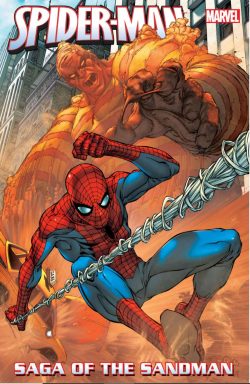
Spider-Man: Saga of The Sandman


By Stan Lee, Roy Thomas, Tom DeFalco, Kurt Busiek, Steve Ditko, Jack Kirby, Herb Trimpe, Ross Andru, Ron Wilson, Patrick Olliffe & various (Marvel)
ISBN: 978-0-7851-2497-9 (TPB/Digital edition)

Spider-Man debuted in the summer of 1962 – Happy Anniversary, webslinger! – but didn’t really take off until he won his own title in the early days of 1963 – so expect a whole bunch of Spidey-reviews here next year. A crucial factor in his success was the ever-expanding and iconic legion of super-foes Steve Ditko, Stan Lee and all their successors so sensibly highlighted over the years. many of them starring in archives like this one on the back of their movie appearances. Here’s another to be going on with… 

Heroes are only truly defined by their enemies and superheroes doubly so, with the added proviso that costumed crusaders generally have a rogue’s gallery of fantastic foes rather than just one arch-nemesis. Even so, there’s always one particular enemy who wears that mantle: Moriarty for Sherlock Holmes; Blofeld for James Bond; Luthor for Superman.

Spider-Man has always had two top contenders… but Sandman isn’t one of them. (*If you can’t guess, check out the end of the review, puzzle-fans!).

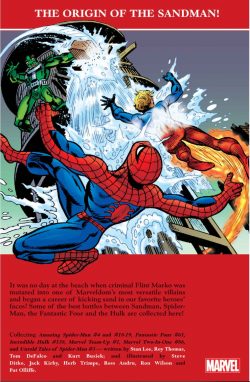
This nifty compilation gathers a range of tales featuring gritty gangster William Baker (AKA Flint Marko): a cheap thug who remade himself into a major threat in numerous spectacular clashes with the wondrous wallcrawler and other Marvel Stars. This brief compilation traces his rather rocky development by a series of key moments: uncomplicated, no-frills thrill-rides each delivering frantic spills and chills, equally appetising to film-inspired new meat and grizzled old veterans of the Fights ‘n’ Tights arena.

It all starts with Amazing Spider-Man #4, cover-dated September 1963, as Lee & Ditko resort to the ubiquitous atomic experiment maguffin to absurdly empower a commonplace, uneducated low grade career criminal, to counterbalance the preponderance of evil geniuses.

‘Nothing Can Stop… the Sandman!’ was another instant classic as brutally violent, simplistic thug Marko gains the shapeshifting power to transform into all aspects of sand. Terrorising New York City, he evades and humiliates the cops before invading Peter Parker’s high school.

Ruthless and deadly, he is challenged by the mysterious Spider-Man who must stop the monster at all costs. The epic clash proves that wits trump force every time…

Marko returned in issues #18-19 (November & December 1964), joining an already in-progress imbroglio by Lee & Ditko. In AS #17 (not included here) the wallcrawler endured renewed print assaults from the Daily Bugle and its rabid publisher J. Jonah Jameson just as enigmatic archfoe Green Goblin began a war of nerves and attrition, employing the Enforcers, Sandman and an army of thugs to publicly humiliate the Amazing Arachnid. To exacerbate matters Parker’s beloved Aunt May’s health took a drastic downward turn…

Resuming here with ‘The End of Spider-Man!’ and explosively concluding in the triumphal ‘Spidey Strikes Back!’ – featuring a turbulent team-up with friendly rival Johnny StormThe Human Torch was another teen Sandman frequently fought – the extended tale proved fans were ready for every kind of narrative experiment and that overwhelming tension, drama and action were always welcome.

As the sixties progressed Sandman teamed up with fellow Torch arch foes The Wizard and Trapster as the core of evil alliance The Frightful Four: targeting the Fantastic Four with determination but little success. That war led to a revolutionary evolution in Fantastic Four #61 (April 1967, by Lee, Jack Kirby & Joe Sinnott)…

Having just defeated cosmically-empowered Doctor Doom and returned to the Silver Surfer his purloined life-energies, the weary team entered their Baxter Building HQ and were ambushed by a new and improved foe in ‘Where Stalks the Sandman?’ Having gone back to school for a crash course in chemistry, Marko had designed a gadget-and-mineral-enhanced costume to maximise his powers. Brashly overconfident, the villain almost defeated the FF before being driven off…

He became a roving solo villain: adding Ka-Zar and The Hulk to his hit list. The latter was a mistake that almost destroyed his powdery predations as a he was turned from sand to glass. That plot thread was resolved by Roy Thomas, Herb Trimpe & Sam Grainger in Incredible Hulk #138 (April 1971) as ‘Sincerely, the Sandman!’ sees the vicious villain rid himself of his crystalline affliction by callously transferring it to Bruce Banner’s true love: turning Betty Ross into a brittle, fragile thing of glass…

Having fallen too low, a touch of humanity was found in Sandman when he was the creep du jour in a bold new publishing venture…

In those long-lost days editors were acutely conscious of potential over-exposure; and since superheroes were actually in a decline they may well have been right. Marvel Team-Up was the second regular Spider-Man title (because abortive companion title Spectacular Spider-Man was created for the magazine market in 1968 but died after two issues). MTU launched at the end of 1971 and went from strength to strength, proving the time had finally come for expansion and a concentration on uncomplicated action over sub-plots…

Marvel Team-Up #1was crafted by Thomas, Ross Andru & Mike Esposito and saw a mutual old enemy of the wallcrawler and the Torch rear his gritty head in a charming seasonal spree: ‘Have Yourself a Sandman Little Christmas!’ is a light-hearted romp full of Christmas cheer, rambunctious action and seasonal sentiment, as Marko repeatedly routs the young heroes in a desperate attempt to wish his mother – blithely unaware of his criminal career – the season’s greetings…

It was back to bombastic bad guy bouts for a long time after that, but time and Tom DeFalco, Ron Wilson & Chic Stone eventually set the super-villain on a new path with April 1982’s Marvel Two-in-One #86. Here, ‘Time Runs Like Sand!’ presents an astoundingly low-key landmark as Ben and the sinister Sandman meet again. However, instead of another battle, they have a few bevies in a bar and talk about their remarkably similar past lives. Treating monsters like men seemingly turns the felon’s life around…

Since then, The Sandman has vacillated between heroic mercenary, greedy criminal and outcast horror according to editorial whim, but this tome terminates with another visit to the early days of unthinking larceny…

Untold Tales of Spider-Man was a series designed to tell new stories chronologically set during the early Lee/Ditko days of the character, and here Kurt Busiek, Patrick Oliffe, Al Vey & Pam Eklund see the webspinner ‘Sand Blasted’ (UTS-M #3, November 1995) as the malleable menace goes a robbing rampage even The Avengers cannot counter. Despite initially thrashing Spider-Man, Marko cannot stop or deter the bold, irrepressible kid and ultimately goes down big time…

Also included here are pertinent ‘Spider’s Web’ letters pages, House ads, info pages from The Official Handbook of the Marvel Universe and the ‘Cover Process’ undertaken from Marks Brooks’ pencil sketch to Jaime Mendoza’s inks and Danimation’s colour finishes.

Epic and engaging, this grab-bag of gritty tussles is pure comic book catharsis: fast, furious fun and thrill-a-minute-melodrama no Fights ‘n’ Tights fan could resist.
© 2017 Marvel Characters, Inc. All rights reserved.
* Green Goblin Norman Osborn and Doctor Otto Octavius still share the dishonours of being Spider-Man’s most dastardly nemeses. If you had trouble with that, you need to read more mainstream comics. If you’re interested, I have a little list …

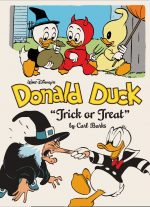
Walt’ Disney’s Donald Duck by Carl Barks volume 13: Trick or Treat


By Carl Barks & various (Fantagraphics Books)
ISBN: 978-1-60699-874-8 (HB/Digital edition)

Win’s Christmas Gift Recommendation: The Utter Acme of All-Ages Entertainment… 10/10

Donald Duck ranks among a small group of fictional characters to have transcended the bounds of reality and become – like Sherlock Holmes, Tarzan, Popeye and James Bond -meta-real. As such, his origins are complex and convoluted. His official birthday is June 9th 1934: a dancing, nautically-themed bit-player in the Silly Symphony cartoon short The Wise Little Hen.

The animated cartoon was adapted by Ted Osborne & Al Taliaferro for the Silly Symphonies Sunday newspaper strip and thus classified by historians as Donald’s official debut in Disney comics. Controversially, he was also reported to have originated in The Adventures of Mickey Mouse strip which began 1931. Thus the Duck has more “birthdays” than he knows what to do with, which presumably explains why he’s such a bad-tempered cuss.

Visually, Donald Fauntleroy Duck was largely the result of animator Dick Lundy’s efforts, and, with partner-in-fun Mickey Mouse, is one of TV Guide’s 50 Greatest Cartoon Characters of All Time. The Duck has his own star on the Hollywood walk of fame and has appeared in more films than any other Disney player.

Throughout the 1930s, his screen career grew from background and supporting roles via a team act with Mickey and Goofy to a series of solo cartoons which began with 1937’s Don Donald. That one also introduced love interest Daisy Duck and the irrepressible nephews Huey, Louie and Dewey

By 1938 Donald was officially more popular than corporate icon Mickey Mouse, and even more so after his national service as a propaganda warrior in a series of animated morale boosters and information features during WWII. The merely magnificent Der Fuehrer’s Face garnered the 1942 Academy Award for Animated Short Film

Crucially for our purposes, Donald is also planet Earth’s most-published non-superhero comics character, and has been blessed with some of the greatest writers and illustrators ever to punch a keyboard or pick up a pen or brush. A publishing phenomenon and megastar across Europe – particularly Italy, Germany, the Netherlands, Greece, Sweden, Denmark, Norway, Finland and Iceland – Donald (& Co) have spawned countless original stories and many immortal characters. Sales are stratospheric across all age groups there and in upwards of 45 other countries they export to. Japan’s manga publishers have their own iteration too…

The aforementioned Silly Symphonies adaptation and Mickey strip guest shots were trumped in 1937 when Italian publisher Mondadori launched an 18-page comic book story crafted by Federico Pedrocchi. It was quickly followed by a regular serial in Britain’s Mickey Mouse Weekly (a comic produced under license by Willbank Publications/Odhams Press that ran from 8th February 1936 to 28th December 1957).

Issue #67 (May 15th 1937) premiered Donald and Donna – a prototype Daisy Duck girlfriend – drawn by William A. Ward. Running for 15 weeks, it was followed by Donald and Mac before ultimately settling as Donald Duck – a fixture until the magazine folded. The feature inspired similar Disney-themed publications across Europe, with Donald regularly appearing beside company mascot Mickey…

In the USA, a daily Donald Duck newspaper strip launched on February 2nd 1938, with a colour Sunday strip added in 1939. Writer Ted Karp joined Taliaferro in expanding the duck cast and history: adding a signature automobile, pet dog Bolivar, goofy cousin Gus Goose, grandmother Elvira Coot whilst expanding the roles of both Donna and Daisy

In 1942, his comic book life began with October cover-dated Dell Four Color Comics Series II #9: AKA Donald Duck Finds Pirate Gold. It was conceived by Homer Brightman & Harry Reeves, scripted by Karp with the illustration by Disney Studios employees Carl Barks & Jack Hannah. That was the moment everything changed…

Carl Barks was born in Merrill, Oregon in 1901, and raised in rural areas of the West during some of the leanest times in American history. He tried his hand at many jobs before settling into the profession that chose him. His early life is well-documented elsewhere if you need detail, but briefly, Barks was a cartoonist, then an animator before quitting the Studio in 1942 to work in the new-fangled field of comic books.

From then until his retirement in the mid-1960s (he officially downed tools in 1966 but was cajoled into scripting stories well into 1968), Barks operated in self-imposed seclusion: writing, drawing and devising a vast array of adventure comedies, gags, yarns and covers that gelled into a Duck Universe of memorable and highly bankable characters like Gladstone Gander (1948), Gyro Gearloose (1952), Magica De Spell (1961) and the nefarious Beagle Boys (1951) to supplement the Studio’s stable of cartoon actors.

His greatest creation was undoubtedly crusty, energetic, paternalistic, money-mad giga-gazillionaire Scrooge McDuck: the World’s wealthiest winged nonagenarian and frequent spur/gadfly and reluctant sugar daddy to the adventuresome youngsters…

Whilst producing all that landmark material Barks was also just a working guy, generating cover art, illustrating other people’s scripts when asked, adding stories to a burgeoning international canon of Duck Lore. Only after Gladstone Publishing began re-packaging Barks material in the 1980s, did he discover the well-earned appreciation he never imagined existed. Media Historian Leonard Maltin called Barks “the most popular and widely read artist/writer in the world”…

So potent were Barks’ creations that they fed back into Disney’s overarching animation output, despite all his brilliant comic work being for Dell/Gold Key and not the studio. The greatest tribute was undoubtedly animated series Duck Tales, based on his classic Uncle Scrooge adventures.

Barks was a fan of wholesome action, unsolved mysteries and epics of exploration, and this led to him perfecting the art and technique of the blockbuster tale: blending wit, history, plucky bravado and sheer wide-eyed wonder into rollicking rollercoaster romps that utterly captivated readers of every age and vintage. Without the Barks expeditions there would never have been an Indiana Jones

During his working life Barks was utterly unaware that his work – uncredited due to company policy, as was all Disney’s comics output – had been recognised by a rabid and discerning public as “the Good Duck Artist”. When some of his most dedicated fans finally tracked him down, belated celebrity began.

In 2013, Fantagraphics Books began chronologically collecting Barks’ Duck stuff in curated archival volumes, tracing his output year-by-year in hardback tomes and digital editions that finally did justice to the quiet creator. These will eventually comprise the Complete Carl Barks Disney Library. Physical copies are sturdy and luxurious albums – 193 x 260 mm – to grace any bookshelf, with volume 13 here resurrecting works spanning May 1952-November 1953 which includes a wealth of material from a landmark spooky seasonal release…

Everything here is written and drawn by Barks, but these comics inclusions come from a quite distant and very different time, so please be aware that – despite his diligent research and sensitive storytelling – some modern readers might be upset by occasionally outdated depictions and characterisations originally and innocently intended to generate thrills and laughs…

I should also not that the contents are not re-presented in strictly chronological order, but honestly do you really care as long they’re good?

It begins eponymously with ‘Trick or Treat’, which was the lead story in Donald Duck #26. Cover-dated November 1952, it was an unofficial Halloween special that proved quite controversial in its own way.

The story was an adaptation of a current cinema release, and Barks’ faithful interpretation of what was clearly acceptable to moviegoers surprisingly fell foul of his comics editor, who had him cut, excise and redraw much of the saga to make it less scary and more palatable. The full story of the story and its repercussions for the artist are discussed in the text sections of this collection and both Bark’s versions of ‘Trick or Treat’ are re-presented here so readers can judge for themselves…

The tale as Barks intended opens with a witch flying over a spooky old graveyard. Hazel is up for mischief and finds plenty when she teams up with Donald’s nephews who are seeking candied loot in the time-honoured tradition. However, when Donald meanly refuses to play along, it sparks a war of pranks, that escalates into a mystical duel that unleashes a most animated parade of ghosts and terrifying multi-limbed magical monster Smorgasdbord…

From the same issue ‘Hobblin’ Goblins’ sees The Nephews embroiled in inventor Gyro Gearloose’s latest crisis, with his highly dubious “Goblin Foiler” setting them on a catastrophic path of zany stunts to save Halloween whilst all the other kids are having fun with pumpkins and fancy dress, after which ‘A Prank Above’ sees the canny Junior Woodchucks actually outsmarted in their tricking by a crafty antiques dealer…

Barks was as adept with single-image and quick-fire gag vignettes as epic adventures: easily blending humour with drama and charm with action and captivating ideas. This book sees many of his best. At this time, Barks’ main gig was covers and mid-length (10 page) Donald yarns in flagship monthly anthology Walt Disney’s Comics and Stories. The following duck tales come from WDC&S #145 through #158 (October 1952-November 1953): a sequence of rapid fire romps that begin with ‘The Hypno-Gun’, as the Loco parentis confiscates an annoying toy and manages to self-delude himself into a “mesmerised” state. Believing himself tough and forceful, he’s easy prey for Uncle Scrooge, who makes him his bad debt collector…

WDC&S ##146 (November 1952) then reveals the story of scenic town ‘Omelet’ as Donald explains to Daisy how he once dabbled in chicken rearing – with outlandishly catastrophic consequences for the entire area…

This surreal disaster saga was purportedly based on Barks’ own recent attempts to make a little extra cash through some backyard farming, but I doubt similar origins sparked the tale that follows as super-lucky Gladstone Gander becomes an undeserving recipient of a social program run by Daisy. The worst part is that Donald is burdened with helping his smarmy cousin in ‘A Charitable Chore’

Christmas hit hard in WDC&S 148 (cover-dated January 1953) as ultra-organised Donald sorted everything early only to find he’d forgotten to arrange his own seasonal feast. Determined not to do without he resolves to fool Uncle Scrooge to pay for it in ‘Turkey with All the Schemings’ but has not factored in his opponent’s mean nature and determination to save a penny…

A month later ‘Flip Decision’ saw Donald fall for a flim-flam man’s hokum and begin making every life decision on the basis of a coin-toss, whilst ‘My Lucky Valentine’ follows Donald’s heroic exploits as mailman in a major blizzard. His valiant record is only threatened once he realises his last delivery a romantic missive from Gladstone Gander to Daisy…

Issue #151 celebrated another seasonal highpoint as Donald is shortlisted for Grand Marshal of the forthcoming big parade. With Gladstone as the only other contender much politicking chicanery and bribery ensues but when he shockingly wins ‘The Easter Election’, Donald realises too late that no one can beat his rival’s supernatural fortune…

The May 1953 WDC&S (#152) is a vicious lampoon of gameshows as Donald tries many manic stunts to get on one and make a thousand bucks, even as the Nephews badger, pester and eventually provide a potential solution to his money worries by adopting ‘The Talking Dog’

A big fishing contest descends into chaos when Donald switches to bait created by Gyro. In ‘Worm Weary’, the entire angling community is outraged and terrified by Don’s powerfully programmed and cooperative wrigglers who dive in and extract all the fish without human intervention, and soon our star is facing a fishy lynch mob…

Working as a realtor, Donald alienates everyone by seeking to sell an old pile currently used by the Nephews as a clubhouse in ‘Much Ado About Quackly Hall’, after which Scrooge adapts the Parable of the Talents to his succession planning and tests Donald, Gladstone and Huey, Dewey & Louie to determine who will eventually inherit and safeguard his money in ‘Some Heir Over the Rainbow’

The Brittle Master series is the name fans use to describe an occasionally-occurring group of stories wherein the perennially self-sabotaging, fiery-tempered and eternally put-upon everyman Duck displayed an astounding excellence in some unique skill, winning the approval and veneration of all and sundry – only to have his own smug hubris bring about ultimate humiliation and downfall.

It began with this tale from Walt Disney Comics & Stories #156 (September 1953) which showed Donald as ‘The Master Rainmaker’: a crop-dusting pilot and cloud-sculpting artiste delivering nigh-magical service to farmers and event-organisers. However, increasingly outrageous requests from his adoring public and his own bellicose nature lead Donald inevitably to disaster when jealousy over Gladstone’s monopoly of Daisy leads to the weather wizard’s accidental creation of a full-blown, devastating ice-storm.

A quirky change of pace came in the October issue where ‘The Money Stairs’ pitted Donald’s youth, fitness and determination against Scrooge’s limitless wealth in an escalating series of physical tasks that seemed too much to believe before #158 (November 1953) pauses the run for now with a manic moment as the boys build an apiary in the backyard that soon shuts down all of Duckburg in ‘Bee Bumbles’

We end as we began with another strip from that contentious Halloween issue – DD #26 – as Barks successfully recycles a very old gag with Donald trying to scare Daisy in ‘Frightful Face’…

The comics are augmented by a sublime ‘Carl Barks Cover Gallery’ proving the Master’s gift for visual one-liners with a selection of frontages from Four Color (volume II) 394 & 450, Donald Duck #26-30 and Walt Disney Comics & Stories #145-158.

The visual verve over, we move on to validation with ‘Story Notes’ offering context and commentary for each Duck tale here, including the background battle of ‘Trick or Treat’ which is re-visited by Jared Gardner and expanded upon in ‘The Cutting Room Floor’, after which Donald Ault details ‘Carl Barks: Life Among the Ducks’.

‘Contributors’ introduces the commentators Ault, Alberto Beccatini, James Robert Cowles, R, Fiore, Craig Fischer, Gardner, Leonardo Gori, Thad Komorowski, Rich Kreiner, Bill Mason, Stefano Priarone and Francesco “Frank” Stajano and why they’re saying all those nice and informative things. We close as ever with an examination of provenance as ‘Where Did These Duck Stories First Appear?’ clarify the rather byzantine publishing schedules of Dell Comics and the chronology of this collection’s treats. No tricks, honest!

Carl Barks was one of the greatest exponents of comic art the world has ever seen, with almost all his work featuring Disney’s Duck characters: reaching and affecting untold billions across the world. You might be late to the party but don’t be scared: it’s never too late to climb aboard the Barks Express.
Walt Disney’s Donald Duck Trick or Treat © 2015 Disney Enterprises, Inc. All contents © 2015 Disney Enterprises, Inc. unless otherwise noted. All rights reserved.
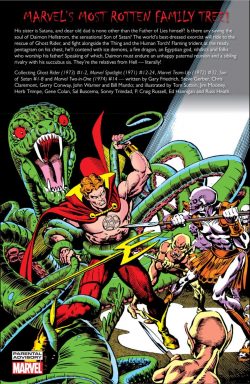
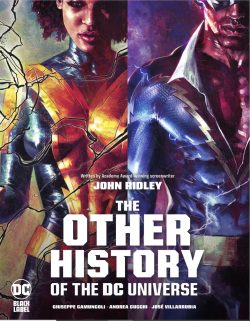
The Other History of the DC Universe


By John Ridley, Giuseppe Camuncoli, Andrea Cucchi, José Villarrubia & various (DC Comics)
ISBN: 978-1-7795-1197-3 (HB/Digital edition)

Win’s Christmas Gift Recommendation: Hard-Hitting, Strong Medicine… 9/10

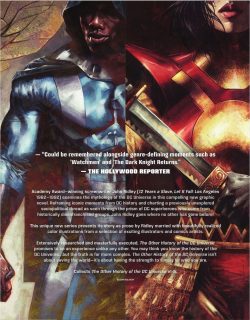
The evolution and assimilation of non-white, non-standard characters – defined and othered by skin colour, religion, ethnicity and who loves whom – has been in most mass media what author and screenwriter John Ridley (12 Years a Slave; Future State: The Next Batman) has described as “measured progressiveness”.

That’s especially true in comics, where incremental firsts have been applauded – and rightly so, as the industry has always been at the forefront of progressive thinking and action – but has also suffered from a tickbox mentality where true change has been slow to materialise and hard to sustain. We can say “first black superhero”, “first gay hero”, “first interracial marriage” or “first same-sex kiss” , but other than offering a glimmer of acceptance, and recognition, what has changed?

It’s certainly better than an all-white, all-male milieu where “different” equates to “lesser than”, where more than 50% of the populace and who knows how much of the readership doesn’t conform to proposed norms and are reduced to eye-candy, plot props and useless bystanders (not even competent villains who at least have agency!). For the longest time these attitudes were tacitly enshrined on funnybook pages – and not even for sinister reasons – but what appears to simply be an unconscious acceptance of an unchallenged status quo…

You can read other books or even some previous posts here from the last month for background, if you want, but here and now, I’m pointing you towards a fascinating and gripping series recently collected as an answer to that situation.

Here Ridley – with illustrators Giuseppe Camuncoli, Andrea Cucchi, José Villarrubia and letterer Steve Wands – re-examines and deconstructs DC’s record of Diversity progress via all those slow incremental steps and breakthroughs: interpreting through the eyes and attitudes of the revolutionary characters the company added but with modern sensibilities and opinions in play…

Filtered from a socio-political perspective and assessment of those times – but not in the comfortably parochial “everything’s basically fine” tones of a white, male middle class parental audience-placator – you’ll learn a different history: one told not under Comics Code Restrictions, or commercial interests sanitising culture and attitude to keep (covertly and actively) racist authorities from embargoing titles but as heroic individuals finally telling their sides of a well-known story.

Published under DC’s Black Label mature reader imprint it begins with the story of Black Lighting in Book One – 1972-1995: Jefferson Pierce. Here we see the inner workings of an African American former Olympian who became a school teacher and vigilante to save lives and how it destroyed and damaged his family, after which Book Two – 1970-1989: Karen Beecher-Duncan & Mal Duncan recounts in their words how being the tokens on a team of white privileged teen super do-gooders shaped their lives and relationship.

A far darker divergence is applied to Japanese warrior/assassin Katana in Book Three – 1983-1996: (plus the kanji for Yamashiro Tatsu), exploring the tragic Japanese widow’s reinventions from faithful wife/widow to murderous killer and lethal weapon to nurturing superhero and beyond…

The lecture continues with the tale of a Gay Latinx cop who inherited the role of DC’s most mysterious avenger in Book Four – 1992-2007: Renee Montoya, before The Question resolves into second generation angst and answers for Book Five – 1981-2010: Anissa Pierce. Here Black Lightning’s actual legacy and effect on DC continuity is reappraised through the eyes of his superhero children Thunder and Lightning, with religion and sexual orientation also coming under fire.

All we’ve seen before is summed up with no obfuscations or confusions, but you might want to reread or acquaint yourself with the original material as seen in various volumes of Black Lightning, Teen Titans, The Outsiders as well as selected continuity highpoints of Green Lantern, Batman, Cosmic Odyssey, Crisis on Infinite Earths, Death of Superman. Don’t let the reading list deter you though: you could simply plunge right in and wing it. The material, its tone and reinterpretation are carefully orchestrated and fully approachable for any level of fan from veteran adept to casual film watcher…

Ridley enacts a miraculous slice of sleight of hand here, examining simultaneously the actual published comics as accepted DC lore but also the redefining times they were created in and filling out the characters in modern terms – quite a feat of meta-realism…

The covers are by Camuncoli & Marco Mastrazzo with Jamal Campbell producing some stunning variants, but the true attraction of The Other History of the DC Universe is the knowledge that times and attitudes have changed enough that this book is even possible. Read it and see…
© 2021 DC Comics. All Rights Reserved.

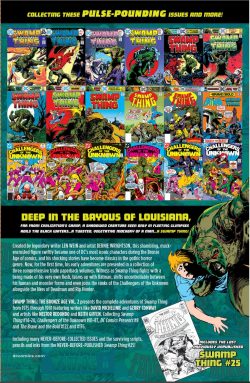
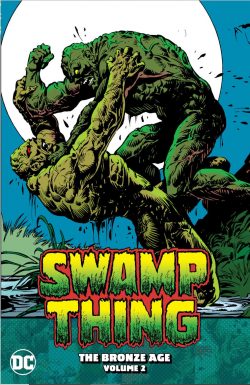
Swamp Thing: The Bronze Age volume 2


By David Michelinie, Gerry Conway, Carla Conway, David Anthony Kraft, Steve Englehart, Bob Haney, Martin Pasko, Nestor Redondo, Fred Carrillo, Keith Giffen, Michael Netzer, Murphy Anderson, Ernie Chan & various (DC Comics)
ISBN: 978-1-4012-9422-9 (TPB/Digital edition)

Win’s Christmas Gift Recommendation: Utter Moodily, Moss-Bedecked Entertainment Perfection… 9/10

The first fan-sensation of the modern era – now officially enshrined as the Bronze Age – of American comic books – Swamp Thing has powerful popular fiction antecedents and in 1972 was seemingly a concept whose time had come again. Prime evidence was the fact that Marvel were also working on a man-into-mucky, muddy mess character at the very same time.

Both Swampy and the Macabre Man-Thing were thematic revisions of Theodore Sturgeon’s classic novella It, and bore strong resemblances to a hugely popular Hillman Comics star dubbed The Heap. He/it sloshed through the back of Airboy Comics (née Air Fighters Comics) from1943 onwards and my fan-boy radar suspects Roy Thomas’ marsh-monster the Glob (from Incredible Hulk #121, November 1969 and #129, June 1970) either inspired both DC and Marvel’s creative teams, or was part of that same zeitgeist.

It should also be remembered that in the autumn of 1971 Skywald – a very minor player with big aspirations – released a monochrome magazine in their Warren Comics knock-off line entitled The Heap.

For whatever reason, by the end of the 1960s superhero comics were in another steep sales decline, again succumbing to a genre boom led by a horror/mystery resurgence. A swift rewriting of the Comics Code Authority augmented the changeover and at National/DC, veteran EC comics star Joe Orlando became editor of House of Mystery and sister title House of Secrets.

These returned to short story anthology formats and gothic mystery scenarios, taking a lead from TV triumphs such as Twilight Zone and Rod Serling’s Night Gallery.

Referencing the sardonic narrator/storyteller format of those EC horror titles, Orlando created Cain and Abel to shepherd readers through brief, sting-in-the-tail yarns produced by the best new and established creators the company could hire. Artists Neal Adams, Mike Kaluta, and especially Bernie Wrightson produced some of their best work for these titles, and the vast range of spin-offs the horror boom generated at DC.

The 12th anthology issue of the resurrected House of Secrets (#92, June/July 1971) cemented the genre into place as the industry leader. There writer Len Wein & Wrightson produced a throwaway gothic thriller set at the turn of the 19th century, wherein gentleman scientist Alex Olsen was murdered by his best friend with his corpse dumped in a swamp.

Years later, Olsen’s beloved bride – now the unsuspecting wife of the murderer – was stalked by a shambling, disgusting beast that seemed to be composed of mud and muck…

The tale struck an immediate chord with the public. That issue was the best-selling DC comic of that month, and reader response was fervent and persistent. By all accounts, the only reason there wasn’t an immediate sequel or spin-off was that the creative team didn’t want to produce one. Eventually however, bowing to interminable pressure, and with the sensible idea of transplanting the concept to contemporary America, Swamp Thing #1 appeared on newsstands in the Spring of 1972. It was an unqualified hit and instant classic…

Wein & Wrightson produced 10 issues together: an extended, multi-chaptered saga of justice and vengeance encompassing a quest for answers that was at once philosophically typical of the time and a prototype for the story-arc and mini-series formats that dominate today’s comics. They also used each issue/chapter to pay tribute to a specific sub-genre of timeless horror story whilst advancing the major plot…

When Alec and Linda Holland retreated deep into the Louisiana Bayou to work on a bio-restorative formula to revolutionise global farming, they had no idea criminal organisation “The Conclave” was after their research. Despite the best efforts of Secret Service agent Matt Cable, the lab was bombed and Linda died instantly. Alec – showered with his own formula and blazing like a torch – hurtled to a watery grave in the swamp. He did not die…

Transformed by the formula (and remember, please, this was prior to Alan Moore’s landmark re-imagining of the character) Holland transformed into a huge man-shaped thing: immensely strong, barely able to speak, and seemingly composed of living plant matter. Holland’s brain still functioned, however, and he vacillated between finding his wife’s killers and curing his own monstrous condition. Cable, misinterpreting the evidence, became obsessed with killing the beat, believing it caused the deaths of his two friends and charges…

Swamp Thing travelled the world, encountering the darkest outbreaks of classic supernature and the insatiable greed of human beasts before eventually convincing Cable of his innocence and true identity. Joined by Abigail Arcane – niece of archenemy and necromantic sorcerer Anton Arcane – they roamed a nation and world increasingly beset by uncanny terrors and macabre plots, with new allies like mystery man Bolt at their side.

Wein’s last issue was #13, having ushered in a new direction for Nestor Redondo – who replaced Wrightson with #11 – to display his own gifts and quickly become the artistic driving force.

Born in 1928 at Candon, Ilocas Sur in the American Territory of the Philippines, Redondo was influenced by US strips like Tarzan, Superman, Buck Rogers and Flash Gordon which were immensely popular in the entertainment-starved Pacific Archipelago.

Drawing from an early age, Nestor emulated his brother Virgilio – who worked as a comics artist in the young country. The Philippines became a commonwealth in 1935, and achieved full-independence from the USA in 1946, but maintained close cultural links to America.

Nestor’s parents pushed him into architecture but within a year he returned to comics. A superb artist, he far outshone Virgilio – and everybody else – in the cottage industry. His brother switched to writing and they teamed up: producing some of the best strips the Islands had ever seen, the most notable and best regarded being Mars Ravelo’s Darna.

Capable of astounding quality and incredible speed, by the early 1950s Nestor was drawing for many titles. Publications like Pilipino Komiks, Hiwaga Komiks and Espesial Komiks were fortnightly and he usually worked on multiple series simultaneously, pencils and inks. He also produced a wealth of covers.

In 1953, he adapted MGM film Quo Vadis for Ace Publications’ Tagalong Klasiks #91-92. Written by Clodualdo Del Mundo, it was serialized to promote the movie in country, and impressed MGM so much that they offered 24-year old Nestor a US job and full residency. He declined, thinking himself too young to leave home yet.

Ace was the country’s biggest comics publisher, but by the early 1960s they were in dire financial straits. In 1963 Nestor, Tony Caravana, Alfredo Alcala, Jim Fernandez, Amado Castrillo and brother Virgilio set up their own company CRAF Publications, Inc., but times were against them and publishers everywhere. Around this time, America called again, in the form of DC and Marvel Comics.

By 1972, US based Tony DeZuñiga had introduced Filipino artists to US editors. Nestor drew horror tales for House of Mystery, House of Secrets, The Unexpected, Phantom Stranger, Secrets of Sinister House, Witching Hour, Weird War Tales; Marvel’s Man-Thing; and an astonishingly lovely run on Rima the Jungle Girl (loosely adapting W. H. Hudson’s seminal 1904 novel Green Mansions), before joining Swamp Thing.

He also worked on Lois Lane and the Tarzan franchise, and in 1973 produced literary adaptations including Dracula and Dr. Jekyll and Mr. Hyde for Vincent Fago’s Pendulum Press Illustrated Classics (later reformatted as Marvel Classics Comics). In later years, he moved to Marvel to ink and eventually fully illustrate The Savage Sword of Conan.

During his DC period he was tapped to draw an adaptation of King Arthur which DC killed before it was completed (once again some pages survive and the internet is your friend if you want to see them) but did limn tabloid-sized Limited Collectors’ Edition: The Bible.

This epic bayou bonanza gathers the last of the original Swamp Thing run (#14-25), plus guest appearances from Challengers of the Unknown #81-87; The Brave and the Bold #122 & 176 and DC Comics Presents #8 (spanning cover-dates January/February 1975 to July 1981) .

Roving America during a period of political instability tainted by cultural hedonism and paranoia, Cable, Abby, Bolt and miserable misshapen Alec Holland (whom they had recently broken out of federal custody) continually stumbled into weird and deadly situations. With writer David Michelinie joining Redondo, proceedings open here with ‘The Tomorrow Children’ (ST #14, January/February 1975).

Separated again, Holland’s human helpers search for him as the depressed nomad discovers an isolated Bayou community of simple folk persecuting a family of freakish kids. Swamp Thing drives off one murderous mob, but stories of the outcast kids’ uncanny powers and the plain facts of strange accidents and mysterious disappearances won’t go away. By the time the townsfolk return to destroy the “demon children”, Holland has discovered radioactive waste is causing all the problems, but far too late to prevent tragedy or promote understanding…

Swamp Thing then falls under ‘The Soul-Spell of Father Bliss’: a seemingly serene and benign cleric with demonically disturbing notions on how to restore faith to his disinterested flock. When Cable and Abby finally find Swamp Thing, it’s not Alec Holland inside the vegetable colossus and only an ultimate sacrifice can save them and humanity from the priest’s folly…

In the awful aftermath, Bolt is captured by agents unknown and the restored Holland-Thing leads a rescue party against an old adversary. Typically, the venture is derailed by cruel fate and the monster ends up alone on tiny Kalo Pago island in the middle of a revolution. On one side is a viciously repressive military government while the rebels are led by High Priestess Laganna – who has a direct line to zombie gods.

Caught in the middle, Holland cannot stem the tide of terror on the climactic ‘Night of the Warring Dead’

ST #17 finds Bolt a prisoner of resurrected former Conclave chief Nathan Ellery, but when Abby, Cable and Swamp Thing finally stumble into his HQ, the maniac’s mercenaries, mechanical myrmidons and global mind-control contraption ‘The Destiny Machine’ at first appear to be an unbeatable opposition. But only at first…

Fleeing the destruction they have partially wrought, the victorious heroes crash land in an idyllic hamlet filled with violently murderous old folk. Its apologetic administrator claims Serenity is an experimental “ultimate retirement facility”, but before long is revealed as a demonic  ‘Village of the Doomed’ requiring all Holland’s power to escape and exorcise…

Cover-dated October 1975, The Brave and the Bold #122 then counts down ‘The Hour of the Beast!’ Bob Haney & Jim Aparo detail the awesome spectacle of Swamp Thing’s return to Gotham City and efforts to save it from a monstrous vegetable infestation. When Holland then becomes a target for a profit crazed showman, it needs all Batman’s ingenuity to save his ally and his city…

That same month in Swamp Thing #19, Gerry Conway joined Redondo to reveal ‘A Second Time to Die’ as a very familiar muck monster prowls Florida’s Everglades and – barely sentient – is befriended elderly Seminole hermit Ho’tah Makanaw. Nearby, Abby Cable and Bolt drive into Gatorberg, seeking their lost companion and following rumours of a big green monster…

The town is far from friendly but one boy is happy to take them to the old Indian who might know something of what they’re seeking…

Events take a drastic turn when the plant giant attacks a government drilling installation even as Ho’tah reveals a magical secret and sets the stage for an incredible clash in the next issue when Swamp Thing Holland battles incredible duplicate ‘The Mirror Monster’ for all the wrong reasons and for people who don’t deserve his aid…

Although the quality of the storytelling was getting better, the times were turning against the horror medium and as Michelinie returned in #21, it was for a science fictional romp as Holland was abducted by alien collector/slaver Solus. The bitterly contested escape left the monster stranded in an American desert and captured by rogue scientists battling madness-inducing contagion in their top secret atomic weapons base. Of course, definitions of “victim” or “cure” for ‘The Solomon Plague’ depended on who was doing the diagnosing, and when the “patients” started resisting treatment Holland could only watch helplessly as nature took its course…

Another attempt at a new direction began in Swamp Thing #23 as Conway & Redondo unleashed ‘Rebirth and Nightmare’, with a mystery mastermind targeting the moss monster and despatching costumed nemeses Sabre and Thrudvang, the Earth Master, even as the lonely wander made contact with his long-lost – and never-mentioned – smarter brother Edward Holland

Their combined efforts to concoct a cure are initially successful despite Sabre’s surprise attack, but as we all know “no good deed goes unpunished”…

Cover-dated August/September 1976, an era ended with #24 as Conway, David Anthony Kraft, Ernie Chan & Fred Carrillo all collaborated on ‘The Earth Below’ as human but still traumatised Alec Holland faces Sabre, even more costumed crazies and ultimately tectonic terror Thrudvang, all craving the bio-regenerative formula still afflicting the former plant monster…

That catastrophic cliffhanger clash was never completed as the title was cancelled without warning or fanfare, just as it was about to formally join the superhero section of the DCU. It was probably for the best. As the Vertigo imprint would prove in a later age, some champions need sophisticated darkness to properly thrive…

As for the Bronze Age, Swamp Thing became a part of the army that hung around waiting to be picked for guest shots or even a revival. With the superhero genre recovering, one old concept granted a new shot ultimately led to fresh shoots for Holland.

The Challengers of the Unknown was a bridging concept. As superheroes were being revived in 1956 here was a super-team – the first of the Silver Age – but with no powers, basic utilitarian uniforms instead of costumes and the most dubious of motives – Suicide by Mystery. They debuted in Showcase #6 (cover-dated February 1957 and on sale in early November of 1956) and followed up in #7, 11 & 12 before gaining their own title (#1-77, May 1958-January 1971, plus a reprint revival in #78-80 in 1973).

They were a huge hit and major players in their time, striking a chord that lasted for more than a decade before they finally died… only to rise again and yet again. The idea of them was stirring enough, but their situation made their success all but inevitable. Conceived by inspirational human hit-factory Jack Kirby – before his move across town to co-create the Marvel Universe – the solid adventure concept and imperfect action heroes he left behind were idealised everyman characters for the tumultuous 1960s – an era before superheroes overtook anthological genre heroes to secure a virtual chokehold on comic book pages.

Kirby had developed a brilliantly feasible concept and heroically archetypical characters in cool pilot Ace Morgan, indomitable strongman Rocky Davis, intellectual aquanaut Prof.” Haley and daredevil acrobat Red Ryan. The Challengers of the Unknown were four (extra)ordinary mortals; heroic troubleshooter and explorers who walked away unscathed from a terrible plane crash. Already obviously what we now call “adrenaline junkies”, they communally decided that since they were all living on borrowed time, they should dedicate what remained of their lives to testing themselves and fate. The quartet would risk their lives for KNOWLEDGE and, naturally, JUSTICE.

They were joined by an occasional fifth member, beautiful (of course) scientist June Robbins in their second appearance (Ultivac is Loose!’ in Showcase #7, March/April 1957), and she became a hardy perennial, frequently popping up to solve puzzles, catch criminals and generally deal with aliens, monsters, mad boffins and assorted supernatural threats. Over the decade other Challengers audited this core group, but none as bizarre as those that popped in during their late 1970s resurgence…

The return began in 1976 as a try-out serial in Super-Team Family #8-10 (January-May 1977) and led to the launch of Challengers of the Unknown #81 (June/July 1977). Crafted by Conway, Michael Netzer (nee Nasser) & Bob Wiacek, it’s included here and sees the boys and June Robbins defeat an old super-foe in ‘Multi-Man’s Master Plan’. In the course of the battle, Prof is diagnosed with an appalling, life-threatening fungal infection that dictates the team heading to Perdition, Pennsylvania, with persistent wannabe hanger-on Gaylord Clayburne desperately seeking to insert himself into the rescue mission…

Older fans will know that’s where Holland first defeated a Lovecraftian horror (Swamp Thing #8): a tale fully reprised in CotU #82, as Conway, Netzer & Joe Rubinstein reveal ‘The Lurker Below’, examine the ‘Legacy of the Damned’, expose ‘The Soul Predator’ and ruthlessly respond as ‘The Lurker Rises’

As a deranged priest seeks to manifest cancer-god M’Nagala, Keith Giffen & John Celardo take over art duties with #83 as the embattled Challs seek to close ‘Seven Doorways to Destiny’. As Prof succumbs to fungal assimilation, aid comes as Clayburne recruits human Dr. Alec Holland as a potential ‘Savior from the Swamp?’ even as ‘The Gods Crawl Closer’. Unknown to the vainly striving Challengers, the subsequent battle reverts Holland to his vegetable form, but ‘Monsters, Good and Evil’ cannot stop the ghastly devil until Holland’s ultimate sacrifice. His triumph over M’Nagala goes completely unnoticed…

Issue #84 finds the human heroes attempting ‘To Save a Monster’ called Prof Haley, but falter until the spirit of Boston Brand occupies and cures him ‘When Deadmen Walk’. In the meantime the Challs learn Holland is the Swamp Thing and seek to make amends. With unperceived aid from Brand, they track the bog beast down only to find he/it has been taken over by Multi-Man…

The threat is covertly countered by Deadman, who sticks around when the Challs offer the plant monster a place on the team, just as Challengers of the Unknown #85 introduces ‘The Creature from the End of Time!’ as ‘The Box from Beyond’ materialises in Toronto, spawning murderous ‘Monsters and Men’ and necessitating a ‘Flight into the Future’

The team had hoped to consult legendary specialist Rip Hunter, Time Master, but learn he and his team have been missing for a decade…

Disappointed but undeterred, the Challs (minus angry quitter Red Ryan but with unsuspected stowaway Deadman) take off for 12 million AD, leaving recuperating Prof behind to face an unsuspected menace…

Penultimate issue #86 solves the mystery of Rip Hunter as the heroes encounter ‘The War at Time’s End’, whilst recap ‘The Way it Began’ restates the convoluted path and events that brought the situation about.

The dismantling of humanity’s final dystopia begins as ‘If This is Tomorrow, You Must Be Rip Hunter!’, leads to the Challenger team investigating ‘Time Times Terror’ and discovering ‘A Pit by Any Other Name’ before the saga concludes in complete chaos with #87 (June/July 1978) as the  ‘Twelve Million Years to Twilight’ pits the human heroes against mutated terrors of the dominant Sunset Lords.

In the end, the future of humanity depends on monsters ghost and primitives enacting an ‘Assault on Sunset’ to secure ‘Twilight’s Last Glimmer’, courtesy of Carla & Gerry Conway, Giffen & Celardo.

Once again, an abrupt cancellation was the reward for valorous service and all players returned home to be shelved again. This compendium closes with a brace of superhero team-ups and a lost treat for true devotees, beginning with DC Comics Presents #8 (April 1979), as ‘The Sixty Deaths of Solomon Grundy!’ by Steve Englehart & Murphy Anderson pairs bog beast with the Man of Steel. Still believing he was a transformed human and not an enhanced plant, Swamp Thing here searches the sewers of Metropolis for a cure to his condition, only to stumble onto a battle between Superman and the mystic zombie who was “born on a Monday…

Crafted by Martin Pasko & Aparo, an encore in The Brave and the Bold #176 (July 1981) reunites Batman and Swamp Thing in a convoluted tale of Bayou-based murder and frame-ups in ‘The Delta Connection’ before the previously unpublished contents of Swamp Thing #25.

With the series cancelled, in-production story ‘The Sky Above’ by Kraft, Chan & Carillo is presented here as plot, script, uncoloured cover 16 pages of layouts, the pencils and inks in a clash with Hawkman that really should have officially taken place…

Also offering covers by Redondo, Aparo, Chan, Netzer, Neal Adams, Rubinstein, Rich Buckler, Jack Abel, Frank Giacoia, Alex Saviuk, Dick Giordano, José Luis García-López and Mike Kaluta; editorial material from Challengers of the Unknown #86 and an unused cover by Rick Veitch & Michelle Madsen, this collection comprises a genuine landmark of the art form, with stories that are superb examples of old-fashioned comics wonderment, from a less cynical and sophisticated age, but with a passion and intensity that cannot be matched. And, ooh, that artwork…

If you love comics you must have his buried treasure.
© 1975, 1976, 1977, 1978, 1979, 1981, 2019 DC Comics. All Rights Reserved.

Deadman: Book One


By Arnold Drake, Jack Miller, Carmine Infantino, Neal Adams, George Roussos & various (DC Comics)
ISBN: 978-1-4012-3116-3 (TPB/Digital edition)

As the 1960s ended, a massive superhero boom became a slow but certain bust, with formerly major successes no longer able to find enough readers to keep them alive. The taste for superheroes was diminishing in favour of more traditional genres, and one rational editorial response was to reshape costumed characters to fit evolving contemporary tastes.

Publishers swiftly changed gears and even staid, cautious DC reacted rapidly: making masked adventurers designed to fit the new landscape. Newly revised and revived costumed features included roving mystic troubleshooter The Phantom Stranger and golden age colossus The Spectre, whilst resurgent traditional genres spawned atrocity-faced WWII spy Unknown Soldier and cowboy bounty hunter Jonah Hex, spectral western avenger El Diablo and game-changing monster hero Swamp Thing, spearheading a torrent of new formats, anthologies and concepts.

Moreover, supernatural themes and horror-tinged plots were shoehorned into those superhero titles that weathered the trend-storm. Arguably, the moment of surrender and change had arrived with the creation of Boston Brand in the autumn of 1967, when venerable science fiction anthology Strange Adventures was abruptly retooled as the haunted home of an angry ghost…

Without fanfare or warning, Deadman debuted in #205 with this first collection (of five) re-presenting that origin event and thereafter, pertinent contents from #206-213: cumulatively spanning cover-dates October/November 1967 to July/August 1968. The drama is preceded by Introduction ‘How Deadman Came to Life’ by originator Arnold Drake and the Foreword – ‘A Most Unusual Character’ by Carmine Infantino – each reminiscing, recapitulating and confirming just how daring and unprecedented the new kind of hero was…

Then it’s straight into eerie action with ‘Who Has Been Lying in My Grave?’ – by Arnold Drake, Carmine Infantino & George Roussos – as we attend the funeral of high wire acrobat Boston Brand: a rough, tough, jaded performer who had seen everything and masked a decent human heart behind an obnoxious exterior and cynical demeanour.

As “Deadman”, Brand was the star attraction of Hills Circus and lover of its reluctant owner Lorna Carling, as well as a secret guardian for the misfits it employed and sheltered. That makeshift “family” includes simple-minded strongman Tiny and Asian mystic Vashnu, but also had a few bad eggs too… people like alcoholic animal trainer Heldrich and chiselling carnival Barker Leary.

The aerialist kept them in line… with his fists, whenever necessary…

One fateful night, Brand almost missed his cue because of Leary and Heldrich’ antics and also because he had to stop local cop Ramsey harassing Vashnu. It would have better if he had been late, because as soon as he started his act – 40 feet up and without a net – someone put a rifle slug into his heart…

Despite being dead before he hit the ground, Brand was scared and furious. Nobody could see or hear him screaming, and Vashnu kept babbling on that he was the chosen of Rama Kushna – “the spirit of the universe”. The hokum all came horribly true as the entity astonishingly made contact, telling Brand that he would walk among men until he found his killer…

The sentence came with some advantages: he was invisible, untouchable, immune to the laws of physics and able to take possession of the living and drive them like a car. His only clue was that witnesses in the audience claimed that a man with a hook had shot him…

Outraged, still disbelieving and seemingly stuck forever in the ghastly make-up and outfit of his performing persona, Deadman’s first posthumous act is to possess Tiny and check out the key suspects. Soon the dormant Hercules finds that the cop and Heydrich are involved in a criminal conspiracy, but they definitely are not Brand’s murderers…

Eventually, the ghost learns a shocking fact: his desperation is not worth the life of anyone else and he must not let his anger put his “vessels” in harm’s way…

Second episode ‘An Eye for An Eye!’ was scripted by Drake, and was Adams’ illustrative debut. Originally inked by Roussos, here it is rather unfairly reinked by Adams and further enhanced by modern colouring techniques. I understand how the artist should have autonomy and agency in his own work, but for the sake of chronology and authenticity, I take quite a bit of umbrage on behalf of old “Inky”, whose efforts seem unfairly judged and slighted by these revisions…

That being said, the tale is a strong one and indicates a sea change in narrative style as Deadman expedites his hunt for justice. The stories henceforth focus on those who are temporarily occupied by Brand: a string of episodic encounters that mirrored the protagonist of contemporary hit TV series The Fugitive (and by extension, Victor Hugo’s Les Misérables), with an unfairly accused victim searching for personal justice all across America, to the benefit of many people in crisis.

Here, that’s young Jeff  Carling, who’s fallen in with a dangerous biker gang and is set up to pay for their crimes. He’s also Lorna’s brother, which is how Deadman gets involved in the mess, after learning the cash-strapped kid had taken out a life insurance policy on the circus star just before the Hook struck…

Having saved the kid from a perfect frame, Brand resumes his search and, as Jack Miller took over scripting in #207, is forced to ask ‘What Makes a Corpse Cry? The hunt leads him to revisit the night he saved bar girl Liz Martin from a drunken assault by her boss Rocky Manzel, but when the spook checks in, he finds Liz and boyfriend Paul being terrorised by Rocky, who coldly implies he caused the death of her last protector…

Even after using his ghost gifts to disqualify Manzel, Deadman is compelled to help the young lovers, and exposes the club owner’s criminal secret, but once again almost causes the death of his human ride…

Miller & Adams were providing a very different reading experience with innovative, staggeringly powerful art, but struggled with deadlines, and ‘How Many Ways Can a Guy Die?’ was delivered in 4 parts across Strange Adventures #208 and 209. The revelatory tale introduces Brand’s trapeze artist rival Eagle, who had tried to kill him years before, and now seeks to replace him in the circus and Lorna’s bed – whether she wants him or not…

When Deadman again borrows Tiny to dissuade the brute, Eagle threatens the gentle strongman with the same thing Brand got and the ghost is convinced his quest is almost over. However, the truth is far crueller, and when Deadman uncovers his rival’s actual scheme, the cost to Tiny and alternate vessel Pete is far too high…

The hunt stalled again, Brand finally thinks to check the official police investigation in #210’s ‘Hide and Seek’ (cover-dated March 1968). To his disgust, he finds the case is cold, with assigned detective Michael Riley dishonourably discharged from the force due to the testimony of a man with a hook…

Sensing a breakthrough, Deadman possesses Riley and, visiting the other “witness” to the former cop’s reported use of excessive force, uncovers a devious plot. Sadly, despite clearing Riley’s name, Brand misses The Hook who coldly disposes of the only man who could describe him before fleeing to Mexico…

Hot on the trail, Deadman arrives in El Campo in #211, and endures a shocking surprise in ‘How Close to Me My Killer?’ as Miller’s last story introduces wayward twin brother Cleveland Brand. Flashbacks show the sibling had plenty of motive to murder his showbiz brother, but as the tale unfolds, Boston learns he has an unsuspected niece and his people-trafficking but repentant brother needs some haunted help to save smuggled “wetback” labourers from a Texan businessman looking to whitewash his criminal endeavours…

Adams took over scripting with #212 and ‘The Fatal Call of Vengeance’ sees another change of direction, adding more conventional fantasy elements to the mix as Cleveland and his daughter Lita head north to Hills Circus.

Wearing his brother’s costume, Cleve revives the Deadman act and, in Mexico, a man with a hook sees a headline and rushes back to the USA.

Faster than any jet, Boston is already there and watches helplessly as his brother makes himself a target of the unknown killer. The phantom is also completely spooked by new lion tamer Kleigman who is rude and unfriendly and is missing his right hand…

With everyone at odds, both Boston’s returned killer and the circus family set traps with disastrous results, but in the end the Hook escapes again and it’s Tiny who’s left bleeding out from a gunshot…

This first collection concludes with a dip into the madly metaphysical as ‘The Call from Beyond!’ tests Deadman’s abilities to the limit as he enters Tiny’s consciousness to promote his recovery and break a assumed-fatal coma. Following that miracle, the restless revenant repays his debt by saving the reputation and life of Tiny’s surgeon Dr. Shasti after the medical savant is duped by murderous con artist/medium Madam Pegeen

With groundbreaking covers by Infantino, Sekowsky, Roussos & Adams and ‘Biographies’ of the creators involved, this spectral delight perfectly captures the tone of an era in transition through a delirious run of comics masterpieces no ardent art lover or fanatical fear aficionado can do without.
© 1967, 1968, 2011 DC Comics. All Rights Reserved.

The Mystery of the Meanest Teacher – a Johnny Constantine Graphic Novel


By Ryan North, Derek Charm & various (DC Comics)
ISBN: 978-1-7795-0123-3 (TPB/Digital edition)

Win’s Christmas Gift Recommendation: Moody, Mirthful and Magical… 8/10

In recent years DC has opened up its shared superhero universe: generating Original Graphic Novels featuring its stars in stand-alone adventures for the demographic inappropriately dubbed Young Adult. To date, results have been rather hit or miss, but when they’re good, they are very good indeed. An ideal example is this cheery chiller reinterpreting the formative years of DC’s magical bad boy: particularly concentrating on his early relationship with things that go bump in the night…

You’ve either heard of John Constantine by now or you haven’t, so I’ll be brief. Created in 1985 by Alan Moore, Steve Bissette, Rick Veitch & John Totleben during a groundbreaking run on Swamp Thing, the unlikeliest of heroes is a mercurial modern mage, a dissolute chancer and self-appointed mystic fixer who plays like an addict with magic – on his own terms for his own ends.

He is not a good guy. He is not a nice person, but all too often, he’s all there is between us and the void…

Winning his own series by clamorous popular demand, Constantine’s own series Hellblazer premiered in 1988, during the dying days of Reaganite Atrocity in the US but at the height of Thatcherite Barbarism in England. We’re pretty much singing the same songs now as back then but – with 5th rate Britain’s Got Talent cover-artist wannabes as our revolving-door leaders – that’s something little Johnny will surely get around to sorting if he gets another outing…

In 1988, creative arts and Liberal attitudes were dirty words in many quarters and the readership of Vertigo was pretty easy to profile. The long-running series started with relatively safe horror plots, introducing us to Constantine’s unpleasant nature, chequered history and odd acquaintances. Even then, discriminating fans were aware of a joyously anti-establishment political line, rebellious nature and wildly metaphorical underpinnings. Racism, Darwinian politics, gender fluidity, plague, famine, gruesome supernature and more were everywhere in the dark dystopian purview of John Constantine – a world of bleeding-edge mysticism, Cyber-shamanism and political soul-stealing.

Relax. That is not the Constantine you’re looking at here…

Courtesy of writer Ryan North (Dinosaur Comics, Adventure Time, Slaughterhouse-Five, Power Pack, Machine of Death, Unbeatable Squirrel Girl, How to Invent Everything, Star Trek – Lower Decks) and illustrator Derek Charm (Jughead, Unbeatable Squirrel Girl, Uncle Scrooge, Jughead’s Time Police, Star Wars Adventures) – assisted by letterer Wes Abbott – we’re meeting a wily wizard in waiting: someone apparently without conscience or impulse control who bears more than a passing resemblance to juvenile parental burden Dennis the Menace – but more the malign mischief maker from The Beano than Hank Ketchum’s wayward waif…

It begins in London where a cocky kid pops into a sweetshop. Unfortunately, Archibald Junior’s Discount Confections is no ordinary purveyor of tasty treats, but then again, Johnny Constantine is no ordinary kid…

Behind a cheesy façade of fragrant gleaming bottles, jars and bags, this exotic emporium has a back room where ghosts, demons and world-devouring cosmic entities can also snatch a little snacky something. It just another eldritch secret that Johnny – who calls himself “Kid Constantine” – somehow knows. The boy has an astounding affinity for magic and has even befriended a few lesser devils, but he also has a weakness for Archibald’s magic chocolates.

Sadly, this latest shoplifting lark endangers all of Earth and, haunted by angry ghosts, the Kid has to take refuge with a pack of low-grade demons.

He’s been casually manipulating his parents for a while now, and fooling himself that he’s a wicked cool Jack the Lad, but he learns a few hard truths as he even wears out his welcome with the unholy monsters, and immediately opts to try boarding school to evade further repercussions. Best of all, the place is in America…

It’s pretty far away, but Johnny doesn’t mind. He’s always been better off alone. Just look what happened to the last friend he foolishly shared his magical gifts with…

With terrifying ease, the unaccompanied boy rocks up at The Junior Success Boarding School in Massachusetts, but his charm and roguish manner can’t help him adjust, settle in or make any friends on campus. In fact, he’s actually starting to feel a bit lonely… until a bit of lazy, labour-saving magic is spotted by fellow sixth grade outsider Anna.

The Kid is just starting to think he might have made a mistake coming to America when she comes clean and confesses that she too can make little miracles…

Our gobsmacked loner thinks long and hard before letting his guard down, but soon they are friends and co-conspirators, playing pranks and testing their limits. It seems the best of all worlds until their homeroom teacher Ms. Kayla starts behaving strangely…

Formerly the nicest adult in school, she abruptly changes, spitefully singling out Johnny and Anna for special attention and cruel psychological bullying. Before long, the supernatural students are using their gifts to learn what caused the transformation, but discover it’s far worse than they could ever have imagined…

Facing a deadly existential supernatural threat, Kid Constantine does what he always does and runs away, deserting Anna and the school, but everything changes when he hits the forests surrounding the institution and meets a potentially life-changing ally in the huge form of a witch-hunting demon called Etrigan

Chastened and emboldened, the Kid makes a decision that will change his life: returning to school, joining Anna and the Demon in ending a monstrous menace more terrible than anyone could have imagined…

Rowdy, rousing and riotous – and sublimely stuffed with twists, shocks and enticing snippets of DC lore – the battle against unforgiving evil culminates in a clever piece of misdirection and some stellar sleight of hand as valiant Anna and duty-driven Etrigan see their bad boy come good and save everything…

This tale is done in one but the book also offers a lengthy excerpt from Jeffrey Brown’s Batman and Robin and Howard that is also worth some of your time and attention…

Bold, beguiling, brilliantly entertaining and deliciously uplifting, The Mystery of the Meanest Teacher is a magical rite of passage and smartly funny adventure with a twist to charm and thrill full-on fans and nervous neophytes alike: one introducing a new wondrous world with a rousing reminder that there is magic everywhere.
© 2020 DC Comics. All Rights Reserved.

Son of Satan Classic


By Gary Friedrich, Steve Gerber, Gerry Conway, Chris Claremont, John Warner, Bill Mantlo, Mike Friedrich, Herb Trimpe, Tom Sutton, Jim Mooney, Gene Colan, Sal Buscema, Sonny Trinidad, P Craig Russell, Ed Hannigan, Russ Heath, Jim Starlin & various (Marvel)
ISBN:  978-3029-0104-2 (TPB/Digital edition)

As the 1960s closed, American comics were in turmoil, reflecting the greater society they were being published in – the one full of reactionary establishment types, turbulent rebellious youth, black people and their multi-ethnic supporters all agitating for universal Civil Rights and impressionable kids looking for entertainment and getting an education along the way.

In that cauldron – one fully addressed and depicted in comics books as much as laws and the Comics Code would allow – dissatisfaction and the need for change permeated everyone’s mind and the desire for a new way gripped the national and international consciousness.

Superheroes had dominated for most of the decade: peaking globally with a rush of outrageously daft, “Camp” humour excess before explosively falling to ennui and overkill. Business never sleeps, however, and in their place, TV, movies and comics returned to familiar old genres like westerns, war, science fiction and especially horror stories: although these too benefitted from and were changed by expanded consciousness and enlightened social attitudes.

For Marvel, the problem must have been particularly acute: Stan Lee & Jack Kirby had rebuilt an ailing minor publisher into a close contender for the top spot, on the backs of gaudily attired mystery men, but now that the bubble seemed to have both deflated and burst… for a second time.

Since other genres were now piquing the still-presumed mostly adolescent interests of comics core readership – like the alternative “cool” vibe attached to the modern notion of disenchanted, unchained youth (and generally ones riding motorbikes) – all publishers were looking for fresh and different ways forward.

To counter the abrupt downturn in superhero sales, the Comics Code prohibition against horror stories and iconography was hastily amended to facilitate the resurrection of scary material and bolster an industry in economic freefall. With terror tales and magical situations back in a big way, a new crop of anthologies and supernatural heroes and monsters started to thrive, supplementing the ghosts, ghoulies and goblins that had been gradually infiltrating the formerly science-only scenarios of the superhero who had weathered the downturn by tackling horror themes and villains…

It should be noted that more mature scary stories had been available since the mid-60s in the monochrome publications of Jim Warren and his imitators, who had deftly sidestepped Comics Code embargos by redefining their graphic output as “magazines” not comics. Now the likes of Eerie and Creepy had some real competition…

Lifting the CCA ban sparked a mass spawning of horror titles of varying degrees of potency and excess. Whether new material or reprints from before and after the instigation of the Code, the inexorable wave of thrillers and chillers helped even more venerable costumed crusaders close their doors and – temporarily at least – bite the dust.

Almost overnight, nasty monsters became acceptable fare on four-colour pages and a parade of pre-code reprints refreshed jaded palates whilst making sound financial sense. However, the creative aspect of the contemporary fascination with supernatural themes was best catered to by adapting already-popular and well-known cultural icons (all long out of copyright) before gambling on new concepts and an untested readership.

Whereas DC quickly cornered the market in new anthology tales – in the mordantly dark vein of Poe, Lovecraft, M.R. James, Algernon Blackwood, Ambrose Bierce, O. Henry and more – Marvel’s attempts at new, stand-alone anthological vehicles proved less successful and they soon shifted editorial efforts to their strong suite: developing ongoing characters in a shared universe. centred

The House of Ideas combined the new trend with their established style to create dark and tragic adventure heroes and even explored having unrepentant villains – like Dracula – as chief protagonist. As always in entertainment, the watchword was fashion: what was hitting big outside comics must be adapted and incorporated into the continuity. Marvel was still reeling from Kirby’s defection to DC in 1970 (where he would conjure his own chilling legends with Spirit World and The Demon) and new Editor-in-Chief Roy Thomas cannily greenlit a new character combining freewheeling, teen-friendly biker themes with the all-pervasive horror-furore…

Are you up for a bit more context before we really begin?

When proto-monster star Morbius, the Living Vampire debuted in Amazing Spider-Man #101 (cover-dated October 1970) and the sky failed to fall in, Marvel moved quickly and instituted a string of shocking super-stars. The began with a tragic wild beast and cruelly cunning predator – Werewolf by Night and The Tomb of Dracula – before chancing something truly new: a devil-haunted biker who could tap into both the motorcycling chic of movie Easy Rider and the global supernatural zeitgeist.

Preceded by god-touched western star Red Wolf and the aforementioned Werewolf by Night a new Ghost Rider premiered in Marvel Spotlight #5 (August 1972), and in turn led to the birth of the troubled subject of this Classic collection.

The graphic grimoire gathers the earliest exploits of Daimon Hellstrom as first seen in Ghost Rider #1-2, Marvel Spotlight #13-24, and Son of Satan #1-8, plus pertinent crossovers from Marvel Team-Up #32 and Marvel Two-In-One #14. Said saga spanned September 1973 to February 1977.

And will need even more background to with your continued indulgence…

Stunt-biker Johnny Blaze sold his soul to Satan to save his adopted father-figure Crash Simpson from cancer, but was cheated by the Devil. When the Lord of Lies came to collect his due, Johnny’s devoted and virginal girlfriend Roxanne Simpson interceded and partially redeemed her man. Although her purity prevented Satan’s victory, the Devil was only temporarily thwarted and took a measure of vengeance by afflicting Blaze with a body that burned with the fiery torments of Hell every time the sun set…

Initially haunting the night and terrorising thugs and criminals, the traumatised biker soon left the city for the solitary desert, perpetually battling The Deceiver’s countless agents who were tasked with shattering Roxanne’s loving aura of protection and claiming Blaze for Hell.

As part of these adventures Blaze battled a diabolical cult led by First Nations medicine man Snake Dance who sought to sacrifice Roxanne. The Ghost Rider barely saved her and – after dodging gun-happy cops – rushed her to hospital, where he was again attacked, this time by the Medicine Man’s daughter, Linda Littletrees, who revealed her own intimate connection to the Infernal…

The confrontation culminated in a devastating eldritch assault as she revealed her hidden role as satanic siren Witch-Woman

That epic duel opens this compendium with Ghost Rider #1 (cover-dated September 1973, by Gary Friedrich, Tom Sutton & Syd Shores), further extending the escalating war between Blaze and the Devil and using the conflict to introduce a new horror-hero who would take over the biker’s vacant slot in Spotlight: one owing much to the tone of the times and the imminent release of movie blockbuster The Exorcist

It transpires that Linda Littletrees isn’t so much a Satan-worshipping witch as ‘A Woman Possessed!’, but when her father and her fiancé Sam Silvercloud call in a Boston-based exorcist named Daimon Hellstrom, they are utterly unprepared for the kind of assistance this demonologist offers.

A Roxanne slowly recuperates, Blaze is still on the run from the police and Ghost Rider #2 sees the bedevilled biker dragged down to Hell in ‘Shake Hands With Satan!’ (illustrated by Jim Mooney & Shores) before the tale concludes in Marvel Spotlight #12 with the official debut of ‘The Son of Satan!’, courtesy of Friedrich, Herb Trimpe & Frank Chiaramonte.

Here it is revealed that religious scholar Hellstrom has a long and painfully suppressed inner self, and that the exorcist is actually a brutal scion of the Infernal Realm eternally at war with his diabolical dad.

Unleashed and liberated, the Prince of Hell swiftly rushes to Blaze’s aid – although more to spite his sire than succour the victim – and, with his own series off to a spectacular start, continues to take the pressure off the flaming-skulled hero.

We learn that the star-crossed career of the perpetually divided champion is comprised of a war between a devout demonologist and the Prince of Pandemonium: a studious, spiritual scholar sharing one body with a rebellious, sadistically violent demonic alter ego dubbed “the Darksoul”, and the Devil’s true spawn and legacy…

Friedrich, Trimpe & Chiaramonte reveal the source of the conflict in Marvel Spotlight #13’s as ‘When Satan Walked the Earth!’ takes Hellstrom back to the house he was reared in to find and read his mother’s diary.

Victoria Hellstrom’s words describe an enigmatic, beguiling stranger who swept her off her feet and subsequent early years of wedded bliss. How she bore a son and, three years after, a daughter. The toe shifts as the writer notes her husband’s increased absences, and the day she found her man and his girl-child performing a macabre blood-oath ritual sacrifice in the cellar of the idyllic family home…

When her spouse revealed himself as Satan Incarnate, the writer went quite mad.

With his mother institutionalised, his sister taken into care and their father vanished, the grieving shellshocked son entered a seminary and studied for the priesthood.

The diary ends with the writer’s death, but Daimon’s reawakened memories stir and he recalls how, on his 21st birthday his heritage came for him. Following an irresistible call, the student followed a disembodied voice through  portal to Hell and saw his father once more…

Offered all the twisted power and malign glory of a seat by the Devil’s side, Hellstrom rebelled, rejecting and battling his father and triggering a short-lived revolution in The Pit, before escaping with Satan’s all-powerful infernal Trident. The unique pitchfork is made of exotic mineral Netheranium: the only substance (other than prayer, piety, devotion and that other holy stuff) that can weaken the Devil. Best remember this is a comic book, and notionally an all-ages one at that…

Thus, after an untold age suppressing his own dark passenger, Daimon Hellstrom reaches an accommodation with his other self and prepares to take the war to the father they both despise…

At this time, Steve Gerber was Marvel’s undisputed Wizard of Weird: a brilliant, erudite, sensitive and ingenious writer who could make almost any off-the-wall concept accessible to readers – everything from Man-Thing to Howard the Duck, Daredevil to Sub-Mariner, Marvel Two-In-One to Iron Man.

He assumed the writer’s reins with Marvel Spotlight #14, joining artists Mooney & Sal Trapani in lying out a career path for the infernal antihero. It began with ‘Ice and Hellfire’ as the demonologist relocated to St. Louis, Missouri, at the request of Gateway University parapsychologist Dr. Katherine Reynolds. She has been terrorised and terrified by a string of bizarre apparitions and periodic poltergeist phenomena plaguing the campus…

Hellstrom soon uncovers an infestation of Ikthalon ice demons, and that these vile visitors and frozen furies are not invaders but have been summoned. In order to defeat them he takes Reynolds into his confidence and is enraged but unsurprised when she fails him…

Resorting to his father’s tactics to repulse the demons, Hellstrom sticks around for reasons he cannot fathom, and #15 (an all-Mooney art job) sees him endure a sinister physical change as a monstrous – possibly prophetic – dream propels him into a state of permanent chaos as his divergent natures fully merge into one eternally warring personality.

Accepting a lecturer’s position at Gateway, Hellstrom then disrupts an undergraduate ‘Black Sabbath’ and clashes again with his father – in his demonic iteration Baphomet – to save the souls of some stupidly curios students…

Trapani inked #16 as ‘4000 Holes in Forest Park!’ lure the exorcist into a very public media circus when a mysterious overnight event entices every kind of whacko out of the woodwork… as well as far less harmless loons like Christian End-Timers and a depraved Legion of Nihilists…

Inevitably the park explodes into a religion-fuelled riot, and when the Son of Satan intervenes, his supernal hellfire gimmick only exacerbates matters, igniting the scattered holes to form a colossal blazing pictogram. When the image then materialises into physical life, Dr. Reynolds and Divinity student Byron Hyatt are hurled back in time to the days before Atlantis sank, resulting in a shattering confrontation and startling glimpse at how magic reshaped the world in MS #17’s ‘In the Shadow of the Serpent!’ Schooled by legendary sorceress Zhered-Na, Hellstrom learns the necessity of catastrophe and the cosmic purpose of disaster, as well as his true role in existence before returning to the present with his fellow voyagers.

Gene Colan stepped in with #18, and – inked by Chiaramonte – takes the exorcist into a ‘Madhouse!’ when Katherine drags Daimon to a party attended by faculty and fellow parapsychologists only to find the festivities befouled by an act of animal cruelty.

The next morning Hellstrom learns that the house burned down after he left, and – curiosity aroused – investigates the ruins and detects psychic evil of tremendous potency. The fresh trail leads to young Melissa who has become the new home of truly ancient evil…

However, even after seemingly banishing ghastly Allatou back to damnation, the rescue mission continues as #19 (inked by Mike Esposito) then pits the exorcist against the girl’s fully-occupied parents in ‘Demon, Demon, Who’s Got the Demon?’: a brutal struggle that only ends when Daimon abandons holy lore and crushes his opponent with the Devil’s despised power and tactics…

Sal Buscema & Al McWilliams limned #20 as ‘The Fool’s Path!’ sees Satan’s Son targeted by a bizarre tarot reader and attacked by her animated cards. Three covers from previous SoS collections then offer a brief pause before #21 concludes the manic mystery in ‘Mourning at Dawn!’ with Joe Giella inks – exposing Madame Swabada’s incredible true nature… The battle concludes in the Bob McLeod inked ‘Journey into Himself!’ with Daimon corporeally confronting his past and a legion of demons and – ultimately – the true cause of all his woes…

Marvel Team-Up #32 – by Gerry Conway, Buscema & Vince Colletta – then offered a fiery collaboration between Human Torch Johnny Storm and Hellstrom. The exorcist inflicts ‘All the Fires in Hell…!’ on a demon possessing Johnny’s best pal Wyatt Wingfoot and assorted fellow members of his Native American Keewazi tribe. An era ended in Marvel Spotlight #23, as Gerber, Mike Friedrich, Sal B & Dan Green declare ‘In this Light, Darkness!’ with Hellstrom looking to conclude his unfinished business with the Legion of Nihilists before leaving St. Louis. The task is delayed when aged sage Father Darklyte seeks to test the scholar, only to be exposed for the menace he is…

The inheritor of Hell ended his tenure in Spotlight with #24 (October 1975) as Chris Claremont, Buscema & McLeod made him ‘Walk the Darkling Road!’ after mortal satanist Gloria Hefford summons Kthara, the Mother of Demons. Travelling to Los Angeles, Daimon seeks to save her, but is manipulated into clashing with his despised younger sister Satana: a girl after her daddy’s heart…

Even after uniting to stop Kthara, no bridges are built or fences mended between the infernal siblings…

The dispossessed Dauphin of Darkness moved into his own place as – cover-dated December 1975 – The Son of Satan #1 proclaimed ‘The Homecoming!’ as scripter John Warner, splash page artist Jim Starlin and story illustrator Jim Mooney took the eccentric exorcist into strange new territory as Hellstrom returned to the family house only to find it defiled. By invading Hell, he then learns that civil war has come to the pit as his father struggles against a usurper called The Possessor: a human who can control demons…

The war spreads, enveloping a well-meaning Navajo shaman in ‘The Possession!’ – illustrated by Sonny Trinidad – and emptying his village of living souls. As Hellstrom probes the history of the Possessor his inquiries take him back to Hell where the deranged super-psychic has his tool Nightfire lead ensorcelled tribesmen in an attack on the infernal hierarchy that the exorcist is barely able to stop in concluding clash ‘Demon’s Head’

Another brief diversion takes us to Marvel Two-In-One #14 where Bill Mantlo, Trimpe & John Tartaglione take Ben Grimm to a western ‘Ghost Town!’ for a spooky encounter with spectres and demons. The notoriously superstitious Thing thought he was on a mission of mercy, but needed much merciful magical assistance from exorcist Daimon Hellstrom to escape the deadly grip of sinister spectre Jedediah Ravenstorm

The final days of Daimon begin in SoS #4 as Warner, P. Craig Russell & Trinidad form a ‘Cloud of Witness!’ when the scholar returns to academia and meets Georgetown (that’s Washington DC) educator Saripha Thames. He believes he’s a specialist researcher, but is unaware that a hidden mastermind is actually studying him under laboratory conditions…

As always, plagued by incomprehensible dreams, Hellstrom gets an inkling of what’s in play when he’s accosted by higher being the Celestial Fool and challenged over his dual nature…

The mental and spiritual assault intensifies in ‘Assassin’s Mind’, with Daimon apparently unable to control his powers or Darksoul, even as new nemesis Mindstar ups the cosmic stakes before #6 begins pulling the strands together in ‘House of Elements!’ (pencilled by Ed Hannigan).and the mystery is explosively resolved in #7’s ‘Mirror of Judgement!’ by Warner & Trinidad.

The series concluded on an artistic high with #8 as Mantlo and Russ Heath – with additional art from John Romita – offered a treatise on temptation as a disturbing phantom begs ‘…Dance with the Devil My Red-Eyed Son!’. By dragging the Son of Satan through the inferno and history’s greatest flashpoints, someone attempts to seduce and soil his soul. Ultimately however, who can say who tempts whom?

This bombastic broadside of metaphysical mastery also includes the Son of Satan Preview article from Monsters Unleashed #3; Comics Code rejected pages, art from Official Handbook of the Marvel Universe entries and a selection of reprint covers to complete a superb journey to Comics’ darkest side.

One final note: backwriting and retcons notwithstanding, Christian boycotts and moral crusades of a later decade compelled increasingly criticism-averse controversy-shy, commercially astute Corporate Marvel to “translate” the biblical Satan of these tales into watered-down generic and apparently more palatable demonic analogues like Mephisto, Satannish, Marduk Kurios and other equally-naff downgrades. Never forget, however, that the original intent of Ghost Rider, spin-offs Daimon Hellstrom and Satana was to tap into the era’s global fascination with supernature and satanism, which had begun with epochal films and novels like Rosemary’s Baby. Please remember these aren’t your modern and feeble Hell-Lite horrors, but concern the real-deal Infernal Realm (as much as the Comics Code would allow) and reflect good people struggling to save their souls from bad breaks and Faustian bargains, so brace yourselves, hold steady and accept no supernal substitutes…
2016 Marvel Characters, Inc. All rights reserved.