Superman & Batman vs Vampires & Werewolves


By Kevin VanHook & Tom Mandrake (DC Comics)
ISBN: 978-1-4012-2292-5 (TPB/Digital edition)

The Man of Tomorrow and the Dark Knight are two characters who have, for the most part, escaped their lowly comics origins to join a meta-fictional literary landscape populated by the likes of Mickey Mouse, Tarzan and Sherlock Holmes. As such their recognition factor outside our industry means that they get to work in places and with other properties that might not appeal to funny-book purists.

Take for example this out-of-print tale that piles on heaped helpings of monster-bashing, and which, despite a host of guest-stars, felt on release more like a test launch than a assured hit and has since become as vanishingly vaporous as its arcane antagonists…

Superman & Batman vs. Vampires & Werewolves is an intriguing, if flawed, oddment (with one of the clunkiest titles ever imagined) that should have appealed to the casual reader, especially if they’re not too adamantly wedded to the comic book roots and continuity of the DC Universe.

Prowling the streets of Gotham City, Batman comes across a partially devoured corpse and is promptly boots-deep in an invasion of mindless berserker vampires and werewolves who turn the city into a charnel house. Helpless to combat or contain the undead rampage, the Caped Crimebuster accepts the aid of enigmatic (but rational) vampire Marius Dimeter and his lycanthropic counterpart Janko who grudgingly ally themselves with the hero to track down Herbert Combs – a truly deranged scientist resolved to traffic with the Realms Beyond.

To facilitate his goals, Combs turned Janko and Dimeter into the accursed creatures they are and unleashed his plague of horrors on America to further his research. The bonkers boffin is infecting more helpless humans and has become an actual portal for Lovecraftian beasts to invade our reality…

Superman joins the fray just as one of these Elder God nightmares is unleashed, but even after its defeat he’s no real help: hampered more by his ethical nature than utter vulnerability to magic. Far greater aid is provided by super-naturalist Jason Blood and his Demonic alter-ego, whilst Kirk Langstrom – who can transform into the monstrous Man-Bat at will – provides both scientific and brutally efficient clean-up assistance.

Fellow harder-edged heroes such as Wonder Woman, Nightwing and Green Arrow turn up and join the battle to great effect, but after their admittedly impressive cameos and participatory contributions inexplicably wander off before the overarching threat is ended…

Nuh-uuh! Once a team-up begins, comics guys (who aren’t paid big bucks like big-name guest actors) don’t leave until the day is saved!!

So it’s up to the headliners – with Dimeter and Janko – to finally restore order and normality, even though the cost is high both in blood and convictions…

At the last, the superheroes are – relatively – victorious, but the ending is rather ambiguous and leaves the impression that the whole affair has been a pilot for a Dimeter spin-off…

This was clearly a break-out publishing project, aimed at drawing in new readerships like those occasional movie tie-ins that drive professional fans crazy, and on that level the daft and inconsistent plot can be permitted, if not fully forgiven.

VanHook (Flash Gordon, Bloodshot, G.I. Joe, Red Tornado) makes more films than comics these days and the tale is certainly most effective on the kind of action and emotional set-pieces one sees in blockbuster flicks: so even if there are far too many plot holes big enough to drive a hearse through, the sensorial ride should carry most readers through. Most importantly, the moody art of Tom Mandrake (Grimjack, The Spectre, Batman, Firestorm, Martian Manhunter) is – as ever – astoundingly powerful: dark, brooding and fully charged for triumph and tragedy…

So if not perhaps for every reader, there’s a great deal of sinful pleasure to be found here. And let’s face it: who doesn’t like monster stories or finding out “who would win if”…
© 2008, 2009 DC Comics. All Rights Reserved.

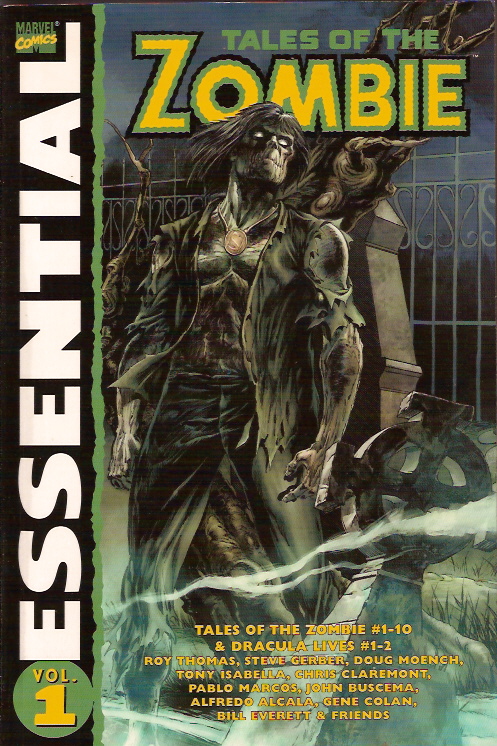
Essential Tales of the Zombie volume 1


By Roy Thomas, Steve Gerber, Stan Lee, Kit Pearson, Marv Wolfman, Tony Isabella, Chuck Robinson, Chris Claremont, Don McGregor, Doug Moench, Gerry Conway, Lin Carter, John Albano, Gerry Boudreau, Len Wein, Carla Joseph, Kenneth Dreyfack, Carl Wessler, David Anthony Kraft, Larry Lieber, John Warner,  Tony DiPreta, Bill Everett, John Buscema, Tom Palmer, Pablo Marcos , Dick Ayers, Tom Sutton, Syd Shores, Gene Colan, Dick Giordano, Winslow Mortimer, George Tuska, Ralph Reese, Vincente Alcazar, Bill Walton, Enrique Badia, Rich Buckler, Vic Martin, Ron Wilson, Ernie Chan, Russ Heath, Frank Springer, Alfredo Alcala, Dan Green, Michael Kaluta, Mike Esposito, Frank Giacoia, Virgilio Redondo, Yong Montano, Tony DeZuñiga, Rudy Nebres, Boris Vallejo, Earl Norem & various (Marvel)
ISBN 0-7851-1916-7 (TPB)

Inspiration isn’t everything. In fact, as Marvel slowly grew to a position of market dominance in the wake of the losing their two most innovative and inspirational creators, they did so less by experimentation and more by expanding established concepts and properties. The only exception was an en masse creation of horror titles in response to the industry down-turn in super-hero sales – a move expedited by a rapid revision in the wordings of the increasingly ineffectual Comics Code Authority rules.

The switch to sinister supernatural stars brought numerous benefits. Most importantly, it drew a new readership to comics: one attuned to a global revival in spiritualism, Satanism and all things spooky. Almost as important, it gave the reprint-reliant company opportunity to finally recycle old 1950s horror stories that had been rendered unprintable and useless since the code’s inception in 1954.

Spanning August 1973 to March 1975, this moody monochrome tome collects Tales of the Zombie #1-10, plus pertinent portions of Dracula Lives #1-2 but – despite targeting the more mature monochrome magazine market of the 1970s – these stories are oddly coy for a generation born before  video nasties, teen-slasher movies or torture-porn, so it’s unlikely that you’ll need a sofa to hide behind…

The chillers commences with ‘Zombie!’ illustrated by unsung legend Tony DiPreta: one of those aforementioned, unleashed 1950s reprints which found its way as cheap filler into the back of Dracula Lives #1 (August 1973). In this intriguing pot-boiler criminal Blackie Nolan runs for his life when the man he framed for his crimes animates a corpse to exact revenge…

A few months earlier, Marvel Editor-in-Chief Roy Thomas had green-lit a new mature-reader anthology magazine starring a walking deadman, based on a classic 1953 Stan Lee/Bill Everett thriller published in Menace #5.

Cover-dated July 1973, Tales of the Zombie #1 contained a mix of all-new material, choice reprints and text features to thrill and chill the voodoo devotees of comics land. The undead excitement began with ‘Altar of the Damned’ by Thomas, Steve Gerber, John Buscema & Tom Palmer, introducing wealthy Louisiana coffee-magnate Simon Garth as he frantically breaks free of a voodoo cult determined to sacrifice him.

He is aided by priestess Layla who usually earns her daily bread as his secretary. Sadly, the attempt fails and Garth dies, only to be brought back as a mighty, mindless slave of his worst enemy Gyps – a petty, lecherous gardener fired for leering at the boss’ daughter…

Next comes a retouched, modified reprint of the aforementioned Everett ‘Zombie!’ yarn, adapted to depict Garth as the corpse-walker rampaging through Mardi Gras and inflicting a far more permanent punishment on the ghastly gardener, after which Dick Ayers limned ‘Iron Head’ as a deep sea diver take a decidedly different look at the native art of resurrection…

‘The Sensuous Zombie!’ is a cinematic history of the sub-genre and ‘Back to Back and Belly to Belly at the Zombie Jamboree Ball!’ delivers an editorial tribute to Bill Everett.

after which Kit Pearson, Marv Wolfman & Pablo Marcos expose the secret of ‘The Thing From the Bog!’ before Tom Sutton applies a disinterred tongue to his cheek for the blackly comic story of ‘The Mastermind!’.

Gerber, Buscema & Syd Shores the saga of Simon Garth in ‘Night of the Walking Dead!’, as the murdered man’s daughter loses the arcane amulet which controls the zombie to a psychotic sneak thief…

Dracula Lives #2 introduces ‘The Voodoo Queen of New Orleans!’ (Thomas, Gene Colan & Dick Giordano relates the Lord of Vampires’ clash with undying mistress of magic Marie Laveau (tenuously included here as the charismatic bloodsucker strides past the recently deceased Garth on a crowded Mardi Gras street) before Tales of the Zombie #2 unfolds in its gory entirety.

Gerber & Marcos led off with ‘Voodoo Island!’ as daughter Donna Garth takes ship for Port-Au-Prince, determined to learn all she can about the dark arts, whilst the shambling cadaver of her father is drawn into the nefarious affairs of criminal mastermind Mr. Six. By circuitous means, mindless but instinct-driven Garth also ends up in Haiti – just as a madman turning women into giant spiders decides Donna is an ideal test subject…

Luckily, the former coffee-king’s best friend Anton Cartier is a resident – and expert in Voodoo lore…

‘Voodoo Unto Others’ by Tony Isabella & Winslow Mortimer tells a grim but affecting tale of the law of the Loa, whilst ‘Acid Test’ by Stan Lee & George Tuska is another 1950’s thriller culled from Marvel’s vaults, followed by a text feature by Isabella trumpeting the company’s “next big thing” with ‘Introducing Brother Voodoo’

It was back to contemporary times with stunning graveyard re-animator yarn ‘Twin Burial’ by Chuck Robinson & Ralph Reese, balanced by Colan classic ‘From Out of the Grave’ after which Chris Claremont asks in expansive prose piece, ‘Voodoo: What’s It All About, Alfred?’

Gerber & Marcos conclude their Garth saga in ‘Night of the Spider!’ before TotZ #3 sees the Zombie still lurching around Haiti in ‘When the Gods Crave Flesh!’, encountering a manic film director and his histrionic starlet wife who want to expose Voodoo to the judgemental celluloid eye of Hollywood.

Bad, bad, bad idea…

Claremont scripted a prose shocker next, contributing part 1 of ‘With the Dawn Comes Death!’ – illustrated with stock movie stills – before ‘Net Result’ offers another Atlas-era DiPreta delight, after which Isabella & Vincente Alcazar excel with an epic of samurai-against-dragon in ‘Warrior’s Burden’.

Don McGregor’s ‘The Night of the Living Dead Goes on and on and on’ provides in-depth analysis of the movie that restarted it all, and Bill Walton limns Fifties fear-fest ‘I Won’t Stay Dead’ before Doug Moench & Enrique Badia deliver a period piece of perfidious plantation peril in ‘Jilimbi[s Word’.

Tales of the Zombie Feature Page’ closes the issue with a Gerber interview and critique of George A. Romero’s film Codename: Trixie – which we know today as The Crazies – before Tales of the Zombie #4 (March 1974) opens with ‘The Law and Phillip Bliss’ as the mystic Amulet of Damballah irresistibly draws Garth back to New Orleans at the unwitting behest of a down-and-out with a grudge…

Another movie feature by McGregor follows, examining the spooky overtones of then-current Bond flick Live and Let Die, after which Gerry Conway, Rich Buckler, Vic Martin & Mortimer crafted a comic strip film-thriller in ‘The Drums of Doom!’

Fantasy author Lin Carter explores modern supernatural proliferation in ‘Neo-Witchcraft’ before ‘Courtship by Voodoo’ (Isabella & Ron Wilson) recounts Egyptian romantic antics, and Moench & Mortimer disclose the downside of desecrating graves in ‘Nightfilth Rising’.

John Albano & Ernie Chua (nee Chan) tell a tragic tale of ‘Four Daughters of Satan’ before ‘The Law and Phillip Bliss’ concludes in cathartic slaughter of high-priced lawyers, whilst ‘The Zombie Feature Page’ highlights the work and life of artist Pablo Marcos.

‘Palace of Black Magic!’ then sees Phil Glass lose the amulet – and control of Garth – to Mr. Six with the Zombie becoming a terrifying weapon of sinister Voodoun lord Papa Shorty, until his new master’s own arrogance lead to carnage and a kind of freedom for the Dead Man Walking. Issue #5 continues with Moench’s filmic tribute article ‘White Zombie: Faithful Unto Death’ and a Russ Heath Atlas classic ‘Who Walks with a Zombie?’

The concluding instalment of Claremont’s article ‘With the Dawn Comes Death!’ precedes text infomercial ‘Brother Voodoo Lives Again’ and new western horror saga ‘Voodoo War’ by Isabella, Shores & Ayers, and TotZ# 5 ends on a gritty high with ‘Death’s Bleak Birth!’: a powerful supernatural crime thriller by Moench & Frank Springer.

Tales of the Zombie #6 (July) opens with a handy update of events thus far before launching into Gerber & Marcos’ ‘Child of Darkness!’ wherein the anguished ambulatory remains of Simon Garth interrupt a Voodoo ritual and encounter once more the Mambo Layla, who tries in vain to save him before his death and revivification. Even together, they are unprepared for the vicious thing lurking in the swamp’s deepest recesses…

Gerry Boudreau explores the genre’s history by critiquing Hammer Films’ ‘The Plague of the Zombies’, followed by a hilarious photo-feature on Zombie/blacksploitation movie ‘Sugar Hill’ and Claremont’s article on all things undead ‘The Compleat Voodoo Man’.

Brother Voodoo initially ran in Strange Tales #169-173 (September 1973-April 1974) but ended on a cliffhanger. It finishes here in Moench, Len Wein, Colan & Frank Chiaramonte’s ‘End of a Legend!’ as the Man with Two Souls finally defeats Voodoo villain Black Talon.

Carla Joseph’s ‘The Voodoo Beat’ rounds up a selection of movies and books then available regarding all things Cadaverous and Fetishy before Moench & Alfredo Alcala provide a fill-in tale in ‘The Blood-Testament of Brian Collier’ wherein Garth shambles into a High Society murder-mystery, followed by a Village Voice article by Kenneth Dreyfack on ‘Voodoo in the Park’, notable for comics fans because it’s illustrated by future great Dan Green.

Moench & Mortimer’s comics featurette ‘Haiti’s Walking Dead’ and Claremont’s book review ‘Inside Voodoo’ take us the issue end and ‘A Second Chance to Die’ – a classy short thriller by Carl Wessler & Alcala.

Tales of the Zombie #8 (November) opens with a similar frontispiece feature by Isabella & Michael Kaluta ‘The Voodoo Killers’ before Gerber & Marcos return with ‘A Death Made of Ticky-Tacky’ as Garth and Layla finally reach New Orleans and fall foul of bored urban swingers seeking a different kind of good time. ‘Jimmy Doesn’t Live Here Anymore’ offers a chilling prose vignette from David Anthony Kraft, liberally illustrated by Kaluta.

‘Night of the Hunter’ by scripter Larry Lieber and artists Ron Wilson, Mike Esposito & Frank Giacoia sees a corrupt prison guard realise he’s tortured and killed the wrong black man, when the victim’s brother turns up straight from the sinister heart of Haiti…

‘Tales of the Happy Humfo’ is another Claremont voodoo article, spiced up with Kaluta drawings after which Alcala again closes show down with ‘Makao’s Vengeance’: a slick jungle chiller scripted by Kraft.

The first issue of 1975 opens with Isabella & Mortimer’s ‘Was He a Voodoo-Man?’, after which the author scripted stunning Zombie headliner ‘Simon Garth Lives Again!’, illustrated by Virgilio Redondo & Alcala, and Claremont & Yong Montano contribute second chapter ‘A Day in the Life of a Dead Man’ (Alcala inks) before Isabella & Marcos conclude the Garth extravaganza with ‘The Second Death Around’.

As an added bonus Moench & Alcala also designed a swampy slaughter-party in ‘Herbie the Liar Said it Wouldn’t Hurt!’

Tales of the Zombie #10 (March 1975) leads with a Brother Voodoo tale by Moench & Tony DeZuñiga, wherein the Lord of the Loa struggles to prevent ‘The Resurrection of Papa Jambo’ because the scheduled Simon Garth saga had been lost in the post at time of printing). Bringing up the rear were medical nightmare ‘Eye For an Eye, Tooth For a Tooth’ by Conway, Virgilio Redondo & Rudy Nebres and Wessler, John Warner & Alcazar’s death-row chiller ‘Malaka’s Curse!’ with Sutton’s macabre ‘Grave Business’ the last seen treat…

By this time the horror boom was beginning to bust, and the advertised 11th issue never materialised. An all-reprint Tales of the Zombie Super-Annual was released that summer, with only its cover reproduced here.

Peppered with vivid Zombie pin-ups by Marcos & Sutton, and covers by Boris Vallejo and Earl Norem, this intriguing monochrome compendium – although a bit dated – contains what passed for Explicit Content in the mid-1970s, so although the frights should be nothing for today’s older kids, the occasional nipple or buttock might well send them screaming over the edge.

However, with appropriate mature supervision I’m sure this groovy gore-fest will delight many a brain-eating fright fan, until Marvel get around to properly reviving this tragic revenant’s roots and earliest recorded revels.
© 1973, 1974, 1975, 2006 Marvel Characters, Inc. All rights reserved.

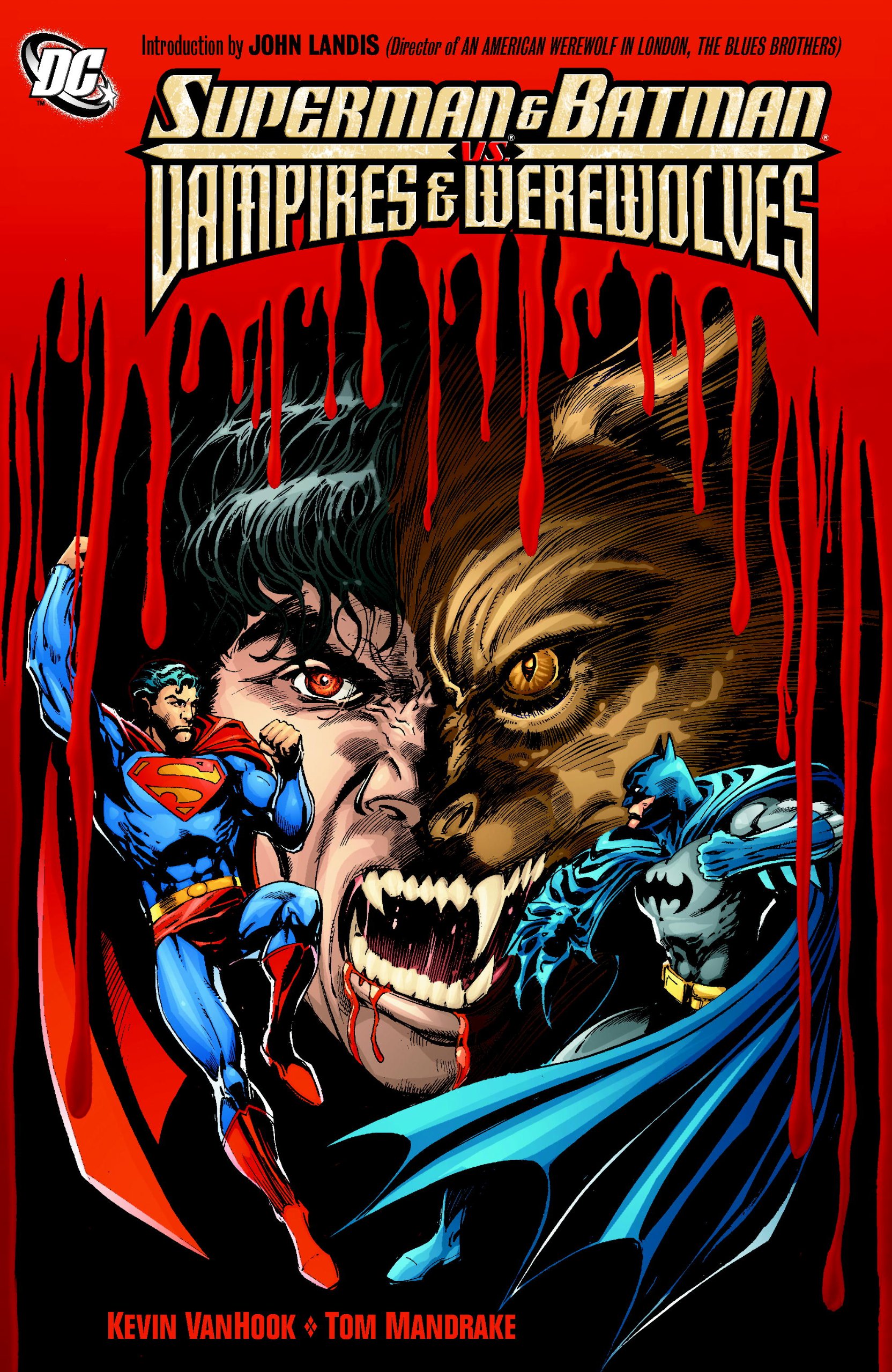
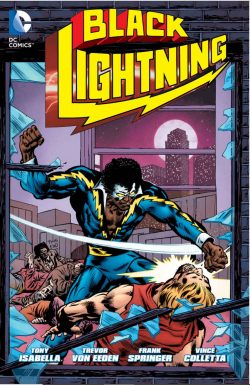
Black Lightning volume 1


By Tony Isabella, Denny O’Neil, Trevor Von Eeden, Mike Netzer, Frank Springer, Vince Colletta & various (DC Comics)
ISBN: 978-1-4012-6071-2 (TPB/Digital edition)

Black Lightning was far from the first superhero of colour, but his mutability, iconic image and sheer tenacity have made him one of the most enduring and widely travelled. He’s been everything from outraged lone street vigilante to teacher; Presidential Secretary to perfect team player (on a succession of super-groups); sporting legend, family man and world-saving wise mentor. He’s even made the turbulent transition to star of his own television series…

Very little of that was apparent when these groundbreaking adventures were first released. Back then, the simple fact that an African-American masked hero was considered sales-worthy was the biggest leap imaginable…

Excluding a few returning characters in jungle-themed comic of the 1940s and 1950s, War comics first opened the door to black characters in the early 1960s, when Robert Kanigher & Joe Kubert created negro boxer Jackie Johnson as a stalwart of Sgt. Rock’s Easy Company in Our Army at War #113 (cover-dated December 1961).

Marvel followed suit with a black soldier in Sgt. Fury’s Howling Commandos (Gabe Jones, debuting in #1, May 1963), and pulled far ahead in the diversity stakes after introducing America’s first negro superheroes. The Black Panther premiered in Fantastic Four #52, (July 1966) and The Falcon first flew in Captain America #117 (September 1969). Luke Cage became the Hero for Hire in the spring of 1972, carrying a June cover-date…

The honour of being the nation’s first black hero to carry in his own title had already come and gone via a little-remembered (or regarded) title from Dell Comics. Created by artist Tony Tallarico & scripter D.J. Arneson, gunslinger Lobo was a vigilante of the wild west who sought out injustice just like any cowboy hero would. He first appeared in December 1965, with his second and final issue cover-dated October 1966…

Gradually, more ethnic lead characters appeared, with DC finally getting a black-skinned hero in John Stewart (Green Lantern #87, December 1971/January 1972), although his designation as a “replacement” GL might be construed as more conciliatory and insulting than revolutionary. By then, Jack Kirby had introduced teen New God Vykin the Black in Forever People #1 (March 1971) and later created enterprising “ghetto kid” Shilo Norman as a hero’s apprentice and eventual successor in Mister Miracle ##15 (August, 1973). DC’s first superhero to have his own solo title didn’t debut until 1977…

This astoundingly accessible, no-nonsense collection – comprising Black Lightning #1-11, material from Cancelled Comics Cavalcade #1 and World’s Finest Comics #260, spans April 1977 to January 1980) and bolts into action following a forthright and informative Introduction by originator Tony Isabella.

It begins as ‘Black Lightning’ (illustrated by neophyte penciller Trevor Von Eeden & veteran inker Frank Springer) sees former Olympic decathlete Jefferson Pierce return to the streets of Suicide Slum, Metropolis to teach at beleaguered inner city Garfield High School. Pierce is determined to make a difference to the troubled kids he used to be numbered amongst, but when the educator interrupts a drug buy on school grounds and sends the dealer packing, the door is opened to vengeance and tragedy…

When the mob – a crime syndicate dubbed The 100 – seek retaliation, one of Pierce’s students pays the ultimate price and the teacher realises he needs the shield of anonymity if he is to win justice and safety for his beleaguered home and charges…

Happily, tailor Peter Gambi – who sheltered Jefferson and his grieving mother after the elder Pierce was murdered – has some useful ideas and inexplicable access to pretty far-out technology…

Equipped with a strength-&-speed enhancing forcefield belt, gaudy costume, a and mask/wig unit completely changing his appearance, a fierce vigilante stalks the streets of Metropolis…

The local chapter of The 100 is run by monstrous, cunning freak Tobias Whale and once the assaults on his soldiers starts biting into profits and offer the downtrodden populace a glimmer of hope, he starts ruthless retaliation.

The sinister strategist lays many traps, culminating in hiring a lethal super-assassin who previously faced Green Arrow and the Justice League of America.

When the killer pounces, Pierce is forced into uneasy alliance with mystery woman Talia Al Ghul, but it ends as soon as bodies start piling up all over the school gym in ‘Merlyn Means Murder’

Vince Colletta assumes the inker’s role as Black Lightning’s continued war against The 100 forces “the Whale” to fight smart, and Metro Police – led by doughty Inspector William Henderson – pursue the vigilante as vigorously as any gangster or felon. Taking seedy stoolie Two Bits Tanner into his confidence, Pierce savagely works his way up the criminal chain of command.

He eventually confronts Tobias in his inner sanctum only to find ‘Every Hand Against Him.’ As the police pounce, paranoia grips Pierce and he begins mistrusting his small team. Has someone he trusts betrayed him?

A more palatable answer seems apparent in #4 as suspicion falls on Tanner’s source – Daily Planet journalist Jimmy Olsen. When the outraged street fighter tries to force a confession from the baffled cub reporter, they are attacked by the 100’s latest super heavy in ‘Beware the Cyclotronic Man’

Jimmy is wounded when they unite to fight off the atomic villain, and Black Lightning is suddenly confronted by the kid’s enraged and late-arriving best pal, who immediately jumps to the wrong conclusion and quickly shows why ‘Nobody Beats a Superman!’

In fact, had Cyclotron not switched attention to the true target Tobias wanted him to kill, everyone might have died, but the heroes’ misunderstandings are all forgotten when Black Lightning saves the Man of Tomorrow from nuclear meltdown, beats the bad guys and uncovers a mole in the police force…

Patience exhausted and under pressure from his own bosses, the Whale declares open season, placing an astounding bounty on Black Lightning. When deeply conflicted manhunter Syonide (and his hilarious, Marvel-baiting in-joke kung fu assistants) stalk the Saviour of Suicide Slum, their first move is to shadow and learn everything about their quarry.

When Gambi is abducted, Jefferson’s secret is finally exposed in ‘One Man’s Poison’, Syonide afflicted with a bizarre sense of honour – hands over a helpless Black Lightning to the Whale in #7. However he cannot escape The Conscience of the Killer’ and is compelled to shelter the captive tailor from the 100’s vengeance before voluntarily paying the ultimate price when ordered to kill the apparently-helpless masked hero…

Tragically, even as Black Lightning undergoes a miraculous transformation and takes out the gathered crooks and villains, he loses another innocent to the violent life he has embraced…

With the power of the 100 seemingly broken and Tobias Whale in custody, Pierce’s war should be over, but the gigantic gangster quickly breaks free and takes hostages from Police HQ.

Determined to end the vendetta, Black Lightning tracks him down for one last duel and in the ‘Deadly Aftermath’ finds the renewed purpose to carry on his alternate lifestyle…

Now considering himself more hero than avenger, Pierce experiences ‘Fear and Loathing at Garfield High’ when his school is invaded by a maniac terrorist operating an army of robotic killers, after which a circus trip exposes ‘The Other Black Lightning’. Sadly, although this well-meaning admirer is a mostly-harmless copycat, jewel thieves and former Flash foe The Trickster provide plenty of genuine danger and menace before the big top sawdust settles…

Comics were experiencing another general sales downturn at this time, and just as Denny O’Neil took over scripting Black Lightning, it was cancelled with #11 (October 1978).

‘All They Will Call You Will Be… Deportee!’ offered hints of a new direction with the urban avenger exposing a people-trafficking ring luring South American refugees into slave jobs at a fast food chain, but for most readers that was the last sight of the hero for some time.

So abrupt was the cancellation, that for legal reasons and to secure copyrights, DC had to put out black-&-white ashcan anthology Cancelled Comics Cavalcade, printing completed but unpublished stories of Claw the Unconquered, The Deserter, The Green Team, Madame Xanadu, Firestorm and others. Also included was Black Lightning #12…

The wider world got to see that last adventure – ‘Lure of the Magnetic Menace’ by O’Neil, Mike Nasser (nee Netzer) & Colletta – a year later when the January 1980 cover-dated World’s Finest Comics #260 ran the story as a prelude to a new series of BL adventures.

This edgy yarn details how the shocking hero is attacked by costumed crazy Doctor Polaris after Jefferson Pierce investigates a possible case of child neglect and abuse involving one of his more troubled students…

Wrapping up this initial outing is a copious selection of working drawings from the ‘Black Lightning Sketchbook’ by Von Eeden, and Mike Netzer’s unfinished cover for never-seen issue #13.

Although closely interlinked to then-current DC continuity, these fast-paced Fights ‘n’ Tights thrillers are so skilfully constructed that even the freshest neophyte can settle in for the ride without any confusion and enjoy a self-contained rollicking rollercoaster of terrifically traditional superhero shenanigans.

So, go do that then…
© 1977, 1978, 1979, 2016 DC Comics. All Rights Reserved.

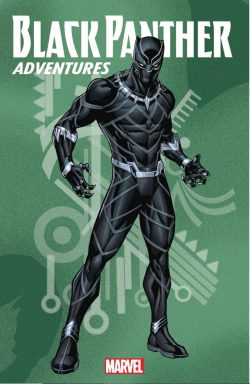
Black Panther Adventures


By Jeff Parker, Marc Sumerak, Christopher Yost, Elliot Kalan, Roy Thomas, Manuel Garcia, Ig Guara, Scott Wegener, Christopher Jones, Chris Giarusso, John Buscema & various (Marvel)
ISBN: 978-1-3029-1034-1 (Digest PB/Digital edition)

From its earliest days, Marvel always courted and accommodated young comic book consumers, often through separates titles and imprints. In 2003, the company instituted the Marvel Age line to reframe classic original tales by Stan Lee, Jack Kirby, Steve Ditko and others for a fresh-faced 21st century readership.

The experiment was tweaked in 2005, becoming Marvel Adventures. The tone of all the tales was very much that of the company’s burgeoning TV animation franchises, in execution if not name. Titles bearing the Marvel Adventures brand included Spider-Man, Fantastic Four and The Avengers and ran until 2010 when they were all cancelled and replaced by new volumes of Marvel Adventures: Super Heroes and Marvel Adventures: Spider-Man.

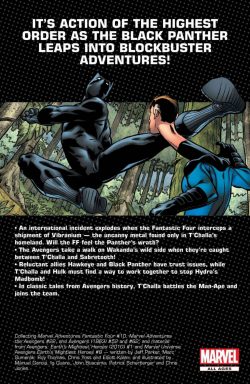
Most of those comic book yarns have since been collected in digest-sized compilations such as this one, gathering a quartet of all-ages Black Panther tales but also including a brace of early1960s episodes from his first stint in mainstream MU series The Avengers.

Acclaimed as the first black superhero in American comics and one of the first to carry his own series, the Black Panther’s popularity and fortunes have waxed and waned since he first debuted as a character in Fantastic Four #52.

In that 1966 landmark the cat king attacked Marvel’s First Family as part of his extended scheme to gain vengeance on the murderer of his father, before eventually teaming up with them to defeat malign master of sound Klaw.

This eclectic compilation – comprising Marvel Adventures Fantastic Four #10, Marvel Adventures The Avengers #22, Avengers: Earth’s Mightiest Heroes #1, Marvel Universe Avengers Earth’s Mightiest Heroes #8, plus Silver Age epics from Avengers #52 and 62 – begins by broadly reimagining that initial FF encounter in ‘Law of the Jungleby Jeff Parker, Manuel Garcia & Scott Koblish (from Marvel Adventures Fantastic Four #10; May 2006) wherein the quixotic quartet are suckered into buying smuggled Vibranium.

The miracle mineral is Wakanda’s only export and the illegal sale quickly brings the duped heroes into savage conflict with a mysterious cat-garbed super-warrior. Tracking the Black Panther back to his super-scientific jungle kingdom, the team  eventually convince the king of their innocence and good intentions before teaming up to tackle the true villains…

Two years later Marvel Adventures The Avengers #22 (May 2008 and by Marc Sumerak, Ig Guara & Jay Leisten) revealed the ‘Wakanda Wild Side as sightings of murderous mutant Sabretooth in Africa draws Wolverine, Storm, Captain America, Spider-Man, Giant-Girl and the Hulk into an uncharted kingdom. They needn’t have bothered: Wakanda’s Panther chieftain is more than equal to the task of taking down the savage invader…

Following a page of comedic Marvel Mini Classics by Chris Giarusso, a short vignette from Avengers: Earth’s Mightiest Heroes #1 (November 2010) as Christopher Yost & Scott Wegener reveal how rival heroes T’Challa and Hawkeye work out their ‘Trustissues whilst battling crazed villain Whiplash.

Never the success the company hoped, the Marvel Adventures project was superseded in 2012 by specific comics tied to those Disney XD television shows designated as “Marvel Universe cartoons”, but these collected stories are still an amazingly entertaining and superbly accessible means of introducing characters and concepts to kids born sometimes three generations or more away from the originating events. They’re also pretty good fun for us old lags too…

Another short tale – this time from Marvel Universe Avengers Earth’s Mightiest Heroes #8 (November 2012) – unites the Panther with the Hulk. Crafted by Elliott Kalan, Christopher Jones & Pond Scum, ‘Mayhem of the Madbomb!finds Green Goliath and Cat King furiously fighting Hydra to prevent he detonation of an insanity-inducing WMD stashed in the Empire State Building…

Wrapping up the action are a brace of classic exploits from Roy Thomas & John Buscema.

On Captain America’s recommendation the Black Panther joined the Avengers in #52’s ‘Death Calls for the Arch-Heroes!’ (May 1968, inked by Vince Colletta): a fast-paced murder mystery which also saw the advent of obsessive super-psycho The Grim Reaper who tried to frame the freshly-arrived-in-America T’Challa for the murder of Goliath, The Wasp and Hawkeye.

Then ‘The Monarch and the Man-Ape!(Avengers #62, March 1969, and inked by George Klein) offered Marvel fans the first real view of hidden Wakanda – and a brutal exploration of T’Challa’s history and rivals – as his trusted regent seeks to usurp the kingdom and overturn the state religion after declaring himself to be ‘M’Baku the Man-Ape!’

Augmented by a cover gallery from Carlo Pagulayan & Chris Sotomayor, Leonard Kirk & Val Staples, Scott Wegener & Jean- François Beaulieu, Khoi Pham & Edgar Delgado and John Buscema, these ferociously enthralling riotous mini-epics are extremely enjoyable and engaging, but parents should note that some of the themes and certainly the level of violence might not be what everybody considers “All-Ages Super Hero Action”…
© 2017 Marvel Characters, Inc. All rights reserved.
Walt Disney’s Donald Duck and the Ghost of the Grotto


By Carl Barks (Fantagraphics Books)
ISBN: 978-1-60699-779-6 (TPB/Digital edition)

Win’s Christmas Gift Recommendation: The Utter Acme of All-Ages Entertainment… 10/10

Carl Barks was born in Merrill, Oregon in 1901. He grew up in rural areas of the West during some of the leanest times in American history. He tried his hand at many jobs before settling into the profession that chose him. His early life is well-documented elsewhere if you need detail, but briefly, Barks worked as an animator at Disney’s studio before quitting in 1942 to work in the new-fangled field of comic books.

With cartoon studio partner Jack Hannah (another occasional strip illustrator) Barks adapted a Bob Karp script for an animated short into the comic book Donald Duck Finds Pirate Gold. Published as Dell Four Color Comics Series II #9 in October of that year – and although not his first published comics work – it was the story that shaped the rest of Barks’ career.

From then until his first official retirement in the mid-1960s, Barks worked in self-imposed seclusion, writing and drawing and devising a vast array of adventure comedies, gags, yarns and covers that gelled into a Duck Universe of memorable, highly bankable characters. These included Gladstone Gander (1948), Gyro Gearloose (1952), Magica De Spell (1961) and the nefarious Beagle Boys (1951), all supplementing Disney’s stable of cartoon actors. His greatest creation was undoubtedly curmudgeonly, energetic, paternalistic, money-mad giga-gazillionaire Scrooge McDuck: the World’s wealthiest winged nonagenarian…

Although producing all that landmark material Barks was just a working guy, generating cover art, illustrating other people’s scripts when asked and contributing stories to the burgeoning canon of Duck Lore. Only after Gladstone Publishing began re-packaging Barks material – and a selection of other Disney strips – in the 1980s, did he discover the well-earned appreciation he never imagined existed…

So potent were his creations that they inevitably fed back into Disney’s animation output itself, even though his brilliant comic work was done for licensing company Dell/Gold Key, and not directly for the studio. The greatest tribute was undoubtedly the animated series Duck Tales: heavily based on his works.

Barks was a fan of wholesome action, unsolved mysteries, rationality-based fantasy and epics of exploration. This led to him perfecting the art and technique of the blockbuster quest tale: blending wit, history, plucky bravado and wide-eyed wonder into rollicking rollercoaster romps to utterly captivate readers of every type and vintage. Without the Barks expeditions, there would never have been Indiana Jones

Throughout his working life Barks was blissfully unaware that his work (uncredited by official policy like all Disney’s cartoon and comic book output) had been singled out by a rabid and discerning public as being by “the Good Duck Artist”. When some of his most dedicated fans finally tracked him down, his belated celebrity began.

In 2013 Fantagraphics Books began collecting Barks’ Duck Stuff in wonderful, carefully curated archival volumes, tracing his output year-by-year in hardback tomes and digital editions that finally do justice to the quiet creator. These will eventually comprise the Complete Carl Barks Disney Library. The publisher also placed some of the most engaging (How to choose? How to choose?) in three accessible landscape paperback collections. At 185 by 140 mm, they are the perfect size to introduce kids to the master’s masterpieces. They’re all available in digital formats, and this particular tome has a spooky Halloween vibe to further entice you…

The majority of inclusions here come from 1947, so please be aware that – despite Bark’s diligent research and careful, sensitive storytelling – modern readers might be upset by some depictions crafted over seven decades ago…

It begins eponymously on a nautical note: ‘Donald Duck and the Ghost of the Grotto’ is an early masterpiece originating in Four Color #159 (August 1947), with Donald and the rowdy, know-it-all nephews who live with him currently residing in the West Indies, running a kelp boat and harvesting seaweed from the abundant oceans. Here, Huey, Dewey and Louie are the sensible ones in a risky, get-rich-quick venture. Although prime catalysts of comedic chaos in other situations when the mallard miser was around, in Barks’ comics the devilishly downy ducklings’ usual assigned roles were as smartly sensible, precocious and a just a bit snotty kid-counterfoils to their “unca”, whose inescapably irascible nature caused him to act like an overgrown brat most of the time. Nevertheless, all too often the kids fell into temptation, reverted to type and fell prey to a perpetual temptation to raise a ruckus…

When a freak accident temporarily strands them on an isolated reef, Donald and the lads discover a long-lost, shipwrecked galleon, encounter an ongoing abduction mystery dating back centuries, battle genuine monsters, confound a particularly persistent phantom and win and lose again a fabulous treasure in a  thrilling romp and supremely beguiling mystery that has never dated…

Originally from Four Color #147 (May), ‘If the Hat Fits’ is an 7-panel gag split over two of these landscape pages, detailing chapeau japery, and precedes ‘Fashion in Flight’ (FC#178, December), exposing hot-headed Donald’s views on car culture.

Thanks to the nephews and some imprudent bee-keeping, a potty scheme to make more cash becomes another painful and humiliating experience as the bellicose bird tries growing blooms commercially in his garden in ‘Donald’s Posy Patch’ (Walt Disney’s Comics and Stories #80, May 1947), after which ‘Turn for the Worse’ (Four Color #178 again) reveals just how annoying – and violent – people looking for directions can become…

From the same issue, ‘Machine Mixup’ sees kitchen confusion for Donald as he experiences the downside of modern white goods, before ‘Donald Mines his Own Business’ (WDC&S #81 June) finds the loco parent-ish duck and his boys prospecting in New Mexico. It’s barely moments before they all fall foul of America’s post-war arms rush and missile-race, with devastating and spectacular consequences…

From FC #189 (June 1948) ‘Bird Watching’ exposes the hidden perils of the gentle hobby before  superstition is painfully debunked in ‘Horseshoe Luck’. The fluffy fun finally finishes with an epic farrago – first seen in WDC&S #86 (January 1947) – as telling tale exposes the rise and fall of ‘Fireman Donald’ whose smug hubris ultimately deprives him of a job he’s actually good at!

Carl Barks’ efforts are readily accessible through a number of publications and outlets and every one of his stories is a treasure beyond price. If you’re new to his work and have never experienced his captivating magic, Walt Disney’s Donald Duck and the Ghost of the Grotto is a perfect introduction. No matter what your age or temperament, you can discover “the Hans Christian Andersen of Comics” simply by applying yourself and your credit cards to any search engine.

Always remember, a fan’s got to do what a fan’s got to do and treasure is out there just waiting to be unearthed…
© 2014 Disney Enterprises, Inc. All rights reserved.
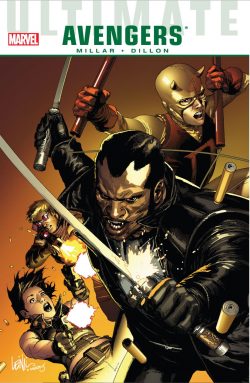
Ultimate Comics Avengers: Blade versus The Avengers


By Mark Millar, Steve Dillon, Andy Lanning, Scott Hanna & various (Marvel)
ISBN: 978-0-7851-4009-2 (TPB/Digital)

Marvel’s Ultimates sub-imprint began in 2000 with key characters and concepts retooled to bring them into line with the tastes and sensibilities of modern readers – a potentially discrete market from the baby-boomers and their descendants. The line proliferated and prospered, but eventually this darkly nihilistic new universe became as continuity-constricted as its predecessor.

In 2008, cleansing event Ultimatum culminated in a reign of terror that killed dozens of superhumans and millions of lesser mortals. Although a strong seller, the saga was largely trashed by the fans who bought it, and the ongoing new Ultimatum Comics line quietly back-pedalled on its declared intentions…

The key and era-ending event was a colossal tsunami that drowned the superhero-heavy island of Manhattan. This post-tsunami collection (re-presenting Ultimate Comics Avengers 3 #1-6) focuses on a more or less dried out world with diminished global populations adapted to the new status quo.

Before the Deluge, Nick Fury (a black iteration so popular that he not only became the film version, but was also retrofitted into the mainstream MCU and replaced the white guy from WWII) ran a super-secret Black Ops team of superhumans designated the Avengers. He was eventually ousted from his position for sundry rule-bending antics – and being caught doing them. Now, as the world dries, he’s firmly re-established, running another black ops team, doing stuff his publicity-courting, officially sanctioned Ultimates team wouldn’t dream of…

Fury’s secret army consists of Hawkeyethe man who never misses; James Rhodes: a fanatical soldier wearing devastating War Machine armour; Gregory Stark, Iron Man’s smarter, utterly amoral older brother; Nerd Hulk – a cloned gamma-monster with all the original’s power but implanted/programmed with Banner’s brain and milksop character; size-shifting insect queen Red Wasp and ruthless super-spy Black Widow.

Also popping in when no one’s looking is resurrected WWII super soldier Captain America – part of the bright and shiny squad, but always happy to slum it when necessary…

Here the dark-side heroes stumble into an ancient and clandestine war that has continued uninterrupted by the end of the world, which sees half-human vampire-hunter Blade on the unaccustomed defensive. The undead bloodsuckers he has historically picked off with ease are now far better organised, more effective and more dangerous. As the story unfolds, it transpires they have found a new king with a grand plan…

This mysterious mastermind is wearing Iron Man’s old armour and now ignores ordinary mortals, preferring to turn super-heroes into a vampiric army. The situation starts bad and gets exponentially worse with metahuman heroes and guest-stars – like Kid Daredevil, Slavic thunder god Perun, numerous Giant-Men, and zen hero-trainer Stick – dropping like flies. With all possible saviours succumbing to the unstoppable plague, it looks hopeless when only Fury, Black Widow and Hawkeye are left untainted, and only the greatest miracle or boldest masterstroke can save humanity. After Cap also succumbs to the curse of the undead, the team’s unwelcome sometime-ally Blade makes a bold but surely suicidal move…

With covers and variants by Leinil Francis Yu, Marte Gracia, Ed McGuinness, Morry Hollowell, Olivier Coipel, Laura Martin, Greg Land, Frank D’Armata, this dark, moody and fast-paced thriller comes from Mark Millar (Judge Dredd, Civil War, Superman, Kick-Ass, The Kingsman, American Jesus, Jupiter’s Legacy) and Steve Dillon (Laser Eraser & Pressbutton, Abslom Daak, Judge Dredd, Animal Man, Preacher, Hellblazer, The Punisher): a wry, violent and powerfully scary romp that is engrossing and eminently readable.

This spooky, cynical, sinister shocker is another breathtakingly effective yarn that could only be told outside the Marvel Universe proper, but one that will resonate with older fans who love the darkest side of superheroes (and remember fondly the days when heroes could be horrors) as well as casual readers who know the company’s movies better than the comics.
© 2020 MARVEL. A British edition published by Panini is also available.

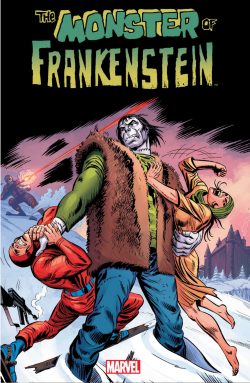
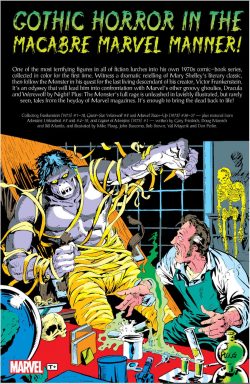
The Monster of Frankenstein


By Gary Friedrich, Doug Moench, Bill Mantlo, Gerry Conway, Mike Ploog, John Buscema, Bob Brown, Val Mayerik, Don Perlin, Sal Buscema & various (Marvel)
ISBN: 978-0-7851-9906-9 (TPB/Digital edition)

Whereas DC Comics capitalised on the early 1970s global boom in all things supernatural and mystic by creating a plethora of short-story anthologies and the occasional spooky star, Marvel Comics took the trend in another direction and created a small army of horror-heroes to headline their own series.

This particular collection reprints the House of Ideas’ interpretation of the Mary Shelley classic from a time when the censorious Comics Code Authority first loosened some of its strictures banning horror material from the pages of comics. That translates here to 18 issues of the colour comicbook; Giant-Sized Werewolf #2, Marvel Team-Up #36-37 and all the pertinent strips from adult-oriented Marvel magazines Monsters Unleashed #2, 4-7, 9-10 and one-shot Legion of Monsters (spanning January 1973-September 1975), all awaiting your rapt attentions.

Some comic artists work best in black-&-white. Such is certainly the case with Mike Ploog. A young find who had previously worked with Will Eisner, Ploog illustrated Gary Friedrich’s pithy adaptation of the original novel before moving on to groundbreaking new ventures as the strip graduated to in-house originated material. This monumental tome is presented mostly in colour, but if you are of a similar opinion you could try to lay your hands on the 2004 monochrome Essential Monster of Frankenstein edition…

Cover-dated January 1973, ‘Mary Shelley’s Frankenstein!’ introduced Robert Walton IV, great grandson of the sea-captain who had rescued scientist Victor Frankenstein from the polar ice and who was subsequently regaled with the incredible tale of “the Modern Prometheus”.

Now, in 1898 and leading a band of rogues, cutthroats and sullen Inuit, Walton finds the fabled monster interred in a frozen slab and brings it aboard his ice-breaker. He then recounts the story to his fascinated cabin-boy, unaware of the fear and discontent simmering below decks…

A bloody mutiny during a terrible gale opens the second issue as the burning ship founders. Meanwhile the flashbacked saga of tragic Victor reaches the terrible moment when the monster demanded a mate. The guilt-plagued scientist complied only to baulk at the last and destroy his second creation. ‘Bride of the Monster!’ concludes with the creature’s fearsome vengeance on his creator, paralleling the grim fate of the storm-tossed ship…

In The Monster of Frankenstein #3, ‘The Monster’s Revenge!’ has the reawakened creature freed from its ice-block to overhear the continuation of his life-story from Walton’s lips, even as the last survivors struggle to find safety in the Arctic wastes.

Thereafter ‘Death of the Monster!’ – with inker John Verpoorten taking some of the deadline pressure off hard-pressed Ploog – turns the tables as the monster reveals what happened after the polar showdown with his creator, leading to a new beginning as Walton reveals that not all the Frankensteins were eradicated by the Monster’s campaign of vengeance. Their warped blood-line lives on…

A new direction began with issue #5 in ‘The Monster Walks Among Us!’. Making his way south, the tragic creature arrives in a Scandinavian village in time to save a young woman from being burned at the stake on a blazing longboat, only to rediscover that when villagers pick up pitchforks and torches to go a-screamin’ and a-hollerin’ for blood, they generally have a good reason…

With issue #6 the comic book renamed itself The Frankenstein Monster as the undying creature reaches the village of Ingolstadt a century after he first wreaked bloody vengeance on his creator’s loved ones.

‘…In Search of the Last Frankenstein!’ is a mini-classic of vintage horrors scripted as usual by Friedrich but plotted, pencilled & inked by Ploog, who was reaching an early peak in his artistic career. It was also his last issue.

Ploog was followed by John Buscema & Bob Brown before Val Mayerik settled as regular artist whilst Friedrich gave way to Doug Moench, a writer once synonymous with Marvel’s horror line.

Issues #7, 8 and 9 bowed to the inevitable, pitting the Monster against Marvel’s top horror star (albeit 75-ish years prior to his contemporary adventures). Beginning with ‘The Fury of a Fiend!’ continuing in ‘My Name is… Dracula!’ and concluding with ‘The Vampire Killers!’, this is an extremely classy tribute to the old Universal movies and then-current Hammer Films in equal measure, wherein the misunderstood misanthrope battled an undying evil for ungrateful humanity, consequently losing the power of speech; and becoming more monstrous in the process.

Produced by Friedrich, Buscema and Verpoorten, this trilogy lacks the atmosphere of Ploog’s tenure, but the action is very much in the company’s house-style. With #10 (inked by Frank Giacoia and Mike Esposito) the creature finally found ‘The Last Frankenstein!’ …much to his regret.

With number #11’s ‘…And in the End…!?’ – illustrated by Brown & Vince Colletta – and #12’s ‘A Cold and Lasting Tomb’ (Moench, Mayerik and Colletta), the Monster wrapped up his historical adventures by falling into a glacial sea. Frozen once again into another block of ice he was revived, Captain America-style, in modern times: i.e. the swinging 1970s…

The epic account then switches to monochrome as more mature episodes from Monsters Unleashed begin, starting with #2 and ‘Frankenstein 1973’ by Friedrich, Buscema & Syd Shores. Here we see how an obsessive young man finds the Monster preserved as a carnival exhibit, only to see his jealous girlfriend revive it whilst trying to burn down the sideshow. The story continued in #4 as ‘Frankenstein 1973: Chapter TwoThe Classic Monster’ (Friedrich, Buscema & Win Mortimer), with a literal mad scientist actually putting his own brain in the monster’s skull. Happily, the unnatural order is restored in ‘Once a Monster…’

Monsters Unleashed #6 introduced new creative team Doug Moench & Val Mayerik who completed the introduction to modern times with a good old-fashioned monster hunt in ‘…Always a Monster!’

This leads directly to #7’s ‘A Tale of Two Monsters!’: a dark, socially relevant tale of the modern underclass and man-made horrors carried over into ‘Frankenstein 1974: Fever in the Freak House’ before concluding in #9’s ‘The Conscience of the Creature’.

The horror boom was fading by this time and Monsters Unleashed #10 was the Monster’s last outing there: a superbly dark and sardonic Christmas offering complete with elves, snow, terrorists and a Presidential assassination attempt.

One final monochrome tale from Moench, Mayerik, Dan Adkins & Pablo Marcos (accompanied by a chilling frontispiece by Marcos) appeared in 1975 one-shot The Legion of Monsters. ‘The Monster and the Masque’ was a bittersweet morality play seeing the creature accidentally accepted at a fancy dress party, which is ruined when a different sort of monster gets carried away…

Switching back to full-colour comics, next up is a rather tame team-up/clash from Giant-Size Werewolf #2 wherein ‘The Frankenstein Monster Meets Werewolf by Night’ (Moench, Don Perlin & Colletta) to collaterally combine and quash a band of run-of-the-mill West Coast Satanists.

Resuming his own series, The Frankenstein Monster #13 displays ‘All Pieces of Fear!’ (Moench, Mayerik & Jack Abel) as, shoe-horned into mid-1970s America, the Monster is drawn into a tale heavy with irony as men act like beasts and an obsessive father ignores his family whilst building his own abominations through the nascent science of cloning.

With a hip young teenager as sidekick/spokesperson, ‘Fury of the Night-Creature’ (Dan Green inks) extends the saga by introducing I.C.O.N. (International Crime Organizations Nexus): yet another secret organisation intent on conquest by merging corporate business practices with traditional gangsterism.

Issue #15’s ‘Tactics of Death’ (Klaus Janson inks) briefly concludes the acronym-agenda as the Monster and companion Ralph mop up the men in suits only to be shanghaied to Switzerland to meet the latest Last-of-the-Frankensteins in ‘Code-name: Berserker!’ (inked by Bob McLeod – who managed to handle the next issue too).

Veronica Frankenstein was still absorbed in the family business, but claimed to be fixing her ancestors’ mistakes when I.C.O.N. creeps showed up, demanding her biological techniques in ‘A Phoenix Beserk!’. Beautifully inked by Mayerik and Adkins, the last colour issue ended on a never-to-be completed cliffhanger (although scripter Bill Mantlo covered elements of the story in Iron Man some years later) as the Monster and his new friend met ‘The Lady of the House’ – the utterly bonkers creature-crafter dubbed Victoria Von Frankenstein

Perhaps the abrupt cancellation was a mercy-killing after all…

Rounding off the narrative wonderment is a 2-part tale from Gerry Conway, Sal Buscema & Colletta first seen in Marvel Team-Up #36-37 wherein Spider-Man is kidnapped and shipped off to Switzerland by the assuredly insane Baron Ludwig Von Shtupf, who proudly proclaims himself The Monster Maker

In ‘Once Upon a Time, in a Castle…’ the bonkers biologist wants to pick-&-mix creature traits – having already secured the Frankenstein Monster to practise on… After the webslinger busts them both out, they stumble upon sexy SHIELD Agent Klemmer, but a rapid counterattack goes badly wrong when Von Shtupf unleashes his other captive – the furiously feral Man-Wolf – and only big Frankie can prevent a wave of ‘Snow Death!’

This codex of comic creepiness concludes with a mammoth bonus section offering art lovers and funnybook historians additional treats such as Ploog’s very first design sketch of the monster from 1972, original art, illustrations and (finished but pre-editorial addition) painted covers by Boris Vallejo.

Also on show are assorted frontispieces, pencils, inks and previous collected editions, covers and original art by Tom Sutton, Gray Morrow, Vince Evans, Mayerik, Bernie Wrightson & Arthur Adams, making this compendium a perfect treat for fantasy fans and dedicated horrorists: one that should be a first choice for introducing scare-loving civilians to the world of comics.
© 1973, 1974, 1975, 2015 Marvel Characters, Inc. All Rights Reserved.

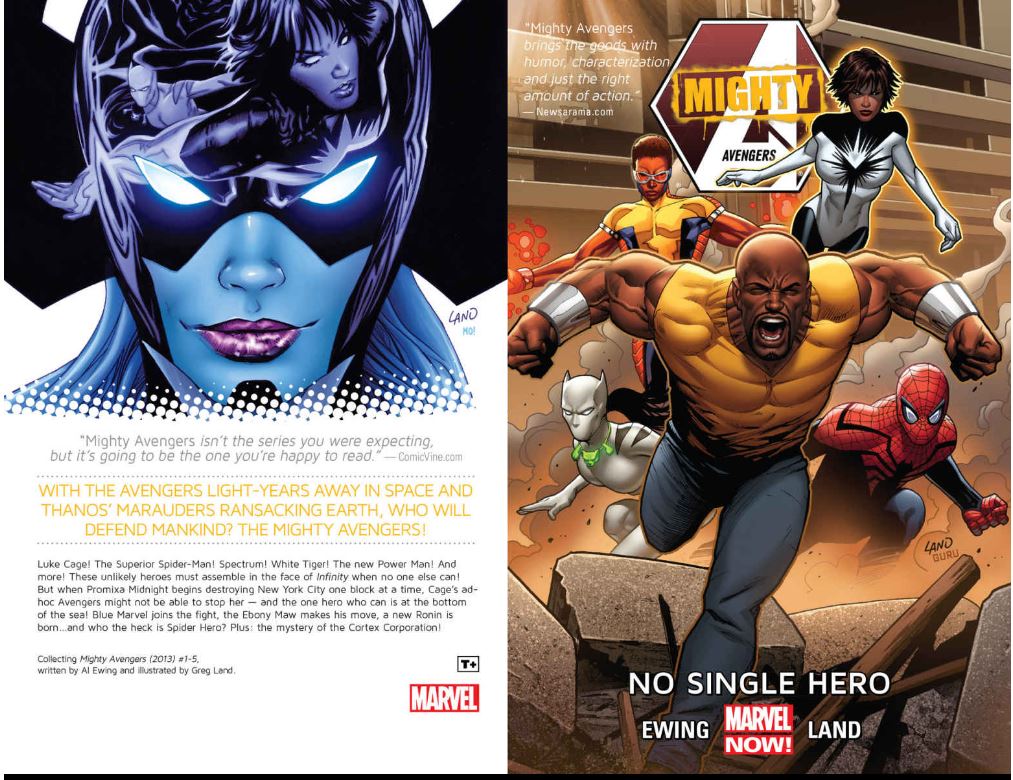
Mighty Avengers: No Single Hero


By Al Ewing, Greg Land, Jay Leisten & various (Marvel)
ISBN: 978-0785188742 (TPB/Digital edition)

Following blockbuster Avengers Versus X-Men publishing event, company-wide reboot MarvelNOW! reformed the entire overarching continuity: a drastic reshuffle and rethink of characters, concepts and brands with an eye to winning new readers and feeding the company’s burgeoning movie blockbuster machine…

Moreover, many disparate story strands were congealing to kick off the always-imminent Next Big Thing, with the cosmically expanded Avengers titles forming the spine of an encroaching mega-epic. The colossal Infinity storyline detailed a grandiose advance into Armageddon as an intergalactic Hammer of Doom fell with an all-out attack by impossibly ancient race The Builders. They claim to have sparked universal life, but now seek to rectify their mistake on Earth – and woe betide any species or intergalactic civilisation in their way.

When The Avengers mobilised most of their assemblage off-planet to tackle the threat before it reached them, Thanos of Titan took advantage of the dearth of metahuman defenders to invade, leaving the remaining superheroes with an almost impossible task…

Written by Al Ewing and illustrated by Greg Land & Jay Leisten, Mighty Avengers volume 2 #1-5 (November 2013 – March 2014) describes how those left behind unite as a resistance force and stayed together as a decidedly different kind of crusading team… one primarily comprising heroes of colour, not the usual bunch of white guys and ones who looked at problems beyond a self-appointed cosmic jurisdiction…

The action opens as Thanos hits Earth, where blithely unaware ex-Avenger Luke Cage is pitting his Heroes for Hire apprentices White Tiger and a new, teenaged Power Man against seasoned super-thief The Plunderer. Their efforts are interrupted and derided by the Superior Spider-Man who orders them to quit before insultingly offering Cage’s kids a real job.

Everybody sees that the wallcrawler has become insufferable since he technologically upgraded his act and hired a paramilitary gang as his deputies. Many of his oldest friends even think he might be going crazy. What no one knows is that the mind inside the arachnid hero’s head is actually archvillain Otto Octavius AKA Doctor Octopus who – despite a passionate initial desire to reform – is slowly reverting to his true manner and bad habits…

The webspinner’s derision spurs White Tiger into quitting, but only fuels her male teammates into trying harder to prove Spider-Man wrong…

Elsewhere ex-Avenger Monica Rambeau (formerly Captain Marvel and Photon, but now calling herself Spectrum) is getting back into the crime-busting game after a bout of retirement. She’s sorting out her costume and talking over old times with an enigmatic fellow champion when the first wave of the Titan’s invasion force smashes into New York.

Donning a store-bought comedy costume, the stranger – also black – joins Monica as a generic “Spider Hero” and converges on the landing site where Cage and the still-enraged Superior Spider-Man are battling the Titan’s ferocious warlord Proxima Midnight

Elsewhere, Mystic Master Doctor Strange has been possessed and corrupted by the Ebony Maw – the most personally ambitious of Thanos’ lieutenants – whilst at the bottom of the sea  Dr. Adam Brashear receives a cosmic visitor. A forgotten African American superhero forbidden by Presidential mandate from operating during the Civil Rights era, The Blue Marvel is thus stirred from a lengthy self-imposed exile and grudgingly agrees to return to the world which shunned and sidelined him…

In New York, ‘The Assembly’ give battle, but the Amazing Arachnid seems more concerned with suing his “copyright infringer” than defeating the invaders, and Spectrum is gravely wounded by Midnight. As Cage tackles Proxima, ordinary citizens are emboldened to join the struggle, compelling ever-watching Thanos to order a retreat.

It’s not over though, as the ravaged metropolis is then assaulted by an overwhelming aspect of voracious Elder God Shuma-Gorath, summoned by enslaved Stephen Strange. The rampant horror gleefully begins transforming native New Yorkers into ghastly demon duplicates…

As Blue Marvel rockets to the rescue, temporarily stymieing the devil god and healing Spectrum, mystically empowered White Tiger and Power Man arrive and Spider Hero -demonstrating a keen knowledge of arcane rites – devises a scheme to drive the Lovecraftian horror back to its own dimension for good.

Cage then has a eureka moment, realising ‘No Single Hero’ could have managed, declaring that they are all Avengers…

Originally parked above Manhattan, the Inhumans’ floating city Attilan was destroyed during the war and its ruins now languish in the Hudson River. Moreover, when Thanos personally attacked Black Bolt, the embattled Inhuman monarch released genetically transformative Terrigen Mists thereby unleashing a host of new super-powered warriors from the ranks of the humans below…

Issue #4 is set after the invasion is finally repelled, with the city engrossed in rapid reconstruction. The space-bound Avengers are still missing off-world but life is returning to normal.

Sleazy entrepreneur Jason Quantrell despatches his personal industrial spy Quickfire – a recent recipient of Terrigen-induced abilities – to raid the sunken citadel in search of fresh mutagens he can monetise, whilst in Times Square Cage has turned his old Gem Theatre offices into a storefront Avengers HQ.

He has a bold new idea: opening the heroic volunteer brigade to the public who can come to them with meta-related problems or issues of injustice. Even though Reservist The Falcon has come aboard, Spider-Man is becoming increasingly intolerant, alternately demanding to be placed in charge and ordering Cage’s crew to cease and desist. Unable to convince them, the furious superior wallcrawler storms off…

Meanwhile Spider Hero – who has some ominous magical acquaintances older fans might recognise – has detected an encroaching mystic crisis and resolved to stay. Adopting the vacant costume and identity of martial arts mystery man Ronin, he invites the team to join him in stopping an impending burglary in Attilan. It’s not Quickfire’s illegal raid that’s the problem, but rather that she’s going to inadvertently awaken the slumbering submerged threat of the Death Walkers if somebody doesn’t stop her…

However, as the most recent Ronin leads the Avengers to the already-in-progress monster catastrophe, Octavius returns to the Gem Theatre and – in a manic fit of frustrated rage – attacks Cage with all the paramilitary resources he can muster: mercenaries, spider-bots and urban assault vehicles all primed to shut down the Avengers forever.

Happily, the harassed Hero for Free had already contacted his lawyer and is delighted to follow Jennifer Walters’ guidance… which basically boils down to “She-Hulk Smash!”…

Fast, furious and fantastically offbeat, this epic epistle also offers a selection of editorial features from the issues in question and a covers gallery, as it delivers hard, fast, thrilling and funny stories about heroism on the other side of the tracks…
© 2013 Marvel Characters Inc.. All rights reserved.

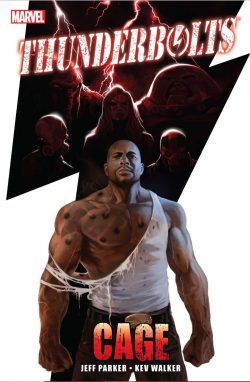
Thunderbolts – Cage


By Jeff Parker, Kev Walker & various (Marvel)
ISBN: 978-0-7851-4774-9 (HB/Digital) 978-0-7851-4775-6 (TPB)

At the end of 1996 the Onslaught publishing event removed The Fantastic Four, Avengers, Captain America and Iron Man from the Marvel Universe: rather unwisely handing over creative control to Rob Liefeld and Jim Lee for a year. For the early part of that period the “Image style” books got most of consumers’ attention, although a new title created to fill the gap in the “real” universe eventually proved to be the true breakthrough of that era…

Thunderbolts was initially promoted as a replacement team-book; untried champions pitching in because the big guns were dead and gone. They consisted of Captain America clone Citizen V, size-shifting Atlas, super-armoured Mach-1, energy-casting virago Meteorite, sonic siren Songbird and mechanised human weapon Techno.

A beleaguered and terrified populace instantly took them to their hearts, but these heroes shared a huge secret – they were actually super-villains in disguise and Citizen V (or Baron Helmut Zemo as he truly was) had nasty plans in mind…

Ultimately defeated by his own scheme as his criminal underlings (Mach-I AKA the Beetle, Techno/the Fixer, Atlas/Goliath, Songbird/Screaming Mimi and even deeply-disturbed Meteorite/Moonstone) increasingly yearned to be the heroic ideals they posed as, Zemo was ousted and the Thunderbolts thereafter carved out – under a succession of leaders – a rocky career as genuine, if controversial, champions.

Even with their Heroes Returned (a long story for another time) life got no easier for Earth and especially America. During the first superhero Civil War, the ever-changing Thunderbolts squad – generally comprised of felons looking to change their ways or escape punishment – became Federal hunters, tracking and arresting metahumans who refused to surrender to the Super-Human Registration Act. Eventually that iteration fell under the aegis of government hard-man Norman Osborn.

Through various deals, deeds and malign machinations former Green Goblin Osborn sought to control the Thunderbolt project as a stepping-stone to his becoming became the USA’s Security Czar…

As the “top-cop” in sole charge of a beleaguered nation’s defence and freedom, the psychotic Osborn controlled America’s costumed/metahuman community. Replacing super-spy agency S.H.I.E.L.D. with his own all-pervasive H.A.M.M.E.R. Directorate, the deadly despot had Captain America arrested and defamed. Setting the world’s heroes at each other’s throats, he dedicated all his energies to stealing political power to match his scientifically-augmented strength and overwhelming financial clout.

Numerous appalling assaults on the nation occurred, including a Secret Invasion by shape-shifting Skrull infiltrators and his own draconian, oppressive response – his Dark Reign – wherein Osborn drove the World’s Mightiest Heroes underground, replacing them with his own team of deadly Dark Avengers.

Not content with commanding the covert and military resources of the United States, Osborn personally led this team, wearing appropriated Tony Stark technology and calling himself the Iron Patriot: simultaneously betraying his country by conspiring with a coalition of major super-villains to divvy up the world between them.

He overreached himself by overruling the American President to direct an unsanctioned military Siege on godly citadel Asgard, and when the fugitive outlawed heroes at last reunited to stop him, Osborn’s fall from grace and subsequent incarceration led to a new Heroic Age.

In the aftermath, it was discovered that the Security Chief’s monstrous manipulations were even more Machiavellian than suspected. One of his initiatives was the kidnapping of super-powered children: tragic innocents he tortured, psychologically abused and experimented upon in a drive to create the next generation of fanatically loyal super-soldiers…

Those traumatised and potentially lethal kids became the responsibility of the exonerated and reassembled Avengers who decided to teach the surviving lab rats how to be heroes in a new Avengers Academy, whilst Osborn – beaten but not broken -was incarcerated in ultra-high-security penitentiary The Raft.

Collecting material from the Enter the Heroic Age one-shot and Thunderbolts #144-147 (July-October 2010) this new direction, written by Jeff Parker, illustrated by Kev Walker and coloured by Frank Martin, sees the Legion of the Lost reformed with a fresh brief and a new leader to once again offer penitence, potential redemption and probable death to the defeated dregs of the Marvel Universe…

For most of modern history black consumers of popular entertainments were provided with far too few fictive role models. In the English-speaking world that began changing in the turbulent 1960s and truly took hold during the decade that followed.

Many characters stemming from those days emerged due to a cultural phenomenon dubbed “Blaxploitation”. Although criticised for its seedy antecedents, stereotypical situations and violence, the films, books, music and art generated by the phenomenon were the first mass-market examples of minority characters in leading roles, rather than as fodder, flunkies or flamboyant villains.

If you care to look elsewhere in this blog, you’ll find a rather pompous review by (old, white) me detailing how that groundbreaking era led to the birth of superheroic cultural icon Luke Cage. You should read those stories: they’re groundbreaking landmarks and really good…

Here, however, the drama begins with the arrival on the high-tech island prison of Osborn and a new intake of monstrous convicts who pretty soon learned the ropes at the calloused hands of Power Man Luke Cage: former Hero for Hire, reserve Avenger and latest director of the Thunderbolts Program. The no-nonsense hard-man and former convict – albeit an innocent, framed and ultimately exonerated one – offered a last-chance way for some of America’s worst malefactors to pay back their immense debt to society and maybe buy a slice of salvation…

Issue #144 took up the story as new Warden John Walker (formerly super-soldier U.S.Agent before losing some limbs during the Siege of Asgard) and Cage begin selecting potential recruits in ‘The Boss’.

With original, genuinely reformed Thunderbolts Fixer and Mach-V as deputies, lethally ambivalent sociopath Moonstone opportunistically joins Cage’s team: the cream of a reluctant, conflicted and very bad bunch also comprising deranged phasing hacker Ghost; dispirited mystic mobile monolith Juggernaut and Captain America’s antithesis Cross-Bones – one of the most ruthless killers in existence.

Offering technical support is size-shifting Scientist Supreme/Avengers Academy headmaster Hank Pym (AKA Ant-Man, Goliath, Yellowjacket, The Wasp and Giant-Man), who devised a unique transport method for the penal battalion: one utilising unsuspected teleportational talents of the macabre, insentient monster called the Man-Thing

However, before the unit can even undergo basic training, intransigent Zemo attacks the inescapable penitentiary, determined to reclaim his old team…

‘Field Test’ offers a surprise or two before Cage seizes control again and the squad set off on an emergency first mission: tracking down man-eating trolls ravaging the Oklahoma countryside and presumably escaped from Asgard after Osborn’s ill-fated attack on the dimensionally-displaced City of the Gods…

That grisly outing promptly segues into another crisis-response from the woefully untrained squad when dispatched to a New Guinea cave to rescue scientists and S.H.I.E.L.D. agents investigating mutagenic, metahuman-creating Terrigen crystals…

The mission is another tragic debacle. There is no cure for what the techs have uncovered and then become, so the salvation run turned into a grim and nasty bug hunt…

This sleek, effective thriller concludes its dramatic presentation with the intermediate part of a crossover tale which began and ended in Avengers Academy, offering some intriguing insights into the ongoing personal rehabilitation of troubled Juggernaut Cain Marko.

The students at the unique school were being trained under a hidden agenda: although officially declared the most accomplished of Osborn’s next generation protégés, sextet Reptil, Finesse, Striker, Hazmat, Mettle and Veil were actually diagnosed as the most experimented upon, abused and psychologically damaged. The Academy not only wanted to turn them into heroes but also intended to ensure the prodigies were not incurably corrupted, potential menaces…

‘Scared Straight’ reveals how toxic nightmare Hazmat, animated Iridium golem Mettle and slowly dissipating gas-girl Veil turn a school-trip to The Raft into an attempt to gain revenge on their erstwhile tormentor. Although the most secure and infallible jail on the planet, no one realises just what Hazmat can really do and when the power goes out she and her equally incensed classmates headed straight for Osborn’s solitary cell…

Their ill-conceived ploy also liberates an army of irate, murderous villains forcing the new Thunderbolts to prove how far they’ve come by choosing which side they are now on. More important than showing Cage and Warden Walker, the convicts and once-pariahs must examine their own unsuspected moral changes and how far they have progressed before order is finally, ruthlessly restored…

This collection confirming Luke Cage’s elevation from edgy outsider to first rank major player in Marvel continuity also comes with a superb cover gallery by Marko Djurdjevic, Bryan Hitch & Karl Kesel, Larry Stroman, Frank Martin, a wealth of character designs and pages of un-inked art from Walker to complete a wry, clever and suspenseful action-adventure package that all fans of gritty superhero action will adore…
© 2010, 2011 Marvel Characters, Inc. All Rights Reserved.

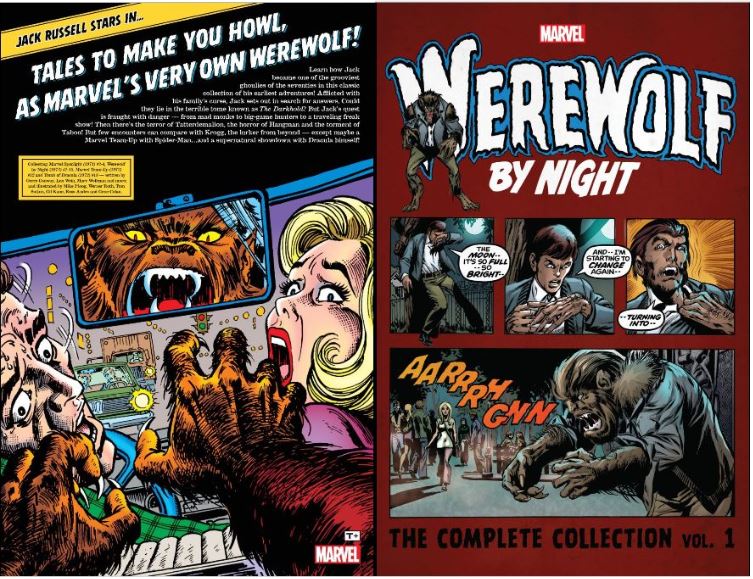
Werewolf by Night – The Complete Collection volume 1


By Gerry Conway, Len Wein, Marv Wolfman, Roy & Jean Thomas, Mike Ploog, Werner Roth, Ross Andru, Tom Sutton, Gil Kane, Gene Colan & various (Marvel)
ISBN: 978-1-30290-839-3 (TPB/Digital edition)

Win’s Christmas Gift Recommendation: Utterly Uncanny and Irresistible Comics Chillers… 9/10

Now a star of page and screen, Werewolf by Night could be described as the true start of the Marvel Age of Horror. Although now technically supplanted by modern Hopi/Latino lycanthrope Jake Gomez – who’s shared the designation since 2020 – the trials of a teen wolf opened the floodgates to a stream of Marvel monster stars and horror antiheroes. Happy 50th anniversary, kid!

Inspiration isn’t everything. In 1970, as Marvel consolidated its new position of market dominance – even after losing their two most innovative and inspirational creators, Steve Ditko and Jack Kirby – they did so employing a wave of new young talent, but less by experimentation and more by expanding proven concepts and properties.

The only real exception to this was the mass-move into horror titles: a response to an industry down-turn in superhero sales, and a move expedited by a rapid revision in the wordings of the increasingly ineffectual Comics Code Authority rules.

Almost overnight scary monsters became acceptable fare on four-colour pages and whilst a parade of 1950s pre-code reprints made sound business sense (so they repackaged a bunch of those too), the creative aspect of the revived fascination in supernatural themes was catered to by adapting popular cultural icons before risking whole new concepts on an untested public.

As always, the watchword was fashion: what was hitting big outside comics would be incorporated into the print mix and shared universe mix as readily as possible. When proto-monster Morbius, the Living Vampire debuted in Amazing Spider-Man #101 (October 1971) and the sky failed to fall in, Marvel launched a line of sinister superstars – beginning with a werewolf and a vampire…

Werewolf By Night debuted in Marvel Spotlight #2 (preceded by western-era hero Red Wolf in #1, and followed by Ghost Rider). In actuality, the series title, if not the actual star character, was recycled from a classic pre-Comics Code short suspense-thriller from Marvel Tales #116, July 1953. Marvel always favoured a using old (presumably already copyrighted) names and titles when creating new series and characters. The Hulk, Thor, Magneto, Doctor Strange and many others all got nominal starts as hairy underpants monsters or throwaways in some anthology or other.

This copious compendium collects the early adventures of a young West Coast lycanthrope re-presenting the contents of Marvel Spotlight #2-4, Werewolf by Night volume 1 #1-15; a guest-shot from Marvel Team-Up #12 and material from the appropriate half of a horror crossover with Tomb of Dracula #18. These cumulatively span February 1972 through 1974.

Following an informative, scene-setting Introduction by long-term Marvel Editor Ralph Macchio, the moonlit madness begins with the landmark first appearance, introducing teenager Jack Russell, who is suffering some sleepless nights…

Cover-dated February 1972 ‘Werewolf by Night!’ (Marvel Spotlight #2), was written by Gerry Conway and moodily, magnificently illustrated by Mike Ploog – the manner of his old mentor Will Eisner. The character concept came from an outline by Roy & Jeanie Thomas, describing the worst day of Jack’s life – his 18th birthday – which begins with nightmares and ends in something far worse.

Jack’s mother and little sister Lissa are everything a fatherless boy could hope for, but new stepfather Philip and creepy chauffeur Grant are another matter. Try as he might, Jack can’t help but see them as self-serving and with hidden agendas…

At his party that evening, Jack has an agonising seizure and flees into the Malibu night to transform for the first time into a ravening vulpine man-beast. At dawn, he awakes wasted on a beach to learn that his mother has been gravely injured in a car crash. Something had happened to her brakes…

Sneaking into her hospital room, the distraught teen is astonished to hear her relate the story of his birth-father: an Eastern European noble who loved her deeply, but locked himself away three nights every month…

The Russoff line was cursed by the taint of Lycanthropy: every child doomed to become a wolf-thing under the full-moon from the moment they reach 18 years of age. Jack is horrified and then realises how soon his sister will reach her own majority…

With her dying breath Laura Russell makes her son promise never to harm his stepfather, no matter what…

Scenario set, with the traumatised wolf-boy uncontrollably transforming three nights every month, the weird, wild wonderment begins in earnest with the beast attacking the creepy chauffeur – who had doctored those car-brakes – but refraining, even in vulpine form, from attacking Philip Russell…

The second instalment sees the reluctant nocturnal predator rescue Lissa from a sick and rowdy biker gang (they were everywhere back then) and narrowly escape the cops only to be abducted by a sinister dowager seeking knowledge of a magical tome called the Darkhold. The legendary spell-book is the apparent basis of the Russoff curse, but when Jack can’t produce the goods he’s left to the mercies of ‘The Thing in the Cellar!’

Surviving more by luck than power, Jack’s third try-out issue fetches him up on an ‘Island of the Damned!’: introducing aging Hollywood writer Buck Cowan, who will become Jack’s best friend and affirming father-figure as they jointly investigate the wolf-boy’s evil stepdad.

Russell had apparently sold off Jack’s inheritance, leaving the boy nothing but an old book. Following a paper trail to find proof Philip had Laura Russell killed leads them to an offshore fortress, a dungeon full of horrors and a ruthless mutant seductress…

That episode ended on a cliffhanger, presumably as an added incentive to buy Werewolf by Night #1 (September 1972), wherein Frank Chiaramonte assumed inking duties with ‘Eye of the Beholder!…

Merciless biological freak Marlene Blackgar and her monstrous posse abduct the entire Russell family whilst looking for the Book of Sins, until – once more – a fearsome force of supernature awakes to accidentally save the day as night falls…

With ‘The Hunter… and the Hunted!’ Jack and Buck deposit the trouble-magnet grimoire with Father Joquez, a Christian monk and scholar of ancient texts, but are still hunted because of it. Jack quits the rural wastes of Malibu for a new home in Los Angeles, trading forests and surf for concrete canyons but life is no easier.

In #2, dying scientist Cephalos seeks to harness Jack’s feral life-force to extend his own existence, living only long enough to regret it. Meanwhile, Joquez successfully translates the Darkhold: an accomplishment allowing ancient horror to possess him in WbN #3, sparking ‘The Mystery of the Mad Monk!’

Whilst the werewolf is saddened to end such a noble life, he feels far happier dealing with millionaire sportsman Joshua Kane, who craves a truly unique head mounted on the wall of his den in the Franke Bolle inked ‘The Danger Game’. Half-naked, exhausted and soaked to his now hairless skin, Jack must then deal with Kane’s deranged brother, who wants the werewolf for his pet assassin in ‘A Life for a Death!’ (by Len Wein & Ploog) after which ‘Carnival of Fear!’ (Bolle inks again) finds the beast – and Jack, once the sun rises – a pitiful captive of seedy mystic Swami Calliope and his deadly circus of freaks.

The wolf was now the subject of an obsessive police detective too. “Old-school cop” Lou Hackett is an old buddy of trophy-hunter Joshua Kane – and every bit as savage – but his off-the-books investigation hardly begins before the Swami’s plans fall apart in concluding tale ‘Ritual of Blood!’ (inked by Jim Mooney).

The beast is safely(?) roaming loose in the backwoods for #8’s quirky monster-mash when an ancient demon possesses a cute little bunny in Wein, Werner Roth & Paul Reinman’s ‘The Lurker Behind the Door!’, before neatly segueing to a slight but stirring engagement in Marvel Team-Up #12 wherein Wein, Conway, Ross Andru & Don Perlin expose a ‘Wolf at Bay!’ As webspinning wallcrawler meets werewolf, they initially battle each other – and ultimately malevolent mage Moondark – in foggy, fearful San Francisco before Jack heads back to LA and ‘Terror Beneath the Earth!’

Here Conway, Tom Sutton & George Roussos dip into an impeding and thoroughly nefarious scheme by business cartel The Committee. These commercial gurus somehow possess a full dossier on Jack Russell’s night-life, and hire a maniac sewer-dwelling sound engineer to execute a radical plan to use monsters and derelicts to boost sales in a down-turned economy.

However, the bold scheme to promote “growth, Growth, GROWTH” by frightening folk into spending more is ended before it begins since the werewolf proves to be far from a team-player in the wrap up ‘The Sinister Secret of Sarnak!’

Issue #11 revelled in irony as Marv Wolfman signed on as scripter for ‘Comes the Hangman’ – illustrated by incredible action ace Gil Kane & Sutton – in something interesting about Philip Russell and the Committee is disclosed, even as Jack’s attention is distracted by a new apartment, a very odd neighbour and a serial kidnapper abducting young women to keep them safe from “corruption”. When the delusional hooded hero snatches Lissa, he soon finds himself hunted by a monster beyond his wildest dreams…

Concluding chapter ‘Cry Werewolf!’ brings in the criminally underappreciated Don Perlin as inker. In a few short months he would become the strip’s penciller, lasting for the rest of the run. Before that though, Ploog & Chiaramonte return for another session, introducing another maniac mystic and a new love-interest (but not the same person) for WbN #13’s ‘His Name is Taboo’.

An aged sorcerer coveting the werewolf’s energies for his own arcane purposes, the magician is stunned when his adopted daughter Topaz finds her loyalties divided and her psionic abilities more help than hindrance to the ravening moon-beast. ‘Lo, the Monster Strikes!’ then pits the wolf against Taboo’s undead-but-getting better son, delivering unexpected revelation and reconciliation between Philip and Jack Russell. As a result, the young man and new girlfriend Topaz set off for Transylvania, the ancestral Russoff estate and a crossover clash with the Lord of Vampires.

Tomb of Dracula #18 (March 1974) begins the battle with ‘Enter: Werewolf by Night’ (Wolfman, Gene Colan & Tom Palmer) as Jack and Topaz investigate a potential cure for lycanthropy, only to be attacked by rampant menace to humanity Count Dracula. Driven off by the girl’s psychic powers the undead aristocrat realises the threat she poses to him and resolves to end her…

The confrontation and this first tome conclude with Werewolf by Night #15 and the ‘Death of a Monster!’ (Wolfman, Ploog & Chiaramonte) as the demonic duel devolves into a messy stalemate… but only after Jack learns of his family’s long hidden connection to Dracula…

Supplemented with an unused Ploog cover for Marvel Spotlight#4; Kane’s pre-corrections cover to ToD #18 and previous collection covers by Ploog & Dan Kemp, this initial complete compendium also offers a wealth of original art pages (20 in total) by Ploog, Sutton & Andru.

A moody masterpiece of macabre menace and all-out animal action, this book covers some of the most under-appreciated magic moments in Marvel history: tense, suspenseful and solidly compelling chillers to delight any fright fan or drama addict. If you crave a mixed bag of lycanthropes, bloodsuckers and moody young misses, this is a far more entertaining mix than most modern movies, books or miscellaneous matter…
© 1972, 1973, 1974, 2017 Marvel Characters, Inc. All rights reserved.