Buck Danny volume 1: Night of the Serpent


By Francis Bergése, colours by Frédéric Bergése translated by Jerome Saincantin (Cinebooks)
ISBN: 987-1-905460-85-4

I’ve finally picked up some of the newest translated versions of a favourite continental classic serial, courtesy of the wonderful Cinebooks; a fine publishing outfit dedicated to bringing more of the fabulous wealth and variety of European comics to the infamously resistant English-speaking World.

All-American Naval Aviator Buck Danny was created by Georges Troisfontaines and drawn by Victor Hubinon before being handed to Jean-Michel Charlier, then working as a junior artist. Troisfontaines was director of the Belgian publisher World Press Agency whilst Charlier’s fascination with human-scale drama and rugged realism had been seen in such “true-war” strips as L’Agonie du Bismark (‘The Agony of the Bismark’– published in Spirou in 1946).

With fellow master-storytellers Albert Uderzo and René Goscinny, Charlier formed the Édifrance Agency, which promoted and specialised in communication arts and comics strips. Charlier and Goscinny were editors of Pistolin magazine (1955 to 1958) and created Pilote in 1959.

Charlier’s greatest triumph is the iconic Western Blueberry (created in 1963 with Jean Giraud/Moebius). Charlier wrote Buck Danny until his death whereupon his artistic collaborator Francis Bergése (who had replaced Hubinon in 1978) took sole charge of the adventures of the Yankee Air Ace.

Like so many artists involved in stories about flight Francis Bergése (born in 1941) started young with both drawing and flying. He qualified as a pilot whilst still a teenager, enlisted in the French Army and was a reconnaissance flyer by his early twenties. At age 23 he began selling strips to L’Étoile and JT Jeunes (1963-1966) after which he produced his first aviation strip Jacques Renne for Zorro. This was soon followed by Amigo, Ajax, Cap 7, Les 3 Cascadeurs, Les 3 A , Michel dans la Course and many others.

Bergése worked as a jobbing artist on comedies, pastiches and WWII strips until 1983 when he was offered the plum job of illustrating the venerable and globally syndicated Buck Danny. When Charlier died Bergése took over the writing too and even found time in the 1990s to produce some tales for the European interpretation of Great British icon Biggles. He retired in 2008, passing on the creative chores of Buck Danny to illustrator Fabrice Lamy and scripter Fred Zumbiehl.

Buck Danny premiered in Spirou in January 1947 and continues to this day. The strip describes the improbably long and historically significant career of the eponymous Navy pilot and his wing-men Sonny Tuckson and Jerry Tumbler. It is one of the world’s last aviation strips and a series which has always closely wedded itself to current affairs such as The Korean War, Bosnia and even Afghanistan.

Like all the Danny tales this premier edition is astonishingly authentic: a breezy and compelling action thriller – originally published as Buck Danny #49: La nuit du serpent in 2000 – with colouring by Frédéric Bergése (I’m assuming that’s his son, but I’m not certain) which blends mind-boggling detail and technical veracity with good old fashioned blockbuster adventure.

At Kunsan Airbase, South Korea a veteran American pilot goes on dawn border patrol only to be hit by an uncanny light which blinds him and seems to negate all his F-16’s guidance systems. Despite his best efforts the jet crashes in the De-Militarized Zone and the North Koreans claim a flagrant breaking of the truce and a huge publicity coup.

Strangely though, the downed Colonel Maxwell is still missing. The Communists don’t have him and the pilot’s tracking devices indicate he’s still out there somewhere: lost in the No Man’s land between North and South.

The American military swings into action, determined to rescue their pilot, clean up the mess and deny the Reds either a tangible or political victory. Danny, Tumbler and Tuckson are at a Paris air show when they get the call and are soon en route to Korea for a last-ditch face-saving mission.

However as the trio prepare to join the covert rescue mission, evidence emerges which casts doubt on the authenticity of the alleged super-weapon. Meanwhile Colonel Maxwell has stumbled into a fantastic secret under the DMZ…

Fast-paced, brimming with tension and spectacular action, this is a classically designed thriller which effortlessly plunges the reader into a delightfully dizzying riot of intrigue, mystery and suspense before its captivating conclusion.

Suitable for older kids and boys of all ages the Adventures of Buck Danny is one long and enthralling tour of duty no comics fan or armchair adrenaline-junkie can afford to miss. Bon chance, mes braves…

© Dupuis, 2000 by Bergése. English translation © 2009 Cinebook Ltd. All Rights Reserved.

Stigmata


By Lorenzo Mattotti & Claudio Piersanti (Fantagraphics Books)
ISBN: 978-1-60699-409-2

In his latest magnificent endeavour, European giant of graphic narrative Lorenzo Mattotti (see Fires) has teamed with novelist and screenwriter Claudio Piersanti to produce one of the most powerful and evocative examinations of religious experience in recent times with their evocative collaboration Stigmata.

This impressive hardback describes the Job-like trials and tragedies of a brutal, alcoholic shipwreck of a man pushed beyond the brink of tolerance and sanity who finds a kind of peace and resolution, but unlike his Old Testament antecedent the protagonist here begins in misery with nothing before losing even those graces and by the end of his travails has found precious little knowledge or understanding but a sort of peace…

Drunken, brutal, dissolute, middle-aged and heading nowhere, the last thing he needed was holes in his hands that bled but wouldn’t heal. Already despised and feared, the lonely bum worked at a bar, but the wounds and the blood were upsetting even those gin-soaked sots. Moreover people were following him, thinking he possessed some divine secret or power to heal…

Eventually he snapped, wrecking the bar and confronting the vicious gangster who ran it… Some folks were calling him “the Saint”. He didn’t think it was funny…

As the city becomes even more savage and ugly he takes off; tracking down his uncle who worked in a carnival. When he finds the travelling show his uncle is gone – arrested for stealing – but the Carnies accept him and he strikes up a romance with the vivacious Lorena. Even working as a handyman his bleeding hands interfere, but the canny show-people turn it their advantage and set him up in a booth dispensing piety and miracle from his shabby, tawdry “House of Blessings.”

Travelling from town to town he finds a kind of peace but the Carnies’ secret sideline of burglary brings police attention. When his old gangster boss tracks him down and delivers a hideous punishment he destroys the Stigmatic’s last shred of hope and Lorena’s life forever…

And then the storm hits… a tempest of Biblical proportions that changes everything…

Stunning and evocative and rendered in a cacophony of swirling miasmic lines, this fearsome modern parable is a fierce interrogation of faith and destiny which asks uncompromising and uncomfortable questions about the price of Grace and the value of belief. Are these trials, so like Job’s cruel yet purposeful tests, the tough love of a benevolent father, the whims of a despicable devil or the random vagaries of an uncaring fate?

Emotive, shocking and utterly compelling, Stigmata is a grotesque and beautiful metaphysical rollercoaster with existential angst and blind faith gripping each other’s philosophical throats and squeezing really hard. No rational reader or mature comics fan can afford to miss this dark shining delight.

© 2010 Lorenzo Mattotti & Claudio Piersanti. All rights reserved.

The Story of Lee volume 1


By Seán Michael Wilson & Chie Kutsuwada (NBM/ComicsLit)
ISBN: 978-1-56163- 594-8

Here’s a lovely simple treat for romantics everywhere and manga fans in particular and, like the subject matter itself, the product of more than one country. Written by British émigré and current resident of Japan Seán Michael Wilson and illustrated by Manga Shakespeare artist Chie Kutsuwada, The Story of Lee follows the budding romance of a dedicated but restless Hong Kong girl as she meets and falls for a young Scottish poet and teacher.

Lee is a young woman with frustrated dreams dutifully working in her father’s shop in Hong Kong. The situation is uncomfortable: the elder means well, but he disapproves of almost everything she does and is not reluctant to tell her so. Even as he chides and disparages Lee his constant pushing for her to achieve something whilst staying true to his old-fashioned ideas is pulling her apart. Moreover, Wang, the nice, proper Chinese boy he perpetually and insistently forces upon her, is creepy and just turns her off.

Lee has a secret: she is a closet poet and besotted with western culture, particularly pop music. In these unwelcome fascinations she is clandestinely supported by her frail and aging grandmother and her unconventional Uncle Jun, a globe-trotting playboy who long ago abandoned convention and tradition to follow his dreams to America.

Lee is 24 and being gradually worn away when the gorgeous temporary teacher Matt MacDonald wanders into the store. He is Scottish; polite, charming, exotic and, as Lee discovers when empting the wastepaper basket, a sensitive and talented poet…

Soon Lee is defying her father as her relationship with Matt inexorably deepens, but when tragedy strikes her life is further complicated as Matt prepares to leave for home. And then he drops the bombshell and asks her to go with him…

Never strident but compellingly seditious, this charming tale uses the powerful themes of cultural differences, mixed-race-relationships, family pressures and the often insurmountable barrier of generational gulf warfare to weave an enchanting tale of desire, duty and devotion.

It all ends on a gentle cliffhanger and I can’t wait to see how it all resolves in the next volume… So will you when you pick up on this mature, addictive story.

©Seán Michael Wilson & Chie Kutsuwada.

Krazy & Ignatz 1919-1921: “A Kind, Benevolent and Amiable Brick”


By George Herriman (Fantagraphics Books)
ISBN: 978-1-60699-364-4

I must admit to feeling like something of a fraud and an idiot reviewing George Herriman’s masterpiece of eternal unrequited love. Although Krazy Kat is unquestionably a pinnacle of graphic innovation, a hugely influential body of work which shaped the early days of the comics industry and an undisputed treasure of world literature, some readers – from the strip’s querulous beginnings in 1913 right up to this morning – just don’t “get it”. So those in the know are already fans (trust me; they just are) whilst those sorry few who are oblivious to the strip’s inimitable charms are beyond my meagre capacity to reach or help.

Still, since everyday there’s newcomers to the wonderful world of comics I’ll assume the missionary position once more and hope to catch and convert some fresh soul – or as I like to think of it save one more “lil Ainjil”…

Krazy and Ignatz, as it is dubbed in these lovely collected tomes from Fantagraphics, is not and never has been a strip for dull, slow or unimaginative people who simply won’t or can’t appreciate the complex multilayered verbal and pictorial whimsy, absurdist philosophy or seamless blending of sardonic slapstick with arcane joshing. It is the closest thing to pure poesy that narrative art has ever produced.

Think of it as Dylan Thomas and Edward Lear playing “I Spy” with James Joyce amongst dry cactus fields whilst Gabriel García Márquez types up the shorthand notes and keeps score…

Some brief background then: Herriman was already a successful cartoonist and journalist in 1913 when a cat and mouse that had been cropping up in his outrageous domestic comedy strip The Dingbat Family/The Family Upstairs graduated to their own feature. “Krazy Kat” debuted in William Randolph Hearst’s New York Evening Journal on Oct 28, 1913 and mainly by dint of the publishing magnate’s overpowering direct influence spread throughout his vast stable of papers.

Although Hearst and a host of the period’s artistic and literary intelligencia (which included e.e. Cummings, Frank Capra, John Alden Carpenter, Gilbert Seldes, Willem de Kooning, H.L. Mencken and Jack Kerouac) adored the strip many local editors did not and took every career-risking opportunity to drop it from the comics section. Eventually the feature found a home in the Arts and Drama section of Hearst’s papers. Protected by the publisher’s patronage the strip flourished unharmed by editorial interference and fashion and ran until Herriman’s death in April 1944.

The basic premise is simple: Krazy is an effeminate, dreamy, sensitive and romantic feline of indeterminate gender in love with Ignatz Mouse: rude crude, brutal, mendacious and thorougly scurrilous.

Ignatz is a real man; drinking, stealing, neglectful of his wife and children and spurns Krazy’s genteel advances by regularly hitting the cat with a well-aimed brick (obtained singly or in bulk from noted local brickmaker Kolin Kelly). A third member of the eternal triangle is lawman Offissa Bull Pupp, hopelessly in love with Krazy, well aware of the Mouse’s true nature, but bound by his own timidity and sense of honour from removing his rival for the cat’s affections. Krazy is blithely oblivious of Pupp’s dilemma…

Also populated with a stunning supporting cast of inspired anthropomorphic bit players such as Joe Stork, (deliverer of babies), the hobo Bum Bill Bee, Don Kiyoti, busybody Pauline Parrot, Walter Cephus Austridge, the Chinese mallard Mock Duck, Joe Turtil and a host of audacious characters – all capable of stealing the limelight and even supporting their own features – the episodes occur in and around the Painted Desert environs of Coconino (based of the artist’s vacation retreat Coconino County Arizona) and the surreal playfulness and fluid ambiguity of the flora and landscape are perhaps the most important member of the cast.

The strips are a masterful mélange of unique experimental art, strongly referencing Navajo art forms and sheer unbridled imagination and delightfully expressive language: alliterative, phonetically and even onomatopoeically joyous and compellingly musical (“He’s simpfilly wondafil”, “A fowl konspirissy – is it pussible?” or “I nevva seen such a great power to kookoo”), yet for all that the adventures are poetic, satirical, timely, timeless, bittersweet, self-referential, fourth-wall bending, eerie, idiosyncratic and utterly hilarious escapades encompassing every aspect of humour from painfully punning shaggy dog stories to riotous slapstick.

There have been an absolute wealth of Krazy Kat collections since the late 1970s when the fondly remembered strip was generally rediscovered by a far more accepting audience and this particular compendium continues the complete year-by-year series begun by Eclipse and picked up by Fantagraphics when the former ceased trading in 1992. The current publisher’s avowed intent is to complete the collection and then keep the works in print and more power to them for that. This fabulous black and white volume Krazy & Ignatz: “A Kind, Benevolent and Amiable Brick” re-presents the years 1919-1921.

Within this magical atlas of another land and time the eternal game plays out as usual, but with some intriguing diversions such as recurring tribute’s to Kipling’s “Just So Stories” as we discover how the Kookoo Klock works, why bananas hang around in bunches and why Lightning Bugs light up; peer into the misty past to see Kwin Kleopatra Kat and Marcatonni Maus and explore the ever-changing seasons in a constant display of visual virtuosity and verbal verve…

Also included are fascinating articles and background features (‘A Mouse by any Other Name: Krazy and Ignatz’s Early Life Under the Stairs’ by Bill Blackbeard, ‘Geo. Herriman’s Los Angeles’ by Bob Callahan and the highly informative and instructional  ‘Ignatz Mouse Debaffler Pages’), some intimate archival illustrations and photos and even unpublished and lost art.

Herriman’s epochal classic is a genuine Treasure of World Art and Literature and these comic strips have shaped our industry and creators, inspired creative auteurs in fields as disparate as prose fiction, film, dance, animation and jazz music and delivered delight and delectation to generations of devoted wonder-starved fans.

If however, you are one of Them and not Us, or if you actually haven’t experienced the gleeful graphic assault on the sensorium, mental equilibrium and emotional lexicon carefully thrown together by George Herriman from the dawn of the 20th century until the dog days of World War II, this latest glorious annotated compendium from Fantagraphics is one of the most accessible and certainly the most easily obtained book yet, so don’t waste this opportunity.

Just remember: not everybody gets it and some of them aren’t even stupid or soulless – they’re just unfortunate… “There Is A Heppy Lend Furfur A-Waay”…

© 2011 Fantagraphics Books. All rights reserved.

Unlovable: the complete Collection


By Esther Pearl Watson (Fantagraphics Books)
ISBN: 978-1-60699-397-2

I first encountered Unlovable when volume 2 turned up unannounced in my review mail-pile last year. I had never heard of the strip nor the magazine Bust where it had run for years, but I’m always in the market for a new graphic experience, so I dutifully sat down and lost myself in the world of a Texas Teen from a long, long time ago…

Ostensibly based on an actual schoolgirl diary the artist found in a gas-station restroom in 1995, these two volumes – as translated and reconfigured by cartoonist Ester Pearl Watson – reveal the innermost thoughts, dreams and experiences of a dumpy, utterly ordinary American girl of the tastelessly intoxicating Eighties – surgically displayed for our examination in a catchy, breathless, effusive warts ‘n’ all style.

In the course of these garish and oddly compulsive tomes we follow the titular “Tammy Pierce” as she goes through the unrelenting daily rollercoaster ride of hormones, social pressure and the twin drives to both stand out and fit in.

From my vantage point twenty years in the future it is crushingly funny and achingly sad. Volume 1 plunges the reader straight into a new term as Tammy goes back to school on August 29th 1988 and is instantly swallowed up by the bizarre and overwhelming world of boys, pimples, a torrent of clothing brands, big-hair bands, adolescent poetry, prank calls and perpetual humiliation from friends and enemies alike – plus the oblivious nature of parents – who just have no clue…!!!

And her obnoxious little brother “Willis the Shrimp” is a complete tool…

The second volume dishes out more of the same as the increasingly sophisticated and mature (I’m pretty sure they’re the words I’m looking for) Miss Pierce endures and survives her Sophomore year of High School, from Christmas Eve 1988 to the Summer of 1989.

When you’re a teenager some things are truly timeless and universal: parents are unreasonable and embarrassing, siblings are scum and embarrassing and your body is shamefully finding new and horrifying ways to betray you almost daily… Your friends can’t be trusted, you’re attracted to all the wrong people and sometimes you just know that no one will ever love you…

Drawn in a two colour, faux-grotesque manner (you can call it intentionally primitive and ugly if you want) the page by page snapshots of a social hurricane building to disaster is absolutely captivating. Although this is a retro-comedy experience, behind her fatuous obsession with fashion, boys, shoplifting, music, curling hair, peer acceptance and traitorous bodily functions, Tammy is a lonely bewildered child that it’s hard not to feel sorry for. Actually it’s equally hard to like her (hell, its difficult to curb the urge to slap her at times) but that is the point after all…

If you live long enough you’ll experience the pop culture keystones of every definitive era of your life at least twice more. The base, tasteless and utterly superficial aspects of 1980s America are back for a new generation which is too young to remember them – but you and I can get all nostalgic for the good bits and blithely ignore all the bad stuff.

Both these big little hardbacks (over 400 pages each and about 15x15cm) comprise a delightful and genuinely moving exploration of something eternal given extra punch with the trappings of that era of tasteless self-absorption, and like those other imaginary diarists Nigel Molesworth, Bridget Jones and Adrian Mole Tammy Pierce’s ruminations and recordings have something ineffable yet concrete to contribute to the Wisdom of the Ages.

Modern and Post-Ironic, Unlovable is unmissable; and now that the entire sorry saga is available in this superb and substantial collectors boxed set, you have the perfect opportunity to discover the how and why of girls and possibly learn something to change your life.

Now please excuse me, I’ve got to turn over my pink vinyl Debbie Gibson Springsteen covers picture disc…

© 2009, 2010, 2011 Esther Pearl Watson. All rights reserved.

E.C. Segar’s Popeye volume 5: Wha’s a Jeep?


By Elzie Crisler Segar (Fantagraphics Books)
ISBN: 978-1-60699-404-7

Elzie Crisler Segar was born in Chester, Illinois on 8th December 1894.His father was a handyman and Elzie’s early life was filled with the kinds of solid blue-collar jobs that typified his generation of cartoonists. He worked as a decorator and house-painter and played drums, accompanying vaudeville acts at the local theatre. When the town got a movie house he played for the silent films, absorbing the staging, timing and narrative tricks from the close observation of the screen that would become his greatest assets as a cartoonist. It was while working as the film projectionist, aged 18, he decided to become a cartoonist and tell his own stories.

Like so many others he studied art via mail, in this case W.L. Evans’ cartooning correspondence course out of Cleveland, Ohio (from where Jerry Siegel and Joe Shuster would launch Superman upon the world), before gravitating to Chicago where he was “discovered” by Richard F. Outcault – arguably the inventor of newspaper comic strips with The Yellow Kid and Buster Brown.

The senior artist introduced him around at the prestigious Chicago Herald. Still wet behind the ears, Segar’s first strip, Charley Chaplin’s Comedy Capers, debuted on 12th March 1916. In 1918 he married Myrtle Johnson and moved to William Randolph Hearst’s Chicago Evening American to create Looping the Loop, but Managing Editor William Curley saw a big future for Segar and packed the newlyweds off to New York headquarters of the mighty King Features Syndicate.

Within a year Segar was producing Thimble Theatre, which launched December 19th 1919 in the New York Journal. It was a pastiche of Movie features like Hairbreadth Harry and Midget Movies with a repertory cast to act out comedies, melodramas, comedies, crime-stories, chases and especially comedies, for vast daily audiences. The core cast included parental pillars Nana and Cole Oyl, their lanky daughter Olive, diminutive-but-pushy son Castor and Olive’s plain and simple occasional boyfriend Horace Hamgravy (later just Ham Gravy).

In 1924 Segar created a second daily strip The 5:15; a surreal domestic comedy featuring weedy commuter and would-be inventor John Sappo and his formidable wife Myrtle (surely, no relation?).

A born storyteller, Segar had from the start an advantage even his beloved cinema couldn’t match. His brilliant ear for dialogue and accent shone out from his admittedly average adventure plots, adding lustre to stories and gags he always felt he hadn’t drawn well enough. After a decade or so and just as cinema caught up with the invention of “talkies” he finally discovered a character whose unique sound and individual vocalisations blended with a fantastic, enthralling nature to create a literal superstar.

Popeye the sailor, brusque, incoherent, plug-ugly and stingingly sarcastic, shambled on stage midway through the adventure ‘Dice Island’, (on January 17th 1929: see E.C. Segar’s Popeye volume 1: “I Yam What I Yam!”) and once his part was played out, simply refused to leave. Within a year he was a regular and as the strip’s circulation skyrocketed, he became the star. Eventually the strip was changed to Popeye and all of the old gang except Olive were consigned to oblivion…

Popeye inspired Segar. The near decade of thrilling mystery-comedies which followed revolutionised the industry, laid the groundwork for the entire superhero genre (sadly, usually without the leavening underpinnings of his self-aware humour) and utterly captivated the whole wide world.

These superb oversized (almost 14 ½ by 10½ inches) hardback collections are the ideal way of discovering or rediscovering Segar’s magical tales. This fifth huge volume also contains an insightful introductory essay from Richard Marschall ‘Character and Personality in Thimble Theatre’ a captivating article of the period (‘Segar’s Hobbies Put Punch in Popeye Comics’) reprinted from Modern Mechanix and Inventions and a fascinating end-piece covering the assorted original art teasers editors used to promote upcoming tales in the magical days before television or viral ad campaigns over and above the increasingly incredible tales from the daily and Sunday strips.

The black and white Monday to Saturday section opens this volume, (covering July 25th 1935 to December 12th 1936) and encompassing one-and-a-half major storylines, beginning with the long-awaited conclusion of ‘Popeye’s Ark’ wherein the bold sailor-man carried out an ambitious plan to set up his own country of Spinachova. The incredible scheme was funded by misogynist millionaire Mr. Sphink who insisted that the new country be absolutely without women – and Popeye went along with it, recruiting a host of disaffected guys looking for a fresh start…

Soon however the thousands of able-bodied men populating the country were starving for any kind of female companionship – even Olive Oyl – who was currently exiled on an island of her own. Things got very strange when the lonely Spinachovans discovered a tribe of mermaids frolicking off the coast, but romance was soon forgotten when Brutian despot King Zlobbo decided the new nation must be his in ‘War Clouds’.

To scout out the potential opposition Zlobbo dispatched the beautiful spy Miss Zexa Peal, but as the most beautiful woman in the country – and indeed 50% of Spinachova’s female population – she wasn’t exactly inconspicuous…

When war broke out it resulted in Popeye’s greatest victory – with just a little excessively violent help from feisty “infink” baby Swee’ Pea…

By the conclusion of that epic tale all the players had returned to America, just in time for the introduction of the star of this tome. ‘Eugene the Jeep’ was introduced on March 20th 1936, a fantastic 4th dimensional beast with incredible powers that Olive and Wimpy used to get very rich very quickly, only to lose it all betting on the wrong guy in another of Segar’s classic and hilarious set-piece boxing matches between Popeye and another barely human pugilist…

This was an astonishingly fertile period for the strip. On August 4th Eugene was instrumental in kicking off another groundbreaking and memorable sequence as the entire ensemble cast took off on as haunted ship to undertake ‘The Search for Popeye’s Papa’.

When Popeye first appeared he was a shocking anti-hero. The first Superman of comics was not a comfortable hero to idolise. A brute who thought with his fists and didn’t respect authority; uneducated, short-tempered, fickle (when hot tomatoes batted their eyelashes – or thereabouts – at him), a gambler and troublemaker, he wasn’t welcome in polite society…and he wouldn’t want to be.

Popeye was the ultimate working class hero: raw and rough-hewn, practical, but with an innate and unshakable sense of what’s fair and what’s not, a joker who wants kids to be themselves but not necessarily “good” and a man who takes no guff from anyone. As his popularity grew he somewhat mellowed. He was always ready to defend the weak and had absolutely no pretensions or aspirations to rise above his fellows. He was and will always be “the best of us”… but the shocking sense of unpredictability, danger and anarchy he initially provided was sorely missed by 1936 – so Segar brought it back again…

This memorable and riotous tale introduced the ancient and antisocial crusty reprobate Poopdeck Pappy and his diminutive hairy sidekick Pooky Jones during another fabulous voyage of discovery. The elder mariner was a rough, hard-bitten, grumpy brute quite prepared and even happy to cheat, steal or smack a woman around if she stepped out of line… Once that old goat was firmly established Segar set Popeye and Olive the Herculean task of ‘Civilizing Poppa’ which is where the monochrome adventures conclude…

The full-colour Sunday pages in this volume span April 4th 1935 to September 13th 1936, and see the bizarrely entertaining Sappo (and Professor O.G. Wotasnozzle) supplemental strip gradually diminish to allow the Popeye feature even more room to excel and amaze. Eventually Sappo became a cartooning tricks section which allowed Segar to play graphic games with his readership and Popeye’s Cartoon Club also disappeared, as the focus inexorably shifted to Popeye and Co. in alternating one-off gag strips and extended sagas. However the Sailor-Man had to fight for space with his mooching co-star J. Wellington Wimpy…

When not beating the stuffing out of his opponents or kissing pretty girls, Popeye pursued his flighty, vacillating and irresolute Olive Oyl with exceptional verve, if little success, but his life was always made more complicated whenever the unflappable, so-corruptible and adorably contemptible Wimpy made an appearance.

The engaging Micawber-like coward, moocher and conman was first seen on 3rd May 1931 as an unnamed and decidedly partisan referee in one of Popeye’s regular boxing matches. The scurrilous but polite oaf obviously struck a chord and Segar gradually made him a fixture. Always hungry, eager to take a bribe and a cunning coiner of many immortal catchphrases such as “I would gladly pay you Tuesday for a hamburger today” and ‘let’s you and him fight’ Wimpy is the perfect foil for a simple action hero and often stole the entire show.

Infinitely varying riffs on Olive’s peculiar romantic notions or Wimpy’s attempts to cadge food or money for food were irresistible to the adoring readership, but Segar wisely peppered the Sundays with longer episodic tales, such as the cast’s Gold prospecting venture to  the inhospitable western desert of ‘Slither Creek’ (April 14th – August 25th 1935) and the sequel sequence wherein the temporarily wealthy but eternally starving Wimpy buys his own diner – the ultimate expression of blind optimism and sheer folly…

The uniquely sentimental monster Alice the Goon returned to the strip on February 23rd 1936, permanently switching allegiance and becoming the nanny of the rambunctious tyke Swee’ Pea and a cast regular by the end of April.

August 9th saw Eugene the Jeep make his Sunday debut and demonstrations of the fanciful beast’s incredible powers to make money and cause chaos fill out this fifth fantastic tome…

There is more than one Popeye. If your first thought on hearing the name is an unintelligible, indomitable white-clad sailor always fighting a great big beardy-bloke and mainlining tinned spinach, that’s okay: the animated features have a brilliance and energy of their own (even the later, watered-down anodyne TV versions have some merit) and they are indeed based on the grizzled, crusty, foul-mouthed, bulletproof, golden-hearted old swab who shambled his way into Thimble Theatre and wouldn’t leave. But they are really only the tip of an incredible iceberg of satire, slapstick, virtue, vice and mind-boggling adventure…

There is more than one Popeye. Most of them are pretty good and some are truly excellent. However with only one more volume of Elzie Segar’s comic masterpiece to come – starring the very best Popeye of them all – don’t you think it’s about time you sampled the original and very best?

© 2011 Fantagraphics Books Inc. All comics and drawings © 2011 King Features Inc. All rights reserved.

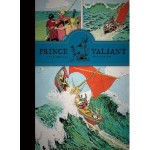
Hal Foster’s Prince Valiant volume 3: 1941-1942


By Hal Foster (Fantagraphics Books)
ISBN: 978-1-60699-407-8

Possibly the most successful and evergreen fantasy creation ever conceived, the Sunday page Prince Valiant in the Days of King Arthur launched on February 13th 1937, a luscious full-colour weekly window onto a perfect realm of fantasy and romance. The strip followed the life and adventures of a refugee boy driven by invaders from his ancestral homeland in faraway Thule who roamed the world and rose to a paramount position amongst the mightiest heroes of fabled Camelot.

Written and drawn by unsurpassed master draftsman Harold “Hal” Foster, that noble scion would grow to manhood in a heady sea of wonderment, visiting far-flung lands and siring a dynasty of equally puissant heroes whilst captivating and influencing generations of readers and thousands of creative types in all the arts.

There have been films, animated series and all manner of toys, games and collections based on the strip – one of the few to have lasted from the thunderous 1930s to the present day (over 3800 episodes and counting) and even in these declining days of the newspaper strip as a viable medium it still claims over 300 American papers as its home. It has even made it into the very ether with an online edition.

Foster produced the strip, one spectacular page a week until 1971, when, after auditioning such notables as Wally Wood and Gray Morrow, Big Ben Bolt artist John Cullen Murphy was selected to draw the feature. Foster carried on as writer and designer until 1980, after which he fully retired and Murphy’s son assumed the writer’s role.

In 2004 the senior Cullen Murphy also retired (he died a month later on July 2nd) and the strip has soldiered on under the extremely talented auspices of artist Gary Gianni and writer Mark Schultz.

This third exquisite hardback volume reprints in glorious colour – spectacularly restored from Foster’s original Printer’s Proofs – the Sunday pages from January 5th 1941 to 20th December 1942.

After an epic clash against corrupt officials in the rapidly declining city of Rome, Valiant and fellow knights Tristan and Gawain headed for home. Splitting up to thwart their incensed pursuers, Valiant took ship on a pirate scow bound for Sicily. Now read on…

After a Dan Nadel’s erudite foreword ‘Modestly, Foster’ the action opens in the shadow of fiery Vesuvius as Val’s vessel is attacked by self-proclaimed Sea-King Angor Wrack. Even the fierce warrior-prince’s martial might is insufficient against such great odds and the boy is eventually captured and enslaved, his fabled Singing Sword confiscated by the victorious pirate.

Thus begins an astonishingly impressive chapter in the hero’s history as Val becomes a galley slave, escapes and washes up starving and semi-comatose on the lost shores of the Misty Isles. Delirious, the boy glimpses his future wife Queen Aleta when she re-provisions his boat before casting him back to the sea’s mercies. The Misty Isles are safe only because of their secret location and the noble girl has broken a great taboo by sparing the shipwrecked lad…

Replenished but lost Val drifts helplessly away but resolves that one day he will discover again the Misty Isles and the enigmatic Aleta…

Eventually he is picked up by more pirates but overwhelms the captain and takes charge. Finding himself in the island paradise of Tambelaine courting the daughters of the aged king Lamorack, Val encounters Angor Wrack once more but fails to regain the Singing Sword, precipitating an extended saga of maritime warfare and spectacular voyaging across the Holy Land from Jaffa to Jerusalem.

The vendetta results in both Angor and Val being taken by Arab slavers, but the boy nobly allows Wrack to escape whilst he battles the Bedouin hordes… Enslaved in Syria Val’s indomitable will and terrifying prowess are insufficient to his need so he seduces his owner’s daughter to effect his escape only to stumble into a marital spat between the region’s greater necromancer and his tempestuous bride.

Reaching Jerusalem Val finally regains his sword and settles all scores with Angor Wrack before determining to return to the hidden Misty Isles, but once again falls afoul of the pirates infesting the region. After incredible hardships he is reunited with Aleta but fate drags them apart again and he departs alone and despondent.

Not for long though, as he reaches Athens and meets the far-larger-than-life Viking Boltar: a Falstaff-like rogue and “honest pirate”. Together they rove across the oceans to the heart of the African jungles…

Securing a huge fortune their dragonship reaches Gaul and Val is reunited with Gawain. After settling a succession of generational feuds between knights and defeating a seductive maniac the paladins at last return to Britain courtesy of Boltar, just in time to be dispatched by Arthur to the far North to scout Hadrian’s Wall and see if it can still keep the belligerent Picts out.

Unfortunately libidinous Gawain abandons Val and the boy is captured by the Caledonian wild-men and their new allies – a far nastier breed of Vikings intent on conquering England. Tortured almost to death the Prince is saved by the ministrations of Julian – a Roman warrior who has seemingly safeguarded the wall for centuries…

When he is recovered Prince Valiant begins to inflict a terrible and studied revenge upon his tormentors…

To Be Continued…

Rendered in an incomprehensibly lovely panorama of glowing art Prince Valiant is a non-stop rollercoaster of stirring action, exotic adventure and grand romance; blending realistic fantasy with sardonic wit and broad humour with unbelievably dark violence (the closing text feature ‘Too Violent for American Dog Lovers’, reveals a number of censored panels and changes editors around the world inflicted upon the saga during this period).

Beautiful, captivating and utterly awe-inspiring the strip is a World Classic of storytelling and something no fan can afford to miss. If you have never experienced the intoxicating majesty and grandeur of Foster’s magnum opus these these magnificent, lavishly substantial deluxe editions are the best way possible to start and will be your gateway to an eye-opening world of wonder and imagination…

Prince Valiant © 2011 King Features Syndicate. All other content and properties © 2011 their respective creators or holders. All rights reserved.

Freeway


By Mark Kalesniko (Fantagraphics Books)
ISBN: 978-1-60699-356-9

It’s a strange occupation writing about a largely pictorial art-form and sometimes the only thing you want to say is “you have got to read this!” However I love to babble on, so I’ll slightly elaborate about the latest superb quasi-autobiographical gem from animator and cartoonist Mark Kalesniko which features another moving and thought-provoking reverie starring his dog-faced alter ego Alex Kalienka.

After working for Disney on such modern classics as The Little Mermaid, The Lion King, Mulan, and Atlantis, British Columbia-born Kalesniko began crafting powerful and imaginative comics in 1991, beginning with the audacious ‘Adolf Hears a Who.

In 1994 he produced Alex; the tale of a alcoholic ex-animator returning to his old hometown and followed it in 1997 by Why Did Pete Duel Kill Himself? – an account of young Alex’s formative years. In 2001 he diverged from Alex’s exploits and examined another aspect of the inherent isolationism of creative types with Mail Order Bride. Now with Freeway Kalesniko returns to his signature character to describe in powerfully oppressive form the heartrending misery of attaining your dream…

Young Alex has left Canada for Hollywood to fulfil his lifelong ambition of being an animator for the monolithic Babbitt Jones Productions (a transparently veiled Disney analogue) but the achievement of his greatest wish is not working out how he had hoped. He seems to spend most of his day trying to drive to or from the studio (no longer part of the colossal Babbitt Jones studio complex but hidden away in a seedy warehouse in a decidedly dodgy district.

After the initial disappointment of discovering the animators and ideas that built the company have become sidelined and despised by the corporate drones that now run the business, Alex settles in and begins the intolerable grind of making art by committee dictat. As he sees his fellows creators slowly crumple to the pressures of office politics, daily compromise, poor leadership and lack of vision in a place where being good is less important than being compliant his elation fades.

Seduced by his own joyous nostalgia for the good old days he never experienced, Alex falls in love with a co-worker but her family considers him an outsider. Every day he sees the talent, aspirations and sensitivity of his fellow artists mauled by malicious ambition and jealousy and every day he spends angry and frustrated hours embedded in the vast aggressive steam kettle of the Los Angeles rush hour…

Little wonder then that his fertile, repressed imagination begins to wander: but when even the daydreams of violent death and merciful release are more satisfying than your life, how long can a creative soul last before it withers or snaps?

This mesmeric saga is deliciously multi-layered: blending compelling narrative with tantalising tidbits and secret snippets from the golden age of animation with rosy reveries of the meta-fictional post-war LA and the sheer tension of a paranoid thriller. Kalesniko opens Alex mind and soul to us but there’s no easy ride. Like Christopher Nolan’s Memento, there’s a brilliant tale here but you’re expected to pay attention and work for it.

Illustrated with stunning virtuosity in captivating black line, Alex’s frustration, anger, despair, reminiscences and imaginings from idle ponderings to over-the-top near hallucinations are chillingly captured and shared in this wonderful book – which can be happily read in isolation of all the other Tomes cited. However as always they’re still available and recommended and can only enhance this glorious and bold truly graphic novel.

Contents © 2011 Mark Kalesniko. This edition © 2011 Fantagraphics Books. All rights reserved.

The Archies & Josie and the Pussycats: Archie & Friends All Stars Series volume 8


By Dan Parent, Bill Galvan, Rick Koslowski & Jim Amash (Archie Comics)
ISBN: 978-1-879794-61-0

MLJ were a publisher who jumped on the “mystery-man” bandwagon following the debut of Superman with their own small but inspirational pantheon of gaudily clad crusaders, beginning in November 1939 with Blue Ribbon Comics, promptly followed by Top-Notch and Pep Comics. The content was the standard blend of costumed heroes, two-fisted adventure strips, prose pieces and gag panels.

After a few years Maurice Coyne, Louis Silberkleit and John Goldwater (hence MLJ) spotted a gap in their blossoming market. In December 1941 the costumed heroes and two-fisted adventure strips were nudged aside by a far less imposing hero, an “average teen” who would have ordinary adventures like the readers, but with the laughs, good times, romance and slapstick emphasised.

Pep Comics #22 introduced a gap-toothed, freckle-faced red-headed goof showing off to the pretty blonde next door. Taking his lead from the popular Andy Hardy matinee movies starring Mickey Rooney, Goldwater developed the concept of a youthful everyman protagonist, tasking writer Vic Bloom and artist Bob Montana with the job of making it work. The six-page tale entitled ‘Archie’ introduced goofy Archie Andrews and pretty girl-next-door Betty Cooper. Archie’s unconventional best friend and confidante Jughead Jones also debuted in that first story as did the small-town utopia of Riverdale.

The feature was an instant hit and by the winter of 1942 had won its own title. Archie Comics #1 was the company’s first non-anthology magazine and with it began the gradual transformation of the entire company. With the introduction of rich, raven-haired Veronica Lodge, all the pieces were in play for the comicbook industry’s second Genuine Phenomenon (Superman being the first).

By 1946 the kids had taken over, so the company renamed itself Archie Comics, retiring its heroic characters years before the end of the Golden Age and becoming to all intents and purposes a publisher of family comedies. Its success, like the Man of Steel’s, changed the content of every other publisher’s titles, and led to a multi-media industry including TV, movies, a chain of restaurants and in the swinging sixties a pop hit as “Sugar, Sugar” (a tune from their animated show) became a global smash. Their wholesome garage band “The Archies” has been a fixture of the comics ever since.

With such a successful format, naturally the company tried to add supplemental stars to their four-colour firmament, Wilbur Wilkins (1994), Suzie (1945), Ginger (1951) and Seymour, My Son (1963), with varying degrees of success. However another 1963 debut did catch and hold the readers attention. Her name was Josie and she was created by Dan DeCarlo as a veritable female clone of Archie.

With issue #45 (1967) the titian-haired ingénue and her best friend Melody formed a band and the title was changed to Josie and the Pussycats. Fame, stardom, a TV cartoon series, a major motion picture and two soundtrack albums later the band were only occasional visitors in the Archie universe until someone had a cunning idea…

Most of her supporting cast was introduced in the first issue, including best friend Pepper, boyfriend Albert… and Melody. Spoiled rich kids Alex and Alexandra Cabot soon joined the cast and the book changed its name with issue #45, and that it remained until the final issue in 1982.

One other fact about Archie’s publisher’s is that they certainly know how to create different publishing events that capture the attention of the general public – as anybody who saw the 1994 Archie Meets the Punisher inter-company crossover will attest…

The Archies & Josie and the Pussycats collects a storyline from 2009-2010 wherein ‘It Starts with a Kiss!’ as the two clean-living bands are signed to tour together, and our red-headed star and the Pussycats’ African-American bassist Valerie are drawn irresistibly together.

After a stolen kiss during a late-night song-writing session the attraction grows stronger in ‘More Than Words’ as hapless Archie tries to concentrate on his daily life – and Betty and Veronica – but can’t get Val off his mind. Moreover, the normally “sensible one” in Josie’s band is similarly distracted…

Luckily for all the tour soon ends and the girls are bound for Europe and a series of solo gigs, but the tearful farewell proves the attraction has grown into something far more serious. All the while the Pussycat’s rat-bag manager Alex Cabot has been trying to scotch the situation and now goes into overdrive in his scheming.

The 2-part ‘Love Smackdown!’ follows the separated and lovelorn Archie and Valerie as distance, daily drudgery, temptation and Alex all operate to keep them apart. After a misunderstanding leaves the couple acrimoniously separated forever events a new combined tour seems destined to rekindle the fire – but do Betty and Veronica want Archie for themselves or do they want him to be happy…?

Moreover, what’s the deal with Valerie’s old flame Declan McCord? He says he’s just a fill-in musician, but does the charismatic Celtic pop-star have plans to win Valerie back for himself…?

Star-crossed love and nigh-torrid melodrama combine with classic Riverdale slapstick in this delightful young romance that shows a burgeoning slice of maturity in the world’s favourite teenager (and don’t quibble: Justin Bieber has a limited shelf-life but Archie has been a teen heartthrob for seven decades) and the tale ends on a fascinating and intriguing open note…

This snazzy tome also has some impressive extra features including writer Dan Parent’s ‘Liner Notes’, full background and histories for The Archies and Josie and the Pussycats, and ‘Once More With Feeling’, 8 pages of penciller Bill Galvan’s art and unused covers reproduced before inkers Rick Koslowski & Jim Amash worked their own particular magic upon them.

All the world loves a lover, and this satisfyingly enticing down-to-earth comedy-drama is a solid example of the kind of comics there just aren’t enough of these days. Remember, “Superheroes aren’t the only fruit” – despite all the tights and stuff…

© 2010 Archie Comics Publications, Inc. All rights reserved.

Buz Sawyer: The War in the Pacific


By Roy Crane (Fantagraphics Books)
ISBN: 978-1-60699-362-0

Modern comics evolved from newspaper comic strips, and these pictorial features were until relatively recently utterly ubiquitous and hugely popular with the public – and highly valued by publishers who used them as an irresistible sales weapon to guarantee and increase circulation and profits.

It’s virtually impossible for us to today to understand the overwhelming power of the comic strip in America (and the wider world) from the Great Depression to the end of World War II. With no television, broadcast radio far from universal and movie shows at best a weekly treat for most folk, household entertainment was mostly derived from the comic sections of daily and especially Sunday Newspapers. “The Funnies” were the most common recreation for millions who were well served by a fantastic variety and incredible quality.

From the very start humour was paramount; hence the terms “Funnies” and “Comics”, and from these gag and stunt beginnings – a blend of silent movie slapstick, outrageous fantasy and the vaudeville shows – came a thoroughly entertaining mutant hybrid: Roy Crane’s Wash Tubbs.

Debuting on April 21st 1924 Washington Tubbs II was a comedic gag-a-day strip that evolved into a globe-girdling adventure serial. Crane produced pages of stunning, addictive quality yarn-spinning whilst his introduction of moody swashbuckler Captain Easy in the landmark episode for 6th May, 1929 led to a Sunday colour page that was possibly the most compelling and visually impressive of the entire Golden Age of Newspaper strips (see Roy Crane’s Captain Easy, Soldier of Fortune: The Complete Sunday Newspaper Strips volume 1)

Almost improving minute by minute Crane’s imagination and his fabulous visual masterpieces achieved a timeless immediacy that made each page a unified piece of sequential art. The influence of those pages can be seen in the works of near-contemporaries such as Hergé, giants-in-waiting like Charles Schulz and comics creators like Alex Toth and John Severin ever since.

The work was obviously as much fun to create as to read. In fact, the cited reason for Crane surrendering the Sunday strip to his assistant Les turner in 1937 was the NEA/United Features Syndicate’s abrupt and arbitrary demand that all its strips must henceforward be produced in a rigid panel-structure to facilitate their being cut up and re-pasted as local editors dictated – although the compelling text features in this book dedicated to his second masterpiece reveal a few more commercial and professional reasons for the jump from the small and provincial syndicate to the monolithic King Features outfit.

At the height of his powers Crane just walked away from the astounding Captain Easy page, concentrating on the daily feature, and when his contract expired in 1943 he left United Features to create the World War II aviation strip Buz Sawyer, lured away by the grandee of strip poachers William Randolph Hearst.

Where Wash Tubbs was a brave but comedic Lothario and Easy a surly tight-lipped he-man, John Singer “Buz” Sawyer was a happy amalgam of the two: a simple good-looking popular country-boy who went to war because his country needed him.

After the gripping and informative text feature ‘Crane’s Great Gamble’ by Jeet Heer the strip explodes into action on Christmas Eve 1942 as new Essex Class Aircraft Carrier USS Tippecanoe steams for the Pacific Theatre of Operation carrying 100 fighter-bombers and an extremely keen pair of cartoon warriors.

Buz Sawyer was a fun-loving, skirt-chasing, musically inclined pilot and his devoted gunner Rosco Sweeney a bluff, simple ordinary Joe – and one of the best comedy foils ever created. The strip is a marvel of authenticity: picturing not just the action and drama of the locale and situation but more importantly capturing the quiet, dull hours of training, routine and desperate larks between the serious business of killing whilst staying alive.

Like contemporaries Bill Mauldin and Milton Caniff, Crane was acutely aware that all his readers had someone involved in the action and therefore felt he had a duty to inform and enlighten as well as entertain. Spectacular as the adventure was the true magic is the off-duty camaraderie and personal moments that pepper the daily drama.

This beautiful archival hardback covers the entire war years of the strip from November 1st 1943 to October 5th 1945 wherein the great artist perfected his masterly skill with craftint (a mechanical monochrome patterning effect used to add greys and halftones which Crane used to add miraculous depths and moods to his superb drawing) and opens with the lovable lads shot down whilst tackling a Japanese carrier.

Marooned, their life raft washed up on a desolate desert island where they’re hunted by enemy troops and discover a German farmer and his beautiful daughter. At first hostile, the lovely fraulein, April, soon succumbs to Buz’s boyish charm. Helping Buz and Roscoe escape, the trio only make it as far as the next islet where fellow pilot and friendly rival Chili Harrison had also been stranded since his plane went down.

Eventually rescued the Navy fliers return to “the Tip” for training on new planes (Curtiss SB2C Helldivers, in case you were wondering) in preparation for the push to Japan. Amidst spectacular action sequences shipboard life goes on, but during a raid on an occupied island Buz and Sweeney are once more shot down. In the middle of a fire-fight they effect repairs and head back to the Tippecanoe, but not without cost. Rosco has been hit…

Sawyer’s exploits haven’t gone unnoticed and, whilst Sweeney is recovering from wounds, he’s selected for a secret mission deep into enemy territory; ferrying an intelligence agent to a meeting with enigmatic underground leader the Cobra.

It all goes tragically wrong and the American agent is captured. With the enemy hunting high and low for the pilot, Buz then fell back on his most infuriating ability: falling into the willing laps of beautiful women.

‘Sultry’ was a gorgeous collaborator high in the favour of the occupying Japanese, but she too finds the corn-fed aviator irresistible. Of course it might simply be that she’s also Cobra…

This extended epic is a brilliant and breathtaking adventure that blends action, suspense, love and tragedy into a compelling thriller that took Buz all the way to December 1944. As a result of his trials the hero is sent home on a thirty day leave – enabling Crane to reveal some enticing background and invoke all the passions, joys and heartbreaks of the Home Front.

Buz doesn’t want to go but orders are order, so to make things a little more bearable Buz takes the still recuperating Sweeney with him. It isn’t that the young flier despises his origins – indeed his civilian life is a purely idyllic American Dream – it’s simply that he wanted to get the job done against the enemy. Nevertheless, with a warrior’s grace under pressure, he resigned himself to peace and enjoyment whilst his comrades soldier on. If he knew the foe he would face in his little hometown, Buz would probably have gone AWOL…

Crane’s inspirational use of the War at Home was a brilliant stroke: it’s not a world of spies and insidious Bundists but just a sweet little burg filled with home-comforts and proud people – the kind of place the soldiers were fighting to preserve and a powerful tool in the morale-builder’s arsenal. It’s also a place of completely different dangers…

Buz was the son of the town’s doctor; plain, simple and good-hearted. In that egalitarian environment the kid was the sweetheart of Tot Winter, the richest girl in town, and when her upstart nouveau riche parents heard of the decorated hero’s return they hijacked the homecoming and turned it into a publicity carnival.

Moreover the ghastly, snobbish Mrs. Winter conspired with her daughter to trap the lad into a quick and newsworthy marriage. Class, prejudice, financial greed and social climbing were enemies Buz and Sweeney were ill-equipped to fight, but luckily that annoying tomboy-brat Christy Jameson has blossomed into a sensible, down-to-earth, practical and clever young woman. She’s scrubbed up real pretty too…

After a staggeringly smart and compelling soap opera sequence that would do East Enders or Coronation Street proud, Buz ended up (accidentally) engaged to Tot after all. Mercifully the leave was over and he and Sweeney had to return to the war… but even then they were disappointed to discover that they wouldn’t immediately be fighting again.

Posted to Monterey, California, they were to be retrained for new planes and a new squadron, reuniting with rowdy rival Chili Harrison: but Mrs Winter was determined to have a war hero in the clan and pursued them with Tot in tow, determined to get Buz married before he returned to the Pacific.

Insights into another aspect of the military experience (Crane had almost unfettered access, consultation privileges and the grateful willing cooperation of the US Navy) were revealed to the readers as the whiz-kid was suddenly back in school again – and usually in the dog-house because of his hot-dogging. Dramatic tension was evenly split between Buz’s apparent inability to be a team-player and the increasingly insistent ploys of Mrs. Winter.

Moreover, the squadron’s training commander had an uncanny ability to predict which pilots would die in training or combat and Buz’s name was high on that list…

At last the training was over and, miraculously alive and unmarried, Buz and Sweeney shipped back to the Pacific and the relatively easy task of ending the war. Part of a massive fleet mopping up the island fortresses en route to Tokyo they were soon flying combat missions and before long, shot down once more. This time they were taken prisoner aboard an enemy submarine…

After another incredible escape and rousing triumph the war ended, but Crane actually ratcheted up the tension by covering the period of American consolidation and occupation as Buz and Sweeney awaited demobilisation. Whilst posted to a medical facility in Melatonga the boys and Chili came across a woman from Buz’s chequered past they had all believed long dead…

When their discharge papers finally arrived (in the episode for September 9th 1945) an era of desperate struggle was over. However with such a popular and pivotal strip as Buz Sawyer that only meant that the Era of Globe-Girdling adventure was about to begin…

This superb black and white hardback also contains a selection of Sunday strips in full colour. The eternal dichotomy and difficulty of producing Sunday Pages (many client papers would only buy dailies or Sunday strips, not both) meant that many strip creators would produce different story-lines for each feature – Milt Caniff’s Steve Canyon being one of the few notable exceptions.

Crane handled the problem with typical aplomb: using the Sundays to tell completely unrelated stories. For Wash Tubbs he created a prequel series starring Captain Easy in adventures set before the mismatched pair had met; in Buz Sawyer he turned over the Sabbath slot to Rosco Sweeney for lavish gag-a-day exploits, big on laughs and situation comedy. Set among the common “swabbies” aboard ship it was a far more family-oriented feature and probably much more welcome among the weekend crowd of parents and children than the often chilling or disturbing realistically and sophisticated saga that unfolded Mondays to Saturdays.

Also included here in delicious full-page fold outs are fifteen of the best – many with appearances by Buz (spanning November 28th 1943 to 25th February 1945) – a cheerily tantalising bonus which will hopefully turn one day into a archival collection of their own. Whilst not as innovative or groundbreaking as Captain Easy, they’re still proficient works by one of the Grand masters of our art-form.

This initial collection is the perfect means of discovering or rediscovering Crane’s second magnum opus – spectacular, enthralling, exotically immediate adventures that influenced generations of modern cartoonists, illustrators, comics creators and storytellers. Buz Sawyer: War in the Pacific ranks as one the greatest strip sequences ever created: stirring, thrilling, funny and moving tale-spinning that is unforgettable, unmissable and utterly irresistible.

Strips © 2010 King Features Syndicate, Inc. This edition © 2011 Fantagraphics Books, all other material © the respective copyright holders. All rights reserved.