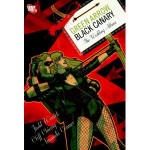
Green Arrow/Black Canary: The Wedding album


By Judd Winick, Cliff Chiang, Amanda Conner & André Coehlo (DC Comics)
ISBN: 978-1-4012-1841-6

Green Arrow is Oliver Queen, a cross between Batman and Robin Hood and one of DC’s Golden All-Stars. He’s been a fixture of the company’s landscape – often for no discernable reason – more or less continually since his debut in More Fun Comics # 73 in 1941. During those heady days origins weren’t as important as image and storytelling so creators Mort Weisinger and George Papp never bothered, leaving later workmen France Herron, Jack Kirby and his wife Roz to fill in the blanks with ‘The Green Arrow’s First Case’ at the start of the Silver Age superhero revival (Adventure Comics #256, January 1959).

As a fixture of the DC Universe since the early 1940s GA was one of the few costumed heroes to survive the end of the Golden Age, consistently adventuring in the back of other heroes’ comic books, joining the Justice League during the Silver Age return of costumed crusaders and eventually evolving into a spokes-hero of the anti-establishment during the 1960’s period of “Relevant” comics, courtesy of Denny O’Neil and Neal Adams.

Under Mike Grell’s 1980/1990s stewardship he became a gritty and popular A-Lister; an urban hunter who dealt harshly with corporate thugs, government spooks and serial killers rather than costumed goof-balls.

And then he was killed and his son took over the role.

And then the original was brought back…

Black Canary was one of the first of the relatively few female furies in the DC universe, following Wonder Woman, Liberty Belle and Red Tornado (who actually masqueraded as a man) and predating Merry the Gimmick Girl. She was created by Bob Kanigher and Carmine Infantino, debuting in Flash Comics #86, August 1947. She disappeared with most of the other super-doers at the end of the Golden Age, only to be revived with the Justice Society of America in 1963.

Originally an Earth-2 crimefighter transplanted to our world, she has been ruthlessly retconned over and again, and (currently) Dinah Laurel Lance is the daughter of an earlier, war-time heroine. However you feel about the character two consistent facts have remained since her reintroduction and assimilation in Justice League of America #73-75 (see Showcase Presents Justice League of America volume 4): she has vied with Wonder Woman herself for the title of premiere heroine and she has been in a stormy romantic relationship with Green Arrow.

The affair which began during of the Summer of Love finally reached a dramatic culmination a few years ago when the couple at last named the day, and this fearsomely dramatic and cripplingly funny tome gathers those unforgettable moments in a celebratory chronicle that will warm the hearts and chill the souls of sentimental thrill seekers everywhere.

Reprinting Green Arrow and Black Canary Wedding Special and issues #1-5 of the monthly Green Arrow and Black Canary comicbook, the saga begins with a hilariously immature retelling of the path to wedlock from scripter Judd Winick and Amanda Conner: spats, tender moments, hen-nights, stag-parties and a tremendous battle as a huge guard of dishonour comprising most of the villains in the DCU attack the assembled heroes when they’re “off-guard”.

Naturally the bad-guys are defeated, the ceremony concludes and the newlyweds head off to enjoy their wedding night.

And then in circumstances I’m not going to spoil for you Green Arrow dies again…

Obviously it doesn’t end there. For the start of their new series and the story-arc ‘Dead Again’, by Winick and Cliff Chiang, Ollie Queen is only seen in flashbacks as the Black Widow Canary goes on a brutal crime-crushing rampage. ‘Here Comes the Bride’ finds her slowly going off the rails and only Ollie’s son Conner Hawke seems able to get through to her where friends like Green Lantern, Superman, Oracle and even Ollie’s old sidekicks Speedy and Red Arrow tell her to move on.

As usual it takes the ultra-rational Batman to divine what really happened on the wedding night…

In ‘The Naked and the Not-Quite-So-Dead’ Dinah and Mia Dearden – the new Speedy -infiltrate the island home of the miscreants who have abducted and imprisoned Green Arrow (notice how vague I’m being; all for your benefit?) where Ollie is already proving to be more trouble than he can possibly be worth. Conner is also on hand and whilst attempting to spring his wayward dad also falls captive to overwhelming forces…

‘Hit and Run, Run, Run!’ ramps up the tension as the heroes all escape but not before one of their number is gravely wounded by a new mystery assailant, and in ‘Dead Again: Please Play Where Daddy Can See You’ it’s Ollie’s turn to fall apart as his wounded young protégé fights for life.

The book concludes in the heart-warming ‘Child Support’ with another series of poignant flashbacks describing Green Arrow’s history and his extended family of sidekicks before Dinah leads Ollie back from the brink of utter despair…

Green Arrow and Black Canary are characters that epitomise the modern adventure hero’s best qualities, even if in many ways they are also the most traditional of “Old School” champions. This is a cracking example of Fights ‘n’ Tights done right and is well worth an investment of your money and time.

© 2007, 2008 DC Comics. All Rights Reserved.
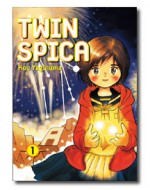
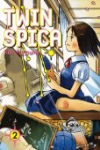
Twin Spica volumes 1 & 2


By Kou Yaginuma, translated by Maya Rosewood (Vertical)
ISBNs: 978-1-934287-84-2 & 978-1-934287-86-6

The mystery and imagination of space travel, so much a component of immediate post-World War II industrial society, returns in all its resplendent wonder and glory in this freshly translated new manga series from young talent Kou Yaginuma who first stormed to public attention with the poignant short story ‘2015 Nen no Uchiage Hanabi’ (‘2015: Fireworks’, published in Comics Flapper magazine, June 2000) before turning the subject, themes and characters into a longer epic combining hard science and fiction with lyrical mysticism and traditional school days growth pangs

2024AD: Asumi Kamogawa is a teenaged girl who has always dreamed of going into space. From her earliest moments the lonely child has gazed up at the stars with her imaginary friend Mr. Lion, staring at the heavens, and especially at the twinkling glow of Virgo and the alluring binary star Spica. An isolated, serious child, she lives with her father, a labourer who once worked for the consortium which built the space rockets for Japan’s Space Program.

In 2010, when Asumi was a year old the first Japanese space launch ended in complete disaster when the ship, dubbed Shishigō (“The Lion”), exploded and crashed to earth on the city of Yuigahama. Hundreds of people were killed and injured, including Asumi’s mother. Maimed and comatose, she took years to die and the trauma broke her grieving husband and utterly traumatised the infant Asumi.

In response to the disaster Japan founded an astronaut and space sciences training school and as the first volume opens Asumi discusses with her imaginary friend the best way to tell her dad that she has secretly taken the entrance exam. Tomoro Kamogawa is a no fan of the space program, having lost his wife, his engineering job and his pride to the race for space. He has raised his daughter alone by working two and often three menial jobs at a time for over a decade.

The problem is taken out of her hands when he opens her results letter and sees that she has been accepted for the next intake for the Tokyo National Space School. After initial resistance he surprises Asumi by not only allowing her to go, but also by giving her all his savings to pay her expenses. Arriving in Tokyo, Asumi moves into the dilapidated campus dormitory with a few other students too poor to live in private lodgings. A further surprise comes when she discovers that Shinnosuke Fuchuya, the boy who teased and bullied her all through school, has also been accepted for the Astronaut course. When questioned he grunts that he’d rather do anything other than run the family fireworks shop…

The course is heavily over-subscribed so the candidates are winnowed out by spending the first week in an adaptability stress test: three to a room, in complete isolation, taking mental and physical tests to determine how they would cope with conditions similar to an extended stay in a space capsule. Tiny Asumi (only four feet, eight inches tall) is placed with the jolly Kei Oumi and chilly, acerbic Marika Ukita whilst Fuchuya’s team is cursed with spooky, ultra-cool style-icon Shu Suzuki…

It quickly becomes clear that the tutors are being devious and the tests are actually designed to measure not just their survival capabilities but also their ability to get on in a crisis. As the week progresses tempers fray and Asumi suffers a flashback to the aftermath of The Lion’s crash…

Only thirteen teams make it through the test. However, even though she is a survivor, worse is to come for the young Asumi…

This first volume includes that painfully powerful and wistful tale‘Fireworks: 2015’, the first of five introductory stories the artist produced for Seinen (manga for older readers; mostly males aged 18-30) publication Comics Flapper. Asumi is a troubled little girl: always running away and even stealing the ashes of her mother, who has just died after years in a coma following the crash of the space rocket onto Yuigahama city.

On her travels the little girl meets a man with a lion’s head, who seems to know her teacher Suzinari. Deeply concerned for Asumi, Suzinari also has problems of her own. She still desperately misses her fiancé, who piloted The Lion and died in the tragic explosion five years previously…

‘Asumi’ is another prequel tale, showing the miserable, melancholic period immediately following the disaster. Bullied in elementary school the little stargazer runs away and gets lost in the wild woods, before chief miscreant Fuchuya heroically saves her from drowning. But were the people Asumi met just hallucinations of an oxygen-starved brain or something far more meaningful and miraculous…?

The first book ends with the vignette ‘Another Spica’ wherein wannabe manga artist Yaginuma is working part-time on a soft-drink stand one Christmas when he sees a little girl who twinkled like the stars and a man with a lion’s head…

The second volume follows space cadet Asumi as she adjusts to life in Tokyo: moving into women’s dorm “The Seagull”, making friends, starting classes and scraping by on her meager funds. An assiduous student, she nevertheless incurs the hostility of the astrophysics lecturer Professor Sano. Unknown to her Sano has bad history with her father and will seemingly do anything to thwart her dreams…

Asumi is far smaller than all the other candidates and though determined to succeed in the arduous physical and mental training incurs real problems in the swimming classes due to her near-drowning as a child. Moreover her size means she will need a custom-made pressure suit – giving Sano an opportunity to force her out by citing budget restrictions.

When this doesn’t work he steps up his campaign and really turns the screw on the unsuspecting Asumi, revealing a shocking secret about her father…

This volume also contains prequel stories of Asumi’s early life and in ‘Campanella’s Forest (referencing author Kenji Miyazawa’s novel Night on the Galactic Railroad) and exploring the past of the astronaut who piloted The Lion and highlighting Suzinari’s relationship with him. Meanwhile, Asumi has got lost again and stumbled upon something wonderful in the woods…

Tomoro Kamogawa is the tragic star of ‘Our Stars, Leaf Stars’. In the wake of the Lion disaster Asumi’s father was assigned by the corporation who built the ship to head the reparations committee. Guilt-wracked and himself bereaved, the devastated engineer had to visit and apologize to each and every survivor or victim’s grieving family. Meanwhile, little Asumi has found a new friend: another little girl forever scarred by the crash.

And as always the faithfully attendant Mr. Lion looks sadly on …

The volume concludes with a second ‘Another Spica’ episode as the cartoonist relates the time he worked in a shopping mall and had to dress up in a monkey suit, as that girl and that lion-headed guy simply looked on and mocked…

Twin Spica ran for eight enchanting years (September 2001 to August 2009): sixteen full volumes tracing the path of Asumi and her friends from starry-eyed students to fulltime astronauts and the saga spawned both anime and live action TV series.

This delightful comicbook epic has everything: plenty of hard science to back up the savvy extrapolation, a believable, likable cast, an enduring mystery, tender moments, isolation and teen angst, dawning true friendships, all wrapped up in a joyous coming-of-age drama with supernatural overtones and gobs of pure sentiment.

This tale reinvigorates the magical allure of the Wild Black Yonder for a new generation and is a treat no imagineer with head firmly in the clouds can afford to miss…

These books are printed in the Japanese right to left, back to front format.

© 2010 by Kou Yaganuma/Media Factory. Translation © 2010 Vertical, Inc. All Rights Reserved.

Fire & Water: Bill Everett, the Sub-Mariner and the Birth of Marvel Comics


By Blake Bell (Fantagraphics Books)
ISBN: 978-1-60699-166-4

Win’s Christmas Gift Recommendation: 9/10 Perfect for art lovers, Marvel Zombies, wannabe illustrators and lovers of pure comic magic

There’s currently a delightful abundance of beautiful coffee-table art-books/biographies celebrating the too-long ignored founding fathers and lost masters of American comic books, and this fabulous tome highlights the astounding wizardry of one of the most accomplished draughtsmen and yarn-spinners of that incredibly fertile early period.

As always you can save time and trouble by simply buying the book now rather than waste your valuable off-hours reading my blather, but since I’m going to froth on anyway feel free to accompany me as I delineate just why this tome needs to sit on your “favourites” shelf.

This lavishly illustrated, oversized tome traces the tragic life and awe-inspiring body of work of possibly the most technically accomplished artist of the US comicbook industry: a man of privilege and astonishing pedigree (he was a direct descendent and namesake of iconoclastic poet and artist William Blake) haunted by illness, an addictive personality and especially alcoholism, but a man who nevertheless raised a family, shaped an art-form and left twin legacies: an incredible body of superlative stories and art, and, more importantly, broken lives saved by his becoming a dedicated mentor for Alcoholics Anonymous.

William Blake Everett was born in 1917 into a wealthy and prestigious New England family. Bright and precocious he contracted Tuberculosis when he was twelve and whilst recuperating in Arizona began a life-long affair with and battle against booze. For the rest of his chequered life “Wild Bill” vacillated between magnificent artistic highs and heartbreaking personal lows, covered with chilling frankness in this excellent biography, written in conjunction with the artist’s surviving family.

Although telling, even revelatory and concluding in a happy ending of sorts, what this book really celebrates is not the life but the astounding legacy of Bill Everett. A gifted, driven man, he was a born storyteller who had the sheer naked ability to make all his own worlds real; and for nearly five decades his incredible art and wondrous stories, which began in the heydays of the Pulps (see also Spicy Tales Collection) enthralled and inspired successive generations of fellow dreamers.

His beautiful artwork featured in a variety of magazines before his fortuitous stumbling into the right place at the right time secured Everett’s place in history forever with his creation of the first anti-hero in comics.

Yet even before the advent of the mutant hybrid Sub-Mariner who, along with his elemental counterpart The Human Torch, secured the fortunes of the budding Marvel Comics (covered in a fascinating and detailed account which clears up many controversies that have raged amongst fans ands historians for decades) Everett was a valued and admired writer/artist/letterer/designer whose early seminal triumphs are lovingly covered here in many reproduced strip extracts, sketches and an utterly invaluable collection of original art pages.

Bill Everett was a jobbing cartoonist who drifted into the new world of comicbooks: a budding industry that combined his beloved drawing with his other compulsion – making up stories. The first chronological art selection here features a plethora of his compelling and irresistible covers for Amazing Mystery Funnies, Blue Bolt, Target Comics, Amazing-Man Comics, Victory Comics, Heroic Comics, and the landmark Motion Picture Funnies Weekly (for which he produced not only the pre-Marvel/Timely Sub-Mariner, but also the all-important back cover sales pitch) and many designs and roughs for unpublished titles, interspersed with pages and spreads from early creations Amazing-Man, Dirk the Demon, Skyrocket Steele, Music Master, The Chameleon, Hydroman, Sub-Zero and of course Prince Namor.

The early days of Marvel Mystery Comics and the Sub-Mariner’s own feature title are thoroughly represented with many pages of original art starring not only his aquatic antagonist but also The Fin and Human Torch, and this section is also full of delightful sketches from his four years of service in the Army Corps of Engineers.

The industry had changed radically by the time Everett mustered out: superheroes were on the wane and other genres were rising in popularity. Returning as a freelancer to Marvel/Timely, Everett worked again on Sub-Mariner and even created the sexy spin-off Namora and stillborn kid crusader Marvel Boy, but it was with the series Venus that he moved in a new direction: glamorous, glorious horror.

For over a decade he brought a sheen of irresistible quality to the generally second-rate chillers Timely/Atlas/Marvel generated in competition with genre front-runners EC Comics. It’s easy to see how they could compete and even outlive EC, with these lush and lurid examples of the hundreds of stunning covers and chillingly beautiful interior pages selected from such titles as Mystic, Menace, Astonishing, Adventures into Weird Worlds, Uncanny Tales, Suspense, Marvel Tales, Spellbound, Mystery Tales, Men’s Adventures and others. My only quibble is that unlike the companion volume featuring unsung genius Mort Meskin (see From Shadow to Light) there are no complete stories collected in this otherwise perfect primer.

Despite being unacknowledged as a master of terror, this period was probably Everett’s most technically adroit, but he also excelled in the other genre-ghettoes of the period. His ability to freeze manic action and convey tension into a single image made him the perfect choice for lead cover artist in the burgeoning military comics fields as can be seen in examples from Man Comics, Navy Tales, Battlefield, Navy Action, Navy Combat and others.

Everett truly excelled in the lush, stylistic depiction of action and horror themes – as well as the seductive delineation of sexy women, although he was equally effective in less histrionic arenas such as merchandising art, wholesome western, romances, cartoon and Bigfoot comedy styles, represented here by pages and covers from such diverse publications as Marvin the Mouse, Nellie the Nurse, Cracked, Jann of the Jungle, True Secrets, Girl Confessions, Bible Tales For Young Folk, Tales of Justice, Quick Trigger Western, Yellow Claw, Sports Action, Pussycat and so many others.

His final creative period follows his return to Marvel after time in the commercial art world and covers the creation of Daredevil, unsatisfactory runs on the Hulk, Dr. Strange, Sub-Mariner, Rawhide Kid and others as well as his stints inking Jack Kirby, Gene Colan, Ross Andru, Herb Trimpe, Dan Adkins and Barry Windsor Smith, before, clean and sober after decades, he produced a landmark run on his signature Sub-Mariner.

Tragically, decades of smoking and alcohol abuse had taken its toll, and only four years after turning his life around he died of complications arising from heart surgery, just when he seemed on the cusp of a brilliant creative renewal as remarkable as his meteoric rise in the 1930s and 1940s.

Evocatively written by biographer Blake Bell, with dozens of first hand accounts from family, friends and contemporaries; the sad, unjust life of this key figure of comics art is lovingly recounted here with hundreds of artistic examples from school days, army service, commercial and cartoon illustration and many intimate photographs supplementing the treasure trove of comics images. By tracking Everett’s early career as a pulp magazine illustrator, through his pioneering superhero art to the moody masterpieces of the 1950s and the Pop Art comics renaissance of the his later years, Fire and Water offers an opportunity to revel in the mastery of a truly unique pillar of America’s sequential Art establishment.

Most importantly for collectors and art-fans there is a overwhelming abundance of beautiful comics magic; from compelling page layouts, sketches and compositions to bold, vibrant pencils and slick luscious inking, and for we comics cognoscenti, the jackpot of never-before-seen unpublished pages: penciled, inked and camera-ready art-boards, as well as illustrations, family pieces and examples of his non-comics career

Brilliant, captivating, and utterly unmissable, this is the book Bill Everett deserves – and so do you.

© 2010 Fantagraphics Books. Text © 2010 Stephen Brower. All art © its respective owners and holders. All rights reserved.

Love and Rockets: New Stories volume 3


By The Hernandez Brothers (Fantagraphics Books)
ISBN: 978-1-60699-379-8

A year goes by like 365 days when you’re waiting for something really special and very often the anticipation is far headier than the eventual pay-off. Mercifully in the case of Love and Rockets: New Stories such in not the case, as the third annual volume proves to be the best yet, combining eccentric drama, bright fantasy, captivating whimsy and appalling human frailty into a package of stunning graphic intensity.

In the 1980s a qualitative revolution forever destroyed the clichéd, stereotypical ways different genres of comic strips were produced and marketed. Most prominent in destroying the comfy pigeonholes we’d built for ourselves were three guys from Oxnard, California; Jaime, Mario (occasionally) and Gilberto Hernandez.

Love and Rockets was an anthology magazine featuring slick, intriguing, sci-fi tinted hi-jinx of punky young things Maggie and Hopey – las Locas – and heart-warming, terrifying, gut-wrenching soap-opera fantasies from the rural Central American paradise of Palomar. The Hernandez Boys, gifted synthesists all, enthralled and enchanted with incredible stories that sampled a thousand influences conceptual and actual – everything from Comics, TV cartoons, masked wrestlers and the exotica of American Hispanic pop culture to German Expressionism. There was also a perpetual backdrop displaying the holy trinity of youth: Sex and Drugs and Rock and Roll – for which please hear alternative music and punk rock.

The result was dynamite. Mario only officially contributed on rare occasions but the slick and enticing visual forays by Jaime explored friendship and modern love whilst destroying stereotypes of feminine attraction through his fetching coterie of Gals Gone Wild and Gilberto created the hyper-real landscape of Palomar: a playground of wit and passion created for the extended serial Heartbreak Soup, in the quicksilver form of a poor Latin-American village with a vibrant, funny and fantastically quotidian cast. The denizens of Palomar still inform and shape the latest tales from Beto both directly and as imaginative spurs for unassociated stories.

Everything from life death, adultery, magic, serial killing and especially gossip could happen in Palomar’s meta-fictional environs, as the artist mined his own post-punk influences in a deceptively effective primitivist art style which blended the highly personal mythologies of comics, music, drugs, strong women, gangs, sex and family using a narrative format that was the graphic equivalent to the literary discipline of Magical Realism.

Winning critical acclaim but little financial success the brothers temporarily went their own ways but a few years ago creatively reunited to produce these annual collections of new material in their particularly peculiar shared or rather, intermittently adjacent pen-and-ink universes.

This third volume commences with Gilbert’s ‘Scarlet by Starlight’ a multi-perspective narrative that appears at first to be a science fictional fable before evolving into something far more disturbing. On a distant world, a team of three earthling explorers are becoming far too intimate with the primitive yet buxom anthropoids that populate the planet and as the human relationships break down, unwise new bonds are formed with unpleasant and even harrowing results…

Savage and sexually explicit, this exploration of drives and desires takes a further step into forbidden territory when the explorers return home…

Maggie Chascarrillo – star of las Locas – takes centre stage in Jaime’s ‘The Love Bunglers Part One’, a lonely middle-aged lady, still looking for her life’s path and still an unsuspecting object of desire to the men who flock around her. But who is that particularly dangerous-looking bum stalking her?

The central portion again features Gilbert’s newest fascination: the young, rebellious and dangerously pneumatic underage Latina spitfire dubbed “Killer” – actually the juvenile character Dora Rivera – granddaughter of Palomar’s formidable Matriarch Luba (see Luba and Love and Rockets: New Stories volume 2) grown to a far more dangerous age.

As seen in the previous volume, Killer, who is slowly making her way into the exotic B-movie arena that fascinated and overwhelmed her Aunt Fritz (See also High Soft Lisp and The Troublemakers) is a highly strung creature on the verge of losing all her remaining innocence and in ‘Killer*Sad Girl*Star’ is considering remaking one of her aunt’s strangest movies whilst becoming involved in a senseless tragic crime… or is she?

Maggie’s turbulent childhood is revealed in Jaime’s startling and truly disturbing ‘Browntown’ as the Chascarrillo family move to a new city where both parents and all four kids undergo differing ordeals which reshape them forever. A note of warning: There are some heart-rending situations of child-abuse here that, although artistically valid and even necessary, are also genuinely upsetting, so please remember that this is a book strictly for mature readers.

The harrowing revelations of ‘Browntown’ lead directly into ‘The Love Bunglers Part Two’ as many of the mysteries set up in the first chapter are thrown into stark relief by the events from Maggie’s past, leading to a surprisingly warm-hearted conclusion to this deceptively hard-hitting book.

Stark, challenging, charming and irresistibly seductive, Love and Rockets: New Stories is a grown up comics fan’s dream come true and remains as valid and groundbreaking as its earlier incarnations – the cutting edge of American graphic narrative.

© 2010 Gilberto, Jaime and Mario Hernandez. This edition © 2010 Fantagraphics Books. All Rights Reserved.

Angel: Not Fade Away


By Jeffrey Bell & Joss Whedon, adapted by Scott Tipton, Stephen Mooney & Ciaran Lucas (IDW)
ISBN: 978-1-60010-529-6

When Buffy the Vampire Slayer stormed onto television screens and into the dark hearts of the world’s fantasy fans the show quickly began turning vampiric lore and traditions on their collective head. One of the most far-reaching storylines involved the feisty heroine falling in love with the enigmatic Angel, who was eventually revealed as the ultimate bad-boy in search of redemption. Once the most sadistic and brutal predator on Earth Angel was cursed by gypsy magic and subsequently regained his soul. Plagued by memory of his horrendous past deeds and driven by insatiable remorse he became a warrior on the side of righteousness – and promptly gained his own spin-off show.

For five seasons and 110 episodes Angel and his crew of assistants, which eventually included his arch-enemy, the other cool bad-boy poacher-turned-gamekeeper Spike (see Buffy the Vampire Slayer: Spike and Dru) battled a all-pervasive demonic coalition intent on dimensional domination in the grim, dark environs of Los Angeles.

Masquerading as big-shot lawyers, Wolfram and Hart constantly worked their horrendous schemes until after years of battle they seemingly corrupted and co-opted Angel and his team, but it was of course a cunning plan to destroy the organisation from within and one which concluded in a an unforgettable final episode that was possibly television’s ultimate “Butch and Sundance” moment. This impressive oddity adapts that final small screen classic into a rather impressive sequential narrative, albeit one that must be utterly impenetrable to non-fans and newcomers…

‘Not Fade Away’ was originally scripted by Jeffrey Bell & Joss Whedon and is adapted here by writer Scott Tipton, illustrated by Stephen Mooney and colourist Ciaran Lucas, first seeing comic life as a three issue miniseries in 2009. It opens as Angel, Spike, defrocked watcher and neophyte wizard Wesley, benevolent demon Lorne and human vampire hunter Gunn seal a pact to murder Wolfram and Hart’s inner circle of demons, the Black Thorn, before the cabal can initiate the apocalypse and end humanity.

Untrusted and watched at all times the doomed band accept assassination assignments and spend the last day of their lives securing what allies they can (such as Angel’s son Conner, morally-ambivalent vampire PA Harmony, elder Goddess Illyria and the turncoat W&H lawyer Lindsey) paying off debts and making their varied peaces with the universe.

A cross between pure Greek tragedy and Scandinavian foreshadowed Ragnarok-in-waiting, this spectacular tale is moody, poignant, brutally action-packed and stuffed with dark humour. It’s no surprise that the heroes succeed in their mission but the saga ends as the supreme masters of supernal evil in the universe unleash all the hordes of hell to take vengeance on the monster hunters who have killed their agents and thwarted their millennial scheme…

As an added bonus for devoted fans and aspiring writer/directors this volume also includes the original shooting script for TV episode, beautifully illustrated by the extremely talented Jeff Johnson.

Somewhat diluted by recent comicbook sagas set after that glorious denouement, Angel and the surviving heroes are still actively holding back the final night…

Although visually impressive and engaging if you’re familiar with the vast backstory, this is still a chronicle best enjoyed by the already converted, although the shows are available on TV and DVD; so if you aren’t a follower yet you soon could – and should – be…

Angel © 2009 Twentieth Century Fox Film Corporation. All Rights Reserved. © 2009 Idea and Design Works, LCC.

Too Soon?: Famous/Infamous Faces 1995-2010


By Drew Friedman (Fantagraphics Books)
ISBN 13: 978-1-60699-537-6

Technically, this isn’t a graphic novel or trade collection, it’s a picture book – but it is an absolutely stunning one, collecting some of the best and most trenchantly funny illustrations by a contender for the title of America’s Greatest Living Caricaturist in a lavish, full-colour hardback.

Drew Friedman began drawing commercially in the late 1970s. His meticulous, stippled monochrome satirical and socially biting cartoons of celebrities – and the rare comic strip – appearing in RAW, Screw, High Times, Weirdo, Comical Funnies, Heavy Metal, National Lampoon and the Holy of Holies MAD Magazine.

Gradually he moved into the publishing mainstream, and the phizzogs and foibles of the Rich and Famous gathered here are culled from a number of eclectic sources including Time, Newsweek, The New Yorker, GQ Magazine, The Wall Street Journal, New York Observer, New York Times, Rolling Stone, The Washington Post, Entertainment Weekly, Village Voice, Mojo, The New Republic, The Los Angeles Times, The Weekly Standard, Blab!, Maximum Golf and even the gun-totin’ sports organ Field & Stream among many others – an hilarious cavalcade of covers and spot illustrations by a master of the graphic ideal moment.

After a funny and extremely informative potted history the mostly painted (but with occasional pen, wash, tone and even charcoal examples), staggeringly cruel, cutting and insightful images are unleashed, beginning with a section covering political and business highflyers.

The period 1995 to 2010 turned up an unenviable horde of risible leaders and manipulative malcontents and included here are 107 cartoon snapshots of such luminaries as the Clintons, Monica Lewinsky, Helmut Kohl, George W. Bush, Barack Obama, Al Gore, Ross Perot, Sarah Palin, “Mayor Mike” Bloomberg, John McCain, Rudy Giuliani, Dick Cheney and many other domestic demagogues as well as such international ideologues as Tony Blair, Yasser Arafat, Mother Theresa, Jacques Chirac and Osama Bin Laden among many others.

The second section deals with Showbiz types ancient and modern, an includes a couple of astonishingly grand panoramic gatefold fold outs amidst the 140+ illustrations featuring super-stars and should-have-beens from sports, music, acting, the media and that nebulous twilight world of people who are famous without actually doing or achieving anything.

The roster includes Tiny Tim, Dean Martin, Sinatra, John Lennon, Michael Jackson (lots of him at various stages of his life-long metamorphosis), Tommy Lee, Madonna, Fred MacMurray, Judy Garland, Jackie Chan, Bob Dylan, Brando, De Niro, Woody Allen, Stallone, Will Smith, Tiger Woods, Mike Tyson, Jack Nicholson and so many others. The volume also includes some book and CD covers and private commissions, and also a fresh selection of the artist’s favourite artistic subjects: sideshow freaks and obscure Jewish and vintage comedians.

Friedman is a master craftsman who can draw and paint with breathtaking power, and his work is intrinsically funny. It’s relatively simple to make Blair, Bush or Bin Laden look like buffoons but try it with Rod Serling, Marilyn Manson, Mother Theresa or Salman Rushdie…

His caricatures are powerful, resonant and joyful, but without ever really descending to the level of graphic malice preferred by such luminaries as Ralph Steadman or Gerald Scarfe. Too Soon? is a book for art lovers, celebrity stalkers and anyone who enjoys a pretty, good laugh.

© 2006 Drew Friedman. All Rights Reserved.

You can see sample pages on the arts website www.Drawger.com

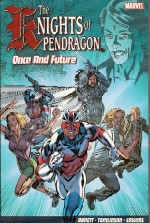
Knights of Pendragon: Once and Future


By Dan Abnett, John Tomlinson, Gary Erskine & Andy Lanning (Marvel/Panini Publishing UK)
ISBN: 978-1-84653-431-7

The world was a rapidly changing place in 1990 and fledgling offshoot Marvel UK was critically rising high thanks to the immensely impressive original Captain Britain material being created by Alan Moore and Alan Davis. On a roll, the company attempted to expand its line with an associated title, once more combining Arthurian fantasy with tried and true Marvel superheroic action. Or so everybody thought…

The Knights of Pendragon prominently featured Captain Britain on the covers but the epic tale that unfolded over the next few months was far more a supernatural horror story in the manner of prophetic TV show “Doomwatch” than a traditional Fights ‘n’ Tights slugfest – even by the often outré British standards.

Steeped in ecological hot-button topics and starring, initially at least, a podgy, over-the-hill welsh copper who had begun life as a authoritarian gadfly before becoming a solid, stolid comrade to Brian Braddock (Cap’s aristocratic Alter Ego), Knights of Pendragon followed Chief Inspector Dai Thomas as he seemingly went off the deep end, plagued by horrific premonitions of grisly massacres that all seemed linked to environmental crimes perpetrated by globe-girdling conglomerate the Omni Corporation. However as the months unfolded a pattern slowly unfolded that indicated something far older and more dangerous than money was flexing long dormant fangs and sinews…

This book gathers issues #1-9, July 1990-March 1991, of the first volume (a second far more traditional series followed in 1993) and sees the saga begin with ‘Brands and Ashes’ as Thomas is summoned by Captain Britain to a meeting of the clandestine agency the Weird Happenings Organisation. It appears the retired cop’s dream of 87 hungry patrons mysteriously suffocating in a spacious, airy well-ventilated burger-bar has come hideously true. Meanwhile Omni Corp exec Grace has sent her dashing leg-breaker Dolph to “reason” with the minister in charge of W.H.O….

As Thomas is briefed on an increasingly large and violent tide of bizarre eco-mysteries, down in Kent something horrible is occurring on an Omni farm using new and lethally dangerous pesticides. Rogue TV journalist Kate McClellan is circling too. She smells a big story and is ruthlessly open-minded. She wants and will publish the truth no matter how strange and impossible it might appear…

Thomas is getting worse. His visions now include blackouts and fugue episodes in which he sees himself as the medieval hero of the ancient epic “Sir Gawain and the Green Knight” battling ogres, villains and monsters.

‘Skin and Bone’ finds him following a lead to Africa where ivory poachers are using helicopters and assault rifles to slaughter elephants in vast numbers. McClellan is there before him and has already discovered a link to smuggled diamonds and Omni but before Thomas can make an arrest the supernal force he is slowly coming to believe in exacts its own bloody justice, whilst ‘Oil and Water’ sees cop and reporter in Florida, investigating another bizarre Omni-related atrocity – smuggling endangered species – when an ambush goes wrong. Any doubt of supernatural involvement is abandoned when they are rescued from certain death by a creature that cannot possibly exist…

Thomas is gradually changing: evolving into a younger, fitter version of himself and the premonitions and dreams of Gawain are occurring more frequently. In ‘Blood and Feathers’, Grace decides to end the old copper’s interference with an elite squad of high tech mercenaries led by Dolph. After smashing another animal smuggling ring – with his bare hands – Thomas and McClellan are attacked in broad daylight. He overcomes the super-commandoes with ease, but the machinations of Grace have made him a liability to W.H.O. and Captain Britain is ordered to bring him in at all costs…

‘Hope and Glory’ reveals Kate is having visions of her own. As Thomas makes his way across Costa Rica hunting the thing that’s hunting Omni’s assorted enterprises, she is arrested by W.H.O. agents. Dai is close to the answers he’s been seeking as he enters an apocalyptic area of jungle deforestation, convinced he is Gawain reborn. The spirit of the planet has given man one final chance to live with, not against, the eco-system, but the forces of progress and destruction are subtle and have turned his greatest friend against him…

After a stupendous battle Thomas is beaten to death by Captain Britain, and in the concluding ‘Once and Future’ Gawain takes full control of his broken body, casually revealing the guilt-wracked superhero to be Lancelot whilst Kate houses the spirit of Guinevere. Attacked by demonic monsters the trio trek through the devastated rain-forest, making a pilgrimage to the home of the embattled animating force called the Green Knight, saving the Green Chapel, mystical heart of the world, from dark forces that have worked through Omni and other modern enterprises which value profit over the planet…

Its mission accomplished, Gawain’s essence leaves Dai’s body, resurrecting and healing him, but there has been no victory, only a truce. The Green Knight will no longer attack human greed and folly directly, but the latest Knights of Pendragon are expected to work in its stead. The second story-arc sees new men of goodwill chosen as hosts for the immortal heroic essences and a redefinition of the vague dark forces they must combat.

In ‘Revelations’ author Ben Gallagher is drawn to a remote Scottish island to bear witness to a brutal slaughter of dolphins, whilst in London a serial killer hunts successful businesswomen and in her technological ivory tower, Omni exec Grace is possessed by the Green Knight’s opposite number, a vile entity calling itself The Bane.

During the Great War the British Empire was championed by a pioneering band of costumed heroes. Union Jack was mere mortal who used brains, brawn and good British ordnance to battle the Hun in two world wars before being succeeded by his son. The third incarnation was Joey Chapman, a true working class hero who here finds himself the next recipient of the spirit of Lancelot.

Kate has a troubled son squirreled away at a remote boarding school. When Cam McClellan goes missing after being possessed by the Merlin analogue known as Herne the Hunter, the situation forces elderly history teacher Peter Hunter to reveal his darkest secret. ‘The Only Child’ describes how in the Great War the schoolmaster was masked mystic superman Albion, but with his surrendered Pendragon force now inhabiting a disturbed child he fears he must reassume the role he gratefully relinquished decades ago.

Captain Britain and Union Jack join the search for Cam but spend more time battling each other than actually helping, leaving the London serial killer free to attack his next target – the world-famous TV journalist Kate McClellan. However, even though the madman is old acquaintance he has not reckoned on her new status as a full-blown Pendragon.

Events take a truly dark turn when Grace arrives at the school to abduct the confused and immensely powerful Cam, intending to corrupt him as once she damned Arthur’s son Mordred…

Gallagher’s sensitively creative yet indomitable nature makes him a perfect host for the returned Sir Percival and in the untitled closing tale he sees the powers arrayed against the returned Knights in full flow, as an innocent dies and entire families of dolphins are sacrificed to the horrific greed and paranoia of humanity and the awful hunger of the Bane

The epic has been building across the nine issues of the series collected here, written with chilling passion by Dan Abnett and John Tomlinson and illustrated with stunning power by then fresh-faced new boy Gary Erskine, suitably inked by near-veteran Any Lanning.

With intriguing and revelatory reminiscences from the writers and original series editor Steve White describing the initial resistance and eventually outright hostility from upper management to the title plus a cover gallery by such leading lights as Alan Davis, Simon Bisley, John Bolton and others, this engrossing and still controversial epic revives a pivotal moment in British mainstream comics and still enthrals two decades later.

Ending on a pensive set of cliffhangers, this absorbing thriller is but half-done, with another utterly fabulous and morally challenging volume still to see. I can’t wait…

© 1990, 1991, 2010 Marvel Entertainment LLC and its subsidiaries. All Rights Reserved. A British edition published by Panini.

Prison Pit Book Two


By Johnny Ryan (Fantagraphics Books)
ISBN: 978-1-60699-383-5

Johnny Ryan is a cartoonist with an uncompromising vision and an avowed intention of producing shock and even revulsion whenever he wants to. In Prison Pit he pushed the limits of taste with a brutal, primitive cascade of casual violence that sprung, teeth bared and claws extended, from his apparent obsession with casual violence, social decay and the mythology of masked wrestling, as well as his obvious fascination in the “berserk” manga strips of Kentaro Miura.

That initial volume presented a disturbingly child-like view of a science fictional Hell: an extra-dimensional purgatory where the most violent felons were dumped to live or die by a society that had no place for them. This barren landscape was littered with grotesque monsters, vile organisms and the worst specimens of humanity ever captured by the forces of civilisation. C.F., a masked wrestler, was dumped there and told to fight or die…

What followed was non-stop excessive force and graphic carnage: a never-ending Darwinian struggle which saw the wrestler damaged beyond comprehension, altered by horrors internal and external, but nevertheless still clawing his way to the top of the gory, scatological heap…

Unbelievably Ryan has gone even further in this second volume as the wrestler defeats what he had assumed to be the king of the heap, aided by a biological travesty that then turns on him, before being kidnapped by a robotic Dr. Moreau, who transforms the wrestler’s most intimate man-parts into a weapon of interpersonal destruction and sends him off violate a monster. Typically, nobody here is doing anything for anyone else’s benefit…

Man’s oldest gynophobic horrors and most simplistic delight in sheer physical dominance are savagely delineated in this primitive, appalling, cathartic and blackly funny campaign of cartoon horror. Resplendent, triumphant juvenilia is adroitly shoved beyond all ethical limits into the darkest depths of absurdist comedy. Not for children, the faint-hearted or weak-stomached, this is another non-stop rollercoaster of extreme violence, profanity and cartoon shock and awe at its most visceral and compelling.

And now that we’ve put off the intellectual and moral stuck-up sticky-beaks who just love to whine and complain, I’ll let you into a secret: this book is all-out over the top and flat out hilarious. Buy and see if you’re broad-minded, fundamentally honest and purely in need of ultra-adult silliness…

© 2010 Johnny Ryan. All rights reserved.

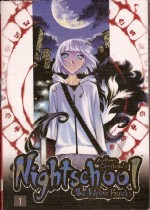
Nightschool: The Weirn Books volume 1


By Svetlana Chmakova (Yen Books)
ISBN: 978-0-7595-2859-8

The sub-genre of supernatural students and spooky schooldays has come a long way since the days of the Worst Witch or even Buffy of Sunnydale High, but this tantalising and impressive entry from Svetlana Chmakova (whose delightful series Dramacon introduced her as a major talent in the international manga world) which stands head and shoulders above the crowd and simply cries out for greater exposure.

PS 13W is just an ordinary High School during the day, but when darkness falls the place is sublet to an entirely different faculty teaching a far more bizarre and dangerous student body (well, different anyway – I’ve seen the everyday shamble of oiks, nerds, preppies and deviants that tumble out of our local educational establishment come chucking out time only to stampede past my front door on their way to celebrate their temporary freedom in mischief, malice and mishap…)

Because this Nightschool caters to such a diverse and often predatory catchment, the usual staff of wizardly teachers and assistants is generally supplemented by a Night Keeper – a supernatural security agent who keeps the peace and minimises collateral damage when students and staff – witches, warlocks (collectively known as Weirn), werewolves, vampires and every shade of juvenile haunt and horror – join in the business of Education.

Sadly the latest Keeper, thoroughly modern Miss Sarah Treveney has something of a punctuality problem… Although the school caters for a broad spectrum of monsters, Sarah’s sister Alexius has to be home-schooled due to an unspecified secret problem, and splitting her time between teaching Alex the magic of the Weirn all day and working all night is taking its toll…

The peace that keeps mortals safe from the assorted eldritch tribes is due to an ancient pact: A Treaty administered by an enigmatic cult of young warriors called Hunters who prowl the city dealing with supernatural threats. They are led by a charismatic teacher called Daemon. Later volumes will eventually reveal a history of ancient strife and impending chaos, but for this first collection (comprising the first six months of the strip) they simply patrol and police the places where rogue night creatures prowl…

When Daemon’s team rescue a young Seer, Marina, from unscrupulous mortals seeking to exploit her prophetic abilities she warns him that a long-dormant menace is breaking the seals which have kept it safely imprisoned for centuries…

Unknown to Sarah, little sister is not the housebound claustrophobe she imagines. Driven by urgings beyond her comprehension Alex often roams the night with only her astral familiar to protect her from mortals and monsters – or is it the other way round?

When she invades a cemetery Alex stumbles across a romantic vampiric tryst and Daemon’s Hunter team in the process of ending it. Suddenly all parties are attacked by Rippers – mindless devolved Nosferatu, all claws and teeth and burning lethal hunger…

When the spectacular battle ends Alex is gone and although more than a match for any known magical threat, three of the Hunters lie mysteriously comatose. The younger Treveny wakes safely at home with no recollection of how she returned, but at the Nightschool things aren’t going so well for Sarah.

Making inroads with the staff and students the Night Keeper thinks she might just make a real go of her job, but when a kid she doesn’t recognize lures her into a horrifying trap she disappears from sight and memory of everybody who once knew her. Moreover, all physical evidence of her existence is fading too. At home Alex sees a photograph gradually disappear and realises she must to something. Girding herself she enrolls in the midnight high school, as all over the cities something very nasty is stalking the Hunters…

This is the merely the opening stage of a much larger and more complex epic, (which has been and is still steadily progressing in monthly installments in the Japanese magazine Yen Plus since August 2008), so it might be preferable to pick up the first three volumes – all that has been collected into books so far – and tackle them at once.

However, the sheer exuberance and quality of storytelling and art here is enough to carry this first book; blending mystery, comedy and spellbinding action with a huge cast of engaging characters. Fun, thrilling and wonderfully addictive.

© 2009 Svetlana Chmakova. All Rights Reserved.

Buffy the Vampire Slayer: Spike and Dru


By Christopher Golden, James Marsters, Ryan Sook, Eric Powell & various (Dark Horse/Titan Books)
ISBN: 978-1-84023-282-0

Vampire love is something of a hot topic these days so let’s take a look at one of the ancient antecedents responsible for this state of affairs – in the shape of a collection of one-shots and short stories originally published by Dark Horse to augment their comicbook franchise of the global mega-hit Buffy the Vampire Slayer.

Buffy was a hip teen cheerleader turned monster killer, and as the TV series developed it soon became clear that the bad-guys were increasingly the fan-faves. Cool vampire villain and über-predator Spike eventually became a love-interest and even a moodily tarnished white knight, but at the time of this collection was still a blood-hungry, immortal immoral jaded psychopath – every girl’s dream date.

His eternal paramour was Drusilla: a demented precognitive vampire who killed him and made him an immortal bloodsucker. She thrived on new decadent thrills and reveled in baroque and outré bloodletting. This collection traces their relationship through the 20th century, laying the seeds for the events of the television episodes and begins with ‘All’s Fair’ scripted by Christopher Golden and illustrated by Eric Powell, Drew Geraci, Keith Barnett, Andy Kuhn, Howard Shum & Norman Lee.

There is an unbroken mystical progression of young women tasked with killing the undead through the centuries, and the book opens during the Chinese Boxer Rebellion in 1900, where Spike and Dru were making the most of the carnage after killing that era’s Slayer. The story then shifts to the Chicago World’s Fair of 1933 where once more the undying lovers are on the murderous prowl. However, the scientific wonders of the modern world are eclipsed by a scientist who has tapped into the realm of Elder Gods as a cheap source of energy. To further complicate matters the dark lovers are being stalked by a clan of Chinese warriors trained from birth to kill the pair to revenge the Slayer killed in Beijing.

Gods, demons, Mad Scientists, Kung Fu killers, Tongs and terror all combine in a gory romp that will delight TV devotees and ordinary horrorists alike.

Decades later the pair were again roaming through America in ‘Queen of Hearts’ (by Golden & Ryan Sook), driving to St Louis where they boarded a gambling palace on a paddle-steamer, just wanting to waste some time and test their luck. Unfortunately the enterprise was run by a sinister luck-demon with as little concept of fair play as Dru and Spike… All the forces of elemental supernature couldn’t prevent the river running red – and numerous other colours – with demon blood…

Author, director and actor James Marsters played the laconic Spike on the TV show and co-wrote the next mini-epic in this tome. ‘Paint the Town Red’ also by Golden & Sook is set just after the undead couple had split up following a terrific spat, and follows the heart-sore Cockney Devil from Sunnydale to an isolated Turkish village where he set up his own private harem and hunting preserve. Everything was perfect until Dru came looking for him with her latest conquest, a resurrected necromancer.

Koines is her love-slave, a wizard capable of controlling corpses with but a thought. Until she set her death-monger against Spike it hadn’t occurred to anybody that vampires are just another sort of cadaver, but once the mage realised he decided to renegotiate the terms of his rather one-sided relationship with the inventively psychotic vampire virago, and Spike found that he was not quite over Dru yet…

The chronicle concludes with the brutally melancholy ‘Who Made Who?’ (Golden, Powell, Barnett & Geraci), a brief yarn set in Rio which revealed why the reunited couple finally called it a day. Cue hearts, flowers, multiple infidelities and a lot of sudden, violent deaths…

These supplementary tales of extremely dark and forbidding romance comprise a thoroughly readable tearjerker with hilariously barbed edges: instantly accessible to not only the dedicated Joss Whedon fan but also any lover of horror stories. If vampires could love I suspect this is how it would really look…
™ & © 2001 Twentieth Century Fox Film Corporation. All Rights Reserved.