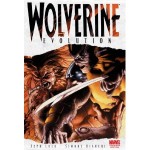
Wolverine: Evolution


By Jeph Loeb, Simone Bianchi & Andrea Silvestri (Marvel)
ISBN: 978-0-7851-2256-5-2

Debuting as an foe for the Incredible Hulk in a tantalising teaser-glimpse at the end of issue #180 (October 1974) before indulging in a full-on scrap with the Jade Giant in the next issue, the semi-feral Canadian mutant with fearsome claws and killer attitude rode – or perhaps caused – the meteoric rise of the AllNew, All Different X-Men before gaining his own series, super-star status and silver screen immortality; a tragic, brutal, misunderstood hero cloaked in mysteries and contradictions.

Logan’s come a long way since then; barely surviving chronic over-exposure in the process and now finds himself a solid star of the Marvel firmament. However that status is not without its own peculiar pitfalls, as such A-List players find themselves afflicted with a particularly tedious modern curse: Pernicious Recurrent Re-Origining…

A separate condition from actually retconning (where characters and continuity are dialed back to a specific point and the character is redesigned, PRR-O consists of infilling perceived cracks or gaps in the canonical history to reveal previously concealed or forgotten information.

Certainly some of these tales are utterly wonderful: Miller’s introduction of Elektra in the 1980s totally revolutionised and revitalised Daredevil and Batman probably started the whole process in 1956’s Detective Comics #235 when Bruce Wayne discovered he had seen father in a Bat-costume whilst still a toddler, but personally I cannot think of anything more pointless than constantly revising a character’s backstory rather than crafting new adventures or developments. I’m obviously in a minority on that score…

Wolverine has had a whole bunch of secret origins and revelatory disclosures in his extended, conveniently brainwashed and amnesiac life but this tome (which originally appeared as Wolverine volume 3, issues #50-55, November 2007-March 2008), at least tacks this latest round of really, honestly, for-gosh-sakes-I-mean-it true surprises to a fast-paced and engrossing recap and (purportedly) final clash between the miniscule mutant and his manic homicidal analogue Victor Creed: Sabretooth.

Scripted by Jeph Loeb and beautifully illustrated by the stunningly talented Simone Bianchi the story begins at fully gory pelt and just races on regardless…

The two fast-healing Mutant furies have clashed over and again and here Wolverine decides to end his enemy once and for all. However, his determination is somewhat distracted by recurring hallucinations and sense-memories of primeval pasts and a strangely familiar race of werewolf-like creatures that he feels a haunting kinship with…

Logan drags Sabretooth from the protective custody of his former X-Men associates in ‘First Blood’ and as new, lost memories constantly assault him, spectacularly battles Creed across half the globe, past clashes blending with current blows and fantastic images of primordial race wars in ‘Deja Vu’.

In ‘Blood on the Wind’ the murderous mutants, unable to permanently harm each other, nevertheless persist in their bloody vendetta until they reach the Black Panther’s hidden African kingdom, where old X-comrade Storm now resides as queen of Wakanda…

A temporary truce in ‘Insomnia’ only results in Sabretooth killing yet more innocents but reveals a possible solution to Wolverine’s delusions, as well as a name for the hidden foe he has sensed at the back of it all. An immortal monster named Romulus…

Moreover, there would seem to be conclusive evidence that rather than mutated humans many “homo superior” might well belong to a completely discrete, ancient species…

With a band of bestial clawed heroes (Sasquatch, Wolfsbane, Thornn and Feral) in tow, Wolverine once more tracks Creed as suppressed memories come thick and fast. In ‘Wake the Dead’ Logan recalls a Second World War exploit with Captain America excised from his consciousness by “Romulus” before Sabretooth attacks again, killing one of his hairy heroic companions…

In the inconclusively chaotic conclusion ‘Quod Sum Eris’ one blood-feud ends and another begins as Wolverine, unsure of anything, prepares to face his hidden foe. Some time somewhere, someday…

These tales are great as vicarious, gratuitous eye-candy, but to simultaneously unwrite a major portion of character history without offering context or conclusion is just inviting new and returning readers to buy different graphic novels with their rapidly diminishing mad-money.

Let’s see any healing factor fix that…

© 2003 Marvel Characters, Inc. All Rights Reserved.
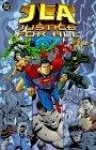
JLA volume 5: Justice for All


By Grant Morrison, Mark Waid, Howard Porter & various (DC Comics)
ISBN: 978-1-84023-110-6

By the time of the fifth collection featuring the breathtaking adventures of the World’s Greatest Superheroes, a pattern for gargantuan epics and mind-boggling conceptual endeavours had been well established and re-originators Grant Morrison and Howard Porter, whilst patiently laying the complex groundwork for a “Big Finish” saga were increasingly sharing creator credits with the cream of the comics-making premier division.

This book, collecting issues #24-33 of the monthly comic-book, also includes contributions from writers Mark Waid, Mark Millar & Devin Grayson and art by Mark Pajarillo, John Dell, Walden Wong & Marlo Alquiza, but begins with Morrison and Porter (with Dell on inks) in cracking form, introducing a brand-new super-team in ‘Executive Action’ as the American military, in the form of General Wade Eiling, announced its own metahuman unit “The Ultramarine Corps”.

The four-person squad was officially tasked with pre-emptively defending America from paranormal threats, but as the JLA (and long-term DC fans) were aware Eiling had a long history of covert, “black-bag” and just plain illegal operations and remained duly suspicious. When the Corps stole the artificial body of major League foe Shaggy Man everyone concerned knew it was bad news but even they were unprepared for ‘Scorched Earth’ wherein Eiling set his Ultramarines and the beleaguered US army against the heroes.

Meanwhile New God members of the JLA were preparing for the imminent cosmic threat they had enlisted to confront (and which would finally materialise in the next volume) whilst Batman, Huntress and Plastic Man infiltrated the General’s base to discover his real motives…

The spectacular revelatory conclusion came in ‘Our Army At War’ (with art by Pajarillo & Wong) as Eiling’s plans were disclosed and the truth about the Ultramarines was uncovered. The net result was the disillusioned super-soldiers setting up their own operation independent of any national influence and beginning to gather like-minded costumed champions for a First-Strike force. They would soon return…

Time-travelling future-robot Hourman replaced the Martian Manhunter for a while and Mark Millar, Pajarillo, Wong & Marlo Alquiza crafted ‘The Bigger They Come…’ a delightfully retrospective yarn which saw size-changing physicist Ray Palmer return to service as the Atom when power-stealing super-android Amazo was accidentally reactivated.

The main event of this volume is a JLA/JSA team-up ‘Crisis Times Five’ (by Morrison, Porter & Dell). The thunderbolt Genie of Johnny Thunder returned with a new master and reality was grievously assaulted by unnatural disasters and magical monsters. Somehow, Triumph, an old friend and foe of the League, was at the heart of it all but promptly found himself trapped in a true Devil’s Bargain…

In ‘World Turned Upside Down…’ with reason on the run the assembled champions of League and Society battled rampant magical chaos, retrofitting a little more secret history as the assorted sprites, Djinn and pixies of the Silver Age DC Universe were revealed to be something far more sinister, and ‘Worlds Beyond’ saw those Genies reduced to civil war; concluding with ‘Gods & Monsters’ as a vast army of united heroes saved reality in the nick of time and space…

‘Inside Job’ (Waid and Devin Grayson with art by Pajarillo & Wong) is deeply embedded in company continuity, set during the Batman: No Man’s Land publishing event and referencing one of the League’s first cases (for which see JLA: Year One) as genetic supremacists Locus returned to make quake-devastated Gotham City their private Petri-dish and releasing a mutagenic terror-virus that not even the JLA could combat…

The book ends with Waid, Pajarillo & Wong’s ‘Altered Egos’ as Batman led a plainclothes mission to discover who – or what – was masquerading as Bruce Wayne: an unexpectedly violent mission which resulted in the return of the League’s most dangerous opponents…

Although Justice For All is as compelling and engrossing as the preceding four volumes the inevitable slippage into company history and continuity means that some tales here might well confuse or even bewilder newer readers; but for all that the action, wit, imagination and sheer fun of these stories should still provide immense enjoyment for devotees of Costumed Dramas and Fight ‘n’ Tights fiction.- and after all, isn’t that inconvenience exactly what footnotes, search-engines and back-issue comics shops are for?

Compelling, challenging and never afraid of looking back fondly or laughing at itself, the new JLA was an all-out effort to be Thrilling, Smart and Fun. For a brief moment in the team’s long and chequered career these were the “World’s Greatest Superheroes” and increasingly ambitious epics, broken up by short, sharp single-issue sorties reminded everybody of the fact. This is the kind of joyous frolic that nobody should ever outgrow and these are graphic novels to be read and re-read forever…

© 1998, 1999 DC Comics. All Rights Reserved.

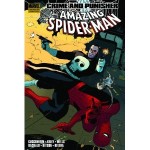
Amazing Spider-Man: Crime and Punisher


By Marc Guggenheim, Joe Kelly, Barry Kitson, Chris Bachalo & various (Marvel Comics)
ISBN: 978-0-7851-5417-6

Although a little disingenuous and rather disjointed for my tastes Crime and Punisher is a splendid slice of spidery superhero shenanigans that proves the modern Wall-Crawler still has a broad reach and plot-themes to suit many moods and occasions.

First off ignore the term “Crime” as the very best part of this collection (comprising Amazing Spider-Man #474-577, and portions of Spider-Man: Brand New Day -Extra!! #1) is a poignant and moving human interest tale with oldest friend Flash Thompson reaching a huge and shocking turning point in his life after returning from a tour of duty in Iraq.

Written by Marc Guggenheim, illustrated by Barry Kitson & Mark Farmer, this low-key tale of inspiration and ordinary heroism is a genuinely moving tribute to soldiers and one of the best Spidey tales of the last twenty years, but it is light-years away from the dark and frenetic retooling of the strictly B-List villain that follows.

‘Death of a Wise Guy’ by Joe Kelly, Chris Bachalo & Tim Townsend (from Spider-Man: Brand New Day -Extra!! #1) tells the secret history of the screen-gangster obsessed young Mafioso who became the brain-damaged cyborg Hammerhead and how his painful rehabilitation and rebuilding under the aegis of new criminal mastermind Mister Negative elevates a clownish super-thug to the top of the villain heap…

When the Spider-Man continuity was drastically and controversially altered at the end of the “One More Day” publishing event a refreshed, now single-and-never-been-married Peter Parker was parachuted into a new life, so if this is your first Web-spinning yarn in a while or if you’re drawing your cues from the movies be prepared to be a little confused.

Therefore this tale from the follow-up “Brand New Day” event sees Parker, a photographer for independent newspaper Front Line stumbling on Negative and Hammerhead’s scheme to consolidate the street gangs into a vast army of boy-soldiers, in ‘Family Ties’ (Amazing Spider-Man #475-6, with additional inks from Jaime Mendoza & Al Vey), a brooding, brutally epic clash wherein Parker puts his life on the line to save Gangsta kids from the Cyborg’s join-or-die recruitment campaign. Kelly’s signature wild comedy perfectly counterpoints the savage battles and highlights the quantum leap in malice the new Hammerhead is capable of…

The book ends with Punisher reluctantly and spectacularly reuniting with Spider-Man to stop their mutual old foe Moses Magnum, a ruthless arms-merchant who has found a way to weaponise Gamma radiation: giving any buyer a serum that producers berserker incredible Hulks to order…

‘Old Hunting Buddies’ (Amazing Spider-Man #477) parts 1 and 2 are written by Zeb Wells, drawn by Paolo Rivera and coloured by Javier Rodriguez & Dean White, with Kelly Kitson & Farmer’s ‘A Bookie Minute Mystery’ bisecting the saga. This last is a cheery little interlude that touches base with J. Jonah Jameson, recovering from heart-surgery and already making plans for his inevitable return…

Fast-paced, bold and extremely engrossing the quality of the individual tales is undeniable, but like an old time Vaudeville Show there’s a marked lack of cohesion, a start instead of a beginning and a close but no ending. Pretty even if lacking in context, it would be a shame if these stories were missed or passed over, so any Fights ‘n’ Tights fan should really give this book a look if they haven’t already…

© 2008, 2009 Marvel Characters, Inc.  All Rights Reserved.
Judge Dredd: The Apocalypse War


By John Wagner, Alan Grant, Carlos Ezquerra & various (Titan Books)
ISBN: 978-1-84023-634-7

Britain’s last great comic megastar might be described as a combination of the other two, combining the fantastic science and adventure of Dan Dare with the unrelentingly seditious anarchy and absurdity of Dennis the Menace. He’s also well on the way to becoming the longest-lasting adventure character in our admittedly meagre home-grown comics stable, having been continually published every week since February 1977 when he first appeared in the second issue of science-fiction anthology 2000AD.

However with at least 52 2000AD strips a year, annuals, specials, a newspaper strip (in the Daily Star and later The Metro), the Judge Dredd Megazine, numerous reprinted classic comics collections and even two rather appalling DC Comics spin-off titles, that adds up to a phenomenal amount of material, most of which is still happily in print from Rebellion.

One of the most attractive packages and certainly one of the most compelling is this sharply stylish black and white deluxe hardcover collection featuring one of the greatest storylines in the entire canon.

Judicial Briefing: Dredd and his dystopian ultra-metropolis of Mega-City One were created by a very talented committee including Pat Mills, Kelvin Gosnell, Carlos Ezquerra, Mike McMahon and others but with the major contribution coming from legendary writer John Wagner, who has written the largest portion of the canon under his own and several pseudonymous names.

Joe Dredd is a fanatically dedicated Judge in the super-city, where hundreds of millions of citizens idle away their days in a world where robots are cheaper and more efficient than humans and jobs are both beloved pastimes and treasured commodities. Boredom and madness has reached epidemic proportions and almost everybody is just one askance glance away from mental meltdown. Judges are last-ditch peacekeepers who maintain order at all costs: investigating, taking action and instantly trying all crimes and disturbances to the hard-won equilibrium of the constantly boiling melting pot. Justice is always immediate and final…

They are necessary fascists in a world permanently on the edge of catastrophe, and sadly, what far too many readers never realise is that the strip is a gigantic satirical black comedy leavened with oodles of outrageous, vicarious cathartic action.

Dredd’s world is a polluted and precarious Future Tense with all the key analogues for successful science fiction (as ever a social looking-glass for the times it’s created in) situated and sharply attuned to a Cold War Consumer Civilisation. The planet is divided into political camps with Post-nuclear holocaust America locked in a slow death-struggle with the Sov Judges of the old Eastern Communist blocs: militaristic, oppressive and totalitarian – and that’s by the US Judges’ standards, so just imagine what they’re like…

In 1981 Progs (that’s issue numbers to you) #236-244 featured a nine-part story ‘Block Mania’ which detailed an all-out war between two colossal habitation blocks in Mega-City One. With weekly instalments illustrated by Mike McMahon, Ron Smith, Steve Dillon and Brian Bolland (who also supplied some incredible covers) the all-out confrontation between Enid Blyton and Dan Tanna Blocks rapidly proliferated, engulfing surrounding Hab-units, spreading like a plague – or a chemical weapon.

Against a backdrop of utter berserker carnage Dredd discovers a plot by Sov agents to destabilise Mega-City One…

For once the Judge is too late and as his city burns the Dictatorat of East-Meg One launch a nuclear strike, following up with a ground-forces invasion. The Judges hit back with their own nukes and terrified of global Armageddon Mega-City Two and Texas City declare themselves neutral. Mega-City One will stand or fall alone…

Over forty years after the Battle of Britain ‘The Apocalypse War’ stunned and delighted readers. This epic tale of dogged resistance and bloody pyrrhic victory is a masterpiece of drama and tragedy, with Carlos Ezquerra drawing all 26 weekly chapters (even some covers!), and three decades later it still ranks as one of the greatest Dredd tales ever published.

Spectacular, violent, epic and leading to almost incomprehensible actions from someone most readers still considered a “hero” and “good guy” this is as powerful an anti-war story as Pat Mills and Joe Colquhoun’s Charley’s War and deserves as much acclaim and respect.

This volume collects the entire saga and its prequel Block War into one mesmerising and compelling work of glittering triumph and dark tragedy, and should grace the shelves of every serious fan of the medium – and the message.
® & © 2003 Rebellion. All rights reserved.

White Rapids


By Pascal Blanchet, translated by Helge Dascher (Drawn & Quarterly)
ISBN: 978-1-897299-24-1

A fascinating moment in recent social history is brought magically to life in this captivating and innovative graphic novel which eschews the traditional iconography and lexicography of sequential narrative, utilising the bold stylisations of art deco design and the gloriously folksy imagery of 1950s Modernism (think the architecture and landscape of the television Poirot and the movie “Metropolis” wedded to the crinkly curlicue characters populating the titles sequences of Bewitched or “Those Magnificent Men in Their Flying Machines”).

The effect is like looking at a period brochure, which tragically underscores the bold and far too typical story of a town which lived and died at the behest of forces beyond the control of the everyday working stiffs who lived there. The design tour de force is the first translated work of Québécoise creator Pascal Blanchet who transformed the history from dry fact into a magnificent torrent of visual music.

In the 1920s Canada’s growing power demands were supplied by private companies and the most efficient generation method was hydroelectric, created by damming the mighty rivers of the country. In 1928 the Shawinigan Water & Power Company decided to build a new dam in a remote northern region of the St. Maurice River at Rapide Blanc, a section where the waters narrowed into the eponymous fast-running white waters of the title.

To operate a power-plant in such an inaccessible – and for nearly half of each year actively hostile – region, a company town would need to be built for workers and their families. For any man to bring his family into such a wilderness it would have to be an impressive and wonderful town indeed…

Blanchet avoids the tempting option of personalising or dramatising the tale, preferring to let mood, impression, atmosphere and style describe the birth, brief life and sad, sudden death of White Rapids (no clues or answers from me – buy the book): a gleaming moment of Enlightened Capitalism actually doing the right and decent thing for the Proletarian Worker.

This is like no other Graphic Novel you’ve ever seen and is stunningly effective for that, rendered in reduced hues of orange, brown and grey, marvellously devoid of the heretofore presumed necessary clichés of narrative convention, avoiding the dynamic seductions of Protagonist/Antagonist and the avid fetishism of Vitruvian representational faces and forms that underpin all comics art no mater how avant-garde.

This is a beautiful work and deserves every award it’s ever won as well as your rapt attention.

© 2006, 2007 Pascal Blanchet. All Rights Reserved.

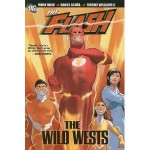
Flash: The Wild Wests


By Mark Waid, Daniel Acuña, Freddie Williams II & others (DC Comics)
ISBN: 978-1-4012-1828-7, paperback 978-1-84576-873-7

Jay Garrick debuted as the first Scarlet Speedster in Flash Comics #1 (January 1940), created by Gardner Fox and Harry Lampert. “The Fastest Man Alive” wowed avid readers for over a decade before changing tastes benched him in 1951. The concept of speedsters and superheroes in general was revived in 1956 by Julie Schwartz in Showcase #4; police scientist Barry Allen becoming the second hero to run with the concept.

The Silver Age Flash, whose creation ushered in a new and seemingly unstoppable era of costumed crusaders, died heroically during Crisis on Infinite Earths (1985-1986) and was promptly succeeded by his sidekick Kid Flash.

Wally West struggled to fill the boots of his predecessor, both in sheer ability and, more tellingly, in confidence. Feeling a fraud, he nonetheless persevered and eventually overcame, becoming the greatest to own the name. After many amazing adventures he married his beloved Linda Park, but just as happiness seemed certain they both disappeared in the reality-bending chaos of the Infinite Crisis…

After the brief death of Bart Allen (Impulse, the second Kid Flash and momentarily the fourth Scarlet Speedster – for which see Flash – Fastest Man Alive: Lightning in a Bottle and Flash – Fastest Man Alive: Full Throttle Wally and Linda returned in a spectacular blaze of glory for six issues, accompanied by their two children, already young heroes in waiting…

Wally West (via scripter Mark Waid) revealed to the DC Universe that all super-speedsters derived their enhanced velocity from an omni-pervasive energy field which permeated all of creation. This “Speed Force” generally provides the energy and stamina needed for extreme accelerated motion and the dubious faux-physics of that fact permeate this rollicking adventure-romp which originally appeared as Flash volume II, issues #231-237.

The twin cities of Central and Keystone have been without heroes for a year when a pair of youngsters, no more than eight or ten, respond to a inexplicable, devastating ferry crash, rescuing drowning passengers from the river using super-strength and vibrational intangibility. As news-crews swarm the kids a reassuringly familiar crimson-and-gold blur once more appears, whisking them away.

And thus we’re introduced to Wally and Linda West’s unique brood, Jai and Iris: one-year-olds cursed with the rapid-aging that blights the children of speed-force users. No one knows where they’ve been and in that timer Linda has blossomed into a scientific wizard: the world’s leading authority on super-speed medicine. As the new parents readjust to life on Earth a race of aquatic aliens launch a wave of “revenge-attacks” on the twin cities, implying the lineage of Flashes was ultimately responsible for their deadly actions.

The recent whereabouts of the Wests becomes crucial to unravelling the motives for the invaders’ murderous rampage (a mystery originally and gradually resolved in short, light-hearted strips by Waid, co-writer John Rogers and artist Doug Braithwaite in the back of each issue, but which are here gathered into one large tale ‘The Fast Life’, preceding the last chapter), and although Wally easily slips back into the role of hero, he feels himself falling far short in new his position of father and provider.

Still, if he can’t stop the water-marauders all his worries will be irrelevant…

The first two chapters are illustrated by the marvellous Daniel Acuña, with Freddie Williams II completing the guest-star stuffed, all-action epic whilst the concluding tale ‘Superman’s Cape’ (written by Keith Champagne and illustrated by Koi Turnbull & Art Thibert) ends the book on a delightfully agreeable high note, combining drama and comedy into a magical tale about learning the heroic ropes.

Fast, furious and sensationally fun this is a magical jaunt for fans of the third Scarlet Speedster, balancing romance and pathos with mind-bending Big-Science, gentle comedy and the mandatory high-speed thrills. My only quibble is that the Wests were casually sidelined to make room for the regrettably inevitable return of Barry Allen.

Still I can’t be the only one asking “Where’s Wally?” so hopefully there’s more to come from the fastest Family Alive…

© 2007, 2008 DC Comics. All rights reserved.

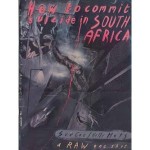
How to Commit Suicide in South Africa


By Sue Coe & Holly Metz (Knockabout/A Raw one-shot)
ISBN: 0-86166-0137

When the creative passions are aroused there is no more powerful medium of expression or tool of social change than graphic narrative. Whether it’s the swingeing pictorial satire of reformers such as Hogarth, the prose of Dickens, the publications of Mark Lemon and Henry Mayhew (founders of Punch) or the questing explorations of Will Eisner or Art Spiegelman the trenchant illustration wedded to the loaded word is an overwhelming Weapon of Mass Communication: cheap, universally accessible and capable of extrapolating terrifying conclusions from the scarcest of supplied data.

This perfect example comes from that period of rare world unanimity and applied social pressure which led to the fall of the vile Apartheid regime of South Africa and the literal liberation of millions of disenfranchised and terrorised citizens from their own government.

As part of a broad sweep of disgust and enraged global sensibilities ranging from stunning ridicule (such as e Tom Sharpe’s novels “Indecent Exposure” and “Riotous Assembly”) to such deeply moving audible cries of rage as Peter Gabriel’s “Biko” or Jerry Dammers/The Special A.K.A’s  “Free Nelson Mandela” and even Richard Attenborough’s momentous filmic exposé “Cry Freedom” the planet’s creative community lead a sustained assault on the monsters of Pretoria which eventually forced Western national governments to sever their commercial (and political, anti-Communist) ties to South Africa’s government.

Comic-books got into the act early and often, hopefully opening many young complacent eyes…

While I’m unsure of the exact and total effect of comic condemnation as opposed to legal sanctions and official reprimands, I am utterly certain that politicians listen to the people who vote them in and out, so the power to arouse Joe Public is one I completely appreciate and respect.

From that contentious time comes this stunningly savage graphic account of the day-to-day atrocities of the regime originally compiled and concocted for Art Spiegelman’s groundbreaking magazine Raw. Journalist Holly Metz produces chilling, dryly factual accounts of the history in ‘Background’ subdivided into ‘Chronology’ and ‘Homelands’, moves on to recount the social situation of the oppressed majority in ‘84% of The Population’ examined as ‘Miners’, ‘Urban Workers and Unions’, ‘Rural Laborers and Domestics’, ‘Education Under Apartheid’, ‘Rape in Namibia’ and ‘Tsotsis’ (slang for “Criminals”), before moving on to recount with horrifying matter-of-factness the everyday working of ‘Detention and Repression’.

Divided into fully annotated and corroborated accounts of ‘Steve Biko’s Death’, ‘The Torture of Neil Aggett’ (the first white person to die in detention – officially at least), ‘Women Beaten, Tried and Tortured’, ‘Inside BOSS’ (Bureau of State Security) and ‘Deaths in Detention Since 1963’ the catalogue of iniquity concludes with ‘Free World’ a mortifying trawl through ‘The U.S. Connection’ and ‘Blue Chip Deals’ calling to account those governments and companies that upheld the regime and colluded in the suppression of Democracy in South Africa tacitly, overtly and covertly, often while officially decrying the actions of the white minority government. All the material throughout is fully accredited, annotated and supported by copious footnotes and bibliography.

Sue Coe steals the show and provides the emotional and pictorial stimulus with collages formed from found newspaper headlines, advertising material and photos, as well as her simply brutal assemblage of large cartoons and monochrome paintings: dark, moody and breathtakingly evocative. A tip of the hat should also go to the superlative design contributions of Francoise Mouly and Spiegelman himself.

The regime fell in 1994, when after years of gradual erosion and capitulation, the last white President Frederik Willem de Klerk called for the country’s first fully multi-national elections, before retiring to the sin-bin of history.

Even three decades later, re-reviewing this slim (44 card pages), huge (422x265mm) tome still evokes the white hot outrage and sense of injustice it was supposed to, and I sleep a little easier knowing that when the next moral atrocity occurs, somewhere, cartoonists and creators will be ready to employ the same weapons with hopefully as telling a result…
© 1983 Sue Coe and Holly Metz. All rights reserved.

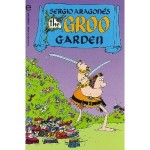
The Groo Garden


By Sergio Aragonés, Mark Evanier & Stan Sakai (Epic/Marvel)
ISBN: 978-0-78510-026-3

Both in comic narrative and the infinitely trickier field of gag-cartooning Sergio Aragonés has produced uncountable volumes of excellent work. His darkly skewed sensibilities and death-grip on the cosmically absurd, wedded to a totally unique drawing style and frankly terrifying professional discipline have made his (usually) silent doodles a vibrant proof of the maxims that laughter is universal and a picture is worth a thousand words.

After working for years for Mad Magazine and DC’s horror titles on gag features and the occasional full comic strip in 1981, with writer and associate Mark Evanier, Aragonés produced a madcap four-page parody of the Sword-and-Sorcery genre as a contribution to the Creators Rights benefit comicbook Destroyer Duck published by Eclipse Comics.

Following a second outing in Mike Grell’s Starslayer (#5) Pacific Comics launched Groo the Wanderer in his own title. After 8 issues (December 1982-April 1984) the troubled company folded but the unsinkable barbarian (that’s a joke I’ll explain later) resurfaced in the Groo Special one-shot from Eclipse (October 1984), before finding a home at Epic Comics: Archie Goodwin’s creator-owned corner of the Marvel Universe.

Aragonés had first created his witless warrior in the 1970s but no publisher would take on the property unless he sold all rights – an almost universal situation in the industry until the advent of the Direct Sales market transferred power from companies and distributors to creators and consumers.

The character is arguably the most successful creator-owned property of the American comic-book market, and this seventh volume (of 27 thus far) collects issues #25-28 (March-May 1987) from the Epic incarnation, with the itinerant idiot fully established in a capacious and vast feudal landscape of wizards, warriors, wild women and weird beasts. With a burgeoning supporting cast, Aragonés and his co-conspirators have plenty of wonky, misshapen leg-room to experiment with narrative and visual merry-making…

For the slow of mind however let me recapitulate:

Groo is the smelliest, ugliest, stupidest unluckiest mercenary in the world – but he’s also the best swordsman in creation and far too stupid to be harmed. He is always hungry and wanders because most places he pause in burn down, wash away or crash into rubble soon after he arrives. He loves to fight and entire nations and navies reel at the mention of his name. Of course they do the same when they stand downwind of him too…

The volume opens with ‘Divide and Conquer’ as the unemployable oaf has something similar to an idea and quite effectively foments unrest between relatively peaceful kingdoms in the hope that somebody will hire him to quell the unrest – with the usual catastrophic results, whilst two sinister sorceresses who really should know better are forced to employ the him again in ‘Arba Dakarba’, shrinking the wandering warrior to the size of his own intellect to steal a wishing amulet.

‘Spies’ places Groo in the background as The Sage and The Minstrel are captured by an army and accused of espionage. To forestall their executions the pair entertain the Commanding General with stories of the worst soldier in existence, but unlike Scheherazade, no tale of Groo can ever have a happy – or safe – ending. Then this chronicle concludes with ‘The Gourmet Kings!’ as the ever-ravenous reaving rover’s always empty stomach leads him to gainful employment and chef-stealing. Naturally the whole affair leads to an excess of chopping, slicing and dicing all around…

Marvelously cynical, wildly witty and stunningly silly Groo is the comic that people who hate comics read: brilliantly tongue-in-cheek, sharply sarcastic and devastatingly self-deprecating. An irresistible humour tour-de-force astoundingly scribed and illustrated by jesters who don’t know when – or how – to stop. New readers can start practically anywhere – and still be none the wiser…

The unstoppable brain-donor (Groo, not Aragones or even wordsmith Evanier, letterer Stan Sakai or colourist Tom Luth) has since rambled on to shut down Image Comics and now threatens to finish off Dark Horse, but as they haven’t completely gone belly-up yet there’s still plenty of material for you to track down…
© 1987, 1994 Sergio Aragonés. All Rights Reserved.

Walt Disney’s Donald Duck Adventures: Voodoo Hoodoo


By Carl Barks (Gladstone Comic Album #16)

ISBN: 0-944599-15-X

Carl Barks was the greatest armchair (and drawing board) adventurer of his generation. A dedicated and voracious researcher who loved exploration and thrived on local colour and detail in his work, he seamlessly blended history, geography and the natural world into his rollicking rip-roaring light-thrillers. All Barks’ spectacular yarns were screened through a mesmerising lens of wonder and excitement and executed with riotous bursts of outrageous comedy that appealed to fun-starved fans of all ages. They still do.

From the 1940’s to the1960s Barks worked in seclusion, concocting a timeless treasure trove of golden myths and fables (ostensibly) for kids; forging a cohesive Duck Universe stuffed with memorable and highly bankable characters such as Uncle Scrooge McDuck, Gladstone Gander, the Beagle Boys, Gyro Gearloose, and Magica De Spell to augment the stable of cartoon actors from the Disney Studio, but his most exciting work always involved the rowdy, know-it-all nephews Huey, Dewey and Louie and their irascible, excitable, indomitable “unca” Donald Duck.

The boys’ assigned roles were as sensible, precocious and just-a-little-bit snotty counterfoils to their guardian whose intemperate nature caused him to act like an overgrown brat most of the time, but they often fell prey to a perpetual and natural temptation to raise a ruckus as well: clearly something in the genes…

West Coast publishing giant Dell/Gold Key held the license to produce comic-books based on Disney properties from the 1940s, generating a vast treasure-trove of graphic wonderment before grinding to a close in the early 1980s. Fan-based publishers Gladstone began re-releasing Barks material and a selection of other Disney comics classics at the end of the decade and this album is one of the best.

Whilst producing all that landmark material Barks considered himself just a working guy, drawing eye-catching covers, illustrating other people’s scripts to order yet still setting the bar for his compatriots with utterly perfect tales that added to the burgeoning canon of Donald Duck and other Disney properties. His output was incredible in terms of quantity and especially in its unfailingly high quality.

Printed in the large European oversized format (278mm x 223mm) this chilling departure into the realms of the unknown reprints one of his eeriest masterpieces with the lead tale from Dell Four Color Comics #238 (August 1949) and sees the author once more accessing darker themes via the sinister delights of horror movies – albeit seductively tempered with Barks’ winningly absurd humour (for more of the same see also Donald Duck Adventures: Ancient Persia).

Duckburg is all in a tizzy when a hulking undead brute begins loitering around town. Eventually Bombie the Zombie delivers a poisoned devil-doll to Donald which apparently makes him start to shrink. Zombies aren’t particularly smart and he/it had been trying for years to deliver the potent vengeance of his witch-doctor master Foola Zoola to the duck that swindled him … and unfortunately Donald looks a lot like Scrooge McDuck did seventy years ago!

Not believing in curses Uncle Scrooge is less than sympathetic but after experiencing the pester-power of Donald and the nephews he grudgingly funds an expedition to Africa to set things right. And only then do their troubles really begin…

Wacky and deeply satirical this tale was the subject of some controversy after it was first published, with Barks’ evolving drawing style skirting jarringly close to some pretty prejudicial and unwholesome racial stereotypes of the time, and considering the target audience it is a pretty scary story in a lot of places, but as ever, the wildly over-the-top madcap humour keeps everything addictively comforting and compelling.

Filling out this volume is another spooky fantasy fable starring Donald and the boys with a far more prominent role for their Bajillionaire relative as the entire family check out his latest acquisition. Scrooge has bought a castle in Scotland because a legendary treasure is hidden within it, but ‘McMerganser Macabre’ (from Donald Duck #26 November 1952) proves the old adage “buyer beware” as the old pile also seems to have an extremely agitated ghost as an unwelcome squatter…

However even when running for their lives and dodging certain death Huey, Dewey and Louie are pretty sure all is not as it seems…

Breathtaking and supremely hilarious this is a sheer graphic treat for fans of comics in their purest and most enticing form and still readily available from a number of online retailers, but even if you can’t find this specific volume most of Barks’ work is readily accessible through a number of publications and outlets.

As everything he’s ever done is well worth reading, no matter what your age or temperament, you’ve nothing to lose and all to gain by tracking down Barks’ captivating creations; so please do do – or experience the repercussions of the Voodoo Hoodoo…
© 1989, 1949 The Walt Disney Company. All Rights Reserved.

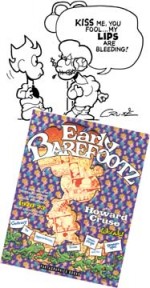
Early Barefootz


By Howard Cruse (Fantagraphics Books)
ISBN: 978-1-56097-052-1

Howard Cruse’s remarkable cartooning career has spanned decades and encompassed a number of key moments in American history and social advancement.

Beginning as a Hippy-trippy, counter-culture, Underground Comix star with beautifully drawn, witty, funny (not always the same thing in those days – or these, come to think of it) strips, evolving over the years into a powerful voice for change in both sexual and race politics through such superb features as Wendel culminating in his masterful Stuck Rubber Baby – an examination of oppression, tolerance and freedom in 1950s America. Since then he has worked on other writer’s work, illustrating an adaptation of Jeanne E. Shaffer’s The Swimmer With a Rope In His Teeth.

Born in 1944 the son of a Baptist Minister in Birmingham, Alabama, Cruse grew up amid the smouldering intolerance of the region’s segregationist regime, an atmosphere that affected him on a primal level. He escaped to Birmingham-Southern College to study Drama in the late ’60s, graduating and winning a Shubert Playwriting Fellowship to Penn State University.

Campus life there never really suited him and he dropped out in 1969. Returning to the South he joined a loose crowd of fellow Birmingham Bohemians which allowed him to blossom as a creator and by 1971 was drawing a spectacular procession of strips for an increasingly hungry and growing crowd of eager admirers.

Whilst working for a local TV station as both designer and children’s show performer he created a kid’s newspaper strip about talking squirrels, Tops & Button, still finding time to craft the utterly whimsical and bizarre tales of a romantic quadrangle starring a very nice young man and his troublesome friends for the more discerning college crowd he still mingled with. The strips appeared in a variety of college newspapers and periodicals

He was “discovered” by publishing impresario Denis Kitchen in 1972 who began presenting Barefootz to a far broader audience in such Underground publications as Snarf, Bizarre Sex, Dope Comix and Commies From Mars from his Kitchen Sink Enterprises outfit.

Kitchen also hired Cruse to work on an ambitious co-production with rising powerhouse Marvel Comics, attempting to bring a bowdlerised version of the counter-culture’s cartoon stars and sensibilities to the mainstream via the Comix Book – a newsstand magazine. It only ran to a half-dozen issues and although deemed a failure it provided the notionally more wholesome and genteel Barefootz with a larger audience and yet more avid fans…

As well as an actor, designer, art-director and teacher, Cruse’s work has appeared in Playboy, The Village Voice, Heavy Metal, Artforum International, The Advocate and Starlog among countless others, and the tireless storyman found the time and resources to self-publish Barefootz Funnies, two comic collections of his addictively whimsical strip in 1973.

Here in this fascinatingly written memoir of those salad days Cruse movingly recounts those early triumphs and re-presents the strips that began it all, covering 1970-73, and although he has moved on to weightier material since (especially on Gay and Race issues) these splendidly whacky and deliriously charming adventures still stand among his most evergreen creations.

So here, for your consideration and delectation are the gathered exploits and ruminations of thoughtful, Nice Young Man Barefootz, his way-out friend and confidante Headrack, sexually aggressive and very forceful gal-pal Dolly and Glory: the frog-manifesting “Thing Under the Bed”, aided and abetted by an ever-changing cast of erudite cockroaches who share his apartment.

As well as the history and Cruse’s reflections, this terrific compilation includes in stunning and meticulous monochrome a selection of Tops & Button gag-panels, ‘The Head Strip’, early strips from campus journal The Crimson-White and The Alternate, syndicated Barefootz from Service Strips, Kitchen Sink single-pagers and the longer stories, ‘Tussy Come Back’, ‘Hint and Run’, ‘Cream of the Genes’, ‘It All Fits’, ‘Suffering Celeste’, the Paperman strips and ‘The Eclipse’, – a classic and unflinchingly engaging treat for any comics fan and grown-up dreamer.

For further information check out Howardcruse.com and track down this and all his other brilliant creations – before Glory turns you into a frog…
© 1970, 1971, 1972, 1973, 1974, 1977 & 1987, 1990 Howard Cruse. All rights reserved.