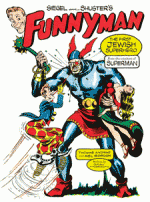
Siegel and Shuster’s Funnyman: the First Jewish Superhero


By Thomas Andrae, Mel Gordon, Jerome Siegel & Joe Shuster (Feral House)
ISBN: 978-1-932595-78-9

The comics industry owes an unpayable debt to two Jewish kids from Cleveland who were in the right place at the right time and were able to translate their enthusiasm and heartfelt affection for beloved influences and delight in a new medium into a brand new genre which took the world by storm.

Writer Jerome Siegel and artist Joe Shuster were a jobbing cartoonist team just breaking into the brand new but ailing comic-book business with strips such as ‘Henri Duval’, ‘Doctor Occult’ and ‘Slam Bradley’ when they rejigged a constantly rejected newspaper strip concept into the greatest sensation of the Age.

Superman captivated depression-era audiences and within a year had become the vanguard of a genre and an industry. In those early days the feature was both whimsical and bombastic, as much a gag strip as an adventure serial, and it was clear the inspired whiz kids were wedded to laughs just as much as any wish-fulfilling empowerment fantasies.

Siegel and Shuster were not well-served by their publishers and by 1946 no longer worked for National Periodicals (today’s DC Comics). In fact they were in acrimonious litigation which led to the originators losing all rights to their creation and suffered years of ill-treatment until an artist-led campaign at the time of the 1978 Superman movie shamed the company into a belated reversal and financial package (consisting mostly of having their names returned to the character’s logo and company medical benefits).

Before this however the pair produced an abortive “Last Hurrah”: another unique character based on early influences, but one who sadly did not catch the public’s attention in those post war years when the first super-heroic age was ending. Based broadly on Danny Kaye, Funnyman was a stand-up comedian who dressed as a clown and used comedy gimmicks to battle criminals, super-villains and aliens: first in six issues of his own comic-book and then as a Daily and Sunday newspaper strip.

A complete antithesis to the Man of Steel, Larry Davis was a total insider, no orphan or immigrant, wealthy, successful, accepted and revered by society but who chose to become a ridiculous outsider, fighting for not the common good but because it gave him a thrill nothing else could match. The series was light, beautifully audacious, tremendous fun and sunk like a concrete-filled whoopee cushion.

Here social historians Thomas Andrae and Mel Gordon re-examine the strip in the much broader context of Jewish Identity and racial character, (especially as it applies to Jewish-Americans), and make some fascinating observations and postulates. Following an intriguing preface by author, writer, editor and comics historian Danny Fingeroth this book dissects the history and psychology of the Judaic experience in a compelling series of astoundingly illustrated essays gathered under the umbrellas of Gordon’s ‘The Farblondjet Superhero and his Cultural Origins’ and Andrae’s ‘The Jewish Superhero’.

The former (and Farblondjet translates as “mixed up” or “lost”) probes ‘The Mystery of Jewish Humor’, ‘The Construct of Humor in Everyday Jewish Life’, ‘The Old Theories: ‘Laughter-Through-Tears’; ‘A Laughing People’; ‘Outside Observer’ and ‘The Badkhn Theory’ (Badkhn being performers hired to insult, offend and depress guests and celebrants at social gatherings such as weddings or funerals).

‘Characteristics of Modern Jewish Humor’ are subdivided and explored in ‘Aggression’, ‘The Yiddish Language’, ‘Self-Mockery’, ‘Inversion and Skepticism’, ‘Scatology’, ‘Gallows Humor’ and ‘Solipsism and Materialism’ and Gibson’s compelling, contextual  potted-history concludes with ‘American- Jewish Comedy Before 1947’ ( when Funnyman debuted) with ‘Weber and Fields’, ‘On the Boards’, ‘The Borscht Belt’, ‘Cartoons and Jokebooks’ and ‘Hollywood Talkies and Syndicated Radio’.

In ‘The Jewish Superhero’ Andrae examines Siegel and Shuster’s possible influences; everything from German expressionist cinema masterpiece ‘The Golem: How He Came into This World’ to the real-life strongman Sigmund Breitbart, a Polish Jew who astounded the world with his feats in the early 1920s. On his American tour he appeared in Cleveland in October 1923. Siegel, a local resident, would have been nine years old…

‘Funnyman, Jewish Masculinity and the Decline of the Superhero’ then explores the psychology and landscape of the medium through the careers and treatment of Siegel and Shuster in ‘The Birth of Funnyman’, ‘The Body Politic’, ‘The Schlemiel and the Tough Jew’, ‘The Decline of the Superhero’ and ‘Comic Book Noir’ before going on to recount the story of the newspaper strips in ‘The Funnyman Comic Strip’ and ‘Reggie Van Twerp’ (a last ditch attempt by the creators to resurrect their comic fortunes) before the inevitable ‘End Game’…

So far this book has been a compulsive and hugely informative academic work, but in ‘Funnyman Comic Book Stories’ the resplendent fan fun really begins with a full colour section reproducing a selection of strips from the six issue run. ‘The Kute Knockout!’ (Funnyman #2, March 1948) pits the Hilarious Hero against a streetwalker robot built to seduce and rob Johns whilst ‘The Medieval Mirthquake’ (Funnyman #4, May 1948) propels the Comedy Crusader back to the time of Camelot. From the same issue comes ‘Leapin’ Lena’ as Funnyman tackles a female bandit who can jump like a kangaroo and #5 (July 1948) has him chasing a worrying new crime gimmick in ‘The Peculiar Pacifier’.

Also included are the striking covers of all six issues, the origin of Funnyman from #1, lots of splash pages and a selection of Shuster’s Superman art, but the most welcome benefit for collectors and collectors is a detailed précis of the entire run’s 20 tales.

The same consideration is offered for the newspaper strips. As well as similar synopses for the Sundays (12 adventures spanning October 31st 1948 to the end of October 1949) and the Dailies (another dozen larks beginning October 18th 1948 and ending September 17th 1949) there are 11 pages of full colour Sunday sections and the complete black and white ‘Adventure in Hollywood’ (December 20th to January 12th 1949) to adore and marvel over.

Like Funnyman this book is an odd duck. Whereas I would have loved to see the entire output gathered into one volume, what there is here is completely engrossing: a wonderful appreciation and compelling contextualization of genuine world-altering pioneers. This is a fabulous book with an appeal that ranges far beyond its possibly limited comic-fan audience.

Siegel and Shuster’s Funnyman © 2010 Thomas Andrae and Mel Gordon. All rights reserved.
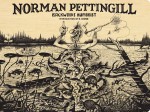
Norman Pettingill: Backwoods Humorist


Edited by Gary Groth, with an introduction by Robert Crumb (Fantagraphics Books)
ISBN: 978-1-60699-319-4

It’s a big planet and there are many places to hide an artistic prodigy. That’s never been more capably proved than in the case of Norman Pettingill, a lost hero of the workaday craft aesthetic who lived and died in Wisconsin, revelling in a backwoods life living off the land and supporting his family with personalised cartoons, jobbing art such as postcards and commercial signage, commissioned illustrations and simply stunning personal works: mostly natural scenes and reportage of the hunting and fishing community he lived in.

He worked in seclusion until his incredibly intense, ribald and frenetic postcard art was discovered by Robert Crumb who immediately reprinted them in his Underground Commix magazine Weirdo. These over-sized scenes were multi-layered, packed with hundreds of characters acting in micro-scenes and grotesquely raw and vulgar: like Hieronymus Bosch, Basil Wolverton and Leo Baxendale working all on the same page.

This superb book, rough and rustic with a wooden front cover, tells the life-story of this truly driven artist – who could no more stop drawing than breathe underwater. Self-taught and clearly besotted with the creative process, Pettingill was clearly not a man afraid to fill a page with extras, and the work gathered here, collected by the John Michael Kohler Arts Center (a major conserver of folk art of the American mid-west) shows a true original equally at home drawing pictures to pay bills and making masterpieces because he couldn’t stop himself.

Gathered here are many of his astoundingly frantic, charmingly gruesome postcard tableaux, featuring hunters, boozers and what we’d call hillbillies but what Pettingill probably called the neighbours, as well as more intimate personal creations; family collages, gloriously entrancing pen and ink studies of the beasts and birds he lived amongst – and hunted – and even the doodles he adorned the envelopes of letters with.

His surreal, bawdy, raw concoctions mirrored and presaged the graphic license and social freedoms of the 1960s counterculture (although he really started his artistic journey twenty years  earlier) but even though his fans today include such iconoclastic cartoonists as Crumb and Johnny Ryan, Pettingill’s appeal is far wider than just grist for us pen-and-ink pushers.

With his fondly cynical, wry observation and piercingly incisive eye Norman Pettingill became a societal camera onto a time and place in rural and even wild America that we seldom see nowadays: a warmly honest raconteur, part of a tradition that includes and spans the fierce and gentle ranges from Garrison Keillor’s elegiac (and positively local) Lake Wobegon tales to the razor-edged self-examination of the Southern kinfolk typified by the gagsters of the Blue Collar Comedy Tour: a purely American humour by and for the ordinary guy.

This first retrospective of Pettingill’s art is stuffed with more than a hundred of his most telling monochrome pieces and will appeal to cartoon-lovers and people watchers equally.

© 2010 Fantagraphics Books. Individual contributions © 2010 their authors. Unless otherwise noted all photography and art © 2010 John Michael Kohler Arts Center. Art from the collections of Glenn Bray, R. Crumb and Jim Pink © 2010 the estate of Norman Pettingill.

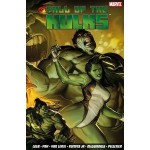
Fall of the Hulks volume 1


By Jeph Loeb, Greg Pak, Jeff Parker, John Romita Jr., Paul Pelletier & others (Marvel/Panini Publishing UK)
ISBN: 978-1-84653-462-1
In recent years the number of Gamma-powered gargantua rampaging across the Marvel landscape has proliferated to inconceivable proportions. There are assorted Hulks, She-Hulks, Abominations and all kinds of ancillary mutations roaming the planet so it’s no more than prudent to occasionally thin the herd.

The days of Bruce Banner getting angry and going Green are long gone too, so anybody taking their cues from the various TV and movie incarnations of the Jade Giant will be more than grateful for the fifteen pages of Marvel Handbook text pages and an additional four pages of contextual catch-up data for filling in some background, but even so the story begun in this book depends overwhelmingly on a working knowledge of what’s gone before.

Even if you are familiar with the Hulk’s history, ancient and modern, you might still founder on the odd point of narrative as this book collects most – but by no means all – of the opening sallies in the major storyline which ran through the various Hulk-related comics during the first half of 2010.

Delving back and deep into many dark corners of in-house continuity this book (collecting Fall of the Hulks: Alpha, Fall of the Hulks: Gamma, Incredible Hulk #606, Hulk #19-20 and Red Hulk #1) opens in the early days of the Marvel Universe as a cabal of the planet’s smartest bad-guys – the Leader, Egghead, Red Ghost, the Wizard, Mad Thinker and Dr. Doom – begin recovering the scattered remnants of the Lost Library of Alexandria, repository of all arcane knowledge.

‘Meeting of the Minds’ outlines the plan and successes of “the Intelligencia” as they raid the Eternals’ hidden home for secrets, stealing as well a cosmic-powered Hulk robot, before going on to raid Project Pegasus (see The Thing in the Project Pegasus Saga), the hidden African kingdom of Wakanda and even sunken Atlantis among other landmarks.

Contemporarily, even though there are eight Variant Hulks and analogues, Banner is not one of them. The mysterious and all-conquering Red Hulk, who has trashed all the heroes of the Marvel Universe, has absorbed Banner’s gamma power, leaving nothing but a determined mortal – albeit a brilliant and determined one. Consequently Banner has never been more dangerous…

The origin of the Red Hulk is revealed after “the Intel” replaced Egghead with the biological computer Modok. Events move swiftly (mainly because many have been left out), but briefly, Dr. Doom betrays the rest of the cabal, Banner teams up with the Red Hulk to stop his assorted foes and the Intel move on to their greatest scheme: to capture and control the eight greatest minds on Earth.

With Red Hulk and Banner pursuing their own at-odds agendas and watching each other for the first sign of betrayal, the Intel snatches Reed Richards, Dr. Doom, Henry (the Beast) McCoy and T’Challa, the Black Panther, preparing to enter the end-game of their years-long campaign.

Meanwhile the assorted Gamma gladiators; Skaar – Son of Hulk, Jennifer Walters and Lyra (two different She-Hulks), Doc Samson, A-Bomb (venerable sidekick Rick Jones transformed into an atomic Abomination), an enigmatic Red She-Hulk and the ubiquitous Red Hulk all jockey for position and advantage in the tumultuous clash to come…

Of course this tome ends on a climactic cliffhanger, but even though it sounds utterly incomprehensible a thin strand of coherent narrative carries through this spectacularly cathartic, bombastic action epic, thanks to the inclusively referential writing of Jeph Loeb, Greg Pak and Jeff Parker.

Moreover if you’re more a fan of art than artifice the monumental illustrations by Paul Pelletier, Ed McGuinness, Carlos Rodriguez, Ryan Stegman, Vincente Cifuentes, Mark Palmer, Danny Miki, Tom Palmer and especially John Romita Jr. & Klaus Janson are cumulatively breathtaking in scope and power. As always the book includes a gallery of the many cover variants that graced the original comicbook releases

Flawed, but not fatally, there’s a heady impetus that carries this tale along despite all the problems and perhaps the concluding volume will assuage even those quibbles. Best then to read the sequel before deciding whether or not this is another “Hulk Smash”…

™& © 2010 Marvel Entertainment LLC and its subsidiaries. All Rights Reserved. A British edition published by Panini.

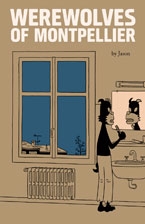
Werewolves of Montpellier


By Jason, translated by Kim Thompson (Fantagraphics Books)
ISBN: 978-1-60699-359-0

Jason, is secretly John Arne Saeterrøy: born in Molde, Norway in 1965 and an overnight international cartoon superstar since 1995 when his first graphic novel Lomma full ay regn (Pocket Full of Rain) won that year’s Sproing Award (Norway’s biggest comics prize).

He won another Sproing in 2001 for the series Mjau Mjau and in 2002 turned almost exclusively to producing graphic novels. Now a global star among the cognoscenti he has won seven major awards from such disparate regions as France, Slovakia and the USA.

Now his latest novella is released, rife with his signature surreality; populated with cinematic, darkly comic anthropomorphs and featuring more bewitching ruminations on his favourite themes of relationships and loneliness, viewed as ever through a charmingly macabre cast of bestial movie archetypes and lost modern chumps.

Here he focuses on the hollow life of expatriate Swede Sven, a purposeless artist who has gravitated into a stagnant, romance-lite existence in a provincial French town. Sven fritters away his days just like his close friend Audrey – another listless intellectual looking for the right lady to love.

The only thing that quickens his pulse these days is the occasional nocturnal foray over the rooftops: burglarizing houses dressed as a werewolf. Unfortunately, Montpellier already has a genuine lycanthrope community and they don’t look kindly upon gauche parvenus intruding into their world…

This post-modern short-and-spooky fable unfolds in Jason’s beguiling, sparse-dialogued, pantomimic progressions and has resonances of Hitchcock’s bubbly comedy-thrillers quirkily blended with Bergman’s humanist sensibilities. The enchantingly formal page layouts are rendered in his minimalist evolution of Hergé’s Claire Ligne style, solid blacks, thick lines and settings of seductive simplicity augmented here by a stunning palette of stark pastels and muted primary colours.

Jason’s work always jumps directly into the reader’s brain and heart, always probing the nature of “human-ness” by using the beastly and unnatural to ask persistent and pertinent questions. Although the clever sight-gags are less prominent here his repertory company of “funny-animal” characters still uncannily depicts the subtlest emotions with devastating effect, proving again just how good a cartoonist he is.

This comic tale is best-suited for adults but makes us all to look at the world through wide-open childish eyes. Jason is instantly addictive and a creator every serious fan of the medium should move to the top of the “Must-Have” list. While you’re at it, make room there for Werewolves of Montpellier too…

© 2010 Jason. All rights reserved.

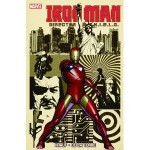
Iron Man: Director of S.H.I.E.L.D.


By Daniel & Charles Knauf, Roberto de la Torre, Stan Lee, Jack Kirby & others (Marvel)
ISBN: 978-0-7851-2299-9

The arch-technocrat and supreme survivor Tony Stark has had many roles in the Marvel Universe since his debut in Tales of Suspense #39 (March 1963): inventor, armaments manufacturer, liberal capitalist, eco-pioneer, politician and of course superhero. In this brief and rather padded package he takes on a new position as leader of the world’s most scientifically advanced spy agency, the Strategic Hazard Intervention Espionage Logistics Directorate.

Collecting issues #15-18 of the third volume of the Iron Man comic-book and set after the dramatic Civil War which divided the super-hero community, it finds Stark placed in charge of the very public covert agency and having a hard time being a commander as opposed to an active combatant. Meanwhile a deadly hodge-podge of previously low-grade terrorist organisations with no philosophy or agenda in common have suddenly all become major threats. Someone is providing the whackos with intel, training and major ordnance…

Battling his own conscience, die-hards from the previous S.H.I.E.L.D. administration unhappy with his “management style”, public opinion and self-serving politicians, Stark is also coming to terms with a bio-technology upgrade that has infested his own body and is forced to wonder whether he if is even a “man” at all any more …

When an anti-terrorist strike-mission to Mongolia leads to a devastating super-weapon attack on S.H.I.E.L.D.’s flying base, Stark’s last-ditch save comes at incredible personal cost. Moreover the beleaguered director is completely unaware that the whole episode has been nothing but a feint to occupy him whilst his deadliest foe returns…

Gritty, clever and hard-hitting this tale is entertaining but agonisingly incomplete and inconclusive. Even with an extensive interview with the scripters and 13 pages of Marvel Handbook text pages the story depends far too much on knowing what’s gone before, and the space devoted to two additional reprint stories could have been better used to apprise new readers. Either that or simply add the lead adventure here to the previous or next Iron Man collection.

Those aforementioned “golden oldies” are strong enough to be included elsewhere and only tangentially relevant to this saga anyway. ‘Nick Fury Agent of S.H.I.E.L.D.: The Man for the Job!’ is from Strange Tales #135 (August 1965) in which Stan Lee, Jack Kirby and Dick Ayers first introduced the spy organisation as well as its nemesis Hydra, but is the first chapter in a far longer epic as is ‘Dread Night of the Dreadnought!’ from Iron Man volume 1, #129 (December 1979): the rather rushed conclusion to another long story-arc in which S.H.I.E.L.D. attempted to buy Stark International out from under its owner in the name of National Security.

Plotted by half the Marvel Bullpen, inked by the other half, scripted by David Michelinie and rough pencilled by the indefatigably trustworthy Sal Buscema the tenuous link to the spy theme is overtaken by a bombastic battle between Armoured Avenger and Hydra robot.

Director of S.H.I.E.L.D. is written by father-and-son team Daniel & Charles Knauf and strikingly illustrated by Roberto de la Torre, Jonathan Sibal, Karl Kesel & Cam Smith. It deserves much better than to be wedged into such a poorly conceived and grossly exploitative package as this. Caveat ever so Emptor

© 1965, 1979, 2007 Marvel Publishing, Inc, a subsidiary of Marvel Entertainment, Inc. All Rights Reserved.

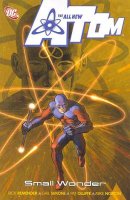
The All-New Atom: Small Wonder


By Gail Simone, Rick Remender, Pat Oliffe, Mike Norton & various (DC Comics)
ISBN: 978-1-4012-1996-3

The adventures of the all-new Tiny Titan came to an abrupt halt with this final collection of mind-bending, time-busting yarns, collecting issues #17, 18 and 20-25 whilst inexplicably omitting #19 (a rather tasty subterranean thriller fill-in from Keith Champagne & Jerry Ordway). Whether the switch from stellar and wistfully whimsical scripter Gail Simone to darker, more hard-edged Rick Remender indicated the series was failing or perhaps caused its eventually demise is a matter of speculation – but it was probably neither…

After the events of Identity Crisis and 52, size-changing Professor Ray Palmer vanished, leaving his world behind him. But life goes on, and his post at Ivy University was offered to a young prodigy from Hong Kong who just happened to be Palmer’s pen-friend and confidante: privy to his predecessor’s secrets ever since he was a child. This neophyte, Ryan Choi, soon inherited his Palmer’s super-hero identity as well – under some rather suspicious circumstances. He battled super-villains, monsters and seemingly random chronal catastrophes that were making Ivy Town a viper’s nest of bizarre occurrences.

Gail Simone opens the book with the two-parter ‘The Atom and the Amazon’ illustrated by Mike Norton, Andy Smith, Trevor Scott and Keith Champagne, a bravura combination of action, adventure and sublime surreal comedy wherein expanding villainess Giganta sexually harasses the young professor into a date whilst the mysterious forces and agencies infesting Ivy Town all jockey for position before the impending crisis to come.

Things come to a head when Federal Department of Metahuman Affairs agent Diana Prince steps in and asks Choi to wear a wire on his assignation…

When a creep with a detachable brain provokes a confrontation Wonder Woman steps in and events spiral out of control until Ryan uses a brilliant seldom-seen ploy to calm things down. Sadly the peace is temporary as the brain-thing incites the entire city to attack the heroes. Nevertheless Atom saves the day and is rewarded by the most outrageous offer he has ever heard…

Simone ended her run with ‘A Few Small Affairs’ as the sinister mastermind  behind so many of Choi’s problems traps the diminishing hero in the perfect prison: a paradisiacal hallucination whilst in reality demons, monsters and aliens rampage through the city…

To see how he stops that mess you’ll need to get this book, but that’s not the end of the fun as the epic ‘Inside Out’ by Remender, Pat Olliffe & John Stanisci pits the new Atom against truly horrendous odds and insurmountable problems. In ‘The Positive Aspects of Negative Thinking’ Choi discovers that his explorations of the micro-cosmos have infected him with a virus and unleashed a monstrous carnivore on the city, whilst ‘How to Disappear Completely’ leaves him shocked and reeling when the beast devours his best friend Panda.

Consumed with a need to make amends Choi is utterly unaware that arch-enemies Chronos and Dwarfstar are preparing to attack, and is horrified to learn that the micro-monster has since disintegrated dozens of citizens. Meanwhile his infection is causing him to uncontrollably shrink in violently painful spasms…

Donning a high-tech containment suit Choi battles on in ‘Strange New World’ becoming lost in the microverse but joyfully discovering that the townsfolk “consumed” by the monster were in fact reduced to sub-atomic proportions and trapped in an extremely hostile new universe. His elation is tempered however when he realises that time passes much faster there and if the horrors inhabiting the place don’t eat them first, they could all die of old age before he can rescue them…

‘Forecast Fascist Future’ guest-stars Booster Gold and focuses on Chronos and his partner in time-crime, a mysterious lady from Choi’s past. All the myriad threads of the series converge and Ray Palmer returns to save the day, revealing some shocking truths to – and about – his successor in ‘Time’, the gripping conclusion to a bold epic and conclusive proof that the Tiny Titans should have been given more time to continue their adventures…

Alas they didn’t and the series passed away, but at least lovers of fun, fantastic fantasy Fights ‘n’ Tights fiction have this tome and its three companion volumes to enjoy, and who knows, maybe the All-New action will resume one day?

© 2008 DC Comics. All Rights Reserved.

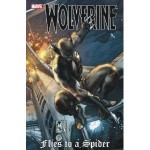
Wolverine: Flies to a Spider


By various (Marvel)
ISBN: 978-0-7851-3569-2

Ever since his glory days in the AllNew, All Different X-Men, the mutant berserker known variously as Wolverine, Logan and more recently James Howlett has been a fan-favourite who appealed to the suppressed, put-upon, catharsis-craving comic fan by perpetually promising to cut-loose and give bad-guys the kind of final punishment we all know they deserve.

Always skirting the line between and blurring the definitions of indomitable hero and maniac murderer, Wolverine soldiered on, a tragic, brutal, misunderstood hero cloaked in mysteries and contradictions until society changed and, like ethically-challenged colleague the Punisher, final sanction and quick dispatch became acceptable and even preferred options for costumed crusaders.

Debuting as a one-off opponent for the Incredible Hulk (in a tantalising cameo at the end of issue #180 in1974) the semi-feral Canadian mutant with fearsome claws and killer instincts spectacularly showed his mettle in a full-on scrap with the Jade Giant in the next issue, and has never looked back since.  Short and feisty he has always promised an explosion of visceral, vicarious ultra-violence and grim, gritty justice at every moment, and in this collection the public finally gets what the public wants.

This collection (which originally appeared as a number of one-shots and specials in 2008-2009) shows the dark and vengeful side of his nature as hunter, judge, jury and particularly as executioner.

First blood comes from Wolverine Holiday Special: ‘Swallowed the Spider’, written by Gregg Hurwitz, with art from Jerome Opeña & John Lucas has a short, mysterious stranger deal out summary justice to a murderous biker gang and the mob bosses who sponsored them one quiet New Year’s Eve, to avenge a little girl who died during one of their rampages. Swapping chilly bike for a cool automobile the hairy hero then tracks down and disposes of a rather specialised serial killer in ‘Switchback’ by Joseph Clark & Das Pastoras.

‘The Anniversary’ (William Harms & Jefte Pal) shows Wolverine’s softer side as he attempts to commemorate the death of his betrothed beloved Mariko, before crazed terrorists and their far from fundamentalist backer soon have back at his savage best, saving a airliner from fiery destruction. Mariko’s death is also the subject of the poignant vignette ‘Ghosts’, a ninja-filled reaffirmation of purpose from writer Jonathan Maberry and artist Tomm Coker,.

The painterly Das Pastoras returns to illustrate Victor Gischler’s ‘Revolver’ an action-packed, sardonic duel with a gambling demon and the book concludes with the darkly superb ‘Chop Shop’, a neat and nasty tale with hot babes, the worst kind of human scum and a brilliant new use of Wolverine’s celebrated healing factor.

Mean, sexy and utterly engaging this is the kind of hero the world too often needs, doing things the comics code would never have allowed. Not for the squeamish but a definite “must-have” for the discerning mayhem maven.

© 2008, 2009 Marvel Publishing, Inc, a subsidiary of Marvel Entertainment, Inc. All Rights Reserved.

Commando Annual 1989


By various (DC Thomson & Co)
ISBN: 0-85116-422-6

Dundee-based DC Thomson is probably the most influential comics publisher in British history. The Beano and The Dandy revolutionised children’s reading, the newspaper strips Oor Wullie and The Broons (both created by the legendary Dudley D. Watkins) have become a genetic marker for Scottishness and the uniquely British “working class hero” grew from the prose-packed pages of Adventure, Rover, Wizard, Skipper and such action-packed  picture papers as Victor, Hotspur and Warlord.

Their comics for girls also shaped generations and still evoke passionate memories – don’t take my word for it either – just ask your mum or grandmother about Judy, Bunty, Diana, Mandy and the rest….

In 1961 the company launched a digest-sized title called Commando. Broadly similar in dimensions to a slim paperback book, it offered 68 black and white pages per issue and an average of two panels a page. Each issue told a complete war story (generally based in World War I or II – although all theatres of conflict have featured since) and told tasteful yet gripping stories of valour and heroism in stark dramas which came charged with grit and authenticity. The fully painted covers made them look more like novels than comics and they were a huge, instant success. They’re still being published.

A number of these stirring sagas have recently been collected in sturdy, capacious hardback volumes, re-presenting  a dozen classics at a time – and I highly recommend them (see for example Commando: True Brit in our own archive section) but in its decades of unflinching service Commando has occasionally produced other collections such as this redoubtable annual from 1989 (the first of two) which contains shorter stories in a more traditional panel format, rendered in varying degrees of colour and offering all new stories.

Because of previous company policy these tales are all uncredited, (happily not the case nowadays) but as I’d rather not prove my ignorance by guessing who did what, I’m saying nothing and you’ll have to be content with the work itself, although the many fan-sites should be able to provide information for the dedicated researcher. Typically when looking at British comics Gold, this book is readily available through a number of online retailers and wonderfully reasonable in price.

Behind the stunning wraparound cover by Ian Kennedy lie seven cracking yarns. In full colour ‘The Young ‘Un!’ follows coal ship crewman Joe Simes as he struggles to come to terms with his father’s death; a victim of the Royal Navy’s foolish, doctrinaire policies – or at least that what he thought until he joined up… whilst ‘No Surrender’ sees intransigent troublemaker Angus McKay fight his own comrades and Germans with equal passion during a mission to Norway and ‘Duel in the Sun’ pits rebellious Australian pilot Mark Hudson against his own commanders when all he really wants is to kill the Japanese genius shooting down allied pilots as if they were sitting ducks…

‘Killed in Action’ is the part-colour tale (black, white, grey and yellow) and sees cruel, cowardly lieutenant Vivian Fawcett-Bligh challenged by a common soldier who knows all his secrets. Set in the African desert in 1941, it doesn’t end the way you might expect… ‘Big Bird, Little Friend’ is another spectacular full-colour air adventure featuring two rival pilots – one British and the other an American – whose bitter quarrel is finally resolved in the flak-blistered skies over Europe and ‘The Good Soldier’ looks at the war through German eyes as Panzer commander Martin Winter becomes increasingly disaffected and appalled by SS atrocities on the Russian Front…

The strips conclude with another half-colour adventure ‘The Three Musketeers’: wherein three boyhood chums are reunited with explosive results on the beaches of Dunkirk, and this classy package also contains a wealth of feature pages and many brilliant painted pin-up pages.

So ubiquitous and effective were Thomson’s war publications that they moulded the character of three generations of boys – and continue to do so eight times every month. This magical slice of the Blitz Spirit is a wonderful example of purely British comic-making: rousing, passionate and winningly understated, so if you’re looking for a more home-grown comics experience, well-written and wonderfully illustrated, get some in and check this out…
© 1988 D.C. Thomson & Co. Ltd. All Rights Reserved.

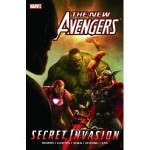
New Avengers: Secret Invasion volume 1


By Brian Michael Bendis, Michael Gaydos, David Mack, Jim Cheung, Billy Tan & various (Marvel)
ISBN: 978-0-7851-2947-9

The Skrulls are shape-shifting aliens who’ve bedevilled Earth since Fantastic Four #2, and they have long been a pernicious cornerstone of the Marvel Universe. After decades of use and misuse the insidious invaders were made the stars of a colossal braided mega-crossover event beginning in April 2008 and running through all the company’s titles until Christmas.

The premise of Secret Invasion is simple: the would-be alien conquerors have only just survived a devastating catastrophe which destroyed much of their empire; subsequently leading to a mass religious conversion. They are now utterly resolved and dedicated to make Earth their new homeworld. To this end they have gradually replaced a number of key Earth denizens – most notably superheroes and other metahumans. When the plot is discovered no defender of the Earth truly knows who is on their side…

Moreover the Skrulls have also unravelled the secrets of Earth magic and genetic superpowers, creating amped-up counterparts to Earth’s mightiest. They are now primed and able to destroy the world’s heroic champions in head to head confrontations.

Rather than give to much away let me just say that if you like this sort of thing you’ll love it, and a detailed familiarity is not completely vital to your understanding. However, for a complete experience, you will need to see the other 22 “Secret Invasion” volumes that accompany this on, although you could get by with only the key collection Secret Invasion – which contains all eight issues of the core miniseries, a one-shot spin-off “Who Do You Trust?” plus an illustrated textbook “Skrulls” which claims to provide a listing and biography for every shape-shifter yet encountered in the Marvel Universe (but if they left any who could tell?).

Collecting issues #38-42 of New Avengers, the saga contained in the book under review here is only the first part of the team’s response to the Invasion, focussing on individual character pieces to propel the narrative rather than vast battles. There is a second Avengers volume, so naturally this one ends on another thrice-accursed cliffhanger…

Scripted throughout by Brian Michael Bendis, the first chapter is illustrated by Michael Gaydos and deals with the aftermath of the superhero Civil War, as Luke Cage and his wife Jessica find themselves on different sides as she leaves a team of outlaw Avengers for the stability of the State-sanctioned alternative, whilst the second chapter (art by David Mack) sees that illegal team – Wolverine, Ronin, Iron Fist, Spider-Man and martial artist Maya – encounter the alien first strike when they narrowly escape death from a multi-powered doppelganger of Daredevil.

The scene then switches to the recent past and the devastated Skrull homeworld, detailing the rise of the new religious faction and the opening days of the Invasion (stunningly pictured by Jim Cheung & John Dell) before segueing to the Savage Land (illustrated by Billy Tan) and a confrontation between Earth’s costumed defenders and a Skrull ship full of what appears to be old friends – some of whom have been or dead for years. Are they escaped humans – or another batch of the new undetectable super-Skrulls?

That particular confrontation resolves itself in the aforementioned Secret Invasion – that’s why I said it was key – but this chronicle closes with another informative reminiscence drawn by Cheung & Dell as the new Skrull Queen recalls how she took lead strategic role in the campaign by replacing Spider-Woman in the Government-Approved Avengers.

As the book closes she readies her team for action, preparing to betray and destroy them all…

You will also definitely benefit by checking out the collections Secret Invasion: the Infiltration, Secret War (2004), Avengers Disassembled, and Annihilation volumes 1-3, as well as the rather pivotal New Avengers: Illuminati graphic novel.

Despite that copious homework list I’ve provided this book is still is solid action-adventure read, with plenty of human drama to balance the paranoia and power-plays. Reading it might be confusing and will be expensive, but for dedicated Marvelites and keen followers of Fights ‘n’ Tights action it is pure guilty pleasure.

© 2010 Marvel Publishing, Inc, a subsidiary of Marvel Entertainment, Inc. All Rights Reserved.

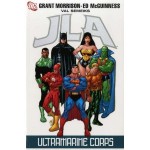
JLA: Ultramarine Corps


By Grant Morrison, Ed McGuinness, Val Semeiks & Dexter Vines (DC Comics)
ISBN: 978-1-84576-383-1

Here’s a peculiar little item thrown up by the peculiarities of periodical comics publishing, but one increasingly important to fans following Grant Morrison’s creative pyrotechnics in the Batman titles. Collecting a portion of JLA Secret Files 2004 #1 and JLA Classified #1-3 the tome also rather inappropriately includes one of those always uncomfortable marriages of publishing convenience as the JLA endures another less than stellar cross-company crossover – this time from JLA/WildC.A.T.S #1.

In JLA: Justice For All Grant Morrison introduced a team of American military metahumans duped by malevolent General Wade Eiling into attacking the World’s Greatest Super-heroes. Wising up at last the Ultramarine Corps eventually declared their independence and resigned their commissions. Setting up a floating headquarters called Superbia, the quartet invited other heroes – such as the Global Guardians and some members of previous Justice Leagues – to join them as a pre-emptive strike-force that would not rule out extreme sanctions wherever necessary.

Here Ed McGuinness handles the art for the spectacular sequel as the new champions attack and are attacked by the lethally dangerous Gorilla Grodd. ‘Island of the Mighty’ finds the Knight and the Squire centre-stage as the new team’s arrogant assault goes hideously awry and all those heroes not eaten by the sinister simian are co-opted by a fantastic being called Neh-Buh-Boh and turned upon helpless humanity.

Meanwhile the JLA are fighting in a distant baby universe and only Batman remains to protect the Earth…

‘Master of Light’ pairs the Dark Knight and the Squire as Grodd’s eerie ally extends his control over the surviving heroes of Superbia, clearly working to his own agenda, whilst the super-ape easily quashes Batman’s last-ditch attack. Things look bleak in ‘Second to Go’ until the JLA returns to spectacularly save the day, before suggesting a unique penance for Superbia’s Finest…

Fast-paced, glossy and chock-full of big ideas this light romp is an enjoyable piece of eye-candy most notable for laying the groundwork and setting up the ambitious Seven Soldiers publishing event.

The remainder of this book is a less successful, but still a vitally visual fiesta for fantastic fight-fans as old JLA foe the Lord of Time begins to rewrite history, causing dimensional rifts and an uncomfortable alliance with the parallel earth heroes called the WildC.A.T.s.

The tale is stuffed with guest cameos as the heroes chase the increasingly more powerful villain through the ages, but as usual far too much time is spent with the teams fighting each other (presumably because all any comic fan could ever desire of a team-up is to discover which hero is strongest/fastest/most buff or buxom…) before they finally unite to tackle the bad-guy – who defeats himself when they cannot.

This yarn is a poor example of Morrison’s exceptional talent, but Val Semeiks, Kevin Conrad & Ray Kryssing do the best they can so at least it looks shiny and pretty. Even though a shaky fit these mismatched tales will still please the dedicated fans and the Ultramarine episodes offer a tantalising glimpse of greater things to come in better conceived books.

© 1997, 1999 DC Comics and Regis Entertainment, 2004, 2005 DC Comics. All Rights Reserved.