David Boring


By Daniel Clowes (Jonathan Cape)
ISBN: 978-10-22406-323-4

One of the greatest assets of the comics medium is the ostensibly straightforward nature of its storytelling. With pictures wedded to text what you see is so clearly what you get. So whenever a master creator deliberately subverts that implicit convention the result might be occasionally obscure or confusing, but always utterly engrossing.

At the forefront of comics storytelling for nearly three decades Daniel Clowes is, for many, an acquired taste but once he’s in your brain there’s certainly no shaking the things he can do with pen and ink, motive, character and the special kind of situational magic that inhabits the world of pictures and word on paper.

Born in Chicago in 1961 he began his career as a cartoonist with humour magazine Cracked before creating uniquely skewed short comic tales for Fantagraphics. His first piece debuted in Love and Rockets # 13 (September 1985), an introductory prelude to his retro-chic detective magazine Lloyd Llewellyn which launched soon after, running in various incarnations for three years.

In 1989 he created the anthology vehicle Eightball and began producing a variety of tales – short and serial-lengths – ranging from social satire, nostalgic absurdist anthropomorphic yarns to surreal, penetrating human dramas, all viewed through the lens of iconic popular cultures and social motifs. All that material has since been collected into graphic novels and two of these, Ghost World and Art School Confidential, have been adapted into critically acclaimed feature films.

His experiences in Hollywood combined with deep-seated childhood influences of noir movies and comics books combined and resulted in ‘David Boring’ which originally ran in Eightball #19-21, before being collected by Pantheon Books in America and this British edition.

David Boring is the narrator of his own story, living a life of unsatisfactory gratification, harassed by his mother and obsessed by his absentee father, a second rate cartoonist and comic book artist who disappeared decades previously. He spends his days with his only real friend, a lesbian named Dot he has known since High School. David is listlessly indulging in his life’s work by searching for his perfect woman when an old friend suddenly shows up and triggers a series of bizarre events that should make his life a living action movie, but instead it all just steers him into increasingly unpalatable and mundane tragedies and horrors…

Set against a backdrop of impending catastrophes, ranging from murder to the end of the world, David’s progress is trenchantly plebeian and low-key: an odyssey rendered drama-free by the protagonist’s relentless lack of – or rather resistance to – passion and unwillingness to fully engage in the events occurring around him. His world is full of sexual encounters, assaults, murders, chases and even global holocausts but he passively accepts and adapts to it all.

Clowes has stated that he crafted this stunningly engaging and challenging tale as an exercise in writing an un-filmable comic. He has, but it’s still been optioned by Hollywood…

This is another of those too-rare productions that shouldn’t really be reviewed, just read, with themes of adolescence, maturity, the quest for self and the impending end of life delivered via a landscape of comics, film noir, mock-heroics and the irreducible knowledge that families make individuals combining to make a truly personal experience for every reader.

But be warned: the most telling narrative device used here is uncertainty. A tremendous amount of the story is left unstated: this is a saga littered with the reader’s conclusions not the characters’ actions. Events are set in motion, consequences are noted but the course of intervening actions if not experienced by David can only be surmised or extrapolated: David is a protagonist with few of the overt trope/meme drives of a standard narrative vehicle hero and his story is one that can’t happen to any one of us…

Brilliant, compelling and utterly wonderful? That’s up to you…

© 2000, 2002 Daniel Clowes. All rights reserved.

Moto Hagio’s A Drunken Dream and Other Stories


By Moto Hagio, translated by Matt Thorn (Fantagraphics Books)
ISBN: 978-1-60699-377-4

It’s Great Big Gift Giving Season: Win’s Christmas Recommendation: 10/10

Girls’ comics have always taken a secondary role in publishing – at least in most countries. In Japan this was the case until a new wave of female artists and writers stormed the male bastions in the 1970s transforming a very much distaff niche into a viable, autonomous marketplace, consequently reshaping the entire manga landscape in the process. At the forefront and regarded as part of a holy trinity of astoundingly gifted and groundbreaking creators is Moto Hagio. The other two, if you’re in the mood to Go Googling (and of course, other search engines are available) are Keiko Takamiya and Yumiko Oshima…)

This lovely hardback collection presents ten of her best short stories gleaned from a career than spans more than forty years, over which time she and her revolutionary compatriots created whole genres, advanced the status of fantasy, horror and science fiction tales, reinvented and perfected the shōjo (“girl’s story”) form, and introduced a degree of literacy, symbology, authority and emotional depth to the medium that has gone on to transform comics in Japan and globally.

Editor, translator and cultural ambassador Matt Thorn has contributed an informative historical treatise on Japan’s comic world and those revolutionary comics creators (thoroughly annotated) as well as providing a far-reaching, moving and engrossing interview with the artist and academic herself.

Although her most popular works are generally science fictional (another arena where she broke new ground in such sagas as ‘They Were Eleven!’, ‘Marginal’ and ‘Otherworld Barbara’), socially probing human dramas like ‘Mesh’ and ‘A Savage God Reigns’ explored previously forbidden realms of psycho-sexual and abusive family relationships with such deft sensitivity that they served to elevate manga from the realm of cheap escapism to literature and even Great Art – a struggle we’re still waging in the West…

This volume traces her beginnings through more traditional themes of romance, but with growing success came the confidence to probe into far darker and more personal subjects, so whereas my usual warnings are about pictorial nudity and sexual situations, here I’m compelled to say that if your kids are smart enough the contextual matter in these tales might be a tad distressing. It is all, however, rendered with stunning sensitivity, brilliantly visual metaphors and in truly beautiful graceful tones and lines.

The comics section (which is re-presented in the traditional front-to-back, “flopped” manner) begins with ‘Bianca’ from 1971: a wistful reminiscence and disguised disquisition on creativity wrapped in the tragic story of a childhood companion whose parents separated, whilst ‘Girl on Porch with Puppy’ (1971) is a disquieting cautionary tale about disobedient little girls who don’t try to fit in and ‘Autumn Journey’ from the same year is a complex mystery concerning a young man trying to meet his favourite author – as well as a painful exploration of families growing up apart.

‘Marié, Ten Years Late’ from 1977 is a heartbreaking example of a “Sophie’s Choice” as a lonely, frustrated artist discovers the truth behind the breakup of a perfect friendship which twisted three lives whilst the eponymous science fictional ‘A Drunken Dream’ (1980) describes a doomed reincarnating romance which has spanned centuries and light-years. This is the only full colour story in a generally monochrome volume.

Moto Hagio is one of a select band of creators credited with creating the “boy’s love” sub-genres of shōnenai and Yaio: sensitively homoerotic romances, generally created by women for women and now more popularly described as BL (as opposed to Bara – gay manga created by men for men) and this lyrical, star-crossed fantasy is a splendid example of the form.

Hanshin: Half-God’ (1984) is a disturbing, introspective psychological exploration of Hagio’s favoured themes of familial pressure and intolerance, described through the lives of anther girls’ comic favourite; twin sisters. The siblings here however are conjoined: Yucy is a beautiful angelic waif whilst her monovular other Yudy is an ugly withered homunculus.

The story is told by ugly Yudy whose life is changed forever by an operation to separate them. This incredibly moving tale adds barbed edges and ground glass to the ugly ducking fairytale and cannot fail to shock and move the reader…

From the same year comes the longer romantic tale ‘Angel Mimic’ as a failed suicide eventually evolves into a slim chance of ideal love, which poesy leads into the harrowing tale of rejection that is ‘Iguana Girl’.

Although couched in fantasy terms this tale of contemporary Japanese family life follows the life of Rika, an ordinary girl whose mother thinks she is a monster, and how that view warps how the child perceives the world throughout her life.

‘The Child Who Comes Home’ (1998) again examines rejection but uses the memory of a dead son and brother to pick open the hidden scabs of home and hearth – or perhaps it’s just a sad ghost story to clear the palate before this superb commemoration ends with the elegiac and almost silent, solitary pantomime of 2007’s ‘The Willow Tree’ which shows yet another side of family love…

Abuse of faith and trust. Love lost or withheld. Isolation, rejection, loss of purpose: all these issues are woven into a sensuously evocative tapestry of insightful inquiry and beautiful reportage. These tales are just the merest tip of a cataclysmic iceberg that invaded the stagnant waters of Girls’ comics and shattered their cosy world forever. The stories grew up as the readers did; offering challenging questions and options not pat answers and stifling pipedreams.

Until the day our own comics industries catch up at least we have these stories – and hopefully many more from the same source. Sequels please, ASAP!

All rights reserved. Original Japanese edition published 1977, 1985, 2007, 2008 by Shogakukan Inc. English translation rights arranged through Viz Media, LCC, USA. © 2010 Fantagraphics Books.

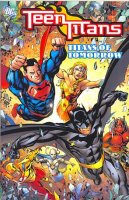
Teen Titans: Titans of Tomorrow


By Sean McKeever, Geoff Johns, George Pérez & others (DC Comics)
ISBN: 978-1-84576-899-7

This slim volume of frantic Fights ‘n’ Tights teen angst follows on from an earlier saga when the constantly changing team of junior heroes arrived a decade into their own future and were aghast to find that their adult selves had conquered America in the name of peace and security. Forearmed with the knowledge of this dystopian tomorrow the kids came back to now (see Teen Titans: The Future is Now) and resolved to counter those events…

Superhero lives are fairly chaotic and in the interim a number of Crises occurred which seemed to guarantee that Tomorrow would never come true. This volume, collecting issues #50-54, opens with a memorial for Superboy and Kid Flash (both recently deceased) as Robin, Wonder Girl, Ravager, Kid Devil, Miss Martian and Supergirl share their grief and memories with previous members.

‘Passage’ (team written by Sean McKeever, Geoff Johns, Marv Wolfman & Todd Dezago and illustrated by Randy Green, Mike McKone, George Pérez, Todd Nauck, Andy Lanning, Sandra Hope, Marlo Alquiza & Larry Stucker) finds the survivors reminiscing in ‘Friday Night Lights’ and ‘Dear Barry…’ whilst including a neat, entertaining digression that provides the other side of a team-up with the new Blue Beetle against Biker-Berserker Lobo (the main part of that saga is collected in the superb Blue Beetle: Reach For the Stars).

Meanwhile a mysterious gang are systematically defeating the Justice League and replacing them…

The four-part epic ‘The Titans of Tomorrow… Today!’ begins with ‘Futures of the Past’ (McKeever, Alé Garza, Derek Fridolfs, Rob Hunter & Marlo Alquiza) as the future Titans – including versions of the dead Superboy and Kid Flash – arrive in contemporary times to ensure their own existence by forcing their younger selves to comply with their draconian counterparts continually re-editing memories.

Simple, no? Perhaps not, as wild card Blue Beetle has inexplicably re-entered the mix…

Selecting a key moment when the alien invader Starro nearly conquered Earth, the future Titans substitute themselves for the JLA and attempt to seduce, demoralise and even thrash their teen incarnations into becoming the fascist monsters they are, but youth is always rebellious and plans go very wrong indeed in ‘Beat Yourself Up’ (art by Jamal Igle, Alquiza, Jesse Delperdang & Hunter) as Robin finds a uniquely dramatic way to stymie his tomorrow tormentor and Blue Beetle leads a counterattack…

The temporally fluid situation shifts again as the future Luthor materializes with a battalion of tomorrow’s corrupted superheroes in ‘Combine and Conquer’ (illustrated by Eddy Barrows & Rob Hunter) to finish the battle and save his own timeline, but his Titan’s Army has overlooked the mind-controlling power of Starro who (which?) simply takes them all over.

The action spectacularly concludes in ‘Fight the Future’ (Barrows, Joe Prado, Greg Tocchini, Hunter, Julio Ferreira & Oclair Albert) as allegiances shift and the future dies forever in an explosive battle and simple resignation…

Fast, furious, this extremely twisty-turny, time-travel extravaganza is better than most of its ilk, and on the whole this is a genuinely fun-filled action romp; but once again I can only remark that for the less well-informed reader or DC newcomer, the bits without hitting and explosions might be very confusing. As always, the choice is yours. The future is not immutable…

© 2007, 2008 DC Comics. All rights reserved.

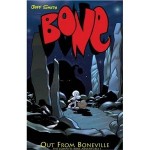
Bone volume 1: Out of Boneville


By Jeff Smith (Cartoon Books)
ISBN: 978-0-96366-094-7

Jeff Smith burst out of relative obscurity in 1991 and changed the comics-reading landscape with his enchanting all-ages comic-book Bone. The compelling black and white saga captivated the market and prospered at a time when an endless procession of angst-ridden, steroid-breathed super-vigilantes and implausibly clad “Bad-Grrls” came and went with machine-gun rapidity.

Born in Pennsylvania and raised in Ohio, Smith absorbed the works of Carl Barks, Charles Schultz and especially Walt Kelly from an early age, and purportedly first began producing the adventures of his Boneville creations at age ten. Whilst at Ohio State University he crated a strip for the College newspaper: ‘Thorn’ was another early incarnation of his personal universe and a proving ground for many characters that would appear in Bone. A high school classmate became a Disney animator and Smith subsequently worked in the industry before striking on his own, mastering the graceful slapstick timing and high finish that typifies his art style.

He founded Cartoon Books to self-publish 55 delightful black and white issues (to be accurate ten of them were put out under the Image Comics imprimatur, but reverted to Smith’s company with #29): a fantasy quest yarn that owed as much to Tex Avery as J.R.R. Tolkien, as well as his holy trinity, Barks Schultz & Kelly. The bold thrilling and fantastically funny saga progressed at its own unique pace between 1991 and 2004. Since then it has been collected into nine volumes from Cartoon Books (with two further collections of prequels and side tales), reissued in colour by Scholastic Books and even reprinted in Disney Adventures magazine.

At series’ end Smith issued a monumental one volume compilation (more than 1300 black and white pages) which Time magazine dubbed “the best all-ages graphic novel yet published” and one of the “Top Ten Graphic Novels of All Time.”

Smith has won many awards including 11 Harveys and 10 Eisners. In 2003 he turned his magic loose again and revived the World’s Mightiest Mortal for DC with Shazam: The Monster Society of Evil. The project took three years but was worth every moment…

His latest work is the science fiction tale RASL.

As you can see there are plenty of versions to opt for but purist that I am I’ve plumped for the original Cartoon Books collection where the action commences in Out of Boneville, which re-presents the first six episodes.

Fone Bone is a strange, amorphous, yet decent little bald guy, a thematic blend of Mickey Mouse and Asterix who has been run out of the town of Boneville along with his tall and not-so-bright cousin Smiley Bone. Well to be exact they haven’t, but their dastardly, swindling cousin Phoncible P. “Phoney” Bone has, due to the kind of irregularities, misdemeanours and malfeasances that bring down presidents – and he running for Mayor at the time…

Crossing a deadly desert and near death the trio are separated by a storm of locusts and Fone finds himself in a lost valley: an oasis of pastoral beauty hidden from the rest of the world. Along the way he is adopted by a dragon he doesn’t believe in, stalked by ghastly rat monsters and befriended by a talking leaf-insect (like a stick insect but flat, not long – and very talkative…)

The little refugee is forced to spend a harsh winter living wild in the deep forest where he befriends many of the small creatures who live there, but as the thaw approaches he meets the beauteous and oddly compelling human girl Thorn. It is Crush-at-First-Sight…

She invites him to stay with her and her grandmother Rose until he can find his lost cousins, but soon regrets it when Phoney turns up: rude, duplicitous, greedy as ever and determined to be a real pain…

Phoney’s insatiable drive to steal, cheat and fake a buck makes life pretty uncomfortable for the besotted Fone Bone, but trouble is brewing in the deep woods. An ancient evil has stirred, driving the rat creatures into a frenzy. An old, cold war is heating up again and for the humans of nearby village Barrelhaven the stakes are really high. The dark creatures have only been waiting for the arrival of their prophesied one – a small bald creature with a star on its chest remarkably similar to the one on Phoney’s shirt…

The assembled horror-hordes attack Thorn’s cottage but their chosen one is long gone. Phoney has scented money and gone to Barrelhaven in search of easy marks. Gran’ma fights a desperate holding action as Thorn and Fone flee through the forest to warn the villagers. After a nightmarish retreat the pair are rescued by the dragon – sworn foe of the rat things and their master. They return to the cottage to find that Gran’ma has survived: moreover she and the Dragon are old acquaintances…

As the Dragon returns to the deep woods the humans (and Bone) relocate to Barrelhaven, where Fone discovers that Smiley has been there all along, working as a bartender in the local tavern. Phoney is there too – working off a tremendous bar-tab…

This volume ends on a happy note as the cousins are finally reunited, but malevolent forces are gathering all around them and there are dark days ahead…

I’ve talked a lot about the influences that informed this wonderful series and there’s one more that cannot be ignored: if you squint your eyes just right you can hear the dulcet deceptions of Bill Watterson’s Calvin (see The Essential Calvin and Hobbes. Just Do. It’s wonderful and so are all the other collections) leaking in to flavour this equally marvelous, child-friendly extravaganza…

Bone is a truly perfect comic tale and one that appeals to kids and adults equally. Already it is in the rarefied rank starring Tintin, Pogo, Rupert Bear, Little Nemo and the works of Carl Barks. It is only a matter of time before it breaks out of the comic club completely and becomes kin to the likes of Wind in the Willows, the Moomins and the Oz books.

If you have kids or can still think and behave like one you must have these books…

© 1996 Jeff Smith. All rights reserved.

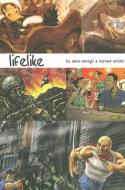
Lifelike


By Dara Naraghi & various (IDW)
ISBN: 978-1-60010-122-9

We do it for fame, we do it for fortune (or at least to pay bills), we do it for fun and the very best of us make comics because we absolutely have to. Every story we hear, every event we see provokes the reaction “how would I break that down into panels? How many on the page?” All data – from shopping lists to bad TV – is taken in, screened through an internal grid and then we worry about how we’ll draw the damn thing one day…

All creative people are a little bit chained to their art-form, and Dara Naraghi apparently more so than most. As well as his own celebrated BigCityBlues comic he keeps busy adapting licensed properties such as Robert Patterson’s Witch & Wizard novels, Terminator: Salvation, It! The Terror From Beyond Space and Ghostbusters into comics form, writing for DC, Image and IDW and running his own publishing house Ferret Press. He also scripts (and occasionally draws) utterly wonderful tales covering every aspect of the human experience from wild fantasy to chilling slice-of-life in a splendid series of webcomic features.

Wonderfully expansive in narrative scope and illustrated by an astounding gathering of talented graphic artisans, an exemplary bunch of these brief delights has been compiled into a fabulous hardcover compilation. All the stories in this anthology come from that webcomic site and are written (and lettered) by Naraghi, complete with commentary and context on the illustrators interpreting each piece.

The wonderment begins with ‘The Long Journey’ illustrated by Irapuan Luiz, which follows the dramatic escape of a disillusioned Iranian soldier determined to leave the Iran-Iraq War behind him forever. Naraghi is Iranian (born in Tehran in 1971) and no doubt his own journey to the west would make pretty interesting reading, although probably without the telling sting in the tale embedded here…

‘Imaginarians’ winningly crafted by award winning artist Tom Williams, takes a barbed look at how the media deals with artists on the promo circuit whilst equally lauded Marvin Mann’s atmospheric ‘Double Cross at the Double Down’ proves that even if crime doesn’t pay, stories about it definitely do.

‘Art/Life’ rendered by Neil Errar is a feel-good fable about a comics creator we all concur with, Jerry Lange’s moody, misty paint-and-Paintbox (showing my digital age there) treatment examines the exquisite pain of unconditional love lost with ‘Remembrance’ whilst Stephen Spenser Ledford opts for monochrome ink washes to recount a particularly trenchant tale of crime and ‘Punishment.’

Sex and booze and rock ‘n’ roll form the basis of the cheeky dating vignette ‘Intermission’, illustrated by Andy Bennett, whilst Jerry Lange’s watercolour expertise displays a different arena for the relationship dance in ‘Crush’ and ‘Comeback’ by Tim McClurg describes a the meteoric fall from stardom for a has-been actor.

Marvin Mann displays his artistic versatility in ‘Smoke Break’, a heartwarming look at modern life and ‘The Routine’ by Steve Black touchingly reminds us that even small victories count in our work-a-day world, whereas the stunning drawing of Adrian Barbu’s gritty thriller ‘Rooftop Philosophy’ adds acres of edge to a dark tale of criminal Darwinism. Tom Williams astounds again with ‘Skin Deep’ a charming semi-autobiographical shaggy-dog story and pictorial programme ends on a heartwarming high note with ‘Repair’ as Shom Bhuiya treats us to a view of the common man at his very best…

The 14 tales collected in Lifelike demonstrate the sheer breadth that material comics could and should be covering rather than the narrow band of easily defined genres usually seen. This book opens up all of human experience and imagination to the cartoonist’s particular skills and insights. Now it’s up to the rest of us to respond and react…

Created and © 2007 Dara Naraghi. All artwork © 2007 by its respective artist. © 2007 Idea and Design Workshop. All Rights Reserved.

Read Dara’s free webcomic, Lifelike under the Stan Lee’s Sunday Comics banner @ Komikwerks.com.

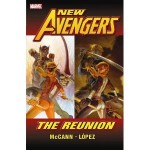
New Avengers: The Reunion


By Jim McCann, David López & Alvaro López (Marvel)
ISBN: 978-0-7851-3855-6

The Marvel publishing event Secret Invasion revoked a number of hasty decisions made by writers and editors in the day-to-day, hand-to-mouth hurly-burly of periodical publication, among them a couple of “deaths”. The Skrulls, shape-shifting aliens, had been infiltrating all corners of the Marvel Universe for years, even abducting and replacing certain heroes. Thus when Bobbi Morse-Barton, Mockingbird, ex-super-spy, West Coast Avenger and wife of Hawkeye was killed, it wasn’t her…

Freed and returned to Earth Mockingbird is having trouble readjusting. The world is a far darker place, and terrorists have overtaken super-villains as the greatest threat, Hawkeye is now the enigmatic warrior Ronin – and wants to pick up where they left off. When Bobbi “died” the couple were going through a divorce, but he has since convinced himself that that was the Skrull impostor playing mind-games…

This is a rare thing for a Marvel graphic novel; a love story/Romcom with genuine sentiment and quite a few laughs riding shotgun on the traditional moody adventure the company generally specialises in. Collecting pertinent portions of Dark Reign: New Nation and the miniseries New Avengers: The Reunion #1-4, the saga opens with ‘Supicion’ as Clint Barton violently forces himself back into Mockingbird’s life and realises that his one-and-only is still carrying a secret trauma from her time as a Skrull prisoner. She wants nothing to do with him and has her own cure for what’s ailing her…

‘The Lady Vanishes’ finds the persistent Ace Archer making a pest of himself until she lets him join her new endeavour. Not prepared to rejoin the Avengers Mockingbird has returned to her old profession and working with a group of other returned Skrull captives has created her own spy network. The World has gone to hell in a hand-basket and if the superheroes can’t fix it her World Counterterrorism Agency will – by whatever means necessary.

Against her better judgement Bobbi allows her once-hubby to come along on a mission and ‘Double Indemnity’ finds them matching wits with the terrifying Monica Rappaccini, new leader of evil think-tank Advanced Idea Mechanics and the world’s most ruthlessly ambitious poisons specialist…

How the odd couple reconnect, save the world and come to terms with the horrors Bobbi experienced on Skrullworld makes for a rollicking, complications-free action-romp that is bright, breezy and just the tonic for romantic fans of modern lovers.

Saving civilisation, punching each other out and gradually redefining the term “True Love” this snappy little package is everything Mr. & Mrs. Smith should have been and writer Jim McCann and artists David López & Alvaro López have my fervent support for a sequel any time they’re in the mood…

© 2009, 2010 Marvel Publishing, Inc, a subsidiary of Marvel Entertainment, Inc. All Rights Reserved.

Girls Bravo volumes 1-3


By Mario Kaneda, translated & adapted by Asuka Yoshizu & Steve Bunche (TokyoPop)
ISBNs: 978-1-59816-040-6, 978-1-59816-041-3 & 978-1-59816-042-0

Here’s another large slice of manga magic that took the world by storm when it inevitably transferred to the anime screen, and another of those uncomfortably inappropriate teen-sex comedies that so delight the Japanese and generally bewilder we less socially ossified westerners. Aimed at older teens this type of tale fully acknowledges and draws seemingly endless amusement from the fact that boys and girls of a certain age are hormone-crazed muskrats desperate to catch furtive snatches of each other’s proscribed bits and only conscience and social pressure keeps them from being even more intolerable than they are.

If only it got any easier with advanced age…

These tales first appeared in the Japanese magazine Shōnen Ace from 2000 to 2005 and were eventually collected in ten volumes of frantic, frenetic slapstick, excruciating comedy-of-manners gaffes, gusset glimpses, shower-scenes, fantasy fun and burgeoning young love.

‘Gārusu Burabō’ is the story of a hapless high school student named Yukinari Sasaki, a short, dim nebbish who is so put upon, teased and bullied by girls – and even his female teachers – that he has developed a condition which brings him out in hives every time anything with no Y chromosomes touches him. His condition is further compounded by the fact that the neighbours’ daughter Kirie, a girl he has known since childhood, and a girl he can at least talk to, has recently changed.

Her shy and awkward nature has developed into a crush he is oblivious to, but unfortunately said crush has devolved into a series of violent assaults every time she gets flustered, and with Sasaki, she gets flustered a lot… At some time when nobody was paying attention she blossomed into an astonishingly well-endowed young woman – something else that embarrasses her greatly and often leads to red-faced punches and kicks…

After a particularly trying day Yukinari returns home and stumbles into Kirie using his shower. He’s flustered, she’s naked and while he’s being pummelled by the blushing, panicked girl he falls into the bath… and emerges into another world and another naked girl’s bath…

But this is a completely different kind of girl. She is genuinely concerned, solicitous, even shorter than him and most importantly not screaming or hitting. Moreover Miharu can touch him without setting off his allergic reaction. All she cares about is his welfare and what earth food is like.

The world of Siren is a revelation; a magical place where women outnumber men 9-1. When her older sister Maharu spots the unattached male she makes a violent play for Yukinari, chasing him into the streets where every female in range tries to capture the fleeing boy-toy.

Miharu rescues him and they double back to her bathroom, but the pursuers are too close and the fugitives fall into the bath – and arrive back in Yukinari’s shower, still occupied by the perplexed, naked and fuming Kirie.

Miharu is apparently stuck on Earth: the perfect companion for the gynophobic lad. She never attacks him, doesn’t cause hives, has magic powers and only cares about food. Unfortunately she’s as naive as a newborn hamster and bewitchingly beautiful, so the hoi-polloi at school trail after her like dogs after biscuits, especially wealthy school stud Fukuyama, a glorious young god of manliness who hides a secret of his own: he is so male-phobic that he has an attack of hives every time a male touches him. He is driven crazy by Miharu’s indifference to him…

Meanwhile hopeless Yukinari is still being teased and bullied by all girls and regularly happening into situations where Kirie is undressed and volatile…

This first volume covers the set-up of the formulae, with lots of stories about simplistic Miharu’s desire to eat anything not nailed down, platonically care for Yukinari and tendency to be duped into wearing revealing or fetishistic clothing by the lecherous Fukuyama. Despite being always hungry and able to consume practically anything Miharu is a brilliant cook, unlike Kirie whose recipes are only really appreciated by terrorists looking for new bio-weapons. Yukinari increasingly has to spend his time protecting the gullible alien’s non-existent modesty…

Gradually the series takes a more supernatural turn as the unhappy ménage-a-trouble encounter an undressed ghost girl and Fukuyama’s sister Risa: a young sorceress convinced that beleaguered Yukinari is her predestined husband and willing to use all her wiles and witchcraft to make him hers – if it means destroying or even befriending Miharu and Kirie…

The first volume ends with a light-hearted and hottie-filled adaptation of traditional Japanese folk-tale Momotaro (the Peach Boy).

Volume 2 continues Risa’s campaign. She casts spells on Yukinari, tries to convince Miharu that her attentions are preventing the diminutive lad from forming normal relationships or shaking his allergic phobia and things get completely crazy when the Siren girl drinks alcohol and begins to replicate herself uncontrollably…

Yukinari still keeps getting accidental, unwelcome and concomitantly painful glimpses of girls whilst growing increasingly fond of Miharu, even battling the hulking alpha male Fukuyama to protect her, but when amnesiac Koyomi appears thing get very strange indeed. For one thing she is the only other girl able to resist the school stud’s dubious charms, she doesn’t give Yukinari hives and when flustered or scared giant pits open in the floor under her…She is in fact an agent from Siren sent to recover the missing Miharu, and when her memory returns she transports her quarry home before Yukinari’s tear-filled eyes…

Of course she does return, and this second volume concludes with another side story; a day in the life of sexy super-stud Fukuyama – or at least in his fevered, fetid mind…

Volume 3 opens with the cast being coerced by the ghastly Lothario into a game of strip Mah-Jong where the returned Konomi (on a secret mission for Miharu’s sister) is Fukuyama’s latest lewd target. Sadly for him she suffers from the same condition as he does – she too is androphobic and repelled by the touch of men…

Konomi’s mission is revealed and she begins searching for a perfect husband for Miharu’s strident, overbearing sister; inevitably leading to some very uncomfortable situations, as do the girls’ communal attempts to earn some extra money, before everything goes really crazy when Kirie falls through Risa’s mirror into a world where all her friends have reversed personalities…

Sweet-natured Miharu’s attempts to buy all her friends New Year’s Gifts goes painfully awry before all ends well, and her celebration of the Setsubun festival (where bad luck is symbolically removed by throwing Soya beans out of the house) also falls flat – but only because Risa summoned real evil spirits to the party… The volume ends on a heartbreakingly beguiling tale of a little girl abandoned in the snow – a story so moving it’s worth buying all three volumes just to read this sparkling gem in perfect context…

Irrepressibly juvenile but great fun and beautifully drawn, this is a series as likely to titillate as offend, but it’s all good clean smut really, harmless and charming and bound to delight girl watchers and anyone enduring puberty or recalling it with any degree of honesty…

© 2001, 2002 Mario Kaneda. English text © 2005, 2006 Tokyopop Inc. All rights reserved.

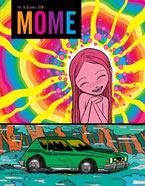
Mome 19: Summer 2010


By various (Fantagraphics Books)
ISBN: 978-1-60699-152-7

Mome is a quarterly compendium of sequential narratives; a magazine that looks like a book, featuring strips, articles, graphic artworks and occasionally interviews from and about a variety of talented, dedicated creators ranging from the internationally renowned to the soon-will-be. It is where the smart kids with the sharpest pencils, shiniest pens, biggest brushes and best software go to play before they blow your minds in great big award-winning graphic novels. It is intense, sometimes hard to read and crafted to the highest production standards. Considered by most to be the successor to Art Spiegelman’s Raw, it doesn’t come out nearly often enough.

Once in awhile, as with this issue, it pushes the envelope of conventional taste and morality so if you are liable to be offended by the depiction of sex acts and adult themes stay away from this volume: The rest of us will just be grown ups without you…

This volume is perfect for newcomers to jump aboard as four continuing features (Fuzz & Pluck, Almost Sound, Nothing Eve and Devil Doll) all take a break. The Summer magic begins here with a glorious and challenging fantasy from The Partridge in the Pear Tree (Shaun Partridge on his tax return) & Josh Simmons (don’t miss his superb graphic novel House) as a troubled woman lands in a baffling Never-land of institutionalised racism and joins a disquieting pixie child in a hunt for ‘The White Rhino’…

Animator and cartoonist Olivier Schrauwen returns with another panchromatic hard-centred extravaganza in ‘The Imaginist’ and comics super-star Gilbert Hernandez opens the black and white section with ‘Roy in “Who Are Your Heroes; What Are Your Heroes?”’ a boldly excessive progression that examines the cultural landscape which shaped the jolly reprobate from Love and Rockets.

‘Evelyn Dalton Holt’ by D.J. Bryant is based on the Steve Ditko story “Driven to Destruction” and delivers a witheringly painful, sexually explicit neo-noir psycho-thriller that will delight all fans of hard-edged fiction, whilst Tim Lane’s ‘Hitchhiker’ offers a far gentler surprise behind its tense edgy monochrome façade.

‘Vote Lily at the Dog Show’ by Conor O’Keefe is simply stunning: classic watercolour fantasy with a modern sensibility as a talking wren goes searching for his lost mate at a county fair aided by the gamin Deidre, a worthy successor to Little Nemo himself: surreal, nostalgic, winningly compulsive…

The black and white history lesson ‘The Spiritual Crisis’ of Carl Jung’ by animator Robert Goodin is a surprisingly tasty confection, dry and sharp and this edition ends with another multi-media delight from T. Edward Bak, who continues his graphic fascination with historic Russia and 18th century German naturalist Georg Wilhelm Steller, with part 3 of ‘Wild Man Chapter 2: A Bavarian Botanist in St. Petersburg, part’ and as ever the tome is graced with a selection of incidental drawings by Kaela Graham

Whether you’re new to comics, currently searching beyond the mainstream or just want something fresh; these strips and this publication will always offer a decidedly different read. You may not like all of it but Mome will always have something you can’t help but respond to. Why haven’t you tried it yet?

Mome © 2010 Fantagraphics Books. Individual stories are © the respective creator. All Rights Reserved.

Amazing Spider-Man: Died in Your Arms Tonight


By Stan Lee, Mark Waid, Marc Guggenheim, Joe Quesada, John Romita Jr. & others (Marvel Comics)
ISBN: 978-0-7851-4485-4

When the Spider-Man continuity was drastically and controversially altered at the end of the “One More Day” publishing event a refreshed, now single-and-never-been-married Peter Parker was parachuted into a new life, so if this is your first Web-spinning yarn in a while or if you’re drawing your cues from the movies prepare yourself for a little confusion. That being said this collection of Web-spun wonderment is more accessible than most: a vast celebratory collection commemorating then 600th issue of the landmark comic-book and stuffed with vignettes, mini-masterpieces and clever nostalgia-steeped moments.

Gathering the contents of Amazing Spider-Man #600-601, material from Amazing Spider-Man Family #7 and Amazing Spider-Man Annual #36, the merry Marvel Magic leads off with the comedic ‘Identity Crisis’ by Stan Lee & Marcos Martin, a whimsical look back and shaggy psychiatrist story, Whilst Mark Waid, Colleen Doran & Jose Villarrubia’s ‘My Brother’s Son’ is a glorious sentimental glimpse into Ben Parker’s life with the child Peter that will bring a tear to every fan’s eye. Written by Marc Guggenheim and illustrated by Mitch & Elizabeth Breitweiser offers a glimpse into the heart of Aunt May on the eve of her marriage to J. Jonah Jameson’s father.

From Amazing Spider-Man Family #7 comes ‘Just an Old Sweet Story’ by Roger Stern, Val Semeiks & Mike Getty, revealing how May Reilly and Ben Parker met and married, whilst Amazing Spider-Man Annual #36 provides Guggenheim, Pat Olliffe & Andy Lanning’s ‘Peter Parker Must Die’ as the impending Bride and Groom’s families meet for the rehearsal dinner in Boston.

This romp introduces a whole new sub-cast into the Wall-Crawling mix with the rambunctious Reilly Clan and also debuts a new villain intent on Peter’s demise. Or is the Raptor actually after somebody else? Also on offer are two more enchanting mood-pieces; ‘A Night at the Museum’ by Zeb Wells, Derec Donovan & Antonio Fabela, reminiscing about one of the most embarrassing moments in Spidey history and Bob Gale & Mario Alberti’s lovely ‘If I Was Spider-Man’ as the hero overhears kids answering the age-old question with startling honesty and profundity…

The latter half of this book is taken up with the stunning lead feature and its sequel. ‘Last Legs’ by Dan Slott, John Romita Jr. & Klaus Janson is set during the wedding of Aunt May and Pa Jameson and recounts the last assault by Dr. Octopus, dying from years of being smacked around by the good guys and determined to make the City of New York remember his passing. Moreover as he almost married May Parker himself once, Ock’s not averse to playing gooseberry there if he can…

Packed with guest-stars like Daredevil, the Avengers and Fantastic Four, all of Manhattan is held hostage to the madman’s final rampage until Spider-Man and the Torch save the day and still get to the church on time. But at the reception there’s still one more shock for Peter Parker…

Issue #601 presents a trio of tales set The Day After, beginning with Waid and Alberti’s ‘Red-Headed Stranger: No Place Like Home’ as the repercussions of Peter’s drunken response to the sudden return of Mary Jane Watson (missing for months) leaves him homeless and clueless whilst ‘The Very Best Version of Myself’ by Brian Michael Bendis & Joe Quesada shows the true heroic power of the wall-crawler and the concluding ‘Violent Visions’ (Joe Kelly, Max Fiumara & Chris Chuckry launches the next big thing as a war against Spider-themed characters begins with the “death” of precognitive bit-player Madame Web…

Stuffed with a gallery of covers and alternate art-pieces by such luminaries as John Romita Jr., Joe Quesada, Joe Suitor, Olivier Coipel, Alex Ross, J. Scott Campbell and John Romita Sr. this treasury of delights proves the modern Wall-Crawler still has a broad reach and major appeal for fans old and new. This is the perfect place to rejoin or jump on if the Webbed Wonder crawled off your radar in recent years…

© 2009 Marvel Publishing, Inc, a subsidiary of Marvel Entertainment, Inc. All Rights Reserved.

Wallace & Gromit in The Wrong Trousers – A Hardback Graphic Novel


By Nick Park, illustrated by Bill Kerwin (Egmont)
ISBN: 978-1-4052-5238-6

Here’s another superb cartoon adaptation of the world’s most animated British heroes. Hard though it is to believe, Wigan’s Finest have been delighting us for over twenty years and this delightful commemorative edition celebrates the fact, adding major mirth and mild menace to the malleable mix in a follow-up edition to last year’s science fiction fantasy Wallace & Gromit in A Grand Day Out.

In fact this magical comic strip adaptation is only coming full circle. Nick Park originally created the ingenious, quintessentially English cheese-loving duo as an art school graphic novel, before the lure of movement and sound diverted the concept into the world of animation and the olfactory, morphic joys of Plasticine.

Bill Kerwin’s moody watercolours aptly capture the pecuniary peril and muted menace of the dauntless duo as they struggle to make ends meet and poor Gromit is summarily ousted from his home to make room for a penguin lodger.

The felonious fowl then proceeds to steal Wallace’s filial affections and even appropriates the wonder dog’s birthday present from his cheese-loving master. What possible use could a penguin have for a pair of robotic techno-trousers?

Gromit must discover the reasons behind the actions of the ruthless, flightless sea-bird before Wallace is lost forever in this spellbinding rollercoaster romp, which perfectly captures the slapstick madness and utter glee of the original film. Lovingly rendered, perfectly timed, the skilful blend of low comedy and whimsy is every bit as effective on paper as on screen and this book is going to make a lot of kids – of all ages – deliriously happy.

Is it ever too soon to start recommending what to buy for Christmas? If not then consider this an essential “must have” – and don’t forget the first utterly excellent excursion A Grand Day Out while you’re about it and completists might also want to track down the 2004 Wallace & Gromit: The Whippet Vanishes. More Crackers, Gromit?!
© and ™ 2010 Aardman Animations Ltd. All rights reserved.