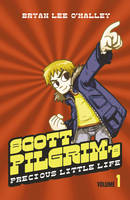
Scott Pilgrim’s Precious Little Life volume 1


By Bryan Lee O’Malley (Oni Press)
ISBN: 1-9326-6408-4

Ha! I Told You So Dept: a shameless cashing–in reprint moment…

Is it just me, or is all the really cool, really fun and really fresh comic stuff coming out of the alternative/Small Press/creator owned/self-published sector of the comic industry? Like so many others my age I grew up in a time with very few strip publishers, and though I love ’em dearly still, I’m acutely aware of just how limited a range those mainstream creators were allowed to work within.

I’m simply appalled that in an era of specialist retailers, comic conventions and all the computer age paraphernalia that should keep editors and publishers totally clued in to the appetites of their customer base, the same old stuff is perpetually retooled and recycled whilst everybody and his aunt bemoans the unstoppable decline in comics sales and the inevitable death of the medium.

I have some maxims that might help solve this conundrum. Produce work for your audience, not yourselves. Variety is the spice of life. Nothing ventured, nothing gained. Think about the work first, and the Subsidiary Merchandising Rights last. This is an entertainment medium: Your goal should be to make entertainment.

Having got that off my capacious chest, I can whole-heartedly recommend the work of Bryan Lee O’Malley. His Manga-tinted tales of an adorable boy-idol idle slacker, shambling his way through contemporary, if somewhat surreal, life is a gentle stroll through a world that manages to feel warmly nostalgic no matter what age you are or where you grew up. Scott Pilgrim is young, lazy and gorgeous, shares a flat with his cool, gay best mate, plays in a band and has girlfriend hassles. He lives his life from moment to moment and manages to keep a firm grip on both angst and hormones.

Although ostensibly targeting the modern counter-culture of the troubled teen, skate-boarding, new punk generation, there is a wonderfully accessible universality to his problematic existence and his perpetually stop-gap solutions. In terms of content alone this should be considered a mass-market item. And should enough people see this work to make Scott Pilgrim a “bankable” commodity pray that the author keeps some form of creative control, because this is that rarest of comic books. The stories and characters are unbelievably good but the sometimes crude and often over-exuberant drawing is absolutely perfect for this material. Nothing and nobody else could possibly do it justice – and that includes any dream cast any Hollywood producer could possibly drool over.

This is a great comic book. Go buy it now.

I wrote the above in 2006 and now I’m cashing in on the movie. See the film, be amused and amazed but for the Love of Grunge get this book and its five sequels!

â„¢ & © 2004 Bryan Lee O’Malley. All Rights Reserved.

Belt Up: Thelwell’s Motoring Manual


By Norman Thelwell (Magnum/Eyre Methuen)
ISBN: 0-413-37320-7

Norman Thelwell (3rd May 1923 – 7th February 2004) is one of Britain’s greatest and most beloved cartoonists. His superbly gentle cartooning combined mannered abstraction with a keen and accurate eye for background detail, not just on the riding and countryside themes that made him a household name, but on all the myriad subjects he turned his canny eye and subtle brush upon. His compositions are an immaculate condensation of everything deprecatingly; resolutely Baby-Booming British – without ever becoming parochial or provincial. He also had a gently vicious, charmingly sardonic sensibility that enabled him to repeatedly hit home like a mink cosh…

His work has international implications and scope, displaying the British to the world for decades. There are 32 books of his work and every aficionado of humour – illustrated or otherwise -could do much worse than possess them all.

From 1950 when his gag-panel Chicko began in the Eagle, and especially two years later with his first sale to Punch, he built a solid body of irresistible, seductive and always funny work. He appeared in innumerable magazines, comics and papers ranging from Men Only to Everybody’s Weekly. In 1957 his first collection of published cartoons Angels on Horseback was released and in 1961 he made the rare reverse trip by releasing a book of all-new cartoons that was subsequently serialised in the Sunday Express.

His dry, sly, cannily observed drawings were a huge success and other books followed to supplement his regular appearances in a variety of newspapers and magazines. Every so often an extra edge of refined bile entered his work, as can be seen in this splendidly spiteful collection of reworked ideas from Punch with new, specially created material on that bane of the modern world, the Motor Car.

Within these pages is a bombastic barrage of car-themed cartoon experiences so nearly universal in range and breadth that any poor fool who has ever put pedal to metal cannot help but cringe in sympathy.

From the wonderfully silly to the pitch-blackly trenchant, created by a man who has come to epitomise middle-class values, aspirations and self-delusions, Thelwell dismantled our love affair with the infernal combustion engine and manufacturers’ style over substance, but, knowing human nature never really evolves, didn’t expect to alter a single point of view… just blow off steam at the extremes of daftness and pigheadedness we can resort to whilst trying to get somewhere in comfort and good time…

Broken down into the hilarious Diagram of Controls, followed by such sections as Technical Terms, Men and Their Motors, Women at the Wheel, Children’s Corner, How to Have an Accident, You Have Been Warned, How to Give a Driving Lesson, Do’s and Don’ts for Drivers, Drivers Frantic and How to Get Rid of Your Car this brilliantly vitriolic visual thesis is still bitingly funny today: another startling exhibition of the artist’s fantastic, funny foresight and the British motorist’s beloved intransigence.

The roads may have become an even more frustrating arena than Thelwell could have imagined, but the lure of the open highway or a coveted parking space still obsesses us all and these superb cartoons are simply the most effective cure to traffic jam whim-whams that I can imagine. Timeless and delightful, why not idle your racing engine and pick up this book…?
© 1974, 1978 Norman Thelwell.

JSA volume 8: Black Reign


By Geoff Johns, Morales, Kramer, Bair & Champagne (DC Comics)

ISBN 1-84023-984-0

New, Extended Review

All periodical fiction (even television shows) walk a tricky tightrope when they try to inject a semblance of contemporary relevance into their narratives, weighing popular cachet and increased interest against potential controversy, accusations of “cashing in” and especially the risk that by the time of release the cause célèbre has faded from public consciousness.

There’s even the ever-present threat of lawsuits such as in the infamous, never, ever to be reprinted ‘Cursed Earth’ episodes of 2000AD wherein the creators of Judge Dredd aroused the litigious ire of the world’s two largest fast-food empires with what we all thought was a funny, fabulous piece of satire…

Here however, damning the consequences, superheroes once more got all geo-political in the eighth compilation of the excellent, award-winning JSA (collecting issues #56-58 as well as Hawkman #23-25) wherein a breakaway branch of current and ex-members invaded an oddly allegorical (lawyers, politicians and media-moguls read comics too remember?) Middle-Eastern country to depose a monstrous and tyrannical dictator and liberate his oppressed subjects.

This naturally leads to the right-thinking defenders of the status quo and champions of democracy having to go in and stop their erstwhile comrades since these actions contravene the long-cherished, unspoken principle of super-hero ideology that Good Guys don’t mess with political injustice and issues. The flagrant and wilful abuse of this principle is, of course, the guiding concept behind the hugely enjoyable series The Authority and even Justice League Elite …

The action begins in the eponymous ‘Black Reign’ illustrated by Don Kramer & Keith Champagne, as magical superman Black Adam leads a team of like-minded heroes (Atom Smasher, Brainwave, super-assassin Nemesis, a new Eclipso and mutated human hawk Northwind) in a bloody campaign to liberate the rogue state of Kahndaq – the middle-Eastern land Adam ruled five millennia ago and one currently suffering under a military dictatorship.

Once the regime-change has been accomplished however the real problems – and calamitous bloodletting – begin…

When originally released the tale alternated with Hawkman‘s own comicbook, and the second chapter, with art by Rags Morales & Michael Bair, saw the Winged Wonder pressgang his own teammates into going after the renegade liberators, even seizing the role of chairman from a bewildered Mr. Terrific, but forces beyond mortal ken were also aligned against the JSA, and with Dr. Fate distracted one of their number sustained a fatal wound.

As the death-toll escalated a sinister old foe was discovered, but to the astonishment of the JSA, had been nothing more than a contributory factor to a much more ancient and human problem: men will fight for the stupidest reasons…

With the heroes ultimately forced to see themselves through victim’s eyes and in unaccustomed roles, every troubled stalwart was compelled to thoroughly reconsider his/her/its position…

Even with a little time and distance it’s impossible to escape the rather heavy-handed political allusions to America’s dubious foreign policy adventures, but by fictionalising such commentary do creators run the risk of also trivialising it? Brutal and deeply jarring, ‘Black Reign’ is a bold but heavy-handed tale from America’s “War on Terror” era which, whilst still being a massive soul-searching punch-up, culminating in a portentously inconclusive stalemate, genuinely attempted to address political issues and involve an audience notoriously ambivalent to real-world issues.

I have diametrically changed my opinion on the book since I first reviewed it six years ago. Perhaps that’s a relevant message for the real world and comic fans alike. Moreover, if all actually you want is an exceptional graphic novel to read, there’s probably nothing better than this stirring saga. After all, it’s only a comic, right?

© 2003, 2004 DC Comics. All Rights Reserved.

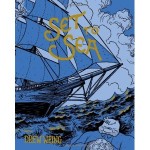
Set to Sea


By Drew Weing (Fantagraphics Books)
ISBN: 978-1-60699-368-2

Sometimes it’s terribly easy to review a new graphic novel. Sometimes they’re simply a good strong tale, beautifully told and universally appealing.

One such is the delightful, genuinely stirring saga of an indigent poet and aspiring barfly with a taste for maritime verse, whose lack of true inspiration is cured when he is press-ganged aboard a Hong-Kong Clipper and forcibly learns the true life of a mariner.

Initially resistant to a life afloat, a terrifying brush with death opens his eye and he accepts the only life he could ever truly enjoy, and even manages, whilst traversing the world for joyous, raucous decades, to satisfy his artistic leanings into the bargain…

Magically circular in structure and beautifully drawn in a homagic blend of Elzie Segar, traditional woodcut prints and, I suspect, a touch of the wonderful Tony Millionaire (see E.C. Segar’s Popeye and Drinky Crow’s Maakies Treasury) this superb rough ‘n’ tumble black and white hardcover collects the impressive online comic into a salty, panel-per-page paean to the gaining of true experience over romantic fantasy, and even manages to be a telling examination of the role of the arts in life.

What more do you need to know? Any lover of a dream-life and fresh yet solid entertainment simply must read this book… Captain’s Orders…

© 2010 Drew Weing. All Rights Reserved.

Dr. Jekyll & Mr. Hyde


By Robert Louis Stevenson, adapted by Guido Crepax (Catalan Communications)
ISBN: 978-0-87416-079-6

Guido Crepax was born in Milan in 1933, the son of a noted cellist, and grew up in an atmosphere of art and music (his closest childhood friend was the noted musician and conductor Claudio Abado). Inevitably the boy Crepax became a creative artist in his own right. Whilst studying architecture in the 1950s he freelanced as a graphic designer, illustrator and printmaker, producing book, medical texts and magazine covers, posters and record sleeves most notably for Classical and Jazz musicians ranging from Charlie Parker and Fats Waller to Domenico Modugno.

He won acclaim and advertising awards throughout the 1950s, but was driven to do still more. In 1963 he began drawing comics, and two years later created his most famous character Valentina for the second issue of Linus. She was initially the lead character’s girlfriend, but whereas superhero Neutron soon lost the interest of readers, the sexy, psychedelic, culturally bold and accessible distaff evolved to become an evocative, fantastic, sophisticated, erotic zeitgeist of the 1960s and far, far beyond. He passed away on July 31, 2003.

Although noted – if not always revered – for his strongly erotic female characters, Crepax was an astute and sensitive tale-teller and examiner of the human condition, and all his varied works vibrate with strong themes of charged sexuality and violence, none more so than his chilling, oppressive adaptation of Strange Case of Dr. Jekyll & Mr. Hyde.

As Editor Maurice Horn points out in his introduction, Stevenson’s novella – first published in January 1886 by Longmans, Green & Co. – has never been as faithfully adapted in any other medium: the tale being constructed and narrated as a recap within a flashback, and almost utterly devoid of any relevant female characters. The story revolutionised not only fiction, but also modern sensibilities, cementing an entire concept of human behaviour into the modern lexicon and becoming a keystone of two separate literary genres, science fiction and horror, whilst maintaining for almost its entire duration the semblance of just another tale of mystery and detection. What it must have been to get to that final chapter and discover an entirely new kind of ending! We simply cannot imagine…

For most readers of the text, rather than viewers of the impossibly large number of film, television, radio and stage productions, the brief morality play is clearly a metaphor (I, for example, have always felt it addressed social repression via an examination of addiction) and Crepax has chosen to interpret the issue here as one of unleashed sexual license…

Narrator Gabriel John Utterson is friend and legal representative to Gentleman Scientist Henry Jekyll, a brilliant, upstanding man obsessed with his image and standing in a rich and excessively reputation-driven society. When the wizened, disreputable Edward Hyde appears and begins to exert some inexplicable, overwhelming hold upon the genteel Jekyll, even keeping him from seeing his friends, Utterson is driven to investigate and uncovers a horrendous, unimaginable catalogue of the dwarf’s excesses, ranging from brutal violence, sexual bondage, blackmail and even murder…

Crepax retained the unique narrative structure, dialogue and even chapter headings of the original text, but peppered his visual interpretation with the highly charged, sexually explicit imagery he was – and is – notorious for in such a manner that their sybaritic inclusion made perfect sense. Following the eerie unraveling of the saga in  ‘Story of the Door’, ‘The Carew Murder Case’, ‘The Letter’, ‘Incident at Dr. Lanyon’s’, ‘The Window’, ‘The Last Night’, ‘Dr Lanyon’s Account’ comes the revelatory, post-mortem disclosures of  ‘Henry Jekyll’s Confession’ and Utterson’s shocked realisation of the pressures of English society and the forces they contain and conceal within every man…

Stark, shocking, convulsively claustrophobic in its public scenes whilst indolently free and spacious for the unleashed hedonistic, yet curiously idyllic and lyrical depictions of debauchery, Crepax’s artistic stylisations are as always cannily calculated to work on the reader’s subconscious and bestow an unrelenting power and oppressive inevitability to the tragedy.

Here is a powerful saga magnificently retold using the language and terms of the British Empire, but this highly adult interpretation is also unflinching in its sexual imagery, so if such visual candour depicted in a truly unique style and manner is going to offend you don’t seek out this superb tale.

Everybody else with their senses of drama, history and perspective intact should go ahead and enjoy a brilliant tale stunningly interpreted: another classic graphic novel desperately in need of reprinting…
© 1989 Olympia Press, Italy, Luca A Staletti, agent. English translation © 1990 Catalan Communications. All rights reserved.

Dead Funny: Punch Among the Angels


By various edited by Peter Barnes (Grafton Books)
ISBN: 978-0-246132-41-3

Here’s one more little dip trip to the vast library of cartoon comedy generated by Britain’s greatest and most prestigious magazine of informed entertainment, this time themed to explore the Really Big Question: After Life – What Next?

Punch began in 1841; a magazine dedicated to satire and humour, and swiftly became a national – and international – institution. It ran more or less non-stop until 2002 before finally closing its acerbic doors, having featured sharp, witty writers such as W. M. Thackeray, P.G. Wodehouse, P.J. O’Rourke and Alan (no initials) Coren among so very many others of their informed, cheerily scathing stripe. Many of these writers’ efforts were illustrated by brilliant draughtsmen and artists.

Punch became a social force, an invaluable historian and savage commentator: its contents could even influence governments.

The magazine probably invented, and if, not certainly perfected, the gag and strip cartoon. The list of brilliant pen-men who graced its pages is something I couldn’t live long enough to relate. Name a cartoonist; if he or she were any good they will have been published in the pages of….

With such a wealth of material, it’s truly surprising how very few collections have been generated from its pages. The one under the glass here is from 1987, selected by Editor Peter Barnes Hewison and finds a motley assortment of modern British pen-pushers exploring through the medium of brush and ink inquisitions the final mystery of what goes on after we go out like candles…

The gags range from familiar old friends to the arcane, surreal and contentiously peculiar but whatever your position or disposition on souls and salvation there’s beautifully rendered work here that will make you smile, chuckle, groan and even weep with laughter.

As usual this particular book isn’t really what I’m recommending (although if you can find a copy you won’t regret it); it’s the type of publication that I’m commemorating. These cartoons and many like them by the likes of such luminaries as Noel Ford, Banx, Donegan, Duncan, Honeysett, Birkett, W. Scully, Mahood, Heath, J. W. Taylor, Spencer, Albert, Cookson, Stan McMurtry, Ken Pyne, Nick, Dredge, Kevin Woodcock, Tony Husband, Ffolkes, McLachlan, Hector Breeze, and all the wonderful rest (with unintelligible signatures) are sitting idly out of touch when they could be filling your bookshelves and giving your deadened hearts a damned good, potentially last laugh…

© 1987 Punch Publications Limited Inc. All Rights Reserved.

Sgt. Frog Volume 1


By Mine Yoshizaki, translated by Yuko Fukami (Tokyopop)
ISBN: 978-1-59182-703-0

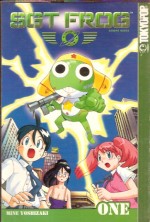
Another monumentally popular manga saga of recent years is this broad, archetypically Japanese fantasy comedy with all the prerequisite elements for success. Keroro Gunsō, Sergeant Keroro or here Sgt. Frog is the mildly malevolent destabilising element that disrupts the life of schoolboy Hinata, just as he’s making the thoroughly distressing move from Elementary to Middle School.

As leader of the school’s Occult club Fuyuki is open to most new and fantastic experiences but even he is given pause when he and his obnoxious “oh-so-perfect” older sister Natsumi accidentally capture a frog-like alien hiding in their house. The revelation panics the orbiting Keronian battle fleet and sends it scuttling away in panic, abandoning all their hidden operatives and leaving them to fend for themselves.

Leader of an elite platoon of infiltrators Keroro offers his surrender but doesn’t really mean it, intending to overcome the primitive earthlings or “Pokopenians” when their guard is down. But as the days pass the little monster gradually “goes native”, succumbing to the constant mental abuse of Natsumi, the grinding drudgery of imposed household chores and the addictive delights of television, the internet, pop music and Gundam model kits. Besides, Fuyuki confiscated his all-purpose Kero Ball super-weapon and the Pokopenians’ mother Aki is a super-hottie MILF who edits manga comics…

A lot of the added-value, in-joke pop-references will have been lost to most English-speaking readers: casualties of both the translation process and the passage of time, but some of the Frog’s wider word-play and constant harping on Bandai model kits, Gundam, Space Battleship Yamato, Dragon Ball, Neon Genesis Evangelion and other ubiquitous elements of modern Japanese fan-culture will still resonate I’m sure…

A further complication occurs when wealthy Mimoka Nishizawa, a shy classmate of Fuyuki’s – who secretly has the biggest crush on him – is found to be in possession of another abandoned platoon member, the highly devoted and incredibly destructive Private Tamama. Mimoka is unable to tell Fuyuki of her feelings and her frustrations usually manifest in psychotic, explosives rages and ultra-violent tantrums…

This first volume features the first dozen episodes or “encounters” and follows the gradually unfolding epic as Keroro’s glittering past and future plans are exposed, with loads of the brutal slapstick, dire puns, situational embarrassments and social gaffe ironies beloved of Manga humour books, but there’s also some touching moments and poignant touches as the ever-expanding cast (which includes ghosts and ancient gods of destruction) go about their lives unaware that everybody’s playing a double game…

Debuting in boys weekly Shonen Ace to immediate success, naturally the series has made the jump to television, movies, computer and even role-playing games. The collected, translated volumes number 18 and counting, comprising an exceedingly engaging light and fluffy concoction that will charm and delight genre fans and casual reader equally.

This book is printed in the ‘read-from-back-to-front’ manga format.

© 1999 Mine Yoshizaki. English text © 2004 TokyoPop Inc.

Essential Nova volume 1


By Marv Wolfman, John and Sal Buscema, Carmine Infantino & various (Marvel)
ISBN: 978-0-7851-2093-9

By 1975 the first wave of fans-turned-writers were well ensconced at all the major American comic-book companies. Two fanzine graduates, Len Wein and Marv Wolfman had achieved stellar successes early on, and then risen to the ranks of writer/editors at Marvel, a company in trouble both creatively and in terms of sales. After a meteoric rise and a virtual root and branch overhaul of the industry in the 1960s the House of Ideas – and every other comics publisher except Archie – were suffering from a mass desertion of fans who had simply found other uses for their mad-money.

Whereas Charlton and Gold Key dwindled and eventually died and DC vigorously explored new genres to bolster their flagging sales, Marvel chose to exploit their record with superheroes and foster new titles within a universe it was increasingly impossible to buy only a portion of…

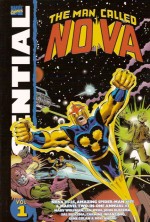
The Man Called Nova was in fact a boy named Richard Rider, a working class nebbish in the tradition of Peter Parker – except he was good at sports and bad at learning – who attended Harry S. Truman High School, where his strict dad was the principal. His mom worked as a police dispatcher and he had a younger brother, Robert, who was a bit of a genius. Other superficial differences to the Spider-Man canon included girlfriend Ginger and best friends Bernie and Caps, but he did have his own school bully, Mike Burley…

An earlier version, “Black Nova” had apparently appeared in the Wolfman/Wein fan mag Super Adventures in 1966, but with a few revisions and an artistic make-over by the legendary John Romita (Senior) the Human Rocket was launched into the Marvel Universe in his own title, beginning in September 1976, ably supported by the illustration A-Team of John Buscema and Joe Sinnott.

‘Nova’, which borrowed as heavily from Green Lantern as well as Spider-Man’s origin, was structured like a classic four-chapter Lee/Kirby early Fantastic Four tale, and rapidly introduced its large cast before quickly zipping to the life-changing moment in Rider’s life when an star-ship with a dying alien aboard transfers to the lad all the mighty powers of an extraterrestrial peacekeeper and warrior.

Centurion Rhomann Dey had tracked a deadly marauder to Earth. Zorr had already destroyed the idyllic world of Xandar, but the severely wounded vengeance seeking Nova Prime was too near death and could not avenge the genocide. Trusting to fate, Dey beamed his powers and abilities towards the planet below where Richard Rider was struck by the energy bolt and plunged into a coma. On awakening Rich realised he had gained awesome powers and the responsibilities of the last Nova Centurion.

The tale is standard origin fare, beautifully rendered by Buscema and Sinnott, but the story really begins with #2’s ‘The First Night of… The Condor!’ as Wolfman, playing to his own strengths, introduced an extended storyline featuring a host of new villains whilst concentrating on filling out the lives of the supporting cast. There was still plenty of action as the neophyte hero learned to use his new powers (one thing the energy transfer didn’t provide was an instruction manual) but battles against winged criminal mastermind Condor and his enigmatic, reluctant pawn Powerhouse plus #3’s brutal super-thug (‘…The Deadly Diamondhead is Ready to Strike!’ illustrated by new art-team Sal Buscema & Tom Palmer) were clearly not as important as laying plot-threads for a big event to come.

Nova #4 saw the first of many guest-star appearances (and the first of three covers by the inimitable Jack Kirby). ‘Nova Against the Mighty Thor’ introduced The Corruptor, a bestial being who turned the Thunder God into a raging berserker whom only the new kid on the block could stop, whilst ‘Evil is the Earth-Shaker!’ pitted the lad against subterranean despot Tyranus and his latest engine of destruction, although a slick sub-plot concerning the Human Rocket’s attempt to become a comic book star still delivers some tongue-in-cheek chuckles to this day…

Issue #6 saw those long-laid plans begin to mature as Condor, Diamondhead and Powerhouse returned to capture Nova, whilst their hidden foe was revealed in ‘And So… The Sphinx!’ (inked by Frank Giacoia), another world-class, immortal super-villain patiently waiting his turn to conquer the world. Meanwhile young Caps had been abducted by another new bad-guy who would eventually make big waves for the Human Rocket.

‘War in Space!’ found Nova a brainwashed ally of his former foes in an invasion of Rhomann Dey’s still orbiting star-ship – an invaluable weapon in the encroaching war with the Sphinx, only to be marooned in deep space once his mind cleared. On narrowly escaping he found himself outmatched by Caps’ kidnapper in ‘When Megaman Comes Calling… Don’t Answer!’ – a tumultuous, time-bending epic that concluded in #9’s ‘Fear in the Funhouse!’

Nova #10 began the final (yeah, right) battle in ‘Four Against the Sphinx!’ with Condor, Diamondhead and Powerhouse in all-out battle against the immortal mage with the hapless Human Rocket caught in the crossfire, whilst ‘Nova No More’ had the hero’s memories removed to take him out of the game; a tactic that only partially worked since he was back for the next issue’s classy crossover with the Spectacular Spider-Man.

‘Who is the Man Called Photon?’ by Wolfman, Sal Buscema & Giacoia, teamed the young heroes in a fair-play murder mystery when Rich Rider’s uncle was killed by a costumed thief. However there were ploys within ploys occurring and after the mandatory hero head-butting the kids joined forces and the mystery was resolved in Amazing Spider-Man #171’s ‘Photon is Another Name For…?’ courtesy of Wein, Ross Andru & Mike Esposito.

Joe Sinnott returned in Nova #13, as another lengthy tale began with the introduction of new hero Crime-Buster in ‘Watch Out World, the Sandman is Back!’, wherein the once formidable villain took a beating and fell under the influence of a far more sinister menace. Meanwhile Rich’s dad was going through some bad times and had fallen into the clutches of a dangerous organisation…

The story continued in the Dick Giordano inked ‘Massacre at Truman High!’ as Sandman attacked Nova’s school and the mystery mastermind was revealed for in-the-know older fans before the guest-star stuffed action-riot ‘The Fury Before the Storm!’ saw Carmine Infantino take over the pencilling and Tom Palmer return to the brushstrokes.

When a bunch of established heroes attack the newbie all at once it’s even money they’re fakes, but Nick Fury of super-spy agency S.H.I.E.L.D. was real enough and deputised the fledgling fighter for #16’s ‘Death is the Yellow Claw!’ and #17’s spectacular confrontation ‘Tidal Wave!’ As the kid came good and saved the city of New York from a soggy demise the long awaited conclusion occurred in ‘The Final Showdown!’, inked, as was ‘Beginnings’ a short side-bar story dealing with the fate of the elder Rider, by the agglomeration of last-minute-deadline busters dubbed “the Tribe.”

A new foe debuted in #19: ‘Blackout Means Business and his Business is Murder!’ opened the final large story-arc of the series as a ebon-energy wielding maniac attacked Nova, but before that epic completely engaged, the Human Rocket guest-starred with the Thing in Marvel Two-in-One Annual #3 (1978) in a simple yet entertaining tussle with god-like cosmic marauders entitled ‘When Strike the Monitors!’ an interlude crafted by Wolfman, Sal Buscema, Giacoia & Dave Hunt.

Hunt stayed on as inker for Nova #20 as the steadily improving young hero went after the cabal that had nearly destroyed his dad in ‘At Last… The Inner Circle!’ leading to a breakthrough in comics conventions as the Human Rocket revealed his alter ego to his family in ‘Is the World Ready for the Shocking Secret of Nova?’ (with art by John Buscema, Bob McLeod & Joe Rubinstein), whilst a long-forgotten crusader and some familiar villains resurfaced in ‘The Coming of the Comet!’ (#22, Infantino & Steve Leialoha) and long-hidden cyborg mastermind Dr. Sun (an old Dracula foe, of all things) revealed himself in ‘From the Dregs of Defeat!’ executing his scheme to seize control of the lost Nova Prime star-ship and its super-computers.

A huge epic was impressively unfolding but the Human Rocket’s days were numbered. Penultimate issue #24 (inked by Esposito) introduced ‘The New Champions!’ as Dr. Sun battled the Sphinx for the star-ship, with Crime-Buster, the Comet, Powerhouse and Diamondhead dragged along on a one-way voyage to the ruins of Xandar, lost home of the Nova Centurions.

This volume ends with #25, a hastily restructured yarn as the cancellation axe hit the series before it could properly conclude. ‘Invasion of the Body Changers!’ by Wolfman, Infantino & Klaus Janson saw the unhappy crew lost in space and attacked by shape-shifting alien Skrulls, all somehow implicated in the destruction of Xandar, but the answers to the multitude of questions raised were to be eventually resolved in a couple of issues of the Fantastic Four and latterly Rom: Spaceknight: episodes not included here, thus rendering this collection aggravatingly incomplete.

There’s a lot of good, solid entertainment and beautiful superhero art in this book, and Nova has proved his intrinsic value by returning again and again, but by leaving this edition on such a frustrating open end, the editors have reduced what could have been a fine fights ‘n’ tights collection into nothing more than a historical oddity. Stories need conclusions and mine is that we readers deserve so much better than this.

© 1976, 1977, 1978, 1979, 2006 Marvel Characters, Inc.  All Rights Reserved.

Hunter x Hunter Volume 1: The Shonen Jump Advanced Edition


By Yoshiro Togashi (Viz)
ISBN:  978-1-59116-753-2

It’s been a while since I reviewed manga graphic novels in any breadth or depth so I’m going to start again, but as there’s simply so much new material around I’ve opted to concentrate more on older series with a few volumes under their belts, occasionally leavened with whatever new material catches my eye – or that publishers send us.

Moreover, I’m no expert, so these will be thoughts restricted to the simple perspective of an interested casual collector, and measured against all other illustrated stories and not other manga/anime. There are plenty of specialist sites to cater for that and they’re there at the touch of a search engine…

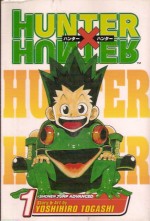
Hantā Hantā (which I translate as either Hunter times Hunter or Hunter Versus Hunter; someone who actually speaks Japanese may not concur) first appeared in Weekly Shonen Jump in March 1998, before exploding into 27 volumes of manga, an anime series and three cartoon movies (so far) and primarily tells the extremely engaging and phenomenally extended tale of young Gon Freecss; a gifted twelve-year-old lad abandoned by his father, who dumped the kid on an aunt in the agrarian backwater of Whale Island before disappearing.

Gon is an exceptional child with a restless nature, big dreams and some uncanny abilities. In the alternate world of fantastic creatures that Gon inhabits the best job in the world is that of the Hunter: incredible Renaissance Men who combine the talents of detectives, treasure hunters, archaeologists, assassins, bounty hunters and repo-men with astounding physical prowess, travelling the world for profit or sheer scientific curiosity. If somebody wants something Hunters will get it.

One day Gon meets a hunter who reveals something the lad had already deduced. His missing father Ging was one of the greatest Hunters of all, and is still alive somewhere. Gon immediately resolves to become a Hunter too, but things are not that simple…

Hunters must pass a horrendous exam, and just getting to that exam is one of the most difficult tasks imaginable. Undeterred, Gon says his goodbyes to Aunt Mito, not realising his assessment has already begun. Taking ship to the mainland he joins dozens of other candidates including enigmatic orphan Kurapika and brash Leorio, the only two hopefuls not to fall at the first hurdle.

Reaching Dolie Harbour the three would-be Hunters endure a number of tests and challenges just to find the Examination site: and that’s where the real testing of their worth and character begins…

Nearly 50 million copies of Hunter x Hunter have been sold thus far, and it’s no surprise. This is a perfect example of the “young hero’s path to destiny” fantasy adventure that Japanese creators do so very well, blending action, humour, unashamed sentiment and wondrous imagination into a seamless, supremely readable confection that is impossible to put down and always leaves the reader hungry for more. Gon and his comradely rivals strive to overcome all obstacles, each blessed with their unique talents and motivations and the tale fairly rattles along until the abrupt cliffhanger end hits like a thunderbolt.

Superbly entertaining, you’re best advised to read this gem a half-dozen volumes at a time.

This book is printed in the ‘read-from-back-to-front’ manga format.

© 1998 POT (Yoshiro Togashi). All Rights Reserved.

Thelwell’s Book of Leisure


By Norman Thelwell (Magnum/Eyre Methuen)
ISBN: 0-417-01000-1

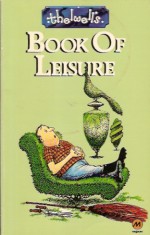
Norman Thelwell (3rd May 1923 – 7th February 2004) is one of our most beloved cartoonists. His superbly gentle cartooning combined Bigfoot abstractions with a keen and accurate eye for background detail, not just on the riding and countryside themes that made him a household name, but on all the myriad subjects he turned his canny eye and subtle brushstrokes to. His compositions are an immaculate condensation of everything deprecatingly; resolutely Post-War, Baby-Booming British – without ever becoming parochial or provincial.

His work has international implications and scope, neatly achieving that by presenting us to the world for decades. There are 32 books of his work and every aficionado of humour – illustrated or otherwise – could do much worse than possess them all.

From 1950 when his gag-panel Chicko began in the Eagle, and especially two years later with his first sale to Punch, he built a solid body of irresistible, seductive and always funny work. He appeared in innumerable magazines, comics and papers ranging from Men Only to Everybody’s Weekly. In 1957 his first collection of published cartoons Angels on Horseback was released and in 1961 he made the rare reverse trip by releasing a book of all-new cartoons that was subsequently serialised in the Sunday Express.

His dry, sly, cannily observed drawings were a huge success and other books followed to supplement his regular appearances in a variety of newspapers and magazines. Thus we have here his shrewd pictorial observations of the growth of a Leisure Economy and the strange phenomenon of people of all classes with a little time on their hands…

These strips, culled mostly from the venerable and equally-missed Punch, (the others all originally appearing in the Sunday Express) come from a time when hobbies and holidays were just starting to become the inviolable, inalienable right of all Britons: no matter how annoying, painful and just plain frustrating they might be…

These cartoons range from the wonderfully silly to the near-mordant, created by a man who came to epitomise middle-class values, aspirations and self-delusions, but Thelwell was also an observer who could spot cupidity, cant and social imbecility a mile off and knew human nature never really evolved, so don’t expect to see a point of view… just the extremes of daftness and pigheadedness we can resort to whilst trying to relax and have a good time…

Subdivided into Leisure on Wheels, Messing About…, Strictly For the Birds…, Relaxing at Home, Drinks by the Pool, Away From it All, The Inner Man (an especially telling sally against food-ism and consumption), Leisurely Pastimes and a particularly exhilarating general section of gags, all still trenchantly relevant and bitingly funny today: another startling exhibition of the artist’s fantastic, funny foresight and the British unwillingness to embrace change.

We may do stranger things today than even Thelwell could have dreamed of, but the art of down-time still obsesses us all and these superb cartoons are simply the most effective cure to the stress of relaxation that I can imagine. Timeless and delightful, why not chill out to these gems and give the Leisure rat-race a miss this year…?
© 1968, 1978 Norman Thelwell.