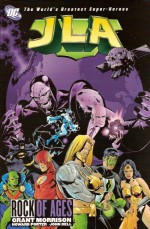
JLA: volume 3 Rock of Ages


By Grant Morrison, Howard Porter, John Dell & others (DC Comics)
ISBN: 978-1-56389-416-9

After the Silver Age’s greatest team-book died a slow, painful, embarrassing death, not once but twice, DC were taking no chances with their next revival of the Justice League of America and tapped Big Ideas wünderkind Grant Morrison to reconstruct the group and the franchise.

And the idea that clicked? Shove everybody’s favourite Big Names in the team.

Of course it worked, but that’s only because as well as star quantity there was an absolutely huge burst of creative quality. The stories were smart, compelling, dauntingly large-scale and illustrated with infectious exuberance. One glance at JLA and anybody could see all the effort undertaken to make it the best it could be.

This third collection re-presents issues #10-15 of the resurgent revival and covers a spectacular landmark tale where old-world goodies-vs.-baddies met contemporary fringe science chic for a rollercoaster ride of boggled minds which only served to set up even bigger concept clashes further down the line. That’s the magic of foreshadowing, folks…

Superman, Batman, Wonder Woman, the Martian Manhunter, Flash, Green Lantern and Aquaman are the legends who are targeted by a coalition of arch enemies comprising Lex Luthor, the Joker, Circe, Mirror Master, Ocean Master and Doctor Light, in the prologue ‘Genesis and Revelations’ wherein ghastly doppelgangers of the World’s Greatest Heroes go on a campaign of destruction all over the globe. Even with new members Aztek and Connor Hawke (the new Green Arrow), on board the new “Injustice Gang’ are running the heroes ragged, but the stakes change radically when the telepathic Martian Manhunter detects an extinction-level entity heading to Earth from deep space…

Rock of Ages proper begins with ‘Hostile Takeover’ as the legion of villains press their advantage whilst the New God Metron appears to warn the JLA that the end of everything is approaching. As Circe tries to head-hunt Aztek, Arrow and Plastic Man, Green Lantern and Flash are treated to a distressing view of the Universes beyond our own reality, as they are dispatched to recover the fabled Philosopher’s Stone in a last-ditch effort to save the worlds.

In ‘Wonderworld’ the fabled last defenders of Cosmic Reality proffer a grim warning of Mageddon, the Anti-Sun, ender of all things to the lost superheroes. Shell-shocked, they are rescued by Hourman, an artificial time-controlling intelligence, and return to our plane of existence only to find it has been conquered by the evil god Darkseid.

‘Wasteland’ is a bleak and chaotic taste of the Final Crisis, with humanity all but dead, and the surviving champions fighting their last battle against the horrors of Apokolips-on-Earth, leading to a perfect Deus-ex-Machina moment of triumph in ‘Twilight of the Gods’ as this wicked universe is un-made and “our” reality reinstated.

Unfortunately if you’ve been keeping up, that was the continuity where the Injustice Gang were beating the stuffing out of the good guys…

‘Stone of Destiny’ brings the saga to a neat and satisfying conclusion as the villains go down fighting and an approximation of order is restored in a cataclysmic combat climax. With Gary Frank, Greg Land, John Dell & Bob McLeod lending artistic assistance to the spectacular proceedings, Morrison and Porter resolve the epic and close with a perfect example of the maxim “always leave them wanting more” – shocking twist to make the reader hungry for the next instalment.

If you haven’t read this sparkling slice of fight ‘n’ tights wonderment then your fantastic comic-life just isn’t complete yet. Savvy, compelling, challenging but not afraid of nostalgia or laughing at itself, the new JLA was an all-out effort to be Smart and Fun. For that moment these were the “World’s Greatest Superheroes” and these increasingly ambitious epics reminded everybody of the fact. This is the kind of thrill that nobody ever outgrows. Got yours yet?

© 1997, 1998 DC Comics. All Rights Reserved.
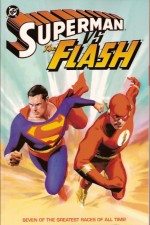
Superman vs. the Flash


By Jim Shooter, Curt Swan & various (DC Comics)
ISBN: 978-1-4012-0456-3

The comic-book experience is littered with eternal questions that can never really be satisfactorily answered. The most common and most passionately asked always begin “who would win if…” or “who’s strongest/smartest/fastest…”

Teenaged scripting wunderkind Jim Shooter knew that very well when he pitched and subsequently scripted a Superman story in 1967 that created a sub-genre of comic-plot and led inevitably and delightfully to the graphic novel under review here.

DC Editors in the 1960s generally avoided such questions as who’s best for fear of upsetting some portion of their tenuous and perhaps temporary fan-base, but as the superhero boom slowed and the upstart Marvel Comics began to make genuine inroads into their market, the notion of a definitive race between the almighty Man of Steel and the “Fastest Man Alive” became an increasingly enticing and sales-worthy proposition.

This sporty chronicle gathers together the initial contest and numerous rematches between the heroic speed-demons, but if you’re seeking a definitive answer you won’t find it here. These are splendid costumed entertainments; adventures designed to catch your breath and quicken your pulse. It not about the winning: it’s all to do with the taking part…

‘Superman’s Race With the Flash’ (Superman #199, August 1967) gets the ball rolling in a stirring saga by Shooter, Curt Swan & George Klein, wherein the two speedy champions were asked to compete in an exhibition contest by the United Nations, thereby raising money to fight World Hunger. Naturally they agreed, but the clever global handicap, circling the planet three times, was secretly subverted by rival criminal combines attempting to stage the greatest gambling coup in history…

Of course justice and charity triumphed in the end, but the stakes were catastrophically raised in the inevitable rematch from Flash #175 (December 1967). ‘Race to the End of the Universe!’ found the old rivals speeding across the cosmos when ruthless alien gamblers threatened to eradicate Central City and Metropolis unless the pair settled who was fastest. Scripter E. Nelson Bridwell added an ingenious sting in the tale, whilst Ross Andru & Mike Esposito delivered a sterling illustration job in this yarn, but once more the actual winning was deliberately fudged.

When World’s Finest Comics became a team-up vehicle for Superman the first guest star was the Flash who again found himself in speedy if contrived competition. ‘Race to Save the Universe!’ and its conclusion ‘Race to Save Time’ (WFC #198-199 November and December 1970, by Denny O’Neil, Dick Dillin & Joe Giella) once more upped the stakes as the high-speed heroes were conscripted by the Guardians of the Universe to circumnavigate the entire cosmos at their greatest velocities to undo the rampage of the mysterious anachronids, faster-than-light creatures whose pell-mell course throughout the galaxies was actually unwinding time itself. Little did anybody suspect that Superman’s oldest enemies were behind the scheme…

Chase to the End of Time!’ and ‘Race to the End of Time!’ opened the new team-up series DC Comics Presents (#1-2, July-August and September-October 1978) as Marty Pasko and the utterly superb Jose Luis Garcia-Lopez & Dan Adkins rather reprised the World’s Finest tale with warring alien races tricking Superman and Flash into speeding through the time-stream to prevent Earth’s history from being corrupted and destroyed. As if that wasn’t dangerous enough, nobody could predict the deadly intervention of the Scarlet Speedster’s most dangerous foe, Professor Zoom, the Reverse-Flash…

After the Crisis on Infinite Earths DC heroes got a sound refitting, and the frankly colossal power levels of the heroic community were downscaled to more believable levels. Some stalwarts even died, and when ‘Speed Kills!’ debuted in Adventures of Superman #463 (February 1990 by writer/artist Dan Jurgens and inker Art Thibert), touted as the first race between the fastest men on Earth, there was a new kid in the Flash’s uniform: ex-sidekick Wally West had graduated to the role.

The story itself is a delightfully whacky romp wherein 5th dimensional pest Mr. Mxyzptlk coerced the pair into running a race everybody knew was fixed from the get-go…

This collection concludes with a spectacular saga unerringly aimed at older fans. ‘Speeding Bullets’ (from one-shot DC First: Flash/Superman July 2002) is by Geoff Johns, Rich Burchett & Prentis Rollins, and features villain Abra Kadabra who challenges the Man of Steel and the 1940s Flash Jay Garrick to catch the current Vizier of Velocity who is running amok at hyper-speed and rapid-aging with every step…

If they can’t catch him then the Fastest Man Alive won’t be…

With the addition of some of the very best covers the company has ever produced to this book, readers casual or deeply devoted are guaranteed a joyous thrill-ride from some of the most entertaining stand-alone stories in DC history. On your marks… get set… Buy!

© 1970, 1972, 1973, 1978, 1990, 2002, 2005 DC Comics.  All Rights Reserved.

Dolltopia


By Abby Denson (Green Candy Press)
ISBN: 978-1-931160-70-4

Not everybody is comfortable with whom they are and most of us don’t like to be assumed one thing when we’re another. Lulu Award winner Abby Denson is a brilliant, magically subversive cartoonist and journalist with such disparate notches in her belt as the graphic novel Tough Love: High School Confidential (relating the Coming Out story of two suburban teens) and The City Sweet Tooth: a culinary cartoon column about the New York desserts scene currently running in L Magazine. She teaches and her script credits run from Scooby Doo and Power Puff Girls to Spider-Man and the Simpsons.

This entrancing shocking pink parable is an edgy, deceptively naivist fairy tale about gender, place and identity; making telling points in a clandestinely gentle manner. Kitty Ballerina is a doll who escapes from The Factory, refusing to be what her makers tell her to be. During her escape she meets Army Jim, another maverick toy who refuses to conform.

Together they make their way to the Promised Land of Dolltopia, where you can wear, and look like and be whatever you want. With the comradeship and assistance of the cat Mr. M, fashion Divas Candy X and Candy O and the slightly off-kilter, self-taught “plastic surgeon” the Doctor, the renegades make themselves at home and truly free…

However freedom demands effort, vigilance and sacrifice. Some freed individuals seem to crave their previous cultural indenture, and raids to liberate more dolls suffer when the apathetic conformists refuse to cast off their social shackles, but the real threat comes when humans threaten to take away and destroy the hard-won oasis of security the disappointed rebels strived so long and hard to win…

Charming and cleverly controversial, if a little heavy-handed at times, this eclectic black, pink and white tome – complete with cut-out-and-dress paper dolls – is a winning and culturally important addition to the world of adult cartooning. You’d be an idiot not to take a good long look – but of course you don’t have to be what I say you are…

© Abby Denson. All right reserved.

Bad Habits


By Norman Dog (Last Gasp)
ISBN: 0-86719-329-8/ ISBN-13: 978-0867193299

I haven’t reviewed a straight cartoon book in a dog’s age, so here’s a rare but still readily acquirable item from an outrageous comedy original and pen-pushing veteran who’s still making America laugh-out-loud – the cooler bits anyway – with his sly, cynical and fabulously skewed outlook and observations on the Human Condition and the Things We Don’t Know Yet..

Cultural commentator Norman Dog may or may not be Raymond Larrett (it’s complicated – that’s why better carbon-based life forms than you or I invented search engines). A West Coast cartoonist whose legendary – he would say “interminable” – strip has run in the East Bay Express since 1981, Dog has been capturing with laconic brilliance the bizarre panorama of modern life for all to see and disagree with…

Describing his slick, modern and excessively hip observations on Real Americans as “Comication”, Dog has been making us foreigners, Pinko Subversive Intellectuals and other weirdoes giggle and think with every exposed home secret or shared cultural reference and seems determined not to stop.

This early volume, collecting the budding best of the strip includes ‘Let’s all go… Dance Crazy!’, ‘I Was Satan’s Plaything!’, ‘The Enchanted Toothbrush’, ‘Celebrity Breakfasts!’, ‘Suicide Hotline’, ‘The Missing Father’, ‘Hey, Stupid!’, ‘Curse of the Mysterious Horror!’, ‘A Perfectly Typical Tuesday Evening at Home With Jane and Walter’, ‘Hints for Aliens’, ‘The Punk Romance’, ‘Giant Crawling Brain!’, ‘Modern Physics for Morons’, ‘Space Sluts’ amongst literally some others and delivers high-octane, occasionally lowbrow doses of premeditated mirth in devastating, delicious, full-page monochrome pastiches of a dozen different graphic styles.

Dog/Larrett, whose work has appeared in Raw Magazine, Spin, Nickelodeon Magazine, Weirdo, Anarchy Comics, The Nation and even some other places and publications, is long overdue for a big, bold book collection, but until then, converts can catch his latest full-colour efforts in the elucidatory The 37 Cartoons You Should Read Before You Die if they so wish.

Enough Soft-Sell: go read something funny…
© 1983, 1984, 1990 Norman Dog. All rights reserved.

Pink Flamingos Book 1: Bring Down the Night and Pink Flamingos Book 2: Maybe Next Time… Maybe Never


By John R. & Carol Q. Sansevere, illustrated by William Rieser (Octopus)
ISBN’s: 978-0-70643-186-5 and 978-0-70643-307-4

Let’s all pop back once or even twice more to the ever-so-now 1980s with these stylish, radically different and frankly peculiar experimental graphic novels that pretty much typified and encapsulated the dichotomies of the age of Big Hair and Brash Money, and layered them lavishly over a pastel-tinted attempt to glam up the old formulas that worked so well for the Famous Five, Nancy Drew and the Hardy Boys.

The Pink Flamingos are a close clique of fashionably attractive Palm Beach teens whose taste for glamour and adventure draw them into some pretty tricky situations. These Chic Chicks are Lana the model, Carla the singer, Amber the waitress/biker babe, Jackie the TV intern and Jody the spoiled rich one…

In volume 1: Bring Down the Night the quirky quintet first get together when a mutual friend commits suicide. As with everything in that swank locale, sophisticated, connected drug-dealer Joey De Silva is at the heart of the web of temptation, corruption and death and the feisty females decide that if the cops won’t touch him then they’ll take him down in their own unique way…

The in-your-face, unashamed hedonism and seductive shoulder-padded indolence continues in Maybe Next Time… Maybe Never as the Material Girls follow Carla to New York City and her big break in the music biz, but sadly, behind the glitz and glamour, drugs and depravity are never too far way… Meanwhile as romance rears its well-coiffed hunky head for one of the Flamingos, Poor Little Rich Girl Jody discovers that for some families money never could buy love…

Originally published by Shuster & Shuster in the US these books appear to be more fashion sketches and studies than straight comics narrative and the oddly removed, if not outright distant writing style looks uncomfortably like an actual recycled unsold pitch “bible” and shooting script for a proposed TV show (and believe me I’ve worked on far too many of those to mistake the feel) but even so the overall effect is not unpleasant or lacking in entertainment value when considered as graphic novels.

Rieser’s bold and vivid storyboard-based illustrations blends well with the faux-TV script narrative captions, and despite a rather static, lifestyle-mag, fashion shoot feel to the action, if you’re a fan of Miami Vice, 21 Jump Street, Dallas, Dukes of Hazzard or even early Neighbours there’s a nostalgic buzz to be gleaned from these rather wholesome adventures for Young Adults.
™ & © 1987, 1988 Angel Entertainment, Inc. All rights reserved.

Superman and the Legion of Super-Heroes


By Geoff Johns, Gary Frank & Jon Sibal (DC Comics)
ISBN: 978-1-84856-009-9

Once upon a time, in the far future, a band of super-powered kids from dozens of alien civilisations took inspiration from the greatest legend of all time and formed a club of heroes. One day these Children of Tomorrow came back in time and invited that legend to join them…

And thus began the vast and epic saga of the Legion of Super-Heroes, as first envisioned by writer Otto Binder and artist Al Plastino in the landmark Adventure Comics #247 (April 1958). Since that time the fortunes and popularity of the Legion have perpetually waxed and waned, with their future history tweaked and rebooted, retconned and unwritten over and again to comply with editorial diktat and popular whim.

The current trend is to re-embrace the innocent, silly, joyous, stirring and utterly compelling pre-Crisis on Infinite Earths tales but to shade them with contemporary sensibilities and with this in mind Geoff Johns has been gradually reinstituting the Lore of the Legion in a number of his assignments. Beginning most notably with Justice League of America: the Lightning Saga and culminating in the ongoing New Krypton and War against Brainiac sagas the Legion are back and once more carving out a splendid niche in the DC Universe.

Along the way came this superb, nostalgia-enhanced cracker of a tale which reestablished direct contact between the futuristic paladins and the Man of Tomorrow…

Collecting Action Comics #858-863, this chronicle finds the Legion back in the 21st century, summoning Superman to save Tomorrow’s World once more. Long ago the Legion had regularly visited: spiriting the young Kryptonian to a place and time where he didn’t have to hide his true nature. However, once he began his public career, the visits ceased and his memories were suppressed to safeguard the integrity of history and the inviolability of the time-line.

Now a desperate squad of Legionnaires must reawaken those memories since the Man of Steel is the last hope for a world on the edge of destruction. In the millennium since his debut Superman has become a beacon of justice and tolerance throughout the Utopian Universe, but a radical, xenophobic anti-alien movement has swept Earth, marginalising, interning and even killing all non-Terrans. Moreover, a super-powered team of Legion rejects has formed a Justice League of Earth to lead a crusade against all extraterrestrial immigrants, claiming Superman was actually a true-born Earthling, and declaring him their spiritual leader…

Of course Kal-El of Krypton must travel to the future and not only save the day but clean the racist stain from his name – a task made infinitely more difficult because Earth-Man, psychotic xenophobe leader of the Earth-First faction, has turned our yellow sun a power-sapping red…

Bold, thrilling and absolutely enthralling, the last-ditch struggle of a few brave aliens against a racist, fascistic and completely ruthless totalitarian tomorrow is the stuff of pure comic-book dreams. Superman strives to unravel a poisonous future where all his hopes and aspirations have been twisted, with only his truest childhood friends to aid him, and the incredibly intense and hyper-realistic art of Gary Frank and Jon Sibal makes it all seem not only plausible but inevitable…

With this kind of material, the new-old may well be back for all time…

© 2007, 2008 DC Comics. All Rights Reserved.
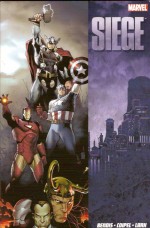
Siege


By Brian Michael Bendis, Olivier Coipel, Michael Lark & others (Marvel/Panini UK)
ISBN: 978-1-84653-452-2

The things that superhero comic-books do best are Spectacle and Cosmic Retribution: the cathartic comeuppance of someone who truly deserves it. So this collection, reprinting the Siege: Cabal one-shot and the four-issue Siege miniseries it led to (selected portions of the vast 2010 publishing event that partially re-set and restored the traditional “Stan & Jack” Marvel Universe) is an effective and welcome hint of a new dawn in the recently bleak and unfriendly world of Captain America and his costumed cohorts…

Norman Osborn, one-time Green Goblin, has through various machinations become America’s Security Czar: the “top-cop” in sole charge of the beleaguered nation’s defence and freedom. Under his meteoric rise the Superhuman Registration Act led to the Civil War, Captain America was arrested, murdered and resurrected (see Captain America Reborn), and numerous horrific assaults on mankind occurred: including the Secret Invasion and the “Dark Reign” which led up to the graphic novel under review here

As well as commanding all the covert and military resources of the USA, Osborn now has his own suit of Iron Man armour and as Iron Patriot leads a hand-picked team of ersatz Avengers. The country should by rights be beyond any possibility of threat or harm. However as the events of Siege: The Cabal (Bendis, Lark & Stefano Gaudiano) graphically depict, Osborn is playing a deadly double game. The Cabal is a Star Chamber of super-villains comprising Osborn, Asgardian God Loki, gang-boss The Hood, mutant telepath Emma Frost, Taskmaster, Sub-Mariner and Doctor Doom.

But cracks are beginning to show, both in the criminal conspiracy and Osborn himself. When Iron Patriot promises to conquer Asgard for Loki, Doom secedes from the group, prompting a disastrous battle between the Masters of Evil…

Asgard is currently displaced and floating scant metres above the soil of Oklahoma. Using his position as Chief of Homeland Security Osborn manufactures an “Asgardian incident” and launches an all-out invasion on the Gleaming City, overruling the new American President to do so.

And so begins Siege (by Bendis, Coipel & Mark Morales) a knock-down, drag-out fight pitting all the long-cultivated metahuman resources of Osborn – paramilitary strike force H.A.M.ME.R., the Dark Avengers and the villainous penal battalion of The Initiative – against the sorely pressed and time-lost Asgardians…

However Osborn has gone too far and the President fires him.

So What?

Well, now the scattered and fugitive “real” superheroes such as Captain America, Nick Fury, the original Iron Man, Spider-Man, the Vision and all the other underground and Secret Avengers are safe to act, but they had better hurry because Thor’s hard pressed people cannot stand against Osborn’s god-killing ultimate weapon…

Despite feeling a little rushed in places, this is a grand, old-fashioned Fights ‘n’ Tights cataclysmic clash of good guys and bad guys, magnificently illustrated and astonishingly compelling. After years of dark and dangerous anti-heroics it’s a splendid palate-cleanser for what Marvel promises to be a new Heroic Age…
© 2010 Marvel Entertainment LCC and its subsidiaries. All Rights Reserved. A British edition released by Panini UK Ltd.

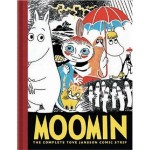
Moomin: the Complete Tove Jannson Comic Strip volume 1


By Tove Jansson (Drawn & Quarterly)
ISBN: 978-1-89493-780-1

Tove Marika Jansson was born into an artistic, intellectual and practically bohemian Swedish family in Helsinki, Finland on August 9th 1914. Her father Viktor was a sculptor, her mother Signe Hammarsten-Jansson a successful illustrator, graphic designer and commercial artist. Tove’s brothers Lars and Per Olov became a cartoonist/writer and photographer respectively. The family and its close intellectual, eccentric circle of friends seems to have been cast rather than born, with a witty play or challenging sitcom as the piece they were all destined to act in.

After intensive study from 1930-1938 (University College of Arts, Crafts and Design, Stockholm, the Graphic School of the Finnish Academy of Fine Arts and L’Ecole d’Adrien Holy and L’Ecole des Beaux-Arts, Paris) Tove became a successful exhibiting artist through the troubled period of the war. Intensely creative in many fields, she published the first fantastic Moomins adventure in 1945: SmÃ¥trollen och den stora översvämningen (The Little Trolls and the Great Flood or more euphoniously The Moomins and the Great Flood), a whimsical epic of gentle, inclusive, accepting, understanding, bohemian, misfit trolls and their strange friends…

A young over-achiever, from 1930-1953 Tove worked as an illustrator and cartoonist for the Swedish satirical magazine Garm, and achieved some measure of notoriety with an infamous political sketch of Hitler in nappies that lampooned the Appeasement policies of Chamberlain and other European leaders in the build-up to World War II. She was also an in-demand illustrator for many magazines and children’s books. She had also started selling comic strips as early as 1929.

Moomintroll was her signature character. Literally.

The lumpy, big-eyed goof began life as a spindly sigil next to her name in her political works. She called him “Snork” and claimed she had designed him in a fit of pique as a child – the ugliest thing a precocious little girl could imagine – as a response to losing an argument about Immanuel Kant with her brother.

The term “Moomin” came from her maternal uncle Einar Hammarsten who attempted to stop her pilfering food when she visited by warning her that a Moomintroll guarded the kitchen, creeping up on trespassers and breathing cold air down their necks. Snork/Moomin filled out, became timidly nicer – if a little clingy and insecure – a placid therapy-tool to counteract the grimness of the post-war world.

The Moomins and the Great Flood was relatively unsuccessful but Jansson persisted, probably as much for her own benefit as any other reason, and in 1946 the second book Kometjakten (Comet in Moominland) was published. Many commentators believe this terrifying tale is a skilful, compelling allegory of Nuclear destruction, and both it and her third illustrated novel Trollkarlens hatt (1948, Finn Family Moomintroll or occasionally The Happy Moomins) were translated into English in 1952, prompting British publishing giant Associated Press to commission a newspaper strip about her seductively sweet surreal creations.

Jansson had no prejudices about strip cartoons and had already adapted Comet in Moominland for Swedish/Finnish paper Ny Tid. Mumintrollet och jordens undergängMoomintrolls and the End of the World – was a popular feature and Jansson readily accepted the chance to extend her family across the world. In 1953 The London Evening News began the first of 21 Moominsagas that captivated readers of all ages. Tove’s involvement in the strip ended in 1959, a casualty of its own success and a punishing publication schedule. So great was the strain that towards the end she had recruited her brother Lars to help and he continued the feature until its end in 1975.

Free of the strip she returned to painting, writing and her other creative pursuits, generating plays, murals, public art, stage designs, costumes for dramas and ballets, a Moomin opera, and another nine Moomin-related picture-books and novels, as well as thirteen books and short-story collections strictly for grown-ups.

Her awards are too numerous to mention but consider this: how many modern artists – let alone comics creators – get their faces on the national currency? She died on June 27th 2001.

Her Moomin comic strip has been collected in seven Scandinavian volumes and the discerning folk at Drawn & Quarterly have translated the first four of those into English for your sheer delight and delectation.

Tove Jansson could use slim economical line and pattern to create sublime worlds of fascination, and her dexterity made simple forms into incredibly expressive and potent symbols. In this first volume the wonderment begins with ‘Moomin and the Brigands’ as the rotund, gracious and deeply empathic hippo-like young troll frets about the sheer volume of free-loading visitors literally eating him out of house and home.

Too meek to cause offence and simply send them packing he consults his wide-boy, get-rich-quick mate Sniff, but when all the increasingly eccentric eviction schemes go awry Moomin simply leaves, undertaking a beachcombing odyssey that culminates with him meeting the beauteous Snorkmaiden.

When the jewellery-obsessed young lass (yes, she looks like a hippo too – but a really lovely one with long lashes and such a cute fringe!) is kidnapped by bandits, finally mild-mannered Moomin finds his inner hero…

‘Moomin and Family Life’ reunites the apparently runaway Moomin with his parents Moominpappa and Moominmamma – a strange and remarkable pair. Mamma is warm and capable but overly concerned with propriety and appearances whilst Papa spends all his time trying to rekindle his adventurous youth. Rich Aunt Jane however, is a far more “acquired” taste…

‘Moomin on the Riviera’ finds the flighty Snorkmaiden and drama-starved Moominpappa dragging the extended family and assorted friends on an epic voyage to the sunny southern land of millionaires where the small-town idiosyncrasies of the Moomins are mistaken for the so-excusable eccentricities of the filthy rich – a delightfully telling satirical comedy of manners and a plot that never gets old…

This first incomparable volume of graphic wonderment concludes with a fantastic adventure ‘Moomin’s Desert Island’, wherein a family jaunt leaves the Moomins lost upon an unknown shore where ghostly ancestors roam: wrecking any vessel that might offer rescue. Sadly the greatest peril in this knowing pastiche of Swiss Family Robinson might well be The Mymble – a serious rival for Moomintroll’s affections. Luckily Snorkmaiden knows where there are some wonderfully romantic bloodthirsty pirates…

These are truly magical tales for the young laced with the devastating observation and mature wit that enhances and elevates only the greatest kid’s stories into classics of literature. These volumes are an international treasure and no fan of the medium – or biped with even a hint of heart and soul – can afford to be unaware of them.

© 2006 Solo/Bulls. All Rights Reserved.

Wally Gropius


By Tim Hensley (Fantagraphics Books)

ISBN: 978-1-60699-355-2
Comics are the most subversive means of communication yet devised. If you’re a creator at the top of your game with no editorial restrictions you can depict and say one thing, in a manner that even the primmest censor would approve of and adore, whilst surreptitiously advocating the most unsavoury, improper and civilisation-threatening dogma. In comics there are no “tells” to give the game away and the manner in which an author writes and draws can actually enhance the propaganda or outright lies…

Have you met young Tim Hensley?

A musician, cartoonist and second-generation comics fan, Hensley’s graphic work has popped up all over the alternative scene in such magazines as Kramer’s Ergot and Fantagraphics’ sublime anthology Mome, from where the intensely sly, brash, revolutionary and mind-bendingly beguiling Wally Gropius has emerged to challenge our every precept of Capitalist culture. This book collects those Mome moments and also includes – at no extra charge – new and revised material.

This colossal 64 page hardback – 10″x 12.5″; marvellously reminiscent of the earliest English-language Tintin albums – is illustrated in a starkly jolly, primary-coloured pastiche of Baby-Boomer kids comics – and not just the obvious and overt  Richie Rich and Archie Andrews trappings, but with a tip of the pen to lost classics of a once ubiquitous, now nearly-forgotten 1960s graphic style that ranged from Mort (Spider, Beetle Bailey) Walker and John Stanley, to the animated creations of Jay Ward and those unnamed geniuses who drew such Dell/Gold Key classics as The Little Monsters and Thirteen Going on Eighteen.

Wally Gropius is barbed and edgy teen satire: the wealthiest teenager on Earth, scion of a petrochemical dynasty, he can have anything he wants. He sings in his band The Dropouts and doesn’t have a care in the world – until his father orders him to marry “the saddest girl on Earth.” With every girl in range tearfully throwing herself at him, Wally suddenly notices the stand-offish and highly hard-to-get Jillian Banks…

Wally Gropius is a devastating, vicious and subversive satirical assault on the modern bastions of Commercialism, Celebrity, and Casual Power. Wally tries everything money can buy to win Jillian, but there’s something he’s blithely unaware of…

Wally Gropius is madcap, screwball and incredibly surreal comedy, with many hidden and time-delayed laugh-traps cunningly concealed for later effect by a keen observer with a disturbingly-honed intellect and a laudable absence of taste. Take note: Money isn’t Everything and Subtext über Alles…

Wally Gropius is Even Cleverer Than It Thinks It Is. Invest in it now and enjoy a thoroughly mature modern masterclass in mercantile mockery and morbidly Infantile Analysis.

© 2010 Tim Hensley. All rights reserved.

The Flash: Wonderland


By Geoff Johns, Angel Unzueta & Doug Hazlewood (DC Comics)
ISBN: 978-1-4012-1489

When Barry Allen, the Silver Age Flash whose creation ushered in a new and seemingly unstoppable era of costumed crusaders, was killed during the Crisis on Infinite Earths in 1985, he was succeeded by his sidekick Wally West, a young man who struggled to fill the boots of his predecessor, both in sheer physical ability and, more tellingly, in confidence. He felt a fraud, but like a true hero he persevered and eventually overcame…

After years in the role, West adapted and made a convincing argument for being an even greater hero as he triumphed over his mentor’s uncanny foes and a whole new Rogue’s Gallery of his own. In Wonderland (reprinting issues #164-169 of the monthly Flash comic-book) scripter Geoff Johns and illustrators Angel Unzueta & Doug Hazlewood pushed him to greater heights – and depths – than ever in a dark, extended saga based in large part on a Barry Allen tale from Flash #174 (November 1967).

Wally West revealed to the DC Universe that all super-speedsters derived their enhanced velocity from an all-pervasive energy field that permeated all of creation. This “Speed Force” generally provides the energy and stamina needed for extreme accelerated motion.

Our book opens with a powerless Flash being arrested and brutalised by cops who know he’s Wally West yet treat him as if he’s a criminal. Deducing that he’s in some alternate dimension where he cannot access the Speed Force, surrounded by familiar faces that don’t know him, West is at his lowest ebb until Captain Cold appears to bust him out of jail.

His home-dimension’s Captain Cold…

The murderous Frozen Felon had also woken up a stranger in a strangely familiar land, and is prepared to use any means to get back to his own world – even if it means helping a hated enemy. On the run and gathering intel they discover just how dark a place America could be without super-speed super-heroes as the history of costumed crimefighters is revealed as one littered with gaudy, prematurely dead champions. This is an Earth that has no time for any metahumans, costumed or otherwise…

When Mirror Master appears, revealing himself to be from their home reality, they assume themselves to be trapped in one of his Mirror Worlds, but sadly that is no longer the case as the Reflective Rogue discloses that all their woes are actually caused by the Mirror Mercenary’s erstwhile silent partner…

The enigmatic Brother Grimm has his own agenda, which tangentially includes the destruction of the Flash; but his real target is Wally’s beloved wife Linda Park. Whilst the hero and villains are lost in the mirror world Grimm makes his move, so that when the fugitives pull off an incredible escape the mastermind has to quickly intervene to preserve his scheme.

Flash, Cold and Mirror Master arrive home to find Keystone City vanished, and decide to continue their tenuous truce until they can restore it…

The chase takes them to even weirder and more terrifying alternate realities, and the tumultuous action is resolved and the secret of Brother Grimm revealed in spectacular manner before order is finally restored…

Johns’ first story arc on the Flash is slick and thoroughly engrossing: rapid-paced, classily violent and often genuinely scary, with the unlikely team of antagonists wandering a range of hostile realities, clashing with twisted versions of friends and foes, and although the conceit of reflecting Lewis Carroll’s Looking Glass tale is a little forced, the overall effect is one of a grand quest successfully completed.

This is the kind of Fights ‘n’ Tights saga that could give comics a good name…

© 2000, 2001, 2007 DC Comics. All Rights Reserved.