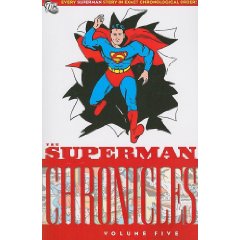
Superman Chronicles volume 5


By Jerry Siegel & Joe Shuster, Wayne Boring, Jack Burnley and the Superman Studio (DC Comics)
ISBN: 978-1-84576-895-9

By the time these tales first saw print Superman was a bona fide phenomenon, and had utterly changed the shape of the fledgling comicbook industry. There was a popular newspaper strip, foreign and overseas syndication and the Fleischer studio was starting production on some of the most expensive -and best – animated cartoons ever produced. Thankfully the quality of the source material was increasing with every four-colour release, and the energy and enthusiasm of Siegel and Shuster had transferred to the burgeoning studio that grew around them to cope with the relentless demand.

This fifth collection of the Man of Steel’s earliest adventures, reprinted in the order they originally appeared, takes us from the beginning of the year to May of 1941; another astounding voyage of thrills and chills that covers his appearances in Action Comics #32-36, the bi-monthly Superman #8-9 as well as his first landmark appearance in the legendary publication World’s Best Comics #1.

As ever, each tale is preceded by the original cover illustration, and the unsung talents of Paul Cassidy and especially Fred Ray should be appreciated for the huge part they played in capturing the attentions of the millions of kids who were daily bombarded by a growing multitude of garish, gaudy mystery-men

We lead off with Action Comics #32 (cover-dated January 1941), ‘The Gambling Racket of Metropolis’ (although like many stories of the time there was no original title and it’s been designated as such simply to make my job a little easier…) wherein the Action Ace crushes an illicit High Society gambling operation that has wormed its nefarious way into the loftiest echelons of Government, a typical Jerry Siegel social drama magnificently illustrated by the great Jack Burnley

Superman #8 (Jan/Feb 1941) was another spectacular and varied compendium containing four big adventures ranging from the fantastic fantasy ‘The Giants of Professor Zee’ (illustrated by Paul Cassidy), topical suspense in ‘The Fifth Column’ (Wayne Boring & Don Komisarow), common criminality in ‘The Carnival Crooks’ (Cassidy again) and concluding with an increasingly rare comic-book outing for Joe Shuster – inked by Boring – in the cover-featured ‘Perrone and the Drug Gang’, as the Metropolis Marvel battled doped-up thugs and the corrupt lawyers who controlled them.

Action Comics #33 and 34 are both Burnley extravaganzas wherein Superman goes north to discover ‘Something Amiss at the Lumber Camp’, before heading to coal country to save ‘The Beautiful Young Heiress’; both superbly enticing character-plays with plenty of scope for eye-popping super-stunts to thrill the gasping fans.

Superman #9 (March/April 1941) was another four-star thriller with all the art credited to Cassidy and the Shuster Studio. ‘The Phony Pacifists’ is an espionage thriller that capitalised on increasing US tensions over “the European War”, ‘Joe Gatson, Racketeer’ recounts the sorry end of a hot-shot blackmailer and kidnapper, ‘Mystery in Swasey Swamp’ combines eerie happenings with ruthless spies and the self-explanatory ‘Jackson’s Murder Ring’ pits Superman against an ingenious gang of commercial assassins.

The success of the annual World’s Fair premium comic-books had convinced the editors that an over-sized anthology of their characters, with Superman and Batman prominently featured, would be a worthwhile proposition even at the exorbitant price of 15¢ (most 64 page titles retailed for 10¢ and would do so until the 1960s). The 96 page World’s Best Comics #1 (and only) debuted with a Spring cover-date, before transforming into the venerable World’s Finest from issue #2 onwards. From that landmark edition comes a gripping disaster thriller ‘Superman vs. the Rainmaker’ illustrated by Cassidy, whilst Action Comics #35 headlined a human interest tale with startling repercussions in ‘The Guybart Gold Mine’, and this volume concludes with Superman mightily stretched to cope with the awesome threat of ‘The Enemy Invasion’, a canny taste of things to come if America entered Word War II.

Stories of corruption, disaster and social injustice were typical of the times, but with war in the news and clearly on the horizon, the content of Superman adventures was changing: and so, necessarily, did the scale and scope of the action. The raw intensity and sly wit still shone through in Siegel’s stories which literally defined what being a Super-hero meant, but as the world became more dangerous the Man of Tomorrow simply became stronger and more flamboyant to deal with it all, and Shuster and his team stretched and expanded the iconography that all others would follow.

These Golden Age tales are priceless enjoyment at an absurdly affordable price. What more so you need to know?

© 1940, 2008 DC Comics. All Rights Reserved.
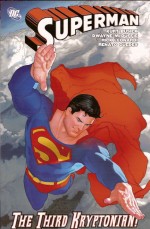
Superman: the Third Kryptonian


By Kurt Busiek, Dwayne McDuffie, Rick Leonardi & Renato Guedes (DC Comics)
ISBN: 978-1-84856-005-5

After interminable page counts and the never-ending angst of hyper-mega-ultra braided multi-part cross-overs, it’s quite nice to pick up an – admittedly slim – endeavour of more modest means and intent: to wit, a book with a couple of stories that actually begin, occur and end.

Collecting the contents of Action Comics #847, Superman #668-670 and Superman Annual #13, this tome actually has three yarns to delight, beginning with Busiek, Leonardi, and Dan Green’s mini-epic in which all the survivors of lost Krypton on Earth, including Power Girl, Clark and Lois’ adopted son Chris (don’t fret, it’s all explained in the story) and even Krypto are targeted for destruction by brutal space pirate Amalak, hungry to take vengeance for the misdeeds of the long dead Kryptonian Empire.

Imagine how the irascible rogue reacts when he discovers that unbeknownst to all, an actual survivor of that long-dead galactic aggressor state has been living secretly on Earth for years…

Good old-fashioned romp though it is, the real meat of this tale is the rewriting of Kryptonian history (Again! Better keep a scorecard handy!) for the post-Smallville/Superman Returns generation. As the disparate continuities of TV, Cinema and comic-books are massaged closer to homogeneity, the best of the old is being refitted to the new and if the result is more readers then I’m all for it.  This is an uncomplicated adventure thriller with nostalgic overtones that has a lot to recommend it.

‘The Best Day’ (Busiek, Fabian Nicieza, Guedes and José Wilson Magalhães) is a sheer delight, beautifully executed. In a quiet moment Superman and Supergirl take the Kent clan on a picnic to the stars and we get a chance to see beloved characters interact in joy and relaxation, when the skies of a million universes aren’t collapsing around their invulnerable ears. It’s a brave, rewarding return to old ways and I want to see more of it.

So go no further than ‘Intermezzo’ (McDuffie and Guedes), another introspective segment sliced from a longer epic, short on punching but big on emotional wallop as Jonathan and Martha Kent share secrets and reveal close-held fears as their adopted son struggles off-camera with another “Never-Ending Battle.”

It’s the gentle moments and the emotional beats that give the best adventure fiction its edge, and this book has them in delightful quantities. This is the stuff that made Superman a legend, and I’m so very glad it making a comeback.

© 2007, 2008 DC Comics. All Rights Reserved.
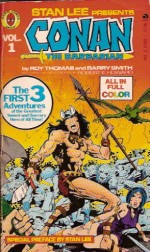
Conan volume 1


By Roy Thomas & Barry Smith (Marvel/Ace Books)
ISBN: 0-441-11692-2

Perhaps I have a tendency to overthink things regarding the world of graphic narrative, but it seems to me that the medium, as much as the message, radically affects the way we interpret our loves and fascinations. Take this little treat from 1978.

The comicbook Conan had become a mighty success, pre-production was beginning on the John Milius movie barbarian and the prose stories themselves – according to the introduction from Roy Thomas – out of print for half a decade, were once again about to grace the bookstores of the nation.

It’s easy to assume that a quickly resized, repackaged paperback book collection of the early comics extravaganzas was just another Marvel cash-cow in their tried-and-tested “flood the marketplace” sales strategy – and maybe it was – but as someone who bought these stories in most of the available formats over the years I have to admit that this version is one of my very favourites and the one I probably re-read most.

Intended as a paperback library of the Cimmerian’s adventures, The Complete Marvel Conan the Barbarian was far from that, only lasting for 6 volumes (it took losing the franchise to Dark Horse Books to properly accomplish that goal over the last few years) and being forced by format restrictions to abridged the source-material was never a satisfactory proposition, but nevertheless these garish little tomes still capture the gritty essence of those landmark tales, whilst Smith’s art actually gains impact delivered at two panels per page, and positively vibrates with power when a non-standard shaped panel layout forces the page designers to get creative with white space…

The book collects the first three adventures commencing with the dramatic, prophetic ‘The Coming of Conan’ (inked by Dan Adkins), through our young hero’s enslavement and liberation in ‘The Lair of the Beastmen’, and concluding with the seminal apocalyptic masterpiece ‘The Twilight of the Grim Grey God’ (both inked by Sal Buscema), three incredibly accessible barbarian tales that actually lured two of my then-school friends into testing the comicbook waters themselves after years of good-natured scorn…

I suppose in the final reckoning how you come to the material is largely irrelevant as long as you do, but I’m certain that different people are receptive to different modes of transmission and we should endeavour to keep all those avenues open…
© 1978 Conan Properties, Inc. All Rights Reserved. Edition © 1970, 1978 Marvel Comics Group, a division of Cadence Industries Corporation.

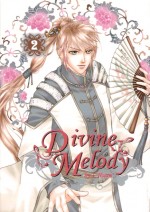
Divine Melody Volume 2


By I-Huan, translated and adapted by Lobelia Cheng & Sue Yang (DrMaster)
ISBN: 978-1-59796-174-5

Celestial Fox Demons are nearly extinct: only females survive and they have enacted a desperate plan to propagate their kind. Stealing a baby deity, they have trained Cai-Sheng over centuries until now she is able to turn into a male at will. But now her abductors are unaware that she/he is matured: able to mate with the fox women; to continue and even elevate their celestial species.

Because Cai-Sheng has other ideas.

When she was still a child two hundred years previously her life was saved by two mortal children, and more importantly, for one glorious afternoon, she learned of play and freedom from duty and destiny. Now after centuries she is reunited with them – or at least their latest reincarnations, beautiful Su Ping and apprentice priest/exorcist Han Yun-Shi. To repay them for their kindness Cai-Sheng has determined to act as matchmaker for the pair, but Ping has seen Cai-Sheng’s male form and become obsessed with “him”.

To further complicate matters Wei Zi-Qiu, an envoy from the goddess of dawn, childbirth and destiny sought out Cai-Sheng, tasked with purifying her and returning her to Heaven whilst in the wings debased fox-demonYu-Niang made her opening move. She had grown strong on two centuries of blood taken from boy children and now she wants the power tied up in Cai-Sheng’s male form…

Yun-Shi is smitten with Su Ping but can’t understand why the frankly weird Cai-Sheng is always hanging around, making herself a nuisance. Moreover, while performing his appointed duties for his disreputable master the apprentice realizes he has a rival in Cai-Sheng’s male form, even if the transforming neo-deity doesn’t…

Zi-Qiu is also constantly turning up, distracting her, and insulting the mortals. He calls Yun-Shi a fraud and questions his motives and honour. When the apprentice is dispatched to find an herb that confers immortality, with Cai-Sheng annoyingly tagging along as usual, he decides to destroy the mystic flower instead, but all the celestial envoy can think of is that Cai-Sheng was alone with the mortal all night, and jumps to the wrong conclusion…

Cai-Sheng returns to the lair of the fox-demons contemplating her designed destiny, but looking at them with new eyes, can’t find any that she loves enough to mate with. Can she save them and be true to her newfound self?

Naming his male self Qin Cai-Sheng, the troubled would-be saviour clashes again with Zi-Qiu, learning the envoy’s tragic history just as the mortal Hui-Niang (a former fox demon who chose humanity, love and children over debased immortality) confronts the wicked Yu-Niang and warns her that her schemes will always be opposed…

And all the strands inevitably draw the cast into a showdown with Yu-Niang and her demonic hordes…

This second volume of the enchanting shōjo tale of legendary China consolidates the characters whilst setting up a portentous clash to come. Even so, Taiwanese creator I-Huan’s flawless blend of mythology and soap-opera temporarily sacrifices comedy for romance and especially action to move on the plot in this saga of duty versus free-will, and familial expectation battling personal desire.

As ever the lyrical art perfectly captures the sense of a lost age whilst horror and fight-fans will revel in the exotic combat scenes (especially against the shadowy demons of Feng Xia) in what is becoming much more than the enduring trials of three people falling in love. A perfect manga for the romantic adventure lover, this is a series that can clearly deliver on all it promises.

This book is produced in the traditional Japanese format and should read from back to front and right to left.

© 2003 I-Huan/Tong Li Publishing Co. Ltd. English translation © 2009 DrMaster Publications, Inc. All Rights Reserved.

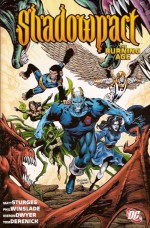
Shadowpact: the Burning Age


By Matthew Sturges, Kieron Dwyer, Tom Derenick, Phil Winslade & various (DC Comics)
ISBN: 978-1-84856-141-0

With this final Shadowpact collection (reprinting issues #20-25 of the tragically defunct monthly comic-book series) scripter Matthew Sturges wraps up all the contiguous plot-lines in fine style over two discrete adventures.

In ‘Black and White’ Kieron Dwyer (part 1, ‘Unexpected Allies’), Tom Derenick & Wayne Faucher (part 2, ‘A Virus of the Mind’) and, Phil Winslade (part 3, ‘Come Together’) delineate the final fate of team-leader Nightmaster, as he and Ragman accompany Nightshade to her home dimension and stumble into an imminent eldritch invasion of Earth by the mystic zombies of The Unbound.

Meanwhile after completing Twelve Heroic Labours for the Vatican, Blue Devil and his lawyer finally get their day in the Courts of Hell to determine the final fate and disposition of the hero’s soul…

Reunited with a team-member long thought forever lost, the extra-dimensional wanderers save the world(s) again and are cataclysmically returned to their Earth-bound comrades just in time to face the invading god known as the Sun King and his disciple Dr. Gotham.

Over three apocalyptic chapters ‘The Burning Age’ (illustrated by Winslade) neatly ties up the entire series as the menace the Shadowpact was formed to battle finally makes its infernal move. The entire team (in fact all of the teams of mystical champions over hundreds of thousands of years) finally confront the ultimate enemy throughout all of time in a deadly magical duel to the death.

Spectacular, intriguing and immensely cathartic, this is a superb note on which to end a great series, whilst still leaving options open for a glorious return. Shadowpact is one of the best team-comic-books of recent years and if the temptation of a “complete set” is what it takes to make a fan out of you, I’ll even sink that low…

Infinite Crisis: Day of Vengeance (ISBN 1-84576-230-4), Shadowpact: the Pentacle Plot (ISBN: 1-84576-533-8), Shadowpact: Cursed (ISBN13: 978-1-84576-738-9), Shadowpact: Darkness and Light (ISBN13: 978-1-84576-892-8) and Shadowpact: the Burning Age: each volume is pure magic, so get ’em all…

© 2008 DC Comics. All Rights Reserved.
Marada the She-Wolf – A Marvel Graphic Novel


By Christopher Claremont & John Bolton (Marvel)
ISBN: 0- 87135-153-6

Scantily clad hot chicks swinging swords have been a staple of fantasy and comics from their very inception, and probably nobody has done it better – certainly visually – than Claremont and Bolton in this heavily recycled yarn set in the days of Imperial Rome.

Marada the She-Wolf is a wandering mercenary whose grandfather was Julius Caesar. When her parents fell into disfavour she was whisked from the Eternal City to live free and grow wild…

Years later in the deserts of Damascus she is rescued from slavers by the Warrior/Magician Donal MacLlyanllwyr, but the indomitable Marada seems a broken doll, devoid of will and spirit. Transporting her to the mystical citadel of Ashandriar amidst the misty hills of Britain the baffled soldier seeks the aid of the legendary sorceress Rhiannon to diagnose, if not cure her illness.

As she slowly recovers the warrior woman forms a bond with Donal’s daughter Arianrhod; a girl of great magical power. Before long the secret of Marada’s malaise is revealed when a demonic creature invades the mystic keep and abducts Arianrhod. Enraged and desperate Marada is forced to brave Hell itself and slash her way through an army of devils to rescue the girl…

These stories originally ran in Epic Illustrated, Marvel’s response to Heavy Metal magazine, (beginning with #10, February 1982) where they appeared in beautiful monochrome wash-and-line, and although Bolton’s sensitive conversion of the art to painted colour is lush and lovely, I have to say that I would have preferred them to have been left that way for this collection.

Also included is ‘Royal Hunt’ a shorter tale wherein Marada and Arianrhod, lost in Africa after escaping the Infernal Realm, are captured by the barbaric Empress of Meroë and given the dubious distinction of being her prey in a competent if uninspired variation of Richard Connell’s landmark 1924 short story (and equally influential 1932 movie) ‘The Most Dangerous Game’.

That crack about recycling didn’t just refer to the art, superb though it is. The original story started life as a Red Sonja yarn for Bizarre Adventures, but when problems arose Claremont and Bolton reworked the thing, and by inserting the whole kit and caboodle into the “real” world of the Roman Empire, albeit braided with Celtic myth and legend, added a satisfying layer of fantastic authenticity to the mix that still leaves it head-and-shoulders above most other Sword and Sorcery “Bad Girls” as well as most general fantasy fiction.

Yet another classy piece of work to add to the “why is this out of print?” pile then…
© 1982, 1985 Christopher S. Claremont and John Bolton. All Rights Reserved.

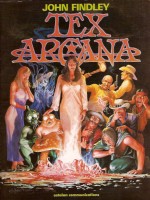
Tex Arcana


By John Findley (Catalan Communications)
ISBN: 0-87416-036-7

One of the best comedy/horror westerns (not, admittedly, a vast field of creative endeavour) of the last fifty years, Findley’s quirky masterpiece of gory, saucy, tongue-in-cheek eccentricity delves into the same rich vein (oh, what a card am I!) as Polanski’s Dance of the Vampires (1967 retitled The Fearless Vampire Killers) and the so-bad-it’s-good Captain Kronus (a rare Brian Clemens turkey from 1974) as well as the immortal Mel Brook’s gem Blazing Saddles in this sagebrush saga of the little town of Hangman’s Corners and the extraordinary things that keep happening there.

Narrated in venerable EC style by the Old Claim-Jumper this slightly abridged volume from 1987 collects the strip which ran in Heavy Metal magazine between March 1981 to 1986 and recounts how a vampire in the thrall of demons attacks the town and how they are all saved by the mysterious lone rider known as Tex Arcana – although most of the work is done by his eerie and ethereal paramour “the Woman in White”. Also included is the short mystery ‘The Amazin’ Case o’ th’ Disappearin’ Chickens’ in which two unprepossessing and ineffectual demons Sweaz and Herp solve the perplexing riddle of why the territory’s biggest chicken rancher loses five head of prime fowl at every full moon…

Findley’s writing is deliciously wacky, full of mock-heroic hyperbole, as he diddles with the icons of the genre whilst his astoundingly rendered fine-line-and-hatching style of drawing – meticulous to the point of mania – is completely mesmerising. This guy can really move a pencil and he doesn’t know how to take short-cuts!

Even after the series was dropped from Heavy Metal Findley kept on working and the eerie epic continues to this day online (http://www.texarcana.com/). In 2006 BookSurge published a 282 page compilation (Tex Arcana: a Saga of the Old West, ISBN: 978-1-41964-632-4) which collected everything to date, but I’ve gone with this 72 page, oversized edition because the reproduction on the new edition is reportedly not everything it could be, and also because I haven’t got hold of a copy of the new book yet. When I do I’ll report back to you…

A little spooky, a lot funny, incredibly realized: whichever version you plump for, doesn’t this sound like your kind of thing..?

© 1987 John Findley and Catalan Communications. All Rights Reserved.

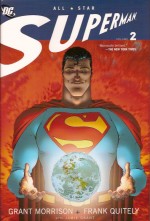
All Star Superman Volume 2


By Grant Morrison & Frank Quitely with Jamie Grant (DC Comics)
ISBN: 978-1-84576-854-4

The worst part of this gig is those moments when you’re holding something that defies your best-words: something utterly self evident, if only you could but see it yourself…

The long-awaited second and concluding volume of Grant Morrison and Frank Quitely’s quirkily reverential and innovatively nostalgic interpretation of the legend of Superman (reprinting issues #7-12 of the award-winning mini-series) wraps up the saga in inimitable manner to the general delight of all fans and occasional dilettantes everywhere.

Superman is dying. Poisoned by Lex Luthor and the Tyrant Sun Solaris, the Man of Tomorrow rushes desperately to finish a shopping list of impossible tasks before his inevitable end, aware that the precious Earth and his greatest friends must be kept safe and happy, even after his demise…

Revisiting such unforgettable Silver Age motifs as the Planet of the Bizarros, being replaced by (even) more competent Kryptonians, liberating the citizens of the Bottle City of Kandor and all those cataclysmic battles with Luthor, not to mention curing cancer and the last Will and Testament of Superman, these gently thrilling glimpses of finer worlds shine with charm and Sense-of-Wonder, leavened with dark, knowing humour and subtle wistfulness. And action. Lots and lots of spectacular, mind-boggling action…

Older readers of the Man of Steel look back on an age of weirdness, mystery, hope and above all, unparalleled imagination. Morrison and the uniquely stylish Quitely (aided and abetted by the digital wizardry of inker/colourist Jamie Grant) obviously remember them too, and must miss them as much as we do.

However this is not just a pastiche of lost grandeur. Kids of all ages are better informed than we were, and the strong narrative thread and sharp, witty dialogue, backed up by the best 21st century technobabble should ensure that even the worldliest young cynic feels a rush of mind-expanding, goose-bump awe.

All-Star Superman: One of the very few superhero collections that literally anybody can – and should – enjoy…

© 2007, 2008, 2009 DC Comics. All Rights Reserved.

Divine Melody Volume 1


By I-Huan, translated and adapted by Lobelia Cheng & Sue Yang (DrMaster)
ISBN: 978-1-59796-173-8

Pity the Celestial Fox Demons: only females now exist and if they wish to advance their status let alone survive as a race they must propagate their kind…

To this end their leader has stolen the girl Cai-Sheng, who with the proper training and refinement will, when full grown, be able to transform into a male and thus father another, superior generation. But all this takes so long. On the haunted mountain they inhabit the fox-demon clan grows impatient. Some renounce their powers and marry mortal men, and bold Yu-Niang has even begun to take little boys as “offerings”…

But as the mystical politicking happens around her all little Cai-Sheng knows is that she is bored and very lonely. Sneaking away from her lessons one day she plays at a secluded well where she meets two village children. Together the girl Xiao-Que and boy Duo Xi romp innocently with her until a dog attacks the magical child (dogs are the mortal enemies of foxes). Brave Duo Xi fights the hound and little Xiao-Que also suffers a cruel bite protecting Cai-Sheng. Just in time her guardian Hui-Niang appears and kills the beast with a well-aimed arrow…

To thank the humans for spilling their blood in the chosen child’s defence, Hui-Niang marks the boy’s torn forehead and the girl’s bitten hand with mystic marks. No matter how long, nor how many incarnations pass, their sacrifice will be rewarded. Promising to meet again on the morrow, the children part, but time and duty is different for celestial being and the humans never see their new friend again.

Two hundred years pass. Cai-Sheng has grown into a beautiful young woman. Hui-Niang has forsworn her immortality and married a mortal. When Cai-Sheng visits to see her new baby she reveals that her training is over. At will she can transform into a beautiful man with incredible magic powers, but has grave doubts about her role and purpose. So far only Hui-Niang knows the secret and Cai-Sheng wants it kept that way.

She wants to see how mortals live and travels to the city to learn all about them. Whilst there, she meets a student priest and apprentice exorcist who is the reincarnation of Duo Xi, and strikes up a tempestuous friendship with him. Together (well, more her than him) they defeat a cat-demon tormenting young Su Ping, the beautiful daughter of Scholar Su, who is Xiao-Que reborn. Delighted to have found her lost friends the fox-redeemer decides to act as matchmaker for the pair but the impressionable Ping has seen Cai-Sheng’s male form and become enamoured…

To further complicate the matter Wei Zi-qui, an envoy from the goddess of dawn, childbirth and destiny has sought out Cai-Sheng, intending to purify her and return her to Heaven where she truly belongs, whilst in the wings corrupt Yu-Niang patiently waits, having grown strong on two centuries of bloody “offerings”…

This remarkable shōjo tale (story for girls) of legendary China from Taiwanese creator I-Huan seamlessly blends mythology with soap-opera, using comedy and action to tell a charming tale of duty versus free-will, and familial expectation battling personal desire. The lovely, lyrical art perfectly captures the sense of a lost age and the enduring immediacy of three people falling in love. A lovely book for the fanciful and romantic, this is a series that looks to have great staying power.

This book is produced in the traditional Japanese format and should read from back to front and right to left.

© 2003 I-Huan/Tong Li Publishing Co. Ltd. English translation © 2009 DrMaster Publications, Inc. All Rights Reserved.

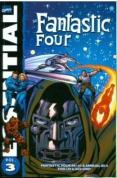
Essential Fantastic Four volume 3


By Stan Lee, Jack Kirby, Joe Sinnott & various (Marvel)
ISBN: 978-0-7851-2625-6

This third collected black-and-white volume of the “World’s Greatest Comic Magazine!” certainly lives up to its own hype as it re-presents those tales wherein Jack Kirby finally unleashed his vast imagination and Stan Lee scripted some of the most passionate superhero sagas that Marvel – or any publisher, for that matter – has ever produced. Both were at the height of their creative powers, and full of the confidence that only success brings, with Kirby in particular eager to see how far the genre and the medium could be pushed.

The wonderment begins with the first part of a tense and traumatic trilogy (inked by Vince Colletta) in which the Frightful Four – Wizard, Sandman, Trapster and the enigmatic Madame Medusa – brainwash The Thing and turn him against his former team-mates. It started in Fantastic Four # 41 (August 1965) with ‘The Brutal Betrayal of Ben Grimm!’, continued in rip-roaring fashion with ‘To Save You, Why must I Kill You?’ and concluded in bombastic glory with #44’s ‘Lo! There Shall be an Ending!’

After that Colletta signed off by inking one of the most crowded Marvel stories ever. Fantastic Four Annual #3 featured every hero, most of the villains and lots of ancillary characters (such as teen-romance stars Patsy Walker & Hedy Wolf and even Stan and Jack themselves) in the company pantheon. In ‘Bedlam at the Baxter Building!’ Reed Richards and Sue Storm finally wed, despite being attacked by an army of baddies mesmerised by the diabolical Doctor Doom. In its classical simplicity it signalled the end of one era and the start of another…

FF #44 was a landmark in many ways. Firstly it saw the arrival of Joe Sinnott as regular inker, a skilled brush-man with a deft line and a superb grasp of anatomy and facial expression, and moreover an artist prepared to match Kirby’s greatest efforts with his own. Some inkers had problems with just how much detail the King would pencil in; Sinnott relished it and the effort showed. What was wonderful now became incomparable.

‘The Gentleman’s Name is Gorgon!’ introduced a mysterious powerhouse with metal hooves instead of feet, a hunter implacably stalking Madame Medusa, who embroiled the Human Torch and thus the whole team in her frantic bid to escape, and that’s before the monstrous android Dragon Man showed up to complicate matters. All this was merely a prelude: with the next issue we were introduced to a hidden race of super-beings that had secretly shared the Earth with us for millennia. ‘Among us Hide… the Inhumans’ revealed that Medusa was part of the Royal Family of Attilan, a race of paranormal beings on the run ever since a coup deposed the true king.

Black Bolt, Triton, Karnak and the rest would quickly become mainstays of the Marvel Universe, but their bewitching young cousin Crystal and her giant teleporting dog Lockjaw were the real stars here. For young Johnny Storm it was love at first sight, and Crystal’s eventual fate would greatly change his character, giving him a hint of angst-ridden tragedy that resonated greatly with the generation of young readers who were growing up with the comic…

‘Those Who Would Destroy Us!’ and ‘Beware the Hidden Land!’ (FF #46 and 47) saw the team join the Inhumans as Black Bolt regained his throne from his brother Maximus the Mad, only to stumble into the usurper’s plan to wipe humanity from the Earth.

Ideas just seem to explode from Kirby at this time. Despite being halfway through one storyline, FF #48 trumpeted ‘The Coming of Galactus!’ and the first Inhumans saga was swiftly wrapped up by page 6, with the entire race sealed behind an impenetrable dome called the Negative Zone (later retitled the Negative Barrier to avoid confusion with the gateway to sub-space that Reed worked on for years).

Meanwhile a cosmic entity approached Earth, preceded by a gleaming herald on a surfboard of pure cosmic energy. I suspect this experimental – and vaguely uncomfortable – approach to narrative mechanics was calculated and deliberate, mirroring the way that TV soap operas were increasingly delivering their interwoven storylines, and a way to keep the readers glued to the series.

They needn’t have bothered. The stories and concepts were enough…

‘If this be Doomsday!’ saw the planet-eating Galactus set up shop above the Baxter Building despite the team’s best efforts, whilst his cold and shining herald had his humanity rekindled by simply conversing with the Thing’s blind girlfriend Alicia. Issue #50’s ‘The Startling Saga of the Silver Surfer!’ concluded the epic in grand style as the reawakened humanity of the Surfer and heroism of the FF bought enough time for Richards to literally save the World. Once again the tale ended in the middle of the issue, and the remaining half concentrated on the team getting back to “normal”. To that extent Johnny Storm enrolled at Metro College, desperate to forget his lost love Crystal and his unnerving jaunts to the ends of the universe. On his first day, the lad met the imposing and enigmatic Native American Wyatt Wingfoot, destined to become his greatest friend…’

Fantastic Four #51 is considered by many the greatest single FF story ever. ‘This Man… This Monster!’ found the Thing’s body usurped by a vengeful and petty scientist who subsequently discovered the true measure of a man, whilst another innovation and great character debuted in the next issue.

‘The Black Panther!’ was an African monarch whose secretive kingdom was the only source of a vibration-absorbing alien metal. These mineral riches had enabled him to turn his country into a technological wonderland. He attacked the FF as part of an extended plan to gain vengeance on the murderer of his father. He was also the first Negro superhero in American comics (Fantastic Four #52, cover-dated July 1966). His origin was revealed in ‘The Way it Began..!’, which also introduced sonic super-villain Klaw. Johnny and Wyatt then embarked on a quest to find Crystal but discovered instead the lost tomb of Prester John in #54’s ‘Whosoever Finds the Evil Eye…!’

Imprisoned on Earth the brooding ex-herald of Galactus had become an instant fan-favourite, and his regular appearances were always a guarantee of something special. ‘When Strikes the Silver Surfer!’ found him in uncomprehending, brutal battle with the Thing, whose insecurities about Alicia had turned into searing jealousy, whereas it was business as unusual when ‘Klaw the Murderous Master of Sound!’ attacked again in # 56.

Throughout all the issues since their imprisonment a running sub-plot with the Inhumans had been slowly building, whilst the on the other side of the Great Barrier, Johnny and Wyatt wandered the wilds also seeking a method of liberating the Hidden City. Their quest led directly into the landmark tale ‘The Torch that Was!’: lead feature in the fourth FF Annual (1966), in which The Mad Thinker resurrected the original Human Torch (actually the World’s first android) to battle destroy the flaming teenager…

Fantastic Four #57-60 displayed Lee and Kirby at their very best; with incredible drama and action on a number of fronts as the most dangerous man on Earth stole the Silver Surfer’s power, the Inhumans finally won their freedom and we discovered the tragic secret of Black Bolt in all its awesome fury. It all began with a jailbreak by the Sandman in #57’s ‘Enter… Dr. Doom!’, continued in ‘The Dismal Dregs of Defeat!’ and ‘Doomsday’ culminating in brains saving the day and humanity in magnificent manner with ‘The Peril and the Power!’

But there was never a dull moment: no sooner had they relaxed than a new and improved foe resumed his aborted attack in #61’s ‘Where Stalks the Sandman?’, another explosive multi-part tale wherein Johnny and Crystal were reunited, the Surfer regained his stolen power and Reed was lost to the anti-matter hell of the Negative Zone’s sub-space corridor.

‘…And One Shall Save Him!’ guest-starred Triton and the newly liberated Inhuman Royal Family, and saw the introduction of another unique enemy, who followed Reed back from the anti-matter universe and straight into partnership with the Sandman. The battle against ‘Blastaar, the Living Bomb-Burst!’ (FF #63, June 1967), concludes the incredible run of superb stories in this volume, but there was still room to include some fascinating freebies in the form of pages of original art, the initial designs for Coal Tiger (who became Black Panther) and an unused cover for #52.

These are the stories that cemented Marvel’s reputation and enabled the company to overtake all its competitors. They’re also still some of the best stories ever produced and as exciting and captivating now as they ever were. This is a must-have book for all fans of graphic narrative.

© 1965, 1966, 1967, 2007 Marvel Characters, Inc. All Rights Reserved.