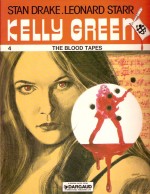
Kelly Green volume 4: The Blood Tapes


By Stan Drake & Leonard Starr (Dargaud International Publishing)
ISBN: 2-205-06956-X

With her cop husband murdered by his own superiors (Kelly Green: The Go-Between), grieving, furious Kelly Green has began a risky new career in the twilight world between the law-abiding and the criminal aided by three of her husband’s reformed “cases”: con-man Spats Cavendish, thief Jimmy Delocke and pugnacious leg-breaker “Meathooks.”

Acting as a fair and impartial broker between antagonistic parties had kept Kelly in groceries for awhile now – and got her into some pretty nasty scrapes – but she had never encountered such unprincipled and dangerous characters as those that populate the Los Angeles music scene. When Rock Legend Alec Blood completed his comeback album he didn’t realise he was signing his death warrant…

When the star was gunned down in the studio parking lot the master tapes were stolen, and with millions of dollars hanging in the balance Kelly was contracted to buy back Blood’s last recordings. But she is horrified to discover that the money is being provided by Tom Ragan, the most dangerous mobster in Las Vegas, and he personally asked for her…

Before she can even begin she has to ascertain if thief and murderer are one and the same, but everywhere she turns the infamous Ragan is dogging her steps. Can he possibly be as murderous as he is good-looking? Is he as good a liar as he is a lover? And can the spiritualist Madame Elsa really convince the murdered Alec Blood to reveal who killed him…?

As usual nothing is what it seems in this superb thriller which blends a classic “whodunit” with the brutal, sexy world of The Mob, where Kelly and her faithful team find themselves punching far beyond their weight, but still doing the best they can in a world crushingly short of White Knights…

The passage of time has made this plot all too familiar but as is so often the case the first is still the best and the tale still has plenty of surprises in store for thriller aficionados and comics fans alike.

Intense and uncompromising, these character-driven yarns are as compelling now as they ever were, and the sheer quality of Stan Drake and Leonard Starr’s narrative creativity, unconstrained by the need to please a family audience – and the editors afraid of offending them – is a master-class in how comics should be made.
© 1983 Dargaud Editeur. All Right Reserved.

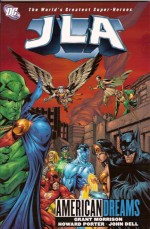
JLA volume 2: American Dreams


By Grant Morrison, Howard Porter, Oscar Jimenez, John Dell & various (DC Comics)
ISBN: 978-1-56389-394-0

After getting off to an impossibly cracking start in JLA: New World Order the superb quality of storytelling actually improved as Morrison and Porter began laying the groundwork for their first big story-arc, and this collection of shorter tales (originally appearing in JLA issues #5-9) stands as excellent interlude as well as a fine example of how modern superhero comics can still surprise, beguile and addict impressionable minds.

Leading off is ‘Woman of Tomorrow’ wherein veteran League villains Professor Ivo and T. O. Morrow construct the perfect super heroine to infiltrate and destroy the World’s Greatest Superheroes from within – but for once they build too well…

This is followed by ‘Fire in the Sky’ and ‘Heaven on Earth’ (with Ken Branch joining John Dell to ink Porter’s hyper-dynamic pencils) as the Angel Zauriel risks everything to warn the heroes of a second rebellion in Heaven, and the League must defeat an invasion by God’s own armies. This spectacular mini-saga also features old foes Neron and arch-demons Abnegazar, Rath and Ghast and was intended to introduce a new Hawkman to the DC Universe, but somewhere, somehow, wiser heads prevailed and the original was eventually retooled and reintroduced with Zauriel winning his own place in the company’s pantheon.

Oscar Jimenez and Chip Wallace stepped in to illustrate ‘Imaginary Stories’ as mind-bending villain The Key attempted to conquer the universe by trapping the individual League members in perfect dreams, and the art team was augmented by Hanibal Rodriguez for the tense conclusion ‘Elseworlds’ which saw the Zen warrior Green Arrow (son of the original, irascible ultra-liberal bowman) join the team in classic “saves the day” style.

Savvy, compelling, dauntingly High-Concept but not afraid of nostalgia or laughing at itself, the new JLA was an all-out effort to be Smart and Fun. Superman, Batman, Wonder Woman, Martian Manhunter, Flash, Green Lantern and Aquaman are the “World’s Greatest Superheroes” and these increasingly ambitious epics reminded everybody of the fact. This is the kind of thrill that nobody ever outgrows. Got yours yet?
© 1997 DC Comics. All Rights Reserved.

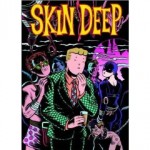
Skin Deep


By Charles Burns (Fantagraphics Books)
ISBN: 978-1-60699-167-1

Charles Burns is a creative force with his roots firmly placed in 1950s kids culture (B-movies, cartoons, EC comics: especially Mad Magazine,) and fingers in many areas of the creative media. As an illustrator, graphic designer, photographer, film-maker and especially cartoonist, his slick, precise methodology tells stories and evokes responses from a place that is dark, skewed, beautiful and overwhelmingly nostalgic.

His comics work blends horror, true romance and Film Noir sensibilities with a sensationalistic fascination with the grotesque and absurdist; all delivered in a tight, meticulous, heavy line style reminiscent of woodcut prints, with huge swathes of solid black like darkness and light suspended and perfectly balanced in a Cold War on every page.

This gigantic softcover (297mm high x 224mm wide) is the third in a series collecting all the artist’s work prior to the landmark publication of the incredible Black Hole (soon to be a Major Motion Picture! – I love typing that!) and the three interlinked – or rather perhaps, overlapping – stories here all originate from between 1988 to1992, having been slightly revised since appearing in the Big Baby weekly strip and in the case of A Marriage Made in Hell, the legendary Raw Magazine. All in their own manner examine the theme of love in the modern world.

Leading off is Dog-Boy, the simple tale of a young man who has a cut-rate heart transplant and finds himself increasingly taking on the characteristics of the canine who his provided his new ticker. Just because he acts a little differently, does this mean that there is no girl out there for him? This tale formed the basis of a 1991 MTV serial for the Liquid Television TV programme (seen here on BBC2, I think).

This leads to the outrageously funny and deeply unsettling Burn Again wherein reformed televangelist Bliss Blister once more falls under the influence of his huckster father, as well as his own wife, who use him to con the religiously gullible. Unfortunately what only Bliss knows is that God – in the form of a hideous, diabolical extraterrestrial Cyclops, is coming to end mankind’s self-inflicted woes…

The book ends with the aforementioned and intensely disturbing story-within-a-story A Marriage Made in Hell. When horny new bride Lydia finally marries her war-hero husband she regretfully discovers that he won’t consummate their union. Just what is the fantastic secret of battle-scarred veteran John Dough, and how does Lydia cope with the incredible situation she finds herself trapped in?

As well as these staggeringly dry, wry and funny tales there is also a selection from the Burns sketchbook, a look at some of those altered story-pages and a brief commentary from the artist himself.

This volume is also available as hardback edition and was previously released as a Penguin book in 1992.
© 1988-1992 Charles Burns. All Rights Reserved.

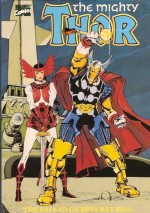
Mighty Thor: The Ballad of Beta Ray Bill

mighty-thor-the-ballad-of-beta-ray-bill
By Walter Simonson with John Workman & George Roussos (Marvel)
ISBN: 0-87135-614-7

For many older fans Thor was the comic that truly demonstrated the fevered and unfettered imagination of Jack Kirby – at least until he relocated to DC at the beginning of the 1970s and really let rip. Living galaxies, the conquest of Evolution: gods, heroes and aliens, machines with emotions and humans without, the strengths and liabilities of family ties and the inevitability of creation itself, all played out on the pages of the Thunder God’s action-packed comic-books.

After The King quit the series Thor floundered as everybody who followed laboured in the master’s largest shadow (and many in his style), but high points were few and inspiration was non-existent.

Until Walter Simonson arrived.

Or more accurately, returned, as he had for a brief while been one of those artists slavishly soldiering to rekindle Kirby’s easily synthesis of mythology, science fiction and meta-humanist philosophy, but with as little success as any other. When Simonson assumed the writing and drawing of the title in November1983 with issue #337, deeply invested in Kirby’s exploratory, radical visionary process, free to let loose and brave enough to bring his own vision to the character, he produced a body of work (#337-382 plus the Balder the Brave miniseries – and which can most easily be found in the Marvel Visionaries series of trade paperbacks) that actually moved beyond Kirby’s Canon and dragged the title out of a creative rut which allowed his own successors to actually introduce genuine change to a property that had stagnated for 13 years.

This particular volume is one of Marvel’s earliest trade paperback collections, with bold vibrant colours on good paper stock, and collects that first iconic story-arc from The Mighty Thor #337-340, which shook everything up and made the Thunder God a collectible sensation for the first time in a decade.

Moreover the entire tale is but the prologue to a stupendous larger epic which actively addresses the over-used dramatic device of the Doom of the Gods that had haunted this series since the mid-1960s…

The story revolves around a spell inscribed on Thor’s hammer and seen in the character’s very first appearance. When crippled Don Blake was first transformed into the Thunder God he saw on the magic mallet Mjolnir the legend “Whosoever holds this hammer, if he be worthy, shall possess the power of Thor…”

The saga begins when Blake is asked by super-spy outfit SHIELD to intercept a fleet of starships headed for Earth which refuel themselves by absorbing suns! Hurtling off into deep space the Storm God boards a vessel only to be defeated in combat by its alien protector, an artificially augmented warrior named Beta Ray Bill. Moreover, as they crash to Earth the alien somehow activates Mjolnir’s magic and transforms itself into a warped duplicate of Thor! And then Odin mistakes Bill for his son and whisks him to Asgard to defend the Realm Eternal from another monstrous threat!  And then…

Enough tomfoolery: suffice to say that the action and surprises pile one upon another as the alien reveals that he is the guardian of his people, the Korbinites, who are fleeing from a horde of demons that destroyed their civilisation and are hunting them to extinction. And now they’re heading towards Earth…

After the mandatory big fight Thor and Bill – each with his own hammer – team-up to investigate the demons, with confused love-interest Lady Sif along for the bombastic ride, and discover a threat to the entire universe. Worse yet, it’s generated by an Asgardian foe destined to defeat the Gods themselves on the Day of Ragnarok!

Brave, bold and occurring at a breakneck pace, with fresh concepts wedded to the most fundamental elements of Marvel mythology, this short appetizer is the perfect cosmic storm, infinitely rewarding and impossibly re-readable. Art, story, concept and design in perfect harmony – this is an unbeatable Marvel Tale…
© 1988 Marvel Entertainment Group Inc. All Rights Reserved.

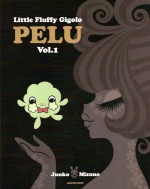
Little Fluffy Gigolo Pelu volume 1


By Junko Mizuno (jaPress/Last Gasp)
ISBN: 978-0-85719-700-6

If you’re over a certain age or have eclectic tastes in art and music you might feel a pang of nostalgia at the work in this intriguing and coyly adult collection, featuring Manga sensation Junko Mizuno’s latest subversively compelling creation.

Since her emergence in 1995, the author has become renowned for combining the appearance of childish innocence or “cuteness” with dark, gory action and unwholesome or stridently clashing and inappropriate content in a sub-genre now dubbed Gothic or Noir kawaii (where kawaii describes cutely drawn protagonists and subjects).

Moreover the skewed sensibilities of her work in such Manga as Cinderalla, Hansel & Gretel, Princess Mermaid and Pure Trance (all available in English language editions) and the as-yet-untranslated Momongo no Isshō (the Life of Momongo) has exploded out of the comics ghetto and been taken up by the larger populace with art exhibitions (Heart Throbs and Tender Succubus), art-books (Hell Babies, Collector File and Flare) and high-end designer toys for adults including plush animals, vinyl figures, stationery, postcards, stickers, original art T-shirts and even a line of erotic products and condoms.

She is scheduled to produce a limited edition My Little Pony figure for a Hasbro charity event and by the time you read this Marvel should have released her first Spider-Man and Mary Jane adventure in the re-launched Strange Tales.

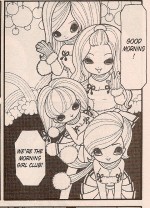
Her self-confessed shojo (“stories for girls”) influenced style also borrows heavily from the imagery of the 1960s and early 1970s, particularly the Graphic Psychedelia that grew out of Pop Art, with huge eyed (admittedly not uncommon in Manga), large-headed girls, drawn to look young – no, not young, but actively, innocently, illicitly under-aged: living in simplified, reduced detail environments.

As previously stated her content is always sharply at odds with her drawing style, like cartoons for toddlers but involving unpleasant visits to the gynaecologist or being eaten by cannibals. Much of her work is in full colour despite the overwhelming preponderance of black and white material in Japan, and this volume (mostly monochrome but with a magically lush colour section) breaks another tradition by using a huge 254 x 201mm page size rather than the usual 188 x 126mm to relate its tales of lonely hearts.

Little Fluffy Gigolo Pelu is another conceptual shocker with a subtle subtext and an overt narrative underpinning, redolent of the naively “Swinging Sixties”. The cute pink planet Princess Kotobuki smells delightful but is invisible to human eyes. On its charming surface dwell nothing but beautiful naked young women and one very lovely, placid purple space hippo: but beware because Space Hippos are carnivorous!

And then there’s Pelu: a fluffy excitable ball of fuzz who questions this idyllic existence. From the hippo Pelu learns of Earth where there are two sexes, not one, and when Pelu learns its own origins (the first chapter is entitled ‘Sex Education on a Fantastic Planet’) it determines to go to the planet of humans and father a baby so it won’t be alone any more…

So begins the charmingly unsettling saga of Gigolo Pelu whose adventures in ‘The Naked Enka Singer’, ‘The Sassy Girl and the Bad Boy’, ‘Beach Maidens’ and ‘The Mysterious High School’ mirror the venerable tale of an Innocent’s road to enlightenment (complete with the loss of the aforementioned innocence), given extra punch by the overwhelming accoutrements of perfect childhood that permeate every atom of the tale.

On Earth the fluffy creature observes human interactions whilst always politely asking if anyone would like to be made pregnant – but love, hate, jealousy, pride, ambition, self-loathing and even murder are hard to grasp until Pelu discovers and befriends a hobo who becomes a valued comrade and teacher.

Everything, especially the many beautiful girls, are drawn in the style of late 1960s Playboy icons, the cartoon stylisations that featured in many movie blockbuster title sequences and especially the psychedelic works of Alan Aldridge and the animated film Yellow Submarine. Anybody British out there who remembers the kids show Crystal Tipps and Alistair, or the hippo from Rainbow, will feel a frisson of nostalgia – which is of course the point. The art is a beautiful velvet trap designed to put the reader in a receptive state so that the author can make her telling points about today’s world.
pelu-pic-2

By co-opting the form of children’s entertainment the author can address fundamental aspects of society in a form intended to shock, subvert, upset and most importantly provoke: hopefully some thought on the readers’ part will be generated beyond the modern shock-reaction to nude young girls and the pre-pubescent idealism and purity that used to be associated with such imagery.

This is a deceptively edgy fantasy with a lot to say about society and relationships – similar to and completely different from Robert Heinlein’s groundbreaking social satire Stranger in a Strange Land, and if enough of the right people read it could have as much impact.
© 2003 Junko Mizuno. All Rights Reserved.

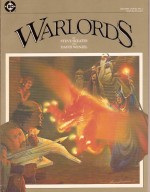
Warlords – DC Graphic Novel #2


By Steve Skeates & Dave Wenzel (DC Comics)
ISBN: 0-930289-04-8

Being nothing but a bunch of banana-fingers with stubby thumbs and utterly immune to the specious allure of computer and video games, I can’t admit to much knowledge of the antecedents of this intriguing fantasy book. Still that means that I can dispassionately comment on the package as a read unswayed by its origins.

In the mid-1980s all the major comics companies were exploring the European concept of albums and graphic novels: enlarged and expanded narratives produced on better paper stock using more expensive printing techniques. Coincidentally, at this time DC had entered into a financial arrangement with video-gaming giant Atari resulting in such superb comics spin-offs as Atari Force (a comic still screaming out for a definitive collection) and Star Raiders.

Another Atari property that made the leap to the printed page was Warlords; at first glance one more Tolkienesque derivative comprised of fairies and elves, wizards and giants, with general blade-based mayhem aplenty. But on closer examination this colourful little epic has hidden charms: for a start it’s written for sly knowing laughs, isn’t afraid to poke fun at itself and even the genre it owes its existence to.

The other big plus is the creative team. The sharp and witty script by the hugely underrated Steve Skeates is illustrated by fantasy master (and honorary Hobbit) David Wenzel and together they produced this impressive and engaging tale of an underachieving troll “Just Plain Dwayne” who reluctantly finds himself holding a magic amulet that everybody wants in the middle of an eternal cold war between the four Warlords who control the world.

Unfortunately now that the scurrilous Dwayne has the mystic bauble that war’s going to heat up pretty quickly…

It’s relatively easy to parody a genre, but to be funny within the internal logic of one is a master’s trick: so when I tell you Dwayne’s little quest is still ripe with climactic battles, fabulous beasts, glorious creatures, hair-raising tension and incredible action you know its something you just have to see.

Trust me, I’m a Scholar…
© 1983 Atari Inc. All Rights Reserved.

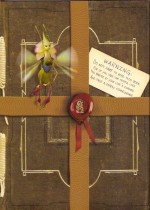
Arthur Spiderwick’s Field Guide to the Fantastical World Around You


By Tony DiTerlizzi & Holly Black (Simon & Shuster UK)
ISBN: 978-1-41690-136-5

One of the most charming and readable children’s stories of recent vintage (the first volume was published in 2003 and I’ll get to them one day…) recounts the adventures of three American kids who stumble into a forgotten and dangerous world of unseen Fairy Magic. The adventures of the Grace children even emerged relatively unscathed from the transition to the big screen in a winning adaptation entitled The Spiderwick Chronicles.

Modern marketing being what it is, a lot of peripheral material has been generated to accompany the books and it’s one of these I want to bring to your attention. Arthur Spiderwick’s Field Guide to the Fantastical World Around You is a fabulous confection, purporting to be the actual tome created by an inquisitive naturalist nearly a century ago, listing in magnificent taxonomical detail and gloriously illustrative manner all the unnatural and supernormal creatures that live beyond the range of normal human sight.

Although Tony DiTerlizzi and Holly Black are deliberately vague as to who does what to craft these tales the former is credited as illustrator, so I’m assuming the Manticore’s share of the superb paintings and drawings in this volume are his and the explanatory notes Ms Black’s – and frankly astonishing it all is.

Divided into Around the House and Yard, In Fields and Forests, In Lakes, Streams and the Sea, In the Hills and Mountains, In the Sky and Outside at Night this beautiful bestiary covers every invisible wonder from Banshees to Will-o’-the Wisps, Dragons to Unicorns and all European ethereals in between.

This is a book to inspire dreaming and creativity in kids of any age, produced with all the tricks and magic of 21st century printing and paper-technology. A true and total delight.
© 2005 Tony DiTerlizzi & Holly Black. All Rights Reserved.

Chimera


By Mattotti (Fantagraphics Books and Coconino Press)
ISBN-13: 978-1-56097-763-6

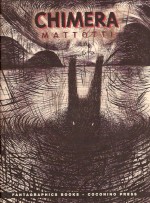
The sixth release (I hesitate to call it a volume, as the format, though bold and wonderful, is far more than a magazine but not quite a book) from the eclectic European publications imprint designated the Ignatz Collection features an uncharacteristic and unforgettable look at the monochrome work of one of the world’s most talented colour artists.

Lorenzo Mattotti was born in Brescia, Italy and studied at the Faculty for Architecture in Venice before beginning a career as a comics storyteller in 1975 in the French magazine Circus. Whether alone or with long-time collaborator Fabrizio Ostani (AKA Jerry Kramsky – they often used the single pen-name “Kleidebistro”) Mattotti’s incredible, nigh-abstract designs and pictorial narratives have won him a huge following, with work appearing in Métal Hurlant, L’Écho des Savanes (France), Rumbo Sur (Spain), Frigidaire, Secondamano and Alter Alter (Italy), Raw (USA) and The Face (UK) among many others.

In 2002 Mattotti and Kramsky produced Docteur Jekyll & Mister Hyde (based on the Robert Louis Stevenson classic) for Casterman, and the English translation won Mattotti an Eisner Award the following year. As an illustrator, Mattotti has worked for Vanity Fair, the New Yorker, Cosmopolitan, Vogue and Le Monde, and has produced a number of startling and beautiful children’s books. His absolute masterpiece thus far is – to my mind at least – Fires (and I think I’ll just add that to my “review real soon” pile).

Behind a deeply unsettling gate-fold wraparound cover, but printed throughout on reassuringly solid cream-coloured card-stock, lurks a startling journey from idyllic cloud-gazing through vaguely erotic musings on gods and giants to the depths of a terrifying and oppressive forested hell. Rendered in a bravura line-and-dry-brush style that ranges from seductive and cajoling, through airy tumult to raw, fierce, bestial rage and horror, Mattotti uses the reader’s eyes to pull the viewer on a chaotic descent reminiscent of Mussorgsky’s “A Night on Bald Mountain” from Walt Disney’s Fantasia, with just a hint of Watership Down thrown in.

Comics aficionados might also recognize a touch of the panning-in technique used by the great André Barbe where small pictorial changes lead to a total transformation, not only to the graphic representations but also to the mental or spiritual state of the object and observer. But where Barbe wanted to languidly surprise and seduce you, Mattotti is here to make you squirm…

Even if the “how” isn’t your major concern, the whole pictorial experience of Chimera is one headlong rush, and a supreme lesson in the power and virtuosity of dark lines against the light. This is probably the only white knuckle ride you can put on a bookshelf… so why don’t you?

Story and art © 2005 Lorenzo Mattotti. Book edition © 2005 Fantagraphics Books and Coconino Press.

JLA volume 1: New World Order


By Grant Morrison, Howard Porter & John Dell (DC Comics)
ISBN: 978-1-56389-369-8

After the Silver Age’s greatest team-book died a slow, painful, wasting death, not once but twice, DC were taking no chances with their next revival of the Justice League of America and tapped Big Ideas wünderkind Grant Morrison to reconstruct the group and the franchise.

And the idea that clicked? Put everybody’s favourite Name superheroes in the team.

Of course it worked, but that’s only because as well as star quantity there was a huge input of creative quality. The stories were smart, compelling, challengingly large-scale and drawn with desperate vitality. With JLA one could see all the work undertaken to make it the best it could be.

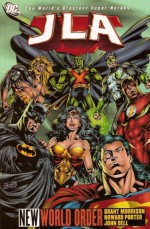
This slim album collects the first four issues of the revival and covers a spectacular landmark tale that altered the continuity landscape of the DC Universe by introducing a family of alien superbeings called the Hyperclan whose arrival on Earth could have ushered in a new Golden Age – a least by their standards.

Superman, Batman, Wonder Woman, the Martian Manhunter, Flash, Green Lantern and Aquaman are the legends who see their methods and careers questioned only to uncover a deadly secret that threatens to doom the planet they’re pledged to protect in a splendid old-fashioned goodies ‘n’ baddies romp that re-sparked fan interest in the “World’s Greatest Superheroes”.

If you haven’t read this sparkling slice of fight ‘n’ tights wonderment then your fantastic life just isn’t complete yet…

© 1997, 1998 DC Comics. All Rights Reserved.

Marshal Law: Fear Asylum


By Pat Mills & Kevin O’Neill with Mark A. Nelson (Titan Books)
ISBN: 978-1-84023-699-6

In 1987 Marvel’s creator-owned imprint, Epic Comics, published a six-issue miniseries starring a hero superficially very much in the vein of Judge Dredd, but one who took the hallowed American creation of the superhero genre and gave it a thorough duffing-up, Brit-boy style, in the tale of a costumed cop who did the Right Thing and did it His Way…

San Futuro is a Metropolitan urban dystopia built on the Post- Big Quake remnants of San Francisco. America is recovering from another stupid, exploitative war in somebody else’s country, and as usual the discharged and brain-fried veterans are clogging the streets and menacing decent society. Unfortunately this war was fought with artificially manufactured superheroes: now they’re home and a very dangerous embarrassment.

Marshal Law was one of them, but now he’s a cop; angry and disillusioned. His job is to put away masks and capes. This establishing series was collected as Marshal Law: Fear and Loathing.

Being a creator-owned property, old zipper-face went with Mills and O’Neill to the British independent outfit Apocalypse, publishers of the talent-heavy 2000AD rival Toxic, which ran from March to October 1991. But before that a final Epic one-shot ‘Marshal Law takes Manhattan‘ was released in 1989, and forms the first part of this final collection.

With some art assistance from Mark A. Nelson and Mark Chiarello, the Hero-Hunter was dispatched to New York to extradite a war criminal (and Law’s old army trainer) The Persecutor. Unfortunately (for them) the perp has hidden himself amongst the inmates of “The Institute” – a colossal Manhattan skyscraper housing all the Big Apple’s native superheroes; each and every one a brilliant, barmy, bile-filled parody of Marvel’s Mightiest.

Naturally carnage and mayhem are the result, but not before author Mills slips a few well-aimed pops at US covert practices and policies in South America under the door.

Less contentious – unless you’re a fan of the movie “Alien” or the Legion of Super Heroes – is ‘Secret Tribunal’ wherein the Marshal is sent to an orbiting Space Station where the government grows its manufactured superbeings just as a nasty incursion of fast-breeding carnivorous space-beasts starts ripping the immature supermen and wonder women to gory gobbets…

The book closes with the decidedly odd pairing of ‘The Mask/Marshal Law’ which finds the militant cape-crusher on the verge of resigning just as the magical mask that made mucho moolah for Dark Horse and a star out of Jim Carrey resurfaces in San Futuro… Cue chaos, carnage and lots of deadly silliness…

Although still fiercely polemical and strident, this is probably the least effective of the Marshal Law books. The feeling that Mills has said all he wanted or needed to say is ominously prevalent and although O’Neill’s art seemingly improves with every page – and the sketch and unseen art sections are engrossing and powerful – the overall feeling is one of tired duty rather than passionate verve.

Although still tremendously entertaining it’s clear than the Marshal hung up his barbed wire and boots just in time. Hero-Harriers Pat Mills and Kevin O’Neill produced a wonderful edgy parody, but until the industry annoys them enough to come back with all Honking Great Guns blazing, fans should just content themselves with this one last hurrah.

© 2003 Pat Mills & Kevin O’Neill. Art © 1993 Kevin O’Neill. The Mask is © 2003 Dark Horse Comics, Inc. All Rights Reserved.