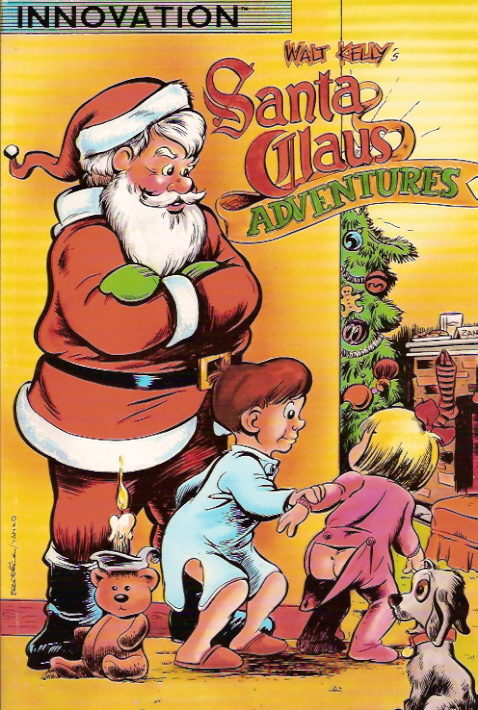
Justifiably revered for his brilliant newspaper strip Pogo, and perhaps even his wonderful Our Gang tales, the incredible Walt Kelly also has a pretty strong claim to owning the traditional childhood Christmas. From 1942 until he abandoned comic-books for newsprint he produced stories and magazines dedicated to the season of Good Will for West Coast publishing giant Dell. Santa Claus Funnies and Christmas with Mother Goose were a Holidays institution in both their Four Color and Dell Giant incarnations and the sheer beauty and charm of Kelly’s work defined what Christmas should be for two generations. Kelly transferred his affinity for the best of all fantasy worlds to the immortal Pogo but still was especially associated with the Festive season. Many publications sought out his special touch. Even the Christmas 1955 edition of Newsweek starred Kelly and Co on the cover.
Thanks to Eclipse Comics some of this fabulous work resurfaced in the late 1980s and this slim book of reprints was put together after their collapse by the equally gone and just as much-missed Innovation outfit.
It starts as it positively must with an adaptation of Clement C. Moore’s inevitable classic poem ‘The Night Before Christmas’ before continuing with the delightful ‘Ticky Tack the Littlest Reindeer’ then the story of ‘Santa’s First Helper’ and the crazily captivating ‘Jeminy’s Christmas’ which proves that even farmyard animals need to be sure that they’re not naughty but nice. ‘Santa’s Story’ is a rather boisterous and action-packed romp with giants and fairy Queens which sets the scene for the concluding ‘How Santa Got his Red Suit’ which, augmented by a couple of pages of animal antics rhymes and celebratory articles by Betsy Curtis and Maggie Thompson, makes for a perfect Christmas package to start your kids on the road to comics addiction.
It absolutely baffles me that Kelly’s unique and universally top-notch Christmas tales – and Batman’s too for that matter – are not re-released every November for the Yule spending spree. Christmas is all about nostalgia and the good old days and there is no bigger sentimental sap on the planet than your average comics punter. And once these books are out there their supreme readability will quickly make converts of the rest of the world.
By Stan Lee, Jack Kirby, Don Heck & various (Marvel)
ISBN 0-7851-1862-4
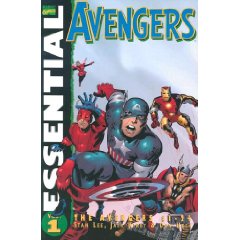
The concept of putting all your star eggs in one basket was not new when Stan Lee and Jack Kirby took a bunch of the new super-characters of the burgeoning Marvel Universe and combined them as a force for justice and high sales, but seldom has it ever been done with such style and sheer exuberance. Cover dated September 1963 the Avengers #1 launched as an expansion package with two other titles, Sgt Fury and his Howling Commandos and the X-Men, but with the advantage of a familiar if not totally successful cast.
‘The Coming of the Avengers’ is one of the cannier origin tales in comics. Instead of starting at a zero point and acting as if the reader knew nothing, creators Stan Lee, Jack Kirby and Dick Ayers assumed that they had a least a passing familiarity with Marvel’s other titles, and wasted very little time or energy on introductions.
In Asgard Loki, god of evil, is imprisoned on a dank islet but still craves vengeance on his half brother the Mighty Thor. Observing Earth he finds the monstrous Hulk and engineers a situation wherein the man-brute goes on a rampage, the better to trick the Thunder God into battling the monster. When the Hulk’s sidekick Rick Jones radios the Fantastic Four for assistance Loki diverts the transmission so they cannot hear it and expects his mischief to quickly blossom. However other heroes do pick up the SOS – namely Iron Man, Ant Man and the Wasp.
As the heroes converge to search for the Hulk they realize that something’s amiss…
This terse and compelling yarn is Lee and Kirby at their bombastic best, and one of the greatest stories of the Silver Age (it’s certainly high in my own top ten Marvel Tales of all time!) and is followed by ‘the Space Phantom’ by Lee, Kirby and Paul Reinman, another classic, in which an alien shape-stealer almost destroys the team from within. Ever-changing, the tale ends with the volatile Hulk quitting the team only to return in #3 as the villain in partnership with ‘Sub-Mariner!’ This globe-trotting romp delivered high energy thrills and one of the best battle scenes in comics history.
Avengers #4 was a true landmark as Marvel’s biggest sensation of the Golden Age was revived. ‘Captain America joins the Avengers!’ has everything that made the company’s early tales so fresh and vital. The majesty of a legendary warrior returned in our time of greatest need, stark tragedy in the loss of his boon companion Bucky, aliens, gangsters, Sub-Mariner and even wry social commentary – this one’s on the list too.
‘The Invasion of the Lava Men’ was another brilliant tale as the team battled superhuman subterraneans and an incredible mutating mountain with the unwilling assistance of the Hulk, but it paled before the supreme shift in quality that was #6.
Chic Stone – possibly Kirby’s best Marvel inker – joined the team just as a classic arch–foe debuted. ‘The Masters of Evil!’ called Nazi super-scientist Baron Zemo out of the South American jungles he’d been skulking in to strike at his hated foe Captain America. To this end the villain recruited a gang of super-foes to attack New York and destroy the Avengers. The unforgettable clash between our heroes and Radioactive Man, Black Knight and the Melter is unsurpassed magic to this day!
Issue #7 followed up with two more malevolent recruits as the Enchantress and the Executioner joined Zemo just as Iron Man was suspended from the team due to misconduct occurring in his own series (this was the dawn of the close continuity era where events in one series were referenced and even built upon in others). That may have been ‘Their Darkest Hour!’ but Avengers #8 held the greatest triumph and tragedy as Jack Kirby relinquished his drawing role with the superb invasion-from-time thriller that introduced ‘Kang the Conqueror’ (inked with fitting circularity by Dick Ayers).
The Avengers was an entirely different package when the subtle humanity of Don Heck’s work replaced the larger-than-life bravura of Kirby. The series had rapidly advanced to monthly circulation and even The King could not draw the huge number of pages his workload demanded. Heck was a gifted and trusted artist with a formidable record for meeting deadlines and, under his pencil, sub-plots and character interplay finally got as much space as action and spectacle.
His first outing was the memorable tragedy ‘The Coming of the Wonder Man!’ (inked by Ayers) wherein the Masters of Evil planted a superhuman Trojan Horse within the ranks of the heroes and next issue the master of time Immortus was responsible when ‘The Avengers Break Up!’
After a glorious Kirby Captain America pin-up the wonderment herein contained continues with #11 with ‘The Mighty Avengers Meet Spider-Man!’, a tale inked by Chic Stone and featuring the return of Kang the Conqueror. Kang’s pin-up is by Heck and precedes a cracking end-of-the-world thriller with guest Fantastic Four villains Mole Man and the Red Ghost. ‘This Hostage Earth!‘ is followed by a rare gangster drama that introduced another major bad-guy in #13’s ‘The Castle of Count Nefaria!’– ending on a tragic cliffhanger as the Wasp was left gunshot and dying…
Issue #14 told how ‘Even an Avenger Can Die!’ – although of course she didn’t – in a classy alien invader tale laid out by Kirby and drawn by Heck and Stone which whetted the appetite for a classic climactic confrontation as the team finally dealt with the Masters of Evil and Cap finally laid to rest the ghost of his dead partner.
‘Now by My Hand, Shall Die a Villain!’ and the concluding episode ‘The Old Order Changeth!’ (issues #15 and 16) by Lee, Kirby, Heck, Mike Esposito and Ayers changed the set-up completely as all the big names were replaced by three erstwhile villains: Hawkeye, Quicksilver and the Scarlet Witch. Led by the old war-horse Captain America, this relatively powerless group with no outside titles to divide the attention could become another squabbling family of neuroses and sub-plots; a formula that readers of the time could not get enough of.
Acting on advice from the departing Iron Man the neophytes seek to recruit the Hulk to add some raw power to the team, only to encounter the Mole Man in #17’s ‘Four Against the Minotaur!’ by Lee, Heck and Ayers, and fall foul of a dastardly “commie†plot ‘When the Commissar Commands!’ These less than stellar tales are followed by an ever-improving run of mini-masterpieces that begins with a two part gem that provides an origin for Hawkeye and introduces a favourite hero/villain.
‘The Coming of the Swordsman!’ by the regular team of Lee, Heck and Ayers is followed by the superb ‘Vengeance is Ours!’ inked by the one-and-only Wally Wood and featuring the Avengers debut of another unforgettable mastermind.
Without pausing for creative breath, #21 launched another big-name villain in the form of Power Man in ‘The Bitter Dregs of Defeat!’ whose diabolical plan with the evil Enchantress was only narrowly foiled in the concluding ‘The Road Back.’
A two part Kang tale follows as the team is shanghaied into the far-future to battle against and with the Master of Time. Avengers #23 (incidentally, my vote for the best cover Jack Kirby ever drew) ‘Once an Avenger…’ is inked by the wonderful John Romita (senior) and the yarn and this volume concludes with the epic ‘From the Ashes of Defeat!’ by Lee, Heck and Ayers.
Page for page this is one of the best comicbook compilations ever produced. Riveting tales of action and adventure, a charismatic blend of established and new characters and some of the best illustrated narrative in Marvel’s history makes this economical black and white tome one of the best comics collections you could ever buy. So why don’t you?
By John Pham (Fantagraphics Books)
ISBN-13: 978-1-56097-946-3
Self-publishing wizard and minicomic genius John Pham has joined with the wonderfully progressive Fantagraphics to release the first volume in a proposed twice-a-year book series dedicated to the sheer joy of pictorial storytelling in our modern, miracle-free world, which any adult fan just won’t be able to resist.
This initial offering, a sublimely designed landscape-format tome printed in quirky two-tone (Magenta and Cyan combined to produce a huge variety of colours welcomingly familiar to anybody who grew up reading Beano or Dandy) features a series of intertwined tales featuring the odd denizens of ‘221 Sycamore St.’
Poignant and surreal by turns, the lives of exhausted ‘Mildred Lee’, dubious stud ‘Vrej Sarkissian’, the tragic and disturbing religious studies teacher ‘Hubie Winters’ and those guys ‘Los Hermanos Macdonald’ are a captivating and laconic examination of the kind of people you probably wouldn’t like or make time for…
The silent, deadly pantomime of the house cat seeking safety outside is worth the price of admission alone, but when the abstract and symbol-stuffed existences on display here shuffle into your head and just sit there twitching, you too will wonder how you ever got on without this creator on your “must-read†list.
By Dean Young & Rick Marschall (Arthur Barker Limited)
ISBN: 0-203-16830-8
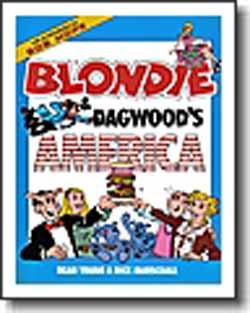
Blondie was for decades the most popular – for which read most commercially successful – newspaper strip in the world. She and her hapless husband Dagwood celebrated 75 years of publication in 2005 and are still going strong today both in print and online. In 1981 this fabulously inclusive and authoritative anniversary compilation was released, and I’m starting early in my campaign to commemorate their 80th – in autumn 2010 – by agitating for its revision and re-release.
The strip was created by Murat Bernard “Chic” Young and handled by King Features Syndicate. It launched on September 8, 1930, the result of a startling game of one-upmanship between Young and King’s general manager Joe Connolly.
A success with the flapper strip Beautiful Bab, Young followed up with the hit Dumb Dora in 1924. He was on a fast track to stardom when the stock market crash wiped out his savings in 1929. Broke and with a new bride, he wanted a new contract for a new feature that he owned and controlled.
Understandably the management had other ideas, but when the artist packed up and took ship for Paris Connelly caved and Blondie was born. She was an instant sensation, spawning 28 movies (1938-1950) starring Penny Singleton and Arthur Lake, who also voiced a radio show (1939-1950) as well as three TV series in 1954, 1958 and 1968-69. The comicbook adventures from Harvey, King and Charlton ran for decades…
In the early days tension was high as the wealthy Dagwood family tried to stop their idiot scion from marrying a low, common blonde, but in 1933, disinherited but happy, they finally wed and the real magic of this everyday family comedy began.
Chic Young drew Blondie until his death in 1973, when his son Dean took over. He has worked with many artists on the strip, including Jim Raymond, Mike Gersher, Stan Drake, Denis Lebrun and most recently, John Marshall. Through it all, Blondie has remained uncannily popular, appearing in more than 2,300 newspapers in 55 countries, translated into 35 languages. Chic Young won the Reuben Award in 1948 for the strip and in 1995 the strip was honoured as one of twenty selected as part of the Comic Strip Classics series of commemorative US Postage Stamps.
This book reprints hundreds of the best strips backed up by wonderfully chatty and informative text-pieces from the junior Young and historian Rick Marschall to provide an enchanting treat for all the family. I don’t know how easy this book is to find and of course other collections are available (most notably 2007’s Blondie: the Complete Family History, published by Thomas Nelson- ISBN-13: 978-1-40160-322-9) but I’ve never found one that featured as broad a spread of strips from this comic landmark’s incredibly long history. Good hunting, and don’t forget to bring a sandwich…
The book was originally published in the US under the title Blondie & Dagwood’s America.
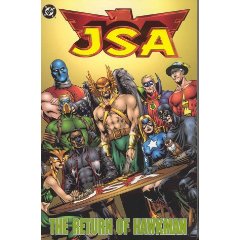
By David S. Goyer, Geoff Johns & various (DC Comics)
ISBN13: 978-1-84023-572-2
This third collection (reprinting issues 16-26 of the monthly comic and portions of JSA Secret Files #1) revived the greatest victim of DC’s perpetual massaging of their in-house continuity – an event considered impossible by many of the company’s top-guns – and accomplished it in a manner that is both impressive and enjoyable.
Hawkman was created by Gardner Fox and Dennis Neville for Flash Comics #1, released in 1940 and one of the most visually arresting characters of the early days of comics. He ran until the end of the Golden Age, led the Justice Society for nearly its entire history and even alternated cover slots with the eponymous Flash.
He vanished with so many others at the beginning of the 1950s, and was revived both as a new concept for the Silver Age, and in his original persona when the JSA met the Justice League of America. Although seemingly incapable of supporting a mass-market book for any sustained period, he is an icon of DC’s line and was savagely retconned many times. In the parlous times of the mid-1990s he seemingly vanished into Limbos both literal and literary.
With a timeline considered “toxic†by the DC powers-that-be he was left to languish until the incredibly audacious scribes Goyer and Johns decided to bring him back and do him right in his true home: the JSA comicbook. And although that’s what this collection reprints, the road took a few twists and turns before it got there…
Kicking off is a five part saga sub-titled ‘Injustice Be Done’ as the Faustian mastermind Johnny Sorrow gathers a team of super-villains and executes a strategic assault on the multi-generational group of heroes. As if it matters those reprobates are Count Vertigo, Killer Wasp, Rival, Blackbriar Thorn, Geomancer, the Icicle, Tigress, the Thinker, Shiv and Black Adam, but the unconfined joy of this fights ‘n’ tights romp is the return of the Spectre to this most influential of teams.
At the climax of the action extravaganza, the Flash is lost in time and the interlude tale ‘Guardian Angels’ details his meeting with the heroes of ancient Egypt – including the flying Warrior Prince Khufu, whose murder led to a cycle of heroic reincarnations that culminated in the birth of Hawkman.
The Big Show then follows with ‘The Return of Hawkman’ a four part spectacle that spans thousands of years and trillions of miles as Hawkgirl and a team of JSA-ers travel to the devastated planet Thanagar to resurrect the Winged Wonder from non-being and destroy a soul-eating demon who has turned the entire planet into a vast charnel house playground.
As well as reconciling the convoluted histories of Hawkman into a viable whole and kicking off a highly entertaining spin-off series this dramatic tale is pure superhero flash and dazzle – the kind of bravura fantasy that no other medium of expression has ever managed to match.
It’s not witty, it’s not significant and it’s not capital A “Art†– but it is spellbinding, breathtaking adventure. What more can a fan-boy want?
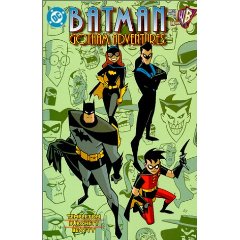
By Ty Templeton, Rick Burchett & John Beatty (DC Comics)
ISBN: 978-1-56389-616-3
The Batman Animated TV series masterminded by Bruce Timm and Paul Dini revolutionised the Dark Knight and led to some of the absolute best comic book adventures in his nigh seventy-year publishing history. The miniseries collected here features the entire Batman Family in adventures set directly following the Batman Adventures: the Lost Years miniseries.
‘With a Price on his Head’ is an unforgettable yarn as a millionaire victim puts an open bounty on the Joker, and Batman’s protective custody plan goes horribly wrong. With the Clown Prince loose in the Batcave and the team hunting down assorted opportunistic super-criminals only Alfred and Batgirl can save the day.
Two-Face commandeers a live game-show in a powerful and stylish tale of parenting entitled ‘Lucky Day’ whilst Batman is saved by his ultimate hero the Grey Ghost in ‘Just Another Day’, a charming shocker featuring the Scarecrow.
Catwoman deals savagely with a millionaire-model who enjoys animal-testing in the hard-hitting ‘Claws’ and the tragic Mister Freeze returns in ‘Polar Opposites’ before the magic concludes with ‘Last Chance’ as Nightwing returns to his circus roots and meets the legendary ghost of Boston Brand – better known to all comic fans as Deadman.
Without ever diluting the power and mood of the character, these tales perfectly honed the grim hero and his team to a wholly accessible and memorable form that the youngest of readers can enjoy, whilst adding shades of exuberance and style that only the very rarest of “real†Batman comics have come near to achieving. This is Bat-Gold and every fan should own it.
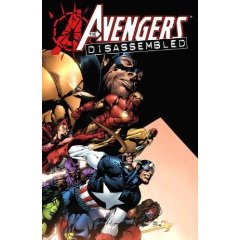
A few years ago the “World’s Mightiest Heroes†were shut down and rebooted in a highly publicised event known as Avengers Disassembled. Of course it was only to replace them with both The New and The Young Avengers. Affiliated comic-books such as the Fantastic Four and Spectacular Spider-Man ran parallel but not necessarily interconnected story-arcs to accompany the Big Show.
Said Big Show consisted of the worst day in the team’s history as a trusted comrade betrayed the World’s Mightiest Superteam resulting in the destruction of everything they held dear and the death of several members, all of which originally appeared in issues #500-503 plus the one-shot Avengers Finale. It is one of the best out and out superhero “Last Battles†ever created, and loses little impact whether this is your five hundredth or first experience with these tragic heroes.
Shocking and beautiful, there is a genuine feeling of an “End of Days†to this epic, and Bendis and the assembled artists David Finch, Danny Miki, Frank D’Armata, Alex Maleev, Steve Epting, Lee Weeks, Brian Reber, Michael Gaydos, Eric Powell, Darick Robertson, Morry Hollowell, Mike Mayhew, Andy Troy, David Mack, Gary Frank. Mike Avon Oeming, Pete Patanzis, Jim Cheung, Mark Morales, Justin Ponsor, Steve McNiven, George Perez, Mike Perkins, Neal Adams and Laura Martin are on top form to deliver a memorable and worthy Armageddon.
I hope I’ve been vague enough to give away nothing whilst making this intriguing. I hope I’ve convinced new readers to try something they might not have. I hope you’re ready for an incredible reading experience.
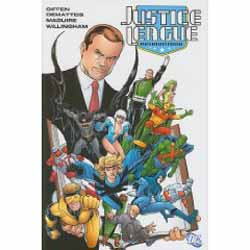
By Kieth Giffen, J.M. DeMatteis, Kevin Maguire, Al Gordon & various (DC Comics)
ISBN13: 978-1-84576-886-7
The revised follow-up volume of the (then) All-New, All-Hilarious Justice League completes the year long story-arc that introduced businessman and 1980’s archetype Max Lord, who reshaped the World’s Greatest Super-team for his own mysterious purposes.
The stories themselves (issues #8-13 of the monthly comicbook and Justice League Annual #1, plus the corresponding issue #13 of Suicide Squad – another great series long overdue for a decent trade paperback series!) are taken from a period when the major comics publishers were first developing the marketing strategies of the “Braided Mega-Crossover Event.â€
This hard-on-the-pockets innovation basically crafts a really big story involving every publication in a company’s output, for a limited time period – so a compilation like this perforce includes adventures that seem confusing because there are “middles†with no beginnings or endings. In this case the problem is deftly solved by inserting (mercifully) brief text pages explaining what’s happened elsewhere. It also doesn’t hurt that being a comedy-adventure, plot isn’t as vital as character and dialogue in this instance.
The merriment begins with ‘A Moving Experience’, where the heroes take possession of their various new UN embassy buildings, a sly and cynical tale of institutionalized ineptitude which is possibly one of the funniest single stories in American comic book history. Most main episodes at the start were followed by a brief back-up vignette drawn by Keith Giffen. ‘Old News’ deals with the closure of previous UN super-hero resource the Dome – which was summarily axed when the League achieved its international charter status.
‘Seeing Red’ is the first of two episodes forming part of the Millennium crossover hinted at above. Broadly, the Guardians of the Universe were attempting to create the next stage of human evolution, and their robotic enemies the Manhunters wanted to stop them. The heroes of Earth were asked to protect the Chosen Ones, but the robots had sleeper agents hidden among the friends and acquaintances of every hero on the planet.
Millennium was DC’s first weekly mini-series, and the monthly schedule of the other titles meant that a huge amount happened in the four weeks between their own tied-in issues: for example…
The Rocket Red attached to the JLI is in fact a Manhunter, who first tries to co-opt then destroy the team with an oil refinery, but by the second part, ‘Soul of the Machine’, the team are jarringly in deep space attacking the Manhunter home planet as part of a Green Lantern strike force. Nevertheless, the story is surprising coherent, and the all-out action is still well-leavened with superbly banter and hilarity.
The back-ups follow the suddenly unemployed Dome hero Jack O’Lantern to the terrorist state Bialya in ‘Brief Encounter’ and show an unfortunate training exercise for Blue Beetle and Mister Miracle in ‘…Back at the Ranch…’
JLI #11 began resolving all the mysteries of the first year by exposing the secret mastermind behind the League’s reformation. With ‘Constructions!’ and ‘Who is Maxwell Lord?’ (in #12) the series came full circle, and the whacky humour proved to have been the veneer over a sharp and subtle conspiracy plot worthy of the classic team. The drama and action kicked into high gear and the characters were seen to have evolved from shallow, if competent buffoons into a tightly knit team of world-beating super-stars – but still pretty darned addicted to buffoonery.
These two full length yarns precluded back-up tales but Giffen illustrated all of #13, wherein the team ran afoul of America’s highly covert Suicide Squad (super-villains blackmailed by the government into becoming a tractable metahuman resource – and without the annoying morality of regular superheroes).
‘Collision Course’ found the US agent Nemesis imprisoned in a Soviet jail with the League forced into the uncomfortable position of having to – at least ostensibly – fight to keep him there. The concluding part ‘Battle Lines’ from Suicide Squad #13 (written by John Ostrander and illustrated by Luke McDonnell and Bob Lewis) is a grim and gritty essay in superpower Realpolitik and a still a powerful experience two decades later.
This volume ends with ‘Germ Warfare’ from the first JLI Annual, drawn by Bill Willingham and inked by Dennis Janke, P. Craig Russell, Bill Wray, R. Campanella, Bruce Patterson and Dick Giordano. It is an uncharacteristically grim horror tale involving inhuman sacrifice and sentient Germ-warfare.
This collection is a breath of fresh air in a time where too many comic-books are filled with over-long, convoluted epics that are strident and oppressively angst-ridden. Here is great art, superb action and the light touch which still mark this series as a lost classic. So read this book and eagerly wait for further compilations to be released.
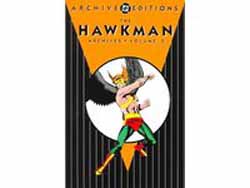
By Gardner Fox & Murphy Anderson (DC Comics)
ISBN: 1-4012-0161-X
When the revived Hawkman series finally made the jump to a full title rather than a try-out or back-up feature the timing couldn’t have been better. Superheroes were rapidly becoming the major draw of the funnybook industry and the new adventures by the incredibly creative Gardner Fox and Murphy Anderson blended history, mystery science fiction and bombastic action with unforgettable impact.
Katar Hol and his wife Shayera were police officers on the planet Thanagar. They originally travelled to Earth from the star system Polaris in pursuit of a spree-thief named Byth who had stolen a drug which gave the user the ability to change into anything. For further information and a real reading treat you should consult the previous volume in this gloriously deluxe hardcover series (ISBN: 1-56389-611-7) or if you’re a fan of black and white artwork, pick up the superbly economical compendium Showcase Presents Hawkman: volume 1 (ISBN13: 978-1-4012-1280-3).
This second volume collects the first eight issues of this classic comic, kicking off with Hawkman #1 (cover-dated April-May 1964).
Two of the most visually arresting characters in comics, the Hawks also had one of the most subtle and sophisticated relationships in the business. Like Sue and Ralph Dibney (Elongated Man and wife) Katar and Shayera were equal partners, (both couples were influenced by the Nick and Nora Charles characters of the Thin Man movies) and the interplay was always rich in humour and warmth.
In ‘Rivalry of the Winged Wonders’, and whilst accommodatingly recapping their origins for newcomers, the couple decided to turn their latest case into a contest. Hawkgirl would use Thanagarian super-science to track and catch a band of thieves whilst Hawkman limited himself to Earth techniques and tools in solving the crime. This charmingly witty yarn was balanced by the action thriller ‘Master of the Sky Weapons’ as Chac, an ancient Mayan warrior, threatened the civilized world with alien super weapons.
‘Secret of the Sizzling Sparklers!’ was an action-packed thriller concerning trans-dimensional invaders, and issue #2 closed with ‘Wings across Time’ a mystery revolving around the discovery of the flying harness of the legendary Icarus. Another brain-teaser opened the third issue. Scientific bandits proved less of a menace than ‘The Fear that Haunted Hawkman’, but common thugs and an extraordinary alien owl resulted in our heroes becoming ‘Birds in a Gilded Cage’.
Issue #4 opened with a tale that would revolutionise DC comics. ‘The Girl who Split in Two!’ introduced Zatanna, daughter of a magician who had fought crime in the 1940s only to “mysteriously disappearâ€.
Zatarra was a magician-hero in the Mandrake mould who’d fought evil in the pages of Action Comics for over a decade beginning with the very first issue. During the Silver Age Gardner Fox had Zatarra’s young and equally gifted daughter, Zatanna, searching for the missing magician by teaming up with a selection of superheroes Fox was currently scripting (if you’re counting, those tales appeared in Hawkman #4, Atom #19, Green Lantern #42, and the Elongated Man back-up strip in Detective Comics #355 as well as a very slick piece of back writing to include the high-profile Caped Crusader via Detective #336 – ‘Batman’s Bewitched Nightmare’. The saga concluded in Justice League of America #51 ‘Z – As in Zatanna – and Zero Hour!’ )
This epic long-running experiment in continuity proved to the creators – and publishers – that there was a dedicated fan-base out there with a voracious appetite for experimentation and relatively deep pockets. Most importantly it finally signalled the end of the period where DC heroes lived and battled in a world of their own. ‘The Machine that Magnetized Men!’ is another fine tale, as the winged Wonders use reason and deduction to defeat thieves who are impossible to touch.
‘Steal, Shadow– Steal!’ in Hawkman #5 was the first full-length thriller in the run, as the ruthless Shadow Thief returned to seek revenge, believing that triggering a new Ice Age to be an acceptable consequence of his schemes. Issue #6 is another long tale, and one that exploited DC’s peculiar obsession with gorillas to create a classic adventure.
‘World Where Evolution Ran Wild!’ drew our heroes to fabled Illoral where a scientist’s explorations had stretched Selection to un-Natural limits. Bold, brash and daft in equal proportions, this is still a fabulous romp and seeing again the cover where Hawkman struggles for his life against a winged gorilla makes the adult me realise those DC chaps might have known what they were doing with all those anthropoid covers!
By issue #7 (April-May 1965) the world was gripped in secret agent fever as the likes of James Bond, the Man from U.N.C.L.E., and a host of others shook and stirred across our TV screens, and even comics were not immune, though spies had been a staple element there for nearly two decades. Before Hawkman joined that crowd however he had to deal with the rather mediocre threat posed by ‘The Amazing Return of the I.Q. Gang!’ They were quickly returned to prison and the Hawks moved on to face the ‘Attack of the Crocodile-Men!’, a high-octane super-science thriller that introduced C.A.W. – the Criminal Alliance of the World!
Another supremely captivating cover adorned #8 – the last in this lovely book – as the Hawks had to defeat an ancient Roman artificial intelligence built by the not-so mythical Vulcan himself in ‘Giant in the Golden Mask!’, and then defeat an alien Harpy who’d been buried for half a million years in ‘Battle of the Bird-Man Bandits’.
Hawkman was one of the most iconic and visually arresting characters of the second superhero boom, not just for the superb art but also because of a brilliant, subtle writer and a supremely talented artist. These tales are comfortably familiar and grippingly timeless, perfect for warming hearts and firing imaginations of kids of all ages. If you love great reads this book and its predecessor deserve space on your bookshelf.