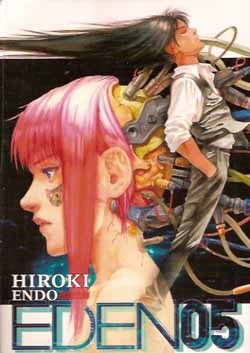
By Hiroki Endo (Titan Books)
ISBN: 978-1-84576-503-3
The world has been devastated by the flesh-calcifying “Closure Virus†and subsequently racked by global civil war as the despotic forces of the Propater secret society attempt to conquer the survivors.
Mysteriously linked to the origins of the virus, young Elijah Ballard is making his way through war-torn South America seeking his lost mother when he is captured by a band of anti-Propater soldiers. Initially they seem more interested in Cherubim, his robot bodyguard, but eventually he begins to bond with the disparate unit of flawed and exotic warriors fighting a war for power on a planet that needs every human left if humanity is to regain its pre-eminence.
Due to cybernetic advancements the very definition of humanity is constantly in question and, as Elijah and the unit move on towards Cuzco City after surviving a particularly vicious assault, the story focus here shifts to the deeply troubled Sophia whose consciousness (can we call it a “soul�) is currently inside an incredible artificial form whilst she seeks a preserved body under strict Propater guard. Is this, at least in part, the reason for much of the bloodiest fighting between the Conqueror-armies and the resistance forces of Nomad?
The brooding character study eventually turns into another of the spectacular battle sequences that this series is justifiably famous for when Elijah and his comrades make a play for the body at a “neutral†Gnosian airport. As the life of perpetual warfare and desperate searching for some greater meaning continues Elijah too is coming to some unpleasant conclusions about “humanity†regarding its nature and worth.
Amid incredible, beautifully realised carnage the book ends on another tragic cliffhanger. If you want to follow this adult (lots of sex and very explicit violence are part and parcel of this series) saga – and you should because it’s a truly brilliant work – you absolutely must start at the beginning.
Unmissable, but impossible to jump into late, this is a tale you must enjoy from the very start. This book is printed in the Japanese right-to-left manner.
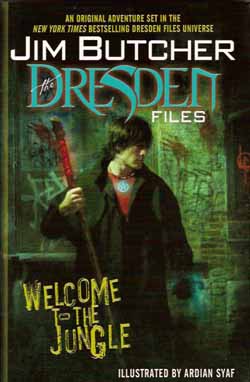
By Jim Butcher & Ardian Syaf (Titan Books/Dabel Brothers Publishing)
ISBN: 978-1-84856-208-0
Jim Butcher is a best-selling novelist and comics fan whose tales of a wizard-for-hire on the mean streets of modern Chicago have won him legions of fans, and even spawned a short-lived but excellent TV series.
In this tale set just before the first novel, Storm Front, Harry Dresden is an “unconventional†Private Eye who occasionally consults for the Chicago Police Department’s Special Investigations Unit, walking a fine line as a specialist fighting supernatural menaces whilst trying to keep all things mystical a secret from the unsuspecting public.
When a Zoo keeper is torn to shreds he uncovers a plot by an ancient horror that will have catastrophic repercussions for frail humanity…
Exceedingly readable, the premise may not be fresh to fantasy fans but the characters and dialogue are top-rate and the art from Ardian Syaf and inkers Nick Nix, Joe Pimentel, David Rivera and Rick Ketcham is understated and highly effective.
This lush hardcover comes with a cover gallery, production sketches plus character studies and profiles. As well as being a great piece of comics storytelling, this book will hopefully entice a few more hold-outs into our magical world of pictures and words. A potential seasonal gift for your favourite comics-resister, perhaps..?
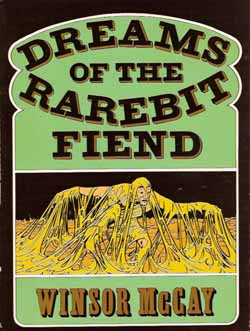
By Winsor McCay (Dover)
ISBN: 0-486-21347-1 ISBN-13: 978-0486213477
Born in Spring Lake, Michigan, on 26th September, 1869 (or perhaps 1871- records differ) Winsor McCay was a brilliant and hugely successful cartoonist and animator who worked on strips and political cartoons from 1903 until his untimely death in 1934. The first of these was Jungle Imps (1903), for The Enquirer, before moving to New York and creating Dull Care, Poor Jake, The Man from Montclair, The Faithful Employee, Mr. Bosh, A Pilgrim’s Progress, Midsummer Daydreams and It’s Nice to be Married for New York Herald publisher James Gordon Bennett between1903 and 1911.
He also originated Little Sammy Sneeze for the Herald in 1904 and Hungry Henrietta in 1905 before abandoning them for two much more important features. On October 15th 1905 the most important children’s strip in the world, Little Nemo in Slumberland, debuted in the Sunday Herald, but even before that McCay had created a version for adults entitled Dreams of the Rarebit Fiend for The Evening Telegram. The editor, wishing to distance the feature from other strips, asked McCay to use a pen-name, and he complied, signing the strips “Silasâ€, reputedly after a local garbage cart driver.
Where Nemo was a beautifully clean and surreal fantasy of childish imagination, Fiend was aimed at grown-ups and displayed a creepy, subdued tension that resonated with the fears and worries of its audience. Black, cruel and often outright sick humour pervades the series. Even the root cause of the otherworldly nightmares was salutary. Each self-contained episode, every disturbing sequence of unsettling or terrifying, incredibly realistic images was the result of overindulgence; usually in late night toasted cheese treats!
Every anxiety from surreal terror to social embarrassment became grist for the fantasist’s mill and the startling perspectives, bizarre transformations and uncanny scenes – always immaculately rendered – made Fiend a hugely successful and well regarded strip in its day.
In 1906 the American film pioneer Edwin S. Porter created a landmark seven minute live action special-effects movie entitled The Dream of a Rarebit Fiend and the Edison company created a cylinder recording with the same name the following year – played by the Edison Military Band. McCay himself produced four animated films in 1916-17: Dream of a Rarebit Fiend, Dreams of the Rarebit Fiend: The Pet, Dreams of the Rarebit Fiend: The Flying House and Dreams of the Rarebit Fiend: Bug Vaudeville.
This book is an almost exact reproduction of Rarebit Fiend, a collection of the first year’s strips originally released by the Frederick A. Stokes Company in 1905. The very last strip has been excluded from this edition however, due to its content being potentially offensive and at odds with modern views on race and ethnicity.
Although working more than a century ago Winsor McCay still affects every aspect of graphic narrative produced ever since. If you can’t afford Ulrich Merkl’s superb complete edition, reprinting everything from 1905-1914, this lovely package – still readily available from internet retailers – is a superb introduction to the darker side of an absolute master of our Art-form.
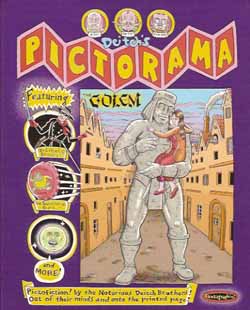
By the Deitch Brothers (Fantagraphics)
ISBN: 978-1-56097952-4
There must be something to this DNA stuff. Gene Deitch is an Oscar winning animator and cartoonist, his first son Kim has been at the forefront of comics’ avant-garde since the days of the Counter Culture and “underground commix†scene whilst his other two, Simon and Seth Kallen, have both made their mark in the popular creative arts.
In this bold new venture the Deitch boys have created a graphic narrative oddity that is both compelling and captivating. Combining heavily illustrated prose, comics, calligraphy, pictorial lettering, cartooning and plain old strips, the five tales blend into a tribute to the versatility of illustrated storytelling in all its variations.
Beginning with a captivating paean to bottle caps and the collecting bug entitled ‘the Sunshine Girl’, followed by an intriguing prose-ish fantasy, ‘The Golem’, the full range of tale-telling is explored. This leads into the disturbing ‘Unlikely Hours’, and a whimsical shaggy dog story ‘Children of Aruf’.
Wisely leaving the very best ’til last, the Pictofictorial fun concludes with the superbly engaging and informative ‘The Cop on the Beat, the Man in the Moon and Me’; an especial treat for anybody interested in the history of comics and music.
Once again I’ve been as vague as I can be, because this is a book that rejoices in storytelling, and half the art and all the joy comes from reading it for yourself, so if you’re an older reader you should do just that.
Edited by Vincenzo Mollica & Antonio Vianovi (Glamour International Productions)
No ISBN
Born on Christmas Eve 1946, Italian electrician Vittorio Giardino changed careers at age 30. Working for many European comics magazines initially, his first collection, Pax Romana, was released in 1978. He has worked slowly but consistently on characters like detective Sam Pezzo, saucy Winsor McKay homage Little Ego, the cold-war drama Jonas Fink and diffident super-spy Max Fridman as well as general fiction tales, producing over 35 albums to date.
In 1986 the Italian outfit which produced the stylish Popular Arts magazine Glamour Illustrated released a number of fabulous art-books collecting the works of some of the biggest names in European narrative storytelling, which had limited distribution in Britain thanks to the specialist importer Titan Distributors, and this is probably the very best of them.
This glorious 200 page tome (48 of them a full-colour high-gloss insert) simultaneously translated into French and English, displays the incredible ability and versatility of an incomparable creator, with excepts from printed works, extensive sketch and working drawing sections a full publication record to date, notes and an appreciation by Gianni Brunoro.
As you would expect there is a large amount of beautifully drawn flesh on display, as well as some of the most clean and sublime narrative art produced in the last half century. Extended excerpted sequences from Sam Pezzo, Little Ego, and Max Fridman show Giardino’s unique ability to inform and suggest with nuanced expression and gesture, and his scrupulous devotion to research and historical accuracy whilst his straight cartooning reveals a sly, dry sense of humour.
This is beautiful book desperately in need of updating and re-release, and Giardino is a world class storyteller that English speakers have too long been deprived of…
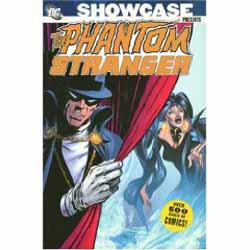
The Phantom Stranger was one of the first transitional heroes of the Golden Age of comics, created at the very end of the superhero boom as readers moved from costumed crimefighters to other genres such as mystery, crime, war and western tales. A trench-coated, mysterious know-it-all, with hat pulled down low, he would appear, debunk a legend or foil a supernatural-seeming plot, and then vanish again.
He was coolly ambiguous, never revealing whether he was man, mystic or personally paranormal. Probably created by John Broome and Carmine Infantino, who produced the first story in Phantom Stranger #1 (August-September 1952) and most of the others, the six-issue run also boasted contributions from Jack Miller, Manny Stallman and John Giunta. The last issue was cover-dated June-July, 1953, after which the character vanished.
Flash-forward to the end of 1968. The second superhero boom is rapidly becoming a bust and traditional costumed heroes are dropping like flies. Suspense and mystery titles are the Coming Thing and somebody has the bright idea of reviving the Phantom Stranger. He is the last hero revival of DC’s Silver Age and the last to graduate to his own title during the star-studded initial run of Showcase, appearing in #80 (January-February 1969) and debuting in his own comic three months later. This time he found an appreciative audience, running for 41 issues over seven years.
Rather than completely renovate the character, or simply run complete reprints as DC had when trying to revive espionage ace King Faraday (Showcase #50-51), Editor Joe Orlando had writer Mike Friedrich and artist Jerry Grandenetti create a contemporary framing sequence of missing children for the 1950s tale ‘the Three Signs of Evil’, and in a masterstroke of print economy, introduced (or rather reintroduced) another lost 1950s mystery hero to fill out the comic, and provide a thoroughly modern counterpoint.
Despite this somewhat choppy beginning, the tryout was a relative success and (Follow Me… For I Am…) The Phantom Stranger launched with a May-June cover-date. In another framing sequence by Friedrich and Bill Draut, a tale of impossible escape from certain death is revealed in ‘When Ghosts Walk!’, a Fifties thriller from John Broome, Carmine Infantino and Sy Barry, followed by an all new mystery ‘Defeat the Dragon Curse… or Die!’ Firmly establishing that the supernatural is real, Friedrich and Draut pit the Stranger and Dr. 13 against each other as well as an ancient Chinese curse.
‘The Man Who Died Three Times’ in the second issue is a mystery with a deadly yet mundane origin, but the incorporated reprint Stranger tale ‘the House of Strange Secrets’ (Broome, Infantino and Barry) and Dr. 13’s ‘the Girl Who Lived 5,000 Years’ (France both provide the uneasy chills that Friedrich and Draut’s by-the-numbers tale do not.
Issue #3 once again used frightened kids as a vehicle for Friedrich and Draut to encapsulate vintage thrillers in a tale with a sinister carnival component. The Stranger relived ‘How do you Know My Name?’ by Broome and Frank Giacoia whilst Dr. 13 proved once more that there were ‘No Such Thing as Ghosts!’ (by Herron and Starr).
With such a formularized start it’s a miracle the series reached the landmark issue #4 where Robert Kanigher and Neal Adams (who had been responsible for the lion’s share of eerie, captivating covers thus far) produced a much more proactive hero in the mystery triptych ‘There is Laughter in Hell This Day!’, ‘There is Laughter in Hell Tonight!’ and ‘Even the Walls are Weeping!’
Stalwart Bill Draut provided inks for this classy classic in which Terry Thirteen became a far more militant – and consequently, frustrated – debunker of the Stranger’s “hocus-pocus†when Tala, the demonic Queen of Evil and Mistress of Darkness escapes her ancient tomb to bedevil the modern world with only the Phantom Stranger and an eclectic gang of runaway teens to oppose her.
This new combative format and repositioning of the book was presumably for the benefit of older kids. The protagonist teens were a strange composite of counter-culture stereotypes named Spartacus (Black kid), Attila (greasy biker), Wild Rose (blonde flower child) and Mister Square (conformist drop-out) who feel a little forced now but were the saving of the book, as was dropping of 17 year old reprints. From now on the stranger would really battle the Dark Powers and Dr. 13 would assume the metaphorical role of a blustering, officious parent who had no idea what was really going on. An added bonus in this cracking issue was a nifty three page horror vignette from Kanigher and the wonderful Murphy Anderson entitled ‘Out of This World’.
Anderson returned to ink the unique Mike Sekowsky in Phantom Stranger # 5, a full-length ghostly thriller featuring more of Tala’s handiwork in ‘the Devil’s Playground!’, topped off with another horror short by Kanigher, credited to Sekowsky here but actually a fine example of Curt Swan’s subtle mastery, especially as it’s inked by Anderson.
Sekowsky wrote and illustrated the next issue, with inks from Vince Colletta. ‘No. 13 Thirteenth Street’ is a Haunted House tale with those meddling kids and Dr. 13 getting underfoot in a delightfully light and whimsical diversion before Kanigher and Tala return in #7’s dark saga ‘The Curse!’ wherein both the Stranger and Terry Thirteen are right and the solution to madness and sudden deaths is both fraud and the supernatural!
This issue is particularly important in that it features the debut of up-and-coming Jim Aparo as illustrator. Over the next few years his art on this feature would be some of the very best in the entire industry.
Issue #8 featured an early arctic eco-thriller with supernatural overtones as Denny O’Neil described the tragic ‘Journey to the Tomb of the Ice Giants!’ whilst Dr. 13 got his own feature and dealt with ‘the Adventure of the Brittle Blossom!’ Mike Sekowsky scripted #9’s ‘Obeah Man!’ a tense shocker of emerging nations and ancient magic which showed Aparo’s superb versatility with locales.
Young Gerry Conway wrote ‘Death… Call Not my Name!’ for #10 which introduced another stylish returning villain in the immortal alchemist Tannarak, and found room for a quickie as the Stranger proved to be no match for ‘Charlie’s Crocodile.’Phantom Stranger #11 (Conway and Aparo) introduced a colossal new threat as evil-doers everywhere began to vanish in ‘Walk Not in the Desert Sun…’ whilst Kanigher returned with a classy haunted love-story in ‘Marry Me… Marry Death!’ in #12 which also featured another debunking solo outing for the Ghost Breaker in Jack Oleck and Tony De Zuniga’s ‘A Time to Die’.
Science met supernature in issue #13 when death stalked a research community in ‘Child of Death’ and Dr. 13 survived an encounter with ‘the Devil’s Timepiece’, both scripts from Kanigher and art supplied by Aparo and De Zuniga respectively.
Len Wein wrote possibly the spookiest adventure to feature the Phantom Stranger in #14’s ‘The Man with No Heart!’, a story which resolved forever the debate about the dark hero’s humanity and also introduced another long-term adversary for our delectation. The Ghost Breaker had his own brush with super-science – but definitely not the supernatural, no sir! – in Wein and De Zuniga’s ‘The Spectre of the Stalking Swamp!’ a tale that actually pushed the Stranger off his own front cover!
Issue #15 returned him to the Dark Continent as a robotics engineer is caught up in revolution in Wein and Aparo’s ‘the Iron Messiah’ whilst Kanigher and De Zuniga send Dr. 13 up against ‘Satan’s Sextet’. On a roll now the Phantom Stranger creative team surpassed themselves with each successive issue, beginning with an ancient horror captured as an ‘Image in Wax’, nicely balanced by a sneaky murder mystery ‘And the Corpse cried “Murder!‒ (Wein and De Zuniga).
‘Like a Ghost from the Ashes’ introduced a nominal love-interest in blind psychic Cassandra Craft as well as returning an old foe with new masters in a the first chapter of an extended saga – so extended it pushed the Ghost Breaker out of #17 altogether. He returned in the back of the next issue in Steve Skeates and De Zuniga’s tense phantom menace ‘Stopover!’, and the artist drew double duty by illustrating the lead strip ‘Home is the Sailor’ a gothic romance with a sharp twist in the tail.
Old enemies resurfaced in ‘Return to the Tomb of the Ice Giants!’ as did artist Jim Aparo, whilst Skeates and De Zuniga’s ‘the Voice of Vengeance’ proved to be another stylish murder mystery in spook’s clothing. ‘A Child Shall Lead Them’ was written by Bob Kanigher, who easily adapted to the new style and produced a tense, powerful chase thriller as all and sundry search for the newest incarnation of a High Lama murdered by magic. Two short suspense tales top off the issue, both illustrated by the veteran Jack Sparling, ‘the Power’ scripted by Mark Hanerfield, and John Albano’s ‘A Far Away Place’.
Phantom Stranger #21 finishes off this superb collection of menace and magic with Wein and Aparo’s ‘the Resurrection of Johnny Glory’ wherein a reanimated assassin finds a good reason to stay dead whilst Dr. 13 debunks one final myth in ‘Woman of Stone’, prompting the question “why don’t killers use guns anymore?â€
The DC Showcase compendiums are a brilliant way to access superb quality comics fare, and these black and white telephone books of wonderment offer tremendous value for money. If you’re looking for esoteric thrills and chills this first Phantom Stranger volume has it all. If you’re not a fan yet give it a chance… you will be.
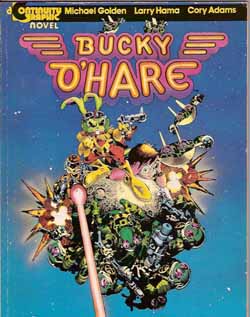
By Larry Hama, Michael Golden & Cory Adams (Continuity Publishing)
No ISBN: ASIN: B000E4SUCM
In the darkest depths of another kind of cosmos justice is upheld and right enforced by agents of S.P.A.C.E (Sentient Protoplasm Against Colonial Encroachment): the police arm of the United Animal Federation. The mammals of this Aniverse are at war with the amphibians of the Toad Empire, and their evil overlord the computer tyrant Komplex.
When a running battle forces the S.P.A.C.E Frigate Righteous Indignation to crack the walls of the continuum, captain Bucky O’Hare, Jenny the Cat, android Blinky, and Deadeye the four-armed duck end up in little Willie DuWitt’s closet in San Francisco. The ingenious Grade Schooler helps out the refugees from beyond, but is subsequently trapped in the Aniverse, becoming a crew member until they can find another portal to his home.
But meanwhile Willie’s got front row seats for the greatest adventure in two universes!
This fabulously cool and charming light-adventure began as serial segments in Neal Adam’s Continuity Comics anthology Echoes of Futurepast, before being collected into a great all-ages album, and for a brief moment was the toast of kids entertainment, spawning an animated TV series (1991-1992), computer games and action figures and toys, and a British company (DC Thomson if I remember aright) picked up the UK rights, publishing a dozen or so all-new adventures after reprinting the Larry Hama/Michael Golden mini masterpiece.
In 2007, Vanguard reprinted the original graphic novel and a couple of the UK issues in a manga format, black-and-white book collection, called ‘Bucky O’Hare and the Toad Menace’ (ISBN-13: 978-1-88759-196-6) but as both the hardcover and paperback originals from 1986 are still readily available and sparkle with Cory Adams’ vibrant, contagious colours, I’d advise you hunt either of those down as Golden’s incredible artwork is a tad to busy at the reduced size.
Hama reputedly wrote a second complete Bucky O’Hare tale which has never been published, so if I can do my bit to create an atmosphere where he can, maybe I can win a MMM (Muddled Mammal Medal) for services to Great Fun…
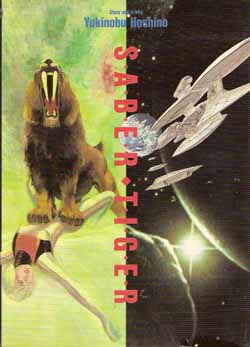
By Yukinobu Hoshino, translated by Fred Burke & Matt Thorn (Viz Spectrum Editions) ISBN: 0-929279-62-X ISBN-13: 978-0-929279-62-6
Yukinobu Hoshino is probably the most respected “hard science†science fiction manga creator in Japan with the phenomenal 2001 Nights saga of exploration and survival as his best known and regarded work, although ‘Steel Queen’ and the Tezuka award-winning ‘Morning Faraway’ are also seminal classics.
After finishing the reincarnation thriller ‘The Legends of a Witch’ in 1980 he began working on the shared theme short stories that became Saber Tiger.
The two stories presented in this book explore his signature fascination with expansion and colonisation, and are underpinned with dour philosophical musings about Man’s place in the universe. In the title story time-travellers from 2479 arrive in the midst of the Ice Age with the sole intention of protecting their distant ancestors from extinction, but the Sabre Tooth Tiger, undisputed master of the frozen wastes has his own ideas…
This bleak, savage examination of evolutionary principles is drawn with captivating skill and guile, as is the second tale ‘the Planet of the Unicorn’ wherein a human colony vessel lands on a perfect world but soon finds that their inexplicable unease was fully justified as both animals and humans suffer behavioural problems and even radical mutations…
Chilling, moving and eerily pensive in the manner of British SF authors J G Ballard, John Lymington or Christopher Priest this is a superb evocation of the dark, cerebral side of science fiction rendered real by the efficient, effective art of a master art technician. Why this isn’t still in print I shall never know, but I have my suspicions…
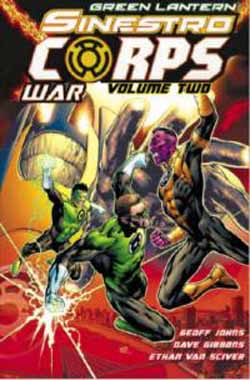
By Geoff Johns & various (DC Comics)
ISBN13: ISBN13: 978-1-4012-1800-3
The universe-shaking battle between absolute security and total terror crashes to a stupendous climax with Earth as the prize and final battleground. The renegade Green Lantern Sinestro has declared war on the entire cosmos and his legions of eager brutalists are carving a bloody swathe through civilised worlds and peacekeepers alike aided by his evil lieutenants Superman-Prime, the Manhunters, Mongul, Cyborg Superman and the Anti-Monitor, and especially the very embodiment of fear: Parallax.
Reduced to a desperate last stand the Green Lanterns unite with the heroes of Earth to snatch a victory of sorts from the jaws of defeat in a action-packed, visually mind-blowing blockbuster which is only the portent of greater dramas to come…
This concluding volume collects Green Lantern #24-25 and Green Lantern Corps #16-19 written by Geoff Johns, Dave Gibbons and Peter J. Tomasi, illustrated by Ethan Van Sciver, Ivan Reis, Patrick Gleason, Jamal Igle, Jerry Ordway, Angel Unzueta, Oclair Albert, Pascal Alixe, Dustin Nguyen, Vincente Cifuentes, Rodney Ramos, Rob Hunter, Marlo Alquiza, Rod Reis, Prentis Rollins, Julio Ferreira, Derek Fridolfs, Dan Davis Rebecca Buchman. Tom Nguyen, Drew Geraci, with colour from Moose Bauman, David Curiel, JD Smith and Guy Major.
Also included is an extensive commentary section, stuffed with production art. A pictorial feast, this book is best read in close conjunction with volume 1 (ISBN13: 978-1-4012-1650-4) and the ancillary Green Lantern: Tales of the Sinestro Corps (ISBN13: 978-1-4012-1801-0).
Flash Greatest StoriesBy various (DC Comics)
ISBN: 978-1-4012-1372-5
The Greatest Stories series of collections has thrown up some unexpected treats in its selection of material, so kudos to all the researchers and editors involved. This volume presents some genuinely intriguing choices featuring three of the characters DC has featured as “the Fastest Man Aliveâ€.
From the Golden Age come two classics of Jay Garrick – a scientist exposed to “hard water fumes†which gave him his super-speed and endurance. Both written by Robert Kanigher, the first, ‘Stone Age Menace’ (Flash Comics #86, 1947) is illustrated by Lee Elias and Joe Kubert and has the irresistible enticements of gangsters and dinosaurs, whilst the much reprinted ‘The Rival Flash’ was the last published tale of the first speedster with the bonus of recapping his origins whilst tackling a villain with all his powers. The art was by Carmine Infantino and Frank Giacoia – who would both work wonders with the Silver Age revival – and originally appeared in Flash Comics #104, 1940.
For nearly a decade, licensed properties, Westerns, War, Mystery and other genre fare dominated the newsstands and despite the odd sally, costumed heroes barely held their own until Julius Schwartz ushered in a new age of brightly clad mystery-men by reviving the Flash in 1956.
For the great majority of fans (aging baby-boomers that they are) police scientist Barry Allen will always be the “real†Scarlet Speedster, struck by lightning, bathed in chemicals – if you couldn’t find an atomic blast to survive, that kind of freak accident was the only way to start a career. From his spectacular run comes the absolute landmark which marked the beginning of a way of life for do many addicted kids.
‘Flash of Two Worlds’ by Gardner Fox, Carmine Infantino and Joe Giella (Flash #123, 1961) revived the Golden Age Flash, and by implication, the whole 1940s DC pantheon, by introducing the concept of parallel worlds and multiple Earths which became the bedrock of the entire continuity, and which the company still mines to such great effect. What’s seldom mentioned is that this initial meeting between the two Flashes is a great super-villain romp featuring a perfect pitched battle against three truly eerie foes: The Fiddler, the Thinker and the Shade.
Villain team-ups were increasingly a major part of the comics experience. Stacking the odds always increased the tension for the thrill-hungry reader and ‘The Gauntlet of Super-Villains!’ by John Broome, Infantino and Giella (Flash #155, 1965) which pits the Vizier of Velocity (don’t you just love those cool alliterative appellatives?) against Mirror Master, Captains Boomerang and Cold, Heatwave, Pied Piper and the Top is one of the best ever, stuffed with action, whimsy and sly wit, and with a hidden mystery foe to crank up the element of danger even more.
Every married man already knows the answer* but for us kids reading this the first time around that question was real stumper.
When Carmine Infantino left the strip most fans were convinced the Flash was ruined. Replacement art team Ross Andru and Mike Esposito were highly controversial and suffered most unfairly in unjust comparisons – and I count myself among their biggest detractors at the time – but in the intervening years I’ve leaned to appreciate the superb quality of their work.
Their tenure is represented here by ‘The Flash – Fact of Fiction?’ from Flash #179 (1968). Written by newcomer Cary Bates and Gardner Fox it took the multiple Earths concept to its logical conclusion by trapping the Monarch of Motion in “our†Reality, where the Flash was just a comic-book character!
Bates eventually became the regular writer of the series and in 1978, when the industry was at its lowest commercial point, wrote the longest single adventure in the Flash’s history. Desperately trying new formats the company launched DC Special Series, a extra-long format for non-standard material. Issue #11 was a 63 page Flash Spectacular which featured Jay Garrick and fellow 1940s speedster Johnny Quick, Barry Allen and the sidekick speedster Kid Flash in a Sci Fi extravaganza ‘Beyond the Super-Speed Barrier!’
Barry Allen died during the Crisis on Infinite Earths (ISBN13: 978-1-5638-9750-4) – whatever that means in comics – and his nephew Wally West graduated from sidekick to the third Sultan of Speed. From Flash volume 2, #91(1994) comes ‘Out of Time’ to close the book. Writer Mark Waid and the much-missed Mike Wieringo (inked here by Jose Marzan Jr.) utterly revitalised the character in the 1990s and this snappy, stylish tale of impossible circumstances clearly shows why and how.
Not quite an icon like Superman, Batman or Wonder Woman, the Flash is nevertheless the quintessential superhero and the reason we’re all doing this today. This book is a great example of why and readily accessible to nostalgists and neophytes alike. Whatever your age there’s something great here for you to enjoy and treasure.
*In case you’re not married, or not a man, the answer is: Fake your own death and move to Bolivia. And if you find a woman there, always tell her everything before she asks or finds out.